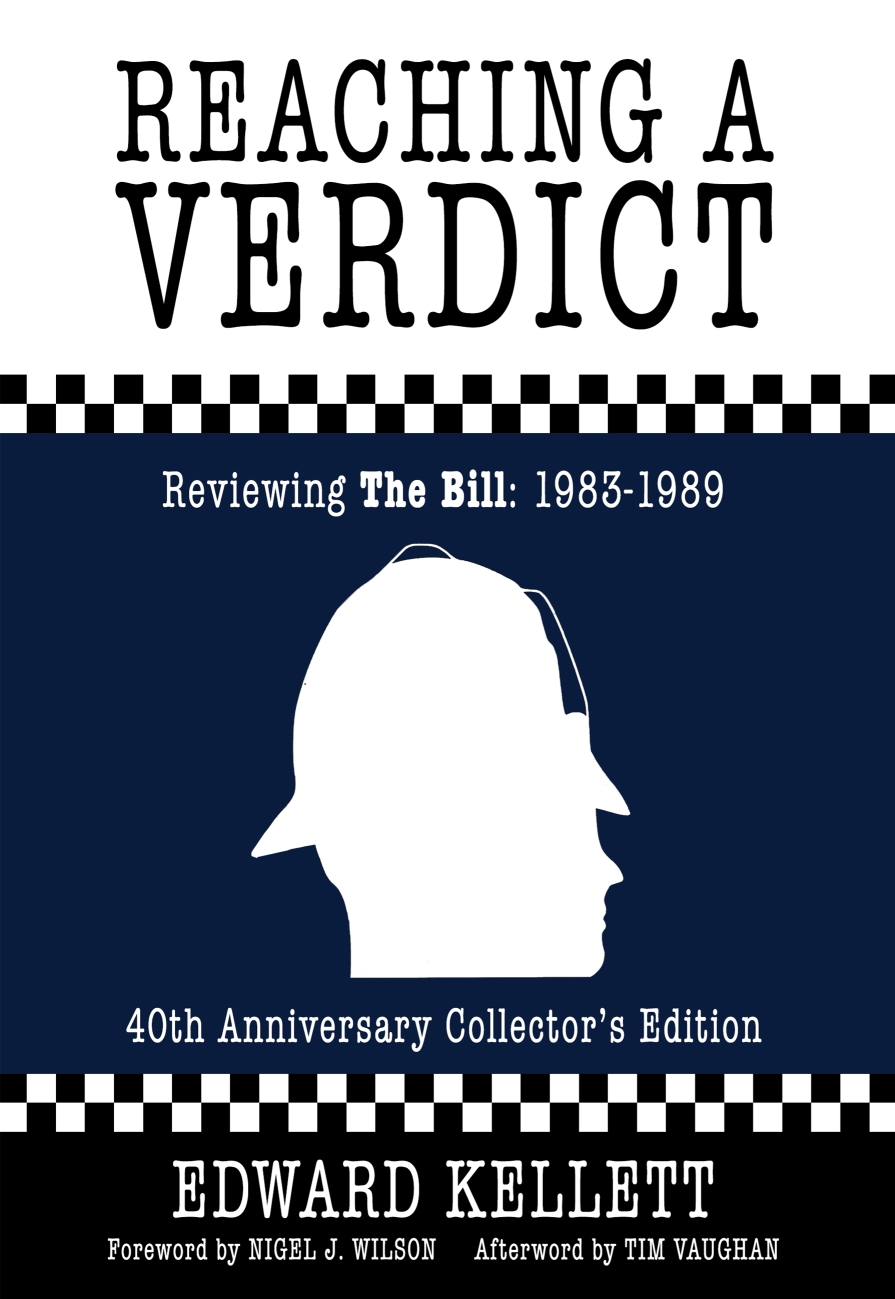
Reaching a Verdict: Reviewing The Bill 1983 – 1989 takes an in-depth look at the first five series of the UK’s longest-running police series. Based on material originally written for The Billaton, Edward Kellett’s book offers a deep dive into the series’ early years and is an excellent companion for anyone attempting a rewatch.
It’s easy to assume that The Bill arrived fully formed in its first series, but instead Kellett is able to show how the series took some time to develop (characters like Jim Carver slowly shedding their naïve persona, for example). John Salthouse’s towering turn as DI Galloway is also acknowledged. During S1 he was a dominant figure and although he’d become more of an ensemble player during series two and three, his departure prior to the series’ half-hour reboot did leave a big hole to fill (luckily, a more than adequate replacement was found …)
I appreciated the way that Edward Kellett was keen to stress how The Bill didn’t develop in isolation. Sometimes, certain programmes can be lauded as mould-breakers, with no acknowledgment given that they were actually building on what had gone before them. So I enjoyed Kellett’s nod to Strangers – a now almost forgotten series.
The ‘missing link’ with the police series of the past is Strangers, a Granada TV show that bridged the five-year gap separating The Sweeney and The Bill – missing in the sense that it can only be tracked down on DVD, not doing the late afternoon rounds on ITV4 as a washed out, zoomed in, cut down travesty like other crime dramas of the period.
With a large, constantly changing cast of regular actors, not to mention an influx of new writers as the series moved to a twice weekly year round production cycle, there’s an awful lot that needs to be noted and analysed. But all the key contributors are given their moment. For example, here’s a thumbnail sketch of Ted Roach –
On paper Roach is the one figure most easily recognisable from TV copperdom, straight out of the Sweeney mould: the roguish, hard-drinking ladies’ man who sails close to the wind but gets results. Ted finds it hard living up to that last caveat, and thus what could have been an imitation Jack Regan is in fact a more substantial one. He is an odd, shambolic presence, imbued with that other great quality Scannell brought to the role, besides his charisma: unpredictability.
Another part of the book that struck a chord with me was the appreciation of Peter J. Hammond’s scripts. Hammond (best known for Sapphire & Steel) is a unique writer whose distinctive voice almost always comes through, no matter what series (The Bill, Z Cars, Angels, etc) he’s working on at the time. His Bill offerings noted here are classic Hammond efforts – at times unsettling and oblique narratives that linger in the memory.
Reaching a Verdict kicks off with a short chapter about the Storyboard pilot – Woodentop – with the remainder of its 250 or so pages divided into five more chapters (covering series one to three of the 50 minute show as well as the 25 minute episodes broadcast during 1988 and 1989).
Having previous enjoyed the two oral production histories of this era of The Bill by Oliver Crocker (see here and here) it’s very pleasing to now have such a comprehensive analysis of the programme as well. It’s certainly made me keen to dig out my DVDs and revisit the show – and I can’t think of any higher recommendation of the book than that.
Reaching a Verdict will be published on the 16th of August 2023. Pre-orders can be made now at Devonfire Books.
 Archive Television Musings
Oliver Crocker has done some amazing ground work and research about the The Bill since he began his podcasts in 2017. I did read his first book covering series 1-3, but it was more a collection of memoirs from the cast & crew rather than a fluid companion about the early years of the programme.
The Bill seems to have developed a popular fan base in recent times and despite its sad decline and inevitable ending in 2010 it was a remarkable series that brings back some fond memories for me as a child on those Tuesday & Thursday nights back in the late 80s and early 90s.
I will be checking out this further book title in due course just to find out that little bit more about the golden days of Sun Hill.
LikeLike