I Claudius – Reign of Terror (1st November 1976)

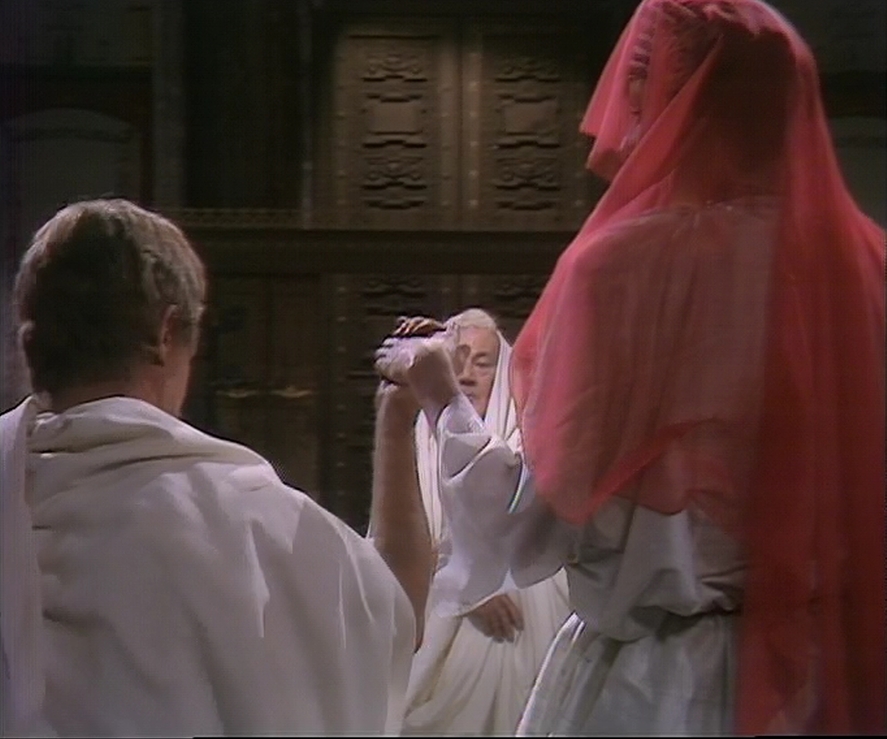
The aged Claudius opens the episode by informing us that following Tiberius’ retirement to Capri, the Empire was effectively now run by Sejanus – who, unfettered by any restraints, instigated a brutal reign of terror. Of course, by the end of the episode we’ve witnessed another reign of terror and in this one Sejanus turned out to be a victim …

As in previous episodes, Tiberius remains an isolated figure with Sejanus solely responsible for deciding who will be lucky enough to be granted an Imperial audience. On the one hand this suits Tiberius very well – he remarks this makes Sejanus the visible figure who attracts the ire of the public (with Tiberius remaining unaffected in the shadows). But there has to be another part of him that realises by abdicating so much power, he’s now little more than an impotent puppet.

Ironically, it’s his hated adversary Agrippina who articulates this very point. Even when she’s brought to him in chains, she manages to exude an aura of lofty disdain. Their final meeting is no more agreeable than any of the others – an apoplectic Tiberius whips her before she’s banished to the same island where her mother (Julia) lived out the remainder of her life.

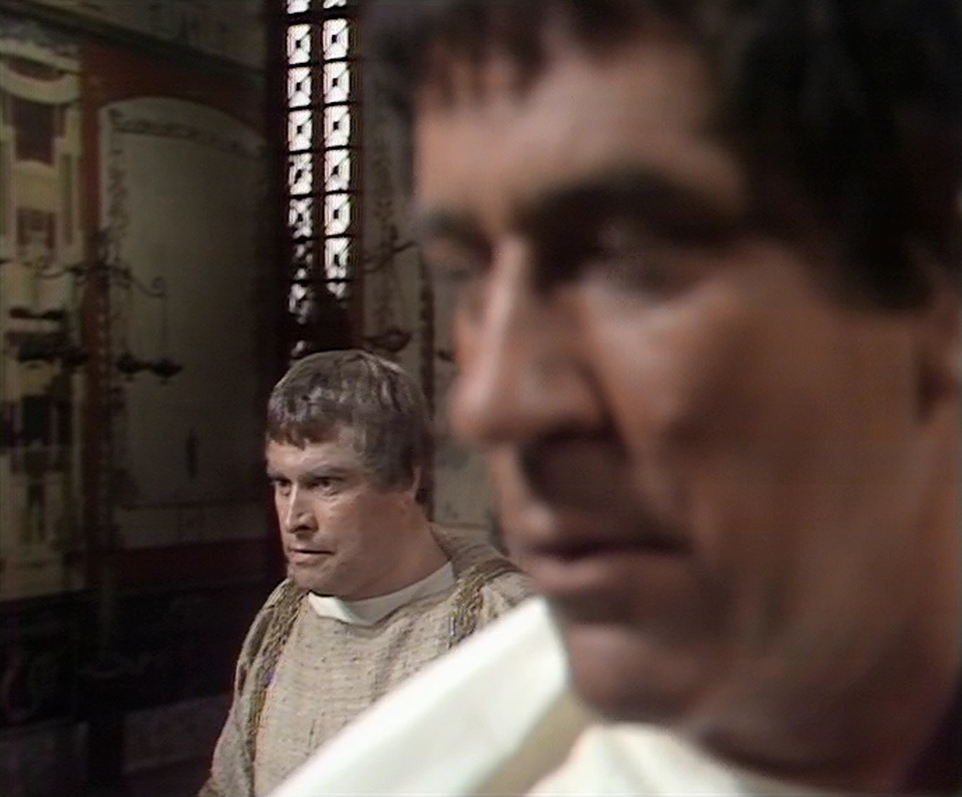
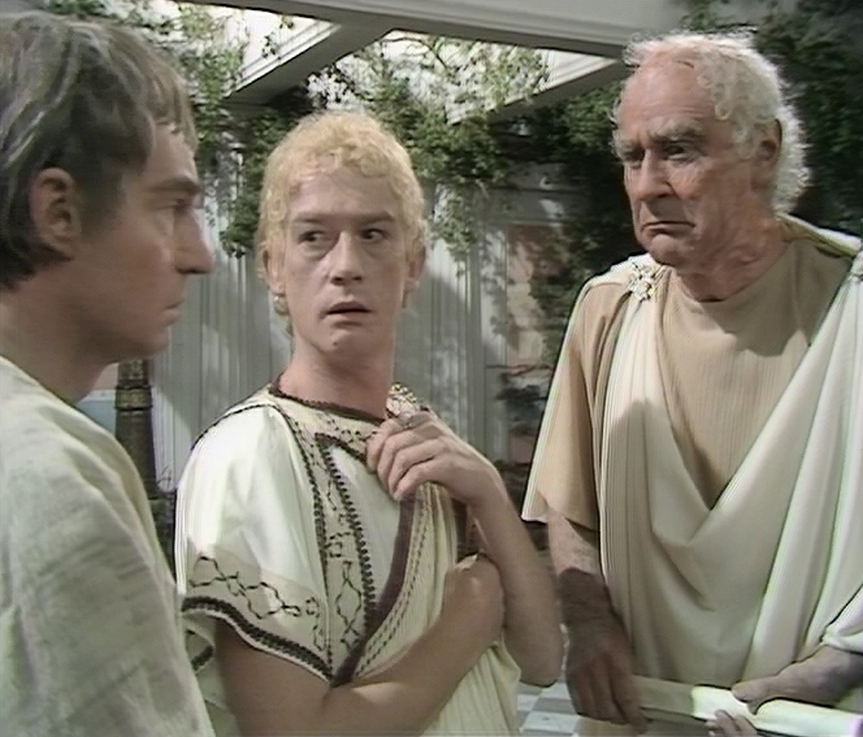
Although he’s not given a great deal of screentime today, every single moment that John Hurt appears is a joy. Caligula’s first scene with Claudius is an instructive one – at this point Caligula may be hedonistic and totally self-obsessed, but he’s not mad (that would come later). He expresses polite disinterest in the fate of his brothers (Drusus and Nero) to Claudius’ disgust – but it’s fair to say that he’s only doing what Claudius has done all his life (keeping his head down, when all about are losing theirs).

Even better than this scene is Hurt’s deadpanning later in the episode, as Claudius brings Tiberius evidence that Sejanus and Livilia planned to murder him. Caligula’s reaction (“I always knew that woman was no good … people really are despicable”) is ordinary enough, but it’s the playful relish of his delivery that entertains so much.

It’s a rare comic highlight (as is Claudius’ irritation that his publisher has illustrated his history of Carthage with endless paintings of elephants!) in the darkest of all the I Claudius episodes.

Livila is desperate to marry Sejanus. He’s keen to do this, but is also agreeable when Tiberius suggests he marries Livila’s teenage daughter Helen (Karen Foley) instead. You can probably guess how Livila reacts to that (just wind Patricia Quinn up and let her go for several minutes).

The corruption of Sejanus’ Rome is represented by the way one man dies – Gallus (Charles Kay). Gallus has three scenes – in the first he makes a principled stand in the Senate (earning Sejanus’ enmity) and in the second he shares a walk back to the Senate with Claudius (the pair have an amiable chat about history – his association with Claudius marking him out as a good guy).

His arrest and brutal torture demonstrates how Sejanus’ reign of terror operates – any opponent can be removed at any time and evidence simply isn’t required. There are so many fine cameo performances across the entire serial – Kay’s is just one among many. “I’ve watched your career with fascination, Sejanus. It’s been a revelation to me. I never fully realized before how a small mind, allied to unlimited ambition, and without scruple can destroy a country full of clever men”.

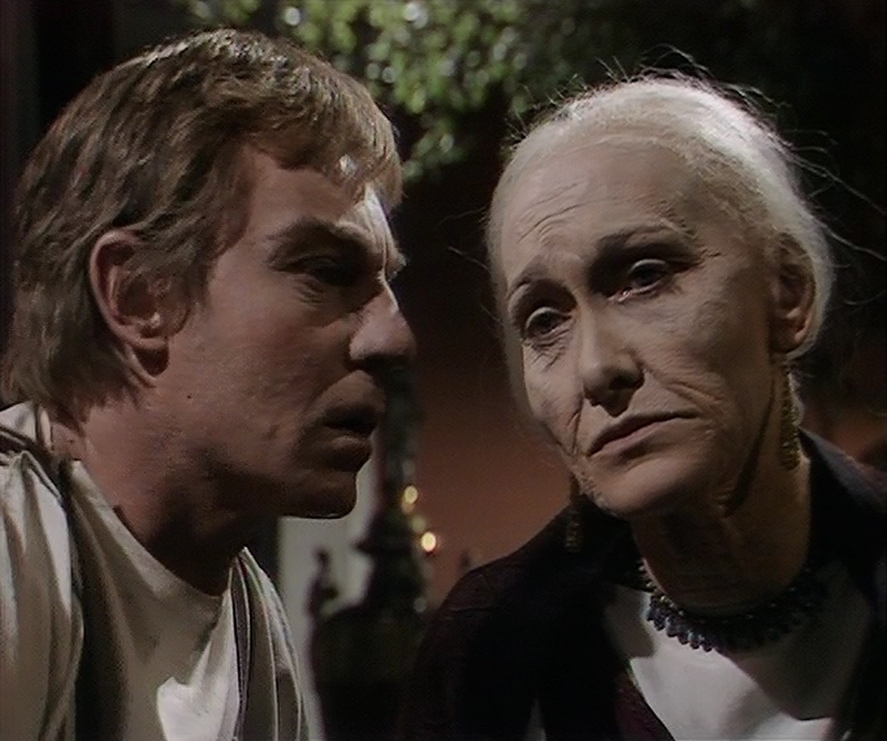
Antonia moves a little more to the forefront today. Her default expression is still disapproving (even now he’s middle-aged, Claudius can seemingly do nothing right in her eyes) but she does emerge as one of the few members of the Imperial family (along with Claudius, of course) who has a strong sense of morality. It’s remarkable that she’s remained innocent about so many things (the part her daughter Livilia played in the banishment of Postumus, for example) but this does seem to be genuine, rather than a politic avoidance of the truth.

So when she’s presented with evidence that Livila poisoned her husband Castor, she acts without hesitation. Locking her in a room and forcing herself to listen to Livila’s screams is a call-back to a similar scene with Augustus/Julia. But where Julia would eventually emerge (bound for exile) Antonia plans to keep vigil until Livila dies of starvation.

Claudius: How can you leave her to die?
Antonia: That’s her punishment.
Claudius: How can you sit out here and listen to her?
Antonia: And that’s mine.

While this is happening, Rome is in turmoil. Sejanus has been removed from power by his second in command Macro (John Rhys-Davies). Rhys-Davies is excellent value as the previously loyal Macro who now eyes a chance to advance. Caligula recommends him to Tiberius as a sound man (he doesn’t know him personally, but he’s slept with his wife several times!)

There’s a few rare handheld camera shots (the death of Sejanus, the aftermath of the massacre in the streets) that help to give the climax of the episode an unusual feel. The studio-bound nature of I Claudius means that it struggles to express a sense of scale (most of the turmoil has to take place off screen) but the visceral nature of the unfolding events still carries a considerable punch. The rape and murder of Sejanus’ young daughter is a case in point.

Reign of Terror is an exhausting episode. And the fact that Tiberius has named Caligula as his successor suggests that the next one will be no quieter …
I Claudius – Queen of Heaven (25th October 1976)

Queen of Heaven opens with the conclusion of an agreeable evening’s feast at the home of Titus (Edward Jewesbery) and Lollia (Isabel Dean). They appear to be the ideal hosts as their guests – including Claudius and Agrippina – seem to have enjoyed themselves.

But the laughter quickly dissipates after Lollia begins to tell a story, concerning Tiberius’ debauched tastes. “I was there subjected to acts of such abominable filth, to bestial obscenities with him and his slaves of both sexes …”

This scene (running for nearly seven minutes) is a fine showcase for Isabel Dean’s histrionic talents (yes, you can argue that she goes a little over the top, but this theatrical intensity was probably the right choice). A shamed Lollia can see no other way out than to take her own life – which she does with a knife in full view of her shocked husband and guests. Clearly she’s one for the grand gesture …

Although sex is the motor that drives a great deal of I Claudius, it’s remarkable how coy the serial was in depicting it. So although we hear several times about Tiberius’ depravities, they’re never actually shown. This might have been a masterstroke, as the imagination is then left to conjure up the worst of images (more prosaically, the production may also have had one eye on overseas – especially American – sales, where any form of nudity wouldn’t have been appreciated).

Caligula has now grown into the figure of John Hurt. Complete with a yellow wig, the 36 year old Hurt (playing Caligula aged approximately 18) is clearly having a ball right from the start. Whether it’s chuckling with Tiberius over a new mucky book (well, mucky scroll) or subjecting his great-grandmother Livia to a lengthy and highly inappropriate kiss, Hurt always catches the eye.

Sejanus also moves into the forefront today. He’s able to convince a pliant Claudius to divorce his wife and marry Sejanus’ sister. Both Antonia and Agrippina denounce him for this, but Herod is more forgiving (or simply more farsighted). He alone understands that had Claudius refused, his life expectancy would have been on the very short side. So as he’s always done, Claudius simply bends with the wind and lives to fight another day.

As for Sejanus, apart from playing cupid for Claudius and his sister, he’s also deep into an affair with the predatory Livilla. This means it’s curtains for the affable, but weak-willed Castor. Kevin McNally bows out after Livilla and Sejanus decide to poison Castor.

As in the previous episode, Livia is depicted as a powerless and rather forgotten character. Almost literally bumping into Tiberius in the forum (as their two chairs meet) she berates him for his lack of attention and peevishly reminds him about her upcoming birthday!

As her son offers no succor and Caligula only fleeting entertainment, it’s Claudius who turns out to be her confidant in the last months of her life. That’s possibly not surprising – her choice being somewhat limited due to her habit of poisoning almost anything that moves …

She cuts a tragic figure when pleading with Claudius to get Caligula (who she’s convinced will be the next Emperor) to make her a goddess (in order  that she won’t suffer eternal damnation). You feel that she’s partly manipulating him, but her sense of terror also seems genuine.

I love the matter of fact way Livia agrees to tell him about her list of crimes (Claudius, as a historian, is keen to have an accurate record). There’s also a few titbits for the viewer as well (we learn for the first time that she poisoned Marcus Agrippa). As with the death of Augustus in episode four, the approaching demise of Livia will leave a large hole.

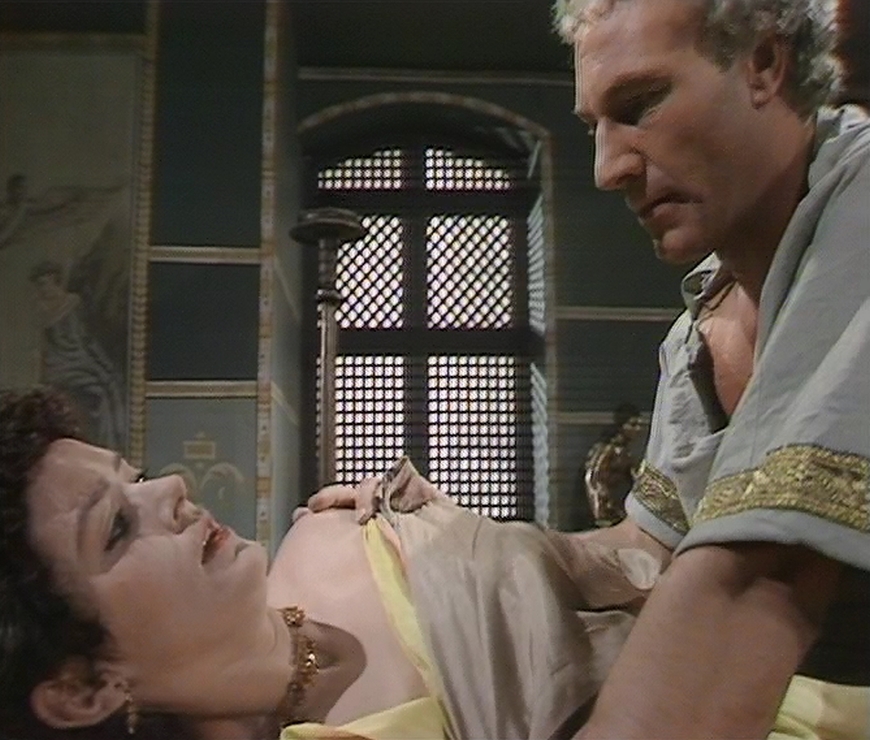
So a doff of the cap to Siân Phillips. It can’t have been easy for her in the last few episodes, thanks to the heavy old-age make-up she had to wear, but like Augustus her exit is a memorable one. Virtually immobile in her sickbed, she’s first visited by Caligula, who shatters any hopes she had of becoming a goddess. “What makes you think that a filthy, smelly old woman like you could become a goddess? I don’t need you anymore, you see, great grandmother. My secret will die with you. You are going to stew in hell forever and ever”.

It’s left to Claudius, alone with her when she dies, to offer whatever comfort he can. The tears in his eyes at her passing sits awkwardly with the remembrance of the aged Claudius at the conclusion of Poison is Queen (where he violently despised her) bur this suggests the way feelings and memories can fluctuate. In this episode Claudius reacts with calm disinterest at Livia’s catalogue of crimes – a far cry from how he recalls them at the end of his life.

I Claudius – Some Justice (18th October 1976)

Germanicus is dead. His widow, Agrippina (Fiona Walker) is convinced that Piso (Stratford Johns) and his wife Plancina (Irene Hamilton) poisoned him ….

So David Robb breathes his last as Germanicus. He has a few brief scenes here – although none are very taxing (in the first he’s already dead, then later there are a few quick flashbacks showing the ailing Germanicus). The fact we never see any interaction between Germanicus and Piso (the recently deposed governor of Syria) means that, like the Senate who are called upon to debate Piso and Plancina’s guilt or innocence, we don’t know what happened for certain (at least not for a while).

Both Stratford Johns and Irene Hamilton add considerable value to this episode. This would be Hamilton’s penultimate television credit whilst Johns still had several decades of work in front of him. As you’d expect, Johns is compelling as the initially affable Piso – convinced that his friendship with Tiberius will be sufficient to get him out of trouble. The more far-seeing Plancina can clearly see that their guilt or innocence doesn’t really matter – the mob (angry at Germanicus’ death) want justice, so it looks like Piso and Plancina will have to be sacrificed.

Agrippina details the way her husband met his end – there’s some lurid (and slightly ludicrous) visual detail to aid the viewer in this. Although Claudius doesn’t have a great deal to do today, he’s still quite key. Meeting with the likes of Agrippina, Castor, Antonia and Herod he makes the suggestion (accepted by Castor) that the trial should take place in the Senate (a move that would favour them). It’s plain that in their company he no longer feels the need to play the fool.

Tiberius and Livia are also somewhat sidelined. As of yet, there’s no great sense about how Tiberius’ reign as Emperor is going (apart from the fact that he peevishly wonders why the public loved Germanicus more than they love him).

Now that Livia has poisoned her way through a vast swathe of the Imperial family, she’s become somewhat surplus to requirements. If Livia assumed that Tiberius would allow her to jointly rule (as Augustus did) then she’s been sorely disappointed. “What a spineless, miserable, mean-spirited creature you are!” she opines in his direction towards the end of the episode. Since he’s not listening to her, who does he take counsel from? It’s Sejanus who’s operating as the power behind the throne (although again, he’s another whose role in the episode is quite brief).

The teeny Caligula (Robert Craig-Morgan) debuts. When even Livia describes him as a “monster” you know he must be bad ….

Indulged by his mother, Agrippina, Caligula is allowed to run riot. Claudius attempts to talk some sense into him (whereas Claudius’ mother Antonia favours locking him in the cellar and giving him a good whipping) but as we’ll see over the next few episodes, his words of caution didn’t really do much good. Even at this young age, Caligula is mad, bad and dangerous to know.

Some Justice was the television debut of Robert Morgan (later Robert Craig-Morgan) who will always be best remembered for playing the satchel-clutching Justin Bennett in the early years of Grange Hill.

Livia’s revulsion occurred after the poisoner Martina (Patsy Byrne) revealed to her the active part that Caligula played in his father’s death. The scene between Livia and Martina serves a dual purpose. On the one hand it’s blackly amusing to see two old hands calmly discussing poisons they have known, but the scene mainly exists so that Martina can info dump some major revelations about the way Germanicus died.

The episode ends – as it began – with the aged Claudius on the Imperial toilet. Which isn’t something you see every day. Some Justice almost feels like a stand-alone story, thanks to the prominence of Stratford Johns and several lengthy court-room scenes. But as he’s an actor I’ve always enjoyed watching this is no hardship for me.

I Claudius – Poison is Queen (11th October 1976)

For most of Poison is Queen, Livia is firmly on the back foot. This is something we haven’t seen before. Up until now, she’s manipulated and poisoned at will without seemingly breaking sweat. But the fact that Augustus now knows about her machinations (even though he can’t quite bring himself to openly confront her) means she’s put on the defensive.

Claudius’ brother Germanicus (David Robb) returns to Rome in triumph from Germany. He’s received with fervor at the Senate (the first time we see this impressive set) and later, quietly ensconced with Claudius, he learns the truth about Postumus (Livia was responsible for his banishment on a trumped-up rape charge).

It’s one thing that Germanicus accepts Claudius’ word on this (after all, he can offer no proof) but credibility is stretched even further when Germanicus offers to go to Augustus and tell him. It’s more than a little frustrating that this happens off-screen and given that Augustus has been married to Livia for fifty years (and has heard rumours about her conduct before) it’s difficult to imagine quite how Germanicus won him round. Let’s suppose that Augustus already had his own suspicions and Germanicus’ visit merely hardened them.

Augustus pays a visit to the exiled Postumus, who’s been living in lonely seclusion on a rock in the middle of nowhere for the last three years. Once again John Castle doesn’t hold back (although you can’t blame Postumus – stuck there for three years with only the guards and some seabirds for company would be enough to drive anyone slightly round the bend).

Augustus tells Postumus that he can’t return to Rome straight away – first he needs to speak to the Senate and get his exile rescinded. Given Augustus’ autocratic dominance of the state this seems like a feeble excuse, but as he’s hardly a man in the first flush of youth (or health) maybe that’s the reason for his hesitancy.

Although the likes of Germanicus, Postumus and Tiberius all have their moments (Tiberius throws a delightful hissy fit when he tells his mother that he’s sick of death of being Augustus’ lapdog and has no interest in becoming Emperor!) most of the episode revolves around the interactions of Augustus/Livia/Claudius.

Claudius speaks to both Livia and Augustus, although his relations with the latter are much more congenial than with the former. Augustus has belatedly realised that Claudius is not quite the fool he appears and (but for Augustus’ death) there’s a sense than an even closer rapprochement might have grown up between them. No such luck with Livia though, who still treats her grandson with undisguised contempt (and unlike Augustus seems not to have realised that Claudius has a sharp brain).

Everything is leading up to that scene. Thanks to Brian Blessed, it’s a technical triumph. The camera focuses solely on Augustus for several minutes as Livia (heard but not seen) delivers a lengthy monologue. As she continues to speak, Augustus dies right before our eyes. Many actors have been called upon to die on stage or screen over the decades, but none have done it as effectively as Blessed here. Under the unforgiving glare of the camera, not even a twitch is detectable. Mind you, some claim there is – and maybe if you analysed it frame by frame you’d find something, but you’d have to be a churlish sort to do so.

Despite Livia’s complicity (“don’t touch the figs” she memorably tells Tiberius) she also sheds tears after closing Augustus’ eyes. Maybe that suggests Livia still possesses a spark of humanity, but only the merest spark ….

Elsewhere, there are effective cameos from James Bree and Jonathan Burn whilst Patrick Stewart (sporting a fine head of hair – albeit not his own) makes his debut as Sejanus, a character who will have a major role to play during the reign of Tiberius.

I Claudius – What Shall We Do About Claudius? (4th October 1976)

Derek Jacobi is finally able to shed his old-age make up and play the young Claudius for the first time. Joining him at the start of the episode are several new actors, which means that a Claudius voice over is required in order to explain to the audience exactly who these runners and riders are.

There’s Postumus (John Castle), Marcus Agrippa’s surviving son and Claudius’ best friend, Claudius’ brother Germanicus (David Robb) as well the scheming Livilla (Patricia Quinn). Livilla is married to Castor (Kevin McNally) but spends her time making googly eyes at Postumus. Their illicit affair turns out to be key to the episode ….

Claudius’ isolation from the Imperial family is made clear in this opening scene. He’s allowed to dine with them, but only on a couch that’s placed a discreet distance away. Despite this unspoken segregation, he’s not totally friendless – Postumus is always prepared to stand up for him and even Augustus regards him with a distracted affection.

Before the serious business begins, there’s the joy of watching Augustus interact with the poet Horace (Norman Shelley). Augustus’ puritanical streak emerges (not for the first time) as he regrets the way that some poets delight in recording only the more sordid aspects of life. “Write poetry, yes, but write about nice things – things that you’d like your children to hear”.

Given that the definitive radio Sherlock Holmes (Carlton Hobbs) appeared in episode one, it’s nice that Shelley (Hobbs’ Doctor Watson) also makes an appearance in I Claudius.  Possibly it was just a coincidence, but it might be that director Herbert Wise remembered their decades long partnership and decided to find Shelley a small role.

Brian Blessed is then given the chance to move into high gear as an unbelieving Augustus receives news that three legions have been massacred in Germany. It’s interesting to see how Tiberius reacts to this – unlike Augustus, he’s totally calm and quite prepared to go out there in order to steady the ship.

Donald Eccles and Denis Carey (as Pollio and Livy) both essay decent cameos. A pair of eminent historians, they’re flattered by Claudius’ interest in their work – although Livy is less flattered when Claudius is unable to tell him which of them he prefers! The scene ends on a serious note though, as Pollio – when he’s alone with Claudius – suggests he carries on playing the fool (that way he might just stay alive). It’s worth bearing this in mind when observing some of Claudius’ later clumsy behavior.

What Shall We Do About Claudius? features several lengthy two handed scenes. The first – between Livia and Livilla – sees Livia (as in the previous episode) casually manipulate a hapless individual in order to remove yet another rival (in this case Postumus) to the throne. Livilla is able to emote in an impressive way, although I get the sense that some of her tears are purely for show (she’s wasting her time though – Livia’s not the one to be moved by sentiment).

The following two-hander (a domestic squabble between Augustus and Livia) is also highly entertaining and leads into the games at the Coliseum, which are being held in honour of Drusus. We meet the adult Herod Agrippa (James Faulkner) for the first time and are also given the opportunity to marvel at the set (which gives the impression of great height – helped by some lower than normal camera angles).

I enjoyed Livia’s pep talk to the gladiators. “These games are being degraded by the increasing use of professional tricks to stay alive! And I won’t have it! So put on a good show and there’ll be plenty of money for the living and a decent burial for the dead. And if not? I’ll break this guild up. And I’ll send the lot of you to the mines in Numidia.”

Later, Postumus is falsely accused of rape by Livilia. The Television Centre roof rattles as John Castle and Brian Blessed wring every last drop out of emotion out of the script. I Claudius is a serial packed with memorable moments, but this one has to be right at the top.

Oh grandfather, open your eyes. Over the years everyone you knew and loved has either died or disappeared. Do you think it was all an accident? My father Agrippa, and before him Marcellus, my brothers Gaius and Lucius, my mother Julia – NOW ME.

After this intensity, the episode winds down with Claudius’ long postponed marriage. His unnamed bride turns out to be much taller than he is, which is the cue for hysterical laughter from all the onlookers (even Livia and Claudius’ mother Antonia – two people who never find anything Claudius does even remotely amusing – have a chuckle).

It’s an oddly discomforting and grotesque scene. Possibly because we then cut back to the elderly, drunken Claudius before the credits roll, we should take it to be nothing more than his fevered remembering, rather than real life.

I Claudius – Waiting in the Wings (27th September 1976)

Time has moved on from the first episode. We can tell this in various ways – firstly, the previously infant Claudius is now a lad of about eight or nine. Young Claudius is played by Ashley Knight. I always like to dig into the credits of child actors to see how far their career progressed – most of Knight’s credits were as a juvenile but he certainly packed a lot in (playing Jim Hawkins in the excellent 1977 BBC Classic Serial adaptation of Treasure Island, for example).

Secondly, Tiberius (currently in exile on a small island) has comfortably settled into middle age. I’m pleased to see this (as commented upon last time, George Baker struggled to convince as a callow youth). Livia is also aging – although some of her old-age make up looks a little false. As the episodes click by you’ll have to cut the serial a little slack when considering this part of the production – fair to say that some of the make-up doesn’t always convince (although I’m sure it was the best that could have been done at the time).

Livia, it won’t surprise you to know, continues to plot. Augustus’ daughter Julia (Frances White) has become a notorious man-eater – and it seems that everyone in Rome knows, apart from her father. This makes Augustus look more than a little foolish – the most powerful man in Rome with such a blind spot? But it’s easy to see that his subordinates would either be terrified to tell him or possibly just assumed he knew and condoned her behavior.

One of Julia’s many, many conquests is the fresh faced Plautius (Darien Angadi), a friend of Julia’s brother Lucius (Simon MacCorkindale). Angadi died tragically young (in 1981, aged 31) but he still managed to notch up a fair few television credits.  Plautius is putty in the hands of Livia, and it’s a joy to watch how she effortlessly turns the young man into her informer.

If their scenes are a definite episode highlight, then – obviously – so is the moment when Augustus lines up a long row of senators accused of sleeping with his daughter and disbelievingly interrogates them. Blessed is at his very best here – Augustus is initially baffled as he encounters old friends, but his anger is quickly stoked. John Scott Martin is the unfortunate who receives the most savage rebuff from Augustus.

With Lucius now discredited (and shortly to die in what appears to be an accident, but you can never be sure) and Julia exiled (Frances White certainly knows to to wail) it looks like Livia has achieved her aim – the recall of Tiberius to Rome.

He seems to have been living a fairly comfortable life, but the lack of company has been a problem. Still at least he has Thrasyllus (Kevin Stoney) on hand to cast endless horoscopes and offer hope for the future. Stoney had previously played Thrasyllus in Philip Mackie’s The Caesars (1968) so you have to assume his casting here was a nod to that production.

If you’ve never seen it, then I can strongly recommend The Caesars. It roughly covers the same period of time as I Claudius but is by no means a retread (Mackie’s Tiberius is a very different character from the one offered by Graves/Pulman, Livia is only a minor character, etc).

Once again, Derek Jacobi has little to do but bookend the episode. The final scene is a memorable one though – it swiftly cuts from the young Claudius with his friends to the aged one now sitting alone in the same spot, with only his memories for company.

I Claudius – A Touch of Murder (20th September 1976)

Jack Pulman’s adaptation of Robert Graves’ two novels (I Claudius and Claudius the God) spanned twelve episodes – with the first (A Touch Of Murder) being a double helping. For the American screening it was split into two 50 minute episodes (various other minor tweaks were also done – such as trimming down shots of the bare-breasted dancers seen in the opening minutes).

The original 100 minute edit is the better one though. Revisiting it once again, I can honestly say that the episode didn’t drag at all – a sure sign that the script and actors are totally engaging. As is well known, I Claudius is a completely studio-bound production – that’s sensible enough, as it would be difficult to find too many UK locations which could have convincingly replicated the grandeur that was Imperial Rome.

Tim Harvey’s production design is one of the serial’s unheralded triumphs. Subtle lighting effects (sun streaming through the palace windows) are used effectively and the outdoor locations (Augustus’ garden complete with fountain) also convinces (thanks to simple effects, such as a wind machine rippling the branches of the trees).

Pulman elected to retain the device of Claudius narrating the history of his strange family. This works on two levels – not only does it display fidelity to Graves’ original work, it’s also very handy for the television viewer (who otherwise – especially in this first episode – might find themselves overwhelmed by the large cast of characters who keep on appearing). So whenever the antecedents of a new arrival need to be explained, Claudius can pop up with a VO to explain all. As the serial progresses, and the regular characters become more familiar, this device is used less often.

Derek Jacobi (Claudius) appears only fleetingly, as at this point in the story Claudius is either not born or only a mewling infant. It’s Augustus (Brian Blessed), Livia (Sian Phillips) and Tiberius (George Baker) who drive the episode along.

There are some who express surprise that Brian Blessed could once upon a time have indulged in a spot of subtle acting (true, Augustus does like to shout a lot, but he tends to be more interesting whenever he’s calm and menacing). Those people probably never saw him in Z Cars then – maybe Blessed only started to go over the top when he grew the beard ….

His Augustus is a multi-layered creation. At times indulgent and child-like, he’s able to change direction in a heartbeat.

If Augustus is ebullient and expressive, then Livia is cold and calculating – prepared to play the long game as she removes all those who might ascend the throne ahead of her son, Tiberius. It’s interesting to see how Pulman greatly expanded the role Livia played in the death of Marcellus (Christopher Guard). To be honest, Marcellus is so irritating that his demise can almost be called a mercy killing. Pulman explicitly states that Livia poisoned him – whereas Graves only mentions in passing that Livia nursed him (possibly anticipating that his readers would join the dots).

Marcellus provides the first half of the episode with some spark, as does John Paul as Marcus Agrippa. Augustus’ strong right arm, the relationship between him and Agrippa is a fascinating one which could have been expanded a little more.

Their final scene together is a treat though. Agrippa is keen to strengthen his ties with the Imperial family and asks to marry Augustus’ daughter – the recently widowed Julia (Frances White). At first a shocked Augustus can barely get any words out, before – after a short period of reflection – he becomes reconciled and heartily agrees. It’s therefore a little jolting to then be told by Claudius that Agrippa, having married Julia, dies some years later (this all happens off-screen).

With Julia back on the market, she’s then married to an unwilling Tiberius – who’s forced to divorce the love of his life, Vipsania (Sheila Ruskin). The increasingly tangled relationships between the members of the Imperial family will only become more tangled over time, so it’s best to keep paying attention …

Out of all those who become Emperor, Tiberius has the fewest character quirks, which means that George Baker has to work hard to bring him to life. He’s served well in A Touch of Murder though – even if Baker doesn’t quite convince as the youthful Tiberius. Tiberius’ awkward and stilted relationship with his mother is nicely done as is the genuine love and affection he has for his younger brother, Drusus (Ian Ogilvy).

Like John Paul and Christopher Guard, Ogilvy is a one episode actor – required to make an impact with only a limited amount of screentime. This he does – firstly as the only man capable of dispelling the black clouds that hang over his elder brother and then later when Drusus, off to campaign in Germany, takes his leave of Augustus.

Drusus, a keen believer in the Republic, is comfortable enough in Augustus’ company not to keep his views secret. Watch out for the moment when their affable chat suddenly turns awkward – for just a brief moment – as Drusus realises that he’s overstepped the mark.

If Pulman makes it explicit that Livia poisoned Marcellus, then her involvement in the death of Drusus is more opaque. The elderly Claudius is convinced that something strange occurred, but doesn’t accuse Livia. True, she did send out to Germany the notable physician Musa (Renu Seta) who had also unsuccessfully treated Marcellus, but was Musa under her control? He seemed genuinely baffled at the death of Marcellus, so if he was later suborned by Livia, we never saw it happen.

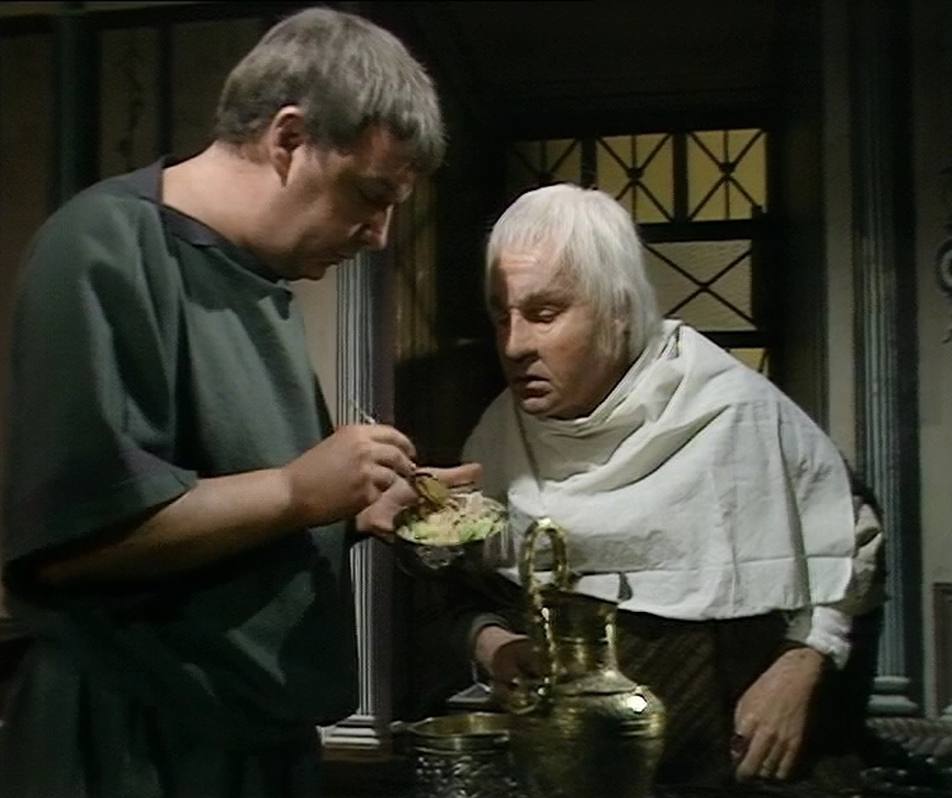
To round off, there’s a few minor performances worth noting. First, Carleton Hobbs as the Greek poet Aristarchus . For me, Hobbs was the definitive radio Sherlock Holmes and it’s always a delight to hear that well-remembered voice again. And Tony Haygarth, as Claudius’ slave, also makes a little go a long way – forced to taste his master’s food and wine, he can’t resist passing judgement on the indifferent culinary fare offered by the palace.

I Claudius and the joy of videotaped drama

It has gladdened my heart to see a largely positive response on Twitter/X to the news that I Claudius will shortly be repeated on BBC4 (from the 16th of August). There were also a few slightly negative comments of course – for some, I Claudius is “old fashioned” or “theatrical” (these are supposed to be criticisms, but both seem like plusses to me!)

Videotaped drama is a form of television that (soaps apart) we don’t see anymore. Once, of course, it was the dominant way of programme-making and remained so for decades (notwithstanding filmed series from the likes of ITC and Euston Films).

There was a change in the air by the late seventies though. The BBC (who had tended to reserve film for one-off plays rather than series or serials) began to dip their toe into the brave new world of film series with Target (quickly followed by Shoestring). By the 1980’s film drama had begun to be seen as prestige (Miss Marple, Edge of Darkness) with taped drama now lagging behind as an inferior second best.

The 1985 Bleak House is a good example of this. Critical chatter at the time reacted positively to its glossy, all-film visuals – comparing and contrasting them to the cheap and cheerful videotaped Classic Serial strand which went out at Sunday tea-time. Such a sweeping point of view ignored the many strengths of the Classic Serials – thankfully, a decent sample are available on DVD and I live in hope that BBC4 may exhume some more in the future (the late 1960’s production of Treasure Island, with Peter Vaughan as Long John Silver, would be a good place to start).

Watching videotaped drama requires a certain mindset (not dissimilar to that of a theatre-goer). You have to accept that what you see may be somewhat impressionistic. In I Claudius, for example, at one point there’s a riot through the streets of Rome which is represented by noises off and about a dozen extras. If you can accept this sort of thing (a high tolerance for CSO is also recommended) then a veritable treasure trove of delights awaits you.

There are many excellent examples of videotaped drama on YouTube – I’ll recommend just three. Harold Pinter’s One for the Road (one set, a handful of actors). Arthur Ellis’ The Black and Blue Lamp (which was written around its production limitations – no exterior filming was available thanks to its low budget). Joe Orton’s What the Butler Saw (a vanished form of television drama that was content to faithfully reproduce the theatrical experience rather than seek to open it up).

Gross oversimplification incoming. If film drama is a director’s medium, then tape drama is an actor’s one. Of course, there are many fine performances to be found in filmed dramas (just as videotape offers good directors the chance to push the medium). But it’s a point that has a certain validity. Taking I Claudius as an example – multi-camera vt recording allowed the actors to perform in extended scenes. That’s one of the strengths of tape for me – the feeling that you’re getting close to the characters (film can have a distancing effect).

I can understand why some find archive tape dramas difficult to connect with. But for me, they’ll always be my drama form of choice. If you’ve never seen I Claudius, then I’d recommend tuning in (or if you’re not in the UK, seeking out an alternative way of viewing). You may just be pleasantly surprised ….