Weakling scum! Doctor Who and the Horns of Nimon

"Unaccustomed as I am to public speaking, I'd like to say one thing and let me make it perfectly clear, I stand before you desperate to find the exit. Can anybody help me?"

With The Horns of Nimon, Graham Williams’ (televised) tenure as producer ended with something of a whimper rather than the bang he intended.

Williams had budgeted two cheaper stories (Nightmare of Eden & Nimon) in order to lavish a generous amount of location filming on the season finale, Shada. But Shada was never completed due to industrial action, which was the final piece of bad luck to befall Williams on Doctor Who.

Even before this though, Williams had more than his fair share of problems to deal with. The late 1970’s was a bad time to be a Doctor Who producer – hyper inflation meant that year on year the show’s budget was shrinking, industrial action was a constant threat and Tom Baker was proving to be more of a handful than ever.

Nimon is rated 223 of out 241 stories in DWM’s 2014 poll. So it’s very much down amongst the also-rans, rubbing shoulders with similarly unloved stories such as Arc of Infinity, Warriors of the Deep and The Time Monster. But whilst nobody in their right mind would call Nimon an overlooked classic, it does have some good points which go some way to balance out the numerous production mis-steps.

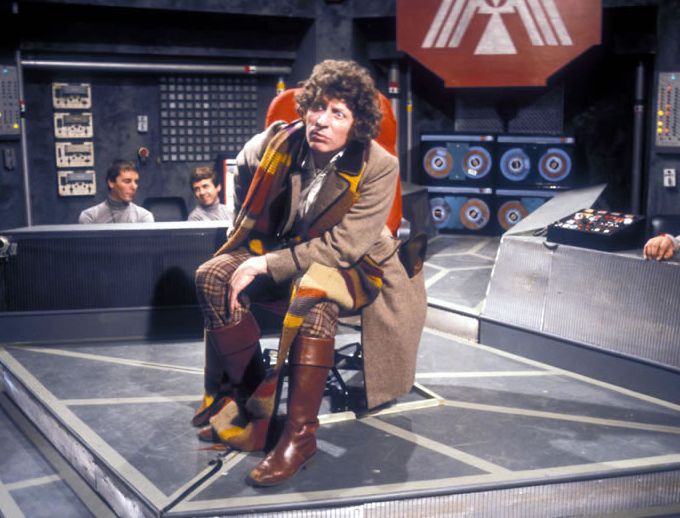
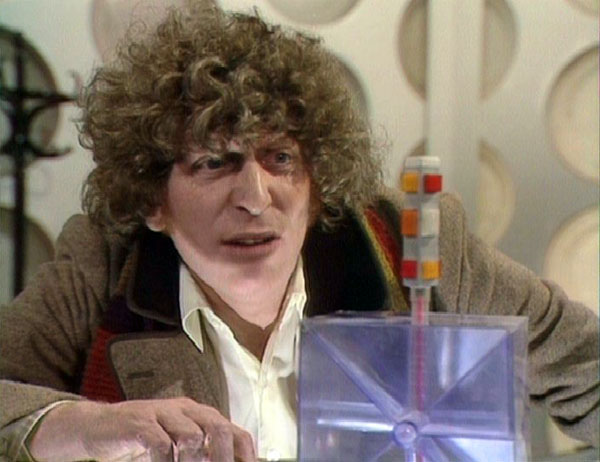
On the credit side, Tom Baker is still coming up with the goods. Six years in, there’s no doubt that he’s done all of this stuff hundreds of times before but he still manages to make it seem fresh. Whatever his thoughts about poor scripts and his off-screen spats with Williams, on-screen he’s focused and giving it 100%. And he does have the odd gem, such as –

Nimon: “Later, you will be questioned, tortured and killed”

The Doctor: “Well, I hope you get it in the right order”

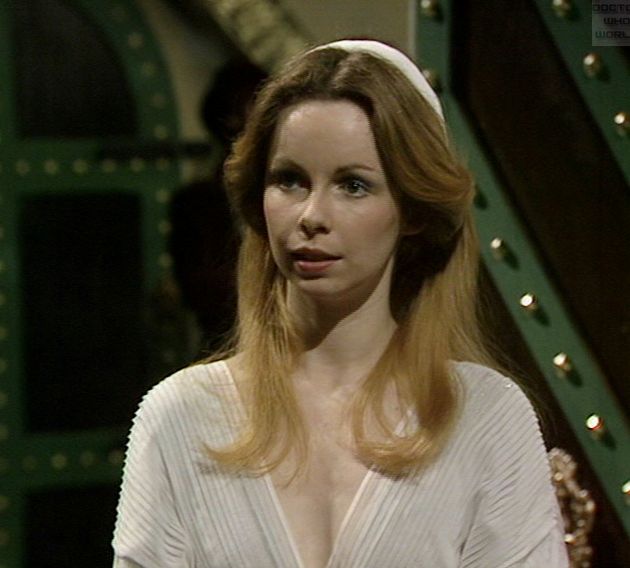
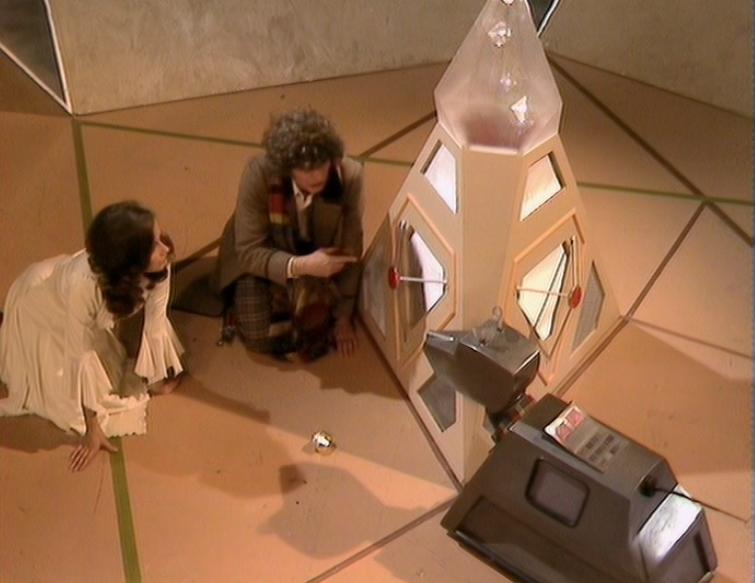
Lalla Ward is equally good value as Romana. Separated from the Doctor for an episode or so she effectively becomes a surrogate Doctor and manages to effortlessly carry the narrative. Forget K9 & Company, a spin-off with Lalla and K9 was a huge missed opportunity.

romana
Lalla Ward as The Doct, sorry I mean Romana.

As for the guest cast, a mixed bag is the kindest way to describe them. Simon Gipps-Kent and Janet Ellis are really just the Babes in the Wood – and their characters are so under-written that they aren’t called on to do much acting.

Malcolm Terris is pretty poor as the Co-Pilot which is summed up by his final scene as he faces the wrath of the Nimon and his trousers fail to take the strain.  Elsewhere on Skonnos, Sorak (Michael Osborne) and Soldeed (Graham Crowden) are an odd couple, to put it mildly.
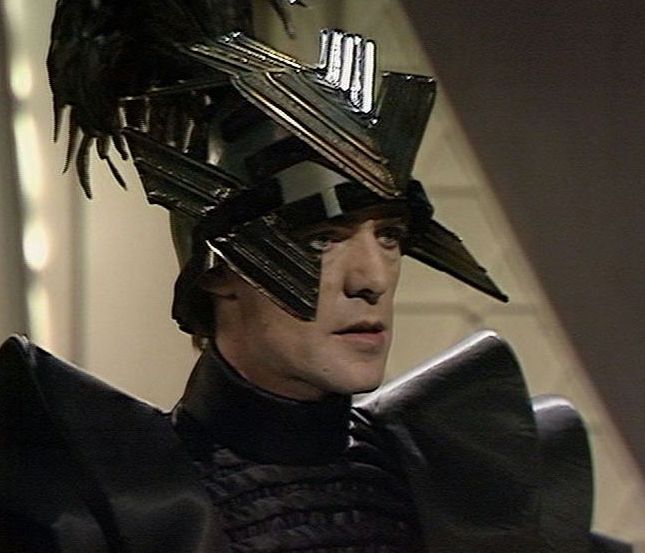
Sorak (Michael Osborne) models a typically understand costume from designer June Hudson.
Sorak (Michael Osborne) models a typically understated costume from designer June Hudson.

Osborne plays it dead straight, which is all the more impressive when you consider his costume. Crowden, on the other hand, gives a performance that is on another planet to everybody else – even managing the impressive feat of making Tom look like an actor of great restraint.

Much has been written about Crowden’s turn as Soldeed and it’s the sort of performance that you either love or hate.  Frankly, I love it as Nimon is the wrong story for too much naturalistic acting. But as some people have never liked Doctor Who to be fun it’s no surprise that many either don’t get the joke or consider it to be out of place.

"My dreams of conquest ....."
“My dreams of conquest …..”

But amongst the under-acting, over-acting and no-acting, there is one perfectly pitched performance – John Bailey as Sezom. Bailey had previously appeared as the doomed Waterfield in The Evil of the Daleks (1967) and there’s a similar vibe to this character. It’s only a small part, but Bailey is excellent and it’s one of the highlights of the story.

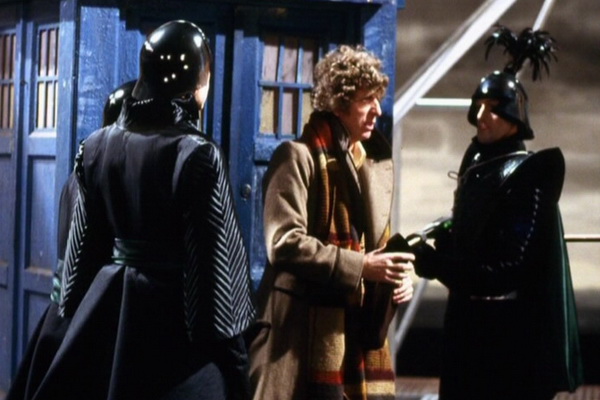
As for the Nimon, oh dear. The Williams era is notable for a run of underwhelming monsters (immediately prior to this viewers would have been reeling from the glowing green bag that was Erato and the less-than-terrifying Mandrels) so the Nimon are pretty much business as usual. And as soon as the first one stumbles onto screen in his platform heels you know it isn’t going to end well.

nimon
“Roaaaarrrrr!!!!”

The Horns of Nimon was the end of an era in many ways. When the series returned it would feel quite different with a much more serious tone to proceedings.  But everything is cyclical and there would eventually be heirs to Crowdens throne (Paul Darrow in Timelash for example).

But for the moment, Nimon is the last gasp for this kind of goofy Doctor Who. Full of faults yes, but anything with Tom Baker, Lalla Ward and Graham Crowden can’t be all bad.
A teaspoon and an open mind. Doctor Who and the Creature from the Pit

“We call it … the pit”

Ranking a lowly 211 out of 241 stories in DWM’s recent poll would imply that The Creature from the Pit isn’t a favourite of many. But apart from one (admittedly large) problem it’s difficult to see why.

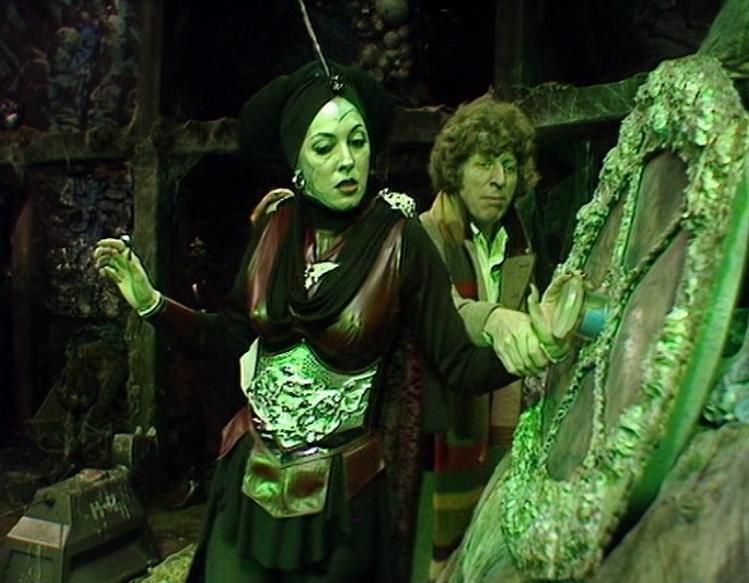
The positives far outweigh the negatives – the jungle scenes at Ealing give the episodes a glossy sheen, Myra Frances is a gloriously hissable villainess, Tom’s on great form, Lalla looks lovely and there’s an entertaining guest turn from Geoffrey Bayldon.

The problem? Well you can’t really avoid it. Erato is a vast, shapeless blob that is said to stretch for miles. How do you realise that on Doctor Who’s budget in 1979?

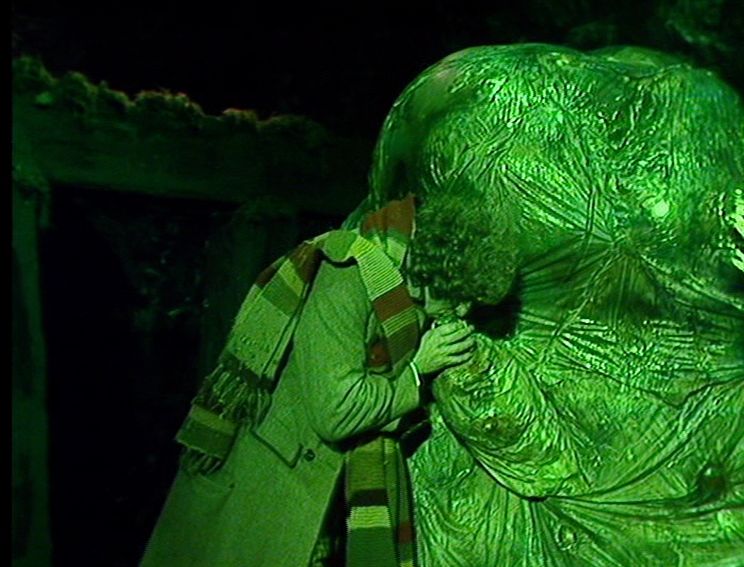
The answer is, of course, that you can’t. So Erato looks like an inflatable green bag with a rude appendage. But the scenes in the pit are nicely lit and Erato’s green glow is quite eerie, so it’s not a total write off.

No, sorry I can't think of any caption.  Please add your own.
No, sorry I can’t think of a caption. Please add your own.

Producer Graham Williams was in no doubt that the special effects department had let the programme down and after transmission made this point in an internal memo. But it’s hard to imagine how this monster could ever have been successfully created, so you do have to wonder why this was never queried at the scripting stage.

New script editor Douglas Adams wasn’t terribly experienced, but Graham Williams had been around for a while and should have twigged that a mile wide green blob was simply asking for trouble. But whatever the merits and demerits of Erato, there’s plenty to enjoy in this story, so let’s take a closer look.

Chloris is a planet rich in vegetation but low on metal. The Lady Adrasta (Myra Frances) owns the only metal mine on the planet and therefore is able to rule with a reign of terror.

But the arrival some years ago of an ambassador from the planet Tythonus has threatened her grip on the planet. Erato proposed a trade – they have plenty of surplus metal but Tythonus is extremely low in vegetation which Erato’s people need in vast quantities.

Adrasta quickly understood that if she no longer had the metal monopoly then her power would dissipate. So she arranged to banish Erato to the pit and would henceforth throw anybody who displeased her down there.

Although transmitted third, this was the first story of Season 17 to be recorded, so it was Lalla Ward’s acting debut as Romana. Her performance here is subtly different as she was still feeling out the part. There’s some nice moments from her though – particularly when she confronts the bandits in their lair.

Sigh.
Sigh.

The guest cast is uniformly solid. Myra Francis manages to be gorgeous and deadly at the same time. Eileen Way (Karela) had appeared in Doctor Who’s first story back in 1963 and is good value as Adrasta’s right hand woman.

Organon (Geoffrey Bayldon) is a hapless astronomer who falls foul of Adrasta and found himself flung into the pit. Managing to avoid being crushed by the monster he has lived a lonely existence until the Doctor turned up. Bayldon, best known for Catweazle, sparks off Tom very well and their scenes together are highly entertaining.

Also skulking around the jungle are a group of inept bandits, lead by Torvin (John Bryans). There has been some criticism of this character over the years, so the viewer will have to decide if he’s a riff on a Fagin-like character or simply a broad Jewish stereotype – “My lovely boys”.

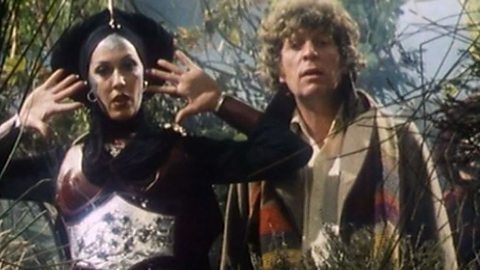
Myra Francis and Tom Baker

So while Creature has its flaws, if you can ignore the glowing green bag there’s plenty of entertainment here. Unloved for decades due to its feeble dinosaurs, in recent years there seems to be more appreciation for Malcolm Hulke’s Invasion of the Dinosaurs (1974). So maybe one day the same thing will happen here and fandom will learn to stop worrying about Erato and love The Creature from the Pit.

War, what is it good for? Absolutely nothing. Doctor Who and the Armageddon Factor

Tom Baker IS The Doctor

Nobody loves The Armageddon Factor.  Ranked 204 out of 241 stories in the recent DWM poll would appear to be a fairly accurate confirmation of its low standing.

But before we turn our attention to the story, lets have a quick look and see how its rated by some other bloggers.  Philip Sandifer considers that it’s “a painful squandering of good will in a way that only deepens the concern that the series has lost its way” whilst the Wife In Space called it a complete waste of time and rated it 4/10.

In his three years as producer, Graham Williams never had much luck with season finales.  Season 15 was going to conclude with a story by David Weir, until it was realised that his draft scripts would have needed a Star Wars-sized budget to make them work.  So Williams and script editor Anthony Read had to cobble something up at the eleventh hour.  The resulting story, The Invasion of Time, was something of a shambles – not helped by a BBC strike which meant that the production lost half of its studio allocation, so they were forced to decamp to a disused hospital to record some of the interiors.

Season 17 was even worse.  Douglas Adams’ Shada was also hit by a strike, but this time there was no opportunity to record the material  affected by the stoppage, so the programme was never completed or transmitted.  But over the last thirty years it has spawned VHS, DVD, audio and book releases – and a notoriety that the original story probably never deserved.

This leaves the last story of Season 16 – The Armageddon Factor.  This was not affected by strikes or last minute rewrites, but there does seem to be something somewhat lacking.  In late 70’s Doctor Who if you weren’t careful, by the end of the season you may have run out of money so your season finale would end up looking a little threadbare.  This is how Armageddon looks – no location filming and rather basic sets.

But the early episodes are helped no end by John Woodvine’s appearance as The Marshall.  Woodvine is a quality actor and he also has the welcome benefit of making Tom Baker raise his game.  There are other examples of this – Julian Glover in City of Death for example – so casting strong actors in late 70’s Who was clearly a good way to get Tom to focus on the matter in hand.

Tom restrains his enthusiasm

By this time, Tom had been in the role for five years.  No actor had played the part for longer, and he still had another two years to go.  Given this, it’s probably not surprising that there were times when he either seemed to go through the motions or dropped in the odd outrageous ad-lib.  Having said that, the commonly held view that Baker was playing the fool throughout the Graham Williams era is quite clearly untrue.  There’s the odd double take and painful pun, but for most of the time he plays it straight – although not everyone else is on the same page.

For example, Davyd Harries, as Shapp, puts in various bits of business that either director Michael Hayes approved of or didn’t notice.  It’s amusing enough though and does help to pass the time during some of the less interesting passages in the first half of the story.

Because apart from Harries and Woodvine, the guest cast are fairly small and not of great interest.  Lalla Ward would quite soon prove to be very important both to Doctor Who and Tom Baker, but there’s very little for her to latch on with the character of Astra.  And Ian Saynor has even less of a character, if that’s possible, with the irredeemably wet Merak.

That leaves William Squire as the main villain, The Shadow.  Squire was a good actor, probably best known for playing Hunter in the two Thames series of Callan.  But The Armageddon Factor takes the strange decision to put him in a mask and also treated his voice, thereby making him unrecognisable.  The Shadow isn’t much of a part anyway, as he tends to speak only in evil-villain talk and then give the odd maniacal chuckle.  It’s a long way from the best villains of the Hinchcliffe era, such as Davros, Sutekh, Harrison Chase and Magnus Greel.  The Shadow seems to have no interest beyond obtaining the last segment of the Key to Time, and therefore he can’t expect to hold the audience’s interest.

"You never know the answer when it's f*****g important do you?"
“You never know the answer when it’s f*****g important do you?”

The story was scripted by Bob Baker & Dave Martin, who had been writing for the series since 1971.  This was their last joint story for the series and it’s probably fair to say that very few people have ever expressed any regret that they didn’t carry on writing for the show.  They were not always bad, and sometimes quite good, but they tended usually to be pretty average.  But a safe pair of hands then, and just what Graham Williams needed to bring The Key to Time Season to a conclusion.

This they do, although the ending in particular has always been viewed as something of a damp squib.  After a season of the Doctor and Romana searching the universe for the six segments of the Key to Time, the conclusion of this epic quest is thrown away in such a perfunctory way.  Script editor Anthony Read should have been able to fashion something better, but didn’t – unless the original proposal was even worse.

But having said all this, is the story totally unwatchable?  No, of course not.  The first half of the story is better than the second, since John Woodvine gets stuck in a time loop in episode four and has little to do from then on.  We are also denied Davyd Harries’ comedy pratfalls later on, and Barry Jackson – as cockney Time Lord Drax – is no substitute.  Remember me to Galifree.

"There's no such thing as free will, only my will as I possess the Key to Time"
“There’s no such thing as free will, only my will as I possess the Key to Time”

Tom Baker and Mary Tamm are both still giving it their all though.  It might have been a long season, but they are committed and do their best to make the most of the thin material.  This was to be Tamm’s last television appearance as Romana and although she tended to be overshadowed by Lalla Ward’s portrayal of Romana II, Tamm had a good rapport with Baker throughout the Key To Time season and remained popular with fans right up until her untimely death, at the age of 62, in 2012.

Sigh.
Sigh.

Overall then, The Armageddon Factor is never going to be regarded as a great or even a good story – but there’s far, far worse out there and Tom Baker, Mary Tamm and John Woodvine all do their best to to inject some energy into it.  If I had to rate it, then a solid 6/10 would seem about right.