Back in 1984, there was somewhat of a buzz about this one. Apart from a cameo in The Five Doctors we hadn’t seen the Daleks in a new story for five years and their previous appearance, in Destiny of the Daleks, had been a disappointment to many.
Thirty years on, Destiny is probably better regarded today than it was back then whilst Resurrection has lost a little of its lustre. But although Eric Saward’s script has its faults, there are some things it does do right and it’s a clear pointer to the style the series would take in S22.
It’s fair to say that Resurrection is a bleak tale. This nihilistic view of the universe reflects the direction in which Eric Saward wanted to take Doctor Who and he wasn’t the only writer to favour this style. Robert Holmes penned very much the same type of story with The Caves of Androzani, but it has to be said somewhat better. Therefore it’s not difficult to see that Holmes would from now on strongly influence Saward’s writing (Revelation of the Daleks with its Holmesian double-acts is surely the sincerest form of flattery).
But back with Resurrection, Saward wanted to tie up the loose ends from Destiny and resolve the Dalek/Movellan war. He probably would have been better off ignoring this and starting afresh, as it does constrict the story (as do some of the other plot threads which go nowhere – such as the Daleks’ plan to duplicate the Doctor so he can go back to Gallifrey and assassinate the High Council).
The main part of the story revolves around the Daleks’ desire to find their creator, Davros, and use his skills to solve their current problems. This is a re-tread from Destiny, but Saward does one important thing right here that didn’t happen in Destiny. One of the clearest character traits of the Daleks is how single-minded they are, so it defied belief that they wouldn’t attempt to use Davros in Destiny for their own ends before discarding him. But this never seemed to occur to Terry Nation.
In Resurrection, the Daleks are quick to realise that Davros is more trouble than he’s worth and they attempt to exterminate him. But by then he’s already re-conditioned several Daleks, which establishes the general plot-thread of Dalek civil war which we see in Revelation and Remembrance.
As for the Daleks themselves, they do look a little worse for wear, it has to be said. They’ve been given a fresh coat of paint, but since they’re a mixture of casings from the 1960’s and 1970’s they naturally do look like they’ve been around the block a few times. For anybody who wants to delve further into the history of the Dalek casings, then Dalek 6388 is a fascinating website.
Michael Wisher was unable to reprise his role as Davros, so Terry Molloy stepped into the breach. Molloy ended up playing the role three times and would go on to make it his own, managing to emerge from Wisher’s substantial shadow. There’s less character for him to latch on here than he would enjoy in Revelation (which was much more of a Davros story than a Dalek one) but he still has some nice, ranting moments.
As for the humans, there’s an interesting ethnic mix on the space-station which is unusual for the series at the time. There’s also signs of the increased gore that would appear during S22 (the Daleks’ disfiguring gas is pretty unpleasant and it’s debatable whether the close-ups should have been transmitted).
One problem with Saward’s scripts up to this point was that characters could often seem like cardboard cut-outs, existing just as long as they formed some plot function. Once that ended, they would be quickly killed off (in order not to clutter up the screen). Styles (Rula Lenska) and Mercer (Jim Findley) are good examples of this. Rodney Bewes as Stein fares somewhat better and has the chance to play the hero at the end.
The Army bomb disposal squad, headed by Del Henney as Colonel Archer are also characters that don’t really go anywhere and it’s unfortunate that Tegan spends most of the story with them. As a final story for Janet Fielding, Resurrection is a poor effort, as Tegan does little of consequence – but as is probably well known, the story was originally planned to close S20 (a BBC strike put paid to that) so her leaving scene had to be tagged onto the already-written story.
Turlough and the Doctor fare little better. Turlough teams up with Styles and Mercer, although he does nothing to advance the plot. The Doctor has one key scene (confronting Davros and proving that he’s unable to kill in cold blood) but apart from that there’s very few of the character traits that Davison so clearly enjoyed in Frontios.
Also skulking about is Lytton (Maurice Colbourne) who will return next season, although it’s worth pondering exactly how the Doctor in Attack of the Cybermen knows all about him, as here they only share one scene and never speak to each other.
After the mass slaughter, it’s difficult not to agree with Tegan that it’s all been a bit too much. But it’s probably aged better than Earthshock and for better or worse, points clearly to the direction the series would take during S22.
One of the most obvious things to note about Frontios is that Christopher H. Bidmead really knew how to write for Peter Davison’s Doctor. Given this, it’s a pity that Bidmead didn’t contribute more scripts for the fifth Doctor (Frontios was his second and last).
I’ve touched on this before, but Peter Davison wasn’t a personality actor like, say, Tom Baker. Baker could take an average script and by the sheer force of his personality make something unique out of it. Davison didn’t have that skill, but provide him a well written script and he could certainly make the most out of what he was given.
Frontios is a wonderful vehicle for Davison and so many of his lines zing. Picking some favourite Davison dialogue from this story is difficult, since there are so many examples, but I do love this –
DOCTOR: Look, I’m not really here at all, officially. And as soon as I’ve helped Mister Range with the arrangements, I’ll be on my way.
PLANTAGENET: Do you feel free to come and go as you please?
DOCTOR: Going, yes, coming, no. We were forced down.
PLANTAGENET: I see. You landed during the bombardment and yet you appear unharmed.
DOCTOR: I’m sorry, we didn’t know there was a war on. At first we thought it was some sort of meteorite storm.
PLANTAGENET: And what do you think now?
DOCTOR: I think your shelters are totally inadequate and your warning system does nothing but create panic.
PLANTAGENET: I did not ask
DOCTOR: Your population has already fallen below critical value required for guaranteed growth and you’re regularly losing new lives. I think, and you did ask what I think, I think your colony of Earth people is in grave danger of extinction.
There’s a bite and attack to Davison’s performance of these lines, which we haven’t seen nearly enough of during his time on the show. Elsewhere, he has a lovely line in vagueness, somewhat Troughtoneque in style, like this –
DOCTOR: Well, that’s it. Now, this should either sort out this whole Tractator problem and repair the TARDIS.
TEGAN: Or?
DOCTOR: Or it won’t
The Gravis is going to have problems operating the controls with his flappy little arms
Sadly, one of the best moments of the story was rather curtailed due to episode four overrunning. We see the Doctor attempt to convince the Gravis that Tegan is an android that he picked up cheap –
TEGAN: Doctor, you can’t let them do this to me.
DOCTOR: I’m terribly embarrassed about all this.
GRAVIS: Not at all, Doctor.
DOCTOR: It must be the humidity causing the malfunction. These serving machines are perfectly reliable on Gallifrey.
GRAVIS: The guard Tractator here will restrain it while I show you more of our work here. It is certainly a very convincing replica of the humanoid life form.
DOCTOR: Oh, you think so? I got it cheap because the walk’s not quite right. And then there’s the accent, of course. But, when it’s working well, it’s very reliable. Keeping track of appointments, financial planning, word processing, that sort of thing.
What was cut was more detail as to why the Doctor undertook this ruse – if the Gravis realised that Tegan was human he might have decided to add her to his excavating machine. The excised material is part of the special features on the DVD thankfully, including the moment where the Doctor puts a screwdriver into Tegan’s ear!
Mark Strickson (after largely sitting out the last few stories) gets to froth at the mouth and drive part of the plot, whilst Janet Fielding is teamed up with Davison for the last few episodes, which is great fun. Just as Bidmead was spot on with Davison’s Doctor, so he was able to get the best out of the Doctor/Tegan relationship. They do spend most of episode three not achieving very much, simply walking round the tunnels. But it’s so entertaining, you don’t really notice that the plot isn’t advancing very much.
On Frontios itself, there’s a decent collection of guest stars. Peter Gilmore is the bluff Brazen, not a subtle performance maybe, but there’s the odd glimpse of hidden depths. Jeff Rawle is good as the out-of-his-depth Plantagenet, whilst William Lucas as Range has a nice line in weary resignation. Norna, played by Lesley Dunlop, isn’t a very developed part – existing mainly to elicit information from other characters – but Dunlop is very appealing and makes the character worth watching.
The rather appealing Lesley Dunlop, as Norna
The odd structural flaw and plot-hole apart, this is an entertaining story that puts the Doctor right in the centre of the action. True, the Tractators (particularly their flapping arms) look a little silly, but the story is hardly unique for having slightly duff monsters.
If you want an example of Davison’s Doctor at his best, then this must rank somewhere at the top, along with Kinda and The Caves of Androzani.
Although The Awakening, like the other Davison two-parters, feels a little disposable, it’s still an decent enough story, helped no end by a larger-than-life performance from Denis Lil (Sir George Hutchinson).
Sir George has somehow (and like a lot of the story we’re somewhat vague on specifics) found himself under the thrall of the Malus, a malevolent alien entity who has lain dormant since the 17th century. The Malus feeds on violent emotions and therefore has had little to feast on since the English Civil War came to this part of the world in 1643.
The ever dependable Denis Lil gives his all
So, Sir George decides that a Civil War re-enactment would be just the thing to restore the Malus to full strength. The concept of a whole village under the thrall of an alien being is a good concept, but it’s not really followed through in the story as he seems to be the only one who is actually under the Malus’ control.
True, Willow (Jack Galloway) is happy to carry out Sir George’s bidding, but that may be because he’s a bit of a bully anyway and there’s nothing to support the claim from Jane that the final battle will be fought for real. The problem with this lack of development could be due to the two part format, which doesn’t allow too much time to develop the various story threads.
If Sir George (and maybe Willow) are on the side of chaos, then the voices of reason are provided by Jane Hampton (Polly James) and Ben Wosley (Glyn Houston). Following the somewhat wooden turns of Warriors of the Deep, their more naturalistic performances are very welcome.
The TARDIS has landed in Little Hodcombe so that Tegan can visit her grandfather, Andrew Verney. This is another part of the plot that doesn’t really go anywhere since Verney is totally redundant to the plot. There’s no reason why the TARDIS couldn’t have simply turned up at random, with the Doctor being naturally drawn into the mystery of the closed village and the strange happenings in the church.
“The toast of Little Hodcombe”
With the concept of two periods connected in time and psychic projections from the past appearing in the present, there’s something of a Sapphire and Steel vibe about this story, which is no bad thing. A refugee from the past, Will Chandler (Keith Jayne) teams up with Davison for part of the story and it’s possible to understand why he was briefly considered as companion material.
The Malus, who has been resident in the local church for three hundred years or so looks very impressive, but it’s somewhat limited, action wise. Once you’ve heard it go “rooooooooaaaaaaarrrrrrrr” a few times then it’s not got much more to offer, with the genuine scares coming from the various projections it can conjure up – particularly the ghostly Roundheads who behead an unfortunate extra.
The location of the Malus does lead one to suppose that the church was built around it, which is an interesting thought. If so, then presumably it was felt that the sanctity of the church would nullify the Malus’ baleful influence. Or maybe they didn’t notice its big head? Who can say?
One other notable point about The Awakening is that it was Barry Newbery’s final Doctor Who story as a designer and also his last work for the BBC (he took early retirement almost immediately afterwards). His most active period on the programme was during the Hartnell era, where to begin with he alternated with Raymond Cusick on each serial. Both Cusick and Newbery performed miracles with the non-existent budgets of the early 1960’s and whilst the success of Doctor Who is due to many people, both of them must take some of the credit as without good visuals, the stories would have foundered. And The Awakening was a decent story to bow out on as it featured some impressive sets – particularly the ruined church.
Although somewhat rushed and with the odd loose end, this is an enjoyable story boasting decent location filming, some good performances and a few scares along the way.
Warriors of the Deep seems to be based on a false premise – namely that the Silurians and the Sea Devils were the chief attraction of Malcolm Hulke’s two Jon Pertwee scripts. This is something that I’d strong disagree with. Doctor Who and The Silurians drew its strength from pitching the Doctor, Liz and the Brigadier against the likes of Baker, Quinn, Lawrence and Masters. It was the confrontations between those characters that kept the story bubbling along in the early episodes and by the time the Silurians take centre-stage, it starts to flag a little. The Sea Devils is mainly about the Doctor/Master rivalry and the Sea Devils are pretty incidental to the plot.
In order to succeed then, Warriors of the Deep needed strong human characters but although the story had some good actors, the script tended to let them down. It isn’t all bad though and with just a little tweaking here and there it could have been rather good. But, as has happened before, a lack of time and money was to prove very costly.
Let’s start positively though, Tony Burrough’s Seabase set is incredibly impressive. It’s tended to come in for criticism in the past for being too brightly lit, but I can’t see this at all. The command centre is brighter than the rest of the base, which seems logical, but the corridors have a low level of lighting and also ceilings (a familiar trait of Tony Burrough’s design work, see also Four To Doomsday). This creates shadows and helps to hide a multitude of sins – even the Myrka looks halfway decent in some of the corridor shots.
We’re barely a minute into the story when we’re introduced to the Silurians. It’s annoying that they refer to themselves as Silurians and Sea Devils (human coined nicknames, of course) and it’s even more annoying that the Silurian’s third eye now flashes every time they speak. And the annoyance factor is increased another notch whenever Icthar says “Excellent”.
The Seabase personnel tend to be split between two camps. There are some – Vorshak (Tom Adams), Bulic (Nigel Humpreys) and Preston (Tara Ward) – who have thinly drawn characters but are watchable since the actors are making the best of a bad job.
“You’ll get no help from me, Silurian!”
For the rest, if I was drawing up a list of shame then Ingrid Pitt as Solow and Ian McCulloch as Nilson would be top of it. Pitt was famously wooden in The Time Monster so it’s no great surprise that twelve years on she’s no better here. But it pains me to see McCulloch’s poor performance, as he’s a much better actor than this (Greg in Survivors, for example).
The central plot is quite sound. It’s a base-under-seige! A staple of the Troughton era, we haven’t had a story like this (Horror of Fang Rock) for a good few years. But it does tend to be scuppered by the fact that the Silurians and Sea Devils are, shall we say, not very dynamic.
They move incredibly slowly (and in the case of the Sea Devils, rather oddly at times). There’s also the Myrka to further slow things down of course. And while I have praised the design work, the amazing foam bulkhead door at the end of episode two is a sight to behold.
Eventually, as with most base-under-seige stories, virtually everybody dies. The Doctor’s final words are well known and yes, there probably should have been another way. It’s interesting that about twenty years earlier virtually the same words were spoken after the Thals and Daleks fought, but then it was Ganatus who had the line, whilst the Doctor seemed unmoved by the wholesale slaughter on Skaro. He’d got his fluid link back, which was the only thing he seemed concerned about.
In retrospect, this marks the start of the harder-edged style of Eric Saward. Resurrection of the Daleks, The Caves of Androzani and the majority of Season 22 would follow a similar path of heavy body-counts and violence.
Warriors of the Deep is not a total disaster, nor is it unwatchable, but a combination of factors proved to be pretty damaging. Johnny Byrne had provided a similarly limp season opener the previous year with Arc of Infinity so it’s maybe not surprising that this was his final script for the series.
For me, The Five Doctors defies critical analysis as to watch it is to be twelve again, when it seemed like the best programme ever. Time may have slightly tempered that enthusiasm, but I still find it’s impossible to rewatch it without a silly grin appearing on my face from time to time.
Is it perfect? Of course not. The Five Doctors was a party where many invitations were handed out, but several people (and one very important guest) were unable to attend. Possibly in a parallel universe they had a story where the 2nd Doctor was partnered with Jamie and Zoe, the 3rd teamed up with Jo and the Brig and the 4th and Sarah were reunited. Also in that parallel universe, maybe Roger Delgado decided not to travel to Turkey in 1973 to film Bell of Tibet so that he was able to return to the role of the Master for the first time in a decade. It’s a nice dream.
But what we have is still very decent fare. Richard Hurndall isn’t attempting to impersonate William Hartnell, Hurndall is playing the first Doctor, which is an important distinction. The only Hartnell story to be repeated in the UK was An Unearthly Child in 1981, so for many of us Hurndall’s was a perfectly acceptable performance. And it still is. He captures the essence of the Hartnell Doctor, there’s certainly the hard edge Hartnell could show from time to time, for example.
Troughton’s back! He may look older, but he’s the major highlight of this story and it’s hardly surprising that they offered him another one shortly after. He has a wonderful partnership with Courtney and all of their scenes fizzle with memorable dialogue. Frankly, I could have watched a story with just these two and been very content.
Pertwee’s back! Although his hair’s a little whiter, he’s still recognisably the same Doctor that we last saw nine years previously. But his sequences don’t quite have the same appeal as the Troughton ones and it’s difficult to put my finger on why this is. Terrance Dicks had, of course, been script editor for the whole of the Pertwee era so he should have had no problem in recreating the 3rd Doctor’s characterisation. But he does has some nice moments whilst traversing the Death Zone though, insulting the Master and finding an appropriately heroic way to enter the Tower, for example.
Pertwee benefits from being matched up again with Elisabath Sladen. We’d seen Sarah two years previously in K9 and Company which was lovely, but to see her back with Pertwee’s Doctor is something else altogether. Like everyone else, her lines are rationed so she has to make the most of everything she’s given, and this she certainly does. The fact that her mittens are sewn onto her jacket is incredibly adorable as well.
“Jehoshaphat!”
Tom’s not back! The reason for his non-appearance is well known and it does leave a hole, but we still have a very good story without him. For many people, Tom Baker was the series, so it’s possibly not a bad thing that he wasn’t here – that way it’s possible to see that there can be a decent tale told without him.
Davison’s still here! Terrance Dicks said that he was keen to ensure that Davison got the best of the action and he does have some good scenes, although the Gallifrey section is a bit limp and it’s a pity that he wasn’t teamed up with Troughton and Pertwee a little earlier on. The Doctors were kept apart since there were concerns that egos would clash. I don’t think that Davision would have been a problem, but Jon Pertwee and Tom Baker certainly would have been an explosive combination.
One slight problem I have with The Three Doctors is the way that Troughton is sometimes written down in order to make Pertwee the dominant figure. Since Pertwee was the current incumbent it’s sort of understandable, but I doubt that Pertwee would have been happy to play second fiddle to Davison. And the prospect of Pertwee and Baker together is even harder to imagine. Pertwee never made any secret of his dislike of the way the series progressed after he left (those cynical souls put this down to the fact that Tom Baker was more popular with both the fans and the general audience than Pertwee ever was) so Tom’s non-appearance was possibly a blessing in that respect.
As for the monsters, we have a rather tatty looking Dalek but we finally get to see that the Pertwee Doctor was right when he said that: “inside each of those shells is a living, bubbling lump of hate”. Given that it stays in the shadows, presumably the Yeti was rather shabby, but it gives Troughton another lovely comedy moment when he’s rummaging through his pockets in a desperate search for something to sort it out with.
Since they only appeared eighteen months previously, it’s a little disappointing that the Cybermen are so prominent here but it makes both economic sense (the costumes were in stock) and also practical sense (it’s difficult to imagine the likes of the Daleks trundling through the Death Zone).
Mention of the Death Zone brings us to one of the major plus points of this story – the locations. NuWho has exhaustively mined Wales for locations but as the original series was based in London, trips to Wales were much rarer. Various locations in Gwynedd were used in March 1983 and they help to give The Five Doctors an expansive, epic feeling.
If Leonard Sachs in Arc of Infinity wasn’t the best Borusa ever, then neither is Philip Latham here. It’s hard to understand how the Borusa of The Deadly Assassin and The Invasion of Time could have ended up as the lunatic obsessed with ruling forever that we see here. So that makes his corruption (which should be shocking) something of a damp squib.
And if the Old-King-Cole Rassilon is another odd move, we do get to see the Doctors together at the end of the story, which is something to be treasured. The rarity is why it’s so special, if it had happened more often then the shine would have been taken off it.
“I know what it says, but what does it mean?”
As it was, it’s Pertwee’s final bow as the Doctor (sorry, Dimensions in Time isn’t canon, and isn’t even a story) whilst Troughton was to have one more appearance to come. Therefore, while The Five Doctors is a celebration of the first twenty years, it also marks something of an end as over the following years we would start to bid farewell to some of the actors who had done so much to ensure that the series had reached 20 not out. And while they may be gone, thanks to the magic of DVD their adventures live on forever. So for me, that’s the best way to approach this story, as an appreciation and celebration of some of the people that made this programme so special.
The King’s Demons is a romp, pure and simple. Rather like a house of cards, if you examine it too closely then it collapses, but there’s plenty of entertainment to be had over its two episodes.
The opening is very impressive as the jousting contest (with Bodiam Castle in the background) looks gorgeous. It may have little to do with the rest of the story, but it’s a welcome bit of gloss.
But there’s no way to avoid the first major problem – the Master is disguised (very badly) as a Frenchman. All the James Stoker business leads you to assume that the production team actually considered his disguise would fool people and that the Master’s reveal at the end of the first episode would come as a shock. Hmm, okay then.
“Your mother was a hamster and your father smelt of elderberries.”
Frank Windsor and Isla Blair are two of the main guest stars. Windsor was a familiar face, thanks to Z Cars and Softly Softly. Truth be told, he seems a little stiff and uneasy with the medieval dialogue (he’s much more assured in Ghost Light). Isla Blair is fine with the little she has to do, but then a two-parter doesn’t offer a great deal of room for character development.
The other guest star is Gerald Flood, who is rather good as King John alias Kamelion. Given his involvement with the Pathfinders series (pretty much a blueprint for Doctor Who and a series that’s fascinating from that perspective) it’s fitting that he eventually landed a part in Doctor Who.
Davison gets to swash a buckle, although the Doctor/Master swordfight is a bit limp and not a patch on the ones from The Sea Devils and The Androids of Tara. Tegan complains a lot and Turlough has virtually nothing to do, although you have to admire Mark Strickson for his ability to wring everything from the few lines he has.
After the “shock” reveal of the Master at the end of episode one, there’s a rather nice exchange of dialogue between Davison and Ainley.
THE MASTER: Oh, my dear Doctor, you have been naive.
THE DOCTOR: Not at all. You may disguise your features, but you can never disguise your intent.
THE MASTER: And you can’t approve.
THE DOCTOR: You know I can’t.
THE MASTER: You’ve always been my greatest stimulation, my dear Doctor, but now you inspire me.
Although the notion of the Master mucking about with Magna Carta has often been criticised (even within the story itself) I do like the concept of the Master traveling to various planets at different time periods and discretely working away in the background to undermine democracy. There was scope to develop this in future stories, although it never happened.
Tegan flying the TARDIS? Uh-oh.
The ending is a mess though. The Doctor nips off in the TARDIS and blithely informs Tegan and Turlough that the Master will shortly be leaving as well, without bothering to check or apparently care if he kills anybody else before he leaves. This point, as well as many others, is addressed in Terence Dudley’s excellent novelisation. It’s well worth tracking down a copy as it clearly shows how much better the story could have been as a four parter.
Atmospheric location filming, one of my favourite scores, decent guest stars and plenty of incident packed into 50 minutes means that The King’s Demons is never dull. It may be rather unloved, but I like it and if you haven’t seen it for a while then I’d recommended giving it another go.
One of the notable things about re-watching the original series is that it certainly takes its time. For those of us brought up on it, it’s very reasonable that the first episode of a story would be concerned with showing us the Doctor and his companions slowly exploring their new surroundings as puzzles and answers are drip-fed, usually leading into a cliff-hanger with a strong hook that’ll bring us back for the second episode.
Enlightenment is a classic case in point. In the new series, they’d probably compress the whole of the first episode into a couple of minutes, and whilst in story terms not a lot happens we do get to enjoy plenty of time with both the crew and the officers of the mysterious craft.
After the first episode the crew don’t contribute a great deal, which is a shame as the likes of Jackson (Tony Caunter) are quite well-drawn. But their involvement early on does help to lull the audience into believing that this really is an Edwardian sailing ship, as it’s not until the final moments of the episode that we realise it’s actually quite another ship, a space ship! This is a classic cliff-hanger and one of the best changes in direction of any Doctor Who story.
I’m still not sure about the suitability of pigs as sailors though.
By now we’ve also met the ship’s officers, who are all Eternals. The first mate, Marriner (Christopher Brown) is obsessed with Tegan, although he seems to want her purely for her mind. The Eternals, whilst they have eternal life and pretty much endless powers, are clearly portrayed as empty vessels without human (or as they call them, “ephemeral”) minds to draw upon.
Keith Barron (Captain Striker) is wonderful as the cold, logical Eternal who is desperate, like all the other captains, to win the prize of Enlightenment. Had a BBC strike not delayed production, then Peter Sallis would have played Striker. It’s a shame we missed his take on the part, but Barron is an excellent subsistute.
I have to flag up the music by Malcom Clarke. Clarke’s first score for the series was the bonkers, but compelling, Sea Devils back in 1972. His work on Enlightenment is more straightforward, but equally as good. It would be nice for SilvaScreen to pop this onto a CD, but for now we can either enjoy the iso-track on the DVD or these edited highlights from Doctor Who – The Music 2.
On-board the Buccanner, the villainous Captain Wrack (like Turlough, an agent of the Black Guardian) is going to win the race by any means necessary. Lynda Baron’s performance as Wrack is best described as “broad” but it’s an enjoyable turn and contrasts well with the icy self-control of Striker. I can’t quite work out exactly how to classify Leee John’s acting performance as Wrack’s second-in-command, or even if it can be described as acting. It’s certainly memorable though, ranking alongside Jenny Laird in Planet of the Spiders as a small, but idiosyncratic, Doctor Who appearance.
Turlough isn’t having a good time. Disowned by the Black Guardian he attempts suicide by jumping overboard (a beautifully shot sequence at Ealing) but is rescued by Wrack. He eventually comes good though and helps the Doctor to bring the Buccanner home first. This brings us to the endgame, where the Black and White Guardians meet to hand out the prize. Although if the White Guardian believes the Eternals shouldn’t have Enlightenment, why is he involved in the contest?
“You will never destroy the light”
Sadly, Cyril Luckham had aged somewhat since his appearance in The Ribos Operation (and his costume here doesn’t really help to instill a sense of dignity). The meeting between the two Guardians is quite nice though and Turlough finally decides to choose the Doctor’s side, which cancels his contract with the Black Guardian.
It does seem that a third encounter between the Doctor and the Black Guardian was a possibility, but the death of Valentine Dyall in 1985 appeared to have scuppered that. Although the Black and White Guardians weren’t particularly well served by these three stories, there’s still scope in the concept of two universally powerful figures (with equal and opposite powers, so that neither can make a move without the other countering it) which makes it a little surprising that they haven’t been revisited since. Although they may appear eventually in NuWho, I’m sure that time will tell.
Enlightenment brings the Black Guardian trilogy to a satisfying conclusion but also works very well as a stand-alone story. The sets look solid, the lighting is pleasingly low and the acting (apart from the odd exception) is first rate. Certainly amongst the best of the Davison stories.
Terminus is a story where every main creative element (writing, acting, music, direction, etc) is just slightly off. None of the elements are particularly bad in themselves, but the cumulative effect produces a curiously static story that fails to impress.
I want to love it, because I love Stephen Gallagher’s previous script, Warriors’ Gate, but Terminus is a very different story. Whereas Warriors’ Gate was an impressionistic tale with several different levels of meaning, Terminus has a very clear narrative drive.
It could be that Gallagher was attempting to make a satirical point concerning the private company, Terminus Inc., who have a contract to process and cure people with Lazar’s disease. In the early 1980’s, the debate about private healthcare versus the NHS was rumbling on. Is Terminus Inc. a sideswipe at private healthcare providers? It’s possible, although it’s not particularly clear.
What does seem clear is that Terminus is an incredibly inefficiently run company. If nobody is ever cured, surely people would eventually realise this and not continue to pay them and send their infected relatives? If they exist to make a profit then surely it would be in their interest to cure as many people as possible, but they don’t seem to have much success with this.
Into this setup, come the Doctor and his companions. Just as the script is a little off, so none of the regulars is particularly well served by the story. It does start brightly though, with a well acted scene between Tegan and Turlough, Tegan is very suspicious about Turlough, rightly so as it turns out. They remain together for the remainder of the story, but once they’re on Terminus they do little of consequence and their importance to the narrative fades.
Tegan doesn’t trust him an inch
Terminus is Nyssa’s final story and Sarah Sutton is moved a little more centre stage, but she’s much less effective when not partnered with Davison’s Doctor. Several stories this year saw Davison and Sutton teamed up, and they worked together very well, but Nyssa fades somewhat when she’s working with the drippy Olvir or the cuddly Garm.
If you mention Olvir (Dominic Guard) then you have to mention fellow pirate Kari (Liza Goddard). Their appearance in episode one is memorable, but for all the wrong reasons. They’re supposed to be hardened space pirates, but the capes and boots somewhat negate this. Olvir’s lashings of mascara don’t help either. It’s tempting to suppose that they were two of the worst pirates ever, so their boss took the step of marooning them on the first spaceship he saw.
Olvir, most useless space pirate ever (apart from Kari, of course)
With Tegan and Turlough crawling around the infrastructure, achieving very little, and Nyssa waiting for a cure, that leaves the Doctor, who also has very little to do in the story. He spends a large part of it working on the mystery of the creation of the universe – but this is presented so baldly that there’s no particular interest generated. For example, when Davison announces (at the end of episode three) that the universe is in danger, it’s difficult to really care – it’s just a rather limp cliffhanger.
The Garm looks rather silly. Gallagher had intended that it should never be seen in full – only its silhouette and his glowing eyes – but he’s here, in all his shaggy-dog glory.
if you tickle him under his chin, then he’s very agreeable
And Roger Limb’s music is fairly horrific. I love the majority of the Radiophonic Workshop’s contributions during S18 – S23, but Terminus is the exception that proves the rule. Sounding rather like a series of random notes, it doesn’t create atmosphere, it merely irritates.
There were numerous production problems with this story, which are fairly well documented and all these helped to contribute to the end result. But there are some highlights, like Peter Benson as Bor, who seems to be acting in a different story from everybody else.
Terminus is a story that it’s difficult to imagine anybody ever reaches down from the shelf on impulse to watch. It’s one of those (like Underworld) that you struggle manfully through whilst engaged on a sequential rewatch and breathe a sigh of relief when it’s over and happier times (Enlightenment) are ahead.
There’s several notable things about Mawdryn Undead (such as the return of the Black Guardian and the introduction of Turlough) but let’s be honest – for most of us it’s all about The Brig.
Nicholas Courtney holds a unique place in Doctor Who history. No other actor played the same character opposite six of the first seven television Doctors and there would be several post-Battlefield appearances as well. Such as Dimensions in Time (oh dear), Downtime (quite good really) and a last hurrah opposite Elisabeth Sladen in The Sarah Jane Adventures.
Before we move on to look at Mawdryn Undead, I would heartily recommend the audiobook of his memoirs, A Soldier In Time, produced by Big Finish. There’s plenty of time spent discussing Doctor Who of course, but by far the most interesting section is devoted to his childhood and his early years as a struggling actor. Courtney’s familiar Doctor Who stories (“five rounds rapid”, “they were all wearing eyepatches”) are part of Doctor Who folklore, but where A Soldier In Time really excels is in showing us something of the real man. Let’s take a quick look at Babelcolour’s lovely tribute (which I can never watch without getting a little misty-eyed) then we’ll turn our attention to Peter Grimwade’s second script for the series.
It seems that Mawdryn Undead was originally planned with Ian Chesterton in mind, which makes sense, as it’s possible to imagine Chesterton in later years teaching at a boys school. But for whatever reason it was redrafted for Lethbridge-Stewart. It had been eight years since the Brigadier had appeared in Doctor Who, with only one of his stories repeated during this time (The Three Doctors in 1981) and for many, including myself, this would only be our second opportunity to see him in action. But we all knew how important he was to the series (both through DWM and also by reading about his earlier stories in Target Books’ series of novelisations).
Initially, we’re presented with a somewhat broken-down and dispirited Brigadier which is a far cry from the resolute, man of action of the Pertwee era. Like much of the story, there’s something of a NuWho feel about this, as it’s impossible to imagine any regular character during the 1960’s or 1970’s being put under the microscope in such a way, whereas it’s much more likely to happen today.
Lethbridge-Stewart seems to be suffering from some deep-rooted trauma, as he doesn’t remember either the Doctor or the TARDIS. Eventually the Doctor manages to break through, which leads us into a gloriously nostalgic clip-fest. This was a regular feature of the early JNT years (there were similar examples in Logopolis and Earthshock). You had to be there, but at the time this was so incredibly exciting. The notion of being able to even see, let alone own, every Doctor Who story in existence was almost beyond imagining so these brief clips were tantalising glimpses into an unknowable, magical past.
Courtney’s wonderful in these scenes, they give him so much more to work with than he’s ever had before. And just as we’ve grown used to this Brigadier, we’re introduced to another (from six years earlier). This is a pre-breakdown Brig, much closer to the character we saw in, say, Terror of the Zygons. The two Brigs (one from 1977 and the other from 1983) become central to the story, and the consequences of time travel is another element of the story which is NuWho flavoured.
The original series rarely used time travel as part of the story. The TARDIS mainly existed to drop the Doctor and his friends off somewhere and would take them away at the end of the story, although there were exceptions of course. In The Time Meddler, Steven and Vikki discuss what would happen if the Monk succeeded in changing history – would their memories of events just change and would they even realise that they had? In The Ark we see the results of the Doctor’s actions, when the TARDIS returns to the Ark several hundred years after his last visit. Dodo’s cold triggered a chain of events that led to the Monoids taking control and subjugating the humans.
Perhaps the story with the closest link to Mawdryn Undead is Day of the Daleks. In Day, two separate times become connected, which means that the events of the present are inexorably linked with the future. Something similar happens here, with the crux of the story resting on the connection of the two Brigadiers.
In retrospect, it’s not difficult to understand why time travel didn’t feature in more stories during the original series. Once you’ve uncorked that particular genie, it’s impossible to get it back into the bottle. For example, at the start of Time-Flight, Tegan asked the Doctor why they couldn’t land the TARDIS on the freighter and rescue Adric before it crashed into the Earth. The real reason was that Matthew Waterhouse’s contract was up and it wasn’t renewed – but the moment you introduce the idea that all the Doctor has to do to solve matters is to nip back in the TARDIS, you’re on very shaky ground.
The Paul McGann TV Movie (or as I prefer to call it, Grace 1999) has a particularly bad example of this, when Grace is brought back to life. When life and death are not absolute (and the new series has often been guilty of this – how many times have the dead been resurrected?) the narrative has to suffer.
As I said earlier, there are a few other notable things about Mawdryn Undead. Firstly, Mark Strickson is introduced as Turlough. It’s interesting that JNT decided to introduce another male companion so soon after Adric. The heyday of the male companion was in the 1960’s where they generally performed the strong-arm stuff that the Doctor was either unable (Hartnell) or unwilling (Troughton) to do. Later on, as Jon Pertwee and Tom Baker were able to handle their own action, the likes of Harry ended up as something of a third wheel.
The Brig’s a little out of his depth (again)
During his first three stories, Turlough has an interesting story arc – he’s an agent of the Black Guardian and has been ordered to kill the Doctor. Even before he’s recruited we can clearly see he’s a bit of a wrong ‘un, so his presence in the TARDIS will certainly shake things up. Strickson’s very good here as he would be during his brief run on the programme. After the Black Guardian trilogy he’s very often sidelined, but whenever he’s given something to do (Frontios, for example) he delivers the goods.
The next item of interest is the return the Black Guardian. I love Valentine Dyall and could listen to his voice forever – butthe Black Guardian is a really rubbish villain. Although the threat of the Black Guardian had hung over The Key To Time season, he only appeared in one short scene. And a problem with the Black Guardian trilogy is that after we’ve seen him pop up once and threaten Turlough with dire consequences if he doesn’t kill the Doctor, then we’ve seen everything he can do.
The Black Guardian makes Turlough an offer he can’t refuse
You’ve also got to wonder why the Black Guardian, charged with creating universal chaos, should be concerned with destroying the Doctor. And why he couldn’t recruit somebody better than Turlough. Surely there must be more efficient killers out there?
Whilst the Doctor, Nyssa and Tegan are busily interacting with the Brigadier and Turlough the main plot is taking shape. Unusually, there’s a very low level of threat for the Doctor and his friends. Mawdryn and his friends are criminals (they stole regenerative equipment from Gallifrey, although how they got past the Transduction Barriers is anyone’s guess) but they don’t actively wish anybody any harm – they just want to die. The debate about assisted suicide carries on today and it’s surprising to see it addressed some thirty years ago in Doctor Who.
Nyssa, Tegan and the Doctor explore the strange ship
The Doctor could help (but this would mean surrendering his remaining regenerations). He declines, although changes his mind later on when he discovers Nyssa and Tegan have been infected. Luckily for everyone, the two Brigadiers chance to meet at just the right moment with the result that Mawdryn and his friends are able to die, Nyssa and Tegan are cured and the Doctor remains a Time Lord.
A quick mention for David Collings as Mawdryn. He’s sometimes hampered by the make-up and costume but he’s very compelling as the weary, resigned scientist locked into an eternal life of torment. It’s easy to see why so many people would have liked to see him play the Doctor (check out his appearances in Sapphire and Steel, where he plays Silver in a very Doctorish way).
Mawdryn (undead)
Season 20 could have just loaded each story with classic monsters and it probably would have worked quite well. But I’m glad that they didn’t and instead there’s a wider range of stories and themes of which Mawdryn Undead is a fine example.
Although Kinda had somewhat bemused Doctor Who fandom in 1982, it was popular with both the general audience and the Doctor Who production team, so a sequel always seemed likely.
Script Editor Eric Saward was also keen for another story featuring the Mara, as it would provide Janet Fielding with another meaty role. Saward had quickly grown to appreciate Fielding’s performance as Tegan and when interviewed by DWB in the mid 1980’s he felt that the series would have been stronger if Davison’s Doctor had only had Tegan as a single travelling companion: “If we’d just had Janet and Peter the contrast would have been excellent — critical, curious, tenacious — all the element I think make a strong and insightful companion against a weaker, much more vulnerable Doctor. Tegan was the best companion not just because of good writing, but because of Janet Fielding’s skill as an actress. Her performances in Christopher Bailey’s scripts confirmed that.”
Whilst Snakedance resembles a traditional Doctor Who story much more than Kinda did, it’s still quite unusual. Unless you count the Mara at the end of episode four, nobody dies and whilst the plot does develop in a linear way there’s still a considerable amount of time to debate the nature of evil. As with Kinda, Bailey’s Buddhist beliefs are very much to the fore.
And like Kinda, Bailey would select the names of several characters from various languages. For example, Tanha is a Buddhist term that means “thirst” and Chela is derived from a Hindu word meaning “slave” or “servant”.
Snakedance is also quite similar to Kinda in that whilst Janet Fielding does get the chance to shine, she’s also off-screen for quite some time (particularly in episode three). This gives a welcome chance for Sarah Sutton to enjoy more of the limelight. As with Arc of Infinity, Nyssa spends the majority of the story with the Doctor and there’s a very interesting, slightly bickering relationship, that develops. Nyssa was the most underwritten companion of S19 and it’s only a pity that finally she’s beginning to show more promise just when her days are numbered.
Working well together – The Doctor and Nyssa
Peter Davision is wonderful in this story. For me it’s one of his three best performances as the Doctor, along with Frontios and The Caves of Androzani. From the opening scene, he seems to have much more of a sense of urgency than in recent stories, as he pushes Tegan hard (too hard for Nyssa’s liking) to remember her dreams. Later, he spends much of episode three locked up, firstly by himself and later with Nyssa. And whilst some of the other Doctors would be pacing up and down and desperately trying to find a way out, there’s a lovely sense of calm about Davison in these scenes – he doesn’t seem to be doing much, but that’s the mark of a good actor.
It’s also noteworthy that he spends most of the story unable to make people believe that he’s anything but a raving madman, since in most Doctor Who stories the Doctor tends to get welcomed into the fold fairly quickly (Kinda is a good example of this, whilst Frontier In Space is, like Snakedance, a relative rarity where we see the Doctor as an outsider for the majority of the yarn).
A key man that the Doctor needs to convince is Ambril (John Carson). But although Ambril is an expert in antiquities, he has little time for the Doctor’s doom-mongering, but the Doctor probably doesn’t help his cause in the following, wonderful, scene –
(A ceremonial helmet with a crest of five faces is on a display stand.)
AMBRIL: Now take this, for example. It dates from the middle Sumaran era and unusually is mentioned quite specifically in the Legend. Oh, there can be no doubt. The reference is to the Six Faces of Delusion. Now count. One, two, three, four, five. You will observe there are five faces, not six as the Legend would have it. Now, my point is this. I do find it quite extraordinarily difficult to take seriously a Legend that cannot even count accurately. Of course, artistically speaking, it’s an entirely different matter. The piece is exquisite. An undoubted masterpiece.
DOCTOR: What is it?
AMBRIL: Hmm? Head-dress.
DOCTOR: Try it on.
AMBRIL: What?
DOCTOR: Try it on.
AMBRIL: Certainly not. Whatever for?
DOCTOR: Please. I want to show you something, then I’ll go and leave you in peace.
AMBRIL: Very well.
(Ambril puts on the headdress.)
AMBRIL: Well?
DOCTOR: Now, count the faces again.
AMBRIL: Do as he says.
CHELA: One, two, three, four, five.
DOCTOR: And one makes six. The sixth Face of Delusion is the wearer’s own. That was probably the idea, don’t you think?
AMBRIL: Get out! Go on, get out!
The Six Faces of Delusion
John Carson’s performance is beautifully judged and must rank as one of the best Doctor Who guest-star performances. There were plenty of bigger names that guest-starred in Doctor Who, but few were as good as Carson. He’s a major reason why this story works so well.
The rest of the cast are equally good though. Snakedance has a fairly small group of characters, which helps to ensure that all of them have room for some decent scenes. Colette O’Neil is perfect as Tahna, the bored wife of the Federator, forced to listen to endless tedious speeches by Ambril about the history of Manussa. Although Martin Clunes’ performance does tend to crop up on “before they were famous” type series, he’s fine as Lon, the bored son of the Federator. Jonathon Morris gives a fresh-faced vigor to the role of Chela and Brian Miller (Mr Elisabeth Sladen) has a lovely turn as the showman, Dugdale.
L-R – Colette O’Neil, John Carson, Martin Clunes and Jonathon Morris
Which leaves Preston Lockwood as Dojjen. He doesn’t have much to say (at least not out loud) but he’s in one of Snakedance’s key scenes as the Doctor submits to a snake bite in order to discover how he can destroy the Mara. And unlike many Doctor Who stories, the Mara can’t be destroyed with a gun or an explosion, something quite different needs to be done –
DOJJEN: No, look into my eyes. You have come this far. You must not now give in to fear. Look.
DOCTOR: It’s the poison. The effect of the poison.
DOJJEN: Fear is the only poison.
DOCTOR: Fear is.
DOJJEN: Ask your question.
DOCTOR: How, how can, I must save Tegan. It was my fault, so how, how can. Destroyed. How can the Mara? It was my fault.
DOJJEN: Steady your mind. Attach to nothing. Let go of your fear.
DOCTOR: What is the Snake Dance?
DOJJEN: This is, here and now. The dance goes on. It is all the dance, everywhere and always. So, find the still point. Only then can the Mara be defeated.
DOCTOR: The still point? The point of safety? A place in the chamber somewhere. Where?
DOJJEN: No, the still point is within yourself, nowhere else. To destroy the Mara you must find the still point.
This excerpt helps to highlight that Snakedance is something unusual. For those who prefer monsters and explosions it might seem a little tame, but I’d take this over the empty heroics of Earthshock any day. If one were being picky, then you could say that Manussa is not the most convincing of planets – it looks incredibly stagey (the entrance to the cave for example, is very artificial). In the end though, I don’t really think this matters, as it’s the script and characters that are important and not the visuals.
It’s a great shame that Christopher Bailey never wrote for the series again, but at least we have Kinda and Snakedance. Not only two of the best Doctor Who stories of the 1980’s, but two of the best Doctor Who stories, period.
Doctor Who celebrated its 20th anniversary in 1983, so it’s quite understandable that it would have been dipping heavily into past continuity. Arc of Infinity is a case in point – we return to Gallifrey and the Doctor is menaced again by Omega, who last encountered the Doctor ten years earlier.
Quite how many people had been eagerly awaiting a rematch between the Doctor and Omega for all those years is debatable. True, The Three Doctors had been repeated in 1981, so Omega wouldn’t have been totally unfamiliar to its current audience, but he’s maybe not the most obvious baddy to bring back.
The return to Gallifrey promised much, but alas it’s not very impressive. I think their over-reliance on soft furnishings is the problem. Obviously, Time Lords need to sit down (although it’s difficult to imagine the Time Lords from The War Games ever relaxing in a comfy chair) but Gallifrey should be a little more imposing.
We meet another Borusa, but Leonard Sachs doesn’t match the performances of either Angus Mackay or John Arnatt. It’s not Sachs’ fault – he was a fine actor, but his timing and delivery (due to age) was just a little off.
Much better was Michael Gough as Hedin. The story tries to halfheartedly hide the identity of the traitor helping Omega, but it’s so obviously Hedin that you wonder why they bothered. Perhaps Gough would have made a better Borusa and Sachs could have played Hedin?
Colin Baker (and his impressive helmet) makes his Doctor Who debut here. You’d be hard pressed, watching this story, to predict that he’d be playing the Doctor in a year or so, obviously he must have been much more entertaining off-screen, since Maxil is a fairly thankless role.
With Tegan apparently absent, this leaves more of a chance to develop the relationship between the Doctor and Nyssa. Peter Davison has never made any secret of the fact that he would have been happy with Nyssa as his sole companion – and in the early part of this story you can see how that would have worked.
Tegan’s about though, and she follows her cousin by getting nobbled by Omega’s pet Ergon. The Ergon looks silly in the publicity stills and even sillier when moving. The fight between the Doctor and the Ergon in episode four is fairly jaw-dropping.
The Ergon. Oh dear.
Stephen Thorne didn’t return to play Omega, instead it was Ian Collier. Although I have a lot of respect for Thorne (and his audiobook reading of The Myth Makers should be in everyone’s collection) his Doctor Who villains did tend to SHOUT a lot, so I’ve got no problem with Collier’s more restrained performance.
That’s once you’ve got over the mental Image that it’s Stuart Hyde inside Omega’s costume.
Simmer down Omega
So we have the return of an old enemy and we’re back on Gallifrey, but the story just feels rather dull and uninteresting. It’s not really bad, just a little bland. As I’ve said, there’s no mystery about the identity of the traitor and although the Doctor’s been sentenced to death, it’s very hard to make this work in story terms. It’s incredibly obvious that the Doctor isn’t going to die, so even when he’s apparently executed we know he’s alright really.
There’s the prospect of overseas location filming to give the story a lift though and I love the initial shot, mainly for the fact that we hear an organ playing “Tulips from Amsterdam” in the background, just in case we didn’t twig where we were!
Amsterdam is heavily featured in the final episode when the Doctor and his friends pursue Omega through the streets. There’s some nice touches here, particularly when Omega is seen enjoying the sights and sounds of the city.
Hedin was certain that Omega only wanted to return to our universe so he could live in peace. The Doctor believes that Omega is mad and would threaten Gallifrey, but who is right? As the Doctor destroys Omega it’s hard not to feel sorry for him. There should have been another way.
Solid, but unspectacular, there’s nothing particularly wrong with this story but nothing that noteworthy either. Much better was just around the corner though.
Time-Flight is a bit of a mess. What it lacks in terms of budget and visuals it also lacks script-wise, so that we’re left with a pretty disappointing season finale.
It starts promisingly enough with episode one, which features Doctor Who’s most expensive ever product placement – Concorde. The location filming at Heathrow and the use of a real Concorde certainly adds a certain something.
I may be wrong, but I don’t think this is a real Concorde
The wheels fall off in episode two though. The prehistoric location doesn’t look great, mainly because it features incredibly obvious painted backdrops.
And just when you think things couldn’t get any worse, Kalid is revealed to be …. the Master! I’ve already written about the Ainley Master’s propensity for dressing up, in my post on Castrovalva but at least there was some logic to his cosplay in that story, since he was expecting the Doctor to turn up.
The Master? Well, I didn’t see that coming
Here, there’s no such excuse, so why on earth did the Master decide to dress as an Oriental magician? Wisely, the script doesn’t dwell on this, presumably hoping that the audience won’t dwell on it either.
After escaping from Castrovalva, the Master found himself trapped on prehistoric Earth. By a remarkable coincidence, at exactly the same time the Xeraphin also become stranded in exactly the same place. The Master attempts to tap the power of the Xeraphin, but finds them difficult to control since they’re a gestalt intelligence whose good and evil sides balance each other out.
The Xeraphin are the most interesting part of the story, but they’re rather underdeveloped. Dropping the Master from the story would have allowed more time to feature them, but as it is we don’t really care about them since they’re painted so sketchily.
This is probably the least involving of all the stories featuring Ainley’s Master, but much better was to come over the next few years. For all its faults, The King’s Demons has a good explanation for the Master’s “small time villainy” and Planet of Fire is a story that is certainly lifted by Ainley’s performance.
If the visuals are sometimes disappointing and the script doesn’t really engage, then it’s just as well that the actors manage to make something out of pretty much nothing. By now the regulars are working well together and the loss of Adric has only served to give both Tegan and Nyssa more to do. After some dodgy performances earlier in the season, Fielding and Sutton have established a good partnership and they both have a good rapport with Davison’s Doctor.
The guest cast have their moments too. Richard Easton (Captain Stapley), Keith Drinkel (Flight Engineer Scobie) and Michael Cashman (First Officer Bilton) all seem to be enjoying themselves. None of the parts are that interesting, but all three actors help to give the story a much needed lift.
The main guest star was Nigel Stock as Professor Hayter. Stock had been a familiar face on British television and film for several decades (he was probably best known for playing Dr Watson alongside Douglas Wilmer and Peter Cushing in the BBC’s 1960’s adaptations of the Sherlock Holmes stories) and he brings a touch of class to the story. Professor Hayter, like the rest of the parts in the story, wasn’t a very rounded character but Stock does his best with what he’s been given.
Awwwwww
Time-Flight ends on a cliff-hanger as Tegan’s left behind at Heathrow. Will she ever see the Doctor again? I guess we’ll have to wait until the next story to find out.
If you don’t fancy watching Time-Flight (or if you have and need cheering up) then this fab video by Farmageddon (aka Michael J. Dinsdale) should be just what, ahem, the Doctor ordered.
Time has maybe not been too kind to Earthshock. In 1982 it was a clear fan favourite, voted as the best of the year in every story poll. But over the years its popularity has dipped a little, possibly because when you take away the impact of the Cybermen’s return the rest of the story does seem to be a little hollow.
The Cybermen’s last appearance was in Revenge of the Cybermen some seven years earlier. In 1981, Cyber co-creator Gerry Davis submitted a story outline on spec entitled Genesis of the Cybermen. There isn’t any evidence to suggest that the story was ever seriously considered for production, or that the submission was even acknowledged, which upset Davis.
Speaking a few years later, he expressed dismay at his treatment: “I’ve had one in mind for a long time which is a Genesis of the Cybermen story and I’d love to do it. But every time I turn around and go back to America I find Nathan-Turner’s commissioned another Cyber-script and I’m not even invited to do it. It wasn’t very pleasant to be snubbed like that.”
When Christopher Priest’s script The Enemy Within proved to be unworkable, this left a hole in the S19 schedule that was ultimately filled with a new Cybermen adventure. Eric Saward was keen to write the story and although the script-editor wasn’t generally allowed to commission themselves, a solution was found. Anthony Root, who had briefly worked as script editor earlier in the season, was credited as Earthshock’s script editor although there’s no evidence that he actually did any work on it.
The first episode or so is set in some very nicely lit studio caves and concerns what we later learn to be a bomb, guarded by two androids, who have been programmed to kill anybody who gets too close.
The bomb has been planted by the Cybermen who intend to use it to destroy the Earth. They aren’t too disappointed when the Doctor deactivates it though, as they have a back-up plan (a rather impressive back-up plan it has to be said, almost as if they knew the bomb wouldn’t work).
“This one calls himself the Doctor, and he does nothing but interfere.”
This transports the Doctor and his friends to a deep space freighter where they encounter a rum bunch of characters. Ringway (Alec Sabin) is a traitor who has sold out to the Cybermen and is cursed with poor dialogue, such as: “I’m tired of your snide remarks and bullying ways”. Given this, it’s not surprising that the character never comes alive, but he’s not the only one.
Scott (James Warwick) is a bluff, gruff soldier who is drawn pretty broadly. Warwick chooses to intone each line with such deadly earnest that the performance often teeters on the edge of parody.
And then there’s Beryl Reid as Briggs. Doctor Who has often cast against type, many times with great success (Russell Hunter in Robots of Death and Nicholas Parsons in The Curse of Fenric, for example). Reid is a little more of a stretch but she’s not too bad, even if she sometimes seems to be a little lost.
There’s no denying the impact that the return of the Cybermen had in 1982, but this is about all the story has going for it. The plot is a little wooly at times (something Saward could often be guilty of). Perhaps the best example of this is when the freighter starts to travel backwards in time in episode four. How is this possible? Anything’s possible, says Adric, when you have an alien machine overriding your computer. Hmm, okay.
There’s certainly a place for this type of story in Doctor Who. The Caves of Androzani managed to combine a high level of action/adventure but also had rich chacterisation. Earthshock has the action, but the characters simply don’t engage.
Matt Finish
The story did make the brave move of killing off a companion, as Adric dies in a futile attempt to stop the freighter crashing into the Earth. This is another shock in the story, but like a whodunnit when you know the identity of the murderer, the shocks lessen when the story is watched again, so that ultimately Earthshock feels somewhat less than the sum of its parts.
Black Orchid is a fairly simple tale, but there are some plot flaws, particularly in episode two, which impact the story.
It was the first two-parter since The Sontaran Experiment in 1975 and there are times when it’s easy to see why this wasn’t a regular format for the show. On occassions a little more time would have worked to the benefit of the story such as in the opening sequence, when we see in quick succession a man being murdered, somebody who looks like Nyssa sleeping whilst a mysterious man spies upon her and then we see someone tied up on a bed.
It’s the same person – George Cranleigh – who killed the man, spied upon the girl and is tied up on the bed, but although there’s a cross-fade between the second and third sequence this isn’t particularly obvious. A little more time spent on the opening could have made this much clearer.
The TARDIS has landed in the 1920’s where, thanks to a case of mistaken identity, the Doctor takes part in a local charity cricket match (he is, of course, an expert at the game) and is later invited, along with his companions, to a party at Cranleigh Hall.
Another one goes for four
Sarah Sutton gets the chance to play two parts, as well as Nyssa she’s also Ann Talbot (who is engaged to Lord Cranleigh). The split-screen shots work very well, although some of the sequences when her double is also in the frame are less convincing.
The party is quite a sight. It was recorded in October and as might be expected the weather wasn’t terribly kind. There’s strong wind in virtually every scene and they clearly had some rain as well, but they do their best to convince us it’s a glorious summers day.
The mysterious man in the attic Is a very tidy chap. After taking the Doctor’s fancy dress costume, killing a servant and carrying off Ann, he then returns the costume to the Doctor’s room. This is so the Doctor can then put it on and be misidentified by Ann as the murderer.
Tegan is quite the botany expert
With the Doctor suspected of murder and taken off to the police station, things look bleak. Ideally it would have been good for the Doctor to prove his innocence by uncovering some clues, but instead he shows the TARDIS to the police, which does the trick. This is a rather lazy piece of writing and indeed the whole trip to the police station is a little unnecessary, it would have been better if everyone had stayed at Cranleigh Hall until the truth was uncovered.
Eventually the identity of the mysterious man in the attic is revealed to be George, the elder brother of Lord Cranleigh. George Cranleigh had been engaged to Ann before his disappearance some years previously and he carries off Nyssa in a case of mistaken identity. There then follows a rather odd sequence. George Cranleigh has started a fire and has taken Nyssa to the roof. The Doctor and Adric run up the stairs but decide it’s too hot to follow them.
Everybody goes outside, then the Doctor goes back inside and does follow them this time (what had changed?). He also makes the point that Nyssa’s life would be in danger if George realised the girl wasn’t Ann. So what’s the first thing he does when he confronts George? Tells him that the girl isn’t Ann! Poor George, who didn’t seem to have had much of a life, then plummets to his death, so that this particular family secret is brought to a conclusion.
Black Orchid has some very decent guest actors (Barbara Murray, Moray Watson, Michael Cochrane) and it chugs along nicely, but the flaws in the plot are a bit of a problem. If you want an expanded take on the story then Terence Dudley’s novelisation (available as an audiobook read by Michael Cochrane) does help to fill in the background and make the story feel more coherent.
Although Antony Root was only attached to the Doctor Who production office for a few months as a temporary script editor, he made one important decision that would shape the course of the series for several years to come.
One of the scripts Root worked on was The Visitation, by a writer new to Doctor Who – Eric Saward. Root was impressed with the script and when John Nathan-Turner asked him if had any ideas about who would be a good permanent script editor, Root suggested Saward.
Eventually the JNT/Saward partnership would implode in spectacular fashion when Saward quit the series in 1986 (during production of The Trial of a Time Lord) taking his script for the final episode with him. I’m sure we’ll come back to the troubles between the two of them in future posts, but for now let’s take a look at Saward’s debut script.
By his own admission, he hadn’t followed the series very closely for some years, so The Visitation does feel like a little bit of a throwback to a previous era. It bears some resemblance to the likes of The Time Warrior and The Masque of Mandragora, both of which featured aliens interfering in Earth’s history. The Time Warrior is the closest fit, since that story was also concerned with a stranded alien using human labour to achieve his goals.
I’ve previously touched upon the difficulties in writing for three companions. So far this season, Castrovalva put Adric In the background and Nyssa only made a token appearance in Kinda. All four regulars appear throughout The Visitation and after the opening sequence Saward only features two other main speaking parts (Richard Mace and the Terileptil leader) which does help matters.
Richard Mace (Michael Robbins) and The Doctor (Peter Davison)
But even this doesn’t hide the fact that Adric is very much surplus to requirements. After escaping from the Manor House in episode three, he spends part of the episode hanging around the TARDIS with Nyssa before deciding to go and look for the Doctor. He quickly gets captured by the villagers and is taken away (very slowly it has to be said). Eventually he escapes and makes his way back to the TARDIS. Therefore in the course of an episode or so, he’s done very little of consequence. But a solution to the overcrowded TARDIS was just around the corner.
Nyssa (Sarah Sutton) looking lovely
Nyssa’s sub-plot (building a device to destroy the Terileptil’s android) isn’t terribly interesting but it does give her something to do. That leaves Tegan, who is closest to the action during the story. But it’s clear that Saward is most interested in his own creation, Richard Mace,
It’s a feature of Saward’s scripts that they often feature characters (such as Lytton or Orcini) that you sometimes feel he would be happier writing about, without that pesky Doctor always getting in the way. Richard Mace is the first example of this, as he gets many of the best lines. And like Kinda, Peter Davison benefits by linking up with a guest actor for a good part of the story (Nerys Hughes in Kinda and Michael Robbins here).
If the majority of the story is quite traditional, with few surprises, then the opening is a little different. We’re introduced to the inhabitants of the Manor House, who we assume will feature in the story, but after this scene we never see them again and their fate is only confirmed during episode three. They’ve been disposed of by the Terileptil leader (played by Michael Melia).
Given the heavy mask, Melia’s performance isn’t particularly subtle and it’s a shame that his voice wasn’t treated – since he sounds like a man speaking through a heavy mask. But although the design of the costume is a little crude, it does have some nice animatronic touches, such as an impressive curling lip.
The Terileptil leader (Michael Melia) looking slightly less lovely
The Terileptil’s plan to wipe out all of humanity does recall Tom’s line from Terror of the Zygons when he queries whether the Earth isn’t just a bit too big for only six Zygons (and there’s only three Terileptils!).
Overall then, The Visitation is a good story with a strong guest performance by Michael Robbins. If it feels a little insubstantial then that’s probably due to the small number of main characters. The villagers never tend to say much apart from “kill the strangers” which means that we don’t have a great deal of perspective about the world outside the Manor House. But it’s a decent enough story midway through a solid season.
Like Warriors’ Gate, Kinda was written by someone new to television and required a substantial rewrite before it was of broadcast standard. And while Christopher Bailey, like Steve Gallagher before him, had a very clear vision of what he wanted to achieve, there had to be a comprise between his original story concept and what script editors Christopher H. Bidmead and Eric Saward required from him in order to produce a Doctor Who story.
Bailey approached the Doctor Who production office in 1980 with a story outline entitled The Kinda. The inspiration for The Kinda was derived from Ursula K. Le Guin‘s 1976 novel The Word for World Is Forest.
The Word For World Is Forest by Ursula K. LeGuin
Le Guin’s novel is set several hundred years in the future and concerns a human colony which has been established on the planet Athshe. Athshe is an unspoilt paradise which the humans regard as rich for exploitation. The Athsheans appear to be docile and primitive and have a culture based on “dream-time” in which they share their thoughts.
Although Kinda does superficially resemble this brief outline, Le Guin’s novel develops in quite a different way as some of the humans, particularly Captain Davidson, enslave large portions of the Athsheans and his cruelty eventually results in a revolt from the Athsheans with a considerable loss of life.
In Kinda nobody dies (except Panna, and as her knowledge and experience were passed over to Karuna, it’s debatable if we can regard this as a “death”). The disappearance of three of the expedition party (Roberts and two others) prior to the TARDIS crew arriving is more of a mystery and is never explained. Hindle (Simon Rouse) does, like Davidson in Le Guin’s novel, enslave some of the natives and poses a considerable threat to them, but unlike Davidson, Hindle is redeemed.
Christopher H. Bidmead was very impressed with The Kinda. For him, it was exactly the sort of intelligent science fiction he was always striving to find. Bailey was commissioned to provide a full story breakdown in summer 1980. He was briefed to include two companions (as this was before Nyssa was added to the crew) and as Tom Baker hadn’t yet decided to quit, it was written with the fourth Doctor in mind.
Bidmead found plenty of interest in the story breakdown but was well aware that a great deal of work needed to be done in order to turn it into a Doctor Who story. One major problem was that it lacked any villains – instead the conflicts came from the various choices and temptations faced by the characters. One of Bidmead’s first recommendations to Bailey was to make the Mara much more of a tangible, corporeal presence.
Although rehearsal scripts had been delivered by August 1980, it was clear that it wouldn’t be ready in time to form part of S18, so it was deferred until S19. By this time Tom Baker had been replaced by Peter Davison and a third companion, Nyssa, had been added to the mix. And by early 1981, Eric Saward was now in the script editors chair and he continued to work with Bailey on the scripts.
One early decision made by Saward was not to ask for the scripts to be rewritten in order to include Nyssa. It was felt that her absence would benefit the story as it would allow the other characters more room for development.
Thanks to Bidmead’s input, episodes one and two were in a workable shape but episodes three and four still required a substantial amount of work. For example, Saward would later comment that he always had a great deal of difficulty in getting Bailey to understand the importance of including a strong cliff-hanger at the end of each episode.
Saward’s major contribution to the script was the ending, where the Mara is drawn from the body of Aris and banished from Deva Loka forever. Bailey understood in the end that dramatically the serial needed such a conclusion, originally he had written something much more low-key.
Eventually, filmable scripts were delivered and John Nathan-Turner assigned Peter Grimwade to direct. Although they were later to have a spectacular falling out, at the time Grimwade was one JNT’s favourite directors. He had already directed Full Circle and Logopolis and would direct Earthshock towards the end of S19. Grimwade would also pen three stories for Davison’s Doctor – Time-Flight, Mawdryn Undead and Planet of Fire.
Grimwade was able to assemble an impressive cast, headed by Richard Todd. Todd had been one of the major stars of British cinema during the 1950’s (probably best known for The Dam Busters) but the decline of the film industry in the 1960’s meant he had spent more time acting on the stage during the 1970’s and by the early 1980’s he had also instructed his agent to look for interesting television roles.
Nerys Hughes was a familiar television face, thanks to her ten-year stint on The Liver Birds. Following the end of that series she had found other television work harder to come by, so this was a welcome role for her to re-establish her profile.
Mary Morris had had an extensive career in film, stage and television. For fans of British telefantasy though, she was probably best known for her roles in A For Andromeda and The Prisoner.
Simon Rouse was still a number of years away from his defining role as DCI Meadows in The Bill, but he was in good company in Kinda, as several other Sun Hill regulars such as Jeffrey Stewart (Dukkha) and Graham Cole (member of the Kinda tribe) were also present.
L-R Simon Rouse, Nerys Hughes, Richard Todd, Peter Davison and Mathew Waterhouse
The decision was made to shoot the entire story in the studio. Although this meant that the forest would occasionally look a little stagey it worked quite well, although there were some problems. Early on it became clear that the movement of the TSS machine and the cameras caused the covering of leaves to be swept away and revealed the studio floor underneath. For later days, more leaves were brought in, but the floor can still be seen at various times during the story.
Story-wise, Kinda is interesting in that there are two main plot-threads (Hindle’s madness and the Mara crossing over in to the real world via Tegan/Aris) which run totally independently of each other. Both of the plot-threads offer the same possibility of destroying the Kinda and starting again the wheel of life as described by Panna in episode three.
As episode one begins, we see Adric and Nyssa playing draughts outside the TARDIS. The fact that Adric is easily able to beat her is a clear indication that she is not herself. The Doctor rigs up a delta wave augmenter in order to allow her to have 48 hours worth of uninterrupted sleep whilst the Doctor, Adric and Tegan explore their new surroundings.
As happens so often in Doctor Who, the three are very quickly separated. The Doctor and Adric end up at the Dome whilst Tegan sleeps alone under the wind chimes. One intriguing aspect of the story is how events are repeated. For example, when Tegan enters the dreamscape she encounters two old people playing chess which mirrors the same scene between Adric and Nyssa. Are the people in Tegan’s dream her subconscious representations of Adric and Nyssa?
“You will agree to believe in me sooner or later. This side of madness or the other.”
As Tegan is offered a way out of her nightmare by Dukkha (which like many of the names in Kinda has a Buddhist translation, this one means suffering or anxiety) the Doctor and Adric meet the survivors of the survey team. They seem to be all quite recognisable archetypes – Sanders is the uptight leader and a stickler for discipline, Hindle is the rigid security officer who probably believes he should be in charge and Todd is the scientist with probably the best grasp on the reality of the situation. Two of these three will change dramatically during the course of the story.
Sanders decides to solve the mystery of his three missing team members and ventures into the forest. There he meets Panna (wisdom) and Karuna (compassion) who offers him the Box of Jhana (meditation).
The properties of the Box of Jhana do seem to change during the story. At this point it’s designed to send a message to the humans in order to bring them to the cave so that Panna can explain about the wheel of life and why they must leave Deva Loka.
The only problem with this is that the Box of Jhana can only be opened safely by a woman. Since five of the six members of the survey team were probably male, this is a bit awkward. Why Panna couldn’t visit the Dome and leave a more straightforward message is a plot-hole that is never explained.
When Sanders opens the box he regresses to childhood, although this is only temporary. Eventually he re-emerges as a whole and better-adjusted person than he seemed to have been at the start of the story. Hindle becomes dangerously psychotic so that when he looks into the box it resets the balance of his mind. The Doctor concludes that the Box of Jhana is a Kinda healing device, which is somewhat different from the start of the story when it was designed to send a message. Perhaps it does both at the same time?
Sarah Prince and Mary Morris
Tegan is still trapped in her dreaming and agrees to let the Mara (the personification of unwholesome impulses) take over her body. Janet Fielding’s three previous broadcast stories had all been somewhat problematic for her character and Kinda is the first time that she’s been allowed to really act. But given that this is seen as a Tegan-centric story, it’s a little surprising that she doesn’t have all that much screen time.
All of her key scenes are in the first two episodes, although if you added up all the sequences in the dreamscape then they wouldn’t run for too long. Her re-emergence into Deva Loka, now possessed by the Mara, is another stand-out moment (but again it’s a fairly short scene). She’s then pretty much absent for episode three and only rejoins the narrative in the last episode. But this is definitely a story where quality outweighs quantity and what she does is certainly memorable.
Matthew Waterhouse has more screen time and spends a large amount of the middle part of the story sharing three-handed scenes with Richard Todd and Simon Rouse. The story of Waterhouse offering the vastly experienced Richard Todd tips on acting is legendary, but Waterhouse doesn’t fare too badly against these two quality actors.
At the start of the story we know perfectly well what sort of character Sanders is. We’ve seen his type in countless films, books and television programmes before (indeed, his name is a direct lift from the British empire yarn Sanders of the River). So his return to the Dome as a wide-eyed childish innocent is a major jolt.
By far the most difficult role in the story is portrayed by Simon Rouse. Doctor Who has portrayed mad and unbalanced people before, but none quite like this. It’s a tour-de-force performance.
Eventually the Box of Jhana is delivered to somebody that can understand the message and Dr Todd and the Doctor venture out to find Panna. With Tegan isolated for much of the story and Adric teamed up with Sanders and Hindle this leaves the Doctor and Todd together.
Nerys Hughes worked very well with Davison, indeed she could have made a very interesting companion. There’s certainly more of a connection between the two of them than there has been between the Doctor and Adric, Nyssa and Tegan in his first few stories.
The Kinda, like many of the civilisations seen in S18, exist in a form of stasis. Panna explains to Aris, the Doctor and Todd why the presence of the Dome and the Mara threatens the Kinda’s idyllic existence –
PANNA: Please. What are you going to do?
ARIS: We shall destroy the dome. The Not-we must be killed. This is our duty.
PANNA: You fool, you blind male fool. Do you think it ends there?
ARIS: We shall be free.
PANNA: Of course not. It doesn’t end there. That is how it all begins again, with a killing. It doesn’t end. That ends as it has always done, in chaos and despair. It ends as it begins, in the darkness. Is that what you all want?
DOCTOR: Did you see the design on his arm?
TODD: What design?
PANNA: The sign of the snake.
DOCTOR: Yes, that’s right.
PANNA: It is the mark of the Mara, the evil ones.
TODD: Doctor, I really think we should …
DOCTOR: What do you know of the Mara?
PANNA: It is the Mara who now turn the wheel. It is the Mara who dance to the music of our despair. Our suffering is the Mara’s delight, our madness the Mara’s meat and drink. And now he has returned.
The Mara (in the body of Aris) doesn’t, it has to be said, seem to pose much of a threat. The Kinda lack any weapons and Aris’ decision to build his own TSS Machine (from wood) might work symbolically but is no match for the real machine even when piloted by the inexperienced Adric.
Hindle is a much more immediate threat, but luckily he opens the Box of Jhana just in time, which solves that problem. This only leaves the job of extracting the Mara from Aris and banishing it from Deva Loka.
With the help of the Kinda, the Doctor traps the Mara within a circle of mirrors. As he says: “No Mara can bear the sight of its own reflection. It must recoil from itself. Understandably, don’t you think, given it’s nature.”
The plan works, although for some the sight of the puppet snake is a major problem. Luckily there is now a CGI snake option for those that object to the original.
It’s better than the Skarasen, anyway.
After its initial transmission in 1982, Doctor Who fandom was split over the merits of this story. Let’s look at some of the differing opinions.
“Kinda was by far the most mind-taxing story of the season, [but] despite the complex nature of the story I thoroughly enjoyed watching it — every moment was brilliant.”
(Michael Emmerson, Views, News and Reviews)
“The one feature cursed by all and sundry though was that wretched snake. With its balance of good and bad scenes Kinda was good, but not, like so much of this season, excellent.”
(Cloister Bell)
“I felt Kinda was an exceptionally good story, but it lacked something. I regret having to put it last in the DWAS poll, but the other stories far surpassed normal standards.”
(Tim Westerman, Laseron Probe)
“Kinda was one of the most visually striking stories since the Hinchcliffe era. Television is a visual art, but it is a rare treat to see work of such high artistic quality.”
(Simon Lydiard, Skaro)
The 2014 DWM poll ranked it at number 63 out of 241 stories, which is fairly respectable. It probably should be higher, since for me it’s an exceptional story that manages to transcend the limitations of the studio environment to produce a story of some depth. It’s certainly a story that repays multiple rewatches in order to discover the various different layers of meaning contained within.
I like Four To Doomsday. It’s by no means perfect, but there’s plenty of good things that balance out the elements that work less well. Let’s start by looking at some of the positives.
Stratford Johns as Monarch. I’ve written here about how much I enjoyed the first series of Softly Softly: Task Force, and one of the major strengths of that series was Stratford Johns’ performance. So if you ever fancy seeing what he looks like when he’s isn’t dressed like a frog then the DVD is well worth getting.
Although encumbered by the make-up, Johns is still able to bring a real personality to Monarch. At times charming, but also able to change to murderous rage in an instant, it’s a lovely guest performance.
“A frog with a funny hairdo”. L-R Enlightenment (Annie Lambert), Monarch (Stratford Johns) and Persuasion (Paul Shelley)
Tony Burrough’s sets. Whilst Four To Doomsday wasn’t the first story to feature sets with ceilings, there was a real novelty to this at the time, as it allows what otherwise would be fairly static and dull corridor scenes to be lit much more interestingly. And all of the sets look pleasingly solid, there’s no S17 wobbling sets here.
Philip Locke as Bigon. The ending to episode two may lack a little, effects wise, but his final line as he holds up the printed circuit that contains his personality and reason is still compelling.
“This compound is not me. This is me.”
Roger Limb’s score. It’s a shame that there wasn’t an isolated soundtrack on the DVD (and the fact that there was an iso track for his frankly awful Terminus score demonstrates that there’s no justice in the world).
Peter Davison. This was Davison’s first recorded story, but you wouldn’t know that from his performance. Some have claimed that he plays the Doctor somewhat differently here, but I can’t really see it. He’s totally confident and able to hold his own against the scene-stealing Stratford Johns.
So. that’s the good, what about the bad?
Adric and Tegan. Both aren’t at all well served by the script. It was a feature of his stories that Adric would sometimes pretend to side with the baddies (State of Decay, Castrovalva) but here he swallows Monarch’s claim that he’s the saviour of humanity hook, line and sinker even though he knows that Nyssa is in danger. Any way you try to rationalise it, this is an amazing display of gullibility that does the character no favours at all.
This was only Janet Fielding’s second recorded story and whilst much better was just around the corner (Kinda), here (particularly in episode three when Tegan hysterically tries to take off in the TARDIS) she’s not given much in the script to latch onto and therefore doesn’t come over very well.
Giving Tegan the TARDIS key is just asking for trouble …..
Terence Dudley’s script is a mixture of the good and bad. The basic plot doesn’t make a great deal of sense. It’s hard to imagine that the likes of Lin Futu and Bigon would be able to persuade the peoples of Earth that Monarch means them no harm, but for what other reason has he taken them onboard? Also, Bigon tells us that he can’t rebel due to his programming, but Lin Futu is able to replace Bigon’s personality chip (surely a rebellious act?) and then Bigon is quite capable, like the other leaders, to happily incite rebellion.
In my post on Castrovalva I mentioned how there was an air of the Hartnell era about that story and this is certainly also present in Four To Doomsday. Terence Dudley had directed a S18 Story (Meglos) but if you’d told me that prior to that he hadn’t watched the series since about 1965 I would have believed you.
It’s very possible to imagine the first TARDIS crew stepping into Monarch’s ship and expressing amazement at the technological wonders contained within. Whilst 1960’s Doctor Who sometimes had a pessimistic view of science (The Daleks, Planet of Giants, etc) in general there was a fairly positive vibe that scientific progress was a good thing. But as the early 1970’s dawned this was replaced with a more consistantly downbeat tone (Colony in Space, The Mutants, The Green Death, etc).
And just as in Marco Polo, where everybody settles down for a story from Ping Cho, here we see the action stop in both episodes two and four whilst a whole host of different cultures entertain us. This does help to slow down the pace of episode two to an almost glacial level, but like most of Four To Doomsday there’s something strangely compelling about the whole mise en scène.
And that’s much like the whole of Four To Doomsday. As I said at the start, it’s got problems (particularly in the characterisations of Adric and Tegan) but there’s an earnest charm about it that has always appealed to me.
As soon as Peter Davison had been announced as the Doctor there was speculation as to how he would play the part. JNT believed that he had cast a “personality” actor, similar to Jon Pertwee or Tom Baker, so assumed that Davison would effortlessly inject his own persona into his portrayal.
Davison was less sure that he was that sort of actor and so went back to the tapes to study his predecessors. Castrovalva has some obvious nods to past Doctors (particularly in the first episode) but going forward what Davison seemed to mostly draw upon were elements from the Hartnell and Troughton incarnations.
Jon Pertwee and Tom Baker’s Doctors tended to automatically dominate proceedings, whereas Hartnell and Troughton might stay a little more in the background before emerging with the solution. Davison’s Doctor would also, like Troughton’s, be happy to play the fool in order to lull people into a false sense of security.
If elements of his portrayal harked back to Hartnell and Troughton, then having three companions was another link back to the 1960’s. However this worked better then than it did in 1982, for several reasons.
Firstly, as the 1960’s series ran virtually all year round, a larger regular cast helped to fill the gaps when one of the lead actors took a holiday. The stories also tended to be longer, therefore there were more opportunities to split the narrative between the Doctor and his companions.
But possibly the most obvious reason why the dynamic of the Doctor/Ian/Barbara/Susan worked so well was down to how each character operated within the structure of the series as it was during S1. To put it somewhat crudely, the Doctor provided the scientific know-how, Ian provided the practical know-how, Barbara was the moral centre and Susan screamed and needed rescuing.
Somewhat of a rough generalisation, but in essence that was how things worked. The S1 Doctor was mostly motivated by a desire to return to the safety of the TARDIS and if he helped anybody along the way it was often incidental. It was Barbara and sometimes Ian who most often tried to help others (or interfere as the Doctor would say, in The Aztecs for example).
Over time the Doctor would take over the characteristics of Ian and Barbara, so that by the early 1970’s the Doctor only needed a single companion – to ask questions, scream and be rescued (again, to put things slightly crudely).
“Well, I suppose I’ll get used to it in time.”
The problem of the overcrowded TARDIS was obviously picked up during the scripting of S19, so in Castrovalva Adric takes a back seat which allows Nyssa and Tegan to take the lions share of the action. Nyssa then sits out Kinda so that Adric and Tegan can enjoy a more substantial role in proceedings.
Christopher H. Bidmead obviously loved the concept of the TARDIS and the first episode and a half are set within the ship. During this time we see flashes of the Doctor-to-be from Davison and Nyssa and Tegan’s friendship starts to develop.
Whilst the Doctor is weak and vulnerable for much of the story, particularly in the opening couple of episodes, there’s enough signs to demonstrate that Davison already has a good grasp on the part (although this story was actually recorded fourth). His character wouldn’t really emerge until the end of episode four, but it’s a confident enough performance.
Unlike Patrick Troughton or Tom Baker, Davison could never take a so-so script and turn in a performance that would help you to ignore the average material. But give him a good script and a well written character (Frontios, Androzani) and he would deliver the goods.
Once the TARDIS crew enter Castrovalva then the story really begins to motor. There are fine performances from Frank Wylie (Ruther), Michael Sheard (Mergrave) and Derek Waring (Shardovan) and the dialogue has a pleasing, lyrical nature. It’s maybe a shame that they didn’t pitch up here an episode earlier.
Michael Sheard was always such a dependable performer, both in Doctor Who and in general, and there’s a typically good performance from him in this story as Mergrave. This is complimented by Frank Wylie and together they make a nice double-act.
“If we could cook your memories, Ruther, we would feast indeed.”
Most interesting of all is Derek Waring as Shardovan. There’s a clear sense of misdirection at play here as everything is directed to make the audience believe that he’s the villain (he’s dressed in black for example whilst the Portreeve is dressed in white) but he turns out to be a man struggling with the concepts of reality and illusion.
As for the Master, Anthony Ainley has a bit of a sticky wicket. In the first few episodes he’s stuck in a cupboard and forced to share numerous two-handed scenes with Matthew Waterhouse – a difficult task for any actor. He then gets to indulge in a bit of dressing up as the Portreeve. The Master’s love of disguises would reach a peak in The King’s Demons, for which I find it difficult to find adequate words to describe the full majesty of his performance. Once I reach that story I promise to try though!
The mad hatter
He’s more restrained as the Portreeve, but it still begs the question as to whether it was designed to fool the audience or the Doctor and his friends. It’s hard to imagine that the audience wouldn’t have failed to notice it was Ainley dressed up, so let’s be generous and assume that the Doctor didn’t twig because of his post-regenerative state and the atmosphere of Castrovalva affected Nyssa and Tegan’s senses.
Apart from the Master’s dressing up games, it has to be said that this is one of the most bizarre and convoluted schemes he’s ever been responsible for. It’s therefore possible to posit that somewhere between The Deadly Assassin and The Keeper of Traken the Master went completely, totally, mad. This would explain the incredibly over-elaborate plan he’s concocted here.
Somehow he knew that the Doctor would die in Logopolis, knocked up a duplicate Adric with block transfer computation, switched him for the real one, got the faux Adric to programme the TARDIS to fly back to Event-One, and if that failed to destroy the ship then the TARDIS would journey onto the non-existant Castrovalva, as well as inputing information about the planet in the TARDIS data-bank. Faux-Adric only flicks a few buttons on the TARDIS console, but it’s enough to do all this. Clever, that!
Then the Master creates a whole world, down to the smallest details, in order for what exactly? His great plan seems to consist of nothing more than a wish to prise open the zero cabinet so he can take one last look at the Doctor before killing him. Couldn’t he have just killed him on Earth? It would have saved a lot of bother.
Ainley’s performance when the Master is attempting to open the zero cabinet with a poker is a little embarrassing, although maybe that was what they were aiming for, as it clearly shows the Master’s grip on reality has gone completely. But the final shot of the Master, as he’s pulled back in the city by the Castrovalvans, is very well done – it has a suitably nightmarish quality.
Overall then, Castrovalva is a decent opening story for Peter Davison with some good guest performances. It wraps up the plot threads from S18 and allows a fresh start for the further adventures of the new Doctor and his young group of companions.
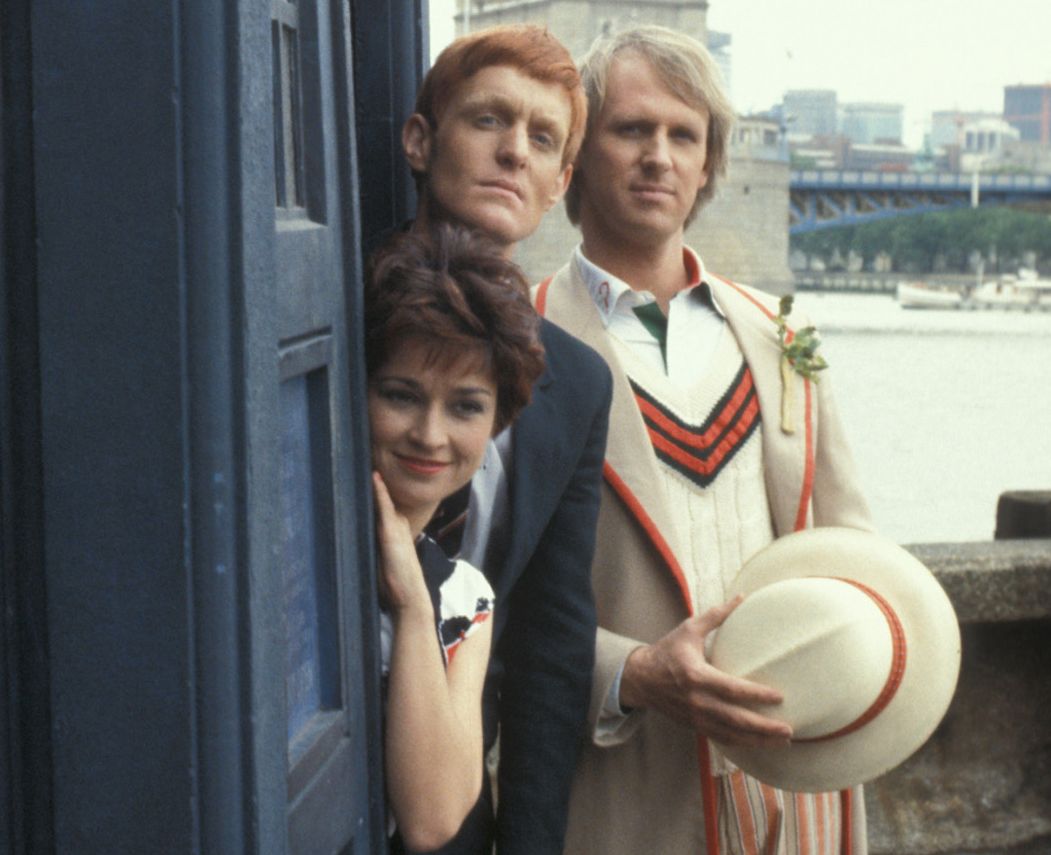


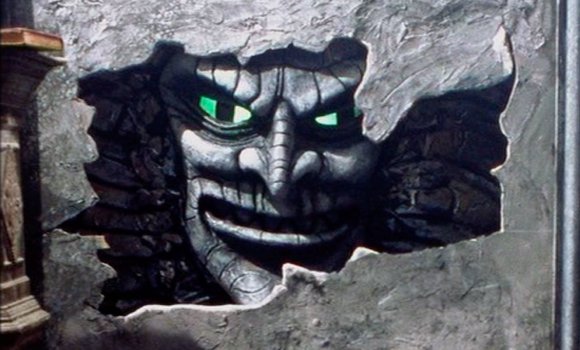


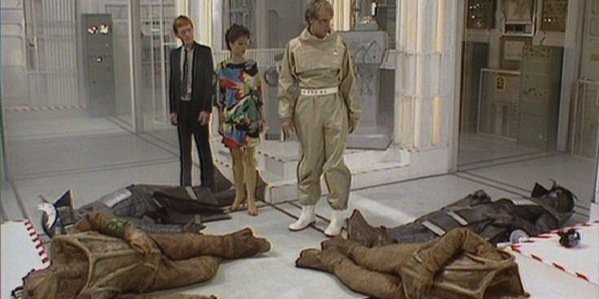
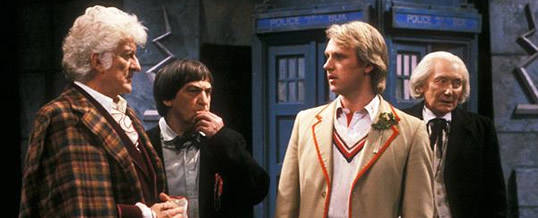
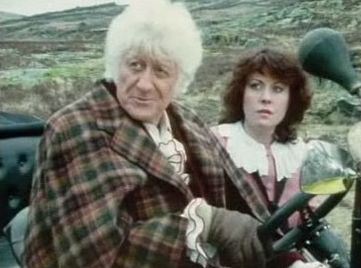
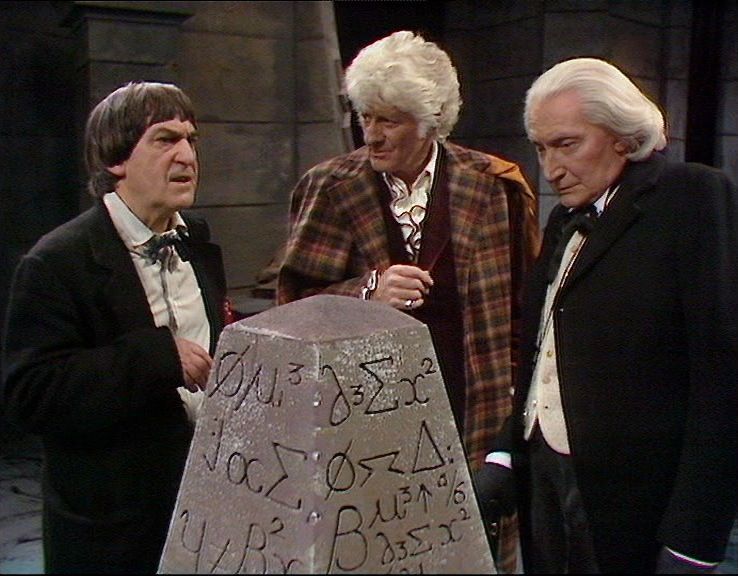
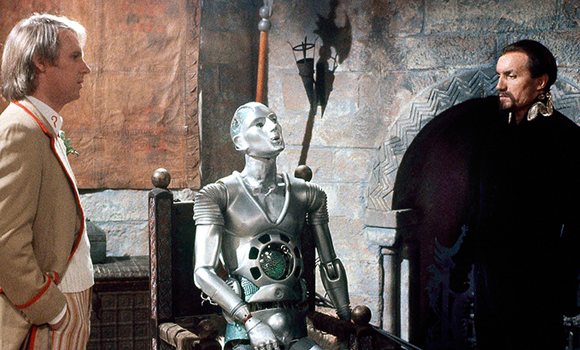
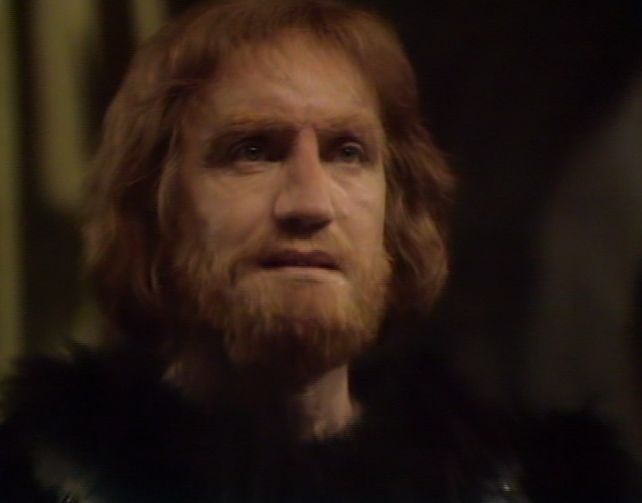
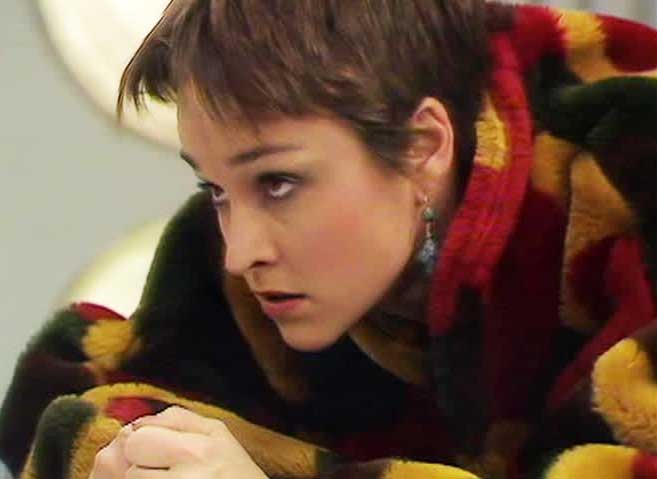
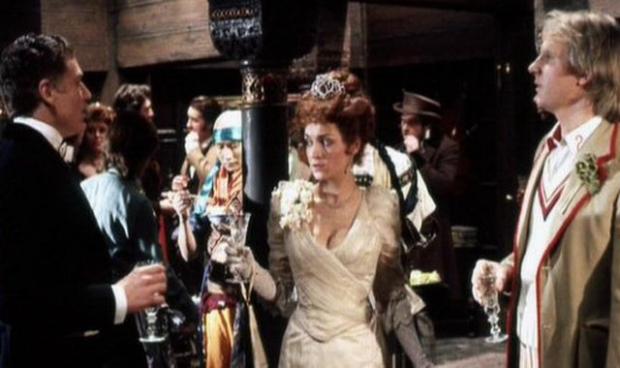


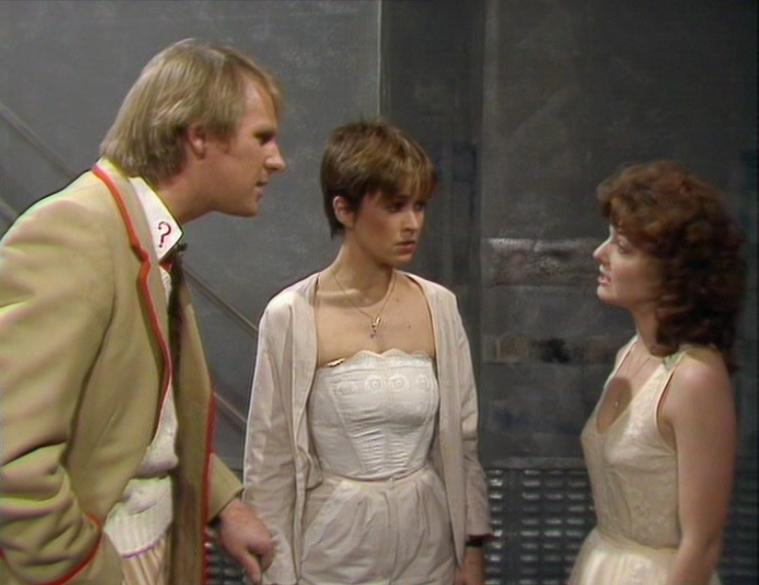
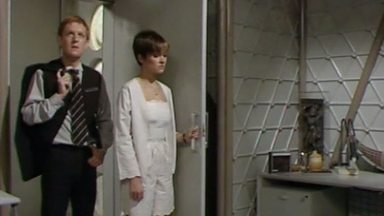
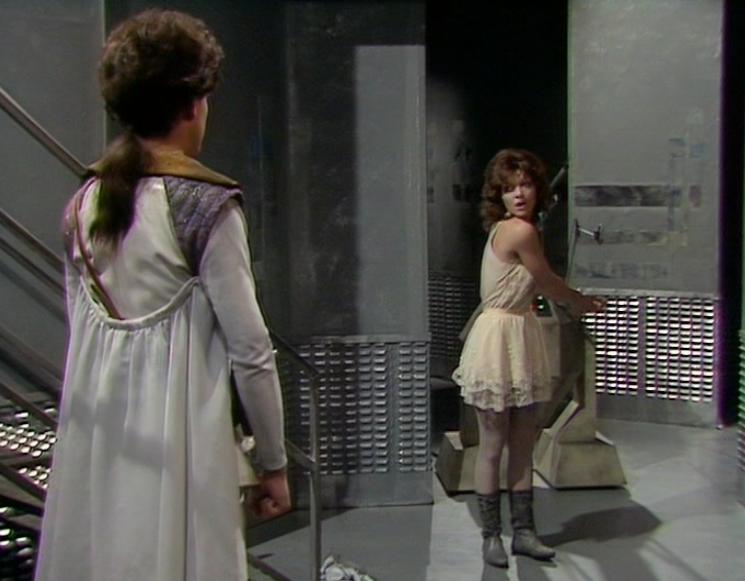
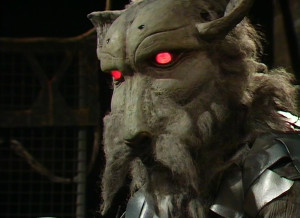
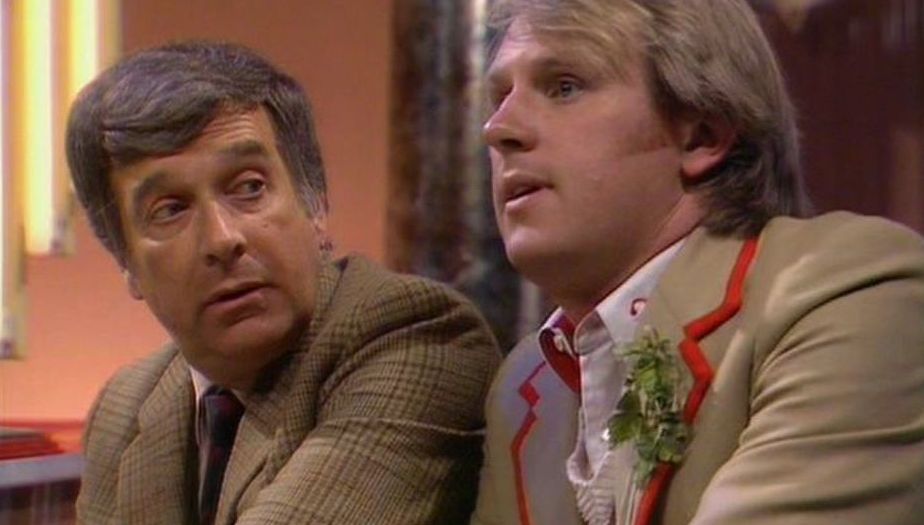
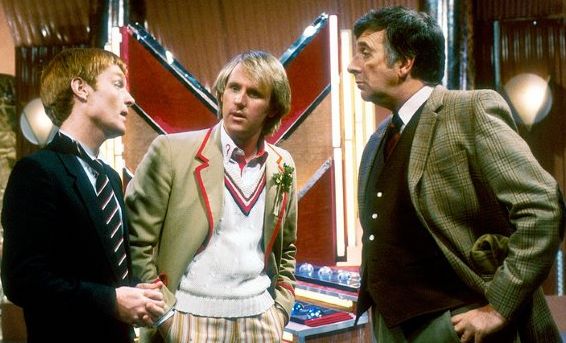
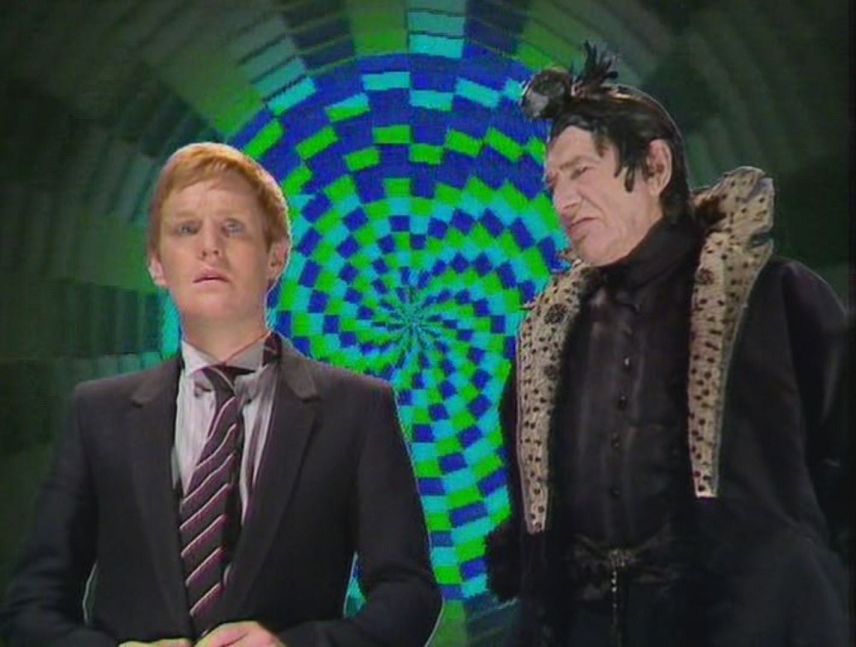
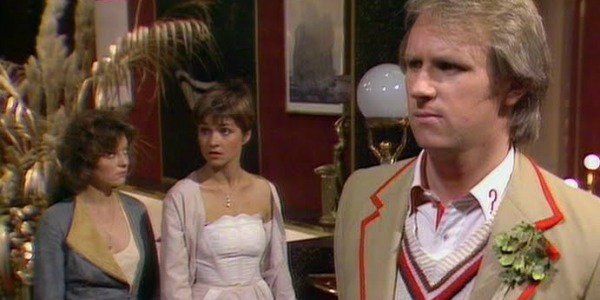
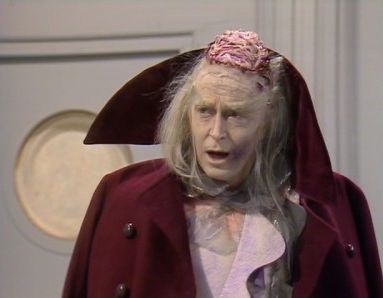
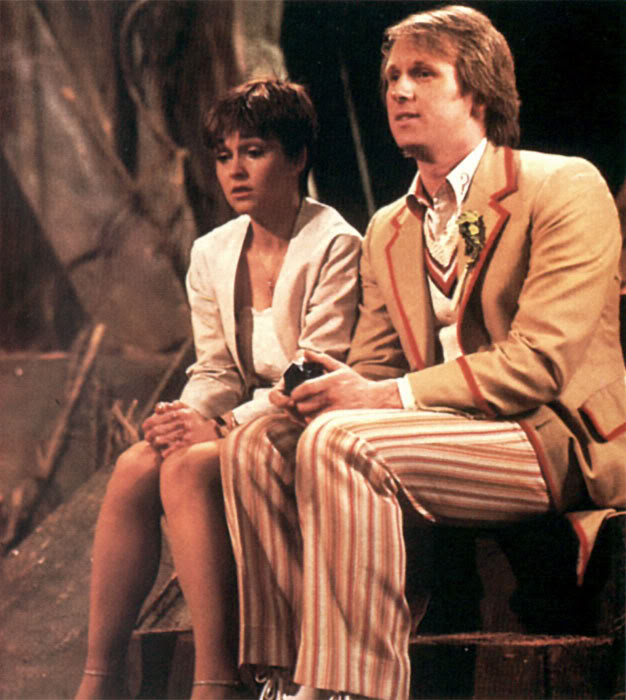
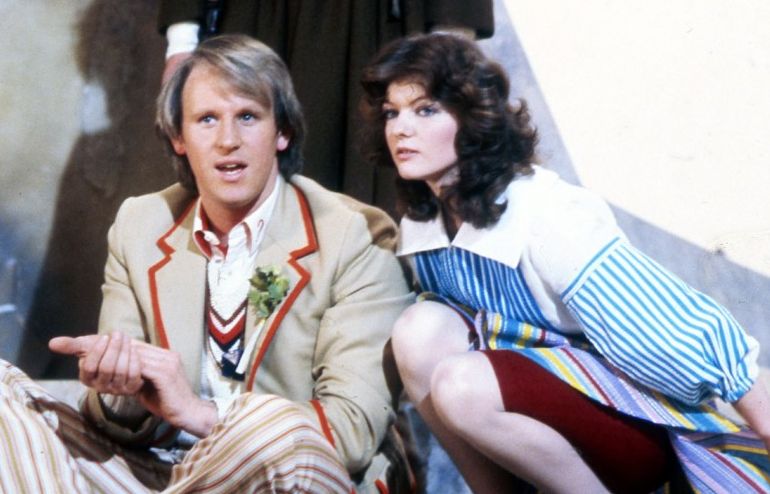
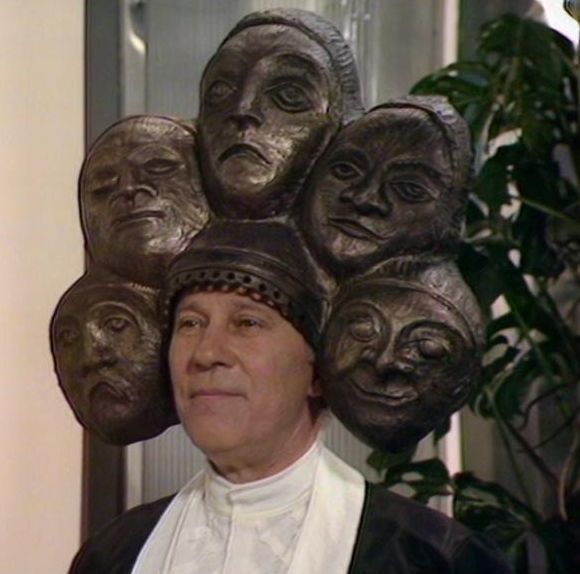
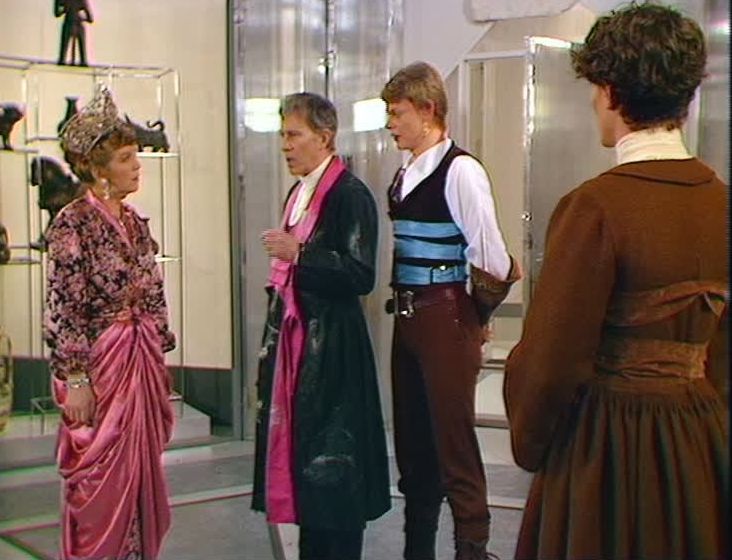
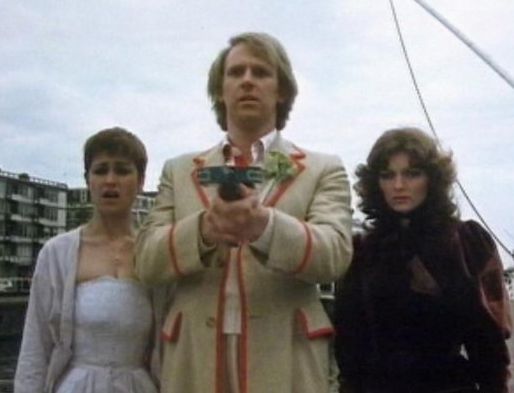
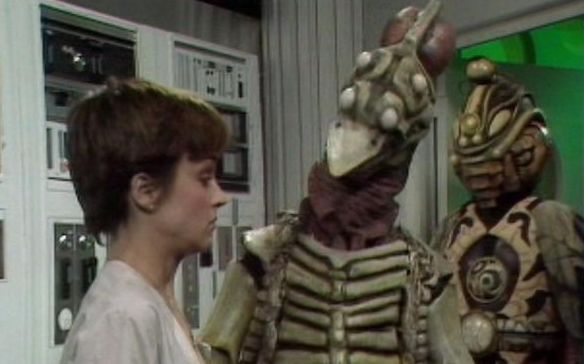
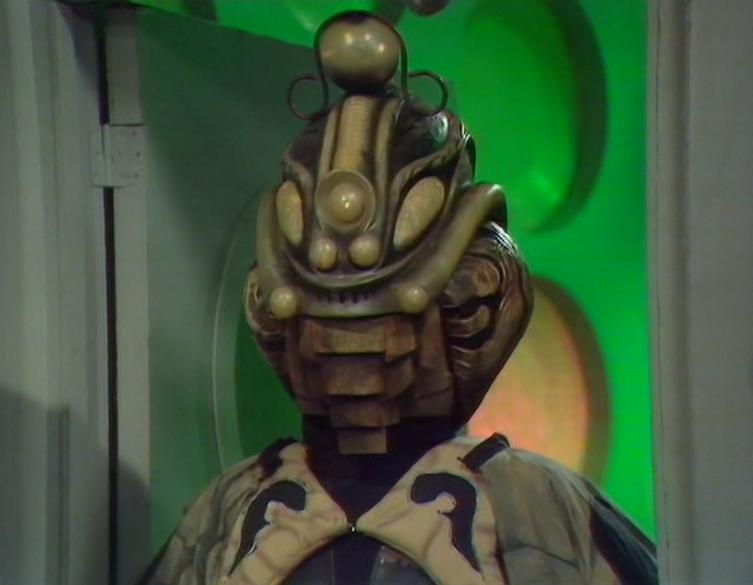
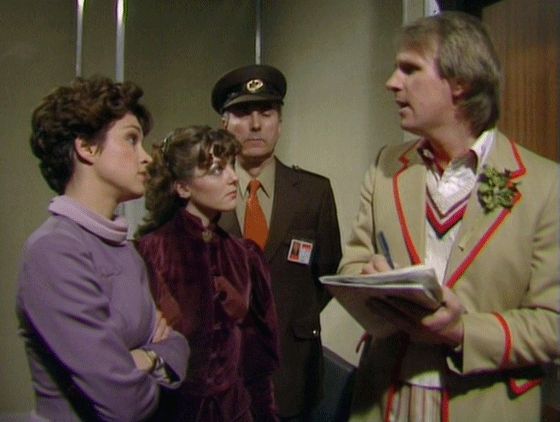
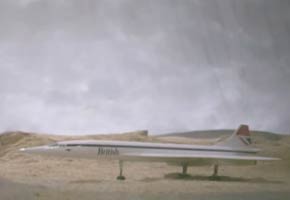
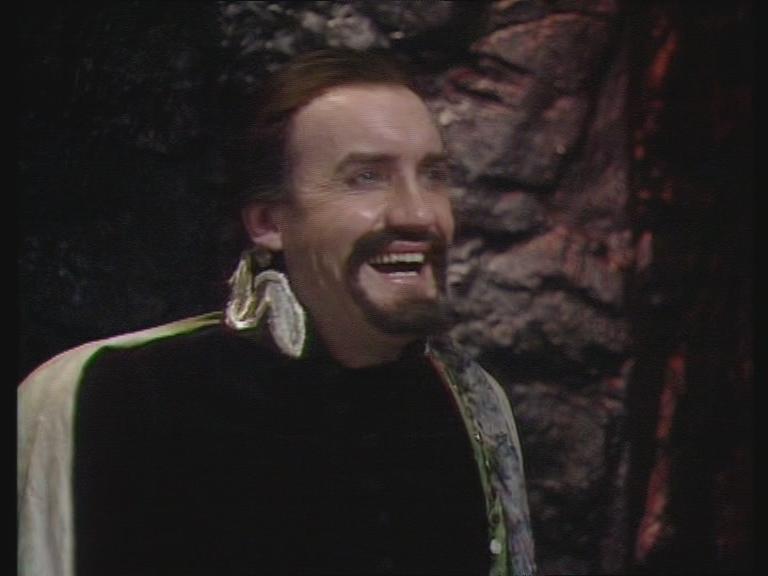
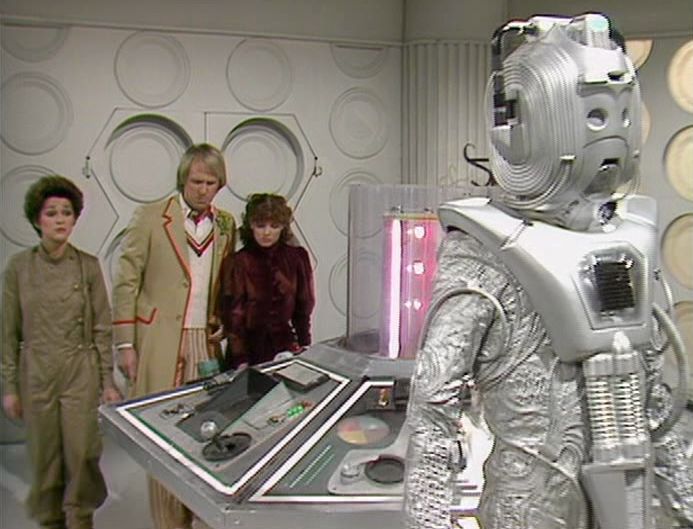
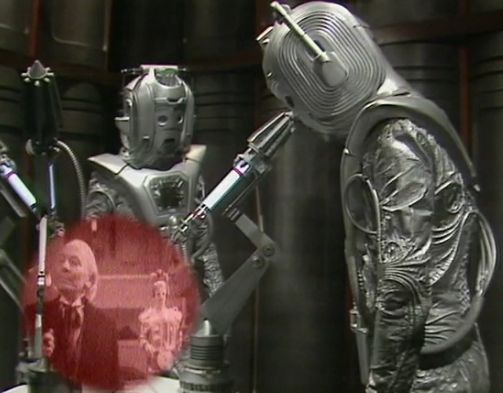
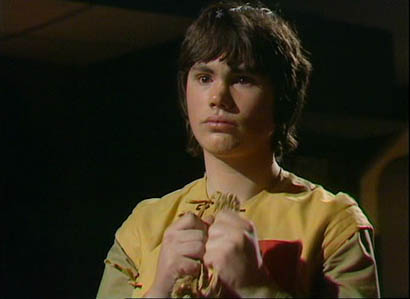
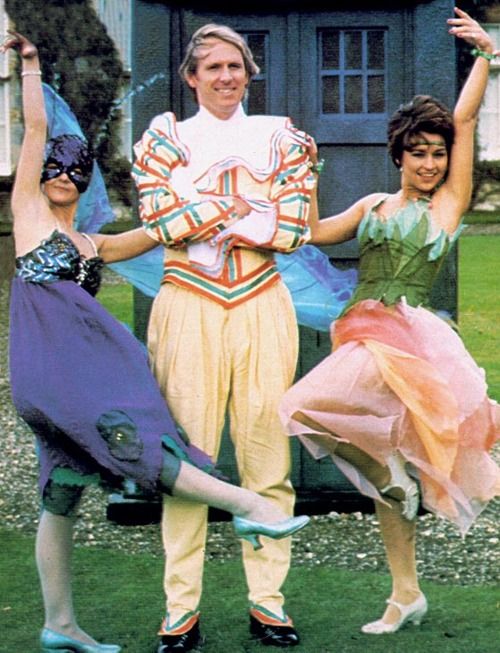
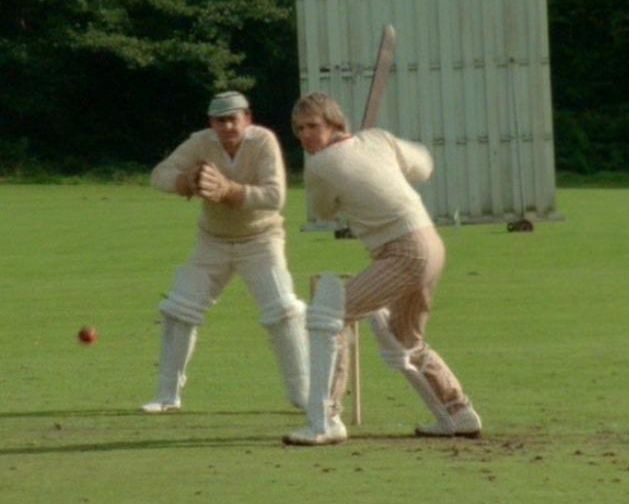
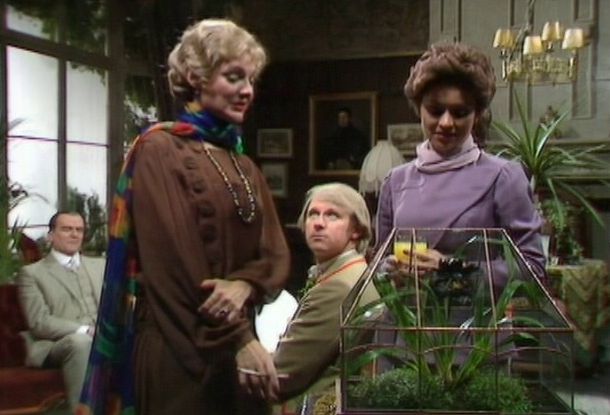
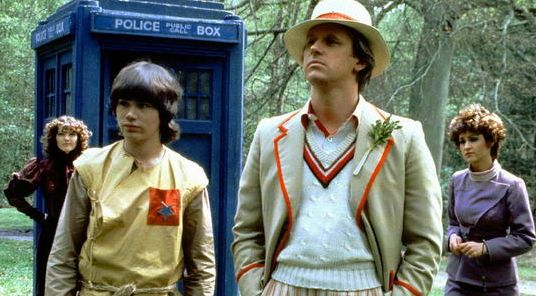
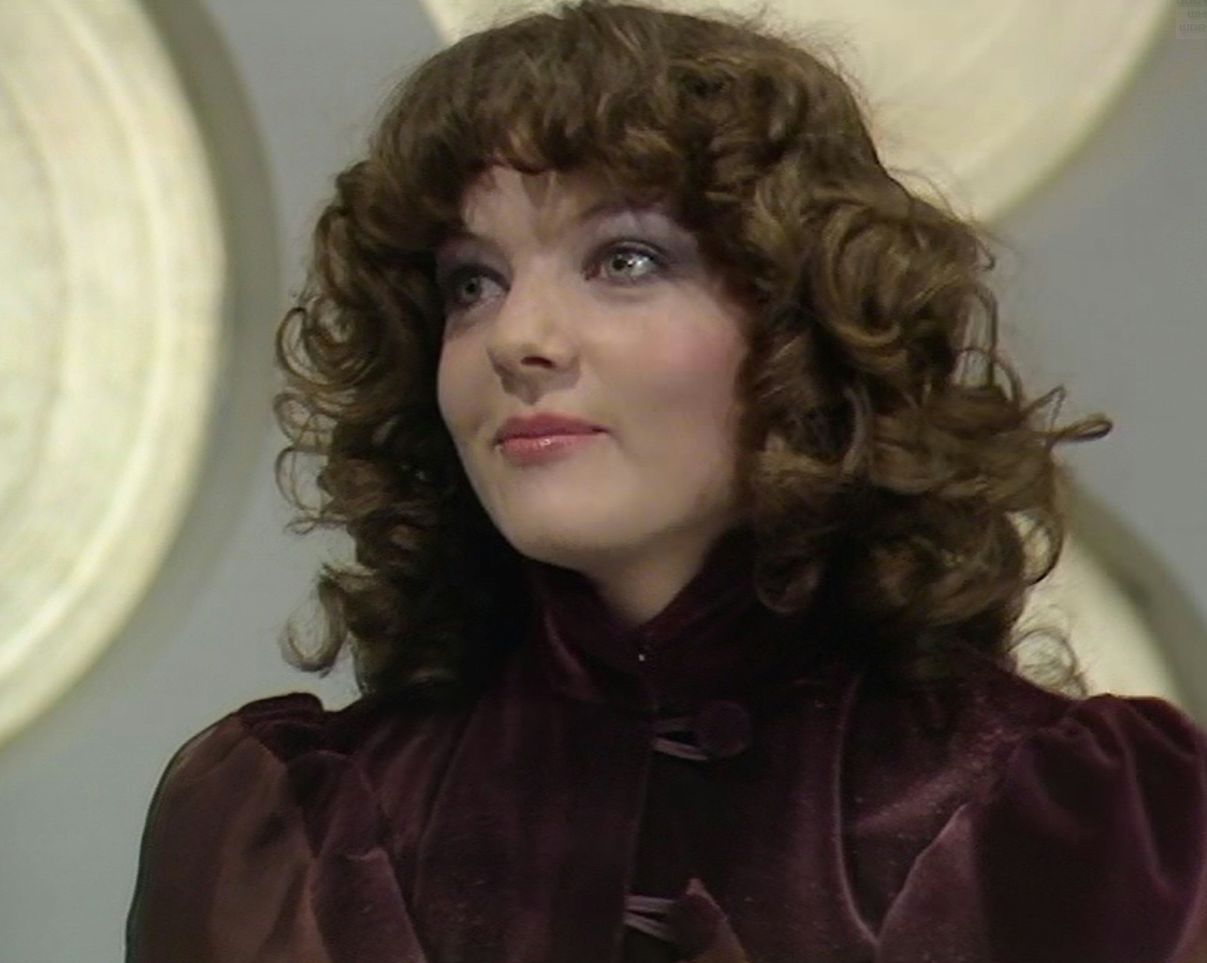
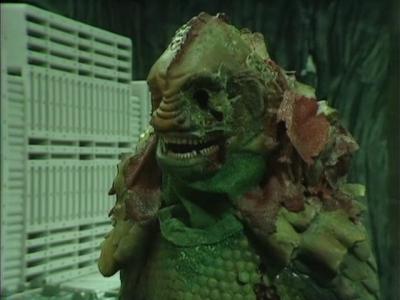
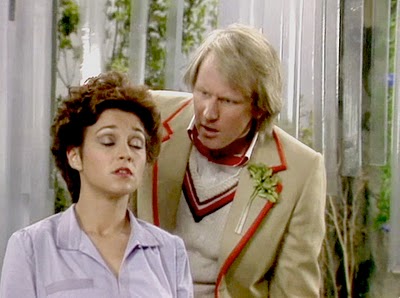
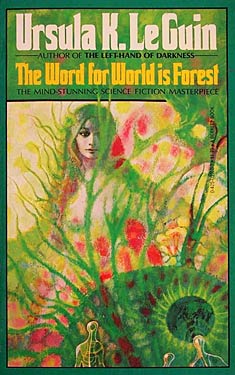
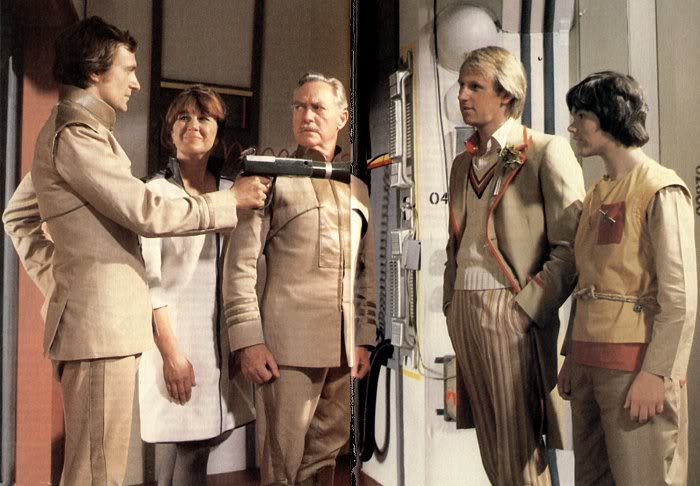
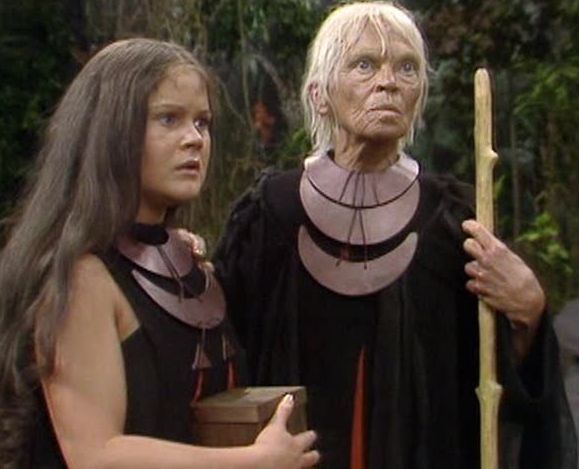
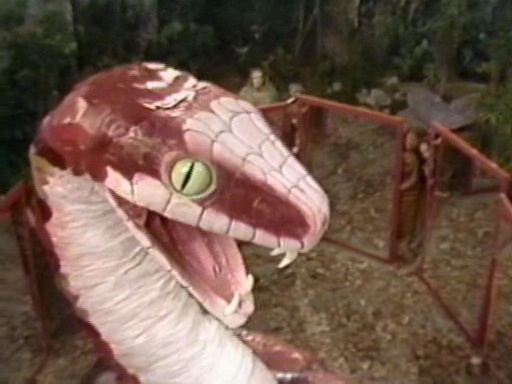
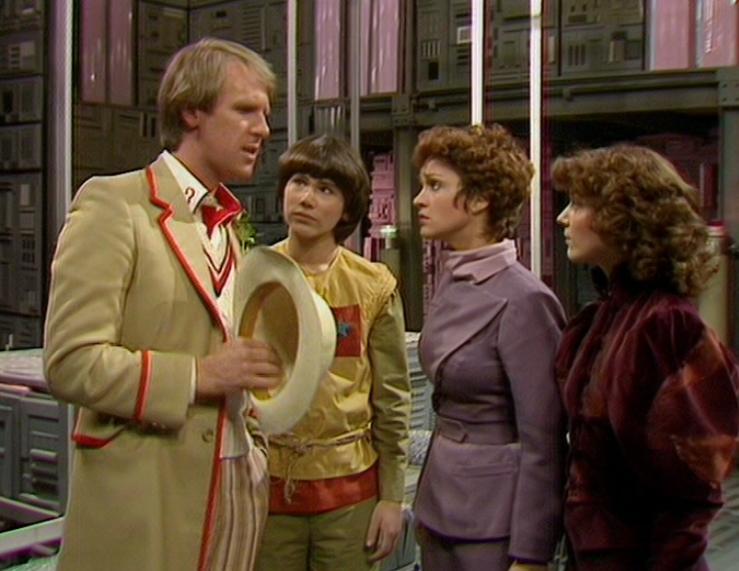
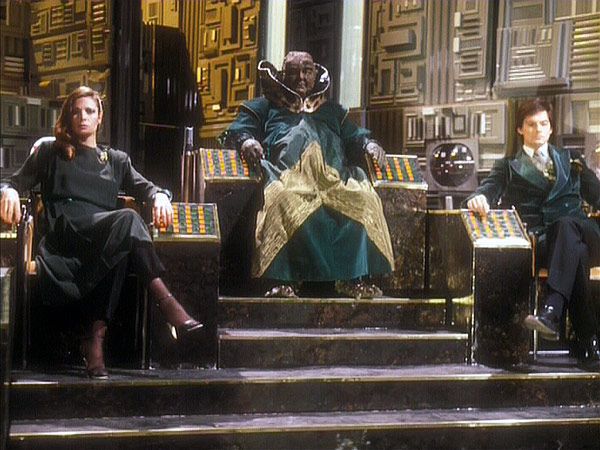
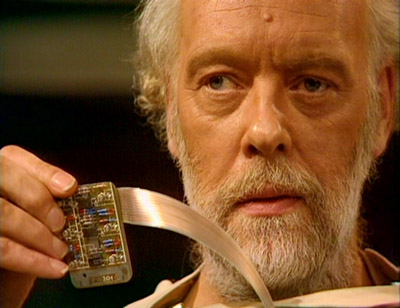
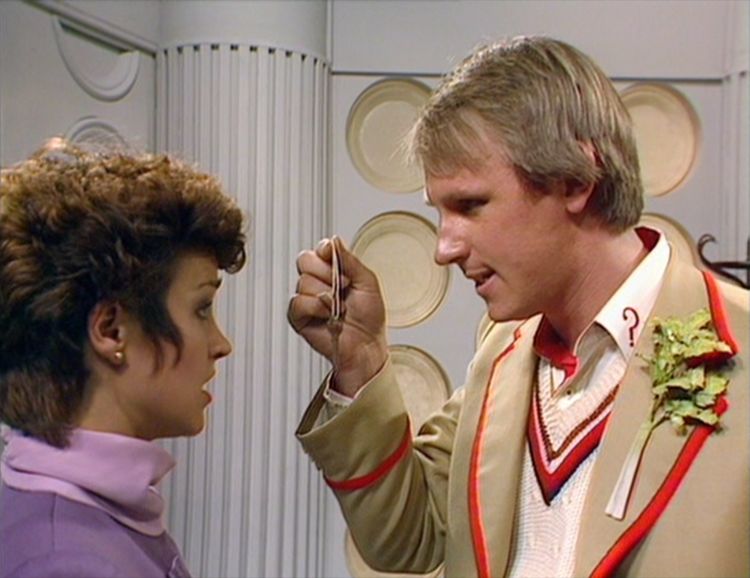
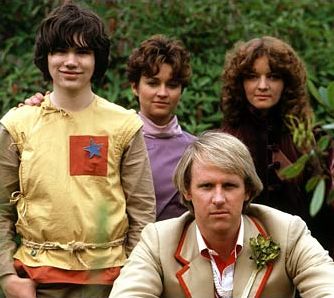
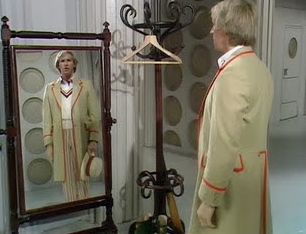
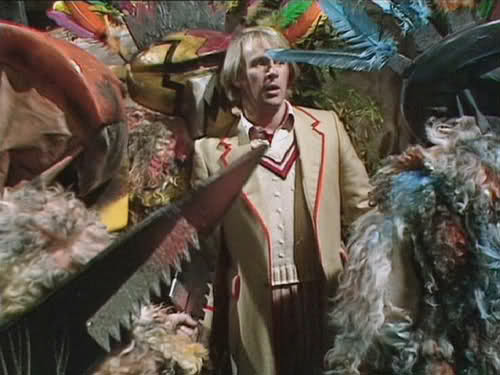
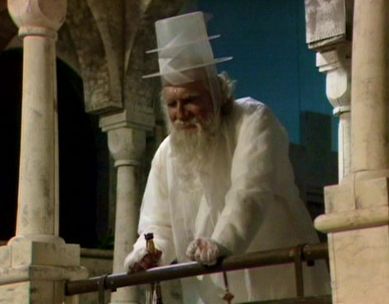
 Archive Television Musings