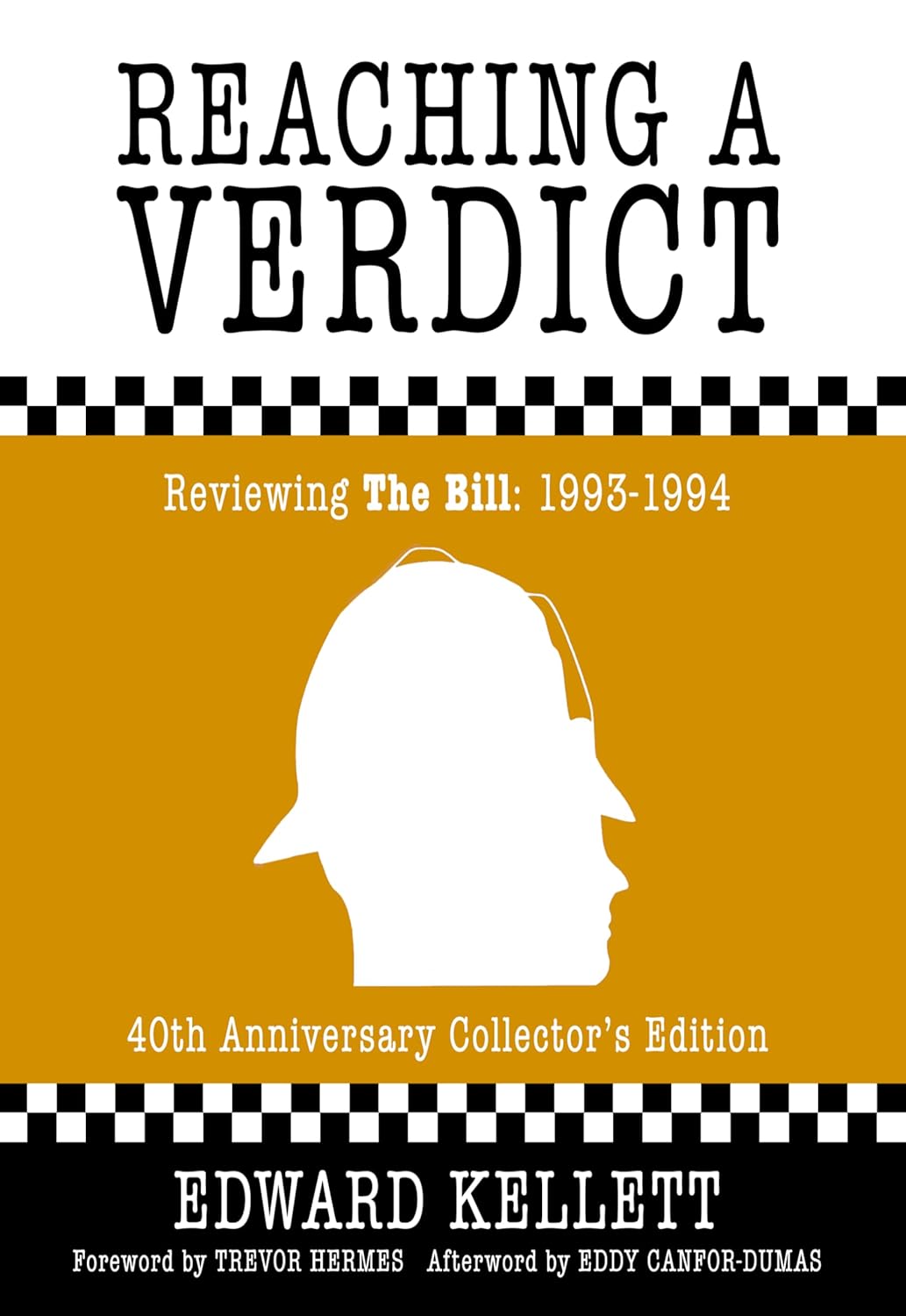
The third book in Edward Kellett’s series, we’ve now reached 1993 and 1994 – a period of change for The Bill as a third weekly episode was added to the schedule. As with the previous volumes, each of the two sections (dedicated to 1993 and 1994) begin by highlighting a number of key episodes (which are ideal picks for anyone keen to sample the programme, but who might balk at watching all 156 episodes from any given year).
Since it would be impractical to review every episode, instead Kellett uses his selected episodes to analyse certain themes and characters – this way he’s able to touch upon many episodes (with the result – as with his previous books – that I found myself breaking off from reading in order to rewatch some of the installments mentioned).
Chief Inspector Cato (the Bald-Headed Bastard from Barton Street) debuted at the beginning of 1993 (New Tune, Old Fiddle by J.C. Wilsher). A character tailor-made to put everybody’s back up, he certainly didn’t disappoint on that score, and some of his greatest hits are faithfully reported. Plenty of dialogue quotes help to give a flavour of the scripts under review, such as Brownlow’s nonplussed “I spoke to Cato this morning… To be quite honest with you I’m not sure there’s anybody at home.”
Although some characters would remain ever present, as ever with a series like The Bill, there would be a regular turnover as old faces departed and newcomers arrived. As described by Kellett, the sudden exit of Ted Roach left a void that was difficult to fill.
Throughout the show’s first decade, Ted’s character arc is its greatest driving force: a remarkable achievement for a series of self-contained stories where no one person is bigger than the ensemble. As noted in Volume 1, on paper he should be a walking cliché, the hard-drinking ladies’ man who doesn’t play by the rules. But The Bill was always adept at showing the messy edges of life, where the image people have of themselves breaks down.
An interesting section of this volume of Reaching A Verdict concerns the decision to go thrice weekly. For some it was a controversial move and marked the end of an era. The programme might have remained a key ITV staple until 2010, but the increase in episodes meant that new writers were needed (with the knock-on effect that the distinct ‘voices’ of the small core group of writers who had guided the series to date would inevitably be diluted).
Kellett’s view (“the amount of quality material is the same – but mingled with more filler, therefore less connected, and less impactful”) is a fair one. By this point in the series’ history, The Bill had tended to eschew running themes (with most episodes existing as as self-contained 25 minute plays). This sort of format has positives and negatives of course – it does mean that today you can dip into individual episodes from this era and not feel that you’re only getting half of the story. And I certainly prefer this style of storytelling to the later, extensive story arcs which seemed to feature rogue and pyscho killer police officers on a regular basis ….
The increased workload seemed to affect a number of actors, most notably Christopher Ellison. Burnside’s abrupt departure is succinctly described by Kellett (“the result is that he is bundled through the exit with indecent, not to say absurd haste”). It’s certainly a destablising time for the programme, with the short-lived DI Harry Haines (Gary Whelan) “parachuted in to fill a Burnside-shaped hole”.
This third book closes with an overview of P.J. Hammond’s contribution to the series during 1993 and 1994. Kellett observes that “it’s not oversight that has kept Hammond’s work out of these pages for so long, but the simple fact that it’s impossible to place in context with anyone else’s”. Indeed, even though the series had become a little bit like a sausage factory, with new episodes appearing one after the other, it was good to see Hammond ever-present with a selection of tales that could frequently be odd, macabre and disturbing, His scripts for The Bill (just like his efforts on the likes of Z Cars and Angels) certainly stands out as the work of a unique talent.
As touched upon before, I can’t think of any higher praise for a book of this type than that it’s frequently made me return to the series under discussion. Reaching A Verdict: Reviewing The Bill 1993-1994 is the third volume in an impressive series that is highly recommended for all fans of The Bill or, indeed, anyone with an interest in British television drama from this era.
Reaching A Verdict: Reviewing The Bill 1993-1994 is available now from Devonfire Books and can be ordered via this link.
 Archive Television Musings