After some silly captions (Python always loved captions) we move to It’s The Arts, which is designed to see how many times the name of a forgotten composer can be recited before it becomes incredibly irritating. His name? Johann Gambolputty de von Ausfern-schplenden-schlitter-crass-cren-bon-fried-digger-dingle-dangle-dongle-dungle-burstein-von-knacker-thrasher-apple-banger-horowitz-ticolensic-grander-knotty-spelltinkle-grandlich-grumblemeyer-spelter-wasser-kurstlich-himble-eisen-bahnwagen-guten-abend-bitte-ein-nürnburger-bratwürstel-gerspurten-mitz-weimache-luber-hundsfut-gumberaber-shönedanker-kalbsfleisch-mittleraucher-von-Hautkopft of Ulm. Terry Jones is his only surviving relative who pegs out halfway through reciting his name. Interviewee John Cleese doesn’t seem too concerned about this and pops off to grab a shovel to dig him a makeshift grave!
Michael Palin is very good as the boss of a crime syndicate that never actually breaks the law.
Right … this is the plan then. At 10:45 .. you, Reg, collect me and Ken in the van, and take us round to the British Jewellery Centre in the High Street. We will arrive outside the British Jewellery Centre at 10:50. I shall then get out of the car, you Reg, take it and park it back here in Denver Street, right? At 10:51, I shall enter the British Jewellery Centre, where you, Vic, disguised as a customer, will meet me and hand me £5.18.3d. At 10:52, I shall approach the counter and purchase a watch costing £5.18.3d. I shall then give the watch to you, Vic. You’ll go straight to Norman’s Garage in East Street. You lads continue back up here at 10:56 and we rendezvous in the back room at the Cow and Sickle, at 11:15. All right, any questions?
It fits into a familiar pattern for Python – visually they look and sound like criminals, so the reveal that they aren’t is the key. It maybe should have been more of a throw-away, but it’s worth it for Palin’s hysterical reaction when he discovers that one of his gang has left their car five minutes overdue on a parking meter.
Five minutes overdue. You fool! You fool! All right … we’ve no time to lose. Ken – shave all your hair off, get your passport and meet me at this address in Rio de Janeiro Tuesday night. Vic – go to East Africa, have plastic surgery and meet me there. Reg – go to Canada and work your way south to Nicaragua by July. Larry – you stay here as front man. Give us fifteen minutes then blow the building up. All right, make it fast.
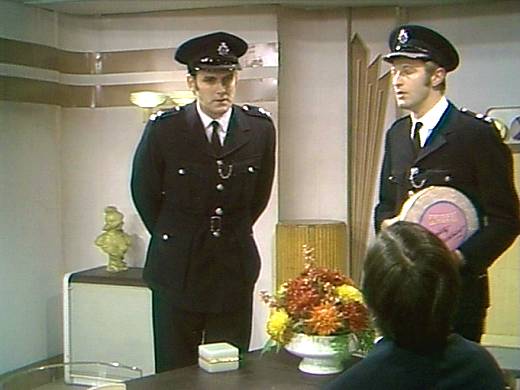
Crunchy Frog is one of Python’s stand-out sketches – which is no doubt reinforced since it featured during most of their live performances, up to and including the O2 gigs earlier this year. It’s possible to imagine it being performed by Cleese/Palin with Palin acting shifty and defensive as the Whizzo Chocolates boss (like the Dead Parrott/Chesse Shop sketches) but whilst that would have worked quite well, what we actually had was even better. Terry Jones is proud of his confectioneries and puzzled as to why anybody could find them at all problematic. Add in John Cleese’s pernickety high-pitched policeman and you have a classic sketch.
Most members of Python faced the possibility of a life in a dead-end job after they left University, so it’s not really a surprise that so many of their sketches feature grey little men who tend to be either Stockbrokers or Chartered Accountants. One of these is Michael Palin in The Dull Life of a City Stockbroker who blithely ignores all the excitement around him (a wonderfully made-up John Cleese as Frankenstein’s monster killing people at the bus-stop and a topless lady in the newsagents, for example) and instead retreats into the excitement of his DC-style comic. This leads into some nice Gilliam animation which then segues into the theatre sketch.
Graham Chapman is an inoffensive chap waiting for the curtain up and Eric Idle is a Red Indian who sits next to him. This bizarre culture clash (“Me heap big fan Cicely Courtneidge. She fine actress … she make interpretation heap subtle … she heap good diction and timing … she make part really live for Indian brave. My father – Chief Running Stag – leader of mighty Redfoot tribe – him heap keen on Michael Denison and Dulcie Gray”) is the motor which drives the sketch. It’s also of interest, since Chapman and Idle appear to be sitting in the Python audience which allows us a quick look at the people who came to these early recordings.
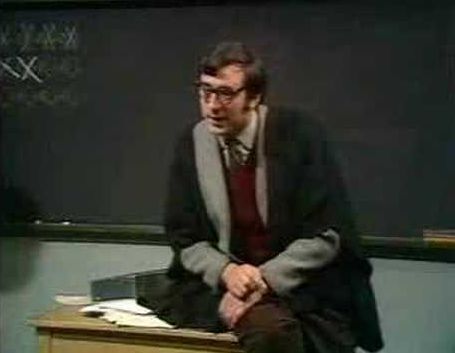
Graham Chapman (as in the Theatre sketch) tended to play the more normal, grounded characters (see The Holy Grail and The Life of Brian for further examples of this). So Twentieth Century Vole allows him a more grotesque character – the despotic film producer Irving C. Saltzberg. This sketch allows us to see all six Pythons together (as well allowing Terry Gilliam his most lines to date) plus guest Ian Davidson. The premise is simple – Saltzberg is a tyrant and his employees are all frightened yes-men who attempt to interpret their boss’ whims and provide him with the answer they think he wants.
Twentieth Century Vole has some good moments, although once you understand the premise of the sketch there’s no real surprises and it doesn’t spin off into an unexpected direction. But it’s worthwhile for Saltzberg’s increasingly bizarre story ideas and, of course, “Splunge”!
Well now we’re getting somewhere. No, wait. A new angle! In the snow, instead of the tree, I see Rock Hudson, and instead of the dog I see Doris Day and, gentlemen, Doris Day goes up to Rock Hudson and she kisses him. A love story. Intercourse Italian style. David Hemmings as a hippy Gestapo officer. Frontal nudity. A family picture. A comedy. And then when Doris Day’s kissed Rock Hudson she says something funny like…
Back in 1987 Dragonfire topped the DWM best story poll. Maybe this was because it was the most “traditional” story of the season and that was why it appealed to the fans. But though it’s a decent enough romp, the lack of logic in the plot (and some of the performances) are a bit of a problem.
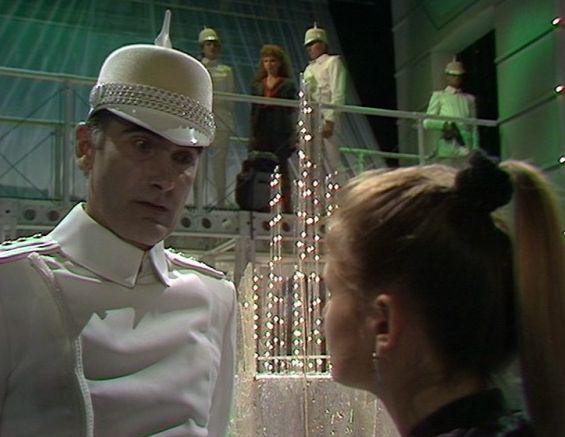
Edward Peel, as the villanious Kane, is one of Dragonfire’s highlights though. Peel doesn’t have to do a great deal – except loom menacingly – but he looms very well. He does has the benefit of playing against Patricia Quinn as Belazs, who has a nice line in frustration and despair. Tony Osboa as Kracauer isn’t so good though – he’s rather overplaying throughout all his scenes. And Kracauer is clearly not too bright. Having agreed with Belazs that it would be a good idea to kill Kane, he then waits around after sabotaging the temperature controls for Kane to wake up and kill him. Not a good move!
I also have to mention the ice statue created of Kane’s dead partner, Xana. He’s clearly delighted with it – “A work of artistry, my friend. Incandescent artistry. I could almost believe Xana lives again.” – but it doesn’t look very impressive to me and not even a terribly good likeness of Xana from the brief picture of her that we see.
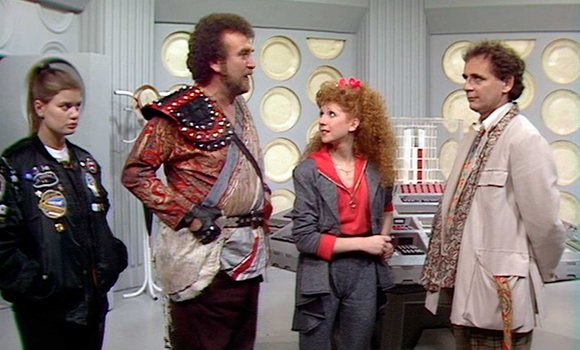
The Doctor and Mel are on the hunt for a Dragon, assisted, in his own unique way, by Glitz (Tony Selby) and Ace (Sophie Aldred). The icy lower levels allow McCoy plenty of opportunities to slip and slide, whilst episode one ends with a notorious cliffhanger – as the Doctor, well, hangs off a cliff. Apparently it should have been made clear that the Doctor had to go down since he couldn’t go back – but why wouldn’t he have waited for Glitz? And how did Glitz get down in order to rescue the Doctor?
Bonnie Langford was uncertain for a long time whether or not to return for S25. When Dragonfire was written it still wasn’t decided, so there were two endings scripted – either Mel went off with Glitz and Ace joined the Doctor, or Ace left with Glitz. As it was, shortly after the first studio session Langford decided to leave after all, so Ace would become the Doctor’s new traveling companion.
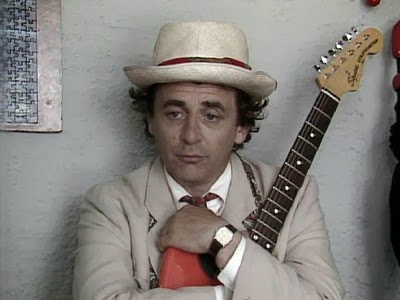
Kane has a tempting offer for Ace
Sophie Aldred was incredibly inexperienced (Dragonfire was the first time she’d been inside a television studio) but she acquits herself well. The character of Ace is not as well defined in this story as it would become – but given the fact that many companions never develop at all during their time on the show, the growth and journey of her character is quite remarkable. For some fans in the late 1980’s, it was Aldred’s show with McCoy playing second fiddle.
Some of the plot-threads in this story will be picked up and developed across the next two seasons, and already we have the sense of a damaged girl hiding behind a tough, streetwise facade.
MEL: You’re from Earth?
ACE: Used to be.
MEL: Whereabouts on Earth?
ACE: Perivale.
MEL: Sounds nice.
ACE: You ever been there?
MEL: No.
ACE: I was doing this brill experiment to extract nitroglycerine from gelignite, but I think something must have gone wrong. This time storm blows up from nowhere and whisks me up here.
MEL: When was this?
ACE: Does it matter?
MEL: Well, don’t you ever want to go back?
ACE: Not particularly.
MEL: What about your mum and dad?
ACE: I haven’t got no mum and dad. I’ve never had no mum and dad and I don’t want no mum and dad. It’s just me, all right?
MEL: Sorry. What about your chemistry A level, then?
ACE: That’s no good. I got suspended after I blew up the art room.
MEL: You blew up the art room?
ACE: It was only a small explosion. They couldn’t understand how blowing up the art room was a creative act.
Things tick along quite nicely for the first two episodes. The Doctor/Glitz and Mel/Ace make two good teams but everything collapses in episode three as there’s no escaping the major plot flaws. Kane’s been imprisoned on Svartos for three thousand years, so why has he only decided now to escape? And if the Dragon (the biomechanoid) is his jailer (and how exactly does this work?) then why does it contain the key which enables him to escape his exile?
And the silliest part of all – are we really supposed to believe that during the last three thousand years, when he’s been running the galactic equivalent of Bejam, he’s never once checked to see how things were going on his home planet of Proamon? It was destroyed by a super-nova two thousand years ago and nobody thought to tell him or he didn’t discover this for himself?
There’s an echo of The Hand of Fear here, but at least Eldrad had a good excuse for not knowing about the current situation on Kastria as only his fossilised hand remained, buried deep in the Earth’s surface for millions of years. Therefore you can’t blame him for not keeping up to date with the latest news (unlike Kane, of course).
Episode three also has the rather uninspiring bug hunt with McLuhan and Bazin and rather too much of the cutesy Stellar (Miranda Borman) for my taste. So ultimately Dragonfire is a bit of a damp squib, though the future was looking brighter.
S23 and S24 had been difficult times for the series, but S25 and S26 would see something of a creative rebirth. As it remained scheduled against Coronation Street there was a general public indifference and the critics were rarely kind either. Doctor Who might have become a beleaguered and largely unloved series, but it still had a few tricks and surprises up its sleeve.
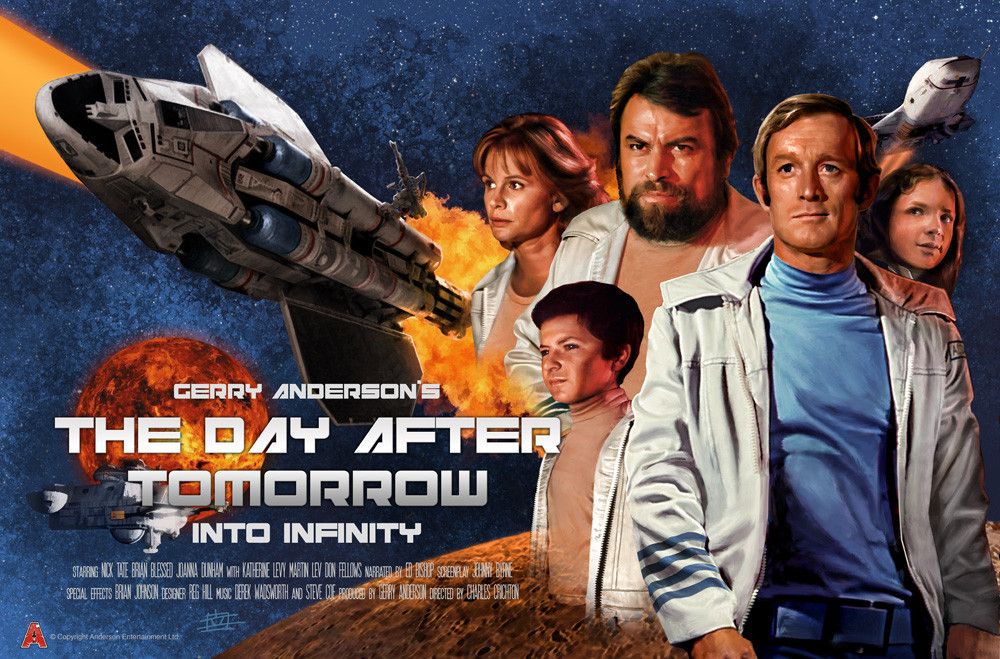
Gerry Anderson’s Into Infinity (also known as The Day After Tomorrow) is to receive a rare television screening. BBC4 will broadcast it on Sunday, 9th November at 10:50 pm.
Since the DVD has only been made available to Fanderson members, this terrestrial outing is very welcome.
Into Infinity was written by Johnny Byrne, directed by Charles Crichton and was originally broadcast on BBC1 in 1976. Planned as the pilot of a possible series, it featured some familiar names from previous Anderson ventures, such as Nick Tate and, as narrator, Ed Bishop. Brian Blessed, a guest star from Space 1999, also features.
Post Space 1999. Anderson was to find funding for his projects hard to come by, so Into Infinity never got beyond the pilot stage. But it’s certainly an interesting curio that’s worth a look.
EDIT – it will shortly receive a wider DVD release, see here for details.
The long opening sketch, Confuse a Cat, seems to be an excuse for a sequence of frankly bizarre images, such as a penguin on a pogo stick (not a sentence that tends to get typed very often!).
Before this though, Graham Chapman’s vet is able to put his finger exactly on the cat’s problem.
You see …. your cat is suffering from what we vets haven’t found a word for. His condition is typified by total physical inertia, absence of interest in its ambiance – what we Vets call environment – failure to respond to the conventional external stimuli – a ball of string, a nice juicy mouse, a bird. To be blunt, your cat is in a rut. It’s the old stockbroker syndrome, the suburban fin de siecle ennui, angst, weltschmertz, call it what you will.
The rest of the episode contains shorter sketches linked by a series of vox-pops. The Cleese/Palin sketch with Palin as the world’s most inept smuggler and Cleese as the customs officer is probably the best of the bunch, although as it features a punch-line it feels a little out of place as a Python sketch. Possibly, like some of the other early sketches, it predated the series?
After this, Terry Jones attempts to chair a discussion on the points raised with a duck, a cat and a lizard. Since all are stuffed, this doesn’t generate a great deal of debate. Luckily though, there are plenty of men in the street who are able to offer an opinion, such as this stockbroker (played by John Cleese).
Well I think they should attack the lower classes, first with bombs and rockets, destroying their homes and then when they run helpless into the streets, mowing them down with machine guns. Ad then of course releasing the vultures. I know these views aren’t popular, but I have never courted popularity.
A Cleese/Chapman sketch featuring Cleese as a bizarre interviewer and Chapman as a bewildered interviewee doesn’t really go anywhere – there would be better examples of the domineering Cleese to come in future episodes.
Like a lot of Man’s crisis etc, the Encyclopedia Salesman sketch is a throwaway, but I’ve always rather liked it.
Delta and the Bannermen is another good story from Doctor Who’s most unfashionable season. It may be pretty light fare but there’s something infectious about the production that induces a feel-good factor. Well, for some people anyway. Others can’t get beyond the Ken Dodd factor.
Doddy is something of an infamous guest star, but he’s only on screen for a couple of minutes so he’s not really much of a problem. His appearance does indicate that this isn’t going to be the most serious of stories, but while there may be plenty of comic moments everybody tends to play it pretty straight, well most of them anyway.
Richard Davies, as Burton, was a familiar face from British sitcoms (a regular on Please Sir and a guest at Fawlty Towers, for example) and his performance is pitched at that level. After all, it’s difficult to deliver lines such as “now, are you telling me that you are not the Happy Hearts Holiday Club from Bolton, but instead are spacemen in fear of an attack from some other spacemen?” without having a certain comedy knack. Davies has the knack and his bewildered but enthusiastic presence is one of Delta’s many strengths.
Hawk (Morgan Deare) and Weismuller (Stubby Kaye) are also good value, although they don’t have a great deal to do with the main plot and their subplot (looking out for an American satellite) is rather odd, to say the least. But it’s Stubby Kaye! In Doctor Who! He may be dressed as the oldest teenager in town but he gives a charming turn.
The main plot (Gavrok hunting down the Chimerons) remains somewhat vague. We never know why Gavrok hates the Chimerons, so he’s ultimately a rather sketchy villain. This lack of motivation meant that it required a good actor to make something out of a fairly nothing role and Don Henderson certainly delivers. Henderson was a popular television face (The XYY Man, Strangers and Bulman) and he’s able to generate a suitable level of boo-hiss villainy.
Sadly, the object of his pursuit (the Chimeron Queen, Delta) is something of a weak link. Belinda Mayne gives a rather colourless, passionless performance and it’s hard to really connect with her or sympathise with the plight of her people. The other main female lead (Sara Griffiths as Ray) was much better. It’s easy to see why Ray was originally planned as companion material, although if she had joined she would needed to have brushed up on her end of episode acting. At the end of episode one she’s threatened with death, but there’s a singular lack of anxiety on her face – just a look of mild inconvenience!
The rather lovely Sara Griffiths
Given the comic-strip nature of the story, Gavrok’s destruction of the Nostalgia Tours bus at the end of the second episode is very jarring. The murder of thirty or forty people should be shocking (particularly those we know, like Murray) but it never really registers. Partly because the effect doesn’t convince but also because it seems out of place in the story to date.
The likes of The Myth Makers had three episodes of comedy followed by a dark, violent fourth episode. If things had taken a similar turn in Delta then this scene may have worked better, but events carry on as normal in episode three (with, for example, the bees attacking the Bannermen – a rather silly scene).
With two female guest roles and only three episodes, Bonnie Langford is a little sidelined in this story (she doesn’t do much at all in the last episode). Sylvester McCoy is on fine form though. I love his scenes with Ray in episode one, where he does his best to console her after she’s discovered that Billy (David Kinder) only has eyes for the lady from another planet. His hesitant comforting of the sobbing girl shows a tender side to the Doctor that we don’t see very often.
“Love has never been known for its rationality”
And his confrontation with Gavrok at the end of episode two is very good, especially the last line.
GAVROK: Give me Delta and I will give you your life.
DOCTOR: Life? What do you know about life, Gavrok? You deal in death. Lies, treachery and murder are your currency. You promise life, but in the end it will be life which defeats you.
GAVROK: You have said enough. I have traversed time and space to find the Chimeron queen. I will not be defeated.
DOCTOR: As you will. I came here under a white flag and I will leave under that same white flag, and woe betide any man who breaches its integrity. Now step aside! Release those prisoners.
(A Bannerman moves to obey.)
DOCTOR: Gavrok, it’s over. You’re finished, and we’re leaving.
(But as the Doctor, Mel and Burton walk to the motorbike and sidecar, they hear the sound of cocking weapons behind them.)
DOCTOR: Actually, I think I may have gone a little too far.
All this, plus a guest appearance by the legendary Hugh Lloyd (Hugh and I, Hancock’s Half Hour) and a stack of great 1950’s music makes me genuinely puzzled as to why this remains amongst the also-rans in every Doctor Who poll. You wouldn’t want every story to be like it, but once in a while it’s good to let your hair down and have a bit of a party – and Delta and the Bannermen certainly delivers that.
Like the rest of S24, Paradise Towers remains somewhat unloved by Doctor Who fandom. Out of 241 stories, the 2014 DWM poll places Time and the Rani at 239, Paradise Towers at 230, Delta at the Bannermen at 217 and Dragonfire at 215.
Is Paradise Towers really the 11th worst Doctor Who story of all time? I don’t think so, and whilst it has serious faults (hello Richard Briers, especially in episode four!) there’s plenty of things that do work.
Firstly, Sylvester McCoy is very good. His performance is far removed from the prat-falling Doctor seen in Time and the Rani. Here, the Doctor is content to watch and listen, and at times there’s a nice sense of stillness from him. As will become clear when we move through his era, McCoy is at his best when he’s downplaying and at his worst when he has to shout and emote.
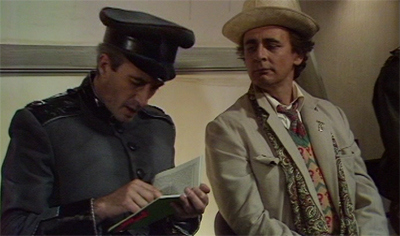
Most of his best scenes are with the Caretakers, and this one is a particular favourite.
DOCTOR: I suppose how you guard me is in that rulebook.
DEPUTY: Yes. Rule forty five B stroke two subsection five.
DOCTOR: I wouldn’t mind having a look at that rulebook, if that’s not against the rules. I mean, after all, I am a condemned man.
DEPUTY: Hmm.
(The Deputy consults the rule book.)
DEPUTY: Yes, we can count that as your last request. You’re entitled to one if you’re to undergo a three two seven appendix three subsection nine death. Not a pretty way to go.
(The Deputy passes over the rule book and the Doctor leafs through it.)
DOCTOR: How extraordinary. No, no. It can’t be true.
DEPUTY: What’s that?
DOCTOR: Oh no, no. It’s. You couldn’t possibly.
DEPUTY: If it’s there, it’s true. Rules are rules. Orders are orders.
DOCTOR: If you say so. I don’t want to make a fool of you.
DEPUTY: Read out what it says.
DOCTOR: Oh, very well, but I find it hard to credit
DEPUTY: Read it!
DOCTOR: It says here about a three two seven appendix three subsection nine death, that after you’ve been guarding the condemned prisoner for (checks his wristwatch) thirty five minutes, you must all stand up.
DEPUTY: But if we
DOCTOR: Yes, I know, I know, I find it extraordinary. I don’t really expect you to do it. But it is in there.
(The Deputy and the Caretaker stand up.)
DOCTOR: The Caretakers present must then move five paces away from the prisoner.
(They do so.)
DOCTOR: Five. Close their eyes and put their hands above their head.
(The Doctor tiptoes up to the back of the Deputy and carefully picks his trouser pocket, removing his wallet containing a selection of cards.)
DEPUTY: How long do we do this for?
DOCTOR: For about a minute and a half. You see, that’s how long the prisoner needs.
(The Doctor takes his umbrella from the Caretaker.)
DEPUTY: To do what?
DOCTOR: Find the key card to the door and escape.
DEPUTY: Sorry?
DOCTOR: Find the key card to the door and escape.
Rules are rules
Clive Merrison, as the Deputy Chief Caretaker, gives a lovely comic performance throughout. As everybody’s come up against the relentless grind of bureaucracy at some time, the rule-book spouting Deputy is something of a joy. Richard Briers, as the Chief Caretaker, is pretty good in the first three episodes (although there are signs of the problems to come) but everything falls to pieces when he gets to episode four.
Once the Chief has been taken over by Kroagnon, Briers’ performance goes into free-fall. It’s astonishingly bad and the question has to be why did JNT and director Nick Mallet allow him to do it? This is probably the reason why the story is so poorly regarded, but even so, there’s some good material and performances in the rest of the story.
Tilda (Brenda Bruce) and Tabby (Elizabeth Spriggs) are great fun as the two old dears who want Mel to stay for lunch, as it were. Their eventual fate (vanishing down the waste-disposal unit) is one of many points in the story which signify that this isn’t a Doctor Who that’s operating on a realistic level. The tone of the piece and the performances are pitched more in the style of a slightly twisted fairy tale rather than the straight-ahead realism of, say, The Caves of Androzani.
The Kangs are interesting, with a slang language all of their own – but the casting seems a little off. They appear have been written as gangs of teenage girls, but the actresses playing them look too old and sound too middle-class. There’s possibly nothing that could really have been done though, since younger actresses would have had limitations on the hours they could have worked, which would have been a problem for the production.
There’s some nice satirical points in the story, particularly on the problems of urban decay. At one time, tower blocks were seen as the only solution to the post-war housing problem, but only a few years after they were built they had become virtual prisons for some of their inhabitants. Kroagnon’s opinion that Paradise Towers would be fine if only it wasn’t full of people is one that was shared by certain other architects. But a building has to be designed to be lived in, not just to exist as a form of modern sculpture.
This type of tale is naturally not going to be to everyone’s tastes. A frequent criticism of Paradise Towers is that it looks and feels like a children’s programme (an odd comment to make about a Doctor Who story surely) but I’d sooner have something like this, which is attempting something different, than another Dalek or Cybermen story.
Back in the late 1980’s, a term was coined for these types of stories – “Oddball”. And whilst the series would later give the fans some of the things they wanted – the return of the Daleks, Cybermen, the Brigadier, etc – they would also throw a few Oddball stories into the mix. And some of the Oddballs have aged pretty well, certainly they stand up to scrutiny better than the likes of Silver Nemesis or Battlefield.
It’s hard to imagine Paradise Towers ever being reclaimed as a classic (or even a halfway decent story) by most people, but thanks to some good performances (McCoy and Merrison particularly) it’s well worth pulling off the shelf and revisiting.
The Band of Brothers concludes the adaptation of Henry V. It opens with the Chorus’ description of the English camp on the night before the Battle of Agincourt. Henry (in disguise) moves around the camp to gauge the thoughts of his men. One of them, Williams (another fine performance from Frank Windsor), is most eloquent on the subject of whether they are right to face the French on the following day.
But if the cause be not good, the king himself hath
a heavy reckoning to make, when all those legs and
arms and heads, chopped off in battle, shall join
together at the latter day and cry all ‘We died at
such a place;’ some swearing, some crying for a
surgeon, some upon their wives left poor behind
them, some upon the debts they owe, some upon their
children rawly left. I am afeard there are few die
well that die in a battle; for how can they
charitably dispose of any thing, when blood is their
argument? Now, if these men do not die well, it
will be a black matter for the king that led them to
it; whom to disobey were against all proportion of
subjection.
The next dawn dawns and Henry has one final chance to rouse his men before they do battle. This is another of Shakespeare’s most famous speeches – the St Crispian’s Day speech – and Robert Hardy attacks it full-bloodily.
This day is called the feast of Crispian:
He that outlives this day, and comes safe home,
Will stand a tip-toe when the day is named,
And rouse him at the name of Crispian.
He that shall live this day, and see old age,
Will yearly on the vigil feast his neighbours,
And say ‘To-morrow is Saint Crispian:’
Then will he strip his sleeve and show his scars.
And say ‘These wounds I had on Crispin’s day.’
Old men forget: yet all shall be forgot,
But he’ll remember with advantages
What feats he did that day: then shall our names.
Familiar in his mouth as household words
Harry the king, Bedford and Exeter,
Warwick and Talbot, Salisbury and Gloucester,
Be in their flowing cups freshly remember’d.
This story shall the good man teach his son;
And Crispin Crispian shall ne’er go by,
From this day to the ending of the world,
But we in it shall be remember’d;
We few, we happy few, we band of brothers;
For he to-day that sheds his blood with me
Shall be my brother; be he ne’er so vile,
This day shall gentle his condition:
And gentlemen in England now a-bed
Shall think themselves accursed they were not here,
And hold their manhoods cheap whiles any speaks
That fought with us upon Saint Crispin’s day.
Whilst we’ve discussed before the problems of staging battles with such limited production resources, it’s disappointing that the Battle of Agincourt is so limply presented. There surely should have been a way to present it better than this. We see a shot of feet walking on the spot facing right and then switch to another shot of feet walking on the spot facing left. The shot then cuts back and forward several times – which is meant to illustrate the two armies marching towards each other. Then there’s a tight shot of soldiers engaged in a very slow battle, whilst Henry is placed in the foreground, looking towards the camera. The whole battle sequence lasts only twenty seconds or so.
There’s a number of cuts to the text made – some scenes with Pistol, Gower and Fluellen are excised and Henry’s reaction (“I was not angry since I came to France. Until this instant.”) now occurs immediately after we’ve seen the luggage boys killed, which is used to underscore why he is so keen to ensure that not one Frenchman is left alive.
But the battle’s over, although it takes a little while for it to sink in. When Henry realises he’s won, he sinks to his knees and accepts the congratulations of Fluellen (Kenneth Farrington) who claims Henry as a true-born Welshman. With so much of Fluellen’s role cut (including his duel with Williams in Act Four, Scene Eight) it’s difficult for Farrington to make much of an impression – but at least he manages it here.
The confrontation between Fluellen and the “turkey cock” Pistol in Act Five, Scene One doesn’t play terribly well. Fluellen seems too aggressive and Pistol (George A. Cooper) plays it too broadly. It really needed a lighter comic touch than was presented here. And given that many of Fluellen’s lines have been cut, it probably would have been better to lose this as well, since it really only works when we’ve seen more of Fluellen.
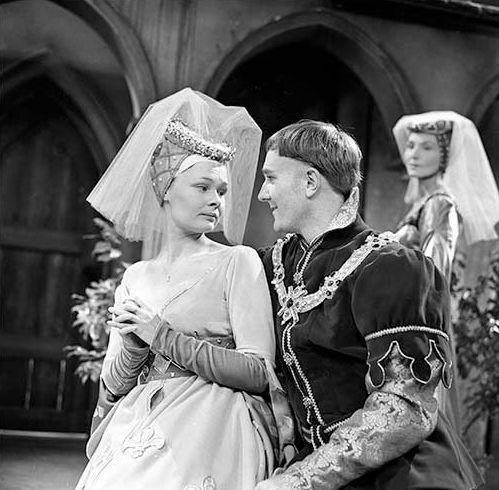
Things improve when we move to the French court and Henry attempts to woo Katherine. As with Signs of War, Judi Dench impresses as Katherine. After their courtship, the Chorus returns to being the play to its conclusion by resting a hand on a coffin which contains Henry. So as the Chorus concludes the tale of Henry V, Henry VI is waiting in the wings.
Next up – Episode Eight – The Red Rose and the White
As I pulled Monty Python’s Flying Circus Series One down from the shelf for a rewatch, I was thinking about this recent article in the Guardian which examined ten comedy shows and asked were they still funny? The verdict on Monty Python was a resounding no – because it was the typical sort of unfunny self-indulgent stuff dreamt up by university types, apparently.
Although it’s easy to dismiss this as the usual Guardian space-filler, it’s true that Monty Python is very much a marmite show, you either seem to love it or hate it. Me? I love it, particularly the first series. This is probably because I taped the first thirteen episodes when they were repeated in 1989 (to celebrate the 20th anniversary of Python) and I did tend to rewatch them an awful lot during the 1990’s.
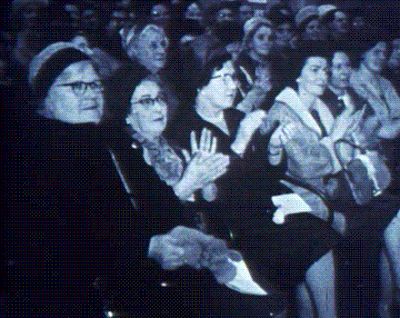
Looking back at the earliest episodes, the muted studio audience response is quite noticeable. According to legend, the first audiences for Python were bus-loads of pensioners who were disappointed that it wasn’t an real circus. Whether this is true or just a story that’s grown in the telling is debatable, but some sketches (which during their later stage shows would be greeted with rapturous approval) are played to near silence, with the odd laugh occurring every so often.
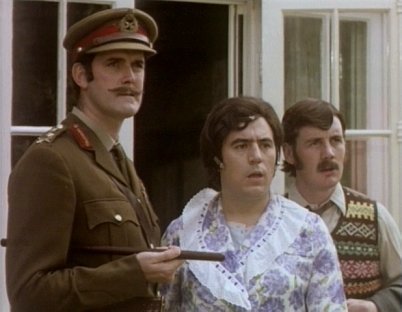
A typical Monty Python audience
As word of mouth concerning Python grew, the audiences for later series became much more vocal and appreciative. This isn’t always a good thing though – the somewhat boisterous and sycophantic audience on I’m Sorry I’ll Read That Again didn’t necessarily add to the quality of the programme, for example.
The other notable thing about these episodes is that they’re somewhat rough around the edges. The numerous film inserts are fine, since they could be edited at leisure, but the studio footage does have a rawer feel, with the odd missed cue or wonky camera angle. Retakes could be done, although like all programmes of this era there was a strict timescale allocated to record the studio material and over-runs wouldn’t have been appreciated by the BBC management.
So is there anything funny in the first four episodes? Let’s find out.
Episode One – Wither Canada?
After Wolfgang Amadeus Mozart introduces some famous deaths (to a rather nonplussed studio audience) we move to a more traditional sketch, featuring Terry Jones as the tutor of an Italian language evening course. The simple comedy device used here (and in many other Python sketches) is one of reversal – as all of his class (with the exception of Helmut) are Italian.
Terry Jones attempts to take coals to Newcastle
Teacher: Well, now, this week we’re going to learn some useful phrases to help us open a conversation with an Italian. Now first of all try telling him where you come from. For example, I would say: ‘Sono Inglese di Gerrard’s Cross’, I am an Englishman from Gerrard’s Cross. Shall we all try that together?
All: Sono Inglese di Gerrard’s Cross.
Teacher: Not too bad, now let’s try it with somebody else. Er… Mr… ?
Mariolini: Mariolini.
Teacher: Ah, Mr Mariolini, and where are you from?
Mariolini: Napoli, signor.
Teacher: Ah … you’re an Italian.
Mariolini: Si, si signor!
Teacher Well in that case you would say: ‘Sono Italiano di Napoli’.
Mariolini: Ah, capisco, mile grazie signor…
Francesco: Per favore, signor!
Teacher: Yes?
Francesco: Non conosgeve parliamente, signor devo me parlo sono Italiano di Napoli quando il habitare de Milano.
Teacher: I’m sorry … I don’t understand!
Like the majority of early Python it’s quite short and compact. Although some of the shows do have longer sketches (The Funniest Joke In The World, The Mouse Problem) it’s surprising how much is packed into each thirty minutes at this point in the series’ history
The good stuff keeps on coming – Whizzo Butter (“You know, we find that nine out of ten British housewives can’t tell the difference between Whizzo butter and a dead crab”) and Sir Edward Ross/Arthur “Two Sheds” Jackson. The Ross/Jackson sketches are essentially the same and playing them back to back is an early mission statement that the series wouldn’t be as linear as some of the Python team’s earlier efforts.
Next up is my favourite sketch from episode one, the Picasso cycling race. For those who view the Pythons as elitist, it’s probably the sort of thing they detest, particularity when John Cleese, in the guise of a reporter, gives a breathless summary of the group of cycling painters zooming past him.
It’s Kandinsky. Wassily Kandinsky, and who’s this here with him? It’s Braque. Georges Braque, the Cubist, painting a bird in flight over a cornfield and going very fast down the hill towards Kingston and… Piet Mondrian – just behind, Piet Mondrian the Neo-Plasticist, and then a gap, then the main bunch, here they come, Chagall, Max Ernst, Miro, Dufy, Ben Nicholson, Jackson Pollock and Bernard Buffet making a break on the outside here, Brancusi’s going with him, so is Gericault, Ferdinand Leger, Delaunay, De Kooning, Kokoschka’s dropping back here by the look of it, and so’s Paul Klee dropping back a bit and, right at the back of this group, our very own Kurt Schwitters.
Some Terry Gilliam animations and The Funniest Joke in the World bring the first episode to a satisfying conclusion. Well, so far it all seems funny to me.
Episode Two – Sex and Violence
There’s slightly less here that appeals, but Terry Jones with two large mallets encouraging his trained mice to squeak “The Bells of St Marys” is an appealing little throwaway. Cleese and Palin’s French aviation experts who demonstrate how sheep can fly is another nice sketch which doesn’t outstay its welcome.
Buried in the middle of this episode is a real gem, the Working-Class Playwright. It gives Graham Chapman the chance to do a little bit of acting (no real surprise he took the lead in both Holy Grail and Life of Brian as he was always the Python who seemed the best suited to being, as it were, a straight actor). Terry Jones drags up well, as he would so many times in the future, as the mother, and Eric Idle is suitably wide-eyed as the son unable to convince his playwright father that coal-mining is a wonderful and worthy job. Another simple inversion sketch, which works a treat.
Another long sketch closes proceedings, this time it’s The Mouse Problem (“Well, we psychiatrist have found that over 8% of the population will always be mice, I mean, after all, there’s something of the mouse in all of us. I mean, how many of us can honestly say that at one time or another he hasn’t felt sexually attracted to mice. I know I have. I mean, most normal adolescents go through a stage of squeaking two or three times a day.”)
Episode Three – How To Recognise Different Types of Tree From Quite A Long Way Away
The linking device of the trees (“Number One. The Larch. The Larch”) is probably the sort of thing that those who dislike Python would sieze upon. It’s not funny in itself, but then the question should be whether every single moment in each episode should contain a rib-tickling gag. But the device helps to bind the episode together.
This episode has a couple of good shorter sketches, Michael Palin as the modest Bicycle Repair Man and Eric Idle as a children’s story-teller, totally unable to find a tale that doesn’t descend into filth (“One day Ricky the magic Pixie went to visit Daisy Bumble in her tumbledown cottage. He found her in the bedroom. Roughly he gabbed her heavy shoulders pulling her down on to the bed and ripping off her…”).
It’s all in a days work for Bicycle Repair Man
The episode is dominated by three sketches, one of which would become an ever-present regular favourite in their stage shows.
We open with a courtroom sketch. This is the longest single sketch we’ve seen so far (running for about ten minutes) but it doesn’t feel drawn out. Although Harold Larch is only charged with a parking offence, his counsel has lined up an impressive list of character witnesses, including the late Arthur Aldridge (complete with coffin) and Cardinal de Richelieu.
Counsel: Er, you are Cardinal Armand du Piessis de Richelieu, First Minister of Louis XIII?
Cardinal: Oui.
Counsel: Cardinal, would it be fair to say that you not only built up the centralized monarchy in France but also perpetuated the religious schism in Europe?
Cardinal: (modestly) That’s what they say.
Counsel: Did you persecute the Huguenots?
Cardinal: Oui.
Counsel: And did you take even sterner measures against the great Catholic nobles who made common cause with foreign foes in defence of their feudal independence?
Cardinal: I sure did that thing.
Counsel Cardinal. Are you acquainted with the defendant, Harold Larch?
Cardinal: Since I was so high (indicated how high).
Counsel: Speaking as a Cardinal of the Roman Catholic Church, as First Minister of Louis XIII, and as one of the architects of the modern world already – would you say that Harold Larch was a man of good character?
Cardinal: Listen. Harry is a very wonderful human being.
Dirty Fork has a familiar comedy construction, as from a mundane start (a slightly dirty fork) it escalates into a major crisis as each subsequent member of the restaurant staff becomes more and more frantic – “You bastards! You vicious, heartless bastards! Look what you’ve done to him! He’s worked his fingers to the bone to make this place what it is, and you come in with your petty feeble quibbling and you grind him into the dirt, this fine, honourable man, whose boots you are not worthy to kiss. Oh… it makes me mad… mad!”
One of Python’s most famous principles was the abandonment of the punch-line (although Spike Milligan in his “Q” series had beaten them to it). There weren’t adverse to the odd punch-line though, particularly when it could be used for additional comic effect. Here, the upcoming punch-line is advertised with a caption and after Chapman has delivered it – “Lucky we didn’t say anything about the dirty knife” – the audience is free to register their disapproval.
The show ends with Nudge Nudge, which is probably something that many people can repeat, virtually verbatim.
Episode Four – Owl-Stretching Time
I love the Pepperpots at the Art Gallery sketch. A typical clash between two types of culture that shouldn’t co-exist, which is probably the reason why it appeals.
Janet: ‘Allo, Marge!
Marge: Oh hello, Janet, how are you love?
Janet: Fancy seeing you! How’s little Ralph?
Marge: Oh, don’t ask me! He’s been nothing but trouble all morning. Stop it Ralph! (she slaps at unseen infant) Stop it!
Janet: Same as my Kevin.
Marge: Really?
Janet: Nothing but trouble … leave it alone! He’s just been in the Florentine Room and smeared tomato ketchup all over Raphael’s Baby Jesus. (shouting off sharply) Put that Baroque masterpiece down!
Marge: Well, we’ve just come from the Courtauld and Ralph smashed every exhibit but one in the Danish Contemporary Sculpture Exhibition.
Janet: Just like my Kevin. Show him an exhibition of early eighteenth-century Dresden Pottery and he goes berserk. No, I said no, and I meant no! (smacks unseen infant again) This morning we were viewing the early Flemish Masters of the Renaissance and Mannerist Schools, when he gets out his black aerosol and squirts Vermeer’s Lady At A Window!
Marge: Still it’s not as bad as spitting is it?
Janet: (firmly) No, well Kevin knows (slaps the infant) that if he spits at a painting I’ll never take him to an exhibition again.
Marge: Ralph used to spit – he could hit a Van Gogh at thirty yards. But he knows now it’s wrong – don’t you Ralph? (she looks down) Ralph! Stop it! Stop it! Stop chewing that Turner! You are … (she disappears from shot) You are a naughty, naughty, vicious little boy. (smack; she comes back into shot holding a copy of Turner’s Fighting Temeraire in a lovely gilt frame but all tattered) Oh, look at that! The Fighting Temeraire – ruined! What shall I do?
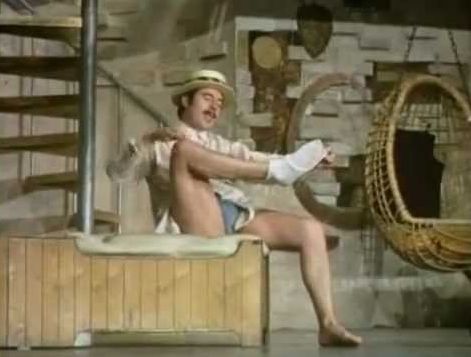
Terry Jones gets to undress in public, or at least he attempts to do so. This is an odd one, a purely visual sketch (unlike the usual verbal fare) which is full of seaside humour and could have easily turned up in an episode of Benny Hill. And there’s not many Python sketches you can say that about!
Some sights just linger in the memory
Self Defence Against Fresh Fruit is another of my favourite Python sketches, principally for Cleese’s full-throated self defence instructor who’s keen to defend himself and his class against the dangers that fresh fruit can bring. Not one of the most famous sketches maybe, but it’s good fun.
Secret Service Dentists is a slightly rambling way to close the show (and maybe a sign of the self-indulgence to come) but it still has some good moments, espcially the catchy Lemming of the BDA song.




 Archive Television Musings