A lack of atmosphere? Moonbase 3 (BBC1 – 1973)

Moonbase3_02

When Barry Letts and Terrance Dicks decided their time on Doctor Who was coming to an end, they chose to originate a new series, which if it proved successful they could then work on full time. Moonbase 3 was the result, broadcast in 1973, although in the end it only ran for six episodes before being wiped and largely forgotten.

It wasn’t until twenty years later, in 1993, that co-producer 20th Century Fox found NTSC copies of the six episodes in their archives – and these prints were returned to the BBC and issued on VHS and then later on DVD.

So is it a lost classic or just better off lost? Letts and Dicks always seemed inclined to the latter opinion, but that doesn’t mean that the series is a total write off. Moonbase 3 has its problems, but for fans of 70’s BBC SciFi there’s plenty of interest.

Letts and Dicks’ episode “Departure and Arrival” opens the series. It sees the arrival of Dr David Caulder (Donald Houston), newly appointed director of Moonbase 3. His predecessor has just died in a shuttle accident and one of Caulder’s first tasks is to examine the reasons for the crash. Harry Saunders (Michael Wisher) suffered a nervous breakdown while piloting the shuttle. But was it an isolated incident or do the problems run deeper?

The introduction of a new character (Caulder) into the Moonbase setup also allows the viewers to be introduced to all the personnel on the base at the same time. It’s an old storytelling trick maybe, but it’s still effective. The senior staff under Caulder’s scrutiny are deputy director Dr Michel Lebrun (Ralph Bates with an interesting French accent), no-nonsense director of operations and maintenance Tom Hill (Barry Lowe) and base psychologist Dr Helen Smith (Fiona Gaunt).

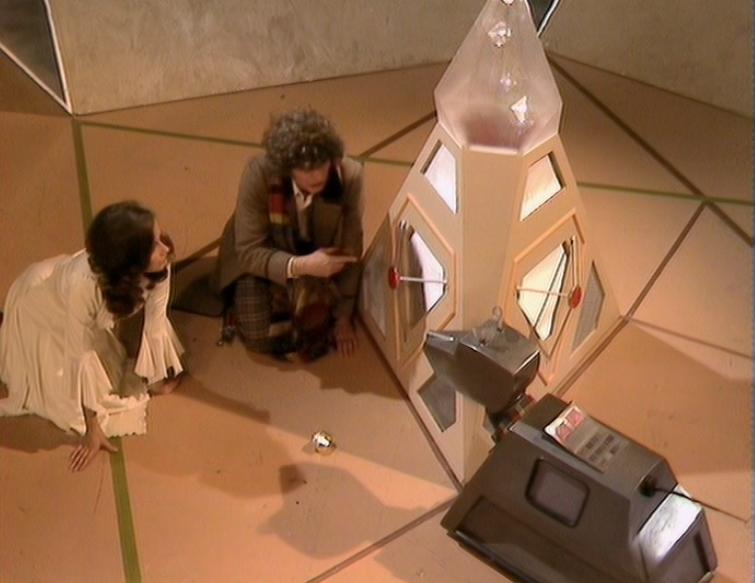
L-R - Ralph Bates, Fiona Gaunt, Donald Houston and Barry Lowe
L-R – Ralph Bates, Fiona Gaunt, Donald Houston and Barry Lowe

After a quick whistle-stop tour, Caulder puts his plan into action in order to demonstrate to Lebrun, Hill and Smith just how dangerous the Moon is. Frankly, Caulder’s actions are reckless in the extreme as he seems happy to risk their lives just to prove a point. But by the end of the story Caulder is able to close his enquiry on the shuttle deaths, so life on the moon can get back to normal.

One of the pleasures of the series is the high quality supporting casts, which includes many familiar faces such as Peter Miles (in “Behemoth”), Edward Brayshaw (in “Achilles Heel”) and John Hallam (in “Outsiders”).

But one major problem the series faced was that in order to generate drama and conflict it meant at least one member of the Moonbase staff had to act in an irrational or dangerous manner per episode. Had the series continued it would have been difficult to see how this problem could have effectively been dealt with. The later series Star Cops (1987) solved this by depicting a Moonbase which had a constant influx of departures and arrivals. The closed nature of Moonbase 3 doesn’t allow such freedom though.

The fifth story, “Castor & Pollux” sees Tom Hill adrift in space and although Caulder is keen to organise a rescue mission, he can’t do it without Russian assistance. The slowest paced episode of the series (and given the zero gravity environment, none of the others exactly race along) there is nevertheless a mounting sense of tension and it’s the best chance for Barry Lowe to shine.

The sixth and final episode of the series is “View from a Dead Planet”, guest starring Michael Gough. When the Arctic Sun Project appears to have destroyed all life on the planet, the Moonbase personnel face the prospect that they are the only human beings left alive – although given the limited supplies they have, this won’t be for long.

And then it was over. Critical and audience response were muted to say the least – a BBC Audience Report found the series “banal, predictable and slow”. And viewing figures were fairly disastrous as it debuted at 6 million whilst later episodes dropped as low as 2 million before recovering slightly at 4 million. But for a mainstream Sunday night BBC1 slot this effectively sealed the programme’s fate.

Why did it fail to capture the public imagination? The team of Letts and Dicks had worked together on Doctor Who since 1970 and had pulled that series around to make it a ratings winner and an important part of the BBC’s Saturday evening schedule. Moonbase 3 was a different beast though. It was hard science fact (with James Burke acting as story consultant) rather than science fiction or fantasy and it didn’t seem to work in the Sunday timeslot.

Donald Houston, whilst never the most subtle of actors, had a certain presence and made Caulder a compelling character. The needle and one-upmanship between Lebrun and Hill added some spice and conflict, which leaves Dr Helen Smith as somewhat of a fourth wheel. As her job was to identify which Moonbase crew-members were operating under stress or were potential risks, it’s embarrassing that so many passed her by. Quite how she managed to keep her job is anyone’s guess.
moonbase
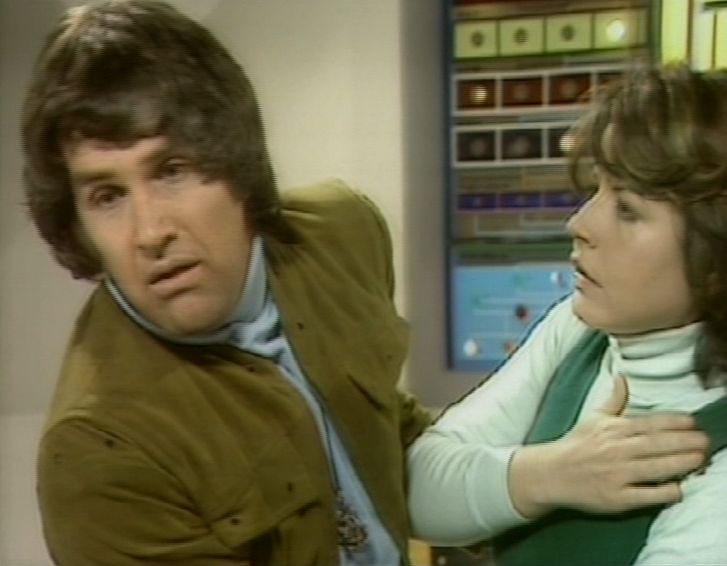
Watch out Dr Smith! Another one’s going round the bend!

Although it has its problems and weaknesses, it’s still a series that I find myself taking down from the shelf and rewatching most years. Maybe it’s the 70’s BBC futuristic setting, which is now somewhat comforting, but for whatever reason it’s a series that, dodgy NTSC picture notwithstanding, does repay multiple rewatches.

The Second Sight DVD has long since been deleted and now goes for silly money, so YouTube is probably the best way to sample this forgotten piece of 1970’s futurism.

The Secret War – 1977 BBC WW2 documentary coming to DVD in September 2014

The Secret War
The Secret War

The Secret War, a six part WW2 documentary made by the BBC in association with the Imperial War Museum, is due for release in September 2014 by Simply HE.

Originally broadcast in 1977, it was presented by William Woollard, with each episode looking at the various different ways that science and intelligence helped the Allies to win the war. Episode titles are as follows –

Episode 1 – The Battle of the Beams
Episode 2 – To See A Hundred Miles
Episode 3 – Terror Weapons
Episode 4 – If
Episode 5 – The Deadly Waves
Episode 6 – Still Secret

Topics covered include the breaking of the Enigma code, Hitler’s terror weapons (the V1 and V2) and the development of Radar. Interviewees include Hitler’s Minister of Armaments, Albert Speer.

A full DVD review can be found here.

War, what is it good for? Absolutely nothing. Doctor Who and the Armageddon Factor

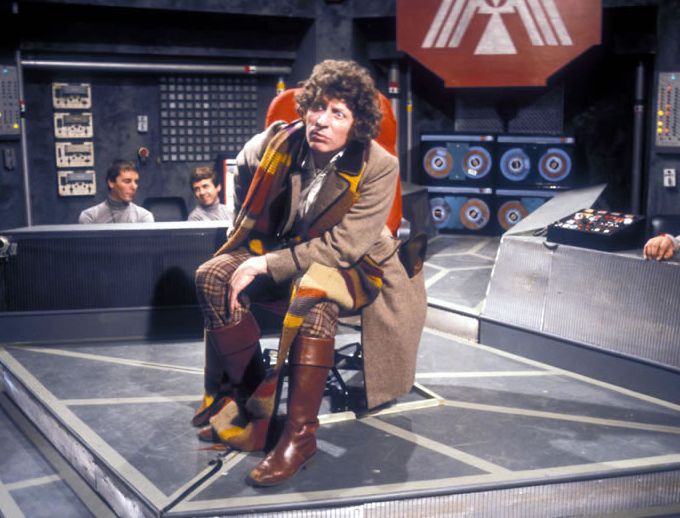
Tom Baker IS The Doctor

Nobody loves The Armageddon Factor.  Ranked 204 out of 241 stories in the recent DWM poll would appear to be a fairly accurate confirmation of its low standing.

But before we turn our attention to the story, lets have a quick look and see how its rated by some other bloggers.  Philip Sandifer considers that it’s “a painful squandering of good will in a way that only deepens the concern that the series has lost its way” whilst the Wife In Space called it a complete waste of time and rated it 4/10.

In his three years as producer, Graham Williams never had much luck with season finales.  Season 15 was going to conclude with a story by David Weir, until it was realised that his draft scripts would have needed a Star Wars-sized budget to make them work.  So Williams and script editor Anthony Read had to cobble something up at the eleventh hour.  The resulting story, The Invasion of Time, was something of a shambles – not helped by a BBC strike which meant that the production lost half of its studio allocation, so they were forced to decamp to a disused hospital to record some of the interiors.

Season 17 was even worse.  Douglas Adams’ Shada was also hit by a strike, but this time there was no opportunity to record the material  affected by the stoppage, so the programme was never completed or transmitted.  But over the last thirty years it has spawned VHS, DVD, audio and book releases – and a notoriety that the original story probably never deserved.

This leaves the last story of Season 16 – The Armageddon Factor.  This was not affected by strikes or last minute rewrites, but there does seem to be something somewhat lacking.  In late 70’s Doctor Who if you weren’t careful, by the end of the season you may have run out of money so your season finale would end up looking a little threadbare.  This is how Armageddon looks – no location filming and rather basic sets.

But the early episodes are helped no end by John Woodvine’s appearance as The Marshall.  Woodvine is a quality actor and he also has the welcome benefit of making Tom Baker raise his game.  There are other examples of this – Julian Glover in City of Death for example – so casting strong actors in late 70’s Who was clearly a good way to get Tom to focus on the matter in hand.

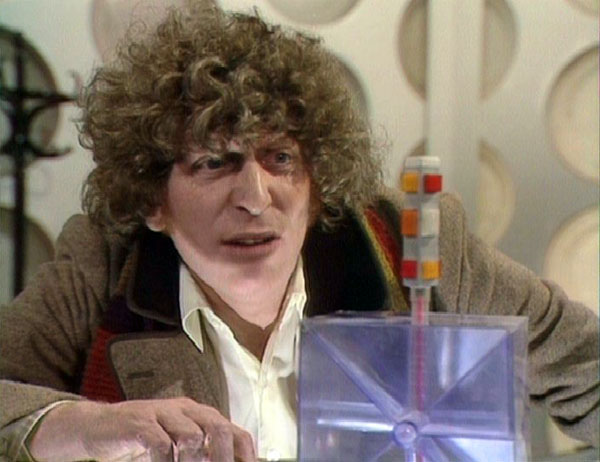
Tom restrains his enthusiasm

By this time, Tom had been in the role for five years.  No actor had played the part for longer, and he still had another two years to go.  Given this, it’s probably not surprising that there were times when he either seemed to go through the motions or dropped in the odd outrageous ad-lib.  Having said that, the commonly held view that Baker was playing the fool throughout the Graham Williams era is quite clearly untrue.  There’s the odd double take and painful pun, but for most of the time he plays it straight – although not everyone else is on the same page.

For example, Davyd Harries, as Shapp, puts in various bits of business that either director Michael Hayes approved of or didn’t notice.  It’s amusing enough though and does help to pass the time during some of the less interesting passages in the first half of the story.

Because apart from Harries and Woodvine, the guest cast are fairly small and not of great interest.  Lalla Ward would quite soon prove to be very important both to Doctor Who and Tom Baker, but there’s very little for her to latch on with the character of Astra.  And Ian Saynor has even less of a character, if that’s possible, with the irredeemably wet Merak.

That leaves William Squire as the main villain, The Shadow.  Squire was a good actor, probably best known for playing Hunter in the two Thames series of Callan.  But The Armageddon Factor takes the strange decision to put him in a mask and also treated his voice, thereby making him unrecognisable.  The Shadow isn’t much of a part anyway, as he tends to speak only in evil-villain talk and then give the odd maniacal chuckle.  It’s a long way from the best villains of the Hinchcliffe era, such as Davros, Sutekh, Harrison Chase and Magnus Greel.  The Shadow seems to have no interest beyond obtaining the last segment of the Key to Time, and therefore he can’t expect to hold the audience’s interest.

"You never know the answer when it's f*****g important do you?"
“You never know the answer when it’s f*****g important do you?”

The story was scripted by Bob Baker & Dave Martin, who had been writing for the series since 1971.  This was their last joint story for the series and it’s probably fair to say that very few people have ever expressed any regret that they didn’t carry on writing for the show.  They were not always bad, and sometimes quite good, but they tended usually to be pretty average.  But a safe pair of hands then, and just what Graham Williams needed to bring The Key to Time Season to a conclusion.

This they do, although the ending in particular has always been viewed as something of a damp squib.  After a season of the Doctor and Romana searching the universe for the six segments of the Key to Time, the conclusion of this epic quest is thrown away in such a perfunctory way.  Script editor Anthony Read should have been able to fashion something better, but didn’t – unless the original proposal was even worse.

But having said all this, is the story totally unwatchable?  No, of course not.  The first half of the story is better than the second, since John Woodvine gets stuck in a time loop in episode four and has little to do from then on.  We are also denied Davyd Harries’ comedy pratfalls later on, and Barry Jackson – as cockney Time Lord Drax – is no substitute.  Remember me to Galifree.

"There's no such thing as free will, only my will as I possess the Key to Time"
“There’s no such thing as free will, only my will as I possess the Key to Time”

Tom Baker and Mary Tamm are both still giving it their all though.  It might have been a long season, but they are committed and do their best to make the most of the thin material.  This was to be Tamm’s last television appearance as Romana and although she tended to be overshadowed by Lalla Ward’s portrayal of Romana II, Tamm had a good rapport with Baker throughout the Key To Time season and remained popular with fans right up until her untimely death, at the age of 62, in 2012.

Sigh.
Sigh.

Overall then, The Armageddon Factor is never going to be regarded as a great or even a good story – but there’s far, far worse out there and Tom Baker, Mary Tamm and John Woodvine all do their best to to inject some energy into it.  If I had to rate it, then a solid 6/10 would seem about right.

Look and Read – The Boy from Space comes to DVD

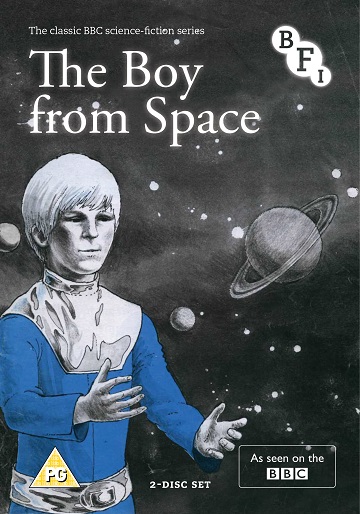
The Boy From Space BFI

The Boy from Space is one of a number of British TV science fiction titles due to be released shortly by the BFI.  Originally broadcast in 1971 as part of BBC Schools’ Look and Read strand, it has gained a certain cult status over the years.

Written by Richard Carpenter (Catweazle, Robin of Sherwood), the original broadcast tapes were wiped following transmission, although the Boy from Space drama inserts were retained.

This meant that when, in 1980, Look and Read were looking for a cheap new production, it was decided to use the original 1971 inserts with newly shot studio footage featuring presenters Cosmo and Wordy.

The two disc release includes –

The 1980 series (10 episodes, each running for 20 minutes).

A new feature length edit of the drama inserts (70 minutes).

An audio version of the 1972 BBC Schools LP (running time 55 minutes) narrated by Charles Collingwood (Wordy).

A new presentation, syncing audio from the BBC Schools LP together with footage from the television broadcast.

Animated sequences and an illustrated booklet.

A full review of the DVD can be found here.