Gideon’s Way – The Prowler

prowler

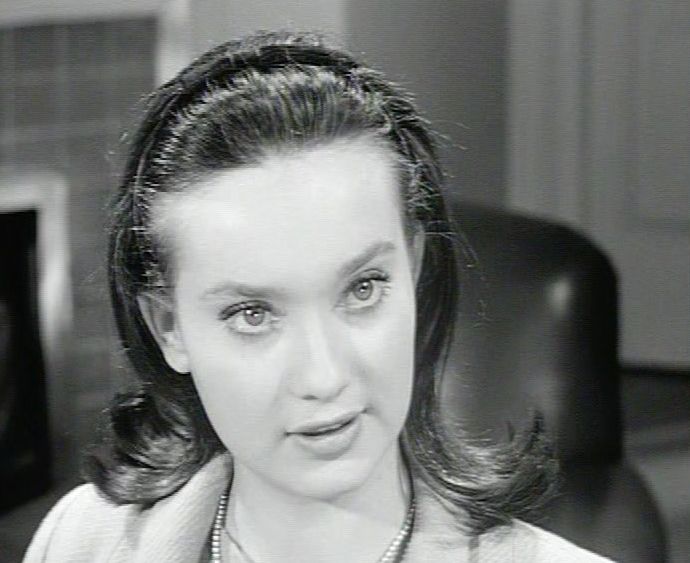
Gideon is under pressure (thanks to negative newspaper reports) to catch a mysterious masked prowler who’s been terrorising London.  So far he hasn’t hurt any of his female victims – he’s simply cut off locks of their hair – but Gideon is concerned that violence and murder might be the next items on his agenda.

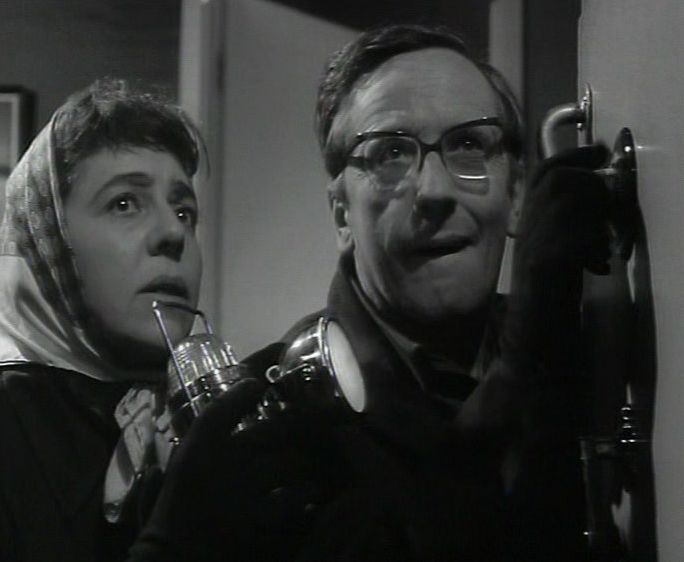
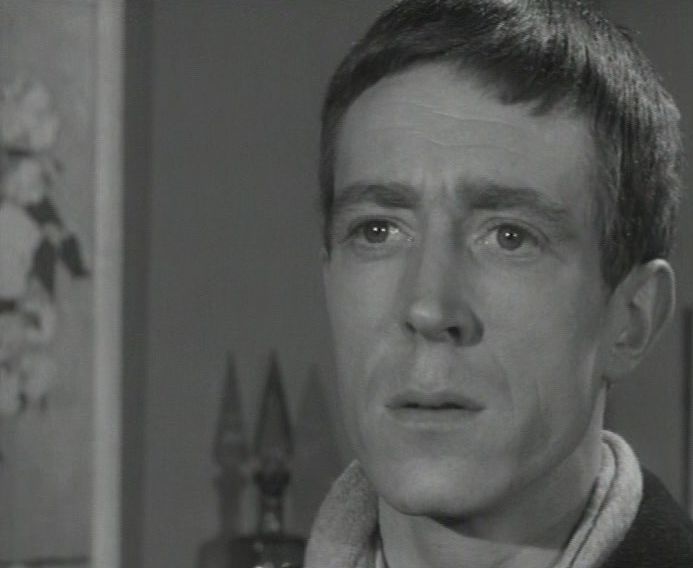
The prowler, Alan Campbell-Gore (David Collings), is a troubled young man.  He may come from a wealthy and titled family, with a mother – Lady Campbell-Gore (Fanny Rowe) – who dotes on him, but it’s obvious that the balance of his mind is disturbed.  He still pines for Wendy, his dead girlfriend, and it’s his inability to come to terms with her death that proves to be his downfall  …..

Robert S. Baker and Monty Berman had already successfully brought the Saint to the small screen, thanks in no small part to the talents of Roger Moore, and with Gideon’s Way they were once again tasked with the problems inherent in transferring a literary creation to the small screen.  Because ITC liked to sell their products worldwide, this meant that excessive violence, for example, would be frowned upon.  It’s well known that the Saint had to be rather watered down from the amoral, anti-hero of the original books – emerging in the television series as the affable globe-trotter familiar from Leslie Charteris’ later novels (which tended not to be as highly regarded as the earlier books).

Revisiting John Creasey’s Gideon novels, it’s easy to see that a similar retooling took place.  The Prowler was adapted from Gideon’s Night, published in 1957, and it offers a subtly different story experience.  To begin with, Gideon opens by musing on how his marriage went through a rocky patch a few years ago (in contrast, the television couple never seem to have a single argument).  Lemaitre is also suffering from domestic strife, as his “bitch” of a wife is blatantly conducting affairs with numerous men.  A little character development like this would have been good for the television Lemaitre as Reginald Jessup, despite being a regular, has a fairly thankless role – mainly existing to line feed both Gideon and Keen.  As for the prowler, he’s instantly made much more sinister after it’s revealed that he strangles his victims (as opposed to the television prowler who simply clips off a lock of their hair).   Other themes in the novel – such as a murderer of young children – were unsurprisingly never adapted for the series.

Returning to this adaptation, the opening few minutes – as Alan pursues his latest victim through a foggy London street – are highly evocative, although there may be some (especially if you equate fog with the stories of Sherlock Holmes) who might regard this scene as something of an anachronism.  Not so.  Fog and smog continued to be a problem in London well into the 1960’s.  The worse case was the great London smog of 1952 which killed thousands and although the problem declined during the 1960’s, it was still there.

The Prowler makes no effort to keep Alan’s identity a mystery.  We know very early on that he’s the guilty man and Harry Junkin’s screenplay makes short work of explaining why this is so.

His continuing love for his dead girlfriend, a recent stay in a clinic (following a breakdown) and the suffocating love of his mother are all factors.  Although Lady Campbell-Gore no doubt feels she’s acting in his best interests, her domineering personality is precisely what he doesn’t need.  After one of the attacks, he pleads with somebody to help him – but since he’s alone in his bedroom, help is not forthcoming.

Clearly he’s reluctant to speak to her about his mental problems and although her actions  – telling him he’s not fit to work yet, ripping up a picture of Wendy – are, in her mind, meant for his own good it doesn’t work out that way.  And when he does later pluck up the courage to try and explain, she dismisses him with short shrift.  No member of their family, she tells him, has ever suffered from insanity.  It’s therefore clear that the reputation and standing of their family name matters more to her than the anguish of her son.

Director Robert Tronson was an experienced hand, active in television between the 1960’s and 1990’s.  A partial list of his credits – The Saint, Man in a Suitcase, Public Eye, Callan, The Power Game, Manhunt, Father Brown, Juliet Bravo, Bergerac, All Creatures Great and Small, Rumpole of the Bailey – reads like a list of some of the best series that British television has ever had to offer.  The Prowler was his sole GW credit, but thanks to the source material he was able to make his mark.

Tronson uses a number of tricks to illustrate Alan’s disturbed state.  The incidental music, whilst verging on the over melodramatic at times, is slightly unusual (thanks to the instruments used) which gives this episode a unique feel.  He also elects to shoot scenes from Alan’s POV – which allows us to see the world from inside his head.  Some of these moments – for example, Alan witnesses the torn photograph of Wendy reassemble itself – clearly can’t have happened, so this is an obvious sign that the way he observes the world is filtered through his own grip on reality.

This was only David Collings’ second television credit (following an edition of The Wednesday Play earlier that same year, 1965) but he’s very watchable as the troubled Alan.  Collings would later find something of a niche playing disturbed and damaged individuals, of which Alan is an early example.  Although the script seems to tell us that Alan isn’t responsible for his actions, it also poses the question as to whether the system is set up to give him the help he needs.

Alan staggers his way over to Wendy’s old flat, but naturally doesn’t find her.  Marjorie Hayling (Gillian Lewis) now lives there and treats the strange man who barges into her rooms with kindness and compassion.  He explains that he was Wendy’s fiancée – she knows that Wendy killed herself and gently asks him if he knows why.  He doesn’t and this may be one of the reasons why he tortures himself.  Marjorie agrees to go out with him, although she’s aware that he’s deeply troubled.  During this scene Alan shows himself to be personable, articulate and lonely.  It’s not an act – he’s all of these things – which makes his other compulsions even more of a tragedy.

The climatic part of the story – Alan is hunted through the dark streets by the police and eventually turns up at Marjorie’s flat – ramps up the tension, as he holds her hostage with a knife.  But had he not felt cornered, would this have happened?  It’s a question to ponder (since his later slapping of Marjorie is the first intended violent act we’ve seen him carry out).  The siege comes to an end, but Alan’s ultimate fate is not disclosed.

An unusual, but impressive, episode – thanks to David Collings.
Gideon’s Way – The Alibi Man

alibi

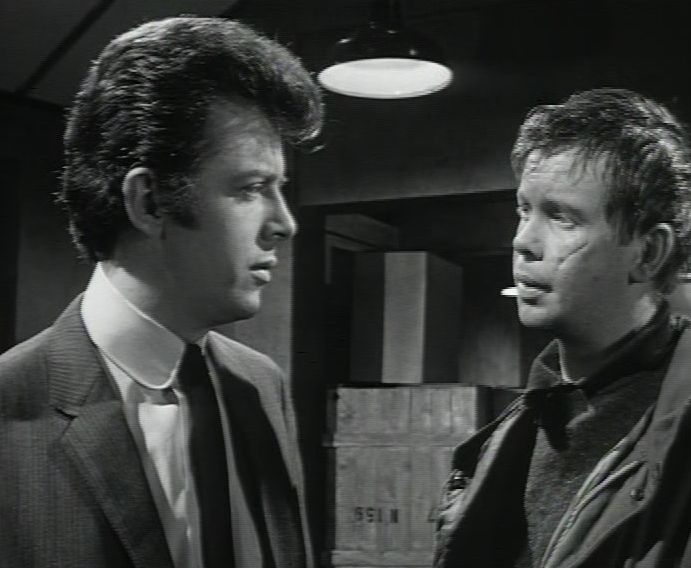
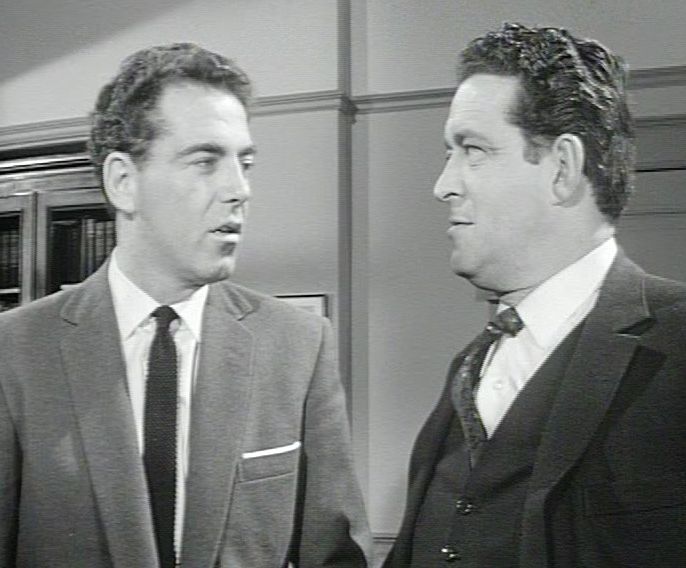
Bruce Carroway (Jack Hedley) might be England’s greatest motor racing driver, but he’s a rotten businessman.  Jeff Grant (Geoffrey Palmer) co-owns a garage with him and is shocked, after checking the books, to find there’s a substantial sum of money missing.

Grant confronts Carroway, but gets nowhere so he decides to head for the police station.  A fight breaks out and Grant is clubbed to death.  Along with his trusty mechanic Eric Little (James Culliford), Carroway creates an alibi which places him far from the scene at the apparent time of the murder.  But Gideon smells a rat …..

The episode opens with some vintage (or at the time, current) motor racing action.  Hedley, via rather unconvincing back-projection, is shown winning yet another race.  Possibly the most noteworthy aspect of the sequence is how relaxed Jack Hedley looks as he drives his car around the circuit.  From the casual expression on his face you’d have assumed he was simply out for a Sunday drive!  I’m sure that steering a racing car of this era took just a little more concentration.

Hedley, probably best known for his later portrayal of the Senior British Officer in Colditz, is excellent as the amoral Carroway.  He may be a fine driver, but as a man he’s severely deficient.  We see him treat his wife with contempt (telling her she’s as much fun as a broken hip) and isn’t too kinder to his mistress, Marjorie Bellman (Jennifer Daniel).  Marjorie is a bought woman – she lives in a beautiful flat, paid for by Carroway – but it’s plain she’s not a gold-digger.  She really loves him, although it’s doubtful whether he’s capable of responding in kind.

It’s nice to see a young Geoffrey Palmer, although we don’t see him for long, as after a fairly brutal fight (for Gideon’s Way anyway) he gets clobbered.  If Carroway’s shown to be a poor businessman, then he’s not much better as a murderer.  He tells Eric to smash one of the windows in the office in order to give the impression of a break-in, but neither thinks of actually entering through it – meaning that the police (thanks to the undisturbed dust on the ledge) quickly work out that no-one came through that way.

Carroway also tries the old clock trick, which I’m sure never works outside of detective novels.  He turns the clock to just after 9.00 pm and then smashes it – so anybody finding it will automatically think that was when the crime must have been committed.  And since he and Eric plan to be somewhere else at that time, they therefore have a cast-iron alibi.  Except that it’s obvious to Gideon and the others that the clock has been deliberately destroyed in order to create such an alibi.

In some ways, this works as a proto-Columbo.  Gideon strongly suspects that Carroway is guilty, and the audience knows he is, but he lacks any evidence.  So the Commander has to keep chipping away at Carroway, trying to push him into revealing his true nature.  But the ending of this one is most atypical for Gideon.  Normally we see the Commander always get his man (or woman) but here there’s a much more open-ended feel – which is unusual for the series, but more accurately reflects real life.

As I’ve said, Hedley is perfect as Carroway and Jennifer Daniel is also strong casting as Marjorie, the woman who loves him but also (since she knows he went to meet Grant) proves to be something of a problem.  A young Nicola Pagett also pops up, as Marjorie’s younger sister Cathy.

The relationship between Carroway and Eric is an intriguing one.  Eric’s badly scarred thanks to a bad motor racing accident some years previously, but he’s indebted to Carroway as he was responsible for pulling him from his burning car.  It’s therefore understandable that Eric will do almost anything for Carroway including murder (he disposes of Marjorie).  But Eric’s comment, just as he’s dispatching the unfortunate Marjorie, is quite telling.  He says that the old days (just the two of them – Carroway and Eric) are now back.  It’s only a throwaway moment, but the possibility that Eric wants a deeper relationship seems quite plain.  Quite what the womanising Carroway would make of Eric’s feelings is anyone’s guess.

Another strong story with a first-rate guest cast.

alibi 02

Gideon’s Way – Gang War

gang

Jerry Blake (Ronald Lacey) and his gang plan to muscle in on the territory of Frank Romano (Ray Brooks).  Romano runs a protection racket, collecting tributes from local shopkeepers, although his wife Lollo (Jane Merrow) wonders if it’s really worth the trouble.  As she tells him, after he’s split the proceeds amongst the members of his gang there’s hardly anything left.

Lollo has something much more ambitious in mind.  Henry Waldo (Frederick Bartman) is a middle-aged bank worker who’s crazy for her and doesn’t know that she’s married.  He’s responsible for the transportation and destruction of surplus bank notes and she finds it very easy to persuade him to tell her when and where the next delivery will be.  So Frank and Jerry team up – with the prize being some four hundred thousand pounds …..

Gang War is such a wonderful time capsule of the period that I find it impossible to watch without a big grin on my face.  The scene is set right from the start – as we see Jerry and two of his compatriots swagger down the street.  As they walk along the pavement they knock into innocent passers by and this action (together with the brassy incidental music) immediately brings to mind the later Monty Python sketch Hells Grannies.  Was the Python sketch directly influenced by this episode?  I don’t know for sure, but it seems likely.

Roland Lacey had a good career (sadly curtailed by his early death) playing misfits and Jerry – who sports a wicked looking scar – is another notable addition to this hall of fame.  Jerry begins his reign of terror by wrecking the shop of an inoffensive Italian barber (who’s played in such a “whatsa matter you?” way as to be very unbelievable) and later moves up a gear by knifing Sammy, one of Frank’s key men.

Frank, like Jerry, has a club as his base of operations.  This means there’s opportunities for oh-so mid sixties incidental library tracks to be played on the jukebox, which ramps up the atmosphere as both men call their gangs together for periodic meetings.  One of Frank’s gang is Weasel (played by Louis Mansi).  Mansi, later to be a regular in Allo Allo, is very recognisable (one of the joys of this era of television is that so many faces, even the bit-part actors, are instantly familiar).

Ray Brooks was something of a sixties icon and he’s another major plus point in the episode’s favour.  Frank starts off as the man in charge, but it doesn’t take long before Lollo makes him realise just how small and petty his ambitions are.  As Frank lounges around their flat in a rather natty dressing gown he slowly begins to see the possibilities of Lollo’s manipulation of Henry – although he doesn’t like the thought of his wife making eyes at another man.

Alas, Henry is a bit of a wimp, and indeed the move away from the gang war to focus on the robbery is something of a misstep, although Frank and Jerry do end up settling their differences in a very permanent way (via a lovely piece of noirish night-time filming).

On-screen violence is kept to a minimum.  Frank whacks one of his men in a face with a billiard ball and there’s the knifing, but apart from that it’s a fairly bloodless gang war (at least until the climatic shoot out).  The stabbing of Sammy (Keith Bell) is a nicely crafted moment though – the camera is placed low on the pavement which then creates an interesting angle after he slumps to the ground.

A generous helping of location filming helps to keep this one clicking along at a very decent pace.  Incredibly enjoyable.

Gideon’s Way – Subway to Revenge

subway

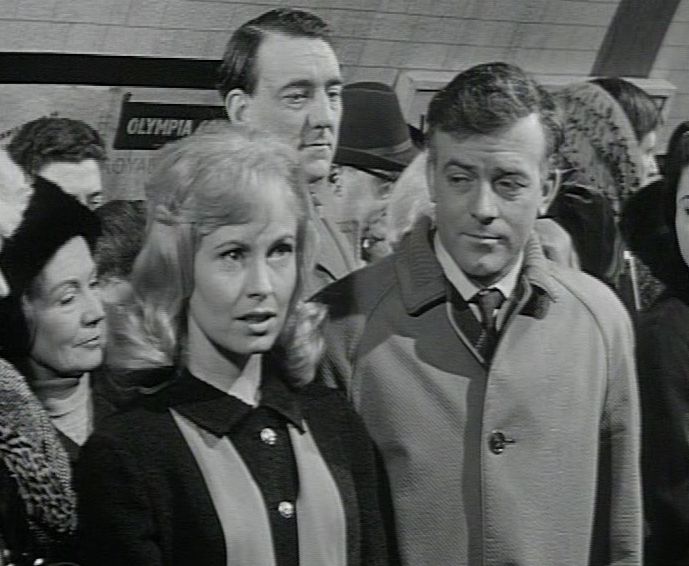
James Lane (Donald Churchill) is a mild-mannered accountant who’s spent the last few months attempting to pluck up the courage to speak to his attractive colleague Ellen Winters (Anne Lawson).  He finally gets his chance when a mysterious stranger (Brian Pringle) attempts to shove him under a subway train.  Ellen is convinced he was pushed deliberately, whilst James insists he slipped.  Although he’s delighted that he’s finally broken the ice with Ellen he’s also highly embarrassed that she’s making such a fuss.  She won’t give up though and goes all the way to the top – right to Commander Gideon ….

The first notable thing about the subway scenes is how unconvincing the stock shots of trains and crowds are – they have a very different feel, meaning it’s hard not to mentally shout “stock” every time they appear.  The second notable thing is that the mysterious stranger (who we later learn is called John Stewart) only gives James a very feeble push.  If he’d have given him a proper shove then it would have been curtains for James.  Stewart is a well-built chap, so this makes the sequence a little unconvincing.

Brian Pringle doesn’t utter a word as Stewart, but he looms very menacingly and remains a foreboding presence throughout the episode.  An early clue that he may not quite be the full shilling is given when we see him smooth down one side of his hair – a nervous gesture that seems to have become a ritual.

To be honest, James is such a feeble specimen that it’s remarkable a lovely young lady like Ellen takes any interest in him.  He’s disinclined to speak to the police himself and is angry (or at least as angry as he ever gets) after Ellen does.  At one point he threatens to put her over his knee, to which Ellen only smiles – which opens up a whole other avenue that we’ll not go into here!

Ellen’s not the first to catch Gideon’s attention with a case that appears trivial but turns out to be more important than it first seemed.  She’s more proactive than most though, as she turns up unannounced at his home and pretty much barges into his living room as he’s relaxing.  Gideon, thanks to John Gregson’s affable playing, doesn’t seem terribly put out though and he soon learns that there’s more to this case than meets the eye.

James and Ellen both work for Chinnery Chemicals and Keen, after a little digging, discovers that three other employees (Martha Robson, Alec Harvey and William Venables) have all died in tube accidents during the last few months. Nobody seems to have even considered that their deaths may have been connected, something which stretches credibility to breaking point.

Martha Robson committed suicide after she was discovered to have embezzled five thousand pounds from Chinnerys.  Harvey and Venables (along with James) were responsible for discovering this, so it doesn’t take the greatest detective to work out that somebody’s out for revenge.  Gideon pays a visit to Robson’s father (played by Esmond Knight).  Knight (a man with an incredibly impressive list of film and television credits) gives a powerful cameo as a man who lived his life through his daughter.  It becomes clear that his intense controlling nature (he attempted to forbid her any contact with the outside world) was, in part, responsible for her death.

Had he been a more reasonable man, maybe Martha would have been comfortable to ask him for a loan so that she and Stewart (revealed to be her fiancé) could have set up house.  But Robson wanted to keep her all to himself and so presumably she felt compelled to steal.  Director Roy Ward Baker maintains tight close-ups on Knight and Gregson during this scene, which – especially with Knight – helps to ramp up the pressure and tension as we see Robson somewhat crumble before our eyes.

One interesting production quirk occurs about twenty minutes in as Gideon questions James and Ellen.  Several pick-up shots must have been done some time after the main filming as Donald Churchill’s haircut is so different that it’s initially very jarring.

Although James is so irritating that I can’t confess to being that concerned about his fate, Ellen is much more appealing as the damsel in distress and stars in the closing scene as Stewart wraps his fingers around her throat.  Anne Lawson doesn’t have that many screen credits, but thanks to appearances in series like The Saint and Espionage (both available on DVD) she’s probably quite familiar to the archive television fan.  Another Anne Lawson performance worth checking out is in the Out of the Unknown episode The Midas Plague.

Gideon’s Way – The Wall

wall

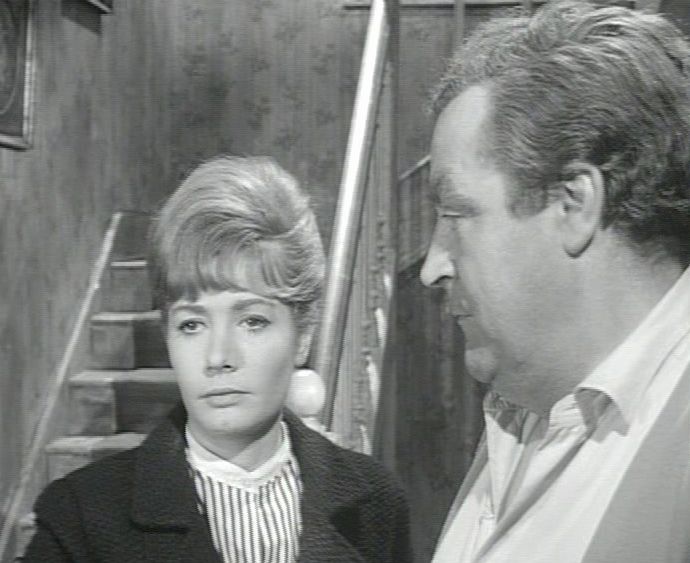
Netta and Michael Penn (Ann Bell and Richard Carpenter) are a young couple very much in love.  At present they’re forced to live in a single room but dream of owning a house of their own.  So when Michael wins seven hundred pounds on the football pools, it seems their dream will come true.

But Michael makes the mistake of mentioning his win to his landlord, Will Rikker (John Barrie).  Rikker, a violent and unpleasant man, asks Michael for a loan of one hundred pounds and when Michael refuses he attempts to steal the money anyway.  Michael discovers him and a fight breaks out – brought to a conclusion when Michael hits his head on the fireplace and is instantly killed.  Rikker’s now got the money, but he also has several problems – he has to dispose of the body, pacify his wife Liz (Megs Jenkins) who learns of his crime and deal with the suspicions of Netta, who can’t understand why her husband suddenly seems to have left her …..

John Barrie would spend a great deal of the 1960’s playing two very different policemen.  Firstly, he was the Victorian Sergeant Cork (between 1963 and 1968, although some of the later episodes had been recorded some years prior to their eventual transmission) and then he moved into the modern age to play DI/DCI Hudson in Z Cars (during 1967 and 1968).  Because of this, it’s a nice change to see him on the other side of the law for a change, and Will Rikker is a splendidly villainous creation.

From the first moment we see him it’s plain that he’s simmering over with resentment and anger.  He snaps at his wife, takes a drink (even though it’s fairly early in the morning) and threatens the Penns dog with violence.  Liz reminds him that the Penns pay them to look after the dog whilst they’re at work, but this cuts no ice with Rikker.  Leslie Norman’s direction favours close ups – especially during the aftermath of the fight – and this works very well as Rikker’s sweaty, anxious face tells its own story.  And with a large part of the episode taking place inside the house, the close-ups also help to add a degree of claustrophobia.

If we have many verbal examples of Rikker’s character, there are also non-visual clues too.  The rooms he shares with Liz are shabby in the extreme, whilst Netta and Michael’s room is spotless.  So whilst the young couple have clearly taken the trouble to ensure that their living environment is as pleasant as possible, Rikker simply doesn’t care about his.  Presumably if he’s got enough money for drink then he’s not too bothered about outward appearances (which is also reflected in his unkempt dress sense).

Richard Carpenter would later be better known as a writer, penning the likes of Catweazle, Dick Turpin and Robin of Sherwood, but during the 1960’s he pursued a successful acting career with a string of appearances in many popular series of the day.  Michael isn’t too much of a part – not really requiring a great deal from Carpenter – but even with his limited screen-time he manages to make Michael seem a likeable and decent chap, which gives his death a certain impact.

It’s Ann Bell who has to carry the second half of the episode, as she continues to puzzle over her husband’s absence.  She reports his disappearance to the police but they don’t seem too interested to begin with, not really surprising since there’s nothing to go on.

Given the sort of storyline this is, where no crime – at least initially – seems to have occurred, Gideon and the others exist very much on the periphery.  So there’s the opportunity to dwell a little on Gideon’s home life (he’s forgotten his wife’s birthday) whilst at work he berates his subordinates for errors in other cases.  None of this impacts on the main plotline, but something had to be found for him to do, otherwise it would have been a thin week for John Gregson.  Gideon does get involved later on, after Netta pleads with him to investigate the case, although Netta herself (and her dog, Skipper) are really the ones who first work out that Rikker is the guilty party.

Thanks to John Barrie’s monstrous performance and Ann Bell’s equally good counter-performance as the innocent ensnared by Rikker’s machinations, The Wall is one of the best of the series.

Gideon’s Way – How To Retire Without Really Working

retire

Robert and Margaret Gresham (Eric Baker and Joyce Grant) might appear to be a perfectly respectable middle-class couple, but they’re also successful career criminals.  Robert’s pulled off one job a month for the last twenty years – each crime nets him some two hundred pounds, which is enough for him and Margaret to live quite comfortably.

But, as he confesses to Margaret, he’s beginning to lose his nerve – which is exacerbated when Gideon comes sniffing around.  He decides to retire, but since neither of them have ever held down an honest job, how will they survive?  So they decide to do just one more job – and this will be a major crime, one which Gideon will never think of connecting to them …..

Eric Barker first made his name as a radio comedian during WW2 and later moved over to both films and television.  He had his own television series – The Eric Barker Half Hour – as early as 1951 and he also featured in several of the early Carry On films.  Those films were scripted by Norman Hudis, who also penned this episode (one of three Gideon’s he was responsible for).

From his opening scene there’s an obvious comic feel about Robert Gresham.  His smash-and-grab is rather bungled (he drops the brick) and he’s also spotted by the shop owner.  Since, by his own admission, he’s carried out some 240 crimes (and only been caught once) this seems rather sloppy.  Although as he says, it could just be a symptom of middle age and a loss of nerve.

Unlike some of the other criminals in Gideon’s Way, we’re invited to identify with Robert and Margaret.  They may be lawbreakers, but they’re the old-fashioned, old-school type of criminal.  They also command Gideon’s respect – he’ll catch them if he can, but it’s plain he’s also got a sneaking admiration for them.

Gideon becomes aware of Robert’s latest crime in a rather roundabout way.  Gideon and Keen are called to a house where the gloriously named Shorty Fleming (Jack Rodney) is holed up.  Shorty is another minor-league villain who’s jumped up into the big-time and, armed with a gun, he attempts to take Gideon hostage.  John Gregson is at his commanding best here, as we see Gideon inexorably approach the quaking Shorty and coolly disarm him.  He’s lucky that Shorty didn’t blow a hole in him (the scene is quite reminiscent of George Dixon’s demise from The Blue Lamp) so either Gideon’s a good judge of character or he took an incredible risk.

Gideon is startled to see Robert Gresham pass by in a Rolls Royce as he stands outside Shorty’s house.  Shorty’s subplot is designed to show what happens when you attempt to punch above your weight – a lengthy jail term awaits.  It doesn’t take a mind-reader to work out that this is exactly the fate that awaits the Greshams, and since they’re obviously devoted to each other it will break their hearts to be separated.  This pains Gideon, which surprises Keen – to him they’re only criminals.

William Mervyn is his usual excellent self as Mr Pater, a major league villain who is able to exploit the Greshams, whilst David Keen is, for once, unlucky in love.  He tells Gideon that he had the means and the motive, but not the opportunity!

How To Retire Without Really Working boasts fine performances from Eric Baker and Joyce Grant but there’s something of a lack of tension.  In other series they might have got away, but since the criminals in Gideon’s Way almost always get run to ground, the episode concludes in a predictable way.

Grange Hill. Series Six – Episode Eighteen

grange hill s06e18

Written by Barry Purchese.  Tx 4th March 1983

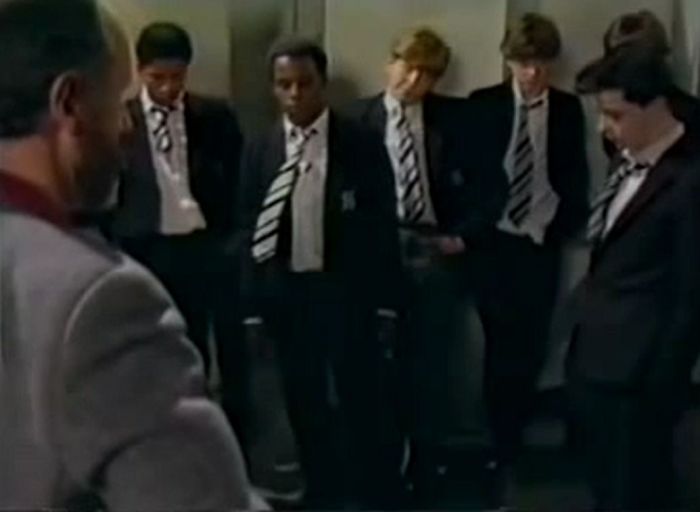
This is an all-film school-based episode (something which was quite common during previous series but not so during this year).  The main theme is how Mrs McClusky is able to manipulate events to her best advantage.

She’s already decided to reinstate Mr McGuffy, but that presents a slight problem – since the staff are well aware of the impending demo by the pupils to demand his return.  Mr Smart, rather delightfully, is the only teacher brave enough to query whether she’s been at all influenced by their protests.  As ever, Gwyneth Powell gives Mrs McClusky a wonderful mixture of sweetness and steel as she tells him that no, she always makes her own mind up.

Mr Smart is in a scene-stealing mood.  As Miss Mooney and Mrs McClusky discuss how gifted Jonah is, and whether he’s planning to sacrifice academic achievement in order to maintain his popularity, Mr Smart looms in the background, making tea and not speaking a word – although the eye is irresistibly drawn to him!

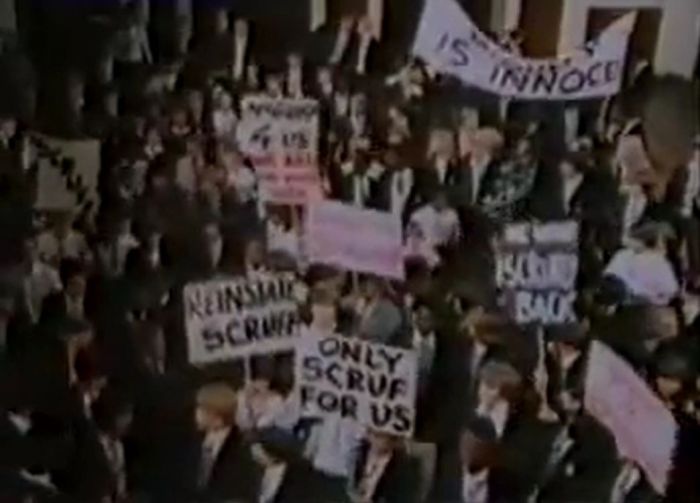
Jonah’s not terribly popular at the moment though.  He’s disinclined to get involved with the demo at first, but then changes his mind as he decides to create an impressive banner.  But his ambition outstrips his ability and despite all the previous comments about his brilliance, he doesn’t seem to notice that he’s not left enough space to get all the letters in.  This alienates him from the others even more, but he makes amends by opening the locked school doors, which enables the protestors to occupy the assembly hall.

And that’s his last contribution to the series.  Also bowing out in this episode are Miss Mooney and Mr Hopwood and, like Jonah, they just fade away with no acknowledgement made that they won’t be returning.  A slight pity, as both Lucinda Gane and Brian Capron had been notable presences over a number of years, but it’s not the first or last time that staff and pupils at Grange Hill just vanish with no ceremony.

The return of Mr McGuffy is a gloriously awkward moment.  As the impressively large body of pupils chant for his return, they then eerily fall silent as he does appear and slowly makes his way to the front.  Claire, Suzanne and the others are appalled to discover that he was reinstated the previous day, so they feel they’ve made all this effort for nothing.  The irony that they’re not even slightly pleased to see him (despite the banners and chanting) is picked up by him – and there’s also a real sense that they used Mr McGuffy simply as the figurehead for all their frustrations about the school.  If Mr McGuffy had been reinstated due to their pressure they would have been delighted, but since the decision was taken out of their hands it only serves to reinforce how impotent and powerless they are.

Mrs McClusky does offer the olive branch of possibly allowing the pupils to take more of a role in future decision making, but – like her manipulation of the flexi-time referendum – you can be sure she’ll always end up on top.

And with the long-range reveal of Pogo’s girlfriend (an unnamed pupil from St Mary’s) series six draws to a close.  Always a favourite series of mine, it still impresses, more than thirty years on.

Grange Hill. Series Six – Episode Seventeen

grange hill s06e17

Written by Barry Purchese.  Tx 1st March 1983

It’s the day of the referendum.  Jonah decides to guarantee that the result is positive by doctoring a number of voting slips.  Elsewhere, Stewpot and Duane initiate the Pogo Patterson Girlfriend Sweepstake.  They plan to sell twenty tickets at 50 pence each, meaning that the winner stands to collect five pounds (whilst Stewpot and Duane are also guaranteed a fiver).  The only problem is that they don’t know her identity and Pogo isn’t telling ……

This episode sees some interesting character development for Jonah.  On the one hand, he’s still the same reckless boy we already know from numerous previous scrapes – attempting to spoil the exam papers was foolish in the extreme (as Mrs McClusky says, it was obvious that the same hand had written on all the papers).  This action suggests that his intelligence isn’t the greatest, but later we see him breeze through his exams in record time.  In the next episode it’s confirmed that he could be a first class student if he only concentrated, but his desire to lark about has set him back.  Had Lee Sparke returned for series seven then this theme could have been developed further (would he have become estranged from Zammo as they moved into different streams?)

This wasn’t to be though, as the programme makers had intended to kill him off at the start of the next series.  It would have been the first time that a regular central character had died (Antoni Karamanopolis had tumbled to his death during series three, but he was someone who only existed on the periphery of events).  It seemed that a sudden death didn’t appeal to either Sparke or his parents, so Jonah didn’t return – causing a hasty rewrite, which we’ll discuss when we get to the episodes in question.

Fay continues to be defined by her love of sport.  She’s therefore similar to Benny in that respect – for him it was football, for her it’s hockey.  She’s delighted to have made the District Team and is rather impatient with the complaints of the others (which she sees as petty).  Diane’s still concerned about her spots (although they appear much fainter here – the script implies they’re as bad as ever, so it must be just a poor case of make up) and Annette’s worried that she may have to wear a brace for a year or two.  Fay’s heartless nature is neatly paid off at the end of the episode, allowing Diane the chance to adopt a mocking attitude for a change.

The Pogo sweepstake is great fun, although Stewpot and Duane are under pressure from the others to reveal the correct name.  If they don’t, then they’ll have to give back all the money they’ve earned.  And they’ve only got one episode left to find out!

Claire, Suzanne and Christine arrange another edition of the underground magazine to insist on Mr McGuffy’s reinstatement.  Slightly surprisingly it’s Claire who’s the prime mover, whilst the nominally more radical Suzanne and Christine are initially hesitant.

Christine’s also involved in the most memorable part of the episode.  Mr Hopwood, in Mr McGuffy’s absence, has to take his English lesson.  He and N4 debate the importance of exams.  It isn’t the first time that we’ve heard pupils take a rather pessimistic view of exams – why bother, when there’s no jobs out there?  Mr Hopwood concedes that times are hard, but it’s still better to have qualifications than not.  Christine then tells him about her cousin, who along with forty four other people applied for a job as a shelf-stacker.  And she has a University degree.  There’s nothing to be said that can counter this, so the scene ends on a close up of Mr Hopwood’s face.  This, and the rally in the next episode, are echos of GH‘s more radical past.

Grange Hill. Series Six – Episode Sixteen

grange hill s06e16

Written by Jane Hollowood. Tx 25th February 1983

Roland’s (pretend) sprained ankle means that, to his great delight, he’s unable to take part in any more activities with the others.  Instead he’s set another task – to bake some Welsh bread, cover it with Welsh jam and butter, eat it on a Welsh hillside and then compose a poem.  Mr Price stumbles across the dozing boy, who’s baked a very decent loaf of bread but hasn’t got very far with the poem.  Maybe, Mr Price says, that’s because he’s used New Zealand butter!  It’s another nice scene for Roland and it does suggest that the trip has been a positive experience for him.

Diane also eventually enjoys herself, as she tackles the canoeing with gusto and she’s also on hand to spot that Zammo’s in difficulty and raises the alarm.  This is another example, though, of how lax the supervision is.  Simon spends his time nattering to one of the other children about a hole in their canoe, totally oblivious to the fact that Zammo’s floundering about in a capsised canoe.

But it’s a well-directed sequence by an uncredited Kenny McBain (who also directed the previous episode).  Since McBain was also the producer he didn’t receive a directors credit – a not uncommon thing to happen on BBC credits at the time.  With the camera placed close to the stricken Zammo, there’s a real sense of how dangerous and unforgiving even a fairly shallow piece of water can be.

It also has to be observed that Miss Mooney filled out a wetsuit very well, to the obvious amusement of Mr Baxter!  This was to be Lucinda Gane’s penultimate episode as Miss Mooney.  After GH she’d pop up in a few more series (notably as a regular in Mapp & Lucia) before dying at the far too early age of 55 in 2005.

The others are sampling the delights of abseiling from a great height – although Mr Baxter is far from keen.  It’s another nice comedy moment for Mr Baxter who knows he can’t back down – the loss of face would be more than he could bear – but his genuine terror is also quite apparent.  In the end he plucks up his nerve, goes for it and is clearly relived when he’s back on terra firma.  A nice touch is when Janet asks him if he was scared.  He tells her he wasn’t scared, he was terrified.

The disco in Mr Price’s barn allows Miss Mooney and Mr Baxter to show the young ‘uns how it’s done as they strut their stuff to Wot by Captain Sensible.  It’s a memorable end to the episode as the music and dancing plays out over the closing credits.

Grange Hill. Series Six – Episode Fifteen

grange hill s06e15

Written by Jane Hollowood.  Tx 22nd February 1983

N2, along with Miss Mooney and Mr Baxter, are in Wales, at the Rhowniar Outward Bound Camp.  It’s no surprise that Mr Baxter is present – his character was always good value on school trips (the doomed French Trip during series four immediately springs to mind).

It’s clear within the opening minutes that Roland is going to give him more than a few headaches during the week.  Everybody else has been sensible enough to pack their belongings in a suitcase, but Roland being Roland decides that plastic bags will suffice.  Needless to say, once Mr Baxter removes them from the back of the coach they split open, exasperating the teacher.

Miss Mooney and Mr Baxter are introduced to Simon (Leo Doe), Doug (John Ratcliff) and Anne (Matyelok Gibbs) who will steer the children and teachers through the week’s programme.  They favour informality – first names only, for example – although neither of the two teachers seem delighted with this, since it means the kids will be able to call them Teri and Geoff.

The two children who will clearly struggle the most during the week are Roland and Diane.  Roland, because of his weight, finds certain tasks (such as clambering over a wall) to be an insurmountable problem, whilst Diane, due to her physical slightness, is placed at a disadvantage whatever she attempts.

Roland doesn’t seem to care though.  When Doug leads the others down a very narrow opening to explore a dirty tunnel (which surely Roland could have never fitted through) the boy simply remains above ground and tags behind the others when they re-emerge.  This scene does highlight that the instructors aren’t terribly observant (something which we’ll return to in the next episode).  Doug doesn’t notice that Roland isn’t amongst his party as they set off – you’d have expected he’d have done a quick head count to ensure that everybody was present and correct.  For all he knew, the boy could have been trapped underground!

Another odd moment occurs later in the episode.  Roland is sent back by Mr Baxter to change into proper mountaineering boots.  Fair enough, but the next time we see him he’s changed into trainers and a jumper (before this, he had on a crash-helmet and waterproofs).  The script seems to imply that he’s got lost on his way back to the outward bound camp, but his change of clothes makes no sense of this.  But if he had made his way back, changed, and was heading back to Mr Baxter this makes no sense either, as now he’s wearing totally the wrong clothes for mountaineering.

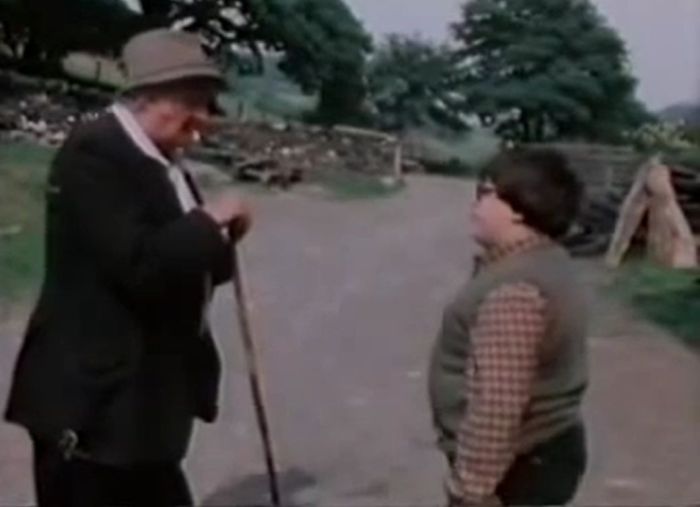
No matter, since isolating Roland from the others was simply a way to make him meet Mr Price (Mostyn Evans).  Mr Price is a local farmer and is able to reassure Roland that he was in no danger from a field full of bulls (they were cows).  He’s able to teach the boy some words of Welsh, tell him about the type of cows he had a close encounter with, and generally give the town-based Roland an insight into life in the Welsh countryside.  It’s a nice part of the episode, developed further next time, which shows that although Roland may not be able to join in with many of the outward bound activities, he’s still able to gain something from the trip.

No such luck so far for Diane though, who continues to cut an isolated and tragic figure.  Although most of the girls – even the tactless Annette – are friendly, there’s still the odd one (like Sarah) who continues to treat her as something of a pariah.

Later, we see that Miss Mooney looks rather fetching in dungarees as she pours out her recent romantic heartbreak to one of the outward bound tutors.  She’s clearly hoping for some solace, although Mr Baxter (Michael Cronin once again in good comic form) seems less than sympathetic as he harrumphs from his corner of the room.

The episode ends in time-honoured comic fashion as the boys rig a trap in their dorm which empties a bucket of water over Mr Baxter’s head.  Although in the ensuing merriment Roland falls off the bunk bed, spraining his ankle.  Not the most high-octane cliffhanger then …..


Grange Hill. Series Six – Episode Fourteen

grange hill s06e14

Written by Barry Purchese.  Tx 18th February 1983

We’ve reached episode fourteen and it’s the first time this year we’ve seen Mr Baxter on videotape.  Hurrah!  Michael Cronin’s only two previous appearances this year were brief film inserts, so it’s long overdue that we should have an episode where he makes a more substantial contribution.

The first scene is between Mr Baxter and Randir.  In Mr Baxter’s world, if you’re good at sports then you’re good, full stop.  Randir’s prowess on the football field has long been established and his decision to carry on playing during a vital school match even though he was carrying an injury (later discovered to be a fractured wrist) clearly meets with Mr Baxter’s unspoken approval.

The return of Gripper begins the endgame of his storyline which has dominated the series since the first episode of episode five.  It had to come to an end – indeed, it seems a little unrealistic that he’d not been expelled before – and Barry Purchese was charged with making his exit as memorable as possible.

Before that happens, there’s some other business to attend to – not least Mrs McClusky’s decision to suspend Mr McGuffy.  It’s a gloriously played comic scene between Gwyneth Powell and Fraser Cains.  When Mr McGuffy protests at Mrs McClusky’s criticism of his conduct and dress, she snaps back that “I haven’t called you here for a debate, Mr McGuffy!” as months of long held exasperation clearly bubble to the surface.

A good demonstration of Mrs McClusky’s skills as a politician is provided when she initiates a referendum into the question of flexi-time.  Mr Hopwood is more than a little surprised, but when she tells him that the referendum will only decide whether to refer the matter to the board of governors, things become clearer.  The governors will dismiss it out of hand, but Mrs McClusky will have been seen to have done something to address the situation, even if it was ultimately futile.  As I said, a skilled politician.

Gripper’s persecution of Randir is an early flashpoint.  Along with his increased mob, he’s cornered the boy in the toilets and their fun is only brought to an end when Mr Baxter storms in.  “Not back in the school five minutes and you’re spewing out your poison.”  When Gripper calls Mr Baxter a paki-lover the teacher reacts with fury, thrusting Gripper’s head into the sink and threatening to wash his mouth out with soap.  It’s a moment that crackles with electricity, although you have to say that Mr Baxter was lucky to escape a charge of assault.

If Mr Baxter is furious with Gripper, then he’s even angrier with his mob.  “As for you bunch of slimy no-goods, you’re worse than he is. He’s rotten, but you lot … you just feed off him like a bunch of maggots.”  When Georgie makes a dismissive sound, Mr Baxter steams over, grabs him by his shirt and points a finger in his face.  The look of fear in the eyes of one of the boys in the background helps to sell the intensity of the scene.

Now that Gripper’s got his own firm he reopens for business.  First is on his list is Pogo – Gripper decides that an exchange of notes (a pound note for the note he’s acquired from Pogo’s girlfriend) is fair.  Yes, Pogo has a girlfriend!  Considering that in the previous episode he was railing against girls in his usual way, this is a little surprising.  Finding out her identity will be a small running thread that’ll continue until the end of series six as Stewpot and Duane (now friends again) continue to be intrigued by his mystery girl.

Mr McGuffy’s suspension means that Mr Baxter is drafted into covering his English lesson, much to the amusement of the fourth-formers.  Precious is convinced that once he sees what they’re studying that’ll be the end of the lesson.  But Mr Baxter isn’t quite the uncultured man he might appear to be.  “Elizabethan verse romances? Oh yes, this is the stuff of literature this is. Drayton, Marlowe, Shakespeare, my word. Wasted on you bunch of philistines of course.”  Another lovely scene which demonstrates just how much Michael Cronin has been missed this year.

Aside from demanding money with menaces again, Gripper’s also got other scores to settle.  One of them is with Claire, thanks to the article on him that she wrote for the underground school magazine.  His choice of revenge – a dirty mop thrust into her face – is suitably unpleasant and provides the episode with yet another dramatic moment.  Stewpot’s naturally incensed and is all for rushing out and dealing with Gripper there and then, but Duane manages to talk him around.  Instead, they team up with Glenroy, who’s already teamed up with Randir.  Rather like the opening episode of series six, it shows how opposing factions in the school can be united because of their hatred of Gripper.

Once again, the mayhem is cut short by the timely arrival of Mr Baxter.  “No, I’m sorry lads. I can’t allow it. Not vigilante groups. Doesn’t matter how justified you may feel. But we let you all down though, haven’t we? There’s no excuse, not really. That evil toe-rag should never have been allowed back on school premises, but he was. And in the space of one morning he’s attacked people because of their colour, because of their sex.  I also hear you’re back to demanding money with menaces, Stebson.  What an utter and complete charmer you are lad.”

As the picture freeze-frames on a shot of Gripper walking to Mrs McClusky’s office to face expulsion (with the cheers of the others ringing in the background) it’s an apporiate way for his time at Grange Hill to end.  Gripper would later make a few one-off apperances, but his absence would leave something of a void.  GH would create many more bullies over the course of the next few decades, but some of them struggled to escape from the long shadow cast by Mark Savage’s intimidating performance.