Grange Hill – Series Nine, Episode Seven

grange hill s09e07

Written by Frances Galleymore.  Tx 28th September 1986

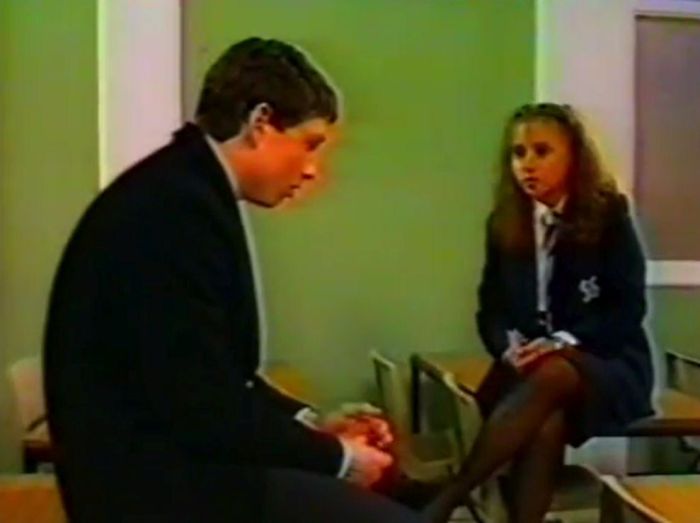
Julia contnues to moon over Ant whilst Georgina continues to avoid Imelda.

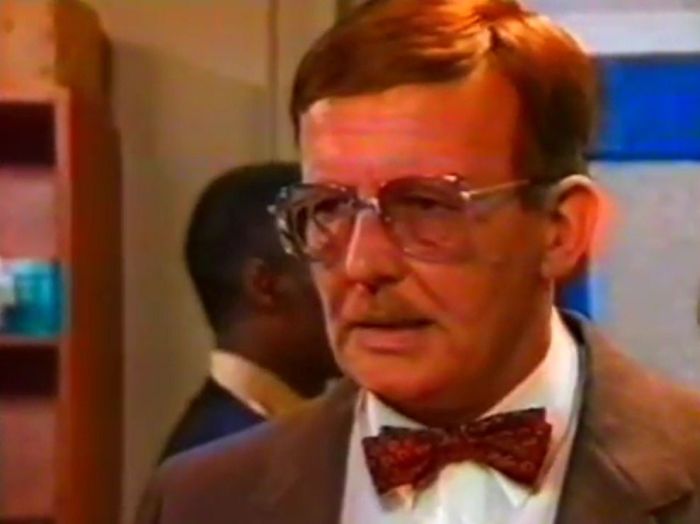
Mr Bronson’s not a happy chappy (the overcrowded staff room is just one of many irritations). Some of the non-speaking extras are also dischuffed – banging down empty coffee containers in a petulant manner – but Mr Bronson is the one who voices the discontent many feel.

A solution to their problems has been found – portacabins.  But when they don’t turn up on time Mr Bronson isn’t terribly pleased (to put it mildly).  That he chooses Mr Baxter to be the recipient of his anger is understandable since he’s not foolish enough to tackle Mrs McClusky head on – so the pair once again lock horns in an entertaining fashion. As ever, Mr Bronson favours the direct approach, bluntly accusing Mr Baxter of using his position as deputy head to ensure that the sports department gets the best of everything whilst the rest of the staff suffer.

You don’t need to be a mind reader to work out that he’s entirely wrong (Mr Baxter has funded extra-curricular activities, like the swimming team, out of his own pocket). This is another clear sign of Mr Bronson’s character defects – if you’re going to accuse a colleague of misconduct it’s best to have clear evidence. Alas, he never seems to learn this basic rule.

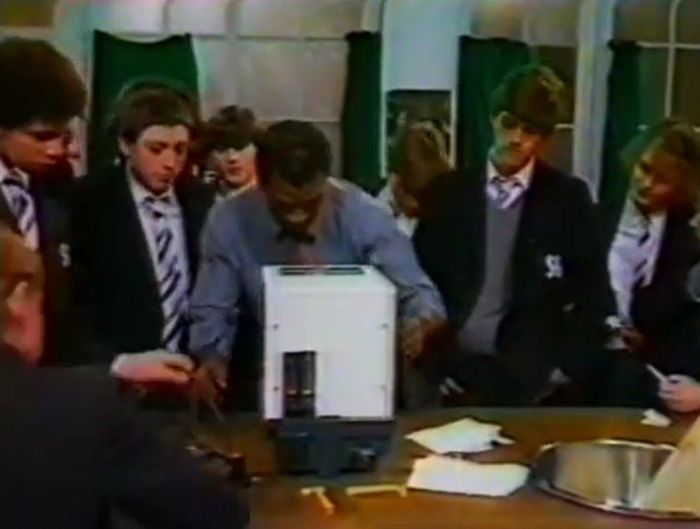
Danny is the recipient of some decent dialogue which goes a little way to explaining exactly what makes him tick. Enjoying a smoke in the chemistry lab, he’s unabashed when discovered by Julia and Laura and goes on to explain his worldview. “That’s what it’s all about in an institution, breaking down independence, everyone joins in doing it”. Imelda, like Gripper before her, is the more obvious example of an uncontrollable pupil but Danny’s a little different as he flies under the radar most of the time. That he’s vocal about keeping his identity and not letting the system crush him might suggest that a close family member has recently seen the inside of a prison.

That old chestnut – two teachers squabbling over who should be in a certain classroom – gets another airing here. Mr Bronson is in possession and is disinclined to give it up in favour of Mr King. Mr Bronson crows about his victory somewhat after a passing Mrs McClusky suggests that Mr King could use part of the canteen, but his celebration is shortlived after Mrs McClusky (in her deceptively sweet way) makes it plain that maturity and tact are key to solving problems like this. Ouch!

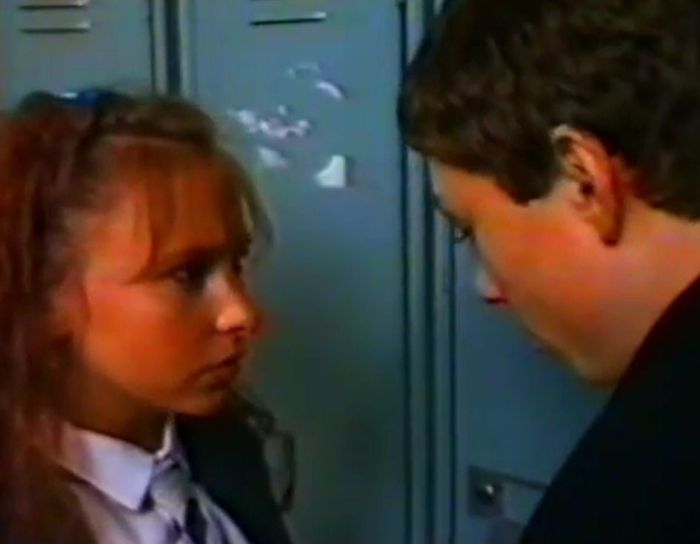
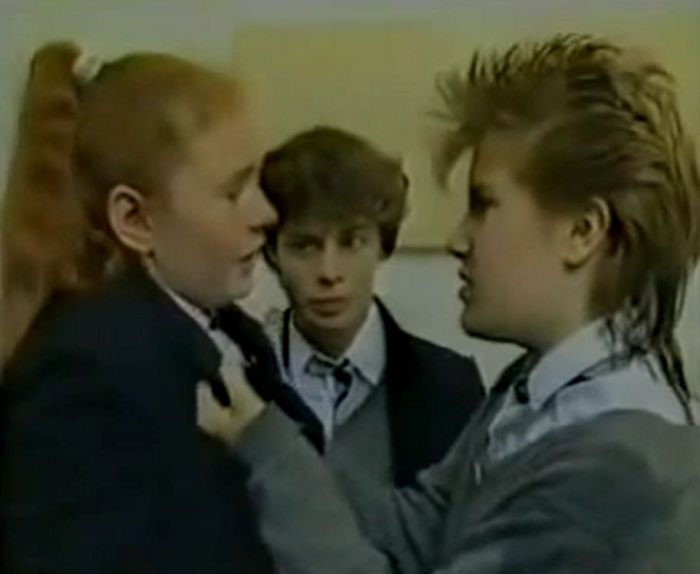
Georgina is worried that she’ll be a target for Imelda, but Ant – continuing to play the alpha male – tells her not to worry, he’s got her back.  Bless!  If you haven’t guessed what happens next then you’ve possibly not been paying attention – Ant’s nemesis Mr Bronson once again appears at the most inopportune moment to harangue the boy – leaving Ant frustrated and Georgina forced to join forces with Imelda once more ….

Given that Mr Bronson is still smarting from the oblique rebuke he’s just received from Mrs McClusky, the arrival of Ant – seven minutes late – isn’t going to improve his temper one little bit. Ant has his familiar excuse (Mr Baxter) which serves as the trigger to send Mr B into meltdown. Michael Sheard hits the heights here (imagine this dialogue delivered by Sheard at full-throttle). “Aaaaaah, Mr Baxter! That explains everything. Every time you are late it is Mr Baxter’s fault. Why?”

Further delights are to be found after Mr Bronson tells Ant that they will settle this with Mr Baxter once and for all immediately after school. Ant, who has arranged to meet Georgina, tells him he’s not free. Sheard once again comes up trumps. “Not free? Change your social diary”. Wonderful stuff.

Ant is discovered to have been a little economical with the truth (Mr Baxter might have been the reason why he missed registration, but he still could have made Mr Bronson’s lesson on time) which means that the boy faces a double-pronged attack from both teachers who temporarily forget their own differences to turn on him.

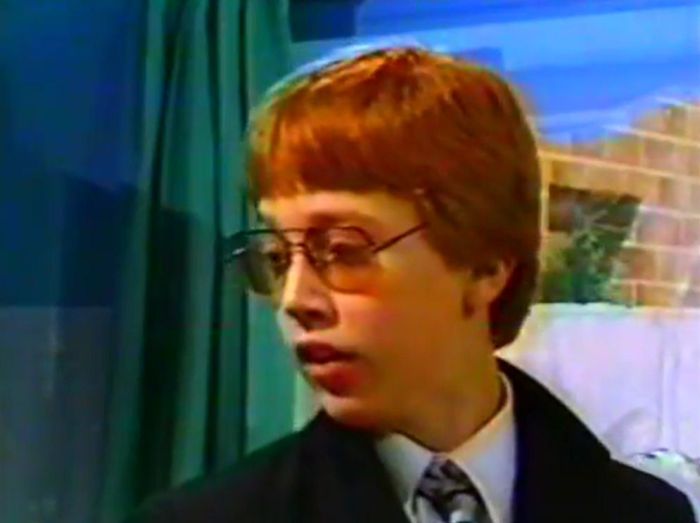
Mr Kennedy’s letter writing lessons continue. Ziggy tells him that he plans to write to the Duke of Edinburgh. Remember this, it’ll become important later ….

Grange Hill – Series Nine, Episode Six

grange hill s09e06

Written by Margaret Simpson.  Tx 24 January 1986

Gonch has been a little quiet this year (although given the influx of new characters that’s possibly not too surprising).  But after a fallow period he comes roaring back to life here with yet another brilliant scheme – a sandwich-making business.  And Gonch being Gonch he starts off by selling shop-bought sandwiches at a profit.  Truly he is Pogo Patterson reincarnated.

But as we’ve seen so often, the life of the businessman is littered with pitfalls.  He has to find premises to maintain his sandwich production and it’s not surprising that his mother bristles at the way her kitchen has been turned into a café. So where now?

Gonch’s sandwich plan is a sound one – with no tuckshop and the canteen full to breaking point there’s a clear opening to make a little money. We drop into the canteen to see a green young teacher left at the mercy of the rather feral pupils (custard smeared on the tables and the likes of Imelda refusing to clear their table doesn’t help). The rest of the pupils also rush out – all but Laura and Julia, the goody-goodys! Tamsin Heatley, later to appear as Bella in The Tweenies, plays the very put-upon teacher.

Whilst it’s understandable that series nine is mainly remembered for Zammo’s heroin addiction, other interesting plotlines were also developed.  Possibly in any other year the relationship between Fay and Mr King would have generated more publicity, but with the blanket Just Say No campaign dominating the airwaves it’s understandable that Grange Hill’s first attempt to depict a suspect relationship between a teacher and a pupil seemed to pass by unremarked.

It’s gently teased out to begin with as we see Fay confide to Julie that she thinks Mr King is really nice (although she immediately denies that she fancies him).  Fay’s been here before of course, although her crush (if that’s what it was) on Miss Gordon back in series seven was handled in a understandably oblique manner. It’ll be a short while before this story develops, but the seed has definitely been sown.

It’s been a few years since the school magazine storyline has reared its head, but it makes a comeback here – with Calley keen to create a school fanzine.  Essentially this would be a school magazine, so the distinction between the two isn’t too clear – except there’s no doubt that she wouldn’t be inclined to run the content past the staff first.  Is this going to end well?  Hmm, I wonder.

Imelda has words with Georgina after Georgina’s relationship with Ant becomes public knowledge.  Quite what a nice girl like Georgina is doing hanging out with a nasty piece of work like Imelda is a bit of a mystery.  You can assume that she decided it was safer to be a part of Imelda’s gang rather than stay on the outside, but one drawback of S9 is the way that a number of new characters tend to rush through various plotlines.

When Denny appeared to turn his back on Gripper in S6 it carried a certain resonance as we’d seen him act as Gripper’s right hand man all the way through S5.  Georgina’s shifting allegiance doesn’t carry the same weight as we’ve only seen her in a handful of episodes.

It’s interesting that both Helen and Georgina are different – and nicer – people away from Imelda’s influence (although Helen’s still shown to be quite spiteful). They both cheer on Ant during the swimming gala (he, of course, wins his race. Mr Perfect, he is). Ant’s victory is the only highlight though, which irritates Mr Baxter no end.

Jackie’s suspicions about Zammo grow. He’s not only spent all the money she lent him but he’s gone ahead and sold his bike to Kevin anyway (she lent him the money so that he wouldn’t have to do this – or so she thought). Once again, Zammo can’t look her in the eye and this – together with his hesistant delivery – is a further sign there’s something up.

If he’s this disconnected most of the time then it’s hard to see how it could go unremarked during lesson time (unless Grange Hill’s teachers are spectacularly unobservant). But as yet, apart from Jackie it seems that nobody’s noticed there’s anything amiss with the boy.

grange hill s09e06-2.jpg

Grange Hill – Series Nine, Episode Five

grange hill s09e05

Written by Margaret Simpson. Tx 21st January 1986

The cramped, multi-class environment of the gym continues to be a stressful experience for teachers and pupils alike.  Mr Bronson stalks around from class to class, saying nothing but clearly far from pleased (signified by the way he taps his pencil in a frustrated manner).  He spends several minutes standing silently by Miss Partridge’s class and it’s instructive that although he observes that Danny is the one who’s being awkward, Mr Bronson’s ire is directed at Ant.

Miss Partridge is eventually able to convince him that Ant was blameless but it’s intriguing that Mr Bronson is clearly shown to victimise Ant without any evidence.  The way that Mr Bronson targets certain pupils is something of a running thread during his time at the school (Zammo, Ant and – later – Danny).

But if Mr Bronson’s intervention was partly due to his disdain for Ant, then Miss Partridge is convinced that it also had something to do with the fact that she’s a woman (“I wouldn’t mind but he didn’t interfere with Peter King’s class”).  Mrs Reagan sympathises.  Mr Glover, a school governor, blocked her application to become head of sport, although quite how he could do this isn’t clear.

Now that Mr Baxter is a suit (deputy head) he finds himself a target as few of his colleagues are happy with the current state of affairs.  He weakly wonders whatever happened to the Dunkirk spirit, although that doesn’t seem to go down terribly well (Mrs Regan’s whispered “men” signifies what she thinks, although this isn’t really an argument that can be divided across male/female lines).

There’s a slight lapse in continuity here.  Last episode we were told that the old Brookdale building couldn’t be reopened because it had been extensively vandalised but this week we learn that it’s half way to becoming a multi-story car park.  Presumably a similar fate has befallen Rodney Bennett, as nobody ever mentions using that school on a temporary basis.

We haven’t seen Zammo since episode three.  There we learnt that he’d sold a present given to him by Jackie, now he’s on the verge of selling his pride and joy – his bike – to Kevin.  He’s clearly on a downward path – when Jackie speaks to him he’s hesitant and can’t look her in the eye – but it’s still not clear what his problem is.  Jackie is still prepared to stand by him and is happy to give him all the money she has in her post office savings account – twenty five pounds.  He’s grateful and promises to pay her back, although it seems unlikely.  It’s noticeable that they only feature very briefly across the twenty five minutes.  This may turn out to be the dominant plotline of series nine but it’s being set up in a very sparing manner.

Trevor is convinced that Julia Glover fancies him.  No, really.  This is even more unlikely than an Ant/Ronnie team up, but it sets us up for the inevitable comic reversal later.  Trevor has a brilliant plan to get a little on-one-on time with the woman of his dreams, he and Vince will rock up to Cheryl’s party, complete with a bottle of cider (lovely touch that) and blag their way in by claiming to be guests of a non-existent friend who’s already inside.  What could possibly go wrong?

This scene between Trevor and Vince is a delight.  It’s very much in the tradition of Laurel and Hardy where one – Laurel/Vince – is stupid and the other – Hardy/Trevor – is even stupider but thinks he’s cleverer.  Trevor’s promise to tutor Vince in the art of female seduction is a mouth-watering one (“watch me at the party, watch a master at work”) as is the way Trevor casually straightens his tie in a knowing manner.

With a little help from Paul Young on the stereo, the party at Louise’s is soon jumping although older sister Cheryl (Amma Asante) disapproves.  Asante must be one of Grange Hill‘s most distinguished former pupils as she’s gone on to enjoy an award-winning career as a director.  Belle (2004) and A Way of Life (2013) have both picked up numerous awards.

Luckily Kevin’s acting as a bouncer, so Trevor and Vince have to skulk off home and sadly we’re denied the opportunity to see Trev’s skills as a lothario at first hand.  Pity!  Kevin later acidly sums them up as “Meat Cleaver and Planet of the Apes”.  Harsh but fair.  Ant is more successful in gaining admittance, although given his comment (“I’m the drummer with Duran Duran, but I’m incognito tonight”) I feel that Kevin was well within his rights to give him a slap anyway.

Unable to catch Ant’s eye, Julia finds solace with alcohol instead.  It’s plain that this isn’t going to end well and so it proves with Mrs Regan forced to pick up the pieces.

Grange Hill – Series Nine, Episode Four

grange hill s09e04

Written by David Angus. Tx 17th January 1986

Big sister Jackie and younger brother Robbie are walking to school.  Jackie is complaining that she has to do numerous household chores whilst Robbie gets off scot free.  Robbie doesn’t see anything wrong with this (after all, she is a girl).  Following this moment of pure sexism (sure to raise the hackles of a certain section of the audience) the attention turns to Robbie’s new earring.  He’s only just had his ear pierced and is more than a little sensitive about letting his friends see it – hence he removes it just before encountering Trevor and Vince.  Melissa Wilks pulls a lovely face here to signify Jackie’s disdain at Robbie’s chicken-heartedness!  As might be expected, the others tease him mercilessly.  All except Trevor who – surprisingly – is supportive.

The characters of Laura and Julia are developed a little more.  Laura, as befits a pupil who has a parent for a teacher, sees herself as something of an outcast although this is possibly only something which exists in her imagination.  Julia is a warm-hearted and friendly type of person, best demonstrated when she attempts to engage Mr Bronson in conversation.  This is a lovely scene.  Mr Bronson, still sporting a large sticking plaster on his neck, is on playground duty and possibly because he’s outside of his natural environment – the classroom – and also talking directly to the girls is surprisingly vulnerable.  He finally admits that his injury was caused by a parrot.  This nugget of information amuses them but Mr Bronson insists that “they can be quite vicious you know. It was a very painful experience”.

If he’s almost human here, then elsewhere he’s his normal, abrasive self.  And once again it’s Ant who’s on the receiving end of his anger.  There’s a painful inevitability in the fact that Mr Baxter turns out to be the reason why Ant doesn’t reach Mr Bronson’s tutorial group on time.  And it’s just as inevitable that Ant, smouldering away, will once again bow to Mr Bronson’s authority with a very ill grace.

Ricky Simmonds had clearly been cast as this year’s GH heartthrob – a rebel without a cause, destined to set female hearts fluttering.  So far this year he and Georgina have already exchanged smiles whilst Ronnie has been gazing wistfully in his direction for a while, although there’s no indication that he even knows who she is.  This is demonstrated when both Ronnie and Georgina head independently to the lunchtime disco and – remarkable coincidence this – happen to stand close together.  Ant ambles towards them, Ronnie nearly faints with excitement but Ant make a beeline for Georgina.  Poor Ronnie.

Apart from these various character interactions, the main thrust of the episode is the way that the one remaining school building is pushed to breaking point.  With capacity for 800 pupils, how can they cram 1,500 in?  The answer, in part, is by installing numerous classes into the gym, although this open-plan and noisy environment is far from ideal – as might be expected Mr Bronson is far from pleased with this solution.  Later he advocates taking industrial action (Mrs McClusky rolls her eyes at this).  It’s a reasonable suggestion, but maybe Mrs McClusky has an alternative plan up her sleeve.

Louise is granted a few more lines as plans for a party at her house are mooted.  Laura and Julia are both keen, although Julia frets that she’ll have to lie about it to her father.  Julia’s father, Mr Glover, has yet to make an appearance but his character type – stern, disapproving – has already been deftly set up here.

Grange Hill – Series Nine, Episode Three

grange hill s09e03.jpg

Written by David Angus. Tx 14th January 1986

The episode opens with Kevin, Fay and Julie chewing the lunchtime fat with Mr Kennedy and Mr Baxter.  A sticking plaster on Mr Bronson’s neck (Kevin believes it’s a love-bite) is a hot topic of conversation.  I love this bit of banter as well as the way that Mr Bronson self-consciously touches the plaster when Mr Kennedy and Mr Baxter sidles past his table.

It’s noticeable that Zammo’s conspicuous by his absence during this merry-making.  Later we see him eating alone before Jackie joins him.  Zammo’s distracted state is once again in evidence – he doesn’t want to go along with Jackie to the lunchtime disco (can’t really blame him for that as it’s not exactly a hip and happening scene) or indeed do anything else with her.  She still wants them to be an item (despite their sniping in the first episode) but Zammo’s non-committal.  That he sold a present she gave him (a calculator) was either a thoughtless gesture or another indication that something’s seriously wrong.  Jackie’s teary state and Zammo’s inability to comfort her suggests the latter.

The wonderful George A. Cooper is on fine form as he takes it upon himself to keep an eye out for the miscreants who are using part of the school as a smoking den.  Mr Griffiths proudly tells Mrs Reagan that during his army days he was known as “the chameleon. That’s what, no lie”.

Last time it wasn’t clear whether Imelda knew how damaging the fibreglass was.  Here we’re left in no doubt on this score – Mr King spells out that it’s nasty stuff – but she still presses ahead to use it in her plan to gain revenge on Ziggy.  This serves as an indication that she’s not merely naughty, but possesses a strong malicious streak.  It’s just a slight pity that her attack on Ziggy was rather little bungled (he starts screaming before she pushes the fibreglass down his back – presumably a second take was out of the question).

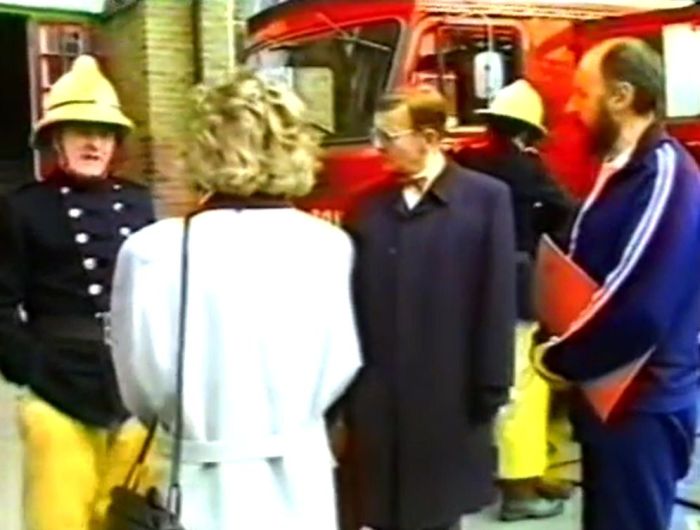
Fire! It’s worrying to see that some teachers don’t respond instantly when the fire alarm sounds.  Mr MacKenzie is a little reluctant (it’s obviously another false alarm) but quickly bows to the inevitable.  Mr Bronson eventually also has to accede, although he does so with an ill grace that’s quite in character.  But there’s smoke billowing out of the building so it must be the real thing.

It was clearly something of a big-budget day as not only do we see a substantial number of schoolchildren (at least a hundred) milling in the playground but there’s also a couple of fire engines thrown in for good measure.  Always a pleasure to see the late Peter Childs, here as a fireman, even if it’s only for a few moments.  The playground scenes also serve as our last opportunity to see the old Grange Hill school in all its Victorian glory (once asbestos is discovered it’s closed for good).

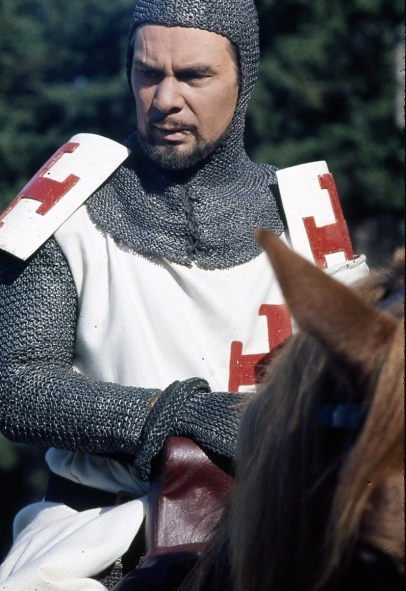
Ivanhoe – Production Stills

A collection of production stills from Ivanhoe.

Grange Hill – Series Nine, Episode Two

grange hill s09e02

Written by Barry Purchese. Tx 10th January 1986

Zammo’s descent into heroin addiction would become the defining theme of series nine (and possibly of the entire thirty one year run).  But dramatically there’s a few missed opportunities along the way.  It’s very noticeable that we never see the reaction of key characters – especially Jackie – when they learn the news for the first time.  Roland’s chosen to be the one who discovers his secret, but again there’s no scene where he discusses this news with the others.

You’d also have expected that his increasingly erratic behaviour would have been commented on by his classmates but after the next episode we aren’t really privy again to many classroom scenes with the fifth formers.  Possibly this was an intentional move though – from now on Zammo’s an isolated character and rarely interacts with his former friends.

Although it’s still early days with this plotline there’s clearly something up with Zammo.  He’s short of money (already in debt to Kevin) and attempts to cheat in the great moustache weighing competition.  Mr Kennedy – aware that Banksie is feeling self-conscious about his moustache – offers to shave off his own facial hair as well.  Banksie’s will be weighed and the class will then be able to use that figure as a control in order to estimate the weight of Mr Kennedy’s moustache.  There’s a twenty five pence entry fee and if anybody guesses the weight correctly they win six pounds, if not the money goes towards the school fund.

It’s an interesting wrinkle that Banksie is the one who discovers Zammo’s cheating ways.  He manages to ensure that Zammo doesn’t profit, but he also doesn’t reveal Zammo’s secret to the others.  Was this because he intended to hold this piece of information back, all the better for using it to manipulate and embarrass Zammo at a later date, or has Banksie turned over something of a new leaf?  He does later tell Mr Kennedy that it’s better that the money goes towards the school, although given that we’d only recently seen him and Trevor attempting to cheat at one of the games during the Christmas Special, this holier-than-thou attitude is slightly hard to swallow.

Mr Kennedy’s affability and ability to connect with the pupils is clearly demonstrated here.  He’s an inspirational teacher and therefore couldn’t be further removed from the bitter and twisted Mr Bronson.  There’s a lengthy staff-room scene at the start of this episode in which Mr Bronson, quietly spitting venom, caustically comments on Mrs McClusky’s choice for acting deputy head.  Mr Baxter? A sports teacher? It’s obvious that he saw himself in the role (or more possibly as the head itself) but instead has to sit on the sidelines, quietly fuming.

As for Mr Baxter himself, he’s the recipient of a fine scene where he firstly berates the second years for their poor quality gym kits and then conscripts the unwilling Gonch, Hollo and Robbie into the newly reformed Grange Hill swimming team.  As ever, Michael Cronin is a joy.

1986 was the last hurrah for the old Grange Hill school.  Shortly to be closed for good following an asbestos scare, it’s in a remarkably run down and dingy state.  This ties into the conversation between Mr Kennedy and the fifth formers (who bemoan the fact that it’s impossible to do projects since the school library has so few books – hence their small fund-raising effort).  The way that Grange Hill has always struggled with funding has been a subtle running theme for a number of years and given the turmoil in the real world during the mid eighties (teacher strikes were at their height) it’s not surprising that it’s touched upon again here.

My recollection is that although it was stated that a character would become addicted to heroin, their identity wasn’t known, meaning that that Danny Kendal seemed to be the obvious choice.  Despite his diminutive size he was unafraid to take anybody on (older pupils, teachers) and there’s further early evidence of his erratic behaviour here as he runs amok with a wrench.  But it would have been obvious – too obvious no doubt – to make him the one and the dramatic potential of turning a previously likeable character like Zammo around was clearly too tempting to avoid.

Imelda’s reign of terror continues.  This week it’s shoving fibreglass down the backs of unfortunate first years.  Everybody around at the time – including Gonch, Hollo and Robbie – find this to be a huge joke, although they aren’t present when the painful lacerations are revealed.  This allows us to understand that they maybe weren’t as heartless as they first appeared, although Calley and Ronnie have sharply differing opinions about Imelda’s part in this.  Calley believes that Imelda also couldn’t have known what damage it causes whilst Ronnie isn’t so sure.  Next time we’ll discover the answer to this question.

Grange Hill – Series Nine, Episode One

grange hill s09e01

Written by Barry Purchese. Tx 7th January 1986

If the Christmas Special, in part, harked back to the past (featuring last hurrahs for some old favourites) then the first episode of series nine was an exercise in looking forward.  This is partly symbolised by an unattractive piece of modern art – aptly titled “New Horizons” – but it’s mostly to do with the various arrivals and departures, courtesy of new producer Ronald Smedley.

The merger between Grange Hill, Rodney Bennett and Brookdale (which had been a running thread during series eight) is now quietly forgotten.  This means that several characters (Banksie’s mate Loop and Julian Fairbrother) were probably deemed surplus to requirements although Banksie and Jackie – now assimilated as Grange Hill types – still had roles to play.

School uniforms, which had previously been abolished for the upper years, are quietly reintroduced.  Nobody ever seems to comment on this which is a little odd (I’m sure Trisha, back in the old days, wouldn’t have taken this decision lying down!).  The dramatic possibilities of Mrs McClusky continuing to chafe at only being the Deputy Head are quickly nullified when it’s revealed that the Headmaster, Mr Humphries, has died in a car accident.  In time-honoured soap style this happens off screen (a quick and easy way to write a redundant character out).

But at least Mr Humphries merited a mention.  Poor Loop and Julian Fairbrother are amongst those who join the long list of the Grange Hill vanished (characters who disappear and are never mentioned again).  Annette’s absence is deemed worthy of comment (she had been in the series for five years though) when it’s revealed that she’s now living in Milton Keynes.  A fate worse than death it’s implied.

With the episode count increased from eighteen to twenty four, some new blood was obviously required.  Deep breath ….

Georgina Hayes (Samantha Lewis) is revealed to be the third member of Imelda’s gang.  Georgina – like Helen – is positioned as someone who could be a good person if only she was able to escape from Imelda’s orbit.  All three have been at the school for the last year (obviously always off-camera during series eight) but one genuine new arrival this episode is Ziggy Greaves (George Wilson).

Ziggy loves spiders (hence his nickname, although I daresay that most of the target audience – like Robbie – wouldn’t have heard of the David Bowie album which gave him his moniker).  With a broad scouse accent, Ziggy is clearly an exotic and unusual creature.  This ensures he ruffles a few feathers (crossing swords with Imelda and a frog whilst Trevor chunters away quietly that the newcomer is taking liberties).  In time Ziggy will team up with third-wheel Robbie, thereby generating a new partnership to sit alongside that of Gonch/Hollo.  Their friendship is tentatively begun here, although since there’s so many new arrivals and plotlines to set up it doesn’t go much further than a quick hello.

It’s not been uncommon for new characters to suddenly appear with everybody pretending they’ve been there for years (Kevin during series seven for example) but this episode goes one better as we see a whole form suddenly materialise out of nowhere.  Laura Regan (Fiona Mogridge), Julia Glover (Sara McGlasson), Louise Webb (Alison McLaughlin), Ant Jones (Ricky Simmonds) and Danny Kendall (Jonathan Lambeth) are a bunch of third years no doubt less than delighted to learn that Mr Bronson is their new form tutor.

Laura and Julia both have influential parents (the games mistress and a school governor respectively).  Louise isn’t given any lines here whilst Danny is shown to be completely disconnected – happy to flout school rules with seemingly not a care in the world.  We’ve seen anti-authority figures before, but Danny is something different.

Ant doesn’t hit it off with Mr Bronson.  Last year Zammo was his whipping boy and it seems that Ant will perform that same function this term.  Once again we see a battle of wills between master and pupil, with both believing that they’re in the right.  Ant had a good excuse for being late for Mr Bronson’s tutorial – a meeting with Mr Baxter – but Mr Bronson isn’t prepared to listen.  Mr Baxter later confronts his fellow teacher and is less than cordial.  “Insisting you’re right when you’re wrong won’t get you respect, it’ll get you resentment”.

On the teaching front, Mrs Reagan (Lucinda Curtis), Miss Partridge (Karen Lewis), Mr Kennedy (Jeffrey Kissoon) and Mr King (David Straun) all make their debuts.  Miss Partridge hardly has the chance to open her mouth in assembly before a frog causes chaos (quite why the unnamed extra reacted with such terror at the frog – placidly sitting inside a crisp bag – is a slight mystery, but we can blame the script).  Mr King fares a little better.  His inexperience is shown (bringing the wrong register to the classroom) although his form group – E2 – don’t make capital out of this.  He may be young, but he’s capable and good humoured and right from the start it’s plain that he has the respect of the pupils.  His replacement next year won’t fare nearly so well ….

With so much going on, there’s still time to set up a few important plotthreads which will simmer away for a while.  The relationship between Zammo and Jackie is a key one (it’s shown to have fractured, with them spitting venom at each other).  Zammo’s also shown to be a little distracted, although the reasons for this aren’t elaborated on.  Banksie’s brave but doomed attempt to grow a moustache amuses Fay, Julie and Jackie no end.  Kevin’s tickled too – he mimics Banskie with a Sieg Heil salute – a little touch which you probably wouldn’t see today.

Possibly introducing the new arrivals of the course of a few episodes would have been more sensible, but although this first episode doesn’t stop to pause for breath, by the end Grange Hill‘s New Horizons have been firmly laid out.

grange hill s09e01 p2.jpg

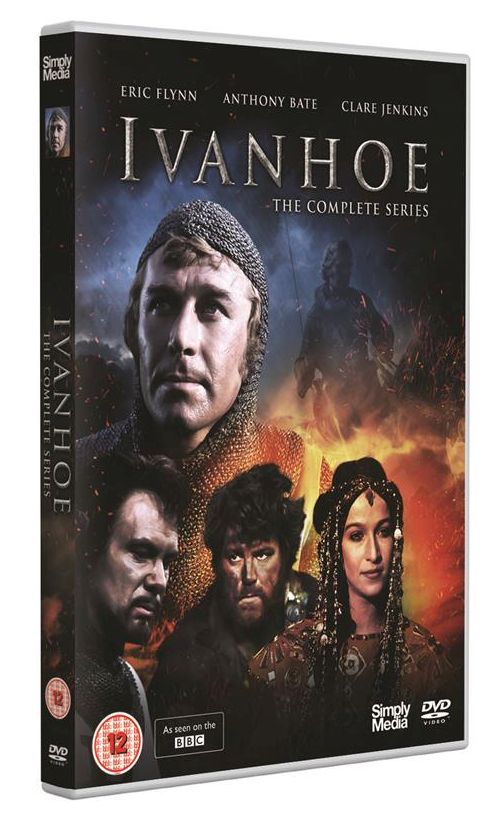
Ivanhoe – Simply Media DVD Review

The year is 1194.  Sir William of Ivanhoe (Eric Flynn) has returned home to England following the disastrous Third Crusade in Palestine.  Ivanhoe’s father, Cedric (Peter Dyneley), one of the few remaining Saxon nobles in an England now dominated by the Normans, has broken off relations with his son due to Ivanhoe’s support for King Richard.

The young Ivanhoe doesn’t seem too disheartened by this familial disapproval though, as he has scores to settle – most notably with Sir Brian de Bois Guilbert (Anthony Bate), a member of the Knights Templar.  They will not only clash on the tournament field but also off it and two desirable young women – the Lady Rowena (Clare Jenkins) and Rebecca (Vivian Brooks) – will both have parts to play in their bitter feud.

Meanwhile, King Richard and Prince John find themselves locked in a grim battle for control of the English throne ….

Published in 1820 across three volumes, Ivanhoe – A Romance has proven to be one of Sir Walter Scott’s most enduring works.  Its mixture of Medieval derring-do and romance is an intoxicating one, with numerous film and television adaptations serving as a testament to the timelessness of the story.

Possibly one of the most notable things about Ivanhoe is how Scott’s novel helped to solidify the modern myth of Robin Hood.  Robin (referred to as Locksley for most of the serial) appears throughout and his characterisation here – a freedom fighter first, an outlaw second – chimes with how we view Robin today (the Robin Hood of the earlier ballads was a much less likeable and noble chap).

Scott wasn’t the first writer to set the struggles of Robin Hood during the reign of Richard I, but this story undeniably helped to create the template which many in the future would emulate.  Certain aspects of the Robin Hood myth are established here – most notably the way that Robin splits the arrow of his challenger during a test of skill.  It’s also interesting how subsequent writers took aspects of Ivanhoe’s character – his return to England from the Crusades, for example – and grafted them onto Robin.

The opening episode wastes no time in creating a sense of place and time. With the rightful King of England, Richard, believed to be languishing in a foreign jail, his brother John sees an opportunity to sieze power. The downtrodden Saxons find themselves suffering under the rule of the Normans, whilst Sir Brian casts a baleful shadow over proceedings.

hi014546802-e1504956112893.jpg
Anthony Bate

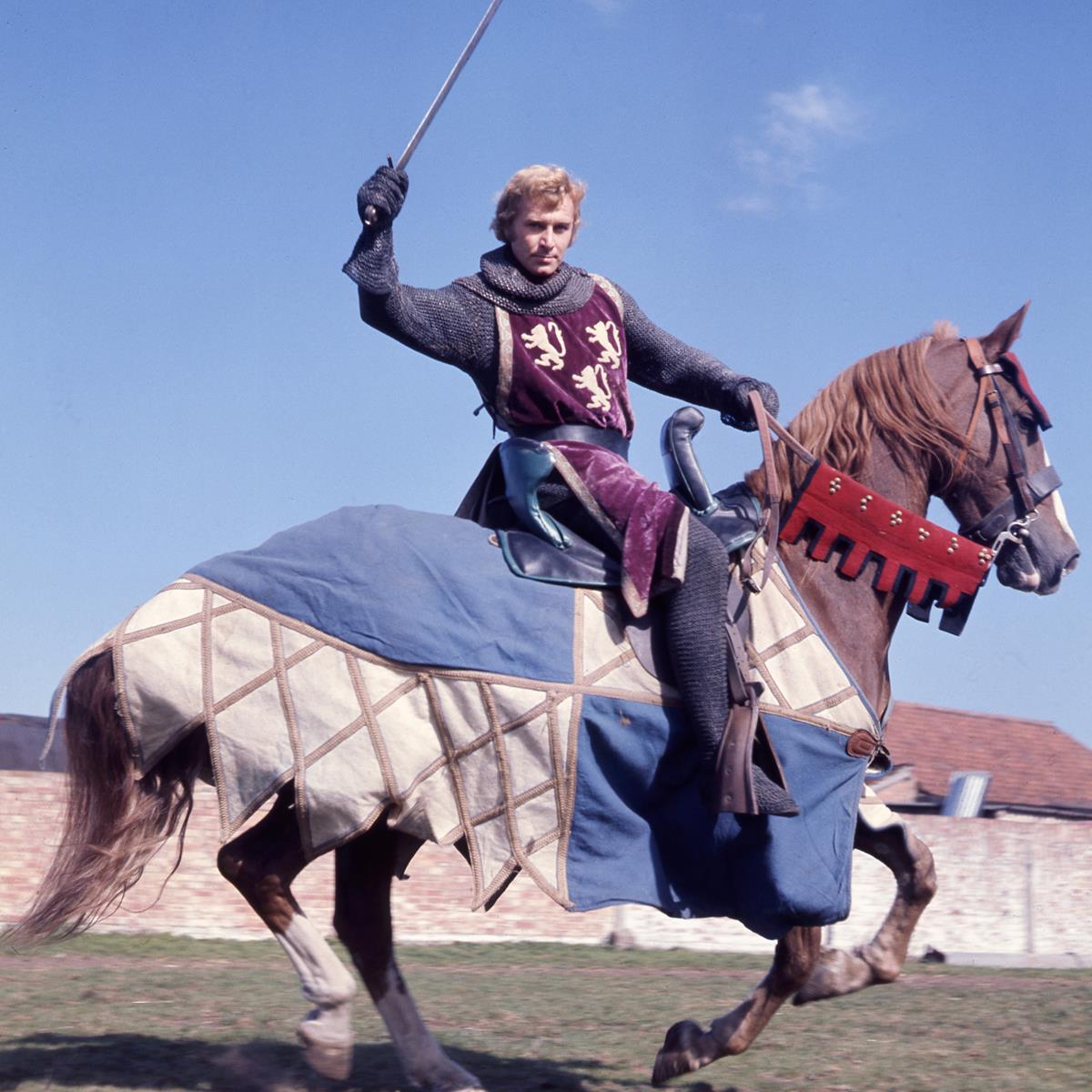
Right from his first appearance, Anthony Bate impresses as Sir Brian. Although Bate tended to play establishment types and professional men, he throws himself into this role – a black-hearted villain, albeit one with his own code of honour – with gusto.  Eric Flynn, as Ivanhoe, is perfectly cast as the square-jawed hero. Whilst it’s true that Bate, as befits a baddy, has the more interesting role to play, Flynn has a boyish charm which suits the character.

Ivanhoe’s first acknowledged appearance is held back until the end of the opening instalment (although it’s rather obvious that the mysterious hooded pilgrim who makes several enigmatic comments throughout the episode is Ivanhoe). That he and Sir Brian (bitter rivals from the Holy Land) happen to run into each other at the castle of Ivanhoe’s estranged father is something of a coincidence ….

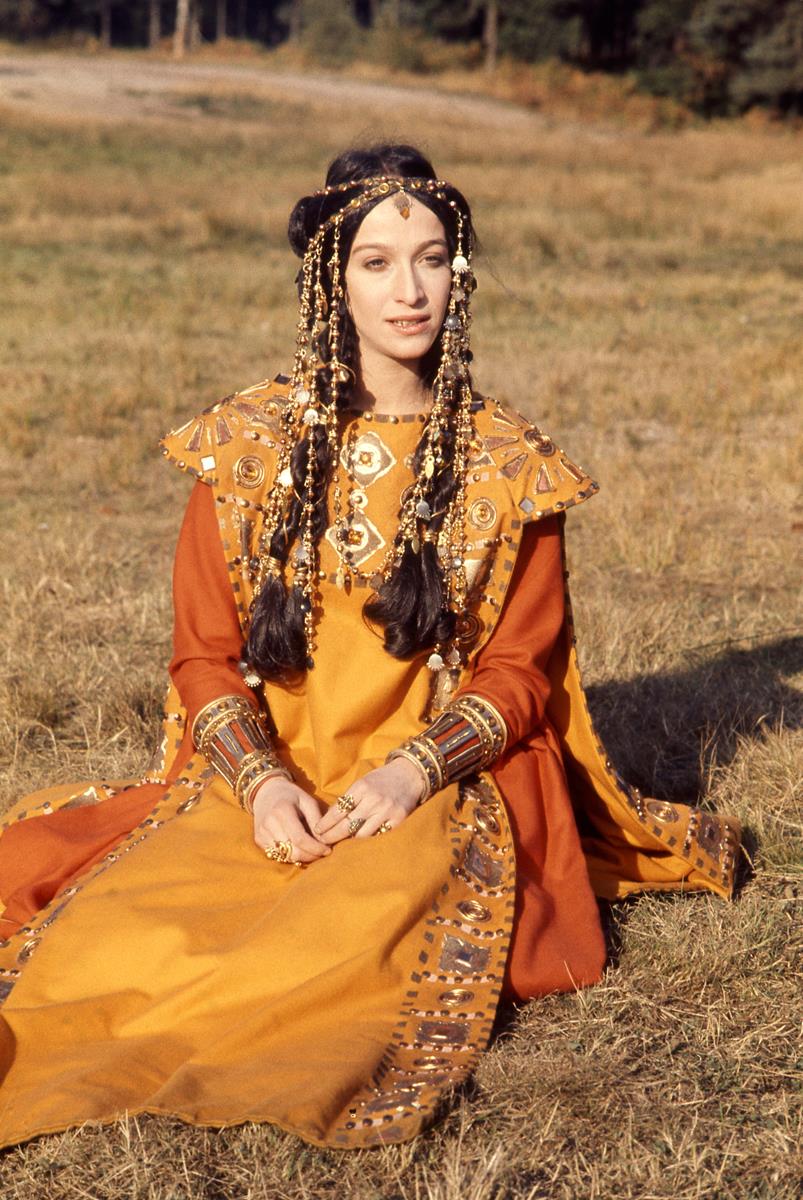
Clare Jenkins, as Rowena, makes for a very appealing herione (coincidentally she and Flynn had appeared together a few years earlier in the Doctor Who story The Wheel In Space). Rowena and Ivanhoe are in love but he has a challenger for Rowena’s affections, the arrogant de Bracy (David Brizley), a Norman lord.

Rebecca (Vivian Brooks), daughter of the despised Jewish moneylender Isaac of York (John Franklyn-Robbins), is somewhat taken with Ivanhoe (she nurses him back to health after Sir Brian gains the upper hand during Prince John’s tourney) but she’s doomed to be unsuccessful as Ivanhoe only has eyes for Rowena.  Sir Brian later attempts to woo Rebecca, but she shuns his advances.

Ivanhoe was Vivian Brooks’ third and final television job (following appearances in Thirty Minute Theatre and Z Cars).  It’s a slight mystery why she didn’t go on to have a longer career as she’s really rather good here, especially when she and Bate cross verbal swords. Brooks may have been very inexperienced compared to Bate, but she more than holds her own during the scenes where Sir Brian and Rebecca warily circle each other.  Vivian Brooks certainly has the meatier of the two main female roles (Clare Jenkins’ Rowena doesn’t have a great deal to do except pine for Ivanhoe).

Vivian Brooks

Although Vivian Brooks only racked up a handful of credits, most of the other main roles were filled by very familiar faces.  That Ivanhoe was directed by David Maloney should be fairly obvious by taking a quick glance at the cast list.  The likes of Graham Weston, John Franklyn-Robbins, Tim Preece, Michael Napier Brown, Bernard Horsfall, Noel Coleman and Hugh Walters had already appeared or would later appear in other productions directed by Maloney.  David Maloney, like many other directors, tended to use a “rep” of actors – dependable people he knew would deliver the performances required.

The strength in depth of the cast is one of the reasons why this serial works as well as it does.  Tim Preece entertains as the capacious and vain Prince John, Hugh Walters is pleasingly off-kilter as Cedric’s fool Wamba, Bernard Horsfall is suitably imposing as the Black Knight, John Franklyn-Robbins impresses as the persecuted Isaac and Noel Coleman is characterically strong as Fitzsurse, one of John’s advisors.  Clive Graham, as Locksley, also offers a vivid performance and it’s always a pleasure to see Michael Craze, here as one of Lockley’s men (Thomas).

Graham Weston, clearly one of David Maloney’s favourite actors (apart from Ivanhoe, Maloney cast him in two Doctor Who stories – The War Games and Planet of Evil), gets a chance to display his skills with a quarterstaff when his character – Ivanhoe’s loyal servant, Gurth – tangles with the outlaws. It’s not a badly directed sequence, although like all fight scenes taped in the studio it pretty much had to be done in a single take (had it been shot on film then it could have been edited much more tightly).

Graham Weston

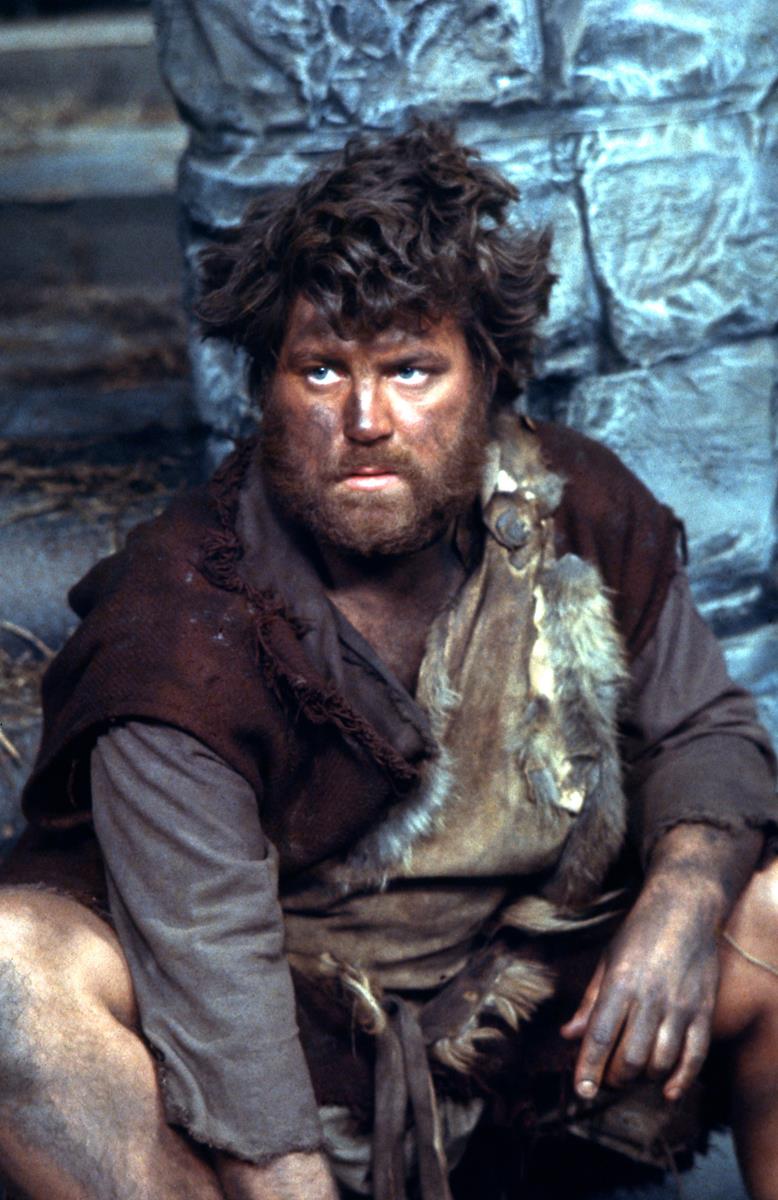
With Ivanhoe injured and insensible during the middle part of the serial, other characters move to the forefront of the action. Bernard Horsfall’s mysterious Black Knight (a vision in blond wig and beard) has an entertaining tustle with Barry Linehan’s disolute Friar. The Friar, living the life of a hermit deep within the forest, may claim to exist on a diet of peas and water but the truth is rather different!

When Ivanhoe, Cedric, Isaac, Rebecca and Rowena are captured by a group of Norman knights led by Sir Brian, they find themselves the prisoners of Godfrey Front de Boeuf (Francis de Wolff). Godfrey has usurped Ivanhoe’s lands and now seeks his death in order to secure his position. de Wolff cackles with evil intent (like Peter Dyneley he’s somewhat of a stranger to subtlety).

Rebecca is later denounced as a witch by the leader of the Templars – angered by Sir Brian’s infatuation with her – and is sentenced to death. She claims the right of trial by combat and nominates Ivanhoe to be her champion. And with Sir Brian in the opposite corner it seems that the final reckoning between them is now at hand ….

Although the Classic Serials had just moved into colour, this ten part adaptation (broadcast during January, February and March 1970) maintained the same production model from the black and white days.  Therefore the bulk of each episode was recorded on videotape in the studio, with film inserts used to open out the narrative.  Whilst this means that it isn’t as glossy or filmic as some of the later television versions, the quality of the performances are more than adequate compensation for the occasional production shortcomings (such as the unconvincing beards and the way some battles largely take place off screen).

Although some of the turns are rather on the ripe side (there are times when it’s impossible not to be reminded of Monty Python and the Holy Grail) there are subtler pleasures to be found elsewhere – Anthony Bate, for example, is excellent throughout. Overall, this is a strong and faithful adaptation of a sprawling epic and certainly deserves a place in your collection.

Ivanhoe is released by Simply Media on the 18th of September 2017.  The RRP is £19.99 and it can be ordered directly from Simply here.

Eric Flynn

Grange Hill – 1985 Christmas Special

grange hill 85 xmas special

Written by Phil Redmond.  Tx 27th December 1985

Broadcast a couple of weeks before the start of series nine, the 1985 Christmas Special performed a duel function. It not only served as a coda for certain storylines from series eight (the return of Calley’s real mother, Roland’s estrangement from Fabienne) but it also looked ahead to the forthcoming run by introducing several new characters.

Rather annoyingly, when the first seventeen series of GH were repeated during the 1990’s this episode (like the 1980 Christmas Special before it) was omitted, meaning we were denied the introduction of Imelda Davis (Fleur Taylor). Mind you, that also meant we didn’t see the arrival of Harriet the Donkey, so it wasn’t all bad ….

Since Gripper’s fall from grace in series six, the position of school bully has been vacant. Jimmy McLaren was too lightweight to be considered a real bully during series seven whilst series eight didn’t even have a token bully figure (although Gripper’s sister, Emma, seemed ready made to fulfil that function). So the time was certainly right for Imelda to make her mark. Ruth Carraway debuts as Helen Kelly, at this point Imelda’s right-hand woman.

The series had also lacked a regular caretaker figure since Mr Thomspon disappeared at the end of series five, so the arrival of George A. Cooper as Mr Griffiths was long overdue. Having an actor of Cooper’s quality and experience was very welcome, since it saved Mr Griffiths from being just the two-dimensional grumpy figure he could so easily have otherwise been. Mr Griffiths stayed with the series for a good while (leaving at the end of series fifteen) which gave plenty of time for various facets of his character to be explored. Yes, he could be the traditional irate caretaker, shaking his fist at those pesky kids, but at times he was also treated as a character in his own right.

Claire and Stewpot bowed out, as did Gripper (who makes a surprise fleeting return, slight recompense for his audio-only appearance during series eight). Another character appearing for the last time was Simon Haywood as Mr Smart. Since this episode was made as part of the series nine production block (confirmed by the fact that incoming producer Ronald Smedley, rather than S8’s Ben Rea, was credited) it seems odd that he was contracted for this one-off appearance, especially since it only amounted to a single, short scene.

What’s really notable about this one is that it was Phil Redmond’s first script for the series since the 1981 Christmas Special. Does his presence mean a return to the harder-hitting issues-led episodes from the early years? Not really. The fact he introduces Harriet the Donkey is a good indication of the episode’s general tone.

We’ll come back to Harriet when she returns as a regular in S10, as she could be said to be the point at which GH jumped the shark – or at the very least it was when the series appeared to lose a little impetus. When many people think of GH it’s the first nine years that probably stand out – from Tucker’s first appearance to Zammo’s downfall. This is more than a little unfair on the next twenty years of the show which had plenty to offer, but there’s no denying that from 1987 onwards the series’ profile dipped.

A befits a Christmas episode, it’s fairly light-hearted fare with the rampaging Harriet taking centre stage.  Left at the school for some unknown reason by its previous owner, Harriet runs amok in a rather unconvincing fashion.  Gonch and Hollo are the fall guys who discover Harriet and then attempt to round her up when she disappears.  You would assume that a donkey would be a fairly slow-moving animal, so suspension of disbelief is required during the scenes where they keep on finding and losing her in quick sucession.

Possibly the best example can be seen when our two hapless heroes spot Harriet at the end of the corridor.  Harriet takes a right turn, they dash after her a few seconds later, but the donkey’s disappeared.  How?!  Harriet then seems to display supernatural powers by re-entering on the left hand side.  Quite how she managed this is probably something it’s best not to dwell on.

Remaining in grumpy nit-picking mode, when Gonch and Hollo accidentally run into Ronnie we’re witness to one of the most unconvincing collisions ever – as all three gently lower themselves to the floor …..

But on the positive side, Redmond knew how to write for Mr Baxter.  If you’re a fan of Michael Cronin then it’s worth braving the donkey-related antics for a good dose of Mr Baxter at his sarcastic best.  Gonch and Hollo are at the receiving end of his withering put-downs as Mr Baxter always seems to appear just at the point when they’re doing something they shouldn’t.  Mr Bronson – chuntering about Christian values – also fares well with a couple of nice scenes.

Dramatically, it’s Roland who receives the meatiest storyline.  There’s a real sense of bleakness at the start as his father – now plying his trade as a long-distance lorry driver – tells his son that they’ll have to delay their Christmas until the 27th (he’s away on a job until then).  It’s difficult to blame Mr Browning for this – as a single-parent he has to put money on the table (and it’s not as if Roland isn’t provided with an alternative Christmas Day arrangement, via a neighbour).  Although Roland (maybe Redmond here was harking back to the boy’s earlier characterisation) isn’t too happy, since he’s convinced he’ll only receive small portions.

So he decides that a trip to Paris (to visit Fabienne no doubt) would be in order.  Logic would tell him this is doomed to failure – witness his ill-fated attempt to stow away with the French exchange students at the end of S8 – and luckily for him his vague scheme never gets any further than attempting – and failing – to win top prize at one of the Christmas Fare games.  The ever-present Janet, falling into her usual role as an interrogator of Rottweiler-like tenacity, continues to badger him until he admits that his dad won’t be home for Christmas.

The warm-hearted Janet then invites him to share Christmas with her family and surprisingly he agrees.  Does this mean that after all these years Roland has finally seen the goodness in Janet?  Hmm, I don’t think so.  It seems to be more along the lines that he realises her family goes in for a full Christmas with all the trimmings.  So Roland’s thinking with his stomach rather than his heart or his head.

That this isn’t quite the normal type of episode is capped off by the ending which sees the whole cast turn to camera and wish the viewers a Merry Christmas.  William Hartnell couldn’t have done it better …..

A Choice of Coward – Blithe Spirit

blithe 01

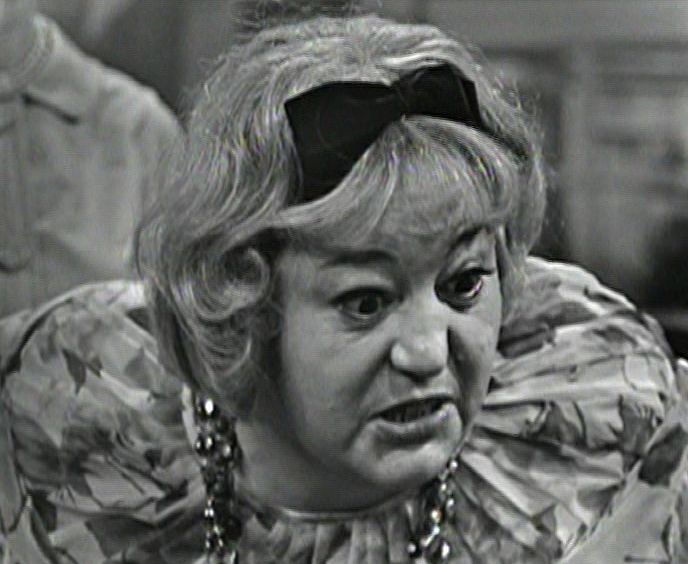
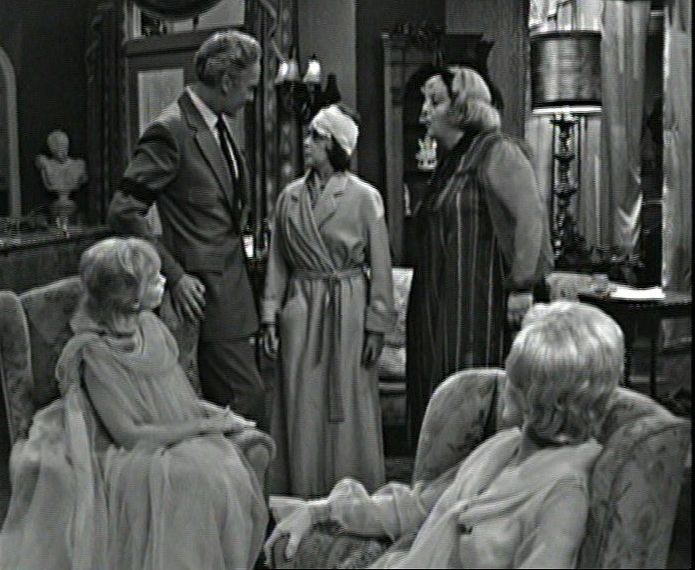
Charles Condomine (Griffiths Jones), a successful novelist in the process of writing a new book about the occult, is keen to experience some authentic colour.  To this end he invites the eccentric medium Madame Acarti (Hattie Jacques) to hold a séance at his house.  Madam Acarti is so obviously a fake that nobody – not Charles, nor his second wife Ruth (Helen Cherry) or their friends – expect the evening to generate anything more than a little light mockery at Madame Acarti’s expense.

So when the spirit of Charles’ first wife, Elvira (Joanna Durham) is conjured up from the other side, he’s more than a little taken aback.  Especially as he’s the only one who can see or hear her …..

Coward had been mulling over writing a play featuring ghosts for a little while, but it wasn’t until his flat was destroyed during the Blitz that he decided to turn these vague notions into reality.  Holidaying with the actress Joyce Carey at Portmerion (later immortalised in The Prisoner) he rapidly churned out the play in a mere six days and afterwards would comment that with “disdaining archness and false modesty, I will admit that I knew it was witty, I knew it was well constructed, and I also knew that it would be a success”.

Premiering in mid 1941, with Cecil Parker as Charles and Margaret Rutherford as Madame Acarti, the play was an immediate success (until the juggernaut run of The Mousetrap, Blithe Spirit was the longest-running non musical West End production).  Rather wonderfully, a few years ago a telegram from Coward to Christie, congratulating her on beating his record, was discovered.

Coward was aware that some people might find the notion of a play revolving around ghosts to be a slightly distasteful subject to pitch during wartime, but he had a ready reply.  Although a comedy, it was deliberately written as a heartless piece.  “You can’t sympathise with any of them. If there was a heart it would be a sad story”.

This is certainly true.  Neither Charles, Ruth or Elvira are in any way admirable characters.  We open with Charles and Ruth discussing his first wife.  Charles, a befits a professional writer, is smooth with his compliments (and able to not commit himself when Ruth asks him if Elvira was prettier than her) but there’s a brittleness to this conversation.

When Elvira unexpectedly pops up the cracks begin to get bigger.  Although it takes a little while for Ruth to believe the truth of the situation, once she realises that Charles isn’t mad or drunk she becomes rather jealous of her dead rival.  After the initial shock, Charles adjusts relatively quickly to Elvira’s presence, but it’s hard to argue that the ghostly Elvira is a symbol of an idyllic past marriage.  Evidence is provided that their relationship was somewhat rocky.  Elvira reminds him that he hit her with a billiard cue (only gently, he says) whilst neither seems to have been totally faithful.

But in her own way she still loves him and so decides to kill him, as that way they’ll both be spirits and together once more.  But it shouldn’t be too much of a surprise to learn that her plans backfire and, after tampering with Charles’ car, she ends up killing Ruth instead (quite how a non-corporeal spirit could do such a thing is a question which the play quite rightly ignores).

This then sets up the denouement, which sees Charles haunted by both of his wives (in mounting desperation he requests that Madame Acarti’s perform an exorcism).  Jacques may not have the largest role, but she’s wonderful comic value whenever she’s on the screen.  With a boundless enthusiasm (Madame Acarti is almost beside herself when she learns that her séance actually conjured a manifestation) Jacques wrings every last comic moment from the script.

Joan Kemp-Welch (who directed all four plays in this short season) appears to have given Jacques her head.  It’s not a subtle performance – Madame Acarti leaps about like a giddy schoolgirl as well as being prone to sudden dramatic swoons – but it’s certainly an eye-catching one.  Coward himself approved, commenting that it was the first time someone had done something with the role that could bear comparison to Margaret Rutherford’s imposing stage and film performances (she reprised the part of Madame Acarti in David Lean’s 1945 movie).

The ending of this adaptation stays true to the original play (unlike Lean’s film, which Coward disliked) and sees a carefree Charles – once Elvira and Ruth have been reduced to silent, invisible spirits – head out for a lengthy holiday aboard, happy in the knowledge that his ghostly ex-wives won’t be able to follow him.  It’s not exactly what you could call a happy ending, but it fits in with the general tone of the piece.

As acknowledged by Coward, it’s hard to warm to any of the characters (apart from the deliciously dippy Madame Acarti) which is probably the reason why Blithe Spirit never quite engages as fully as it could have done.  Amusing, but icy.

blithe 02

A Choice Of Coward – Present Laughter

present 01

Like many of his contemporaries, Noël Coward found the 1950’s to be a critically lean period.  He may have created a string of hit plays during the 1920’s, 1930’s and 1940’s, but in the brave new world of the angry young men his style seemed to be hopelessly dated.

But everything comes round again eventually and by the mid sixties the Coward revival was in full swing.  His new plays continued to attract only polite interest, but revivals of his classics tended to garner both popular and critical acclaim.

Therefore 1964 was the ideal time for Granada to turn their Play of the Week strand over to Coward for four weeks.  Featuring introductions from the Master himself before each of the four plays, A Choice of Coward kicked off with Present Laughter.

Written in 1939 and first staged in 1942, Coward’s introduction makes it clear that the play was written with a single thought in mind – to provide him with a star vehicle.  The character originally played by Coward – Garry Essendine – is the centre of the play and the recipient of most of the best lines.  There’s obviously a strong sense of autobiography at play (which wouldn’t have been lost on the audience at the time) as Garry is a fortyish, elegant, dressing-gown clad figure, who continues to deliver bon mots with practised ease even as his world descends into chaos.

Garry isn’t the only character to have a clear real-life counterpart.  Garry’s loyal and long-suffering secretary Monica is a straightforward analogue of Coward’s equally devoted secretary, Lorne Lorraine, whilst Garry’s almost ex-wife, Liz, is said to be partly modelled on Joyce Carey, who played Liz in the original production.

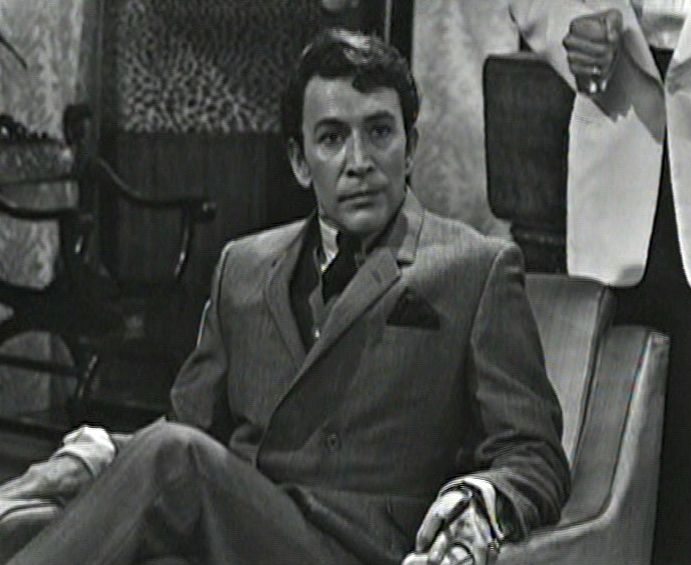
Garry Essendine (Peter Wyngarde) is the bright star around which his devoted satellites – Liz (Ursula Howells), Monica (Joan Benham), manager Morris (Danvers Walker) and producer Henry (Edwin Apps) orbit.  But it would be wrong to call Garry a despot, he appears to be much more affable than that.  Although as he’s an actor it’s difficult to know whether any of the emotions he exhibits are genuine.  This might have been a fruitful area for the play to examine, but as this is a lightweight confection (albeit with the odd barb) it tends to steer clear of psychological analysis.

The play opens with Daphne Stillington (Jennie Linden) exploring Garry’s flat.  A would-be actress and a devoted admirer of Garry, she has stayed the night (albeit in the spare room).  When Garry eventually rises, he firmly, but charmingly dispatches her (an early sign of how he tends, almost absent-mindedly, to pick up and then discard people at will).  Linden is very appealing as the naïve and fresh-faced young woman besotted with the stylish Garry.  Daphne exits but returns later, when she helps to raise the comic tempo.

present 02.jpg

Daphne’s presence doesn’t faze Monica, no doubt it’s something of a regular occurrence.  Coward may have given Garry most of the best lines, but he didn’t forget his co-stars completely and Monica is the recipient of some good lines, as is Liz.  Liz and Garry may be separated but she’s still part of his inner circle and very much involved in every part of his life.  That she too regards Daphne will cool disinterest speaks volumes about her husband and their strange relationship.

James Bolam is great fun as Roland Maule.  Maule is an earnest young playwright, entranced and repulsed by Garry’s star quality in equal measure.  Maule is flattered to be in Garry’s presence but is forthright in explaining how Garry’s work in the commercial theatre is totally without artistic merit.  Coward, who always valued popular success over critical acclaim, plainly uses Maule to take a not-terribly subtle dig at his detractors.

By the time Barbara Murray appeared here as Joanna (Henry’s wife) she was a familiar television face thanks to her role in The Plane Makers as Pamela Wilder.  Joanna wouldn’t really have been too much of a stretch for her, since both characters share similar traits – not least a desire for male conquests.  Joanna is already conducing an affair with Morris and now she sets her sights on Garry.  Wyngarde and Murray both cross verbal swords in a very appealing manner with Garry eventually forced to succumb to the inevitable ….

By now the plot is simmering away nicely and this leads into the frantic conclusion which sees Garry – about to set off for a theatrical tour of Africa – learn to his horror that Daphne, Morris and Joanna have independently bought tickets for Africa as well and are all dead-set on accompanying him.

Eventually matters are resolved, although those expecting the characters – especially Garry – to have learnt anything will be disappointed.  As touched upon earlier, this an exercise in farce, not realism.

Adapted by Peter Wildeblood, it runs to just over seventy minutes, so a certain amount of filleting had to be done in order to bring it down to the required length.  This means dropping some characters, such as Garry’s valet Fred, and cutting some decent lines, but on the plus side this editing means that it zips along at a fine pace.

Peter Wyngarde dominates of course.  He would later become well-known for playing a similar womanizing character, Jason King, so Garry Essendine could almost be said to be a dry run.  Clearly relishing Coward’s dialogue, Wyngarde’s a treat from beginning to end.

One of Coward’s evergreen classics (over the years it’s been revived numerous times, with Donald Sinden, Simon Callow, Peter O’Toole, Tom Conti, Peter Bowles, Rik Mayall and Albert Finney amongst those taking on the role of Garry) this cut-down version of Present Laughter is an impressive production.

present 03

Doctor Who – Horror of Fang Rock. Episode Four

horror 04-01

It’s slightly odd to think that during the eighties Horror of Fang Rock wasn’t a story with a terribly good reputation.  But then this was the decade (in British fandom certainly) when many of us only had very limited access to the series’ past, so we had to rely on what DWM or the fanzines of the day told us was true.

And since Graham Williams was still persona non grata for many, Horror was often lumped in with the majority of the other stories from this period as something of a disappointment.  Only City of Death managed to escape this chorus of disapproval.

It’s interesting that part four opens with what we later learn to be the shape-shifting Rutan (still looking remarkably like Rueben) running into Vince for a brief and (on Vince’s part) painful meeting.  Had Vince been killed at the end of part three then the actor wouldn’t have received a fee for the final instalment (this seems a trivial matter, but Doctor Who, like many other series of the time, tended to be quite frugal about matters like this).

I wonder if the original plan had been to end part three with Vince’s death?  It would have been a strong cliffhanger, especially since it would have immediately followed the Doctor’s weary statement that he’d been wrong all along about their mysterious foe.

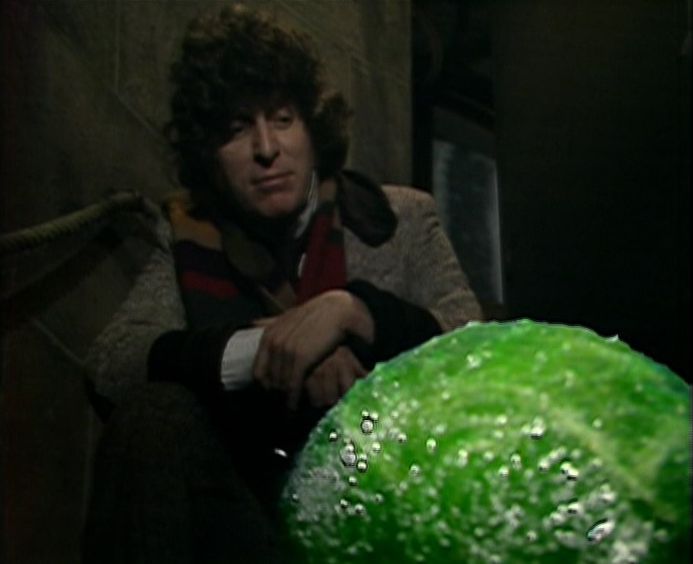
But no matter, Vince now bites the dust and Adelaide follows him shortly after.  This leaves Skinsale as the last man standing, apart from the Doctor and Leela.  Whilst Leela and Skinsale head off to find a weapon to use against the Rutan, the Doctor settles down for a friendly chat with the glowing green blob.

If one were being critical, then it’s probably fair comment that part four does somewhat dribble to a conclusion.  The Rutan (looking rather like – I’m sorry – a large piece of green snot) and the Doctor have a nice little natter for a few minutes which rather slows the story down.  That Dicks chose a Rutan as the monster is a nice nod to Holmes (Holmes had already named them as the age-old enemies of his creations, the Sontarans).  Or it could just be that Dicks was running short of inspiration …..

As is often the way with even the most repellent of monsters, they tend to be very garrulous once you get them talking (a fact which Dicks slyly drops into the script) and the Doctor now knows exactly what he has to do.  Destroy the Rutan mothership – which is shortly due to land – and the rest of the Rutan fleet will scoot off to look for easier pickings elsewhere.

This is a little hard to swallow, but it’s even harder to believe that the Doctor could rig the lighthouse’s lamp into a deadly ray with little more than a dash of ingenuity and a diamond from Palmerdale’s body belt.  It’s easy to criticise the modern series for plucking solutions out of the air, but this is just as bad.

Since Dicks wrote both the script and the novel, there’s one small change which has always interested me.  Skinsale dies because he stays behind and scrabbles for Palmerdale’s extra diamonds.  When Leela asks where Skinsale is, the Doctor tells her he died with honour.  This is obviously not so and Dicks – when he penned the novelisation – chose to make this plain.  Was it not originally played as Dicks wrote it, or did he take the later opportunity to tighten up a this slight plot oddity?

But even if the ending slightly disappoints, Horror of Fang Rock is still an essential story.  Base-under-siege stories always work (although familiarity did breed contempt a little during the Troughton era) and thanks to the unusual lighthouse setting this one works better than most.

Finishing with a touch of Wilfrid Gibson doesn’t hurt either.  “Aye, though we hunted high and low, and hunted everywhere, of the three men’s fate we found no trace. In any time, in any place. But a door ajar and an untouched meal and an over-toppled chair”.

horror 04-02.jpg

Doctor Who – Horror of Fang Rock. Part Three

horror 03-01

Horror of Fang Rock was the last time that Terrance Dicks and Robert Holmes worked together on the same Doctor Who story.  If one had to choose the most significant writer who ever worked on the series then Dicks and Holmes, along with David Whitaker, would surely have to be towards the top of the list.

All three had similar career paths – they had all served as script-editors and helped to broaden the mythos of the series in numerous ways (they weren’t too shabby as writers either).  If pressed, I might have to plump for Terrance Dicks – as not only did he help to stabilise the series in the early seventies (following the rocky road the show had trod in the later Troughton era) thereby ensuring that the programme had a long term future, but he also had the good sense to commission Robert Holmes.  And a Doctor Who cosmos without Robert Holmes scarcely bears thinking about ….

That’s a bit of a flip reason true, since Dicks was no slouch as a writer himself.  Fang Rock is probably his best solo script for the series – which is especially impressive when you consider that it was a last minute replacement for his rejected vampire story.  Compare and contrast with The Invasion of Time, which also had to be cobbled together at great speed.  True, the season closer also had to stumble through the production from hell, but had the script been sounder then things wouldn’t have turned out to be so shambolic.  But that’s a story for another time.

Rueben’s looking far from well, but isn’t actually dead (or so it appears).  Once again the Doctor’s still several paces behind the action and is working from a false premise – he believes that Rueben’s seen the creature and has valuable information, but the truth’s a little more complicated.

Whilst the Doctor attempts to contact Rueben through a locked door, Palmerdale is tempting Vince with a fortune (fifty pounds).  Palmerdale has a limited opportunity to make a killing on the stock exchange with the information supplied earlier by a reluctant Skinsale.  Skinsale would much prefer that he didn’t of course (since he would be ruined if the news leaked out).  Quite how this would be isn’t quite made clear – some kind of insider trading obviously – but it’s not really important.

The key fact is that Palmerdale attempts to bribe Vince to use the telegraph to broadcast a message to his brokers, so Skinsale destroys the telegraph machine to ensure this doesn’t happen.  This is clearly a very bad move as it isolates them from the mainland.  The Doctor helpfully spells this out.  “To protect your honour, you’ve put all our lives in danger”.

It’s a good dramatic moment and played well by Tom (the Doctor doesn’t display anger at Skinsale, only weary resignation).  But you have to wonder why the Doctor or indeed anybody else hadn’t thought to radio for help before.  And let’s be honest, even if Skinsale hadn’t wrecked the telegraph it’s impossible to imagine the Doctor ever lowering himself to request anybody’s assistance, certainly not turn of the century human beings.

Therefore the destruction of the telegraph is a bit of a red herring, although it serves a useful purpose in allowing us to see that Skinsale is just as corrupt and untrustworthy, in his own way, as Palmerdale.

We’re closer to the end of the story than the beginning, so it’s clearly time that the remaining humans are bumped off, one after another.  Palmerdale is the first to go, which sends Adelaide into a fit of hysterics (swiftly curtailed after Leela gives her a good hard slap!).  There then follows a nice exchange between the two, which sees Leela tell Adelaide that she shouldn’t put her faith in astrology.  “A waste of time. I too used to believe in magic, but the Doctor has taught me about science. It is better to believe in science”.

Before we’ve caught our breath from Palmerdale’s demise then Harker is also killed off and a couple of scenes later the Doctor and Leela discover Rueben’s cold, dead body. This is a bit of a mystery since Rueben has recently been seen alive and well.

The Doctor finally understands. “The chameleon factor, sometimes called lycanthropy. Leela, I’ve made a terrible mistake. I thought I’d locked the enemy out. Instead, I’ve locked it in, with us”.

It’s a slight oddity that the Doctor refers to lycanthropy, since that only refers to the change between a human and a werewolf, but the Doctor’s ominous pronouncement is an interesting point on which to end the episode. Having the Doctor or the others placed in danger would have been more of a hook, but the realisation that the Doctor’s been wrong all along is also frightening and disturbing – albeit for a different reason.

horror 03-02.jpg

Doctor Who – Horror of Fang Rock. Part Two

horror 02-01

I’ve previously mentinoed Terrance Dicks’ firm grip of basic storytelling principles and there’s further evidence of that here.  Our new characters – Lord Palmerdale, Skinsale, Adelaide and Harker – all have interlocking conflicts with each other which will help to keep the drama ticking along.

Palmerdale (Sean Caffrey) plainly sees himself as the top dog and is quite happy to boss young Vince about.  And although Adelaide (Annette Woollett) might be Palmerdale’s employee she too has no compunction in ordering Vince to do her bidding.  There’s a nice moment of class comedy played out during the scene where Adelaide asks Vince his name.  He replies Vince Hawkins and she graciously responds. “Thank you Hawkins”.  He’s pleased to have received kind words from a lady and the fact that she used his surname doesn’t register with him.  The mistress/servant divide is plain here (just as the opposite is in play with the Doctor and Leela, who always call Vince by his first name).

If Palmerdale and Adelaide both seem rather superior (although having to share a cramped lighthouse with a killer will no doubt wipe the smiles off their faces) then our first impression of Skinsale (Alan Rowe) is rather more favourable.  The audience is invited to view the arrogant Palmerdale with disdain and it’s Skinsale who is allowed to articulate these feelings.  That Skinsale is placed in opposition to Palmerdale (along with Skinsale’s wry humour) immediately makes him a likeable character although, as we’ll see, his ruthless self-interest will prove to be dangerous.

The Doctor continues to brood and Tom dominates the screen whenever he’s on.  The moment where he strides into the crew room and places his feet on the table (a Tom adlib possibly?) is one of those little touches which adds so much to the feel of the story.  The Doctor’s baiting of Palmerdale is another treat.

The arrival of Harker (Rio Fanning) ramps up the drama another notch.  The only survivor from the crew, Harker blames Palmerdale for the death of the others (this simmering resentment will eventually spill over).  For now though, he’s a handy man to have about – a practical sort, unlike the pampered upper-class types still bickering upstairs in the crew room.

The mystery of Ben’s death continues.  If he was dead, how did he find his way out of the lighthouse and into the sea?  The Doctor has an explanation for Vince.  “The shock simply stunned him, he partly recovered, staggered out onto the rocks, fell into the sea and was drowned”. It sounds reasonable, although the Doctor’s well aware that it’s not the truth. But, as he tells Leela, he can’t tell Vince the truth, because he still doesn’t know what the truth is. Whenever the Doctor is clutching at straws it helps to raise the tension just that little bit higher.

The relatively small cast and the confined space allows the Doctor and Leela to be paired together for long stretches (most stories would tend to see the Doctor and companion split up for an episode or two). Tom and Louise might have been struggling off-screen, but on-screen the Doctor and Leela make for an excellent team. Here, the Doctor shares his fears with her. “That creature, or whatever it is, will be getting bolder by now. It’s seen this primitive technology, it’s had time to calculate the physical strength of its enemies. I think we’re in terrible trouble”. Leela’s deadpan next line (“Do not be afraid, Doctor”) is another well-delivered moment as is the Doctor’s slow-burn reaction to it.

As I touched upon earlier, Terrance Dicks provided Leela with plenty of good material. Apart from her byplay with the Doctor, she gets to memorably threaten Palmerdale (“Silence! You will do as the Doctor instructs, or I will cut out your heart”).

This week’s cliffhanger is a tad more impressive than last week’s. A blood-curdling cry causes the others to stop their squabbles as it suggests that the Beast of Fang Rock has claimed another victim ….

horror 02-02.jpg

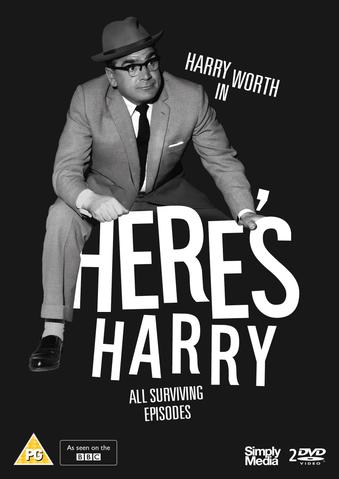
Here’s Harry – Simply Media DVD Review

harry.jpg

Although largely forgotten today, Harry Worth was a major television star of the sixties and seventies.  His rise to the top was neither straightforward or quick though – born Harry Bourlan Illingsworth in 1917, he left school at 14 and went straight to work down the local mine (he stuck it out for eight years, despite hating every minute of it).

As with so many entertainers of his generation, World War II was to prove defining.  Even when he’d been a miner, Worth had continued to hone his showbiz skills (practising his ventriloquism act whilst hewing coal for example).  Prior to WW2 he’d begun to ply his trade by working as a ventriloquist in the numerous working men’s clubs dotted around Yorkshire, but appearing in RAF shows gave the young Worth further valuable experience.

Following his demob, and still attempting to make it big with his wooden friends (at this point he was dubbed ‘The Versatile Vent’), Worth began his slow ascent to the top.  Like many of his contemporaries he played the notorious Windmill Theatre (“we never clothed”) as well as just about every variety theatre in the country.  During the forties and fifties the variety circuit was still thriving (although the rise of television would eventually kill it off) and Worth was able to make a living, just.

Frequently bottom of the bill, Worth’s career seemed to be heading nowhere, although a tour with Laurel and Hardy in 1952 would prove to be crucial.  After watching him from the wings, Oliver Hardy persuaded Worth that he should abandon his vent act and concentrate on becoming a comedian instead.  This was valuable advice and within a few years Worth would make his television debut, which in time would lead to his own series.
worth 01

John Ammonds, forever associated with the classic BBC Morecambe & Wise shows, would produce Worth’s debut series The Trouble With Harry (1960) and the bulk of the follow-up, Here’s Harry (1960 – 1965).  His next series, simply titled Harry Worth, would enjoy four successful runs between 1966 and 1970, at which point he decided to jump ship and join Thames (Morecambe & Wise and Mike Yarwood would later do exactly the same thing).

Like many other series of this era, Here’s Harry has a rather patchy survival rate.  Out of sixty episodes made, only eleven now exist (although it’s pleasing to note The Musician, recently recovered by Kaleidoscope, is included in this release).  Here’s what’s contained on the two DVDs –

Series Two

The Bicycle – 4th May 1961.  Featuring Wensley Pithy, Sam Kyd, Ivor Salter and Anthony Sharp.

The Holiday – 11th May 1961.  Featuring Ballard Berkeley, Ronnie Stevens, Meg Johnson and Reginald Marsh.

The Request – 18th May 1961.  Featuring Jack Woolgar and John Snagge.

The Medals – 1st June 1961.  Featuring Anthony Sharp and Totti Truman Taylor.

The Voice – 8th June 1961.  Featuring Jack Woolgar, George Tovey, Sydney Tafler, Joe Gladwin and Meg Johnson.

Series Three

The Dance – 14th November 1961.  Featuring Ronnie Stevens, Reginald Marsh, Colin Douglas, Vi Stevens and Harold Goodwin.

The Plant – 21st November 1961.  Featuring Vi Stevens and Patrick Newell.

The Birthday – 5th December 1961.  Featuring Jack Woolgar, Vi Stevens and Ivor Salter.

The Overdraft – 12th December 1961.  Featuring Gwendolyn Watts, Joe Gladwyn and Jack Woolgar.

The Last Train – 26th December 1961.  Featuring Harold Goodwin, Tony Melody, Jack Woolgar and Reginald Marsh.

Series Five

The Musician – 22nd November 1963.  Featuring Geoffrey Hibbert, Jack Woolgar and Max Jaffa.

What’s interesting about the surviving episodes is that – apart from the recently recovered The Musician – everything we have either comes from the second or third series.  Series two is virtually complete (only one episode missing) whilst the survival rate for the third series is also pretty good (five out of eight).

The various opening titles help to set the tone for the show. The iconic shop window sequence doesn’t debut until later (it’s only featured in this set on The Musician) so in series two and three we observe Harry strolling down the street, politely raising his hat to unseen passers by and almost colliding with a lampost. That he raises his hat to the lampost is a characteristic touch.

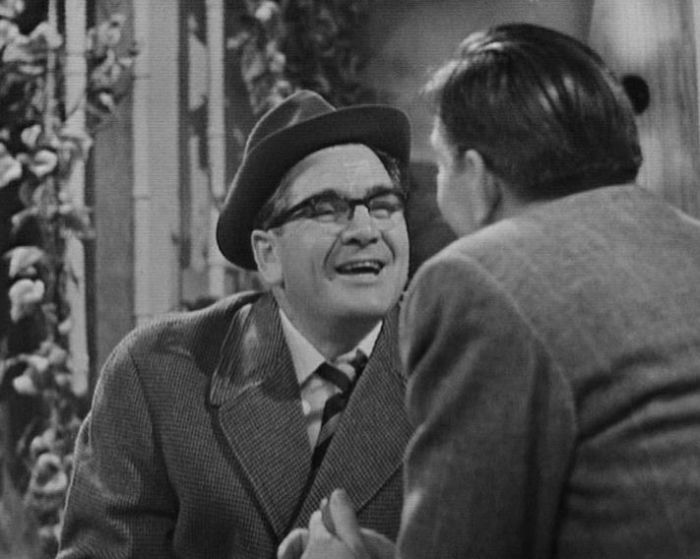
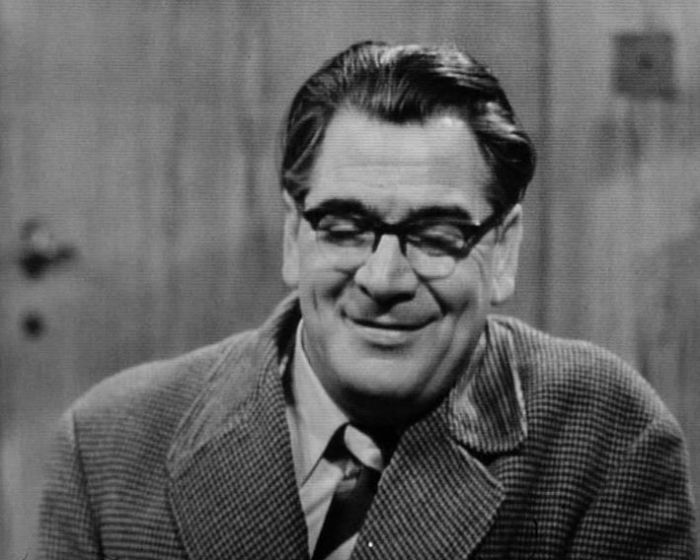
Worth, who lives in the fictional town of Woodbridge (at 52 Acacia Avenue with his cat, Tiddles, and his never seen aunt, Mrs Amelia Prendergast) is a familiar comic creation.  Buffeted by events, he rarely seems to be in control of his own destiny – instead he’s at the mercy of officialdom which is sometimes friendly and sometimes not.  But this never concerns Harry as he treats everybody with kindness and always remains totally oblivious to the fact that his presence serves as the catalyst for terrible disasters.
worth 02

Other similar character types – Tony Hancock, Frank Spencer, Victor Meldrew – can easily be brought to mind but Worth’s style is quite different as there’s a warmth about his befuddled comic persona that’s very appealing.

Vince Powell and Harry Driver were the most prolific writers across the seven series, which should allow you to gauge the general level of scripting (both were competent scribes, although hardly in the same league as Galton & Simpson or Clement & Le Frenais).  Not that this really matters as the scripts are simply the starting point – Here’s Harry stands or falls on Worth’s ability to make his shtick work (and when he’s placed in opposition to a decent performer then things chug along very merrily).

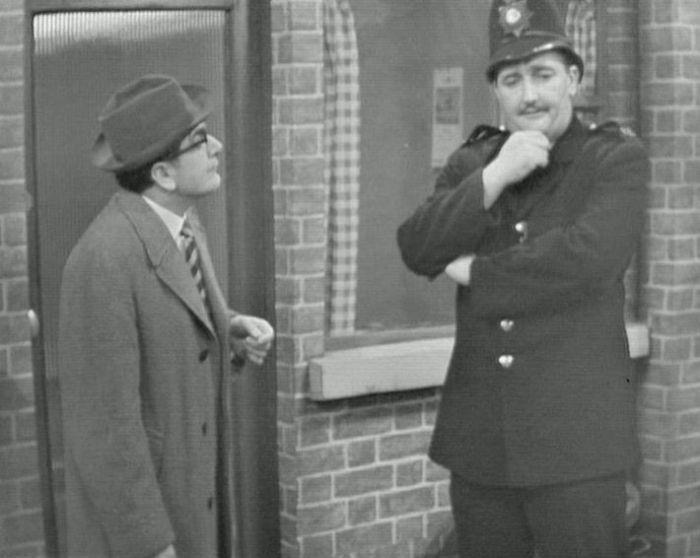
The Bicycle serves as a perfect example of the way the show operates. Harry is more than upset when a total stranger regularly decides to leave his bicycle outside his house and decides to seek legal advice, although the solicitor (played by Anthony Sharp) is naturally nonplussed about exactly how he can help. Over the course of about ten minutes Harry’s amiable idiocy is enough to reduce Sharp’s solicitor to a gibbering wreck. But when Harry learns that the bike belongs to Ivor Salter’s police constable, Harry (who’s hidden the bike in his shed) becomes frantic with worry ….

Later tangles with Sam Kyd’s postman and Wensley Pithy’s chief constable are further examples of the way Harry so often leaves a trail of devastation in his wake. The “sit” part of this comedy is remarkably slight (a missing bicycle) but it’s plain that each situation is simply the excuse for Worth to move from one authority figure to the next, each time causing mayhem.

Harry’s child-like nature and undeveloped view of the world is further evidenced in The Holiday (he believes that it’s perfectly possible to catch a bus straight from London to Monte Carlo). A long-suffering travel agent is the latest person to suffer from Harry’s presence, although he gets off relatively lightly (Ronnie Stevens’ remarkably camp photographer – tasked with the job of taking Harry’s passport photos – doesn’t fare so well). Ballard Berkeley and Reginald Marsh – both wonderful performers – are also lined up to take their dose of punishment from Mr Worth.

There’s a touch of gentle satire at play in The Request as Harry turns up at the BBC, keen to ensure that a request for his Auntie gets played on Housewives Choice. Due to a barely credible misunderstanding he gets mistaken for a singer (Worth does croon a little bit of Are You Lonesome Tonight quite well though) and then decides to roam the corridors of the BBC, causing chaos wherever he goes (such as interrupting the iconic newsreader John Snagge mid broadcast). His face may not be familiar, but Snagge’s voice is unmistakable and it’s lovely to see him end up as Harry’s latest victim.

The remaining surviving episodes of series one – The Medals and The Choice – maintain the high standard, with Anthony Sharp, this time as a Brigadier, returning in The Medals to once again cross swords with Harry.
worth 03

Amongst the surviving shows from series three, both The Overdraft and The Last Train are highlights.  A visit by Harry to the bank in The Overdraft has plenty of obvious comic potential.  He informs the long-suffering assistant that he wishes to deposit three pounds ten shillings (to enable him to draw out precisely the same amount!) This is so he can extract his money in a bewildering and precise series of coins, all the better for then depositing them in a plethora of tins (for the gas bill, newspapers, etc, etc).

The Last Train finds a festive Harry patiently waiting for his train home.  It seems a bit odd for trains to be running on Christmas Day but it helps to explain why some of the staff are rather downcast.  Harry’s not of course, he’s a regular ray of Christmas sunshine – although his well-meaning efforts to entertain and help don’t always have the results he’d hoped for.  Not that this concerns Harry who – as always – breezes through each and every situation, totally oblivious to the havoc he’s causing.

The final existing show – the recently returned The Musician – features a guest appearance from Max Jaffa.  Like John Snagge, Jaffa’s a good sport (the typically dense Harry knows that Jaffa is someone famous, he just can’t remember who).  The moment when Jaffa tells him who he is and Harry removes his hat in respect is a delight as is the way that Harry initially mistakes him for the music hall comedian Jimmy Wheeler (for good measure Harry throws in Wheeler’s famous catchphrase – “Aye, aye, that’s your lot!” – to increasingly befuddle his famous companion).

Whilst it’s undeniably formulaic, the surviving episodes of Here’s Harry are also undeniably entertaining. The combustible combination of the well-meaning but inadvertent loose cannon that is Harry and the range of authority figures he finds himself encountering (some pleasant, some not) is the reason why the show works as well as it does. The situations may often be slight, but the way that Harry and his co-stars interact is always a joy.  Something of a neglected comic treat it’s a pleasure to see it available on DVD and comes warmly recommended.

Here’s Harry is released by Simply Media on the 11th of September.  The RRP is £19.99 and it can be ordered directly from Simply here.
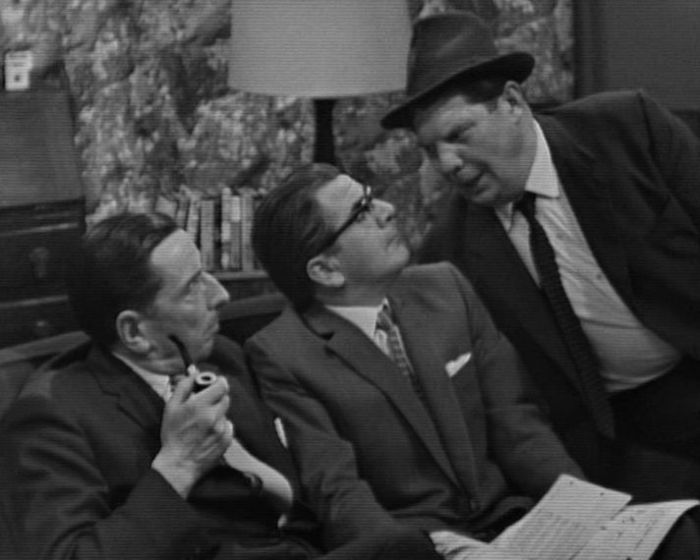
worth 04

Doctor Who – Horror of Fang Rock. Part One

horror 01-01

Doctor Who fans tend to break down sections of the show into recognisable eras.  Usually this is done by producer and not lead actor (which is understandable when, say, analysing Tom Baker’s seven year stint as his three producers – Hinchcliffe, Williams, JNT – all had very different styles).

The only problem with this method is that the cut-off is never absolute.  Horror of Fang Rock is a prime example – in mood and style it can comfortably sit alongside Talons (that it shares the same Victorian/Edwardian setting doesn’t hurt on this score).  It’s also possible to find echoes of the Williams era in several Hinchcliffe stories (when the Doctor bumps into Styggron in The Android Invasion, his cheery greeting could easily have played virtually anywhere in S15/S16/S17).

This bleeding of styles was rarely acknowledged back in the day.  In the 1980’s, when Graham Williams was still beyond the pale for many, things seemed much simpler.  His three years in charge were plainly a disaster from start to finish, not least for the unsubtle humour and schoolboy larking about.  If the Doctor mocked his adversaries and didn’t treat them with fear or respect, why should the audience?

As we’ve seen, the line between Hinchliffe/Williams wasn’t absolute, but this distinction tended not to be acknowledged.  One of my favourite summations of Graham Williams’ producership can be found in issue three of the fanzine Mondas, published in 1984.  We’ll be kind and not name the writer (a familiar name from Doctor Who fandom).  Graham Williams was apparently the man “who (unwittingly or not) almost cold-bloodedly butchered our programme, leaving it only in a fit state for recycling as dog meat”.

Hmm.  I’m slightly more of a fan ……

When he took over as producer, Graham Williams had three immediate problems to contend with.

  1. A requirement to tone down the violence and horror in the show.
  2. Galloping inflation, which meant that in real terms he had less to spend on the show for each of his three years.
  3. Tom Baker.

All three were bequests from Philip Hinchcliffe in one way or another.  The first seems to be Williams’ overriding legacy on the show, but there’s also evidence to suggest that even if the BBC management hadn’t insisted on change he would have done so anyway.  Williams (like Barry Letts) had been critical of the sadistic tone which had crept into the show during the mid seventies and was keen to steer the programme in a slightly different path (one example quoted by Williams was the moment in Genesis where Sarah is dangled over the edge of the rocket gantry by a Thal guard – a scene he never would have countenanced).

Philip Hinchcliffe liked to overspend, but it was Graham Williams who had to face the consequences. When Williams took over he discovered that budgets now had to be strictly adhered to (which led to some sticky later moments).  If the Hinchliffe era had been made in the same cash-strapped environment then it’s probable we’d think a little less of it.

Tom Baker. Ah, where do you start.  Tom and GW didn’t enjoy the best of working relationships to put it mildly.  Many believe that because Tom was by now so firmly entrenched in the series he was disinclined to listen to anybody else’s point of view.  But it’s possible to argue that Tom was simply looking to do the best for the programme (railing against unimaginative scripts) and that his actions weren’t motived by pure self-ego.  The truth probably lies somewhere inbetween.

The series had suffered from testy relationships between the lead actor and producer before.  William Hartnell and John Wiles were never a marriage made in heaven whilst Patrick Troughton’s interactions with both Peter Bryant and Derrick Sherwin weren’t much better. Terrance Dicks’ portrait of Bryant – a barely functioning alcoholic – is a rather unflattering one, but it suggests the reason why the professional Troughton felt frustrated towards the end of his stint on the show.  That Sherwin and Troughton didn’t get on can clearly be evidenced by Sherwin’s commentary on The War Games.  Whenever Sherwin’s in the chair and Troughton’s on the screen an acid put-down is never far away.

But if the turmoil between Baker and Williams would spill out onto the screen in later stories, at this point in time there’s no hint of what was to come.  Part one of Horror of Fang Rock is a model of efficient storytelling – establish your location (a lighthouse), your first wave of principal guest characters (the three lighthouse keepers – Ben, Rueben and Vince), introduce the Doctor and Leela, mix well and stand back.

The three keepers are, handily, of different generations.  So we have the old man, Rueben (Colin Douglas), the middle-aged Ben (Ralph) and the youngster Vince (John Abbott).  That they’re of varying ages is an obvious touch as it quickly helps to differentiate their characters.  Say what you like about Terrance Dicks, but he understood the basics of storytelling.

Rueben might be the oldest, but he’s not the senior man in charge here (a point which no doubt rankles with him).  Ben and Rueben articulate two very different viewpoints – science and superstition.  Indeed, had Ben not met his imminent death then it would have been interesting to see him and Rueben develop through the serial, almost as a surrogate Doctor and Leela.

Ben embraces the brave new world of electric-powered lighthouses whilst Rueben harks back to the good old days of oil.  Both, in their own ways, are entrenched in their own positions, although we’re no doubt meant to side with Ben.  That partly helps to explain why he’s first for the chop – having a level-headed sensible chap around is far less fun than the doomy, superstition-ridden Rueben (“‘taint natural”).  Vince occupies the middle ground as he’s prepared to listen to both of them (and the Doctor as well).

Louise Jameson was never too enamoured of this script (mistakenly believing that it had been written for Sarah-Jane).  I can’t see many causes for complaint though as Leela’s provided with some good material throughout.  The moment when Leela changes out of her wet clothes in front of a scandalised Vince (“I’m no lady Vince”) is just one nice character beat.

Tom Baker is in full brooding mood.  This may be because the script required it, but the evidence seems clear that at this point in time he wasn’t enjoying a harmonious relationship with his co-star (the fact that a female director had been assigned simply darkened his mood even more).  But if his playing here is partly informed by his off-screen irritations, then no matter – it’s also the perfect choice for the story.

Another interesting wrinkle is the air of mystery that hangs over Fang Rock.  We have a dead body – Ben – but the Doctor doesn’t know who killed him or why.  And it’ll be a long time before he finds out (Tom’s Doctor might often characterised as an unstoppable know-all, but that’s not the case here).

The cliffhanger (a toy boat runs aground) might be a little anti-climatic, but there’s little else to complain about here.  Some forty years to the day when this episode was first broadcast, Horror of Fang Rock part one still engrosses.
horror 01-02

Doctor Who – The Talons of Weng-Chiang. Episode Six

talons 06.jpg

Finally the Doctor and Greel have a face to face meeting. The Doctor has dealt with Greel’s proxy – Chang – previously, but it’s not until now that Greel and the Doctor have the chance for a chat.

As time went on, Tom’s Doctor became more and more flippant (although to be fair, flippancy was always part of his character). Some dislike his mockery of the villains (maintaining that it diminished them) but I’ve never had a problem with it. Yes, the Doctor gives the impression that he’s not taking Greel seriously (“never trust a man with dirty fingernails”) but there’s still a palpable air of threat and menace from the masked man.

Jago and Litefoot continue their sojourn as prisoners of Greel. This brief dialogue exchange is lovely –

JAGO: Well, I’m not awfully. Well, I’m not so bally brave when it comes to it. I try to be but I’m not.
LITEFOOT: When it comes to it, I don’t suppose anybody is.
JAGO: Well, I thought I ought to tell you anyway, in case I let the side down.
LITEFOOT: You won’t, Henry. I know you won’t.

Jago’s cowardice has been evident right from the start, but the fact that he admits it (and Litefoot doesn’t think any less of him because of it) is nicely done.

If the Doctor was rather playful with Greel at Litefoot’s house, then the mood changes once both are back in Greel’s lair.  Once he discovers that the man masquerading as Weng-Chiang is actually Magnus Greel (“the infamous Minister of Justice. The Butcher of Brisbane”) there’s a definite gear-change.

DOCTOR: I know you’re a wanted criminal and that a hundred thousand deaths can be laid at your door.
WENG: Enemies of the state! They were used in the advancements of science.
DOCTOR: They were slaughtered in your filthy machine.
WENG: So, you are from the future, and I, for all my achievements, are only remembered as a war criminal. Of course, it is the winning side that writes history, Doctor. Remember, you would not be here if it were not for my work.

Both Baker and Michael Spice are sparking here. Spice, hidden behind a mask, has been somewhat hampered throughout the story but his skill as a voice actor means that Greel is still a fully-formed character, despite the fact we never (apart from one glimpse) see his features.
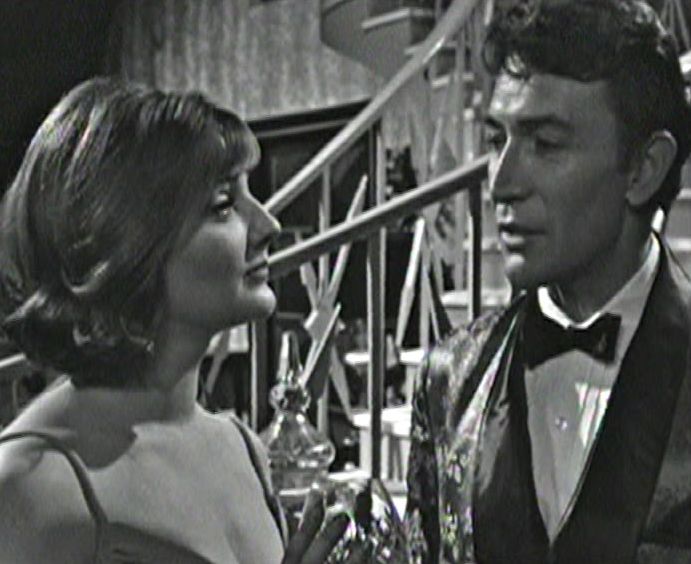
The Doctor is locked up with Jago, Litefoot and two young girls, Greel’s latest victims.  That they’re so very young is the sort of plot-point you probably wouldn’t see today (Holmes did have some dialogue explaining that their age – on the point of puberty – was the reason why Greel had abducted them).  Ah, it was a different time back then.

The Doctor might not carry a weapon, but he’s happy to improvise.  His home-made gas bomb is one such example – and the sort of thing that would vanish from the series once Graham Williams took over.

The final battle is a little anti-climactic (and the less about Tom wrestling with an obvious Mr Sin dummy the better) but it doesn’t detract from the fact that this is Who at its best.  It’s a real regret that they don’t make them like this anymore.
Doctor Who – The Talons of Weng-Chiang. Episode Five

talons 05

Amongst Tom Baker’s many skills as the Doctor was his ability to deal with strangest of dialogue.  The Doctor’s description of Mr Sin is a case in point – in a lesser Doctor’s hands it might have come across as a comic moment,  but there’s no such sense with Baker.  “The Peking Homunculus was a toy, a plaything for the Commissioner’s children. It contained a series of magnetic fields operating on a printed circuit and a small computer. It had one organic component. The cerebral cortex of a pig. Anyway, something went wrong. It almost caused World War Six”.
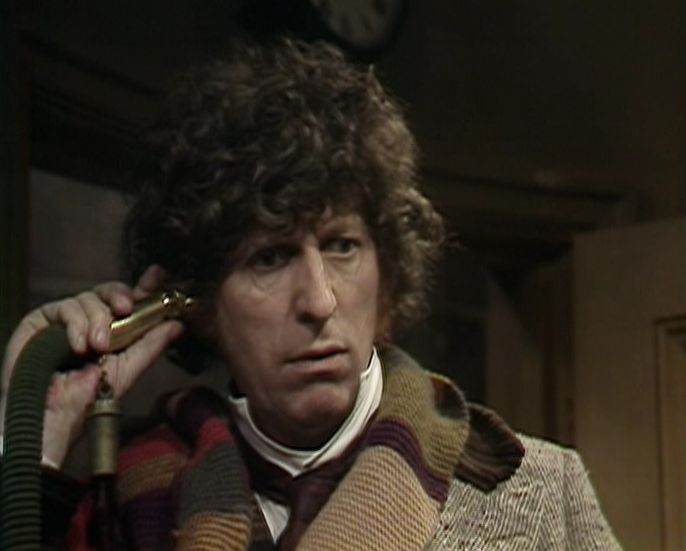
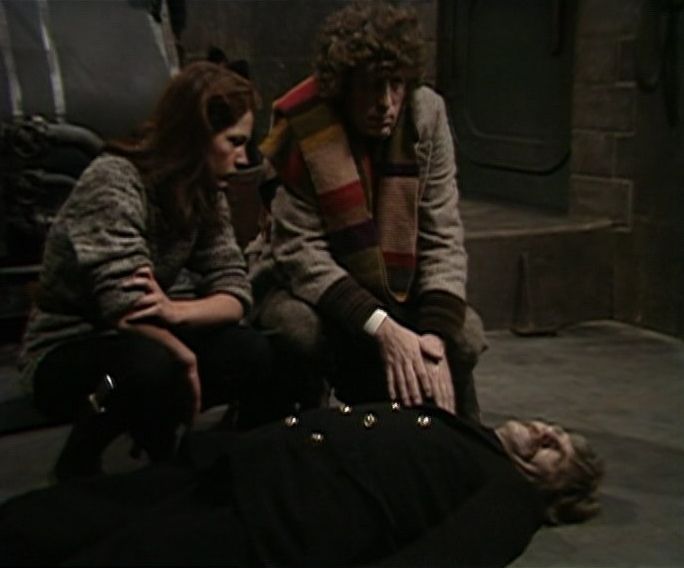
Now that Greel’s finally obtained the time cabinet he’s rather chuffed (“oh, how I have dreamt of this moment. To be free of this putrefying carcass”) but wouldn’t you believe it, he’s lost the key. All these years when he had the key but not the cabinet and now the position is reversed. You have to feel a little sorry for him, master criminal he is not.

But you have to feel sorrier for the unfortunate Ho, who left the bag containing the key behind at the theatre.  He takes the sting of the scorpion and dies horribly as the chuckling Mr Sin looks on. This is another of those nightmarish moments which many argued crossed the boundaries between children’s and adult’s television (although Holmes’ original draft – Greel takes out a revolver and shoots Ho multiple times – was even more uncompromising).

And finally … Jago and Litefoot meet. It’s easy to see why Robert Holmes briefly considered spinning these characters off into their own series and even easier to understand why the Big Finish series of audio plays has entertained so many. Benjamin and Baxter make for a wonderful team.

Litefoot, like he was with the Doctor, has to play the straight-man somewhat, but he’s more than simply a foil for Jago’s comic bumbling. Their first scene is a treat – Jago mistaking Litefoot for his own butler and then attempting to back out of a nocturnal adventure due to his weak chest!

Chang’s brief reappearance is something of a surprise, but the sight of him – doped up on opium and missing a leg – provides us with clear evidence that he’s not long for this world. Thanks to Bennett as well as Holmes’ script, Chang is much more than a single-minded villain. His wistful regret that he was shortly due to perform before Queen Victoria at Buckingham Palace (hopefully he would have kept Mr Sin under control) is a nice touch.

Bennett’s casting will always be a bar to some people, but I don’t find the oft-repeated accusation that Talons painted a strong negative portrait of the Chinese to be correct.

Jago and Litefoot may be many things, but they’re no match for Greel and quickly find themselves locked up. Their abortive escape attempt – via the dumb waiter – doesn’t really go anywhere though. Possibly this was a spot of padding from a now desperate and weary Holmes. Benjamin and Baxter still manage to entertain though.

But things pick up with the cliffhanger, as Leela (and the audience) views the unmasked Greel for the first time ….

Watergate (BBC, 1994)

nixon

I’ve recently been rewatching Watergate, the five part BBC2 documentary series from 1994.  One of the most remarkable things about the programme was the way that – Nixon excepted – virtually every living participant was not only willing to talk on camera, but did so extremely candidly.  It was written and narrated by Fred Emery, who also penned a tie-in book which is an excellent print summation of this most fascinating of political stories.

Emery’s skill is in letting the participants speak for themselves.  What emerges from their oral history is that the Watergate affair was bungled right from the start – this was no controlled mission, rather it was a collection of loose cannons ricocheting off each other. And loosest of all must be G. Gordon Liddy, the former FBI agent who was the chief architect of the Watergate break in.  Liddy is a mesmerising interviewee, not least for the moment when he recalled that he would have been quite happy to murder Jack Anderson, a Washington reporter who was something of a thorn in the side of the Nixon administration, had the order been given.  Just one of a number of jaw dropping revelations from Liddy, easily the most entertaining interviewee.

Although Richard Nixon, who coincidentally died just before the programme was broadcast, didn’t take part, he’s still very much present – thanks not only to the David Frost interviews but also via the infamous White House tapes which would eventually lead to his downfall.

Watergate is a quality documentary that’s well worth four hours of your time.