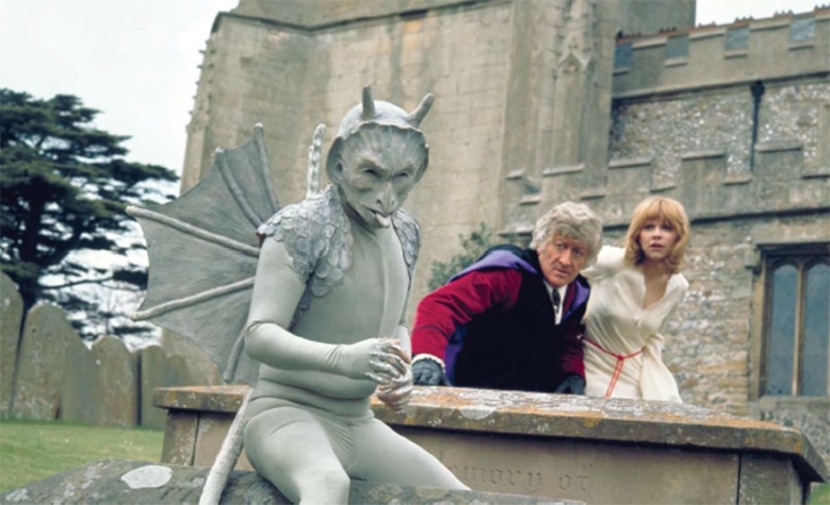
Having recently marked the 52nd anniversary of part one of The Dæmons, I decided to give the whole serial another airing. What follows is less of a review and more of a random selection of observations stitched together. Hopefully some may be interesting or entertaining (fingers crossed).
Who (or what) killed old Jim, who met his end in the very first scene? It can’t be Azal, as the Master hasn’t called him up yet, and presumably it wasn’t Bok (as he tends to simply evaporate people).
After at least one mysterious death (Professor Horner) it slightly beggars belief that the police force of Devil’s End (who apparently are represented only by poor old PC Groom) allow the BBC crew to nip off home in double quick time. I understand why it happened in programme terms (they’d served their story purpose and if the actors hung around, they would have had to be paid) but it’s a tad jarring.
Jon Pertwee gets an easy episode two, as he spends most of it asleep. Whilst he’s napping, Yates and Benton arrive at Devil’s End in the Brig’s chopper. Why are they in mufti? (were their uniforms in the wash?). Since they’re on duty, this seems a little odd – but, hey, we get to see what casual wear they favour, so it’s not all bad.
If The Dæmons doesn’t do the Brig any favours (he’s literally shut out of most of the story) then Yates and Benton are the ones who pick up the slack. John Levene teams up with the delightful Damaris Hayman (Levene was always at his best when given a strong actor to bounce off – see his interplay with Troughton in The Three Doctors). Mike Yates turns into an all-action hero which is interesting, I guess.
It’s well known that Jon Pertwee often asked for “a moment of charm” to be inserted into the stories. I wonder if he also sometimes requested “a moment of arsiness?”
There’s a prime example in episode three, when Jo (after observing that the Brigadier’s desire to blow things up might be a tad counterproductive) has to meekly stand by as the Doctor lectures her. “Jo, the Brigadier is doing his best to cope with an almost impossible situation. And since he is your superior officer, you might at least show him a little respect”.
What makes this even more galling is that you know Jo’s comment is one that the Doctor could easily have made himself. For boorish behaviour, it doesn’t quite top the Doctor’s sandwich-guzzling in The Sea Devils, but it’s a close run thing.
Azal’s quite well behaved isn’t he? The Master raises him up several times and it seems that all he does is pop out into the countryside for a quick stroll (Yates and Benton spot his hoofprints on one occasion) before returning to the church for a rest. Presumably he stomped on PC Groom but maybe that was more accidental than malicious.
The Doctor/Master confrontation scenes are always a highlight, so it seems odd that they don’t meet until the end of the story. Especially since both are stuck in the same tiny village.
Azal doesn’t make a full on-screen appearance until the cliffhanger of the penultimate episode. If you’re going to hold back your monster until then, he’d better be good. Ah well, you can’t win them all. Stephen Thorne isn’t quite as shouty as when he assumes the mantle of Omega, but (if truth be told) the story does rather stumble to a conclusion in episode five.
I dug out my DVD for this viewing. Given that it’s getting on in years (released in 2012) I was pleasantly surprised how good the picture quality was. Mind you, I have to confess it’s one of those Pertwee stories that I still sometimes watch in black and white (as that’s how I originally saw it – via bootleg VHS recordings of the Australian repeat runs during the 1980’s).
This might seem strange, but then I stumbled across this BFI screening of Spearhead from Space in B&W so maybe I’m not alone. Although since I’ve never seen Spearhead in monochrome, I’m not sure whether that would work for me.
I’ve now got a hankering to dig out Barry Letts’ novelisation which adds some extra value to the story (the travails of Squire Winstanley, for example).
Is The Dæmons a classic? Hmm, not sure. It’s nicely paced, rarely dull and the substantial location filming in and around Aldbourne gives it an ITCish sheen that few other DW stories of this era have. Not a tip top favourite then, but one that I enjoyed revisiting after a number of years.
 Archive Television Musings
What hasn’t already been said about The Daemons? It’s often regarded as the highpoint of the second Jon Pertwee series, and one of the highpoints of the Jon Pertwee era. It was certainly momentous enough for the Daily Mirror cartoonist to supply a caricature of Jon Pertwee for the tv listing page on the day of its first broadcast.
I first saw The Daemons when it was shown on BBC2 in late 1992. Earlier that year BBC2 did a season of vintage Doctor Who, which eventually included episodes with all the Doctors. The first run finished with The Sea Devils, and in the autumn they did an extra Jon Pertwee story when they showed the newly recolourised version of The Daemons.
There was a bit of a bias towards Jon Pertwee with the vintage repeats seasons. In The Five Faces of Doctor Who they showed two Jon Pertwee stories, albeit one of them was the one with William Hartnell and Patrick Troughton. They showed two Jon Pertwee stories during the 1992-93 repeats series. For Doctor Who’s thirtieth anniversary they showed Planet of the Daleks, which was an odd choice as it follows on directly from the previous serial, and one of the episodes was in black and white. (The first Dalek serial would have been a better choice.) Shortly after Planet of the Daleks BBC2 showed The Green Death, and Pyramids of Mars. In 1999 the BBC g=began what was supposed to be a complete run of the colour Doctor Who serials, but they only showed Speahead From Space and The Silurians, before skipping ahead to Genesis of the Daleks, and then stopping altogether.
In The Five Faces of Doctor Who they showed the story where the Time Lords released the Doctor from his exile, and his first trip in the Tardis after being granted his freedom, but in reverse order. In the spring of 1992 we saw the story where the Master escapes from prison, and later that year we saw the story which shows how he ended up in prison in the first place.
I once asked Barry Letts if Reverend Smallwood, the vicar who mysteriously disappeared and got replaced by Mr Magister, was named after Peter Sellers’ character from Heavens Above, but he said he wasn’t.
One of the Master’s disciples in the coven was played by Matthew Corbett of Sooty fame.
I believe Paul Weller later made a pop video in Aldbourne.
(Compiled from earlier Archive TV Musings postings.)
LikeLike
What hasn’t already been said about The Daemons? It’s often regarded as the highpoint of the second Jon Pertwee series, and one of the highpoints of the Jon Pertwee era. It was certainly momentous enough for the Daily Mirror cartoonist to supply a caricature of Jon Pertwee for the tv listing page on the day of its first broadcast.
I first saw The Daemons when it was shown on BBC2 in late 1992. Earlier that year BBC2 did a season of vintage Doctor Who, which eventually included episodes with all the Doctors. The first run finished with The Sea Devils, and in the autumn they did an extra Jon Pertwee story when they showed the newly recolourised version of The Daemons.
There was a bit of a bias towards Jon Pertwee with the vintage repeats seasons. In The Five Faces of Doctor Who they showed two Jon Pertwee stories, albeit one of them was the one with William Hartnell and Patrick Troughton. They showed two Jon Pertwee stories during the 1992-93 repeats series. For Doctor Who’s thirtieth anniversary they showed Planet of the Daleks, which was an odd choice as it follows on directly from the previous serial, and one of the episodes was in black and white. (The first Dalek serial would have been a better choice.) Shortly after Planet of the Daleks BBC2 showed The Green Death, and Pyramids of Mars. In 1999 the BBC g=began what was supposed to be a complete run of the colour Doctor Who serials, but they only showed Speahead From Space and The Silurians, before skipping ahead to Genesis of the Daleks, and then stopping altogether.
In The Five Faces of Doctor Who they showed the story where the Time Lords released the Doctor from his exile, and his first trip in the Tardis after being granted his freedom, but in reverse order. In the spring of 1992 we saw the story where the Master escapes from prison, and later that year we saw the story which shows how he ended up in prison in the first place.
I once asked Barry Letts if Reverend Smallwood, the vicar who mysteriously disappeared and got replaced by Mr Magister, was named after Peter Sellers’ character from Heavens Above, but he said he wasn’t.
One of the Master’s disciples in the coven was played by Matthew Corbett of Sooty fame.
I believe Paul Weller later made a pop video in Aldbourne.
LikeLike
Also the only Doctor Who story with a ligature in the title.
LikeLike
Yeah I think it’s pretty over rated but is certainly at least good.Some other well remembered Pertwee tales are better for me like The Sea Devils and Curse Of Peladon.Odd Spearhead been shown in monochrome now.
LikeLike
Yes, Spearhead From Space was always available in colour. The BBC never wiped the colour copy. (And of course it was shot entirely on film.) They might have made black and white copies of Spearhead From Space for overseas sales, but the colour copy was never lost.
LikeLike