Morecambe & Wise – Scene/Omnibus documentaries (1973)

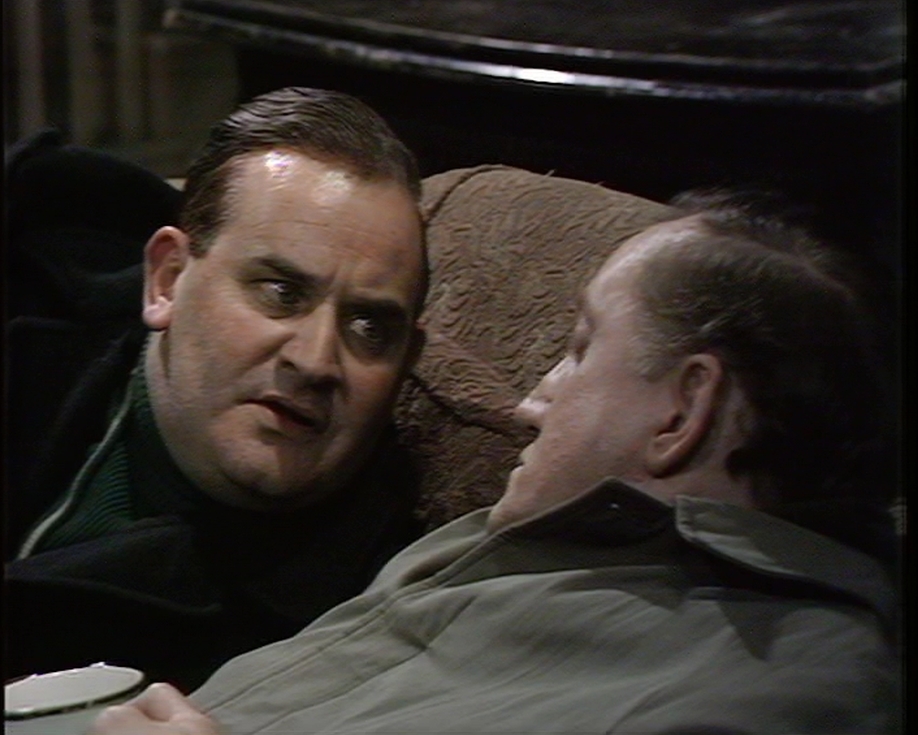
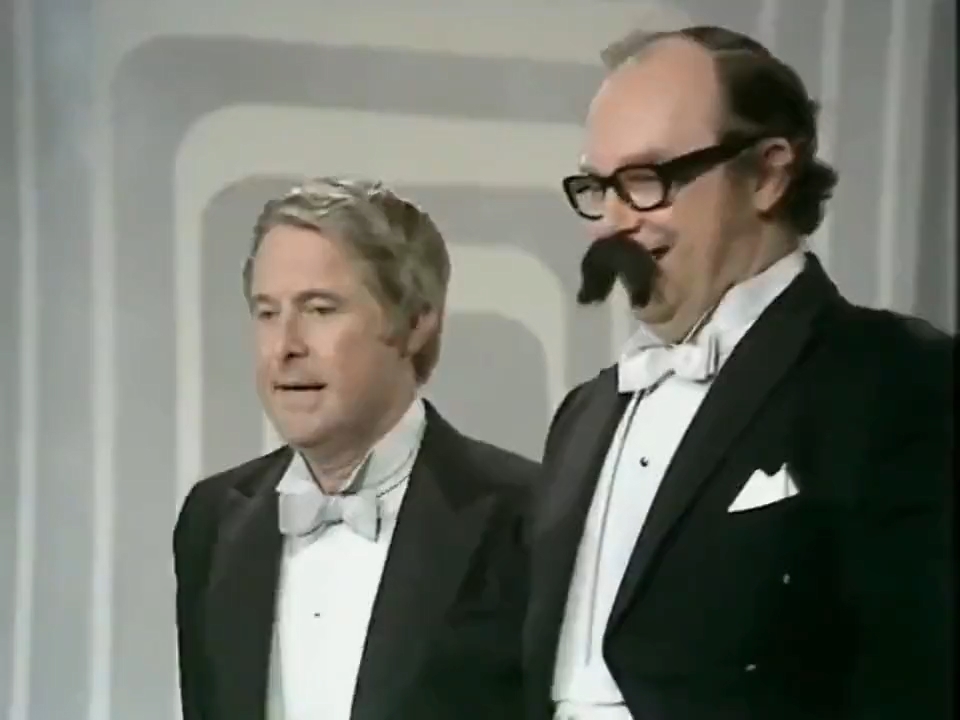
In early 1973 two documentaries about Morecambe & Wise hit the airwaves within a month of each other. First, the BBC Schools programme Scene aired a 22 minute programme on BBC2 (18th January) and then on BBC1 (18th February) the Omnibus strand broadcast Fools Rush In, which ran for 50 minutes.

Both documentaries were culled from fly on the wall footage shot the previous summer, when episode 7.7 of The Morecambe & Wise Show was being rehearsed and recorded. Show 7.7 was broadcast two days before the Omnibus doco, which meant that the lucky schoolchildren who caught the original Scene screening had an early peak at one of the most enduring M&W moments (“Arsenal!”)

Without knowing the original tx dates, it would be easy to assume that the Scene programme was simply a cut-down version of the adult documentary. But given that Ronald Smedley was the producer of both, it’s plain that Scene was the original one (presumably it was felt that the material gathered was too good to waste – hence it was reassembled and expanded for Omnibus).

Ronald Smedley spent his career working in children’s television. His highest profile job was as the producer of Grange Hill between 1985 and 1989, a period that saw the programme hit highs of controversy and public interest (Just Say No) and lows (Harriet the Donkey).

That apart, I find it fascinating that he worked on a series of impressive drama productions for BBC Schools, some of which were later repeated for an adult audience (including a modern language version of Julius Caesar, renamed Heil Caesar, and An Inspector Calls).

This serves as a reminder that schools programmes of this era could often be of a high quality. Indeed, the Scene documentary about Morecambe & Wise doesn’t talk down to its audience so it’s easy to imagine it receiving a peak time slot on its own merits (although with so much footage recorded it’s maybe understandable that the decision was made to produce a new effort from scratch).

Both have similar structures – although one notable difference is that Scene employs a narrator whilst Omnibus doesn’t. So while the Scene viewer is told that Eddie Braben lives and works in Liverpool, the Omnibus watcher is simply shown a picture of his house and either has to work out his geographical location or just not care.

Although Eric Morecambe can’t resist acting up for the cameras, both Eric and Ernie also talk seriously about Braben’s pivotal role in the series. At one point, Eric wistfully admits that he could never do what Braben did every week (enter his writing room on a Monday with a blank piece of paper and emerge with something). The pair concede that they may be able to improve on Braben’s work, but they’d be lost if they had to attempt to create it from scratch.

Both of these programmes would have made excellent special features on the Morecambe & Wise DVDs. Of course, neither were included ….

Sadly, the original range of releases lacked any extras at all (not even the Parkinson interview) and while the most recent DVD (containing previously lost episodes) did include a few bits and bobs, it was something of a half-hearted attempt. But at least there’s reasonable quality copies currently on YouTube. Links for both are below.
Porridge – New Faces, Old Hands (5th September 1974)

“With these feet?”

The series proper of Porridge kicks off with this episode. As touched upon in the last post,  a few adjustments have had to be made – at the end of Prisoner and Escort it looks like Fletch had already been processed and allocated a cell (he’d certainly been in for a chat with the governor).

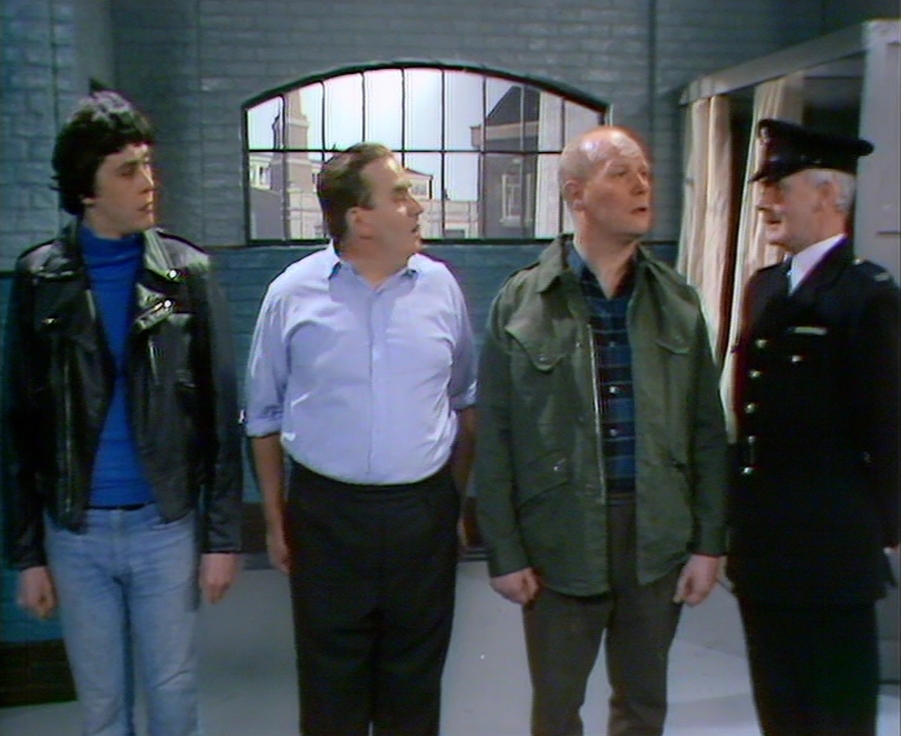
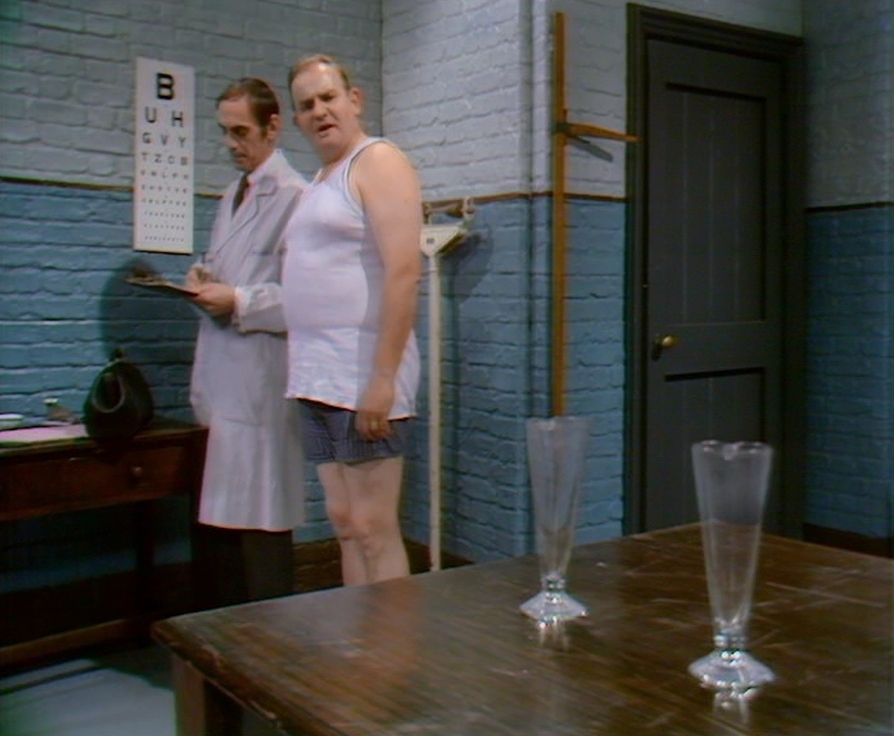
At the start of New Faces, Old Hands the story has rewound somewhat – Fletcher now finds himself lined up with the ingenuous Godber (Richard Beckinsale) and the gormless Heslop (Brian Glover) as the three are forced to listen to a lecture from Mackay, suffer a cursory inspection from the indifferent Medical Officer (John Bennett) and then are dished out with uniforms from Mr Barrowclough (“looks like Charlie Chaplin on stilts”).

Godber is the audience identification figure. Fletch instructs him (and us) about the way the prison works. Fletcher, the old hand of the title, knows the system inside out and how far it can pushed. Godber’s accent is a little more noticeable in this episode (possibly it was suggested to Beckinsale that he tone it down).

Brian Glover (“I read a book once. Green it was”) makes the first of three appearances as Heslop. He’d already had form with Clement and La Frenais – turning up as the cackling Flint in the series one Whatever Happened To The Likely Lads? episode No Hiding Place (tx 20th February 1973).

Michael Barrington debuts as the governor, Mr Venables (he’d appear eight times in total). Clearly Barrington had that sort of face, as he’d already played a prison governor in the forgotten late 1960’s sitcom Her Majesty’s Pleasure (which also featured a future Slade prison inhabitant – Ken Jones).

New Faces, Old Hands is stuffed with quotable lines. For example –

MO: Suffer from any illness?
Fletch: Bad feet.
MO: Suffer from any illness?
Fletch: Bad feet!
MO: Paid a recent visit to a doctor or hospital?
Fletch: Only with my bad feet!
MO: Are you now or have you at any time been a practicing homosexual?
Fletch: What, with these feet? Who’d have me?

Not to mention –

MO: Now I want you to fill one of those containers for me (points to a specimen container some distance away).
Fletch: What, from ‘ere?

It’s well known that Clement and La Frenais (working as uncredited script doctors) added this exchange into the 1983 James Bond film Never Say Never Again. My memory tells me that I’ve seen very similar lines in a late sixties/early seventies television series, although I can’t remember where. If anybody knows, please drop me a line ….

The episode opens on film at Ealing Studios with Mackay, Barrowclough and the silent (and never seen again) Mr Leach noisily striding down the metal walkways. This moment is played straight and since it directly follows on from the title sequence (which is rather bleak and also joke free) some viewers might have begun to wonder if this new programme was a drama rather than a comedy.

Mr Leach exists simply so that Mackay can tell him (and the audience) about the new arrivals. It seems odd, in retrospect, to see Mackay being deferential to another member of staff in uniform (later he’d be firmly established as Slade’s top dog, answerable only to the governor).

Although New Faces, Old Hands revolves around Fletch’s confidence that he can buck the system, Clement and La Frenais aren’t yet prepared to give him too many “little victories”. It’s Godber, rather than Fletch, who’s allocated a single cell and Fletch’s cushy job (mucking out the pigsty) turns out to be not that cushy after all.

It’s interesting that at the end of the episode Fletch and Godber are split up (the logical decision would have been to make them cellmates straight away). Was this because Clement and La Frenais, at the original writing stage, saw Godber as a similar supporting character to the likes of Heslop? If so, they would quickly change their minds ….

7 of 1 – Prisoner and Escort (1st April 1973)

7 of 1 served a dual purpose – not only was it a showcase for Ronnie Barker (allowing him to assume a variety of very different roles) but it also was a collection of pilots that could, potentially, be developed further.

Indeed, the first three episodes were all spun off into series. First there was Open All Hours (no prizes for working out what that became) followed by Prisoner and Escort (Porridge) and finally My Old Man (which ended up on ITV with Clive Dunn inheriting the Barker role).

Famously, out of the two episodes written by Clement & La Frenais (Prisoner and Escort, I’ll Fly You For A Quid) Barker felt that the latter one had more scope. History has proved that, on this occasion, his judgement was slightly faulty.

Although many of the building blocks of Porridge (which began in September 1974) are already present, it’s also interesting to note the differences.

Fletch’s baiting of Mr Mackay (Fulton Mackay) is already firmly in place (“I spy with my little eye something beginning with C”) as is the way that Fletch can effortlessly wrap the pliable Mr Barrowclough (Brian Wilde) around his little finger. Although in Prisoner and Escort, Fletcher is harsher (watch how, in the railway carriage, he cuts across Barrowclough in order to make his own points).

Since Mackay is absent for large stretches, Prisoner and Escort is essentially a two-hander between Fletch and Barrowclough. Holed up in a lonely cottage hours from anywhere (after Fletch sneakily directs his urine into the van’s petrol tank) the pair share a bottle of whisky as Barrowclough is encouraged to open up his heart.

We hear for the first time about Barrowclough’s unhappy home life (his unseen wife – here described as a serial philanderer – would become an item of interest in the future, not least in one of the Christmas specials) and he also admits that his career has been a complete and utter failure. This is tragic stuff (Wilde is so good) especially when you realise that Fletch is simply waiting for Barrowclough to fall unconscious so that he (Fletch) can make a break for it.

Barker’s wolfish expression as the oblivious Barrowclough chatters on is a little bit chilling – in the future Fletch could be hard, but he’d never be quite so menacing as he is here.

And, of course, based on what we later learn, it’s totally out of character for Fletch to attempt to escape. But as a set-piece moment in what could have been just a one-off, it’s fine (especially when the gag – Fletch wanders around the moor for hours and is eventually shocked to find out he’s walked in a complete circle and has returned to the cottage – is played so well by Barker).

Prisoner and Escort ends with Fletch having finally arrived at the prison (not yet called Slade). He’s in a cell that looks nothing like the one he’d later occupy and the fact he’s already quite comfy means that a bit of retconning has to be done with the first episode of Porridge (Old Faces, New Hands) which implies that Fletch, Godber and Heslop had all arrived together.