Somehow we’ve nearly got through another year, so that means it’s time to start riffling through my collection of Christmas programmes and begin to decide which ones will get another airing this December.
Some old favourites (the Porridge Christmas specials, The Box of Delights) are pretty much shoe-ins, as are the Morecambe & Wise Christmas shows. Indeed, I’ve kicked off this Xmas season with the first of their BBC Christmas shows from 1969 (as their links for the 1968 Christmas Night With The Stars no longer exist).
It’s noticeably not a very festive programme (apart from Eric & Ernie briefly messing about with a very large Christmas tree and Nina – together with a collection of cute children – singing Do You Know How Christmas Trees are Grown?). The reason becomes obvious when you do a little digging – Eric was taken ill (with flu) during the recording on the 21st of December, which meant that most of the show had to be assembled from material taped for their next series.
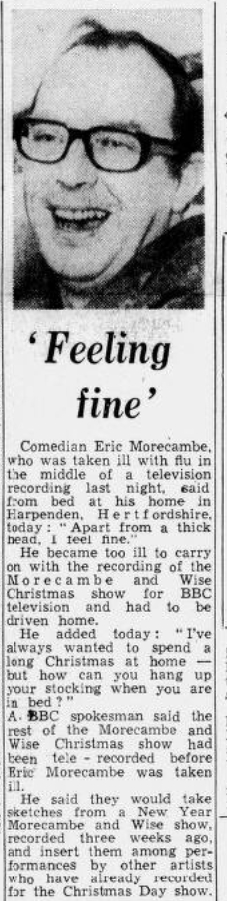
What I find interesting is that the recording was done so close to Christmas. In years to come, you’d often hear about festive programmes being taped in the summer, possibly Eric & Ernie preferred not to do this. Which, of course, was fine provided nothing went wrong.
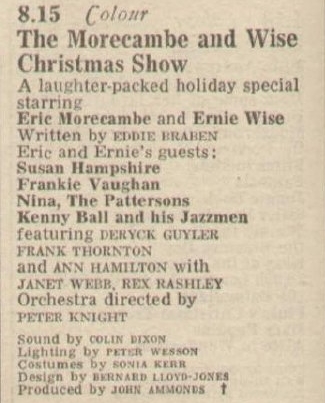
The Radio Times listing, published before the aborted recording, tells us what we should have enjoyed – with Susan Hampshire and Frank Thornton due to appear (they were replaced in the broadcast programme by Fenella Fielding). There was no problem with the musical guests, so their spots were recorded as planned (although when you know about the cobbled together nature of the programme, the fact there’s no interaction between them and Eric and Ernie does become obvious).
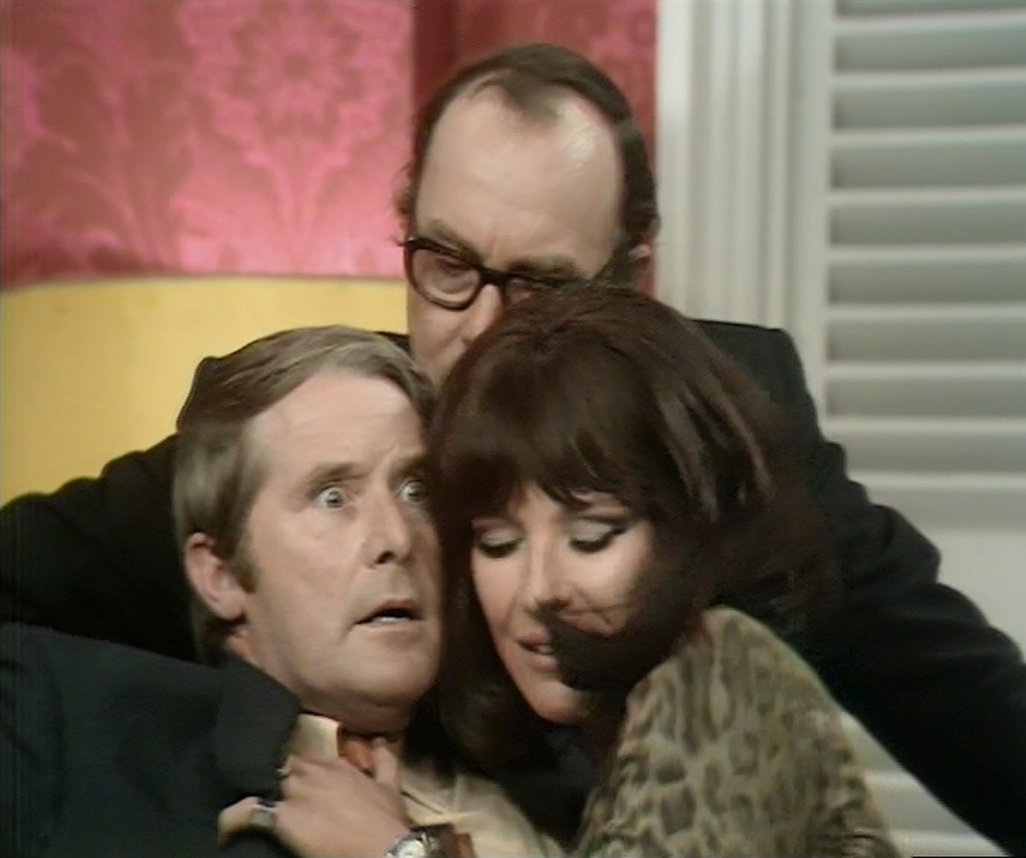
Also appearing, but not billed in the Radio Times, was Sacha Distel. His performance was dropped in from Show 3.3 (broadcast on the 11th of February 1970). Indeed, this edition was plundered for most of the Christmas programme material (such as the opening with a hip-looking Ernie and a be-wigged Diane Keen, Ernie in the bath, the window cleaner sketch and Fenella Fielding).
So it must have been strange for the first time viewer in February 1970, settling down to watch a “new” episode of Morecambe & Wise, to suddenly realise that most of it was very familiar ….
 Archive Television Musings
There was a reference to the timing of the recording of Christmas telly in the final Steptoe
“I like Christmas telly…All them stars giving up their Christmases just to entertain us.”
“They don’t give up their Christmases! All them programmes is recorded in October! Comes Christmas, they’re all away sunning themselves in the South of France. It’s just us lot sat here in the freezing cold watching ‘em.”
LikeLiked by 1 person
Taping the Morecambe and Wise Show just prior to transmission was not a choice but a necessity. Recording a tv programme in the week prior to the broadcast date was common practice at the BBC in the 1960s. And if you think about it, the reason is obvious.
BBC-tv started out in 1946 as a live service, in an age when pre-recording in the studio was impossible. Live tv continued through the 1950s, and many types of tv continued to be live even when taping became a technical possibility in the mid 1960s, because it was cheaper to avoid buying the very expensive videotape.
It was not necessary to fund future programmes when all tv was live, because in an age of live tv it was not possible to make any. BBC budgets thus originally allowed the programme makers to pay for one year of live tv, or in other words the audience was paying an annual fee for the current year’s broadcasts (only). As the money came in, it was spent on the current shows.
When pre-recording became possible, the method of funding the BBC hadn’t changed. It was still a system which could only afford the current programmes.
There was no money in the budget to pay for the making of programmes that would be shown at a future time, because that would mean not funding this week’s broadcasts. If you had only as much money as you needed in order to make the current week’s programmes, you needed it all, or you would have fewer programmes on the air this week.
The most practical solution in such a situation was to record a broadcast during the week in which it was to be transmitted.
LikeLike
I suppose you’d really have to dig through the BBC’s 1960’s production paperwork to establish the truth of this. Certainly over on ITV they were more than happy to record programmes that would remain on the shelf for some time (Sergeant Cork is a good example – made in two lengthy production blocks, some episodes ended up airing years after they’d been taped).
LikeLike
Do You Know How Christmas Trees Are Grown? The answer becomes obvious when you do a little digging.
I read a book about Morcambe and Wise, but I don’t remember reading that story. The book did have an episode guide so I don’t know if the 1970 series did include items that had previusly appared in the Christmas special.
I heard that sometime Eddie Braben would write a sketch for one of Morcambe and Wise’s weekly series, and then be told that it was too good for the series and should be usede in the Christmas special, and he would have to rustle up something else. That was what the pressure was like.
LikeLike