Fred – Simply Media DVD Review

fred

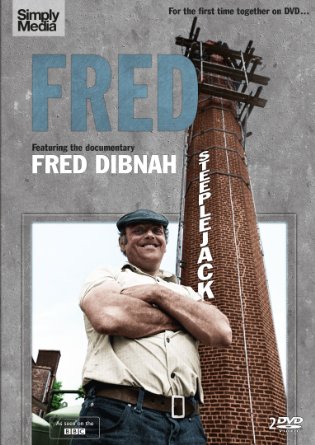
In 1978 Fred Dibnah was commissioned to repair  the clock tower at Bolton’s Town Hall.  His casual attitude, even when suspended from a rickety bosun’s chair high above the ground, caught the attention of the BBC’s local news programme, Look North West.  Dibnah’s down-to-earth attitude meant that he was an excellent subject for a one-off documentary broadcast in 1979, Fred Dibnah, Steeplejack.   This then led to the seven part series Fred, broadcast in 1982.  Both are included on this DVD.

Easily the most famous part of Fred Dibnah, Steeplejack is the moment when he has to run fairly sharpish to avoid being crushed by a chimney which he’d just detonated.   His immediate response of “d’you like that?” was a classic television moment and it’s no surprise that it was later used on the opening credits of every episode of Fred.

Both the one-off documentary (which won a BAFTA in 1979) and the series follow a similar path.  They show Fred both at work and off-duty (where he’s often to be found tinkering in his shed). Wherever he’s working – up chimneys, church steeples, etc – the pictures are enlivened by Fred’s pre-recorded musings on a variety of topics.  Nobody could ever have called him profound, but his thoughts on life and religion have a rugged honesty about them.  Fred might have already been something of a celebrity by the time Fred was made (the third episode sees him as a guest of honour at a shop opening) but he still seems to take everything in his stride.

Fred’s all-consuming passion for his steam engine (which he spent more than a decade restoring) is gently suggested as putting something of a strain on his marriage.  After all, he seemed to spend more time in the shed with it than he did with his wife and children.  There’s also a later scene, which could possibly have been staged for the cameras, showing Fred merrily driving the steam engine very slowly down the road, whilst his wife and children stoically sit on the back!  But when you know that Alison, his first wife, let him in 1985 because she felt neglected, it does tend to make you view certain moments in a different way.

With series like these, it’s always interesting to ponder just how much we see is truthful and how much is the way it is just because there were cameras rolling.  Certain moments, such as when Fred decides to buy a new engine, do seem a little forced – mainly because the other person in the frame with Fred doesn’t seem as comfortable in front of the camera as he is.

But the public Fred probably wasn’t terribly different from the private Fred and this could be the reason why he was such a hit with the public.  Although he made many later series, for me this one is the most compelling.  With Deryck Guyler’s unmistakable tones as narrator, Fred is a pleasure from beginning to end.  Whether he’s musing about how he feels undressed without his cap or hoping that heaven will be stocked with steam engines, there’s plenty to enjoy.  And if Fred’s rough-hewn philosopy doesn’t entertain, then you can simply sit back and enjoy some of the remarkable photograpy as he scales some incredibly high constructions with a highly casual air.

Disc one contains the first four episodes of Fred, whilst disc two has the final three, plus the 1979 Fred Dibnah, Steeplejack.  Some sources say that Fred was an eight part series, although since the eighth episode listed by the likes of IMDB (A Disappearing World – not included in this set) was broadcast some six months after the rest of Fred, it’s actually a one-off and not part of the series, hence its non-inclusion here.

Fred is released by Simply Media on the 23rd of May 2016.  RRP £24.99.

fred


Timeshift – Live on the Night: The Story of Live TV Drama

I’ve uploaded some bits and bobs to my YouTube channel over the last few days and one of them is this Timeshift documentary from 2004.

It tells the story of live British television drama – from the early days and then right up to date.  Covering programmes like the original Quatermass serials, Nineteen Eighty-Four, Dixon of Dock Green and Z Cars and featuring interviews with Nigel Kneale, Peter Byrne and Brian Blessed amongst others, it ties neatly into some of the shows that I’ve written about in recent months.

The Secret War (1977 BBC WW2 documentary). Simply Media DVD review

cover

In retrospect, the 1970’s was an ideal time to be making documentaries about the Second World War.  Some thirty years or so had passed since the war had come to an end, which was long enough for people to be more candid about some events and particularly (in the case of this series) for certain facts, hitherto not in the public domain, to be discussed.

Several years before, Thames Television’s The World At War had covered many areas of the conflict in detail, but one omission was the role played by the code-breakers at Bletchley Park.  At the time The World At War was in production this information wasn’t public knowledge, which meant that The Secret War was one of the first programmes to describe this vital part of the war.

The Secret War was narrated and presented by William Woollard,  a familiar face from Tomorrow’s World.  It was comprised of six episodes.

Episode 1 – The Battle of the Beams.  Early in the war, British Intelligence became aware that the Luftwaffe were using a series of radio navigational aids to accurately pinpoint targets, even in the dark.  This first episode describes these developments as well as the  jamming countermeasures developed by British scientists.

This episode, like several others, relies heavily on the input of R.V. Jones.  Jones played a major part in the development of the jamming beams and his book Most Secret War is not only a fascinating read in its own right, it was also a useful guide for the programme-makers in the early stages of The Secret War’s production.

R.V. Jones
R.V. Jones

Episode 2 – To See A Hundred Miles.  This episode discusses the development of Radar as well as British Intelligence’s efforts to discover German developments in the same field.

R.V. Jones appears again, as does Albert Speer – Hitler’s Minister of Armaments.  Another key interviewee is Arnold Wilkins, co-creator of Radar.  The presence of pioneers such as Wilkins is certainly one of The Secret War’s main strengths.

Episode 3 – Terror Weapons.  The creation of Hitler’s vengeance weapons – the V1 and V2 – and the countermeasures taken to combat them.

Interviewees here include Duncan Sandys (Chairman of the War Cabinet Committee responsible for defence against flying bombs and rockets) and Raymond Baxter, Woolard’s Tomorrow’s World colleague, who describes his exploits as a spitfire pilot and his unsuccessful attempt to shoot down a V2 rocket.

Episode 4 – If.  This episode describes numerous inventions that never came to pass.  These include the Messerschmitt Me 321, a large cargo and troop aircraft which was intended for use in the German invasion of Britain – codenamed Operation Sealion.  Also discussed are German bouncing bombs.

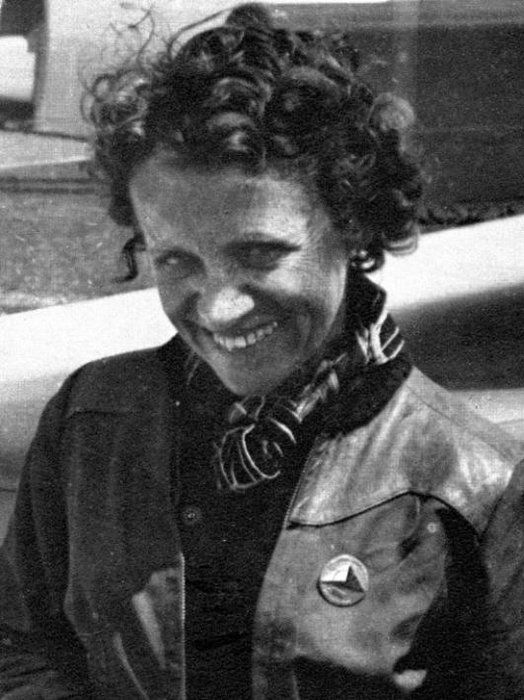
As well as further input from R.V. Jones and Albert Speer, also interviewed were Frank Whittle (creator of the turbojet engine) and Hanna Reitsch. Reitsch was a German test pilot and the only woman to be award the Iron Cross First Class. As might be expected, her unique status makes her a fascinating interviewee.

Hanna Reitstch
Hanna Reitstch

Episode 5 – The Deadly Waves.  Episode 5 looks at the hazards of magnetic mines and the methods used to counteract them, including degaussing.

Lt Cdr John Ouvry, who defused a German mine on the shoreline at Shoeburyness is interviewed and this actual mine is used in the programme to re-enact the event.

Episode 6 – Still Secret.  As previously mentioned, when The Secret War was in production the first information about the code-breakers at Bletchley Park began to emerge.  So whilst this programme is far from complete (as much more information would emerge in the decades to come)  it’s still a very interesting watch.

Discussed are the efforts to break the Enigma Code and the role played by the Colossus computer, designed by T.H. Flowers.  In 1977 the Colossus was still on the secret list, so details are fairly sparse, but the programme benefits enormously from an interview with Flowers.  And there are also valuable contributions from others present at Bletchley Park during WW2 such as Gordon Welchman, Harry Golombek and Peter Calvocoressi.

T.H. Flowers
T.H. Flowers

Whilst there are numerous WW2 documentaries available, The Secret War is noteworthy for several reasons.  The interviews with key pioneers on both sides is a major plus as is the wartime footage, some of which had not been widely seen until this programme.  The series was produced in association with The Imperial War Museum, so the programme-makers were able to make full use of their archives to locate interesting material.

And finally, the series helps to tell some of the less familiar stories of the Second World War.  Whilst the key battles and individual acts of heroism were already well known, The Secret War was able to explain that some of the real breakthrough moments of the war came not at the front, but in laboratories, far away from the fighting.

This is a first class documentary series and hopefully Simply will delve in to the archives again to unearth similar treasures.

A brave new world. The Computer Programme (BBC 1982)

the-computer-programme

It’s slightly sobering to think that more than thirty years have passed since The Computer Programme was first broadcast on BBC2.

At that point in time the home computer revolution was just beginning and the BBC were keen to produce a series that introduced the concept and abilities of the modern computer to a wide audience.

The BBC obviously didn’t want to use an existing computer – and then be accused of offering free advertising – so they designed their own.

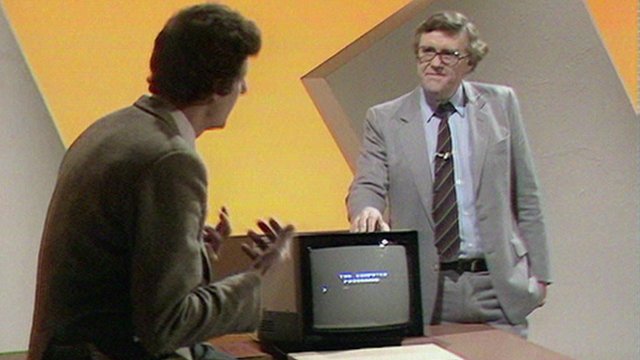
Ian McNaught-Davis was the avuncular expert and Chris Searle stood in for the viewer, asking all the obvious questions.

_73093377_73093376
Chris Searle and Ian McNaught-Davis

There were ten episodes in total –

It’s Happening Now (11 January 1982)

Just One Thing After Another  (18 January 1982)

Talking to a Machine  (25 January 1982)

It’s On the Computer (1 February 1982)

The New Media  (8 February 1982)

Moving Pictures (15 February 1982)

Let’s Pretend  (22 February 1982)

The Thinking Machine  (1 March 1982)

In Control  (8 March 1982)

Things to Come  (15 March 1982)

Looking back at the series, it’s amazing to consider how far we’ve come in just a single generation. All the episodes are available on YouTube (something that would have seemed like science fiction in 1982) and the programmes are fascinating watching, both for those of us who were there at the time and also for younger people who can get a flavour of how computers used to be In the dim and distant past.


The Secret War – 1977 BBC WW2 documentary coming to DVD in September 2014

The Secret War
The Secret War

The Secret War, a six part WW2 documentary made by the BBC in association with the Imperial War Museum, is due for release in September 2014 by Simply HE.

Originally broadcast in 1977, it was presented by William Woollard, with each episode looking at the various different ways that science and intelligence helped the Allies to win the war. Episode titles are as follows –

Episode 1 – The Battle of the Beams
Episode 2 – To See A Hundred Miles
Episode 3 – Terror Weapons
Episode 4 – If
Episode 5 – The Deadly Waves
Episode 6 – Still Secret

Topics covered include the breaking of the Enigma code, Hitler’s terror weapons (the V1 and V2) and the development of Radar. Interviewees include Hitler’s Minister of Armaments, Albert Speer.

A full DVD review can be found here.