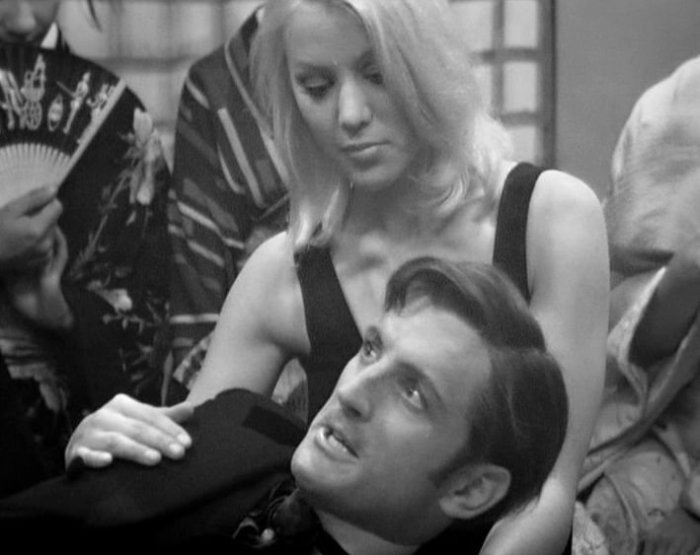
Adam (with Georgina tagging along of course) heads off to Tokyo to deal with an evil blackmailer who spells trouble for the British government ….
Oh dear. After two pretty entertaining episodes we hit something of a speed bump with the third. Terence Frisby’s other writing credits include a couple of (wiped) episodes of Public Eye but he’s easily best known for penning the play There’s A Girl In My Soup. His sole contribution to AAL! is a curious thing, although the major problem is one key casting decision.
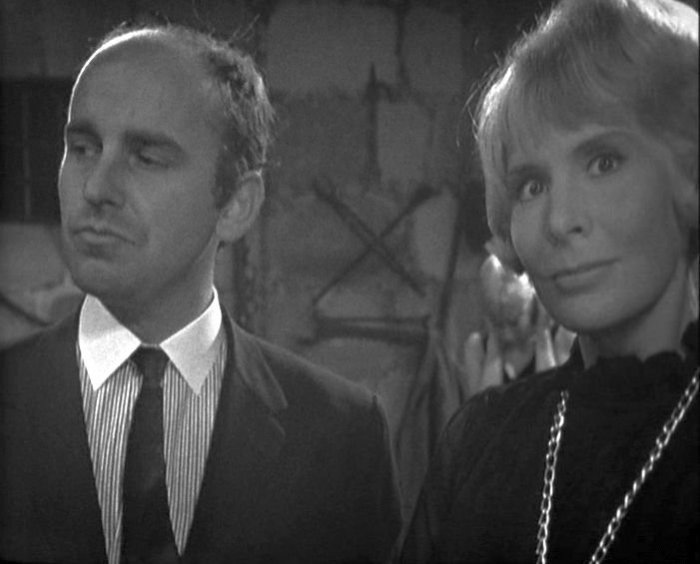
Things start sprightly enough. Sir Ernest Hampton (Maurice Hedley) is an important government official who’s been unwise to find himself ensnared in a honey trap. But rather than do the decent thing and resign, he wants Adam to find the blackmailer and kill him! Another series might have made more of the notion of a Government sponsored killer, but the breezy comic-strip nature of AAL! means that it’s not something that’s dwelt on for more than a moment.
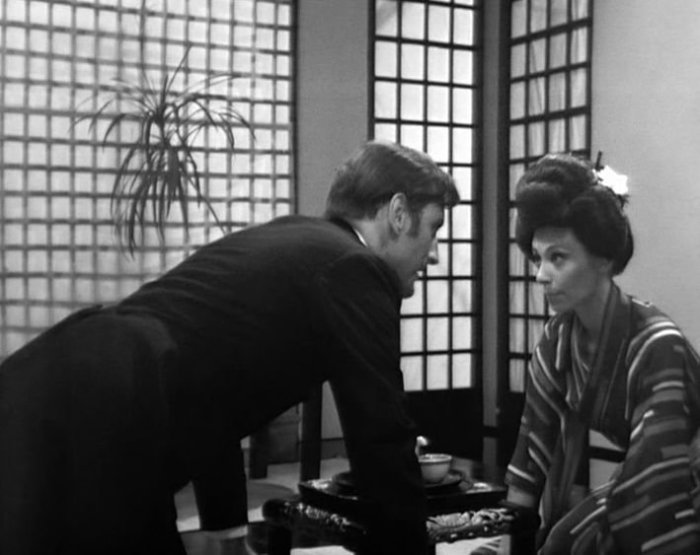
It seems odd for the blackmailer to be out in Tokyo and unlike Blackpool last time, we’re denied any scene-setting. I wouldn’t have expected the production team to jump on a plane to the East, but at least a few stock shots might have sold the illusion. As it is, we simply travel from one studio set to the next (most of the action taking place in a Geisha house) which just as easily could have been anywhere in the world.
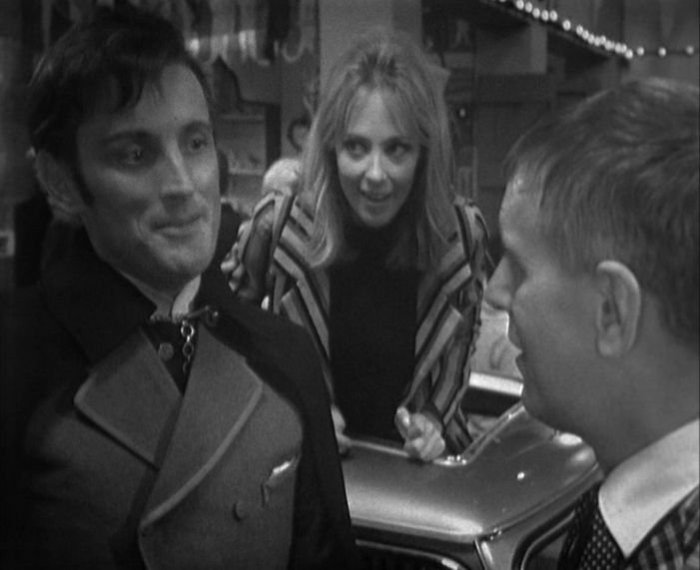
Some comedy is extracted from Adam’s horror at being asked to consort with Geisha girls, although he quickly adjusts. He’s a fast learner that boy. There’s no room for Simms in this adventure (although possibly it was written before Death Has A Thousand Faces). There should really be no place for Georgina either, but she rather improbably manages to shoe-horn herself in. The moment when – dressed as a Geisha – she confronts Adam is rather nicely played though.
Given the dearth of ethnic actors in the UK during the sixties and seventies it was common to see British actors playing a variety of nationalities (blacking up as and when required). On the plus side, More Deadly Than The Sword does boast many ethnic supporting actors, it’s just a great pity that the major role of Madame Nagata was played by the very English Mary Webster.
Her cod Japanese accent becomes wearisome very quickly and it’s this one performance which really torpedoes the episode, although Barry Linehan as McLennon doesn’t help either. He was a familiar television face, but I have to confess that his performances often seemed a little off-key. Margaret Nolan (as Sadie) provides one bright spot. Probably best known for playing Dink in Goldfinger, she doesn’t have to do anything except play a dumb blonde, but she livens up proceedings for a few minutes.
Easily the least engaging of the surviving episodes, let’s hope that the next is somewhat better.
Adam and Georgina head off to Blackpool in order to foil a deadly scheme to blow up the Golden Mile ….
After the lovely picture quality of the first episode, the murky gloom of Death Has A Thousand Faces comes as an unpleasant surprise. Unlike A Vintage Year For Scoundrels, it doesn’t appear that the film inserts for this one still exist – a shame, as it would have been nice to see the Blackpool travelogue scenes in better clarity.
They’re still good fun though – the incongruous sight of Adam and Georgina strolling down the Golden Mile doesn’t advance the plot at all, but it generates a spot of local colour and gives us a breather before the main plot kicks in. As for the story, it’s probably best not to ask why a vital clue was contained within the middle of a stick of Blackpool rock which was then taken to London. This seems a very strange way of going about things.
Once Adam has dispatched the two Hells Angels (one played by the distinctly unthreatening Geoffrey Hinsliff) who were pursuing Georgina (who just happened to have come into contact with the mysterious rock) the pair head off to Blackpool. It might be a big place, but it isn’t long before they stumble across the villains – Madame Delvario (Stephanie Bidmead) and her henchmen Jeffreys (Michael Robbins) and Danny (Patrick O’Connell).
As with the previous story, we see how a female villain causes problems for Adam (his Edwardian mindset makes it difficult for him to process the concept that a lady could be evil). This would be a theme that would run and run throughout the series. Bidmead (who had played the villainous Maaga in Lambert’s last Doctor Who story as producer – Galaxy Four) offers a subtler performance than the scenery-chewing of Freda Jackson and she’s given strong support from both Robbins and O’Connell.
Apart from those already mentioned, another familiar face – Sheila Fearn – appears as Susie, an apparently sympathetic character, but another who turns out to be on the side of the ungodly. Poor Adam, if this goes on he’s going to develop a complex about the female of the species.
The most important new arrival is, of course, Jack May as William E. Simms. Simms is currently plying his trade as a Punch and Judy performer but by the end of the episode he will have wangled himself a new position as Adam’s valet. May’s performance across the series is idiosyncratic – sometimes cultured, sometimes crude – but never, ever dull.
There’s another round of fisticuffs (plus Georgina nearly gets stretched on the rack) before order is restored. Madame Delvario’s plan – blowing up the Golden Mile with black lightbulbs filled with explosives in order that a rival area can take over – is one that you’re not likely to see anywhere else.
A step up from the debut episode, although the series is still on somewhat shaky ground. Alas, the next episode doesn’t mark an upswing in quality ….
Having worked on Doctor Who, Verity Lambert was already well versed in the difficulties of bringing a television concept to the screen. Like Who, Adam Adamant Lives! had a “pilot” episode which was reshot, but in the case of AAL!, the changes were rather more dramatic ….
Donald Cotton’s original script was deemed to be unworkable, so the majority of his work was binned (only the opening ten minutes – set in 1902 – were retained). Also deemed surplus to requirements was the original Georgina (Ann Holloway). With only a handful of production photographs existing to document her brief association with the show, it’s impossible to know for sure why she didn’t work out. Lambert’s assertion that Holloway simply wasn’t sixties enough has always seemed a little odd to me.
But with a new script and a fresh Georgina (Juliet Harmer) the series could try again. Cotton’s surviving material (all shot on film) is rather entertaining – it firmly establishes the 1902 Adam, a man who tends to throw his assailants off high balconies at Windsor Castle and then ask questions later. But his sense of honour is obvious – an adversary can be respected if they play the game, but a traitor is beyond the pale.
So when his one true love – Louise (Veronica Strong) – turns out to be in cahoots with the evil Face (Peter Ducrow) poor Adam is rather distraught. Never raising his voice above a whisper (as well as being shot out of focus) the Face makes the most of his limited screentime. His masterplan (encasing Adam in a solid block of ice, thereby ensuring he exists forever in a living hell) does beg a few questions mind you, such as how the ice never melts.
This question was still bothering me some sixty years later when a group of workmen uncovered Adam – still perfectly frozen. Oh well, you have to accept that plot vagaries are part and parcel of AAL! Now we’re in 1966, there’s one more notable film sequence – this occurs as Adam wanders dazedly around the West End of London, encountering Georgina for the first time – before the series largely switches over to videotape.
Contemporary reviews noted that Adam’s disorientated stumbling went on a bit (which it does) but it’s still an interesting spot of guerrilla filming. Lambert and Gerald Harper had different recollections about it – Lambert was sure that they had permission before shooting, whilst Harper remembered dashing from one location to the next in order to keep out of the clutches of the police. Certainly most of the passers-by seem to be simply ordinary members of the public, unaware they’ve briefly become television stars, rather than extras.
The comic possibilities between the upright Adam and the groovy Georgina are successfully mined. Adam’s shock at being left with an unattended Georgina in her flat (not to mention his amazement that she wasn’t – as he first thought – a boy) are entertaining. Although the entertainment ratchets down a notch when the main plot comes into play.
If the story of the villainous Margo Kane (Freda Kane) and her dopey henchman was really a step up from the storyline in the pilot then goodness knows how feeble that must have been. The shock of switching from film to videotape is most obvious during the fight sequence in Georgina’s flat. Even though the VT sequences were transferred later to film to allow for tighter editing, there’s only so much than could be done – so they end up looking a little rough round the edges.
But overall it’s not a bad debut and given the production difficulties it’s possibly surprising that it turned out as well as it did.
The Doctor’s in a right old strop at the start of this episode (his bad mood carries over from the previous cliffhanger). This feels a touch artificial and seems to have been done for two reasons – not only does it create a good hook into A Land of Fear (otherwise the last episode might have ended with the Doctor saying “oh look, a forest”) it also gives the regulars, especially Hartnell, some nice character moments in the opening few minutes of the story.
William Russell has spoken in the past about how the arrival of Dennis Spooner was greeted with enthusiasm by the main cast. Spooner had a good ear for naturalistic dialogue and also liked to pepper his stories with humour. And following the earnest and rather stilted dialogue which sometimes cropped up in The Sensorites, The Reign of Terror does come as a breath of fresh air. However, it’s notable that Spooner’s scripts do feature various Americanisms, which feel strange coming from the mouths of the TARDIS crew, simply because they’ve never spoken like this before (Hartnell, for example, says “you don’t say” later this episode. This feels jarring after watching the series in order).
The Doctor is convinced that he’s landed Ian and Barbara back in England 1963 and is keen drop them off and move on. Not surprisingly, Ian and Barbara aren’t prepared just to take the Doctor’s word for it. This infuriates the Doctor. “I’m rather tired of your insinuations that I am not master of this craft. Oh, I admit, it did develop a fault, a minor fault on one occasion, perhaps twice, but nothing I couldn’t control.”
This is lovely stuff and Hartnell plays it to the hilt. As we’ll see time and time again over the years, the joke’s on the Doctor since his confidence does turn out to be entirely misplaced. They’re in France, not England, and a couple of hundred years back in time. The TARDIS has set them down during the French Revolution (“the reign of terror”) which according to Susan is the Doctor’s favourite period in Earth history. I wonder why. Does he enjoy the sight of all those French aristocrats being sent to the guillotine? The Doctor never explains why he enjoys this time so much, so we’re left guessing.
The TARDIS crew meet Rouvray (Laidlaw Dalling) and D’Argenson (Neville Smith) at an abandoned farmhouse. Both Frenchmen are on the run from the authorities and it seems probable that they’ll be significant figures in the story. Whilst D’Argenson is nervous and apprehensive, Rouvray is calm and still in total command. He may be a hunted man but possesses an unbelieving belief in his own authority. He bluntly tells Ian and Barbara that “in France now there are only two sides. You’re either with us or against us. Our sympathies are obvious. We want to know yours.”
The arrival of a group of soldiers immediately darkens the tone. They’re depicted as a barely controllable rabble, with the common soldiers openly contemptuous of the Sergeant’s authority. The Sergeant (Robert Hunter) cleverly doesn’t attempt to browbeat his men into obeying his orders, instead he suggests that if they watch the back of the house they might have a chance to kill some royalists. This meets with their approval and they move into position.
Whilst Robespierre might later claim this is a glorious and just revolution, the behavour of the soldiers is clearly designed to indicate otherwise. And when Rouvray and D’Argenson are both brutally murdered it helps to reinforce the concept that life is now very cheap. Since both characters seemed to have been set up to play a major part in the narrative, their sudden deaths are quite shocking. It also serves as an early demonstration that the Doctor and his friends could also face death at any time.
Rouvray’s death is a noteworthy moment. He disarms one of the soldiers just by asking for his rifle and then comments that “you can give them uniforms, Lieutenant, but they remain peasants underneath.” This is another example of Rouvray’s unshakable belief in his own authority, but it’s also a demonstration of the ruling elite’s unspoken arrogance. Did this exchange led directly to his death? It seems more than likely.
With the Doctor unconscious in the upstairs part of the house, the soldiers decide to take Ian, Barbara and Susan to Paris. Their motivation is not out of a sense of duty though – they believe there might be a reward and are keen to collect. They torch the house before they depart, which means we conclude with a strong cliffhanger – the Doctor awakes to find himself trapped in a raging inferno ….
Given the episode title, the opening few minutes (which finds PC Lynch in court as a chief prosecution witness) appears to be something of an exercise in misdirection. Lynch (James Ellis) has been called upon to give evidence against a man accused of stealing a bottle of milk – not exactly the crime of the century (nor one that you would assume would be sufficient to maintain fifty minutes of drama).
But in one way it does turn out to have a later significance. The case is quickly proved, with the magistrate (played by John Gabriel) commenting that although Lynch was accused of planting this bottle of milk, he can find no reason why he would have done so. A modern audience might possibly look slightly askance at this seemingly automatic assumption that the police would be incapable of speaking nothing but the whole truth, but they’d be well advised to watch the remainder of John Hopkins’ script before jumping to any conclusions.
The bulk of the story revolves around a series of fairly petty thefts of foodstuffs organised by Trevor Kiernan (Richard Leech). Kiernan runs a small supermarket, frequented by the likes of Fancy Smith (Brian Blessed), and has taken to pilfering from his competitors in order to increase his profit margins.
But the dogged Detective Inspector Dunn (Dudley Foster) is on his case. Foster didn’t appear in that many episodes of Z Cars, which is a slight shame as Dunn’s incredibly phlegmatic and passionless officer is quite compelling. It’s plain though that he’s never going to be the sort of person to make many friends (at one point he tells a weary Lynch to grab some sleep before returning to duty but – as Lynch says – always manages to make a friendly remark sound like an insult).
Fancy and Jock Weir (Joe Brady) seem to have created a watertight case against Kiernan (thanks to a marked box) but this all comes to naught after they’re both destroyed in the witness box by Kiernan’s smooth-talking barrister, Garston (Jerome Willis).
This last ten minutes or so is easily the most compelling section of the episode. Willis’ character is able to effortlessly run rings around both Fancy and Jock, casting just enough doubt on their evidence without ever stepping over the boundary to accuse them of outright corruption. Thanks to this, he’s able to secure an acquittal for his client. Therefore the same magistrate who earlier found in favour of the police – Lynch – now finds against them.
Dunn’s reaction to the hapless Fancy and Jock afterwards is interesting. You might have expected him to be more than a little ticked off, but instead he’s fairly sanguine about the whole affair. No, they didn’t gain a conviction, but he’s convinced that Kiernan would have found the whole trial and subsequent publicity to be so off-putting that from now on he’ll stick to the straight and narrow. Other, later, police shows might regard the conviction as the be all and end all – but for this era of Z Cars that’s not the case.
Brief appearances by Barlow and Watt help to enhance a fairly routine instalment, although Jerome Willis’ appearance (and the always solid performances from the regulars) helps to keep the interest ticking along.
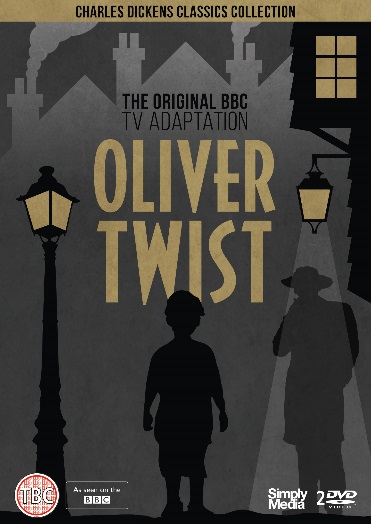
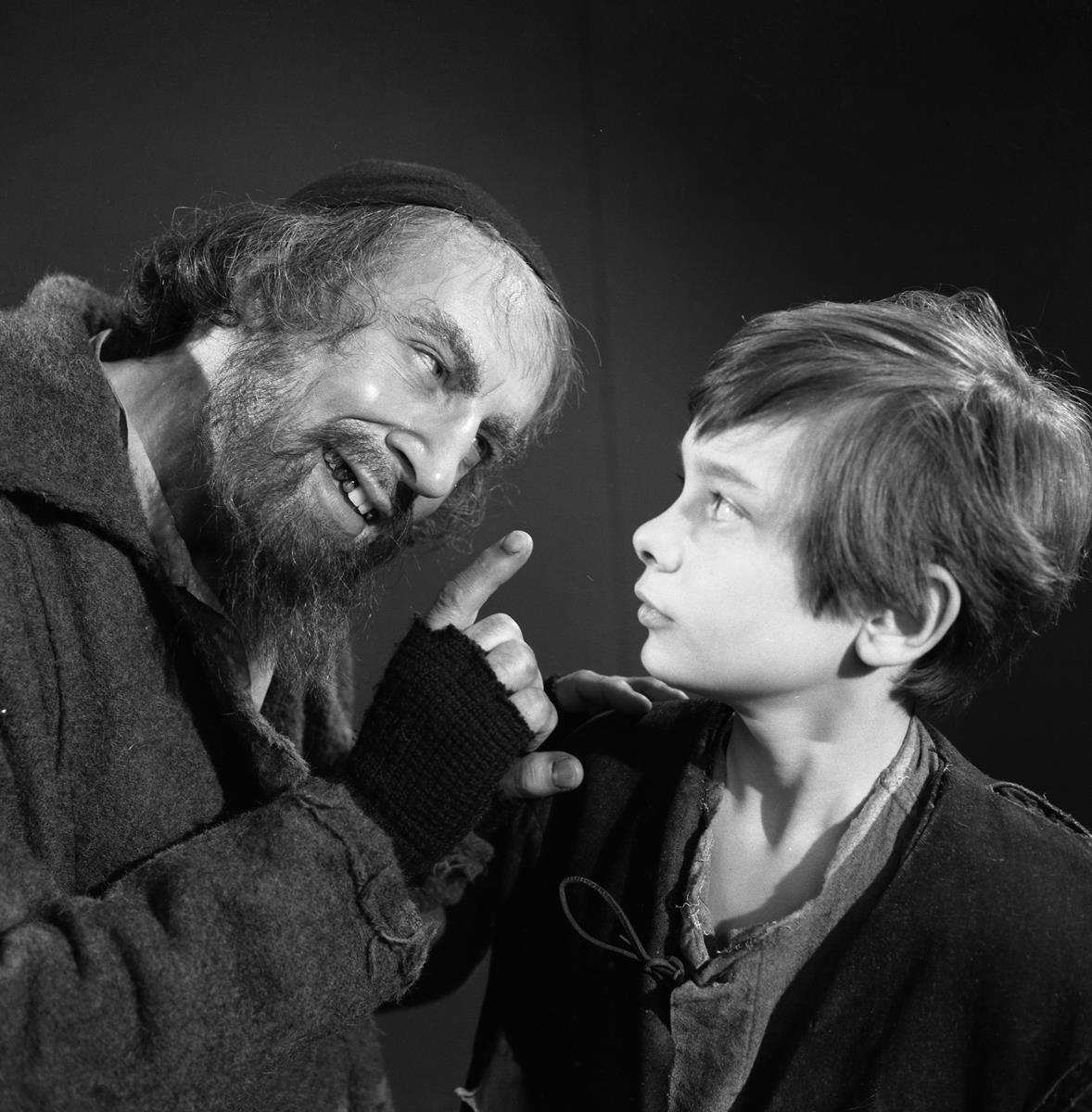
Following the death of his mother in childbirth, the young Oliver Twist (Bruce Prochnik) is placed in the indifferent care of the state. His childhood is a miserable one and eventually he runs away to London to seek his fortune. There he encounters the devious Fagin (Max Adrian) who has no compunction in manipulating the trusting and naïve Oliver to serve his own ends ….
Published between February 1837 and April 1839, Oliver Twist was Charles Dickens’ second novel and remains one of his evergreen tales, evidenced by the numerous film, television and stage adaptations it has inspired. David Lean’s 1948 film and the stage/film musical by Lionel Bart (Oliver!) are possibly the most memorable, although there have also been multiple television adaptations as well.
This one, broadcast between January and April 1962, was the first BBC version and as might be expected remained very faithful to the original novel. Constance Cox had already adapted Bleak House and would go on to tackle several other classic Dickens novels during the 1960’s (The Old Curiosity Shop, Martin Chuzzlewitt, A Tale of Two Cities) although sadly out of those three only a few episodes from A Tale of Two Cities currently exist.
Bruce Prochnik, playing the eponymous Olivier, had a pretty short television career (1961 – 1965) with Olivier Twist by far his most substantial role (he had a handful of later credits in series such as Taxi! and Emergency Ward-10). It’s interesting to note that post-Olivier he popped up a couple of times on Juke Box Jury. Clearly this serial had been successful enough to turn him into a household name for a short time.
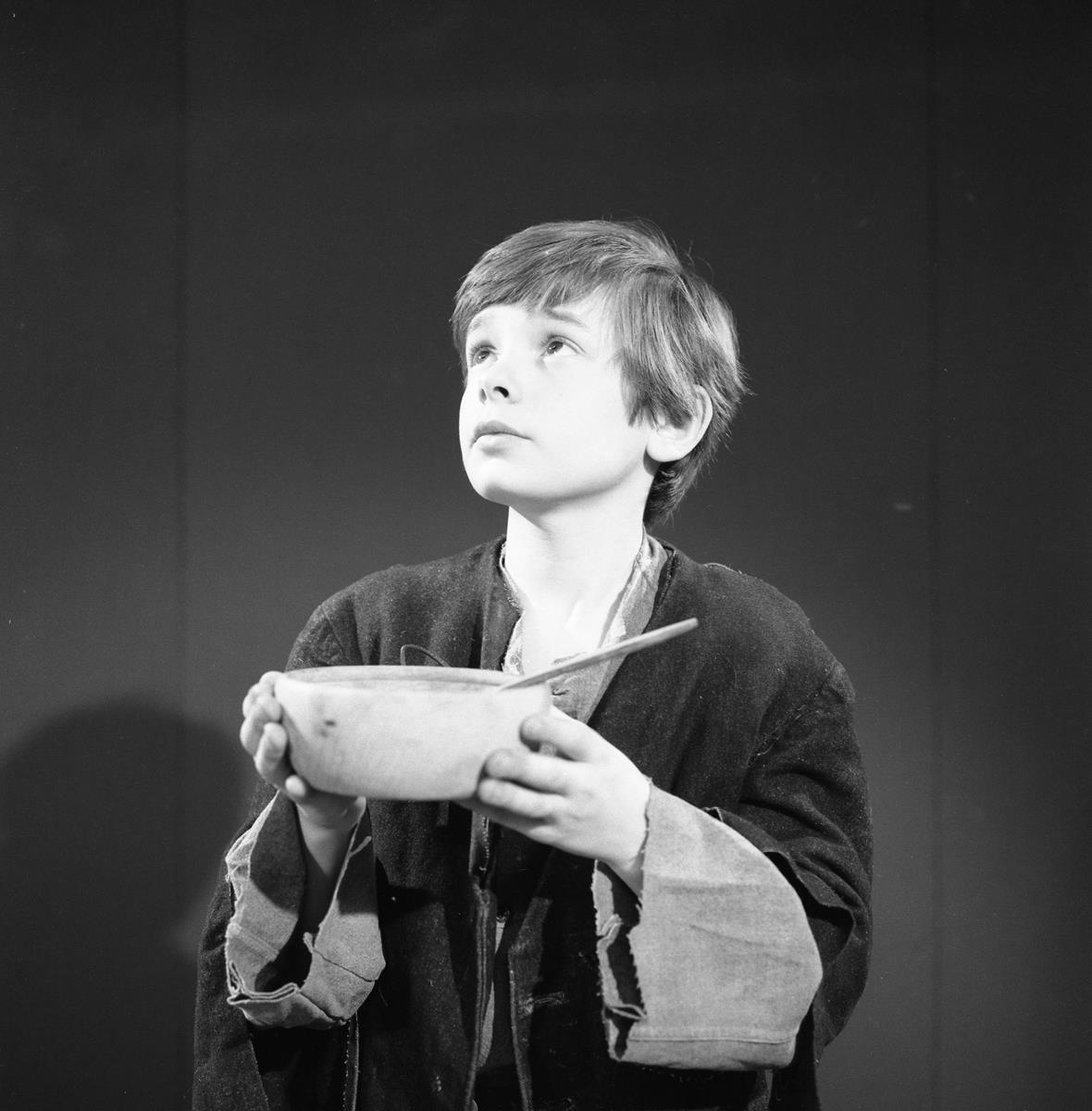
An early signature moment occurs when Olivier, by this point a starving inmate of the workhouse, timorously asks for another bowl of gruel. There’s a grimy hopelessness about these early episodes. Workhouse life is shown to be hard and unrelenting (with a piece of bread, once a week on Sundays, about the only thing the boys have to look forward to).
Bruce Prochnik
Mr Bumble (Willoughby Goddard), the Parish Beadle, is shocked by Oliver’s behaviour. It’s hard to imagine anybody could have been better cast as Bumble than the corpulant Goddard, who’s always a pleasure to watch.
Olivier’s insurrectionist behaviour makes him an embarrasment to the workhouse board, so they decide to remove the problem. He’s apprenticed to the undertaker Sowerberry (Donald Eccles), although it’s debatable whether he’s better off here than he was in the workhouse. Mrs Sowerberry (Barbara Hicks) certainly has little time for the boy (Oliver’s first meal are the cold scraps which had been left out for the dog). Hicks, who had gone way over the top in Barnaby Rudge, is thankfully more restrained in her brief appearance here.
Once this section of the story is completed, the action moves to London where the innocent Olivier falls in with the worst crowd possible. Two very familiar actors (Melvyn Hayes and Alan Rothwell) appear as the Artful Dodger and his wise-cracking sidekick Charley Bates. Both Hayes and Rothwell make for appealing rogues, although their roles in the story are fairly slight.
It’s the grotesque Fagin (Max Adrian) and the intimidating Bill Sikes (Peter Vaughan) who will come to dominate the narrative. Adrian was a noted classical stage actor who also managed to carve out an impressive film and television career. Across the decades Peter Vaughan would rack up some memorable appearances in Charles Dickens serials and his portrayal of Bill Sikes is a typically impressive one – from the moment we first meet him there’s an air of menace and simmering violence in the air.
The corruption of the green Oliver (Prochnik continues to radiate a sense of wide-eyed innocence) by Fagin, Dodger and Charley is another horrifying and distubing scene. Far removed from the chirpy cockney sing-alongs of Oliver!, this adaptation accurately reflects the bleakness of Dickens’ original novel.
Max Adrian & Bruce Prochnik
As the serial progreases, the plot-threads deepen. Why does a gentleman like Monks (John Carson) consort with the likes of Fagin and why is Monks so insistent that Fagin keeps a tight grip on Oliver? Carson, later to take the lead in Dombey & Son, was one of those actors who enhanced any production he appeared in (his tortured, conflicted Monks is no exception to this rule).
Everybody we’ve met so far has either mistreated Oliver or desired to use him for their own ends, so it’s therefore jolting when he finally runs into somebody who treats him with kindness. Mr Brownlow (George Curzon) initially accused the blameless Oliver of picking his pocket (Dodger and Charley were responsible). The contrite Brownlow takes him home and nurses the emaciated boy back to health.
Now that Oliver has a benevolent benefactor, his luck finally seems to have changed. But Fagin and Sikes, convinced that Oliver intends to inform on them, are determined to snatch him back ….
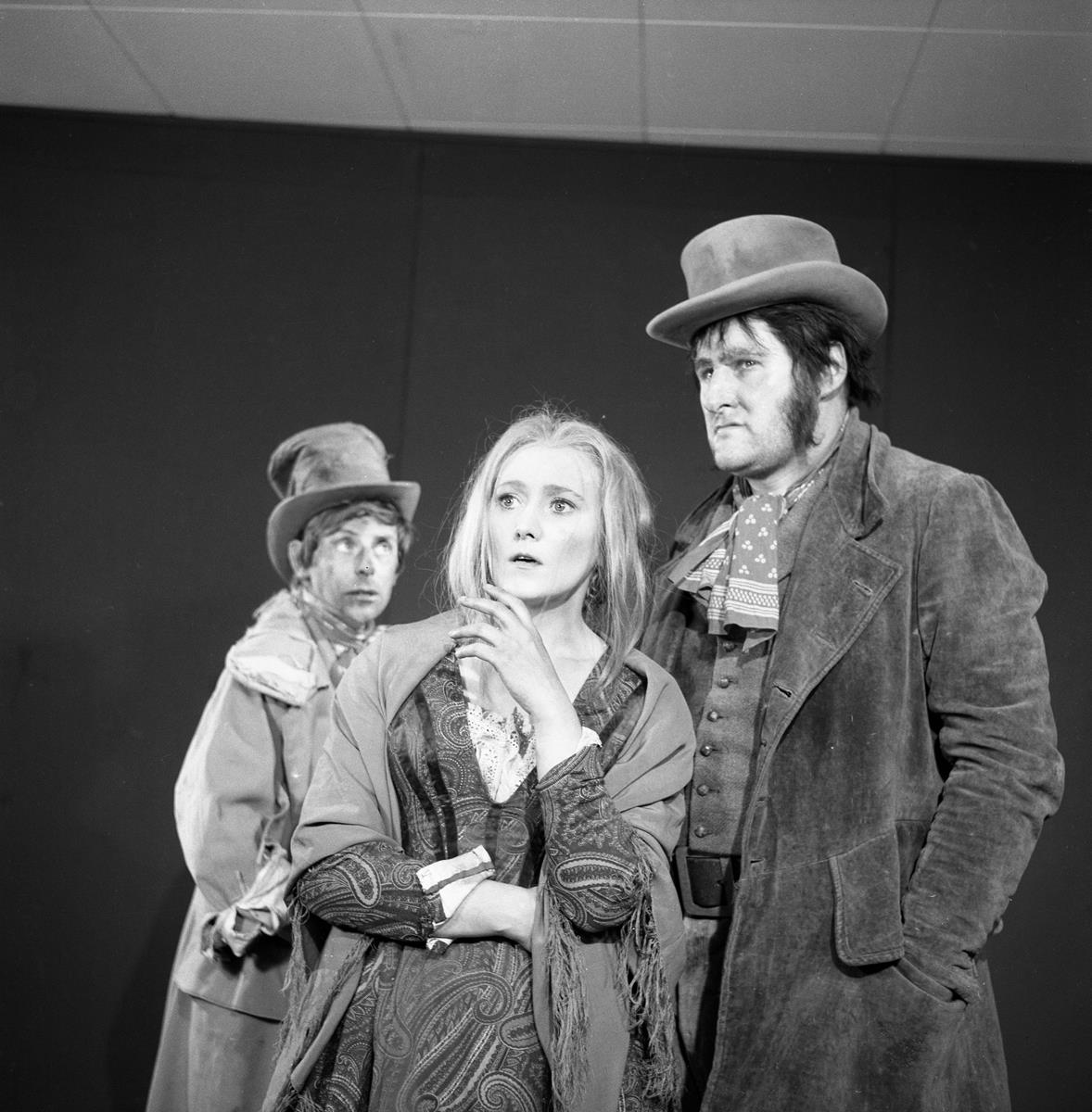
Bill Sikes’ relationship with the prostitute Nancy (Carmel McSharry) runs through the middle part of the serial with Nancy’s most famous scene – her murder at the hands of a vicious Sikes – proving to be a shocking moment. Although it’s not graphically violent, Vaughan and McSharry manage to give the scene considerable resonance by their performances alone. Sikes’ clubbing to death of the unfortunate Nancy was deemed to be so disturbing that it was later edited down before the serial was offered for sale (the prints we have here were recovered from overseas, hence the reason why they’re slightly edited at this point).
Poor Olivier is again ensnared in Fagin’s web of crime although it’s not too long before he finds himself free once more. It slightly stretches credibility that Olivier would stumble across another well-to-do family who elect to take him in, although this sort of plotting (and remarkable coincidences regarding Olivier’s parentage) are par for the course with early Dickens.
The production – as with the other Dickens serials recently released by Simply – is very studio-based. Photographic blow-ups of buildings are used to give a sense of depth (these work pretty well, although there’s no doubt that on the lower-definition television sets of the 1960’s the illusion would have been even more convincing). Sound-effects are utilized to generate a sense of hustle and bustle whilst Ron Grainer’s incidental music is used sparingly at key moments.
If Bruce Prochnik begins to irritate after a while (his Olivier is rather squeaky and a little too clean-cut) then there’s substantial acting compensations to be found elsewhere. Apart from those already mentioned, Peggy Thorpe-Bates and the always entertaining William Mervyn help to enliven proceedings.
The telerecordings were restored by Peter Crocker at SVS (Crocker, well known in archive television circles for his work on the Doctor Who DVDs, is the very definition of a safe pair of hands). VidFIRE seemed to be out of the question (presumably because the telerecordings weren’t of a sufficient standard) but the restoration helps to make the serial a more pleasant viewing experience than it would have been before.
Whilst there’s numerous adaptations of Olivier Twist to choose from, this one – thanks to the fidelity it displays to Dickens’ original novel and the performances (especially Peter Vaughan’s rampaging Bill Sikes) – is certainly worth checking out. Recommended.
Olivier Twist is available now from Simply Media, RRP £19.99. It can be ordered directly from Simply here.
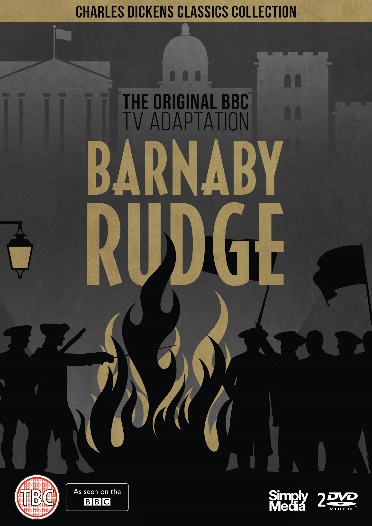
Barnaby Rudge was the first of Charles Dickens’ two historical novels (the other being The Tale of Two Cities). Set during the late eighteenth century, it climaxed at the Gordon Riots of 1780. Largely forgotten today, the Gordon Riots were an anti-Catholic protest which quickly spiralled out of control. A group of between 40,000 and 60,000 protestors nursing various grievances – including the increasing Catholic influence sweeping the country, high taxes, overcrowded cities and repressive laws – ran amok on the streets of London. The riots raged on for several days until the army were eventually able to brutally restore order. But by this point some 285 people had been shot dead with several hundred more wounded.
If the Gordon Riots are forgotten today, then a similar fate has befallen Barnaby Rudge. Easily Dickens’ most obscure novel, this is evidenced by the fact that this 1960 serial remains the only television adaptation. Published between February and November 1841, it came quite early in his career – which explains why it feels a little episodic and unfocused at times.
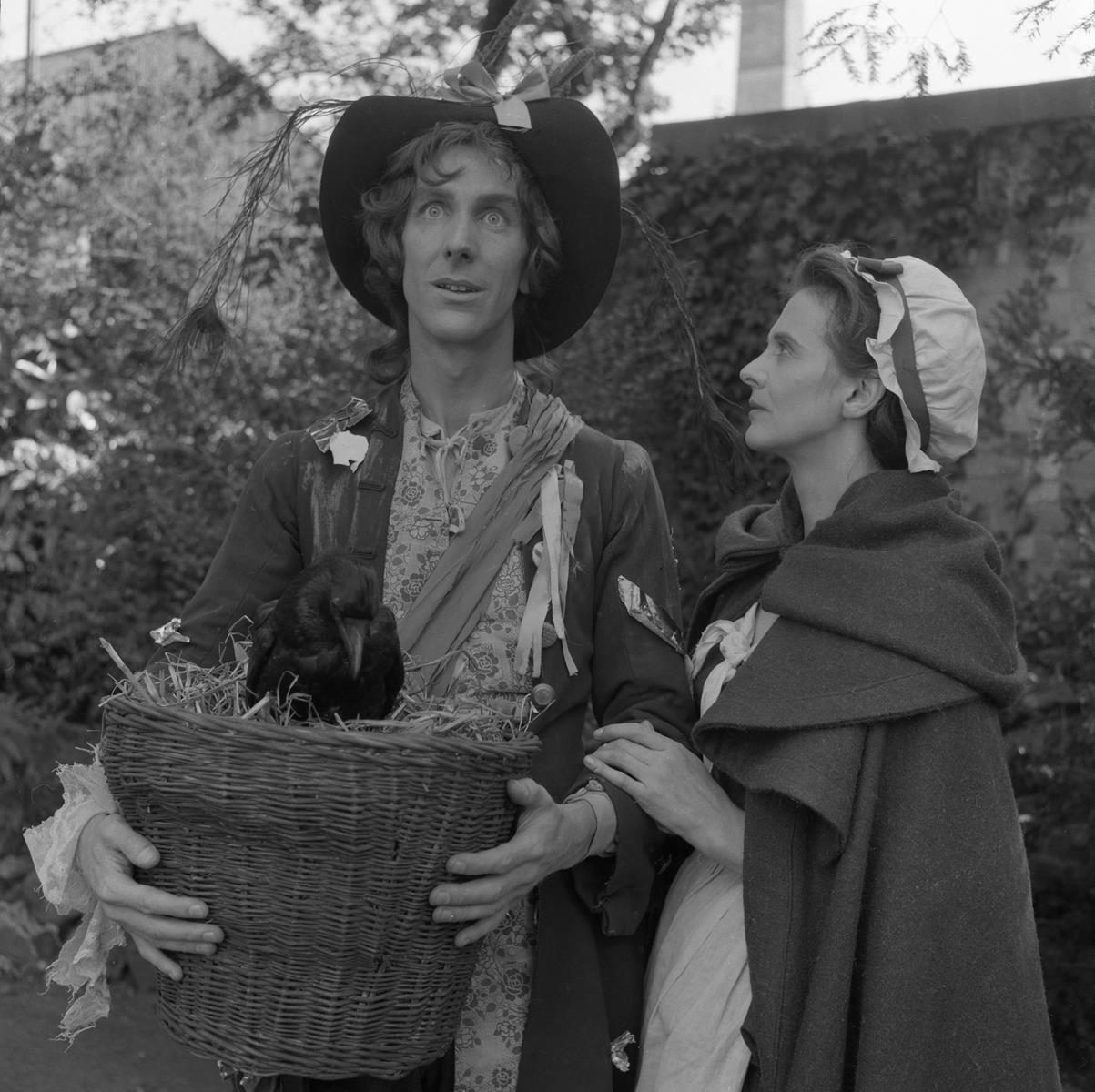
Barnaby Rudge himself (played by John Wood) is a simple-minded chap, buffeted along by events rather than directly influencing them. It’s a difficult part to play – there’s no malice in Barnaby – but Wood is generally pretty effective as the easily-manipulated innocent. But whilst he may be the title character he’s not the central one – Barnaby drifts in and out of the narrative, appearing and disappearing as required.
John Wood & Isabel Dean
Episode one opens with a stranger (played by Nigel Arkwright) asking the local innkeeper about the nearby grand house owned by Geoffrey Haredale (Peter Williams). It’s a dark and stormy night outside – achieved via sound effects and camera trickery (simple but effective).
Arthur Brough, later best known as Mr Grainger in Are You Being Served?, here plays John Willet, the innkeeper. Puffing on a long pipe he helps to tease out a strange story which much will later become significant. The mysterious murders twenty two years ago of Geoffrey’s brother, Reuben, and Reuben’s loyal servant Rudge (Barnaby’s father) are mysteries which are still debated by the locals to this day.
Arkwright doesn’t offer a subtle performance, but it’s a menacing one as he brings out the simmering violence which powers his character. Joan Hickson, as Mrs Varden, also isn’t holding back, but this broad playing suits the shrewish character she plays.
The remainder of the Varden household are also deftly sketched out. Head of the household, Gabriel (Newton Blick), is an affable sort who’s often to be found allied with his attractive young daughter Dolly (Jennifer Daniel) against their wife and mother.
Rellgious dogma will later become the central theme of the story, although to begin with it’s teased out in a casual manner – Mrs Varden’s constant quoting from the bible or the way that John Chester (Raymond Huntley) regards Emma Haredale (Eira Heath) as an unsuitable wife for his son due to her religion – but as the serial progresses the conflict between Catholics and Protestants will become more marked. Huntley, playing to type as the austere and flinty Chester, offers a standout performance. Some others may essay broad, comic performances during the serial, but Huntley is agreeably more naturalistic.
Gabriel Varden, a locksmith by trade, has an apprentice, Simon Tappertit (Timothy Bateson), who has set his cap at Dolly (although she regards him with casual indifference). As in Bleak House, Bateson delivers a lovely comic performance, although there’s a harder edge to this character. Like many others, he possesses a simmering discontent (although with him it’s not relgious concerns, instead his ire is directed towards those he regards as his wealthy oppressors).
As the first half of the serial progresses, various plotlines are developed. Simon’s links with a group of dissident apprentices who meet in secret and dream of violent disobedience against their oppressive masters, the curious link between Barnaby’s mother and the mysterious stranger, Joe Willit’s (Alan Haywood) longing for the flitish Dolly and the forbidden love between Edward Chester (Bernard Brown) and Emma Haredale are all teased out.
Eira Heath & Jennifer Daniel
Mid way through the serial, several major new characters – such as anti-Catholic agitator Lord George Gordon (Anthony Sharp) – are introduced as we proceed on the path to the Gordon Riots. Gordon is a fanatic, whose cry of “No Popery” quickly becomes a popular sentiment amongst the masses.
Geoffrey Haredale, a staunch Catholic, spells out what precisely what these two simple words could mean. “I have, tonight, seen an ignorant and unhappy people roused. They know nothing of what the repeal of the act means, but ‘No Popery’ is the cry that is going to right all their wrongs. ‘No Popery’ is the cry that is going to give them food, shelter, clothes, work and drink”.
Those who cannot remember the past are condemned to repeat it …..
The production design is very sound. Real horses (never easy to control in a studio) occasionally appear and the outside of Geoffrey Haredale’s house is depicted via a painted backdrop. This is a very theatrical way of generating a sense of depth and scale, but it works. More backdrops are in evidence when the action moves to the streets of London, whilst the later episodes are also opened out thanks to a judicious use of filmed inserts. Unsurprisingly, the scale of the riots was far beyond the means of the production, but director Morris Barry marshalled his resources well. Even with the limited number of extras at his disposal, Barry was effectively able to show the ugliness of mob violence.
It’s fair to say that some parts of the story work better than others. Edward and Emma’s romance never really sparks into life – not really the fault of the actors though, it’s simply that the two characters are never sharply defined. Barbara Hicks, as the Varden’s maid Miggs, gives a performance that can best be described as “broad”. It’s a typically comic Dickens character, but Hicks’ shrieking does become wearying after a while.
But on the credit side there are many fine performances, most notably that of Raymond Huntley. His timing is spot-on (plus his brief interactions with Timothy Bateson and Joan Hickson are rather delightful).
The introduction of Lord George Gordon is the point at which the story rapidly changes direction. This is a little jarring, but the influx of new characters does help to give the serial a fresh impetus. One notable new arrival is Esmond Knight (previously he had memorably played Silas Wegg in Our Mutual Friend) . Here he appears as Dennis the Hangman, one of a number of individuals who encapsulate the baser end of society.
Like other surviving drama of this era, the source materials are telerecordings taken from the original 405 line broadcasts. The recordings may exhibit the occasional spot of damage or dirt, but overall the picture quality is more than watchable (although the concluding episode is notably poorer than the others).
Although a handful of performances are less than effective and the story feels somewhat disjointed (it’s essentially two seperate tales bolted together) Barnaby Rudge is still a serial of considerable interest. The theme of the later episodes feels eerily topical, offering a sharp change of pace from the countryside intrigues of the first half. It’s another well-crafted Classic Serial which, despite its length, never outstays its welcome. Well worth adding to your collection.
Barnaby Rudge is available now from Simply Media, RRP £19.99. It can be ordered directly from Simply here.
Richard Carstone and Ada Clare (Colin Jeavons and Elizabeth Shepherd) are two young wards of court, enmeshed in a seemingly unending court case – that of Jarndyce and Jarndyce. John Jarndyce (Andrew Cruickshank) also has an interest in it and despite being on the opposing side to Richard and Ada is happy to take custody of them both.
So Richard and Ada, along with Ada’s companion Esther Summerson (Diana Fairfax), take up their residence at Jarndyce’s country home, Bleak House. Others, such as the nearby Lady Dedlock (Iris Russell), are also connected to Jarndyce and Jarndyce, but that isn’t the reason why the arrival of Richard, Ada and Esther impacts so dramatically on her hitherto quiet life ….
Originally published between March 1852 and September 1853, Bleak House is a typically sprawling work by Dickens, notable for the way it switches between first and third person narration.
It has been tackled three times for television, with two further adaptations (in 1985 and 2005) following this one. Both of the later adaptations are, in their different ways, of interest. The 1985 Bleak House was one of the earliest BBC Dickens productions to be made entirely on film – this glossy production style would quickly become a standard production model, signalling the death knell for the old-style videotaped Classic Serial productions which until then had been a staple of the schedules for decades.
When Bleak House next hit the screens, via Andrew Davies’ adaptation in 2005, it was hailed as innovative – due to its half-hour twice-weekly scheduling which, according to the critics, gave it a soap-like feel as well as simulating the partwork feel of Dickens’ originals. Presumably these critics must have been unaware that the running time for the Classic Serials, broadcast between the 1950’s and the 1980’s, also tended to be half an hour …
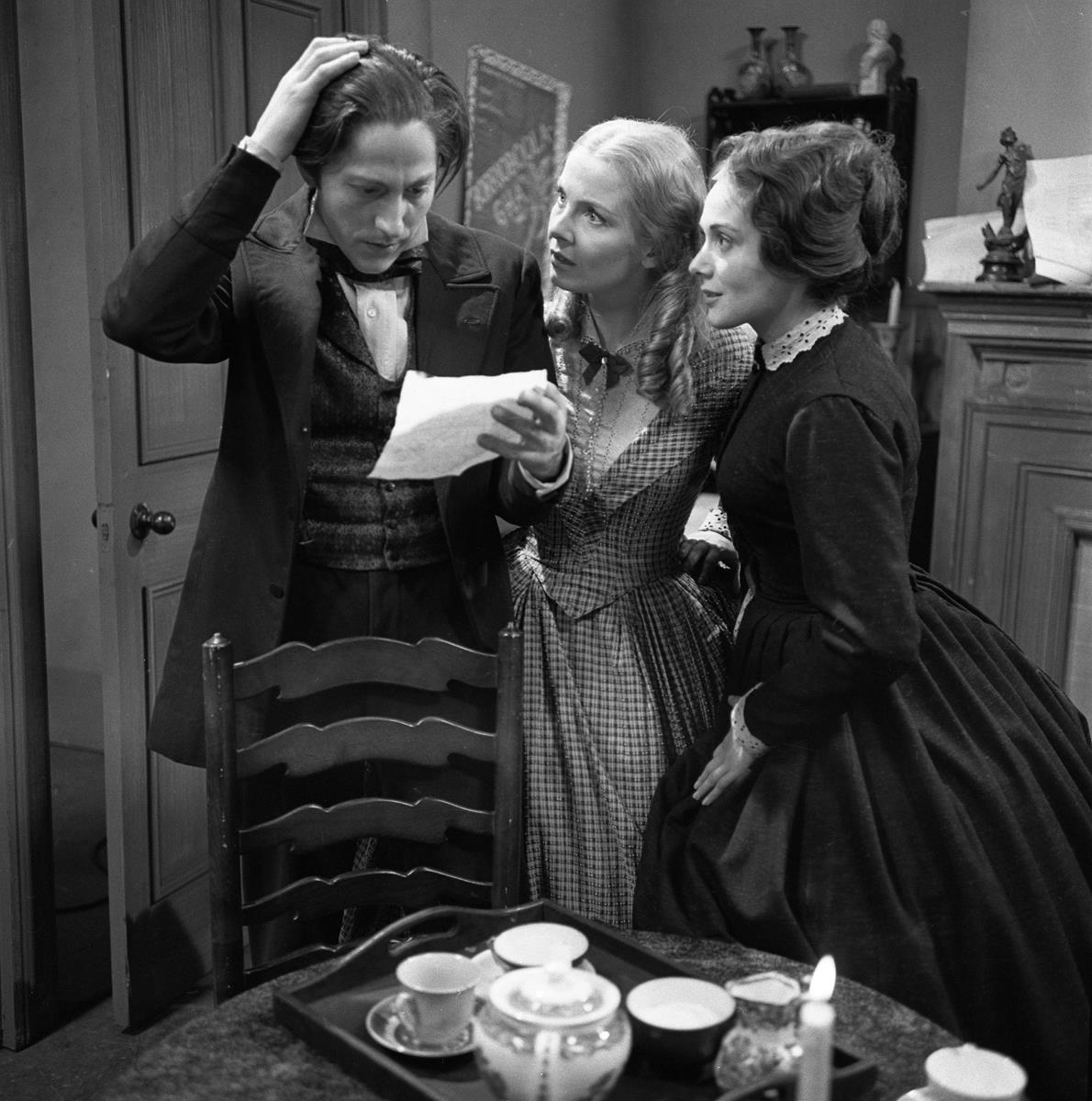
Elizabeth Shepherd, Diana Fairfax and Colin Jeavons
It’s unfortunate that, despite a lengthy career, Elizabeth Shepherd seems fated to be remembered for the part that got away – that of Emma Peel in The Avengers. Despite having already filmed some material for her first episode, for whatever reason it was quickly decided to dispense with her services and Diana Rigg was hastily drafted in. Although Ada is the least developed of the main roles, Shepherd still acquits herself well. Ada’s a sweet, uncomplicated girl, with none of the subconscious dark secrets that trouble Esther.
At this point in his career, aged thirty, Colin Jeavons was no stranger to either television or Charles Dickens. He’d played Herbert Pocket in Great Expectations (also 1959) and the same year had also appeared as Henry V in The Life and Death of Sir John Falstaff. Jeavons made a career out of playing slightly off-key characters and although Richard seems at first to be quite level-headed, there’s still a faint air of instability about him – something which Jeavons is well able to tease out as the serial progresses. Richard is a young man with a bright future, but it’s precisely what that future will be which proves to be the problem.
Diana Fairfax was also no stranger to classic serials. Prior to Bleak House she’d appeared in The Diary of Samuel Pepys whilst the next year, 1960, would see her perform in both Emma and Kipps. Esther is the moral centre of the story, although it takes some time for her importance to become obvious (to begin with, she appears to be little more than Ada’s loyal companion).
Andrew Cruickshank might have been a few years away from his defining role – that of the curmudgeonly, but kindly Dr Cameron in Dr Finlay’s Casebook – but he’d been a familiar face on both the big and small screen since the late 1930’s. Cruickshank is excellent as John Jarndyce – a lonely man who delights that his house has been brought back to life by the influx of three young people.
Andrew Cruickshank
As is usual, Dickens created a rogues gallery of supporting players – all of whom are gifts for any decent actor. Timothy Bateson appeals as Mr Guppy, a young solicitor with an unrequited love for Esther. This is obvious from their first meeting when he appreciates her fresh-faced country look (“no offence”). Bateson’s comic timing is given full reign here.
It’s always a pleasure to see Michael Aldridge (playing Mr George) whilst another very dependable character actor, Jerome Willis, also enlivens proceedings as Allan Woodcourt. Nora Nicholson offers us a vivid portrait as Miss Flyte – an elderly woman now more than a little deranged from her own endless court case (if Richard and Ada pursue the case of Jarndyce and Jarndyce, will they end up like her?)
He may not be on screen for too long, but Wilfred Brambell sketches an appealing cameo as the grasping Krook. Brambell had also made a memorable appearance in the previous BBC Dickens, Our Mutual Friend, and wasn’t the only actor to have appeared in both serials. Richard Pearson and William Mervyn also have that honour, with Pearson – here playing the dogged Inspector Bucket – also catching the eye.
Tulkinghorn, the oppressive lawyer who digs into Lady Deadlock’s long-buried secret is another key character. John Phillips doesn’t have Peter Vaughan’s menacing screen presence (Vaughan played Tulkinghorn in the 1985 adaptation) instead he essays a sense of remorseless blankness, which works just as well.
As might be expected, the serial is pretty much studio bound with the occasional brief film insert. The telerecordings are slightly muddy, but no worse than other examples from the same period. And while the prints may exhibit occasional damage there’s nothing too dramatic – meaning that the serial is more than watchable.
Lacking the visual sweep of the later adaptations, this version of Bleak House has to stand or fall on the quality of its actors. Luckily, there’s very little to complain about here. There are some fine central performances – Fairfax, Cruickshank and Jeavons especially – whilst, as touched upon earlier, there’s strength in depth from the supporting players with Timothy Bateson standing out.
Another strong early BBC Dickens serial, Bleak House comes warmly recommended.
Bleak House is released by Simply Media today. RRP £19.99. It can be ordered directly from Simply here.
Paul Dombey’s (John Carson) fondest wish is for a son to carry on his thriving business. As the story opens, his wife duly delivers a baby boy who is swiftly named Paul after his doting father. Although Mrs Dombey dies shortly afterwards, this seems to have a negligible impact on Dombey as his son quickly becomes the centre of his life (with the result that his daughter Florence is pushed even more into the background).
When young Paul dies at the age of six, Dombey Snr is devastated. Florence attempts to comfort him but he continues to rebuff her, which eventually leads to a seemingly irrevocable split between father and daughter ….
Originally published in nineteen monthly instalments between October 1846 and April 1848, Dombey & Son, despite being regarded by many as one of Dickens’ best works, has generated surprisingly few film or television adaptations. In the cinema, a 1917 British silent film and a very loose 1931 adaptation (which was renamed Rich Man’s Folly and saw the action transferred to the United States) are the only examples. On television there have been just two English-language versions – this one and a later BBC Classic Serial adaptation in 1983.
The first episode quickly defines Dombey’s character. He’s a proud, dignified and extremely humourless man who treats his young daughter, Florence (played to begin with by Vicky Williams and later by Kara Wilson), with at best indifference and at worst contempt. John Carson, an actor who was seemingly incapable of giving a bad performance, impresses right from the start. Unbending as Dombey might be, Carson doesn’t play him as simply a monster, instead he offers a much more nuanced performance.
John Carson
Although Dombey is something of a dull fellow, as compensation there’s a number of sparkling comic performances sprinkled throughout the thirteen episodes. Two sitcom favourites – Hilda Braid and Pat Coombs – form a wonderful double-act as Louisa Chick and Lucretia Tox. Louisa (Braid) is Dombey’s sister, a woman who shares her brother’s low opinion of Florence whilst Lucretia (Coombs) is her friend, a somewhat simpleminded person who simpers delightfully over Dombey and harbours a hopeless secret desire to become the next Mrs Dombey.
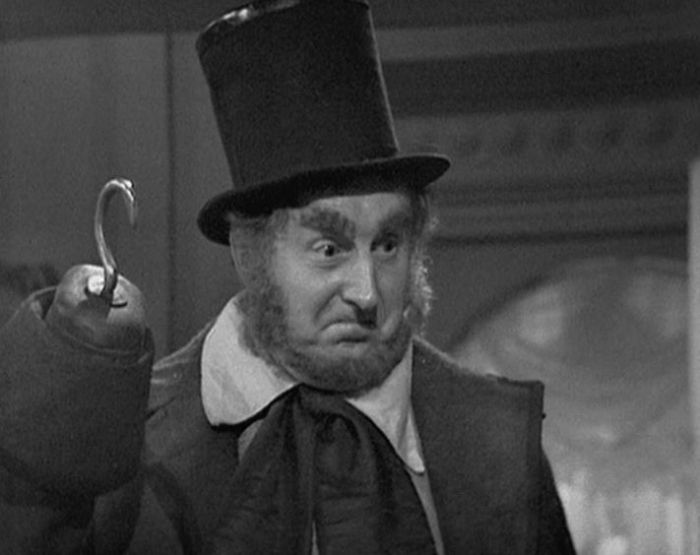
William Moore, another actor probably best known for his sitcom work (for example, the long-suffering Mr Lumsden in Sorry!) is padded up as the hearty seadog Captain Cuttle. Complete with a hook for a hand, Moore gives an unsubtle, but highly entertaining performance.
The first meeting between Dombey and Cuttle is an absolute gem. Dombey, taking afternoon refreshment with Paul and Florence in a Brighton tearoom (young Paul has been sent to the coast in the hope that the sea air will restore his failing health), is appalled when the colourful Captain Cuttle sidles over to his table. Cuttle is introduced to Domby by Walter Gay (Derek Seaton), one of Dombey’s clerks. The best moment of all is when Walter first mentions Cuttle’s name and the Captain raises his arm (the one with the hook, naturally) in response. Lovely!
William Moore
Vicky Williams, as young Florence, doesn’t have a great deal of screentime (Kara Wilson would take over the role by the middle of the second episode) but she still makes an impression. The scenes where she’s lost in the city after being robbed of her clothes by an old crone, Mrs Brown (Fay Compton), are heartbreaking. Equally affecting is Ronald Pickering as young Paul. When Paul asks Dombey (in response to being told that money can buy anything) whether it can buy good health, his father is temporarily speechless.
When Dombey decides to send his young clerk, Walter, to the West Indies, it’s a story-beat which intrigues on several levels. Firstly, it’s another example of the way that Dombey cares little for other people (apart, of course, from his son) since it never seems to cross his mind to canvas Walter’s opinion first. Secondly, since Walter has shown interest in Florence, dispatching him abroad serves to sever their tentative relationship. Considering that he seems to care little for his daughters happiness, this appears to be an act of deliberate cruelty.
The fourth episode tugs at the heartstrings as young Paul begins to fade. His death is an understated moment – the camera moves away from his bed to focus on the window as the sound level reduces. The next scene, as Dombey stands by his son’s grave, is a sharp and jolting cut, but it works well.
Christopher Sandford as Mr Toots helps to lighten the mood following Paul’s funeral. Mr Toots, a former schoolfriend of Paul, is a kind-hearted, vague and twitchy young man who loves Florence dearly (but although she always treats him kindly it’s plain that she doesn’t feel the same way). But the ever-optimistic Mr Toots is never downhearted and can always be guaranteed to come bouncing back. Sandford provides a delightful comic performance in a serial which has an abundance of them.
Towards the end of this episode there’s the first hint that Dombey isn’t quite as unbending as he might appear. He decides not to send Walter to the West Indies after all, but it’s too late – his ship has already sailed, much to Florence’s anguish (which only increases when the vessel is feared to have been lost at sea). Kara Wilson, as befits the character she plays, may be somewhat placed in the background but she still essays a subtle performance as a young woman constantly rebuffed by a father who finds it impossible to communicate with her on anything but the most rudimentary level.
Kara Wilson
Clive Swift is yet another quality addition to the cast. He plays the bluff and hearty Major Bagstock, who seems to be Dombey’s only friend. The restrained Dombey and the ebullient Bagstock would seem to have little in common, but it’s their very differences which help to generate an entertaining spark between them.
The middle part of the serial sees Dombey remarry. He selects Edith Granger (Sally Home) who seems in every way to be an ideal choice – as she’s a skilled artist and musician as well as being a refined conversationalist. Nestling amongst some deliciously broad comic performances, Home offers a sharp contrast as the second Mrs Dombey.
Although she accepts Dombey’s proposal, it’s plain that – on her side at least – it’s not a love match. Manipulated by her mother from an early age (in order to ensnare a rich husband) Edith is a weary and embittered figure. But the one bright spark in her new life is her relationship with Florence.
Whilst some children might regard a new step-mother with mistrust, Florence is plainly overjoyed – partly because she hopes it will enable her father to find new happiness but also because there’s no doubt that her lonely existence would be enriched by a mothers love. The way that Florence instantly refers to Edith as Mama is touching (Kara Wilson is excellent again here).
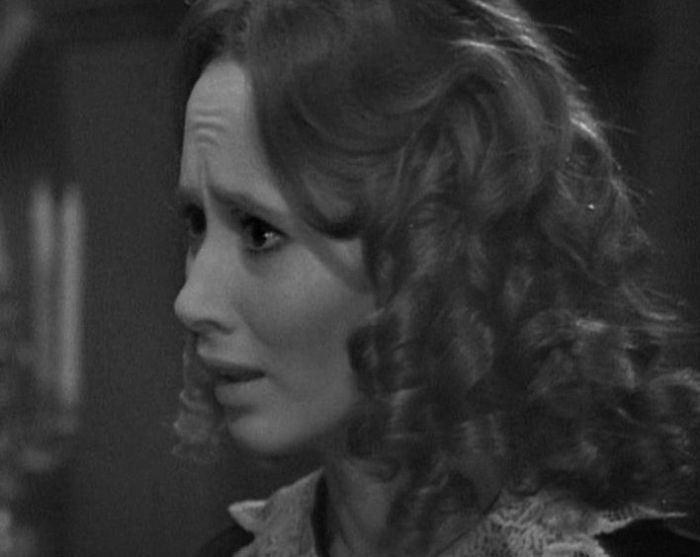
Sally Home
But any happiness that Dombey might have hoped for is short-lived, as Edith runs away with the slimy and manipulative Caker (Gary Raymond). Dombey, with the assistance of Alice Brown (also played by Sally Home) and her mother (who coincidently robbed the young Florence earlier in the serial) vows to track them down.
Gary Raymond seems to delight in playing the boo-hiss villain who, as tradition demands, meets a sticky end. And although Home plays both roles well, it probably would have been better had another actress played Alice (a woman who had a special cause to dislike Caker). This is mainly because it’s more than a little odd that no-one who ever meets Alice comments on her remarkably strong resemblance to Edith ….
Edith’s departure finally severs the already fraying relationship between Dombey and Florence. Whilst a distraught Florence is taken under Captain Cuttle’s wing (William Moore once again marvellous value at this point in the serial) Dombey faces severe business traumas due to Caker’s rash profiteering. And as Dombey’s own health takes a turn for the worse, a now happily-married Florence attempts one final reconciliation. Will the patrician Dombey deign to acknowledge his daughter and her children?
Runnng for thirteen 25 minute episodes, Hugh Leonard’s adaptation manages to skillfully fillet Dickens’ novel and thereby retain everything of interest. A fine rogues gallery of comic performers – headed by the peerless William Moore as Captain Cuttle – helps to keep things ticking along nicely although the family drama between Dombey and Florence is never overshadowed. In general, performances across the serial are very strong although Douglas Mann as young Rob Toodle does overact somewhat (luckily his part isn’t a particularly large one).
Director Joan Craft had already helmed a number of Charles Dickens adaptations, although the survival rate of her serials is sadly quite low. Both The Old Curiosity Shop (featuring Patrick Troughton as Quilp – his favourite role) and Martin Chuzzlewit are completely missing although odd episodes from A Tale of Two Cities and David Copperfield do exist. More encouragingly, her 1968 version of Nicholas Nickleby remains in the archives, so hopefully a release from Simply might occur in the future.
Her directorial style isn’t dramatic or showy (there’s few of the flourishes that can be seen in Alan Bridges’ Great Expectations) but she still manages to ensure that the story unfolds at a decent pace. The production style is as you’d expect from a programme of this era – mostly studio sequences recorded on videotape, with occassional brief film inserts.
The episodes are a mixture of telerecordings and original videotape masters. The episodes which still exist on videotape are obviously the best quality ones. although since the telerecordings are also of a very high standard the jump between the different formats isn’t as great as it could have been. Overall, the picture quality (considering the unrestored nature of the source materials) is very good. The sound is generally clear although some of the telerecorded episodes (episode eleven especially) are somewhat crackly in places.
Thanks to the first-class cast who rarely put a foot wrong, Dombey & Son is another impressive Dickens adaptation. Highly recommended.
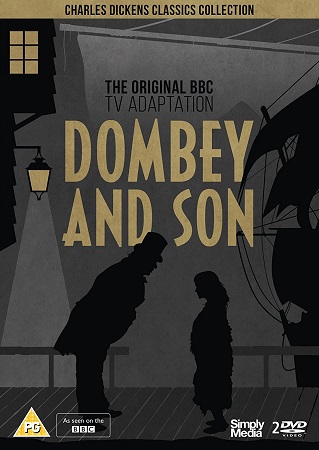
Dombey & Son is released by Simply Media on the 3rd of July 2017. RRP £19.99. It can be ordered directly from Simply here.
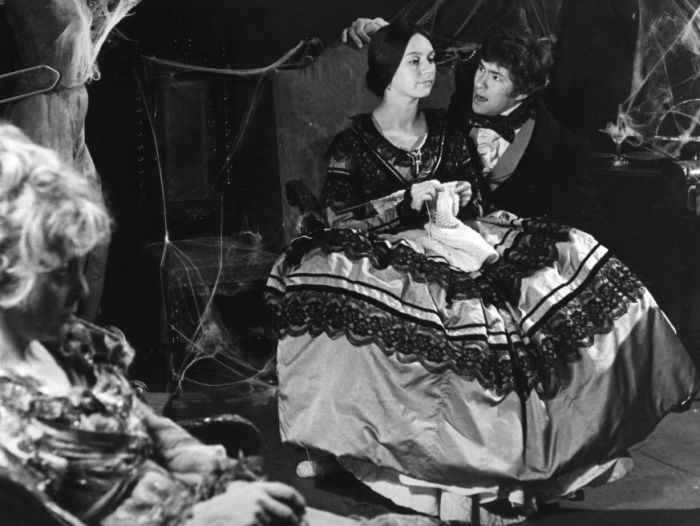
When young Phillip Pirrip, nicknamed Pip, meets a strange, reclusive lady called Miss Haversham (Maxine Audley) it opens up a new world of possibilities. Miss Haversham’s ward, the beautiful Estella (Francesca Annis), bewitches him from the first time they meet, although she is unable to return his love.
As the years pass by and the boy grows into a man, Pip learns that he has “great expectations” and will shortly come into the possession of a handsome property. Since his most heartfelt desire is to become a gentleman (only then, he believes, will he be able to win Estella’s heart) it seems like a dream come true.
So he moves to London and at first all seems well. But later he receives a shock – his anonymous benefactor turns out not to be Miss Haversham after all, but a convict named Magwitch (John Tate) ….
Originally published across 1860/61, Great Expectations was Charles Dickens’ penultimate completed novel (Our Mutual Friend and the incomplete The Mystery of Edwin Drood would follow). A popular success at the time of its original publication (unlike Our Mutual Friend, which received a much more muted reception) Great Expectations has proved to be one of Dickens’ most enduring works.
Its popularity can be judged by the number of film and television adaptations it has inspired. Great Expectations made its debut in the cinema all the way back in 1917, whilst on television the 1959 BBC adaptation, with Dinsdale Landen as Pip, was the earliest. Sadly, the 1959 Expectations is missing one of its thirteen episodes (episode eight) so it looks unlikely to be released on DVD. Some eight years after the BBC first tackled the novel they did so again – with this 1967 ten-part adaption by Hugh Leonard.
Since so much of the impact of Great Expectations comes from the travails of Pip, strong casting of the character is essential. Luckily this production managed the feat twice – Christopher Guard played the young Pip, whilst Gary Bond took over when he reached adulthood. Guard had already appeared as David Copperfield the previous year, so was clearly well versed in the world of Dickens. Bond had racked up a varied list of credits since his screen debut in 1962 (including a notable film appearance in Zulu as Private Cole).
The first episode opens with Pip’s graveyard encounter with Magwitch. It’s a sequence that required a certain amount of skill on the part of the vision mixer, due to the way it frequently cuts from film (establishing shots of Pip) to videotape (the studio dialogue between Pip and Magwitch) and then back to film again. It’s a pity that the entire scene wasn’t shot on film, but presumably this was a matter of cost. There’s more filmwork across the serial than there was in Our Mutual Friend, but the studio scenes still dominate.
John Tate & Christopher Guard
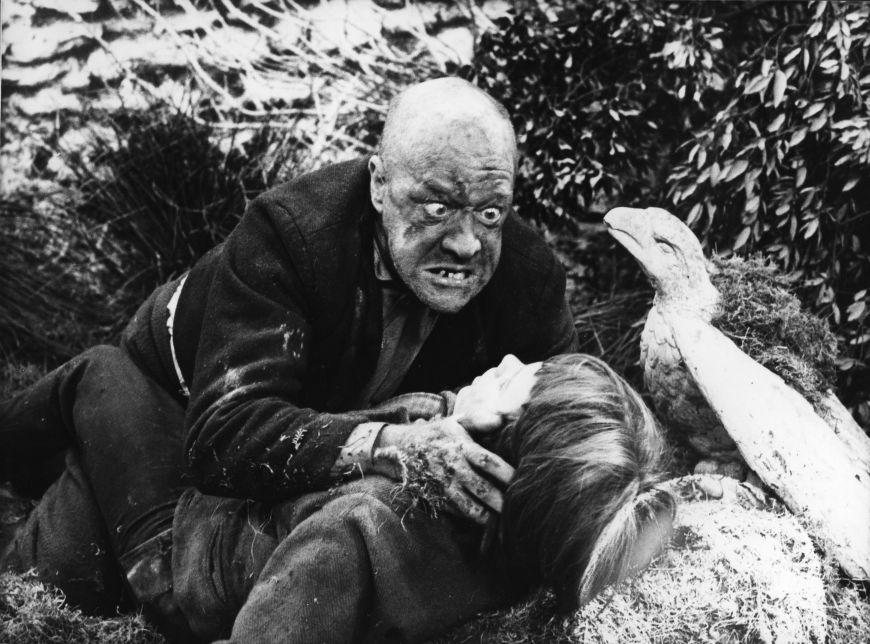
John Tate makes for a menacing Magwitch, although even in this intial scene there’s a feeling of conflict in his character. He might issue bloodcurdling threats against Pip, but he also holds him close in a way that almost seems to be tender. And when he’s later recaptured (Tate excellent again here, mudcaked and weary) he chooses not to mention that he forced Pip to fetch food for him.
Young Pip’s homelife is pretty grim. He’s abused by his sister (played by Shirley Cain) although her husband, Joe Gargery (Neil McCarthy), is a much more genial – if simple-minded – chap. McCarthy, like so many of the cast, impresses with a deftly sketched performance.
Sound effects and music are prominent right from the start. The music is dramatic (possibly over-dramatic at times) although the sound effects are more successful in creating mood and atmosphere. The constant wailing of the wind throughout the early episodes helps to create the impression that Pip lives in a cold, desolate and foreboding area. Visual signifiers – a rotting corpse hanging on a roadside gallows – reinforces this.
If Pip’s first meeting with Magwitch is a signature moment, then so too is his initial encounter with Miss Haversham. As Pip approaches her intimidating house the music swells and then abruptly cuts off as Pumblechook (Norman Scase) lays a hand on him. This could be intentional, although it seems more likely that it was a grams error.
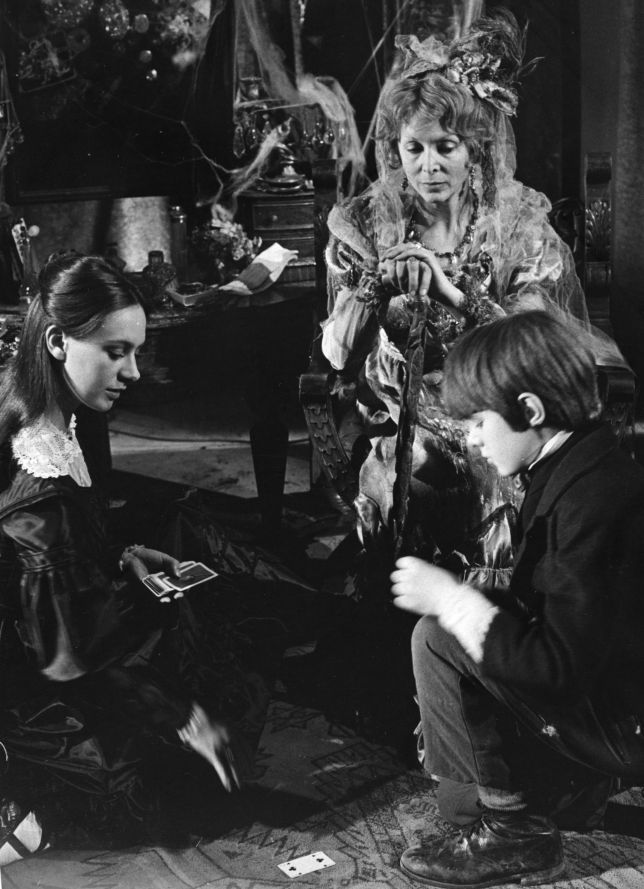
Whilst Maxine Audley’s Miss Haversham is muted to begin with, the meeting between her and Pip still has a uncomfortable, off-kilter feeling. Not least because of Francesca Annis’ cold and abusive Estella who treats Pip with the utmost contempt.
Francesca Annis, Maxine Audley & Christopher Guard
Christopher Guard gives a very internal performance as Pip. Since he’s only a young boy (and one you can imagine has beaten into obedience from a very early age) Pip is unable to talk back to his elders and betters. So Guard has to either suffer in silence or express his true feelings somewhat obliquely.
The third episode – Apprenticeship – sees the mantle of Pip pass from Christopher Guard to Gary Bond. It’s done in a visually striking way as we see Pip, apprenticed as a blacksmith to Joe, toiling in the forge. Overlaid smoke effects and mournful music create a weary mood as the camera moves down to focus on the metal he’s hammering. And when it moves back up, the boy has become a man (thereby not only solving the problem of how to move from one actor to another, but also neatly suggesting that Pip has spent years in a form of stasis – doing the same thing, day-in and day-out).
Great Expectations boasts many fine performances across its ten episodes. Ronald Lacey casts a menacing shadow as the drunken and violent Orlick (who, like Pip, starts off as an apprentice to Joe) whilst Hannah Gordon radiates honest goodness as Biddy, a maid who helps to keep Joe’s household together after Mrs Gargery is left insensible after a violent attack from an unknown assailant.
The always dependable Peter Vaughan has a nine line in icy disdain as Mr Jaggers, the solicitor who informs Pip of his great expectations. Bernard Hepton, another fine actor, plays Jaggers’ clerk, Wemmick, a much more approachable and amusing fellow. After they’ve become better acquainted, Wemmick takes Pip on a tour of his house – a wonderfully eccentric creation which features a drawbridge, waterwheel and a gun on the roof (which he fires every day at 9.00 pm). And all this in the heart of London!
Richard O’Sullivan is a pleasingly jaunty Herbert Pocket and sharply contrasts with a brooding Jon Laurimore as Bentley Dummle
Pip remains a curiously unlikable character for most of the serial. His desire to better himself and become a gentleman is generated purely by the hope it will win Estella’s approval (although given her utter indifference for him, he seems doomed to failure). Her mocking laughter at the end of the fifth episode – The Betrayal – shows that while Pip may have changed, she hasn’t. Unlike some of Dickens’ other novels, where you sensed that the author approved of and supported his hero, there’s a much icier feeling here as well as a deep sense of melancholy.
Maxine Audley, Francesca Annis & Gary Bond
The seventh episode – Pip’s Benefactor – helps to pivot the story into new and unexpected directions. The return of Magwitch is heralded by a brief burst of icy wind on the soundtrack (a nice, understated nod back to their initial graveyard meeting).
Pip’s horror that Magwitch is his benefactor is plain to see. Is it because Magwitch, although wealthy thanks to his efforts as a convict in Australia, is still somewhat uncouth? Or does it have more to do with the fact that transportation is a life sentence and so by returning to England, Magwitch faces certain death if he’s caught? Initially there’s no doubt that he’s somewhat repulsed by Magwitch but eventually he acknowledges the sacrifices the older man had made for him, which is a key moment (from this point on Pip becomes much less self-centered).
Alan Bridges peppers the ten episodes with some interesting directorial flourishes. Miss Haversham’s mausoleum of a house offers plenty of unusual camera angles whilst elsewhere (Mr Jaggers’ office, for example) the use of projected light helps to create striking shadows on the wall. Miss Haversham’s death in episode eight is another standout moment, although like Pip and Magwitch’s first meeting it’s puzzling that the scene (mostly shot on film) still has a few brief videotape inserts.
This adaptation of Great Expectations has no weak links on the performance front – Peter Vaughan, John Tate, Bernard Hepton, Richard O’Sullivan, Neil McCarthy, Francesca Annis and Maxine Audley are especially noteworthy – whilst both Pips, Christopher Guard and Gary Bond, acquit themselves well. Bond is especially impressive in the closing episodes as Pip faces one reversal of fortune after another, although they do help to deepen and strengthen his character.
The prints are of a pretty consistent quality throughout – there’s the occasional sign of dirt and damage, but given that the materials are some fifty years old that’s not too surprising. In general the picture is clear and watchable although there’s always a slight drop in quality during the film sequences (not surprising, due to the way that the film inserts would have been telecined in during the recording session).
Even with so many different adaptations of Great Expectations jostling for position, this 1967 serial – although it may lack the budget and scale of some of the others – is still worthy of attention. Tightly scripted and well acted, it’s a very solid production which still stands up well today. Warmly recommended.
Great Expectations is released by Simply Media on the 3rd of July 2017. RRP £19.99. It can be ordered directly from Simply here.
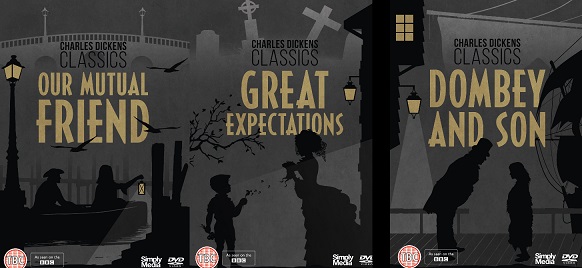
It’s very pleasing to see that a number of 1950’s/1960’s BBC Classic Serial adaptations of Charles Dickens’ novels are due shortly from Simply Media. Three have been confirmed for release on the 3rd of July 2007 – Our Mutual Friend, Great Expectations and Dombey & Son.
Below is a little more detail about them.
Our Mutual Friend. Adapted by Freda Lingstrom and broadcast in twelve episodes during 1958/59. Paul Daneman, Zena Walker, David McCallum, Richard Pearson, Rachel Roberts and Robert Leach head the cast, whilst many other familiar faces – Rachel Gurney, Peggy Thorpe-Bates, Wilfred Brambell, Melvyn Hayes and Barbara Lott – also appear.
Great Expectations. Adapted by Hugh Leonard and broadcast in ten episodes during 1967. Gary Bond, Francesca Annis, Neil McCarthy, Richard O’Sullivan, Peter Vaughan and Bernard Hepton are the major players in this one whilst there’s also plenty of quality to be found lower down the cast-list (Ronald Lacey, Jon Laurimore and Kevin Stoney amongst others).
Dombey & Son. Adapted by Hugh Leonard and broadcast in thirteen episodes during 1969. A typically strong cast is headed by John Carson as Mr Dombey with Clive Swift, Pat Coombs, Ronald Pickering and Davyd Harries amongst the other familiar faces appearing.
And with three further releases to come in late August – Barnaby Rudge (1960), Oliver Twist (1962) and Bleak House (1959) – the next few months look to be good for those who enjoy classic BBC B&W drama.
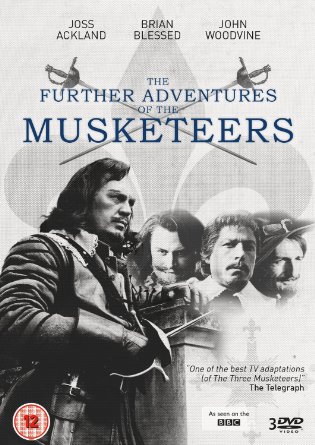
Broadcast between May and September 1967, The Further Adventures of the Musketeers (based on Dumas’ novel Twenty Years After) was a sixteen-part serial which followed on from the previous years adaptation of The Three Musketeers.
Brian Blessed and Jeremy Young returned as Porthos and Athos, but there were also two important changes. Joss Ackland took over the role of d’Artagnan from Jeremy Brett whilst John Woodvine replaced Gary Watson as Aramis.
I have to confess at not being terribly impressed with Brett’s performance as d’Artagnan, so I wasn’t too sorry he didn’t return – although it would have been intriguing to see how he would have handled the older, more cynical character seen in this story. In The Three Musketeers, d’Artagnan is young, keen and filled with dreams of heroism. It’s therefore more than a little jarring when Ackland’s d’Artagnan is introduced at the start of the first episode.
Others may continue to call him a hero, but he’s not convinced. Although he still holds a commission in the Musketeers, it now appears to be a hollow honour – especially since his three former steadfast friends (Porthos, Aramis and Athos) have all left and gone their separate ways. When he recalls their old battle cry (“one for all, and all for one”) it’s done so ironically and whilst he bursts onto the screen with an impressive bout of swordplay, it was only to subdue a drunk in a tavern. Brawling in taverns seems to be something of a comedown for the brave d’Artagnan, as he himself admits.
He’s therefore keen to grasp any opportunity to rekindle the glory days of old and when Queen Anne (Carole Potter) asks for his help, how can he refuse? Potter was something of a weak link during The Three Musketeers and her rather grating performance continues here. This may be a deliberate acting choice though, as we see over the course of the serial that the Queen is a far from admirable character – instead she’s capricious, vain and frequently misguided.
d’Artagnan pledges his allegiance to the Queen, her young son, King Louis XIV (Louis Selwyn) and Cardinal Mazarin (William Dexter). They are the orthodox ruling establishment, but the majority of the people seem to side with the imprisoned Prince de Beaufort (John Quentin).
The question of personal morality is key, especially when understanding which side the four Musketeers support. As we’ve seen, d’Artagnan supports the Cardinal and Queen, but is this because he believes they are the right choice for France or is it just that they’ve offered him a chance to redeem his tarnished honour?
When d’Artagnan meets up with Porthos, his former colleague quickly joins him. Blessed, a joy to watch throughout the serial, is never better than in his first scene. He’s the lonely lord of a manor, complaining that his neighbours consider him to be something of a peasant and won’t talk to him, even after he’s killed several of them! So he agrees to join d’Artagnan, mainly it seems because he’s always keen for a scrap.
But Aramis and Athos are both on the Prince’s side. They believe their cause is just and Athos regards d’Artagnan’s allegiance to the Cardinal with extreme disfavour. Athos supports the King, but in his opinion the Cardinal is manipulating both the King and the Queen to serve his own ends. It’s telling that d’Artagnan doesn’t deny this.
Joss Ackland, from his first appearance, is totally commanding as d’Artagnan. If Brett’s take on the role tended to see him play the character at a hysterical pitch then Ackland is much more restrained and therefore much better. As I’ve said, Brian Blessed is tremendous fun – he gets to shout a lot and has some great comic lines. John Woodvine, a favourite actor of mine, is excellent as Aramis whilst Jeremy Young once again impresses hugely as Athos.
Although there wasn’t a great deal of evidence of this in The Three Musketeers, at the start of this serial d’Artagnan tells us that Athos was always his mentor and closest friend (essentially a second father to him) so the fact they are on opposing sides means there’s some dramatic scenes between them.
Young, a rather underrated actor I feel, is compelling across the duration of the serial. Athos’ monologue in episode five, after d’Artagnan bitterly rounds on his old friends, is one performance highlight amongst many. “We lived together. Loved, hated, shared and mingled our blood. Yet there is an even greater bond between us, that of crime. We four, all of us, judged, condemned and executed a human being whom we had no right to remove from this world. What can Mazarin be to us? We are brothers. Brothers, in life and death.”
Athos is referring to the murder of his former wife, Milady de Winter. As we’ve seen, her death still preys heavily on his mind – but he’s not the only one. She had a son, Mordaunt, who spends the early episodes vowing vengeance on the men who murdered his mother. As the serial progresses we see that his thirst for revenge makes him a formidable foe. A variety of other plot threads also run at the same time – such as the kidnapping of the boy King, Athos and Aramis’ secret mission to England to rescue King Charles I (d’Artagnan and Porthos are also in England and change sides to fight for the King) and the continuing conflict between Queen Anne and Prince de Beaufort – all of which helps to ensure that the story, even though it lasts sixteen episodes, never feels repetitious.
Plenty of quality actors drift in and out. Edward Brayshaw (once again resplendent in a blonde wig and complete with a wicked-looking dueling scar) returns as Rochefort, Michael Gothard is suitably villainous as Mordaunt, Geoffrey Palmer is memorable during his fairly brief appearance as Oliver Cromwell, David Garth is remote and aloof as King Charles I, whilst the devotee of this era of television can have fun picking out other familiar faces such as Nigel Lambert, Anna Barry, Morris Perry, Vernon Dobtcheff, David Garfield and Wendy Williams.
The budget was obviously quite decent, as there’s a generous helping of location filming and several notable set-pieces – such as the Prince’s escape from his prison fortress, which sees him absail to safety from the castle ramparts (although the use of illustrations as establishing shots for various locations is never convincing). Generally though, Stuart Walker’s production design is impressive – for example, his studio reproduction of Notre Dame Cathedral includes various architectural features from the original. Few would have missed them had they not been there, but it’s a nice example of the trouble taken to be as accurate as possible.
With a number of interconnecting plotlines, there’s certainly a great deal to enjoy in Alexander Barron’s dramatisation. The episodes set in England may lack a little tension (as we know Charles is doomed to die) but his execution is still a powerful moment. Athos is under the scaffold, frantically attempting to rescue the King, and is crushed when he realises that all his efforts have come to nothing. A macabre note is created when Charles’ blood drips through the floorboards onto the numb Athos. Christopher Barry and Hugh David share the directorial duties and although there’s (possibly thankfully) few of the directorial flourishes that made The Three Musketeers notable, they manage to keep things ticking along nicely.
The Further Adventures of the Musketeers looks and sounds exactly how you’d expect an unrestored telerecording of this period to look and sound. It’s perfectly watchable, although the picture is a little grainy and indistinct at times (and the soundtrack can also be somewhat hissy). A full restoration would have been possible, but as always it’s a question of cost. Niche titles like this don’t sell in huge numbers, so it’s no surprise that this DVD was a straight transfer of the available materials.
But although the picture quality is a little variable, the story and the performances of the four leads more than makes up for it. With many classic BBC black and white serials still languishing in the vaults, hopefully sales of this title will encourage more to be licenced in the future.
The Further Adventures of the Musketeers runs for sixteen 25 minute episodes across three DVDs. It’s released on the 23rd of May 2016 by Simply Media with an RRP of £29.99.
The war is over and Milady de Winter once more vows vengeance on her enemies, especially D’Artagnan. She’s tracked down D’Artagnan’s mistress, Madame Bonacieux, who is sheltering in a convent and anxiously awaiting the arrival of her lover.
Although she’s been absent for a few episodes, Kathleen Breck picks up where she left off (alas) by still playing Madame Bonacieux as a wide-eyed giddy schoolgirl, which makes her fate something of a mercy killing for the audience. And given her broad performance during the serial it’s no surprise that she also milks her death scene for all its worth. You can probably guess how Brett’s D’Artagnan takes it (not very well at all). It’s just as well that the ever pragmatic Athos is on hand to tell him that “women weep for the dead, men avenge them.”
Even in this final episode, it’s clear that Peter Hammond was attempting to push the limitations of studio shooting as far as he could (the convent set features several high camera shots, not easy to do with the sort of cameras in use during the mid sixties).
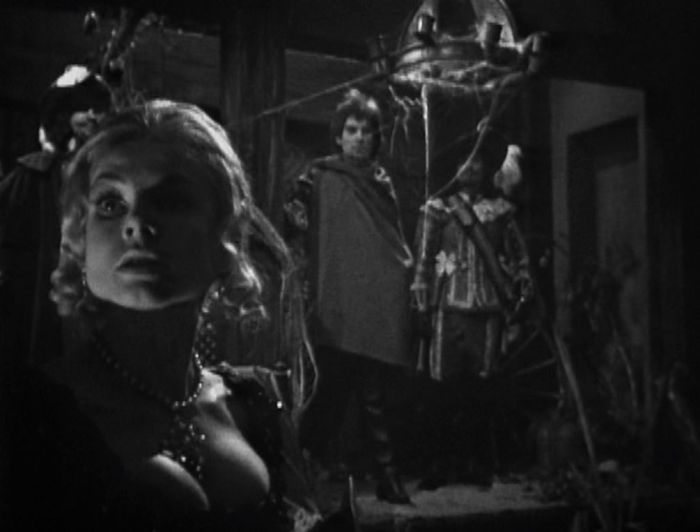
Mary Peach’s bosoms once again heave impressively as D’Artagnan and the others track her down, list her crimes and find her guilty. Naturally enough, the sentence is death. Her executioner (Kevin Stoney) is already known to her and it’s poetic justice that he’s the one who’s tasked to carry out the act. Shot on film, Milady’s final scene is extravagantly played by Peach, but unlike some of the other broad performances it works well.
Although some of the playing throughout the serial isn’t subtle and Peter Hammond’s direction is rather idiosyncratic, there’s still plenty to enjoy in The Three Musketeers. The 25 minute format means that each episode zips along and there’s plenty of familiar faces – Kevin Stoney in this episode, Pauline Collins and Milton Johns, amongst others, earlier on – who pop up in small roles.
It’ll be interesting to shortly compare this to The Further Adventures of the Musketeers, especially how the recasting (Joss Ackland for Jeremy Brett, John Woodvine for Gary Watson) blends with the returning Brian Blessed and Jeremy Young. The additional six episodes and shared directorial duties (Christopher Barry and Hugh David) should also give the sequel a different feel. My review can be found here.
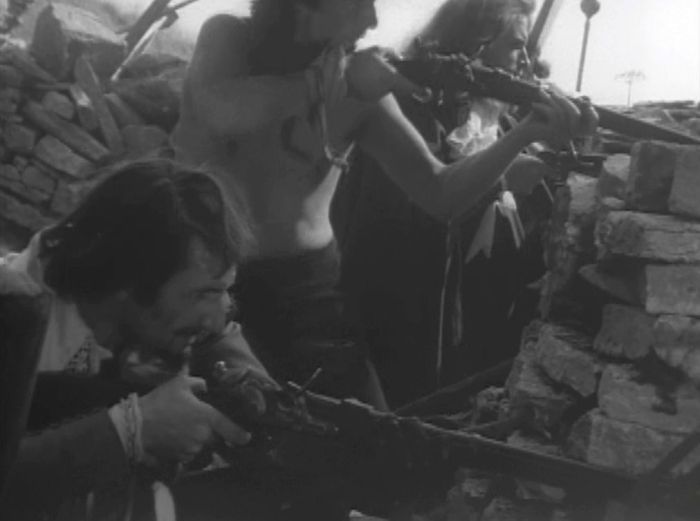
With a limited budget, the battle scenes we see throughout the serial have to be somewhat impressionistic. This is demonstrated at the start of Assassin, as D’Artagnan and the Musketeers are seen defending a hill fort. Although there’s a limited number of extras – representing both their allies and their enemies – sound effects, smoke and hand-held camera work all have to create the impression of many more.
The jumpy camera-cuts do effectively suggest the confusion of battle though, and it’s amusing that the Musketeers and D’Artagnan are cool enough to stop for a bite to eat and a discussion of their current troubles. Milady de Winter’s mission to England spells trouble for all of them and although some of her plans (such as arranging the assassination of the Duke of Buckingham) don’t directly involve them, it’s still vital that they stop her. A letter to Milady’s brother-in-law (who, we remember, had his life saved by D’Artagnan) should do the trick.
Presumably The Three Musketeers, like many series and serials of the time, had an allocated amount of film work per episode. Since the previous episode had no filming at all, this may account for the more generous allocation in Assassin. Some of it – for example, showing Milady’s arrival in England and her travels through the country – aren’t strictly speaking vital to the plot, but they provide gloss and an expansive feeling (otherwise it would be too easy for the story to simply jump from one interior set to the next).
Milady de Winter’s reunited with her brother-in-law, but it’s not a happy meeting. “Spy, bigamist, would-be-assassin, branded criminal. I’m sending you to our Southern colonies. In a few months the tropic sun would have burnt out that fatal beauty and sucked dry your evil mind.” He leaves her a prisoner, guarded by young Felton (John Kelland) but Milady is easily able to manipulate this pious, worthy man. Once again, it’s a pleasure to watch the delight on Mary Peach’s face as Milady manipulates yet another hapless victim. She clearly has deep powers of persuasion, as not only is she able to obtain her release, she also convinces him to kill Buckingham. A powerful lady indeed.
The scene where the Cardinal confronts D’Artagnan and the Musketeers is, like the earlier scene with Brett, Blessed, Young and Watson, shot on film. This clever piece of scheduling meant that they weren’t required for the studio recording, therefore giving them a week off.
The revelation that Milady de Winter is Athos’ treacherous wife, whom he believed was put to death years ago, spins the story in a different direction. Athos doesn’t fear for his own life – we’ve already seen that he doesn’t care if he lives or dies – but this revelation also places D’Artagnan’s life in immediate peril.
After the high drama of the opening scene, we quickly change gear as Porthos is brought face to face with the cuckolded husband of his latest mistress, Madame Coquenard. Porthos is humiliated by the elderly Monsieur Coquenard, who capers around in a bizarre fashion (complete with antlers on his head!) before collapsing.
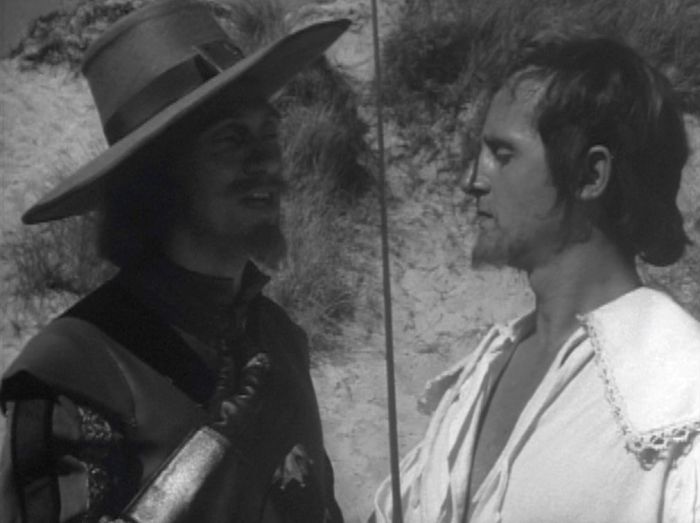
D’Artagnan is summoned for a meeting with the Cardinal. Pasco’s Cardinal remains conversational and reasonable – as stated before, it makes a change from portraying Richelieu as a cackling villain and it only serves to make him all the more deadly. He doesn’t attempt to suborn people through fear, instead he uses the much subtler weapon of charm. And even when he gives D’Artagnan an ultimatum, Pasco still doesn’t raise his voice. “Up till now, whether you knew it or not, my hand has been behind you. The moment I withdraw my hand, why then my friend I would not give one farthing for your life. You will remember hereafter, if any misfortune befalls you.”
There’s more odd shot changes during this meeting. Every so often, the camera cuts away from the two actors to show the various suits of armour dotted around the room. If it happened once you might believe it was a miscue from the vision mixer, when it happens again it must be a deliberate choice.
Later, the Cardinal enlists the assistance of the three Musketeers to escort him to a meeting. This is a baffling move, since his meeting is with Athos’ hated wife Milady de Winter, whom he’s planning to send to England to meet with Buckingham.
The Cardinal wishes to prevent Buckingham from intervening in France’s civil war and has chosen the Englishman’s love, the Queen of France, as the lever. If Buckingham doesn’t withdraw his army, then the Queen’s honour will be tarnished beyond repair. With the three Musketeers ear-wigging in the next room, they now know all of the Cardinal’s plans ….
Once again an episode closes strongly, this time as Athos confronts his wife. Both Jeremy Young and Mary Peach are excellent in this short scene. Considering the wrongs he’s suffered, you might expect that vengeance would be uppermost on his mind, but, as highlighted before, he’s more concerned about D’Artagnan’s fate.
Milady de Winter has succeeded in winning the love of D’Artagnan, but tells the Cardinal that she’ll only reciprocate in order to convert him to their side. Interestingly he reacts strongly against this, as he wants no suborned followers. If D’Artagnan is to serve him then it must be because he wishes to act for the glory of God. Appearing in just this single scene, Richard Pasco continues to impress as the wily Cardinal, offering a subtle performance that contrasts sharply with some of the more, shall we say, exuberant turns.
Speaking of exuberant, D’Artagnan turns up at the house of Milday de Winter, only to be told by her maid Kitty (Pauline Collins) that her mistress doesn’t love him at all. Considering that he spent the previous episode bemoaning the loss of his one true love, Madame Bonacieux, he clearly seemed to have quickly forgotten her once Milday fluttered her eyelashes at him (he’s clearly a fickle type). When Milady returns, Kitty hides him and this enables him to hear Milady utter the following words. “One day I will have D’Artagnan’s head on a platter.”
The Musketeers are tasked to escort the King in his upcoming campaign against the Huguenots. Porthos would sooner be fighting the English and given the current political climate it looks as if that will happen soon.
Aramis’ desire to leave the secular world has been a running thread throughout the serial and now it seems to be on the verge of happening. Porthos isn’t best pleased about this (and Brian Blessed shows this displeasure in his most typical way – he raises his voice). The cultured, religious Aramis contrasts well with the sensual, rumbustious Porthos and the pessimistic, nihilistic Athos – over the course of the seven episodes to date their various differing character traits have been skilfully drawn out.
The news that Aramis’ love still loves him changes everything though. All thoughts of taking holy orders are instantly forgotten, demonstrating that, just like D’Artagnan, he’s ruled by the women in his life.
More directorial flourishes are in evidence after Milday receives a letter which pleases her, but upsets Kitty. The picture rapidly cuts between Milday’s ecstatic face and Kitty’s distressed one. Elsewhere, a lack of location filming means that the friendly duel between Porthos and Aramis has to take place on a rather unconvincing studio set dressed as a forest clearing. Animal sound effects and a gentle breeze attempt to sell the illusion, but it’s no substitute for the real thing.
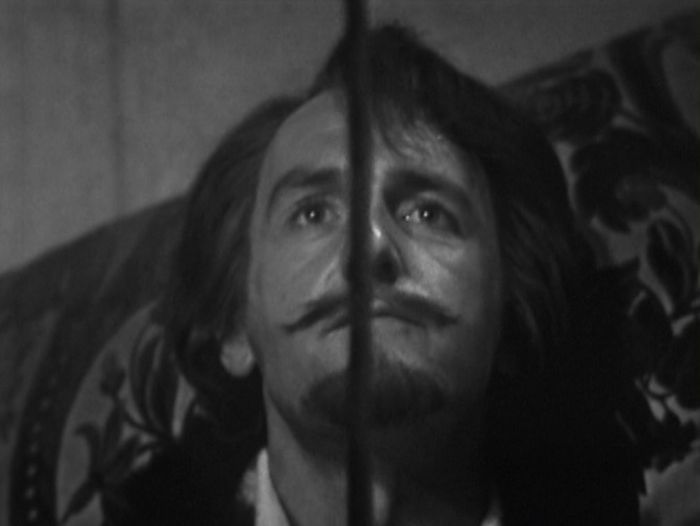
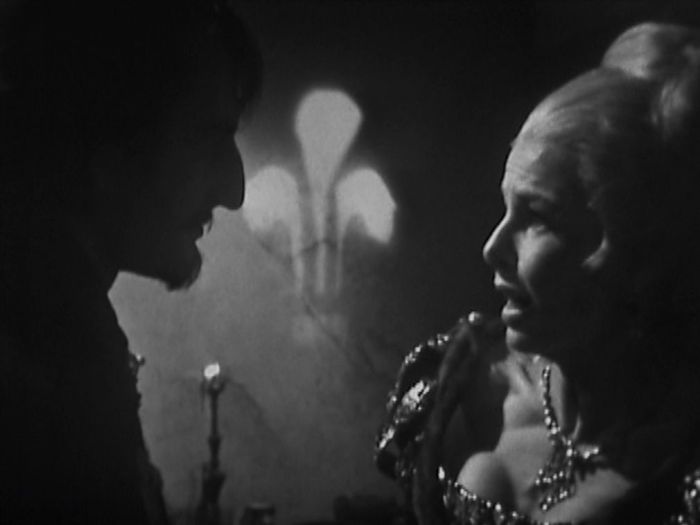
D’Artagnan’s climatic confrontation with Milady reveals that she bears the mark of the fleur-de-lys. Which means there’s a great deal of wailing and the return of the projected fleur-de-lys on the wall. It’s a strong way to conclude an episode that’s mostly chugged along in second gear (which is understandable in a ten-part serial – there’s bound to be a few episodes where the plot doesn’t advance a great deal).
















 Archive Television Musings