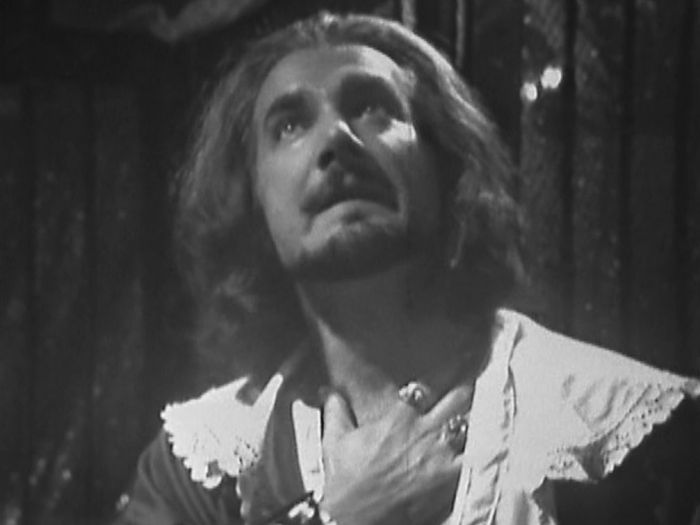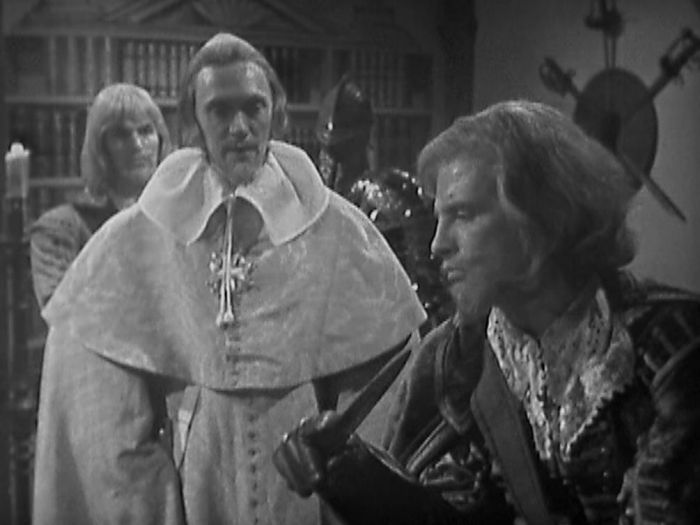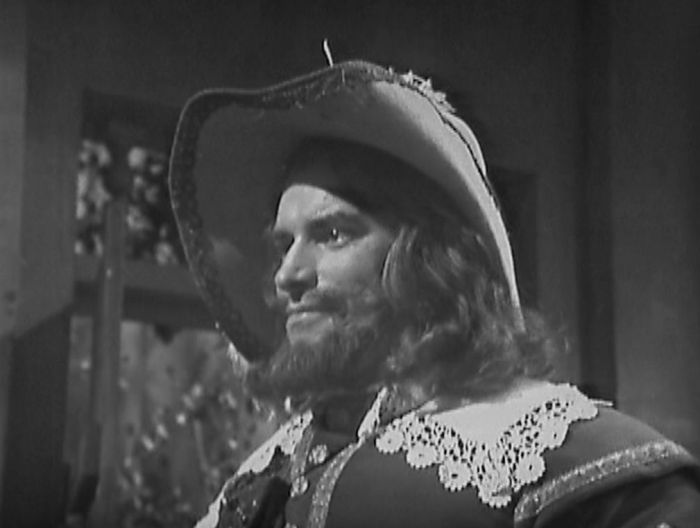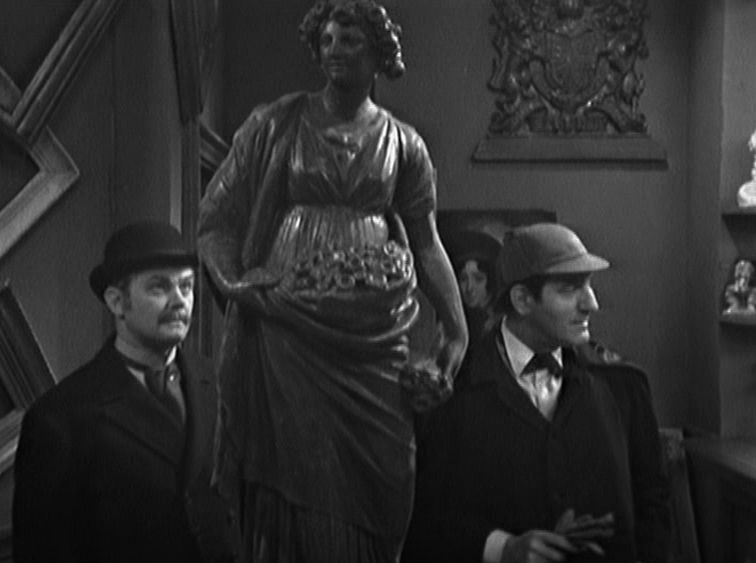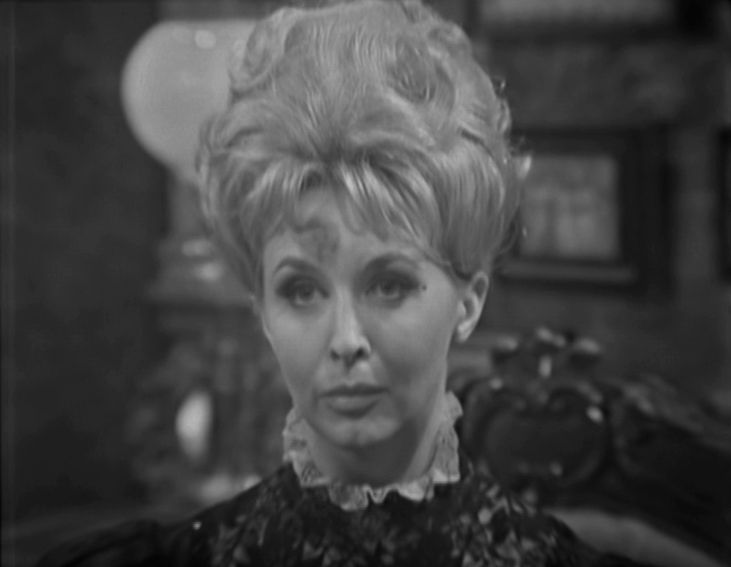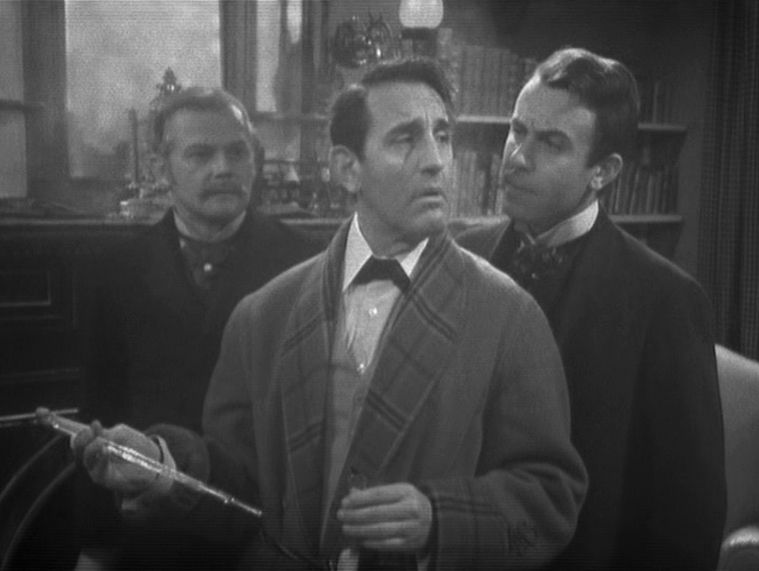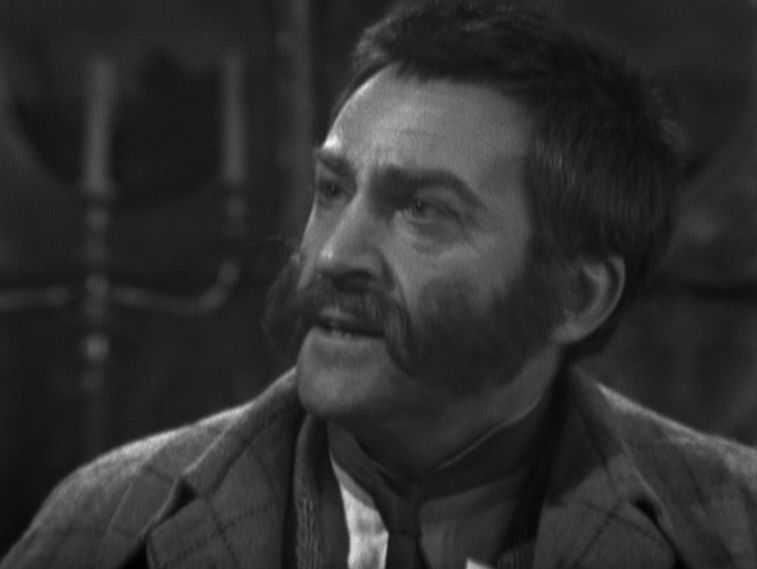
The Three Musketeers. Part Five – Scandal

three 05-01

Peter Hammond’s by now familiar directorial tic is firmly in evidence at the start of this episode, as D’Artagnan and the Musketeers pull up at a country inn.  Rochefort has arrived ahead of them and he (as well as the audience) observe their arrival through a slightly obscured window.

That Rochefort is something of an underhand cad is clearly demonstrated when he shoots one of the Musketeers’ servants.  His men, also carrying guns, then approach our heroes which, since they’re only armed with swords, hardly seems like a fair fight.

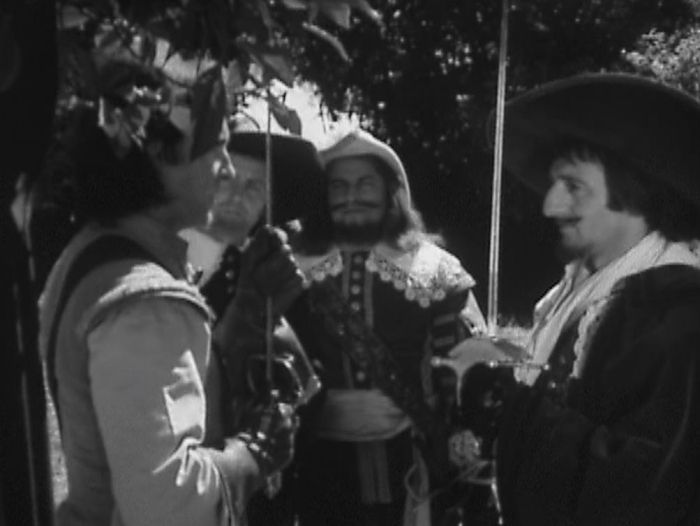
But it’ll come as no surprise that even with such uncompromising odds D’Artagnan and the Musketeers still manage to gain the upper hand.  Plenty of swashes are buckled, but it’s still a struggle for the greatly outnumbered Musketeers to hold their attackers off – and in order to buy D’Artagnan some time to complete his mission they urge him to make his escape whilst they stay behind, still fighting furiously.

When D’Artagnan reaches the coast he indulges in more swordplay.  For anyone who’s been upset of the lack of fighting in the last few episodes, the first ten minutes of this one (all shot on film) more than make up for it.

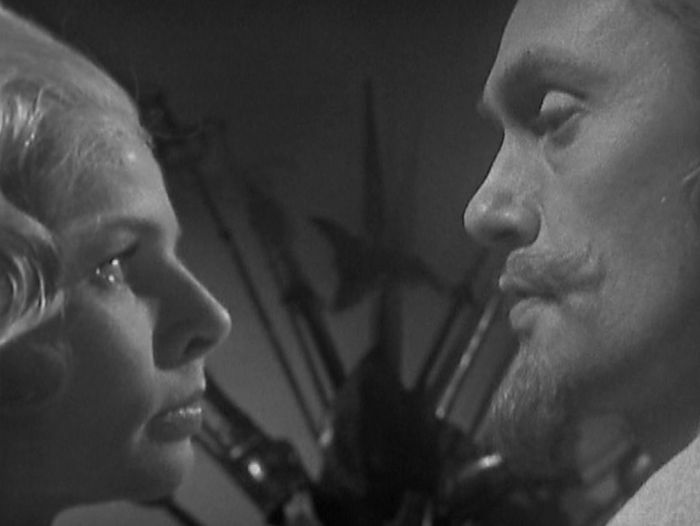
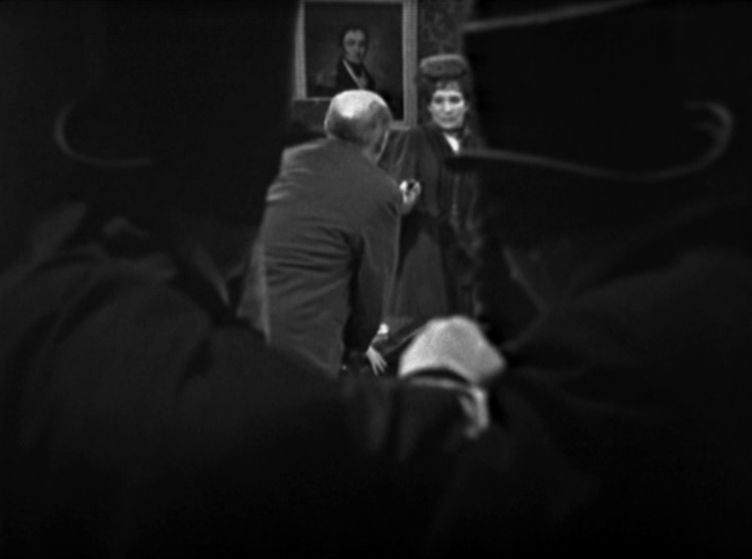
D’Artagnan meets with Buckingham. The Duke gladly gives back the Queens gift in another scene that’s uniquely shot. Buckingham has created a shrine to the Queen, complete with flickering candles, and Hammond chose to overlay even more candles over the picture. This gives the scene a rather strange look, but it sort of works.

It’s ironic that although the Queen is the woman he professes to love, his earlier dalliance with Milady de Winter obviously indicates that he’s not the faithful type! And just as we can lay blame on the Queen for giving him the gift in the first place, if he hadn’t entertained Milady in his bedchamber then she wouldn’t have been able to snip off a few of the diamond studs.

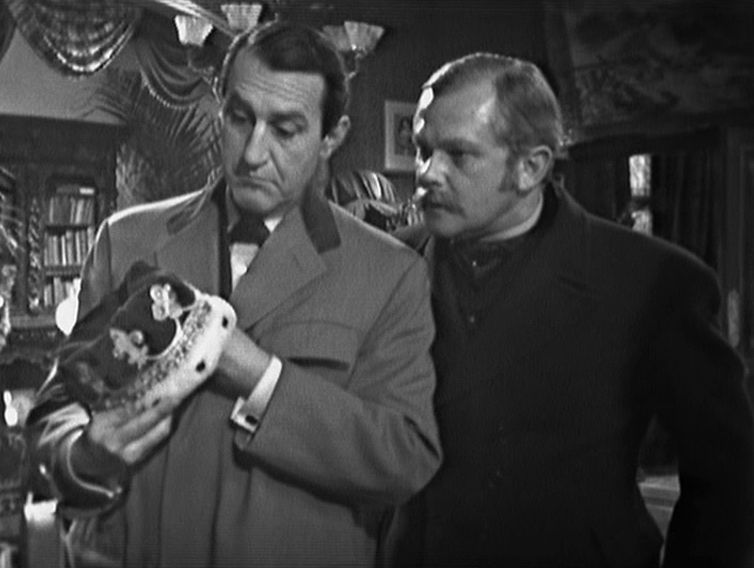
Poor Buckingham goes to pieces when he learns of Milady’s treachery. Simon Oates is once again highly entertaining as Buckingham, now rather highly strung as he and D’Artagnan try to prevent Milady from reaching the Cardinal as well as attempting to repair the Queen’s damaged gift.

Given some of the strange camera shots we’ve seen so far, I’m not sure whether the one some fifteen minutes in was an accident or another piece of Hammond planning. Buckingham and D’Artagnan exit from different sides of the frame, but the camera doesn’t follow them. Instead, for a few seconds we focus on an empty room whilst Buckingham’s voice continues off-camera. An intentional shot or a miscue? Hmmm.

It’s interesting that the three Musketeers don’t make any attempt to follow D’Artagnan after they finally manage to battle off Rochefort’s men. Instead they spend a convivial evening at the inn, eating and drinking – although there’s a twist. Porthos is perturbed to find that Athos wagered his horse in a bet with the landlord (and lost). Aramis is equally upset to discover his silver crucifix has gone the same way. Although this is nothing compared to the revelation that the meat they enjoyed earlier was Porthos’ horse! Lovely comic playing by all three actors, with a final pay off that Athos was lying to them all along and both Porthos’ horse and Aramis’ crucifix are unharmed.

three 05-02

The Three Musketeers. Part Four – Audacity

three 04-01

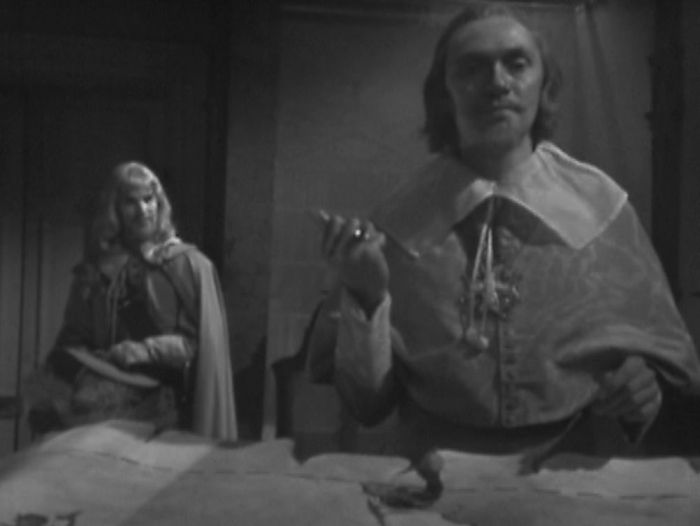
Peter Hammond’s showy camera-work continues in the first scene, as the Cardinal subtly manipulates the King (John Carlin). Several of the shots take place through a window, thus giving the audience a restricted view of the meeting (and also ensuring that we’re placed in the role of observers, eavesdropping on their conversation). The Cardinal professes that the Queen is wholly innocent of any inappropriate liaison with Buckingham, but then smoothly changes tack and suggests the King host a Ball in her honour. And wouldn’t it be an ideal time for her to wear the diamond studs he recently gave to her …..

Carole Potter’s Queen is distraught (again). Lying on her bed, crying woe is me, she’s fretting about how to get the diamond studs back from Buckingham in order to prevent a hideous scandal. Although as I’ve previously said, it was silly of her to give them away in the first place. Never mind, if she hadn’t then there wouldn’t have been much of a story.

Madame Bonacieux is convinced that she can count on her husband to travel to England and save the day, but he’s now the Cardinal’s man. Not only because he’s been paid off, but also for more pressing reasons. “Intrigue frightens me. I’ve seen the Bastille. I’ve seen the torture room. Wedges of wood to drive between your knees to crush your joints.” Peter Hammond’s love of mirror shots continues, as do scenes shot with restricted views. Here it’s because D’Artagnan is upstairs, viewing the confrontation between husband and wife through a crack in the floorboards. As with the opening scene of the episode, it allows the audience a chance to eavesdrop on a private conversation.

Paul Whitsun-Jones departs the serial in this episode. Later to star as the rather ineffectual baddy in the Doctor Who story The Mutants, it therefore came as something of a surprise that he was amongst the subtler actors in these early episodes. Kathleen Breck continues to be a stranger to subtlety, as Madame Bonacieux responds to her husbands departure by flinging herself across a table in a highly theatrical manner. “Dear god, what am I to do?” If I was uncharitable, I’d say a second take, but I’m not so I won’t.

It’s clear that her prayers will be answered, as D’Artagnan – due to his overpowering love for her – will do anything that she asks. “Since I love you. Since I would go through fire for you. Since I am brave, loyal to the throne, I’m your man.” Brett continues to push his intensity level up to eleven, especially when Madame Bonacieux appears to reciprocate his love. The moment when they kiss is an interesting one – as D’Artagnan is rather clumsy, to say the least. A bungled take or was this Brett’s choice, attempting to show how young and inexperienced (in so many ways) D’Artagnan is?

The Musketeers are sidelined in this episode until the last five minutes. It’s fair to say that at first they’re not best pleased at having to go to London, but duty calls. Despite the fact that D’Artagnan isn’t even a Musketeer, they seem to have no problem in accepting that not only is he is charge but that he won’t divulge the reason for their mission. For Athos, if it means a chance to fight and die then he’s content, whilst Porthos and Aramis also relish the chance for a scrap, even if they lack Athos’ apparent death wish.

With four of them, the odds are that at least one will reach London to deliver the vital message. And one is all they need. “All for one and one for all.”

three 04-02

The Three Musketeers. Part Three – Peril

three 03-01

Madame Bonacieux’s bosom heaves in an impressive fashion as D’Artagnan attempts to divine the reason why she was targeted by the Cardinal’s men. A very blatant boom shadow is a little bit of a distraction, but there’s another example of Peter Hammond’s quest to find interesting camera angles – the conclusion of the scene is shot directly at a mirror, showing us the reflections of Madame Bonacieux and D’Artagnan.

Monseuir Bonacieux finds himself a prisoner in the Concierge, questioned by the relentless Commissary (Vernon Dobtcheff). Making his sole appearance in the serial, Dobtcheff’s another very dependable actor who’s always a joy to watch – his relentless bullying of Paul Whitson- Jones’ hapless Bonacieux is very nicely played. The Commissary is further irritated when he’s presented with someone whom he believes to be D’Artagnan, but turns out to be Athos. This shows us Athos’ chivalrous side – he doesn’t deny that he’s not D’Artagnan in order to enable his friend to remain at liberty – but Jeremy Young still remains the least developed of the Musketeers at this point.

Jeremy Brett continues to chew the scenery as his love for Madame Bonacieux deepens, as does his paranoia that she loves another (and he seems to have forgotten that she’s a married woman anyway!) “Madame, if you could see my heart, you would discover so much love.” At present she can’t reciprocate, telling him that she has gratitude for him, but little else. The arrival of a strange man provides more fuel for D’Artagnan’s jealousy. But the Duke of Buckingham (Simon Oates) hasn’t got his eyes on Madame Bonacieux, he’s aiming a little higher …..

Oates, later to star as the womanising, foppish scientist John Ridge in Doomwatch, plays a womanising foppish member of the English nobility here. So not too much of a stretch. He does seem to be enjoying himself though, as he clearly relishes the ripe dialogue. More restrained performances can be seen when the disheveled Monseuir Bonacieux is brought into the presence of the Cardinal. If Buckingham and the Queen are florid and histronic then the Cardinal and Rochefort continue to downplay. This is an interesting choice, as you’d normally expect the villains to offer broad and moustache twirling performances.

Brian Blessed and Gary Watson only pop up towards the end of the episode. Blessed remains as loud as you might expect, but he’s also as entertaining as you might expect too. He tells D’Artagnan and Aramis that he has an assignation with a noble lady and takes his leave of them.  But the truth is somewhat different – he finds his pleasures with women from a lower class of society (pride prevents him from admitting the truth). It’s a nice character beat and the brief following scene is played well by Blessed, as Porthos momentarily show irritation when he’s in the company of his latest date, before he puts on a brave face and makes the best of it.

More bosoms heave as Milady de Winter reappears. The Cardinal has learnt that the Queen gave Buckingham a casket containing twelve diamond studs gifted to her by the King. It seems rather strange that not only would she decide to give away a present presented to her by her husband but also one that would be so identifiable. The Cardinal sends Milady de Winter to England with the clear directive to obtain several of these studs. Once a link between the Queen and Buckingham can be proved, the Cardinal will have all the evidence he needs to bring the monarchy crashing down …..

three 03-02

The Three Musketeers. Part Two – The Three Duels

three 02-01

Although we open episode two with D’Artagnan facing the prospect of dueling with all three Musketeers, it doesn’t take too long before he’s accepted by them and Brett gets to utter the immortal line “one for all and all for one.” Cue another fight scene shot on film with more highly dramatic music. It’s interesting to note that Hammond seemed to have the use of a crane, as there’s a couple of very high shots which gives the scene a little lift.

The three Musketeers and D’Artagnan enjoy their tussle with the Cardinal’s men which then leads us into our first sight of Cardinal Richelieu (Richard Pascoe). Pascoe is another strong performer, exuding quiet menace in his meeting with Brayshaw’s Rochefort.

The Queen (Carole Potter) has a low opinion of the Cardinal. “That man of God who wears the face of Lucifer. A priest who in his lust for power once dreamt of making France’s Queen his mistress. His passion filled me with disgust and I so scorned him that his breast cannot contain the hatred he now bears me.”

Potter emotes freely as the Queen struggles to free herself from the trap she knows Richelieu has set for her (he hopes to make capital out of her relationship with the Duke of Buckingham, an English noble). This is an early example of the two main parts of the serial – there’s derring do and fights aplenty, but inbetween the action the pace slows down as lengthy dialogue scenes dominate. Carole Potter’s television cv isn’t particularly extensive. She returned as Queen Anne in The Further Adventures of the Musketeers the following year and the year after that appeared as Violet Smith in the Sherlock Holmes story The Solitary Cyclist (one of the episodes from the Peter Cushing series that’s sadly wiped). Like Brett’s early scenes as D’Artagnan, she seems a stranger to subtlety as she wails about her misfortunes to her trusted servant Madame Constance Bonacieux (Kathleen Breck).

The long arm of coincidence is in operation after D’Artagnan rents a comfortable room from Madame Bonacieux’s husband (played by the always reliable Paul Whitsun-Jones). With the Queen in trouble and Madame Bonacieux her only confidant, it seems plain that it won’t be long before she and D’Artagnan meet (within a matter of minutes as it happens). D’Artagnan observes her enter through a loose floorboard and Breck rather unsubtly demonstrates Madame Bonacieux’s distress by placing both hands over her face in a very exaggerated manner. After the Cardinal’s men catches up with her, Breck starts wailing very loudly, but luckily for those with sensitive ears D’Artagnan is on hand and makes quick work of them.

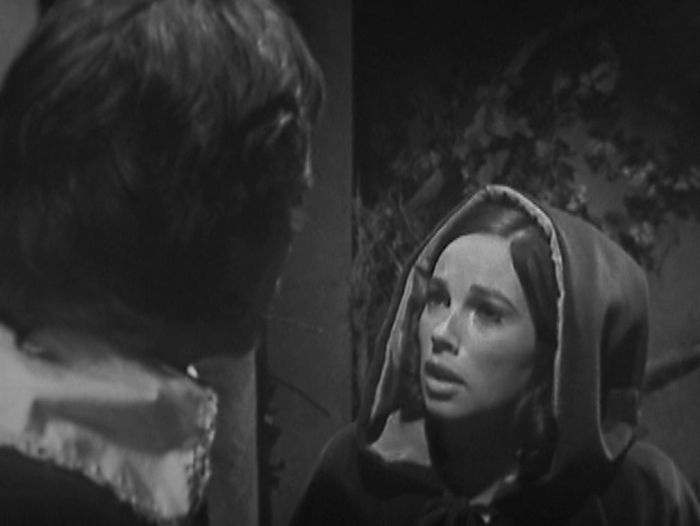
Afterwards, D’Artagnan and Madame Bonacieux regard each other for the first time and it’s clear that he likes what he sees ….

three 02-02

The Three Musketeers. Part One – Enemies

three 01-01

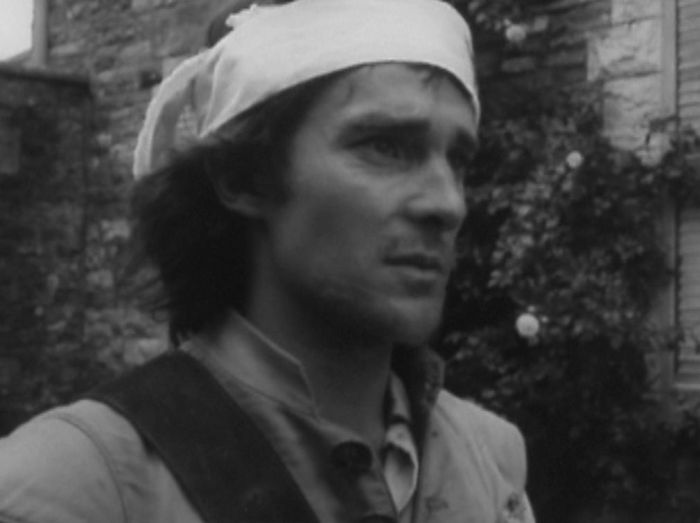
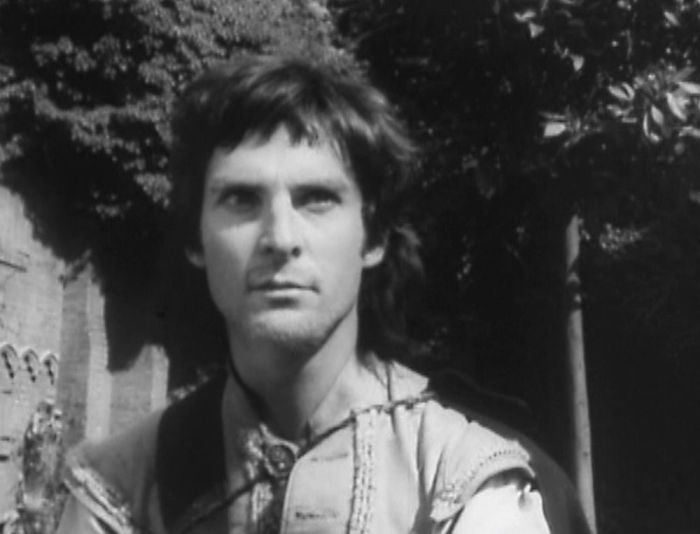
The Three Musketeers was a ten part serial, broadcast on BBC1 between November 1966 and January 1967. It was adapted by Anthony Steven, directed by Peter Hammond and starred Jeremy Brett (D’Artagnan), Brian Blessed (Porthos), Jeremy Young (Athos) and Gary Watson (Aramis).

With the sequel serial, The Further Adventures of the Musketeers, due to be released on DVD next month, it seems the ideal time to dig out The Three Musketeers for a rewatch. Although it’s never had an official UK release, the Koch DVD from 2006 seems to play perfectly well on R2 machines, even though the packaging states that it’s R1.   Whilst it looks like an unrestored telerecording, the picture quality is actually pretty decent (I’ve certainly sat through far worse).

As you’d expect from a BBC production of this era, the studio scenes were taped pretty much sequentially with any outdoor sequences pre-recorded on film and played into the studio via telecine. The “as live” nature of this type of recording meant that it was rare to stop recording for minor technical issues, so there will always be some wonky camera movements and line fluffs.

Some of the shots, right from the start, are slightly odd though – which makes me wonder whether they were actually chosen by Peter Hammond.  A good case in point is the opening scene, where D’Artagnan’s father hands him a sword, tells him he’s now a man and urges him to make his way in the world. The opening dialogue comes from D’Artagnan’s father, but the camera is positioned behind him, so we can’t see his face. The camera then closes in for an extreme close up of the sword’s hilt as D’Artagnan wields it for the first time – but why don’t we see Brett’s face? It’s slightly odd.

As is Brett’s performance. Later to become something of a national treasure for his portrayal of Sherlock Holmes, he’s a little hammy to begin with – although once he falls in with the Musketeers he does improve somewhat. Having been told by his father that a gentleman never refuses a fight, D’Artagnan, when arriving at a tavern, doesn’t back away from a tussle with Rochefort (Edward Brayshaw) who is amused by D’Artagnan’s mode of transport (a rather weedy looking pony). Brayshaw, even with his stick on beard, is wonderful in his opening scene – mocking and controlled, contrasting very well with Brett’s hysteria. Since D’Artagnan is supposed to be something of a callow youth it’s understandable that he’s easily riled, although this makes the casting of the thirty-three year old Brett a slightly strange decision.

Rochefort declines his offer of a fight, but D’Artagnan still doesn’t shy away from single-handidly taking on three others. As this was shot on film, the fight is nicely cut together and it’s something of a treat – complete with over-dramatic music. Once D’Artagnan has been dealt with, Rochefort keeps his rendezvous with the alluring Milady de Winter (Mary Peach).

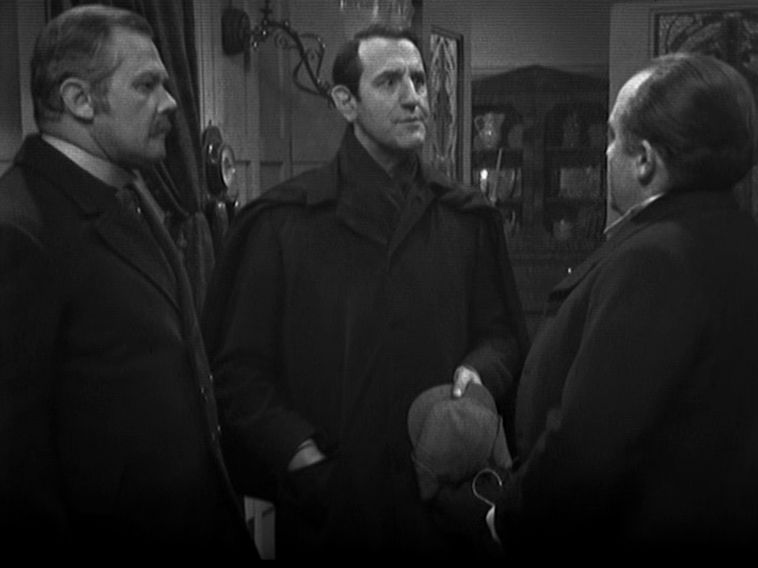
After his diversion with Rochefort, D’Artagnan has a meeting with de Treville (Martin Miller), the leader of the Musketeers. Although Rochefort steals the letter of introduction provided by D’Artagnan’s father, he’s still readily accepted – which makes Rochefort’s actions seem a little pointless. We then meet the three Muskeeters. Brian Blessed is excellent throughout the serial, an ideal Porthos, Watson gives Aramis a cultured, amused air whilst we don’t really get to grips with Jeremy Young’s Athos until later on.

Although the humour isn’t overt, it’s still there (especially if you regard Brett’s overplaying as ironic) and this is clearly demonstrated at the episode’s close as D’Artagnan manages to upset Athos, Porthos and Aramis independently within the space of a few minutes. This means they all challenge him to a duel, so it appears he’s going to be killed three times over!

three 01-02

Z Cars – A Place of Safety

safety

Tx 24th June 1964

A Place of Safety has something of an abstract opening.  We see a man climbing up several flights of stairs, but then the camera seems to lose interest in him as it tracks away – firstly to record some children going down the stairs and then to observe a woman slowly walking upwards.

But we can still hear his voice.  He’s banging on a door, demanding entry – promising that things will be worse if he has to come back.  The relative peace is then shattered as the man falls down the stairs.  We cut to the inside of a room to reveal a man holding a bloody axe.

If parts of Newtown (Z Cars‘ fictional location) were indeed new, then others most certainly were not.  The building where the man (who we later learn is a bailiff called Wallace) lies injured is a crumbling wreck, mostly populated by those on the poverty line (and who also happen to be black).  This doesn’t seem to please Fancy Smith (Brian Blessed) who is visibly exasperated when he’s unable to get any of the other residents to utter a word.  He ironically comments that they’re deaf, but the inference seems to be that they can’t, rather than won’t, speak English.

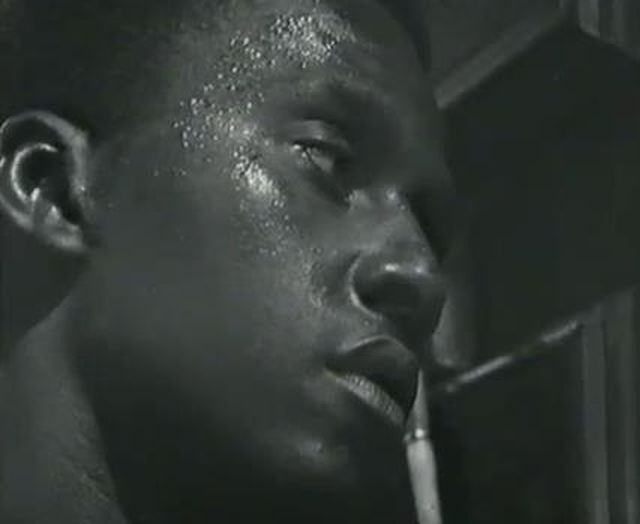
To begin with, it’s possible that the same could be said for the man with the axe – Adignu Sadik (Johnny Sekka).  Barricading the door, he’s depicted as a mute, irresolute figure.  He’s not alone, as his wife Nana (Alaknanda Samart) and his two young children are also present.  Bathed in sweat, Sadik doesn’t utter a word during these early scenes – not even when he’s tempted out of the room by Detective Chief Inspector Barlow (Stratford Johns).

Indeed it’s not until about twenty minutes in, when he’s being questioned at the police station by Detective Sergeant Watt (Frank Windsor), that Sadik utters his first words.  And he’s revealed to be an articulate, softly spoken man, unable to explain why he should have exploded in a sudden burst of anger against Wallace.

That Sadik is not an unthinking, violent creature is surely an intentional piece of scripting – as several characters have already expressed negative opinions about Sadik and the black community in general.  Wallace’s boss, Lowther (Norman Bird) regards them as savages whilst Fancy makes the unoriginal observation that they all look alike.

A Place of Safety doesn’t offer any glib answers or pat solutions and nor does it shie away from suggesting that the police are capable of prejudice just like anybody else.  Barlow gently probes Lowther to try and find out what Wallace was like as a person – did he enjoy his job too much?  Lowther reacts angrily.  Wallace was an ex-copper, doing a dirty job, he says, but he didn’t deserve to be the victim of an unprovoked assault.  After he leaves, Watt tells Barlow that Wallace does have a reputation as a troublemaker, but nothing ever comes of this (we never see Wallace after his tumble down the stairs, so he’s not a defined character).

Lowther bitterly believes that Barlow’s attempting to find excuses to excuse Sadik’s attack.  But when Barlow and Watt are alone, Barlow admits quite the reverse – he suffers from prejudice as well, so he’s doubly keen to ensure that he treats Sadik fairly.

Johnny Sekka is excellent as Sadik, a man with no previous history of violence who finds events has spiraled out of his control.  But the script also poses the question  about exactly how much sympathy we should have for him.  Another very strong performance comes from Alakanda Samarth as his wife, Nana.  She has several key scenes, but possibly the most notable one is right at the end.

With her husband locked up, she and her children have been thrown out onto the streets.  Watt arranges a temporary place for them to stay, but the children can’t remain with their mother.  Fancy and Jock drop her off and there’s an intriguing moment of tension between her and Fancy.  We’ve already seen that the bluff Fancy has an undisguised raft of prejudices and Nana is prepared to meet him head on – she’s proud and independent and can clearly pick up the negative signals from Fancy (and isn’t prepared to ignore them)

An excellent episode by John Hopkins, which also works as a fascinating slice of social history.

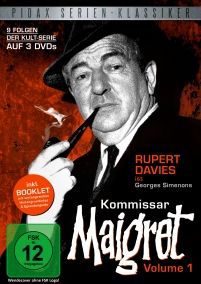
Selected episodes from series one of Maigret (Rupert Davies) to be released in Germany in July 2015

maigret

German company Pidax have announced they will be releasing Kommissar Maigret – Vol. 1 which contains nine of the first ten episodes from series one (originally broadcast in 1960/1961). Thirty-six episodes have been cleared via FSK (the German equivalent of the BBFC).

This would suggest that Pidax plan to release four volumes, each containing nine episodes.  Since all fifty-two episodes starring Rupert Davies exist, this would leave sixteen episodes unreleased.  As per one of the comments below, this may be because the episodes are being sourced from the available material contained within the German archives rather than new masters being obtained from the BBC (who hold a complete run).

Initial reports indicated the DVD would have both English and German language tracks, but now it seems that they may have German only.  So for now, it’s probably best to wait unril the DVD is in circulation before buying.

EDIT – Sadly it’s now confirmed that this DVD only has a German language track. That’s disappointing, but maybe a UK company (Simply or Acorn maybe?) might consider an English language release sometime in the future.

EDIT 8/9/15 – Volume two has been announced. Like volume one it only has a German language track – the included episodes are listed below.

1. Maigret und die Gangster (The Experts)
2. Maigret als möblierter Herr (The Cactus)
3. Maigret unter den Anarchisten (The Children’s Party)
4. Maigret und der Schatten am Fenster (Shadow Play)
5. Maigret und der Kopflose (The Simple Case)
6. Maigret trifft einen Schulfreund (Death of a Butcher)
7. Maigret und sein Toter (The Winning Ticket)
8. Maigret und Inspektor Lognons Trumph (Inspector Lognon’s Triumph)
9. Maigret und der geheimnisvolle Kapitän (The Lost Sailor)

Douglas Wilmer in Sherlock Holmes – The Disappearance of Lady Frances Carfax

carfax

Holmes muses to Watson that in his opinion “one of the most dangerous things in the world is the drifting and friendless woman. She may be perfectly harmless in herself, but all too often, she is a temptation to crime in others.  She is a stray chicken in a world of foxes, and when she is gobbled up, she is hardly missed. I very much fear that some evil has befallen the Lady Frances Carfax.” This monologue is a preamble to Holmes’ request that Watson travels to the hotel in Lausanne (where Lady Frances was last seen) so he can investigate her sudden disappearance.

Holmes is convinced that the trip will do his friend good, since he’s observed that Watson has been feeling run-down lately.  Watson, of course, is amazed that Holmes knows this – and Holmes’ explanation (involving the way Watson’s shoe-laces are tied) is a classic Conan-Doyle moment.

Watson travels to the hotel and speaks to the manager Moser (Roger Delgado).  Moser mentions that Lady Frances seemed to be worried by a bearded stranger and there’s also the question of why she gave a cheque for fifty pounds to her former maid.  The manager is also able to tell Watson that Lady Frances spent some time in the presence of Dr. Shlessinger and his wife.  This seems to be a dead-end though, as Dr. Shlessinger is a man of piety and devotion who surely can have connection to the case.

Watson’s investigations continue, but it’s maybe no surprise to learn that all of his efforts turn out to be futile.  Luckily, Holmes is on hand to shed some light on this tangled mystery.

The Disappearance of Lady Frances Carfax
was originally published in 1911. Like the preceding story adapted for the series, The Retired Colourman, it’s memorable for depicting an independent Watson, sent off to investigate by Holmes.  It’s just a pity that since this happened so rarely, the two were broadcast one after another.

But no matter, as once again we can enjoy the sight of Nigel Stock’s Watson in investigative mode.  As ever, Stock plays these scenes so nicely (witness the moment when Moser wonders if Watson is a detective and you can see Stock visibly grow in stature).  Of course, things don’t go very well and he has to be rescued by Holmes after he gets into a tussle with the bearded stranger.

Despite Holmes’ claims that he was too busy to make the trip, he has (after reading Watson’s initial reports) decided to come over after all – and Wilmer’s sudden appearance is delightful.  Holmes is wearing a very effective disguise and his ironic comment of “Dear me, Watson. You have managed to make a hash of things, haven’t you?” is one of the episode’s many highlights.

For those brought up with the efficient and unflappable Watsons of the Granada series, this may be a little difficult to take – but it’s totally consistent with Conan-Doyle’s original story.  As good as the Granada series was (for the most part) it’s fair to say that on occasions, their eagerness to redress the perceived imbalance in some of the previous portrayals of Watson sometimes pushed the character too far the other way (making him rather too capable).

This excerpt from the Conan-Doyle story is interesting –

To Holmes I wrote showing how rapidly and surely I had got down to the roots of the matter. In reply I had a telegram asking for a description of Dr. Shlessinger’s left ear. Holmes’s ideas of humour are strange and occasionally offensive, so I took no notice of his ill-timed jest.

The clear inference from this is that Watson is heading for a fall, since we know that Holmes never makes a frivolous request.  And the fact that Watson, after all his years of experience, should think so doesn’t reflect well on him.

It’s also worth viewing the Granada adaptation, which takes many liberties with the original story – including completely removing the plot-thread of Watson being sent to investigate Lady Frances’ disappeance (in the Granada version he’s already present at the hotel and sends for Holmes when he becomes concerned for Lady Francis’ safety).  All of Watson’s mis-deductions are therefore absent, which isn’t surprising since they would have jarred with the efficient and capable picture of Watson presented since series one in 1984.  It’s a valid decision, but it sits rather uneasily with the Granada’s original claim that they would return to the original stories and present them authentically (undoing the harm they considered was done by earlier portrayals, such as Nigel Bruce’s).

Thanks to Holmes’ intervention, it becomes clear that the bearded stranger is a friend not foe.  His name is the Hon. Philip Green and had Lady Frances’ family not objected, he would have married her years ago.  Joss Ackland (as Green) is completely unrecognisable (he’s sporting long black hair and a black beard).

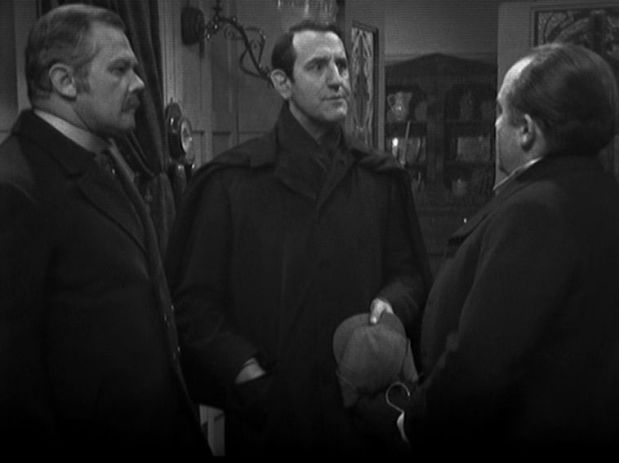
One of my favourite actors, Ronald Radd plays Peters, the villian of the piece and a brief appearance by another favourite, Roger Delgado, is just the icing on the cake.  Holmes and Watson return to London and track down Peters (the erstwhile Dr. Shlessinger).  I love the moment when Holmes and Watson confront him.  Holmes warns Peters that Watson is a very dangerous ruffian and, after a moments pause, Stock raises his stick in a mildly threatening manner!  It’s only a little throwaway moment (possibly worked out in rehearsal) but it never fails to raise a smile.

Location filming in France helps to give the story a sense of authenticity and whilst there’s the odd production misstep (the body in the coffin looks very odd) all in all this is a very strong end to the series.

This would be Douglas Wilmer’s final appearance as Holmes in the series, as various factors made him decide not to return for a second run.  These included problems with scripts, directors and the news that series two would be made to an even tighter production schedule than the first.  For Wilmer (who considered that the quality of the series was already compromised) this was unacceptable, and it would be Peter Cushing who would have to deal with numerous production difficulties when the series returned in 1968.

It’s fair to say that the series suffers from the same problems of virtually every series of this era.  Boom shadows are a regular presence and the sets sometimes wobble (and so do the actors!).  The stories only had a limited amount of studio-time (with over-runs strictly frowned upon) so occasionally we will see scenes with technical problems (line-fluffs, malfunctioning props) that could have been resolved had the time been available for another take.

But the series also has all the strengths of television of this era – and the main strength is the sheer quality of the actors.  Peter Wyngarde, Patrick Troughton, Patrick Wymark, Nyree Dawn Porter, James Bree, Anton Rodgers, Leonard Sachs, Derek Francis and Maurice Denham are just some of the fine actors to grace the stories prior to this one.  And that’s not forgetting the numerous smaller roles which were equally well performed.

It’s not surprising that the lavish Granada series tends to be regarded as the definitive Sherlock Holmes television version as the BBC’s Sherlock Holmes will never be able to compete in a visual sense (the BBC series was much more studio-bound and therefore lacked the visual sweep of the Granada Holmes).  But these adaptations were as good (and as faithful, if not more so) to Conan-Doyle’s original stories.  Plus the first BBC series has an obvious trump card – Douglas Wilmer.

Few actors have ever been able to capture as well as Wilmer the icy, logical nature of Holmes.  Watson once called him “the perfect reasoning machine” and it’s this precise, mechanical nature that Douglas Wilmer portrays to perfection.  Many actors would have sought to soften him, but Wilmer stays true to Conan-Doyle’s original.  It’s a performance that never fails to impress, as Wilmer (even in the scenes where he has little dialogue) is always doing something that’s worth watching.

He’s complimented by Nigel Stock’s Watson.  It’s, at times, a rather comedic turn, but as I’ve mentioned it’s probably not as far removed from the original text as some people would think.

If you love Sherlock Holmes or you love 1960’s British television then the BFI DVD is a treasure.
Douglas Wilmer in Sherlock Holmes – The Retired Colourman

retired

Watson briefly meets Holmes’ latest client, Josiah Amberley (Maurice Denham), on the stairs.  When Holmes asks what opinion he formed of the man, Watson confesses he found him to be “a pathetic, futile, broken creature.”

Holmes agrees, but Amberley certainly seems to have cause for distress.  His wife has disappeared, along with Dr Ray Ernest (a friend of both of them).  Also, his strong-box has been forced and a considerable amount of cash and securities taken.  Can Holmes locate the pair as well as Amberley’s missing money?  Naturally, he can.  But the solution to the mystery isn’t quite as straightforward as it initially seems.

The Retired Colourman was one of the final Sherlock Holmes stories, originally published in 1926.  Given that it’s a very decent mystery, it’s surprising that this was the only time it was adapted for the screen.

With Holmes otherwise engaged, it falls to Watson to begin the investigation.  And this means that the story is a lovely vehicle for Nigel Stock’s Watson.  His performance in the series has, it’s fair to say, attracted some criticism over the years.  He’s not quite in the Nigel Bruce buffoon category, but neither is he as competent as the Granada Watsons.

Stock’s Watson is honest, loyal and totally unimaginative.  Yes, the series does delight in showing him to be several steps behind Holmes at all times, but if you closely read the original stories that’s a perfectly valid interpretation.  For example, in this story Holmes is very blunt when he tells Watson that his initial enquiries have missed almost everything of importance (this is taken directly from Conan-Doyle’s original story).

He’s paired up for most of the duration with Maurice Denham’s Amberley.  Denham, as expected, gives a fine performance and there’s something very entertaining about the combination of the relentlessly cheerful Watson and the doom-laden Amberley.

Holmes is rather cruel to Watson – as he sends him and Amberley off on a wild-goose chase so that he can do a spot of burglary at Amberley’s house.  Indeed, Holmes sends them so far afield that Watson and Amberley have to spend the night in a rather uncomfortable country hotel.  In the original story Watson speaks to Holmes on the phone, but here Holmes dictates a telegram to his unfortunate colleague.  The result is the same though and it’s clear from the expressions on the faces of Holmes and Mrs Hudson (making a rare appearance in the Wilmer series) that they have little pity for poor Watson, trapped at a hotel at Frinton with the unpleasant Amberley!

Denham and Stock are the chief reasons why this one is very watchable.  It’s true that there are a few plot-holes (particularly why Amberley decided to consult Holmes in the first place) but these are problems with Conan-Doyle’s story and Jan Read’s dramatisation is content to faithfully adapt the original material.  A generous amount of location filming helps to open the story out (some of the other studio-bound ones do tend to feel a little claustrophobic).

An interesting adaption of one of the “lesser” stories from the canon.

Douglas Wilmer in Sherlock Holmes – Charles Augustus Milverton

charles

Lady Eva Brackwell (Penelope Horner) has become the latest victim of master blackmailer Charles Augustus Milverton.  Milverton has acquired a bundle of rather indiscreet letters that she wrote to a young army captain.  If they fall into the hands of her intended husband,is the preferavle version.the Earl of Dovercourt, then there’s little doubt that their forthcoming marriage would be in serious jeopardy.

Holmes agrees to act for Lady Eva, but when Milverton holds all the cards, what can he possibly do?

Charles Augustus Milverton was originally published in 1904.  It’s a rather interesting story, mainly because Holmes doesn’t provide any resolution to the tale – a third party does – and therefore he needn’t have appeared at all.  Plot-wise, it strongly resembles A Scandal in Bohemia (both revolve around an incriminating item, which Holmes decides to retrieve via burglary).

Barry Jones’ Milverton isn’t demonstratively villainous.  Since he knows that his position is unassailable, he’s able to project a relaxed persona (although there’s little doubt of the evil that lurks beneath).  Holmes is well aware just how formidable a foe he is, as he tells Lady Eva.  “You have fallen into the hands of a very dangerous man. Charles Augustus Milverton is far from commonplace. In fact, one may safely call him the king of blackmailers. There are hundreds in this great city who turn white at his name.”

Holmes quickly discovers that Milverton can’t be threatened or intimidated and he won’t negotiate.  His price is seven thousand guinees – no more, no less.  When Holmes tells him that surely it’s better to accept a smaller amount than to expose Lady Eva for no personal gain, Milverton replies that it would suit his purposes very well.  If it become known that he had ruined Lady Eva, then his other victims would be all the more anxious to settle.  Penelope Horner’s Lady Eva is the nominal central figure, but it’s Lady Farningham (Stephanie Bidmead) who brings the story to its conclusion.  She had previously suffered at Milverton’s hands and we see her return to exact a measure of revenge.

If the main plot is quite linear, there’s a great deal of incidental business (mostly centered around Holmes and Watson) which make this one very enjoyable.  Nigel Stock is on fine form from the start – he’s disgusted with Milverton’s treatment of Lady Eva (indignantly calling him “a blackguard”) and later picks up a chair to attack him!

When Holmes decides that the only course of action is to burgle Milverton’s house, Watson insists on coming with him – despite Holmes’ protests.  Eventually Holmes agrees and tells him that “we have shared the same rooms for a number of years, my dear fellow. I suppose it might be amusing if we ended up by sharing the same cell.”

Wilmer has some lovely comic business when he’s disguised as a plumber who’s been courting Milverton’s maid (he later tells a shocked Watson that he’s become engaged to the girl) .  The pair enjoy a kiss and it’s obvious how discomforted Holmes is.  He gingerly places his hands on the girl and then shortly afterwards attempts to break free of her tight embrace.  Once they’ve finished, his first thought is to check that his false moustache is still in place!

The Granada adaptation was extended to two hours (and was broadcast under the name of The Master Blackmailer).  It kept the same basic plot as the original short story,  but the two hour running length ensured that a great deal of additional material had to be added.  This means that the Wilmer adaptation does bear more direct resemblance to Conan-Doyle’s original and so, for me, is the preferable one.

Douglas Wilmer in Sherlock Holmes – The Bruce-Partington Plans

bruce

Holmes’ brother Mycroft (Derek Francis) is a man of regular habits. Nothing (except the gravest crisis) would make him deviate from his normal schedule.  So when he turns up at Baker Street, with Inspector Lestrade in tow, Holmes knows it’s serious.

But his brother’s arrival is just what Holmes needs, as prior to this he had bitterly complained to Watson about how dull the London criminal had become. Now, Mycroft offers him an intriguing case of the most pressing urgency.

A clerk from the Royal Woolwich Arsenal, Arthur Cadogan West, has been found dead on the Underground tracks near Aldgate tube station. On his body were several documents relating to the top secret Bruce-Partington submarine. Several more vital documents about the submarine are missing and Mycroft urges Holmes to use all of his powers to track them down.  It seems obvious that Cadogan West stole the plans and had intended to sell them to the highest bidder. But as we’ve seen in previous stories, the truth is sometimes not quite so straightforward ….

The Bruce-Partington Plans was originally published in 1908.  It featured the second and final appearance of Mycroft Holmes. He first turned up in The Greek Interpreter, which was adapted for the second series of Sherlock Holmes (starring Peter Cushing).  Sadly, that episode is missing.

We’re slightly more lucky with this one, as the first half of the story exists (and there’s an audio copy of the second half).  For this DVD, the audio for the missing half has been nicely cleaned up and is synchronised to a reproduction of the script (with images of the cast in the background).

This works pretty well, although since the soundtrack is so clear it probably wasn’t necessary to have the script on-screen at the same time as the audio.  Instead, a decent reconstruction could have been made with images taken from the first half, along with on-screen descriptions for any visual sequences.  But while the script is sometimes distracting (mainly because it often varies from the actual dialogue spoken) it still clearly allows the viewer to understand how the story concludes.  It’s also interesting that the soundtrack for the existing half of the story doesn’t seem to be in the greatest shape – at various points the odd word is inaudible.

But although the ravages of time have rather compromised this story, what remains is very decent fare.  Derek Francis is a rather good Mycroft and though this story doesn’t have the same sort of one-upmanship that The Greek Interpreter did, there’s still some nice moments between the brothers (mainly visual ones).  For example, when Holmes offers Mycroft a seat, Mycroft promptly takes Holmes’ own – much to Holmes’ annoyance (and Watson’s amusement!).  Later we see Mycoft very freely use Holmes’ tobacco – and again there’s a slight flicker of annoyance from Sherlock.

An effective piece of model-work (a rather nice train!) and a smoky studio set help to bring the railway section of the story alive in the first half of the story and, as ever, The Bruce-Partington Plans boasts the usual quality cast (even in the smaller roles).

John Woodnutt (a highly familiar face during four decades or more of British film and television) is the station-master, whilst Gordon Gostelow (again, another very well-known actor) plays Sydney Johnson, Cadogan West’s superior.  Allan Cutherbertson, whose lengthy career included a visit to Fawlty Towers as well as a stint acting as Tommy Cooper’s straight-man, was no stranger to dramatic parts – and he’s well-cast as Colonel Valentine Walter.  It’s a pity that his more intense scenes come at the end of the story, when we don’t have the visuals.

As we’ve previously seen, Wilmer’s Holmes can be incredibly rude and off-hand at times.  His dismissal of Lestrade early in the story is a case in point and Stock’s Watson covers well for him – Holmes is clearly a man for whom social niceties count for very little.  But although he can be chilling at times, he’s also able to extend a degree of courtesy – witness his interview with Cadogan West’s fiance Violet Westbury (Sandra Payne).  Violet was convinced that her late fiance was innocent and though Holmes couldn’t hide his irritation when he realised she had little useful to tell him, he was still able to reassure her that he would do everything he could to restore Cadogan West’s honour.

Few actors have ever quite managed to capture all the nuances of Holmes’ character quite as well as Douglas Wilmer did – and he’s a major reason why this series should continue to be enjoyed by anybody who loves the original Sherlock Holmes stories.

Douglas Wilmer in Sherlock Holmes – The Beryl Coronet

beryl

Alexander Holder (Leonard Sachs) is a well-respected city banker.  Early one evening he is visited by a prominent member of society who urgently needs £50,000.  Holder is happy to advance the money, especially when he’s given the Beryl Coronet as collateral.  Holder shows it to his son and niece and though he admits it’s not quite the Crown Jewels, it’s certainly highly impressive – and is worth at least double the amount he’s advanced.

Holder’s son, Arthur (Richard Carpenter), is worried about such a valuable item residing overnight in their house, but he also has concerns of his own.  Although he’s an amiable sort, Arthur is a gambler and owes a considerable sum.  He asks his father for several hundred pounds, but Holder refuses – he’s tired of settling his son’s gambling debts.

In the middle of the night, Holder is awoken and comes downstairs to find the coronet in the hands of his son.  He is appalled to find that the crown is broken and three beryls are missing.  Arthur offers no defence and is arrested.  Although an intensive search is carried out, there’s no trace of the missing jewels.  It seems to be a simple case and Arthur’s guilt appears to be obvious, but Holmes is never prepared to take anything at face value.

The Beryl Coronet was one of the earliest Sherlock Holmes short stories (originally published in the Strand Magazine in 1892).  Since it was never adapted for the Granada series, the Douglas Wilmer version is quite noteworthy, as it’s the only sound version of the story (it was twice adapted for the silent screen, in 1912 and 1921).

Although Wilmer and Stock don’t enter the story until the 17th minute, it’s still a lovely vehicle for both of them.  Wilmer’s Holmes is rather enigmatic in this one – until he reveals the true solution to Holder at the end, he’s not prepared to share any of his theories.  This, of course, helps to sustain the mystery, which is no bad thing.  Holmes also gets to don a disguise (which totally fools Watson!)

The story boasts a strong supporting cast.  Leonard Sachs (best known for The Good Old Days) is the unfortunate Holder, whilst Richard Carpenter is his son, Arthur.  Carpenter was a decent actor, but it’s his later career as a writer that he’ll undoubtedly be best remembered for.  Amongst his many writing credits were the well-remembered Look and Read serial The Boy From Space, Catweazle, The Ghosts of Motley Hall, Dick Turpin and the best television adaptation of the Robin Hood legend – Robin of Sherwood. He’s very appealing as the unfortunate Arthur, who’s regarded by everybody (except Holmes and Watson) as clearly guilty.  Another noteworthy appearance comes from David Burke as the devious Sir George.  Burke would later play Watson opposite Jeremy Brett’s Holmes during the first two series of the Granada run.

The Beryl Coronet possibly wasn’t the most obvious story to adapt, but I’m glad they did – especially since nobody else had done so since 1921!  Wilmer continues to dominate the screen and it’s easy to see why, for so many people, he’s regarded as the archetypical Holmes.

Douglas Wilmer in Sherlock Holmes – The Man with the Twisted Lip

twisted

Mrs St. Clair (Anna Cropper) has travelled to London to conduct some business.  On her way back to the train station, she passes through Upper Swandam Lane (home to a notorious opium den).  Mrs St. Clair is astonished to see her husband briefly at the upper window of this disreputable place – but a second later he vanishes (as if pulled back by some unseen hand).

Neville St. Clair is a respected journalist who would have no reason to visit such a dive – unless he was a secret opium addict.  When Mrs St. Clair returns with the police they find no trace of her husband, although in the upstairs room they do discover a box of children’s blocks.  Mrs St. Clair collapses, as her husband told her he planned to buy such a toy for one of their children that very day.  Mr St. Clair’s clothes are also discovered.

All the evidence suggests that a well-known beggar, Hugh Boone (Anton Rodgers), was with Mr St. Clair when he was spotted by his wife.  Boone is quickly picked up by the police, but he’s saying nothing.  Holmes is convinced that Boone holds the key to Neville St. Clair’s disappearance – which he does, although Holmes’ solution is a most unexpected one.

The Man with the Twisted Lip was one of the original batch of Sherlock Holmes short stories, published in the Strand Magazine in December 1891.  Jan Read’s dramatisation is pretty faithful to the source material, but it’s a pity that the original, striking, opening wasn’t used.  In Doyle’s story, Watson travels to the opium den to extract a friend of his, Isa Whitney, who has fallen under the thrall of the drug.  When he’s leading his friend outside, he’s accosted by an old man (who turns out to be Holmes in disguise).  Holmes then explains that he’s investigating the disappearance of Neville St. Clair.  In Read’s adaptation, Watson does discover a disguised Holmes, but it sits rather uneasily in the middle of the story (where it makes less sense).

Although his screen-time is quite limited, Anton Rodgers is very effective as the disfigured beggar, Hugh Boone.  Anna Cropper, as Mrs St. Clair, is the latest stoic beauty to turn to Holmes for help.  A sign that retakes were only undertaken in the gravest circumstances is demonstrated by the scene where Mrs St. Clair visits Baker Street.  After lifting the veil from her hat, it falls down again and she simply has to push it back up and carry on.

Given the small pool of ethnic actors working in the UK during the period, it was very common to see British actors playing characters of every nationality.  Here we see Olaf Pooley (as the villainous Lascar) browned up.  To modern eyes it may seem strange, but it wasn’t an unusual occurrence at the time.

The Man with the Twisted Lip benefits from some atmospheric location filming in the East End.  The story could have been shot entirely in the studio, but the real locations certainly add something to the end product.  Within a few years redevelopment would have changed the locations beyond all recognition, so they were used at just the right time.

The first story of the series to be made (it was recorded in September 1964) it’s a very efficient production.  Given that the majority of the stories adapted for this series were later also adapted for the Granada series, it’s difficult to avoid comparing the two.  It’s slightly unfair though, since the Granada series had a much larger budget and therefore it would always score highly, particularly in a visual sense.  But whilst the Wilmer series has more modest production values, it can certainly hold its own performance wise, and in the end it’s the performances that really matter.

Douglas Wilmer in Sherlock Holmes – The Six Napoleons

six

Inspector Lestrade (Peter Madden) pays a visit to Baker Street and recounts a strange tale to Holmes and Watson.  Someone in London seems to have such a hatred of the late Emperor Napoleon that they’ve taken to smashing miniature busts of him.  What’s even odder is that they’ve resorted to burglary to do so.

Dr Barnicot (James Bree) is a collector of Napoleonic memorabilia, and he’s disturbed to find both his office and house have been burgled and in each case a bust of Napoleon has been smashed to smithereens.  When another burglary takes place, at the home of a journalist called Horace Harker (Donald Hewitt), Harker not only finds his statue smashed, but a dead body as well …..

Like The Abbey Grange, The Six Napoleons was one of the stories published after Holmes’ return from his tussle with Moriarty at the Reichenbach Falls (later collected in the volume entitled The Return of Sherlock Holmes).

The farcical side of the story is emphasied in Giles Cooper’s adaptation.  Bree’s Dr Barnicot is a character who’s certainly played for laughs – he’s depicted as a highly eccentric devotee of Napoleon who advances three theories (all of them bizarre) to Holmes, Watson and Lestrade in order to explain who could have committed such an outrage.

Wilmer, Stock and Madden have little to do in Bree’s scene – but Wilmer especially is a joy to watch as he rolls his eyes at Barnicot’s wild flights of fancy and beats a hasty retreat as soon as he politely can.  When Barnicot is alone again, he takes out a Napoleonic hat and, after putting his arm inside his jacket, strikes a suitably heroic pose by the mirror.  You get the feeling that he does this a great deal!  James Bree was certainly an idiosyncratic actor, capable of performances of depth and subtlety (series one of Secret Army) as well as turns which verged on the bizarre and unwatchable (the Doctor Who story, The War Games).  He’s quite odd here, but since he plays it as scripted and only has a small cameo appearance, it’s quite acceptable.  Had he appeared throughout, it might have been quite wearying though.

The opening of the next scene is nice – Watson is striking a Napoleonic pose back at Baker Street, to the amusement of Holmes and Lestrade.  It’s only a little throwaway moment, possibly worked out in rehearsal, but it does help to reinforce the bond of friendship between them.  Since Wilmer’s Holmes tends to be quite serious, the odd lighter moment is welcome.

The Six Napoleons sees the first appearance of Peter Madden as Lestrade.  Characteristically, Wilmer’s Holmes doesn’t pretend to be particularly pleased to see him at the start of the story – he offers him a chair with the air of a man who’d be equally happy if he left straightaway.  But as soon as he piques Holmes’ interest, the Great Detective is clearly much more kindly disposed to him!

It’s a studio-bound production, but director Gareth Davies does manage to make the most of the limited space and he offers the viewer a few good flourishes.  My favourite is the scene set immediately after the burglary at Harker’s house.  The camera tracks past a number of statues, as well as a policeman standing so immobile that he could be mistaken for a statue.  Which is almost what Watson does, as we see him walk down the line, identifying each statue to Holmes – before giving a double-take as he reaches the policeman.

Elsewhere, the limitations of the studio environment are more apparent.  There’s a brief scene set in the garden outside Harker’s house, which shows the sky to be a rather wrinkled backdrop.  Moving clouds are projected on it – had the backdrop not been so tatty it would have been quite effective.

The comic turns contunue throughout the story.  Later, Holmes finds himself caught in the middle of Josiah Brown and his wife (Arthur Hewlett and Betty Romaine) who are a rather voluble couple.  Wilmer’s pained expession is priceless.

Indeed, this is a story where the solution of the mystery is somewhat secondary to the performances.  Giles Cooper’s adaptation is good fun and certainly allows the cast plenty of scope to produce some ripe turns.

Douglas Wilmer in Sherlock Holmes – The Abbey Grange

abbey

Holmes and Watson are summoned to the Abbey Grange by Inspector Hopkins (John Barcroft) to investigate the murder of Sir Eustace Brackenstall.  His wife, Lady Brackenstall (Nyree Dawn Porter), was also attacked, but only received superficial injuries.

Holmes is irritated to have been called out as the solution seems obvious.  The district has been plagued by the Randall gang (a father and two sons) who have committed several burglaries in the neighbourhood.  After listening to Lady Brackenstall’s story, there seems no doubt that the Randall gang were responsible for this outrage as well.

But on the way back to London, Holmes isn’t happy.  It’s only a small point which worries him (concerning three wine glasses) but it’s enough to make him return to the scene of the crime and look again at the evidence.

The Abbey Grange was originally published in 1904 (it was one of the stories published directly after Holmes’ remarkable return from the Reichenbach Falls).  Sadly, this is one of two episodes which are incomplete in the archives.  Each story was made up of two 25 minute reels – and in the case of The Abbey Grange the first reel is missing (for The Bruce PartingtonPlans, the second reel has been lost).

The DVD has filled in the missing section in a novel way – with a reading by Douglas Wilmer.  Since the adaptation made a few changes to the original story, the text has also been slightly adjusted – but it’s basically the same as Conan-Doyle’s original.  This reading runs for around twenty minutes and works pretty well – although it might have been better to have reduced the text to a summary of around half the time.  But kudos to the BFI and Douglas Wilmer for making it happen, it’s certainly a nice bonus feature.

When we get to the existing section, it’s a chance to observe Holmes at his analytical best – puzzling over the three wine glasses and the severed end of the bell-rope.  His observations are enough to reveal the identity of the true murderer (which is something the police never discover).  As with several stories in the canon, Holmes elects to take the law into his own hands, calling on Watson to act as the jury.  Watson finds the man not guilty – so he’s allowed to go free.

The gorgeous Nyree Dawn Porter is effectively winsome as Lady Brackenstall, a woman who now finds herself freed from the clutches of a cruel and abusive husband.  Peter Jesson has the small (but important) part of Captain Croker, whilst Peggy Thorpe-Bates (later to be a formidable “She” opposite Leo McKern’s Rumpole) is Lady Brackenstall’s faithful maid.

With a large portion of the story missing, it’s difficult to assess how effective it is overall – but what we do have is impressive, and it works particularly well as a showcase for Wilmer’s Holmes.

Douglas Wilmer
Douglas Wilmer

Douglas Wilmer in Sherlock Holmes – The Red-Headed League

red

Holmes is distracted from the pursuit of a daring young criminal called John Clay (David Andrews) by the arrival of Jabez Wilson (Toke Townley) who has a most curious tale to tell.

Wilson makes a decent, if not particularly profitable living, as a pawnbroker.  But then his young assistant Vincent Spaulding draws his attention to the following newspaper advertisement.

On account of the bequest of the late Ezekiah Hopkins, of Lebanon, Pennsylvania, U.S.A., there is now another vacancy open which entitles a member of the League to a salary of four pounds a week for purely nominal services. All red-headed men who are sound in body and mind and above the age of twenty-one years are eligible. Apply in person on Monday, at eleven o’clock, to Duncan Ross, at the offices of the League, 7 Pope’s Court, Fleet Street.

Wilson and Spaulding duly apply and Ross (Trevor Martin), most impressed with Wilson’s fiery red hair, offers him the position on the spot.  His duties are quite straightforward – each day he has to copy out pages from the Encyclopedia Britannica.  But he has to remain within the offices of the League the whole time (if he leaves for any reason, then he forfeits his position).  Spaulding tells him that he’d be happy to run the shop whilst Wilson is working at the League, so all seems well.

For a while, everything is ticks along nicely.  But then, without warning, Wilson arrives one day to find that the office is shut and nobody else in the building has ever heard of the Red-Headed League.  Was it all just an elaborate practical joke or is there a more sinister purpose at play?

The Red-Headed League (originally published in 1892) is one of my favourite Sherlock Holmes stories, although I do find this adaption to be a little flat.  This is partially because it’s a tale that works better on the printed page than on the screen, but there are other problems.  The story rests on the notion that Jabez Wilson has such a head of fiery red hair that Duncan Ross, once he sees him, instantly sends all the other applicants away.  It’s difficult to show this in black and white though!

The major difference between Anthony Read’s teleplay and Conan Doyle’s original is that in Read’s version we know about John Clay from the start, whereas in the Doyle original we open with Wilson’s strange story and it’s only much later that Holmes realises that Clay is involved.  I’m not sure whether Read’s embellishment is an improvement or not, but it helps to bulk out the running time somewhat.

Toke Townley (best known as Sam Pearson from Emmerdale Farm) doesn’t look much like Doyle’s description of Wilson (he described him as a stout, florid-faced elderly gentleman) but he has decent comic timing and is quite a sympathetic character.  Although Carla Challoner (as Wilson’s maid) only has a small role, she’s rather striking and coincidentally one of her other 1965 television appearances (as Zenna Peters in the Out of the Unknown episode Thirteen to Centaurus) has also recently released by the BFI and is well worth a look.

The other notable guest turn comes from David Andrews as Vincent Spaulding/John Clay. He had an interesting career, and had begun to make the change from an actor to a director at around this time. Along with Trevor Martin, Andrews discusses this and numerous other matters on a chatty commentary track moderated by Toby Hadoke.

This is a wholly studio-bound production which is competently handled by Peter Duguid, although the opening scene does have some quick cuts which maybe don’t quite work as well as they should.  Whilst this episode has a certain charm, for me the later Granada version with Jeremy Brett edges it.

Douglas Wilmer in Sherlock Holmes – The Copper Beeches

copper

When Sherlock Holmes proffers the letter he’s received from Miss Violet Hunter (Suzanne Neve) to Watson, he tells him that it marks a new low-point in his career.  Miss Hunter has been offered a position as a governess, but wishes to seek Holmes’ advice before accepting the post.

Although it initially seems like a trivial matter, once Miss Hunter begins her strange story it becomes clear that there may be more to it than meets the eye.  Miss Hunter has been offered a position by Jephro Rucastle (Patrick Wymark).  Rucastle seems to be a charming man and he makes her a very generous offer – a salary of one hundred pounds a year (a considerable amount, which is much more than many people in her position could ever expect to earn).

Rucastle goes on to tell her that he and his wife (faddy people, he admits) may ask her to sit in a certain chair or wear a certain dress from time to time.  This isn’t a problem, but when Rucastle insists that she has to cut her long hair very short, Miss Hunter protests.  When Rucastle later increases the salary to one hundred and twenty pounds, she weakens – but she wishes to consult Holmes first.  Miss Hunter decides to take up the post, but keeps in contact with Holmes as strange events begin to happen.

The Copper Beeches was originally published in June 1892 and later formed part of the first collection of Holmes short-stores, The Adventures of Sherlock Holmes.  Patrick Wymark (best known as the scheming Sir John Wilder in The Plane Makers and The Power Game) is wonderful as Rucastle.  Alternatively charming and sinister, it’s a very memorable performance.

Suzanne Neve, as the plucky young Miss Hunter, is another strong piece of casting (fans of UFO will remember her as Straker’s ex-wife Mary).  As with the original story, Holmes and Watson are very much on the periphery, so it’s Miss Hunter and Rucastle who dominate proceedings.

It’s certainly a strange household that she finds herself in.  Rucastle’s wife (played by Alethea Charlton) is polite, but seems somewhat under her husband’s thrall.  There’s a rather surly couple of servants, Mr and Mrs Toller (Michael Robbins and Margaret Diamond), whilst the Rucastle’s young son, Edward (Garry Mason), is a most peculiar child.

Although Rucastle insists that his son will grow up to be an important man, there’s little evidence of that in the very brief time we spend with him.  As per the original story, Edward doesn’t feature very much – but Vincent Tilsley’s adaptation does add a little something which sharpens the characters of both father and son.  In Conan-Doyle’s story, Miss Hunter tells Holmes that Edward delights in catching all manner of animals, such as mice.  Tilsley adds a scene where Edward bashes a mouse to death in front of Miss Hunter (with Rucastle looking on approvingly).  It helps to add another rather discordant note and it’s one of a number of good character moments for Wymark.

Although, as mentioned, Wilmer and Stock don’t have the largest of parts in this one, they do enjoy some decent byplay, especially at the end when Watson appears briefly convinced that Holmes had asked Miss Hunter to marry him!  We saw that Holmes was enamored of Miss Hunter’s analytical abilities, but his appreciation of her clearly went no further than that.

It’s a decent comic moment to end the story on and overall The Copper Beeches is a faithful and entertaining adaptation of one of the most atmospheric of the early Holmes stories.

Douglas Wilmer in Sherlock Holmes – The Devil’s Foot

devil

Stress and overwork have affected Sherlock Holmes’ iron constitution, so both he and Dr Watson have decided to take a holiday in Cornwall. Holmes, naturally enough, abhors inactivity and is keen to seize on any distraction – so when the vicar (John Glyn-Jones) bursts into their cottage early one morning with a tale of death and madness, he’s immediately interested.

Three members of the Tregennis family have been struck down in a most inexplicable way – the sister is dead whilst the two brothers have been driven quite mad. A fourth Tregennis sibling, Mortimer (Patrick Troughton), was present with them the previous evening, but he insists that when he left all was well.

Holmes and Watson risk their own sanity to solve this devilish puzzle ….

Originally published in 1910, The Devil’s Foot was one of Conan-Doyle’s favourite Sherlock Holmes stories (he ranked it ninth out of twelve favourites). With a very limited number of suspects it’s not really a whodunnit, rather it’s a howtheydunnit.

According to legend, when the script was delivered it was found to be dramatically under-running, so both Douglas Wilmer and Nigel Stock intensively worked on it and were able to bring it up to the correct length. This is mentioned in the BFI booklet, so there must be some credence to the story, but it’s hard to understand why the actors had to do this (rather than script-editor Anthony Read).

Douglas Wilmer does give his opinion about what Anthony Read was doing at the time (via the highly entertaining commentary track). I won’t reveal what he says, but it’s not terribly complimentary! The comm track on this episode is a must listen as though Wilmer is 95, he’s still as sharp as a tack. Although his dissatisfaction with some parts of the series was well known (this was the reason he didn’t do a second series) I wasn’t quite aware just how unhappy he was.

He seems to have had problems with the producer, some of the directors (who he considered to be far too inexperienced) as well as several of the adaptations. Overall, he doesn’t seem to have enjoyed himself at all – which is a pity, partly because it’s still an impressive series (despite whatever was happening behind-the-scenes) but also because it’s the programme he’ll always be best remembered for. But although making the series wasn’t always a happy one, he’s still got a sharp sense of humour and this helps to stop the commentary track from simply being a long list of complaints.

The story benefits from location filming in Cornwall (the jagged cliffs and stormy seas are particularly photogenic). It’s just a shame that the original film sequences no longer exist (as the telecine process has made the images rather murky).

There’s a remarkable performance from John Glyn-Jones as the vicar. I can’t decide whether he’s playing his initial scenes (where he describes the horror of the Tregennis house) for laughs or if he’s simply overplaying to a ridiculous degree. Much more assured is Patrick Troughton as Mortimer Tregennis. It’s always a pleasure to see Troughton and whilst it’s a fairly low-key part, Troughton’s class still shines through (although his Cornish accent is a bit hit and miss).

Mortimer Tregennis is a rather shifty type, so he appears to be the prime-suspect – meaning that his death (in an identical fashion to his sister) mid-way through the story is a good twist. Suspicion then falls on Dr Sterndale (Carl Bernard) who has already clashed swords with Holmes earlier on.

Holmes eventually divines the way the murders were carried out and elects to undertake an experiment to replicate the same effect. Watson is steadfast in accepting to stay with him and afterwards we see a very nice moment between Holmes and Watson (and Wilmer and Stock of course). If Wilmer’s Holmes is often rather detached and analytical (with not too much of the warmth and humour that some actors have brought to the part) then the aftermath of the experiment provides us with a telling scene.

Holmes berates himself for risking both his and Watson’s life, although Watson tells him that “it is my greatest joy and privilege to help you.” Any Holmes/Watson relationship will only work if you believe that they enjoy a strong bond of friendship – if Holmes is too remote or Watson too stupid, then it’s difficult to fully invest in the characters.

Some of Doyle’s stories, like this one, do feel slightly stretched when adapted for a fifty minute slot, but overall The Devil’s Foot is very decent fare – thanks to Troughton, the Cornish location and the continuing good work from Wilmer and Stock.

Douglas Wilmer in Sherlock Holmes – The Illustrious Client

client

Holmes is consulted by Sir James Damery (Ballard Berkeley) who is acting for an unnamed (but illustrious) client. Violet de Merville (Jennie Linden) is engaged to be married to Baron Gruner (Peter Wyngarde). Gruner has an evil reputation (several deaths, including that of his former wife, can be laid at his door – although he’s never actually been convicted of anything).

Many people have attempted to warn Violet off, but she is completely besotted with Gruner and won’t hear a word against him. Holmes agrees to act but Gruner is a very dangerous man, so by opposing him Holmes will put his life in danger …..

The Illustrious Client was one of Conan Doyle’s final Holmes tales (originally published in 1924). The majority of stories adapted for this series tended to be drawn from the earlier runs (which are generally considered to be stronger) but since this one has a formidable villain it’s no surprise that it was selected.

Peter Wyngarde (later to play the dandy writer and sometimes detective Jason King) is compelling as the malevolent Gruner. Yes, his accent is a little distracting, but he manages to display such a sense of menace that you can forgive him for that. Gruner’s relationship with the unfortunate Violet is an interesting part of the adaptation – he makes no attempt to hide his cruel streak, instead he seems to revel in mistreating her (and she either enjoys it or is so blinded that it simply doesn’t register).

Linden (who would play Big Screen Barbara later that year in Doctor Who and the Daleks) exerts an icy control over herself whereas Rosemary Leach (as Kitty Winter) barely has any control at all. Kitty was one of the Baron’s many previous conquests – used and then tossed aside. She agrees to help Holmes in his attempt to make Violet see exactly what sort of a man the Baron is, but she also has her own agenda.  It was one of Leach’s earliest television appearances and she’s very watchable as the bitter and damaged Kitty.

There’s plenty to enjoy in this one. Holmes and Watson take a trip to a music hall to visit one of Holmes’ underworld contacts. Although it’s only a studio set, it looks very impressive and clever camera angles manage to hide how small it is (and how few people are actually there).

Holmes and Gruner face off in a spellbinding scene (lifted virtually verbatim from the original story) which is a perfect showcase for both Wilmer and Wyngarde. The only thing that slightly spoils it is some rather wonky camerawork at the start (which was something that tended to happen in VT dramas of the period – a pity they couldn’t have gone back for another take).

Nigel Stock might be largely used for comic relief, but he still manages to instill Watson with a certain dignity. Although it must be said that one of the drawbacks of making his character seem a little dense is that when Holmes asks him to swot up on Chinese pottery (so he can distract Gruner, whilst Holmes burgles his study for incriminating evidence) it’s difficult to believe that he’d be able to pull it off.

But he does pretty well and the scene between Stock and Wyngarde is another good one – Wyngarde is arrogantly playful, whilst Stock falls back on bluster when he realises he’s on shaky ground.

Like some other Sherlock Holmes stories, there’s no real mystery here – rather the story revolves around the different characters and the way they interact with each other. And thanks to the first-rate guest cast (headed by Peter Wyngarde and Rosemary Leach) it’s a memorable fifty minutes.