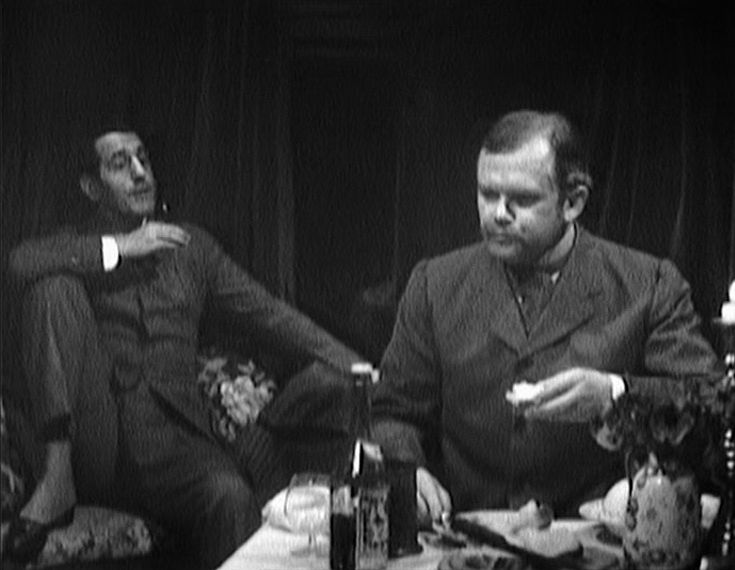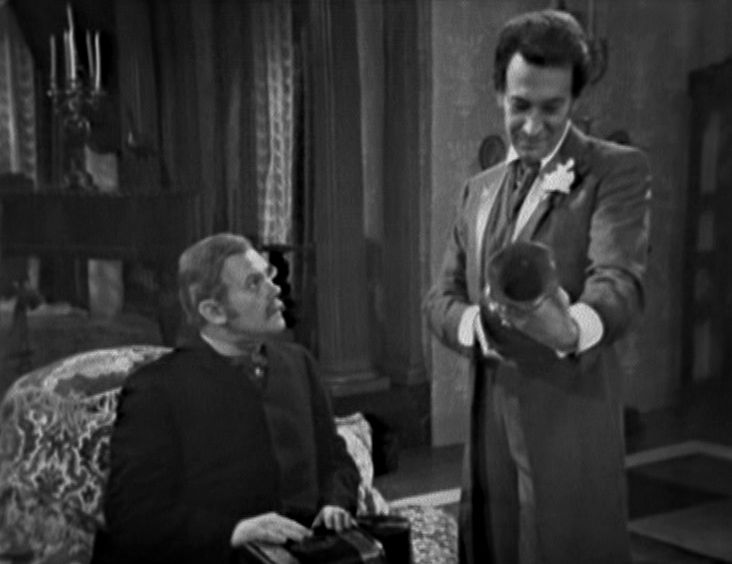
Douglas Wilmer in Sherlock Holmes – The Speckled Band

speckled

Helen Stoner (Liane Aukin) leads a lonely existence in the rambling home she shares with her remote, forbidding father Dr. Grimesby Roylott (Felix Felton). Over the last few years, she’s felt even lonelier – ever since her beloved sister Julia (Marian Diamond) died in very mysterious circumstances.

Julia had been engaged to be married and was due to shortly leave them – but tragedy struck before this could happen. And her last whispered words to her sister (“the speckled band”) have stayed with Helen ever since.

Shortly before her death, Julia was convinced that something would happen to her (she claimed to hear strange whistles in the dead of night, which she found very unsettling). Now, two years later, Helen is engaged herself and it seems that the same pattern is happening all over again. In desperation, she consults the one man who can help her – Sherlock Holmes.

One of the most famous of all the Sherlock Holmes stories, The Speckled Band was originally published in 1892. Given its enduring appeal, and the fact it’s an intriguing “locked room” mystery, it was an obvious story to kick off the series. Although when it first aired, in 1964 as part of the Detective series, it wasn’t a certainty that a series would be commissioned. But this was clearly successful enough to ensure that another twelve stories followed in 1965.

The first twelve minutes take place in and around Dr Roylott’s house at Stoke Moran. Although this means we have a little wait before we get to see Wilmer, this scene-setting works well, since it establishes the claustrophobic location (which is certainly dark and forbidding) as well as Holmes’ client Helen and her father, the tyrannical Dr Grimesby Roylott.

When we do see Holmes for the first time, it’s a very low-key appearance. Helen has already clearly outlined the facts of the case to Holmes and our first glimpse of Wilmer is just a back view. Watson (Nigel Stock) then enters the room, greets Helen as Holmes steps out the frame and tells the Doctor that Helen “has brought a strange and tragic tale to our breakfast table.”

Holmes then offers Julia some coffee, but his face remains unseen until Julia tells Watson that she trembles not through cold, but fear. The camera then switches to a close-up of Wilmer as he assures the woman that “you must not fear. We shall soon set matters to rights, I have no doubt.” It’s an unshowy, but impressive introduction.

If Nigel Stock sometimes ventures into Nigel Bruce territory (he can lack the subtlety that later Watsons, such as David Burke and Edward Hardwicke brought to the role) it’s also clear that even this early on, Wilmer is pretty much perfect. He displays many of Holmes’ key attributes during Julia’s consultation him (being both charming and aloof).

Liane Aukin is very appealing as Helen and Felix Felton invests Dr Roylott with just the right touch of mania. It’s pleasing to see that one of the signature moments of the story – Dr Roylott warns Sherlock Holmes off by pending a poker, which Holmes then straightens – is present, correct and done well (although the poker does seem to bend rather easily!)

Any Sherlock Holmes adaptation tends to stand and fall on the interaction between Holmes and Watson. The Granada Watsons (especially Hardwicke) expressed their dismay at how the character had sometimes been portrayed in the past (as a buffoon, basically). It seemed to them quite clear that Holmes wouldn’t spend his time with an idiot.

There’s a touch of the idiot with Stock’s portrayal – as Watson, musing on the case, tells Holmes that “if the lady’s correct and the window was shuttered and the door was locked, then no-one could have entered the room.” Holmes’ response (delivered so well by Wilmer) of “marvellous, Watson” is clearly ironic, but we’ll also see plenty of good humour between the pair as we proceed through the series.

A sinister, atmospheric story, The Speckled Band serves as a fine introduction to both Wilmer and Stock’s interpretations of Holmes and Watson.

Sherlock Holmes (BBC Douglas Wilmer series) – BFI DVD Review

wilmer

The Douglas Wilmer Sherlock Holmes series (broadcast during 1964 and 1965) wasn’t the first time that the BBC had brought the Great Detective to the screen. Alan Wheatley and Raymond Francis had starred as Holmes and Watson in a short series of six adaptations, broadcast live in 1951.

Wheatley would later call it the most difficult job of his career – the adaptations had been structured in such a way that little time was left for the actors to get from one set to the next or make costume changes. According to Wheatley, the worst example of this occured in one of C.J. Lejurne’s dramatisations when “in one particular scene she finished up with a sentence from me, and opened the next scene also with a sentence from me, in heavy disguise, with no time at all for a change!”

With no effective way for recordings to be regularly made from live broadcasts in the early 1950’s, we’ll never know exactly how good (or bad!) the 1951 series was, as no visual or audio record exists. But we’re much more fortunate with the Wilmer series – since eleven of the thirteen episodes exist in their entirety (later, we’ll discuss how the BFI have dealt with the two partly missing stories).

The stories adapted for the first series of Sherlock Holmes (a second, starring Peter Cushing as Holmes with Nigel Stock continuing as Watson was broadcast a few years later) are as follows –

The Speckled Band (18 May 1964). This was transmitted as an episode of the Detective series.

The Illustrious Client (20 February 1965)
The Devil’s Foot (27 February 1965)
The Copper Beeches (06 March 1965)
The Red-Headed League (13 March 1965)
The Abbey Grange (20 March 1965)
The Six Napoleons (27 March 1965)
The Man with the Twisted Lip (03 April 1965)
The Beryl Coronet (10 April 1965)
The Bruce-Partington Plans (17 April 1965)
Charles Augustus Milverton (24 April 1965)
The Retired Colourman (01 May 1965)
The Disappearance of Lady Frances Carfax (08 May 1965)

With the complete canon to cherry-pick stories from, the above list is an interesting selection. Some of the choices are no surprise, since they’re amongst the most popular of ACD’s tales (the likes of The Speckled Band, The Copper Beeches, The Red-Headed League, The Six Napoleons and The Man With the Twisted Lip) although it’s surprising that a few others (The Retired Colourman and The Disappearance of Lady Frances Carfax, for example) were chosen ahead of arguably stronger fare.

Of course, had the series continued, then maybe the ultimate aim would have been to record all of the fifty-six short stories and four novels. This is something that no British series has ever done (the Granada series with Jeremy Brett came close – but by the time Brett died, there were still more than a dozen unfilmed stories).

By the mid 1960’s, television no longer had to be transmitted live, since it was possible to pre-record. However, it was still often recorded “as live” (shot in long continuous takes with recording only pausing for serious technical problems or when it was impossible for the action to continue from one set to another without a pause).

01 - speckled
The Speckled Band

Sherlock Holmes, like the majority of BBC drama of the period, was made largely in the studio (captured on 405-line videotape with exteriors shot on film). Since videotape was very expensive, the tapes would be routinely wiped in order to record new programmes – so virtually everything that still exists from these years does so thanks to film copies that were made (either for overseas sales or because the programme was so technically complex that it had been decided to edit and transmit it from a film dub).

Anybody who knows a little about British television of this era will be aware that the survival rates of programmes can be frustratingly inconsistent – so we’re very lucky that virtually all of the Wilmer series exists (Cushing’s BBC Holmes run is sadly much less complete).

Something else which the archive television fan will be aware of is that the existing film prints of any series tend to vary in quality – which can be for several reasons. It may be because the prints were “biked” from country to country (when a particular country had finished broadcasting it, as per agreements with BBC Enterprises they then forwarded it onto the next country in the chain) and so the print would have suffered wear-and-tear (dirt, damage, etc). Or it might be due to the telerecording process used (The Speckled Band was the only one of the Wilmer series to be recorded with the ‘suppressed field’ process – a system that produces a noticeably lower picture quality).

The upshot is that whilst watchable, previous releases (such as the Region 1 DVD) left a little to be desired on the visual front. This BFI DVD features restored versions of all episodes and does offer a good upgrade. Although it’s true to say that it could be better (it’s not up to the standards of the frame-by-frame restorations and VidFIREd black & white Doctor Who stories, for example) it’s important to understand that the budget for restoration will only stretch so far.

If you have the BFI release of Out of the Unknown, then the restoration carried out here is comparable – certainly every story now looks better than it did on the Region 1 DVD and various picture flaws that were previously very evident (a tramline scratch on a long section of The Devil’s Foot, for example) have either been fixed or made much less obvious. With more time and money the episodes could have been improved even more – but when so many programmes of this era languish unreleased in the archive (and of the few that are released, many don’t receive any restoration) the picture quality of these episodes are generally very pleasing.  Peter Crocker, of SVS Resources, should be applauded for his efforts, considering the limited time and budget he had to work with.

If the improved picture quality is one reason to upgrade, then the strong selection of special features is certainly another. Chief amongst these are the inclusion of the existing footage from the two incomplete episodes – The Abbey Grange and The Bruce-Partington Plans (which is very welcome since neither story was represented on the previous DVD releases).

The first half of The Abbey Grange no longer exists, so it’s completed with a newly shot sequence of Douglas Wilmer reading an adaptation of the story. The second half of The Bruce-Partington Plans is missing from the archives and it’s been completed with an off-air soundtrack syncronised to extracts from the camera script. Neither is a substitute for having the complete episode (and it might have been wise to cut-down Wilmer’s piece to camera for The Abbey Grange) but it’s certainly much, much better than nothing.

Like Out of the Unknown, Toby Hadoke and producer John Kelly have assembled a mouthwatering series of commentary tracks with directors Peter Sasdy and Peter Cregeen as well as actors Douglas Wilmer, David Andrews and Trevor Martin across five episodes.

Wilmer’s involvement (on two commentaries, a 22 minute interview and the first half reading of The Abbey Grange) is particularly welcome. The BFI should be applauded for including so many good supplementary features, as these help to place the original programmes in their correct historical and cultural contexts.

From Tuesday onwards, I’ll be blogging a quick review of each story (where I’ll go into more detail about the merits of both Wilmer and Stock) but suffice it to say that if you’re a fan of Sherlock Holmes or simply a fan of 1960’s British television, then this is must buy. Good picture restoration and a quality selection of bonus features help to enhance a very strong series. Hopefully sales of this will be good enough to persuade the BFI that other BBC series of the same era deserve similar treatment.

But for now, I’d strongly recommend picking up a copy of this classic series.

Sherlock Holmes starring Douglas Wilmer (BBC 1964-1965) to be released by the BFI on R2 DVD (March 2015)

wilmer

It’s very welcome news that the BFI will be releasing the Douglas Wilmer Sherlock Holmes series on DVD next March.  Their press release reads as follows –

SHERLOCK HOLMES (4-DVD SET)

Sir Arthur Conan Doyle’s Sherlock Holmes: The Classic BBC TV series.

Regarded by many to be the best incarnation of the Baker Street sleuth, Douglas Wilmer gives a career-defining performance in this celebrated BBC series. Intelligent, quick on his heels, and bearing a striking resemblance to the original Sidney Paget illustrations, Wilmer’s portrayal as possibly the closest to Conan Doyle’s original vision that there has ever been. In 2012, his status as legend within the Sherlock pantheon was cemented when he was asked to make a cameo appearance in Sherlock with Benedict Cumberbatch.

The first story in the series, The Speckled Band, was originally produced as part of the BBC drama strand Detectives. Appearing alongside Wilmer, as Holmes loyal companion Dr John Watson, was the great Nigel Stock. Such was the success of the adaptation that Wilmer and Stock were reunited a year later for a full 12-part series. With a supporting cast that included Clochemerle star Peter Madden as Inspector Lestrade, TV veteran Derek Francis as Mycroft Holmes, and guest starts such as Peter Wyngarde (Department S, The Innocents) and Patrick Troughton (Doctor Who), the popularity of the series gave rise to a second series, in which the role of Sherlock was played by Peter Cushing.

Presented for the first time on UK DVD, this long-awaited release also includes an array of fascinating special features, including two reconstructions of partially-surviving episodes, an alternative presentation of the Detectives pilot, an alternative title sequence, an interview with Douglas Wilmer and a number of newly-recorded audio commentaries

Special features
Original 1964 Detectives pilot episode The Speckled Band
All surviving episodes from the 1965 series
Alternative Spanish audio presentation of The Speckled Band
Alternative title sequence for The Illustrious Client
The Abbey Grange episode reconstruction, featuring a newly-filmed sequence of Douglas Wilmer reading the first half of the story, followed by all surviving original footage
The Bruce-Partington Plans episode reconstruction, using all surviving original footage and original shooting scripts
Douglas Wilmer…on Television (2012, Simon Harries, 20 mins): the iconic actor discusses his career in British film and television
Five audio commentaries, including contributions from Douglas Wilmer and celebrated directors Peter Cregeen and Peter Sasdy, all moderated by actor-comedian Toby Hadoke
Fully illustrated booklet with new essays and full episode credits
UK | 1964-65 | black and white | English language, with optional hard-of-hearing subtitles | 650 minutes approx | Original broadcast ratio 1.33:1 | 4 x DVD9 | PAL | Dolby Digital mono audio | Cert: 12 | Region 2 DVD

Although the series has received a R1 release and a French R2 release, as the above indicates this will be the first UK release and the inclusion of the existing material from the two incomplete episodes as well as the Douglas Wilmer interview and commentaries are the icing on what looks like a very appealing cake.

A DVD review can be found here.

An Age Of Kings – Episode Nine – The Red Rose and the White (Henry VI Part One)

eileen atkins
Eileen Atkins

Henry VI Part One is generally considered to be the weakest of Shakespeare’s history cycle.  This might explain why, uniquely, it was the only play adapted for An Age of Kings to be condensed down to a single episode. This obviously meant that major cuts had to be made – the exploits of Talbot in France are completely removed as are all the battle scenes.  What remains are the verbal skirmishes between the nobles in England as they symbolically choose either white or red roses to mark their allegiance.

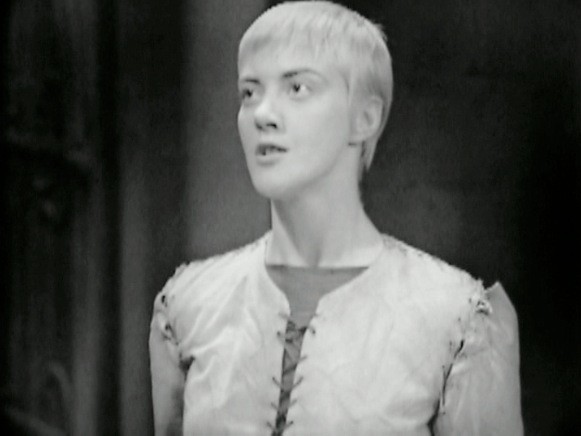
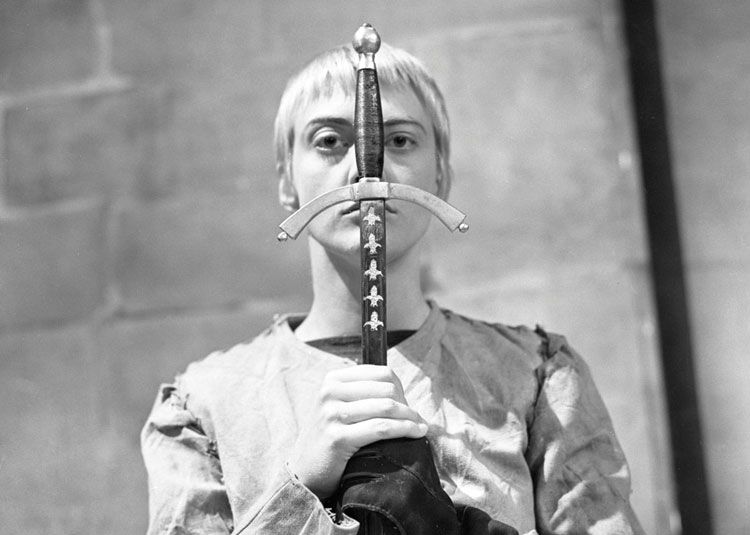
With the battles in France excised, what’s left are the scenes between the Dauphin (Jerome Willis) and Joan of Arc (Eileen Atkins).  These could have been cut too, which would have allowed all the events of the play to be centered in England, but I’m glad they were kept in.  Atkins gives a striking performance – her Joan is confident and self-assured and she easily captivates the Dauphin.

Dauphin, I am by birth a shepherd’s daughter,
My wit untrain’d in any kind of art.
Heaven and our Lady gracious hath it pleased
To shine on my contemptible estate:
Lo, whilst I waited on my tender lambs,
And to sun’s parching heat display’d my cheeks,
God’s mother deigned to appear to me
And in a vision full of majesty
Will’d me to leave my base vocation
And free my country from calamity:
Her aid she promised and assured success:
In complete glory she reveal’d herself;
And, whereas I was black and swart before,
With those clear rays which she infused on me
That beauty am I bless’d with which you see.
Ask me what question thou canst possible,
And I will answer unpremeditated:
My courage try by combat, if thou darest,
And thou shalt find that I exceed my sex.
Resolve on this, thou shalt be fortunate,
If thou receive me for thy warlike mate.

One of the drawbacks of such intensive cuts is that it severly reduces her role.  But the little we have of Joan is very impressive, all the more so since up until now there have been few decent roles for women in the history cycle.  Director Michael Hayes also creates some impressive shots – for example, when Joan’s nearly defeated and attempting to summon up demonic spirits to aid her, he zooms into her eyes and superimposes dancing figures onto her irises.  Such a trick would be commonplace now, but to achieve such an effect then and particlarly during a live broadcast is quite noteworthy.  Joan’s death is also another stand-out moment.  The flames are quite effective, as are her ear-splitting screams as the picture fades to black.

Back in England, the nobles are taking sides.  Given the cuts to the play and the number of characters we see, this isn’t particularity easy to follow and is probably one of the major drawbacks of condensing the play.  What is clear is that the Duke of Gloucester (John Ringham) is the protector of the young King, Henry VI (Terry Scully), and Winchester (Robert Lang) opposes Gloucester.

Both Ringham and Lang (familiar faces from previous episodes) give good performances and Scully manages (via his high-pitched tones) to indicate Henry’s youth and inexperience.  Another notable appearance is that of Mary Morris as Margaret, daughter of the Duke of Anjou.  Margaret would prove to be a major figure in the upcoming plays and Morris impresses here as she would do later on.  She was always an unusual actresses, with a style all of her own, and there’s more than a hint of that here.

Effectively, The Red Rose and the White stands as a prologue for the battles of the Wars of the Roses which will run for the remaining six episodes of the series.  It may not be the most distinguished part of An Age Of Kings, but thanks to some fine performances (particularly Eileen Atkins) it’s not without interest.

Next up – Episode Ten – The Fall of the Protector

An Age Of Kings – Episode Eight – The Band of Brothers (Henry V)

band

The Band of Brothers concludes the adaptation of Henry V.  It opens with the Chorus’ description of the English camp on the night before the Battle of Agincourt.  Henry (in disguise) moves around the camp to gauge the thoughts of his men.  One of them, Williams (another fine performance from Frank Windsor), is most eloquent on the subject of whether they are right to face the French on the following day.

But if the cause be not good, the king himself hath
a heavy reckoning to make, when all those legs and
arms and heads, chopped off in battle, shall join
together at the latter day and cry all ‘We died at
such a place;’ some swearing, some crying for a
surgeon, some upon their wives left poor behind
them, some upon the debts they owe, some upon their
children rawly left. I am afeard there are few die
well that die in a battle; for how can they
charitably dispose of any thing, when blood is their
argument? Now, if these men do not die well, it
will be a black matter for the king that led them to
it; whom to disobey were against all proportion of
subjection.

The next dawn dawns and Henry has one final chance to rouse his men before they do battle.  This is another of Shakespeare’s most famous speeches – the St Crispian’s Day speech – and Robert Hardy attacks it full-bloodily.

This day is called the feast of Crispian:
He that outlives this day, and comes safe home,
Will stand a tip-toe when the day is named,
And rouse him at the name of Crispian.
He that shall live this day, and see old age,
Will yearly on the vigil feast his neighbours,
And say ‘To-morrow is Saint Crispian:’
Then will he strip his sleeve and show his scars.
And say ‘These wounds I had on Crispin’s day.’
Old men forget: yet all shall be forgot,
But he’ll remember with advantages
What feats he did that day: then shall our names.
Familiar in his mouth as household words
Harry the king, Bedford and Exeter,
Warwick and Talbot, Salisbury and Gloucester,
Be in their flowing cups freshly remember’d.
This story shall the good man teach his son;
And Crispin Crispian shall ne’er go by,
From this day to the ending of the world,
But we in it shall be remember’d;
We few, we happy few, we band of brothers;
For he to-day that sheds his blood with me
Shall be my brother; be he ne’er so vile,
This day shall gentle his condition:
And gentlemen in England now a-bed
Shall think themselves accursed they were not here,
And hold their manhoods cheap whiles any speaks
That fought with us upon Saint Crispin’s day.

Whilst we’ve discussed before the problems of staging battles with such limited production resources, it’s disappointing that the Battle of Agincourt is so limply presented.  There surely should have been a way to present it better than this.  We see a shot of feet walking on the spot facing right and then switch to another shot of feet walking on the spot facing left.  The shot then cuts back and forward several times – which is meant to illustrate the two armies marching towards each other.  Then there’s a tight shot of soldiers engaged in a very slow battle, whilst Henry is placed in the foreground, looking towards the camera.  The whole battle sequence lasts only twenty seconds or so.

There’s a number of cuts to the text made – some scenes with Pistol, Gower and Fluellen are excised and Henry’s reaction (“I was not angry since I came to France. Until this instant.”) now occurs immediately after we’ve seen the luggage boys killed, which is used to underscore why he is so keen to ensure that not one Frenchman is left alive.

But the battle’s over, although it takes a little while for it to sink in. When Henry realises he’s won, he sinks to his knees and accepts the congratulations of Fluellen (Kenneth Farrington) who claims Henry as a true-born Welshman. With so much of Fluellen’s role cut (including his duel with Williams in Act Four, Scene Eight) it’s difficult for Farrington to make much of an impression – but at least he manages it here.

The confrontation between Fluellen and the “turkey cock” Pistol in Act Five, Scene One doesn’t play terribly well. Fluellen seems too aggressive and Pistol (George A. Cooper) plays it too broadly. It really needed a lighter comic touch than was presented here.  And given that many of Fluellen’s lines have been cut, it probably would have been better to lose this as well, since it really only works when we’ve seen more of Fluellen.

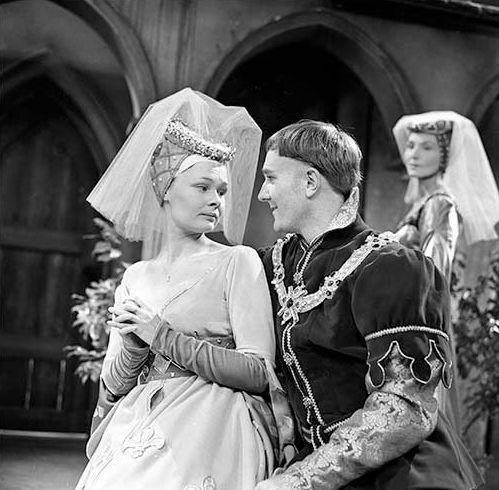
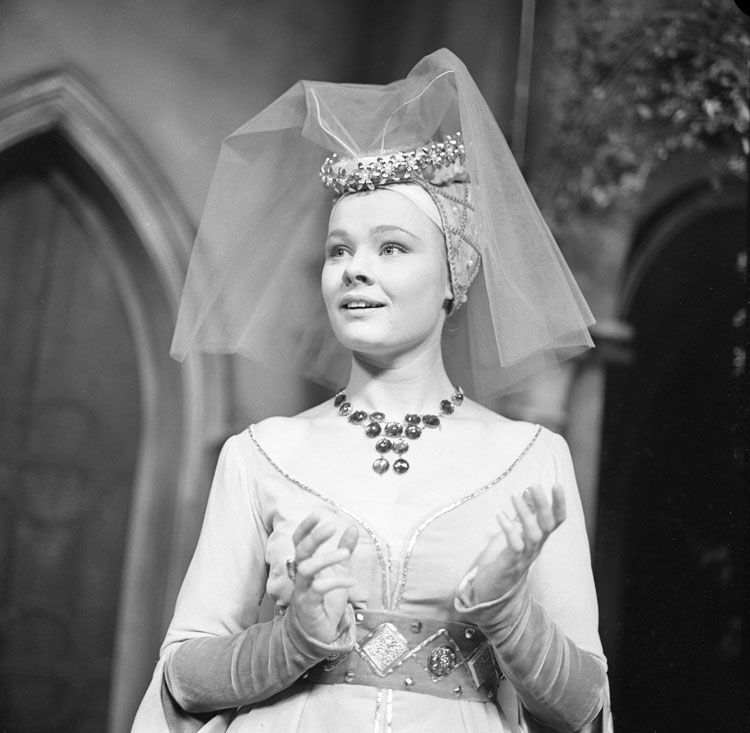
Things improve when we move to the French court and Henry attempts to woo Katherine. As with Signs of War, Judi Dench impresses as Katherine.  After their courtship, the Chorus returns to being the play to its conclusion by resting a hand on a coffin which contains Henry.  So as the Chorus concludes the tale of Henry V, Henry VI is waiting in the wings.

Next up – Episode Eight – The Red Rose and the White

An Age Of Kings – Episode Seven – Signs of War (Henry V)

Judi Dench
Judi Dench

Episodes seven and eight of An Age Of Kings adapt Henry V, one of Shakespeare’s most popular and enduring plays.  Possibly part of the reason for its appeal is that, like so many of Shakespeare’s works, it is open to various different interpretations.  It can be played as a straightforward heroic piece (as this adaption does) but it also contains darker sequences which explore both the folly and the bitter consequences of war.

The Henry presented across these two episodes is a fairly unambiguous character (similar to Olivier’s performance in his 1944 film) with many of the more questionable points concerning his conduct either downplayed or cut.  But although there are some trims, the bulk of the play is presented here very well – especially considering the limitations of the television studio.

Shakespeare was obviously aware of the problems that existed in attempting to re-create the battle of Agincourt on stage, so the Chorus appears at the beginning of the play to crave the audience’s indulgence in exercising their imagination.

But pardon, and gentles all,
The flat unraised spirits that have dared
On this unworthy scaffold to bring forth
So great an object: can this cockpit hold
The vasty fields of France? or may we cram
Within this wooden O the very casques
That did affright the air at Agincourt?
O, pardon! since a crooked figure may
Attest in little place a million;
And let us, ciphers to this great accompt,
On your imaginary forces work.

Given that this television play would also need to call on the audience’s suspension of disbelief, the Chorus is retained and, as played by William Squire, he is able to take us through the early action and operates as a narrator.  A more filmic dramatisation could have dispensed with this device, but the theatrical nature of this play suits the Chorus well.

Many familiar faces from previous episodes (John Ringham, Frank Windsor, Julian Glover, Jerome Willis, etc) fill out the minor roles and there are also several new faces, most notably Judi Dench as Katherine.  She has a single scene here, played with Stephanie Bidmead, and delivered entirely in French – but she manages to light up the screen even in such a short space of time.

Henry V is one of Shakespeare’s most quotable plays and one of the most famous speeches comes in the middle of this episode.

Once more unto the breach, dear friends, once more;
Or close the wall up with our English dead.
In peace there’s nothing so becomes a man
As modest stillness and humility:
But when the blast of war blows in our ears,
Then imitate the action of the tiger;
Stiffen the sinews, summon up the blood,
Disguise fair nature with hard-favour’d rage;
Then lend the eye a terrible aspect;
Let pry through the portage of the head
Like the brass cannon; let the brow o’erwhelm it
As fearfully as doth a galled rock
O’erhang and jutty his confounded base,
Swill’d with the wild and wasteful ocean.
Now set the teeth and stretch the nostril wide,
Hold hard the breath and bend up every spirit
To his full height. On, on, you noblest English.
Whose blood is fet from fathers of war-proof!
Fathers that, like so many Alexanders,
Have in these parts from morn till even fought
And sheathed their swords for lack of argument:
Dishonour not your mothers; now attest
That those whom you call’d fathers did beget you.
Be copy now to men of grosser blood,
And teach them how to war. And you, good yeoman,
Whose limbs were made in England, show us here
The mettle of your pasture; let us swear
That you are worth your breeding; which I doubt not;
For there is none of you so mean and base,
That hath not noble lustre in your eyes.
I see you stand like greyhounds in the slips,
Straining upon the start. The game’s afoot:
Follow your spirit, and upon this charge
Cry ‘God for Harry, England, and Saint George!’

This is a speech that defines Henry and Robert Hardy delivers it with passion and relish. The staging of the scene is done very effectively – the camera is placed behind a group of soldiers and Henry stands directly in front of them.  The camera therefore acts as a member of the crowd and the tight nature of the shooting helps to disguise the small scale of the set and the limited number of extras.

By the end of the episode we have reached the conclusion of Act III and the fields of Agincourt beckon.

Next Up – Episode Eight – The Band of Brothers

An Age Of Kings – Episode Six – Uneasy Lies The Head (Henry IV Part Two)

henry iv part 2

Uneasy Lies The Head concludes the tale of Henry IV Part Two.  As the episode opens, a sickly Henry (Tom Fleming) is still awake in the early hours of the morning and muses on why everybody should be asleep but he.

Canst thou, O partial sleep, give thy repose
To the wet sea-boy in an hour so rude,
And in the calmest and most stillest night,
With all appliances and means to boot,
Deny it to a king? Then happy low, lie down!
Uneasy lies the head that wears a crown.

As with the previous episodes, Fleming is very good and whilst he doesn’t have a great deal to do (this scene and his deathbed scene are his two main moments) he’s still compelling to watch.

But as with The New Conspiracy the focus of the piece (at the start anyway) is concerned with Falstaff’s misadventures.  But he’s met his comic match when he comes up against Justice Shallow (William Squire).  Squire delivers a fine performance as the fussy, reflective Shallow and he’s one of the highlights of Uneasy Lies The Head.

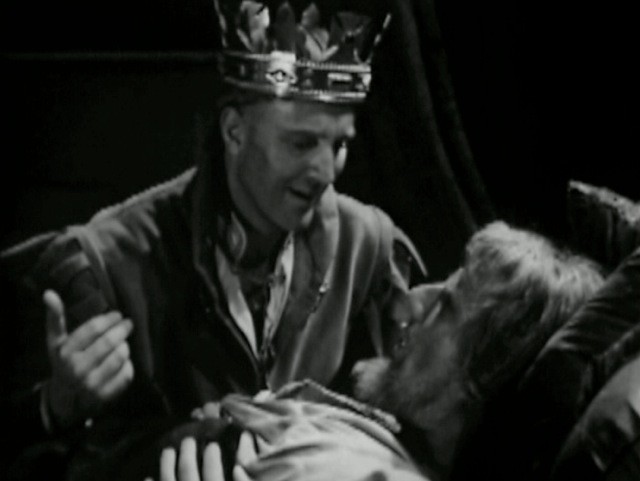
The heart of the piece, though, is the death of the King and Hal’s elevation to the throne.  Believing the King to be dead, Hal takes away the crown, but Henry still has breath in his body and is dismayed to find his crown missing.  Hal explains his actions (some quality acting here from both Robert Hardy and Tom Fleming) and they are reconciled just before Henry’s death.

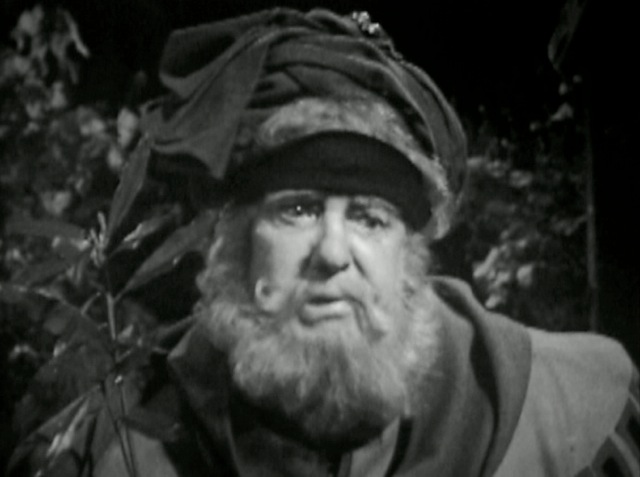
Once Hal has become King Henry V there is one important matter to be dealt with – that of Falstaff.  Although I can’t confess to have been greatly enamoured with Frank Pettingell’s performance during the last few episodes, he does manage to capture very well Falstaff’s shock and hurt when Henry publicly disowns him.  Hardy’s delivery here is spot on – and his journey from wastrel Prince to King Henry V is completed.

I know thee not, old man: fall to thy prayers;
How ill white hairs become a fool and jester!
I have long dream’d of such a kind of man,
So surfeit-swell’d, so old and so profane;
But, being awaked, I do despise my dream.
Make less thy body hence, and more thy grace;
Leave gormandizing; know the grave doth gape
For thee thrice wider than for other men.
Reply not to me with a fool-born jest:
Presume not that I am the thing I was;
For God doth know, so shall the world perceive,
That I have turn’d away my former self;
So will I those that kept me company.

As the credits roll, there’s one more surprise.  We see the actors removing their stage clothes and talking amongst themselves whilst the camera gradually focuses on William Squire.  Squire removes the white wig and false nose of Shallow and after the credits have finished he steps forward to deliver the epilogue of the play which promises the return of Falstaff (something which didn’t happen as Shakespeare obviously changed his mind – Falstaff dies off-stage in Henry V).

The breaking of the fourth wall is somehow in keeping with the theatrical tradition of the piece and it’s an interesting conclusion to the episode.

Next up – Episode Seven – Signs of War

An Age Of Kings – Episode Five – The New Conspiracy (Henry IV Part Two)

Frank Pettingell as Sir John Falstaff

The New Conspiracy picks up from where The Road To Shrewsbury left off.  The rebellion, lead by Hotspur, has been crushed but the danger to the King is far from over.  The Earl of Northumberland (George A. Cooper) and others still plot to overthrow him – but these machinations are very much placed in the background as this part of the play focuses on Falstaff and his friends.

Any scenes with Falstaff tend to be played very broadly, but Frank Pettingell does have some good actors to play off against.  Angela Baddeley (best known for playing Mrs Bridges in Upstairs Downstairs) has several lovely scenes opposite him, as does Hermione Baddeley as Doll Tearsheet.  George A. Cooper also manages to change performances totally (he’s the Earl of Northumberland at the start of the episode and the rampant Anicent Pistol at the end).  Geoffrey Bayldon, as the Lord Chief Justice, also gets to cross swords with Falstaff.  And Bayldon, like the majority of the actors, continues to impress me.

Robert Hardy, as Prince Hal, doesn’t appear until mid-way through the episode, but he still dominates proceedings.  There’s a certain steel in Hardy’s performance when he believes that Poins has been ill-using him (Falstaff writes that Poins has made it known that Hal will marry his sister, Nell – much to Hal’s surprise).  He also confides to Poins the reason why he isn’t outwardly grieving about his father’s ill-health.

PRINCE HENRY

By this hand thou thinkest me as far in the devil’s
book as thou and Falstaff for obduracy and
persistency: let the end try the man. But I tell
thee, my heart bleeds inwardly that my father is so
sick: and keeping such vile company as thou art
hath in reason taken from me all ostentation of sorrow.

POINS

The reason?

PRINCE HENRY

What wouldst thou think of me, if I should weep?

POINS

I would think thee a most princely hypocrite.

PRINCE HENRY

It would be every man’s thought; and thou art a
blessed fellow to think as every man thinks: never
a man’s thought in the world keeps the road-way
better than thine: every man would think me an
hypocrite indeed.

Although The New Conspiracy feels something like an interlude before the main action, it still moves along quite nicely – and is another step in the journey of Hal from Prince to King.

Next up – Episode Six – Uneasy Lies The Head

An Age Of Kings – Episode Four – The Road To Shrewsbury (Henry IV Part One)

hal

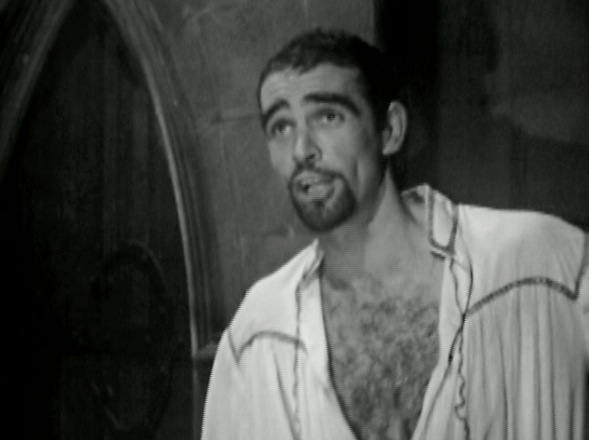
The Road To Shrewsbury opens with Hotspur (Sean Connery) enduring the boastful claims of his ally Owen Glendower (William Squire).  Although Glendower isn’t a large part, it’s a scene-stealing gift for any decent actor and Squire certainly takes advantage.  Although Squire was born in Neath, Glamorgan, few of his more familiar roles (he was probably best known for appearing opposite Edward Woodward in the Thames series of Callan) called on him to use a Welsh accent, so this is a good opportunity for him to act broadly Welsh.  Glendower is certainly a character that has, shall we say, a good opinion of himself.

Cousin, of many men
I do not bear these crossings. Give me leave
To tell you once again that at my birth
The front of heaven was full of fiery shapes,
The goats ran from the mountains, and the herds
Were strangely clamorous to the frighted fields.
These signs have mark’d me extraordinary;
And all the courses of my life do show
I am not in the roll of common men.

Hotspur seems unimpressed with such hyperbole and Connery plays this opening section well – capturing the mocking and insolent nature of Hotspur, which still manages to earn the respect of Glendower.

On the other side, Hal (Robert Hardy) is re-united with his father, the King (Tom Fleming).  Although Hal initially seems to be the same casual character we saw in Rebellion from the North, very quickly it becomes apparent that he’s now prepared to put aside his dissolute past and grasp his destiny.

I will redeem all this on Percy’s head
And in the closing of some glorious day
Be bold to tell you that I am your son;
When I will wear a garment all of blood
And stain my favours in a bloody mask,
Which, wash’d away, shall scour my shame with it:
And that shall be the day, whene’er it lights,
That this same child of honour and renown,
This gallant Hotspur, this all-praised knight,
And your unthought-of Harry chance to meet.
For every honour sitting on his helm,
Would they were multitudes, and on my head
My shames redoubled! for the time will come,
That I shall make this northern youth exchange
His glorious deeds for my indignities.

Although Connery is more central to the episode than Hardy (at least until the closing fifteen minutes or so), Hardy is more than able to make a favourable impression during these scenes with the King, and Tom Fleming as Henry IV continues to impress.

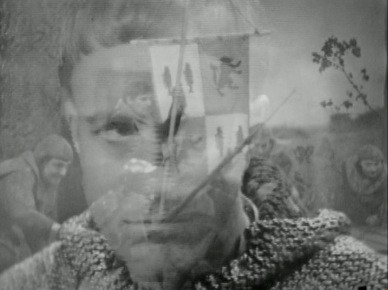
Battle scenes throughout An Age of Kings are always somewhat problematic.  The nature of live recording, small casts and the limited studio space are all factors which need to be appreciated.  There are a few interesting moments though – initially shots of the battlefield are overlaid on the faces of Hotspur and Hal, for example.

Elsewhere, the viewer is required to use their imagination that while they can hear an army offscreen, they can only see a handful of soldiers (this, of course, is a similar experience to watching the play on the stage).  Eventually, Hotspur and Hal meet and duel to the death.  Their sword-fight (not overly convincing it must be said) is inter-cut with shots of dead bodies on the battlefield and it’s noticeable that Hal’s killing thrust isn’t seen.  Was it deemed too violent for the times or did the camera just miss it?

Director Michael Hayes elects to end the episode on the battlefield dead, this time with snow overlaid, which is quite an effective ending.  Henry IV Part One has never been a favourite play of mine and this adaptation, whilst solid enough, hasn’t really changed my opinion on it, but it’s well worth watching for Connery and Hardy.

Next Up – Episode Five – The New Conspiracy

An Age Of Kings – Episode Three – Rebellion from the North (Henry IV Part One)

Hotspur (Sean Connery)

Episodes three and four of An Age of Kings contains virtually all of Henry IV Part One.  As episode three opens, we see that Henry IV (Tom Fleming) is still unsettled from the death of Richard II.  And a crusade to the Holy Land has to be postponed when trouble flares with Scotland and Wales.

The Percy family who helped him to the throne are becoming increasingly discontent, particularly Harry Percy (Hotspur), played by Sean Connery.  To add to Henry’s woes, his son Hal (Robert Hardy) is content to idle his time away in the taverns, consorting with the likes of Sir John Falstaff (Frank Pettineill).  But with Hotspur leading a rebellion against the King, Hal has to put aside his wastrel living and the two are fated to meet on the field of battle.

The opening line of the play is Henry’s “So shaken as we are, so wan with care” and this seems to be the case as Henry appears visibly aged and staggers when leaving at the end of Act One Scene One, holding onto his chair for support. His age and infirmity contrast with the youth and vigor of both Hotspur and Hal.

Rebellion from the North is driven by the performances of Connery and Hardy. Although he was not then, and never became, an experienced Shakespearean actor, Connery isn’t out of place here – as his charisma shines through.  He has several key moments in this episode such as when he confronts the King.  There’s an interesting shot as Hotspur walks around the table and blocks the King from our view. Given the somewhat frantic nature of live performance, this could be an error or it may have been an intentional move. His reply to Henry’s accusation that he failed to hand over the majority of the prisoners captured in a recent squirsish is a highlight of Connery’s performance.

My liege, I did deny no prisoners.
But I remember, when the fight was done,
When I was dry with rage and extreme toil,
Breathless and faint, leaning upon my sword,
Came there a certain lord, neat, and trimly dress’d,
Fresh as a bridegroom; and his chin new reap’d
Show’d like a stubble-land at harvest-home;
He was perfumed like a milliner;
And ‘twixt his finger and his thumb he held
A pouncet-box, which ever and anon
He gave his nose and took’t away again;
Who therewith angry, when it next came there,
Took it in snuff; and still he smiled and talk’d,
And as the soldiers bore dead bodies by,
He call’d them untaught knaves, unmannerly,
To bring a slovenly unhandsome corse
Betwixt the wind and his nobility.
With many holiday and lady terms
He question’d me; amongst the rest, demanded
My prisoners in your majesty’s behalf.

Whilst Hotspur dreams of conquest, young Prince Hal seems to have no further ambitions at the start of the play than purely pleasurable ones.  Hardy is effective as the wastrel Prince, although his performance does undercut the text from time to time as he already seems to have grown tired of his dissolute life and the company he’s been keeping.  Pettingell’s Falstaff is presented less as a close confident and more as a convenient crony since Hal is already biding the time when he will return to his father’s side.

If all the year were playing holidays,
To sport would be as tedious as to work;
But when they seldom come, they wish’d for come,
And nothing pleaseth but rare accidents.
So, when this loose behavior I throw off
And pay the debt I never promised,
By how much better than my word I am,
By so much shall I falsify men’s hopes;
And like bright metal on a sullen ground,
My reformation, glittering o’er my fault,
Shall show more goodly and attract more eyes
Than that which hath no foil to set it off.
I’ll so offend, to make offence a skill;
Redeeming time when men think least I will.

If Frank Pettingell is a slightly disappointing Falstaff (he lacks charm and humour and comes over as something of a bore), then Sean Connery and Robert Hardy are more than adequate compensation.  Running for just under 80 minutes, the episode ends at Act Two, which leads us onto the battlefield.

Next Up – Episode Four – The Road to Shrewsbury

An Age Of Kings – Episode Two – The Deposing of a King (Richard II)

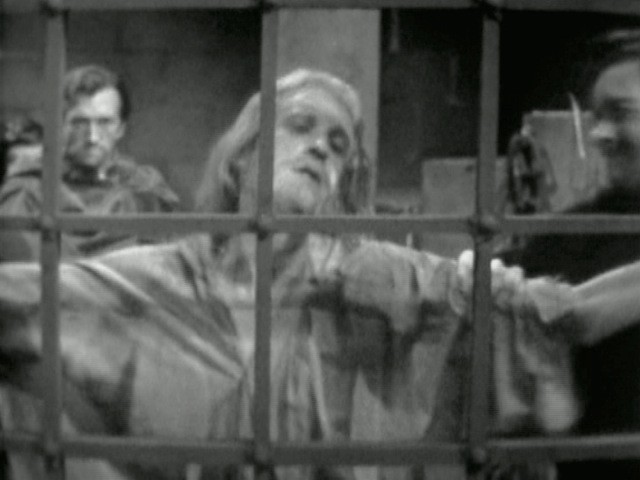
Richard is murdered by Exton (Robert Lang)

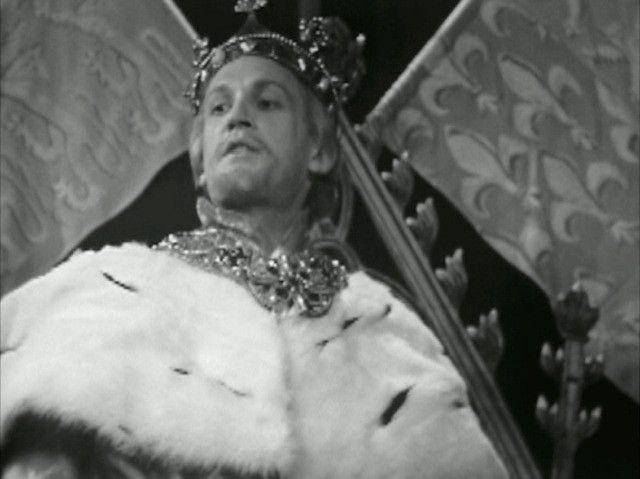
The Deposing of a King concludes the story of Richard II, begun in The Hollow Crown.  It quickly becomes apparent to Richard (David William) that Bolingbroke (Tom Fleming) holds such a strong position of power that he has no other course of action than to stand aside and offer the crown to him.  This is very much David William’s episode – he has the majority of the speeches and he’s very impressive as he divests himself of the duties of Kingship.

Early on, he muses about his fate –

What must the king do now? must he submit?
The king shall do it: must he be deposed?
The king shall be contented: must he lose
The name of king? o’ God’s name, let it go:
I’ll give my jewels for a set of beads,
My gorgeous palace for a hermitage,
My gay apparel for an almsman’s gown,
My figured goblets for a dish of wood,
My sceptre for a palmer’s walking staff,
My subjects for a pair of carved saints
And my large kingdom for a little grave

His best moments though, come in Act V Scene 5.  Richard is incarcerated in Pomfret Castle and considers his death, which he knows will shortly come.  Here, the limitations of live performance are used to the series’ benefit, as the whole scene (lasting over nine minutes) which encompasses his speech, a discussion with a friendly groom (Julian Glover) and his murder are played out with just a single camera.

Elsewhere, Frank Windsor, who impressed in The Hollow Crown, has another good scene here, as he defends Richard against Bolingbroke and the rest of the nobles.  Another small, but telling performance, comes from Gordon Gostelow as the gardener who breaks the news to the Queen that Bolingbroke has seized power.

Next Up – Episode Three – Rebellion From The North.

An Age Of Kings – Episode One – The Hollow Crown (Richard II)

david william
David William as Richard II

Episode One of An Age Of Kings adapts the first half of Richard II.  David William is Richard and he gives a decent performance in this first episode, as we see him move from regal majesty to arrogant petulance.  His performance isn’t quite perfect though – and he’s certainly better in the second episode – although his final scene here, as he laments his misfortunes, is a definite highlight.

For God’s sake, let us sit upon the ground
And tell sad stories of the death of kings;
How some have been deposed; some slain in war,
Some haunted by the ghosts they have deposed;
Some poison’d by their wives: some sleeping kill’d;
All murder’d: for within the hollow crown
That rounds the mortal temples of a king
Keeps Death his court and there the antic sits,
Scoffing his state and grinning at his pomp

The play opens with Bolingbroke (Tom Fleming) and Mowbray (Noel Johnson) who request an audience with the King to seek his advice in settling their dispute (Bolingbroke alleges that Mowbray has squandered monies which should have been spent on the Kings’ soldiers).  The two men find it impossible to resolve their differences, so a trial of arms seems to be the only course of action.  But just before the duel commences, Richard announces a different plan – banishment from the realms of England.  Mowbray is to be banished for life, whilst Bolingbroke is to leave the shores of England for ten years (later reduced by the King to six).

Both Fleming and Johnson are impressive in these early scenes, although the limitations of live television and the somewhat cumbersome nature of the cameras does become apparent since it’s several minutes before a camera is able to manoeuvre sufficiently to allow us a decent shot of Johnson (prior to this he’s only seen from the side).

Bolingbroke’s father, the Duke of Gaunt (Edgar Wreford) takes this news particularly badly and quickly sickens.  And it’s Richard’s decision, upon Gaunt’s death, to sieze his lands and money which sets in motion the chain of events which seal Richard’s fate.

Before that though, Gaunt delivers one of Shakespeare’s most memorable speeches (and it’s very well performed by Wreford).  Part of it is quite famous –

This royal throne of kings, this scepter’d isle,
This earth of majesty, this seat of Mars,
This other Eden, demi-paradise,
This fortress built by Nature for herself
Against infection and the hand of war,
This happy breed of men, this little world,
This precious stone set in the silver sea,
Which serves it in the office of a wall,
Or as a moat defensive to a house,
Against the envy of less happier lands,
This blessed plot, this earth, this realm, this England

What isn’t so well known is that the speech isn’t actually painting an idealised and romantic view of England, since Gaunt carries on to express his dismay at how the country is suffering under the reign of Richard.

This land of such dear souls, this dear dear land,
Dear for her reputation through the world,
Is now leased out, I die pronouncing it,
Like to a tenement or pelting farm:
England, bound in with the triumphant sea
Whose rocky shore beats back the envious siege
Of watery Neptune, is now bound in with shame,
With inky blots and rotten parchment bonds:
That England, that was wont to conquer others,
Hath made a shameful conquest of itself.
Ah, would the scandal vanish with my life,
How happy then were my ensuing death!

Also impressive in this episode is Geoffrey Bayldon as the Duke of York (who skillfully manages to smooth over a line fluff – as this is live television there will be more to come over the following weeks).  There’s also a certain pleasure in watching the likes of George A. Cooper (an actor who went on to have a long and varied career on television and is probably best known for playing the grumpy caretaker in Grange Hill) rubbing sholdiers with Sean Connery.  Connery (like Julian Glover) only has a few lines here, but we’ll hear a lot more from both of them in forthcoming installments.  Also impressive in a small role is Frank Windsor as the Bishop of Carlisle.

Act 1 Scene 2 (the Duke of Gaunt and the Duchess of Gloucester at the Duke of Lancaster’s palace) is excised from the adaptation.  This helps to speed up the play in the early stages as well as keeping the focus on Bolingbroke and Mowbray.

Next up – Episode Two – The Deposing of a King.

An Age Of Kings (BBC 1960) – Series Introduction

age of kings

An Age of Kings, broadcast on the BBC between April – November 1960, was an incredibly ambitious project.  All eight of William Shakespeare’s history plays were adapted in this series – across fifteen episodes – and each play (with the exception of Henry VI Part One) was split across two episodes.  Broadcast live, once a fortnight, An Age of Kings served as an excellent showcase for first rate cast, many of whom (Sean Connery, Judi Dench, Julian Glover, Robert Hardy, etc) were at the start of their impressive careers.

Producer Peter Dews had joined the BBC in 1957 and one of his first productions was an adaptation of Henry V.  This was a success and it paved the way towards a production of the entire cycle.

A core group of twenty or so main actors were engaged for the series.  Rather like a repertory company, they would play various roles in the different plays and therefore would be central in some and more peripheral in others.  Many of the actors recruited by Dews were veterans of the Old Vic and were therefore very familiar with the material.  Given the live nature of the transmissions and the quick turnaround (one episode to be broadcast every fortnight, each running for between 60 and 80 minutes) this was essential.

Once production began, the actors had four days to learn their lines – and then they would have a weeks rehearsal.  On transmission days there would be camera rehearsals throughout the day, before the live transmission at 9.00 pm.

Despite very favourable newspaper reviews, the series was repeated only once in the UK (in 1962).  After that it remained unavailable until it was released on DVD in R1 a few years ago whilst in 2013 it was released in R2 by Illuminations Media.

Over the course of the next few weeks I’ll blog a short overview of each episode.  So let’s start with episode one – The Hollow Crown.

Softly Softly: Task Force – Series 1 (BBC 1969-1970)

packshot

Softly Softly:Task Force was a spin-off from Softly Softly (which in turn was a spin-off from Z Cars) and was launched on BBC1 in late 1969. Although branded as a new series, Task Force was, in production terms, a continuation of Softly Softly.

Stratford Johns (Barlow), Frank Windsor (Watt) and Norman Bowler (Hawkins) were the three characters from Softly Softly who crossed over into the new series. They were joined by a host of new faces, including Walter Gotell as Chief Constable Cullen, Terence Rigby as PC Snow, David Lloyd Meredith as Sgt Bob Evans and Susan Tebbs as DC Donald.

Walter Gotell as Chief Constable Cullen and Stratford Johns as DCS Barlow

The first series ran for sixteen episodes and generally the quality is very high. Quick capsule reviews  –

Arrival sees Charlie Barlow take up his new position as DCS of the newly formed Task Force based in Thamesford. Whilst most of the running time is taken up with Barlow investigating his surroundings there is a secondary story about a missing child with a bleak conclusion.

Next up is Exercise which sees John Watt arrive to lead Task Force 1. Shortly after his arrival the squad are deployed to investigate a stabbing. There’s a nice guest turn from Barry Jackson in this one and some needle between Barlow and Watt.

There’s a good role for Susan Tebbs, as DC Donald, in Diversion.  Brian Croucher guest stars.

The first few episodes are concerned with the Task Force team and the crimes are very much secondary. The Spoilt Ones is a change of pace as the miscreants are the focus (lovely, grimy, performance by John Bennett).

Stratford Johns is outstanding in To Protect the Innocent. Given the large cast, no one character dominates each episode, but each one where Barlow is centre-stage are highlights for me.

Any Other Night. The theft of a number of tyres from the police depot is an embarrassment. The fact it happens on New Years Eve is another irritation. A routine episode, but it has some good character moments.

The spectre of football hooliganism is tackled inThe Aggro Boy. A fascinating look at the run down state of British football in the late 60’s/early 70’s. Interesting time capsule.

Frank Windsor as Det Sup John Watt and Stratford Johns as DCS Barlow

Another hot topic of the time, union unrest, is tackled in the episode Standing Orders. Fairly routine stuff, enlivened by an early appearance from Katy Manning.

Another good turn from Stratford Johns in Private Mischief. A straightforward tale, but not without interest.

Open and Shut. It seems like a simple case, but first appearances can be deceptive. A station-based, procedural episode, this is a good character piece.

An undercover operation at the docks leads to the uncovering of an illegal immigrant ring in Sprats and Mackerels. Plenty of familiar faces in roles of varying sizes (Kenneth Cranham, Sally Geeson, Joe Gladwin, Christopher Benjamin).

Like Any Other Friday is one of the lesser episodes on this release. A blink-and-you’ll-miss-him appearance from Tom Baker is one of the few items of interest here.

Things immediately pick up with Power of the Press though. It’s another Barlow-centric episode with Stratford Johns once again on great form. And here he has an opponent of equal weight – Ronald Radd as the corrupt Councillor Whitaker. The original Hunter, opposite Edward Woodward in Callan, Radd was a quality actor and it’s a pleasure to see him in opposition to Johns. Probably the best episode of the first series.

Susan Tebbs as DC Donald

Trust a Woman. Another good, but not spectacular, episode. A nice guest turn from Imogen Hassall is the highlight here.

The Hermit. A straightforward, but engaging, story about a gang of fraudsters preying on the elderly and vulnerable. Another very watchable episode.

The final episode of series 1 is Escort. Whilst it’s a bit of a runaround, it’s worth it for the last ten minutes or so.

Overall, this is a very good collection of episodes. There are a few lesser ones, but generally the hit rate is very high and the quality of the guest and regular casts make this a very enjoyable watch.

Sadly, the initial release from Simply was somewhat flawed as all the episodes had an unintentional “filmising” effect. There was a repress, but the “filmising” effect was still present on three episodes. There was then a second repress in February 2014 which finally sorted things out.

Whilst I would unreservedly recommend this series, there may still be uncorrected copies out there, so purchasers may wish to be wait until they have gone out of circulation. Simply did have an exchange program and if you do have a faulty release it might be worthwhile to contact them to see if it’s still running.

For the record, the address for returns was – Simply HE, FREEPOST RSYX-ERKC-CJJH, Ringwood, BH24 1HD.

Encoding issues apart, for anybody who enjoys British police drama from this era, SS:TF is well worth a look.