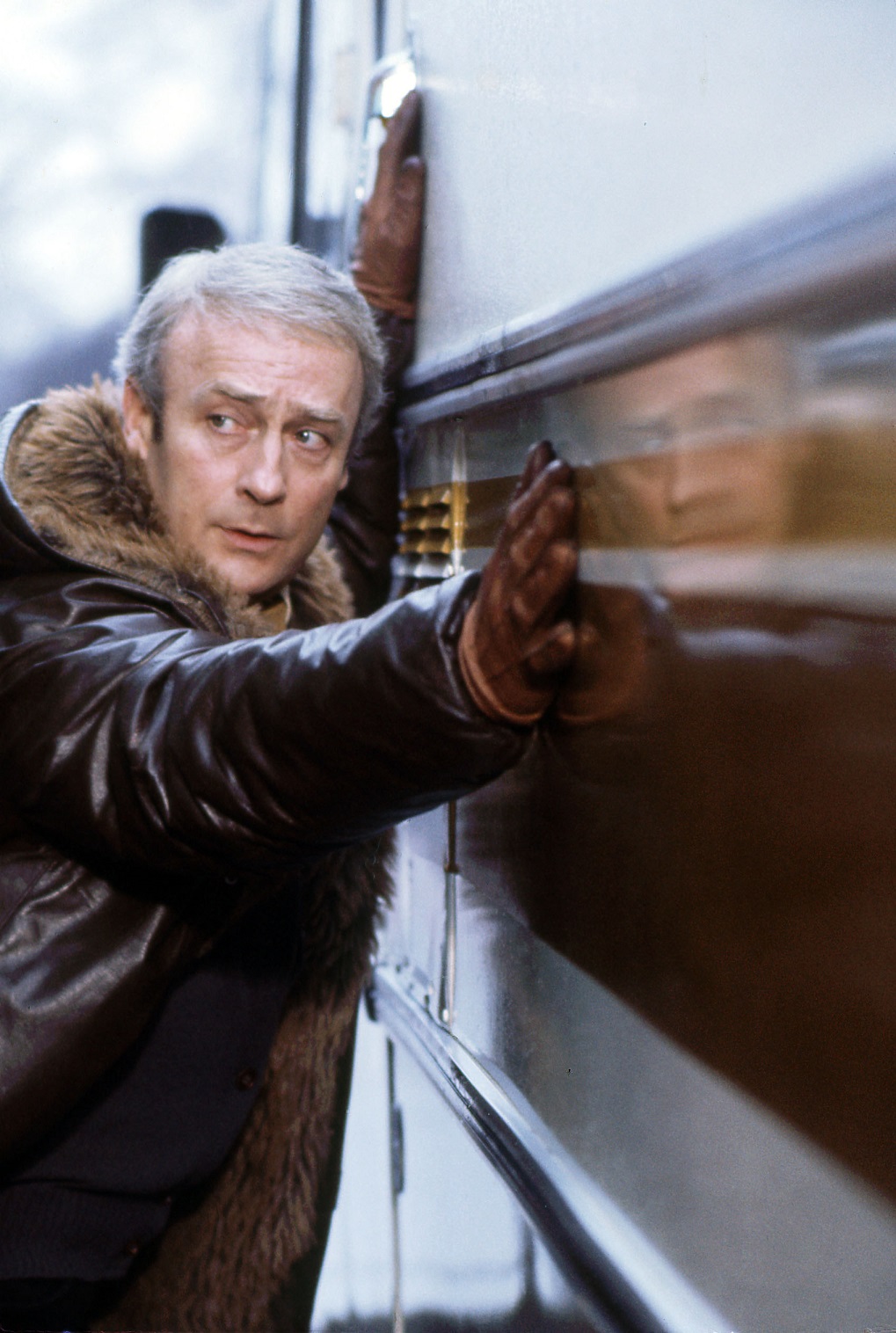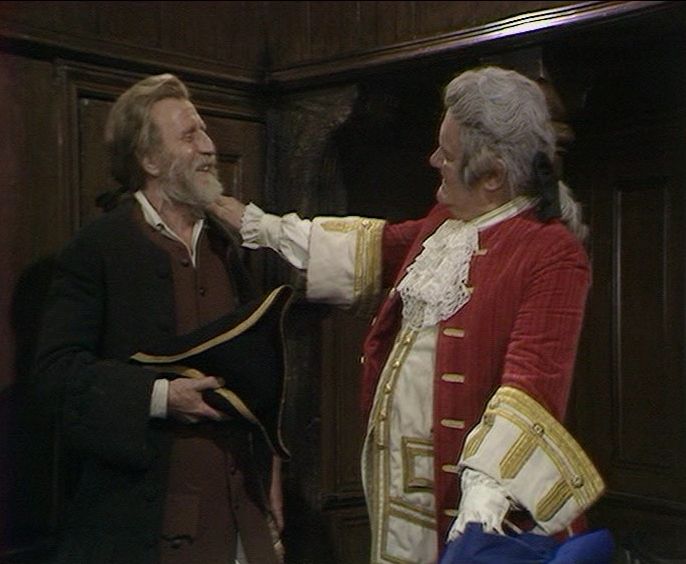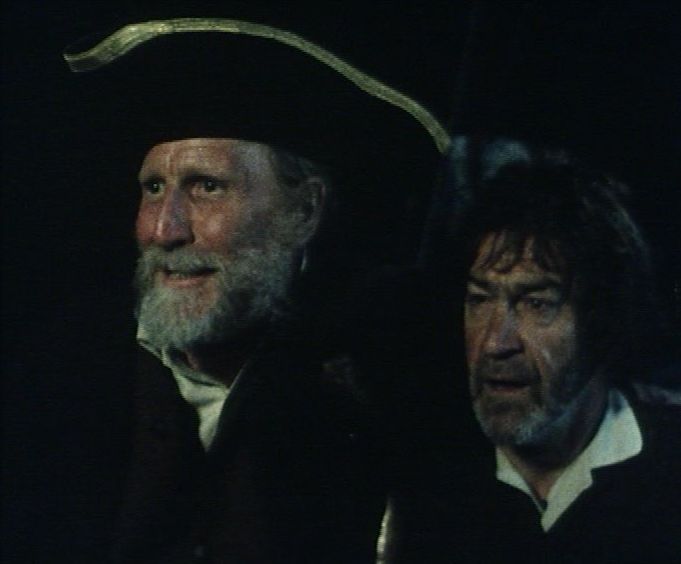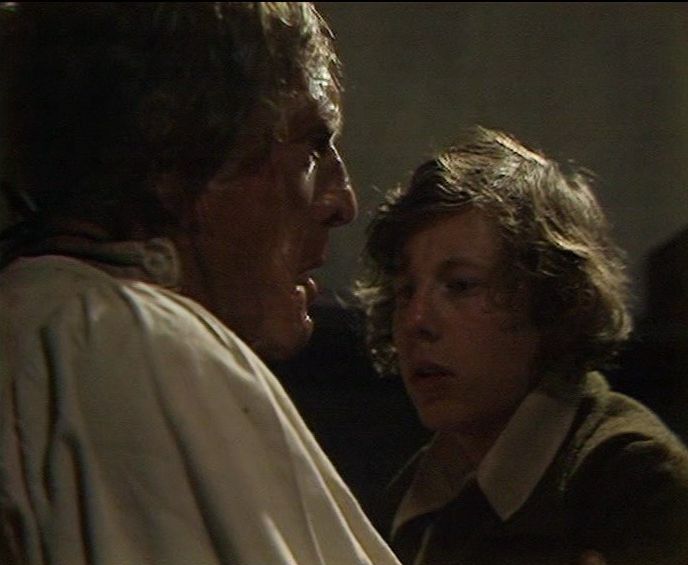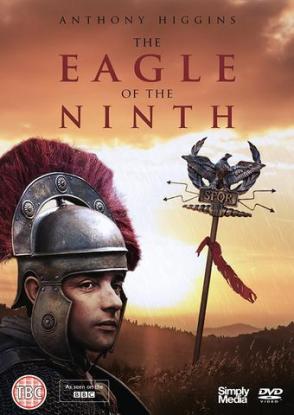
The Eagle of the Ninth – Simply Media DVD Review

eagle.jpg

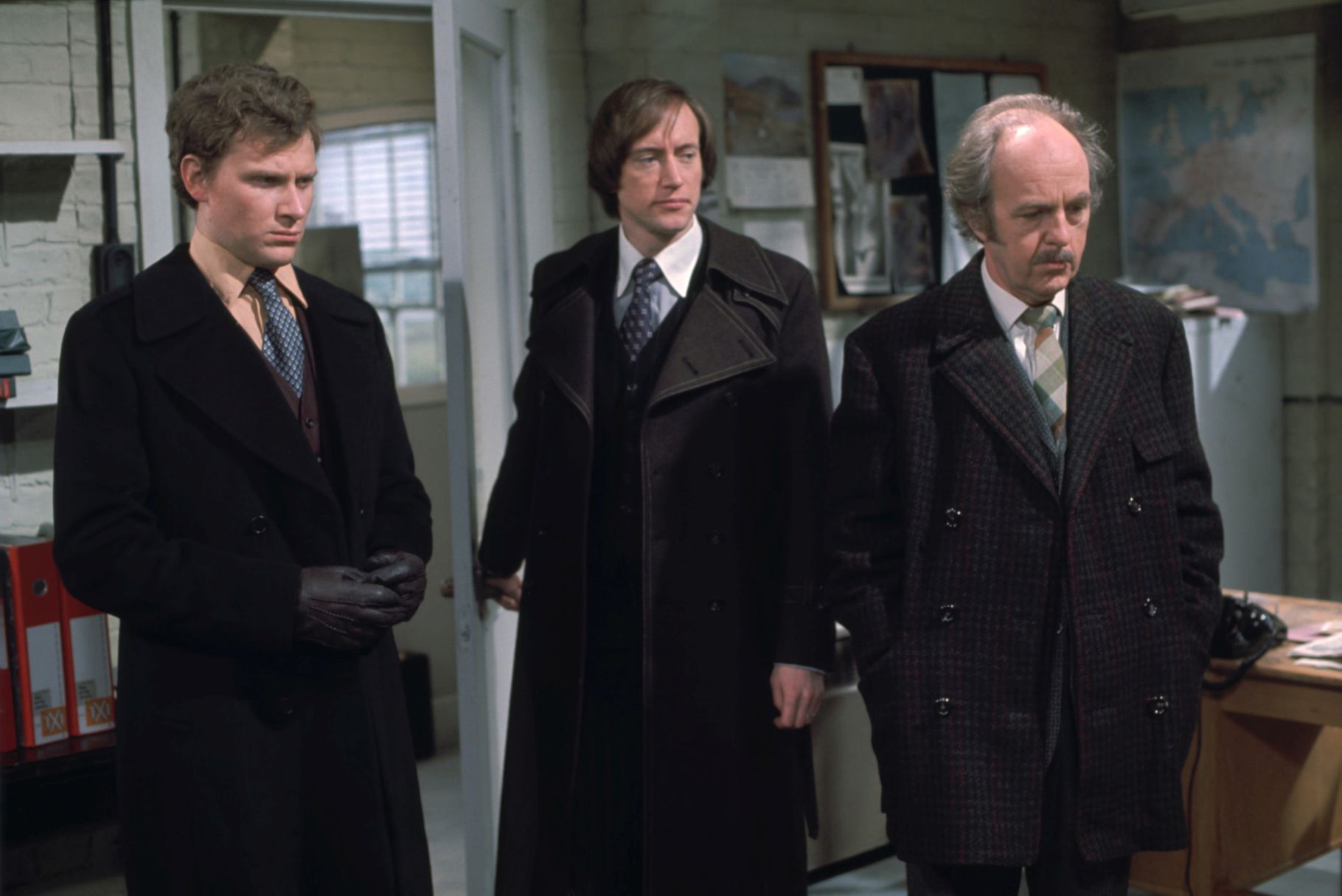
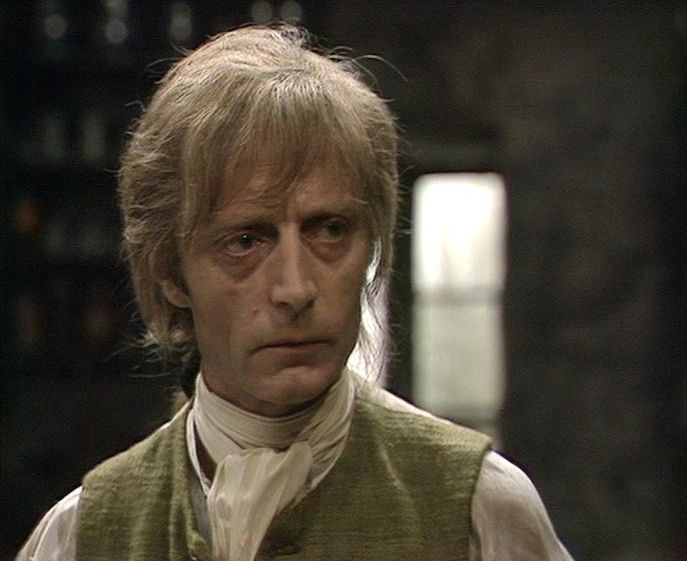
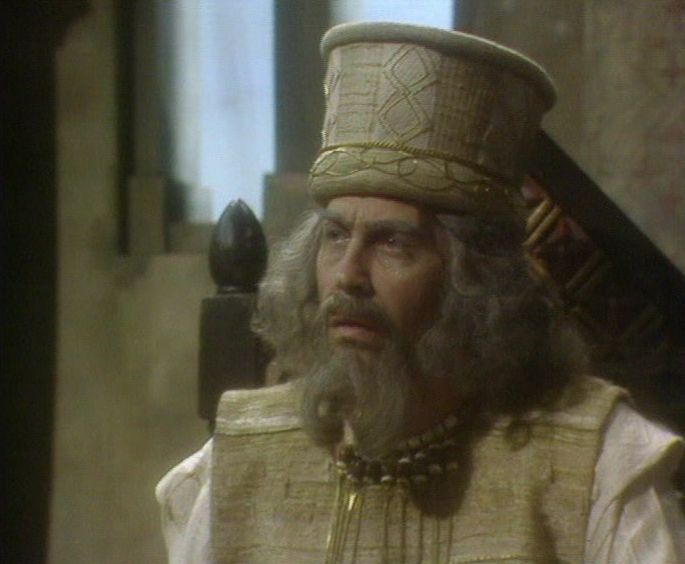
The year is 119 AD.  Former Roman officer Marcus Flavius Aquila (Anthony Higgins) is haunted by the fate of his father’s legion, the Ninth.  Four thousand men had been dispatched to fight the Caledonian tribes in Northern England, but they all vanished without trace.  Adopting the disguise of a Greek oculist and accompanied by the faithful Esca (Christian Rodska), Marcus is determined to locate the Ninth’s Golden Eagle, which symbolises the honour of the legion, and bring it back home.

Originally published in 1955, The Eagle of the Ninth was a children’s historical adventure novel written by Rosemary Sutcliff.  A prolific author, The Eagle of the Ninth has to rank as one of her most enduring works.  And although the bulk of her output was written for a juvenile audience, Sutcliff once stated that she wrote “for children of all ages, from nine to ninety”.

That her stories had universal appeal is demonstrated by this adaptation, which ran for six episodes during 1977.  Broadcast in the Sunday Classic Serials slot, there’s no sense that it was specifically tailored for a younger audience.  As was usual for adaptations from this era, it sticks pretty closely to the original source material (whereas the recent film – The Eagle, starring Channing Tatum – took more liberties and therefore rather diluted the impact of Sutcliff’s tale).

Episode one opens twelve years after the disappearance of the Ninth.  Marcus arrives in Britain to take up charge of an isolated garrison.  He’s still a little touchy about his father’s fate, but the rebellious Britons massing outside the fort might be more of an immediate problem.

eagle 01
Anthony Higgins

There’s some familiar faces lurking inside the garrison, such as the blunt Drusillus (played by Bernard Gallagher).  Gallagher, probably best known for appearing in the first few series of Casualty, gives Drusillus an entertaining dose of weary cynicism – he’s an older and a much more experienced soldier than Marcus, but it’s Marcus who’s in charge.

This first episode – Frontier – also boasts an early television appearance from Patrick Malahide, as Cradoc.  You may have to look twice to find him though, as he’s almost unrecognisable thanks to an impressive wig and beard.  Marcus attempts to foster good relations with Cradoc, a notable local, but his friendly entreaties are in vain.

Anthony Higgins impresses right from the start.  Marcus might be young and inexperienced, but he’s also honest and heroic, so it therefore seems natural that we immediately side with him against the influx of hairy tribesmen.  The episode has a generous film allocation, although the scenes of the tribesmen attacking the fort do look slightly comic (and tight camera angles have to be used in order to hide how few extras were available).  The hand to hand fighting is nicely directed though.

The injuries suffered by Marcus during the attack have left him unable to walk which means that his time as a soldier has come to an end.  Whilst recuperating at his uncle’s farm, they both elect to visit the local amphitheatre.  It’s not the coliseum, but it does introduce us to two important characters –  Esca and Cottia (Gillian Bailey).

eagle 02
Gillian Bailey

Esca is toiling in the pit – locked into a fight to the death with another slave – whilst Cottia, like Marcus, is a slightly queasy spectator (both were perturbed by the sight of a bear being gored to death).  When Esca is beaten, the crowd – overcome by bloodlust – all place their thumbs downwards, signifying that Esca should be put to death.  We can forgive this anachronstic moment – since it was widely believed to be accurate at the time – although quite how Marcus was able to persuade the crowd en-masse to spare Esca is a bit of a mystery.

Marcus needs a body slave and buys Esca.  Their relationship is a key part of the story and the interaction between Higgins and Rodska works well throughout the serial.  Esca is initially reserved and bitter, but it isn’t long before the pair form a tight bond.  Gillian Bailey also impresses as the proud Cottia.  She rails against being forced to act like a Roman maiden, rather than the Iceni tribeswoman she actually is.  There’s a lovely moment when, anxious to see the ill Marcus, she bites the arm of a slave blocking her way!

The second half of the serial sees Marcus and Esca set out to find the Eagle of the Ninth.  This quest results in Marcus suddenly gaining a rather unconvincing beard (but then fake face fungus can be found in most classic serials of this era).  He’s also haunted in his dreams by the long-dead soldiers of the Ninth – in his imaginings they’re a legion of walking skeletons (a brief, but quite effective nightmarish scene).

The Eagle of the Ninth was made in the usual way for a production of this era – film for the exteriors and videotape for the interiors.  Picture quality is as you’d expect for something that’s forty years old – some of the early film inserts are a little grubby and the studio scenes are a little soft – but overall it’s quite watchable.  Production design is very sound throughout, especially the studio farmhouse which features in several episodes (nicely designed by Campbell Gordon).

Although the serial features a number of battle scenes, this isn’t an action story – it’s more of a reflective, character-driven drama.  According to this webpage, Rosemary Sutcliff not only loved the adaptation, but was so taken with Higgins’ performance that she kept a photograph of him on her writing desk for decades afterwards.

It may be true that some of the tribal antics (and beards) are a little unconvincing, but overall this is a literate and well acted production which transcends its limited budget.  Running for six 30 minute episodes (spread across two discs) it’s released by Simply Media on the 16th of January 2018 and can be ordered directly from them here.  RRP £19.99.

eagle 03
Christian Rodska

Ivanhoe – Production Stills

A collection of production stills from Ivanhoe.

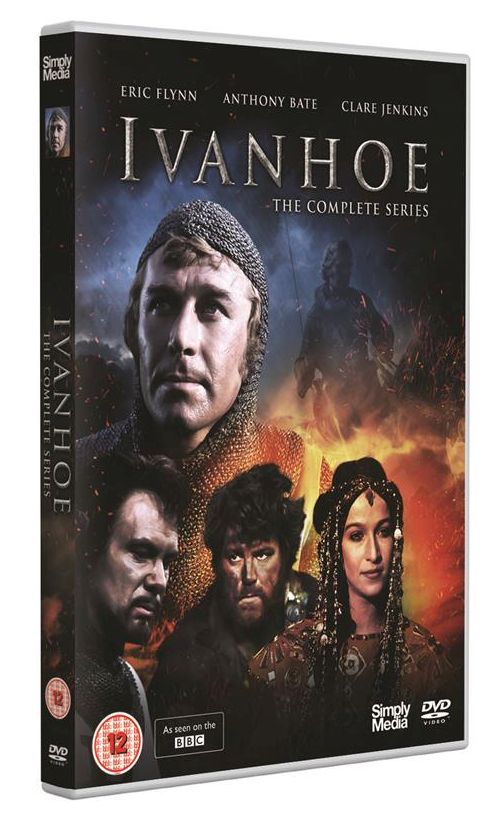
Ivanhoe – Simply Media DVD Review

The year is 1194.  Sir William of Ivanhoe (Eric Flynn) has returned home to England following the disastrous Third Crusade in Palestine.  Ivanhoe’s father, Cedric (Peter Dyneley), one of the few remaining Saxon nobles in an England now dominated by the Normans, has broken off relations with his son due to Ivanhoe’s support for King Richard.

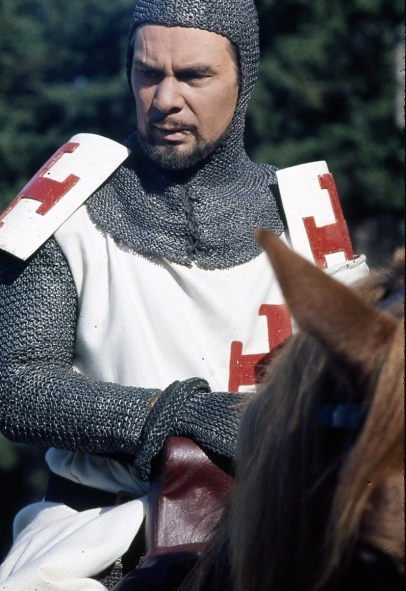
The young Ivanhoe doesn’t seem too disheartened by this familial disapproval though, as he has scores to settle – most notably with Sir Brian de Bois Guilbert (Anthony Bate), a member of the Knights Templar.  They will not only clash on the tournament field but also off it and two desirable young women – the Lady Rowena (Clare Jenkins) and Rebecca (Vivian Brooks) – will both have parts to play in their bitter feud.

Meanwhile, King Richard and Prince John find themselves locked in a grim battle for control of the English throne ….

Published in 1820 across three volumes, Ivanhoe – A Romance has proven to be one of Sir Walter Scott’s most enduring works.  Its mixture of Medieval derring-do and romance is an intoxicating one, with numerous film and television adaptations serving as a testament to the timelessness of the story.

Possibly one of the most notable things about Ivanhoe is how Scott’s novel helped to solidify the modern myth of Robin Hood.  Robin (referred to as Locksley for most of the serial) appears throughout and his characterisation here – a freedom fighter first, an outlaw second – chimes with how we view Robin today (the Robin Hood of the earlier ballads was a much less likeable and noble chap).

Scott wasn’t the first writer to set the struggles of Robin Hood during the reign of Richard I, but this story undeniably helped to create the template which many in the future would emulate.  Certain aspects of the Robin Hood myth are established here – most notably the way that Robin splits the arrow of his challenger during a test of skill.  It’s also interesting how subsequent writers took aspects of Ivanhoe’s character – his return to England from the Crusades, for example – and grafted them onto Robin.

The opening episode wastes no time in creating a sense of place and time. With the rightful King of England, Richard, believed to be languishing in a foreign jail, his brother John sees an opportunity to sieze power. The downtrodden Saxons find themselves suffering under the rule of the Normans, whilst Sir Brian casts a baleful shadow over proceedings.

hi014546802-e1504956112893.jpg
Anthony Bate

Right from his first appearance, Anthony Bate impresses as Sir Brian. Although Bate tended to play establishment types and professional men, he throws himself into this role – a black-hearted villain, albeit one with his own code of honour – with gusto.  Eric Flynn, as Ivanhoe, is perfectly cast as the square-jawed hero. Whilst it’s true that Bate, as befits a baddy, has the more interesting role to play, Flynn has a boyish charm which suits the character.

Ivanhoe’s first acknowledged appearance is held back until the end of the opening instalment (although it’s rather obvious that the mysterious hooded pilgrim who makes several enigmatic comments throughout the episode is Ivanhoe). That he and Sir Brian (bitter rivals from the Holy Land) happen to run into each other at the castle of Ivanhoe’s estranged father is something of a coincidence ….

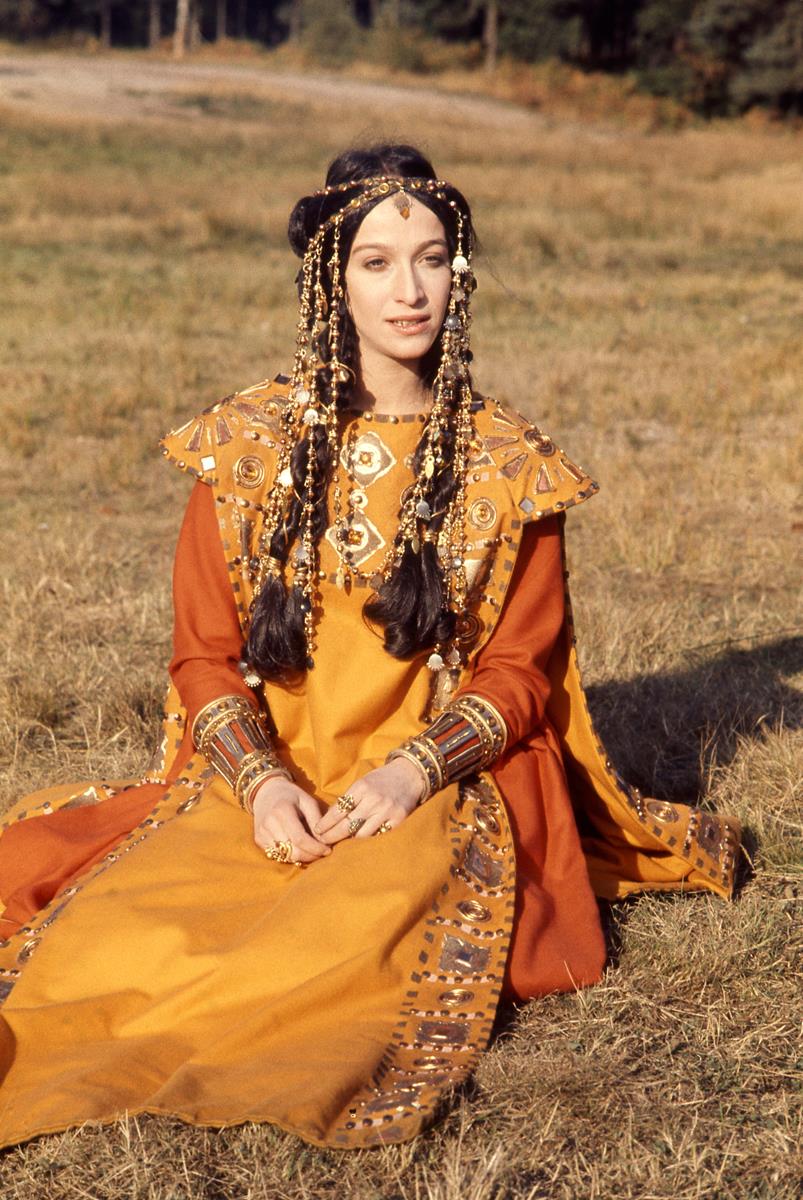
Clare Jenkins, as Rowena, makes for a very appealing herione (coincidentally she and Flynn had appeared together a few years earlier in the Doctor Who story The Wheel In Space). Rowena and Ivanhoe are in love but he has a challenger for Rowena’s affections, the arrogant de Bracy (David Brizley), a Norman lord.

Rebecca (Vivian Brooks), daughter of the despised Jewish moneylender Isaac of York (John Franklyn-Robbins), is somewhat taken with Ivanhoe (she nurses him back to health after Sir Brian gains the upper hand during Prince John’s tourney) but she’s doomed to be unsuccessful as Ivanhoe only has eyes for Rowena.  Sir Brian later attempts to woo Rebecca, but she shuns his advances.

Ivanhoe was Vivian Brooks’ third and final television job (following appearances in Thirty Minute Theatre and Z Cars).  It’s a slight mystery why she didn’t go on to have a longer career as she’s really rather good here, especially when she and Bate cross verbal swords. Brooks may have been very inexperienced compared to Bate, but she more than holds her own during the scenes where Sir Brian and Rebecca warily circle each other.  Vivian Brooks certainly has the meatier of the two main female roles (Clare Jenkins’ Rowena doesn’t have a great deal to do except pine for Ivanhoe).

Vivian Brooks

Although Vivian Brooks only racked up a handful of credits, most of the other main roles were filled by very familiar faces.  That Ivanhoe was directed by David Maloney should be fairly obvious by taking a quick glance at the cast list.  The likes of Graham Weston, John Franklyn-Robbins, Tim Preece, Michael Napier Brown, Bernard Horsfall, Noel Coleman and Hugh Walters had already appeared or would later appear in other productions directed by Maloney.  David Maloney, like many other directors, tended to use a “rep” of actors – dependable people he knew would deliver the performances required.

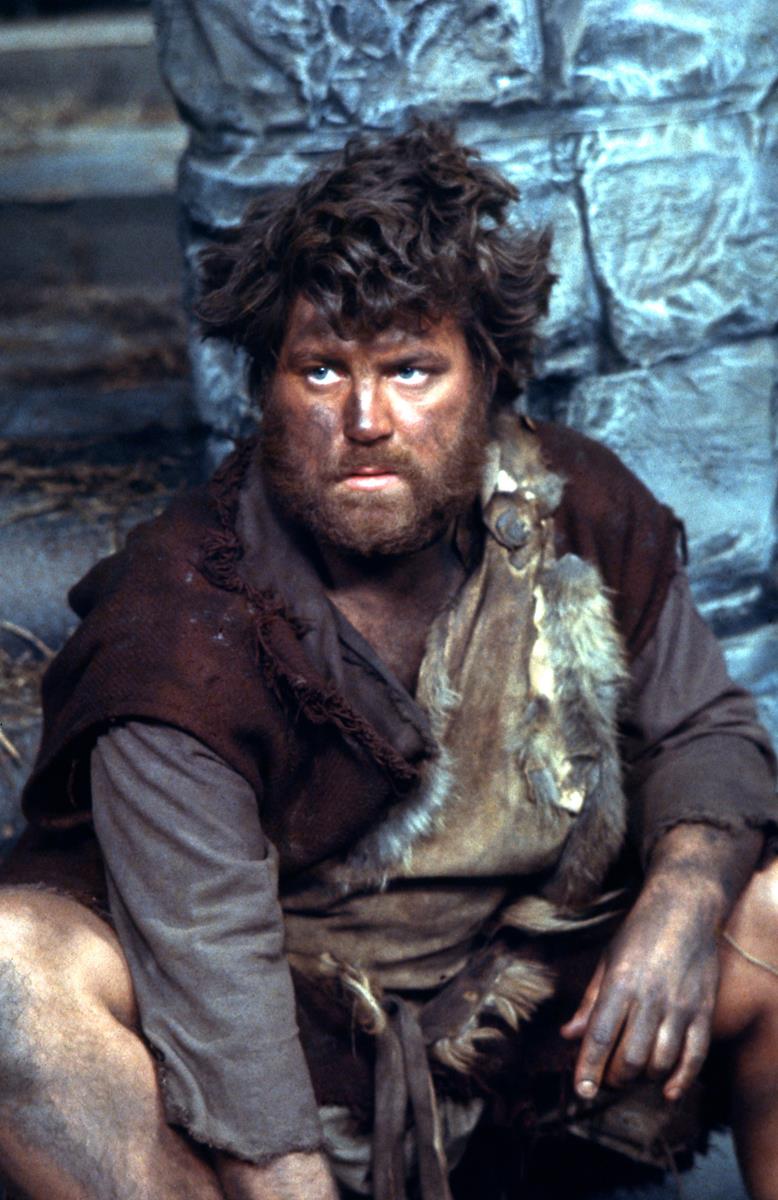
The strength in depth of the cast is one of the reasons why this serial works as well as it does.  Tim Preece entertains as the capacious and vain Prince John, Hugh Walters is pleasingly off-kilter as Cedric’s fool Wamba, Bernard Horsfall is suitably imposing as the Black Knight, John Franklyn-Robbins impresses as the persecuted Isaac and Noel Coleman is characterically strong as Fitzsurse, one of John’s advisors.  Clive Graham, as Locksley, also offers a vivid performance and it’s always a pleasure to see Michael Craze, here as one of Lockley’s men (Thomas).

Graham Weston, clearly one of David Maloney’s favourite actors (apart from Ivanhoe, Maloney cast him in two Doctor Who stories – The War Games and Planet of Evil), gets a chance to display his skills with a quarterstaff when his character – Ivanhoe’s loyal servant, Gurth – tangles with the outlaws. It’s not a badly directed sequence, although like all fight scenes taped in the studio it pretty much had to be done in a single take (had it been shot on film then it could have been edited much more tightly).

Graham Weston

With Ivanhoe injured and insensible during the middle part of the serial, other characters move to the forefront of the action. Bernard Horsfall’s mysterious Black Knight (a vision in blond wig and beard) has an entertaining tustle with Barry Linehan’s disolute Friar. The Friar, living the life of a hermit deep within the forest, may claim to exist on a diet of peas and water but the truth is rather different!

When Ivanhoe, Cedric, Isaac, Rebecca and Rowena are captured by a group of Norman knights led by Sir Brian, they find themselves the prisoners of Godfrey Front de Boeuf (Francis de Wolff). Godfrey has usurped Ivanhoe’s lands and now seeks his death in order to secure his position. de Wolff cackles with evil intent (like Peter Dyneley he’s somewhat of a stranger to subtlety).

Rebecca is later denounced as a witch by the leader of the Templars – angered by Sir Brian’s infatuation with her – and is sentenced to death. She claims the right of trial by combat and nominates Ivanhoe to be her champion. And with Sir Brian in the opposite corner it seems that the final reckoning between them is now at hand ….

Although the Classic Serials had just moved into colour, this ten part adaptation (broadcast during January, February and March 1970) maintained the same production model from the black and white days.  Therefore the bulk of each episode was recorded on videotape in the studio, with film inserts used to open out the narrative.  Whilst this means that it isn’t as glossy or filmic as some of the later television versions, the quality of the performances are more than adequate compensation for the occasional production shortcomings (such as the unconvincing beards and the way some battles largely take place off screen).

Although some of the turns are rather on the ripe side (there are times when it’s impossible not to be reminded of Monty Python and the Holy Grail) there are subtler pleasures to be found elsewhere – Anthony Bate, for example, is excellent throughout. Overall, this is a strong and faithful adaptation of a sprawling epic and certainly deserves a place in your collection.

Ivanhoe is released by Simply Media on the 18th of September 2017.  The RRP is £19.99 and it can be ordered directly from Simply here.

Eric Flynn

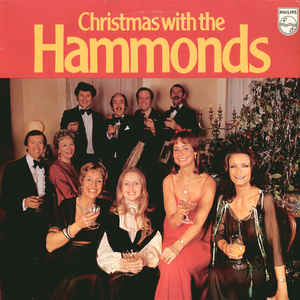
Christmas with the Hammonds

christmas

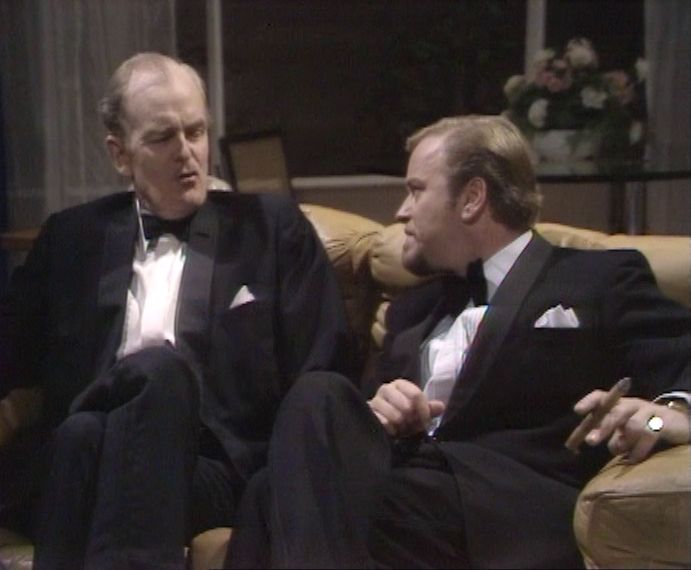
Having reached the end of the series, I’ve found that a Brothers fix is still required, so I naturally turned to the 1976 long-playing extravaganza that is Christmas with the Hammonds.

Colin Baker’s website has done a wonderful public service by making it available for everybody to enjoy.  If, for example, you’ve ever wondered how Paul Merroney would wrestle White Christmas to within an inch of its life, then this is the disc for you.

Without further ado, let’s jump straight in ….

Winter Wonderland, Sleigh Ride – Bill & Gwen Riley

Derek Benfield and Margaret Ashcroft favour a soft duet singing style and they also both handle individual lines with aplomb.  A very solid start.

The Holly and The Ivy – Jane Maxwell

I don’t believe I’ve ever heard Kate O’Mara sing before, so I wasn’t sure what expect.  She can certainly handle a tune and together with a tasteful string arrangement it seems that Kate was taking it very seriously.  Two out of two so far, can this good run continue?

We Need A Little Christmas – David Hammond

Robin Chadwick may be slightly flat, but how can you not love the jaunty backing track?  It’s only two minutes long, which means it doesn’t outstay its welcome.

The Christmas Story – Mary Hammond

Jean Anderson is spared the ordeal of singing as instead her track tells the story of the birth of Jesus.  You can imagine Mary telling this story to her three sons every Christmas, whether they wanted to hear it or not.  Good old Mary.

The Twelve Days of Christmas – 1: Jane 2: Bill 3: Gwen 4: April 5: All 6: Jenny 7: Ted 8: Mary 9: Brian 10: Paul 11: David 12: All

It’s tag-team time as everybody pitches in.  It gives us our first opportunity to hear the vocal talents (ahem) of Patrick O’Connell and Colin Baker, whilst it also confirms that a whole track of Jean Anderson singing might have been a step too far.

Cantique de Noel – Brian Hammond

Decades later, during The Cult of the Brothers documentary, Richard Easton still seemed to regard his major contribution to the album with fondness and a little pride.  And why not? He can hold a tune well and, as befits his character, adds a touch of gravitas to proceedings.

Have Yourself A Merry Little Christmas – Jenny Hammond

With only a piano accompaniment, Jennifer Wilson is a little exposed, but thanks to her breathy singing style she just about pulls it off.

Good King Wenceslas – Ted Hammond and Paul Merroney

Nice to see that Ted and Paul managed to bury the hatchet in order to contribute to this duet.  It’s fair to say that neither Patrick O’Connell or Colin Baker were blessed with angelic singing voices, so their decision to keep their tongues firmly in their cheeks was the only possible option.  It’s certainly memorable.

Rudolph the Red-Nosed Reindeer – April Hammond

It’s slightly surprising that April and Paul didn’t have a duet together.  Singing is clearly not Liza Goddard’s strength, so the clip-clop backing attempts to cover some of the cracks.

White Christmas – Paul Merroney

After the delight of Good King Wenceslas, it seemed obvious that the world needed more of Colin Baker’s unique vocal talents.  Fair play to the man for sharing this track in all its grisly glory (instead of claiming that it had somehow been lost).  It’s three minutes which defy description (but once again I have a feeling Mr Baker wasn’t taking it entirely seriously, or possibly a little alcoholic refreshment had loosened him up somewhat).  The line – “may all your days be Merroney and bright” –  is sheer genius.

Good Wishes For the Season – Gwen, Bill, Jenny, Ted, Jane, Brian, April, Paul, David & Mary

This is lovely as all the cast – in character – take turns to wish the listeners the compliments of the season. Naturally enough Mary gets the last word whilst Jane (“keep the men in their place and have a fantastic time”) has the most memorable message.

A treat from start to finish, it feels a little odd to be listening to it in July, but come December I’m sure I’ll be revisiting Christmas with the Hammonds again.


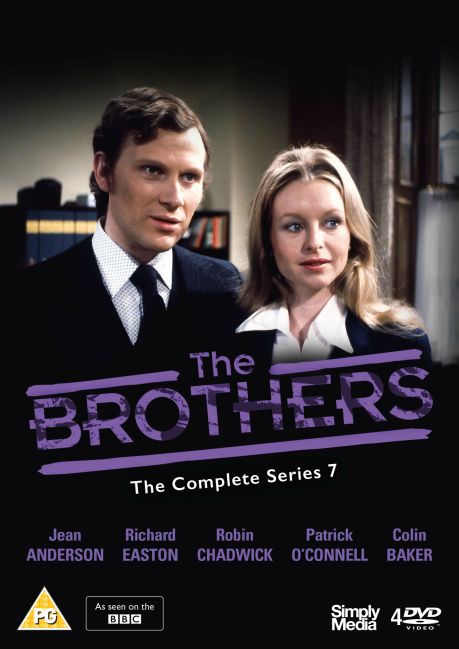
The Brothers – Series Seven. Simply Media DVD Review

Within the first few minutes of the series seven opener – To Honour and Obey – it’s plain that change is in the air.  First we have a new title sequence which acknowledges that Hammond Transport is now about more than lorries (shots of swooping aircraft makes that plain).

But even more startling is the fact that we’re presented with the sight of Paul Merroney (Colin Baker) having a shave.  All of the main characters (with the exception of Paul) have previously had their private lives investigated in exhaustive (and some might say exhausting) detail. Up until now Paul’s has been exempt from this – indeed the others have unkindly referred to him as a robot on more than one occasion, suggesting that he doesn’t have a private life at all.

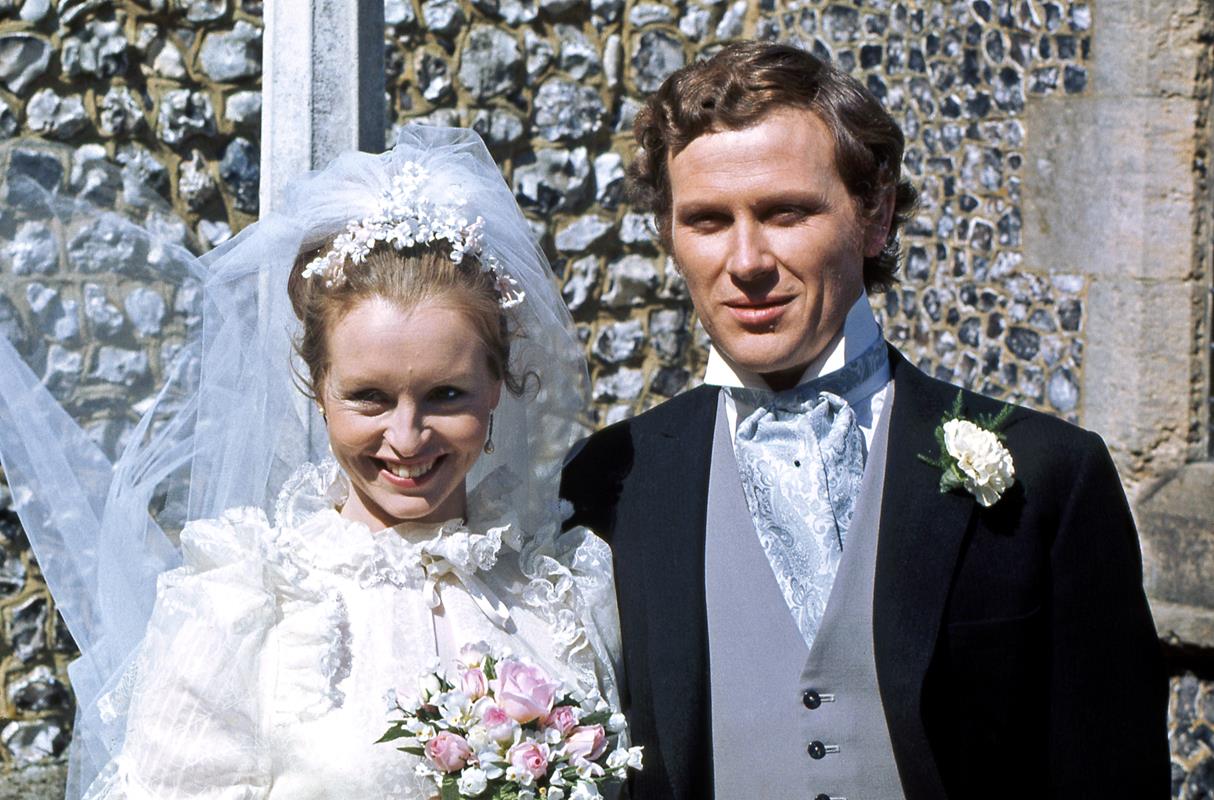
Seeing Paul Merroney in any other setting than a purely business one is something of a jolt, but since this episode is concerned with his wedding I guess we’re going to have to get used to it.  Brian (Richard Easton) is his best man, which rather implies that poor Paul is somewhat lacking in friends.  Although his bride-to-be April (Liza Goddard) might make up for that.  Or maybe not, let’s wait to see how their marriage plays out ….

Liza Goddard & Colin Baker

Given Brian’s previous problems with the bottle, it’s a little strange that he got drunk at Paul’s stag party (a pity we didn’t see it, I’m sure it would have been a hoot – no doubt Paul was stuck in the corner, sipping a tomato juice). Paul then discusses his father (in the first five minutes we learn more about Paul the man than we had in the last two and a bit series).

We’re quickly introduced to members of April’s family. Her father, Lord Winter (Anthony Nicholls), has little time for his son-in-law-to-be and April’s brother, Simon (Terence Frisby), shares his disdain – although since Simon and Paul are involved in a power-struggle at the bank, at least their conflict is professional rather than personal (Lord Winter just considers him to be a dull fellow).

Brian’s children have been conspicuous by their absence for most of the series to date. Even when he and his former wife, Ann, were together we never saw much of them. So when Brian’s daughter Carol (Debbie Farrington) suddenly turns up, it’s a bit of a jolt. Mind you, that’s nothing compared to the shock when Ann (Hilary Tindall) also reappears ….

I’ve missed Ann, so it’s lovely to see her again – even if it’s only a fleeting visit. With Brian now entering a tentative relationship with Jane Maxwell (Kate O’Mara), Ann’s presence certainly helps to shake up the status quo, although Carol is the key figure here – seemingly undecided about whether to live with her mother or father.

Carol’s now a new-age hippy chick but Ann’s still the same old Ann. They both bow out in episode four, The Female of the Species, with Carol rather bamboozling Brian before she goes. And before Ann leaves she has the chance to confront Jane (Hilary Tindall and Kate O’Mara – an implacable force meeting an immovable object).

Happy marriages are something of a rarity in The Brothers.  This series Ted (Patrick O’Connell) and Jenny (Jennifer Wilson) are the first to suffer a few bumps in the matrimonial road.  Although they’ve always seemed well-suited, it should be remembered that as soon as they tied the knot Jenny became incredibly bossy (her ill-fated desire for a child was just one of the times when Ted – a hard-case in business but a teddy-bear at home – gave way).

Patrick O’Connell & Jennifer Wilson

This year Ted’s showing signs of mellowing on the business front.  Spending time away on a business course helped him to finally release that Paul Merroney wasn’t quite the villain he always believed him to be (something the viewers twigged some time back).  When he returns home, Jenny’s off to visit her daughter, Barbara, in Canada (and more than a little irritated that Ted’s changed his mind about joining her).  Barbara (Julia Goodman) is another familiar face from the past to make a return this year (her marriage – surprise, surprise – has hit something of a rough patch).

A little extra spice is added to Ted and Jenny’s relationship after April, at a loose end during one of Paul’s numerous foreign trips, offers to cook Ted dinner.  There’s no strings attached – it’s just a friendly offer from April who’s concerned that Ted will waste away if he has to fend for himself – but the reactions of their respective spouses are quite instructive.  Paul’s coolly amused (his long-standing disdain of Ted still stands) whilst Jenny doesn’t say a great deal (although it clearly rankles, as we’ll see during the next few episodes).

Of course it was Paul who mischievously told Jenny that her husband and his wife had enjoyed a meal together rather than the hapless Ted, who no doubt would have much preferred to have kept quiet.  This leads April to liken Paul to one of the Borgias – which he takes as a rich compliment!

Regular viewers will probably be expecting several long-running plot-threads to rear their heads one last time.  And you won’t be disappointed as yet again Mary’s (Jean Anderson) health takes a turn for the worse, leaving the brothers to play nursemaid, although neither Brian or David (Robin Chadwick) are falling over themselves to volunteer.  The sight of Brian and David tossing a coin (Brian lost, so he had to stay at home with her) is a nice comedy moment.

The saga of Gwen Riley’s (Margaret Ashcroft) new house also continues to rumble away – every time she seems to be on the verge of moving, something happens to prevent her (this time she’s been gazumped).  Once again, Ashcroft (and Derek Benfield as Bill Riley) impress as the one couple who somehow manage to juggle their work and private lives without resorting to taking lumps out of each other.  Ashcroft gets to flex her acting muscles a little more towards the end of the series after Bill and Gwen’s son is involved in a motorbike accident.

Margaret Ashcroft

Later series of The Brothers tended to be shared out amongst a pool of writers who would then pen a block of consecutive episodes.  For the seventh and final series this was split as follows – Ray Jenkins (episodes one to three), Brian Finch (episodes four, five and nine to twelve), Elaine Morgan (episodes six to eight) and N.J. Crisp (episodes thirteen to sixteen).

Elaine Morgan’s three scripts – Arrivals and Departures, The Distaff Side and Cross Currents – are of particular interest.  Although this was her only contribution to The Brothers, her extensive career spanned the mid fifties to the late eighties with many notable credits.  The Life and Times of David Lloyd George is an obvious career highlight, with top-quality literary adaptations (including The Diary of Anne Frank, Testament of Youth and How Green Was My Valley, amongst others) also featuring heavily on her CV.

Christine Absalom appears in Morgan’s three episodes as temporary secretary Judy Vickery.  It’s fair to say that she and Paul don’t hit it off – possibly it’s her toy Snoopy (a good-luck mascot, she tells him) or maybe it’s because she appears to be slightly flustered (although she assures him that once she settles down she’ll be fine).  As an outsider, Judy allows us to see the regulars through a fresh pair of eyes – especially the martinet Paul Merroney (the way she mispronounces his name to begin with is a lovely comedy touch).

Paul, enroute to Istanbul, calls April from the airport.  She has bad news for a him (a family bereavement) and is appalled when he doesn’t cancel his flight and return home  This is a key moment, as although Paul shows a spasm of pain at the news, business comes first.  It’s an attitude which April finds incomprehensible and serves to sow the first seed of disharmony between them.

The unexpected arrival of Paul’s mother in The Distaff Side throws the Hammonds into a tizzy. With Paul still away and April uncontactable, Ted and Brian attempt to play pass the parcel with her. Luckily, Mrs Merroney (Norah Fulton), a plain-speaking Geordie, takes up Gwen’s offer of a bed for the night (much to Brian’s obvious relief!)

Mrs Merroney’s conversations, first with Gwen and Bill and then later with April, help to shed considerable light on Paul’s character. A sickly, bookish child, he found himself teased by the local children – therefore his drive to succeed in business was partly borne out of a desire to prove his parochial home-town rivals wrong. These are further strong scenes from Elaine Morgan.

Liza Goddard & Colin Baker

Elsewhere, there’s a nice spark of jealously directed towards Jane by Jenny. Jane’s arrival in series five generated a certain amount of friction amongst all the members of the Hammonds board, although it was rather downplayed the following year. Quite why Jenny should be so set against the possibility of Jane becoming a Hammond (after all, that’s precisely what she did by marrying Ted) is a bit of a mystery but it helps to give Jenny a little more to work with on the character front.

Jenny’s paranoia keeps on bubbling away (she’s convinced that everybody is plotting against her). The best moment comes when she confides to Mary that Brian and David are locked in a bizarre love triange with Jane! That’s somewhat far from the truth – since Brian’s long-relationship with Jane has been platonic, David sees nothing wrong in inviting her out for a couple of meals.

The result of Jenny’s rash comment puts Mary on the warpath. She attempts to rope Ted in, but he’s less than keen to get involved – although their conversation sets up a pulsating later scene which sees Ted accuses Jenny of spewing posion. With their marriage already a little rocky, this simply adds to the pressure. Jenny has the last word as she cruelly, but maybe accurately, labels the Hammond brothers as “a lush, a failure and a has-been!” Wonderful stuff.

Everything then kicks off in typical Brothers style as Mary confronts Jane, Brian confronts David and David, in a huff, packs his bags and leaves home.

Kate O’Mara, Richard Easton & Colin Baker

Episode ten – Celebration – is ironically titled, as Jane receives the bad news that one of her new C41s has disappeared somewhere in the Atlantic, Jenny receives a summons for dangerous driving whilst Paul and April’s marriage seems to have hit a brick wall.

Possibly this was art imitating life, as Colin Baker and Liza Goddard had married for real shortly after Paul and April tied the knot in the series.  Baker would later acknowledge that their union was probably a mistake as it sadly didn’t last very long.

April is a rather passive character to begin with – content to wait at home for her husband to return from the office (although capable of becoming annoyed when he’s late).  April bemoans the fact that their luxury flat has become a gilded cage for her, but she seems unable or unwilling to do anything to rectify the situation, such as finding a job. Given that the role isn’t terribly interesting for large stretches, it’s lucky that Liza Goddard was on hand to breathe a little life into her. Goddard does icy detachment better than anybody and some of her later scenes suggest that April could have developed into quite the bitch had the show gone to an eighth series.

Paul Merroney’s latest scheme is to expand into the Middle East. From a modern perspective, setting up bases in places such as Baghdad and Kuwait seems to be asking for trouble, but it’s true that it was a different time back then. Only Brian opposes the plan, whilst the others see a chance to make a handsome profit (although the risk factor is great).

Whilst the cast were confidently expecting an eighth series, I wonder if the return of co-creator N.J. Crisp to write the last four episodes was something of a sign?  Crisp had only penned a handful of episodes during the previous couple of runs, so it could be that he had an inkling the series was reaching the end and wanted to be the one to conclude it.

Whilst a continuing drama can never come to a compete stop, there’s a sense that The Brothers was reaching a natural conclusion.  We’ve seen over the years how Hammond Transport had changed from a privately owned company to a publicly owned one, but the Middle East scheme serves as the catalyst to finally wrest control away from the Hammond family (via a new share option which will raise much needed capital but will also serve to dilute their majority share-holdings).

But various questions remain unanswered as the credits rolled for the final time.  How would Paul and April’s wobbly marriage have resolved itself?  Most intriguingly, would Paul’s Middle Eastern escapade have been a disaster?  If so, then he might have been eased out and maybe the Hammonds would have attempted to regain control of the company.

Although there were plenty of options for future storylines it wasn’t to be, so The Brothers came to an end on the 19th of December 1976 with The Christmas Party. Final treats include Brian’s quite astonishing moves on the dance floor and Ted’s firm rejoinder after Paul suggests that Hammond Transport Services Ltd is a rather old-fashioned name. Surely something like Worldwide Transport Services would be better?

Another strong collection of episodes, this seventh and final series of The Brothers is just as addictive as the previous runs.  It’s easy to why it captivated a generation back in the 1970’s and forty years on it’s still as entertaining.  If you’ve been collecting the DVDs then you’ll know how good the show is, if not then I’d strongly recommend picking up series one and making your way through a classic slice of seventies drama from there.

The Brothers – Series Seven is released by Simply Media on the 10th of July 2017.  RRP £29.99.  It can be ordered directly from Simply here.

Patrick O’Connell, Robin Chadwick & Jean Anderson

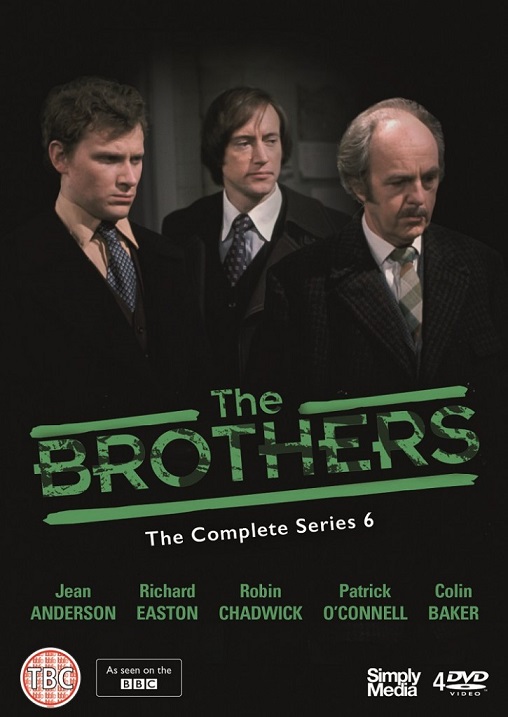
The Brothers – Series Six. Simply Media DVD Review

Series six kicks off in a typically confrontational way as Ted (Patrick O’Connell) clashes with Merroney over Brian’s future. Will Brian be welcomed back onto the board? Ted wants a fair deal for his brother and – possibly surprisingly – Merroney concurs. But the reason he gives is sure to put Ted’s back up. “Because of the three of you, he’s the only true professional”.

Colin Baker still looks as if he’s enjoying himself enormously as Merroney continues to call the tune, forcing the others to dance to it. His relationship with Brian (Richard Easton) has always been complex.  He values Brian’s business acumen and knows that Brian likes him personally (which has helped create a bond between them) but it’s also plain that Merroney would drop him like a stone if he proved to be unreliable.

Somewhat Godot like, Brian has an influence over events even when he’s not on screen. The series opener, Red Sky At Night, begins with the others awaiting his return. But when he’s not on Don Stacey’s charter-flight there’s concern all round. Where is he? Is his absence further evidence of his unreliability?

When Brian (still sporting the impressive moustache he grew last year) does reappear, it’s telling that it’s Merroney he goes to see. Although both David (Robin Chadwick) and Ted have fought for their brother’s interests in their own ways, Brian clearly feels more comfortable with somebody outside of the family.

Colin Baker, Robin Chadwick and Derek Benfield

Brian’s gradual reintegration back into the business is a running theme during these early episodes as is the question of Jenny (Jennifer Wilson) and Ted’s adopted baby, William. When the baby’s real mother decides she wants him back, Jenny starts to feel the strain. One has to wonder why Jenny and Ted didn’t legally adopt the child (William was abandoned by her mother six months earlier but she now feels more confident that she can look after him).

Our sympathy should be with Jenny, but there’s something more than a little off-putting about her manic determination to hang onto William whatever it takes. Jennifer Wilson plays these scenes well and since her character’s usually so level-headed and sensible it’s an interesting change to see her put under pressure for once.

Jenny is happy to cast William’s natural mother, Pat Hawkins (Elaine Donnelly), in a poor light, but that’s not the impression most will get when they hear her story. “Look, I’m just a girl from the local estate, okay? And I got a baby. And I couldn’t explain to my mum and dad why I wanted to keep him. So I did the only thing I could do and I gave him away”.

One might raise an eyebrow at the revelation that Pat’s husband, Alan (Ian Marter), works for Hammonds. Something of a remarkable coincidence it must be said, but this does allow Ted to be pushed over the edge a little further (like Jennifer Wilson, Patrick O’Connell seems to relish these dramatic scenes). Plus it’s always a pleasure to see the late Ian Marter, even in a small role like this.

Jennifer Wilson & Patrick O’Connell

Carleton Hobbs makes a welcome reappearance as Sir Neville Henniswode (Hobbs had appeared in series four but was presumably unavailable for series five, which led to Llewellyn Rees taking over the role). Hobbs had a decent film and television career but for me – and I’m sure for many others – he’ll forever be the definitive radio Sherlock Holmes. Just to hear the timbre of his voice is enough to conjure up images of foggy streets and Hansom Cabs ….

One of the more unlikely developing plotlines concerns the relationship between Sir Neville and Mary Hammond (Jean Anderson), the imposing matriarch of the family. At least this enables Mary to get out of the house every so often and therefore makes a nice change from her usual scenes (which tend to consist of her chivvying one or more of her sons).  Since both David and Brian are currently living with her at the family home, she’s got ample opportunity to fuss around them.

The first half of series six sees the Hammonds struggling to balance their work/private lives. Brian is still finding his way back to fitness slowly, David has never been terribly business minded anyway, whilst Ted and Jenny are more concerned with the fallout from William’s departure than they are with Hammond Transport.

This leaves Merroney in a strong position, although Bill Riley (Derek Benfield) for one isn’t prepared to roll over for him. Bill’s rise through the ranks has been an entertaining running thread over the last few series. Initially he was a little diffident at board meetings – due to his elevation from the shop floor – but by this point he’s more then happy to speak his mind.

Derek Benfield

He’s matched in the common-sense stakes by his wife Gwen (Margaret Ashcroft). Whilst the majority of the characters in The Brothers are middle-class or higher, the Rileys are resolutely working-class and proud of it. It would be easy for them to be portrayed in a patronising light, but this doesn’t happen – meaning that there’s something charming in the way they enjoy the simple pleasures of life (an evening game of Scrabble, for instance). But they’ve not immune to pressure and Bill’s increasing workload will be seen to have a negative effect on their marriage.

Merroney’s private secretary Clare Miller (Carole Mowlam) still finds that her loyalty is divided between Merroney and David. With neither man in a regular relationship, both are content to use her as a dinner companion and confidant. Although Clare is a character designed to react to others rather than instigate her own plotlines, Mowlam still manages to give Clare a spiky sense of humour, ensuring she’s more than the cardboard character she otherwise could have been.

During S5, Merroney seemed mainly to exist in order to thwart the Hammonds at every turn. But throughout this run of episodes he’s more nuanced – whereas previously he was totally dedicated to Sir Neville and the bank, now he confesses that he’s beginning to side with the Hammonds over certain matters. Although on other occasions he’s quite prepared to steam-roller right through them, if he can ….

Brian also shows some unexpected facets to his personality (since his breakdown he’s become a more relaxed and far-thinking person). At one point he expresses his new personal philosophy. “You’ve got to feel that what you’re doing is really worth doing. Nobody makes money except the Mint. All the rest of us do is push it around a bit, trying to make sure that we get a little more than the next man. But it’s not wealth. Wealth is enriching. Making money is just debilitating. In the end it leads to a sense of personal isolation”.

When David finds himself rejected by Clare in episode eight  – The Chosen Victim – it serves as something of a wake-up call for him. All his life he’s been able to get whatever he wanted (until Clare). Will this make him a more rounded and less arrogant character? It’ll be interesting to see if his growth continues next series.

Paul Merroney and Jane Maxwell (Kate O’Mara) fractious relationship shows no sign of abating. At one point she tells him he’s “one of the lowest forms of life I’ve ever come across”. But when you learn that Merroney was castigating Jane’s ex-husband, the hard-drinking pilot Don Stacey (Mike Pratt) at the time, it’s easy to understand the reason for her anger.

Kate O’Mara

Don bows out of the series in the sixth episode, Tender (broadcast just a few months before Pratt’s death at the age of 45). Pratt’s gaunt appearance gave the running plotline of Don’s impending medical exam a bitter irony. “Sooner or later they’ll find something that creaks or groans or doesn’t react fast enough and that’s it. You can keep as fit as you like, but Anno Domini gets you in the end”. Don didn’t do a great deal (although his leaving scene was a powerful one) but he was always an amusing character and Pratt, even though he was clearly ailing, always played him with an agreeable twinkle in his eye.

As series six moves towards its conclusion, several familiar faces pop up. Clive Swift plays the shifty Trevelyan whilst Joby Blanshard (best known as the plain-speaking Colin Bradley from Doomwatch) appears as Van der Merwe.

After being somewhat subdued in the early episodes, Ted roars back into life (few sights are more impressive than that of Patrick O’Connell in full flight) whilst Brian and Jane seem to be forming something of an alliance, both personally and professionally. But Brian’s wounded psyche (he has a fear of being touched) might be a problem. Richard Easton, as so often throughout all six series, impresses here.

The sight of April Winter (Liza Goddard) who briefly appears in the penultimate installment – The Bonus – signifies that change is on the way for Merroney. His offhand comment that she’s his fiancee is a real leftfield jolt – although April’s been mentioned on several occassions (which has prepared the ground for her arrival) it’s hard to imagine the coldly efficient Merroney ever being in love. Clare is crushed by the news. Bill later tells Gwen that “the torch that girl carries for him makes the Statue of Liberty look like a candle”.

Hammond Transport has undergone substantial changes over the last few years, morphing from a wholly-owned family concern into a company with strong ties to the bank (where Sir Neville and Merroney reign). But it’s the proposed takeover bid from Kirkmans which threatens to split the Hammond family down the middle. Some, like David, would be happy to sell their shares for a handsome profit whilst Ted (and especially Mary) are resolutely opposed to the deal.

When Merroney goes AWOL (he’s in Amsterdam, meeting with Van der Merwe) the others (especially Ted) are concerned that he’s plotting behind their back. His adventures in Amsterdam are great fun, adding a touch of out-of-season glamour to the series. The sight of his discomforted face as Van der Merwe’s daughter whisks him round Amsterdam at great speed in an open-top jeep is worth the price of admission alone.

The series finale – Birthday – might be partly concerned with Mary’s birthday celebrations but business matters are also on her mind. The takeover from Kirkmans may have foundered but a merger with Van der Merwe’s company is still very much on. But Mary, frustrated at being out of the loop, begins to flex her muscles. As with previous years, the final episode finishes on a strong hook which will lead in nicely to the start of the next series.

The Brothers remains a very moreish and ridiculously entertaining series.  Richard Easton and Colin Baker especially impress, but there’s no weak links here.  Four decades on it’s still easy to see why the show built up such a large and devoted fanbase (not only in the UK but in many other countries as well).  Sharply defined and well-acted characters, placed in perpetual conflict with each other was a key part to its success and the passing of time has done nothing to dull this winning format.

The Brothers – Series Six is released on the 12th of June 2017 by Simply Media and contains thirteen 50 minute episodes across four discs.  RRP £29.99.

Patrick O’Connell, Jennifer Wilson, Richard Easton, Jean Anderson & Robin Chadwick

The Brothers – Series Five. Simply Media DVD Review

The beginning of series five finds The Brothers in something of a transitional phase.  Two key cast members (Gabrielle Drake and Hilary Tindall) had left the show at the end of the previous run, although fresh blood (most notably in the shape of Kate O’Mara as Jane Maxwell) would shortly arrive to shake things up.

The departures of both Drake (Jill Hammond) and Tindall (Ann Hammond) were used to good dramatic effect though.  Ann and Brian had gone through the relationship mill during the previous series and even though their union was now at an end, Brian continues to suffer.  But his broken marriage is just one reason why he goes severely off the rails in the early episodes.

Although Tindall was gone, her character was still alive and therefore a return was always possible (and  indeed Ann did make a fleeting reappearance in a handful of episodes at the start of the seventh and final series).  But Drake wasn’t so fortunate, as Jill is dispatched in the time-honoured way of dealing with soap actors who either can’t or won’t carry on (an off-screen accident).  Talking about this decades later in The Cult of The Brothers documentary, it seems that Drake was a little taken aback at just how ruthlessly Jill was dealt with.

Another character, Martin Farrell, had also left, which results in both personal and professional consequences.  Professionally, it means that the position of chairman is vacant – which seems tailor-made for the ambitious Paul Merroney.

And on a more personal note, it was plain that Ted Hammond’s nose was put out of joint last series by the interest Farrell had been taking in Jenny Kingsley (Jennifer Wilson).  So with Farrell out of the picture, Ted (Patrick O’Connell) rekindles his own relationship with her.  Lest we forget, Jenny carried on a lengthy and clandestine affair with Ted’s late father.  Unsurprisingly this meant she has always been viewed with great disfavour by Ted’s mother – the indomitable matriarch Mary Hammond – but it seems that Ted has eventually summoned up the courage to defy his mother and make an honest woman out of Jenny.  Although I’m sure there’s still going to be a few bumps ahead before they can enjoy a lifetime of wedded bliss.

Patrick O’Connell & Jennifer Wilson

The series opener, the aptly titled Life Goes On, finds Brian in a pretty poor state. This concerns the bank – they don’t want to see their investment in Hammonds put at risk because the new managing director is feeling flaky – but Paul Merroney has put plans in motion to protect their money ….

Although Merroney was a rather peripheral character during the last series, here he really starts to make his mark. For one thing, he’s gained an assistant – Clare Miller (Carole Mowlam). Apart from signifying Merroney’s increasing significance, Clare also emerges as a character in her own right – becoming close to David, for example.

Baker’s good value in these early episodes as Merroney begins his manoeuvres. Surprisingly, only the bluff Bill Riley realises that Merroney has his eye on the chairman’s job – which doesn’t say much for the business acumen of the others! There’s a delicious sense of duplicity on show from Merroney as he puts the blame for the recent ousting of Ted as managing director firmly on the shoulders of the departed (and innocent) Farrell.

The way the audience learns about Jill’s death is done in a very interesting way which makes a positive out of the fact that Gabrielle Drake was no longer a member of the cast.  Jill isn’t mentioned during most of the first episode, although that wasn’t unusual (she was absent from the first few episodes of series four).  It’s only right at the end of Life Goes On, when David runs into a friend who’s been out of town for several months that we find out Jill is dead.  This is an incredibly jolting moment which provides us with a strong hook into the next episode where her fate is discussed in detail.

The dynamic between the three brothers – Ted, Brian and David – has been the motor which has powered the series to date.  Whilst series five continues to play on their conflicts, the emergence of Paul Merroney as a major player refreshes this somewhat – as an outsider he has quite a different set of loyalties.

Colin Baker

But the brothers still dominate the storylines especially, in the early episodes, Brian.  In many ways he’s now got everything he wished for – he’s become managing director of Hammonds, ousting Ted.  Or has he?  We’d seen in previous series that it was Ann who was the ambitious one, constantly pushing him forward.  So the fact that he’s gained in business but lost out in his personal life must come as a bitter irony to him.

Richard Easton continues to impress as Brian, especially when he starts to lose the plot (the episode title Breakdown makes it fairly obvious what’s going to happen).  As his drinking increases, Brian is encouraged to seek psychiatric help.  And always around is Merroney, plotting to oust Brian at one point and then (so the others fear) attempting to buy Brian’s shares so he can gain overall control of the company. But as we’ll see, Merroney is no cardboard villain – he may be mainly motivated by self interest but he’s also not without compassion for the stricken Brian.

As Brian, ensconced in a nursing home, retreats into the background, so other plotlines begin to develop.  The long-running will they/won’t they relationship between Ted and Jenny is now very much back in “they will” territory and moves forward at a rate of knots.  The problem with Mary (Jean Alexander, as good as always) still has to be overcome though, as the icy disdain she feels towards the woman who conducted a long-term affair with her late husband continues to be a fruitful source of drama.  Even when Mary and Jenny appear to be on civil terms there’s always the sense that at any moment things could change ….

Although the departure of both Hilary Tindall and Gabrielle Drake left something of a hole, two new female characters filled the gap nicely.  Clare’s divided loyalties (between David and Merroney) generate a good source of drama which plays out as the series progresses whilst Kate O’Mara makes an immediate impression as Jane Maxwell.  Debuting in episode six, Flight of Fancy, Jane is the hard-headed director of an air-freight business which Hammonds have an interest in.  As a proactive business woman she’s something of a rarity in the world of The Brothers (Jenny might be a board member of Hammonds, but she’s a much more passive character).

Kate O’Mara

Also appearing for the first time in this episode is Mike Pratt as Don Stacey, a hard-drinking pilot.  This would be Pratt’s final television role before his death in 1976 at the age of just 45.  Don would appear throughout the remainder of series five and the first half of series six. Whilst it’s always a pleasure to see Pratt, it’s rather tempered by how ill and haggard he looks.

Yet again, things conclude in the boardroom (episode thirteen, Warpath) as Merroney continues to scheme although it’s possible that in Jane he’s finally met his match (a decade or so later Baker and O’Mara would once again lock horns, this time in Doctor Who).  With Ted under pressure and Brian’s fate still uncertain, things are left nicely poised for the following series to pick up where this one left off.

By now, The Brothers had become a well-oiled machine and series five not only manages to develop the existing characters in a variety of ways but it also develops intriguing new ones as well.  It continues to be highly addictive stuff, especially as the Hammonds, Merroney and Jane jostle for power and superiority.  But there’s time for more personal stories as well (Jenny’s longing for another child) which ensures that the series isn’t completely boardroom and business based.

The Brothers – Series Five is released by Simply Media on the 27th of March 2017.  RRP £29.99.

Richard Easton, Robin Chadwick & Patrick O’Connell

1990 – Series One. Simply Media DVD Review

1990, which ran for two seasons during 1977 and 1978, was set in a Britain tyrannised by the Public Control Department (PCD), a Home Office organisation dedicated to crushing free speech and any other signs of dissent.  Given the parlous state of Britain during the 1970’s, it wasn’t surprising to find a series which posited what might happen if the economy finally and irrevocably disintegrated.  And given the way things are today, many of 1990‘s themes seem eerily topical  ….

Some background to the collapse is teased out as the series progresses.  We learn that the country went bankrupt in 1983, which led to a series of swingeing restrictions from the newly-formed PCD.  These included strict rationing – not only of food, but also of housing and other essential services.  Virtually everything has been nationalised, meaning that the government has almost complete control.  Dissidents are harshly dealt with – via Adult Rehabilitation Centres – where they are treated with electro-convulsive therapy.

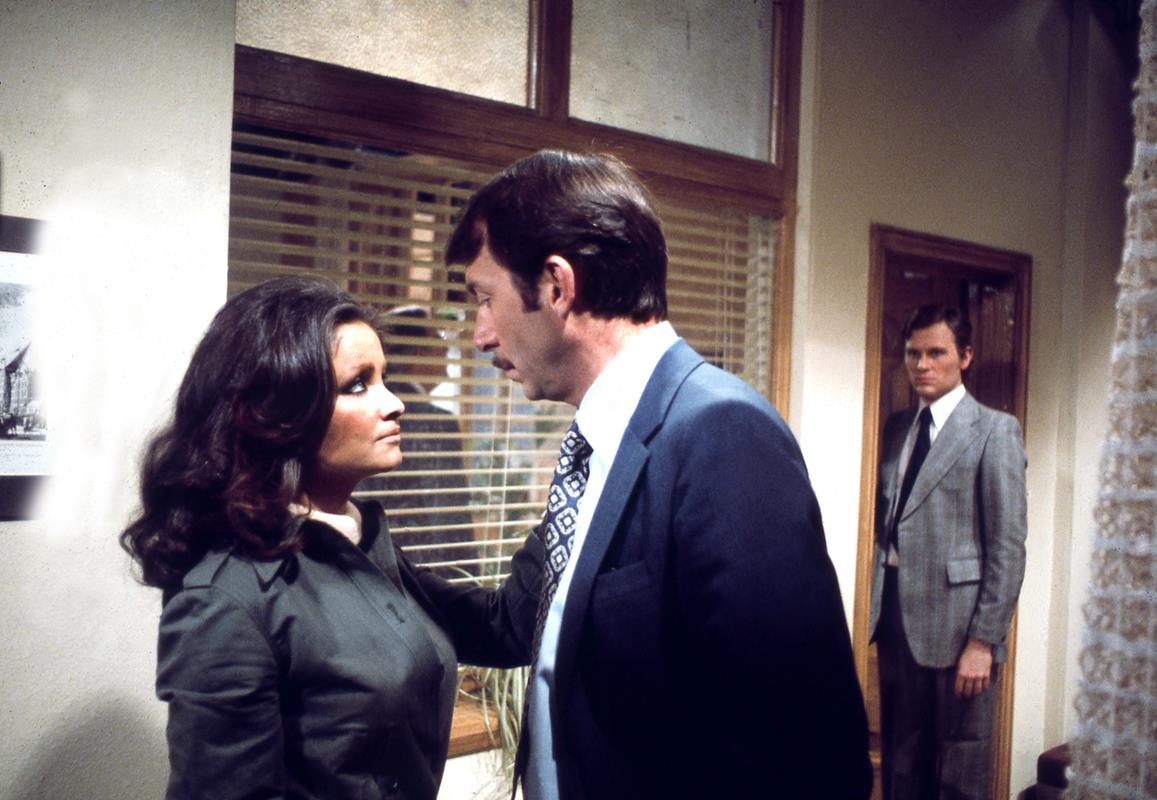
1990 is a grim place then, but there are still a few people attempting to resist the state.  One is Jim Kyle (Edward Woodward), a journalist on The Star, one of the last independent newspapers. The PCD, in the form of Controller Herbert Skardon (Robert Lang) and his two deputies, Delly Lomas (Barbara Kellerman) and Henry Tasker (Clifton Jones), keep him under close surveillance, which leads to a tense battle of nerves.

Robert Lang, Barbara Kellerman and Clifton Jones

Series creator Wilfred Greatorex (1922–2002) started his career writing for Probation Officer (1962) and quickly moved onto The Plane Makers (1963 – 1965) and its sequel The Power Game (1966 – 1969) where he acted as the script-editor.  Character conflict was key to both The Plane Makers and The Power Game and it’s plain to see that a similar format was carried over to 1990.  The heart of the series is concerned with the way the main characters (especially Kyle, Skardon and Lomas) interact.

Edward Woodward (1930 – 2009) had been acting since the mid 1950’s but it was Callan (1967 – 1972) which really established him as a household name.  His success as the world-weary state-sponsored killer allowed him to diversify (pursing his love of singing in The Edward Woodward Hour, for example) whilst cult films like The Wicker Man (1973) enhanced his profile even more.  Woodward was a quality actor and his central performance is one of the reasons why 1990 works as well as it does.

The series opened with Greatorex’s Creed of Slaves (“Necessity is the plea for every infringement of human freedom. It is the argument of tyrants; it is the creed of slaves” – William Pitt the Younger).  Kyle is penning a piece for his newspaper on the Adult Rehabilitation Centres (ARCs) which causes Skardon considerable irritation.  But that’s merely the tip of the iceberg as Kyle is also part of an organisation dedicated to smuggling people out of the country ….

There’s more than a little touch of 1984 about the series of course (Greatorex referred to it as 1984 plus six).   This is particularly evident in the opening few minutes as we observe how the PCD are able to monitor everybody, both visually and aurally, although wise old hands like Kyle are able to give them the slip with embarrassing ease.  The relationship between Kyle and the members of the PCD is already well established before the episode begins and it’s his interaction with Delly Lomas which particularly intrigues.  Since Skardon mentions that Kyle likes her cooking, it’s plain that, despite the fact they’re on different sides, there appears to be some sort of spark between them.  Or are both simply playing games? At one point Kyle directs this comment to her. “How do you look like you do and do the job that you do?”

Edward Woodward & Barbara Kellerman

The next episode, When Did You Last See Your Father?, continues one of the plotlines from episode one, concerning Dr Vickers (Donald Gee), a man who is keen to take his wife and family out of the UK. This proves to be impossible via official means, as exit visas are severely restricted.

The banality of evil runs throughout the series. On the one hand, Skardon, Lomas and Tasker are simply bureaucrats doing a job (in their minds they no doubt see themselves on the side of law and order). It’s this blurring between “good” and “evil” which is so compelling – the PCD may be oppressive, but their public face can appear to be reasonable. This is key – if you can keep the nastiness buried then maybe you stand a chance of fooling most of the people.

The first non-Greateorex script, Health Farm, stars the imposing Welsh actor Ray Smith as union leader Charles Wainwright.  Following a disastrous trip to America in which he gave a speech littered with criticisms of the British government, Wainwright is sent to an ARC for “correction”.  The shocking change in him (from the firebrand we first meet to an adjusted patient keen to toe the party line) brings home the true horror of the ARCs.

Strong guest stars continue to appear throughout the remainder of series one, such as Graham Crowden as Sondeberg in Decoy and Richard Hurndall as Avery in Voice from the Past.

The last two episodes – Witness and Non-Citizen ramp up the conflict between Kyle and the PCD. Dr Vickers, who escaped from the UK in episode two with Kyle’s help, is persuaded to return in order to testify in a show-trial against Kyle – if he does then his family will be granted exit visas.  Prior to the trial (featuring John Bennett as the prosecutor) Kyle’s office and home are targeted by PCD thugs, which causes distress to his wife Maggie (Patricia Garwood) and children.  Woodward gives a typically powerful performance, especially when Kyle finds his family are under threat.

Edward Woodward

Series one concluded with Non-Citizen. Considering how much of a thorn Kyle has been in the PCD’s side, it’s odd they’ve taken so long to decisively deal with him. But here at last they finally seem to have broken him. With his family missing, no money, no job, no home and no status, Kyle is pushed to the limit by a sadistic Skardon. It’s not surprising that Woodward once again excels here.

Although the themes of the first series of 1990 tapped into contemporary fears and neuroses, it’s fascinating how most of it still remains topical some forty years on.  The official face presented in 1990 appears to be fair and reasonable – tribunals are held which claim to offer the public an unbiased hearing and the ARC we visit is located in a palatial country home with well-manicured lawns – but scratch a little beneath the surface and it’s plain there’s something very rotten in this state.  You don’t need jackbooted guards on every street corner to create a true sense of fear, there are far more subtle ways than that ….

The way that language, spin and bureaucracy are all utilised in order to obfuscate the truth is especially instructive.  When you hear a politician complaining that the press, in the shape of Kyle, is spreading disinformation and therefore creating disharmony about the state of the economy (i.e. disseminating fake news) then the parallels to the modern world are perfectly clear.  In many ways 1990 is something of a chess game with all the major players – especially Kyle and Lomas – engaged in a game of manoeuvre and counter-manoeuvre.

Barbara Kellerman & Edward Woodward

As I’ve said, Edward Woodward is a fine leading man whilst Barbara Kellerman and Robert Lang (who receive second and third billing) offer strong support.  The gravelly-voiced Lang graced many a film and television programme with his presence and is perfect as the harassed mandarin Tasker whilst Kellerman (possibly best known for playing the White Witch in the 1980’s BBC production of The Lion, The Witch and The Wardrobe) is intriguing as Della, the apparently acceptable face of the PCD.  Kellerman didn’t return for series two, which was a shame, although this did allow the format to be shaken up a little.

Interviewed by the Radio Times prior to the broadcast of the first episode, Woodward said that the series was “either going to create a furore or pass without comment” (Radio Times, 17th September 1977).  Although it didn’t quite go unnoticed, the fact it was tucked away on BBC2 was probably part of the reason why it never became a mainstream hit. But it clearly impressed enough to be renewed for a second series.

Although largely forgotten today, 1990 is a series which deserves to be much better known, especially since its power to disturb and unsettle remains undimmed after forty years.  It’s pleasing to have the first series available on DVD, with the second to follow in May, and for those who appreciate well-crafted British character drama of the seventies it’s certain to appeal.

1990 – Series One is released by Simply Media on the 20th of March 2017.  RRP £19.99.
Treasure Island (BBC, 1977) – Part Three

treasure-03-01

Most of the crew have decided to throw their hand in with Silver.  Most, but not all.  One whose loyalty remains undecided is Tom (Derrick Slater).  He knows and respects Silver of old, but will he elect to join the others in mutiny?

The question of Tom’s allegiance brings the character of Silver into sharp focus.  Silver is fond of Tom and seeks to win him over – to this end, along with some of the others they make for the island (leaving Smollett, Livesey and the others aboard the Hispaniola, guarded by a small number of pirates).  Silver believes that away from the ship he’ll be able to talk Tom round.

Given all the quality character actors seen throughout the serial, it’s slightly surprising that the relatively undistinguished Slater was given this role.  True, Tom’s screentime is very limited, but since the confrontation between Silver and Tom allows us – and Jim – a chance to witness Silver’s ruthless side, it’s therefore a pity that Slater’s performance is on the lifeless side.

Tom tells Silver that “you’re old and honest too, or has the name for it. And you’ve money, which many a poor sailor hasn’t. Brave too, or I’m mistook. You tell me why you let yourself be led away by that kind of mess of swabs.”  During this monologue Silver has lain a friendly arm on him, but pulls away once he realises that Tom won’t be won over.  With a horrified Jim watching from his hiding place close by, Silver stabs Tom to death.  Given that the battle seen later in the episode is fairly bloody, it’s interesting that Tom’s murder occurs off camera.  We see Silver stabbing something, but we never see what it is.

Captain Smollett and the others make their way ashore.  Smollett really begins to take charge (Richard Beale is first class during these scenes) and they elect to use Flint’s old stockade as their base.  But even before they’ve secured it there’s a brief battle and Squire Trelawney’s loyal servant, Tom Redruth (Royston Tickner), lies dying.

Tom’s barely had a handful of lines, but he does get a good death scene.  Up until now it seems as if the Squire hasn’t really grasped the reality of the situation – it’s been little more than a game to him (finding a ship, employing a tailor to make him the grandest uniform, etc).  It takes the death of a loyal family retainer, someone uprooted from his settled life in Britain and fated to die a lonely death on a distant island far away from his family, to bring him back to reality.  He asks Tom to forgive him (and is insistent that he does so).  Tom, loyal to the last, insists there’s nothing to forgive and, as Trelawney recites the Lord’s Prayer, Tom gently slips away.  Beautifully played by both Tickner and Thorley Walters.

We meet Ben Gunn (Paul Copley).  He’s Irish and speaks in a remarkably high pitched voice, which is a little odd.  But then Ben Gunn’s supposed to be odd (what with his cheese fixation) and after a while his voice lowers a little, so a little bit of normality is restored.  His cave – a studio set – looks very good (another design triumph for Graham Oakley).

John Dearth was one of those utility actors who was always worth watching, even in the smallest of roles.  He was a regular during the first series of the ITC Richard Greene Robin Hood’s, playing a different role each week (and sometimes two in the same episode!)  Various personal problems meant that he later sometimes found work hard to come by, but he was lucky to have several loyal supporters – one of whom was Barry Letts.  Both Briant and Letts had directed him in Doctor Who, so like many of the cast it’s not unexpected that he turns up here.  Dearth’s character (Jeb) mainly seems to exist in order to stress how dangerous Silver is – Jeb states that the only man the vicious Captain Flint ever feared was Long John Silver.

I’ve already touched upon how good Richard Beale has been and he’s never better than in the scene where Smollett and Silver face off.  Both have their own set of demands and neither is prepared to give the other any quarter.  Alfred Burke switches from smiling affability to snarling disdain in a heartbeat.  This then leads into the sequence where the pirates attempt to storm the stockade.  It’s slightly jarring that the outside is on film whilst the stockade interior is on videotape – the rapid switching between the two is a slight problem.

But no matter, Michael E. Briant still manages to choreograph a decent action sequence with a liberal dose of blood (nothing explicit, but it still manages to create the impression that a short – and brutal – battle has taken place).  The pirates are beaten back, which infuriates Silver – so he elects to send for reinforcements from the ship ….

treasure-03-02

Treasure Island (BBC, 1977) – Part Two

treasure-02-01

Since Treasure Island is packed with character actors of distinction, it’s easy to overlook the young actor who played Jim Hawkins.  But Ashley Knight more than holds his own amongst such august company, possessing just the right amount of youthful spirit and innocence.

That he’s deceived by Silver shouldn’t come as too much of a surprise, since Long John also managed to fool Squire Trelawney (Thorley Walters).  But, to be fair, fooling the Squire probably wasn’t too tricky for Silver, as Trelawney (as per Stevenson’s novel) is portrayed as the sort of trusting, loose-mouthed individual you really wouldn’t want to entrust with the delicate matter of finding a ship and crew to sail to the Spanish Main in search of buried treasure.  Walters is a delight as the Squire, he may be pompous and vain but he’s also curiously lovable.

The way that Silver manipulates Trelawney into engaging him as the ship’s cook and then agrees that he can handpick the crew provides us with another opportunity to witness the apparently charming and helpful side of Silver (although he’s only serving his own interests of course).  His charm is seen again when the wily Long John takes Jim under his wing.  There’s no reason why Silver should seek to deceive Jim, which leads us to assume that his friendly stories have no ulterior motive.  But there’s a sting in the tail – at the same time he’s regaling Jim with yarns about the sea, Silver is planning to murder Trelawney, Livesey and Captain Smollett (Richard Beale) and anyone else who stands in his way.

Would he also do the same to Jim?  It’s not explicitly stated, but he does confide to Israel (the ever-watchable Patrick Troughton) that he doesn’t intend to leave any witnesses, so we can pretty much take it as read.  This dichotomy in Long John’s character is what makes him so fascinating – the other pirates make little or no attempt to hide their evil intent, but it’s the way that Silver can wear different masks at different times that makes him such an enduringly appealing creation.  And of course, in the hands of an actor as good as Alfred Burke it’s just a pleasure to watch.

Not all of the crew are content, like Silver, to wait for the right time to make their move, some want action now.  Prime amongst the malcontents is Merry (Roy Boyd) who paces the ship with a murderous look on his face, but you get the feeling that he’s never going to be any sort of match for Long John.

During this era of television, directors tended to have a “rep” of actors who they employed on a regular basis.  If you’re familiar with some of Michael E. Briant’s previous productions then names such as Roy Evans, Richard Beale, Royston Tickner and Alec Wallis will be familiar ones.  Alec Wallis has a nice little cameo as Patmore, a corrupt tailor who Silver deliberately sends along to Trelawney, just so he can denounce him before the Squire and therefore gain his trust.  Beale is suitably upright as the incorruptible Smollett, a man who sets to sea with the gravest misgivings about the crew (a pity nobody listened to him).

Before the ship sets sail there are several scenes which take place within the Squire’s cabin.  Thanks to a very simple CSO effect (bobbing waves outside the cabin window) the illusion at being on the water is created very effectively.  But there’s no substitute for the real thing and it’s the later filmwork aboard the Hispaniola, as it makes it way towards Treasure Island, which really opens up the production.

treasure-02-02

Treasure Island (BBC, 1977) – Part One

treasure-01-01

Treasure Island, an evergreen classic of children’s literature for more than a century, has generated more film, television and radio adaptations than you could shake a cutlass at.  But even though there’s many versions to chose from, this one (broadcast in four episodes on BBC1 in 1977) has to rank amongst the very best.

Like the majority of the BBC Classic Serials from the sixties, seventies and eighties, the adaptation (this one from John Lucarotti) displays considerable fidelity to the original source material, although Lucarotti is unafraid to build upon the original narrative.  In a way this isn’t surprising, since the book was told from Jim’s perspective it’s inevitable that it has a somewhat restricted viewpoint.

Lucarotti’s additions begin right from the start, as Jim’s father, Daniel (Terry Scully), someone who merited only a handful of mentions in Stevenson’s original, is fleshed out into a substantial character.  Scully excelled at playing people who suffered – he had one of those faces which could express a world of pain – and Daniel is no exception.  Daniel is clearly far from well and concern that he’s unable to provide for his family is uppermost in his mind.  So the arrival of Billy Bones (Jack Watson) seems to offer a chance to extricate himself from his financial problems.

Watson’s excellent as Bones.  With his weather-beaten face and the addition of a wicked-looking scar, he’s perfect as the rough, tough, seaman with a secret.  Bones’ decision to recruit Daniel (an invention of Lucarotti’s) is quite a neat idea, since it explains how Long John Silver and the others came to learn where Bones was (Daniel heads off to secure passage for himself and Bones to the Caribbean, not realising that Silver is monitoring the port for any unusual activity).

Lucarotti also elects to bring Silver and his confederates into the story very early, making it plain that Bones has absconded with something of great value that they’d all like back.  If you love British archive television of this era then the sight of Silver’s gang will no doubt warm the cockles of your heart (step forward David Collings, Patrick Troughton, Stephen Greif and Talfryn Thomas amongst others).

Alfred Burke’s Long John Silver impresses right from the off.  He doesn’t have Robert Newton’s eye-rolling intensity, nor does he have Brian Blessed’s physical presence – but what Burke’s Silver does possess is great charm and a rare skill at manipulating others to do his will.  But although he seems pleasant enough to begin with, it doesn’t take long before he demonstrates his true colours.

Bones’ run-in with Doctor Livesey (Anthony Bate) is kept intact from the original.  Bate is yet another wonderful addition to the cast and Livesey’s stand-off with Bones is a highlight of the episode.  Lucarotti’s subplot of Daniel’s doomed night-time misadventure slots into the original story very well, as it explains why his health suddenly took a turn for the worse, which then resulted in his death shortly afterwards.

A member of Silver’s gang, Black Dog (Christopher Burgess), arrives to confront Bones.  Burgess was a favourite actor of the producer, Barry Letts, so it’s maybe not too much of a surprise that he turns up.  He and Watson step outside (and therefore onto film) for a duel, which leads to Bones’ stroke.  Watson’s particularly fine as the bedridden Bones, suffering nightmares accrued from the horrors of a life spent on the high seas and dreading the arrival of the black spot.

David Collings’ nicely judged cameo as the malevolent Blind Pew is yet another highlight from a consistently strong opening episode.

treasure 01-02.jpg

Blakes 7 – Headhunter

head 01.jpg

The previous episode, Animals, established the concept that Avon is keen to recruit a whole group of experts to join him in his fight against the Federation.  Alas, Justin didn’t make it the end of that episode, I wonder if top cybernetics expert Muller (John Westbrook) will fare any better here?  Gosh, that’s a tough one …..

Tarrant and Vila have drawn the short straw of escorting Muller back to base.  Tarrant teleports down to the rendezvous, but it seems obvious that Muller’s colleagues don’t want him to leave (there’s a dead body under the table, although Muller himself seems unharmed).  Tarrant takes a cursory look at the body but seems to miss the obvious point, mentioned later, that the corpse is missing its head.  You’d have thought a small thing like that would be easy to spot, but clearly not.

Muller is a man of peace, something confirmed by Vena (Lynda Bellingham) who’s back at base with Avon, Dayna and Soolin.  But when they teleport back to Scorpio, Muller goes crazy and attempts to bear-hug Tarrant to death.  Vila gives Muller a tap on the shoulder with a monkey-wrench which apparently kills him.  Muller’s brief homicidal interlude is one of several (I assume unintentional) comic highlights.

Muller went mad after Tarrant brought back a box from Muller’s workshop.  After we learn of the headless corpse it seems obvious that the box contains Muller’s head, but not so, the truth is even stranger.  Muller’s android killed his creator, cut off his head and put it on his own, android, body.  Quite why the apparently peace-loving Muller would have created a homicidal android (who incidentally wants to enslave all human life) is anyone’s guess.  But it explains the faux-Muller’s strange dress sense and robotic delivery.

head-02

Poor Lynda Bellingham isn’t very well served by the script.  Vena spends most of her time moping that her loved one is dead, only to briefly spring back into life when it appears that he isn’t.  But her joy is short-lived as the android with Muller’s head then bear-hugs her to death.  It’s not a very dignified way to go I’m afraid.

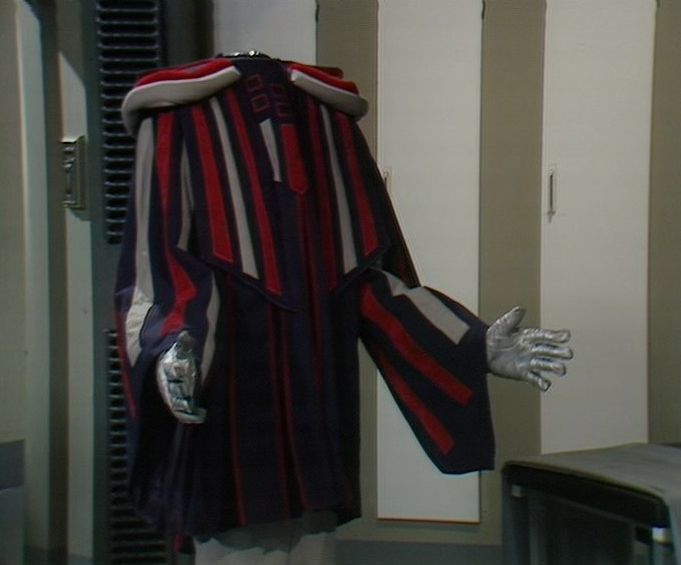
So far, so strange, but the best is yet to come.  During the last fifteen minutes or so, Muller’s head drops off – meaning that we’re able to enjoy the vision of a headless android stomping around Xenon base, threatening to kill everyone.  There can be few funnier sights in all of B7‘s 52 episodes.

I also have to mention the wonderfully expressive hand acting from Nick Joseph who plays the headless android.  When you don’t have a head it’s hard to get your point across, so Joseph elects to waggle his hands and arms in a very emphatic fashion.  Another great comedy moment.

Muller was a protégé of Ensor, which means that Muller’s android is keen to join up with Orac in order to fulfil his dream of universal domination.  Quite how one android hopes to dominate all life is another of those small plot points which never gets adequately explained, but it does give Peter Tuddenham the chance to do a little more with Orac for once.  And indeed also with Slave, who subtly changes from servile to surly as the mysterious effect of Muller’s android takes hold.

Since Headhunter only features the regulars plus Muller and Vena, everyone – even the rather underwritten-to-date Soolin – gets a chance for a decent share of the action.  Paul Darrow elects to intone his lines with the sort of distracted, far-away delivery which would be his trademark style during S4.  He has the odd killer line (“Tarrant, what have you got up there apart from yourself, a half-wit and a corpse?”) but the best exchange is saved until the end.  After a big bang organised by Tarrant, Avon asks him what’s happened to the android.

TARRANT: Gone to the great cyberneticist in the sky.
AVON: You fool! It’s superstitious half-wits like you who hold back every advance we make.
ORAC: And arrogance, Avon, like yours and Muller’s which threaten to destroy …
AVON: Shut up!
ORAC: Yes, master!

After a less-than-serious romp, this small moment once again highlights how detached Avon has become from reality. The android, if controllable, would have been an asset, but everyone except Avon is clearly able to see that it would have been suicidal to keep it operational. Yet another example of Avon’s lack of judgement.

Whatever else Headhunter is, it certainly isn’t dull. The third and final of Roger Parkes’ scripts for the series, it falls somewhere between his other two.  It’s not as good as Children of Auron, nor is it as crazy as Voice from the Past (although it’s close).  But whatever its faults, the loopy concept never fails to raise a smile.

head-03

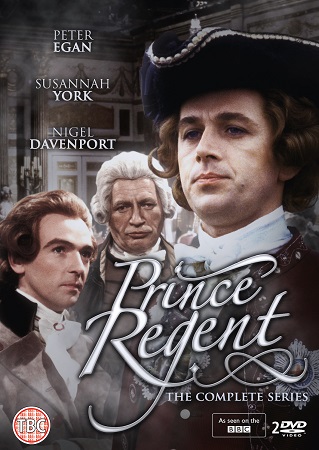
Prince Regent – Simply Media DVD Review

164454- Chief Crazy Horse Sleeve.indd

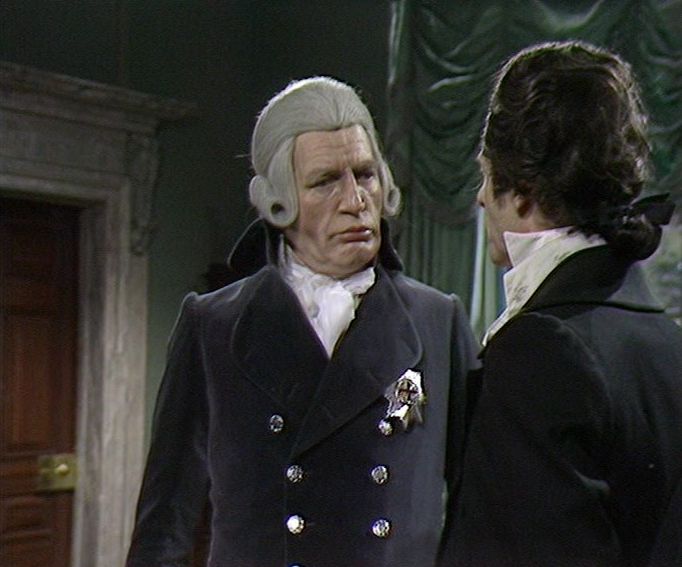
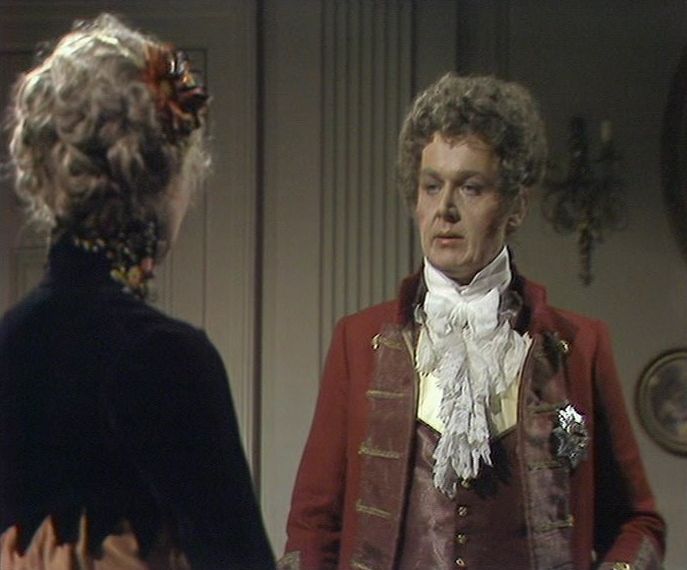
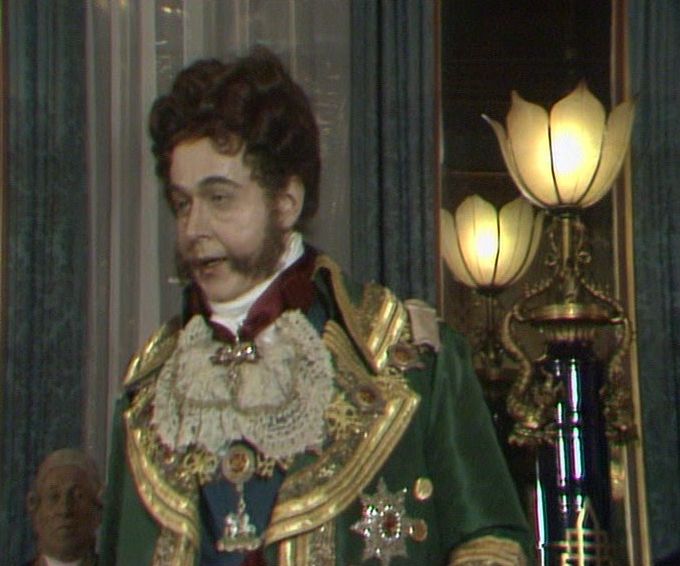
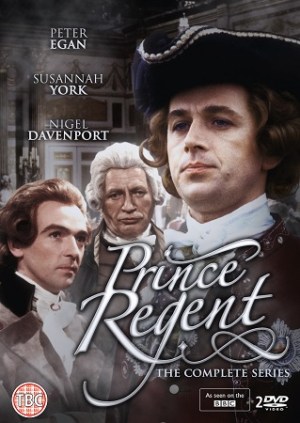
Prince Regent was an eight-part serial broadcast between September and October 1979.  Peter Egan played George, Prince of Wales, a man destined to ascend the throne of England.  But the madness of his father, George III (Nigel Davenport), and the strained relationship enjoyed with his wife Caroline (Diana Stabb) ensure that his succession is far from straightforward.

Unusually, multiple writers worked on the serial.  Robert Muller penned five episodes with the remainder provided by Reg Gadney, Nemone Lethbridge and Ian Curteis.  Carl Davis scored the music whilst Michael Simpson and Michael Hayes shared directing duties.

As might be expected, Peter Egan is supported by a highly impressive cast.  Nigel Davenport, Francis White, Keith Barron, Clive Merrison, Susannah York, Diana Stabb, David Horovitch, Barbara Shelley, Caroline Blakiston, Murray Head, David Collings, Cheri Lunghi and Patsy Kensit all appear in multiple episodes whilst the likes of Geoffrey Chater, Jane Freeman, Jo Kendall and Trevor Martin make one-off appearances.

Below is a brief episode by episode review.

Episode One – Mad For Love – 4th September 1979

In his own estimate talented, passionate, sensitive, a lover of art, of sport, of freedom, of women. In his father’s opinion scandalous and irresponsible, a drunkard, a ne’er-do-well, a lecher. 1782, and George Augustus Frederick, Prince of Wales, heir to the throne of England, approaches his coming-of-age (Radio Times Listing)

Mad for Love opens with a montage of the Prince of Wales enjoying various pursuts (fencing, shooting, carriage racing) which quickly establishes his less than serious nature. That he’s easily distracted by a pretty face is also in evidence after Maria Fitzherbert (Susannah York) catches his eye. The Prince finds (much to his amazement) that he’s violently in love with her, something which Maria – after listing George’s numerous previous conquests – finds impossible to believe.

The testy relationship enjoyed between the King and the Prince of Wales is explored for the first time. The King (wonderfully portrayed by Nigel Davenport) has a low opinion of his son, but it’s puzzling that he denies the Prince the opportunity to serve in the army. By doing so he condems his son to sort of aimless life he claims to despise.

regent 01.jpg

Episode Two – Put Not Your Trust in Princes – 11th September 1979

The Prince has married his beloved Maria. The ceremony is illegal and secret, hidden not only from the King but also from Fox. And the rumours and whispers of scandal, soon begin … (Radio Times listing)

Nigel Davenport continues to entertain as George III. Whether he’s at the dining table and lecturing his children about why they can’t afford certain fruit (Egan’s in full eye-rolling mode here) or displaying a lack of interest in the Bard (“oh dear god, not Shakespeare. Detest the fellow, sad stuff”) he’s great fun. But the early signs of the King’s madness casts a shadow, especially as we know what’s to come. It also has to be said that whenever George III goes “what, what, what” (which he does rather often) I can’t help but be reminded of Neddy Seagoon ….

Keith Barron, another quality player, gives a strong performance as Fox, although his heavy 5 o’clock shadow makes him look rather odd. Malcolm Terris, as a yokel politician bitterely opposed to George’s marriage, has a couple of nice scenes.

Episode Three – The Bride from Brunswick – 18th September 1979

The illegal marriage to Maria turning cold, his debts steadily increasing, the Prince begins to think the unthinkable. Why not a second, official, marriage? But who will be the bride this time? (Radio Times listing)

The Prince decides to show his gratitude to his father for settling his substantial debts by agreeing to marry whoever the King chooses. George III plumps for Princess Caroline, who is, to put it mildly, a woman of character.

James Harris, the Earl of Malmsbury (Julian Curry), is given the task of travelling to Brunswick, Germany, to arrange the match. The court at Brunswick is a delight, with Ralph Michael offering a fine comic turn as the Earl of Brunswick. The Earl likes to have endless fanfares whenever he eats, even if it means that the unfortunate players pass out after straining to maintain the notes!

Caroline is a real handful and it’s plain that she’ll shake up the Prince’s life. The meeting between Caroline and George’s most prominent mistress Lady Frances Jersey (Caroline Blakinston) is a treat but this is topped when George and Caroline first set eyes on each other. He recoils at her heavily made-up face whilst she bitterly comments that “he’s terrible fat and by no means as handsome as his portrait”. This is not going to be a marriage made in heaven ….

Episode Four – The Trouble with Women – 25th September 1979

An official wife, an unofficial wife, and a powerful and determined mistress – is it any surprise that the Prince feels besieged by women? (Radio Times listing)

Caroline bears the Prince a daughter, Charlotte, but if he’s to finally extricate himself from his debts then he’ll need to produce many more (each new child would see an increase in his allowance). George doesn’t take kindly to this thought, the fact he refers to Caroline as “that unnatural hell-hag from Brunswick” makes his postion abundantly clear.

David Collings (as Pitt) is yet another fine actor who enriches the production no end. Pitt has been opposed to George’s antics in the past, but now supports the suggestion that the Prince and Caroline should live separate lives. The Princess of Wales’ man-eating tendances (which occur off-screen) are touched upon after George tells his wife that he’s found her a nice house in Blackheath, which will be convenient, since the Royal Naval College and a home for distressed seamen are both nearby!

regent-02

Episode Five – Father and Son – 9th October 1979

The King’s health has been good for several years but now there are ominous signs of a relapse into madness – convulsions, delusions, incessant talking. Is it at last time for a Regency? (Radio Times listing)

This one opens with the unusual sight of George indulging in amateur dramatics, performing an intense monologue before a select, but appreciative, audience. Although I’m sure there’s more than a touch of sychophancy in their fulsome appreciation.

George III cuts a tragic figure. He knows that his intermittent madness has returned, but the prospect of the “cure” (beatings, leeches, isolation in a darkened room) is more than he can bear. Davenport once again commands the screen.

George’s wish that his father either dies or goes properly mad is chilling.

Episode Six – God Save the King – 16th October 1979

A delicate investigation has been ordered into the alleged adultery of Princess Caroline. The Prince sees a chance for divorce from his hated wife. (Radio Times listing)

Peter Egan’s appearance at the start of this episode comes as a bit of a shock. He was slighly made up in the previous episode in order to portray an ageing and portlier George, but here it’s even more pronounced. Oddly, George III looks no different …

The investigation isn’t able to prove that Caroline has commited adultery, a verdict which rather upsets George. But even with his rather unforgiving make-up, Egan impresses as an older, wiser George. His conversation with the dying Fox is a touching one.

With George III’s madness even more of a problem, his son is finally confirmed as Regent. But now this long-cherished day has arrived, what will be the outcome?

Episode Seven – Milk and Honey – 23rd October 1979

The Regent decides that it is time for his beautiful and high-spirited daughter, Princess Charlotte, to marry. He has a candidate – but the strong-willed Princess has her own opinions on the subject. (Radio Times listing)

Princess Charlotte (Cheri Lungi) brings her new man, Captain Charles Hesse (Paul Herzberg) to meet her mother. Princess Caroline is much taken with him (they end up in bed a short while later!)

Lungi’s appearance might be fairly brief, but she’s yet another strong addition to the cast. Charlotte tells her father that she takes after him (a double-edged compliment that’s for sure). The Queen is concerned about her – Charlotte has a stutter and delights in showing people her underwear, whether they ask to see it or not. Jane Freeman, as Charlotte’s governess Lady de Clifford, has a brief but amusing cameo.

James Garbutt, as Lord Elson, has some acid lines which demonstrate that he’s not Princess Caroline’s greatest admirer. “She’s a foul-mouth, a slut and I don’t care who hears me say it.” As he says himself, there’s plenty more where that came from ….

The episode ends with the bleakest of news. It’s another blow for George, who has cast an increasingly melancholy figure as the years have progressed (a far cry from his carefree younger self).

Episode Eight – Defeat and Victory – 30th October 1979

The Prince prepares for the greatest battle of his life. His adversary is his hated wife Caroline, and he is determined to rid himself of her once and for all. (Radio Times listing)

Defeat and Victory opens with the deaths of the King and Queen.  Both Nigel Davenport and Francis White have been exemplary throughout the serial and this continues right up until their final moments.  With George now due to become King he is gripped by a single obsession – to ensure that Caroline is not crowned Queen and to that end she’s put on trial by the House of Lords.  Leading the prosecution is Sir Robert Gifford (James Cossins).  Cossins, the latest in a long line of wonderful character actors to grace the serial, seems to be enjoying himself enormously.

The episode title is an apt one, as although the Lords find Caroline not guilty, George is still able to ensure that his wife never becomes Queen.

Peter Egan, skilled at playing charming rogues, was perfect as George.  But whilst he was easily able to exude George’s affable nature, Egan didn’t shy away from showing us the other side of the coin – the irresponsible man who sometimes rode roughshod over others. Capricious, charming, selfish, generous, George was all these things and more. It’s his ever-changing moods, as well the increasing melancholy which desended on him in his later years, which makes him such a fascinating character.

A co-production with Time Life Television and Polytel International , it’s plain that the budget was pretty generous since the studio sets are detailed and impressive.  The serial also benefits from location recording at the Brighton Pavilion, this really helps to add an extra gloss to proceedings.  A typically impressive BBC costume drama of the era, Prince Regent is a sharply scripted and well-acted serial that just oozes class.  It may be something of a forgotten treasure, but it’s a treasure nonetheless and comes highly recommended.  Prince Regent is released by Simply Media on the 17th of October 2016.  RRP £24.99.

regent 03.jpg

The Legend of King Arthur – Simply Media DVD Review

164454- Chief Crazy Horse Sleeve.indd

Broadcast in eight 30 minute episodes during October and November 1979, The Legend of King Arthur contains all the familiar story-beats you’d expect, but Andrew Davies’ adaptation still manages to throw in a few twists along the way.

Merlin (Robert Eddison) and Arthur (Andrew Burt) have established a new enlightened age, thanks in part to the mighty sword Excalibur which is used by Arthur to subdue his rivals.  But this hard-won peace is short-lived as his vengeful half-sister Morgan le Fay (Maureen O’Brien) has vowed to avenge her father’s death and only Arthur’s demise will satisfy her.  Well versed in the dark arts of witchcraft, she uses her powers to convince Arthur that his bravest knight Lancelot (David Robb) and Queen Guinevere (Felicity Dean) are enjoying a passionate affair.  But Morgan isn’t the only danger that Arthur faces and the treacherous Mordred (Steve Hodson) proves to be the one who fatally halts Arthur’s reign.

Long regarded as one of the best adaptations of the Arthurian legend, once you can get past the rather low-key production values (the VT nature of the studio scenes gives everything a rather stagey feel) there’s much to enjoy.

The central performances of Andrew Burt, Maureen O’Brien, David Robb, Felicity Dean and Steve Hodson are all first-rate.  Burt (the original Jack Sugden in Emmerdale Farm) might not be the sort of actor that would instantly spring to mind when considering the perfect Arthur, but his rather stolid persona is just what the production needed.  Maureen O’Brien is compelling as Morgan, eschewing cackling villainy for something much more low-key.  David Robb and Felicity Dean are both strong players whilst Steve Hodson gives Mordred the sort of slowly increasing intensity which serves the character well.

And if the main cast are pretty faultless, there’s also strength in depth to be found with the supporting players.  Denis Carey, Kevin Stoney, Richard Beale, Geoffrey Beevers, Peter Guinness, Hilary Minster, Ivor Roberts and Margot van der Burgh are amongst those who help to enrich the production.  A young Patsy Kensit, playing Morgan le Fay as a child, is another actor worth looking out for.

The story opens with the King, Uther Pendragon (Brian Coburn), deciding that he wants a Queen to bear him a son. He declares that the wife of his trusted ally, Goloris (Morgan Sheppard), will fit the bill nicely. Both Goloris and his wife, the lady Igrayne (Anne Kidd), are horrified, but Uther is not a man for compromise and tells Goloris that if he doesn’t comply, “however strong you may make this castle, I will have you out of it and roast you like a badger!”

Goloris and Igrayne have a daughter, Morgan (Patsy Kensit), who calls on divine help to strike down Uther, but Merlin appears instead. He tells her that “you have the gift, but not the knowledge of the gift. You see a glimpse of the forbidden things, but only a glimpse.” Merlin may stand by Uther’s side, but he doesn’t serve him, not fully. Goloris’ death at the hands of Uther sets in motion Morgan’s life-long hate of her half-brother Arthur (born of the forced union between her mother and Uther).

arthur-01

Kensit might have only been eleven at the time, but she was already something of a television and film veteran (her first credit came when she was just four years old). She’s appealing as the innocent who finds herself consumed with loathing for the boorish Uther (a broad, but effective turn from Coburn) and Arthur. Morgan’s transformation from good to evil is sealed when she fails to aid the choking Uther. That he dies after a glutinous feast rather sums up his character.

Episode one then moves ahead some fifteen years, as we see the young Arthur (Richard Austin) pull the sword from the stone, the act which confirms he is the true King. Sadly it’s a rather flatly staged moment, lacking any sense of magic or wonder. Much better is the following scene where Arthur makes a decent impression with some of the nobles. Others are less convinced, so there will be war. But first there’s another key moment – Excalibur needs to be retrieved from the Lady in the Lake.

It’s a pity that we don’t spend more time in the company of young Arthur, as by the start of episode two Andrew Burt has assumed the mantle. It’s not too surprising that the long battles he had to fight in order to prove his legitimacy happened off-screen (budget considerations I’m sure played a part in this). Maureen O’Brien now takes over the role of Morgan. She claims to Merlin that now she serves only God ….

arthur 02.jpg

It quickly becomes clear that Arthur is not the man his father was. Arthur is fair and conciliatory, but events prove this to be a weakness rather than a strength. After he pardons a bitter rival called Accolon (Anthony Dutton), it’s obvious that he’s simply delayed an inevitable confrontation. Arthur and Guinevere are married and Lancelot offers to be her champion, to stay constantly by her side and do whatever she bids.

Merlin disappears after the second episode, which is a shame as Robert Eddison had a teasing, impish presence. Merlin’s absence forces Arthur to take control of his own destiny, which you sense is not going to end well. And Morgan’s arrival at Arthur’s court, with Mordred in tow, sets in motion the long endgame that results in Arthur’s death.

The middle episodes develop the relationship between Guinevere and Lancelot. Whilst the arrival of the elderly King Pelles (Denis Carey) dispossed of his lands and with a daughter laying stricken under the curse of a powerful witch (who has to be, unknown to any at court, Morgan) adds another layer to the narrative. Carey, an actor of dignity and subtlety, always enhanced any programme he appeared in and this one is no exception. Pellas tells the court that only one man can save his daughter and that man is Lancelot.

As the serial progresses, both Morgan and Mordred continue to manipulate Arthur.  Amongst some of the riper turns, Steve Hodson offers something more nuanced. When we first meet him he appears to be Arthur’s man, but his alliance with his aunt Morgan and his own ambitions slowly rise to the surface to reveal his true nature.

Morgan suggests to Arthur that the love between Guinevere and Lancelot is the sort of love shared between a husband and wife, whilst Mordred spies an excellent opportunity to blacken Guinevere’s name even further.  Mordred and Morgan had intended to poison Guinevere with a piece of fruit, but the Queen innocently decided to offer this treat to someone else.  When Guido de la Porte (Tim Wylton) drops dead after a single bite, the Queen is suspected of murder.

arthur-03

Lancelot would be the man to defend her honour, but he lies injured and isolated from the court.  And Lancelot’s standing amongst his fellow Knights (already shaky due to the innuendo about his possible affair with the Queen) diminishes even further when the dead body of Eleanor (Amanda Wissler) comes drifting towards them.  Eleanor loved Lancelot, but he couldn’t return her love.  When Lancelot and the others realise that the spurned Eleanor has taken her own life, it’s amongst the most powerful moments in the serial.   By the time we reach the final episodes, Galahad (James Simmons) arrives, as does the Quest for the Holy Grail, Lancelot and Arthur become bitter rivals whilst Mordred, in Arthur’s absence, usurps his kingdom.

Even with eight episodes, given the amount of ground covered in The Legend of King Arthur there’s the sense that an even longer running time would have allowed some of the secondary characters to be fleshed out a little better, as well as allowing more time to linger on certain themes.  For example, when Lancelot heads off to avenge King Pellas, he’s able to do so with almost indecent haste.  He may be the bravest Knight in the land, but this still seems a little perfunctory!

Produced by Ken Riddington, directed by Rodney Bennett and with incidental music by Dudley Simpson, The Legend of King Arthur is a treat from start to finish.  Those used to the glossier production values of modern television may find it to be lacking in places, but Andrew Davies’ layered adaptation, an attention to detail and the quality cast all help to compensate for the fairly low budget.

There are some production missteps (for example, as the characters age unconvincing wigs and beards are pressed into service) but there are many positives as well.  Andrew Burt is entertaining as the thoroughly decent but doomed King, whilst Felicity Dean is terribly appealing as the winsome Guinevere.  Add in the smiling manipulative villainy of Maureen O’Brien’s Morgan and it all combines to produce a heady brew.

The Legend of King Arthur is released by Simply Media on the 10th of October 2016.  RRP £19.99.
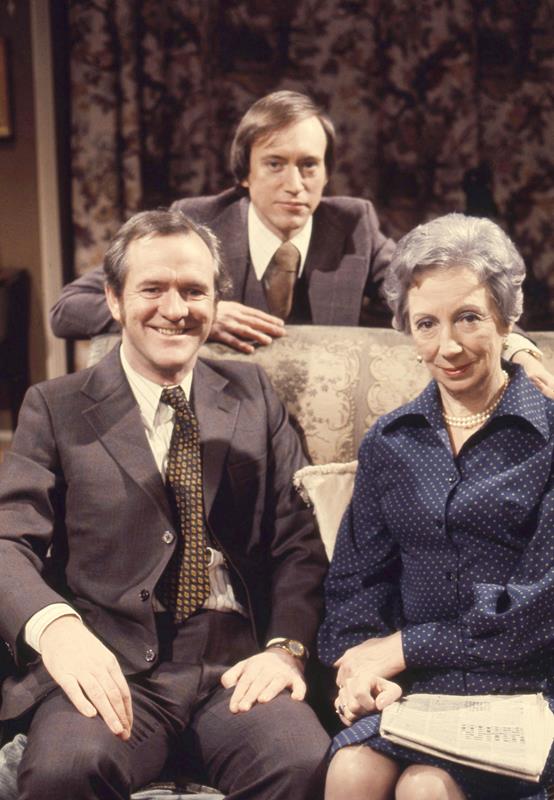
arthur-04

Prince Regent to be released by Simply Media – 17th October 2016

164454- Chief Crazy Horse Sleeve.indd

Starring Peter Egan and Susannah York, Prince Regent will be released by Simply Media on the 17th of October 2016.  Review here.

BAFTA winner Peter Egan (Chariots of Fire), Oscar and Primetime Emmy nominee Susannah York (Superman) and Nigel Davenport (Chariots of Fire) star in the BAFTA winning eight-part historical drama, Prince Regent: The Complete Series.

Transmitted by the BBC in 1979, the series depicts the life and times of George IV (1762-1830) from his early days of debauchery, his ascent to the throne as Prince Regent and his reign as King. Covering his famously dissolute lifestyle including his two marriages (one legal, one not), his mistresses, the famous men of his day and the over-indulgence and frustration of waiting for his father George III to die or remain mad; this sumptuous series will be available on DVD from 17 October 2016.

Directed by BAFTA winner Michael Simpson (The Bill) and also featuring Patsy Kensit (Holby City) and Cherie Lunghi (Mary Shelly’s Frankenstein).


The Legend of King Arthur to be released by Simply Media – 10th October 2016

164454- Chief Crazy Horse Sleeve.indd

The Legend of King Arthur will be released by Simply Media on the 10th of October 2016.  Review here.

Andrew Davies’ (House of Cards) sumptuous adaptation of the timeless saga, The Legend of King Arthur, makes its home entertainment debut on 10 October 2016 with the complete 1979 series.

Dark Ages wizard Merlin (Robert Eddison – Indiana Jones), weary of the barbarism around him, creates a new order of enlightenment and justice with a youthful Arthur (Andrew Burt – Emmerdale) at its head. Merlin presents Arthur with the magic sword Excalibur to help him defeat the nobles who oppose his rule. But Arthur must also beware his half-sister Morgan (Maureen O’Brien – Doctor Who), a sorceress who has sworn to kill him to avenge her father’s death.

As Morgan intensifies her campaign, she uses magic to draw Lancelot (David Robb – Downton Abbey) and Guinevere (Felicity Dean – The Whistle Blower) into a passionate affair. But it is the still more traitorous Mordred (Steve Hodson – Break in the Sun) who will fatally halt Arthur’s rule.

Bringing high romance, low treachery and magical adventure via a host of legendary characters and featuring an early appearance by Patsy Kensit (Holby City), this is a fabulous retelling of the gloriously twisting tale.


Softly Softly: Task Force – Series Two. Simply Media DVD Review

164454- Chief Crazy Horse Sleeve.indd

Series two of Softly Softly: Task Force was broadcast between September 1970 and March 1971.  Whereas series one (discussed here) had sixteen episodes, series two ran for twenty six episodes (an obvious sign that series one had been a success).

Below is a brief episode guide –

Baptism – 16th September 1970
Written by Elwyn Jones. Featuring Ian Hogg

Sunday, Sweet Sunday – 23rd September 1970
Written by Alan Plater. Featuring Christopher Beeney, Windsor Davies and Michael Hawkins

Safe in the Streets? – 30th September 1970
Written by Allan Prior. Featuring Leon Vitali, Vicki Michelle and George Tovey

Good Listener – 7th October 1970
Written by Elwyn Jones. Featuring Jonathan Newth

Time Expired – 14th October 1970
Written by Robert Barr

Lessons – 21st October 1970
Written by Arnold Yarrow. Featuring John Ringham, Glynn Edwards and Sally Thomsett

Without Favour – 28th October 1970
Written by Alan Plater. Featuring Collette O’Neil

Never Hit a Lady – 4th November 1970
Written by Allan Prior.  Featuring Neil McCallum and Richard Beale

Its Ugly Head – 11th November 1970
Written by Elwyn Jones.  Featuring Michael Goodliffe

Who Wants Pride…? – 18th November 1970
Written by Robert Barr. Featuring Jess Conrad and Ray Lonnen

Collation – 25th November 1970
Written by Elwyn Jones

Do Me a Favour – 2nd December 1970
Written by Robert Barr. Featuring Chloe Ashcroft, Victor Maddern and Jon Rollason

Sweet Are the Uses of Adversity – 9th December 1970
Written by Elwyn Jones. Featuring Del Henney

Bearings – 16th December 1970
Written by James Doran

A World Full of Rooms – 23rd December 1970
Written by Allan Prior. Featuring Milton Johns

The Lie Direct – 30th December 1970
Written by Elwyn Jones. Featuring Tony Calvin and Geoffrey Palmer

Ground Level – 6th January 1971
Written by Alan Plater. Featuring Glyn Owen

Company Business – 13th January 1971
Written by John Elliot. Featuring Wendy Gifford

Kick Off – 20th January 1971
Written by Elwyn Jones. Featuring Roddy McMillan and George Pravda

Final Score – 27th January 1971
Written by Elwyn Jones. Featuring Roddy McMillan and George Pravda

Something Big – 3rd February 1971
Written by Robert Barr. Featuring Desmond Llewellyn, John Woodvine and Jeremy Wilkin

Games – 10th February 1971
Written by Arnold Yarrow. Featuring Jean Boht

In the Public Gaze – 17 February 1971
Written by Elwyn Jones. Featuring Gawn Grainger and Reginald Marsh

Held for Questioning – 24th February 1971
Written by Robert Barr. Featuring Denis Quilly and Norman Jones

Black Equals White – 3rd March 1971
Written by Allan Prior. Featuring Angus MacKay

Cash and Carry – 10th March 1971
Written by Elwyn Jones. Featuring Gertan Klauber and Peter Sallis

The regular cast is pretty much unchanged since series one. Stratford Johns continues to dominate as Chief Supt. Barlow, whilst Frank Windsor returns as the straight-talking Det. Sup. Watt.  Norman Bowler (Det. Insp. Hawkins) doesn’t have such a sharply-defined character as either Barlow or Watt, but he’s still a very solid presence.  Walter Gotell, probably best known playing Gogol in the James Bond films, makes the occasional appearance as Chief Constable Arthur Cullen.

David Lloyd Meredith provides a dash of humour as the rather Welsh Sgt. Evans whilst Terence Rigby (always a rather idiosyncratic actor) is, as PC Snow, another actor who’s always worth watching.  PC Snow was distraught at the end of series one after his police-dog Inky was shot and killed, so series two sees him develop his working relationship with Inky’s replacement.  Susan Tebbs, as Det. Con. Donald, remains the show’s sole female regular.  Terrence Hardiman is a new recruit, turning up towards the end of the season as Inspector Armstrong.

As listed in the episode guide above, a host of familiar faces pop up during the course of the twenty six episodes and there’s also some very sharply written scripts, especially those provided by Alan Plater (a Z Cars veteran).  Elwyn Jones (who had created the Softly Softly: Task Force format) was another writer who had racked up numerous credits on Z Cars and Softly Softly and would be just as prolific on Softly Softly: Task Force and the later spin-off, Barlow.  Like Plater, he really understood how the series worked and his episodes, including the series opener and closer, are some of the strongest.

It’s interesting that both SS:TF and Dixon of Dock Green started to produce several all-film episodes at the same. It’s just a pity that these ones – Lessons and Do Me A Favour – look pretty poor (very faded colours on both throughout). Given the age of the material that’s not a surprise, but generally what we have across the seven discs is quite watchable. There’s no particular issues with the VT sequences (apart from the occassional bit of tape damage) but the film inserts on certain stories are rather grubby.

With so many episodes, it’s inevitable that the quality dips from time to time, but generally the level remains pretty consistent throughout the run.  During the next month or so I’ll be posting reviews of every episode, which will enable me to examine them in a little more detail.

Softly: Softly Series Two is released by Simply Media on the 26th of September 2016.  RRP £44.99.
Doomwatch – Sex and Violence

sex

There’s a clear irony in the fact that Sex & Violence, a story which concerned itself with the question of censorship, was pulled from the schedules and was never transmitted.  Given the very depleted nature of season three Doomwatch episodes it’s odd, but welcome nonetheless, that an episode which didn’t even make it to the screen somehow managed to survive the archive purges (logic would have suggested it would have been the first to go).
One suggestion for the reason why the BBC got cold feet concerns the use of real-life Nigerian executions.  It’s certainly shocking – but this footage had already been transmitted on several occasions prior to this, so it’s reasonable to assume that for viewers at the time the shock value wouldn’t have been too great.  And had this really been a cause of concern it would have been easy to excise the section without damaging the narrative flow too greatly (we could have cut away from the clip before the shooting and simply shown the reaction of the watching committee).

It seems much more likely that the episode was pulled since several characters were thinly disguised caricatures of real people.  Both Mrs Catchpole (June Brown) and Mrs Cressy (Noel Dyson) have more than a touch of Mary Whitehouse about them.  This is made very obvious in the pre-credits sequence, which sees Mrs Catchpole holding forth at a public meeting – held in a church – and railing about the filth thrown at people like her (her audience is comprised of middle-aged, middle-class women) by the intellectual media elite.

Unlike Mrs Whitehouse, Mrs Catchpole isn’t a national figure, therefore she tends to exist around the fringes of the plot.  So Mrs Cressy also acts as a Whitehouse substitute – she’s less of a rabble-rouser, but is equally vehement about stamping out sex and violence.  Mrs Cressy is a member of the Purvis sub-committee, who have been charged with investigating all aspects of pornography and violence in the media.  Quist is also asked to look into the same question, which he’s less than keen about.

Pollution in the air or the sea he can understand, but moral pollution?  It’s not his thing at all.  But as we’ve seen several times before, Quist starts off doubtful but eventually gets more interested as the story progresses.  It’s just a pity that yet again he’s operating on the periphery of the plot. Dr Tarrant is seconded to the sub-committee, which means she’s as an active participant, leaving Quist as a fairly passive onlooker.

The other members are Professor Fairbairn (Brian Wilde) and Steven Grainger (Bernard Horsfall) who tend to lean towards the permissive end of the spectrum.  Mrs Cressy and the Rev Charles Garrison (Llewellyn Reees) take the opposing view, which means that Dick Burns (Christopher Chittell) is a valuable floating voter, since he holds no firm opinions either way.  Burns, a pop star, is another clear analogue to a real public figure (at the time Cliff Richard had been asked to sit on a very similar committee).  Although Burns is a much less straight-laced figure than Richard, the parallel seems clear.

Sex & Violence is a dense, talky episode – a great deal of it revolves around the committee’s debates – which really comes alive thanks to the first-rate guest cast.  Brian Wilde and Bernard Horsfall are always a pleasure to watch, whilst June Brown (a decade or more away from achieving national fame in EastEnders) has some sharply written comic scenes.  It’s fair to say that Mrs Catchpole isn’t a subtle character though, and it’s no doubt this less than veiled attack on Mrs Whitehouse which sealed the story’s fate.  The Doctor Who fan in me was quietly delighted to see Llewellyn Rees and Bernard Horsfall in the same scene (a few years later they’d both appear in The Deadly Assassin).

There’s no stunning revelations here.  For example, Anne is attacked by Mrs Hastings (Angela Crow) as she attempts to buy a ticket for an Oh Calcutta type play.  Although Anne’s hurt and bruised, she’s much more interested why a law-abiding person like Mrs Hastings would be incited to violence.  The answer seems to be that she’s always been fairly repressed about sex (since her parents didn’t talk about it at all) which it probably didn’t take a psychiatrist to work out!  It’s also worth mentioning the décor of Mrs Hastings’ flat, which has the most garish early seventies wallpaper you could possibly imagine.

When Quist later wonders exactly why Doomwatch is involved, it’s easy to agree with him.  It’s an interesting enough story, but it’s also yet another example of how far the series changed from the early Pedler/Davis ecological tub-thumping.

Possibly the most interesting part of the plot revolves around the character of  Arthur Ballantyne (Nicholas Selby).  He’s a political figure who’s made considerable capital out of the sex and violence debate (he’s revealed to have financed a number of pressure groups, including Mrs Catchpole’s).  It’s easy enough to look around today and find politicians who have risen to prominence on the coat-tails of controversial debates – which is a final demonstration that Doomwatch, even forty years later, can continue to hold a mirror up to our society.

Doomwatch – Hair Trigger

hair trigger

Anne is at Weatheroak Hall Maximum Security Medical Research Unit.  She’s there to meet Doctor McEwan (Barry Jackson) and Professor Alec Hetherington (Morris Perry) who have developed a revolutionary process to deal with hardened and psychopathic criminals.

Behind a glass panel she observes Michael Beavis (Michael Hawkins) receiving treatment.  Anne is horrified to learn that he’s essentially little more than a radio-controlled puppet – electrical impulses, controlled via a computer, damp down any negative or violent feelings he may have and McEwan is convinced this will enable him to be reintegrated into society (otherwise Beavis would remain a prisoner in Broadmoor and therefore a severe drain on the nation’s finances).

But for Anne, Beavis isn’t cured – his psychopathic tendencies are simply being suppressed.  Apart from the ethical issues this raises for her, she’s also far from convinced that the treatment is foolproof.  McEwan is happy for her to speak to Beavis on a one-to-one basis in order that her fears may be allayed, but by doing so she re-opens his long-buried trauma and after attacking her, he escapes ….

Hair Trigger was tapping into something of a zeitgeist about how technology could deal with violent criminals.  This was a theme of A Clockwork Orange (both the original book and the later film) whilst the 1971 Doctor Who story The Mind of Evil  also had its own method of removing evil impulses from the minds of criminals (an alien parasite).  Although the Doctor Who story was much more fantastical than Hair Trigger,  there are some similarities – not least Anne’s statement that by suppressing all the violent tendencies from any given subject they’ve basically been neutered and aren’t really human beings any more.

Director Quentin Lawrence creates a decent visual joke as the episode title and writer credit is displayed following the opening credits. They’ve overlaid over what appears to be a pastoral scene, but a few seconds later it’s revealed to be an album cover of classical music, which Anne puts onto the turntable as she attempts to convince Quist that McEwan’s process is fundamentally immoral.

Quist is slow to agree (although there’s the suggestion later that he was playing devil’s advocate). That Anne is the one who’s concerned whilst Quist remains a passive onlooker is another example of the way his role was downplayed during series three. He acts as a decent sounding board for Anne to develop her arguments, but apart from that Quist has little involvement in the main narrative.

The rest of the Doomwatch team are also pretty much surplus to requirements in this one. Bradley is absent, whilst Stafford and Barbara only have a couple of scenes. Although even in the limited screen time they both have, Barbara’s obvious dislike of Stafford is made quite clear.

Morris Perry and Barry Jackson both give characteristically solid performances, but the acting honours must go to Michael Hawkins as Beavis. When we first meet him, Beavis is desperately keen and eager to please, although when McEwan gently tells him that Anne will want to talk about his past life there’s a strong sense that his former crimes (he murdered his wife and children) still trouble him.

This is therefore something of a story weakness. We’re told that McEwan’s work has a zero failure rate – yet as soon as Anne starts to probe Beavis about his history he goes berserk. And the computer control isn’t able to stabilise him afterwards, as he escapes from the compound and takes a family hostage.

If the Doomwatch team aren’t terribly well used here (remember that Anne isn’t actually a member of Doomwatch) then Brian Hayle’s script is still a tautly written and well-acted affair. As I’ve said, acting kudos must go to Hawkins, especially in the final ten minutes as the hostage situation plays out to an inevitable but nonetheless powerful conclusion.

Doomwatch – Waiting for a Knighthood

waiting

Although Waiting for a Knighthood was only the fourth episode of series three, there had already been a number of key developments during the first three (all now sadly wiped) episodes.

The series opener, Fire and Brimstone, had seen John Ridge steal a number of anthrax phials in order to hold the government to ransom.  This plotline had been developed to lessen Simon Oates’ involvement in the show, as he’d disliked the way the second series had developed and didn’t wish to remain a regular for the third run.  Waiting for a Knighthood, which sees Ridge ensconced in a secure nursing home following his breakdown, is the last existing episode which features him.

Ridge’s removal from Doomwatch meant that a replacement had to be found – hence the introduction of Commander Neil Stafford (John Bown).  Stafford isn’t a scientist, he’s a security man, which meant he could take over the security and clandestine aspects of Ridge’s role whilst remaining a distinct character.  He’s certainly no womanizer and the fact that he reports to the Minster means that it’s not always easy to know where his loyalties lie.  Given the small number of series three episodes existing, he looked to be an interesting character and it’s a pity that we don’t have the opportunity to see more of him in action.

Perhaps the most jarring aspect of this episode is that we see Quist relaxing at home (or as it turns out, Anne Tarrant’s home) – the picture of perfect domestic contentment.  Up until the end of series two, Quist had been an emotionally isolated figure – living only for his work – so it’s something of  surprise to find that he’s now deep into a relationship (and also that Anne calls him “Spence”! which is something nobody else has done).

Given that when Dr Fay Chantry was introduced in series two Ridge mentioned casually in passing that she might be a decent match for Quist, it’s intriguing to wonder whether any thought had been given to matching them up.  It’s just as likely a coupling as the one-off character of Dr Tarrant (who had appeared in You Killed Toby Wren) linking up with him I guess.

Waiting for a Knighthood opens with Anne attending a church service.  Along with the other parishioners, she’s perturbed to see the vicar suffer a breakdown and it’s later revealed that he’s suffering from lead poisoning (he’s a keen mechanic and had ingested a dangerous level of fumes).  A similar thing seems to have happened to Ridge, which provides an explanation for his behaviour in Fire and Brimstone.

These incidents, and increasing concerns about the levels of lead in petrol, indicate that there should be tighter controls – but Richard Massingham (Frederick Jaeger), after enjoying a decent dinner with the Minister, Sir George Holroyd (John Barron), tells him he’s not convinced.  Massingham is an oil man and doesn’t see why a few high profile cases should mean swingeing restrictions.  After all, he says, it’s not as if people are dropping down dead all over the place.

The debate about harmful levels of lead both here and at the Doomwatch office keep the story ticking along, but the main part of the plot concerns the kidnapping of Massingham’s young child (played by Stephen Dudley).  Dudley, the son of producer Terence Dudley, would be a regular a few years later in Survivors (and already had another Doomwatch credit – Tomorrow the Rat – to his name).  Dudley the younger is rather irritating in this one, so I’m thankful his screentime was fairly limited.

Coincidence is the name of the game here.  The boy was kidnapped by Mrs Sylvester (Glenm Watford) who happened to be passing Ridge’s garage at just the right moment to hear Bradley and Stafford discussing the possibility that Ridge had suffered from lead poisoning.  Her own son had died from something similar and so she decides to kidnap Massingham’s boy in revenge.  And Massingham has direct links with the Minister, which means that Doomwatch are involved straight away.

If the plot seems a little messy and rather open-ended, then there’s still some useful food for thought about the dangers of lead in petrol.  Bradley gets  decent share of the action (as does Barbara, who becomes more of a central character during series three – just a pity that we can’t see most of it).  Frederick Jaeger as Massinghm is suitably solid.  Massingham isn’t a cartoon villain – knowingly polluting the air – he’s a realist who knows that the only way for the government to take action is if they raise petrol prices substantially, which of course they won’t do.

A pity that Quist’s rather sidelined though, but that tends to be par for the course with series three.