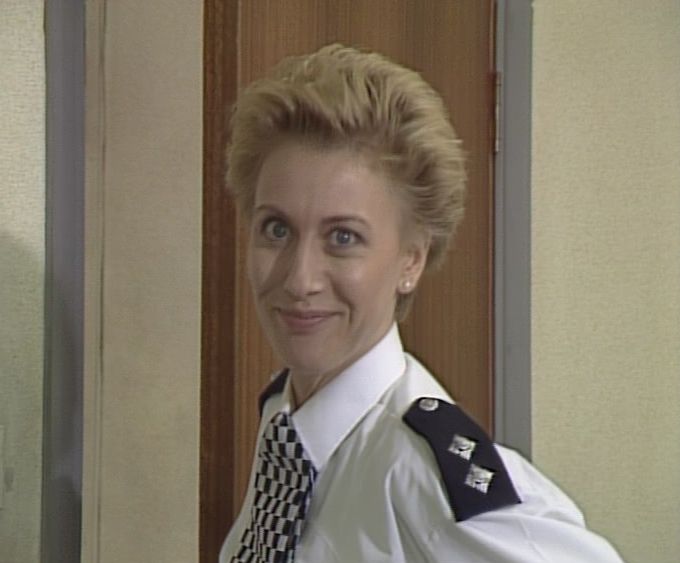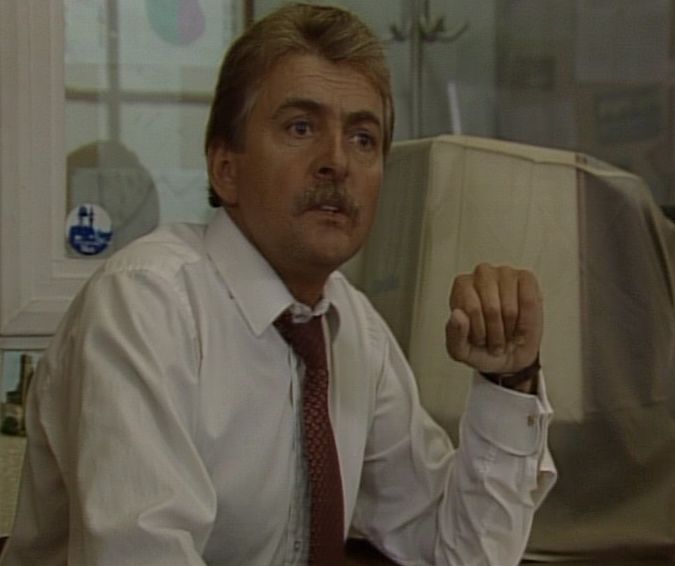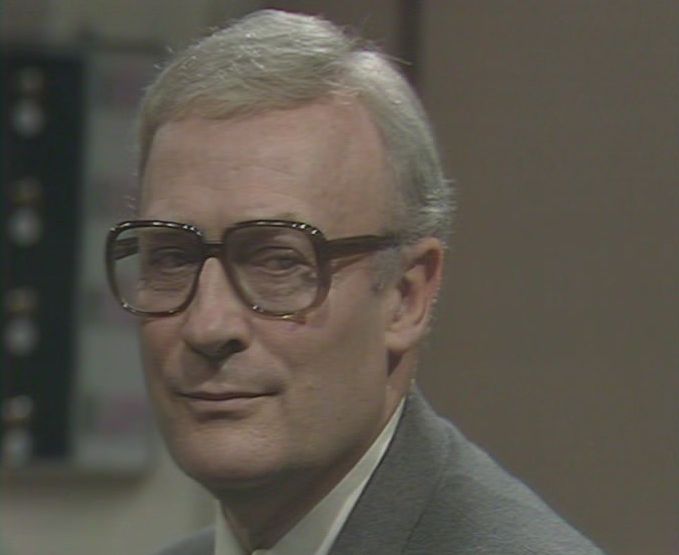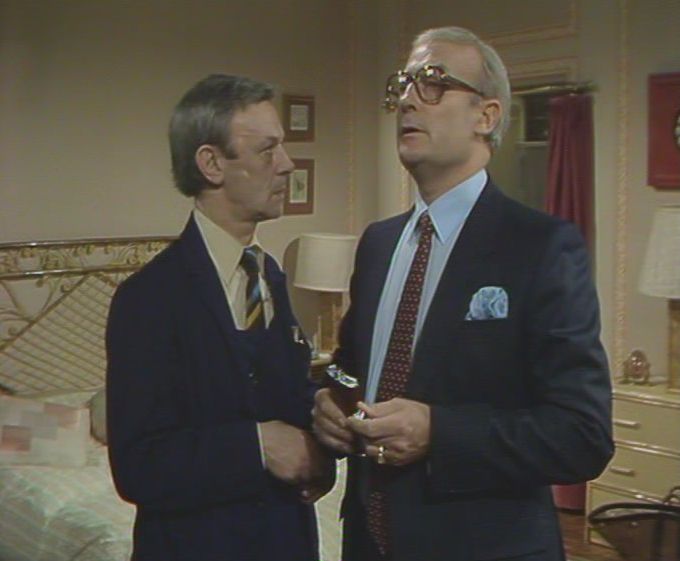
Minder – The Beer Hunter

beer

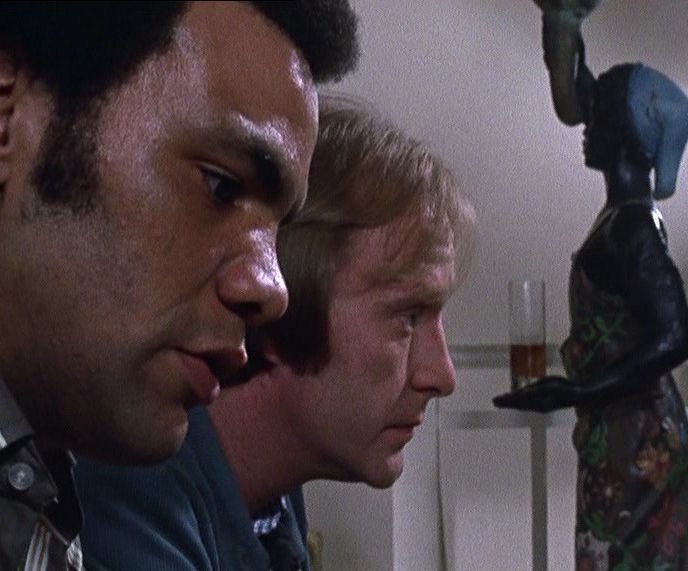
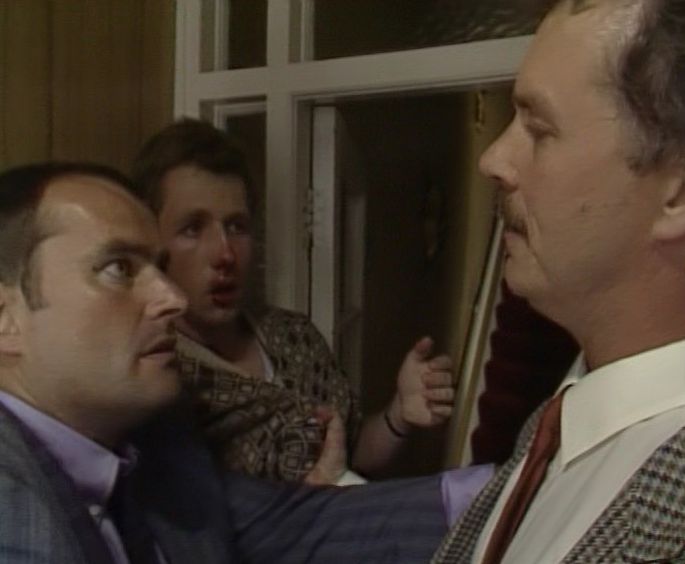
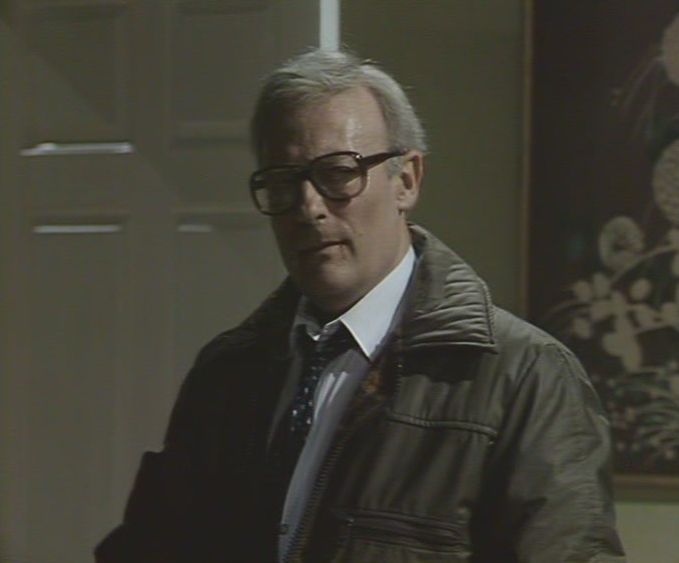
Arthur’s reunion with Yorkie (Brian Glover), an old pal from his army days, doesn’t go to plan after Yorkie disappears following a night of drunken revels. This means that Arthur and Terry have a race to find him before his wife, Dora (Pat Ashton), arrives from Rotherham …

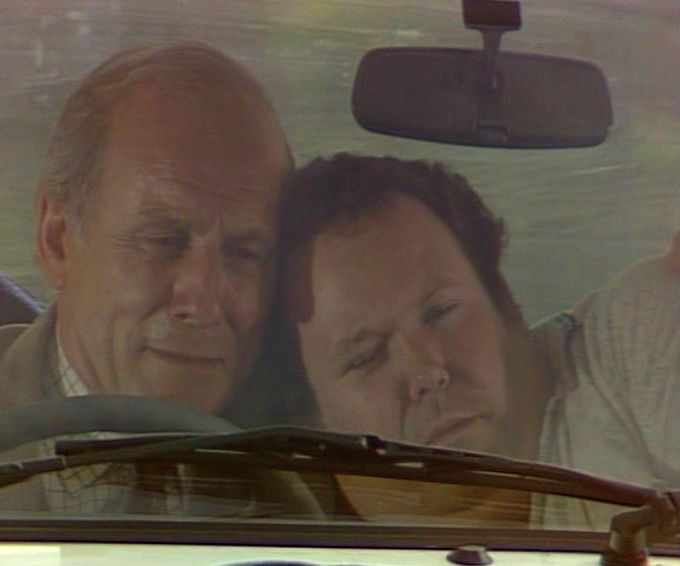
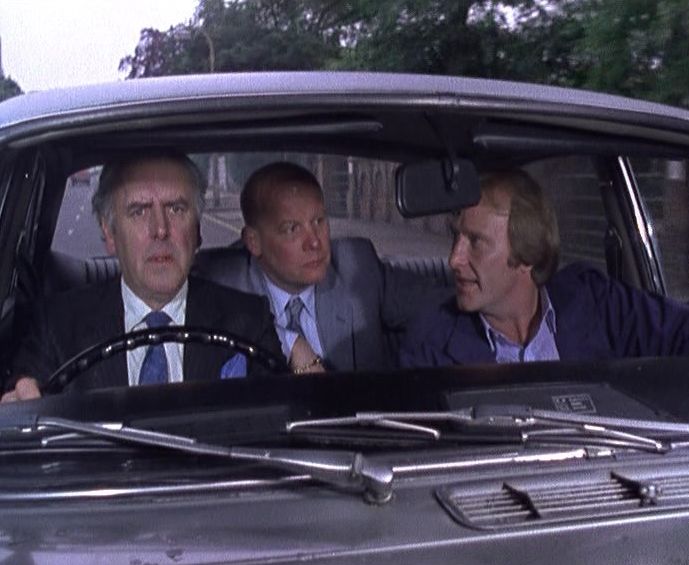
The sight of Cole and Glover, drunkenly singing off-key, is an early episode highlight. Arthur and Yorkie have clearly been having a good evening, Terry less so. He’s been dozing in Arthur’s car, waiting to pick them up and drive them home.

The sight of Terry in an expensive motor catches the eye of a passing policeman but although there’s a brief moment of tension when Terry admits he doesn’t know the registration, the officer accepts his story and walks on by.

Yorkie’s presence helps to shade in a little of Arthur’s backstory.
We learn that Arthur’s military career was far from distinguished, but possibly Yorkie was the key to his survival anyway. Arthur tells Terry that Yorkie was “my best mate in the Army. I would go to hell and back again on my hands and knees for Yorkie”.

Did he operate pretty much as Terry does now, as a minder, keeping Arthur safe from his fellow soldiers? It’s easy to imagine Arthur back then running various dodgy schemes and if Yorkie did have his back it makes sense why Arthur now feels indebted to him. It would also explain Terry’s presence today- a Yorkie substitute, if you will.

Naturally, it doesn’t take long before Willis Hall’s script undercuts Arthur’s drunken reminisces of heroic endeavour (lovely playing, as usual, by Cole). Terry reminds him that he wasn’t called up until 1949! It quickly becomes clear that Arthur spent most of his service time propping up the bar, but it’s entirely characteristic that over the decades he’s rewritten this humdrum chapter of his life into something much more impressive.

We get a close encounter with ‘Er ‘Indoors – possibly about the nearest she ever came to making an onscreen appearance. As Arthur, propped up in bed, makes an early morning phone call to Terry, we see and hear the curtains being quickly drawn back (causing Arthur a momentary spasm of pain) followed by the slam of the bedroom door. Two off-screen moments which suggest his better half is not amused.

Carlos Douglas plays the imaginatively named Carlos, one of the hotel staff at Yorkie’s seedy hotel (Janine Duvitski is another) . He’s probably best known for playing the equally imaginatively-named Carlos in Duty Free. An uncredited Phil Rose (Friar Tuck from Robin of Sherwood) makes a brief appearance whilst Harry “Aitch” Fielder pops up as one of the patrons in the Winchester – if his face is instantly recognisable then, like me, you’ve clearly watched far too much old television …

The mystery of Yorkie’s disappearance isn’t a mystery for long. He’s ended up in the bed of a prostitute called Renee (Georgina Hale). Hale had previously appeared in Budgie (scripted by Willis Hall and Keith Waterhouse) which might explain her presence here. Hale’s acting style has always been unique – thanks to her drawling delivery – and she’s typically entertaining here, as poor Yorkie wakes up to find he’s lost his trousers and Renee does her best to help him.

A later highlight has to be when Arthur interferes with a school rugby match – he picks up the ball and runs off, pursued by the pack of kids! Arthur subsequently compares himself to Gareth Edwards, although Terry thinks Jimmy Edwards is nearer the mark. And Arthur’s earlier comment, as he runs onto the rugby pitch (“don’t you speak to me like that! I used to play for the All Browns!”) is another wonderful line from an episode packed with first-class comic moments.

Yorkie’s hero-worship of Arthur is also developed as the episode progresses – he tells the disinterested Renee that Arthur’s got more cars than British Leyland. This sort of dog-like devotion might also explain why Arthur enjoyed having him around during their service days.

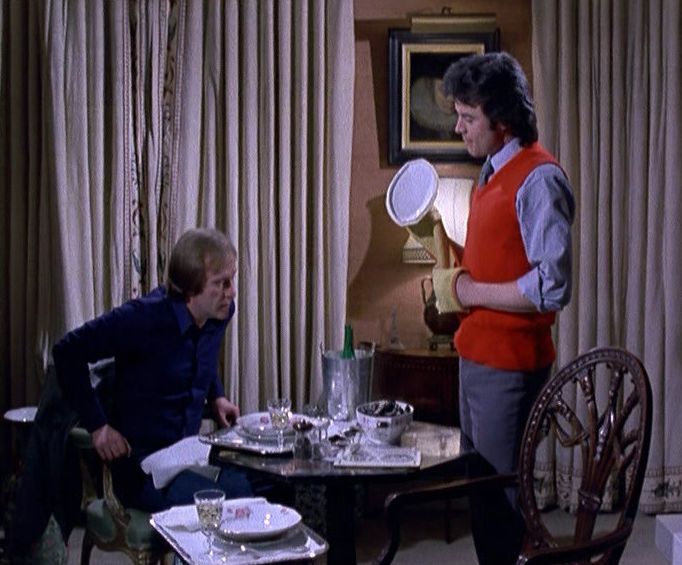
There’s some other lovely performances scattered throughout – Alan David as a chef who’s obsessed with hats that don’t stand proud, for example – and although The Beer Hunter does feel at times like a series of vignettes, there’s plenty to enjoy in this densely-packed script, not least the wonderful performance by Brian Glover. The sight of Glover hiding in a Wendy House is just one treat amongst many.
Minder – Not a Bad Lad, Dad

not

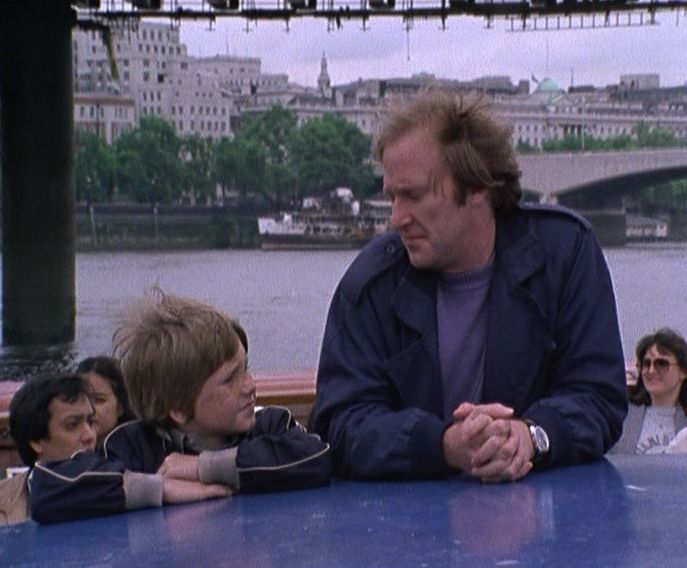
Terry’s latest minding job is an unusual one – a nine-year old boy called Peter (Warren O’Neill) who might possibly be his son ….

Given that Terry’s something of a bird magnet, it would be surprising if he didn’t have a few children dotted around that he knows nothing about.  Could Peter be one of them?  When his mother, Beryl (Sharon Duce), leaves him in Terry’s care, he’s certainly left with that impression.

Even this early in the story, the viewer might have a few questions – firstly why has Sharon come back into Terry’s life after so many years? It’s also very strange that she dumps her son on Terry’s doorstep and then disappears (although she does keep a watching brief, hidden around the corner).

Arthur’s not happy.  Peter’s a distraction who could blunt Terry’s effectiveness and this concerns Arthur greatly.  As the series progressed over the years, the rough edges of the characters were gradually smoothed down, but this is very much the early, selfish Arthur – a man who only thinks of himself and is quite happy to manipulate others to achieve his ends, no matter what the consequences might be.

Early on, he tells Terry that it’s unnatural for him to imagine he could be a father. “I’m referring to your erratic lifestyle, your total lack of ambition, your cavalier attitude to matters domestic. It don’t exactly make you odds on favourite for the fatherhood stakes”. Arthur’s advice about Peter is stark (“dump him”). Not in the river, he qualifies, but down at the social.

Tony Hoare’s script offers a change of pace for the series as we see Terry slowly adjusting to the possibility of being a father (although Peter’s under the impression that Terry’s his uncle).  As the episode progresses it’s plain that he’s doing all he can to entertain the boy – games of football and trips on the river – but the negative aspects of Terry’s personality surface from time to time.

Peter’s a lad with attitude, best demonstrated when he gets into a mild fracas with a couple of older youths (Terry’s been forced to take him along to his bouncer’s job at the local pub).  Terry attempts to draw a line under events with his usual diplomatic skill.  “Shut your mouth, sonny or I’ll squeeze all your pimples. Now on your bike, both of you!”  The lads don’t take the hint though and when one of them wonders if Peter will grow up to be as big a pillock as his uncle, Terry responds in the only way he knows how – violence.

We’ve seen Terry hand out similar punishments on numerous previous occasions, but due to Peter’s presence this feels somewhat different.  The way that Peter looks at him afterwards is a telling moment – suggesting that Terry’s world of violence disturbs him. It’s an interesting touch that as Terry and Peter look at each other, the ambient sound fades away. This helps to make the moment seem a little more claustrophobic (the fact that Terry is unable to hold Peter’s gaze is notable too).

Giving Terry a son (even if he didn’t appear in every episode) would certainly have changed the dynamic of the series.  If they’d been thinking ahead, making him a teenager would have meant he could eventually have taken over from Terry (as it was, the family tradition was maintained from the Daley side, with young Ray).  But since Minder was never a series with continuing threads, it’s no real surprise when Beryl’s husband, Ronnie (Dicken Ashworth), turns up, with Beryl not too far behind, both intent on reclaiming their boy.

If Ashworth’s size wasn’t enough to create a sinister impression, there’s also a sprinkling of stock music which helps to hammer this point home. Whenever Ronnie appears he’s accompanied by ominous-sounding music which tells us he’s a man who’s no stranger to violence. We’re never in any doubt that Terry will be able to deal with him (they have a cracking fight though) but Beryl and Peter’s fate is less certain.

The ending didn’t please everybody (one correspondent to the TV Times complained that it was “a poor man’s Kramer vs Kramer with slow motion and sentimental music”).  I’ve never minded it too much, although it’s easy to see why it wasn’t to everyone’s taste.

Beryl’s manipulation of Terry (raising his hopes for a while that Peter was his child) does seem somewhat cruel, although since Ronnie is a man who’s been violent to both his wife and son on numerous occassions, it’s not surprising that she’s acting a little erratically. But if Peter’s speaking the truth when he tells Terry this is the first time he’s left Warrington, how has Beryl coped on all the previous occassions when Ronnie became agressive?

Apart from a few quibbles about the script and the oversentimental ending, Not A Bad Lad, Dad engages, thanks to the partnership of Dennis Waterman and Warren O’Neill.

Minder – Don’t Tell Them Willie Boy Was Here

willie

Boxer Willie Reynolds (Paul Barber) has returned to the UK for a comeback fight.  Terry is assigned to be his minder and, after a few early disagreements, also agrees to coach him back to winning ways …

Paul Wheeler’s script may be rather predictable, but the journey is pleasant enough.  It’s fairly obvious that although Willie starts off as deeply antagonistic towards Terry (viewing him as little more than a hired help) they’ll form a bond over time.  No doubt Terry (who could have been a contender) sees more than a little of himself in Willie – a man at the mercy of others, especially his manager Barney Mather (Alfred Marks, on fine form as usual).

The opening – a chat show with Willie and Jackie Collins (playing herself) – is an unusual touch for Minder.  Although it doesn’t quite work, it’s a useful dramatic device as it helps to quickly show us that Willie is something of a loudmouth and braggart (dubbed “The Mersey Mouth” – no doubt a tribute to Muhammed Ali’s nickname of “The Louisville Lip”).  Jackie Collins isn’t called upon to do a great deal except gaze adoringly at Willie and ask him if he’d be interested in a part in her new film, Black Stud.  A sequel to The Stud no doubt.

Undoubtedly best known for playing the hapless Denzil in Only Fools and Horses, Paul Barber’s credits stretch back to the mid seventies.  One of his first regular television roles was as Malleson in Gangsters, in which Tania Rogers (who here plays Willie’s wife, Ruth) also appeared.  Barber’s good value as the arrogant Willie, managing to put a little meat on the bones of what is a rather two-dimensional character (an over-the-hill fighter who’s concerned he now lacks the killer instinct).

This is a Terry-centric episode, although Arthur does get a few moments to shine.  Arthur’s surprisingly hard-edged at times – tipping a pint over a young man (played by Jesse Birdsall) at the Winchester for example.  It’s also one of the rare episodes where Arthur ends up on top (having made a nice little bundle after betting on Willie to win).

I love Arthur’s monologue to Terry, where he bemoans the state of the country.  “It’s dog eat cat in this world today. I mean I often wonder to myself what has happened to all the smiling bus-conductors or the service you used to get? Whatever happened to flying boats?” Out of all the things from the past to hanker for, flying boats was a very leftfield choice.

Barney’s first meeting with Arthur is a treat.  Arthur’s offered a cigar (“made in Japan? What will they think of next?”).  The sight of him spluttering on his Japanese cigar after taking a few puffs is a lovely one (George Cole milks the scene for all its worth).

Arthur may consider himself to be a shrewd businessman, but he’s an amateur compared to Barney, whose sense of PR is firmly on show when he organises a couple of attractive girls (one played by future Allo Allo! star Vicki Michelle) to pose with Willie.  “Teeth and tits” is what Barney requires from them (their t-shirts, emblazoned with “I like Willie” is a classy touch).  Within a few minutes we’ve had plenty of evidence that Barney is a monster and Alfred Marks, a vision in his check suit, seems to be having a ball playing him.

Another familiar face can be spotted when Willie and Terry head out to the disco.  Imogen Bickford-Smith (Fawlty Towers/Doctor Who) plays the object of Willie’s unwelcome attention.  The music chosen for the disco scene is very odd – it’s supposed to be 1980, so you’d have assumed the young people would have been grooving to the latest New Wave hits.  Instead, they’re jiving to a piece of library music dating from 1971 – Atomic Butterfly by Barry Stoller – which sounds incredibly out of place ….

After Willie’s sparring partner twists his ankle, you just know that Terry’s going to volunteer to take his place.  And so he does.  It’s also less than surprising that Terry easily manages to get the best of an out-of-condition Willie.  Dennis Waterman’s in his element here, with no doubles being required.

The fact that Willie eventuality triumphs against all the odds does seem a little unrealistic, but it does ensure a suitably feel-good ending.  But before we get to that point we have the obligatory training scenes – the Rocky theme would have been the perfect accompaniment, but we have to make do with the Minder theme instead!

Barney, concerned about Terry’s influence over Willie, fires him.  Terry leaves Willie with something to think about.  “We never did sort out your punching problem, did we champ? But I’ll tell you what to do. You have a look around you. ‘cos these nice gentlemen here are using your skin to make a packet. Go on, you have a good look. And when Jack Straw starts hurting you, you remember their faces”.

Don’t Tell Them Willie Boy Was Here might be slightly corny, but the two leads (as well as the strong guest cast) aren’t pulling their punches, leaving us with a convincing win.

Minder – You Lose Some, You Win Some

lose some

Professional gambler Maurice Michaelson (Anthony Valentine) has organised a group of ordinary punters who, under his instructions, intend to make a killing at the roulette table. Unfortunately for Maurice, casino boss Parsons (Leslie Schofield) is keeping tabs on him, which makes it essential he protects his team from Parsons’ intimidating ways.

Ever the good Samaritan, Arthur suggests that Terry’s flat would be the ideal place to keep them safe, although Terry – who had planned to spend some quality time alone with Penny (Ginnie Nevinson) – needs a little convincing ….

Following on from his S1 appearance in Aces High and Sometimes Very Low, Anthony Valentine makes a welcome return as Maurice (although sadly this would be the last we’d see of him).

Maurice has assembled together a mixed group of individuals who include the lovely Beth Morris as Jackie, the imposing Peggy Thorpe-Bates (probably best known as the long-suffering “She” – wife to Leo McKern’s Horace Rumpole) as Mrs Beecham and Ronald Leigh-Hunt (a very familiar television face) as Major Lampson.  And after appearing, uncredited, in Gunfight at the O.K. Laundrette, Lynda Baron has a more substantial role – here she plays Sadie, a friend of Maurice’s long-suffering wife Maureen (Lesley Joseph).

Penny’s disdain for Arthur, and his manipulation of Terry, is made plain.  She tells Terry that “you never make any plans, you just drift around letting that Arthur con you out of your hard-earned wages”.  And when Arthur calls round to Terry’s flat, her antipathy is even more pronounced.  After she angrily tells Arthur that he needs Terry more than Terry needs him, Arthur responds derisively (George Cole on great form here).

Terry is adamant that he’s not interested in Arthur’s latest minding job, but it would be a rather short episode if that was the case.  So when Arthur mentions that there’s six hundred pounds in it for him, Terry starts to waver.  Arthur then explains the mathematics to him.  “Look, my agreement with Maurice is 10% of his 50%.  He reckons they can clear five grand a night, work it out for yourself.  No maybe not”.  For once it appears that Arthur’s not diddling him, Arthur’s 10% would work out as £1,500.00 – 60% for him and 40% for Terry.  Although you might want to wait until the end to see if Arthur keeps his word.

Once Terry’s togged out in a nice suit provided by Arthur (at a price of course) he’s able to start protecting his charges, although the odds seem to be against him.  How can he look after six people when they all go their separate ways at the end of the night?  This leads them to bunk up at Terry’s (luckily Arthur’s got a consignment of sleeping bags from the last Everest expedition!).  Poor Terry, he’s no match for Arthur.

There’s some nice comic moments during this section – from the Major’s bitter comment that he was more comfortable out in Kenya, fighting the Mau Mau, to Penny’s forced politeness as she takes the drinks order (tea, coffee and either a cocoa or hot chocolate, if possible).  Penny’s quiet week with Terry has suddenly become very crowded ….

When Terry sets out to find Maurice’s wife, Maureen (who’s disappeared) it’s Arthur who’s left in the flat, minding the punters.  He later bitterly remarks that even ‘Er ‘Indoors would be preferable to this.  There’s another lovely scene when Arthur attempts to wake Penny, who is occupying the sleeping bag next to him.  In her sleepy state she mistakes him for Terry and prepares to give him a fond embrace.  He mutters “geroff” whilst she reacts in horror once she wakes up!

Anthony Valentine’s on fine form as usual (since there was clearly more mileage in Maurice, it’s odd that he never appeared again).  Stock music makes an unwelcome comeback (it’s rather strident and electronic) as Terry and Maurice attempt to find Maureen.  And when Maurice finds himself getting a beating from Parsons’ goons there’s a touch more stock music (this time it all goes a bit funky).

Although the casino stuff is entertaining (especially when Terry tangles with – and bests – Parsons) the hunt for Maureen is a little less involving.  Not quite top tier then, but with a cast of familiar faces and Terry’s relationship with Penny placed under extreme pressure, the episode zips along nicely.

Minder – Whose Wife Is It Anyway?

wife

When Arthur’s friend Alex Brompton (David Daker) is hospitalised after a hit-and-run accident, Arthur asks Terry to mind Alex’s antique shop.  It’s fair to say that Terry doesn’t hit it off with Jim (Alun Lewis), the shop’s co-owner and Alex’s partner ….

Tony Hoare’s script is very much of its time.  After meeting Jim, Terry’s convinced that he’s an iron (iron hoof = poof).

Terry: Listen, if you think I’m spending time in the same pad as that, you’ve got another think coming.
Arthur: What are you talking about, what’s wrong with him?
Terry: Leave it out, can’t you see?
Arthur: See? What is there to see? A perfectly charming young man. I mean he may not be one of the chaps …
Terry: Arthur, the geezer is a raving iron.
Arthur: Don’t be ridiculous, an iron?
Terry: Do I have to scream it?
Arthur: How’d you know he’s a poofter? How can you tell?
Terry: I can tell, believe me! Go on have another look. Don’t make it too obvious, eh?

Terry’s a thoughtful lad in other ways though, best demonstrated when he visits his gran (Molly Veness) to wish her a happy birthday.  Arthur pops by later with chocolates and flowers with the result that his presents end up overshadowing Terry’s own efforts!  Terry’s suitably narked although Arthur is defensive (“I didn’t know you bought her flowers as well”).  It’s a nice comic moment, even if it seems a little unlikely – after all Arthur only came by to pick up Terry, surely he’s too much of a tightwad to splash out on gifts for Terry’s gran for no good reason?

Back at the antiques shop, Terry tells Arthur that he’s “got nothing against irons, I just don’t want to live with one”.  Arthur tells him not to worry and if Jim does try any funny business “tell him you’re sorry but you’re normal.  Say it’ll upset your mum or something like that”.  Given that Jim’s somewhat effete, Terry hardly needs to worry about having to fight him off – it’s more that Terry is worried about his reputation.  What happens when it becomes known on the manor that he’s living with an iron?

Arthur finds it difficult to believe that his friend Alex (who he calls a real “man’s man”) could be involved with Jim.  But it quickly becomes plain that he is, which makes sense of his earlier comment that Jim’s his partner (not just in the business sense then) and that he’s no longer living with his wife.

Ironically, although Terry is uncomfortable around Jim whilst Arthur’s there, when Terry and Jim are by themselves (and especially after Terry’s enjoyed Jim’s cooking) he appears to be much more relaxed – although this may just be his professional instinct kicking in (possibly Alex’s injuries weren’t accidental and they may be connected to the apparent threats made against the shop).

Although the comedy and attitudes are politically incorrect (to say the least) there’s some undeniably funny moments.  When Jim and Terry visit a gay bar (although Terry seems to be totally oblivious about this) Terry runs into an acquaintance, Chas (David Auker), who congratulates him on his new choice of partner.  Terry’s not impressed ….

Even better is the moment when Jim comes into Terry’s room and wakes him up to apologises for his off-hand attitude.  He promises that things will be different from now on and lays a friendly hand on Terry’s knee.  This, of course, is the moment when Arthur chooses to walks in (George Cole’s expression is priceless!).

Tony Hoare wrote some of Minder‘s best episodes, but Whose Wife Is It Anyway? doesn’t fall into this category.  If the story been made today then probably Arthur and Terry would have been called upon to confront their prejudices.  This doesn’t happen here, meaning that their opinions (that gays are unnatural as well as predatory – always on the lookout to convert straight men) remain unchallenged.

Alun Lewis chose to play Jim in a low-key manner, rather than as a raving queen, which given some of the material was probably the right move – although this does mean that he ends up as a somewhat pallid character who never really engages.  The mystery part of the story feels rather tagged on as well.

But there’s a decent roof-top punch-up towards the end, featuring a heavy who’s concerned about the way that Terry’s grabbing his hair (“Please, I’ve only recently had a transplant. Would you mind not pulling it so hard?”).  An interesting time-capsule of the period then, but not one of the series’ best efforts.

Minder – National Pelmet

pelmet

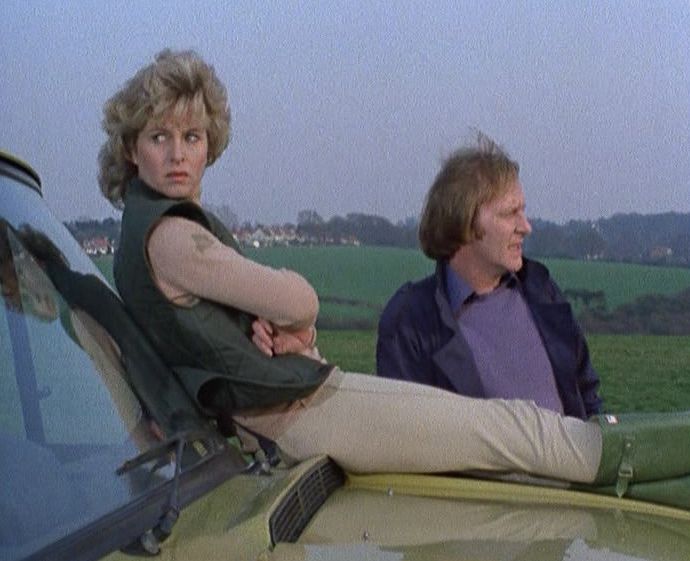
Terry is far from impressed with his latest minding job – a racehorse called Pelmet – but the sight of its attractive jockey, Jocelyn Maxwell-Saunders (Liza Goddard), softens the blow somewhat ….

National Pelmet, scripted by Willis Hall, was the first episode of Minder‘s second season and was originally broadcast on the 11th of September 1980.  It opens at a racecourse and after a couple of minutes of horsey colour we see Arthur and Terry emerging from a marquee.  Naturally, Arthur has entered into the spirit of things – he’s an absolute vision. decked out in wellingtons, binoculars, walking stick and a bow-tie.

Early on, the Arthur/Terry dynamic seems firmly slanted in the older man’s favour.  Arthur rubbishes Terry’s choice of a horse (“Lily Law?”) and advises him to stick his money on Spring Return.  Terry does so and it’s utterly predictable that Spring Return refuses the first fence whilst Lily Law (with Jocelyn onboard) romps home to an easy victory.

Arthur being Arthur, of course, is completely unabashed after leading Terry astray.  “If you have a fancy, a feeling in your water, stick to it. You shouldn’t listen to me, you should be strong-willed in this world, Terry. Implacable, like me”.

Arthur has two gross of 100% genuine reproduction statuettes of Milton (“Paradise Lost, Paradise Got Back”) and believes that his well-healed contact Jeremy Burnham-Jones (Robert Swann) will be able to help him shift them (Jeremy has an antiques shop in Brighton).   And since Jeremy has a racehorse called Pelmet which he wants protected before the big race, Arthur sees a way to kill two birds with one stone.

En-route to Brighton on the train, there’s a telling non-verbal moment which suggests that Terry’s not always going to be a pushover.  Arthur and Terry visit the buffet car and Arthur asks for a couple of light-ales and sandwiches.  After Arthur’s been told the price, he looks encouragingly at Terry who ignores him, forcing Arthur to find the money himself.  This is very underplayed – there’s no outward change in either of their expressions – but it’s a good character moment nonetheless.

As they settle back into their seats, Arthur – always a nostalgic – bemoans the fact that luxury rail travel is now a thing of the past.  At one point, he tells Terry, all the famous theatrical knights would be on the London to Brighton train – but not any more.  “Can you see Johnny Gielgud, Sir Johnny Gielgud no less, with his light ale slopping around in his plastic beaker while he stuffs an individual fruit pie into his north and south?”  Simply glorious.

There’s plenty of comedy to be mined from Terry’s reluctant guarding of Pelmet – from the fact that the horse is rather flatulent, to the way that Terry accidentally eats food prepared for one of the other horses (which has a dose of laxatives included!)  It’s not subtle but it passes the time nicely enough.  Indeed, National Pelmet is a story that’s low on incident and action – we’re more than thirty minutes in before the mysterious stranger who’s been keeping tabs on the stables – Brickett (Ken Hutchinson) – makes a move and attacks Terry.

The ensuing fight is brief but thanks to the combination of straw from the stable and an overturned lamp, it creates a fire which wakes everybody up and moves the story up a gear.  But it later becomes clear that this is something of a cheat – Brickett isn’t interested in Pelmet, he’s the ex-husband of stable-girl Rita (Jane Carr) and although they’re now divorced he’s still following her around the country, attacking anybody who even speaks to her.

From the first time we meet her, Rita is clearly shown to be interested in Terry, but he’s utterly dismissive of her.  Given Terry’s insatiable interest in the opposite sex this is a little difficult to fathom – possibly Rita was written as a more dowdy character but as Jane Carr isn’t unattractive and plays Rita as a perfectly pleasant young woman it makes Terry’s indifference and cutting remarks seem rather cruel.

When Terry and Rita confront Brickett, it gives her the chance to explain exactly what the situation is – which she does most forcibly.  Carr delivers this impassioned monologue very well (Rita’s ex-husband turned overnight from a normal chap into a religious maniac) although this sudden lurch into drama seems a little out of place with the light-hearted tone of the rest of the episode.

You might have expected that Jocelyn, especially given the casting of Liza Goddard, would have played a larger role in the story but she’s somewhat of a peripheral figure.

It doesn’t take a mind-reader to guess what will happen when, towards the end of the story, Arthur confidentially predicts that Pelmet is a dead-cert.  This time Terry is wiser (especially after having witnessed Jeremy placing all his money on the second favourite) and puts his bet elsewhere.  Jocelyn falls off (a blatant dive) which means that Arthur’s lost a bundle whilst Terry’s emerged ahead for once.

When we learn that Jeremy and Jocelyn are an item, all becomes clear.  This surprises Terry who’d tagged Jeremy as gay (Terry’s hostility towards anybody he considers to be “queer” is one of his less attractive traits in these early stories).  It’s slightly unexpected that Jocelyn turned out to be a wrong ‘un, but since she wasn’t too developed a character it’s not the jolt it could have been.

Arthurs’ incurable optimism can be seen at the end, in my favourite scene from the story.  Arthur’s still lumbered with his Milton statuettes but he has a plan – paint them blue and white and they can be sold as Chelsea footballers!  When Terry points out that Milton’s a famous poet with a book in his hand, Arthur has a ready answer.  “FA handbook, innit?”

Possibly not the tightest script that Minder ever had, but Willis Hall’s first contribution managed to easily nail the Arthur/Terry relationship and if that’s right then it’s possible to forgive a slightly humdrum story.

The Bill – Bad Faith

bad-faith

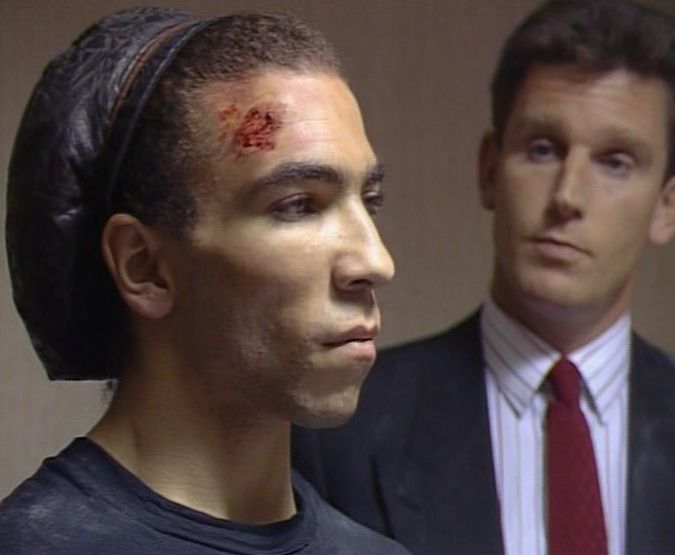
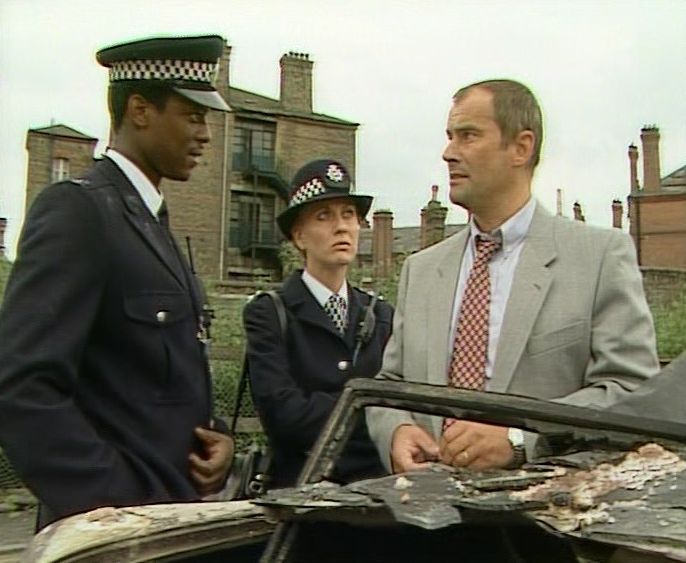
Bad Faith opens with Carver and Dashwood on the hunt for a suspect called Warren Michaels (Anthony Lennon).  Michaels lives on a typical inner-city estate – complete with burnt out cars, barking dogs and a general air of oppression.  Dashwood spots his prey and both he and Carver give chase down numerous flights of stairs.

Michaels trips and gashes his head, which obviously creates a bad impression once other people start to take notice of the melee.  The sight of an injured young black man being roughly handled by two white police officers generates a brief moment of tension.  This is clear when Carver tells the gathering crowd that they’re the police, only to realise a second later that this statement might not necessarily diffuse the situation.  And the onlookers aren’t troublemakers, they’re a small crowd of solid citizens (both black and white) faced with a scene which will probably reinforce their low opinions of the police force.

There’s a disorientating sense to the early part of this episode, reinforced when Michaels is brought to the station, as Frank Smith’s direction favours unusual low shots.  Dashwood tells Michaels that he’s a suspect in a murder case, although that doesn’t prove to be the case – it’s simply a ruse designed to unsettle him.

When Burnside joins the fun then the tension ramps up another few notches.  Michaels is nervous and twitchy, but Burnside ruthlessly overrides his request for a solicitor.  The interview, conducted in something of an ad hoc manner, also doesn’t seem to be recorded.  Dashwood later explains to Carver that “boys like this want us to give them a good hiding, gives them status, martyrdom.”  Cryer, overhearing the conversation, mutters that Dashwood is beginning to sound more and more like Burnside.

Dashwood and Cryer are plainly placed in opposition here.  Dashwood is keen to nail Michaels for a series of burglaries but admits that without clear evidence they’re dependent on an incriminating statement from him – so he sees nothing wrong in pushing as far as he possibly can.  And with a rising crime rate (allied to pressure for convictions) it’s a point of view that’s no doubt shared by many of his colleagues.

Cryer operates in a different field.  If the plain clothes branch deal with detection, then the uniform police are more concerned with prevention and maintaining law and order in general.   Cryer’s comment that Dashwood was a good PC indicates that he’s changed after switching “sides” although this could be taken as an inevitable consequence.

Carver, younger and more idealistic, attempts to see both sides.  Unlike Dashwood he views most of the residents on the estate as ordinary people trying to do the best they can.  If they demonize them or make the estate a no-go area then it’s only going to inflame the situation.  Will Jim manage to retain his optimism or will the system crush him?  Only time will tell.

After someone nicks the tyres from Dashwood’s car (and then drops a fridge on it for good measure!) the episode ends in confusion.  We never find out whether Michaels was guilty or innocent, although the inference seems to be that Dashwood’s been wasting his time and energy in the wrong place.  What’s certain is that police/community relations have suffered something of a knock.

The Bill – Hold Fire

hold-fire

Hold Fire opens with a bang – literally – as Melvin and Smith tangle with an exploding car.  Melvin – or rather his stunt double – is set on fire whilst Smith is caught up in the aftershock of an impressive pyrotechnics display.

Both Melvin and Smith are hospitalised, although neither are badly hurt (Melvin’s hands require attention whilst Smith has a dislocated shoulder).  This could have been the end of this particular plot, but events then move in an unexpected direction as we learn that the car isn’t all it appears to be.

It’s Frazer’s call as to whether she brings in CID, but for the moment she decides not to – which later displeases Burnside.  We’ve already seen him sniffing around the CAD room and when he runs into Frazer at the accident scene he’s typically forthright.  “You’ve got one burnt-out bent motor, a geezer dead, another one in hospital suspected of carrying explosives, and you don’t know what you’ve got?”

Apart from this, Jim and Viv are engaged in a stake-out at a pub.  This isn’t the worst job in the world, as it allows them the chance to have a few drinks and play all the video machines.  We learn that Viv is much better at Out Run than Jim is ….

Ted also has a decent subplot, as he deliberately flunks his firearms retraining.  Dashwood reacts caustically to the news when Conway tells him (wondering if Ted shot the instructor!) but doesn’t feel able disclose the reason why.  Thar’s left to Ted later in the pub, when he obliquely discusses his day with the barmaid Sadie (Cheryl Hall).  This would be Hall’s last appearance as Sadie (a semi-regular since 1984) although Hall would rack up six later credits on the show, each time as a different character.

Ted tells Sadie that it’s easy to shoot someone, and for Ted it’s obviously too easy.  You wouldn’t expect such a seemingly self-confident man to be wracked with such doubts, but it’s a nice beat that serves to strengthen and deepen his character a little more.

Apart from Cheryl Hall, Hold Fire also features several other familiar faces.  Walter Sparrow, someone who may not have had a very recognisable name but had a very familiar countenance, plays an elderly, garrulous patient at the hospital whilst Peter Wight, an incredibly busy actor, is the firearms instructor who gives Ted a hard time.

As so often, there’s an open-ended feeling to proceedings as the “A” case (the exploding car and the suspect at the hospital) doesn’t end the way that Burnside and the others would have hoped.  It remains rather nebulous anyway, since we never learn exactly who they were and what the job, if any, was.  But elsewhere there’s better news, as Jim and Viv get their man.  You win some, you lose some ….

The Bill – Stealing Cars and Nursery Rhymes

stealing-cars

Yorkie befriends a young lad, Jimmy Nelson (Martino Lazzeri).  Jimmy and his mates have little going for them, which means they are almost guaranteed to drift into a life of crime.  Yorkie is keen to help but others, such as Haynes, are much more cynical and convinced it’s bound to end badly ….

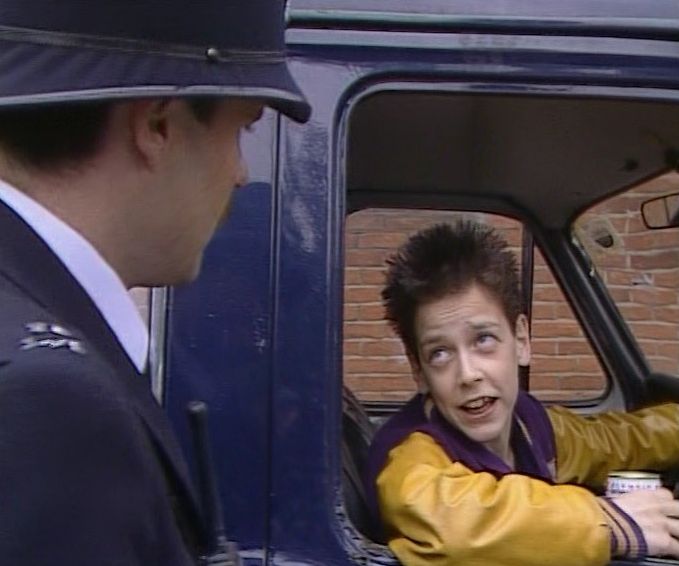
Yorkie’s first meeting with Jimmy isn’t terribly auspicious.  Jimmy, sitting in a van, is attempting to start the engine.  When Yorkie asks if he’s trying to steal it, the boy replies that he is.  The owner of the van – from the local youth centre, St Marks – quickly diffuses the situation, but Jimmy isn’t impressed with Yorkie’s warning not to do it again (“go lick your bottom”).

When Jimmy’s with his friends then they’re all something of a handful – stealing Yorkie’s helmet when he enters the youth centre, for example – but later he encounters Yorkie on his own and they start a conversation.  For Yorkie this is something of a breakthrough, Jimmy may appear to be something of a bad lad (there’s a suggesting he’s into glue sniffing) but Yorkie’s convinced there’s good underneath.

He can’t find anyone else to share his opinions though.  Haynes tells him that the boys are worthless – they don’t respect their homes, families or anyone else.  It would be interesting to get to know their future customers, but apart from that what’s the point?  Eamonn Walker and Robert Hudson go at each other hammer and tongs in an entertaining scene.  Since arriving at Sun Hill, Haynes hasn’t done anything controversial, so this is the first time he’s really emerged as a character.

Indeed, Haynes’ outspoken views might have been better suited to Nick Ramsey, but he’s got troubles of his own – a stray dog has attached himself to him and won’t let go.  Exactly how the dog managed to sneak into the station without anyone noticing is anyone’s guess, but it sets up a nice comedy reaction when Ramsey twigs that the pooch is still dogging (sorry) his footsteps.

Luckily the dog is wearing a collar, so Ramsey is able to off-load him back to his owner.  Except that the man (Tom Cotcher) tells him that it isn’t his dog (he died) but it is his collar!  So he takes the collar and leaves Ramsey still holding the dog.  Cotcher would return a few years later as DC Alan Woods.

Martino Lazzeri might have been fifteen at the time, but he was rather diminutive for his age, meaning that Jimmy appears to be a much younger character (barely into his teens).  With the other subplots being quite minor, Julian Jones is able to concentrate on the relationship between Yorkie and Jimmy.  Yorkie sees plenty of good in the boy, but is it enough to keep him on the right side of the law?

After being introduced with a bang a few weeks earlier, Ramsey’s not really featured terribly heavily since, nor has his shady past been referenced.  This was something of a feature of this era of the programme, with each episode tending to be very self-contained.  But Ramsey has his hands full here – not only does he have a new canine best friend, but he also has to reassure an anxious old woman that the Martians haven’t landed next door (it’s a satellite dish) and then deal with a mugging victim.  At least with the mugging there’s a nod back to the fact that he’s not really a people person – Ramsey often struggles to keep a civil tongue in his head when dealing with members of the public.

But then he does something unexpected – giving the UFO woman the dog.  Yes in a way he’s simply offloading a problem, but the old woman reacts with such pleasure that it’s hard not to imagine that he was partially motived by the thought of doing a good deed.

There’s a glimmer of hope for Jimmy and the others as the episode ends on an optimistic note.  It would have been nice to revisit Jimmy a few years later to see whether he did manage to stay out of trouble, but although Lazzeri made a few more Bill appearances, none were as Jimmy.  Lazzeri had a particularly active career during the 1990’s (he’ll be recognizable to Grange Hill viewers as Joe Williams) and it’s Jimmy’s amusing interaction with Yorkie which forms the heart of a strong episode.

The Bill – Alarms and Embarrassments

alarms-01

Before the start of the episode proper there’s a nice moment of character comedy.

Tom Penny mentions he’s thinking of going to Corfu, bad move says Hollis.  He tells him that the place is crawling with sea urchins which although not deadly are still rather unpleasant.  To prove his point he takes off his sock and shows Tom some grim evidence – even after two years the spikes from a sea urchin are still embedded in the sole of his foot.  But there is a solution – urine.  Tom wonders exactly how you’re supposed to pee on the sole of your own foot, but Hollis sets him straight – you get someone else to do it for you.  Tom suggests that for Hollis that wouldn’t be a problem.

Alarms and Embarrassments features some familiar faces.  After six years playing Fay Lucas on Grange Hill, Alison Bettles made the first of a handful of post-GH appearances.  Here she plays Mandy Peake, a bag-snatcher who preys on the elderly and vulnerable.

You get the sense right from the start that the police are on something of a hiding to nothing.  An identification parade has been organised – with Mandy present in the lineup – but the eye-witness is somewhat doddery.  We’ve previously seen that Frazer and Roach are very different officers and it’s restated here – Frazer is keen to not to put any pressure on the eye-witness, Miss Everleigh (Margot Boht), but there’s the sense that Ted rails against this softly softly approach.  No doubt if he had his way he’d tip her the nod as to which one to pick out.

Another well-known actor, Jeff Rawle, also guests.  He appears as a mugging victim called Derek Pardoe, whose ability to give evidence is hampered by the fact that he’s severely physically disabled.  It’s not an easy part to play – as Pardoe has issues both walking and talking – but Rawle certainly throws himself into the role.  Possibly it’s a case of changing attitudes, but nowadays you’d expect a role like this to be played by a disabled actor, which means there’s something a little unsettling about watching an able-bodied actor pretend to be disabled.  I don’t quite know why this would be, since all acting is pretending, but there’s a nagging sense that, as good as Rawle is, there’s something not quite right.

Carver befriends Pardoe, although it’s clear that the line between friendship and patronisation is very fine.  Jim may have the best of intentions but Ted’s not best pleased to find that he’s been neglecting his assigned duty (the theft of fifty thousands pounds worth of tyres) in order to hold the hand of a robbery victim.  Had Pardoe not been disabled, Jim wouldn’t have given him a second glance – harsh, but true.  Another sign of the times is that both Jim and a passer-by at the scene refer to Pardoe as a spastic.

There’s also a robbery at an off-licence whilst Frazer, rushing back to the station for a meeting with Conway, encounters a bag-lady slap bang in the middle of the road.  The juxtaposition between the normally cool Frazer and the squealing, filthy bag lady is acute.  Just another normal day at Sun Hill then ….

alarms 02.jpg

The Bill – Country Cousin

country

Barry Appleton’s Country Cousin wastes no time in setting up three storylines within the space of the first few minutes.  Burnside is at the train station, waiting impatiently for the arrival of DS Jarvis (John Labanowski), Edwards and Haynes deal with the fallout from a bus crash whilst Tom Penny hopes to learn whether he’ll be allowed back onto active service.

The bus crash is rather nasty – this might have been pre-watershed, but there’s still plenty of blood and pain on show.  The bus-driver is shown to be in a very bad way, whilst several elderly passengers are in a pretty distressed state.  Edwards and Haynes, first on the scene, are therefore placed in the thick of the action – and by the time the ambulances arrive they’re caked in blood.

Once the ambulances do turn up, the work of Edwards and Haynes is over, but it’s not surprising that both – especially Edwards – find it hard to disengage.  The later revelation that the driver was an epileptic pushes the narrative into a different direction.

Burnside’s encounter with Jarvis is highly entertaining.  Jarvis is an almost stereotypical country bumpkin (albeit one with a hard centre).  The fact he’s not come to London to apprehend a major criminal (his quarry is only responsible for burning some hay) serves to reinforce this point.  And when he catches his man, he gives him a backhander – which offends Burnside.  We’ve already seen that Burnside isn’t averse to giving criminals a slap himself, so it’s not an objection to force per se – I think it’s more to do with the fact that Jarvis is on Burnside’s manor and therefore it’s not the done thing to dispense a little rough justice without asking permission first!

Despite the fact that Burnside clearly has little time for him, a sense of duty still means that he’s honour-bound to show him the sights for a few hours.  These sights, somewhat inevitably, involve a seedy bar full of prostitutes.  Burnside is called away, leaving Jarvis in the safe hands of Mike Dashwood – who inevitably loses him ….

I’m not sure whether the music we hear in the bar – instrumental versions of various Human League hits – is meant to serve as a signifier of the downbeat nature of the place (they couldn’t even afford a tape of the real thing, so have to make do with ersatz copies) or has more to do with the issue of licencing music for television (since it’s presumably cheaper to use sound-alikes).

Tom Penny, driven to and from his assessment by Viv, fluctuates between confidence and despair.  One minute he’s feeling fine, the next he’s convinced that his days as a copper are over.  And if he’s no longer a policeman then he’s nothing – an admission that for him, like many others, the job has become all-consuming.  It’s very much the “c” plot (we eventually learn that Tom will be reassessed in a month’s time) but Roger Leach is always worth watching as the pained Penny.

Jarvis gets involved in an all-mighty punch-up, but still comes up smelling of roses, much to Burnside’s irritation.  Alongside the more downbeat narrative of the bus crash, the way that Burnside finds himself comprehensively bested by a mere carrot-cruncher acts as a welcome dose of light relief.  Country Cousin feels a little insubstantial, but still manages to juggle three mainly non-station storylines with ease.

The Bill – Homes and Gardens

homes

Yorkie Smith and Taffy Edwards arrest Mickey Cozens (Stephen Lee) after he causes a disturbance on the high street.  Yorkie quickly assesses that “he’s not the full shilling” and it later transpires that he has the mind of a seven-year old, albeit with the sort of powerful frame that could easily cause someone damage.

And he’s been in trouble before – cracking a bouncers head open a few years back – although his main problem is that he’s easily led (surrounded by so-called friends who manipulate him to create havoc).

Sun Hill is no place for him, as the cells are full of remand prisoners.  Penny suggests that Yorkie either lets him go or sections him – a stark choice.  Whilst Yorkie is uneasy with the thought of Mickey being restrained in hospital, Hollis takes the opposite view.  He believes it’s the best place for him, as sooner or later Mickey’s going to step way over the mark.  No surprises that it happens later in this episode.

Mickey’s father George Cozens (Brian Peck) arrives at the station and Yorkie drives them both home.  Although George maintains that Mickey is normally placid, we see how quickly that can change after he’s told he can no longer see his friends (or “yobbos” as George calls them).  Mickey lashes out in anger, accidentally knocking Yorkie out.  George panics, bundles Yorkie and Mickey into the police car and drives off …

Homes and Gardens has some nice character moments.  We see Alec Peters taking pride in his tomato plants, although he’s unsuccessful in interesting either Viv or Ken Melvin in taking one off his hands (Ken tells him that he has no room – his cannabis plants take up too much space!).  But Frazer is impressed with Alec’s plants and later nips out to buy some of her own.  Taffy is less than overjoyed when he hears that Yorkie’s been kidnapped, complaining that he did it on purpose as he knew Taffy wanted to finish a little early.  Meanwhile Hollis wafts around the building darkly muttering that he knew all along this was going to happen.  Tom Penny is in an uncompromising mood, running the charge room with an iron hand – a far cry from the previous episode when he was very flaky (possibly this was due to the episodes being recorded out of sequence?)

There’s a subplot centering around Jack and Edie Fairweather (Anthony Collin and Pamela Pitchford) return home from holiday to find that their garden’s been stolen.  Poor Jim is lumbered with this one.

Rather like Home Sweet Home, there’s something of a sense that the most vulnerable in society are being neglected.  Although few would agree with Reg Hollis’ opinion that it would be best to lock Mickey up in an institution for the rest of his life, he doesn’t seem to have received anything like the appropriate level of support.  It’s plain that his father is the rock in his life, but following the incident with Yorkie both father and son face an uncertain future.  We don’t know what will happen to them and never will, meaning we end on a troubling note.

The Bill – Caught Red Handed

caught-01

Barry Appleton’s Caught Red Handed juggles several plotlines at once and, as with previous episodes, it takes a little while before it becomes clear which ones will dominate and which will fade away.

The episode opens with the fallout from a stabbing.  Jill Kelsey (Chrissie Cotterill) attacked her husband, John (Jim Barclay), with a breadknife – stabbing him eight times.  It’s instructive to see how pretty much everybody (apart from Alec Peters) treats her with compassion, from Ted Roach at the scene to Inspector Frazer and Viv Martella at the nick.  Jill Kelsey is positioned as a victim rather than a criminal, which explains why Ted’s usual brusque manner is absent.

Of course, the fact she stabbed her husband not once but eight times suggests this may be more than a family row which escalated.  But she seems genuinely contrite and he – as soon as he regains consciousness – is completely forgiving and disinclined to press charges.  It slightly stretches credibility that he recovers so quickly (after eight stab wounds? Clearly they were very shallow ones).  His revelation that the argument started when he complained about soggy cornflakes signifies that this crime has a faintly comic air, strengthened when John turns up at Sun Hill to take his wife home.

So Burnside’s quite happy to let them go – the whole incident written off as a domestic – although it seems rather unlikely that he’d be discharged from hospital quite so soon (even if they were desperate for beds).  That he turns up at the nick still dressed in his hospital pyjamas also seems a little unbelievable.  There’s a late coda to this part of the story, which once again is played rather for laughs.

Attention then turns to an obbo at the local swimming baths with Tom Penny and June Ackland.  This is chiefly of interest due to the way Tom reacts when put under stress (not very well).  They’ve rigged up an observation point to monitor the changing rooms in an attempt to identity a thief who’s been rifling through the lockers.

When someone is spotted, June tells Tom to switch on the video recorder.  This is a slight plot weakness – back in 1988 VHS tapes would have been quite cheap, so why not just keep the recorder running all the time?  Although they catch the criminal, something goes wrong with the tape and they’re left with no visual evidence.  This is enough to once again push Tom to breaking point – showing that whilst he appears to be fine on the surface, whenever there’s the merest hint of stress he’s liable to fold like a pack of cards.  As before, there’s never any suggestion that he’s not in a fit state to do the job – or that the next time he makes a mistake it may have more fatal results – presumably everybody just expects that eventually he’ll pull himself together.

This part of the episode has a happy ending, money treated by the SOCO (Susan Curnow) was placed in the lockers.  It contained an invisible red dye, which would stain the hands of anybody who handled it.  Hence the episode title.

But Caught Red Handed could also refer to Yorkie Smith, who’s observed in the pub acting in a very suspicious manner.  Frankly he wouldn’t make a very good criminal as he’s far too transparent (although his fashion sense – rolling up his jacket sleeves as though he was in Miami Vice – should certainly be against the law).  Jim suspects he’s been buying drugs and a search of his locker reveals a packet of pills.

This places Jim in a moral quandary.  After confronting Yorkie and a brief moment or two of soul searching he feels he has no alternative but to make it official.  Later, Ted Roach is withering in his condemnation – telling Jim he may have irreparably damaged Yorkie’s career.  Ted’s viewpoint would no doubt be shared by many of his colleagues, where it would be seen as closing ranks to protect your own, rather than concealing a crime.

Yorkie comes clean.  The drugs are anabolic steroids, designed to help him rebuild his strength as a rugby player.  He claims that many athletes take them (which is true, although his statement that it’s not an offence is a little harder to swallow).

Had Burnside not been DI then it’s possible it would have been dealt with unofficially.  But Caught Red Handed provides us with early evidence that Burnside is keen to mould Sun Hill in his own image, and this incident gives him an ideal opportunity to clip the wings of the uniformed branch.

His summary of both Brownlow and Conway is insightfully caustic.  He claims that Brownlow “is more interested in his golf swing and that converted barn he’s got up in the lakes than what goes down at Sun Hill”.  He concedes that Conway is a good man and a good copper but that he has to play things “by the book. And that is a worse handicap that Brownlow’s golf swing.”

caught-02

The Bill – Just Call Me Guvnor

guvnor

Frank Burnside (Christopher Ellison) returns to Sun Hill to take up the vacant post of DI.  But first he has a little undercover business to deal with – rounding up a violent gang of football supporters.

Burnside had previously made three appearances in the 50 minute series at Det Sgt Tommy Burnside (his name was later changed to Frank when it was revealed there really was a Tommy Burnside serving in the Met).  That he already has a little history with both the viewers and the officers at Sun Hill is something that works well.

We open with Conway explaining that Operation Red Card has infiltrated two undercover officers into Front Line (“a highly organised and extremely dangerous gang of thugs who are responsible for a great many of the violent acts at football matches up and down the country”).  And now they’re going to arrest them all.

The countdown to the start of the operation takes place in the peace and quiet of the CAD room with Viv, Hollis and Tom Penny.  Viv’s keen to be out on the streets with the others but the more pragmatic Hollis knows they’re well out of it.  Ted, who is present at the scene, is wise enough to know that you don’t go rushing in – you let the uniforms soak up most of action and then bring up the rear.

One of my favourite moments occurs when one of the Front Line yobbos spits at Ted.  He responds with a well-aimed headbutt!

It’s been expressly stated to all the troops that when they come across the undercover officers they should make no sign if they know them.  However, Ted and Jim can’t help but goggle as Frank Burnside is taken away (dressed in a natty pair of underpants) which immediately blows his cover.  Not the best way for Ted and Jim to encounter their new boss ….

Burnside and Bob Cryer have a history.  Bob has always regarded Burnside in a very jaundiced light, convinced that he’s corrupt (and later tells him to his face that he doesn’t understand how Operation Countryman – set up to investigate police corruption – missed him).  They don’t really hit it off when Burnside returns to Sun Hill either – as Frank enters the charge room and gives one of the suspects a quick slap.  Unsurprisingly, Bob takes a dim view of this.  “Let me remind you, as one of the duty officers on this relief, I will not have my prisoners assaulted.”

The needle between Bob and Burnside always remains bubbling under the surface, as – of course – does Ted’s spiky relationship with his new boss.  Burnside does have some supporters though – chief amongst them being Inspector Frazer.  This is partly because she knows that Burnside previously acted the part of a corrupt officer in order to ensnare others.  Problem is he played the part so well that the likes of Bob Cryer are now convinced he actually is bent.  Not that he’s bothered what others think of him.

The fact that Burnside and Frazer have a history is an interesting touch.  He greets her with a “hello sexy” which doesn’t upset her.  When he calls her Chrissie, she melts a little more – although both accept that “the past is the past” (there’s a hint that they had an affair back when he was a married man).

Just Call Me Guvnor is a cracking reintroduction for Burnside.  It sets up the parameters of the character perfectly whilst letting the audience know more about him than his colleagues do.  We know that Burnside isn’t corrupt, although Bob and Ted – contemptuously referred to as “a couple of tossers” by Burnside – and the rest of the nick believe otherwise.  Bob is later put straight on this by Frazer and he’s forced to apologise to Burnside, although he also tells him that it still doesn’t mean he has to like him …

A late story beat (revolving around the prisoner headbutted by Ted) might not come as a total surprise, but it’s yet another victory for Frank Burnside who ends the episode very much on top.

The Bill – All in Good Faith

good faith.jpg

All in Good Faith shows the sharp delineation between two very different types of coppers – on the one hand there’s Ramsey and Roach, on the other are Frazer and Conway.

Frazer calls Ramsey in for a chat.  She’s concerned about his attitude – seven members of the public have made complaints about him this year alone.  Given his faintly contemptuous and sarcastic attitude in front of her, it’s easy to see that he takes this same persona onto the streets.  Ramsey doesn’t disagree, telling her that he treats people the same way others treat him – which isn’t really what she wants to hear.

He can’t resist adding that a frontline policeman is always going to be the subject of complaints which someone like her, with little or no experience of policing on the streets, will never be able to understand.  This conflict – between the sharp end and the executive level – has been played out numerous times across multiple police series.

We also see it again with Roach and Conway.  Ted Roach’s time as acting DI is going fairly smoothly (he’s off the drink for one thing) but the wheels start to come off when a gun handed in at a recent amnesty is tied back to a man called Duffy (Leslie Schofield) and linked to a crime which occurred five years ago.

Ted is keen to go round and nick him, but never stops to consider the nature of an amnesty.  Conway decides that for the sake of community relations it wouldn’t be a good idea to arrest Duffy (if they did, the public would lose all faith in future weapons amnesties) but Roach ignores him and nicks him anyway.

Conway and Frazer discuss Ted, with Frazer musing that “surely he must understand there’s more to police work than arresting people, we have to gain the public’s cooperation and respect.”

However when Ted brings Duffy in, Frazer is more forgiving.  “We’re sadly lacking good practical officers, with all his faults I wouldn’t like to see Roach get into trouble over this.  I’m positive he’d make a good DI”.  Conway then makes a revealing statement – as long as Brownlow is in charge at Sun Hill, Roach will never rise above his current status as DS.

All in Good Faith adds a little more meat to the bones of Ramsey’s character, whilst also throwing the spotlight on Conway and Frazer.  Conway is shown to be more of a politician than a thief-taker, but in his position – where he has to face both public and political pressure – that’s understandable.  Frazer’s character traits are teased out nicely – it’s difficult to say whether she or Ramsey came off best during their meeting (both made fairly valid points) but she seems more able to straddle both sides of the fence (a desire to catch criminals allied to the realisation that they need the respect and cooperation of the public) than Conway does.

The Bill – Home Sweet Home

home-01

Cryer leads an operation to evict a group of squatters.  Councillor Thomas (John Bowe) is on hand to ensure that there’s no police brutality, but it seems any brutality will come from the squatters side ….

Whilst Thomas is quick to jump to the defence of the squatters, not many share his opinion (certainly not the other residents or the police).  The squatters may soon be homeless, but Bob opines that it’s out of choice not necessity – they all come from affluent families and are indulging themselves by playing as revolutionaries.  Cultural slumming, according to Hollis.  CND posters serve as clear signifiers of their beliefs, although their desire to make a stand for liberty and freedom is rather dissipated when we see them bailed out by their parents to return home with fleas in their ears.

Marie Tucker (Sasha Mitchell) is also homeless, although she has no-one to come to her aid (apart from social services).  Her social worker, Sonja Bloomfield (Janet Dale), is concerned, not only for Marie’s two young children, but also for Marie herself – who could be suicidal.

There’s a circular path to the story as Marie holes up in Councillor Thomas’ bathroom.  On returning home, Thomas is less than impressed to find his house has been invaded (he makes a swift beeline for the scotch).  There’s a clear irony at work here – Thomas was keen to champion the rights of the squatters earlier on, but (at least initially) he has little or no sympathy when events move to his own doorstep, as he urges Smith and Frazer to extract Marie as quickly as possible.

Bloomfield is on hand to discuss with Frazer how the system has failed Marie and countless others like her.  Marie and her children had previously lived in a grotty bed and breakfast (“wardrobe there, bed there, damp bit there, rotting bit there, roaches all bloody over”) but walked out when she could stand it no more.  Instead of pumping money into bed and breakfasts, Bloomfield despairs that there should be a better way.

The core of the episode – an unhappy Marie pouring out her heart to Frazer and Bloomfield – is unusual, since we can only hear Marie, we can’t see her.  This means that Frazer and Bloomfield are the ones who have to react as Marie’s monologue takes an increasingly dark turn.

There’s no happy ending.  Marie overdoses on pills from Thomas’ bathroom and by the time the door is broken down she’s unconscious and fading fast.  The fact she’s surrounded by her two young children only serves to make this emotional punch even greater.  Thomas sums it up (“what a mess”) and reflects how he entered politics to help people like Marie, but has failed to do so.

Cleverly changing gear away from the squatters (who initially seemed to be the focus of the episode) Home Sweet Home offers little hope or reassurance.   When PC Haynes frets that the ambulance is taking too long, Thomas shrugs and says that it’s a sign of the times.  “But we’re running out of time” counters Haynes.  Can we draw any solace from these events?  Thomas (who saw his marriage disintegrate due to his political ambitions) reacts with compassion to Marie’s children, which offers hope that in the future he’ll redouble his efforts to help the most vulnerable, but it’s about the only crumb of comfort on offer.

Nicholas McInerny contributed twenty nine scripts for The Bill between 1988 and 2008, although given the quality of Home Sweet Home, his debut, it’s surprising he didn’t write more.  He’ll return later in 1988 for Old Habits, but then takes a break until 1995.

home-02

The Bill – Good Will Visit

good

In later years Sun Hill nick would become a hotbed of tangled interpersonal relationships and corruption.  But in 1988 things were much simpler.  Back then, if the boys and girls in blue had personal relationships they had the good grace not to let it interfere with their work whilst rotten apples were few and far between.

True, the likes of Ted Roach were happy to bend the rules, but there’s no sense that he was actively fitting up suspects.  Even Frank Burnside, briefly glimpsed during the 50 minute series and shortly to return as the new DI, was on the side of the angels.  The series made capital out of his reputation for corruption several times, but nothing was ever proved (although you could always argue that he was simply good at concealing it!)

The introduction in this episode of PC Ramsey (Nick Reding) helps to shake up the relief.  Ramsey, transferred from Barton Street, brings with him an unsavoury reputation and is viewed with suspicion and mistrust – at least to begin with – by the others.  Ramsey didn’t stay at Sun Hill for too long (about six months) and it’s interesting to observe that over time his rough edges were smoothed down, leaving him as just another member of the team.  The Bill would make capital out of bent coppers later on, but back in 1988/89 it was a storyline that seemed to be off-limits.

Ramsey’s first appearance – driving a flash car very fast (and parking in the Chief Super’s space no less) – is a non-verbal signifier of his attitude and his brusque manner when asking June and Yorkie for directions also helps to quickly define his character – he’s a self-contained unit, not interested in making friends unless (like Ted Roach) they can further his career.

His interview with Chief Inspector Conway (Ben Roberts) helps to fill in some of the blanks.  Conway regards Ramsey as a bent copper, although Ramsey counters that he was cleared.  Conway doesn’t see it that way – in his view (one shared by Ramsey’s previous Chief Super) Ramsey was clearly guilty, although when we discover what his crime was – cheating at cards – it doesn’t seem too bad, but it was serious enough for Ramsey to be busted down from plain clothes to uniform, a clear humiliation for him.

It doesn’t take long before Ramsey makes himself comfortable, demanding bribes from local traders, such as Leslie Fisk (Tony Portacio).  But his actions quickly catch the attention of Bob Cryer, which sets up a nice dramatic tension – Cryer now knows that Ramsey’s a wrong ‘un, so he’ll be watching him like a hawk ….

Ted Roach continues to rampage around the building.  Now he’s acting DI, Ted spends his time giving Mike and Jim a very hard time.   Ted forces Mike and Jim onto the streets where they tangle with a couple of Asians.  One of them launches himself at Jim with some flashy kung-fu moves, but the ever resourceful Jim throws a bin at him, which does the trick!

Mix in another subplot concerning Alec Peters and some sailors and you’ve got a typically dense episode of the series.  The arrival at Sun Hill of a well-drilled squad of sailors (responsible for smashing up a bar) is a nice comedy moment, as is Conway’s acid response when he discovers exactly what Alec has done.  “How can you board one of her majesties frigates in sight of traitor’s gate, of all place, without permission?”

The Bill – The Three Wise Monkeys

wise 01.jpg

Geoff McQueen returned to script The Three Wise Monkeys.  It opens with Ted in a bad mood (for a change) although DC Mike Dashwood (Jon Iles) is, as ever, much more sanguine.  Ted wants to be back at the nick, so he can deal with Blakelynn (Tom Owen) but instead has to deal with the fall-out from an attempted armed robbery.

Blakelynn ends up being extracted from Ted’s clutches and delivered into the care of DC Willis (Mark Carey) and DC Hawtrey (Nick Brimble).  They come from the West Country, so are obviously “carrot crunchers”, as Ted so nicely calls them.   Brimble makes the most of his handful of lines.  Towering over Ted, Hawtrey tells him that “if you don’t shove off within the next five seconds I’m going to bounce your head around this yard for a pastime.”  Lovely!

Tom Penny’s still on light duties (in the CAD room) but all this talk of shooters isn’t doing him any good.  Frankly, he looks so flaky that it’s rather strange nobody has noticed anything is amiss – not even Chief Supt. Brownlow (Peter Ellis – sporting a severe new haircut) who’s wandered into the CAD room to stick his oar in (or coordinate proceedings, depending on your point of view).

But having said nobody’s noticed Tom’s traumas, that’s not quite the case.  Both Alec Peters (Larry Dann) and Bob Cryer (Eric Richard) are aware he’s got something of a drink problem, as does Inspector Frazer.  She’s only had a short time to make her presence felt, but the fact she elects not to do anything official about Tom- leaving it to Bob to have a quiet word – indicates that she’s on the side of the troops.  The counter-conclusion we can draw is that she somewhat negligently leaves an officer she knows to be sub-par in a position of considerable authority.

Ted and Mike are cruising the area, looking for the armed robbers (they’ve stolen a car and taken the driver hostage).   They have no joy, but WPC June Ackland (Trudie Goodwin) and PC Yorkie Smith (Robert Hudson) are more fortunate, or maybe unfortunate ….

They pick up three armed TSG officers who are rather forthright (“get right up his end son”) and it’s clear that their gung-ho attitude is going to bite them on the bottom very soon.  And so it does.  There’s a spot of gunplay before the end of part one, which is chiefly notable for how bad a shot the baddy is – he lets off twelve rounds at fairly close range but doesn’t hit anybody.  It’s still a traumatic event though – which becomes plain later on as both June and Yorkie come to terms with their close escape.

And if it was stressful for them, then it’s even more so for Tom Penny.  He might have been safe in the station, but even thinking about it is enough to push him to the point of collapse.  Frazer continues to demonstrate her sense of empathy as she takes June into the toilets and encourages her to have a good cry (“there’s no men in here”).  June prefers to throw up instead, which seems to please Frazer just as much.  After a good cry or a good puke, she’ll no doubt feel a lot better.

The Three Wise Monkeys quite neatly shows how police work can be seconds of pure terror.  The plotline with Tom Penny will be referenced again, which is a rarity during this period of The Bill as normally it didn’t string out character angst across multiple episodes.  How that would change ….

wise-02

The Bill – Light Duties

light

Light Duties, the first episode from the reformatted 25 minute incarnation of The Bill, aired on the 19th July 1988.  It gave us our first chance to see Jim Carver (Mark Wingett) in plainclothes (and demonstrates he’s something of a landlubber – Jim feels seasick after a trip down the Thames).

It’s not a pleasure cruise though, Jim and Ted Roach (Tony Scannell) are interested in a body fished out of the river.  But anywhere that Ted goes trouble’s not too far behind – he finds himself tangling with DS Dougan (Andy Secombe) and DI Corrington (Anthony Dutton), both of whom claim the body for their own.  Ted glowers at them in his trademark fashion.

Scripted by series creator Geoff McQueen, Light Duties demonstrates that even though the running time of each episode had halved, there wouldn’t be any problems keeping multiple plotlines on the go as per the previous series.  A collapsed man in the street (along with his dog) and concerns over the health of Sgt Penny (Roger Leach) are both developed (Penny’s the one on light duties following a recent incident where he was shot).

Plenty of new characters are swiftly introduced.  PC Haynes (Eamon Walker) is the new token black character, whilst Inspector Frazer (Barbara Thorn) is the new token female officer.  PC Edwards (Colin Blemenau) remains as the token Welshman ….

Some of the troops aren’t too impressed about serving under a female officer.  Given this was 1988 and both Juliet Bravo and The Gentle Touch had aired some years ago, this seems slightly surprising.  Clearly Sun Hill was a very conservative area.  Frazer’s first appearance, in plainclothes, is a treat.  Poor PC Stamp (Graham Cole) shooed her away from the incident with the collapsed man in a rather heavy-handed way, not realising who she was.  The audience didn’t know at the time either, but I’ve a feeling that the penny dropped with them long before it registered with Stamp.

Ted’s continuing to grizzle.  With the DI’s room vacant, he feels that he’s the man for the job – but obviously nobody else does.  So Ted does what he does best in times of crisis, grabs his bottle of whisky and heads off to drown his sorrows.  The toilets are an obvious place for a spot of peace and quiet – presumably why Tom’s there, chugging down a handful of pills in order to soothe his shattered nerves.  Ted offers him a swig from his bottle (“might help”) which Tom accepts.  Pills and alcohol, not a good mixture ….

These episodes of The Bill tended to be self-contained but, as we’ll see, Tom’s issues carried over into the next episode – The Three Wise Monkeys.  Understandable, since it would have been a little unbelievable to have neatly wrapped up his problems within twenty five minutes.

Ted’s blood pressure continues to take a pounding when he learns that Burnside (“bent Burnside!”) is a contender for the vacant post of DI.  Although the pre-watershed placing of the series now means that his oaths (“naff off, Bob”) lack a certain something.

Rather coincidently, there’s a connection between the old man who collapsed and Ted’s dead body.  This allows him to score something of a coup, although I’ve a feeling that any kudos will be short-lived.  Ted operates on such a short fuse that you can guarantee he’ll soon put somebody’s nose out of joint and be back to square one.

A number of characters didn’t make the transition from the 50 minute format to the twice weekly 25 minute series, but I’m glad that Ted Roach did.  Sun Hill wouldn’t have been the same without him, although it’s plain that one day he’s going to go too far.  Luckily, that won’t be for a while yet.

Callan – Wet Job

wet-01

The television series Callan seemed to have come to a pretty permanent end with A Man Like Me in 1972, but that wouldn’t be the last we’d hear of David Callan.  First came the 1974 movie, adapted by James Mitchell from his 1969 novel Red File for Callan, which in turn had been based on his 1967 Armchair Theatre pilot A Magnum for Schneider.  Despite the rehashed plot, the film probably works better as a coda to the television series than it did as an introduction (since it features a retired Callan brought back, unwillingly, for one final mission).

Mitchell would continue to pen a number of novels featuring Callan (Russian Roulette, Death and Bright Water and Smear Job) during the 1970’s, which suggested that he felt there were still stories to tell.  So it wasn’t too much of a surprise when David Callan returned to television in 1981, in a one-off eighty minute ATV play entitled Wet Job.  Unfortunately, it wasn’t the conclusion that anybody – not James Mitchell, Edward Woodward, Russell Hunter or indeed the audience – deserved.

Before we look at what didn’t work, let’s consider the positives.  Nearly a decade has passed since the events of A Man Like Me and Callan is a changed man.  Physically he looks older (he has grey hair and glasses) and he’s also somewhat better dressed than he used to be.  It would have been easy enough for Woodward to dye his hair, put in contact lenses and pretend that no time at all had passed, but there’s something pleasing in the way that Mitchell acknowledges that he’s not the man he was.

Callan, now lodging in a plush house owned by Margaret Channing (Angela Browne), also moves in more rarefied circles than before and jokes with one of Margaret’s party guests that he hasn’t killed anybody for years.  This throwaway moment is touched upon later, when he has a rare spasm of self doubt – after being dragged back into Section business against his will he has to face that fact that he may be forced to kill again, but can he do so?  This is an interesting point, but alas it’s never really developed – which given the lengthy running time is a disappointment.  We do get flashes of an older, wearier Callan, but it shouldn’t come as any surprise that when the firing starts he’s still as deadly as ever.

The main joy of Wet Job is the reunion of Callan and Lonely.  The obvious respect shared by Woodward and Hunter is plain to see and this means that their scenes together are wonderfully entertaining.  Again, Mitchell is keen to show how time has moved on – Lonely is now a man of means with a successful business and an impending marriage.  We never see his fiancé, but Callan’s reaction to her photograph indicates that Lonely’s a lucky man.

wet 02.jpg

My favourite moment of the story comes during Callan and Lonely’s first meeting.  Lonely admits that Margaret is quite a looker, although he goes on to say that she’s rather old (after all, she won’t see forty again).  Callan, who sometimes shares her bed, is rather affronted by this, asking Lonely how old his fiancé is.  When he’s told she’s twenty seven it’s yet another indication that Lonely’s far removed from the man we knew.

He makes that point himself – it’s not the old days anymore and he has no wish to get dragged back into Callan’s illegal activities.  There’s something a little tragic in the way that Callan admits there’s no-one else he could ask (the power dynamic in that relationship has certainly shifted).  In plot terms, Lonely does nothing of significance but the story would have been much poorer had he not been there.

Hugh Walters as the latest Hunter is also a plus.  Walters had a habit of playing effete characters and his Hunter is no different (it’s a little jarring to hear Hunter refer to Callan as “dear heart”).  Much may have changed, but the Section is still a cheerless and impersonal place and the lengthy early scene between Callan and Hunter is another highlight (even if, as we’ll come to soon, the incidental music does its best to destroy the mood).

Wet Job has two main plot-threads.  The first concerns Daniel Haggerty (George Sewell), an ex-MP who blames Callan for the death of his daughter and is writing his memoirs which threaten to expose Callan as a government assassin.  Margaret’s niece, Lucy Robson Smith (Helen Bourne), is helping Haggerty with the book and she’s also attempting to ensure that a dissident Russian philosopher, Dobrovsky (Milos Kerek), gains safe passage to the UK.

It’ll come as no surprise to learn that Hunter (who called Callan in to warn him about Haggerty’s book) hasn’t told him everything, but because both plot-lines are so drawn out it’s probable that eventually the audience will cease to care.  Sewell’s solid enough as Haggerty, but apart from one scene early on, he’s kept apart from Callan until the very end.  Kerek makes little impression as Dobrovsky, so it’s hard to feel invested in his fate.

There are a few nods to the past – Hunter tells Callan that Meres is dead (this may be a joke though) and Callan has a brief reunion with Liz.  But since Liz is now played by Felicity Harrison rather than Lisa Langdon, it rather falls flat.

Wet Job was shot entirely on videotape.  This wouldn’t necessarily be a problem (quite a few of the Thames Callan episodes were as well) but everything looks dull and lifeless – when the early 1970’s VT Callan‘s look sharper and more vibrant than this 1981 effort you know you’re in trouble.

The worst thing about Wet Job is, of course, the music.  Firstly, it’s a shame that Jack Trombey’s iconic library track – used as the series’ theme – wasn’t pressed into service again, but that’s a minor irritation compared to the horrors of Cyril Ornadel’s incidental score.  If the music could be removed then there’s no doubt that my appreciation of the story would increase considerably.  Any time that Ornadel can spoil the mood he does so – tinkling piano, electronica, it’s a masterclass in awfulness.

There are so many examples, but I’ll restrict myself to three. The first meeting between Callan and Hunter is a cracking scene, but what it didn’t need was a heavy piano underscore.  Watch from 17:20 as the camera focuses on Callan, musing how he’ll never be free of the Section (without the music this moment would play so much better).  The end of part one (from 26:00) as Haggerty confronts Callan is another time when the intrusive music is simply breathtaking.  And the moment where Haggerty discusses Callan with Lucy (55:50) is just a cacophony of noise – electric piano, twanging guitar – that builds to a crescendo until (at 56:22) it suddenly and unexpectedly stops and the relief felt is palpable ….

There was a decent fifty minute episode here, but unfortunately it was expanded to eighty.  Edward Woodward and Russell Hunter are their usual immaculate selves, but it’s sad to say that this is a very average story.  There was plenty of scope to really dig into Callan’s character – showing that whilst he may now have a veneer of respectability, underneath the darkness still lurks – but sadly Mitchell didn’t go down that route.  And any goodwill that the audience has towards the project is surely slowly sapped as Cyril Ornadel’s music drones on and on (he certainly should have gone into a Red File).

wet-03