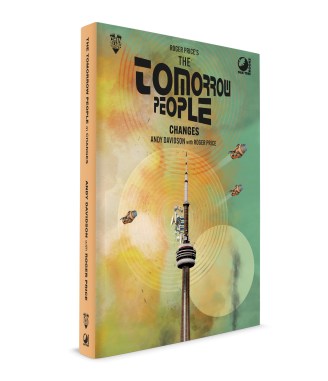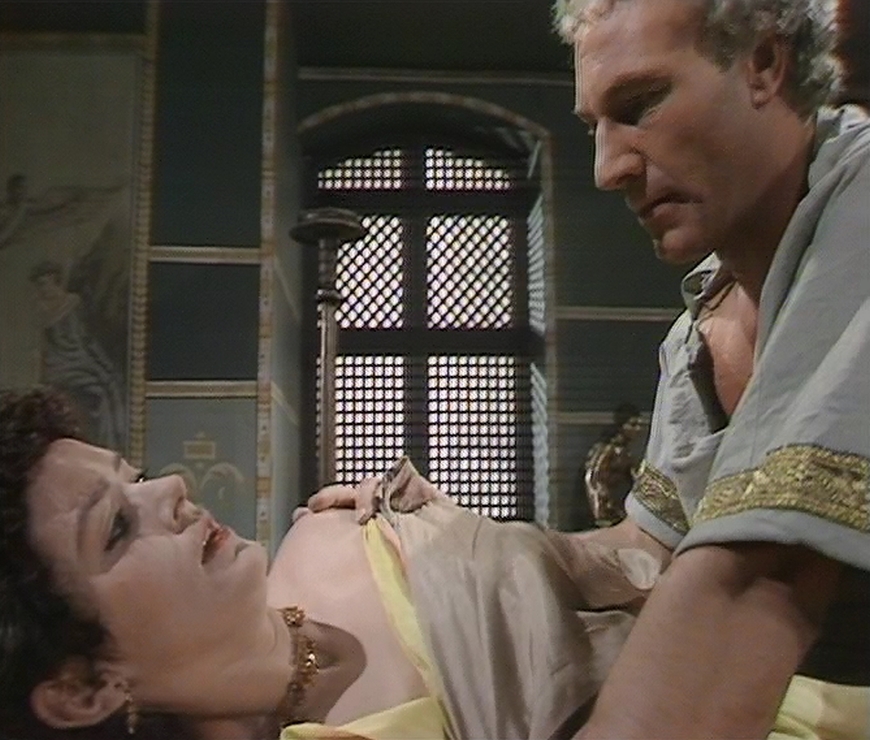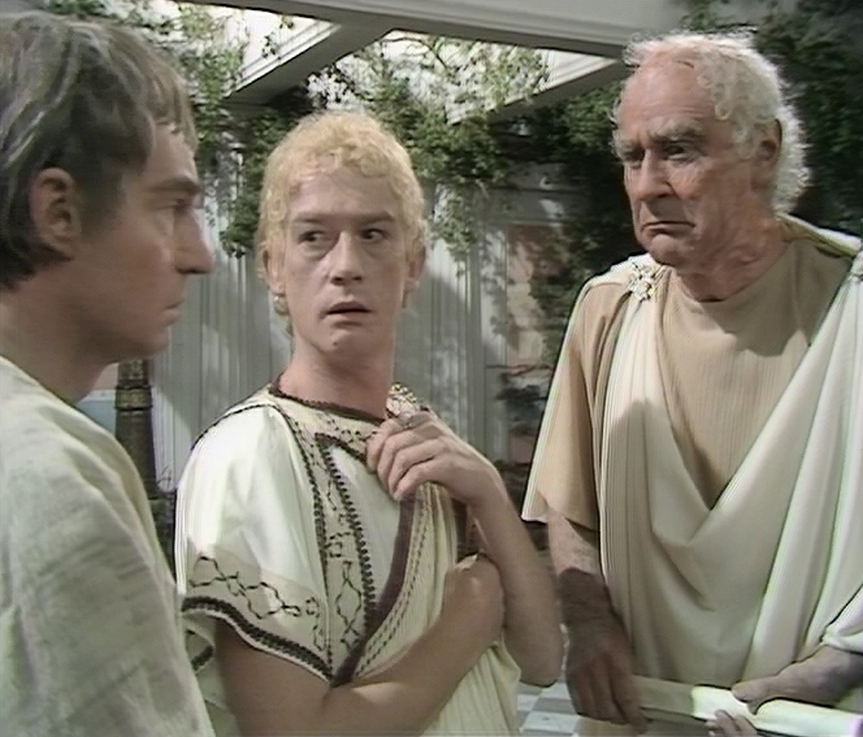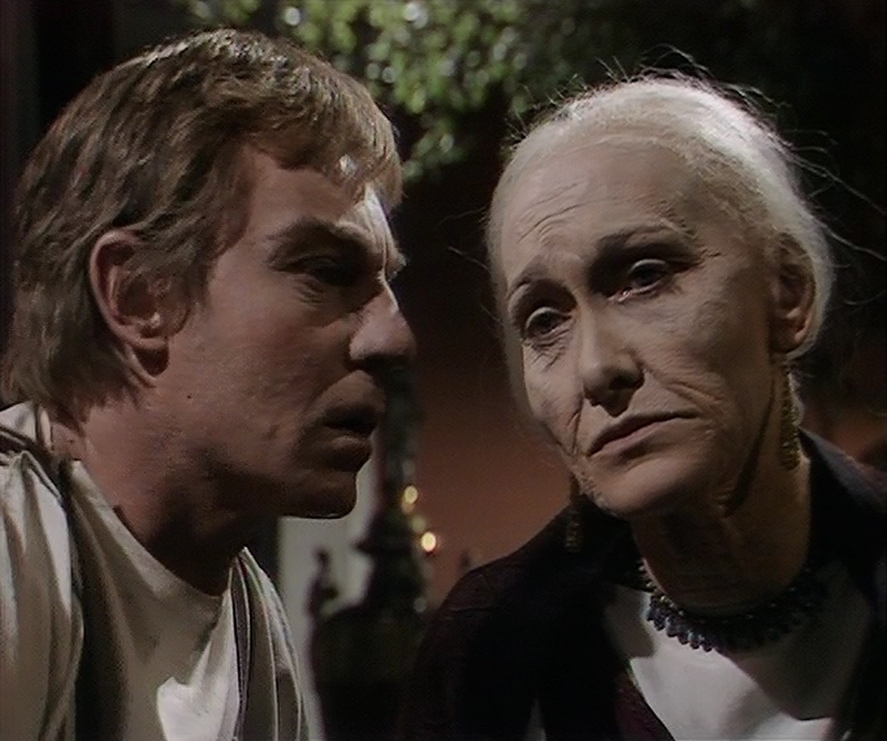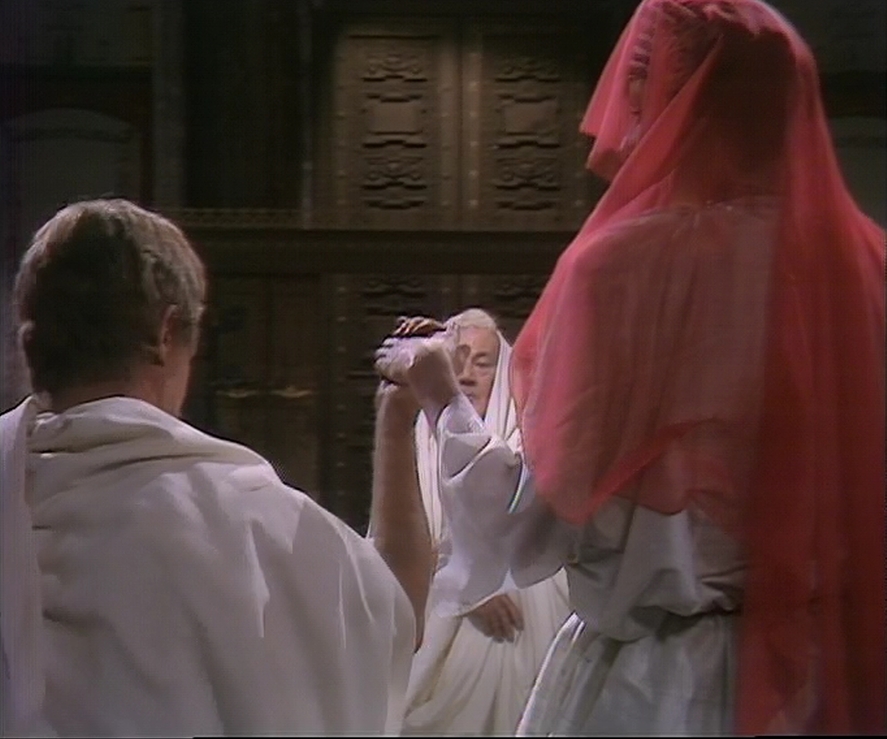
The Tomorrow People – Changes. New book due December 2023

A decade has passed since teen pop sensation Gabriel burst onto the scene.

Rescued from the shattered ruins of a city devastated by alien invaders, the plight of the golden-haired orphan with the face – and voice – of an angel burned brightly for a decade, winning legions of devoted fans across the world, though Gabriel has grown tired.

Not with the wealth or the adulation, but with the constant struggle to undo the terrible consequences his single moment’s hesitation unleashed upon the people of Earth many years ago.

But tonight, the Tomorrow People of every generation are coming to join the struggle for humanity’s future.

Published next month, The Tomorrow People – Changes is a new novel written by Andy Davidson, based on an storyline by Roger Price (the creator of TTP). After reading the book, an impressed Price said “When Andy sent me the manuscript, which he wrote from my detailed treatment, my response was, ‘I’m humbled – I could never have written anything this good!’”

Changes will be published by Chinbeard Books (who have the exclusive literary licence for The Tomorrow People) and Oak Tree Books and will be followed by a series of bi-monthly Tomorrow People novels, set in the continuity of the television series, written by Gary Russell, Rebecca Levene & David Derbyshire, Nigel Fairs, Joseph Lidster, and Iain McLaughlin.

Changes can be pre-ordered via this link.

Doctor Who on the iPlayer

At the beginning of November, nearly all of the Whoniverse (a word that causes me to grind my teeth ever so slightly) came to the iPlayer. Apart from the first story (An Unearthly Child) the whole sprawling back catalogue of Doctor Who is now available at the click of a button. Plus every episode is subtitled and signed as well.

Had you told the younger me, back in the mid 1980’s, that this would one day happen (at the time I was just beginning to acquire the series on VHS at a glacial pace) then it would have seemed like pure science fiction.

It’s a nice coincidence that this launch occurred during the same week that The Five Faces of Doctor Who debuted on BBC2 back in 1981. For an earlier generation, that was a considerable archival treat (indeed, even more so than the iPlayer splurge – as back in 1981 some of these stories had been unseen for decades).

Having everything (well apart from the recently released cartoons) on DVD, I can’t confess to working up the same sort of excitement expressed in certain areas of social media about the series’ new iPlayer home, but it’s undeniably convenient not to have to reach up and pluck a shiny disc off the shelf every time I want to watch a story. Hmm, I’ve a nasty feeling I’m turning into a couch potato.

I’ve had a quick look at the animations of Galaxy 4 and The Faceless Ones but couldn’t get very far through either. I find it impossible to watch them with a straight face ….

The news that the first Dalek story will receive a radical re-edit (cut down to 75 minutes, colourised and treated to a new score) caused me to raise an eyebrow. I’m not terribly fond about the concept of daubing black and white material with colour (my thoughts about how it benefitted/or not Tony Hancock can be found here) and I tend to find it baffling that so much time and money is expended on such projects.

Still, I’m sure that one day all the Hartnell and Troughton stories will be coloured in and resold to many of the same punters who’ve already bought them on VHS, DVD and BD. Good luck to them, but I’ll be saving my pennies.

I’ll keep an open mind on The Daleks though, and will report back later in the month.

Sapphire & Steel – Assignment Two

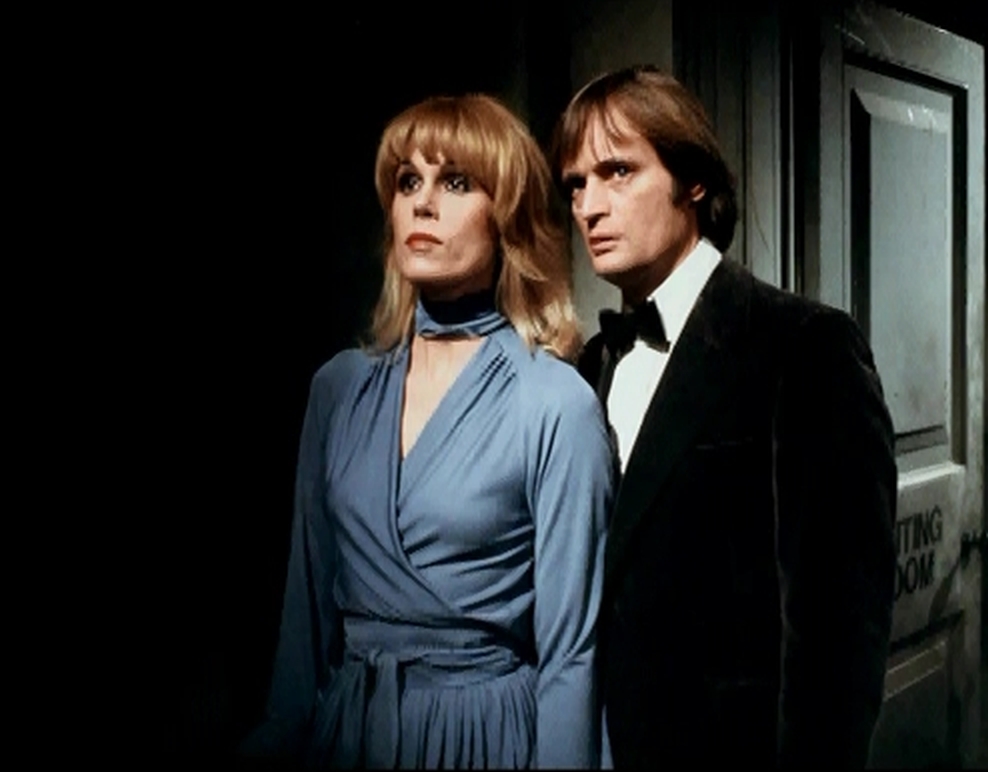
The recent death of David McCallum has spurred me into another rewatch of Sapphire & Steel (my previous thoughts about their first adventure begins here).

Assignment Two (the one with the railway station) remains the favourite of many, although it’s one that has always slightly niggled me. Yes, it’s a high quality and disturbing 200 minutes, but it has a few issues.

The first is that it’s just a little too long. At eight episodes it demands a certain loyalty on the part of the audience to keep returning week after week with the plot only moving at a snail’s pace (even more so back in 1979 when it was unfortunately affected by the ITV strike – the first four episodes aired in July and August, the remainder didn’t surface until October and November).

The second problem I have (which we’ll discuss more a little later) is that the ending feels somewhat rushed and perfunctory, which is odd given the serial’s lengthy running time.

Positives? The production design (the abandoned railway and hotel) is first rate and – like the first story – the relatively small cast (in addition to S&S there are only two other major characters – Tully and Price) hold the attention throughout. Gerald James gives a splendid and touching performance as the doomed ghost-hunter George Tully with Tom Kelly exuding both menace and vulnerability as the ghost of Sam Pearce.

Watching, as I tend to do, a fair amount of archive television from the same period, you tend to see the same faces crop up again and again. So it’s proved recently, as I went from this serial to Angels 3.5 (Patterns, written by Pat Hooker) which featured the television debut of Tom Kelly. It’s a small world ….

Sapphire & Steel was a series which generated a certain amount of its strength from what some might regard as a drawback – the fact it was taped on multi-camera videotape in an electronic studio. But while this means it lacks the gloss of single-camera film, the benefits – lengthy takes allowing the actors to “breathe” – help to outweigh the negatives.

Studio vt recordings are often referred to as “theatrical”  (indeed, in the early days of television, this type of drama was dubbed electronic theatre) and this feeling is pushed to the extreme here. For example, when Steel is drawn into the fantasy of a WW2 pilot, we don’t see him in a plane (sound effects suffice). And later, Tully and Sapphire are trapped in the illusion of a doomed submarine (created with nothing more than a change of clothing in addition to altered lighting and sound).

This might be budget related, but it also feels like an artistic choice. Maybe this won’t be to everyone’s tastes (the viewer is given an impression of something and then required to fill in the blanks themselves) but it works for me.

What doesn’t quite work for me is the ending. We learn little throughout the serial about the darkness, the malevolent force that has reanimated Pearce and others like him. Steel has a way of dealing with it though – by offering up the life of poor Mr Tully.

This seems very harsh on Tully (Gerald James never better than at the moment when Tully appears to realise he’s being offered as a sacrificial lamb) and leaves a few unanswered questions. Such as, what the danger would have been had the darkness carried out its plan with Pearce and his colleagues. Also, if the darkness wanted Tully, why couldn’t it just take him?

And oddest of all, Steel tells the darkness that if he takes Tully and releases the ghosts, then the resentment generated (by tine – which would be more than a little miffed that someone had died before they were due) would be substantial. Given that Sapphire and Steel’s job is to protect time, this seems a little cavalier. Unless, of course, Steel was bluffing (or indeed, that the sacrifice of Tully is a way to keep the darkness dormant for some time, and therefore Steel regarded it as the lesser of multiple evils).

Given that P.J. Hammond’s scripts often tend to be opaque, it’s not surprising that the viewer is required to supply some of these answers. But after such a long serial, you might expect just a tad more closure (so that’s always been a black mark against it for me).

The series would never attempt an eight parter again (future serials would run for either four or six episodes) which was probably wise. But minor niggles apart (and if you absolutely love this one, please don’t feel compelled to tell me I’m wrong – it’s just my opinion) there’s more than enough here to always make any rewatch a rewarding one.

Book review. Taste and Decency – The Swizzlewick Story by Michel Seely

One of the pleasures (or frustrations, depending on your point of view) faced by the devotee of archive television is that there’s just so much of it. No matter how deep you think you’ve dug at times, there’s always yet more forgotten programmes just waiting to be unearthed.

Such a one is Swizzlewick, which – until this book – I’d never examined in any detail. Like Michael Seely, my first thoughts were that it was a children’s series, but that’s far from the case ….

A twice-weekly BBC serial created by David Turner, Swizzlewick was an experimental and satirical drama set in the world of local government. If remembered at all today, it’s because Mary Whitehouse (then just beginning her campaign to clean up tv) was incensed by the series – convinced that Swizzlewick had deliberately lampooned both her and her husband.

As Seely notes early on, Whitehouse’s claims have been taken as fact (notably in her memoirs). But by digging through the surviving production documentation, Seely is able to tell – for the first time – the richer and more accurate story about the series’ genesis, production, clash with Mrs Whitehouse and swift demise (it came to an end after just 26 episodes – of which only one exists today).

In the field of continuing dramas (or “soap operas” as they’re known today) ITV reigned supreme in the 1960’s with both Coronation Street and Crossroads. The BBC wasn’t idle though and, following on from the 1950’s Grove Family, they broadcast a variety of different series (Compact, 199 Park Lane, United!, The Newcomers) during the following decade with varying degrees of success.

Swizzlewick was born out of the success of Compact (an audience favourite, but viewed with disdain by the critics) which had run for several years and was now approaching its natural end. Anybody who has studied the genesis of Doctor Who, will recognise some of the figures floating around the BBC drama department at this time (Donald Wilson, Anthony Coburn) and it was Wilson who spoke to David Turner about the local government series concept that had been developed by Coburn.

I love facts and there’s plenty of facts in this book. For example, we learn how many guineas the scripts cost, as well as the budget for each episode (around about the same as the early episodes of Doctor Who). Sydney Newman offered criticism and encouragement as the series’ format was developed, although Morris Barry struck a more downbeat note (noting in a memo that the series was far removed from the glossy escapist fare of Compact – and so was more suited to a later evening slot).

From this (and of course, knowing the series’ eventual fate) it’s hard not to chug through these earlier chapters with a feeling of unease that Swizzlewick won’t be long for this world. And so it turns out – but the way it got there (and the Whitehouse controversy especially) does make for a fascinating story.

Thanks to a plethora of diligent researchers, we know so much about the genesis of Doctor Who, but the vast majority of its contemporaries have not been so fortunate. That’s one of the reasons why I found the early chapters of Swizzlewick so engrossing – to be able to eavesdrop in detail on the creation and production of a 1960’s BBC drama series that isn’t Doctor Who is quite a treat.

The first half of the book details the production of the series, the second half offers a detailed episode guide (very detailed, in fact) which is followed by an epilogue, entitled Was Swizzlewick any good? Michael Seely thinks so and having finished the book, I’d have to concur.

It goes without saying that this is a very niche book. And yet I’m sure it will find a market, as even if the series won’t be familiar to many, the wealth of production documentation unearthed will ensure it’s bound to catch the eye of anyone with an interest in 1960’s British drama. Warmly recommended.

Swizzlewick can be ordered directly from Saturday Morning Press at this link.

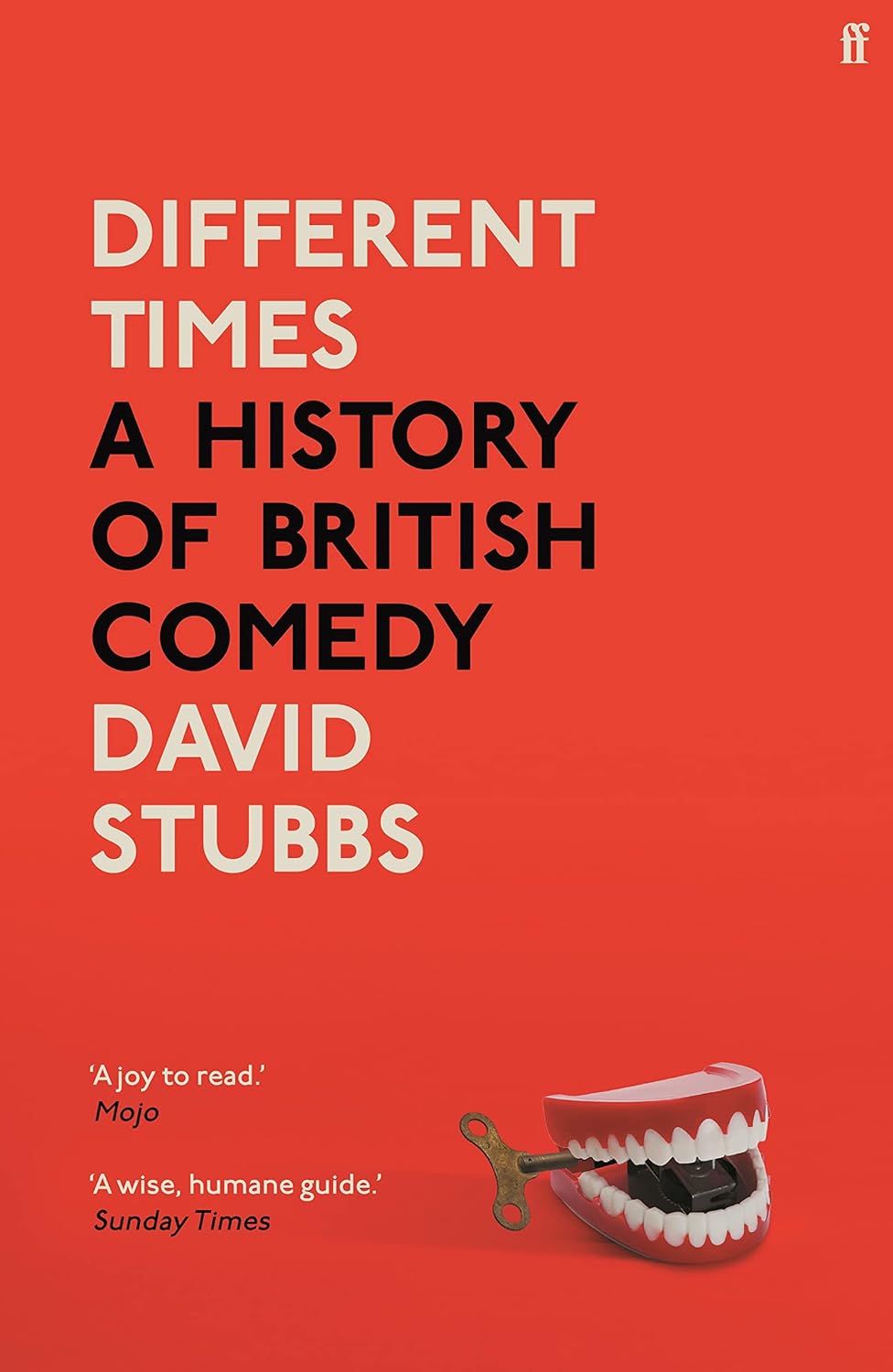
Book review. Different Times – A History of British Comedy by David Stubbs.

Anybody attempting to chronicle the history of British comedy in a single volume will have to be somewhat selective. And this proves to be the case with Different Times – A History of British Comedy by David Stubbs.

Although films (the work of Charlie Chaplin and Stan Laurel, Ealing, the Pythons) are touched upon as is the stand-up circuit, the bulk of the book concerns itself with television comedy (with the 1970’s taking up by far the largest chapter).

David Stubbs sketches affectionate appreciations of the likes of Tony Hancock, Joyce Grenfell and Dad’s Army although his introduction (where he acknowledges his privileged upbringing as a “white, male, cisgender, Oxbridge” type) does give warning that some sacred cows will be slaughtered.

Although, in fact, there’s not too much the devotee of classic comedy to get hot under the collar about. True, he doesn’t have a great deal of time for Spike Milligan (whilst taking pains to acknowledge his importance in the comedy firmament) but I can appreciate his point of view. I’m happy to have the surviving episodes of Q close at hand – but it’s fair to say that it’s not a series I reach for all that often.

Familiar targets like On The Buses and Love Thy Neighbour are given a good kicking. Possibly more surprisingly, he seems to dislike Are You Being Served? although it’s never made clear why (aside from the fact that Grace Brothers was, even by the 1970’s, an anachronism). No doubt David Croft and Jeremy Lloyd were well aware of this – so it seems an odd point to call them out on.

Any discussion of problematic 1970’s sitcoms is bound to include It Ain’t Half Hot Mum (although it’s worth noting that the series has recently been re-run on That’s TV and the world has continued to turn). The casting of Michael Bates as Rangi Ram is a sticking point for some (with Stubbs firmly against) although it’s interesting to hear some different points of view from those who aren’t (in Stubbs’ words) white and cisgender.

For example, Sanjeev Bhaskar has always appreciated Bates’ performance. ‘Michael Bates could speak Urdu fluently. He served in the Army in India and he could speak the language. And secondly, within that programme, the character he was playing wasn’t the butt of the joke… Rangi Ram was the fixer, he was the one who sorted things out.’

Renu Setna, who appeared multiple times in the series, did initially confess that the casting of Bates upset him. That was, until he saw his performance and had to acknowledge that he was perfect in the role.

Sergeant-Major Williams’ homophobic treatment of the concert party might also be a concern – but there’s little doubt that it’s entirely accurate (Jimmy Perry was a member of a similar concert party and directly drew upon his own memories whilst Kenneth Williams’ An Audience With offers a story with a very similar NCO character).

As you work through the book, you can help but notice that Stubbs has some annoying tics (like Ben Elton, he can’t resist a little bit of politics from time to time). But knowing that Morecambe & Wise were apparently life-long Conservative voters adds nothing to his thumbnail sketch of them, since Eddie Braben’s scripts were never political.

Given the limited word-count, certain series are given short shrift (and others ignored completely). Last of the Summer Wine, for example. is dealt with in a rather condescending and inaccurate way. Stubbs opines the familiar statement that the series was created as the misadventures of three OAPs (to begin with, they were all in their fifties and unemployed, rather than retired). Also LOTSW is described as an archetypal Sunday evening series which (during the 1970’s at least) it never was.

It’s a pity that I kept noticing other niggling little errors. You’d have to be a real nit-picker to worry about them. I’m a real nit-picker. Sorry ….

For example, we’re told that Bill Kerr was slowly eased out from the television version of Hancock’s Half Hour (he never appeared in a single episode). Bob didn’t attempt to join the army at the end of series one of The Likely Lads (it was series three). Ronnie Barker never appeared in At Last the 1948 Show or Do Not Adjust Your Set. dinnerladies was broadcast on BBC1, not BBC2 …

These brief quibbles apart, Different Times – A History of British Comedy was a book that I devoured very quickly and, in the main, enjoyed. I can’t say I agreed with all of David Stubbs’ opinions (it’s doubtful that many will) but in-between the occasional bouts of hectoring he offers some very readable and incisive analysis.

Different Times – A History of British Comedy was published by Faber & Faber on the 27th of July 2023

I Claudius – Reign of Terror (1st November 1976)

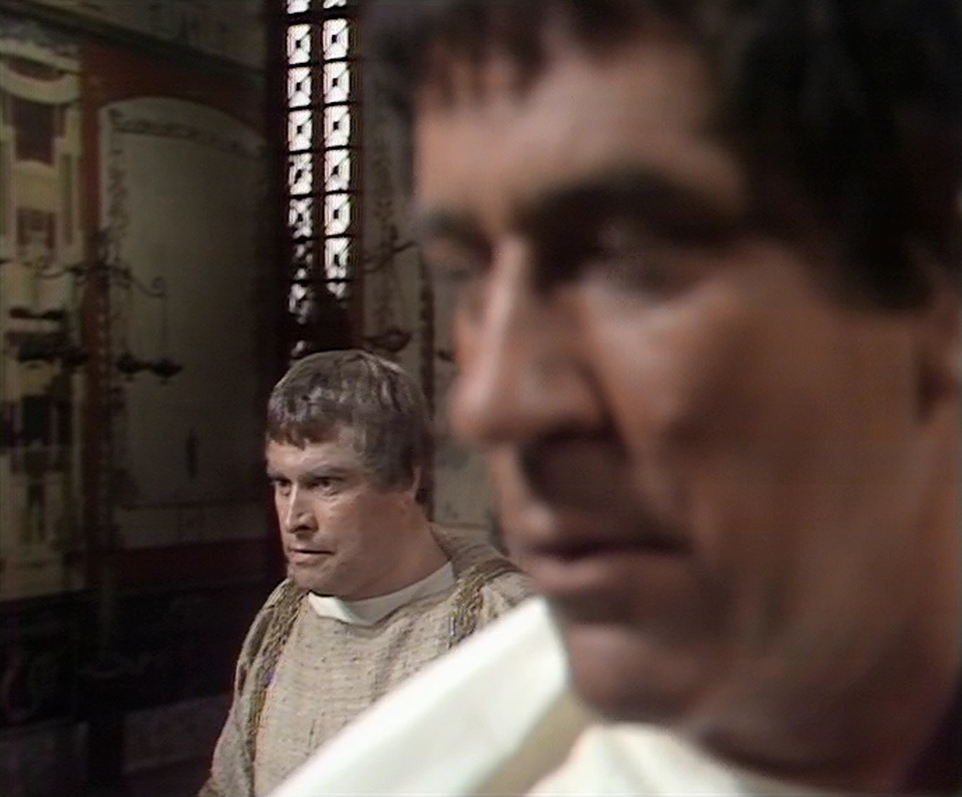
The aged Claudius opens the episode by informing us that following Tiberius’ retirement to Capri, the Empire was effectively now run by Sejanus – who, unfettered by any restraints, instigated a brutal reign of terror. Of course, by the end of the episode we’ve witnessed another reign of terror and in this one Sejanus turned out to be a victim …

As in previous episodes, Tiberius remains an isolated figure with Sejanus solely responsible for deciding who will be lucky enough to be granted an Imperial audience. On the one hand this suits Tiberius very well – he remarks this makes Sejanus the visible figure who attracts the ire of the public (with Tiberius remaining unaffected in the shadows). But there has to be another part of him that realises by abdicating so much power, he’s now little more than an impotent puppet.

Ironically, it’s his hated adversary Agrippina who articulates this very point. Even when she’s brought to him in chains, she manages to exude an aura of lofty disdain. Their final meeting is no more agreeable than any of the others – an apoplectic Tiberius whips her before she’s banished to the same island where her mother (Julia) lived out the remainder of her life.

Although he’s not given a great deal of screentime today, every single moment that John Hurt appears is a joy. Caligula’s first scene with Claudius is an instructive one – at this point Caligula may be hedonistic and totally self-obsessed, but he’s not mad (that would come later). He expresses polite disinterest in the fate of his brothers (Drusus and Nero) to Claudius’ disgust – but it’s fair to say that he’s only doing what Claudius has done all his life (keeping his head down, when all about are losing theirs).

Even better than this scene is Hurt’s deadpanning later in the episode, as Claudius brings Tiberius evidence that Sejanus and Livilia planned to murder him. Caligula’s reaction (“I always knew that woman was no good … people really are despicable”) is ordinary enough, but it’s the playful relish of his delivery that entertains so much.

It’s a rare comic highlight (as is Claudius’ irritation that his publisher has illustrated his history of Carthage with endless paintings of elephants!) in the darkest of all the I Claudius episodes.

Livila is desperate to marry Sejanus. He’s keen to do this, but is also agreeable when Tiberius suggests he marries Livila’s teenage daughter Helen (Karen Foley) instead. You can probably guess how Livila reacts to that (just wind Patricia Quinn up and let her go for several minutes).

The corruption of Sejanus’ Rome is represented by the way one man dies – Gallus (Charles Kay). Gallus has three scenes – in the first he makes a principled stand in the Senate (earning Sejanus’ enmity) and in the second he shares a walk back to the Senate with Claudius (the pair have an amiable chat about history – his association with Claudius marking him out as a good guy).

His arrest and brutal torture demonstrates how Sejanus’ reign of terror operates – any opponent can be removed at any time and evidence simply isn’t required. There are so many fine cameo performances across the entire serial – Kay’s is just one among many. “I’ve watched your career with fascination, Sejanus. It’s been a revelation to me. I never fully realized before how a small mind, allied to unlimited ambition, and without scruple can destroy a country full of clever men”.

Antonia moves a little more to the forefront today. Her default expression is still disapproving (even now he’s middle-aged, Claudius can seemingly do nothing right in her eyes) but she does emerge as one of the few members of the Imperial family (along with Claudius, of course) who has a strong sense of morality. It’s remarkable that she’s remained innocent about so many things (the part her daughter Livilia played in the banishment of Postumus, for example) but this does seem to be genuine, rather than a politic avoidance of the truth.

So when she’s presented with evidence that Livila poisoned her husband Castor, she acts without hesitation. Locking her in a room and forcing herself to listen to Livila’s screams is a call-back to a similar scene with Augustus/Julia. But where Julia would eventually emerge (bound for exile) Antonia plans to keep vigil until Livila dies of starvation.

Claudius: How can you leave her to die?
Antonia: That’s her punishment.
Claudius: How can you sit out here and listen to her?
Antonia: And that’s mine.

While this is happening, Rome is in turmoil. Sejanus has been removed from power by his second in command Macro (John Rhys-Davies). Rhys-Davies is excellent value as the previously loyal Macro who now eyes a chance to advance. Caligula recommends him to Tiberius as a sound man (he doesn’t know him personally, but he’s slept with his wife several times!)

There’s a few rare handheld camera shots (the death of Sejanus, the aftermath of the massacre in the streets) that help to give the climax of the episode an unusual feel. The studio-bound nature of I Claudius means that it struggles to express a sense of scale (most of the turmoil has to take place off screen) but the visceral nature of the unfolding events still carries a considerable punch. The rape and murder of Sejanus’ young daughter is a case in point.

Reign of Terror is an exhausting episode. And the fact that Tiberius has named Caligula as his successor suggests that the next one will be no quieter …

I Claudius – Queen of Heaven (25th October 1976)

Queen of Heaven opens with the conclusion of an agreeable evening’s feast at the home of Titus (Edward Jewesbery) and Lollia (Isabel Dean). They appear to be the ideal hosts as their guests – including Claudius and Agrippina – seem to have enjoyed themselves.

But the laughter quickly dissipates after Lollia begins to tell a story, concerning Tiberius’ debauched tastes. “I was there subjected to acts of such abominable filth, to bestial obscenities with him and his slaves of both sexes …”

This scene (running for nearly seven minutes) is a fine showcase for Isabel Dean’s histrionic talents (yes, you can argue that she goes a little over the top, but this theatrical intensity was probably the right choice). A shamed Lollia can see no other way out than to take her own life – which she does with a knife in full view of her shocked husband and guests. Clearly she’s one for the grand gesture …

Although sex is the motor that drives a great deal of I Claudius, it’s remarkable how coy the serial was in depicting it. So although we hear several times about Tiberius’ depravities, they’re never actually shown. This might have been a masterstroke, as the imagination is then left to conjure up the worst of images (more prosaically, the production may also have had one eye on overseas – especially American – sales, where any form of nudity wouldn’t have been appreciated).

Caligula has now grown into the figure of John Hurt. Complete with a yellow wig, the 36 year old Hurt (playing Caligula aged approximately 18) is clearly having a ball right from the start. Whether it’s chuckling with Tiberius over a new mucky book (well, mucky scroll) or subjecting his great-grandmother Livia to a lengthy and highly inappropriate kiss, Hurt always catches the eye.

Sejanus also moves into the forefront today. He’s able to convince a pliant Claudius to divorce his wife and marry Sejanus’ sister. Both Antonia and Agrippina denounce him for this, but Herod is more forgiving (or simply more farsighted). He alone understands that had Claudius refused, his life expectancy would have been on the very short side. So as he’s always done, Claudius simply bends with the wind and lives to fight another day.

As for Sejanus, apart from playing cupid for Claudius and his sister, he’s also deep into an affair with the predatory Livilla. This means it’s curtains for the affable, but weak-willed Castor. Kevin McNally bows out after Livilla and Sejanus decide to poison Castor.

As in the previous episode, Livia is depicted as a powerless and rather forgotten character. Almost literally bumping into Tiberius in the forum (as their two chairs meet) she berates him for his lack of attention and peevishly reminds him about her upcoming birthday!

As her son offers no succor and Caligula only fleeting entertainment, it’s Claudius who turns out to be her confidant in the last months of her life. That’s possibly not surprising – her choice being somewhat limited due to her habit of poisoning almost anything that moves …

She cuts a tragic figure when pleading with Claudius to get Caligula (who she’s convinced will be the next Emperor) to make her a goddess (in order  that she won’t suffer eternal damnation). You feel that she’s partly manipulating him, but her sense of terror also seems genuine.

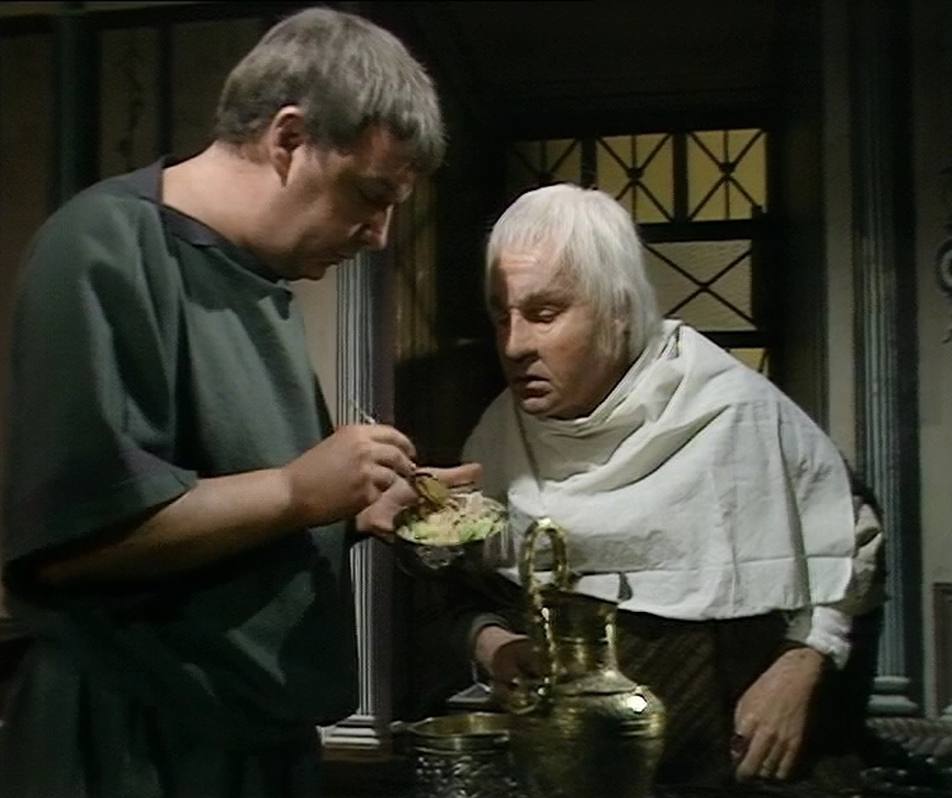
I love the matter of fact way Livia agrees to tell him about her list of crimes (Claudius, as a historian, is keen to have an accurate record). There’s also a few titbits for the viewer as well (we learn for the first time that she poisoned Marcus Agrippa). As with the death of Augustus in episode four, the approaching demise of Livia will leave a large hole.

So a doff of the cap to Siân Phillips. It can’t have been easy for her in the last few episodes, thanks to the heavy old-age make-up she had to wear, but like Augustus her exit is a memorable one. Virtually immobile in her sickbed, she’s first visited by Caligula, who shatters any hopes she had of becoming a goddess. “What makes you think that a filthy, smelly old woman like you could become a goddess? I don’t need you anymore, you see, great grandmother. My secret will die with you. You are going to stew in hell forever and ever”.

It’s left to Claudius, alone with her when she dies, to offer whatever comfort he can. The tears in his eyes at her passing sits awkwardly with the remembrance of the aged Claudius at the conclusion of Poison is Queen (where he violently despised her) bur this suggests the way feelings and memories can fluctuate. In this episode Claudius reacts with calm disinterest at Livia’s catalogue of crimes – a far cry from how he recalls them at the end of his life.

I Claudius – Some Justice (18th October 1976)

Germanicus is dead. His widow, Agrippina (Fiona Walker) is convinced that Piso (Stratford Johns) and his wife Plancina (Irene Hamilton) poisoned him ….

So David Robb breathes his last as Germanicus. He has a few brief scenes here – although none are very taxing (in the first he’s already dead, then later there are a few quick flashbacks showing the ailing Germanicus). The fact we never see any interaction between Germanicus and Piso (the recently deposed governor of Syria) means that, like the Senate who are called upon to debate Piso and Plancina’s guilt or innocence, we don’t know what happened for certain (at least not for a while).

Both Stratford Johns and Irene Hamilton add considerable value to this episode. This would be Hamilton’s penultimate television credit whilst Johns still had several decades of work in front of him. As you’d expect, Johns is compelling as the initially affable Piso – convinced that his friendship with Tiberius will be sufficient to get him out of trouble. The more far-seeing Plancina can clearly see that their guilt or innocence doesn’t really matter – the mob (angry at Germanicus’ death) want justice, so it looks like Piso and Plancina will have to be sacrificed.

Agrippina details the way her husband met his end – there’s some lurid (and slightly ludicrous) visual detail to aid the viewer in this. Although Claudius doesn’t have a great deal to do today, he’s still quite key. Meeting with the likes of Agrippina, Castor, Antonia and Herod he makes the suggestion (accepted by Castor) that the trial should take place in the Senate (a move that would favour them). It’s plain that in their company he no longer feels the need to play the fool.

Tiberius and Livia are also somewhat sidelined. As of yet, there’s no great sense about how Tiberius’ reign as Emperor is going (apart from the fact that he peevishly wonders why the public loved Germanicus more than they love him).

Now that Livia has poisoned her way through a vast swathe of the Imperial family, she’s become somewhat surplus to requirements. If Livia assumed that Tiberius would allow her to jointly rule (as Augustus did) then she’s been sorely disappointed. “What a spineless, miserable, mean-spirited creature you are!” she opines in his direction towards the end of the episode. Since he’s not listening to her, who does he take counsel from? It’s Sejanus who’s operating as the power behind the throne (although again, he’s another whose role in the episode is quite brief).

The teeny Caligula (Robert Craig-Morgan) debuts. When even Livia describes him as a “monster” you know he must be bad ….

Indulged by his mother, Agrippina, Caligula is allowed to run riot. Claudius attempts to talk some sense into him (whereas Claudius’ mother Antonia favours locking him in the cellar and giving him a good whipping) but as we’ll see over the next few episodes, his words of caution didn’t really do much good. Even at this young age, Caligula is mad, bad and dangerous to know.

Some Justice was the television debut of Robert Morgan (later Robert Craig-Morgan) who will always be best remembered for playing the satchel-clutching Justin Bennett in the early years of Grange Hill.

Livia’s revulsion occurred after the poisoner Martina (Patsy Byrne) revealed to her the active part that Caligula played in his father’s death. The scene between Livia and Martina serves a dual purpose. On the one hand it’s blackly amusing to see two old hands calmly discussing poisons they have known, but the scene mainly exists so that Martina can info dump some major revelations about the way Germanicus died.

The episode ends – as it began – with the aged Claudius on the Imperial toilet. Which isn’t something you see every day. Some Justice almost feels like a stand-alone story, thanks to the prominence of Stratford Johns and several lengthy court-room scenes. But as he’s an actor I’ve always enjoyed watching this is no hardship for me.

I Claudius – Poison is Queen (11th October 1976)

For most of Poison is Queen, Livia is firmly on the back foot. This is something we haven’t seen before. Up until now, she’s manipulated and poisoned at will without seemingly breaking sweat. But the fact that Augustus now knows about her machinations (even though he can’t quite bring himself to openly confront her) means she’s put on the defensive.

Claudius’ brother Germanicus (David Robb) returns to Rome in triumph from Germany. He’s received with fervor at the Senate (the first time we see this impressive set) and later, quietly ensconced with Claudius, he learns the truth about Postumus (Livia was responsible for his banishment on a trumped-up rape charge).

It’s one thing that Germanicus accepts Claudius’ word on this (after all, he can offer no proof) but credibility is stretched even further when Germanicus offers to go to Augustus and tell him. It’s more than a little frustrating that this happens off-screen and given that Augustus has been married to Livia for fifty years (and has heard rumours about her conduct before) it’s difficult to imagine quite how Germanicus won him round. Let’s suppose that Augustus already had his own suspicions and Germanicus’ visit merely hardened them.

Augustus pays a visit to the exiled Postumus, who’s been living in lonely seclusion on a rock in the middle of nowhere for the last three years. Once again John Castle doesn’t hold back (although you can’t blame Postumus – stuck there for three years with only the guards and some seabirds for company would be enough to drive anyone slightly round the bend).

Augustus tells Postumus that he can’t return to Rome straight away – first he needs to speak to the Senate and get his exile rescinded. Given Augustus’ autocratic dominance of the state this seems like a feeble excuse, but as he’s hardly a man in the first flush of youth (or health) maybe that’s the reason for his hesitancy.

Although the likes of Germanicus, Postumus and Tiberius all have their moments (Tiberius throws a delightful hissy fit when he tells his mother that he’s sick of death of being Augustus’ lapdog and has no interest in becoming Emperor!) most of the episode revolves around the interactions of Augustus/Livia/Claudius.

Claudius speaks to both Livia and Augustus, although his relations with the latter are much more congenial than with the former. Augustus has belatedly realised that Claudius is not quite the fool he appears and (but for Augustus’ death) there’s a sense than an even closer rapprochement might have grown up between them. No such luck with Livia though, who still treats her grandson with undisguised contempt (and unlike Augustus seems not to have realised that Claudius has a sharp brain).

Everything is leading up to that scene. Thanks to Brian Blessed, it’s a technical triumph. The camera focuses solely on Augustus for several minutes as Livia (heard but not seen) delivers a lengthy monologue. As she continues to speak, Augustus dies right before our eyes. Many actors have been called upon to die on stage or screen over the decades, but none have done it as effectively as Blessed here. Under the unforgiving glare of the camera, not even a twitch is detectable. Mind you, some claim there is – and maybe if you analysed it frame by frame you’d find something, but you’d have to be a churlish sort to do so.

Despite Livia’s complicity (“don’t touch the figs” she memorably tells Tiberius) she also sheds tears after closing Augustus’ eyes. Maybe that suggests Livia still possesses a spark of humanity, but only the merest spark ….

Elsewhere, there are effective cameos from James Bree and Jonathan Burn whilst Patrick Stewart (sporting a fine head of hair – albeit not his own) makes his debut as Sejanus, a character who will have a major role to play during the reign of Tiberius.

I Claudius – What Shall We Do About Claudius? (4th October 1976)

Derek Jacobi is finally able to shed his old-age make up and play the young Claudius for the first time. Joining him at the start of the episode are several new actors, which means that a Claudius voice over is required in order to explain to the audience exactly who these runners and riders are.

There’s Postumus (John Castle), Marcus Agrippa’s surviving son and Claudius’ best friend, Claudius’ brother Germanicus (David Robb) as well the scheming Livilla (Patricia Quinn). Livilla is married to Castor (Kevin McNally) but spends her time making googly eyes at Postumus. Their illicit affair turns out to be key to the episode ….

Claudius’ isolation from the Imperial family is made clear in this opening scene. He’s allowed to dine with them, but only on a couch that’s placed a discreet distance away. Despite this unspoken segregation, he’s not totally friendless – Postumus is always prepared to stand up for him and even Augustus regards him with a distracted affection.

Before the serious business begins, there’s the joy of watching Augustus interact with the poet Horace (Norman Shelley). Augustus’ puritanical streak emerges (not for the first time) as he regrets the way that some poets delight in recording only the more sordid aspects of life. “Write poetry, yes, but write about nice things – things that you’d like your children to hear”.

Given that the definitive radio Sherlock Holmes (Carlton Hobbs) appeared in episode one, it’s nice that Shelley (Hobbs’ Doctor Watson) also makes an appearance in I Claudius.  Possibly it was just a coincidence, but it might be that director Herbert Wise remembered their decades long partnership and decided to find Shelley a small role.

Brian Blessed is then given the chance to move into high gear as an unbelieving Augustus receives news that three legions have been massacred in Germany. It’s interesting to see how Tiberius reacts to this – unlike Augustus, he’s totally calm and quite prepared to go out there in order to steady the ship.

Donald Eccles and Denis Carey (as Pollio and Livy) both essay decent cameos. A pair of eminent historians, they’re flattered by Claudius’ interest in their work – although Livy is less flattered when Claudius is unable to tell him which of them he prefers! The scene ends on a serious note though, as Pollio – when he’s alone with Claudius – suggests he carries on playing the fool (that way he might just stay alive). It’s worth bearing this in mind when observing some of Claudius’ later clumsy behavior.

What Shall We Do About Claudius? features several lengthy two handed scenes. The first – between Livia and Livilla – sees Livia (as in the previous episode) casually manipulate a hapless individual in order to remove yet another rival (in this case Postumus) to the throne. Livilla is able to emote in an impressive way, although I get the sense that some of her tears are purely for show (she’s wasting her time though – Livia’s not the one to be moved by sentiment).

The following two-hander (a domestic squabble between Augustus and Livia) is also highly entertaining and leads into the games at the Coliseum, which are being held in honour of Drusus. We meet the adult Herod Agrippa (James Faulkner) for the first time and are also given the opportunity to marvel at the set (which gives the impression of great height – helped by some lower than normal camera angles).

I enjoyed Livia’s pep talk to the gladiators. “These games are being degraded by the increasing use of professional tricks to stay alive! And I won’t have it! So put on a good show and there’ll be plenty of money for the living and a decent burial for the dead. And if not? I’ll break this guild up. And I’ll send the lot of you to the mines in Numidia.”

Later, Postumus is falsely accused of rape by Livilia. The Television Centre roof rattles as John Castle and Brian Blessed wring every last drop out of emotion out of the script. I Claudius is a serial packed with memorable moments, but this one has to be right at the top.

Oh grandfather, open your eyes. Over the years everyone you knew and loved has either died or disappeared. Do you think it was all an accident? My father Agrippa, and before him Marcellus, my brothers Gaius and Lucius, my mother Julia – NOW ME.

After this intensity, the episode winds down with Claudius’ long postponed marriage. His unnamed bride turns out to be much taller than he is, which is the cue for hysterical laughter from all the onlookers (even Livia and Claudius’ mother Antonia – two people who never find anything Claudius does even remotely amusing – have a chuckle).

It’s an oddly discomforting and grotesque scene. Possibly because we then cut back to the elderly, drunken Claudius before the credits roll, we should take it to be nothing more than his fevered remembering, rather than real life.

I Claudius – Waiting in the Wings (27th September 1976)

Time has moved on from the first episode. We can tell this in various ways – firstly, the previously infant Claudius is now a lad of about eight or nine. Young Claudius is played by Ashley Knight. I always like to dig into the credits of child actors to see how far their career progressed – most of Knight’s credits were as a juvenile but he certainly packed a lot in (playing Jim Hawkins in the excellent 1977 BBC Classic Serial adaptation of Treasure Island, for example).

Secondly, Tiberius (currently in exile on a small island) has comfortably settled into middle age. I’m pleased to see this (as commented upon last time, George Baker struggled to convince as a callow youth). Livia is also aging – although some of her old-age make up looks a little false. As the episodes click by you’ll have to cut the serial a little slack when considering this part of the production – fair to say that some of the make-up doesn’t always convince (although I’m sure it was the best that could have been done at the time).

Livia, it won’t surprise you to know, continues to plot. Augustus’ daughter Julia (Frances White) has become a notorious man-eater – and it seems that everyone in Rome knows, apart from her father. This makes Augustus look more than a little foolish – the most powerful man in Rome with such a blind spot? But it’s easy to see that his subordinates would either be terrified to tell him or possibly just assumed he knew and condoned her behavior.

One of Julia’s many, many conquests is the fresh faced Plautius (Darien Angadi), a friend of Julia’s brother Lucius (Simon MacCorkindale). Angadi died tragically young (in 1981, aged 31) but he still managed to notch up a fair few television credits.  Plautius is putty in the hands of Livia, and it’s a joy to watch how she effortlessly turns the young man into her informer.

If their scenes are a definite episode highlight, then – obviously – so is the moment when Augustus lines up a long row of senators accused of sleeping with his daughter and disbelievingly interrogates them. Blessed is at his very best here – Augustus is initially baffled as he encounters old friends, but his anger is quickly stoked. John Scott Martin is the unfortunate who receives the most savage rebuff from Augustus.

With Lucius now discredited (and shortly to die in what appears to be an accident, but you can never be sure) and Julia exiled (Frances White certainly knows to to wail) it looks like Livia has achieved her aim – the recall of Tiberius to Rome.

He seems to have been living a fairly comfortable life, but the lack of company has been a problem. Still at least he has Thrasyllus (Kevin Stoney) on hand to cast endless horoscopes and offer hope for the future. Stoney had previously played Thrasyllus in Philip Mackie’s The Caesars (1968) so you have to assume his casting here was a nod to that production.

If you’ve never seen it, then I can strongly recommend The Caesars. It roughly covers the same period of time as I Claudius but is by no means a retread (Mackie’s Tiberius is a very different character from the one offered by Graves/Pulman, Livia is only a minor character, etc).

Once again, Derek Jacobi has little to do but bookend the episode. The final scene is a memorable one though – it swiftly cuts from the young Claudius with his friends to the aged one now sitting alone in the same spot, with only his memories for company.

I Claudius – A Touch of Murder (20th September 1976)

Jack Pulman’s adaptation of Robert Graves’ two novels (I Claudius and Claudius the God) spanned twelve episodes – with the first (A Touch Of Murder) being a double helping. For the American screening it was split into two 50 minute episodes (various other minor tweaks were also done – such as trimming down shots of the bare-breasted dancers seen in the opening minutes).

The original 100 minute edit is the better one though. Revisiting it once again, I can honestly say that the episode didn’t drag at all – a sure sign that the script and actors are totally engaging. As is well known, I Claudius is a completely studio-bound production – that’s sensible enough, as it would be difficult to find too many UK locations which could have convincingly replicated the grandeur that was Imperial Rome.

Tim Harvey’s production design is one of the serial’s unheralded triumphs. Subtle lighting effects (sun streaming through the palace windows) are used effectively and the outdoor locations (Augustus’ garden complete with fountain) also convinces (thanks to simple effects, such as a wind machine rippling the branches of the trees).

Pulman elected to retain the device of Claudius narrating the history of his strange family. This works on two levels – not only does it display fidelity to Graves’ original work, it’s also very handy for the television viewer (who otherwise – especially in this first episode – might find themselves overwhelmed by the large cast of characters who keep on appearing). So whenever the antecedents of a new arrival need to be explained, Claudius can pop up with a VO to explain all. As the serial progresses, and the regular characters become more familiar, this device is used less often.

Derek Jacobi (Claudius) appears only fleetingly, as at this point in the story Claudius is either not born or only a mewling infant. It’s Augustus (Brian Blessed), Livia (Sian Phillips) and Tiberius (George Baker) who drive the episode along.

There are some who express surprise that Brian Blessed could once upon a time have indulged in a spot of subtle acting (true, Augustus does like to shout a lot, but he tends to be more interesting whenever he’s calm and menacing). Those people probably never saw him in Z Cars then – maybe Blessed only started to go over the top when he grew the beard ….

His Augustus is a multi-layered creation. At times indulgent and child-like, he’s able to change direction in a heartbeat.

If Augustus is ebullient and expressive, then Livia is cold and calculating – prepared to play the long game as she removes all those who might ascend the throne ahead of her son, Tiberius. It’s interesting to see how Pulman greatly expanded the role Livia played in the death of Marcellus (Christopher Guard). To be honest, Marcellus is so irritating that his demise can almost be called a mercy killing. Pulman explicitly states that Livia poisoned him – whereas Graves only mentions in passing that Livia nursed him (possibly anticipating that his readers would join the dots).

Marcellus provides the first half of the episode with some spark, as does John Paul as Marcus Agrippa. Augustus’ strong right arm, the relationship between him and Agrippa is a fascinating one which could have been expanded a little more.

Their final scene together is a treat though. Agrippa is keen to strengthen his ties with the Imperial family and asks to marry Augustus’ daughter – the recently widowed Julia (Frances White). At first a shocked Augustus can barely get any words out, before – after a short period of reflection – he becomes reconciled and heartily agrees. It’s therefore a little jolting to then be told by Claudius that Agrippa, having married Julia, dies some years later (this all happens off-screen).

With Julia back on the market, she’s then married to an unwilling Tiberius – who’s forced to divorce the love of his life, Vipsania (Sheila Ruskin). The increasingly tangled relationships between the members of the Imperial family will only become more tangled over time, so it’s best to keep paying attention …

Out of all those who become Emperor, Tiberius has the fewest character quirks, which means that George Baker has to work hard to bring him to life. He’s served well in A Touch of Murder though – even if Baker doesn’t quite convince as the youthful Tiberius. Tiberius’ awkward and stilted relationship with his mother is nicely done as is the genuine love and affection he has for his younger brother, Drusus (Ian Ogilvy).

Like John Paul and Christopher Guard, Ogilvy is a one episode actor – required to make an impact with only a limited amount of screentime. This he does – firstly as the only man capable of dispelling the black clouds that hang over his elder brother and then later when Drusus, off to campaign in Germany, takes his leave of Augustus.

Drusus, a keen believer in the Republic, is comfortable enough in Augustus’ company not to keep his views secret. Watch out for the moment when their affable chat suddenly turns awkward – for just a brief moment – as Drusus realises that he’s overstepped the mark.

If Pulman makes it explicit that Livia poisoned Marcellus, then her involvement in the death of Drusus is more opaque. The elderly Claudius is convinced that something strange occurred, but doesn’t accuse Livia. True, she did send out to Germany the notable physician Musa (Renu Seta) who had also unsuccessfully treated Marcellus, but was Musa under her control? He seemed genuinely baffled at the death of Marcellus, so if he was later suborned by Livia, we never saw it happen.

To round off, there’s a few minor performances worth noting. First, Carleton Hobbs as the Greek poet Aristarchus . For me, Hobbs was the definitive radio Sherlock Holmes and it’s always a delight to hear that well-remembered voice again. And Tony Haygarth, as Claudius’ slave, also makes a little go a long way – forced to taste his master’s food and wine, he can’t resist passing judgement on the indifferent culinary fare offered by the palace.

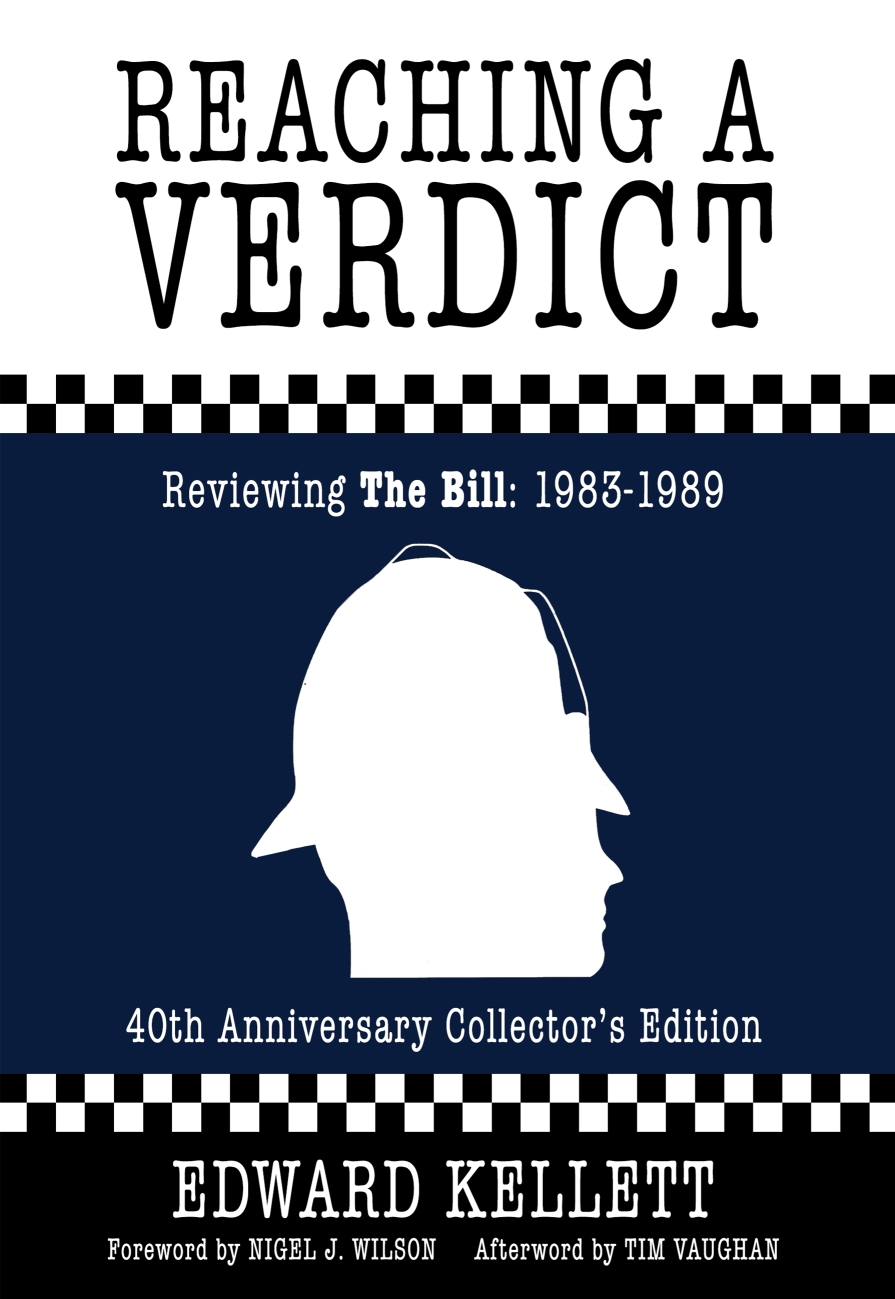
Book review – Reaching a Verdict by Edward Kellett

Reaching a Verdict: Reviewing The Bill 1983 – 1989 takes an in-depth look at the first five series of the UK’s longest-running police series. Based on material originally written for The Billaton, Edward Kellett’s book offers a deep dive into the series’ early years and is an excellent companion for anyone attempting a rewatch.

It’s easy to assume that The Bill arrived fully formed in its first series, but instead Kellett is able to show how the series took some time to develop (characters like Jim Carver slowly shedding their naïve persona, for example). John Salthouse’s towering turn as DI Galloway is also acknowledged. During S1 he was a dominant figure and although he’d become more of an ensemble player during series two and three, his departure prior to the series’ half-hour reboot did leave a big hole to fill (luckily, a more than adequate replacement was found …)

I appreciated the way that Edward Kellett was keen to stress how The Bill didn’t develop in isolation. Sometimes, certain programmes can be lauded as mould-breakers, with no acknowledgment given that they were actually building on what had gone before them. So I enjoyed Kellett’s nod to Strangers – a now almost forgotten series.

The ‘missing link’ with the police series of the past is Strangers, a Granada TV show that bridged the five-year gap separating The Sweeney and The Bill – missing in the sense that it can only be tracked down on DVD, not doing the late afternoon rounds on ITV4 as a washed out, zoomed in, cut down travesty like other crime dramas of the period.

With a large, constantly changing cast of regular actors, not to mention an influx of new writers as the series moved to a twice weekly year round production cycle, there’s an awful lot that needs to be noted and analysed. But all the key contributors are given their moment. For example, here’s a thumbnail sketch of Ted Roach –

On paper Roach is the one figure most easily recognisable from TV copperdom, straight out of the Sweeney mould: the roguish, hard-drinking ladies’ man who sails close to the wind but gets results. Ted finds it hard living up to that last caveat, and thus what could have been an imitation Jack Regan is in fact a more substantial one. He is an odd, shambolic presence, imbued with that other great quality Scannell brought to the role, besides his charisma: unpredictability.

Another part of the book that struck a chord with me was the appreciation of Peter J. Hammond’s scripts. Hammond (best known for Sapphire & Steel) is a unique writer whose distinctive voice almost always comes through, no matter what series (The Bill, Z Cars, Angels, etc) he’s working on at the time. His Bill offerings noted here are classic Hammond efforts – at times unsettling and oblique narratives that linger in the memory.

Reaching a Verdict kicks off with a short chapter about the Storyboard pilot – Woodentop – with the remainder of its 250 or so pages divided into five more chapters (covering series one to three of the 50 minute show as well as the 25 minute episodes broadcast during 1988 and 1989).

Having previous enjoyed the two oral production histories of this era of The Bill by Oliver Crocker (see here and here) it’s very pleasing to now have such a comprehensive analysis of the programme as well. It’s certainly made me keen to dig out my DVDs and revisit the show –  and I can’t think of any higher recommendation of the book than that.

Reaching a Verdict will be published on the 16th of August 2023. Pre-orders can be made now at Devonfire Books.

I Claudius and the joy of videotaped drama

It has gladdened my heart to see a largely positive response on Twitter/X to the news that I Claudius will shortly be repeated on BBC4 (from the 16th of August). There were also a few slightly negative comments of course – for some, I Claudius is “old fashioned” or “theatrical” (these are supposed to be criticisms, but both seem like plusses to me!)

Videotaped drama is a form of television that (soaps apart) we don’t see anymore. Once, of course, it was the dominant way of programme-making and remained so for decades (notwithstanding filmed series from the likes of ITC and Euston Films).

There was a change in the air by the late seventies though. The BBC (who had tended to reserve film for one-off plays rather than series or serials) began to dip their toe into the brave new world of film series with Target (quickly followed by Shoestring). By the 1980’s film drama had begun to be seen as prestige (Miss Marple, Edge of Darkness) with taped drama now lagging behind as an inferior second best.

The 1985 Bleak House is a good example of this. Critical chatter at the time reacted positively to its glossy, all-film visuals – comparing and contrasting them to the cheap and cheerful videotaped Classic Serial strand which went out at Sunday tea-time. Such a sweeping point of view ignored the many strengths of the Classic Serials – thankfully, a decent sample are available on DVD and I live in hope that BBC4 may exhume some more in the future (the late 1960’s production of Treasure Island, with Peter Vaughan as Long John Silver, would be a good place to start).

Watching videotaped drama requires a certain mindset (not dissimilar to that of a theatre-goer). You have to accept that what you see may be somewhat impressionistic. In I Claudius, for example, at one point there’s a riot through the streets of Rome which is represented by noises off and about a dozen extras. If you can accept this sort of thing (a high tolerance for CSO is also recommended) then a veritable treasure trove of delights awaits you.

There are many excellent examples of videotaped drama on YouTube – I’ll recommend just three. Harold Pinter’s One for the Road (one set, a handful of actors). Arthur Ellis’ The Black and Blue Lamp (which was written around its production limitations – no exterior filming was available thanks to its low budget). Joe Orton’s What the Butler Saw (a vanished form of television drama that was content to faithfully reproduce the theatrical experience rather than seek to open it up).

Gross oversimplification incoming. If film drama is a director’s medium, then tape drama is an actor’s one. Of course, there are many fine performances to be found in filmed dramas (just as videotape offers good directors the chance to push the medium). But it’s a point that has a certain validity. Taking I Claudius as an example – multi-camera vt recording allowed the actors to perform in extended scenes. That’s one of the strengths of tape for me – the feeling that you’re getting close to the characters (film can have a distancing effect).

I can understand why some find archive tape dramas difficult to connect with. But for me, they’ll always be my drama form of choice. If you’ve never seen I Claudius, then I’d recommend tuning in (or if you’re not in the UK, seeking out an alternative way of viewing). You may just be pleasantly surprised ….

Morecambe & Wise – Scene/Omnibus documentaries (1973)

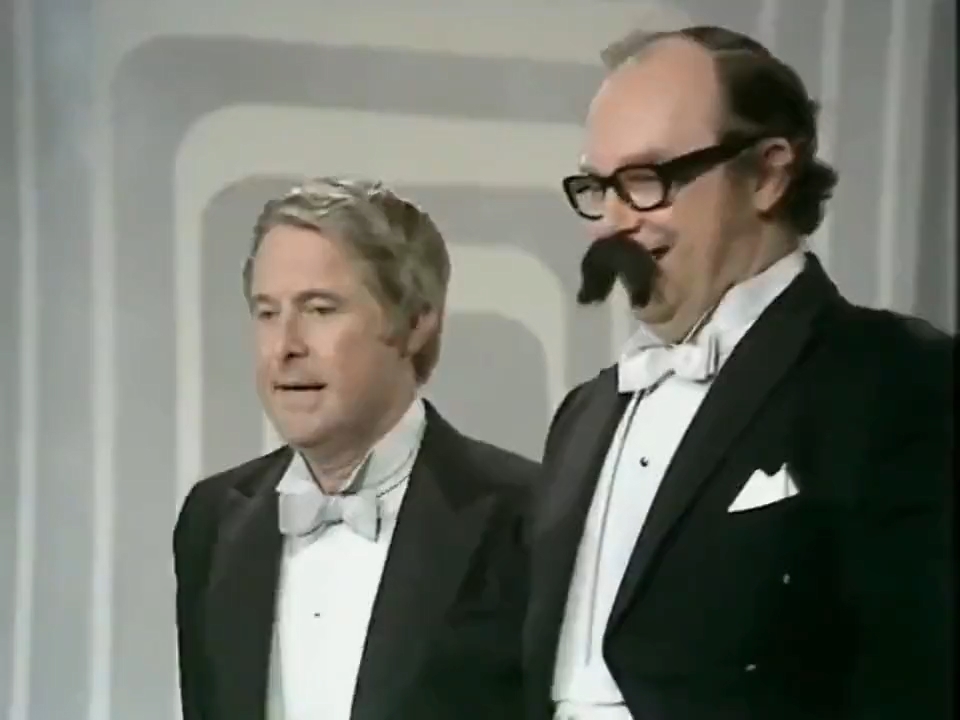
In early 1973 two documentaries about Morecambe & Wise hit the airwaves within a month of each other. First, the BBC Schools programme Scene aired a 22 minute programme on BBC2 (18th January) and then on BBC1 (18th February) the Omnibus strand broadcast Fools Rush In, which ran for 50 minutes.

Both documentaries were culled from fly on the wall footage shot the previous summer, when episode 7.7 of The Morecambe & Wise Show was being rehearsed and recorded. Show 7.7 was broadcast two days before the Omnibus doco, which meant that the lucky schoolchildren who caught the original Scene screening had an early peak at one of the most enduring M&W moments (“Arsenal!”)

Without knowing the original tx dates, it would be easy to assume that the Scene programme was simply a cut-down version of the adult documentary. But given that Ronald Smedley was the producer of both, it’s plain that Scene was the original one (presumably it was felt that the material gathered was too good to waste – hence it was reassembled and expanded for Omnibus).

Ronald Smedley spent his career working in children’s television. His highest profile job was as the producer of Grange Hill between 1985 and 1989, a period that saw the programme hit highs of controversy and public interest (Just Say No) and lows (Harriet the Donkey).

That apart, I find it fascinating that he worked on a series of impressive drama productions for BBC Schools, some of which were later repeated for an adult audience (including a modern language version of Julius Caesar, renamed Heil Caesar, and An Inspector Calls).

This serves as a reminder that schools programmes of this era could often be of a high quality. Indeed, the Scene documentary about Morecambe & Wise doesn’t talk down to its audience so it’s easy to imagine it receiving a peak time slot on its own merits (although with so much footage recorded it’s maybe understandable that the decision was made to produce a new effort from scratch).

Both have similar structures – although one notable difference is that Scene employs a narrator whilst Omnibus doesn’t. So while the Scene viewer is told that Eddie Braben lives and works in Liverpool, the Omnibus watcher is simply shown a picture of his house and either has to work out his geographical location or just not care.

Although Eric Morecambe can’t resist acting up for the cameras, both Eric and Ernie also talk seriously about Braben’s pivotal role in the series. At one point, Eric wistfully admits that he could never do what Braben did every week (enter his writing room on a Monday with a blank piece of paper and emerge with something). The pair concede that they may be able to improve on Braben’s work, but they’d be lost if they had to attempt to create it from scratch.

Both of these programmes would have made excellent special features on the Morecambe & Wise DVDs. Of course, neither were included ….

Sadly, the original range of releases lacked any extras at all (not even the Parkinson interview) and while the most recent DVD (containing previously lost episodes) did include a few bits and bobs, it was something of a half-hearted attempt. But at least there’s reasonable quality copies currently on YouTube. Links for both are below.

Porridge – New Faces, Old Hands (5th September 1974)

“With these feet?”

The series proper of Porridge kicks off with this episode. As touched upon in the last post,  a few adjustments have had to be made – at the end of Prisoner and Escort it looks like Fletch had already been processed and allocated a cell (he’d certainly been in for a chat with the governor).

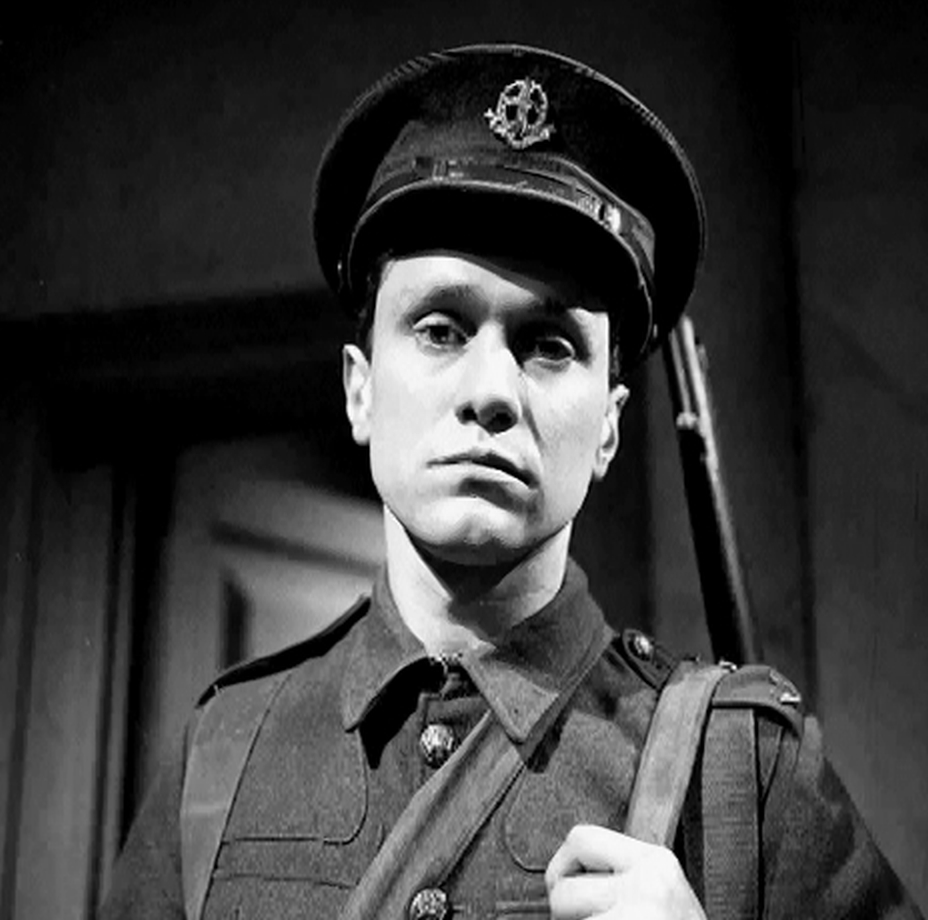
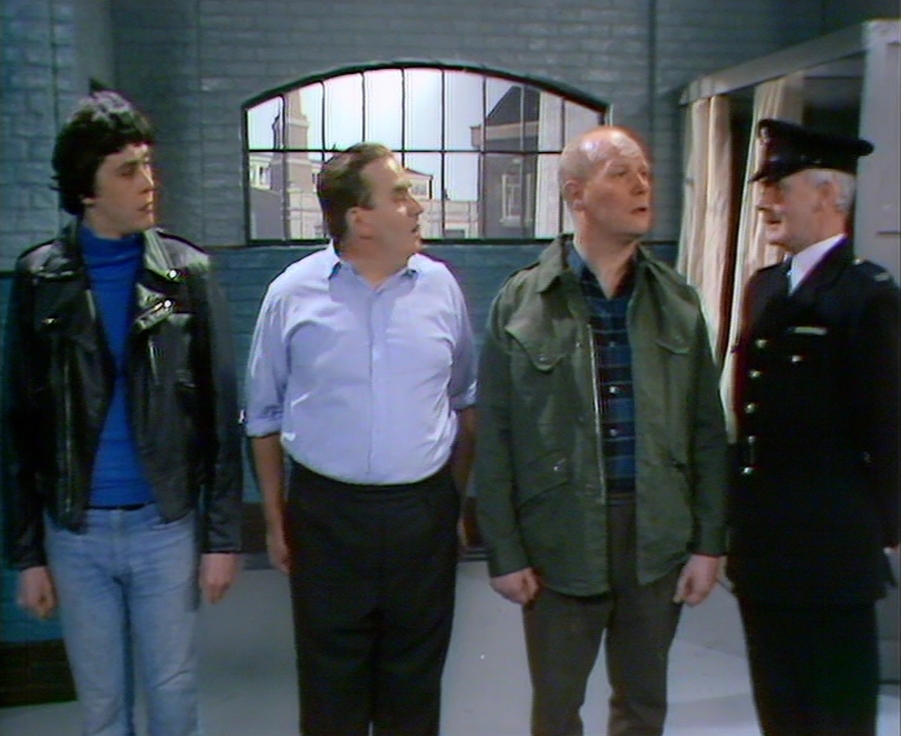
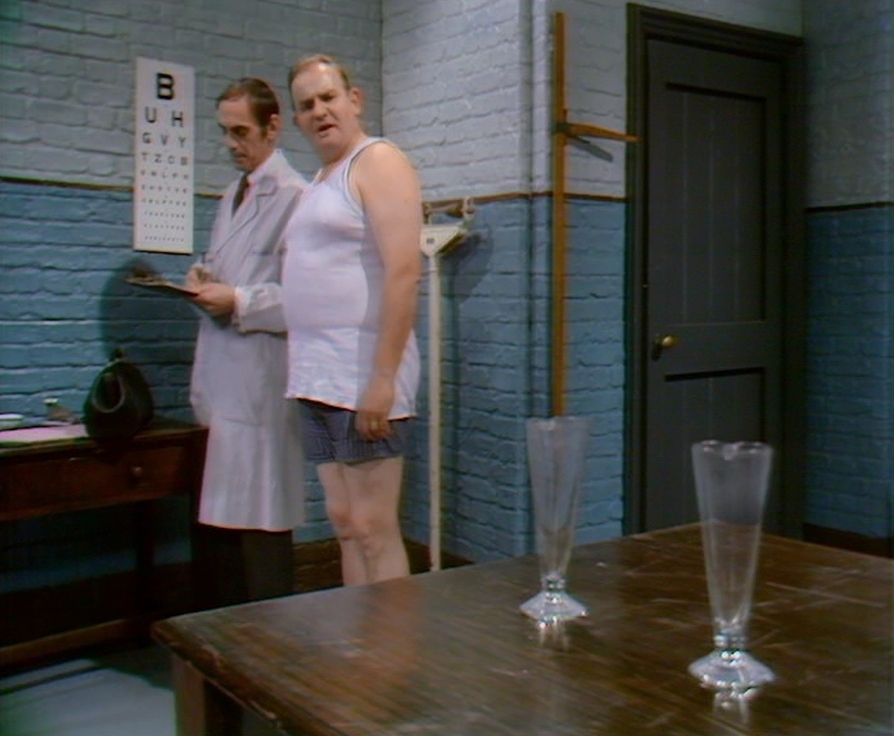
At the start of New Faces, Old Hands the story has rewound somewhat – Fletcher now finds himself lined up with the ingenuous Godber (Richard Beckinsale) and the gormless Heslop (Brian Glover) as the three are forced to listen to a lecture from Mackay, suffer a cursory inspection from the indifferent Medical Officer (John Bennett) and then are dished out with uniforms from Mr Barrowclough (“looks like Charlie Chaplin on stilts”).

Godber is the audience identification figure. Fletch instructs him (and us) about the way the prison works. Fletcher, the old hand of the title, knows the system inside out and how far it can pushed. Godber’s accent is a little more noticeable in this episode (possibly it was suggested to Beckinsale that he tone it down).

Brian Glover (“I read a book once. Green it was”) makes the first of three appearances as Heslop. He’d already had form with Clement and La Frenais – turning up as the cackling Flint in the series one Whatever Happened To The Likely Lads? episode No Hiding Place (tx 20th February 1973).

Michael Barrington debuts as the governor, Mr Venables (he’d appear eight times in total). Clearly Barrington had that sort of face, as he’d already played a prison governor in the forgotten late 1960’s sitcom Her Majesty’s Pleasure (which also featured a future Slade prison inhabitant – Ken Jones).

New Faces, Old Hands is stuffed with quotable lines. For example –

MO: Suffer from any illness?
Fletch: Bad feet.
MO: Suffer from any illness?
Fletch: Bad feet!
MO: Paid a recent visit to a doctor or hospital?
Fletch: Only with my bad feet!
MO: Are you now or have you at any time been a practicing homosexual?
Fletch: What, with these feet? Who’d have me?

Not to mention –

MO: Now I want you to fill one of those containers for me (points to a specimen container some distance away).
Fletch: What, from ‘ere?

It’s well known that Clement and La Frenais (working as uncredited script doctors) added this exchange into the 1983 James Bond film Never Say Never Again. My memory tells me that I’ve seen very similar lines in a late sixties/early seventies television series, although I can’t remember where. If anybody knows, please drop me a line ….

The episode opens on film at Ealing Studios with Mackay, Barrowclough and the silent (and never seen again) Mr Leach noisily striding down the metal walkways. This moment is played straight and since it directly follows on from the title sequence (which is rather bleak and also joke free) some viewers might have begun to wonder if this new programme was a drama rather than a comedy.

Mr Leach exists simply so that Mackay can tell him (and the audience) about the new arrivals. It seems odd, in retrospect, to see Mackay being deferential to another member of staff in uniform (later he’d be firmly established as Slade’s top dog, answerable only to the governor).

Although New Faces, Old Hands revolves around Fletch’s confidence that he can buck the system, Clement and La Frenais aren’t yet prepared to give him too many “little victories”. It’s Godber, rather than Fletch, who’s allocated a single cell and Fletch’s cushy job (mucking out the pigsty) turns out to be not that cushy after all.

It’s interesting that at the end of the episode Fletch and Godber are split up (the logical decision would have been to make them cellmates straight away). Was this because Clement and La Frenais, at the original writing stage, saw Godber as a similar supporting character to the likes of Heslop? If so, they would quickly change their minds ….

7 of 1 – Prisoner and Escort (1st April 1973)

7 of 1 served a dual purpose – not only was it a showcase for Ronnie Barker (allowing him to assume a variety of very different roles) but it also was a collection of pilots that could, potentially, be developed further.

Indeed, the first three episodes were all spun off into series. First there was Open All Hours (no prizes for working out what that became) followed by Prisoner and Escort (Porridge) and finally My Old Man (which ended up on ITV with Clive Dunn inheriting the Barker role).

Famously, out of the two episodes written by Clement & La Frenais (Prisoner and Escort, I’ll Fly You For A Quid) Barker felt that the latter one had more scope. History has proved that, on this occasion, his judgement was slightly faulty.

Although many of the building blocks of Porridge (which began in September 1974) are already present, it’s also interesting to note the differences.

Fletch’s baiting of Mr Mackay (Fulton Mackay) is already firmly in place (“I spy with my little eye something beginning with C”) as is the way that Fletch can effortlessly wrap the pliable Mr Barrowclough (Brian Wilde) around his little finger. Although in Prisoner and Escort, Fletcher is harsher (watch how, in the railway carriage, he cuts across Barrowclough in order to make his own points).

Since Mackay is absent for large stretches, Prisoner and Escort is essentially a two-hander between Fletch and Barrowclough. Holed up in a lonely cottage hours from anywhere (after Fletch sneakily directs his urine into the van’s petrol tank) the pair share a bottle of whisky as Barrowclough is encouraged to open up his heart.

We hear for the first time about Barrowclough’s unhappy home life (his unseen wife – here described as a serial philanderer – would become an item of interest in the future, not least in one of the Christmas specials) and he also admits that his career has been a complete and utter failure. This is tragic stuff (Wilde is so good) especially when you realise that Fletch is simply waiting for Barrowclough to fall unconscious so that he (Fletch) can make a break for it.

Barker’s wolfish expression as the oblivious Barrowclough chatters on is a little bit chilling – in the future Fletch could be hard, but he’d never be quite so menacing as he is here.

And, of course, based on what we later learn, it’s totally out of character for Fletch to attempt to escape. But as a set-piece moment in what could have been just a one-off, it’s fine (especially when the gag – Fletch wanders around the moor for hours and is eventually shocked to find out he’s walked in a complete circle and has returned to the cottage – is played so well by Barker).

Prisoner and Escort ends with Fletch having finally arrived at the prison (not yet called Slade). He’s in a cell that looks nothing like the one he’d later occupy and the fact he’s already quite comfy means that a bit of retconning has to be done with the first episode of Porridge (Old Faces, New Hands) which implies that Fletch, Godber and Heslop had all arrived together.

Doctor Who – Warriors of the Deep

I blame the Twitter account @doctorwho1980. They’ve been covering the production history of 1980’s Doctor Who for a number of years (we’ve currently reached June 1983 and the production of Warriors of the Deep).

Partly thanks to their recent deluge of photographs, GIFs and facts about this S21 opener, I’ve had a hankering to revisit it. But also it’s because some of the replies to their tweets have, I confess, raised my hackles just a little.

Many Doctor Who stories see their fortunes wax and wane over the decades, but then there are others (like Warriors) that are doomed to remain stuck in the sediment forever. After all, we all know the “facts” about this one.

  1. Pennant Roberts was an awful director (hmm).
  2. The story was massively overlit (double hmm).
  3. The Myrka was a terrible embarrassment (okay, even I’m going to struggle with defending that one, but I’ll give it a go).

Poor Pennant Roberts. Few DW directors have ever had quite so much opprobrium heaped upon them as he has. The charge sheet contains two heavyweight offerings (Warriors  of the Deep, Timelash) although it’s rare for his 1970’s DW work (The Sun Makers, The Pirate Planet, Shada) to receive the same sort of flack. Sure, you can pick holes in, say, The Sun Makers if you wish – but most seem to accept that its uninspiring visuals were due to a lack of budget, and therefore something outside of Roberts’ control.

I’ve never directed a multi-camera VT drama production (like, of course, most of his detractors). But unlike them, I’ve always been prepared to cut him a little slack. The production travails of Warriors of the Deep are well known (a curtailed pre-production period meant that – for example – some sets were still being painted during camera rehearsals) and so simply keeping the show on budget and on time has to count as a major achievement.

And production-wise the story is very good. Tony Burrough’s sets are impressive and Mat Irvine’s modelwork is also up to scratch.

But, of course, we all know that Warriors was derailed partly because all the sets were floodlit.

When this canard is trotted out yet again, I wonder if it’s because the person responsible seriously believes it, or if they’re just parroting what they’ve heard so many times before or possibly it’s the easiest thing they can focus on to give the story a good kicking.

There’s absolutely nothing wrong with the lighting in this story. Yes, the Bridge is quite brightly lit, but up there you’d hardly expect them to be wandering about in the dark (and when there’s a computer simulated missile run on the Bridge in the first episode, the lights drop down dramatically).

Outside of the Bridge, there are shadows everywhere – in the corridors, storerooms, etc. And all these scenes are much the better for it. Even the poor old Myrka, bless him, doesn’t look (quite) as bad when he’s lumbering down dimly-lit corridors.

The elephant in the room (or story) is the aforementioned Myrka. On no level can it be called a design success, but it doesn’t have that much screentime (it appears at the end of episode two and is killed at the end of episode three). Indeed, if you added all of its scenes together, I doubt they’d run for more than a few minutes.

Yes, it seems longer – but this is hardly the first DW story to feature a duff monster (and, by a long chalk, it won’t be the last).

Quite why Eric Saward didn’t insist on cutting the Myrka from the draft scripts is anyone’s guess. The monster doesn’t do anything that the Sea Devils and Silurians couldn’t achieve themselves and logic would have surely told him that on DW‘s budget it was doomed to failure.

Pennant Roberts was always referred to as an actor’s director. Given this, it’s slightly odd that most of the guest performances are very stiff. Roberts might have got some good performances out of Ian McCulloch during their days on Survivors (amongst the episodes directed by Roberts was the memorable S1 effort Law and Order. Funny how no-one was suggesting back then that he was a useless director) but he’s just phoning it in today. Mind you, I guess some lines (“so if your conscience bothers you, lock it away in a strong box until our task is completed”) are tricky to deliver with any feeling.

Tom Adams as Commander Vorshak deadpans throughout (“you’ll get no help from me, Silurian”) but over time it’s become a turn that I’ve grown to enjoy. Nigel Humphreys makes a little go a long way and the younger cast members – Tara Ward, Martin Neil, Nitza Saul – offer slightly more naturalistic performances.

Then there’s Ingrid Pitt, who’s in a class all of her own. The Time Monster would have primed the DW viewer about what to expect, and she lives up (or down, depending on your point of view) to expectations.

As for our reptile friends, it’s staggering how quickly the Silurians make their first appearance (when the story is barely two minutes old). Clearly nobody felt that holding them back for a “shock” cliffhanger was worthwhile. Whenever two Silurians are talking to each other it’s rather painful (due to their silly voices and flashing third eyes) but things calm down a little in the final episode, once the Doctor is able to confront them.

This is also when the story moves up a gear. Firstly, Ichtar (last of the noble Silurian triad – um, let’s not worry about that) describes his final solution (“these human beings will die as they have lived, in a sea of their own blood”) before the Doctor is forced to make a tricky moral decision which he later ends up regretting (“there should have been another way”).

Everybody dies! Apart from Bulic, although it’s possible he could have perished off screen. It’s the sort of nihilistic ending you know Eric Saward would have loved (and is repeated later in the season – first in Resurrection and then Androzani). Davison – never less than the complete professional – does his best to sell the anguish of the Doctor’s final line and, hand on heart, it worked for me.

So there you are. Warriors of the Deep is a story that I enjoyed rewatching this time round. It’s riddled with holes if you wish to pick it apart, but I found it slipped by more agreeably than a fair few stories which DW fandom insists are better.

Goodbye Network?

Although there’s still been no official announcement, it looks like, sadly, Network are no more. Whilst there’s always a chance that a new company might pick up the baton, that seems unlikely – the golden days of DVD releases are now far behind us ….

It’s not too hard to understand why. Network were always a niche organisation even in their heyday (releasing many titles of such commercial obscurity that it’s hard to imagine they racked up more than a few hundred sales each). Today, streaming is the thing – not only legit suppliers such as BritBox or Prime, but also the likes of YouTube or DailyMotion (where a large chunk of the Network catalogue can be watched for “free”).

No doubt this piracy had an impact on Network’s well-being. Why bother to shell out for a DVD or BD when you can watch it for “free” on YouTube?

But back in Network’s early days (late 1990’s) the landscape was quite different. It was still the dial-up era, so streaming video larger than a postage stamp wasn’t really on. If you wanted to enjoy the rich flow of archive programming supplied by Network then you had to buy the discs.

And for a fair few years they were flinging out releases at a bewildering rate of knots. Sometimes I’d find myself becoming reacquainted with programmes I’d watched in my youth (the ITC catalogue, Strangers, Bulman, Mr Palfrey of Westminster, Nightingales) but mainly I’d be taking a punt on shows that I’d never heard of.

Sergeant Cork, Redcap, Public Eye and The Main Chance are just a few that spring to mind. With only sketchy information available (as well as the odd online recommendation) it was simply a case of handing over your money and hoping for the best. And generally – drama wise – I’ve little to complain about. ITV’s sitcom output is a different matter though – I may not have scraped right at the bottom the barrel (Don’t Drink The Water, Yus My Dear) but some DVDs can be filed under “watched once, never again”. Or even “watched a few minutes of the first episode and decided that was more than enough”.

In recent years (maybe even the last decade or so) Network’s release schedule had slowed right down. They would still pull the occasional rabbit out of the hat – Maigret (surprisingly dull) or Give Us A Clue (surprisingly addictive) – but I didn’t find this too bad a thing as it allowed me to mop up most of my wanted titles from their back catalogue.

And to be honest, even if a Network Mk 2 emerges from the flames with a packed new release schedule I’d probably give most of them a miss. Some years back I came to the conclusion that I’d already bought enough DVDs to last a lifetime (several lifetimes, in fact) and rather than continually fretting about what wasn’t available, I should really begin to enjoy what I have.

That also means that I’m not in the least interested in the Doctor Who BD releases. I’ve got the stories on DVD and they look fine to me, so buying them again with new special features that I’m probably only likely to watch once is a waste of both my time and money.

It’s hard not to have a pang of regret about Network’s passing though. I’ll think I’ll pop on a DVD in their honour. But which one? Hmm, this might take some time ….

Storyboard – Inspector Ghote Moves In (26th July 1983)

Inspector Ganesh Ghote, of the Bombay C.I.D., made his debut in the 1964 novel A Perfect Murder by H.R.F. Keating. Keating’s rich depiction of Bombay life was so vivid that it came as a surprise to learn that at that point he’d never visited India (simply relying on books to provide all the dashes of local colour which peppered his early novels).

From the first, Ghote was an appealing figure. A hardworking, diligent but frequently put-upon man, in most of his cases he begins as an underdog but eventually, through sheer persistence, manages to solve the mystery and emerge with his dignity largely intact.

Following the success of A Perfect Murder, Keating continued to regularly pen Ghote novels, so it was unsurprising that television would eventually show an interest. Although given the budget problems inherent in a Bombay based series, it makes sense that both the BBC and ITV chose to temporarily relocate Ghote to London …

Missing from the archives, Detective – Inspector Ghote Hunts The Peacock was broadcast on BBC1 in 1969. Adapted by Hugh Leonard, from Keating’s fourth Ghote novel, it’s a tale that may have worked well on the small screen. Ghote, in Britain to attend a  Scotland Yard conference on drugs, reluctantly becomes involved in the search for a missing relative (a flightily young teenager nicknamed the Peacock) which leads him into drug-dealing coffee bars and encounters with mini-skirted teens, a fading pop star and a group of gangster brothers who love their mother (loosely based, I assume, on the Krays).

Ghote would next return to television in 1983, courtesy of ITV’s Storyboard in Inspector Ghote Moves In, written by H.R.F. Keating himself. Given that the Detective adaptation no longer existed, a rehash of that might have worked well – but instead Keating penned an original story.

Whether this was intended as the pilot for a possible series I’m not sure (Storyboard did later spawn the likes of The Bill, Lytton’s Diary and Mr Palfrey of Westminster) but after this episode Ghote presumably returned to Bombay and (on television at least) was never heard from again.

Although he only receives third billing (behind Alfred Burke and Irene Worth) Sam Dastor is an endearing Ghote. True, the script doesn’t allow Ghote much freedom of movement, but Dastor does his best. Although Dastor wouldn’t play him again on television, his Ghote would reappear on radio (1984’s Inspector Ghote Hunts The Peacock, for example) and he would also narrate numerous audiobooks from the series  – so he remains firmly identified with the good Inspector.

When I think of Alfred Burke, it’s his pitch-perfect performances in series such as Public Eye and Enemy at the Door that come to mind. Which means that his scenery chewing turn as Colonel Bressingham came as a bit of a shock. Bressingham is a last days of the Raj type, convinced at times that he’s back in India and fighting numerous imaginary battles. Irene Worth, as his long-suffering wife, is desperately scrabbling around for money to pay for carers to look after her increasingly erratic husband whilst the impassive servant Ayah (a somewhat underused Zora Segal) completes the household.

Inspector Ghote Moves In is set entirely in the Bressingham’s flat, which certainly helped to keep the budget down (although this also impacts the drama too). Normally I wouldn’t reveal the “whodunnit” part of a mystery but it’s so obvious here that I don’t feel I’m giving away any spoilers (given that Keating was an old hand at this sort of thing, it must have been intentional).

Mrs Bressingham tells Ghote that in the night a burglar has stolen her jewels, but the kindly Ghote quickly works out that she’s hidden them in order to claim on the insurance money (in order to finance the care her husband needs). Ghote deals with this and works out a way to find the cash she needs, so we’re left with a happy ending.

Although this part of the story lacks suspense (to put it mildly) it’s not a total write-off, thanks to the performances of Tony Doyle (as the insurance man) and Patrick Durkin (playing an officious policeman who’s politely, but firmly, put in his place by Ghote).

There wasn’t a great deal of critical response. This might have something to do with the fact that Storyboard launched in July, traditionally a rather dead period for new shows (anything decent would normally be held back until the new season launch in September). Hilary Kingsley did take a passing swipe at the play though. “I’m enjoying The Chinese Detective on Sunday, repeats or not, especially as there are no other tv cops around. I’m forgetting the Indian detective in the Tuesday play Inspector Ghote Moves In. I think it’s kindest” (Daily Mirror, 30th July 1983).

Much as it pains me to agree with her, I think she has a point. Whilst the Ghote novels offer plenty of scope for a series, it possibly wouldn’t have happened on Thames’ limited budget – which means that this first Storyboard goes down as a flawed curio.