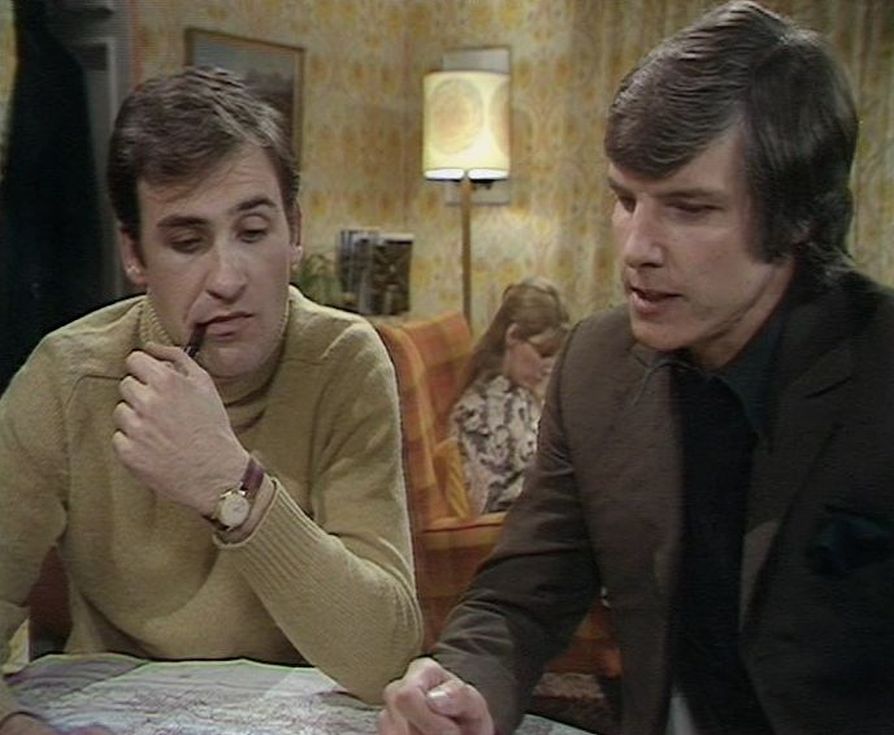
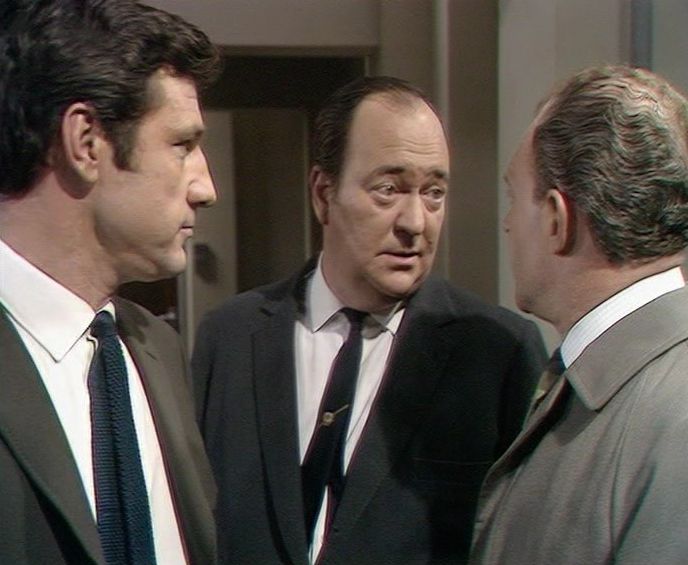
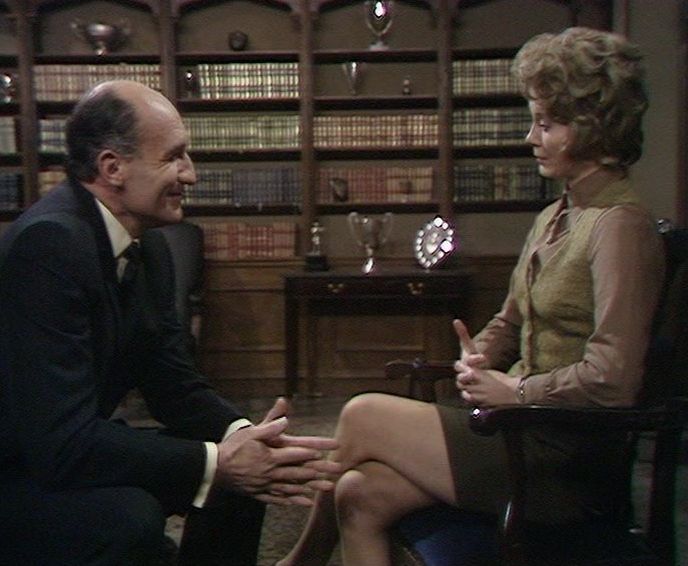
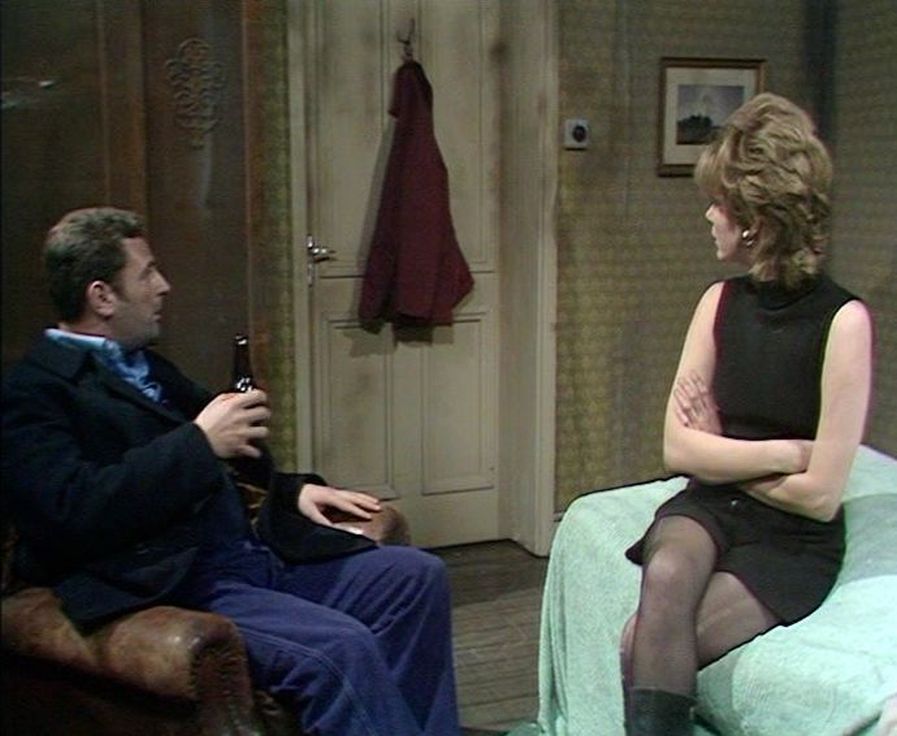
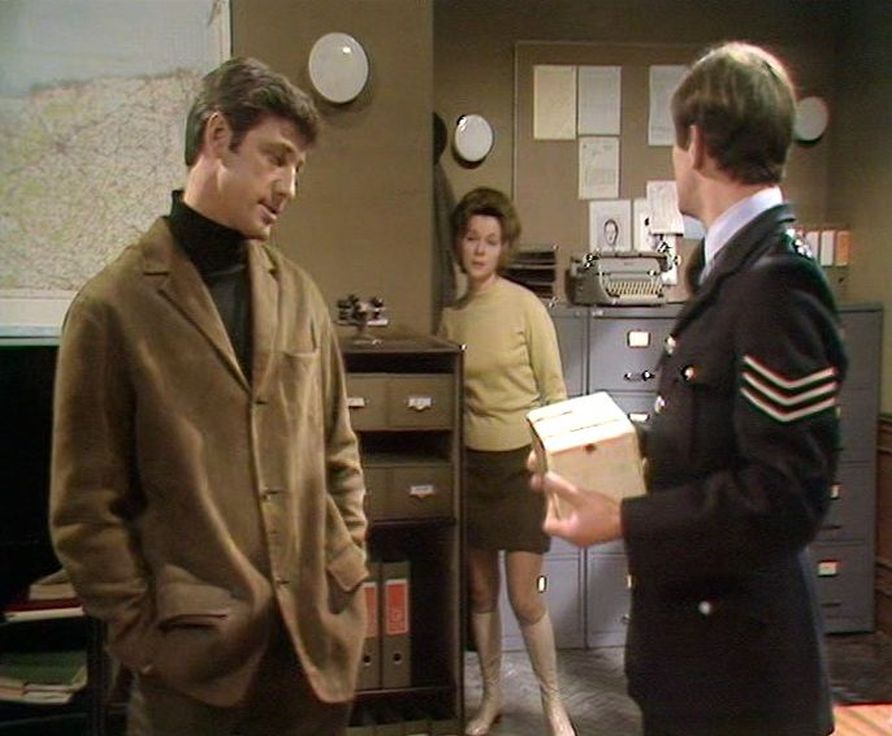
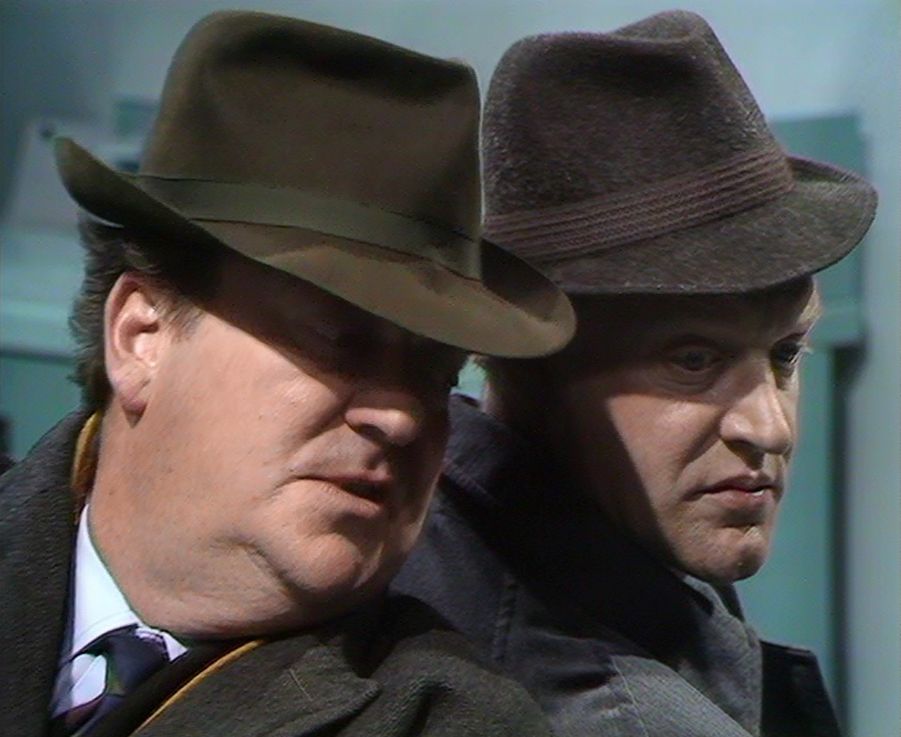
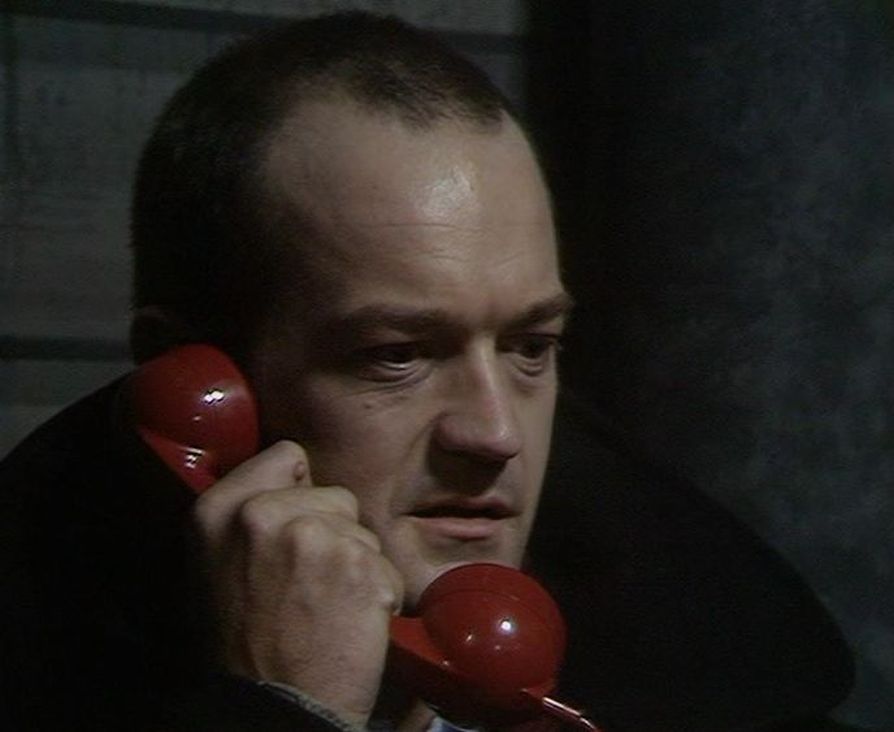
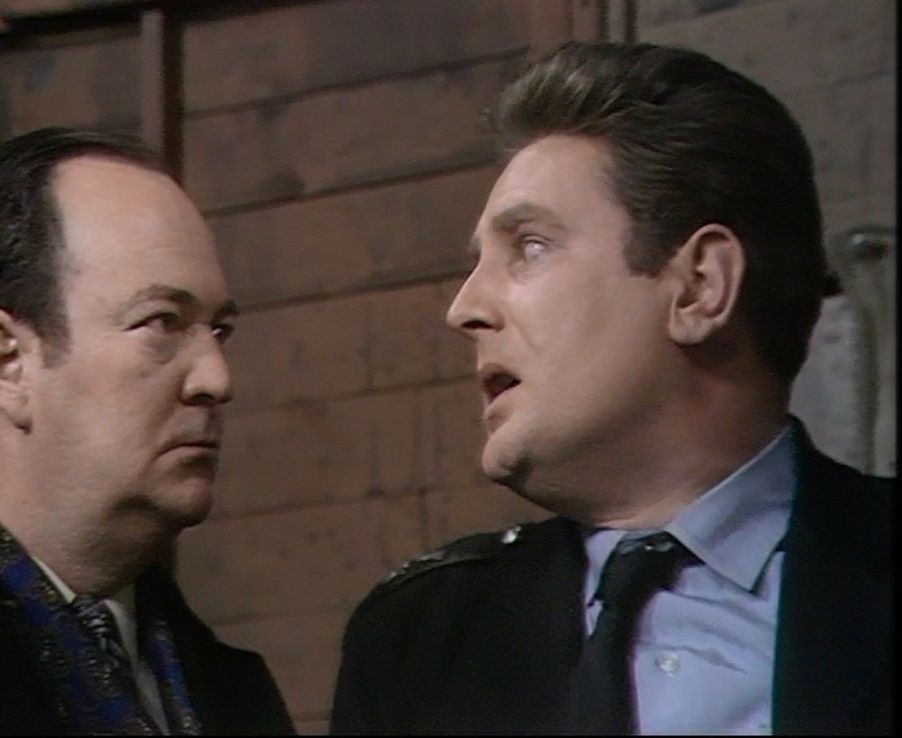
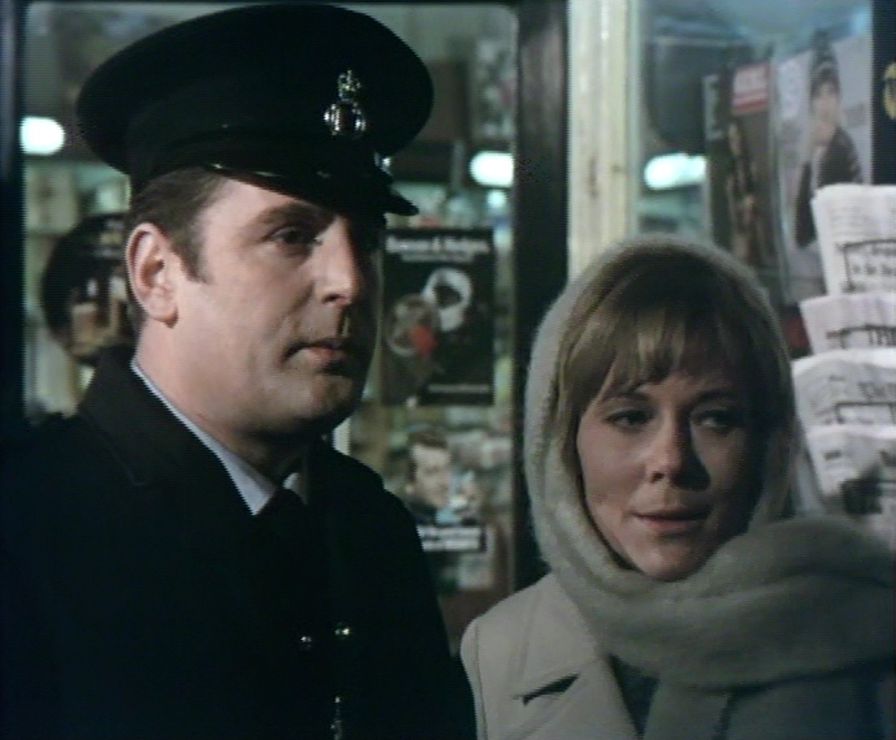
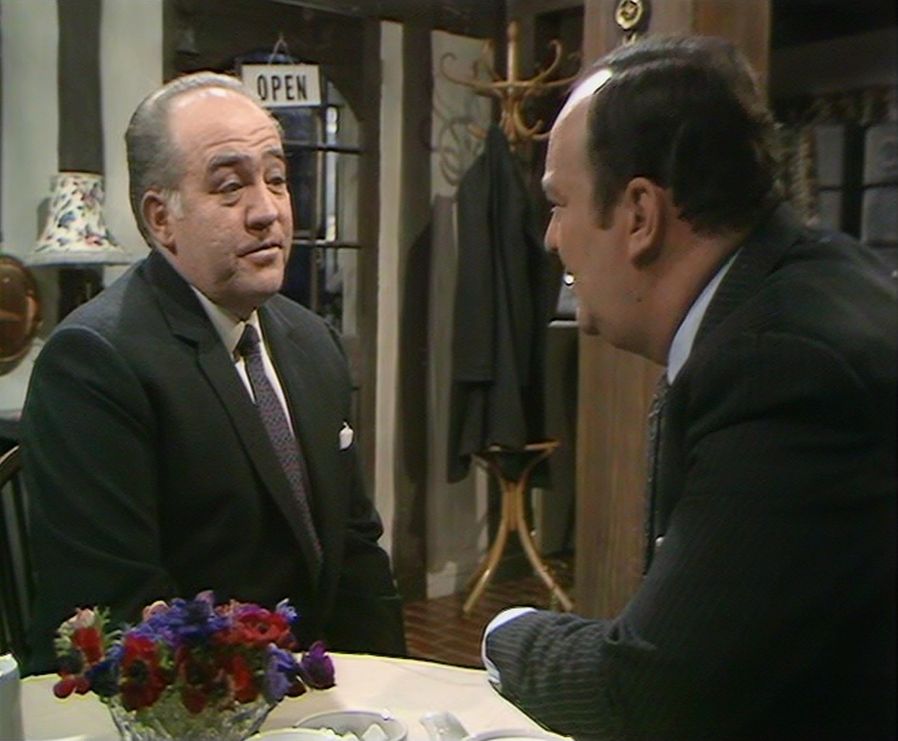
Softly Softly: Task Force – The Lie Direct

S02E16 (30th December 1970). Written by Elwyn Jones, directed by Roger Jenkins

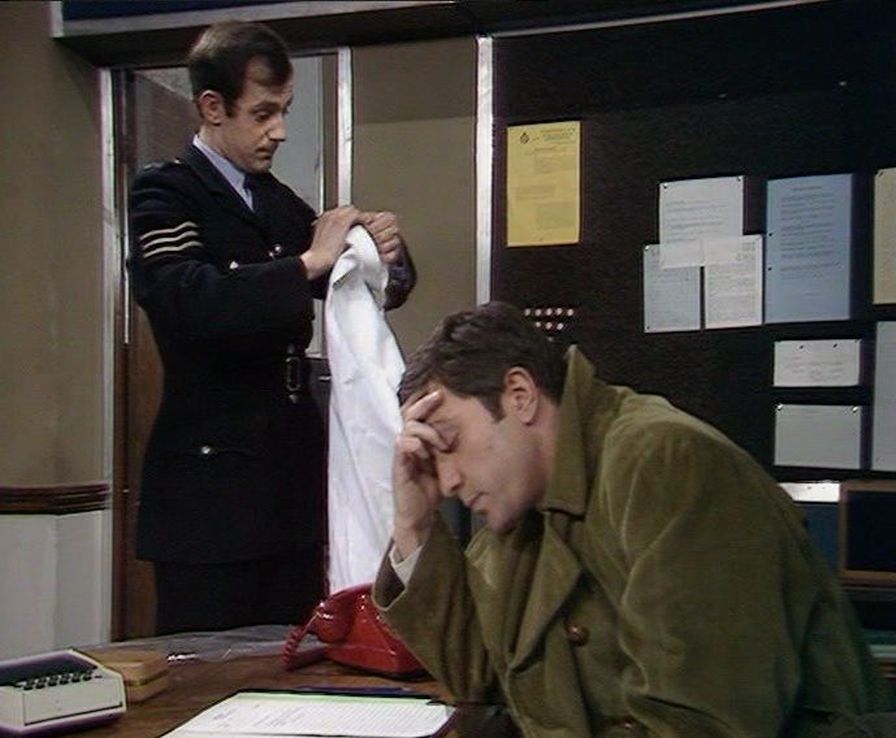
PC Snow and Radar discover the dead body of a woman, later identified as Alice Forrester, in a parked car.  Barlow decides that Watt should lead the investigation and it doesn’t take long before a prime suspect – Jim Colley (Tony Calvin) – is found.  He even confesses, but something nags at both Barlow and Watt.  Colley is revealed to be a born liar, so could his confession be false as well?

The Lie Direct opens with Snow and Radar on night duty.  A parked car in a lonely wood catches Snow’s attention and he decides to take a closer look.  It takes a few minutes before he makes his grisly discovery, but before that happens we cut to the bedroom of Watt and his wife (Jean, a doctor).  The camera lingers over their two bedside phones – one on either side – so it’s clear that one or more will be ringing soon.  There’s a similar shot of Barlow’s bedroom, which again informs us about what will shortly happen.

Jean is called out to pronounce that life is extinct, whilst her husband sleeps on.  Barlow is informed of the murder – as is routine – and we then have a good example of his devilish sense of humour.  He tells the duty office that he’d be happy to come down to the scene, but they might like to contact Mr Watt to see if he’d prefer to go instead.  As soon as he puts the phone down, there’s a wolfish grin on Barlow’s face as he gets up and starts to get dressed.  He’s interrupted Watt’s peaceful night, which no doubt is the reason for his jubilation!

From the moment we first meet Colley there’s something unsettling about him.  He tells Donald that he’s Mrs Forrester’s lodger (but that’s all, she’s far too old for him).  When he’s told of her death his reaction is remarkably casual, there’s not a trace of shock or surprise.  We later learn that Colley and Mrs Forrester were married a month ago and they had a row on the day she disappeared – over money – which gives him a powerful motive for murder.

He obligingly confesses, but since this doesn’t happen at the end of the story there’s a sense that we’re not seeing the full picture.  Tony Calvin is mesmerising as Colley.  Is Colley the coolest murderer ever, is he mad, or is he simply an innocent who’s unaware of the hole he’s digging himself into?  As the episode progresses, this is the question that all the officers have to ask themselves.

Donald is convinced of his guilt from the moment she first speaks to him, whilst Watt is much more cautious.  He makes his position clear – they have to examine all the possibilities, since approaching any potential suspect with a closed mind is dangerous.  Colley later tells them that Mrs Forrester had a boyfriend (albeit a rather old “boy” – he’s in his sixties) which is another avenue to be explored.

Allan Prior delivers another decent script that serves the selected regulars – Barlow, Watt, Hawkins, Donald, Snow – incredibly well.  After leaving the investigation in Watt’s capable hands, Barlow returns later to question Colley.  We might expect Barlow to be in full intimidating mode, but that’s not the case – unexpectedly he also demonstrates compassion.

When the case is over, he mulls events over with Jean.  Even after all he’s seen over the years he still manages a certain amount of disconnection, as he tells her it’s the court who will decide innocence or guilt, not him.  He just has to deliver them up.  Whether he’s being truthful here is debatable, as we’ve seen him get personally involved on many, many occasions ….

Watt is irritated throughout.  He’s irritated at being woken up and his irritation remains after Barlow leaves him in charge.  Watt succinctly sums his superior officer up (“bastard!”) but unsurprisingly does so when he’s not in earshot.  Hawkins is cheerful, positive and keen to tackle the enquiry without Barlow breathing down their necks.  Donald does a fair amount of questioning of suspects and witnesses (notably Colley and Mrs Forrester’s sister) and whilst Snow doesn’t say much, it’s always worth listening whenever he does speak.

Jean Watt is used well. Her spiky sense of humour and easy interaction with the likes of Barlow and Hawkins makes me sorry she wasn’t used more (Jean appears in nine more episodes, her last in 1974 during series six).

The Lie Direct is yet another SS:TF episode which features extensive night filming. In story terms there’s no real need for it (the car could easily have been discovered during the daytime) although it’s undeniable that this adds a little extra gloss to the episode (but had the budget been tighter it’s easy to imagine this could have been turned into an effective studio-bound story).

The night filming might explain why there’s only three speaking guest performers (Tony Calvin, Geoffrey Palmer and Maureen Norman) as well as a semi-regular (Gay Hamilton as Jean Watt). Palmer has a short scene as Professor Brett whilst Norman’s screentime (as Mrs Forrester’s sister) is also quite limited. Calvin (if you’re a Doctor Who fan, you’ll recognise him as Dexeter from Full Circle) is the one who gets the lion’s share of the action.

Thanks to Colley’s unusual behaviour – he never responds in the way you’d expect – this is another strong series two story.

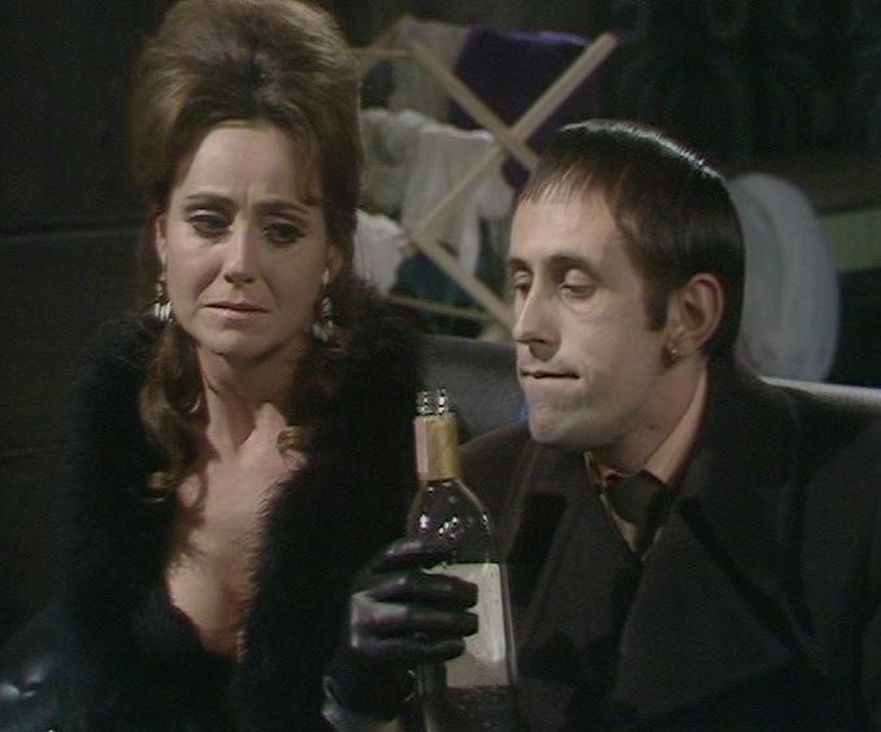
Softly Softly: Task Force – A World Full of Rooms

S02E15 (23rd December 1970). Written by Allan Prior, directed by Paul Ciappessoni

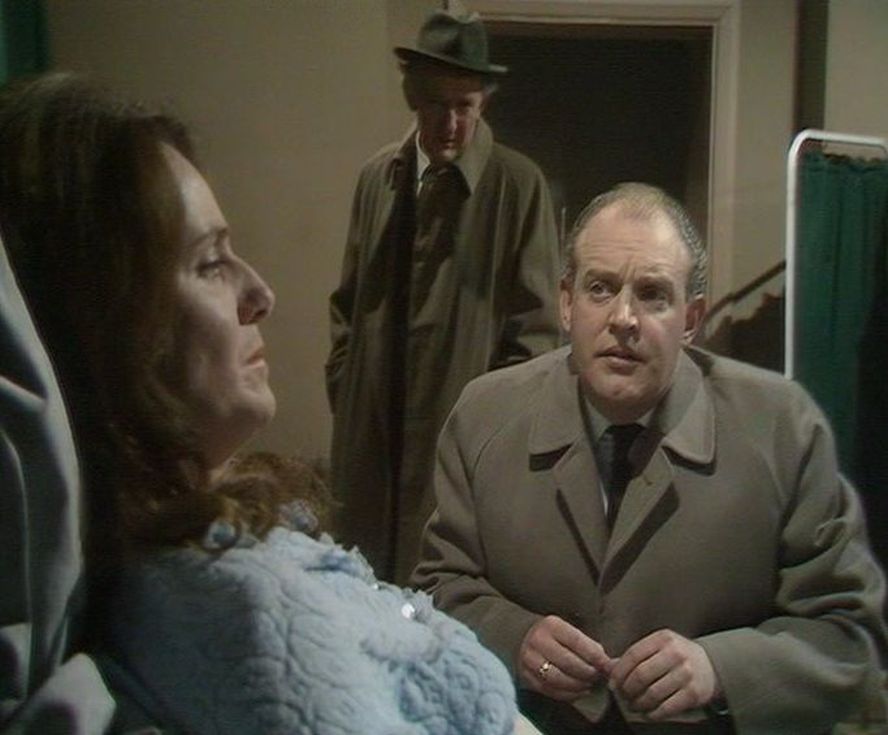
A prostitute called Sylvie Ashford (Jennifer Wilson) is knifed in her room.  Watt wants the culprit found and convicted, but he comes up against a wall of silence which is hard to break down ….

A World Full of Rooms opens with Sylvie entertaining what appears to be a client.  We later learn that Charley Smith (Milton Johns) is generally referred to as Mad Charley Smith, which given his actions and demeanour comes as no surprise.  Over the decades Johns has carved out a nice niche playing sadistic characters, of which Mad Charley is a prime example.

Sylvie’s slowing spiraling unease as she realises that the still, sinister man has an agenda of his own is nicely played by Wilson.  To emphasise the way she begins to feel trapped, the camera closes in on her face. An obvious move, but still effective.

Charley’s looking for Sylvie’s ponce, Tommy Bartrum, who’s disappeared.  Tommy works for Jackie Frankitt (Alex Scott) as does Charley.  Jackie’s currently inside, so his business interests (prostitution, naturally) are being looked after by his sister Mollie (Elizabeth Seal).  It appears that Tommy’s absconded with some of Jackie’s money, hence the interest.

The attack on Sylvie has disrupted the smooth running of the neighbourhood, which concerns Detective Sergeant Foster (Aubrey Richards).  Foster has been a vice detective for thirty years and it’s plain that he operates in a very hands-off way.  He regards the vice scene in the area as disorganised and low-key and sees no reason why everything should be stirred up by Watt’s aggressive questioning.  Rarely seen without a fag dangling from his mouth, Foster is the antithesis of a policeman like Watt.

When Foster and Watt first meet, Foster lights up a cigarette and, standing very close to Watt, begins to puff smoke into his face. That Watt doesn’t flinch or ask him to stop is slightly remarkable – clearly passive smoking wasn’t an issue back then …

As the Task Force’s token woman, it falls to Donald to go to the hospital to try and make Sylvie talk.  Considering that it wasn’t a life-threatening attack, it seems a little strange that Donald spends so much time with her.  It’s also slightly odd that Sylvie seems to have a private room complete with a television set.  Clearly prostitution pays ….

Sylvie tells Donald that “you’re a different animal to me. You live in the fresh air, see. I live in a room, with little rodents. Ever since I was 16, I’ve lived in rooms, whole world full of little rodents.”  Donald tries to get her to name her attacker, but Sylvie knows what her fate would be.  She’s offered protection, but Donald’s offer is an empty one (which presumably she realises – after all, how long could they really protect her?).

Jake Rollins (Keith Marsh) and John Johnson (John Bown) are also reluctant to talk to the police.  They live in the flat below Sylvie and Jake is able to identity Charley as Sylvie’s attacker.  But Jake also knows what would happen if he was to give evidence.  Jake and John are clearly a couple, although it’s not stated outright.  After Watt and Snow leave their room, Snow remarks that they were quite helpful, considering.  Watt looks at him but doesn’t say anything.  Later Watt uses the same remark to Snow in an ironic way, although Snow doesn’t respond either.  Snow’s prejudices are therefore made clear, but not in an overt way.

Watt is able to persuade both Jake and Sylvie to name Mad Charley.  His bullying of Sylvie is something of an eye-opener (the episode closes with a shot of Sylvie’s weary face lying in her hospital bed).  She might have agreed to give a statement, but at what cost to her?  And what cost to Jake and John?  Watt may have got the result he wanted – enough evidence to charge Charley – but there’s an uncomfortable sense that the witnesses may be looking over their shoulders for the rest of their lives.  Does Watt appreciate this, or is the “result” the only thing that matters?

Another taut script from Allan Prior, A World Full of Rooms is enlivened by several of the guest players, notably Milton Johns and Jennifer Wilson.  At the start of the story, Charley is totally in control, but when we see him again (towards the end) this control is starting to crack.  If Johns has always been good at playing sadists, then he’s even better at playing sadists who have some sort of character flaw, like Mad Charley.  The scenes between Wilson and Tebbs, as Sylvie recounts her life, don’t advance the plot a great deal, but they help to make her seem more like a real person, rather than the cliché figure of the middle-aged prostitute she otherwise could have been.

Softly Softly: Task Force – Bearings

S02E14 (16th December 1970). Written by James Doran, directed by Frank Cox

News of a collision between a goods train and a passenger train shatters the early morning Monday routine.  It’s a bad business – some six people are dead and numerous others are injured – but it turns out to be no accident (wheel bearings had been stripped from the goods train prior to it setting out).  These bearings have long been the target of thieves, who can make a tidy sum selling them to scrap metal merchants.  Barlow is incensed, he considers that the culprits are guilty of murder.  But Watt, whilst sympathetic, knows it’ll be almost impossible to prove …..

Bearings has a quiet opening.  Barlow pops into Watt’s office and they exchange notes about how their respective weekends went.  Watt’s was restful, a few jars and a doze in his armchair whilst Barlow still seems to be suffering from the efforts of a round of golf.  Barlow wonders if maybe he should take up drinking as a hobby, like Watt, to which Watt counters that since Barlow does so much drinking when he’s working he’d have no time to fit it in during his off duty time!

There’s also a chance to witness the workings of the operations room, as men and women quietly and efficiently deal with the public’s emergency calls.  The operations room is the location where it’s established exactly how serious the train incident is.  This isn’t surprising, as all the train shots we see are stock footage of real accidents.  Given SS:TF’s limited budget, mounting a crash was never going to happen, although it’s a pity that due to the inferior picture quality of the stock footage it’s rather a jarring moment.  But Evans’ radio report about what he can observe, together with the brief stock shots, help to create a reasonable impression.

Barlow might regard the theft of the wheel bearings as murder, but Watt isn’t so sure.  He believes the best they can hope for is to charge the culprits with dishonest handling, how can you prove that somebody actually removed the bearings, unless you have a witness?  Once it’s been established what caused the derailment, the officers click into action and proceed to question all the local scrap metal merchants

There’s a nice clash between Evans and Jackson.  They might both be Sergeants, but Evans has a certain amount of disdain for the desk-bound Jackson.  Although Jackson says that without paperwork and planning they’d never catch any criminals, Evans counters that it doesn’t catch thieves.  “You can’t plan that look in a man’s face that says all you’ve got to do is lean on him and you’ve got him”.  And Evans’ nose comes up trumps as he finds the bearings in the possession of Matthew Riley (Desmond Perry). So score one to Evans then.

Barlow conducts the interview with Riley, which means we’re guaranteed some fireworks.  It’s a memorable encounter – even after learning that the removal of the bearings has caused a substantial loss of life, Riley remains unmoved.  Barlow slightly loses his cool and afterwards concedes that he rather bodged the interview  “That’s the trouble with shock tactics, once you’ve used them you’ve got nothing left.”

The transport police believe that Wiley (Paul Thompson) and Dawes (Jack Carr) might have been responsible for stealing the bearings, but Watt doesn’t make any headway questioning them.  Evans (who seems to spend just as much time these days in plain clothes as he does in uniform) is tasked to keep them under observation.  This he does and he also runs down a couple more suspects who might provide them with the break they need to gain a conviction.

Bearings is another story which finds Stratford Johns on top form.  Barlow is at his intimidating best, but is still unable to make any of the suspects talk – even Johnstone (Adrian Shergold) the youngest and most inexperienced of them won’t admit anything.

The human tragedy of the crash is brought starkly into focus when a mother tearfully identities a shoe which belonged to her missing eleven-year old daughter.  Barlow brandishes the shoe to Johnstone, which is finally enough to make the younger man come clean.  Whether Barlow will be able to gain a conviction for murder or manslaughter is outside the parameters of the story, but he’s at least got somebody to admit what happened, which is a victory of sorts.

Bearings makes a virtue out of its lack of budget.  We don’t see the train crash or its aftermath, nor do we see the police traipse around all the local scrap metal merchants (we’re told there’s quite a few in the area).  Instead, the story focuses on the police’s efforts to gather evidence.  The breakthrough – a distressed mother and her child’s shoe – is a rather random event, but it doesn’t feel too contrived.

It was the first of three SS:TF scripts written by James Doran (he contributed one apiece during series two, three and four). Doran wrote for many popular series during this era (for example, Parkin’s Patch, Barlow at Large, Hunter’s Walk, Public Eye, 37 episodes of Z Cars, Enemy at the Door, The Gentle Touch, Juliet Bravo) and also co-wrote the screenplay for the 1965 film adaptation of The Ipcress File.

His experience on Z Cars (dating back to 1962) seems to have been put to good use here, as Bearings could have easily slotted into the early run of SS:TF’s parent series. A cut above the norm.

Softly Softly: Task Force – Sweet Are the Uses of Adversity

S02E13 (9th December 1970). Written by Elwyn Jones, directed by Ronald Wilson

A prostitute called Vera (Maggy Maxwell) is beaten up.  This irritates Hawkins, in charge of the Task Force during Watt’s absence, as Snow was keeping her under surveillance at the time ….

Sweet Are the Uses of Adversity is a story that allows Hawkins to demonstrate his skills as a leader.  He’s clearly somewhat hesitant about taking command which is demonstrated by his reluctance to use Watt’s office.  This was suggested by Sergeant Jackson, a man who’s plainly very ambitious (much more ambitious than the easy-going Hawkins that’s for sure).  An interesting character-beat is developed when Jackson admits that he’s always fancied being either a butler or a valet and we see him put those skills in operation later in the episode.

Hawkins, the worse for wear after a night’s surveillance, is greeted the next morning by a chirpy Jackson who presents him with a fresh shirt and a razor.  Hawkins is irritated.  “Look, valet, am I going on parade or something?”  But Jackson’s response that Cullen wants to see him in half an hour is more than enough to make him spring into action!

In previous episodes we’ve seen Watt and Barlow gently (and not so gently) restrain some of Jackson’s impulses.  He’s a man who wants to get on in the force and is happy to ally himself to anybody – such as Hawkins – who might smooth his passage.  But it’s undeniable that Jackson makes a good point with his suggestion that Hawkins uses Watt’s office.  Hawkins must be seen to be in charge if he’s to command the respect of those below him.   Which raises the concept that command is – in part – little more than an acting job (this is confirmed to Hawkins later by Cullen).

As the episode continues, Jackson operates as the power behind the throne by providing various avenues for Hawkins to investigate.  Whether Hawkins would have achieved so much without Jackson’s input is debatable – we’ve seen the Sergeant provide Watt with invaluable advice previously, but today he seems even more proactive.

Snow is mildly roasted by Hawkins after his early slip-up, but argues he was detailed to keep a watch on the house (and so wouldn’t have been able to observe what was happening inside).  Evans, who’d taken over from Snow on watch, is first on the scene following the arrival of the ambulance for Vera.  This is a much more harder-edged Evans, sharply removed from his more relaxed and jovial persona.

A woman’s touch is required, so Donald interviews Vera in the hospital.  She can’t tell the detective a great deal – names are not used in her business – but does reveal that the man was probably a geordie.  The sight of Vera, middle-aged and careworn even without the bruises, makes a change from the more usual depiction of prostitutes as young and attractive.  Jennifer (Irene Bradshaw), the other prostitute in the house, fits the more stereotypical profile of the young and glamorous working girl.

Geordie (credited as such on the end titles, since we never learn his name) seems to be responsible for a number of other break-ins and assaults in the area, although the speed at which the Task Force jump to this conclusion feels a little contrived.  At one house, Evans radios in to say that he’s found some fingerprints which look very similar to the ones they’d taken from other recent crime scenes.  That Evans could zero in to suspect fingerprints is impressive enough, but to be able to match them in the middle of the night with his naked eye to previously taken dabs has to be a step too far!

We then start to follow Geordie (Alan Tucker).  He’s very much a loner, and this lack of interaction with others allows Tucker the chance to show the character’s instability in a variety of non-verbal ways.  Using a knife to deface a table in one of the houses which he’s burgled is an obvious example.  Later he buys a bottle of milk from a milkman and then proceeds to smash it over the unfortunate milkman’s head.

This flash of violence – albeit mostly achieved offscreen – is unsettling.  Alan Tucker, as Geordie, doesn’t utter a word until very late on.  This lack of speech works very well as it maintains an aura of menace and unpredictability around the character. His motivations remain a mystery though. We discover he has a job, so he’s not stealing money for need – presumably he just enjoys robbery with violence.

Hawkins’ inexperience sees him make decisions which possibly aren’t the best.  He later rallies the troops with a pep talk, although it’s slightly frustrating that it happens off-screen (we only hear about it from Donald and Evans).  Evans is impressed, calling it a beautiful speech.  Donald is slightly more cautious, for her it was a shrewd but cagey talk.

Today’s episode is another of those to have a major night shoot – which wouldn’t have come cheap (so whenever you see another story that’s entirely studio bound you can assume a spot of book balancing has gone on). As has happened before, some scenes switch from film, to tape and then back to film (most notably when Geordie is finally appended – it’s mostly a film scene, but a few lines are clearly recorded on videotape). It’s hard to imagine this would have been a production choice, so presumably they ran out of time on location and had to pick up some fluffed lines later on in the studio.

Sweet Are the Uses of Adversity is an archetypical slice of SS:TF, with Elwyn Jones’ script concentrating on the character interactions of the regulars.  Norman Bowler and David Allister, as Hawkins and Jackson, get the lion’s share of the action, but Snow, Evans, Donald and Cullen all have a chance to shine as well. It’s notable for being the first SS:TF to feature neither Barlow or Watt – with Harry Hawkins taking his first stumbling steps as a temporary Task Force chief.

Softly Softly: Task Force – Do Me a Favour

S02E12 (2nd December 1970). Written by Robert Barr, directed by Brian Parker

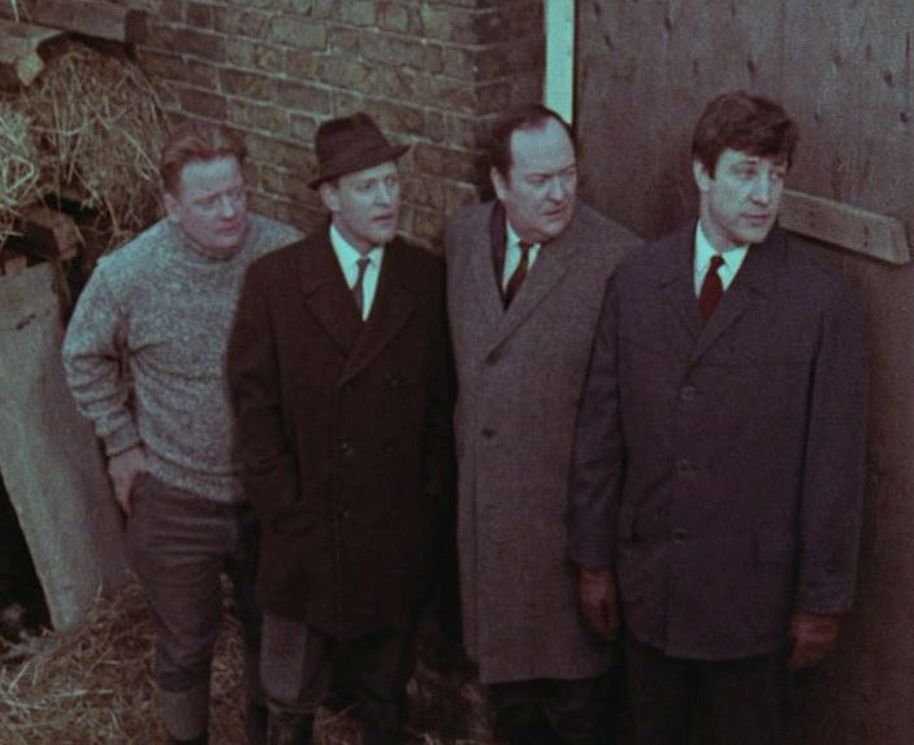
The Task Force officers are investigating a spate of lorry thefts.  This leads them to a farm owned by a Mr and Mrs Kerr (Jon Rollason and Chloe Ashcroft).  The Kerrs have recently made the acquaintance of a man called Mott (Victor Maddern) who tells them he works at the local market and is looking for somewhere to store his stock.  It turns out that Mott is planning to stash the stolen gear at the farm, which means that a stake out is set up ….

Those hardy souls who have been reading all these reviews will know that I haven’t been terribly impressed with Robert Barr’s scripts so far, and this one – his third for the second series – is sadly on pretty much the same level as his others.  If one were being generous then you could say that the opening (focusing on Snow and Evans tailing a lorry that may or may not be hijacked any minute) is an accurate reflection of the routine and humdrum nature of the majority of police work (nothing happens).  But it doesn’t make for very entertaining viewing of course.

There are consolations to be found with the guest cast however.  Victor Maddern had a wonderfully long career playing twitchy underachievers and is perfect casting as Mott.  Mott is the acceptable face of the gang (which makes sense, since he has to be the one to sweetalk the Kerrs into letting him use their shed).  Whenever I see Victor Maddern I find it impossible not to think of this Dixon of Dock Green outtake.  I’m probably not alone in this.

Jon Rollason (who was one of The Avengers for a very short time – about three episodes in fact) and Chloe Ashcroft (forever remembered for Play School) are both rather good.  Mr Kerr is keen to assist the police and possibly grab a substantial reward whilst Mrs Kerr is much more concerned for their personal safety.  Ashcroft is slightly off-key throughout, although this may have been a performance choice rather than a case of bad acting.  Ken Hutchison, another familiar television face, can be spotted amongst the heavies in the gang.

Do Me A Favour was the second of the all-film episodes and, like the first, it does rather look as if it’s been dragged through several hedges backwards.  But once you get over the shock of the faded film quality, it’s interesting to compare the story with the more typical SS:TF fare.  It’s obviously more “filmic” and less reliant on dialogue and character-byplay, which for me is quite detrimental (there’s little of the usual interaction between the regulars for example).  Although whether this is because of the nature of film compared to videotape or just because Barr’s script didn’t concentrate on this aspect of the series is a moot point.

So overall this is passable but a little uninvolving.

Softly Softly: Task Force – Collation

S02E11 (25 November 1970). Written by Elwyn Jones, directed by David Sullivan Proudfoot

Sergeant Jackson has been studying a number of recent high-profile burglaries and has found a curious pattern.  Every night that a major break-in occurred, in roughly the same area there were several smaller ones.  These were trivial affairs though – a bottle of wine in one house, a lighter taken from a corner shop, etc.  It’s a curious state of affairs – why go to all that bother just to steal trinkets?  But John Watt doesn’t have a great deal of time to ponder, as his wife Jean (Gay Hamilton) is unable to find her watch and then discovers that their home-made pâté has vanished from the fridge.  The evidence is unmistakable, Watt is the latest victim ….

At the start of the story, Evans (after hearing about the lighter stolen from the corner shop) tells the proprietor that whilst it appears to be a trivial matter, it’ll be stored away and collated for future reference.  And it doesn’t take long before we see his words come true – on its own the theft of a lighter is meaningless, but when it’s plotted with the other robberies it becomes of great significance.

The burglary at Watt’s house is an interesting development.  Because this is a story centred around the police investigation (we don’t see the criminals until we’re well into the episode) it poses several questions.  Is it simply a coincidence that Watt was targeted or does our burglar have a sense of humour?  The drip, drip of information continues when it’s revealed that several witnesses reported seeing a police officer outside various properties, including Watt’s house, in the early hours of the morning.  Barlow reacts with a spasm of anger at the thought that one of their own might be responsible.

He’s also angry – although it’s done slightly tongue in cheek – when he learns that the Watt’s pâté has been stolen.  They had been planning to dish it up for Barlow that evening!  Their dinner party goes ahead, although Watt grumbles that the shop-bought pâté just isn’t the same.  The sight of Jean Watt, as well as their slightly awkward dinner party, gives us a few nice off-duty moments of colour.  All of the Task Force officers, but especially Barlow and Watt, are so focused and driven that it’s often hard to imagine they have any home life at all.

One of the witnesses who saw what appeared to be a police officer acting suspiciously is young Timothy (David Arnold).  Arnold gives an extraordinary performance.  Timothy (he doesn’t like being called Tim and tells Evans and Barlow so on different occasions) might be the son of a greengrocer, but he’s remarkably well-spoken, polite and logical.  It’s hard to imagine children like him ever existed and it’s a little curious why a more naturalistic performance wasn’t sought, but the dialogue suggests Arnold was playing the role the way it was written.

His interview with Evans is a bit of a treat and Evans also has a memorable encounter with one of Watt’s neighbours.  She was burgled six months ago and cynically tells him that she never had all this fuss made (but since John Watt is a policeman he has the red-carpet treatment).  Evans protests that that’s not the case, but she’s not in a listening mood.  She proves to be of value though, as she’s the first to link a policeman to the crimes.  When Evans presses her to describe the man, she tactlessly states that the man wasn’t as stout as Evans!  Timothy’s evidence also comes up trumps when he begins to have second thoughts about whether it was a policeman he saw after all.

The Task Force manage to track down a suspect suspiciously easy, which begs a rather obvious question – why haven’t they done so before?  It surely can’t be just because John Watt has now become a victim?  And the reveal that the villains were only pretending to be police officers is maybe not too great a shock – bent coppers existed at the time, but they didn’t turn up very often in SS:TF.

One story weakness is that it’s never explained why they carried out the small burglaries which netted nothing of value.  It seems an unnecessary risk for no gain, unless they were simply doing it for kicks.  But they were hardly kids, so that suggestion is slightly difficult to swallow.

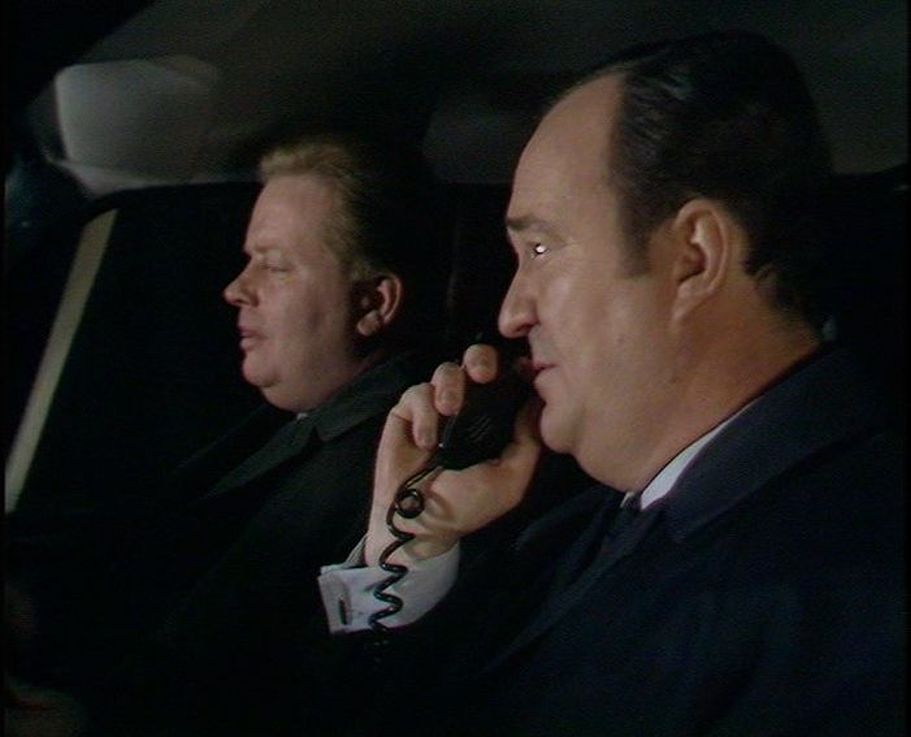
Collation is decent rather than outstanding, but there are several areas of interest, not least John Watt’s undercover work (complete with a rather clumsy looking instamatic camera).  David Lloyd Meredith is on good form throughout – whether it’s tangling with young Timothy or sharing an observation car with Barlow.  For example, Evans can’t resist a chuckle when he learns that the codeword for the operation is pâté!  And when Timothy’s attacked by the fake copper, watch the way that Barlow deals with him.  It’s certainly not gentle ….

Softly Softly: Task Force – Who Wants Pride …?

S02E10 (18th November 1970). Written by Robert Barr, directed by Roger Jenkins

An empty security van – with a very neat hole in its side – is discovered in a secluded wood.  Three men (one of them with a military bearing) were seen running away from it after a loud explosion.  All the evidence suggests it was a test for the military man to demonstrate his skills with explosives.  So will they try again, but next time with a loaded van?

It’s a little while into the story, about ten minutes or so, before we meet the criminals.  This means that the police, especially Barlow, have time to consider who they might be.  The man with a military bearing is of particular interest – is he army, or ex-army?   It concerns Barlow that he might be an soldier, as they – like the police – should have a strong devotion to duty.  Barlow then muses to Watt that this man will have pride in his service, like themselves, which wouldn’t be easy to break.  The cynical Watt counters that for “the money they can take knocking off security vans, who wants pride?”

Shortly after we discover that the soldier is called Jim O’Donnell (Ray Lonnen).  He’s an army regular who wants a little extra money so that he and his girlfriend, Betty Patterson (Jeannette Wild), can buy a flat and settle down.  Betty’s brother Tom (Bill Wilde) and David Marks (Jess Conrad) are the villains keen to use Jim’s expertise.  Jim agrees – but only one job.

Ray Lonnen would later become identified with military/espionage roles (The Sandbaggers and Harry’s Game, for example) which makes this neat casting in retrospect, although at the time he was probably best known for the fruit and veg soap opera Market in Honey Lane.  He’s always an actor that I enjoyed watching, even if his Irish accent does take a little bit of getting used to.

The first meeting we see between Jim, Tom and David is a bit of a nightmare for the cameraman.  There clearly wasn’t a great deal of manoeuvrability around Betty’s flat, as twice there’s very pronounced camera wobbles after it collides with the furniture.

A successful robbery is carried out, although Jim is disappointed that he didn’t get as much money as he’d hoped, so he decides to do one more.  Watt is distressed at the fate of the guards inside the van – dazed and deafened by the blast.  “Beat them stupid with pick handles, throw ammonia at them and now this.”

Presumably Jim would have known this would happen, although earlier he airily states that they’ll hardly be scratched.  Is this a case of self delusion or is he not quite the expert he appears to be?  Things start to unravel for him after the Special Investigation Branch (SIB) starts to poke around his camp.  Knowing that he’s sure to be found out, he decides to go over the wall – taking more explosives as well as a machine gun.  Jim’s character – a man who lives for danger – is now brought sharply into focus.  His plan is to return to Ireland, along with Betty, where he’s convinced he’ll be safe.

Who Wants Pride …? is a better story than Robert Barr’s previous series two script, Time Expired, but it’s still a little sub-par.  Ray Lonnen’s always worth watching, but the focus on Jim means there’s not a great deal of time to concentrate on the regulars.

But even though Jim gets a decent amount of screentime, he remains a rather nebulous character. The main problem is that it’s hard to understand why he would jeopardise his army career in this way. That he’s possibly more than a little unstable is suggested on several occasions, most notably when he tells the others that he’s taken the gun in order to ensure he’ll be able to return to Ireland safely. It’s also inferred that once he’s back home he’ll be fighting again, although it’s not clear whether it’ll be on the side of the Catholics or the Protestants. There’s plenty of dramatic potential in the concept of an Irishman fighting in the English army (divided loyalties) but it’s not something that’s developed.

It’s also an issue that Jim, Tom and David are placed under very close surveillance towards the end of the story – ensuring that the tension is sapped a little.  They may be planning another job, but since they’re being shadowed every step of the way the story ends with a whimper rather than a bang.

Softly Softly: Task Force – Its Ugly Head

S02E09 (11th November 1970). Written by Elwyn Jones, directed by Leonard Lewis

A student called Bernard Pinks (Ian Sharp) is arrested during a demonstration after throwing pepper at Snow’s dog, Radar.  His solicitor, Grenville (Michael Goodliffe), later alleges that Pinks, whilst he was in custody, was subjected to a homosexual assault by Harry Hawkins ….

Its Ugly Head opens with Barlow and Watt hauled over the coals by Cullen.  They both look rather like naughty schoolchildren summoned to the Headmaster’s office for a dressing down.  The reason for Cullen’s displeasure isn’t particularly important in plot terms, but it helps to reinforce the notion that he’s an implacable individual, well versed in getting his own way.

He also has a chat to Donald about the conduct of Inspector Reynolds.  During the course of the conversation it becomes clear that Inspector Reynolds made advances to Donald when she was a uniformed officer (which was one of the reasons why Donald was glad to move to plain-clothes).  That the unseen Reynolds is later revealed to be a woman is an unexpected development.  It seems that rumours of her conduct have been fairly widespread (although Cullen knew nothing about it until recently).  Now that he does, he wants action – but what can be done?

It can hardly be a coincidence that the main plot thread is also concerned with an allegation of same-sex misconduct.  Cullen and Barlow are visited by the smooth-talking Grenville, who tells Barlow that his client, Pinks, might make a counter-claim of assault against Hawkins when he appears in court the following day.  Nothing’s put down officially on paper though and it becomes obvious that this is a fishing exercise – if the police drop their charges then Pink will drop his.  It’s blackmail, pure and simple, and neither Barlow or Cullen can possibly agree to Grenville’s veiled offer, but Hawkins still has to be questioned.

A completely studio-bound episode (we hear about the demonstration, but never see it) Its Ugly Head works best as an exercise in seeing how the various member of the Task Force operate under stress.  Barlow is quick to rise to anger when Grenville makes his allegations, whilst Watt is irritated to find he’s been kept out of the loop.  Frank Windsor’s very good in this one, a particular highlight being Watt’s rather awkward chat with Donald, after he stumbles across her problem with Inspector Reynolds.

Evans is initially sanguine about being called back to the station (it puts off a wall-papering job) but his anger slowly rises when he understands where Barlow’s questioning is leading.  Evans’ self-declared awe at Barlow (he feels more comfortable standing up when being questioned by him, rather than sitting down) slowly dissipates as incredulity takes hold.  Norman Bowler, as the unfortunate Hawkins, also has his moment to shine, although it’s relatively brief – he might be the man in the spotlight, but the likes of Cullen and Donald have more screentime.

The way Donald’s colleagues feel about her, also a feature previous episodes, is touched upon again.  Some, like Snow, are almost paternalistic – he feels she’s too nice a girl to be in a job like this.  Others, such as Watt, can’t help but make mildly sexist remarks, although he’s later given a chance to make his position clearer.

Donald – the object of unwanted attention from both males and females –  clearly has a lot to put up with. That she struggles to be treated as an equal with her male colleagues can be seen during her interview with Cullen. He speaks to her in an avuncular way that just wouldn’t have happened if she hadn’t been a women (imagining a similarly cosy chat with the likes of Snow or Evans makes the mind boggle!) Is this another example of the sexist nature of the series or was it simply reflecting the way the police force was at the time? Or maybe a little of both?

Michael Goodliffe was an impeccable actor with a long and impressive list of credits.  As Grenville, he’s controlled and calm until the closing minutes, when it becomes clear that the police hold the upper hand, meaning that his composure ever so slightly wavers.  Ian Sharp, the other guest artist, has less to work with, but is able to capture well the contradictions in Pinks’ character.  He might be scruffy and dirty, but he’s not ill-educated – so it’s possible to believe that he comes from an affluent background and is simply playing at being a revolutionary.

It goes without saying that this is a story very much of its time – Donald confesses to feelings of revulsion after the never-seen Inspector Reynolds made advances towards her whilst Hawkins reacts with apoplectic fury at the allegation he sexually assaulted Pinks (had it just been a regular assault claim, then I doubt he would have gotten so angry).

As ever, Elwyn Jones delivers a sharply-written script, full of decent character conflict.

Softly Softly: Task Force – Never Hit a Lady

S02E08 (4th November 1970). Written by Allan Prior, directed by Simon Langton

PC Snow and WDC Donald go undercover.  For Donald, posing as a prostitute, it means putting herself at considerable personal risk ….

Never Hit A Lady has an effective cold opening – the setting is a greasy spoon transport café.  Our initial sight of Donald – plastered in makeup – makes it obvious that she’s working undercover.  When Mick Harrigan (Neil McCallum) enters, we see her keen to strike up a conversation.

Harrigan drives lorries full of whisky from Scotland to London.  He’s been robbed in the past and there’s a suspicion it might happen again soon.  But is Harrigan a victim or part of a criminal conspiracy?  If Donald can persuade him to take her to London, there’s a chance she’ll be able to find out.  But Harrigan refuses – he doesn’t travel with anybody that he doesn’t know.

Donald makes a friend – Peg (Margaret Brady).  Peg has plied her trade up and down the lorry routes for a while and now cuts a somewhat tragic figure.  But there’s still a spark of defiance and bite there (which she obviously needs, otherwise the life she leads would have worn her down a long time ago).  Peg is the sort of person that Donald, if she really was a prostitute, might eventually become – Peg knows that she’s doomed, but can’t see any way out.

Brady essays a confident performance. She didn’t have that many credits and interestingly her last one (an episode of Jack the Ripper in 1973, playing Elizabeth Prater) would have a SS:TF link as Barlow and Watt were the ones investigating that coldest of cold cases.

Barlow, Hawkins and especially Snow (who’s been detailed to watch her every step of the way) are concerned about Donald.  At this point there’s no evidence that Harrigan is particularly violent, so it’s possible to interpret their concern in a sexist light.  The unspoken inference is that Donald, since she’s a woman, will be unable to cope if things turn ugly.

But then it turns out that Harrigan might be dangerous after all – as it seems he brutally beat up Peg after giving her a lift.  After hearing the news, Donald rushes to the hospital to speak to her (which is a little bit of a story loophole – just how did the Task Force learn so quickly that Peg had been hospitalised?)  Still posing as a fellow down and out, Donald gives her some money to tide her over – a gift which Peg gratefully (and somewhat pathetically) accepts.

It’s third time lucky, as Harrigan finally agrees to give Donald a lift to London and also suggests they might have a meal later on.  He’s something of an old smoothie, telling her that – unlike most of the girls who work this route – she doesn’t smell.  I have to confess that it’s slightly hard to see what Donald’s undercover operation is now supposed to achieve.  A confession from Harrigan that he hit Peg?  Even if he did so, it wouldn’t be admissible as evidence.

It’s a pity there wasn’t a closer guard on his parked lorry, as while Snow and Hawkins were tailing Donald and Harrigan, a group of armed men drove it away from the lorry park.  Since the whisky thefts were supposed to be the object of the exercise, why didn’t the Task Force have somebody on a constant watch?

Now that Donald’s gone back to Harrigan’s room it’s painfully obvious what he expects to happen next, and he’s not going to take no for an answer.  Given there’s a suspicion he could be violent, Donald seems to have been placed in danger for no good reason.  He does attack her, but she’s able to signal to Snow and Hawkins (waiting anxiously outside).

The sight of an unconscious Donald – blood on her face – incenses Snow.  He proceeds to choke the life out of Harrigan before Hawkins pulls him off.  Terence Rigby was good at playing affable, but – as here – could do implacable just as well.  Feelings are running high as Barlow (after Harrigan dismisses Donald as “a bloody teaser”) also looks as if he’d like to choke Harrigan.  But luckily Hawkins is there once again to keep the peace.

The moment when an incensed Barlow – goaded once too often by Harrigan – overturns the table and approaches him menacingly is a memorable one. Possibly it’s a little over-cooked, but I daresay studio time by this point in the recording session might have been pretty tight, so a retake wouldn’t have been possible.

Never Hit A Lady is a cracking showcase for Susan Tebbs.  What’s especially interesting about Allan Prior’s script is how it doesn’t shy away from showing just how inept and flawed the operation was right from the start.  There’s not a great deal of Stratford Johns, but the final five minutes or so, centered around Barlow’s questioning of Harrigan, is electrifying.

Softly Softly: Task Force – Without Favour

S02E07 (28th October 1970). Written by Alan Plater, directed by Frank Cox

Sgt. Evans pays Mrs Marlowe (Colette O’Neil) a visit.  He’s looking for her husband Jack, but is told that he’s working up north (“building a motorway so that the crime cars can get around a bit faster”).  This comes as something of a relief to Evans – there’s been a spate of robberies in the area and Jack (as an ex-convict) is an obvious suspect.

Jack’s been going straight for two years but will still be of interest to the police after any suspicious activity in the area.  Evans blames the system for this, but it’s a moment that provides a sharp insight into policing methods – when you have no evidence, give some likely suspects a tug.  There’s no vindictiveness on Evans’ part though.  He claims part of the credit for helping Jack to go straight and therefore has a vested interest in seeing him keep out of trouble.

If crime doesn’t pay, then it appears going straight doesn’t either.  The Marlowes live in a grimy room in a grimy part of town.  With a background of barking dogs and screaming children, it’s a desperate sort of place.  On entering their room, Evans lights up a cigarette and offers Mrs Marlowe one.  After a brief pause – presumably because nobody ever offers her anything for free – she accepts.  It’s odd to see an officer smoking on duty, but we can interpret it as Evans’ attempt to put her at her ease.

An off-hand remark about her poor accommodation catches Evans’ interest.  She tells him that there’s no point in complaining to her landlord, Spence (Donal McCann), as he’d only send some of his boys round to “persuade” her to keep quiet.  Evans files this away for later.

We then switch to the Chief Constable’s office, where he’s delighted to let John Watt know he’s delegated him a very important job – speaking to the Kingley Rotary Club on the subject of crime prevention.  The juxtaposition between two very different sections of society was no doubt intentional on Alan Plater’s part and we return to this theme at the episode’s close.

Watt’s far from delighted with this important mission but begins to plan his speech anyway.  A few jokes will be essential to ensuring that everything goes off smoothly, and he’s informed that PC Snow is the man to see.  “Probably tries them on his dog” mutters Watt.  This is a lovely moment, but there’s even better to come after Snow tells him one of his best jokes.  Watt’s unimpressed expression is a joy to behold!

Evans decides to pay Spence a visit.  He’s also the boss of a local amusement arcade, which provides us with a brief nostalgic glimpse of a number of old-fashioned one-armed bandits and the like.  Spence isn’t impressed with Evans’ comment that the properties he owns are dirty and rundown.  “Dirt’s the responsibility for the people who make the dirt. Well, look at me. Look at this office. Am I dirty?”  He denies sending heavies to harass his tenants and since Evans can’t prove that he does, there’s something of a stalemate.

Since there’s no evidence of wrongdoing, it’s easy to see how Spence can later complain to Watt about Evans’ visit.  When he claims that Evans’ actions are motivated by personal enmity, it’s not an outrageous statement.  Evans clearly dislikes Spence – a slum landlord who also runs an arcade that takes money off the poor and vulnerable – but Spence counters that he’s simply offering people a service.  In many ways, this smoothly-dressed, fast-talking man looks ahead to the Thatcherite 1980’s.

The two-handed scene with Lloyd Meredith and McCann is the heart of the story.  Evans is convinced that Spence is a villain, it’s simply that the police haven’t found any evidence yet that’ll stand up in court.  In Evans’ view (and it’s no doubt one shared by many of his colleagues) Spence is a lower form of criminal life because he doesn’t accept that he’s a villain.  Career-criminals – those who come quietly after being caught – garner a certain amount of respect from the police.  But Spence seems to be different, as Evans tells him. “You steal off other people just as much as a bank robber. You steal off their weakness. And all the time you try to justify it by garbage about providing a public service.”

This scene runs just over eleven minutes. Long it may be, but padded it is not.  Possibly in other hands it might not have worked so well, but Plater’s dialogue is sharp throughout.

Evans is later hauled over the coals by Cullen and Watt.  He admits that he wouldn’t have spoken to Spence in the way he did in a formal interview or if there had been anybody else present.  It was simply a speculative interview that was intended to rattle Spence’s cage.  Cullen concedes that Evans hasn’t broken any rules and so there’s no question of a disciplinary charge but Watt has a few comments to make.

Watt starts by admitting that they all bend the law from time to time(!) but goes on to label Evans a “bloody bad policeman” and spells out the reason why.  Evans loathes Spence, which is wrong.  “Feelings get in the way of judgement. Feelings make coppers start thumping when they should be talking, asking questions, getting information. Forget about feelings, you can’t afford them.”  All Evans has done is to warn Spence to be on his guard.  But Watt agrees with Evans that he’s probably a crook and will keep an eye on him.

The story closes with the juxtaposition of Watt’s speech to the Rotary Club and Evans’ return to speak to Mrs Marlowe.  Watt’s speech is a plea for public co-operation, mirrored by Evans’ attempt to persuade Mrs Marlowe to provide evidence against Spence.

The contrast between the well-heeled Rotarians and the shabby environment inhabited by Mrs Marlowe is striking.  Mrs Marlowe is non-committal when Evans asks for her help, although she doesn’t dismiss it out of hand.  If she does co-operate, it may be because Evans has treated her and her husband with respect in the past – which can be seen as a victory for a non-confrontational type of policing.  Whilst Watt appeals to the Rotarians sense of public duty, Evans admits to Mrs Marlowe that he dislikes Spence and wants to put him behind bars.  It’s plain that Evans has pitched his appeal at her level – if he, like Watt, had played the public duty card he probably wouldn’t have got very far at all.

Remarkably, although there’s no actual crime in Without Favour, it’s still an absorbing fifty minutes.  Both the unseen Jack Marlowe and the very visible Spence may feel aggrieved at being questioned by the police when there’s no evidence connecting them to crimes, but if you’re an ex-criminal (like Jack) or someone operating on the fringes (like Spence) then it appears that’s just a price you have to pay.  Alan Plater is skillful enough to keep his voice neutral throughout, so it’s left to the viewers to decide whether he condemns or condones this practice.

Softly Softly: Task Force – Lessons

S02E06 (21st October 1970). Written by Arnold Yarrow, directed by Leonard Lewis

Lessons opens with Barlow teaching a group of cadets how to work a murder scene.  The training officer, Chief Inspector Fox (John Ringham), expresses his surprise to Watt that Barlow agreed so readily to play teacher, but Watt knows that Barlow is never more in his element than when he has an attentive audience.  He covers all the essentials – don’t contaminate the crime scene, ensure that life really is extinct, etc – and thanks to his convivial, easy-going nature he seems to have got all his messages across.

In story terms, it’s no surprise that a real-life murder is reported shortly afterwards – now we’ll have the chance to see how well Barlow’s theories work in practice.  The presence of Fox is also interesting.  He’s been seconded to training for the last two years, but has just returned to active service.  Fox has long desired to be back at the sharp end and now has his wish – but how will he shape up after such a long spell in the classroom?

The discovery of the body – a girl on the beach – is tightly filmed.  We observe events from the viewpoint of the man who finds her.  He spies a trail of clothes, leading to a fence partitioning two sides of the beach.  After seeing an arm lolling out, he rushes over (at this point we don’t see the rest of the body) and by his expression it’s evident that something bad has happened.  He rushes off for help, but the seafront is eerily deserted, so he hurries over to the nearest phone box.

The picture then cuts to a quick reveal of the dead girl, before showing a grim-faced Barlow approaching the scene.  This rapid cutting is an interesting choice – it’s a little jarring to jump ahead quite so quickly, but it helps to keep the story moving along.

The girl is soon identified – Myra Vernon, aged fourteen.  “A dangerous age” mutters Barlow.  Her father (played by Glynn Edwards) looks very distraught after identifying the body, leading Barlow to offer him a drop of something.  A lack of incidental music (the series never featured any) and the stark, sea-front setting makes the moment seem quite brutal.

There’s some good character work in this story.  Early on, Jackson and Evans are discussing the first murder case Barlow investigated in the area.  Evans still feels sorrow for the murderer, considering him to be as much of a victim as the murdered child, something which Jackson doesn’t understand.  And later at the murder scene there’s a brief scene between Jackson and Hawkins which serves to illuminate the Sergeant’s character a little more.

After discussing whether Mr Vernon is the sort of person likely to go to pieces after learning that his daughter is dead, Jackson is easily able to banish this thought from his mind and go about his business.  Hawkins calls him a hard case, whilst Jackson counters that he’s simply objective.  Barlow’s irritation with Jackson is also made evident – the senior man is contemptuous that the Sergeant has little practical knowledge of the nitty-gritty of policework (he’s never worked directly on a murder enquiry, for example).   Jackson may be a decent administrator, but he’s not a thief-catcher, which is why Barlow delights in regularly baiting him.

Cadet Wellbeloved (Crispin Gillbard) had earlier played the body in Barlow’s training exercise, but now he’s of even more use.  As a local man, he knows that the tide on this part of the beach will be coming in very soon (and not in two hours time, as the tide books report).  This means there’s something of a scramble to document all the evidence before it’s washed away.  Fox is perturbed that they’re not following the correct procedure, but Barlow tells him that it’s the “difference between textbook and the real thing, Mr Fox. Tides wait for no man”.

Susan (Sally Thomsett), a schoolfriend of Myra’s, has some information.  Presumably Susan was supposed to have been the same age as Myra, although Thomsett was twenty when this was recorded (but still able to play younger quite convincingly).  Susan reveals that Myra was seen chatting to a window-cleaner, shortly before she disappeared, which gives the police a suspect to pursue.  The window-cleaner, Dave (Graham Berown), is quickly run to ground and seems to be rather shifty.  The truth emerges shortly afterwards, and although it gives Jackson the chance to experience the sharp end of policing, Barlow’s still less than impressed with him …

Lessons was the first episode of SS:TF to be shot entirety on film.  Dixon of Dock Green had also begun to do the same thing at around the same time (the first all-film Dixon, Waste Land, aired a month after this).  It helps to give the story a very different feel, although this effectiveness today is somewhat blunted by the rather poor picture quality (the screencaps show just how faded the colours are).  It’s a slight pity, but considering that many other series from around this time (especially Dixon) are poorly represented in the archives, the fact that every episode of SS:TF still exists is rather amazing (so if some are rather dog-eared, that’s better than them not being around at all).

It’s certainly interesting to see how the tone of the series changes when it’s an all film production. This episode is less dialogue heavy than most (instead we have regular lingering camera shots across the crime scene). There’s something of a documentary feel about this one – almost as if we were eavesdropping on a real investigation.

Arnold Yarrow was something of a renaissance man.   He penned several episodes of SS:TF whilst working as the story editor at the same time.  And when he wasn’t wearing those two hats, he also pursued a successful acting career.  For me he’ll forever be plucky Bellal from the Jon Pertwee Doctor Who story Death to the Daleks.

With a very limited cast of suspects, Lessons isn’t a whodunnit.  Yarrow’s script focuses on the procedural nature of a murder enquiry and it also serves as a good vehicle for the regulars (Yarrow’s familiarity with the characters, due to his work as the show’s story editor, no doubt paid dividends here).

Softly Softly: Task Force – Time Expired

S02E05 (14th October 1970). Written by Robert Barr, directed by David Sullivan Proudfoot

Sergeant Jackson spots a familiar face by the docks.  Ingram (Leon Eagles) has been out of prison for a month or so, but it’s what he was sent down for that interests Barlow.  Along with a man called Thomson (Jonathan Holt), Ingram stole a cargo of ingots worth fifty thousand pounds.

Ingram’s been asking about a man called Bruton.  It quickly transpires that he’s a link in the ingot chain, but Bruton’s death has complicated matters.  When Ingram goes to visit another person connected to the crime, Maitland (John G. Heller), there’s a gratuitous info-dump that’s simply breath-taking. Maitland asks Ingram to refresh his memory and tell him about how the robbery was committed (even though Maitland already knows all about it).  It’s an incredibly clumsy way of bringing the audience up to speed and not really necessary anyway, since at this point we’re only ten minutes in.

But clumsy though it is, it does make the plot crystal clear.  Ingram and Thomson entrusted their cargo to Bruton, who planned to ask his son Peter (John White) to take it over to Holland on his barge.  But Ingram and Thomson were arrested and unable to make their rendezvous with Bruton and Peter denies all knowledge of the ingots.

Sadly Time Expired is the first dud of series two.  Barlow doesn’t do a great deal and there’s no sign of Evans or Snow (who can both be guaranteed spice up a middling script).  Instead, Hawkins and Donald take centre-stage.  Norman Bowler and Susan Tebbs are both fine at what they do, but since Hawkins and Donald are rather conventional characters they tend to cancel each other out.

The story is given a little lift when Thomson is released from prison.  We’ve already been told that he’s not going to be pleased that the ingots have disappeared – and it’s true that he does seem a little miffed.  But the tension is still played at a very low key (a spot of gratuitous violence from Thomson might have spiced things up, but it wasn’t to be).

By now the viewer might be pondering one very obvious question. Ingram and Thomson have both been in prison for three years, so why have they made no attempt to find out what’s happened to the ingots until now?  Maybe they’re both very trusting fellows, but it all seems a bit odd.

The main problem with Robert Barr’s script is that we don’t feel invested in the hunt for the ingots, mainly because Ingram and Thomson are such pallidly drawn characters.  There’s some nice location filming, but that aside, this one is entirely forgettable.

Softly Softly: Task Force – Good Listener

S02E04 (7th October 1970). Written by Elwyn Jones, directed by Leonard Lewis

PC Snow and Radar, patrolling in the park, meet a middle-aged lady called Miss Thomson (Sylvia Barter).  She’s clearly agitated and Snow, seeing this, suggests she tells her story to Radar.  As strange as this seems it does the trick and Miss Thomson explains that she’s worked as a bookkeeper at a local company for the last fifteen years.  It’s recently been taken over by a man called Overson (Jonathan Newth) and Miss Thomson is concerned that something fraudulent is going on.

The opening scene is another example of a film/VT mix which isn’t very effective.  Location filming always cost more than taping scenes on videotape in the studio, so it’s easy to see why SS:TF tried to limit the time they spent on location.  The problem comes when you mix film and videotape in the same scene.  Here, the establishing shots of the park are on film.  We them move to videotape for the dialogue, which is jarring enough, but there’s also a moment when Terence Rigby delivers several lines on videotape with a film background.  This looks very odd indeed.

PC Snow is a copper rather in the Dixon mould, shown by the way that he has time to stop and chat.  Possibly this might also have something to do with the fact that he spends most of his time alone apart from Radar.  He admits he does talk to his dog, but presumably the dog doesn’t answer back!

Sgt Jackson (David Allister) is a more complicated figure than Snow.  He tended to exist around the fringes of the action in series one and rarely initiated events.  Unlike the much more avuncular Sgt Evans, Jackson doesn’t seem to possess much of a sense of humour and is also deeply ambitious.  We see an example of this here – Hawkins is happy to shuffle off the job of investigating the potential fraud to the Commerce Division, but Jackson is keen to keep it in-house.  He argues that it’ll be good experience for them (and won’t look bad on their records if the right result is gained).

Jackson, clearly enjoying being in charge, sends Snow around to the company warehouse to sniff around.  He meets the manager, Bert Fowler (Douglas Livingstone) and the assistant bookkeeper Betty Adams (Marilyn Harrington).  Both are friendly enough to Snow’s face, but clearly have little time for the police.  Because they have something to hide?  For his part, Snow’s not impressed with Betty, later telling Hawkins that she’s “a little tartlet and tough with it.”

When Barlow finds out that Jackson is running his own enquiry without the authorisation of the Commerce Division, he entertains himself by making the Sergeant sweat for a few minutes.  There’s no finer sight than Barlow in full flight, although he’s prepared to wait and see what Hawkins and Snow (on photographic reconnaissance) turn up.

When Hawkins and Snow return, Barlow continues in pretty much the same vein, taking shots at all of them.  I also love Stratford Johns’ reaction when PC Snow admits that he talks to Radar.  Barlow succulently sums the situation up. “Barmy. I think this is a nut house, not a police office.”

The crime in this story is very much secondary to the interactions of the regulars.  I’ll probably end up sounding like a broken record as I make my way through the series, but Stratford Johns is always so amazingly watchable.  The story is ticking along nicely without him, but it’s only when Barlow appears and begins to terrorise his subordinates that things really begin to motor.

Jonathan Newth, an actor who’s appeared in a score of popular series from the 1960’s onwards (and who’s still going strong today) is perfect as the icy kingpin.  He considers himself to be fireproof (as the police aren’t interested in long frauds) but now that Barlow’s on the case all bets are off ….

Another good script from Elwyn Jones.

Softly Softly: Task Force – Safe in the Streets?

S02E03 (30th September 1970). Written by Allan Prior, directed by Paul Ciappessoni

Safe in the Streets? opens with an atmospheric piece of night-time filming.  A smartly-dressed Asian man, Ali Suleiman (Saad Ghazi), is being stalked through the streets by a gang of youths.  They corner him in an alleyway and, after relieving him of his money, give him a kicking.

Henry Mardsley (Leon Vitali) is the ringleader of the skinheads, although it’s noticeable that he’s spurred on to put the boot in by his girlfriend Reen (Vicki Michelle).  She seems to take pleasure in Ali’s pain and although the attack is brief it’s still brutal.  This is a well-directed and unsettling opening to the story.

Hawkins later learns that such attacks are fairly common.  The doctor at the local hospital tells him non-whites are targeted in this way in order to force them to go back home.  But as he says, if that’s the case why is their money stolen as well?

Barlow and Watt are also in the area, taking a drink at a fairly down-at-heel bar.  Delightfully, Watt tells Barlow that “I think you brought me down here tonight because you’re feeling nostalgic. For the old times, you know, out in the streets, the docks, the pubs, like this one. Only then we were ten years younger and you were two stone lighter.” It’s a lovely nod back to their  Z Cars past and although Barlow demurs, there’s a sense that he’s enjoying being out on the streets again, rather than struggling with the pressures of command.

Barlow and Watt have come to talk to Nasim Khan (Marne Maitland).  The script is deliberately opaque for a while about Barlow’s interest in the man, although Watt suggests that if he wasn’t white he might not be so interested.  This raises the possibility that Barlow could be racist, although when Hawkins comes into the pub and tells them about the attack on Ali, Barlow reacts with fury (an innocent man going about his business who’s robbed and attacked clearly sticks in his craw).

Whilst Watt and Hawkins head off to speak to Nasim, Barlow goes looking for the youths.  His confrontation with Henry is a cracking scene, with both Stratford Johns and Leon Vitali on fine form.  Henry should be the one to dominate – after all, he’s got a coffee shop full of cronies to back him up.  Barlow has no-one on his side, yet the older man is slowly but surely able to dominate the younger.

Barlow gently probes him about his dislike of Pakistanis.  Henry responds that they shouldn’t be over here, taking all the jobs (a viewpoint which, sadly, makes this story just as relevant today – more than 50 years later). But there’s some doubt as to whether Henry actually believes the bigoted comments he comes out with. It’s just as likely that he simply enjoys causing aggro and the colour of his victim’s skin is immaterial. Apart from Reen, the rest of the gang are non-speaking extras, which although slightly limiting does work well in one way (their silence generating a continual air of menace).

When Barlow meets up again with Watt, the pair discuss the youth problem and it becomes clear they have very different opinions.  Watt is all for handing out a dose of swift, brutal retribution whilst Barlow is more resigned and laid-back (he indulgently muses that they’re a lost cause). This harks back to a previous episode (1.6 – The Aggro Boy) which had a similar theme – a teenage underclass, ignored by society, who dish out violence for want of anything better to do.

On a technical point, there’s some rather dodgy CSO at work in these scenes.  Their current base of operations (a laundrette) is on videotape, whilst the streets outside are on film.  Both are fine, but when the two are mixed together it looks rather odd …..

If Henry delights in making money out of the local immigrant community, then so does Khan, albeit in a different way.  Khan is a fixer, smoothing the passage of illegal immigrants and finding them homes and jobs (Ali is one of his many “clients”).  Khan has a veneer of culture – he enjoys taking a glass of sherry every evening – but he’s still profiting from the misery of others.

He turns out to be Henry’s latest victim, which closes the story in a slightly contrived way (Henry, after a brief chase, admits to Barlow and Watt that he was responsible for the attack).  Although this feels slightly unbelievable, it doesn’t detract from the quality of Allan Prior’s script. Seeing Barlow and Watt working the streets is highly entertaining (and it must have been an expensive episode, since most of it was shot on film at night) whilst the nihilism of Henry and Reen is quite disturbing (both Vitali and Michelle are very watchable).  A fascinating time capsule of the period.

Softly Softly: Task Force – Sunday, Sweet Sunday

S02E02 (20th September 1970). Written by Alan Plater, directed by Simon Langton

John Watt has sent the Task Force to the seaside.  Sunday is the day when the skinheads tend to turn up, creating havoc wherever they go.  But this week – possibly because of the strong police presence – they don’t appear.  So Watt sends his team out onto the streets to sniff out crime wherever they can find it ….

Sunday, Sweet Sunday has a nice, wrong-footing opening.  After Watt explains about the skinhead problem, the audience will have been primed for their arrival.  PC Snow is one of the officers waiting on the train platform for them and several shots of slowly approaching trains serves to ramp up the tension just a little more.

But since they never turn up, the story is able to veer off in unexpected scattershot directions as Plater sketches several different examples of crime (all fairly mild, it must be said).

PC Snow is less than impressed with Stephens (Windsor Davies), a bingo caller at the local amusement arcade.  Snow reminds him that he promised the players a prize if they completed a line – so why did he ask two ladies to play off for the prize when they both completed a line at the same time?  Terence Rigby is as delightfully deadpan as usual.

WDC Donald runs across a cheeky chappie photographer called Daley (Christopher Beeny).  Daley takes photographs of holiday makers and offers to post them several prints for the princely sum of five shillings.  Donald twigs that he hasn’t put any film in his camera all morning, realising that he just pockets the money and moves on.  Earlier, Sgt. Evans confessed to Donald that he finds the seaside to be a somewhat depressing place – it simply exists, he claims, to fleece holidaymakers of their money.

His comments are echoed by Daley who admits that he’s ripping people off, but attempts to justify himself by telling Donald that “people come to the seaside expecting to be taken for a ride. Well, most of them on the seaside are pretending that they’re giving you value. I mean, you’ve got fruit machines, you’ve got bingo, bags of chips. It’s all a big con. Really it is. So I don’t bother pretending.”  Beeny gives a nice comic turn (I especially like his reaction when Watt arrests him. “That’s not fair, you should wear a helmet”!)

Earlier, Watt agreed to meet Mr Hughes (Donald Morley) for a drink.  He’d never previously heard of him, but it’s noticeable that when Watt speaks to him on the phone he straightens up after learning he’s friendly with the Chief Constable!  Hughes is a local businessman who, along with several others, is concerned about an influx of hippies.  The hippies don’t actually do anything, but Hughes still wants them moved on.  Watt’s a stickler for the law and views Hughes with disfavour – if the hippies haven’t broken any laws then there’s nothing he can do.  Frank Windsor bristles with indignation during this nicely-played scene.

And with Evans chasing a Borstal escapee, Kennedy (Andrew Neil), through the fairground and onto the beach, as well as the conman Miller (Michael Hawkins) lurking about, there’s no shortage of incident in Alan Plater’s script.  Although Chief Constable Cullen isn’t terribly impressed after Watt discusses his haul, deadpanning that the home office is very worried about seaside photographers!

Possibly because of the faded film sequences, the seaside footage has a rather seedy glamour.  These scenes are a lovely time capsule of the period though, especially the rather run-down fairground.  A typically dense story from Plater which is a rather good vehicle for Susan Tebbs (Donald’s encounter with Daley being the pick of the vignettes).

Softly Softly: Task Force – Baptism

S02E01 (16th Septembder 1970). Written by Elwyn Jones, directed by Frank Cox

Tommy Abbott (Ian Hogg) has broken out of prison and returns home to a less than warm welcome from his wife Sal (Diana Bishop).  John Watt is concerned to learn that Abbott’s on the loose.  Reports have reached him that Abbott could be developing schizoid tendencies, which may make him a danger either to himself or others ….

When Abbott first appears he has two fellow escapees, Michaelson (Louis Mahoney) and Jewkes (John Garrie), with him.  Let’s be kind and say that their performances are somewhat on the broad side – especially Mahoney – but things pick up when Abbott is left alone with his wife.

This was a fairly early credit for Hogg, probably best known for the 1980’s police series Rockliffe’s Babies.  Abbott may be the focus of the Task Force’s attention, but until the last fifteen minutes or so he doesn’t have a great deal of screentime.

He winds up at the chemical plant where he used to work.  Sal is convinced that he plans to kill himself and also hints that she was raped by him earlier (which might confirm Watt’s theory about Abbott’s devolving personality).  Barlow, never the most tactful of people, labels Abbott as a nutter and doesn’t seem at all concerned to learn that he might be contemplating suicide.

Other programmes might have discussed whether the penal system had created Abbott’s problems, but SS:TF only lightly skirts around this issue. A psychologist is brought in, but he doesn’t have too much to contribute. Although there’s a grudging comment that if Abbott is captured then he’ll receive treatment (had he stayed locked up, the inference is that he wouldn’t) that’s about as far as the debate goes.

PC Snow and his new police-dog Radar (who replaces Inky, shot down in the line of duty in the final episode of series one) believe they’ve located Abbott, but if he’s inside the chemical plant then they’ll have to tread very carefully (Abbott is carrying a box of matches and one spark could cause an inferno).

All of the series one regulars return for the debut episode of series two. Inconsequential musings – I’m not yet sure about Donald’s new hairdo (but maybe it’ll grow on me) and Cullen (togged up for an evening at the hunt ball) looked very smart …

Baptism is a static, talky episode but things pick up towards the end when Abbott makes his reappearance and we see Barlow entertain himself by browbeating Michaelson.  Mahoney has some decent material to work with here and the battle of wits between Barlow and Michaelson is a good one.

Softly Softly: Task Force – Escort

S01E16 (12th March 1970). Written by Elwyn Jones, directed by Frank Cox

A controversial American senator is due to make a flying visit to Oldcote Parish Church. Since he’s received several death threats, the Task Force are charged with his protection ….

And so we reach the final episode of series one. Spoiler alert – a regular is shot and killed during the course of this episode.

You may think that issuing a spoiler alert for an episode broadcast 53 years ago is a tad extreme, but in the past I’ve been ticked off for revealing plot twists from similarly ancient programmes, so you never know.

Escort is an episode with an awful lot of chat. Senator Alderton (Alan Gifford) doesn’t make an appearance until we’re about thirty minutes in – before that the audience is made privy to the meticulous planning which (it is hoped) will see him arrive and depart in safety. Given how things play out, I think they’ll need to go back to the drawing board next time.

The episode resists several times to go down the obvious route. It wouldn’t have been surprising had the American liaison, O’Hara (Douglas Lambert), been a boorish character, keen to override the suggestions of his British counterparts. But instead O’Hara is softly spoken and conciliatory – impressed with the Task Force’s organisation and happy to let them take charge (although he seems mildly surprised that John Watt isn’t armed).

And although Senator Alderton’s intemperate views have stoked our anticipation – in person he’s wryly humorous and businesslike (possibly Allan Prior was making a point here).

Jack Shepherd offers a lovely character sketch as the Rev. George Rowley. Somewhat unworldly (although since he’s hopeful of a handsome donation from Alderton he’s not totally unworldly) he remains baffled as to why Watt has ringed such a tight security cordon around the church. Interestingly Watt pretends that it’s simply an exercise – I understand the need for discretion, but surely Rowley should have been told that the senator’s life was in peril?

Given how exhaustive (and indeed, exhausting) the preparations have been, Escort then briefly tips into farce. Donald identifies a suspect – Arnold Forrester (Glenn Beck) – and she and Barlow escort him out of the church.  He then manages to overpower both of them (by tapping Donald in the chest and stepping on Barlow’s foot!)

A black mark for the Task Force then and the fact there’s no police stationed outside the church allows Forrester to make a break for it (whilst Barlow hops around in pain). This is all a little eyebrow raising, but the drama ramps up again when two shots ring out and Snow comes into view holding Inky (“the bastard’s shot Inky!”). This sent mild shockwaves through the country – Valerie Singleton on Blue Peter had to ensure concerned younger viewers that Inky hadn’t really died. Like the rest of the cast, he was just a very good actor.

Snow gets his revenge by giving Forrester a good kicking. Despite the fact Forrester was armed, clearly nothing was going to stop Snow. A foolhardy move, but one that Barlow seems to tacitly approve of.

So there we go. One series down, seven to go.

Softly Softly: Task Force – The Hermit

S01E15 (5th March 1970). Written by Elwyn Jones, directed by Michael Simpson

A group of confidence tricksters are preying on the elderly. John Watt dearly wants to catch them, but that seems unlikely – until a golden opportunity falls into their laps …

Two future Rentaghost alumni (Anthony Jackson, Jeffrey Segal) are members of the gang, along with Harry Landis. Parrish (Segal) is the smooth-talking front man – complete with clipboard he’s a very convincing gas board official. Knocker (Landis) is the sneak thief who rifles through the unfortunate victim’s belongings while Parrish keeps them talking with Corry (Jackson) remaining outside in the car, always ready to make a quick getaway at the first sign of any trouble.

There’s something more than a little disturbing at the thought of the vulnerable being tricked in this way. Several elderly extras are used to illustrate just how prolific the gang are, with the story concentrating on two victims – Miss Dobson (Joan Cooper) and Mr Partland (Andreas Malandrinos).

Joan Cooper (the wife of Arthur Lowe) was only 47 at the time of recording. So either she’d had a very hard life or some skillful old-age make up was applied. In material terms, the amount stolen from Miss Dobson isn’t too great but it’s the sentimental value (her mother’s rings, an Ormolu clock that belonged to her father) that makes the crime so hurtful. Cooper only had a handful of film and television credits to her name, which – based on the evidence of her cameo here – is a little surprising as she gives a powerful performance during her key scene.

Watt – present when Miss Dobson dissolves into tears – is incapable of offering any comfort (he leaves that job to Donald) but it’s obvious how much he wants the thieves caught. At first, Barlow seems less interested, but gradually he’s drawn in (and it’s his actions which ensure the episode ends with a nasty sting in the tale).

Although Cooper was acting elderly, Andreas Malandrinos was the real thing (he was 81). Mr Partland is certainly very doddery, although before I knew Malandrinos’ age I was almost convinced he was putting it on (perhaps he wasn’t quite as infirm as Mr Partland though).

Mr Partland is the owner of a great deal of silver, and the crooks plan to return and pinch the lot. When he tells his story to Barlow and Watt, Barlow’s eyes light up – if they allow Parrish and Knocker to carry out the robbery then they can follow them and catch the big fish. Watt’s understandably hesitant to put the old man through such an ordeal but Barlow ruthlessly overrules him (and easily manages to convince the vague and pliant Mr Partland).

Everything seems to go off fine, but the Task Force are only able to round up the minnows after all – plus Mr Partland suffers an attack after Parrish and Knocker leave. The episode therefore closes on Barlow’s unreadable face as he stoops down towards the prone and barely conscious figure of Mr Partland. We never know if he recovers or not – and it’s up to the viewer to decide whether Barlow feels any remorse …

Due to the subject matter, this is a grim story with only intermittent relief. One bright spot occurs when Donald meets Watt in the post office. He tells her not to call him ‘sir’ whilst she’s working undercover – and she takes this advice to heart by kissing him on the cheek and holding out her cheek for a reciprocal kiss! Later, posing as a mother with a pram, she attempts to use the perambulator as a weapon in order to stop one of the fleeing crooks (it runs an impressive way down a hill before crashing to a halt).

Softly Softly: Task Force – Trust a Woman

S01E14 (26th February 1970). Written by Robert Barr, directed by Ben Rea

In the course of another enquiry, WDC Donald learns that Chris Conner (Sean Caffrey) and his associates are planning a serious crime. But can Donald’s informant – Conner’s girlfriend Molly Carson (Imogen Hassall) – be trusted?

It’s always a slightly melancholy experience watching a performance by Imogen Hassall. Whilst it’s true that most of the actors in series of this age will no longer be with us, Hassall’s tragically early death (she took her own life in 1980 at the age of just 38) hits just that little bit harder.

Her film and television credits began to dry up in the early seventies, but at least her role as Molly is a substantial one. And apart from an Irish accent which comes and goes a little, it’s a fine one and held my attention throughout.

Donald, searching for a missing Swedish au pair girl, strikes up a friendship with Molly. John Watt (who despises female informers in general and Molly in particular) seems initially reluctant to accept her word on anything (at one point referring to her as a “bitch”). It’s just as well that he eventually comes round though, as everything she passes onto Donald proves to be true.

As for Donald herself, she literally has to be pushed into Hawkins’ office to share this lead. That she seems so hesitant could be partly due to her inexperience or partly because of her sex (Watt’s unbelieving comment of “and she came to you?” can be taken either way).

Sean Caffrey has the less flashy role of Chris Conner. Although we’ve been told that Conner is a violent criminal, at first (and especially round Molly) there’s little evidence of this. But Caffrey’s performance is a subtle one and prior to his arrest (where he puts up plenty of resistance – courtesy of a Peter Diamond arranged fight sequence) he manages to tease out the darkness that lies underneath Conner’s affable exterior.

Stephen Rea (as Conner’s brother Philip) has a handful of scenes whilst the other main guest performers are a gaggle of young British actresses who attempt to convince (well, they don’t convince that much) as foreign au pair girls. Their sing-song accents are a little too close to parody for my tastes.

It’s easy to tell this is a Robert Barr script (Conner explains how they’ll tackle the safe robbery in extreme detail – complete with maps and little model cars) but at least it’s one of his better ones. If there’s no particular twist in the tale – apart from the fact that Molly may not have been quite the victim she claimed to be – then it’s still competent enough.

Softly Softly: Task Force – Power of the Press

S01E13 (19th February 1970). Written by Elwyn Jones, directed by Brian Parker

Smooth-talking London journalist Derek Watson (Gary Waldhorn) is in the Thamesford area, ostensibly to write a piece about the force. In reality he’s targeting a corrupt local councillor called Whitaker (Ronald Radd). What makes the story especially juicy for Watson is Whitaker’s close ties to Barlow …

There’s a lot to enjoy in this episode. Firstly, it’s one where Cullen runs the show. From his initial politely combative interview with Watson to his spiky interaction with Barlow, Walter Gotell is very well served today. I like the fact that Cullen decided to secretly tape his interview with Watson – clearly President Nixon later took a leaf out of his book ….

We don’t often see Barlow discomforted or on the back foot, but until the last fifteen minutes or so (when he confronts and dominates both Whitaker and Watson) he’s pretty subdued. Although there’s no suggestion that he took a bribe from Whitaker, it seems that Barlow did partly cultivate their friendship because he’d hoped that Whitaker would be a useful ally (helping with career advancement, etc).

If Watson oozes oily charm, then his local counterpart – James Potter (Kenneth Waller) – just gives the air of being a grubby little man in a raincoat. Waller specalised in roles of this kind and he doesn’t disappoint.

Highlights of the episode include an awkward round of golf between Barlow and Whitaker, which takes place on the most cheerless course you could possibly imagine (maybe it would have looked a little better had the sun been out). I also enjoyed Evans’ remarkable ability to down a pint in a single gulp (god bless those fake pint glasses).

That the denouement of the story takes place in a genteel tea shop seems fitting for the sometimes rural nature of SS:TF. Whitaker is recorded accepting a £50 bribe to wave through planning permission on the shop – a fairly small spot of corruption it must be said, although Whitaker hints that this is only the tip of the iceberg.

Ronald Radd never gave a bad performance and he’s typically polished and quietly menacing today. Due to his lived-in face he sometimes played older than he actually was (Radd was in his early forties at this time, whereas Whitaker was some ten years older). Whitaker faces the wrath of Barlow with equanimity, seemingly confident that he’ll be able to wriggle out of this spot of trouble. It’s only when Barlow begins to bellow alarmingly that he seems slightly taken aback.

A good one, especially once Barlow casts off his shackles and begins to intimidate all and sundry.