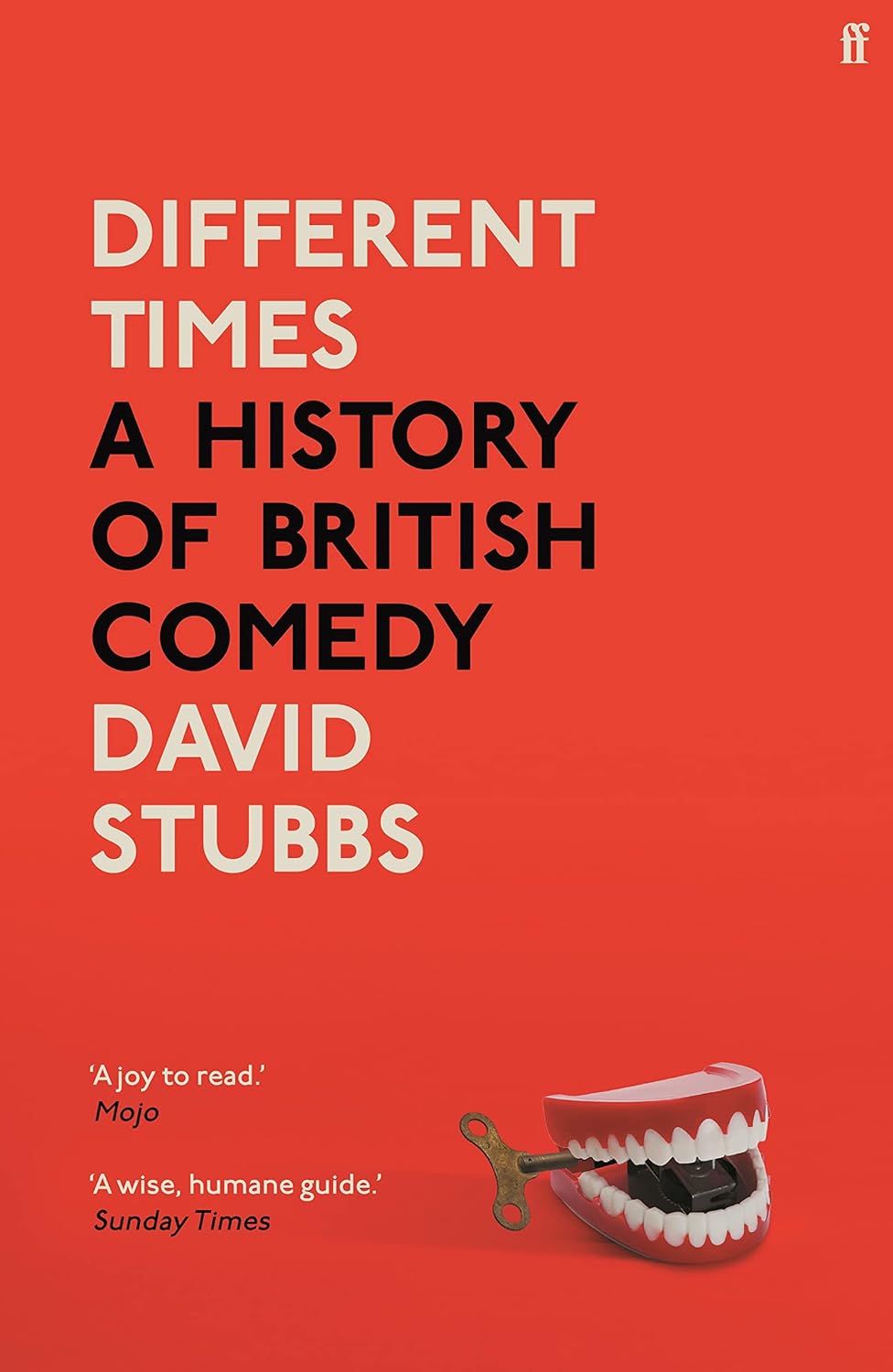
Anybody attempting to chronicle the history of British comedy in a single volume will have to be somewhat selective. And this proves to be the case with Different Times – A History of British Comedy by David Stubbs.
Although films (the work of Charlie Chaplin and Stan Laurel, Ealing, the Pythons) are touched upon as is the stand-up circuit, the bulk of the book concerns itself with television comedy (with the 1970’s taking up by far the largest chapter).
David Stubbs sketches affectionate appreciations of the likes of Tony Hancock, Joyce Grenfell and Dad’s Army although his introduction (where he acknowledges his privileged upbringing as a “white, male, cisgender, Oxbridge” type) does give warning that some sacred cows will be slaughtered.
Although, in fact, there’s not too much the devotee of classic comedy to get hot under the collar about. True, he doesn’t have a great deal of time for Spike Milligan (whilst taking pains to acknowledge his importance in the comedy firmament) but I can appreciate his point of view. I’m happy to have the surviving episodes of Q close at hand – but it’s fair to say that it’s not a series I reach for all that often.
Familiar targets like On The Buses and Love Thy Neighbour are given a good kicking. Possibly more surprisingly, he seems to dislike Are You Being Served? although it’s never made clear why (aside from the fact that Grace Brothers was, even by the 1970’s, an anachronism). No doubt David Croft and Jeremy Lloyd were well aware of this – so it seems an odd point to call them out on.
Any discussion of problematic 1970’s sitcoms is bound to include It Ain’t Half Hot Mum (although it’s worth noting that the series has recently been re-run on That’s TV and the world has continued to turn). The casting of Michael Bates as Rangi Ram is a sticking point for some (with Stubbs firmly against) although it’s interesting to hear some different points of view from those who aren’t (in Stubbs’ words) white and cisgender.
For example, Sanjeev Bhaskar has always appreciated Bates’ performance. ‘Michael Bates could speak Urdu fluently. He served in the Army in India and he could speak the language. And secondly, within that programme, the character he was playing wasn’t the butt of the joke… Rangi Ram was the fixer, he was the one who sorted things out.’
Renu Setna, who appeared multiple times in the series, did initially confess that the casting of Bates upset him. That was, until he saw his performance and had to acknowledge that he was perfect in the role.
Sergeant-Major Williams’ homophobic treatment of the concert party might also be a concern – but there’s little doubt that it’s entirely accurate (Jimmy Perry was a member of a similar concert party and directly drew upon his own memories whilst Kenneth Williams’ An Audience With offers a story with a very similar NCO character).
As you work through the book, you can help but notice that Stubbs has some annoying tics (like Ben Elton, he can’t resist a little bit of politics from time to time). But knowing that Morecambe & Wise were apparently life-long Conservative voters adds nothing to his thumbnail sketch of them, since Eddie Braben’s scripts were never political.
Given the limited word-count, certain series are given short shrift (and others ignored completely). Last of the Summer Wine, for example. is dealt with in a rather condescending and inaccurate way. Stubbs opines the familiar statement that the series was created as the misadventures of three OAPs (to begin with, they were all in their fifties and unemployed, rather than retired). Also LOTSW is described as an archetypal Sunday evening series which (during the 1970’s at least) it never was.
It’s a pity that I kept noticing other niggling little errors. You’d have to be a real nit-picker to worry about them. I’m a real nit-picker. Sorry ….
For example, we’re told that Bill Kerr was slowly eased out from the television version of Hancock’s Half Hour (he never appeared in a single episode). Bob didn’t attempt to join the army at the end of series one of The Likely Lads (it was series three). Ronnie Barker never appeared in At Last the 1948 Show or Do Not Adjust Your Set. dinnerladies was broadcast on BBC1, not BBC2 …
These brief quibbles apart, Different Times – A History of British Comedy was a book that I devoured very quickly and, in the main, enjoyed. I can’t say I agreed with all of David Stubbs’ opinions (it’s doubtful that many will) but in-between the occasional bouts of hectoring he offers some very readable and incisive analysis.
Different Times – A History of British Comedy was published by Faber & Faber on the 27th of July 2023
 Archive Television Musings