Until late 2013, this was the only surviving episode of The Enemy of the World and it may be the reason why the story generally enjoyed a fairly low standing, pre-recovery. There’s nothing particularly wrong with it, but it’s quite low on incident (which is quite typical for one of the middle episodes of a six-parter).
Salamander orders Denes to be arrested and he later tells Fedorin to kill him (thoughtfully he provides the poison to do so). Given that Denes would obviously prove to be awkward if he was brought to trial, his removal is understandable – it’s just bizarre that Salamander would chose Fedorin to do it. From his first scene he’s been presented as a weak link. True, if he did murder Denes then it would tie him even closer to Salamander, but logically you would have expected that a hand-picked guard would be a better choice.
As has often been stated, it’s a little odd that Denes is kept under guard in a corridor. This is because, apparently, it’s the easiest place to guard him. What, easier than a room with a door they can lock? In story terms, having Denes in the corridor means that he can easily interact with any passing character, but it’s a pity that they couldn’t come up with a better reason why he was there.
This episode is immeasurably livened up by Griffin the Chef (Reg Lye). In plot terms he contributes nothing (and he doesn’t appear later in the story either) but his droll sense of humour is welcome in a story that’s been rather grim up until now. Griff’s an eternal pessimist and with a long-suffering air agrees to take on Victoria as an assistant. He asks her to write out the menus. “First course interrupted by bomb explosion. Second course affected by earthquakes. Third course ruined by interference in the kitchen. I’m going out for a walk. It’ll probably rain.”
Jamie wonders if somehow Salamander managed to cause the earthquakes. We then cut to scenes of the continuing earthquakes and rather neatly we pull away from this footage to show it was something the Doctor and Kent were watching on a monitor screen. It seems like a nice directorial flourish, although it may have been scripted since Kent unconsciously continues the conversation that Jamie (many miles away) was having as he tells the Doctor he’s convinced that Salamander, via the Research Station, is somehow responsible for the earthquakes.
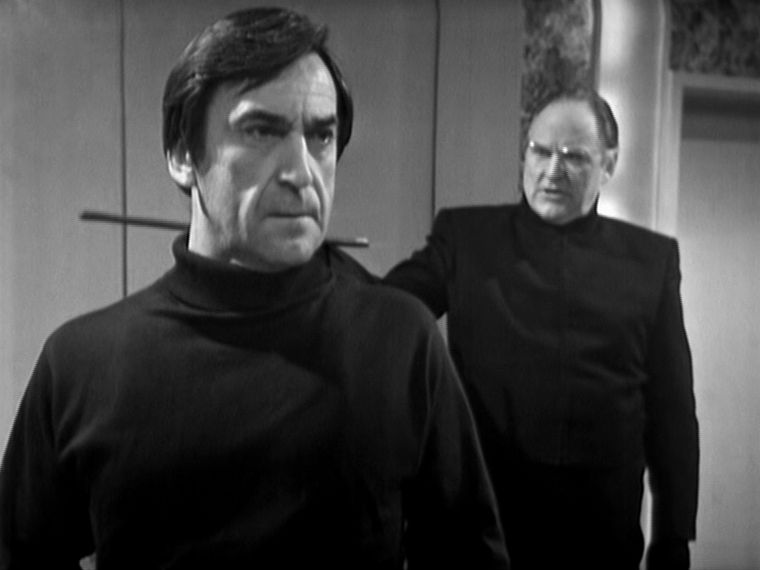
This is Troughton’s sole scene in episode three as the Doctor and he’s still not convinced. “What you’re saying is that Salamander’s found a way of harnessing the natural forces of the earth. It’s a little difficult to accept. I’m not saying it’s impossible, mind you.” Although the plot’s ticking away nicely and Troughton continues to entertain as Salamander, the necessity of the story means that the Doctor is once again placed in the background. He gets to witness how unpleasant and ruthless Beink can be, but it’s still not enough proof for him. “Unpleasant, yes, destructive, but not necessarily evil.”
There’s quite a high body count in this story and in episode three we bid farewell to both Denes and Fedorin. Denes is shot in the back after Astrid attempted to rescue him and Fedorin is poisoned by Salamander. I love Fedorin’s death scene, as you can clearly see that David Nettheim was milking it for all it was worth! Denes’ death is a little more rushed though – it’s possible that time was a factor as there’s a swift cut after he’s shot straight into the next scene. It’s a shame that Denes won’t take any further part in proceedings as George Pravda, especially in this episode, was rather good, especially the way he managed a wry tolerance of the madness occurring around him.
We end with Salamander becoming increasingly suspicious of Jamie and Victoria (which will conveniently remove them from the story for a week). He’s also amazed to hear from Bruce that he’s recently met with Giles Kent ……
The Doctor manages to bluff Bruce into believing that he’s Salamander, but afterwards he’s still not convinced that he should help. “I don’t know where you stand, Mister Kent, but you and this Salamander are obviously on opposite sides. That at least is clear. But which side is good? Which side is bad? And why should I interfere?”
Kent’s proposal is that Jamie and Victoria infiltrate Salamander’s HQ (using a plan he’d already devised for his own operatives) to find proof of his criminal activities. Given the Doctor’s reluctance to get involved, it’s a little strange that he agrees so freely to this, as it will place both Jamie and Victoria in terrible danger. We’ve seen the manipulative side of Troughton’s Doctor before, notably with his treatment of Jamie in Whitaker’s The Evil of the Daleks, but it’s still difficult to believe that he would agree to such a risky plan so readily.
As Jamie and Victoria leave for the Central European Zone, Kent suggests that he and the Doctor take a look at the Kanowa Research Station. They won’t reach there until episode three, but we briefly see inside it this episode, as we meet a character who’ll become more central to the story later on – Benik (Milton Johns). Before we go inside, there’s an establishing shot of the outside of the building. Although it’s represented by a still photo, it’s a nice touch that a small piece of foliage is slowly waved very close to the camera, increasing the impression that it’s a live action shot. It’s a very simple trick, but quite effective.
Like many of the actors in Enemy of the World, Milton Johns would make several appearances in Doctor Who as well notching up hundreds of other credits. Frankly, he’s something of a national treasure – one of many, many actors of this era who could always be guaranteed to enliven whatever tv show or film he appeared in. Never the lead, but always solid support.
He’s tended to specialise in playing odd, weak or ineffectual characters and Benik fits into all three categories quite nicely. We’ll discuss Benik in more depth later on, but even in his single scene here it’s quite possible to get a good grasp of his character. He occupies a position of some power and he’s no problems with exercising this authority (witness his confrontation with Bruce). But there’s something slightly repellent about him and he certainly doesn’t give off a very trustworthy vibe.
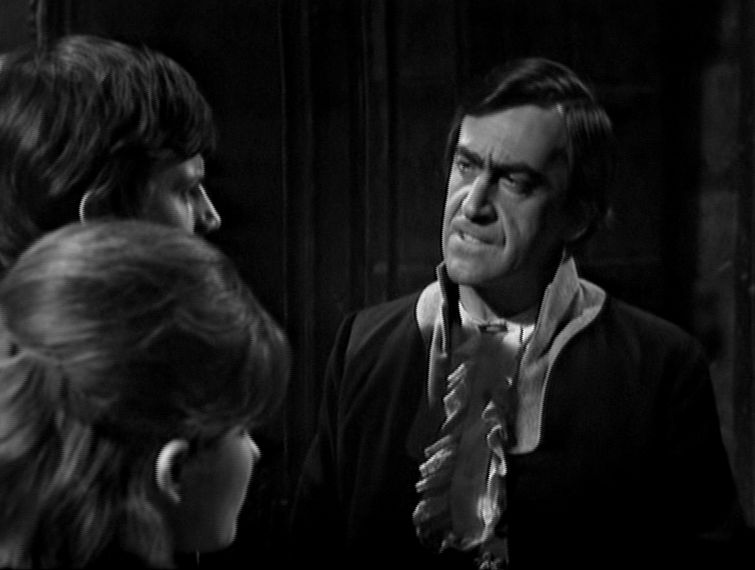
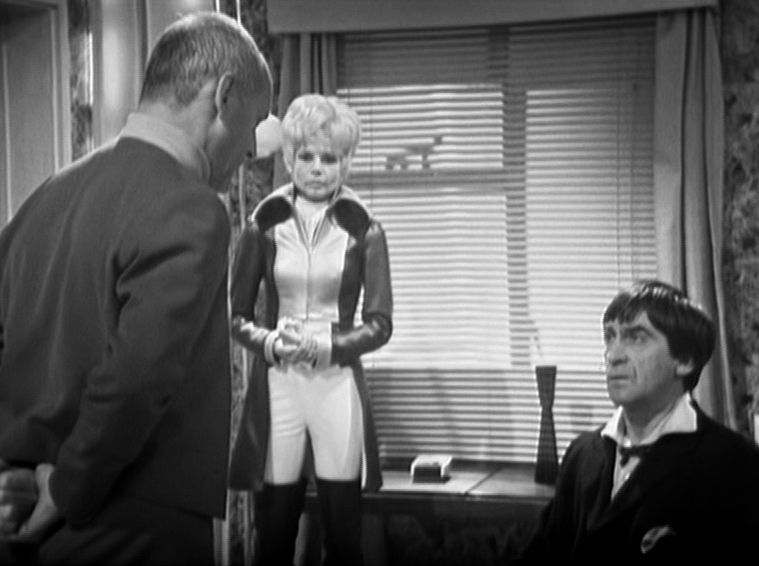
We then move to the Central European Zone, where we get our first proper look at Salamander. He’s got an interesting accent which at times does slightly rob the character of a little of his menace, but it’s Troughton, so you know that he’s always going to deliver a nuanced performance that will command the screen.
He’s meeting with the Zone controller Denes (George Pravda) and Fedorin (David Nettheim). Salamander warns that the Zone will shortly suffer a devastating earthquake. Denes is polite, but noncommittal, although he promises to have his experts check the data (much to Salamander’s irritation). Denes is another of Kent’s allies, although when he speaks to Astrid later he mentions that the meeting he just had with Salamander was the first time he’d met him. This would imply that Denes has only just been made controller, as surely he would have had contact with him on a regular basis. And since he’s never met him, why is he so convinced that Salamander is evil?
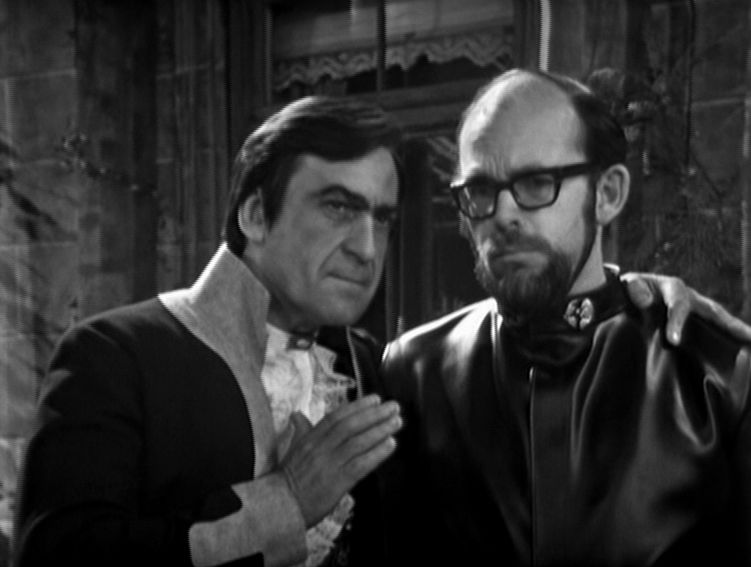
Once Denes leaves, Salamander explains to Fedorin exactly what will happen next. Denes will die and Fedorin will take over. Salamander has incriminating evidence (faked, if we believe Fedorin) on Fedorin, but doesn’t plan to use it, “this just an insurance, hmm?” It’s a joy to watch Troughton’s Salamander steamroller the ineffectual Fedorin and it gives us an early indication that he’s utterly ruthless – replace an honest man with one that you have a hold over and your power-base is immeasurably stronger. David Nettheim’s role isn’t particularly large (he only appears in this and the next episode) but his twitchy, anxious turn is a memorable one.
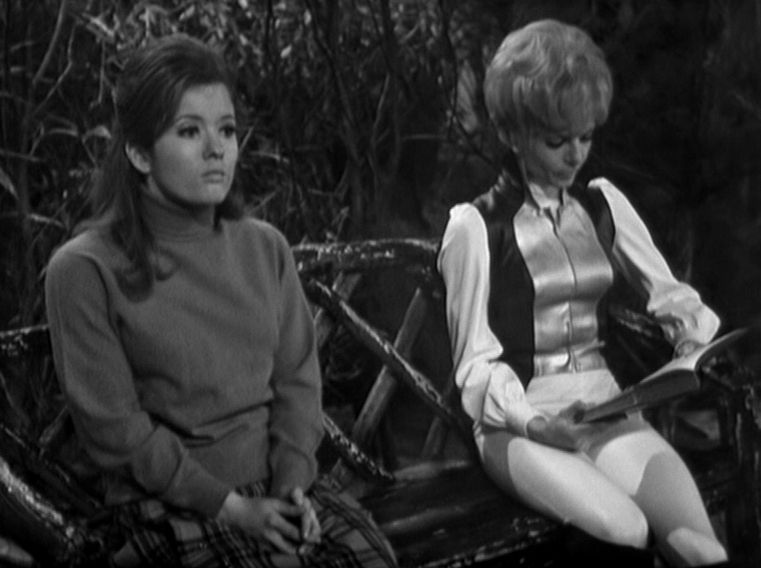
Barry Letts elects to use back projection for the park scenes, which is an innovative, if not entirely successful, attempt to suggest the action is taking place outdoors and not in the studio. After the initial location splurge at the start of episode one, the rest of the story is largely studio bound so it was reasonable enough to try and open things out. When he became producer of Doctor Who, Letts would delight in using CSO in ways that few other directors would ever attempt, so it’s not surprising that he tried something similar here. It looks just as fake as CSO often did, but we’ll give him points for effort.
The other major character introduced in this episode is Fariah (Carmen Munroe). She’s one of Salamander’s servants, but Fedorin observes that she doesn’t appear to be an ordinary servant. Fariah tells him that she’s his food taster, as there have been many attempts to poison him. As her contempt for Salamander is barely concealed, Fedorin wonders why she decided to work for him. Fariah tells him that Salamander has a way of persuading people and Salamander’s own comments on her are quite noteworthy. “She was hungry. Only thing is, now she has all the food she needs, she’s lost her appetite. Both Troughton and Munroe are skillfully able to imply an intriguing back-story with just a few lines.
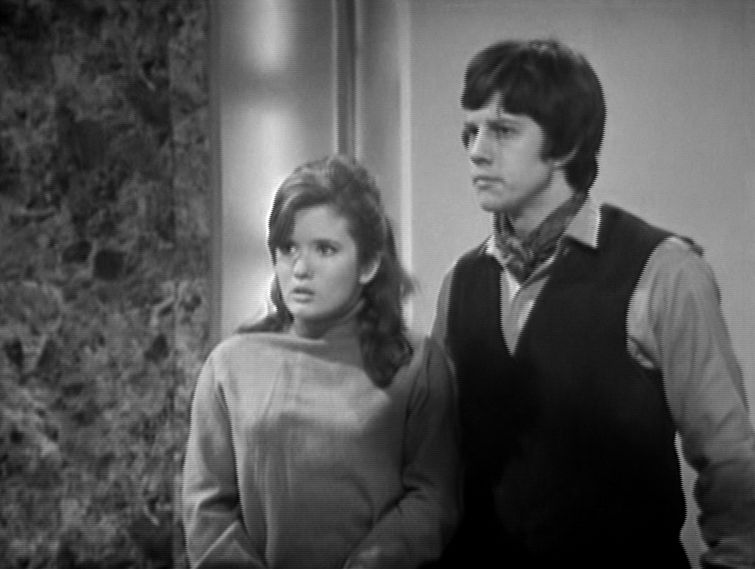
Meanwhile Jamie and Victoria have managed to win Salamander’s confidence (in a slightly unbelievable way, it must be said). Salamander’s security must be really poor for Jamie to be able to get within touching distance of him without any of his guards being able to stop him. Although his ruthless streak is made even clearer when he tells his guards to take the guard that Jamie overpowered away. “Look after him. Better still, get rid of him.”
Episode two ends with Salamander’s forecasted volcanic eruptions. This is achieved, less than satisfactorily, via stock footage which doesn’t at all match with the clean VT studio sequences. It’s also a little strange that Salamander quite calmly watches the devastation from the veranda in his Presidential Palace, which implies that that the eruptions can’t be too far away. But at no time does anybody suggest that they should leave and move to a safer place.
Salamander orders Denes to be arrested and we then see a rather odd cliffhanger which ends on the worried face of Fedorin who’s clearly deciding whether to agree to Salamander’s plan or support Denes. It’s a convenient place to pause the story, but rather atypical (normally we’d expect to see one of the regulars in peril).
Even some eighteen months later, there’s a faint air of unreality about the recovery of The Enemy of the World and The Web of Fear.
Maybe this is because the notion of complete (or nearly complete) stories returning to the archives seemed to be such a remote possibility. Yes, it had happened back in 1992 with Tomb, but as time went on that appeared to be a miraculous one off. Post-Tomb, we’d become conditioned that the small (but very welcome) trickle of orphaned episodes would be all we could ever expect.
The recovery of these nine episodes changed that though and it allows us to reassess a substantial chunk of season five. For most people, including myself, viewing these two stories was a very different experience from watching The Tomb of the Cybermen back in 1992. Tomb might have been a legendary lost story, but in 1992 I didn’t even have a complete collection of the existing episodes (although I was well on the way). So Tomb was just another story and I approached it with none of the baggage that some older fans would have had.
Enemy and Web were very different. I’d had the orphaned episodes for twenty five years and the audios for nearly as long. So the small amount of existing visual material and the audio of the remaining episodes were very familiar – meaning that finally being able to put pictures to the sounds was an exciting, if slightly nerve-wracking experience, first time around.
This was Barry Letts’ first brush with the series and it’s apt that episode one features both a hovercraft and a helicopter, given that the Pertwee era would show a similar love of hardware. The opening ten minutes or so are mostly shot on film and they help to give the story a glossy, expansive start. As a first-time director on the show, Letts was clearly keen to push as far as he could and there’s some impressive shots (such as the POV from the helicopter showing Anton and Rod firing as it pulls away) that maybe a more experienced (or jaded) director wouldn’t have bothered with.
The early minutes are peppered with some lovely visual moments – such as the Doctor stripping down to his long-johns to take a dip in the ocean. This emphases the Troughton Doctor’s child-like nature although he’s also quick to sense that the approaching hovercraft means them harm (although this seems to be via a sixth sense as there’s no visual clue).
The hovercraft is piloted by Anton (Henry Stamper), Rod (Rhys McConnochie) and Curly (Simon Cain). It’s Anton who gets the lion’s share of their dialogue, although sadly it’s not particularly memorable and Stamper’s unsubtle delivery doesn’t help. Thankfully, all three are put out of our misery shortly afterwards.
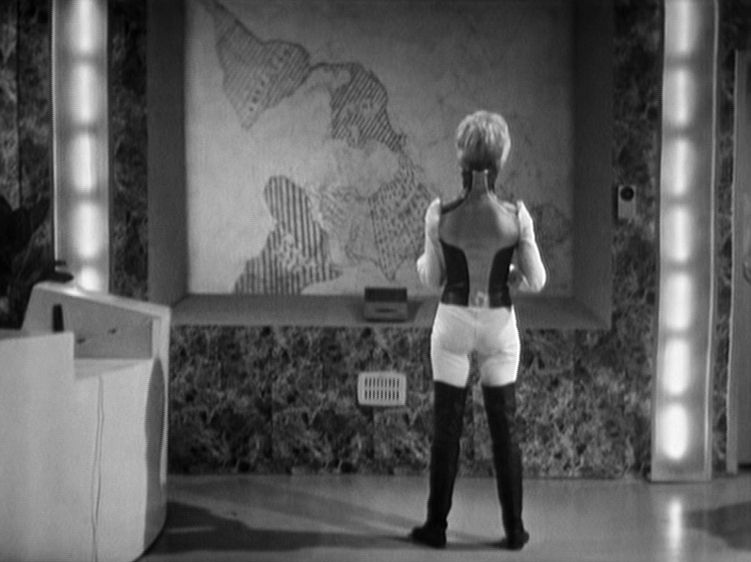
The Doctor, Jamie and Victoria are rescued by Astrid (Mary Peach). Our first sight of Astrid is from the rear and it’s easy to believe that this was a deliberate shot-choice from Letts as Ms Peach does have a rather attractive derriere. Certainly something for the dads there!
But although it’s impossible to deny that Astrid is an objectified figure right from the start, she’s also a strong, capable woman at a time when that was still something of a rarity in Doctor Who. There are other examples in the Troughton era – Anne Travers in the next story and Gia Kelly in The Seeds of Death, for example – but they were still the exception rather than the rule.
After the Doctor attended to a flesh-wound she picked up during their escape, she begins to delicately pump him for information. Once she learns he’s a Doctor, Astrid wonders in what field, possibly law or philosophy. Troughton’s reply, with a faint smile playing around his lips, of “which law? Whose philosophies, eh?” is another of those lovely moments that only works when you have the visuals to match up to the soundtrack. And it does make you wonder just how many more examples of Troughton’s magic are lost on the audio-only episodes.
Another nice moment comes shortly afterwards when she tells the Doctor that he’s “the most wonderful and marvellous man that’s ever dropped out of the skies” and asks if he’ll do something for her. The Doctor’s quite taken with her compliment and dreamily tells her that, yes, he will. But he’s brought up sharply when Astrid tells him it’ll probably cost him his life! It’s a gag moment, as it’s impossible to believe that the Doctor would ever be taken in by such a cheap piece of flattery, but it’s still amusing.
What happens next is interesting. The Doctor seems reluctant to meet with Astrid’s boss, Giles Kent (Bill Kerr) and wishes to leave. It’s Jamie who for reasons unknown (perhaps he fancies Astrid?) tries to persuade him to stay. The Doctor’s inaction during the story was mainly for practical reasons – an episode could either largely feature Troughton as the Doctor or as Salamander, but it would be hard to do both. So the Doctor had to drop out of the narrative for a few episodes in order for Salamander to dominate. Therefore, if the Doctor had agreed to the impersonation straight away, then the story would have been over much sooner.
There could be another reason though – since the story was scripted by David Whitaker, the show’s original script editor, whose view of the series was very different from those who came after (especially Dennis Spooner). Something very consistent in the Whitaker script-edited stories is that the Doctor never decides to stay and help purely out of a sense of moral duty (instead it’s generally because he’s unable to leave – the TARDIS is taken by Marco Polo, the lock of the TARDIS is stolen in The Sensorites, the TARDIS is trapped by a fallen girder in The Dalek Invasion of Earth, etc). It’s therefore quite reasonable for Whitaker to script a Doctor who’s reluctant to act.
This is unusual for the series at this time though, where the Doctor is generally quite happy to pitch in straight away. But it’s an interesting move, as whilst Giles Kent is very convincing in painting Salamander as a villain, there’s little actual evidence to back this up. For anybody familiar with the parameters of the series to date, it would seem clear that Salamander = Bad and Giles = Good. As we’ll see though, things aren’t quite as clear cut and this is an early example of the series taking a more pessimistic world-view where few, if any people, can be trusted. Possibly the best example of this is The Caves of Androzani which must be unique in lacking any characters (outside of the regulars) that could be said to be wholly “good”.
But even this early on, we have clear evidence that Kent is a ruthless manipulator. He wants the Doctor to impersonate Salamander but obviously knows that he’ll take a great deal of persuading. So he contacts Salamander’s head of security Donald Bruce (Colin Douglas). Since they’re implacable enemies, quite what he says is something of a mystery, but Bruce turns up shortly afterwards and Kent gives the Doctor an ultimatum. He has to impersonate Salamander and he has to be good enough to fool Bruce, otherwise the lives of Jamie and Victoria will be forfeit.
One thing that the range of Doctor Who DVDs (from An Unearthly Child to the TVM) isn’t short of is documentaries. Just about every release has a plethora of supplementary information – from story-specific features, interviews with people from both in-front of and behind the camera to more tangential featurettes (such as The Blood Show from the State of Decay DVD. A twenty minute documentary on the use and meaning of blood in society? No, me neither).
But back at the start of the 1990’s, things were very different. The only British-made documentary screened during the series’ original twenty-six year run was 1977’s Whose Doctor Who. Reeltime Pictures catered for the fan market during the 1980’s and 1990’s with the MythMakers series of interview videos, but these (like VHS releases of convention panels) were only preaching to the converted. A mainstream documentary on BBC1 seemed like a remote possibility.
But 1993 was Doctor Who’s 30th anniversary and even if the show had been off the air since 1989, it still had a certain presence (thanks to healthy VHS sales). Kevin Davies was keen to make a documentary celebrating the program and he had an impressive calling card – The Making of the Hitch-Hiker’s Guide to the Galaxy – a popular straight to video documentary that mixed archive footage, outtakes and new interviews.
Thirty Years in the TARDIS was to eventually take very much the same shape – although prior to this format being agreed Davies made numerous other pitches which were rejected. These included Tomb of the Time Lords which would have featured Ace searching the Doctor’s memory in the Matrix – which would have provided the excuse for a series of clips. Another intriguing possibility was The Legend Begins, a drama-documentary about the creation of the series (Davies suggested Pete Postlewaite as Hartnell). We would have to wait another twenty years, and Mark Gatiss’ An Adventure in Space and Time, for this idea to eventually hit the screen.
Thirty Years in the TARDIS was produced by The Late Show team and although Davies had been given a free hand, some higher-ups became concerned with the approach used. Davies wanted to take the nostalgic route to try and pinpoint why Doctor Who had been such as success whilst The Late Show team felt that the documentary should have a more factual basis and so additional interview material was shot.
In the end, this made the transmitted version a rather uneasy comprise between Davies and his producers. But even though it was a bit of a hodge-podge, there were still plenty of impressive moments (especially the drama recreations). However, Davies still felt that there was a better documentary that could be made from the material and so in 1994 More Than Thirty Years in the TARDIS was released on VHS.
Davies had free reign to re-edit the program to his wishes as well as adding an additional forty minutes (bringing the running time up to ninety minutes). From the perspective of 2015 it’s just another documentary, but back in 1994 it was something rather special.
Although the pirate video network (see Cheques, Lies and Videotape on the Revenge of the Cybermen DVD for more info) was still flourishing at the time (which meant that some of the rarer material featured – studio outtakes, for example – were in circulation) not everybody had access to them. So a major draw of the VHS were the snippets from studio sessions, including The Claws of Axos and Death to the Daleks , as well as ephemera like the Tom Baker/Lalla Ward Prime Computer adverts. Even the end credits were fascinating, as they were packed with clips of studio off-cuts.
Jon Pertwee, Colin Baker and Sylvester McCoy were interviewed, but Tom Baker and Peter Davison were conspicuous by their absence. Tom did make an appearance via archive footage though and given that many anecdotes were already calcified by this time (yes, Jon Pertwee does mention Yetis in Tooting-Bec!) this probably wasn’t too much of a drawback.
One notable new section concerned the thorny issue about who exactly created the Daleks (was it Terry Nation, Raymond Cusick or Davros?). This discussion was intercut with Jon Pertwee’s appearance on the Anne and Nick show where he disagreed that it was Terry Nation (much to the amusement of the studio crew!).
The DVD release of More Than is pretty much a direct port of the VHS master which means that many of the clips look rather grotty. Along with the staggering number of special features, the amount of restoration work carried out the DVD releases is really highlighted when you see exactly how badly the stories used to look.
If you didn’t live through the 1990’s as a Doctor Who fan, then More Than is probably not going to have the same special appeal today as it did then. Just about every scrap of interesting material can be found in a more complete form somewhere on the DVD range (you want the whole studio spool from The Claws of Axos? You’ve got it) but More Than does manage to compress twenty six years of history into an entertaining ninety minutes.
This obvious nostalgia apart, it remains a very decent documentary that does its best to explain the magic of the series and I’m glad it ended up on DVD.
Stress and overwork have affected Sherlock Holmes’ iron constitution, so both he and Dr Watson have decided to take a holiday in Cornwall. Holmes, naturally enough, abhors inactivity and is keen to seize on any distraction – so when the vicar (John Glyn-Jones) bursts into their cottage early one morning with a tale of death and madness, he’s immediately interested.
Three members of the Tregennis family have been struck down in a most inexplicable way – the sister is dead whilst the two brothers have been driven quite mad. A fourth Tregennis sibling, Mortimer (Patrick Troughton), was present with them the previous evening, but he insists that when he left all was well.
Holmes and Watson risk their own sanity to solve this devilish puzzle ….
Originally published in 1910, The Devil’s Foot was one of Conan-Doyle’s favourite Sherlock Holmes stories (he ranked it ninth out of twelve favourites). With a very limited number of suspects it’s not really a whodunnit, rather it’s a howtheydunnit.
According to legend, when the script was delivered it was found to be dramatically under-running, so both Douglas Wilmer and Nigel Stock intensively worked on it and were able to bring it up to the correct length. This is mentioned in the BFI booklet, so there must be some credence to the story, but it’s hard to understand why the actors had to do this (rather than script-editor Anthony Read).
Douglas Wilmer does give his opinion about what Anthony Read was doing at the time (via the highly entertaining commentary track). I won’t reveal what he says, but it’s not terribly complimentary! The comm track on this episode is a must listen as though Wilmer is 95, he’s still as sharp as a tack. Although his dissatisfaction with some parts of the series was well known (this was the reason he didn’t do a second series) I wasn’t quite aware just how unhappy he was.
He seems to have had problems with the producer, some of the directors (who he considered to be far too inexperienced) as well as several of the adaptations. Overall, he doesn’t seem to have enjoyed himself at all – which is a pity, partly because it’s still an impressive series (despite whatever was happening behind-the-scenes) but also because it’s the programme he’ll always be best remembered for. But although making the series wasn’t always a happy one, he’s still got a sharp sense of humour and this helps to stop the commentary track from simply being a long list of complaints.
The story benefits from location filming in Cornwall (the jagged cliffs and stormy seas are particularly photogenic). It’s just a shame that the original film sequences no longer exist (as the telecine process has made the images rather murky).
There’s a remarkable performance from John Glyn-Jones as the vicar. I can’t decide whether he’s playing his initial scenes (where he describes the horror of the Tregennis house) for laughs or if he’s simply overplaying to a ridiculous degree. Much more assured is Patrick Troughton as Mortimer Tregennis. It’s always a pleasure to see Troughton and whilst it’s a fairly low-key part, Troughton’s class still shines through (although his Cornish accent is a bit hit and miss).
Mortimer Tregennis is a rather shifty type, so he appears to be the prime-suspect – meaning that his death (in an identical fashion to his sister) mid-way through the story is a good twist. Suspicion then falls on Dr Sterndale (Carl Bernard) who has already clashed swords with Holmes earlier on.
Holmes eventually divines the way the murders were carried out and elects to undertake an experiment to replicate the same effect. Watson is steadfast in accepting to stay with him and afterwards we see a very nice moment between Holmes and Watson (and Wilmer and Stock of course). If Wilmer’s Holmes is often rather detached and analytical (with not too much of the warmth and humour that some actors have brought to the part) then the aftermath of the experiment provides us with a telling scene.
Holmes berates himself for risking both his and Watson’s life, although Watson tells him that “it is my greatest joy and privilege to help you.” Any Holmes/Watson relationship will only work if you believe that they enjoy a strong bond of friendship – if Holmes is too remote or Watson too stupid, then it’s difficult to fully invest in the characters.
Some of Doyle’s stories, like this one, do feel slightly stretched when adapted for a fifty minute slot, but overall The Devil’s Foot is very decent fare – thanks to Troughton, the Cornish location and the continuing good work from Wilmer and Stock.
As might be expected from the Two Ronnies, there’s several wordplay orientated sketches in the show. The first (upper class city gents who can’t pronounce their words properly) is amusing enough, but does slightly outstay its welcome.
Ronnie B’s monologue is delivered by a milkman (H.M. Quinn) in the style of the Queen’s Christmas speech. His delivery clearly appeals to at least one member of the audience (listen out for some very audible female squealing on the most innocuous of lines). The majority of the monologue doesn’t actually contain any jokes (just some milk-based wordplay). The idea that Barker is talking like the Queen is presumably supposed to do most of the comic heavy lifting.
Next up are a couple of Northern road-workers who exhume some golden oldies from the Old Jokes Home, such as –
RONNIE C: Sithee, does tha believe in reincarnation?
RONNIE B: Well, it’s all right on fruit salad, but I don’t like it in me tea.
Following the very Chrissmassy musical number (the Rons dressed as a couple of Stereo Santas) and a quick Ronnie C solo sketch we move into the best part of the show. First up is another wordplay sketch – with the Ronnies as two soldiers in a WW1 trench. Ronnie C has the unfortunate knack of mishearing everything that Ronnie B says, such as –
RONNIE B: God, I wish I were back in Blightly.
RONNIE C: Do you, sir? What sort of nightie, sir? Black frilly one?
RONNIE B: Sounded like a Jerry rifle.
RONNIE C: Bit strange in the trenches, sir. A sherry trifle.
It’s a lovely, typical Two Ronnies sketch. The courtroom sketch that follows is something a little different. It opens quite normally, with Ronnie C prosecuting and Ronnie B in the dock, but it quickly becomes a parody of several popular quiz shows (What’s my Line?, Call My Bluff, Blankety Blank, Mastermind, The Price is Right) – it’s also a pleasure to see Patrick Troughton as the judge.
Ronnie B has a solo singing spot as Lightweight Louie Danvers (not too dissimilar to Fatbelly Jones it has to be said).
Following Ronnie C in the chair, it’s the big film – The Ballad of Snivelling and Grudge. Guest star Peter Wyngarde is a delight – mainly because he takes the whole thing totally seriously. There’s no winks to camera and his dead-pan performance is spot on. And if, like me, you can spot Pat Gorman in the background, then you’ve probably watched far, far too much old British television. If you don’t know who Pat Gorman is, then you’ve clearly not watched enough!
No news items to end the show – instead it’s a old-fashioned style song about Christmas. It’s somewhat comforting and sums up the Two Ronnies quite well. By the mid eighties they were pretty much out of step with contemporary comedy (and Barker knew that their time was nearly up) but it doesn’t really matter – great comedy is timeless, and there’s several examples here that still work thirty years later and will surely endure for decades to come.
Following his threat in the last episode, Abner Brown now seems determined to stop Tatchester Cathedral celebrating its Thousandth Christmas Midnight Service. He gains nothing from doing this, but since he seems fated not to have the Box of Delights it’s one way of getting a measure of revenge. Later, he decides to flood the dungeons when it’s clear he’s lost completely – which is the final sign that his grip on reality has gone.
He dispatches two creatures of the night (both created very nicely with traditional animation and mixed well into the picture) to prevent anybody getting to Tatchester – by road, rail or air.
Abner and Cole Hawlings face off. It’s at this point that Abner realises he’ll never possess the Box and so he decides to take everybody with him (by flooding the dungeons). Hawlings and Kay manage to escape and find Peter, Caroline Louisa and the Bishop along the way.
It has to be said, it’s a mystery why Cole Hawlings allowed himself to stay locked up for so long. He was able to create a key from nothing more than a piece of card and a stub of pencil, not to mention turning his hat into a motorboat – so maybe he just liked the underground ambiance?
Abner Brown’s final moments (as he sinks beneath the cold, dark water) is nicely shot and accompanied by a musical sting from Roger Limb that sounds not unlike the music he composed for Revelation of the Daleks the following year.
So, all’s well that ends well. Thanks to Herne the Hunter and the old lady everybody gets to the Cathedral in time for the service. After the adventure, this gives us time to catch our breaths – and it’s suitably Chrissmassy. It’s even more impressive when you realise that the service was shot during the day and at the height of summer, with black paper over the windows to hide the sunlight!
Not everybody is in favour of the ending, but it’s as good a way as any to conclude the story and bring Kay back to reality.
Thirty years on, The Box of Delights is still as enjoyable as ever. Whilst the production does occasionally overreach (particularly with the CSO effects) so much is right (the animation, the music and especially the actors) that it seems churlish to complain. It’s always a Christmas treat.
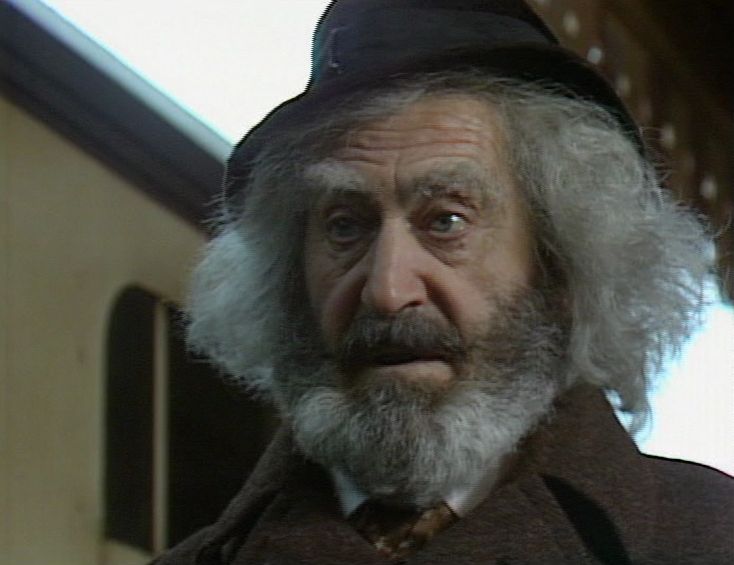
Given the potency of his performance, it’s remarkable how small Patrick Troughton’s screen-time in The Box of Delights actually is. The majority of his scenes are in the first episode, whilst in episode two he only has one scene of importance before disappearing. He returns at the end of the sixth episode but does little of note.
Basically though, once Cole Hawlings passes the Box to Kay in episode two, his function in the story is over. And whilst he’s still vague about what’s actually happening, he does share one important piece of information – the Box isn’t his, it belongs to Master Arnold who appears to be stranded somewhere in the past.
After Kay and Peter witness the old man being scrobbled by Abner’s men, they report it to the Inspector (James Grout). The Inspector, of course, doesn’t believe a word of it, preferring to think that Hawlings was spirited away by some of his friends who were playing a prank on him. James Grout is lovely in this scene, as he is throughout the story. There’s a real warmth to his conversation with the children – he may disbelieve everything they say, but he’s never abrupt or unkind. It’s a staple of children’s literature that adults tend to not to believe anything the children say, forcing them to solve the mystery by themselves and the Inspector falls nicely into this pattern.
There’s a major sequence with the Box in this episode – Kay ventures into the wood to meet Herne the Hunter and both of them are transformed firstly into deer, then into birds and finally into fish. It’s a gorgeous example of animation that is enhanced by Roger Limb’s fine score. This sort of animation was never cheap, but it’s immeasurably to the series’ benefit that they spent the money – even if it does look a little the worse for wear on the 2004 DVD release. If the original elements still exist, it would be nice to think they could be restored one day for a special edition re-release.
The reason for this scene is obliquely explained to us by Herne. “Did you see the wolves in the wood? That is why we became wild duck. Did you see the hawks in the air? That is why we became fish in the pool. Now do you see the pike in the weeds?” Which seems to imply that there is danger everywhere, even in the Box – it’s not a safe haven.
One thing that the second episode has lacked is an appearance from Robert Stephens. We have to wait until the final scene before we see him – but even though he has only a brief moment of screen-time he still oozes villainy, which leads us nicely into episode three.
Where is that Rat? And where is the Box? As for the boy … that interfering, overreaching boy … reporting to the police, talking on telephones. What I won’t do to that boy!
Next up – Episode Three – In Darkest Cellars Underneath
Originally broadcast thirty years ago, The Box of Delights became an instant classic (it was awarded three BAFTAs in 1985 – Best Children’s Programme, Best Video Lighting and Best VTR Editing) and has remained an ever-present staple of many people’s Christmas viewing.
It was adapted by Alan Seymour from the novel published in 1935 by John Masefield. The book was a sequel to The Midnight Folk which had been published in 1927 and also featured Kay Harker. Other characters who return in The Box of Delights having first appeared in The Midnight Folk include Abner Brown and Sylvia Daisy Pouncer, so it’s intriguing to wonder whether the BBC ever considered adapting both novels.
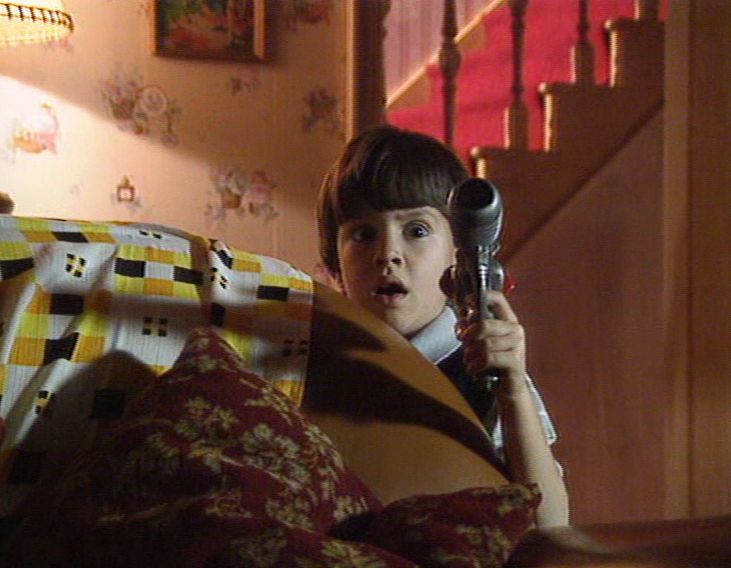
Kay Harker (Devin Stanfield) is returning home for the holidays. On the way he meets a strange Punch and Judy man, Cole Hawlings (Patrick Troughton) and two even stranger clergymen, Foxy Faced Charles (Geoffrey Larder) and Chubby Joe (Jonathan Stephens).
Both Cole Hawlings and the two clergymen seem to know a great deal about Kay. By magic, possibly? Quite why Charles and Joe decided to con Kay out of half a crown by playing Find the Lady (and then presumably steal his purse and watch for good measure) is a bit of a mystery. Did Abner Brown (who we later discover employs Charles and Joe) ask them to target him or was it simply a piece of opportunistic thieving?
They also seem to have considerable powers (it’s not explicitly stated, but they appear to change from human form into wolves) and this is apparently confirmed by Cole Hawlings later, when he states that their new magic is sometimes too powerful for his old magic.
But Cole Hawlings has something they want – the Box of Delights. It can make a Phoenix rise from a fireplace (a lovely piece of traditional animation) and also brings a photograph to life, allowing Cole Hawlings to make his escape. This is another very impressive piece of work, particularly when the animated mule changes to a live one and then back again. It’s easy to overlook just how tricky that would have been to achieve, especially when working with traditional animation.
Nowadays, the effects seen in The Box of Delights could no doubt be easily achieved with CGI, but there’s a certain undeniable charm about the effects they used here. They may seem crude to some people, but they work – and that‘s all that matters.
Cole Hawlings tells Kay that “The wolves are running”. He doesn’t elaborate too much on this enigmatic warning and elsewhere there are other oblique messages (delivered by an old lady with a ring who disappears at will and a mysterious man on horseback who tells Kay that “If you see someone … say someone is safe”).
At the end of the episode we get our first sight of Abner Brown (Robert Stephens). Stephens is, from this first scene, mesmerising and remains (along with Patrick Troughton) the best thing about The Box of Delights.
Next Up – Episode Two – Where shall the ‘nighted Showman go?
The Two Doctors is, to put it mildly, a real mixed bag. Robert Holmes was asked to include a number of elements – a foreign setting (originally New Orleans, later Seville), the Second Doctor and Jamie and the Sontarans. We’ve previously discussed how Holmes disliked “shopping list” stories – this was the reason he didn’t complete his draft script for The Five Doctors for example – so placing so many restrictions on him was possibly asking for trouble. Another problem was that it was effectively the same running time as a six-parter (which was a length of story Holmes loathed).
Given all this, it’s a little surprising that The Two Doctors turned out as good as it did. Its tone is uncertain at times (Holmes always had a dark sense of humour and was probably delighted to find his whims indulged by Eric Saward) and it’s surprising to see that Troughton is somewhat wasted, but there’s plenty to enjoy here, so let’s dive in
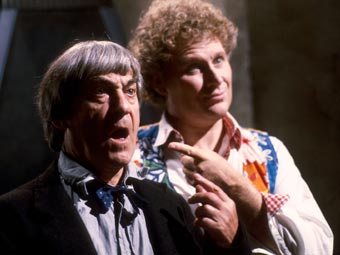
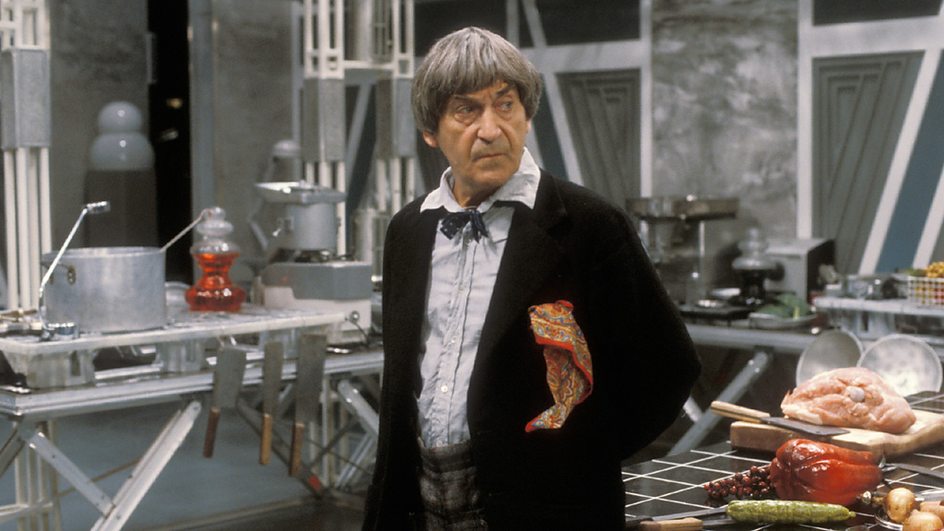
The opening fifteen minutes or so are pure bliss. Back in 1985, the sum total of my exposure to Patrick Troughton’s Doctor comprised of The Krotons and The Three Doctors from the Five Faces repeats in 1981 and The Five Doctors from 1983. They were enough to convince me that Troughton was a brilliant Doctor and this story only cemented my appreciation of him. Although Troughton looks much older and greyer than before, there’s still a spark there and his byplay with Shockeye and Dastari is lovely. Frazer Hines, somewhat remarkably, didn’t look much older than when he bade the Doctor farewell in The War Games, some sixteen years earlier. Whilst Hines works well later on with Colin Baker and Nicola Bryant, it’s a pity he’s separated from Troughton for the majority of the story.
The incomparable Patrick Troughton
Given the length of the story, it’s odd that Troughton is absent for such a long period (he vanishes fifteen minutes into the first episode and doesn’t re-appear until fifteen minutes into episode two – some forty five minutes). And after such a strong start, he’s a somewhat impotent character for the remainder of the story. He spends episode two tied up (although he has a few good scenes) and suffers the indignity of being turned into an Androgum in episode three, something of a lowlight of the story. But back to episode two, there’s a delightful scene between Troughton and Stike (Clinton Greyn).
DOCTOR: Tea time already, nurse?
STIKE: I do not understand.
DOCTOR: Just as well. A face like yours wasn’t made for laughing.
STIKE: The operation must begin at once. I am needed at the front.
DOCTOR: Yes, I heard you. What was it, a vital strike in the Madillon Cluster? Oh, dear me. Nothing changes, does it? You and the Rutans have become petrified in your attitudes.
STIKE: Nothing can change till victory is achieved. But, but I fear I might have made a tactical error.
DOCTOR: Oh? I thought the Sontarans never made mistakes.
STIKE: It is not easy being commander. The loneliness of supreme responsibility.
DOCTOR: Why don’t you resign, Stike? Take a pension.
STIKE: When I die, it will be alongside my comrades at the front. Doctor, you have a chance, in death, to help the Sontaran cause.
DOCTOR: How can I do that?
STIKE: Tell Dastari where your symbiotic nuclei is located in your cell structure. Vital time will be saved and I can be on my way.
DOCTOR: Is that what Chessene’s offered you, the knowledge of unlimited time travel? In that case, you should watch your back, Stike.
STIKE: What?
DOCTOR: She’s an Androgum! A race to whom treachery is as natural as breathing. They’re a bit like you Sontarans in that respect!
(Stike slaps the Doctor.)
STIKE: That is for the slur on my people!
DOCTOR: And for that I demand satisfaction!
STIKE: You know that is impossible.
DOCTOR: I am challenging you to a duel, Stike. That is traditional among Sontarans, is it not?
STIKE: Oh, I would dearly love to kill you, but unfortunately you are needed alive.
DOCTOR: Release me, Stike. You are not only without honour, you’re a coward as well.
STIKE: As you are not a Sontaran, Doctor, you cannot impugn my honour.
(Stike leaves.)
DOCTOR: Well, that didn’t work, did it?
It does worry some people that Troughton’s Doctor is working for the Time Lords (and that Jamie knows all about them). This has given rise to the Season 6b theory, but the basic truth is that this was the latest attempt by Robert Holmes to demystify the Time Lords. Holmes disliked the way they had been portrayed in The War Games (aloof, august, etc) and instead he took every opportunity to portray them as out of touch and basically corrupt. The Deadly Assassin (which so upset a vocal minority of fandom at the time) was the clearest demonstration of this and The Two Doctors, more subtly, carries this on. Holmes would, of course, continue this theme the following year in his episodes of The Trial of a Time Lord. This interview excerpt with Holmes sheds some light on exactly what he was attempting to achieve.
When I wrote The Two Doctors, it was no mistake that the Troughton Doctor knew he was being controlled by the Time Lords. The theory which myself and others who worked on Doctor Who began to conceive was that the Time Lords were in dual control of the TARDIS all the time. The first trial was a mockery, a public relations exercise, because the Doctor had become involved too close to home and something had to be done about him. That’s why he is almost half-hearted about attempting to escape, which normally he never was. He knew that they were in complete control and had been all along. To operate as sneakily as this, you would have to be corrupt, and that’s what came later, when I was the script editor. Did they not condemn the Doctor to exile for interfering in the affairs of other planets? And yet who had sent him on these missions? They had!
Episode one has some rather strange plot holes (although it’s possible to argue these away). What was reason for displaying the image of the Second Doctor apparently being put to death? If nobody was left alive then who would have seen it? And it’s incredibly sloppy to leave the equipment in place, so that when someone came to investigate they would instantly see that the Doctor’s death was a fake.
And if the Second Doctor’s death was phony, why should the Sixth Doctor be affected? It’s also a remarkable co-incidence that when the Sixth Doctor decides to seek medical advice he not only chooses Dastari (out of all the medical men and women in the Universe) but lands the TARDIS at exactly the point in time immediately after the Sontarans have attacked the space station. The only possible explanation for these whacking great plot holes is that the Time Lords were aware the Second Doctor had been kidnapped and subtly influenced the Sixth Doctor in order to get him to investigate.
Robert Holmes always had a gift for language, which is very much present in this story. True, it sometimes edges towards the macabre (there were plenty of examples of this in the 1970’s and it does seem that Saward was keen to exploit this). Colin Baker benefits from Holmes’ writing – he’s impressed me in his stories so far, but here (thanks to Holmes) he goes up another couple of notches. This is a good example of morbid Holmes.
PERI: Ugh! Oh, Doctor, it’s foul. Are you sure it’s safe?
DOCTOR: Plenty of oxygen.
PERI: Yeah, but that awful smell.
DOCTOR: Mainly decaying food (sniffs) and corpses.
PERI: Corpses?
DOCTOR: That is the smell of death, Peri. Ancient musk, heavy in the air. Fruit-soft flesh, peeling from white bones. The unholy, unburiable smell of Armageddon. Nothing quite so evocative as one’s sense of smell, is there?
PERI: I feel sick.
DOCTOR: I think you’ll feel a good deal sicker before we’re finished here.
And this is lyrical Holmes.
DOCTOR: She can’t comprehend the scale of it all. Eternal blackness. No more sunsets. No more gumblejacks. Never more a butterfly.
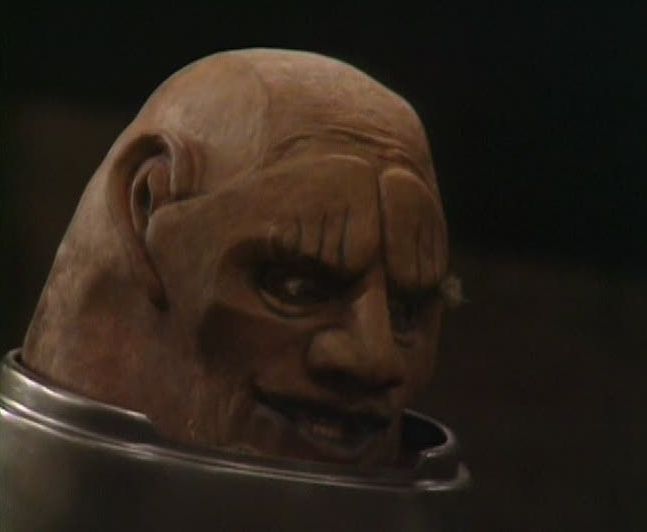
There are problems with The Two Doctors, and the major one is the Sontarans. Although they have the reputation of being a classic Doctor Who monster, they were remarkably ill used, particularly in the original series. Linx was great, thanks to a wonderful performance by Kevin Lindsey and an impressive mask. Styre was comprimised by only appearing in one episode and a slightly less impressive mask (made to ease the strain on Kevin Lindsey). Stor was pretty rubbish and the Sontarans were generally pretty ineffectual anyway in The Invasion of Time.
Which leads us on to their next appearance, in this story, and it does seem to be a case of diminishing returns. The masks here are the worst yet seen – they look far too obviously like masks (just compare them to Linx from a decade earlier). Both Stike and Varl are very tall as well, which looks a little odd – nasty, brutish and short should be how the Sontarans look. Holmes writes them quite well, and Stike has a nice military swagger, but it’s clear they’re not the focus of the story and it probably would have worked just as well with just the Androgums.
The Sontarans (and their ill-fitting masks) fail to impress
The debate about violence during S22 was a fairly hot topic and there are two main talking points here – the death of Oscar and the death of Shockeye. Oscar (James Saxon) seems to be an archetypal Holmes figure (think Vorg in Carnival of Monsters or Jago in Talons of Weng Chiang). They exist to bring a little light relief to the story with their cowardly antics, but they come good in the end – by showing unexpected reserves of courage. Holmes was never afraid to kill off sympathetic characters (Lawrence Scarman in Pyramids of Mars, for example) but the death of Oscar is a jolt.
Although he wasn’t used as much as Jago, there would have been a similar shock if Greel had knifed Jago to death in the last episode of Talons. His death is supremely pointless too – although maybe that’s Holmes’ point. Throughout the story we’ve seen how groups of characters treat the species’ they consider to be lesser than them. The Doctor and Dastari consider the Androgums to be a lower form of life, just as the Androgums regard humans as little more than animals whilst Oscar has no compunction in killing moths, which he does simply for the pleasure their mounted displays brings him.
The Doctor’s killing of Shockeye isn’t a problem – it’s obviously self defence as Shockeye was out for blood. It’s just unfortunate that we have a few shots of the Doctor smiling whilst preparing the cyanide. The sight of the Doctor apparently relishing what was about to happen is more than a little disturbing – although this may not have been the intention and simply how it was cut together.
So whilst the story flags somewhat in the last episode (like City of Death and Arc of Infinity they can’t resist a run-around so they can show off the foreign location) it’s never less than entertaining across all three episodes. It’s a pity that Troughton wasn’t used better and also that the two Doctors were kept apart for the majority of the story, but apart from these niggles it’s a very decent script from Robert Holmes and in many ways it was the last one he wrote where he was fully on top of his game.
For me, The Five Doctors defies critical analysis as to watch it is to be twelve again, when it seemed like the best programme ever. Time may have slightly tempered that enthusiasm, but I still find it’s impossible to rewatch it without a silly grin appearing on my face from time to time.
Is it perfect? Of course not. The Five Doctors was a party where many invitations were handed out, but several people (and one very important guest) were unable to attend. Possibly in a parallel universe they had a story where the 2nd Doctor was partnered with Jamie and Zoe, the 3rd teamed up with Jo and the Brig and the 4th and Sarah were reunited. Also in that parallel universe, maybe Roger Delgado decided not to travel to Turkey in 1973 to film Bell of Tibet so that he was able to return to the role of the Master for the first time in a decade. It’s a nice dream.
But what we have is still very decent fare. Richard Hurndall isn’t attempting to impersonate William Hartnell, Hurndall is playing the first Doctor, which is an important distinction. The only Hartnell story to be repeated in the UK was An Unearthly Child in 1981, so for many of us Hurndall’s was a perfectly acceptable performance. And it still is. He captures the essence of the Hartnell Doctor, there’s certainly the hard edge Hartnell could show from time to time, for example.
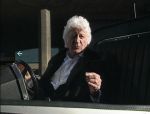
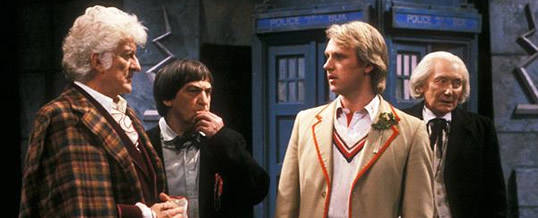
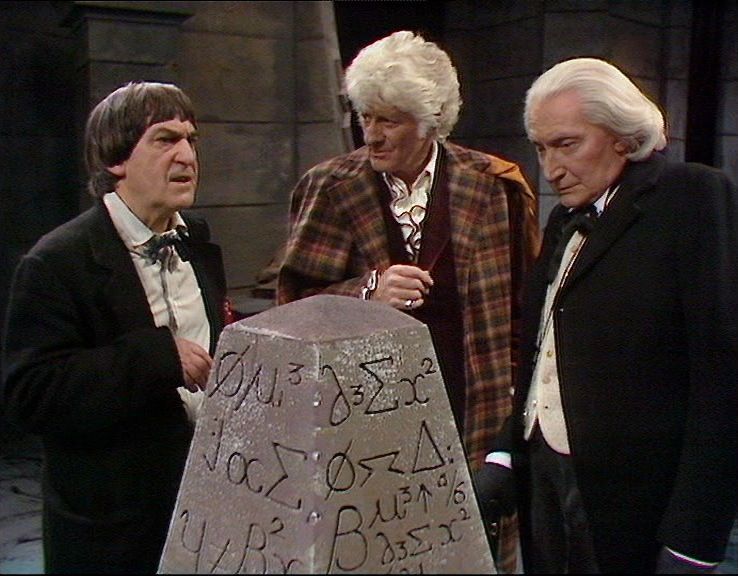
Troughton’s back! He may look older, but he’s the major highlight of this story and it’s hardly surprising that they offered him another one shortly after. He has a wonderful partnership with Courtney and all of their scenes fizzle with memorable dialogue. Frankly, I could have watched a story with just these two and been very content.
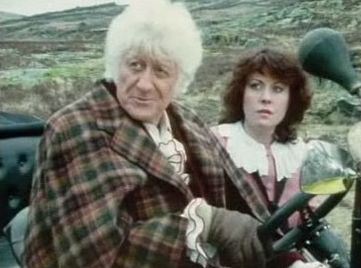
Pertwee’s back! Although his hair’s a little whiter, he’s still recognisably the same Doctor that we last saw nine years previously. But his sequences don’t quite have the same appeal as the Troughton ones and it’s difficult to put my finger on why this is. Terrance Dicks had, of course, been script editor for the whole of the Pertwee era so he should have had no problem in recreating the 3rd Doctor’s characterisation. But he does has some nice moments whilst traversing the Death Zone though, insulting the Master and finding an appropriately heroic way to enter the Tower, for example.
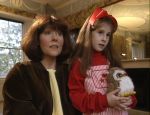
Pertwee benefits from being matched up again with Elisabath Sladen. We’d seen Sarah two years previously in K9 and Company which was lovely, but to see her back with Pertwee’s Doctor is something else altogether. Like everyone else, her lines are rationed so she has to make the most of everything she’s given, and this she certainly does. The fact that her mittens are sewn onto her jacket is incredibly adorable as well.
“Jehoshaphat!”
Tom’s not back! The reason for his non-appearance is well known and it does leave a hole, but we still have a very good story without him. For many people, Tom Baker was the series, so it’s possibly not a bad thing that he wasn’t here – that way it’s possible to see that there can be a decent tale told without him.
Davison’s still here! Terrance Dicks said that he was keen to ensure that Davison got the best of the action and he does have some good scenes, although the Gallifrey section is a bit limp and it’s a pity that he wasn’t teamed up with Troughton and Pertwee a little earlier on. The Doctors were kept apart since there were concerns that egos would clash. I don’t think that Davision would have been a problem, but Jon Pertwee and Tom Baker certainly would have been an explosive combination.
One slight problem I have with The Three Doctors is the way that Troughton is sometimes written down in order to make Pertwee the dominant figure. Since Pertwee was the current incumbent it’s sort of understandable, but I doubt that Pertwee would have been happy to play second fiddle to Davison. And the prospect of Pertwee and Baker together is even harder to imagine. Pertwee never made any secret of his dislike of the way the series progressed after he left (those cynical souls put this down to the fact that Tom Baker was more popular with both the fans and the general audience than Pertwee ever was) so Tom’s non-appearance was possibly a blessing in that respect.
As for the monsters, we have a rather tatty looking Dalek but we finally get to see that the Pertwee Doctor was right when he said that: “inside each of those shells is a living, bubbling lump of hate”. Given that it stays in the shadows, presumably the Yeti was rather shabby, but it gives Troughton another lovely comedy moment when he’s rummaging through his pockets in a desperate search for something to sort it out with.
Since they only appeared eighteen months previously, it’s a little disappointing that the Cybermen are so prominent here but it makes both economic sense (the costumes were in stock) and also practical sense (it’s difficult to imagine the likes of the Daleks trundling through the Death Zone).
Mention of the Death Zone brings us to one of the major plus points of this story – the locations. NuWho has exhaustively mined Wales for locations but as the original series was based in London, trips to Wales were much rarer. Various locations in Gwynedd were used in March 1983 and they help to give The Five Doctors an expansive, epic feeling.
If Leonard Sachs in Arc of Infinity wasn’t the best Borusa ever, then neither is Philip Latham here. It’s hard to understand how the Borusa of The Deadly Assassin and The Invasion of Time could have ended up as the lunatic obsessed with ruling forever that we see here. So that makes his corruption (which should be shocking) something of a damp squib.
And if the Old-King-Cole Rassilon is another odd move, we do get to see the Doctors together at the end of the story, which is something to be treasured. The rarity is why it’s so special, if it had happened more often then the shine would have been taken off it.
“I know what it says, but what does it mean?”
As it was, it’s Pertwee’s final bow as the Doctor (sorry, Dimensions in Time isn’t canon, and isn’t even a story) whilst Troughton was to have one more appearance to come. Therefore, while The Five Doctors is a celebration of the first twenty years, it also marks something of an end as over the following years we would start to bid farewell to some of the actors who had done so much to ensure that the series had reached 20 not out. And while they may be gone, thanks to the magic of DVD their adventures live on forever. So for me, that’s the best way to approach this story, as an appreciation and celebration of some of the people that made this programme so special.







 Archive Television Musings