
I blame the Twitter account @doctorwho1980. They’ve been covering the production history of 1980’s Doctor Who for a number of years (we’ve currently reached June 1983 and the production of Warriors of the Deep).
Partly thanks to their recent deluge of photographs, GIFs and facts about this S21 opener, I’ve had a hankering to revisit it. But also it’s because some of the replies to their tweets have, I confess, raised my hackles just a little.
Many Doctor Who stories see their fortunes wax and wane over the decades, but then there are others (like Warriors) that are doomed to remain stuck in the sediment forever. After all, we all know the “facts” about this one.
- Pennant Roberts was an awful director (hmm).
- The story was massively overlit (double hmm).
- The Myrka was a terrible embarrassment (okay, even I’m going to struggle with defending that one, but I’ll give it a go).
Poor Pennant Roberts. Few DW directors have ever had quite so much opprobrium heaped upon them as he has. The charge sheet contains two heavyweight offerings (Warriors of the Deep, Timelash) although it’s rare for his 1970’s DW work (The Sun Makers, The Pirate Planet, Shada) to receive the same sort of flack. Sure, you can pick holes in, say, The Sun Makers if you wish – but most seem to accept that its uninspiring visuals were due to a lack of budget, and therefore something outside of Roberts’ control.
I’ve never directed a multi-camera VT drama production (like, of course, most of his detractors). But unlike them, I’ve always been prepared to cut him a little slack. The production travails of Warriors of the Deep are well known (a curtailed pre-production period meant that – for example – some sets were still being painted during camera rehearsals) and so simply keeping the show on budget and on time has to count as a major achievement.
And production-wise the story is very good. Tony Burrough’s sets are impressive and Mat Irvine’s modelwork is also up to scratch.
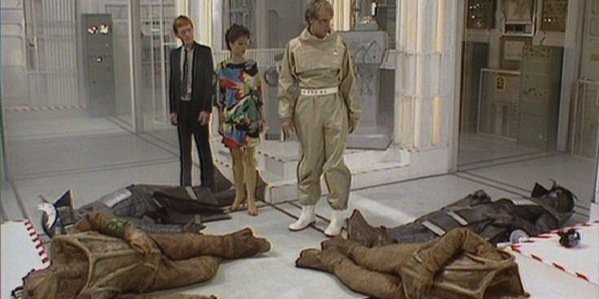
But, of course, we all know that Warriors was derailed partly because all the sets were floodlit.
When this canard is trotted out yet again, I wonder if it’s because the person responsible seriously believes it, or if they’re just parroting what they’ve heard so many times before or possibly it’s the easiest thing they can focus on to give the story a good kicking.
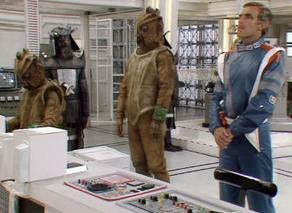
There’s absolutely nothing wrong with the lighting in this story. Yes, the Bridge is quite brightly lit, but up there you’d hardly expect them to be wandering about in the dark (and when there’s a computer simulated missile run on the Bridge in the first episode, the lights drop down dramatically).
Outside of the Bridge, there are shadows everywhere – in the corridors, storerooms, etc. And all these scenes are much the better for it. Even the poor old Myrka, bless him, doesn’t look (quite) as bad when he’s lumbering down dimly-lit corridors.

The elephant in the room (or story) is the aforementioned Myrka. On no level can it be called a design success, but it doesn’t have that much screentime (it appears at the end of episode two and is killed at the end of episode three). Indeed, if you added all of its scenes together, I doubt they’d run for more than a few minutes.
Yes, it seems longer – but this is hardly the first DW story to feature a duff monster (and, by a long chalk, it won’t be the last).
Quite why Eric Saward didn’t insist on cutting the Myrka from the draft scripts is anyone’s guess. The monster doesn’t do anything that the Sea Devils and Silurians couldn’t achieve themselves and logic would have surely told him that on DW‘s budget it was doomed to failure.
Pennant Roberts was always referred to as an actor’s director. Given this, it’s slightly odd that most of the guest performances are very stiff. Roberts might have got some good performances out of Ian McCulloch during their days on Survivors (amongst the episodes directed by Roberts was the memorable S1 effort Law and Order. Funny how no-one was suggesting back then that he was a useless director) but he’s just phoning it in today. Mind you, I guess some lines (“so if your conscience bothers you, lock it away in a strong box until our task is completed”) are tricky to deliver with any feeling.
Tom Adams as Commander Vorshak deadpans throughout (“you’ll get no help from me, Silurian”) but over time it’s become a turn that I’ve grown to enjoy. Nigel Humphreys makes a little go a long way and the younger cast members – Tara Ward, Martin Neil, Nitza Saul – offer slightly more naturalistic performances.
Then there’s Ingrid Pitt, who’s in a class all of her own. The Time Monster would have primed the DW viewer about what to expect, and she lives up (or down, depending on your point of view) to expectations.
As for our reptile friends, it’s staggering how quickly the Silurians make their first appearance (when the story is barely two minutes old). Clearly nobody felt that holding them back for a “shock” cliffhanger was worthwhile. Whenever two Silurians are talking to each other it’s rather painful (due to their silly voices and flashing third eyes) but things calm down a little in the final episode, once the Doctor is able to confront them.
This is also when the story moves up a gear. Firstly, Ichtar (last of the noble Silurian triad – um, let’s not worry about that) describes his final solution (“these human beings will die as they have lived, in a sea of their own blood”) before the Doctor is forced to make a tricky moral decision which he later ends up regretting (“there should have been another way”).
Everybody dies! Apart from Bulic, although it’s possible he could have perished off screen. It’s the sort of nihilistic ending you know Eric Saward would have loved (and is repeated later in the season – first in Resurrection and then Androzani). Davison – never less than the complete professional – does his best to sell the anguish of the Doctor’s final line and, hand on heart, it worked for me.
So there you are. Warriors of the Deep is a story that I enjoyed rewatching this time round. It’s riddled with holes if you wish to pick it apart, but I found it slipped by more agreeably than a fair few stories which DW fandom insists are better.

 Archive Television Musings