Sergeant Cork – The Case of the Knotted Scarf

knotted

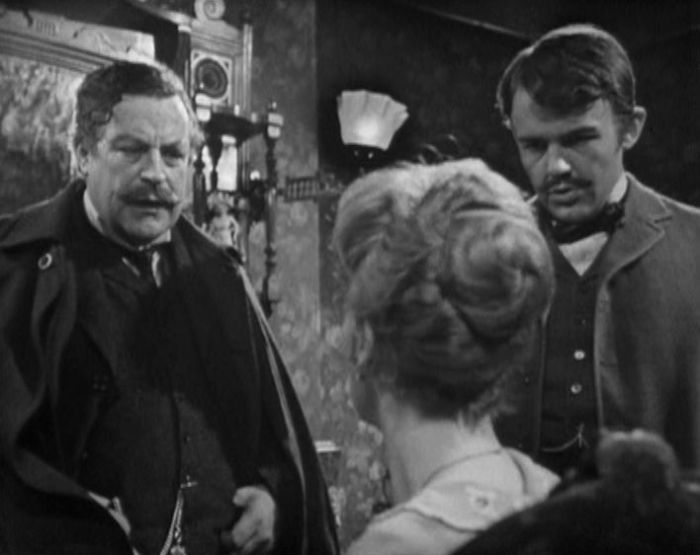
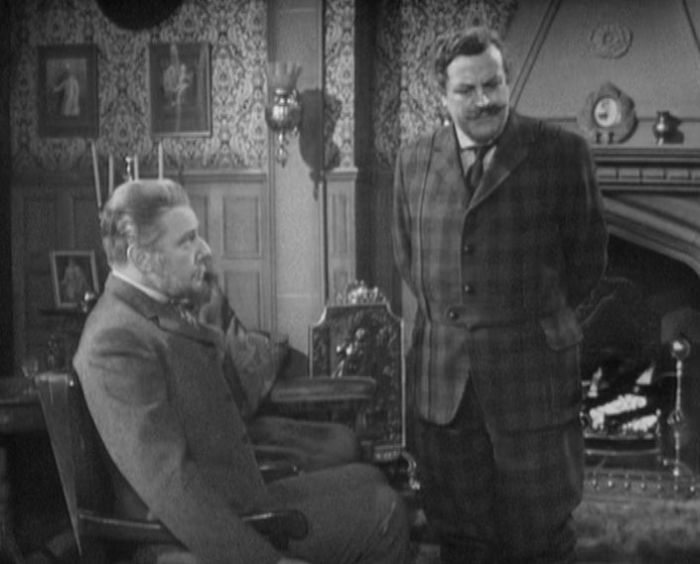
Cork and Marriott venture into the countryside to investigate the murder of Lady Langford.  Her husband, General Sir Gerald Langford (Brewster Mason), is a distinguished old solider, whilst his late wife was much younger (and had previously been an actress).  After viewing where the body had been found the pair venture to Langford’s palatial house and begin to peel away the layers of this intriguing mystery.

Cork’s check suit (presumably it’s his country wear) is a sight to behold.  But whilst his appearance is a little distracting, Cork’s analytical skills remain just as sharp in the country as they are on the streets of London.  Sir Gerald is convinced that his wife was killed by a mysterious madman, but Cork is quick to contradict him – he believes that the murderer will be found much closer to home.  A little later Cork outlines his detective’s philosophy to Marriott. “You have to cultivate a mind that traps details like a spider’s web snares flies. And always work on the assumption that things are never quite what you think they’re going to be.”  Rather delightfully he breaks off from his monologue to wonder if he’s becoming pompous in his old age, telling Marriott that if so then Bob has his permission to boot him up the backside!

The General is wheelchair bound, so that seems to eliminate him, but he has a house-guest (the mysterious Jean-Pierre Ducane) who seems a likely suspect.  British-born Robert Arnold, playing Ducane, sports a very broad French accent.  British actors playing every nationality under the sun were very common during this era of television, but if you think he’s going rather over the top there’s a clever twist later on which explains why.

Brewster Mason is rather odd casting as Langford.  The General is presumably supposed to be in his sixties, but Mason was only in his early forties when this was made.  A fake beard and wig aren’t really enough to sell the illusion that this is an elderly man, especially when the camera favours him with close-ups that show his unlined face.

Director Anthony Kearey adds a few flourishes to the production.  A particularly memorable shot is that of Ducane, as seen though the barrel of Langford’s rifle.  Apart from a few brief scenes elsewhere, the bulk of the story takes place in Langford’s house (which is attractively decorated with mementos from the General’s time in India).

So this is effectively a country house murder mystery – and in time honoured fashion it concludes with Cork gathering all the members of the household together before revealing the murderer’s identity.  This was Jon Manchip White’s sole writing credit for Cork, which is a pity as The Case of the Knotted Scarf is a very decent murder-mystery with an unexpected ending.  Since there aren’t that many suspects it’s possible to have a stab at working out who the murderer is (although I have to confess that I didn’t get it right!).
 

Sergeant Cork – The Case of the Two Drowned Men

drowned.jpg

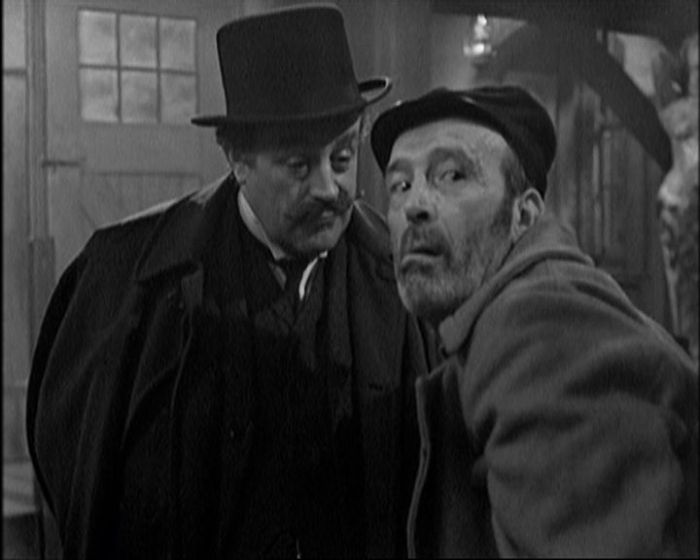
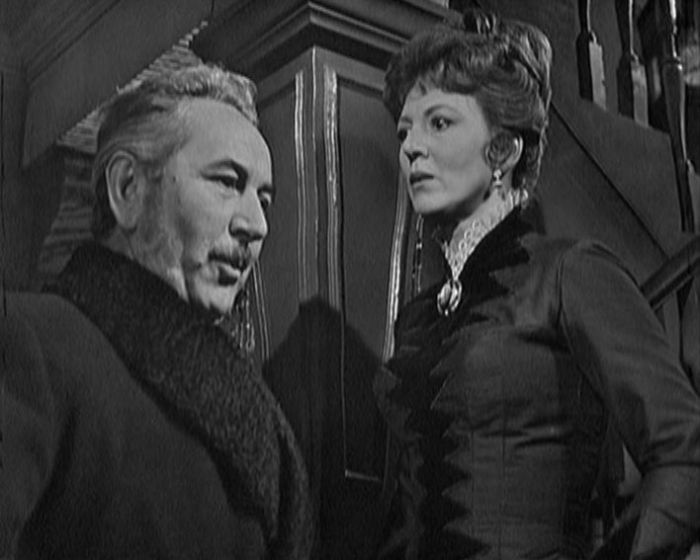
Cork and Marriott are hunting two men who killed a bank messenger and made away with a thousand sovereigns.  A tip off leads them to the docks, where Sergeant Dempsey (Victor Brooks) has some news – he says that one of their suspects, Jack Simons, has been fished out of the river.  The ever-suspicious Cork isn’t too sure, since the man’s face was so disfigured as to make a physical identification impossible.  Dempsey responds that they found several papers in the dead man’s pockets which positively identified him as Simons.  The next day, the other man they were looking for, Steve Gurling, is also found dead in the river.  But Cork’s still not happy – why weren’t both men killed at the same time?

The mystery of whether Simons and Gurling are alive or dead isn’t one that’s played out for very long.  Within the opening ten minutes or so we see a boat tie up at the docks and two men get out.  They call each other Steve and Jack which makes it obvious that these are the two men Cork and Marriott are searching for.  It’s a pity this is so explicitly (and rather clumsily) explained straightaway, as it dissipates the mystery somewhat.

Steve Gurling was played by Tony Beckley.  Beckley tended to play rather fey characters, such as Freddie in The Italian Job, Rene Joinville in the Callan episode Suddenly – At Home and most memorably of all, the monomaniacal plant lover Harrison Chase in the Doctor Who serial The Seeds of Doom.  Since Gurling is a rough, tough, East End type it’s not really a part that plays to Beckley’s strengths, but he still makes a decent fist of it (even if his performance isn’t terribly subtle).  He’s not alone in this though, as some of the other inhabitants of the waterfront offer equally broad turns (the cackling crone especially).  But although there’s more than a touch of “gor blimey guvnor” about this episode, it still offers a decent portrait of the underbelly of Victorian London.

Cork views the area with extreme disfavour.  “Do you know what this place could do with, lad? A terrible thing to say, but it could do with another fire. Another Great Fire of London, burn out all these slums. They breed vice and they breed vermin.”  Marriott replies that it’s no use getting rid of the slums if you don’t get rid of the poverty that causes them – a point which the Sergeant agrees with.

Production design is impressive.  Without ever leaving the studio, designer Anthony Waller was able to create a convincing outdoors environment.  The Adam and Eve is a nicely designed waterfront dive (complete with parrot!) and there’s enough water to create the illusion that the docks are close by.  The use of sound effects (such as the constant hooting of tugboats) and a touch of smoke (to simulate the London fog) are also simple, but effective, ways of enhancing the atmosphere.

William Gaunt shows a flair for comedy as Marriott goes undercover at the Adam and Eve.  He’s disguised as a sailor with a fake beard and an even faker Irish accent, but only gets a black eye for his trouble.  Later he’s bashed about the head after he follows a suspect, to the despair of Cork who expresses his exasperation quite forcibly!

As I’ve said, this is pretty ripe stuff, but John Barrie continues to impress.

Sergeant Cork – The Case of the Girl Upstairs

girl upstairs.jpg

Returning to his rooms following a long train journey, Cork is looking forward to a quiet evening and a bite of steak and kidney pudding.  So he’s less than impressed to find Marriott waiting with a Miss Beesley (Margaret Diamond) who has a matter she wishes to discuss urgently.

She’s convinced that her niece Jane (Meg Ritchie) is being poisoned by her stepmother Charity (Mary Kenton).  Following her brother’s death Miss Beesley has been barred from the house, but she recently caught a brief glimpse of Jane and was shocked by her appearance.  Jane is attended by a doctor, Ernst Lukas (Joseph Fürst), but Miss Beesley has a very low opinion of him.

After an opening scene of Jane suffering under Charity’s ministrations (she’s forced to sleep in a room with the windows open and a single blanket) we get a brief glimpse of Cork’s home-life.  Cork has comfortable rooms and an indulgent landlady who ensures that he has hot meals. It’s clearly a pleasant enough existence but it’s an early indication that there’s no significant other in his life.

Cork seems initially unimpressed by Miss Beesley’s suspicions, which she counters by asking if he is “always governed by fact in everything you do? Are you never swayed by instincts, by feelings?” He responds that he often acts on his instinct and agrees to investigate.

It’s clear from the start that Charity Beesley is waging psychological warfare on her step-daughter, but it’s not clear why.  Mary Kenton is chilling as Charity, whilst Meg Ritchie is convincingly overwrought as the unfortunate Jane.  Joseph Fürst (complete with monocle) gives an understated performance as Dr Lukas.  For me, it’s impossible not to associate Fürst with his gloriously over the top performance as Zaroff in the Doctor Who story The Underwater Menace, but that seems to have been something of an aberration.  Apart from Zaroff, he tended to play sinister characters who were much more grounded in reality (for example, his two Callan appearances).

Lukas is revealed to be brilliant, but also unorthodox and unbalanced.  For him, Jane is nothing more than an experimental subject.  He has no desire to kill her – that would invalidate the experiment – but also has no compunction in pushing her to the edge of madness.

It’s a bleak ending – Cork, Marriott and Arthur Lowman (Philip Latham sporting a rather obvious false beard – not the last time we’ll see fake face fungus in this series) rescue the girl, but Lowman is pessimistic about whether she’ll ever come to her senses.  So whilst the guilty will be punished it seems that the innocent are fated to suffer as well.

The Case of the Girl Upstairs is quite slowly paced but it’s still a satisfying story, thanks to a brief, but memorable, guest turn by Joseph Fürst.

Sergeant Cork – The Case of the Reluctant Widow

widow

Sergeant Cork is an excellent example of just how good a mid sixties studio-bound VT series can be.  Running for a total of sixty six episodes, it was made on something of a production treadmill – the first production block of forty episodes ran from April 1963 to September 1964.  Following a break, there was a second production block of twenty six episodes which were recorded between March 1965 and March 1966.

This meant that an episode would have to have been designed, rehearsed and recorded every two weeks.  Given the relentless nature of the production process it’s remarkable that the quality of the series remained as high as it did.  There are, naturally enough, some lesser episodes over the run, but the general quality remained very high.

A major part of its success has to be down to the two main regulars, Cork (John Barrie) and Bob Marriott (William Gaunt).  Barrie is always incredibly watchable and manages to highlight many facets of Cork’s character over the duration of the series.  Cork is a crusader and an innovator, with a highly developed sense of justice.  Bob is initially a bewildered intruder into Cork’s world, but quickly develops an a wry sense of humour and becomes a perfect foil for the unpredictable sergeant.

Sergeant Cork is set in the late Victorian era, at the time when science was beginning to make a breakthrough in the detection of crime.  In some ways Cork isn’t too dissimilar from Sherlock Holmes – since he also was keen to find scientific ways to fight crime.  And they also both live for their work (there’s no Mrs Cork, for example)

Bob has decided on a career in the police force.  It’s interesting that he can just turn up for an interview with Superintendent Nelson (John Richmond) and find himself working as a detective the same day.  But Nelson does explain that recruiting people into the detective branch has been difficult.  “Some people, you see, regard the CID as an experiment, some regard it as a failure and very few regard it as important.”  He decides to assign Bob to Sergeant Cork.

Our first sight of Cork sees him using his long-suffering general factotum Chalky White (Freddie Fowler) as a guinea pig (Cork is testing various methods of taking fingerprints).  He mentions to Bob that the Americans have been using fingerprint identification for several years and the possibilities of introducing such a system in Britain clearly both intrigues and stimulates him.

With an air of absent-minded enthusiasm, Cork’s character is quickly defined – he’s somebody who is quick to embrace any scientific advance in the fight against crime. But since Superintendent Nelson has already told Bob that the CID is not highly regarded, it’s plain that Cork (due to his unorthodox methods) will face a struggle to convince others that he’s not simply a crank.

In these early scenes, Bob finds himself bewildered by Cork’s tangential enthusiasm and it takes a little while before he’s able to find his bearings and settle in.  To begin with he’s not even sure what case they’re supposed to be investigating – until Cork eventually explains.

After Mr Oxley dies in his bed, the question has to be, was it suicide or murder?  Suspicion falls on his beautiful young widow Julie Oxley (Jean Trend).  But Dr Cato (Peter Halliday) reports to the inquest that he found traces of chloroform in Oxley’s stomach and from this declares that the man took his own life.  For the local police this seems to close the case, but Cork is far from convinced and he’s quite forthright (in a manner that will be become very familiar) in making this clear to Superintendent Bradnock (Gerald Case).  Cork is no respecter of seniority and isn’t at all cowed by Bradnock’s initial hostility.

John Barrie hits the ground running.  His questioning of Mr Oxley’s mother Kate (Hilda Barry) is a classic scene.  Although Cork gives the impression of being an affable sort, his cross-examination shows that he can also be ruthless.  Whilst Mrs Oxley professes a deep love for her son (and also makes it clear that she believes he was murdered by his wife) Cork is relentless in exposing the fact that she held her son in contempt.

Suspicion falls on Clive Graham (Christopher Guinee) after he’s spotted throwing a bottle of chloroform away.  Graham runs the cafe owned by Mr and Mrs Oxley and certainly seems to be on intimate terms with Mrs Oxley.  But Mrs Oxley appears to be heavily implicated as well – despite her tearful protestations of innocence to Cork.

Jean Trend (a familiar face from the likes of Emergency Ward 10 and Doomwatch) gives a good performance as Julie Oxley.  Mrs Oxley’s histrionics are impressive, but they cut no ice with the suspicious Cork.  Another actor who’s instantly recognisable is Peter Halliday as Dr Cato.  Halliday didn’t often use a Welsh accent (despite being Welsh-born) so The Case of the Reluctant Widow is something of a rarity.

With a final surprising revelation, this is a very decent opening episode.  It’s a pity that the existing telerecording (like most of the series one episodes) is rather hacked about (the adcaps have been very clumsily edited out) but that’s only a minor niggle.