Time and the Rani seems to be nobody’s favourite Sylvester McCoy story (including McCoy himself). It was a rather uneasy collaboration between old-school writers Pip and Jane Baker and the new script editor Andrew Cartmel. Although I’m sure we’ll have more to say on Cartmel’s work as we move through the McCoy era, one positive step he took was to find and encourage new writers.
Eric Saward had always found the job of locating new writers to be a problem, but everything Cartmel commissioned (Time and the Rani was in preparation before he joined the series) was from writers new to Doctor Who. And although Cartmel had a fairly low opinion of Time and the Rani there wasn’t time to do a major re-write, so the story went into production pretty much as written.
This, of course, marks Sylvester McCoy’s debut as the Doctor and his performance is, broad, to put it mildly. There’s plenty of clowning and pratfalls (which naturally didn’t please some sections of Doctor Who fandom at the time) and it doesn’t take long before the new Doctor demonstrates his ability to play the spoons (twice!). But buried amongst the humour are some quieter, still moments which hint at the Doctor he will become.
Mel gets to scream (an awful lot) and forge a friendship with the hot-headed rebel Ikona (Mark Greenstreet). Like the other main characters, Ikona is very much a generic Doctor Who character (we also have Donald Pickering as the noble leader and Wanda Ventham as the proud, supportive wife and mother). There’s a slight sense that three good actors are being wasted in fairly nothing roles, but the story does benefit from having them here.
The Rani’s back! And since she’s no longer has the Master hanging around, she needs another Time Lord to help her with the fiddly bits of her master-plan (this all gets explained in the last episode but it’s not really worth waiting for). She snares the Doctor by diverting his TARDIS with a very small gun. It’s worth wondering how long she spent on the planet’s surface, looking up to the heavens, waiting for the Doctor’s TARDIS to appear. Actually, it’s probably best not to dwell on this, because it is a very silly idea.
Seemingly unconcerned that she’s triggered a regeneration for the Doctor, the Rani then plays dress-up (see The Mark of the Rani for another example of her cosplay skills). This time she’s dressed as Mel and there’s some fun to be had with Kate O’Mara’s wicked mimicking of Bonnie Langford.
Although the story is fairly derided, it does chug along quite nicely. The small cast means that the focus is very much on the Doctor, Mel and the Rani. How much this appeals does depend on your opinion of all three actors – so for some this is clearly not a good thing at all. The Tetraps are a bit iffy though – they look like men in costumes, wearing masks (which is what they are, but it’s a bad sign when they look so fake).
But whilst I can’t make the case that this is an overlooked classic, it’s possibly not quite as bad as some would have you believe. It’s certainly not Underworld bad, which is one of those stories where I find my brain switching off during episode two and by the time the credits for episode four have rolled it’s very hard to remember exactly what’s happened during the last 75 minutes (apart from bad CSO, rocks, more bad CSO and more rocks).
Given the rather indifferent nature of The Trial of a Time Lord, S24 really needed a substantial opening story that would refire the public’s imagination. Time and the Rani certainly wasn’t it (in fact we’d have to wait another year and Remembrance of the Daleks for the first signs that Doctor Who was starting to recover it’s strength) but Time and the Rani is a diverting enough way to spend 100 minutes.
Episodes seven and eight of An Age Of Kings adapt Henry V, one of Shakespeare’s most popular and enduring plays. Possibly part of the reason for its appeal is that, like so many of Shakespeare’s works, it is open to various different interpretations. It can be played as a straightforward heroic piece (as this adaption does) but it also contains darker sequences which explore both the folly and the bitter consequences of war.
The Henry presented across these two episodes is a fairly unambiguous character (similar to Olivier’s performance in his 1944 film) with many of the more questionable points concerning his conduct either downplayed or cut. But although there are some trims, the bulk of the play is presented here very well – especially considering the limitations of the television studio.
Shakespeare was obviously aware of the problems that existed in attempting to re-create the battle of Agincourt on stage, so the Chorus appears at the beginning of the play to crave the audience’s indulgence in exercising their imagination.
But pardon, and gentles all,
The flat unraised spirits that have dared
On this unworthy scaffold to bring forth
So great an object: can this cockpit hold
The vasty fields of France? or may we cram
Within this wooden O the very casques
That did affright the air at Agincourt?
O, pardon! since a crooked figure may
Attest in little place a million;
And let us, ciphers to this great accompt,
On your imaginary forces work.
Given that this television play would also need to call on the audience’s suspension of disbelief, the Chorus is retained and, as played by William Squire, he is able to take us through the early action and operates as a narrator. A more filmic dramatisation could have dispensed with this device, but the theatrical nature of this play suits the Chorus well.
Many familiar faces from previous episodes (John Ringham, Frank Windsor, Julian Glover, Jerome Willis, etc) fill out the minor roles and there are also several new faces, most notably Judi Dench as Katherine. She has a single scene here, played with Stephanie Bidmead, and delivered entirely in French – but she manages to light up the screen even in such a short space of time.
Henry V is one of Shakespeare’s most quotable plays and one of the most famous speeches comes in the middle of this episode.
Once more unto the breach, dear friends, once more;
Or close the wall up with our English dead.
In peace there’s nothing so becomes a man
As modest stillness and humility:
But when the blast of war blows in our ears,
Then imitate the action of the tiger;
Stiffen the sinews, summon up the blood,
Disguise fair nature with hard-favour’d rage;
Then lend the eye a terrible aspect;
Let pry through the portage of the head
Like the brass cannon; let the brow o’erwhelm it
As fearfully as doth a galled rock
O’erhang and jutty his confounded base,
Swill’d with the wild and wasteful ocean.
Now set the teeth and stretch the nostril wide,
Hold hard the breath and bend up every spirit
To his full height. On, on, you noblest English.
Whose blood is fet from fathers of war-proof!
Fathers that, like so many Alexanders,
Have in these parts from morn till even fought
And sheathed their swords for lack of argument:
Dishonour not your mothers; now attest
That those whom you call’d fathers did beget you.
Be copy now to men of grosser blood,
And teach them how to war. And you, good yeoman,
Whose limbs were made in England, show us here
The mettle of your pasture; let us swear
That you are worth your breeding; which I doubt not;
For there is none of you so mean and base,
That hath not noble lustre in your eyes.
I see you stand like greyhounds in the slips,
Straining upon the start. The game’s afoot:
Follow your spirit, and upon this charge
Cry ‘God for Harry, England, and Saint George!’
This is a speech that defines Henry and Robert Hardy delivers it with passion and relish. The staging of the scene is done very effectively – the camera is placed behind a group of soldiers and Henry stands directly in front of them. The camera therefore acts as a member of the crowd and the tight nature of the shooting helps to disguise the small scale of the set and the limited number of extras.
By the end of the episode we have reached the conclusion of Act III and the fields of Agincourt beckon.
Uneasy Lies The Head concludes the tale of Henry IV Part Two. As the episode opens, a sickly Henry (Tom Fleming) is still awake in the early hours of the morning and muses on why everybody should be asleep but he.
Canst thou, O partial sleep, give thy repose
To the wet sea-boy in an hour so rude,
And in the calmest and most stillest night,
With all appliances and means to boot,
Deny it to a king? Then happy low, lie down!
Uneasy lies the head that wears a crown.
As with the previous episodes, Fleming is very good and whilst he doesn’t have a great deal to do (this scene and his deathbed scene are his two main moments) he’s still compelling to watch.
But as with The New Conspiracy the focus of the piece (at the start anyway) is concerned with Falstaff’s misadventures. But he’s met his comic match when he comes up against Justice Shallow (William Squire). Squire delivers a fine performance as the fussy, reflective Shallow and he’s one of the highlights of Uneasy Lies The Head.
The heart of the piece, though, is the death of the King and Hal’s elevation to the throne. Believing the King to be dead, Hal takes away the crown, but Henry still has breath in his body and is dismayed to find his crown missing. Hal explains his actions (some quality acting here from both Robert Hardy and Tom Fleming) and they are reconciled just before Henry’s death.
Once Hal has become King Henry V there is one important matter to be dealt with – that of Falstaff. Although I can’t confess to have been greatly enamoured with Frank Pettingell’s performance during the last few episodes, he does manage to capture very well Falstaff’s shock and hurt when Henry publicly disowns him. Hardy’s delivery here is spot on – and his journey from wastrel Prince to King Henry V is completed.
I know thee not, old man: fall to thy prayers;
How ill white hairs become a fool and jester!
I have long dream’d of such a kind of man,
So surfeit-swell’d, so old and so profane;
But, being awaked, I do despise my dream.
Make less thy body hence, and more thy grace;
Leave gormandizing; know the grave doth gape
For thee thrice wider than for other men.
Reply not to me with a fool-born jest:
Presume not that I am the thing I was;
For God doth know, so shall the world perceive,
That I have turn’d away my former self;
So will I those that kept me company.
As the credits roll, there’s one more surprise. We see the actors removing their stage clothes and talking amongst themselves whilst the camera gradually focuses on William Squire. Squire removes the white wig and false nose of Shallow and after the credits have finished he steps forward to deliver the epilogue of the play which promises the return of Falstaff (something which didn’t happen as Shakespeare obviously changed his mind – Falstaff dies off-stage in Henry V).
The breaking of the fourth wall is somehow in keeping with the theatrical tradition of the piece and it’s an interesting conclusion to the episode.
If The Ultimate Foe brings The Trial of a Time Lord to a slightly disappointing conclusion, the somewhat chaotic nature of the scripting of the story is probably the reason why.
Eric Saward had commissioned Robert Holmes to write the two concluding episodes. Holmes was mid-way through episode thirteen when he was hospitalized and sadly, he was to pass away shortly afterwards. With Holmes in hospital, Saward completed episode thirteen and, working from Holmes’ story outline, wrote the concluding episode.
JNT wasn’t happy with Saward’s ending (the Doctor and the Valeyard were trapped, apparently for ever, in a Time Vent) and asked for it to be changed. Saward refused and then resigned as script editor, taking his script with him. He also attempted to stop his section of episode thirteen from being used, but was unsuccessful.
Pip and Jane Baker were commissioned to write a new concluding episode. For copyright reasons they couldn’t be given any details of Saward’s script. So all they had to go on was episode thirteen and to make matters worse they had only a few days to deliver a workable episode.
Holmes’ section of episode thirteen runs up until the Doctor enters the Matrix. After that (with one exception) the rest was scripted by Saward. What’s interesting about Holmes’ scenes is how he takes yet another opportunity to tarnish the reputation of the Time Lords. Holmes had started this process some ten years earlier with The Deadly Assassin. And in many ways, The Ultimate Foe is really The Deadly Assassin II.
Episode thirteen answers some of the unanswered questions from The Mysterious Planet (although it’s debatable how many people actually remembered the points that are tidied up). Glitz and Mel are called as star witnesses and the Master pops up. I love the reveal of Ainley on the Matrix screen as well as his comment that he’s been sat in the Matrix watching everything and “enjoying myself enormously”.
The Master has the best seat in the house
All of the Time Lords’ dirty schemes are revealed (they’re somewhat complicated it has to be said) and there then follows a scene which could have been a game-changer in the direction of the series.
MASTER: You have an endearing habit of blundering into these things, Doctor, and the High Council took full advantage of your blunder.
INQUISITOR: Explain that.
MASTER: They made a deal with the Valeyard, or as I’ve always known him, the Doctor, to adjust the evidence, in return for which he was promised the remainder of the Doctor’s regenerations.
VALEYARD: This is clearly
DOCTOR: Just a minute! Did you call him the Doctor?
MASTER: There is some evil in all of us, Doctor, even you. The Valeyard is an amalgamation of the darker sides of your nature, somewhere between your twelfth and final incarnation. And I may say, you do not improve with age.
The origin of the Valeyard is something of a mystery and is never addressed. There was further mileage in an evil anti-Doctor (possibly taking over from the Master as the Doctor’s main nemesis) but it was never explored again (on television at least). But these two episodes do give Michael Jayston a chance to flex his acting muscles (and lose the hat!) and whilst the Valeyard never develops beyond a fairly stereotypical villain, Jayston does give him a bit of class.
Mel – “As truthful, honest, and about as boring as they come.”
Given the scripting race against time, episode fourteen is actually a lot better than it could have been. There’s some nice set-pieces (the Doctor apparantly convicted in a fake trial room and the unmasking of Popplewick aka the Valeyard) but the Valeyard’s ultimate plan (to assassinate various key Time Lords) is a little less than impressive. But there’s some prime examples of the Bakers unique use of the English language to enjoy – “a megabyte modem” and “there’s nothing you can do to prevent the catharsis of spurious morality” amongst others.
And then it’s all over. The Doctor is free to go and leaves with Mel (paradoxically before he’s actually met her!) and the Valeyard lives to cackle another day. Colin Baker’s final words “carrot juice, carrot juice, carrot juice” are perhaps not the most impressive last words he could have had – but, of course, it wasn’t planned to be his final story.
Over the last three weeks or so, I’ve really enjoyed revisiting all of Colin Baker’s stories for the first time in a number of years. He was something of a victim of circumstances and had things been different he could have gone on for several more years and really established himself as one of the best Doctors. But even given his rather compromised stint, there’s still plenty to enjoy in S22 and S23 and it’s with a little regret that I bid him farewell.
Anybody who’s ever studied the tortured production history of S23 will probably be aware that Eric Saward had some trouble in finding workable scripts. Various writers were approached and submissions were made, but many of them came to nothing. So it’s fair to say that Pip and Jane Baker weren’t his first choice to fill episodes nine to twelve – they were commissioned more as an act of desperation when everything else had fallen through.
Not that Saward had much to do with the story. The dispute over his script for episode fourteen (which I’m sure we’ll touch upon when we reach The Ultimate Foe) triggered his resignation and Terror of the Vervoids went through the production process without a designated script-editor (JNT assumed these duties).
The lack of Saward isn’t really notable – as the Bakers were quite able to script a decent story off their own bat (although as per all their stories, sometimes the characters are saddled with very unnatural sounding dialogue). Vervoids is an entertaining whodunnit, packed with suspects and red-herrings galore. It may (like the rest of S23) look a little cheap (some of the Hyperion III seems to be cobbled together from stock) but there’s a decent set of actors and minimal interference from the trial, which makes this one of the highlights of S23.
Professor Lasky gets caught by the Vervoids
Chris Clough was assigned director of the final six episodes and his influence is notable from the first shot – he’s turned down the lights in the Trialroom and everything instantly looks a great deal better. Although there are a few instances when it appears that the Matrix has again been tampered with, this doesn’t impact the story as badly as it did Mindwarp. And episode nine allows the story time to develop with the trial sequences book-ending the episode – it’s nice, for once, to have an episode where there aren’t delays every few minutes which are devoted to discussing meaningless points.
It’s maybe just as well that the Internet didn’t exist in 1986, as the casting of Bonnie Langford would have caused it to melt. She wasn’t exactly welcomed with open arms by a certain section of Doctor Who fandom (who clearly saw her casting as the final straw) but looking back at this story she’s perfectly fine. She does lack any sort of background (inevitable since we’re introduced to her cold in this story) but Mel’s young, keen, headstrong and with a knack for getting into trouble. She can also scream in tune with the closing sting on the theme music, which is a good trick!
True, her opening scene is somewhat iffy –
MEL: This will wake you up.
DOCTOR: Carrot juice?
MEL: It’ll do you good. Honestly, carrots are full of vitamin A.
DOCTOR: Mel, have you studied my ears lately?
MEL: It’s your waistline I’m concerned about.
DOCTOR: No, no, seriously, though. Is it my imagination or have they started to grow longer?
MEL: Listen, when I start to call you Neddy, then you can worry. Drink up.
DOCTOR: You’ll worry sooner when I start to bray.
But things do pick up after this. It’s also interesting to note how mellow Colin Baker’s Doctor is – he’s a million miles away from the abrasive character of S22, all his previous arrogance and bluster have gone.
Once aboard the Hyperion, the Doctor and Mel mix with the guests and staff and start to uncover various conspiracies. Clearly one whodunnit wasn’t good enough for the Bakers, so there’s a diverse series of events and problems which need to be solved.
Honor Blackman and Michael Craig are the main guest stars. Blackman is good fun as the constantly bad-tempered Lasky, whilst Craig (although he sometimes has the air of a man who wishes he was elsewhere) is solid enough as Travers. David Allister is quite compelling as Bruchner, the scientist with a conscience, whilst the late Yolande Palfrey manages to make something out of nothing, as the stewardess Janet.
Lurking in the air-conditioning are the Vervoids, who aren’t the most impressive monsters that the series has produced. They’re just too polite to be particularly threatening (“we are doing splendidly”) and it doesn’t help that the actors in the suits tend to do typical monster acting – lurching from side to side and waving their arms about.
A scary cliff-hanger (something of a rarity in S23)
But if the Vervoids do lack a little something, then there are still a few scares to be had in the story. Since the majority of cliff-hangers this season have ended on a crash-zoom of the Doctor’s pouting face, it’s nice to have two that buck the trend. Episode nine gives us a chance to hear Mel’s ear-splitting scream as the Hydroponic centre explodes whilst episode ten has the creepy reveal of Ruth Baxter.
After twelve weeks, we’re now into the trial’s endgame. Episodes thirteen and fourteen will either provide a satisfying conclusion to the previous three months or, well, they won’t. The ultimate foe awaits ….
The New Conspiracy picks up from where The Road To Shrewsbury left off. The rebellion, lead by Hotspur, has been crushed but the danger to the King is far from over. The Earl of Northumberland (George A. Cooper) and others still plot to overthrow him – but these machinations are very much placed in the background as this part of the play focuses on Falstaff and his friends.
Any scenes with Falstaff tend to be played very broadly, but Frank Pettingell does have some good actors to play off against. Angela Baddeley (best known for playing Mrs Bridges in Upstairs Downstairs) has several lovely scenes opposite him, as does Hermione Baddeley as Doll Tearsheet. George A. Cooper also manages to change performances totally (he’s the Earl of Northumberland at the start of the episode and the rampant Anicent Pistol at the end). Geoffrey Bayldon, as the Lord Chief Justice, also gets to cross swords with Falstaff. And Bayldon, like the majority of the actors, continues to impress me.
Robert Hardy, as Prince Hal, doesn’t appear until mid-way through the episode, but he still dominates proceedings. There’s a certain steel in Hardy’s performance when he believes that Poins has been ill-using him (Falstaff writes that Poins has made it known that Hal will marry his sister, Nell – much to Hal’s surprise). He also confides to Poins the reason why he isn’t outwardly grieving about his father’s ill-health.
PRINCE HENRY
By this hand thou thinkest me as far in the devil’s
book as thou and Falstaff for obduracy and
persistency: let the end try the man. But I tell
thee, my heart bleeds inwardly that my father is so
sick: and keeping such vile company as thou art
hath in reason taken from me all ostentation of sorrow.
POINS
The reason?
PRINCE HENRY
What wouldst thou think of me, if I should weep?
POINS
I would think thee a most princely hypocrite.
PRINCE HENRY
It would be every man’s thought; and thou art a
blessed fellow to think as every man thinks: never
a man’s thought in the world keeps the road-way
better than thine: every man would think me an
hypocrite indeed.
Although The New Conspiracy feels something like an interlude before the main action, it still moves along quite nicely – and is another step in the journey of Hal from Prince to King.
Mindwarp is the story which suffers most for being part of the Trial format. Like The Mysterious Planet the action stops periodically whilst not terribly interesting points are debated in the Trialroom. For example, in episode five, there are six courtroom scenes, several of which don’t serve any particular purpose (apart from providing some exposure for guest stars Michael Jayston and Lynda Bellingham).
But more serious than this is the Doctor’s growing realisation that what he’s watching on the screen varies significantly from his own memories. Story-wise, this is interesting – but it does damage the narrative, how can we care about what we’re watching if it might not be true?
This concerned Colin Baker, who in rehearsals queried whether certain scenes were real or created by the Matrix. Eric Saward was unable to clarify, so this leaves sections of the story feeling a little unsatisfactory. We can say that the Doctor’s interrogation of Peri on the Rock of Sorrows in episode six and the end of episode eight are at least two examples of faked pictures.
On the original transmission, the end of episode eight was a shock (even allowing for the crash-zoom into the pouting face of Colin Baker). That this ending is negated later in the season is a fatal flaw. It would have been far better to have it revealed that the Time Lords were responsible for Peri’s death – since they took the Doctor out of time before he could save her. Instead, we have the fudge that it never really happened.
If we put aside the problems with the Trial format, then Mindwarp is still a solid, if unspectacular, Doctor Who story. Brian Blessed is the main guest star and he produces a typical Brian Blessed performance. Even by the mid 1980’s, he was (in)famous for his larger than life performances and he delivers a typical one here. He has a greater range than this though (at times he’s quietly menacing in I Claudius) so it’s a pity he couldn’t have had a more subtle character to play.
Nabil Shaban returns as Sil, much more of a comic relief than he was in Vengeance on Varos. Christopher Ryan (clearly an actor who can’t appear in Doctor Who unless he’s encased in latex) is very good as Kiv, Sil’s boss. Patrick Ryecart gives a typically smooth performance as the unscrupulous Crozier whilst Thomas Branch is able to overcome the difficulties of restricting make-up to deliver a touching turn as Dorff. It’s not all good news though, as Gordon Warnecke is monumentally wooden as Tuza, but his bad performance is an exception.
This is Nicola Bryant’s last story and, as has become a familiar story trope, she spends the majority of it fighting off somebody’s unwelcome attentions. It surely can’t be unintentional that Yrcanos shares a number of character traits with the Doctor (they both shout a lot, for example). The Peri/Yrcanos romance must be the least convincing since Leela/Andred and it’s interesting to ponder exactly how much of a say Peri had in matters. After the Doctor was removed from Thoros Beta she clearly had few other options than to stay with Yrcanos, but after the Doctor realises she’s still alive he never seems particularity interested in visiting to see how she is. Poor Peri!
“Protect me. I am your lord and master”
Nicola Bryant does have some good material though (her final scene is stunning) and there’s some nice exchanges between Peri and Yrcanos.
PERI: Why do they want Tuza?
YRCANOS: Execution one at a time, that’s how it will be.
PERI: Oh. Oh, it’s strange. Ever since we came to Thoros Beta I’ve been homesick. Not so much for a place, but a time. I just want to be back in my own time with people I love.
YRCANOS: What is that? Love?
PERI: Well, it’s when you care for someone or something more than yourself, I guess.
DORF: More than yourself?
PERI: Well, I know it sounds crazy, but, sometimes more than life.
YRCANOS: I care nothing for mine.
PERI: How can you say that, Yrcanos?
YRCANOS: Well, on my planet of Krontep, when we die, our spirit is returned to life, to be born in a more noble warrior.
PERI: Until what? Where do you end after all your brave deaths?
YRCANOS: You become a king! Me, after my next death, I join the other kings on Verduna, the home of the gods.
PERI: To do what?
YRCANOS: Why, to fight! What else?
PERI: Well, that figures
If the Trial sequences don’t help the story, then the decision to have the Doctor act out of character for several episodes is also not a great move. Colin Baker’s abrasive performance during parts of S22 hadn’t found favour with some, so S23 (particularly with its reduced running time) should have concentrated on making him a more accessible character. Of course, at the time nobody knew that Baker would shortly be sacked by BBC management – if he had stayed on then this wouldn’t have mattered so much.
Mindwarp seems to be a slightly less focused story than Vengeance on Varos. Varos had a clear satirical point to make, whilst Mindwarp doesn’t – and at times feels much more like generic Doctor Who. It’s also saddled with some pretty poor dialogue – “Nobody likes brain alteration” – which suggests that Eric Saward’s attention was elsewhere. Indeed, he’d soon be gone and his eleventh hour walkout would be another blow to an already beleaguered season.
The news that two episodes of At Last The 1948 Show have been discovered in David Frost’s personal archive is, of course, very welcome news – as is the fact that they will receive a public screening in December as part of the BFI’s annual Missing Believed Wiped celebration.
Although At Last has sometimes been considered chiefly notable for being a clear precursor to Monty Python, it stands up extremely well in its own right. Written by and starring John Cleese, Graham Chapman, Tim Brooke-Taylor and Marty Feldman, the series also featured Aimi Macdonald.
Some of the already existing material, such as the four Yorkeshiremen sketch, would be instally familiar to Monty Python fans as it remained a staple of their live sets, right up to their farewell gigs at the O2 earlier this year.
The question now is, will these episodes together with the rest of the series, finally receive a worthy DVD release? The previously existing material surfaced on this DVD nearly a decade ago. Since it’s the only commercial way to own the series it was a must buy, although there are several problems with it.
Firstly, the picture quality is very poor. This is because the episodes have been sourced from very ropey looking teleecordings. Restoration could clean them up nicely, but the issue seems to be that whilst a company called Archbuild now owns the copyright of the Rediffusion archive, they don’t actually own the physical recordings.
Ideally, it would be wonderful for a company like Network to issue a release, such as their Incomplete and Utter History Of Britain. Maybe, thanks to the publicity generated by these two rediscovered episodes, the tangled question of copyright and ownership can be resolved and we’ll finally get the DVD the series deserves. One interesting point is that the BFI press release (link at bottom of the post) mentions they have been restoring the material of At Last which they hold. For a possible DVD release maybe?
The other major problem with the existing DVD is that it’s compiled from a series of Swedish compilations and therefore doesn’t flow in the way the original programmes would have done. The following list was compiled by Matthew K. Sharp and it shows what material was used to source the episodes on the DVD –
Episode One
2.5 choir won’t sing hymns
2.5 psychiatrist
2.5 secret service cleaner
??? the nasty way
2.1 reptile keeper swallowed by snake
2.6 chartered accountant dance
2.6 four yorkshiremen
Episode Two
1.6 televisione italiano presenta – let’s speak english
1.5 top of the form
2.1 doctor trying to sell things
2.1 thief hiding in public library
2.1 come dancing
Episode Three
??? musical item
1.4 someone has stolen the news
2.4 topic – freedom of speech
2.7 railway carriage
2.4 repeats report
2.4 tour through a live programme
Episode Four
1.2 opening
1.2 foggy spain link
1.2 four sydney lotterbys
1.3 visitors for the use of
1.3 sleep starvation
1.3 mice laugh softly, charlotte
1.4 jack the ripper
1.4 plain clothes police(wo)men
Episode Five
2.2 opening
2.2 shirt shop
2.2 the nosmo claphanger show
2.2 insurance
2.4 uncooperative burglars
2.2 rowdy scottish ballet supporters
Ideally, any future DVD would present the sketches in the correct order. This would mean some episodes would run short since various episodes are incomplete, but that would be better than the somewhat random nature of the above compilations.
Time will tell on that score, but at the very least it’s to be hoped that these two episodes will make their way into the public domain, as finding archive gems like these does seem somewhat pointless if they’re then locked away from public view.
PDF of the BFI press release concerning the rediscovery.
Update Sep 2015 – Another two episodes have been found which means that we’re getting close to having a complete run of the series (series one episode one only has about five minutes of footage in existence whilst a couple of other episodes have small amounts of material missing). Radio Times article on the new discoveries here.
Doctor Who’s fall from grace in the mid 1980’s was dramatic and sudden. In 1983 the series celebrated its 20th Anniversary and still seemed to be regarded as one of the nation’s favourties. But by 1985 the series was tagged as old fashioned, violent and dropping in popularity.
Doctor Who needed friends in high places, but it was sadly out of luck. Previously, executives and programme controllers had both enjoyed the series as well as recognising its importance in the BBC1 schedules. But by the mid 1980’s a new breed was in place – Michael Grade and Jonathan Powell disliked the show and their dislike became public knowledge.
Therefore, in 1986 it was clear that the series was in trouble. Initial omens for S23 weren’t good. The episode count was slashed to fourteen 25 minute episodes, film was replaced by VT for exterior shots and there was a general feeling that the budget was much tighter than before. If the reduced episode count had ensured that more money was spent on each story then that would have been understandable, but apart from the odd impressive FX shot the series looked as cheap as it had for a long time. Foreign filming (a regular occurrence during the previous three seasons) now seemed to be a thing of the past.
With only fourteen episodes, the programme needed to make an instant impact, but it’s fair to say that the most calamitous decision was to have an overall umbrella theme of the Doctor on trial. Given that the series was fighting for its life with the BBC executives, it clearly struck JNT and Eric Saward as a witty idea to have the Doctor do the same.
As it stands, the Trial sequences slow each story down, as periodically the action is paused for the Doctor, the Valeyard (Michael Jayston) and the Inquisitor (the late Lynda Bellingham) to debate what we’ve all been watching. The Trial only really comes into its own in the last two episodes, but at the start of the series that’s three months away. How many people would stick with it throughout all fourteen episodes and remember the plot threads from this first story which are only answered three months later? The ratings tell their story on that one.
I foresee many objections in the weeks to come
The Trial starts with The Mysterious Planet which was Robert Holmes’ final complete script for the series. Holmes died whilst writing the first of the two episodes designed to wrap the season up and it’s long been regarded that his illness played a factor in the slightly underwhelming nature of this story.
The Mysterious Planet feels like a first draft and although there are familiar Holmesian traits (such as the roguish Sabalom Glitz) there’s a certain lack of sparkle. It’s a perfectly serviceable story (although it draws heavily on Holmes’ own back-catalogue) but after being off-air for 18 months, Doctor Who needed to come back with a bang and this was a little disappointing, It’s certainly no Caves of Androzani, that’s for sure.
Whilst looking for inspiration, Holmes seems to have drawn upon his debut Doctor Who script, The Krotons. Drathro, like the Krotons, remains unseen by the population and regularly takes the two most intelligent work-units to live with him. Although Drathro actually puts their genius to some use, unlike the Krotons.
While the story is a little underpowered, there’s still plenty of good moments. The relationship between the Doctor and Peri has noticeably softened since S22 and therefore it’s a shame that Nicola Bryant’s days were numbered, particularly since this is the last story where she has decent interaction with the Doctor. And as with The Two Doctors Colin Baker benefits from having Robert Holmes write his dialogue.
DOCTOR: I know how you feel.
PERI: Do you?
DOCTOR: Of course I do. You’ve been traveling with me long enough to know that none of this really matters. Not to you. Your world is safe.
PERI: This is still my world, whatever the period, and I care about it. And all you do is talk about it as though we’re in a planetarium.
DOCTOR: I’m sorry. But look at it this way. Planets come and go, stars perish. Matter disperses, coalesces, reforms into other patterns, other worlds. Nothing can be eternal.
Tony Selby seems to be enjoying himself as Sabalom Glitz. Glitz is derived from other Holmes creations, such as Garron, but there’s a slightly harder edge to Glitz (at least in this story).
GLITZ: You know, Dibber, I’m the product of a broken home.
DIBBER: You have mentioned it on occasions, Mister Glitz.
GLITZ: Which sort of unbalanced me. Made me selfish to the point where I cannot stand competition.
DIBBER: Know the feeling only too well, Mister Glitz.
GLITZ: Where as yours is a simple case of sociopathy, Dibber, my malaise is much more complex. A deep-rooted maladjustment, my psychiatrist said. Brought on by an infantile inability to come to terms with the more pertinent, concrete aspects of life.
DIBBER: That sounds more like an insult than a diagnosis, Mister Glitz.
GLITZ: You’re right there, my lad. Mind you, I had just attempted to kill him. Oh, I do hate prison psychiatrists, don’t you? I mean, they do nothing for you. I must have seen dozens of them, and I still hate competition.
Glitz, Robert Holmes’ final comic creation.
The core of the story (a group of primitives who treat various technological devices as items for worship) is a very familiar one and Joan Sims is, at best, merely acceptable as Katryca. We’ve seen far too many similar civilizations in previous Doctor Who stories for the Tribe of the Free to make any particular impression, sadly.
But although The Mysterious Planet is uninspired, it’s not particularly bad. On it’s own merits it’s perfectly watchable and would have slotted in very comfortably mid-season to many a series of Doctor Who. As a season-opener for what looked like a make-or-break year, it falls somewhat short though.
The Road To Shrewsbury opens with Hotspur (Sean Connery) enduring the boastful claims of his ally Owen Glendower (William Squire). Although Glendower isn’t a large part, it’s a scene-stealing gift for any decent actor and Squire certainly takes advantage. Although Squire was born in Neath, Glamorgan, few of his more familiar roles (he was probably best known for appearing opposite Edward Woodward in the Thames series of Callan) called on him to use a Welsh accent, so this is a good opportunity for him to act broadly Welsh. Glendower is certainly a character that has, shall we say, a good opinion of himself.
Cousin, of many men
I do not bear these crossings. Give me leave
To tell you once again that at my birth
The front of heaven was full of fiery shapes,
The goats ran from the mountains, and the herds
Were strangely clamorous to the frighted fields.
These signs have mark’d me extraordinary;
And all the courses of my life do show
I am not in the roll of common men.
Hotspur seems unimpressed with such hyperbole and Connery plays this opening section well – capturing the mocking and insolent nature of Hotspur, which still manages to earn the respect of Glendower.
On the other side, Hal (Robert Hardy) is re-united with his father, the King (Tom Fleming). Although Hal initially seems to be the same casual character we saw in Rebellion from the North, very quickly it becomes apparent that he’s now prepared to put aside his dissolute past and grasp his destiny.
I will redeem all this on Percy’s head
And in the closing of some glorious day
Be bold to tell you that I am your son;
When I will wear a garment all of blood
And stain my favours in a bloody mask,
Which, wash’d away, shall scour my shame with it:
And that shall be the day, whene’er it lights,
That this same child of honour and renown,
This gallant Hotspur, this all-praised knight,
And your unthought-of Harry chance to meet.
For every honour sitting on his helm,
Would they were multitudes, and on my head
My shames redoubled! for the time will come,
That I shall make this northern youth exchange
His glorious deeds for my indignities.
Although Connery is more central to the episode than Hardy (at least until the closing fifteen minutes or so), Hardy is more than able to make a favourable impression during these scenes with the King, and Tom Fleming as Henry IV continues to impress.
Battle scenes throughout An Age of Kings are always somewhat problematic. The nature of live recording, small casts and the limited studio space are all factors which need to be appreciated. There are a few interesting moments though – initially shots of the battlefield are overlaid on the faces of Hotspur and Hal, for example.
Elsewhere, the viewer is required to use their imagination that while they can hear an army offscreen, they can only see a handful of soldiers (this, of course, is a similar experience to watching the play on the stage). Eventually, Hotspur and Hal meet and duel to the death. Their sword-fight (not overly convincing it must be said) is inter-cut with shots of dead bodies on the battlefield and it’s noticeable that Hal’s killing thrust isn’t seen. Was it deemed too violent for the times or did the camera just miss it?
Director Michael Hayes elects to end the episode on the battlefield dead, this time with snow overlaid, which is quite an effective ending. Henry IV Part One has never been a favourite play of mine and this adaptation, whilst solid enough, hasn’t really changed my opinion on it, but it’s well worth watching for Connery and Hardy.
Filmed in Supermarionation is a glorious two-hour documentary from director/producer Stephen La Rivière which tells the story of how a small company based in Slough were able produce some of the most iconic children’s television series of all time.
Central to the story, of course, is the late Gerry Anderson. Happily he’s well represented throughout the documenatry via an extensive interview. Also present is Gerry’s ex-wife, Sylvia, who was a key figure in the sucess of AP Films/Century 21, not least for voicing Lady Penelope in Thunderbirds. Sadly, the divorce of Gerry and Sylvia was very bitter, which meant that during Gerry’s lifetime she was persona non grata – so it’s good to have her contribution appreciated here.
Apart from Gerry and Sylvia, there were a whole host of unsung heroes who brought these shows to life and celebrating their work was one of the main reasons why Stephen La Rivière wanted to make this documentary. Many of the surviving creative team have been interviewed (others who have passed on, like Barry Gray and Derek Meddings, are represented by archive footage) and there’s some lovely moments – such as when a group of puppeteers return to the location of the studio in Slough to be confronted with a immaculate recreation of a studio set, complete with puppets. Also very touching is the moment towards the end, when David Graham (the voice of Parker) takes a moment to thank his wooden friend for making such an important contribution to his career.
Amazingly, Parker and Lady Penelope hardly look a day older than when we first met them in 1964.
Filmed in Supermarionation is presented by Lady Penelope and Parker (voiced, as in the original series, by Sylvia Anderson and David Graham). This allows a few affectionate jokes to be made, as well as giving us the chance to see Parker turn up in some odd places (on the set of Captain Scarlet, for example).
The documentary proceeds in strict chronolgocal order, so the first hour or so is devoted to the early series, such as the two made with Roberta Leigh (The Adventures of Twizzle, Torchy the Battery Boy) before moving onto Anderson’s early solo efforts, such as Four Feather Falls, Supercar and Fireball XL5. For those waiting to get to the likes of Thunderbirds, this may feel slightly drawn out, but personally I enjoyed the detail on these earlier, and to me, less familiar series.
Both Stingray and Thunderbirds are well covered, with the largest section of the documentary concentrated on Thunderbirds. This isn’t surprising, since it was clearly the peak of Supermarionation and the pride felt by those who worked on it comes over very well. Captain Scarlet is dealt with quite quickly (although there’s some more material contained in the deleted scenes package) and after a brief look at Joe 90 (with its slightly sinister theme of brainwashing a nine-year old child each week) and the frankly bonkers The Secret Service (a lovely anecdote from Gerry who describes how aghast Lew Grade was at the gibberish-speaking Stanley Unwin!) the story comes to a sad end as the company is sold off and the sets and puppets are broken up and chucked into skips.
But while the company came to an abrupt end, the programmes they made still endure today and this is down to the group of men and women who constantly sought to innovate and experiment. The effects in an average episode of Thunderbirds wouldn’t look out of place in a feature-film and that was always a hallmark of AP Films/Century 21. Filmed in Supermarionation, with its interviews, archive footage and re-creations is able to explain how they made it all happen.
Also on the disc is twenty minutes of deleted scenes, two short featurettes (three to four minutes each) which look at the modelwork created for the documentary, home movie footage featuring Gerry and Sylvia in America, archive behind-the-scenes material from Tomorrows’ World, Something for the Children and Parade as well as a brtief clip of the Lord Mayor visiting a fairly life-size Thunderbird 3.
Eric Saward’s previous scripts (The Visitation, Earthshock, Resurrection of the Daleks and Attack of the Cybermen) had all been fairly straightforward action/adventure yarns. So back in 1985, Revelation of the Daleks (a black, black comedy concerned with various forms of death) was unexpected, to say the least.
Saward hadn’t been particularly happy with the way Resurrection had turned out (as he felt he’d been strait-jacketed into adhering to previous Dalek continuity). Revelation is very much his own story and is all the better for it. Although, in fact, it’s not really a Dalek story as they only appear briefly throughout. Llike Genesis, it’s very much Davros’ story.
Terry Molloy is spellbinding throughout. Despite being stuck in a perspex tube for most of the two episodes, he’s a constant, malevolent presence. Graeme Harper tends to shoot him largely in close-up and this helps to create a sense of claustrophobia. Harper is also skillful in dealing with the Daleks. Seen head-on, they’re never that impressive – so Harper elects to shoot them close-up (so we only see a part of them gliding through the frame) or from low-angles (which makes them loom over people). Another interesting shot is when Davros offers Tasambeker immortality as a Dalek – and a Dalek eye-stalk comes into view on the right-hand side of the screen.
Although Harper’s direction isn’t as immediately impressive as The Caves of Androzani, there’s still more than enough interesting visual touches to mark this as something above the norm. And like Androzani, he’s assembled a first-rate cast.
As a devotee of Robert Holmes, Saward seems to have inherited one of Holmes’ familiar story traits – namely that of the double act. Indeed, Revelation is full of them (Kara/Vogel, Tasambeker/Jobel, Takis/Lilt, Orcini/Bostock, Grigory/Natasha as well as, of course, The Doctor/Peri).
Saward obviously enjoyed writing for these combinations and the only drawback is that the Doctor is pretty much superfluous to the first episode. He and Peri arrive, get attacked by a mutant, climb over a wall and then a statue appears to collapse on top of the Doctor – that’s the end of part one and we’re half-way through the story. In fact, the Doctor could have turned up a minute before the episode finished and it probably wouldn’t have impacted the story at all.
He has slightly more to do in the second episode, but it’s the likes of Orcini that Saward seems to be much more interested in. As is probably well known, Eric Saward never really cared for the Sixth Doctor and Revelation (either consciously or unconsciously) has virtually written him out of the narrative. His infamous Starburst interview from 1986 was the first time it became public knowledge that he didn’t consider Colin to be Doctor material and this was enough to sever their relationship forever. So for example, you knew that if Eric Saward was present for a Sixth Doctor DVD commentary, then Colin Baker wouldn’t be.
Bostock and Orcini
But if the Doctor struggles to make an impact, the rest of the characters fare much better. William Gaunt is lovely as the world-weary assassin Orcini, wishing for one final, honourable kill, accompanied by John Ogwen as his grimy squire, Bostock. They are hired by Kara (Eleanor Bron) and her fawning, obsequious secretary, Vogel (Hugh Walters) to assassinate the Great Healer (aka Davros). The initial meeting between Kara and Orcini is a good example of Saward’s new-found comic touch.
VOGEL: Be seated, gentlemen.
ORCINI: We prefer to stand.
KARA: Of course. How foolish. As men of action, you must be like coiled springs, alert, ready to pounce.
ORCINI: Nothing so romantic. I have an artificial leg with a faulty hydraulic valve. When seated, the valve is inclined to jam.
VOGEL: Perhaps you would like one of our engineers to repair it for you.
ORCINI: I prefer the inconvenience. Constant reminder of my mortality. It helps me to keep my mind alert.
KARA: Oh, Vogel, we have a master craftsman here. I feel humbled in his presence. Oh, no wonder your reputation’s like a fanfare through the galaxy.
ORCINI: I take little joy from my work. That I leave to Bostock. I prefer the contemplative life. It isn’t always easy to find, so, to cleanse my conscience I give what fee I receive to charity.
KARA: Such commitment. Oh, you are indeed the man for our cause.
Davros has been busy since we’ve seen him last, and when he and the Doctor finally meet he (like all villains down the ages) is more than happy to explain his evil scheme in great detail.
DAVROS: I am known as the Great Healer. A somewhat flippant title, perhaps, but not without foundation. I have conquered the diseases that brought their victims here. In every way, I have complied with the wishes of those who came in anticipation of one day being returned to life.
DOCTOR: But never, in their worst nightmares, did any of them expect to come back as Daleks.
DAVROS: All the resting ones I have used were people of status, ambition. They would understand, especially as I have given them the opportunity to become masters of the universe!
DOCTOR: With you as their emperor. But what of the lesser intellects? Or will they be left to rot?
DAVROS: You should know me better than that, Doctor.I never waste a valuable commodity . The humanoid form makes an excellent concentrated protein. This part of the galaxy is developing quickly. Famine was one of its major problems.
DOCTOR: You’ve turned them into food?
DAVROS: A scheme that has earned me great acclaim.
DOCTOR: But did you bother to tell anyone they might be eating their own relatives?
DAVROS: Certainly not. That would have created what I believe is termed consumer resistance. They were grateful for the food. It allowed them to go on living.
DOCTOR: Until you take over their planets.
DAVROS: Precisely.
If some of the plot doesn’t really hang together (it’s hard to believe Davros would have rigged up the collapsing statue that pretended to crush the Doctor, it’s really not his style. And why was Tasambeker exterminated after killing Jobel? That’s what Davros told her to do) the overall experience is certainly a rich one and something tonally very different from the norm.
“I am to become a Dalek. We are all to become Daleks”
There are plenty of highlights, for example Alexei Sayle as the DJ broadcasting to the dead and Alec Linstead as Stengos, encased within a glass Dalek and slowly turning into a monster. It’s a pity that just as the series had hit imaginative new heights it was taken off-air for eighteen months. But the style that S22 had pushed all year had clearly gone too far for some at the BBC, so that when Doctor Who returned in 1986 it would be a radically different series.
Episodes three and four of An Age of Kings contains virtually all of Henry IV Part One. As episode three opens, we see that Henry IV (Tom Fleming) is still unsettled from the death of Richard II. And a crusade to the Holy Land has to be postponed when trouble flares with Scotland and Wales.
The Percy family who helped him to the throne are becoming increasingly discontent, particularly Harry Percy (Hotspur), played by Sean Connery. To add to Henry’s woes, his son Hal (Robert Hardy) is content to idle his time away in the taverns, consorting with the likes of Sir John Falstaff (Frank Pettineill). But with Hotspur leading a rebellion against the King, Hal has to put aside his wastrel living and the two are fated to meet on the field of battle.
The opening line of the play is Henry’s “So shaken as we are, so wan with care” and this seems to be the case as Henry appears visibly aged and staggers when leaving at the end of Act One Scene One, holding onto his chair for support. His age and infirmity contrast with the youth and vigor of both Hotspur and Hal.
Rebellion from the North is driven by the performances of Connery and Hardy. Although he was not then, and never became, an experienced Shakespearean actor, Connery isn’t out of place here – as his charisma shines through. He has several key moments in this episode such as when he confronts the King. There’s an interesting shot as Hotspur walks around the table and blocks the King from our view. Given the somewhat frantic nature of live performance, this could be an error or it may have been an intentional move. His reply to Henry’s accusation that he failed to hand over the majority of the prisoners captured in a recent squirsish is a highlight of Connery’s performance.
My liege, I did deny no prisoners.
But I remember, when the fight was done,
When I was dry with rage and extreme toil,
Breathless and faint, leaning upon my sword,
Came there a certain lord, neat, and trimly dress’d,
Fresh as a bridegroom; and his chin new reap’d
Show’d like a stubble-land at harvest-home;
He was perfumed like a milliner;
And ‘twixt his finger and his thumb he held
A pouncet-box, which ever and anon
He gave his nose and took’t away again;
Who therewith angry, when it next came there,
Took it in snuff; and still he smiled and talk’d,
And as the soldiers bore dead bodies by,
He call’d them untaught knaves, unmannerly,
To bring a slovenly unhandsome corse
Betwixt the wind and his nobility.
With many holiday and lady terms
He question’d me; amongst the rest, demanded
My prisoners in your majesty’s behalf.
Whilst Hotspur dreams of conquest, young Prince Hal seems to have no further ambitions at the start of the play than purely pleasurable ones. Hardy is effective as the wastrel Prince, although his performance does undercut the text from time to time as he already seems to have grown tired of his dissolute life and the company he’s been keeping. Pettingell’s Falstaff is presented less as a close confident and more as a convenient crony since Hal is already biding the time when he will return to his father’s side.
If all the year were playing holidays,
To sport would be as tedious as to work;
But when they seldom come, they wish’d for come,
And nothing pleaseth but rare accidents.
So, when this loose behavior I throw off
And pay the debt I never promised,
By how much better than my word I am,
By so much shall I falsify men’s hopes;
And like bright metal on a sullen ground,
My reformation, glittering o’er my fault,
Shall show more goodly and attract more eyes
Than that which hath no foil to set it off.
I’ll so offend, to make offence a skill;
Redeeming time when men think least I will.
If Frank Pettingell is a slightly disappointing Falstaff (he lacks charm and humour and comes over as something of a bore), then Sean Connery and Robert Hardy are more than adequate compensation. Running for just under 80 minutes, the episode ends at Act Two, which leads us onto the battlefield.
The Deposing of a King concludes the story of Richard II, begun in The Hollow Crown. It quickly becomes apparent to Richard (David William) that Bolingbroke (Tom Fleming) holds such a strong position of power that he has no other course of action than to stand aside and offer the crown to him. This is very much David William’s episode – he has the majority of the speeches and he’s very impressive as he divests himself of the duties of Kingship.
Early on, he muses about his fate –
What must the king do now? must he submit?
The king shall do it: must he be deposed?
The king shall be contented: must he lose
The name of king? o’ God’s name, let it go:
I’ll give my jewels for a set of beads,
My gorgeous palace for a hermitage,
My gay apparel for an almsman’s gown,
My figured goblets for a dish of wood,
My sceptre for a palmer’s walking staff,
My subjects for a pair of carved saints
And my large kingdom for a little grave
His best moments though, come in Act V Scene 5. Richard is incarcerated in Pomfret Castle and considers his death, which he knows will shortly come. Here, the limitations of live performance are used to the series’ benefit, as the whole scene (lasting over nine minutes) which encompasses his speech, a discussion with a friendly groom (Julian Glover) and his murder are played out with just a single camera.
Elsewhere, Frank Windsor, who impressed in The Hollow Crown, has another good scene here, as he defends Richard against Bolingbroke and the rest of the nobles. Another small, but telling performance, comes from Gordon Gostelow as the gardener who breaks the news to the Queen that Bolingbroke has seized power.
Next Up – Episode Three – Rebellion From The North.
Whatever else Timelash is, it certainly isn’t dull. But although it’s difficult (if not impossible) to argue that it’s an overlooked classic, it does have some decent elements and the bad ones are, very often, good for a laugh.
The first problem comes directly after the opening credits. It should have started with the escape of Aram, Tyheer and Gazak. This short scene manages to info-dump some important information quite well (the planet has a Citadel, a rebel encapment and the planet is ruled by the Borad) and it has a sense of urgency. Instead, we open with a bickering TARDIS scene between the Doctor and Peri.
Whilst the Doctor and Peri remain stuck in the TARDIS, arguing about the Time Corridor and waiting to enter the main plot, events are happening on Karfel. Timelash has a real range of performances, which travel the scale from Denis Carey (excellent and menacing in a small role) right down to Paul Darrow. The opening scene in the inner sanctum allows us to observe some good examples of this.
It’s probably a relief that the rebel Gazak (Steven Mackintosh) is cast into the Timelash so early on. His delivery of the lines “I’m no rebel. I love this planet. My crime is merely a concern for our world, our people, our loss of freedom, and the growing danger of an interplanetary war. ” is delivered in such a flat, lifeless way that his death is really a mercy killing.
Much better is Neil Hallett as Maylin Renis. He also departs from the story quite quickly, which is a little bit of shame. Hallett was a decent actor with decades of experience (a familiar face from series such as Ghost Squad) and his early demise allows Paul Darrow to step into the breach as the new Maylin.
Much has been written about Paul Darrow’s performance. Arch, would be a good way to describe it (other less polite words are also available). Like many parts in the story, it’s rather underwritten, so Darrow seems to to be doing his best to make it memorable, which he undeniably does. But for a true masterclass in good-bad acting, you can’t beat Graham Crowden in The Horns of Nimon. Darrow’s not in the same league.
Tracy Louise Ward is appealing as Katz. There’s nothing particularly interesting about her character, but she still manages to be very watchable. Easily the best from the guest cast is David Chandler as Herbert. He’s got the sharpest-written character (with some nice humourous moments) and he forms a good rapport with both Vena (Jeananne Crowley) and Colin Baker.
And if there’s one person holding this together, then it’s Colin Baker. Although he may have realised that the story wasn’t working, there’s no sense of that in his performance – he still gives 100% and his energy and enthusiasm help to lift proceedings immensely. But it’s not a good vehicle for Nicola Bryant as she spends the majority of the story chained up and menaced by an unconvincing rubber monster. The Board is the latest in a long line of aliens who has taken a shine to her, and sadly that’s about the extent of her involvement in the plot.
Poor Peri is menaced by an unconvincing rubber monster. The fate of Doctor Who companions down the ages.
Speaking of rubber monsters, there’s the glorious appearance of the Bandril ambassador pleading for more grain, which is another highlight. There’s also some fun to be had from the gratuitous info-dumping that happens from time to time, a sure sign that the script needed at least a few more redrafts (for example, “all five hundred of us?” which very clumsily establishes how many people are present in the Citadel). The visual realisation of the Timelash, seen at the photo at the top of this post is breathtaking (for all the wrong reasons). The sight of Colin Baker dangling on a rope whilst struggling to get back to safety is something that’s not easily forgotten.
The Borad is quite an impressive villian (at least visually) and he sounds suitably menacing, thanks to Robert Ashby. His “shock” return after apparantly being killed (it was a clone that died) doesn’t really work though – as it feels like another ending tagged on to bolster an underruning episode. And as the lengthy TARDIS scene in the second episode was recorded because the episode was short, so like The Mark of the Rani there’s a sense of the story running out of steam mid-way through episode two.
But having said all this, I can’t find it in my heart to actually dislike Timelash. It’s not slapdash and shoddy like The Invasion of Time, dull like Underworld or just plain irritating like The Web Planet. It’s never going to win any popularity contests, but it’s not all bad either. Like the majority of S22 it remains fairly unloved by fandom, which is a shame, but whilst it has many faults, the commitment of the leading man certainly isn’t one of them.
Episode One of An Age Of Kings adapts the first half of Richard II. David William is Richard and he gives a decent performance in this first episode, as we see him move from regal majesty to arrogant petulance. His performance isn’t quite perfect though – and he’s certainly better in the second episode – although his final scene here, as he laments his misfortunes, is a definite highlight.
For God’s sake, let us sit upon the ground
And tell sad stories of the death of kings;
How some have been deposed; some slain in war,
Some haunted by the ghosts they have deposed;
Some poison’d by their wives: some sleeping kill’d;
All murder’d: for within the hollow crown
That rounds the mortal temples of a king
Keeps Death his court and there the antic sits,
Scoffing his state and grinning at his pomp
The play opens with Bolingbroke (Tom Fleming) and Mowbray (Noel Johnson) who request an audience with the King to seek his advice in settling their dispute (Bolingbroke alleges that Mowbray has squandered monies which should have been spent on the Kings’ soldiers). The two men find it impossible to resolve their differences, so a trial of arms seems to be the only course of action. But just before the duel commences, Richard announces a different plan – banishment from the realms of England. Mowbray is to be banished for life, whilst Bolingbroke is to leave the shores of England for ten years (later reduced by the King to six).
Both Fleming and Johnson are impressive in these early scenes, although the limitations of live television and the somewhat cumbersome nature of the cameras does become apparent since it’s several minutes before a camera is able to manoeuvre sufficiently to allow us a decent shot of Johnson (prior to this he’s only seen from the side).
Bolingbroke’s father, the Duke of Gaunt (Edgar Wreford) takes this news particularly badly and quickly sickens. And it’s Richard’s decision, upon Gaunt’s death, to sieze his lands and money which sets in motion the chain of events which seal Richard’s fate.
Before that though, Gaunt delivers one of Shakespeare’s most memorable speeches (and it’s very well performed by Wreford). Part of it is quite famous –
This royal throne of kings, this scepter’d isle,
This earth of majesty, this seat of Mars,
This other Eden, demi-paradise,
This fortress built by Nature for herself
Against infection and the hand of war,
This happy breed of men, this little world,
This precious stone set in the silver sea,
Which serves it in the office of a wall,
Or as a moat defensive to a house,
Against the envy of less happier lands,
This blessed plot, this earth, this realm, this England
What isn’t so well known is that the speech isn’t actually painting an idealised and romantic view of England, since Gaunt carries on to express his dismay at how the country is suffering under the reign of Richard.
This land of such dear souls, this dear dear land,
Dear for her reputation through the world,
Is now leased out, I die pronouncing it,
Like to a tenement or pelting farm:
England, bound in with the triumphant sea
Whose rocky shore beats back the envious siege
Of watery Neptune, is now bound in with shame,
With inky blots and rotten parchment bonds:
That England, that was wont to conquer others,
Hath made a shameful conquest of itself.
Ah, would the scandal vanish with my life,
How happy then were my ensuing death!
Also impressive in this episode is Geoffrey Bayldon as the Duke of York (who skillfully manages to smooth over a line fluff – as this is live television there will be more to come over the following weeks). There’s also a certain pleasure in watching the likes of George A. Cooper (an actor who went on to have a long and varied career on television and is probably best known for playing the grumpy caretaker in Grange Hill) rubbing sholdiers with Sean Connery. Connery (like Julian Glover) only has a few lines here, but we’ll hear a lot more from both of them in forthcoming installments. Also impressive in a small role is Frank Windsor as the Bishop of Carlisle.
Act 1 Scene 2 (the Duke of Gaunt and the Duchess of Gloucester at the Duke of Lancaster’s palace) is excised from the adaptation. This helps to speed up the play in the early stages as well as keeping the focus on Bolingbroke and Mowbray.
An Age of Kings, broadcast on the BBC between April – November 1960, was an incredibly ambitious project. All eight of William Shakespeare’s history plays were adapted in this series – across fifteen episodes – and each play (with the exception of Henry VI Part One) was split across two episodes. Broadcast live, once a fortnight, An Age of Kings served as an excellent showcase for first rate cast, many of whom (Sean Connery, Judi Dench, Julian Glover, Robert Hardy, etc) were at the start of their impressive careers.
Producer Peter Dews had joined the BBC in 1957 and one of his first productions was an adaptation of Henry V. This was a success and it paved the way towards a production of the entire cycle.
A core group of twenty or so main actors were engaged for the series. Rather like a repertory company, they would play various roles in the different plays and therefore would be central in some and more peripheral in others. Many of the actors recruited by Dews were veterans of the Old Vic and were therefore very familiar with the material. Given the live nature of the transmissions and the quick turnaround (one episode to be broadcast every fortnight, each running for between 60 and 80 minutes) this was essential.
Once production began, the actors had four days to learn their lines – and then they would have a weeks rehearsal. On transmission days there would be camera rehearsals throughout the day, before the live transmission at 9.00 pm.
Despite very favourable newspaper reviews, the series was repeated only once in the UK (in 1962). After that it remained unavailable until it was released on DVD in R1 a few years ago whilst in 2013 it was released in R2 by Illuminations Media.
Over the course of the next few weeks I’ll blog a short overview of each episode. So let’s start with episode one – The Hollow Crown.
The Two Doctors is, to put it mildly, a real mixed bag. Robert Holmes was asked to include a number of elements – a foreign setting (originally New Orleans, later Seville), the Second Doctor and Jamie and the Sontarans. We’ve previously discussed how Holmes disliked “shopping list” stories – this was the reason he didn’t complete his draft script for The Five Doctors for example – so placing so many restrictions on him was possibly asking for trouble. Another problem was that it was effectively the same running time as a six-parter (which was a length of story Holmes loathed).
Given all this, it’s a little surprising that The Two Doctors turned out as good as it did. Its tone is uncertain at times (Holmes always had a dark sense of humour and was probably delighted to find his whims indulged by Eric Saward) and it’s surprising to see that Troughton is somewhat wasted, but there’s plenty to enjoy here, so let’s dive in
The opening fifteen minutes or so are pure bliss. Back in 1985, the sum total of my exposure to Patrick Troughton’s Doctor comprised of The Krotons and The Three Doctors from the Five Faces repeats in 1981 and The Five Doctors from 1983. They were enough to convince me that Troughton was a brilliant Doctor and this story only cemented my appreciation of him. Although Troughton looks much older and greyer than before, there’s still a spark there and his byplay with Shockeye and Dastari is lovely. Frazer Hines, somewhat remarkably, didn’t look much older than when he bade the Doctor farewell in The War Games, some sixteen years earlier. Whilst Hines works well later on with Colin Baker and Nicola Bryant, it’s a pity he’s separated from Troughton for the majority of the story.
The incomparable Patrick Troughton
Given the length of the story, it’s odd that Troughton is absent for such a long period (he vanishes fifteen minutes into the first episode and doesn’t re-appear until fifteen minutes into episode two – some forty five minutes). And after such a strong start, he’s a somewhat impotent character for the remainder of the story. He spends episode two tied up (although he has a few good scenes) and suffers the indignity of being turned into an Androgum in episode three, something of a lowlight of the story. But back to episode two, there’s a delightful scene between Troughton and Stike (Clinton Greyn).
DOCTOR: Tea time already, nurse?
STIKE: I do not understand.
DOCTOR: Just as well. A face like yours wasn’t made for laughing.
STIKE: The operation must begin at once. I am needed at the front.
DOCTOR: Yes, I heard you. What was it, a vital strike in the Madillon Cluster? Oh, dear me. Nothing changes, does it? You and the Rutans have become petrified in your attitudes.
STIKE: Nothing can change till victory is achieved. But, but I fear I might have made a tactical error.
DOCTOR: Oh? I thought the Sontarans never made mistakes.
STIKE: It is not easy being commander. The loneliness of supreme responsibility.
DOCTOR: Why don’t you resign, Stike? Take a pension.
STIKE: When I die, it will be alongside my comrades at the front. Doctor, you have a chance, in death, to help the Sontaran cause.
DOCTOR: How can I do that?
STIKE: Tell Dastari where your symbiotic nuclei is located in your cell structure. Vital time will be saved and I can be on my way.
DOCTOR: Is that what Chessene’s offered you, the knowledge of unlimited time travel? In that case, you should watch your back, Stike.
STIKE: What?
DOCTOR: She’s an Androgum! A race to whom treachery is as natural as breathing. They’re a bit like you Sontarans in that respect!
(Stike slaps the Doctor.)
STIKE: That is for the slur on my people!
DOCTOR: And for that I demand satisfaction!
STIKE: You know that is impossible.
DOCTOR: I am challenging you to a duel, Stike. That is traditional among Sontarans, is it not?
STIKE: Oh, I would dearly love to kill you, but unfortunately you are needed alive.
DOCTOR: Release me, Stike. You are not only without honour, you’re a coward as well.
STIKE: As you are not a Sontaran, Doctor, you cannot impugn my honour.
(Stike leaves.)
DOCTOR: Well, that didn’t work, did it?
It does worry some people that Troughton’s Doctor is working for the Time Lords (and that Jamie knows all about them). This has given rise to the Season 6b theory, but the basic truth is that this was the latest attempt by Robert Holmes to demystify the Time Lords. Holmes disliked the way they had been portrayed in The War Games (aloof, august, etc) and instead he took every opportunity to portray them as out of touch and basically corrupt. The Deadly Assassin (which so upset a vocal minority of fandom at the time) was the clearest demonstration of this and The Two Doctors, more subtly, carries this on. Holmes would, of course, continue this theme the following year in his episodes of The Trial of a Time Lord. This interview excerpt with Holmes sheds some light on exactly what he was attempting to achieve.
When I wrote The Two Doctors, it was no mistake that the Troughton Doctor knew he was being controlled by the Time Lords. The theory which myself and others who worked on Doctor Who began to conceive was that the Time Lords were in dual control of the TARDIS all the time. The first trial was a mockery, a public relations exercise, because the Doctor had become involved too close to home and something had to be done about him. That’s why he is almost half-hearted about attempting to escape, which normally he never was. He knew that they were in complete control and had been all along. To operate as sneakily as this, you would have to be corrupt, and that’s what came later, when I was the script editor. Did they not condemn the Doctor to exile for interfering in the affairs of other planets? And yet who had sent him on these missions? They had!
Episode one has some rather strange plot holes (although it’s possible to argue these away). What was reason for displaying the image of the Second Doctor apparently being put to death? If nobody was left alive then who would have seen it? And it’s incredibly sloppy to leave the equipment in place, so that when someone came to investigate they would instantly see that the Doctor’s death was a fake.
And if the Second Doctor’s death was phony, why should the Sixth Doctor be affected? It’s also a remarkable co-incidence that when the Sixth Doctor decides to seek medical advice he not only chooses Dastari (out of all the medical men and women in the Universe) but lands the TARDIS at exactly the point in time immediately after the Sontarans have attacked the space station. The only possible explanation for these whacking great plot holes is that the Time Lords were aware the Second Doctor had been kidnapped and subtly influenced the Sixth Doctor in order to get him to investigate.
Robert Holmes always had a gift for language, which is very much present in this story. True, it sometimes edges towards the macabre (there were plenty of examples of this in the 1970’s and it does seem that Saward was keen to exploit this). Colin Baker benefits from Holmes’ writing – he’s impressed me in his stories so far, but here (thanks to Holmes) he goes up another couple of notches. This is a good example of morbid Holmes.
PERI: Ugh! Oh, Doctor, it’s foul. Are you sure it’s safe?
DOCTOR: Plenty of oxygen.
PERI: Yeah, but that awful smell.
DOCTOR: Mainly decaying food (sniffs) and corpses.
PERI: Corpses?
DOCTOR: That is the smell of death, Peri. Ancient musk, heavy in the air. Fruit-soft flesh, peeling from white bones. The unholy, unburiable smell of Armageddon. Nothing quite so evocative as one’s sense of smell, is there?
PERI: I feel sick.
DOCTOR: I think you’ll feel a good deal sicker before we’re finished here.
And this is lyrical Holmes.
DOCTOR: She can’t comprehend the scale of it all. Eternal blackness. No more sunsets. No more gumblejacks. Never more a butterfly.
There are problems with The Two Doctors, and the major one is the Sontarans. Although they have the reputation of being a classic Doctor Who monster, they were remarkably ill used, particularly in the original series. Linx was great, thanks to a wonderful performance by Kevin Lindsey and an impressive mask. Styre was comprimised by only appearing in one episode and a slightly less impressive mask (made to ease the strain on Kevin Lindsey). Stor was pretty rubbish and the Sontarans were generally pretty ineffectual anyway in The Invasion of Time.
Which leads us on to their next appearance, in this story, and it does seem to be a case of diminishing returns. The masks here are the worst yet seen – they look far too obviously like masks (just compare them to Linx from a decade earlier). Both Stike and Varl are very tall as well, which looks a little odd – nasty, brutish and short should be how the Sontarans look. Holmes writes them quite well, and Stike has a nice military swagger, but it’s clear they’re not the focus of the story and it probably would have worked just as well with just the Androgums.
The Sontarans (and their ill-fitting masks) fail to impress
The debate about violence during S22 was a fairly hot topic and there are two main talking points here – the death of Oscar and the death of Shockeye. Oscar (James Saxon) seems to be an archetypal Holmes figure (think Vorg in Carnival of Monsters or Jago in Talons of Weng Chiang). They exist to bring a little light relief to the story with their cowardly antics, but they come good in the end – by showing unexpected reserves of courage. Holmes was never afraid to kill off sympathetic characters (Lawrence Scarman in Pyramids of Mars, for example) but the death of Oscar is a jolt.
Although he wasn’t used as much as Jago, there would have been a similar shock if Greel had knifed Jago to death in the last episode of Talons. His death is supremely pointless too – although maybe that’s Holmes’ point. Throughout the story we’ve seen how groups of characters treat the species’ they consider to be lesser than them. The Doctor and Dastari consider the Androgums to be a lower form of life, just as the Androgums regard humans as little more than animals whilst Oscar has no compunction in killing moths, which he does simply for the pleasure their mounted displays brings him.
The Doctor’s killing of Shockeye isn’t a problem – it’s obviously self defence as Shockeye was out for blood. It’s just unfortunate that we have a few shots of the Doctor smiling whilst preparing the cyanide. The sight of the Doctor apparently relishing what was about to happen is more than a little disturbing – although this may not have been the intention and simply how it was cut together.
So whilst the story flags somewhat in the last episode (like City of Death and Arc of Infinity they can’t resist a run-around so they can show off the foreign location) it’s never less than entertaining across all three episodes. It’s a pity that Troughton wasn’t used better and also that the two Doctors were kept apart for the majority of the story, but apart from these niggles it’s a very decent script from Robert Holmes and in many ways it was the last one he wrote where he was fully on top of his game.
Every entry from the Radio Times between 1923 and 2009 is available to browse. I’m sure I wasn’t the only one to go straight to the day I was born to find out what programmes were broadcast. Top of the Pops, All Gas & Gaiters and Z Cars were all part of the evening schedule. Not a bad line-up!
For the researcher, as well as the more casual browser, this looks like a fascinating resource.
It’s very much in Beta mode at the moment and there are numerous typos (due to the scanning software). But this is an open resource and people are encouraged to submit their corrections and amendments, so that over time the accuracy should improve.
After jumping back in time some thirty years, to WW2, in The Wrong End of Time, Liz and Simon now find themselves transported twenty years into their future. The year is 1990 and the pair materialise outside the Antarctica research base nicknamed the Ice Box.
The Ice Box (or more correctly, the International Institute for Biological Research), is headed by the distincy odd Morgan C. Devereaux (John Barron), and they are conducting experiments on selected human volunteers. HA57, Deveraux’s own creation, is a longevity drug that vastly increases the average person’s lifespan. Liz and Simon, mistaken for volunteers, are enrolled in the programme, but are less than enthused to hear about the Ice Box’s other plans for them – they intend to fit Liz with an artificial arm and Simon with an artificial leg!
There’s more shocks in store for Liz, when she realises that her mother is a member of the research team. But worse is to come – Beth (Mary Preston), another member of the Ice Box team, is a future version of Liz. This is something Liz finds difficult to contemplate, how can she possibly turn into the cold, unfriendly Beth?
Liz sums this up quite succinctly. “How did I ever grow up to be like you? You’re hard. You’re mean. You’re a rotten old cow. You’re an old ratbag. And what’s more, you’re not even pretty”.
Beth and Liz don’t exactly hit it off
Elsewhere on the base, we have the jolly-hockey-sticks Doctor Edith Joynton (played by Peggy Thorpe-Bates, best known for Rumpole of the Bailey) as well as the logical Doctor Bukov (John Barcoft). And last, is Larry (Robert Oates) who has clearly been written as the everyman character and certainly seems the most straightforward of them all. He harbours something of a passion for Beth, so it’s maybe not surprising that he is drawn towards Liz, though given that Liz is only supposed to be fifteen, at times their relationship does seem to be a little inappropriate. This is picked up by Simon, who views Liz’s flirting with disfavour.
It’s sometimes said that nothing dates quite so quickly as our visions of the future, and certainly the 1990 seen here bears little resemblance to the real 1990. It’s maybe understandable that thoughts of the future and silver suits went together, but this does leave the scientists looking a little odd. Episode Six (the only episode of Timeslip to exist in colour) allows us to see them in all their technicolour glory.
If The Wrong End of Time slightly deflated the tension with Traynor’s insistence that Liz and Simon could come to no harm in the past since they existed in the present (an interesting paradox, which doesn’t make much sense) then the constant availability of the Time Barrier in this story also damages any sense of jeopardy. At least in The Wrong End Of Time it vanished for a while – here Liz and Simon can nip back home any time they feel like it, and indeed they do so at the end of the first episode.
But whilst some of the acting is a little stilted and Liz can still be rather annoying, The Time of the Ice Box is an entertaining story. Partly for the relationship between Liz and Beth, but also for the extraordinary performance by John Barron.
Barron gives a display of bad acting that only a very good actor could manage. From his variable accent (normally Mid-Atlantic, but it does wander a little) to his bizarre gestures which occur more often as Devereaux starts to lose his grip, it’s certainly a performance you can’t take your eyes off and it’s a definite highlight of the six episodes.
I didn’t get where I am today without talking in an oddly staccato manner. etc. etc
The ending is a little bleak. The computer (which was Devereaux’s pride and joy) has failed and the base begins to freeze. The personnel all take an anti-freeze formula, in the hope that this will allow them to survive until they are rescued. There’s no such joy for Devereaux though, who is found outside by Liz and Simon, frozen solid (although the production obviously couldn’t afford snow, or even electronic snow, so you have to use your imagination).
Liz and Simon escape through the Time Barrier, but where will they end up next?

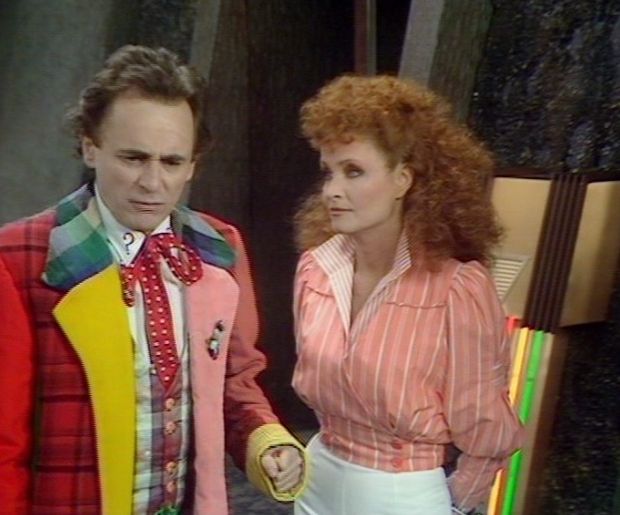
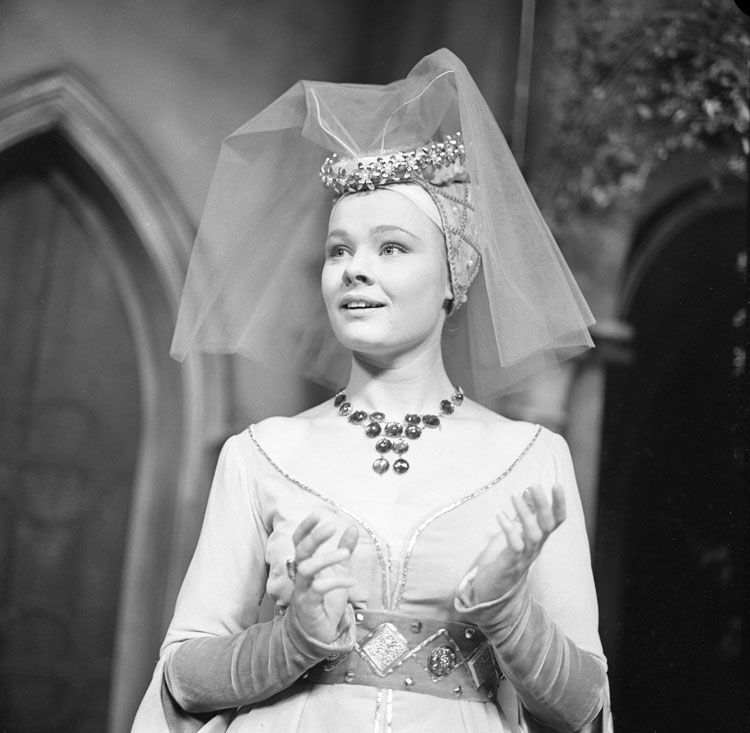
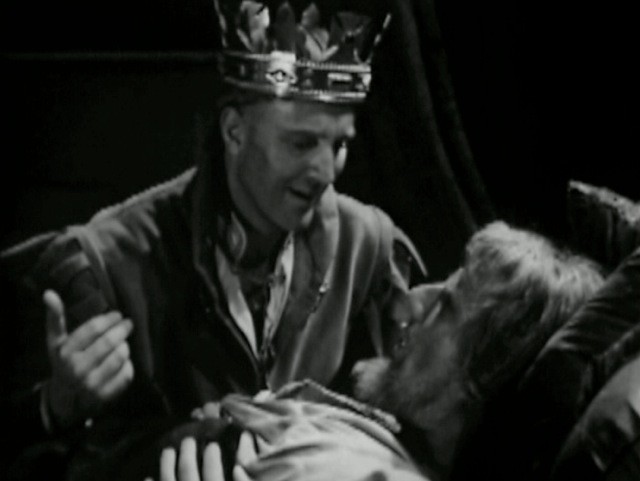
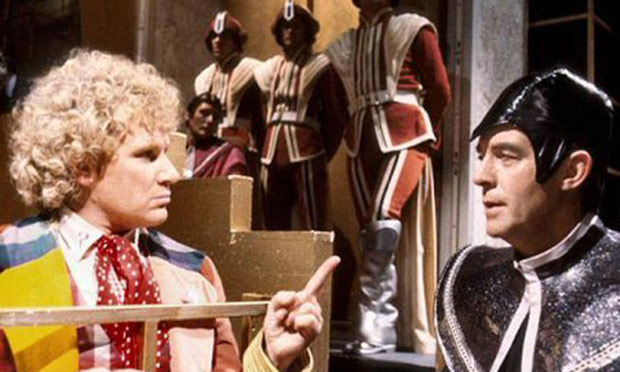
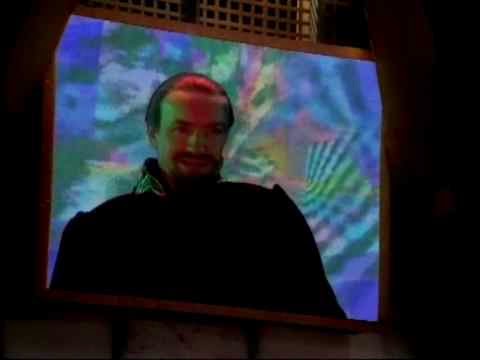
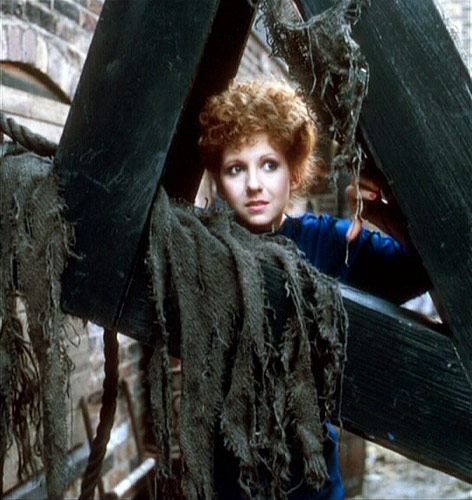

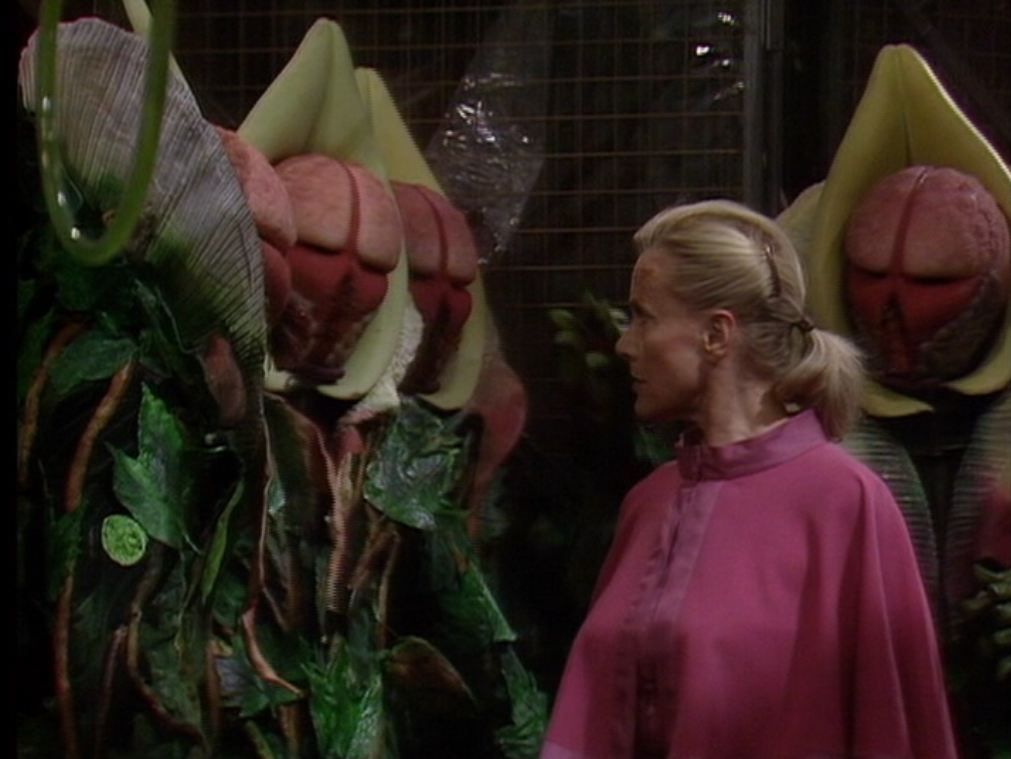
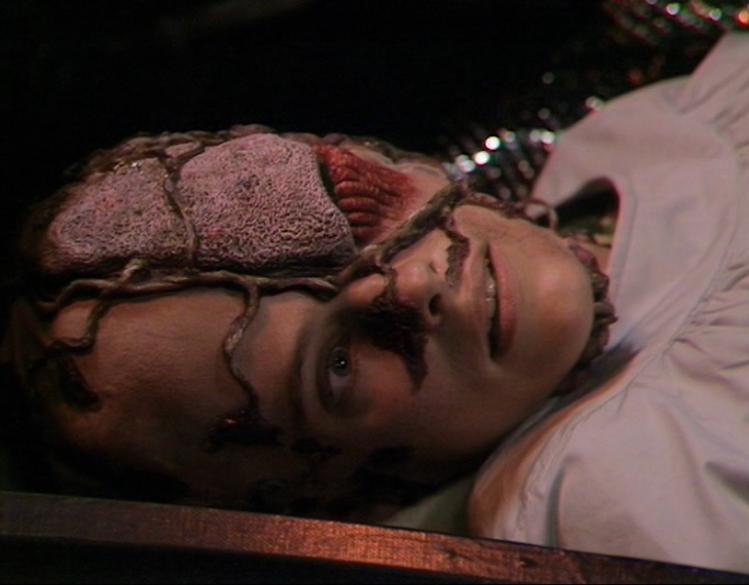
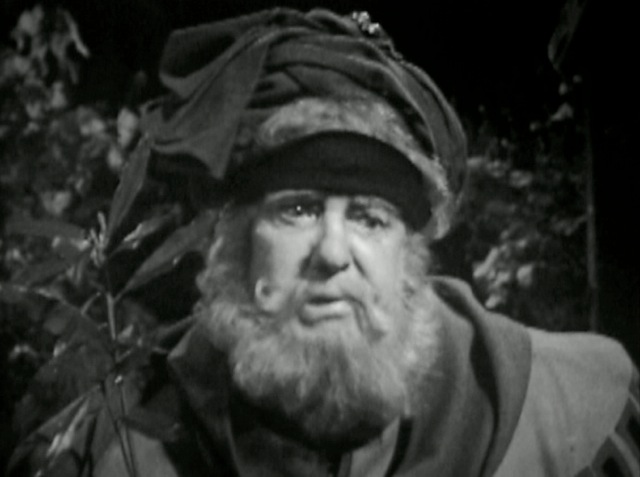
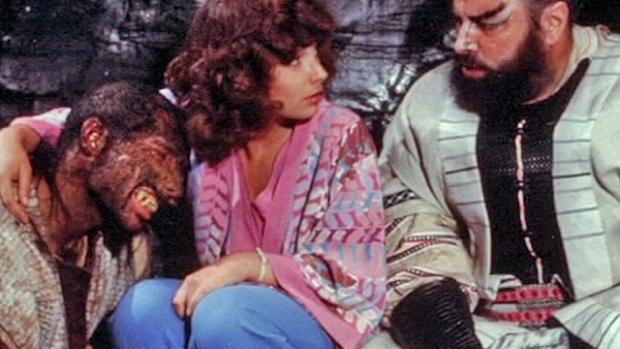
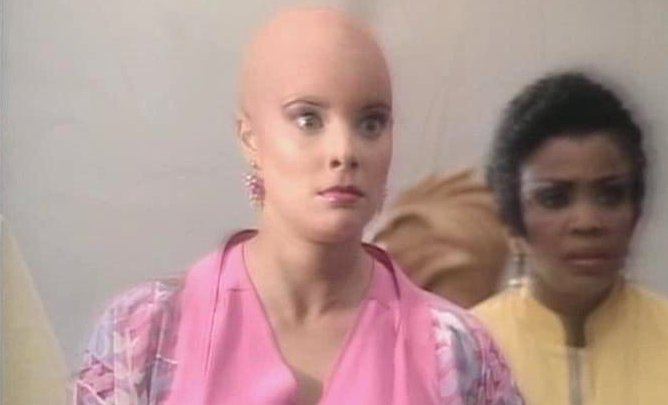
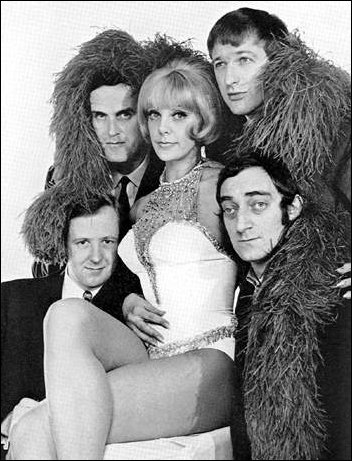

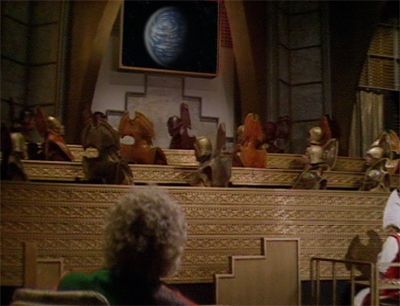
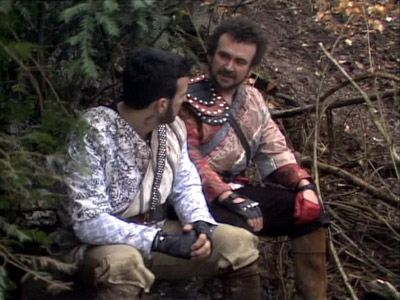
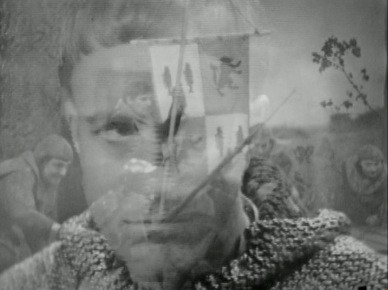
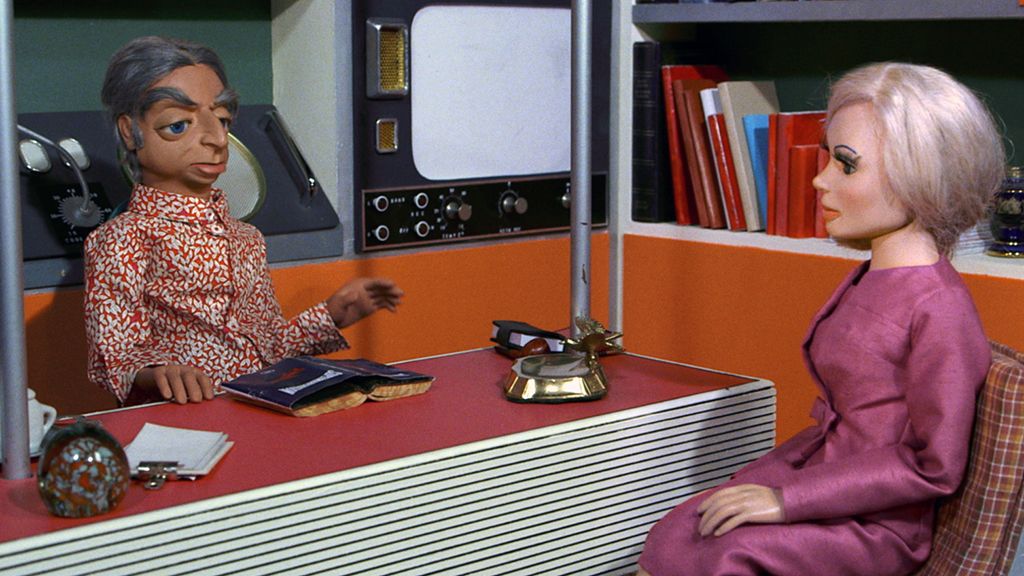
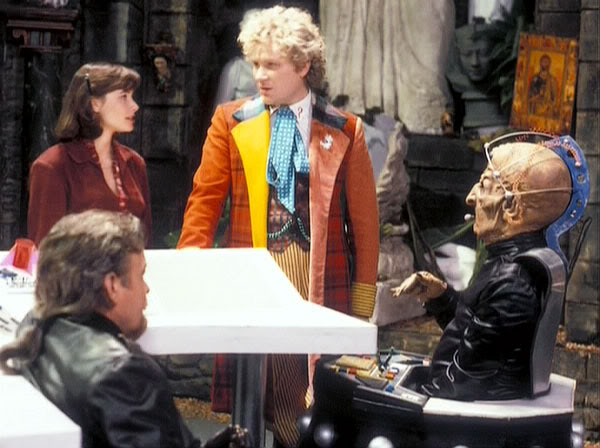
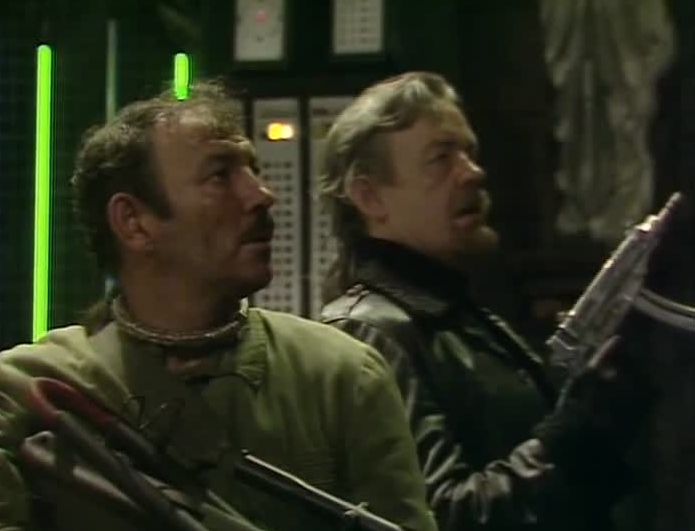

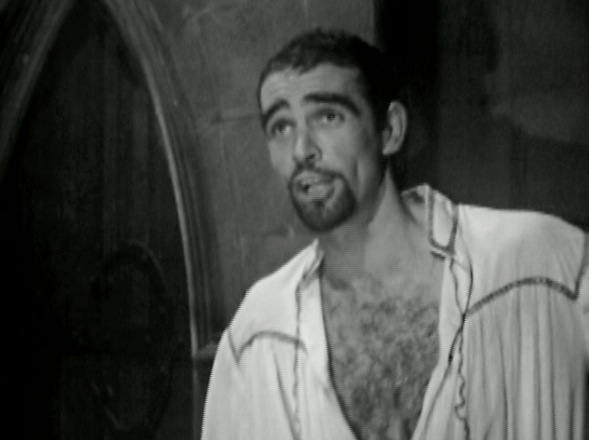
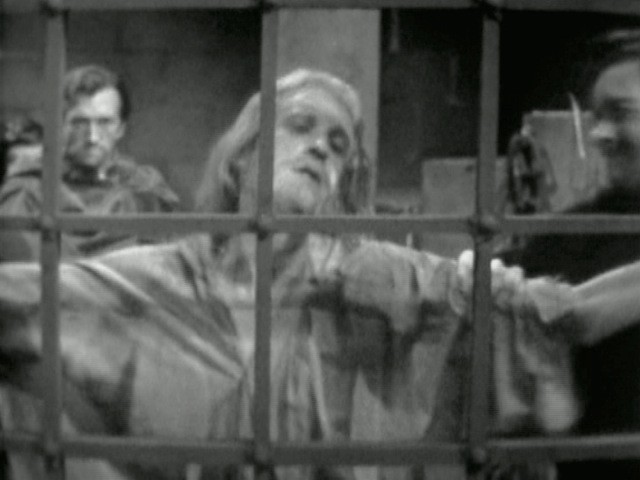
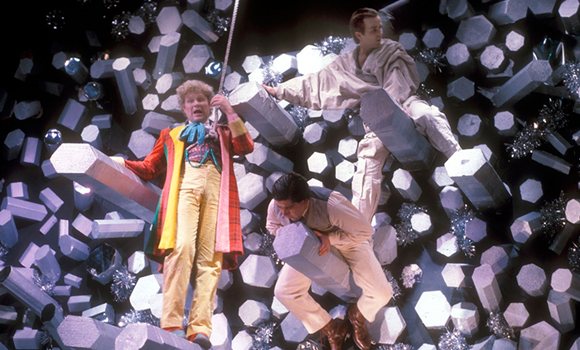
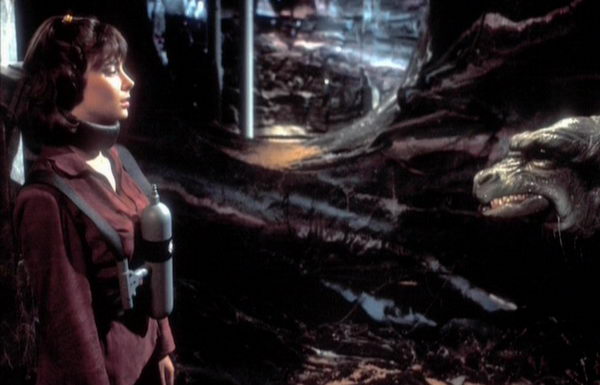
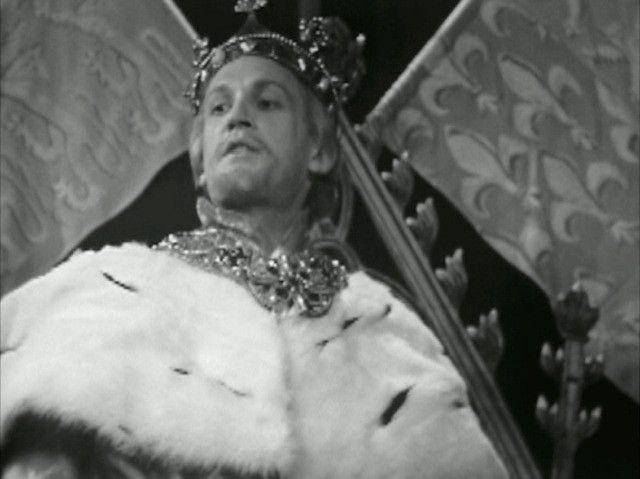
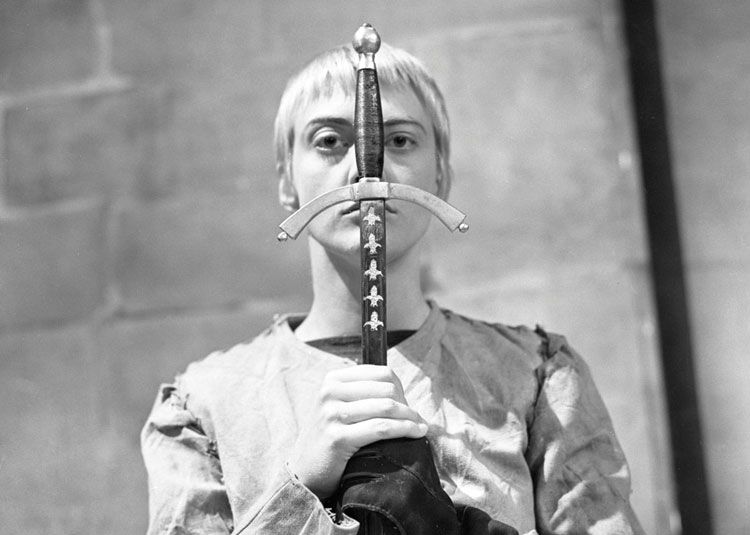
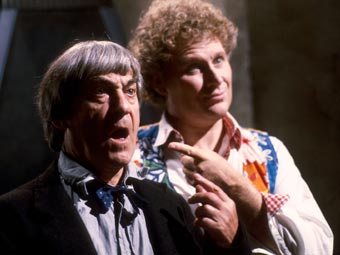
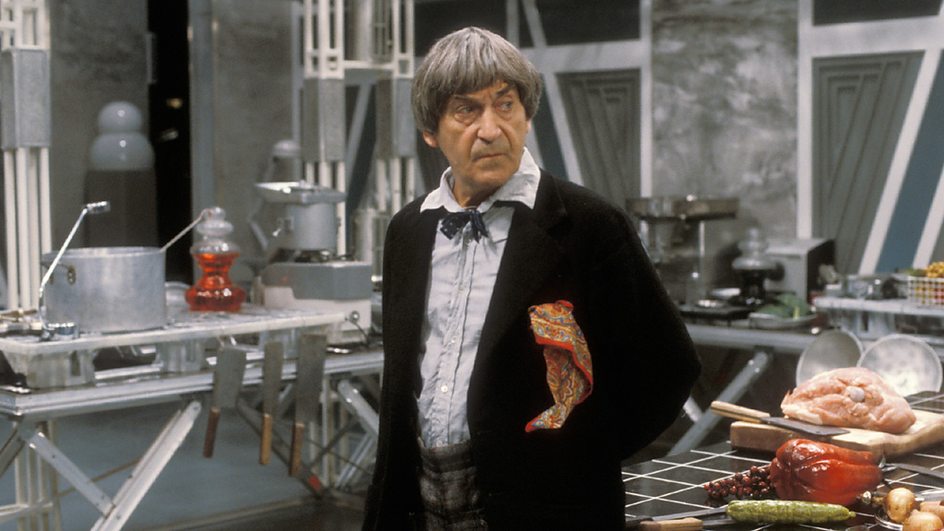

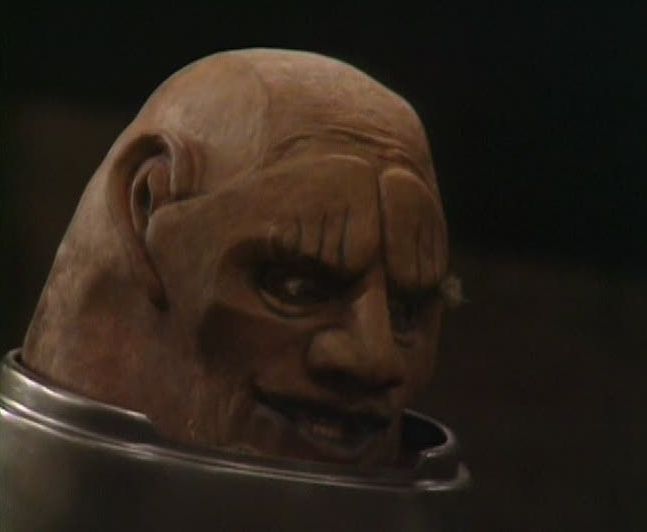
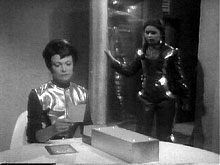
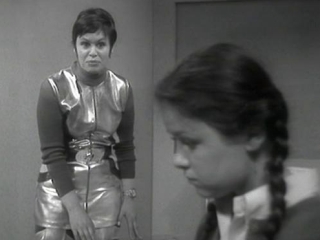
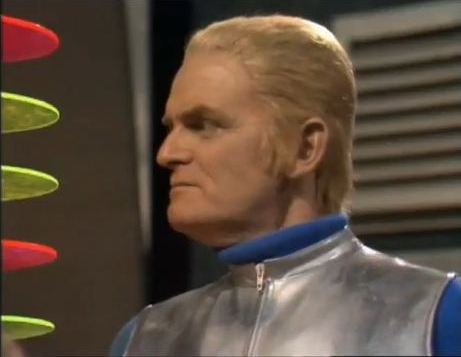
 Archive Television Musings