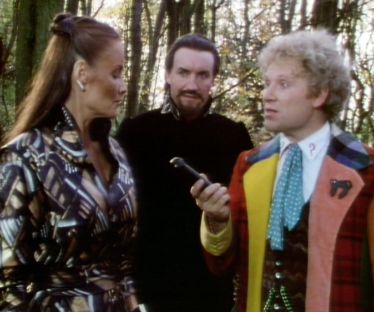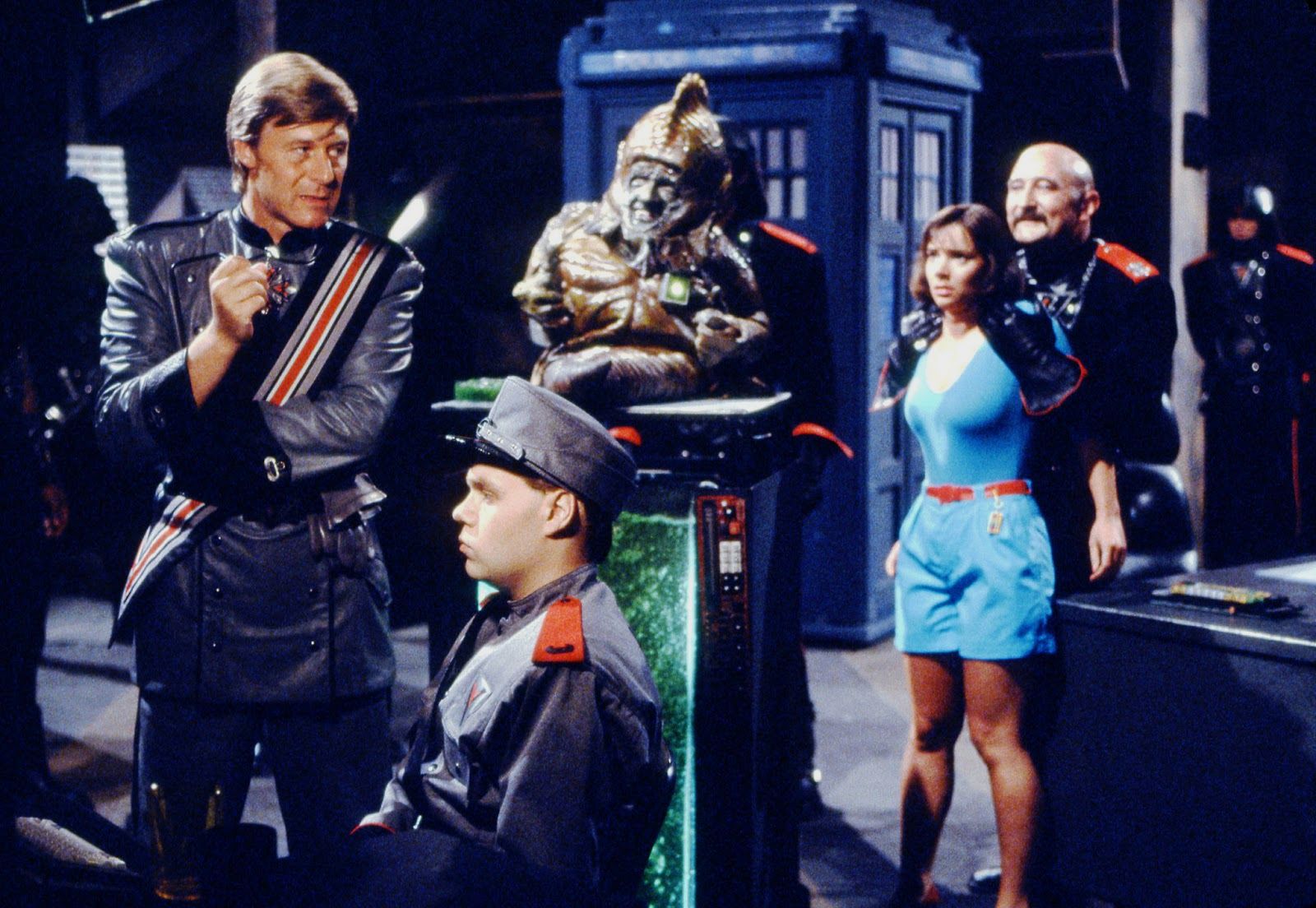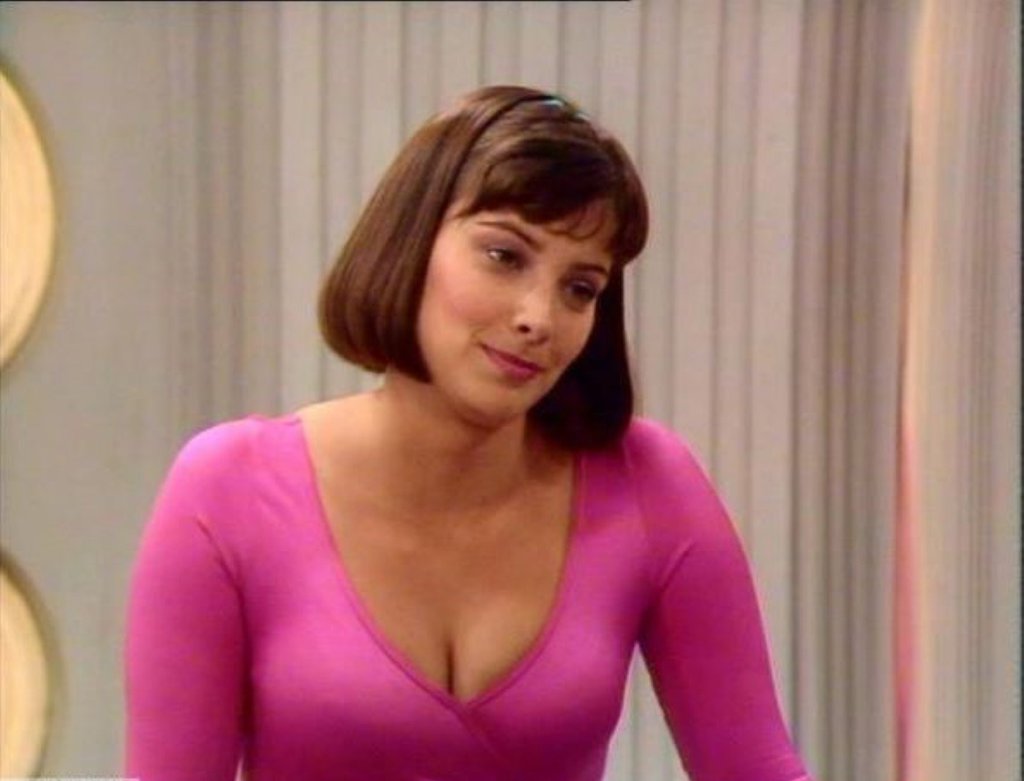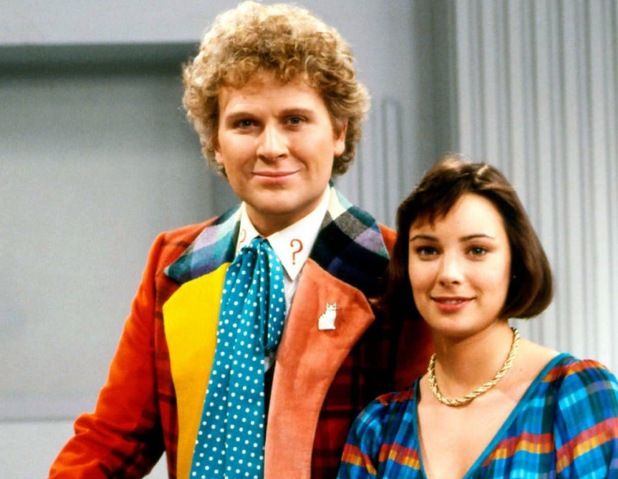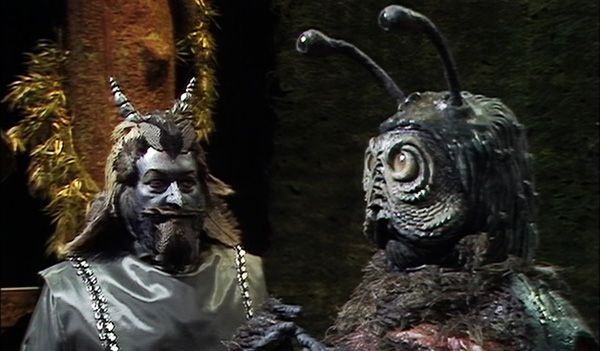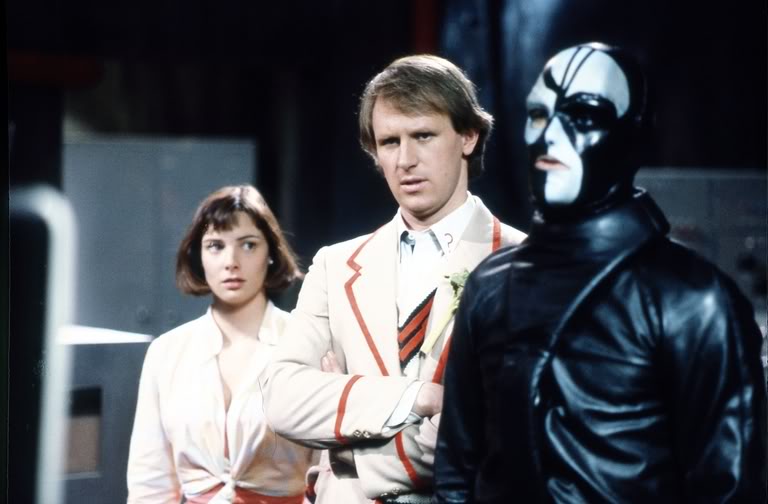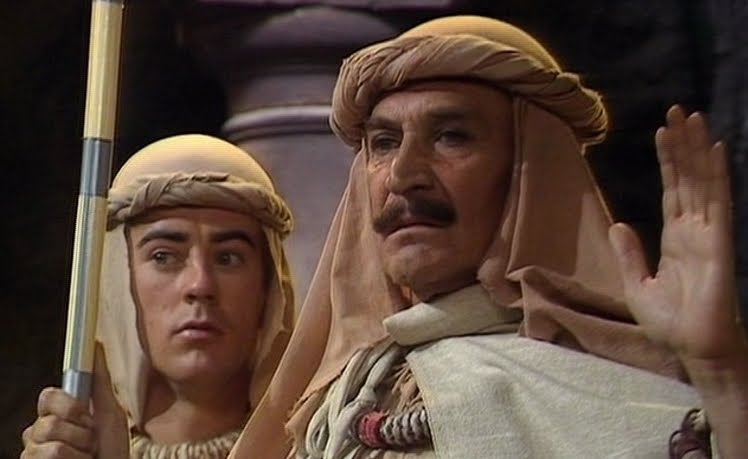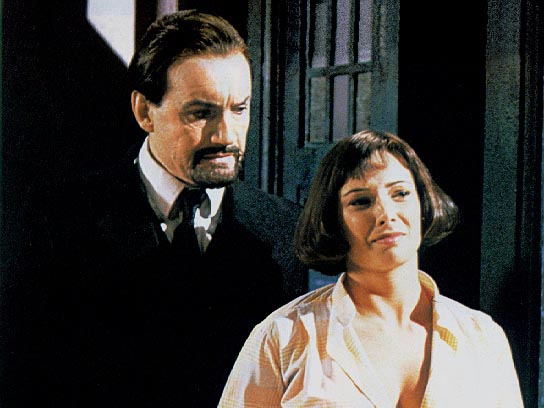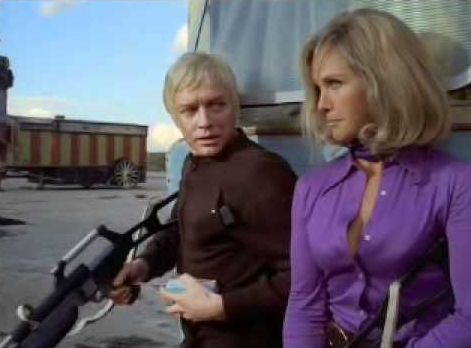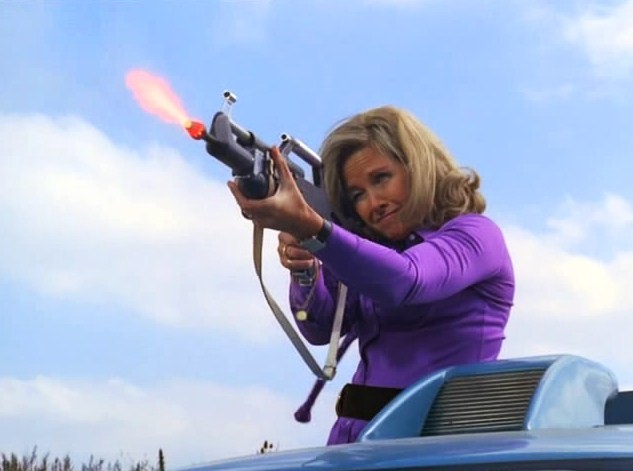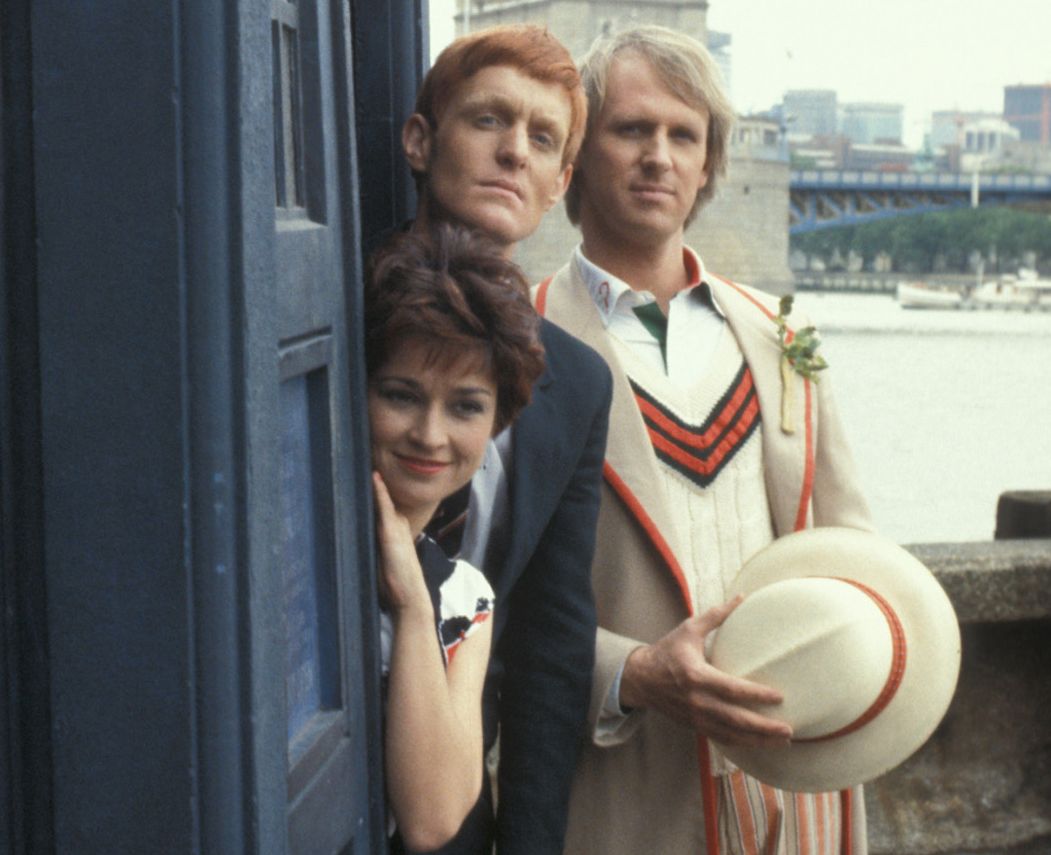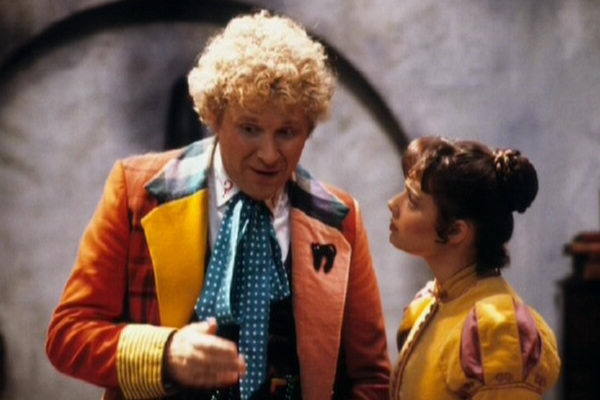
The tree won’t hurt you. Doctor Who – The Mark of the Rani

mark2

After the somewhat bleak and violent stories already seen in S22 (Attack of the Cybermen and Vengeance on Varos) The Mark of the Rani was, literally, a breath of fresh air.

A scheduling quirk meant it was allocated double the amount of location filming a story of this length would normally have had, which is certainly a great benefit.  Ironbridge Gorge Museum (where the bulk of the filming took place) is a lovely location and director Sarah Hellings certainly made the best use of it.

This is best demonstrated in the opening scene of the story.  Hellings elected to use all the available extras in a n expansive tracking shot showing the miners leaving work for the day and proceeding down the main street.  She knew that she wouldn’t be able to have so many extras available for the remainder of the shoot, but by creating an impressive opening it allows the viewer to fill in the blanks later on when there are fewer actual people about.

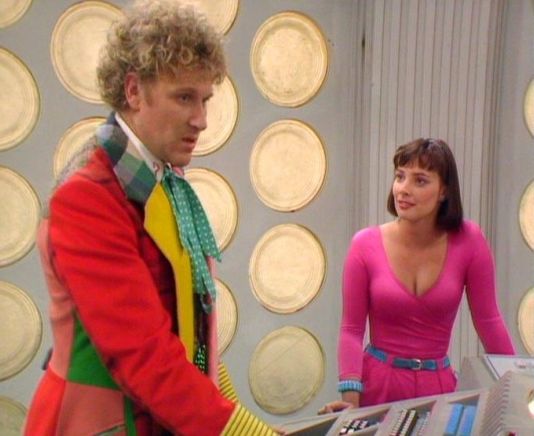
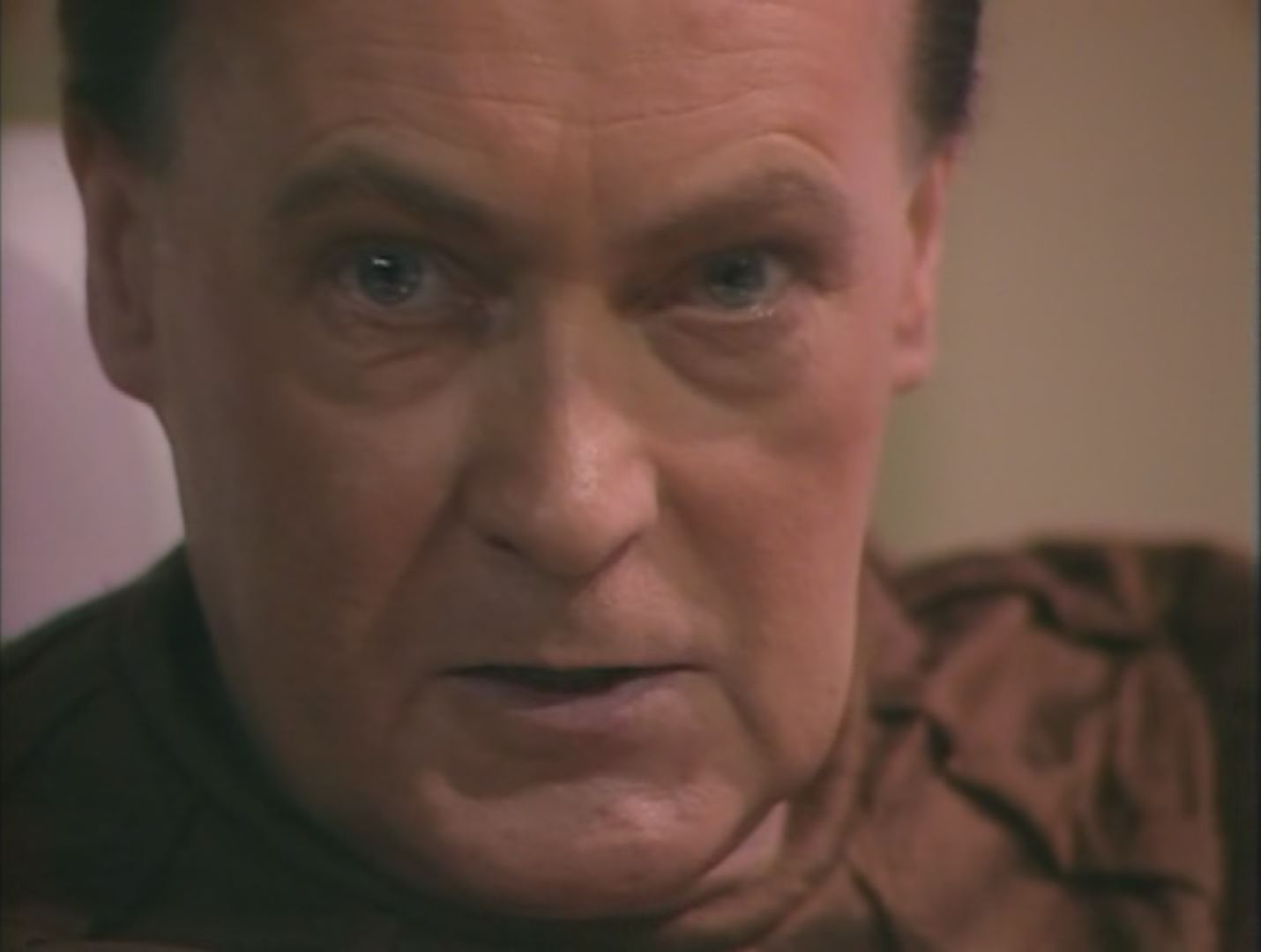
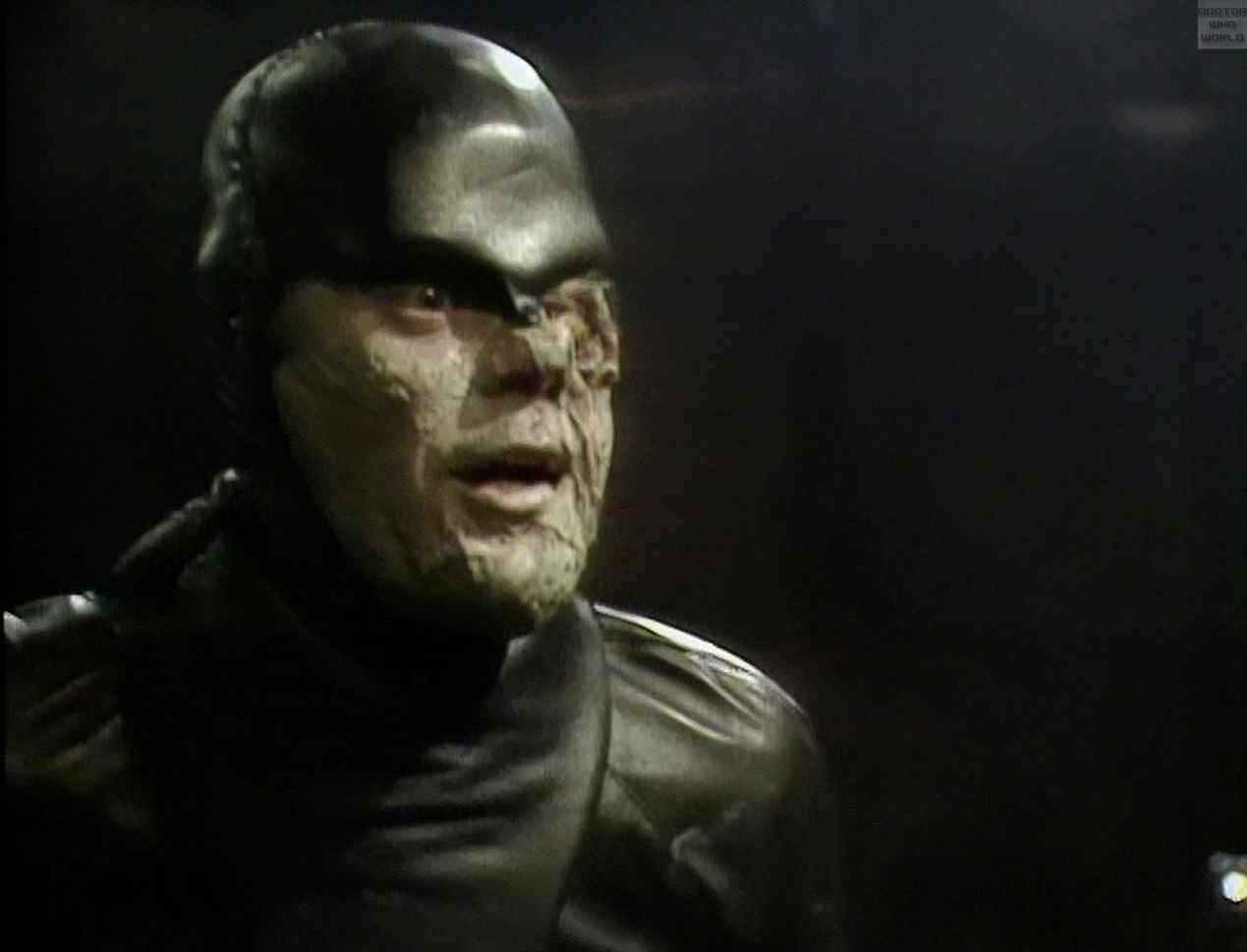
Although the story features the return of the Master (so he didn’t die in Planet of Fire, no surprise really!) it’s much more concerned with the machinations of the Rani (Kate O’Mara).  Originally it was scripted that the Rani acted as, effectively, the Master’s assistant (ala the Doctor and Peri) but once Kate O’Mara was cast the plans changed and she became the dominant character.

This does mean that the Master (a second-rate villain at the best of times) is made to look even less impressive as the Rani slings a series of insults his way, for example referring to him as an “asinine cretin” and she also offers a good summation of his, frankly, often bonkers schemes, “It’ll be something devious and overcomplicated. He’d get dizzy if he tried to walk in a straight line.

"There are more things in heaven and earth than are ever dreamed of in your barren philosophy."
“There are more things in heaven and earth than are ever dreamed of in your barren philosophy.”

Why the Master was dressed as a scarecrow at the start of the story is a mystery that’s never solved, as is the reason he chooses to divert the Doctor’s TARDIS (it’s almost as if he wants to make his evil plans as difficult as possible to achieve).  His scheme here is a little undercooked it has to be said, as he plans to harness the brainpower of Telford/Davy/Faraday/Stevenson and make the Earth an unbeatable superpower.  Yes, they were all geniuses – but could they really have raised the technological level of the planet to the degree the Master wants?

Episode One is great fun – plenty of location filming and nice scenes with O’Mara, Ainley and Baker all facing off.  Episode Two does sag a little though – so maybe this would have worked better as just a single 45 minute story.  We’ve already seen the Doctor attacked by the augmented locals in Episode One, so when we see it again in Episode Two there’s a sense of deja vu.

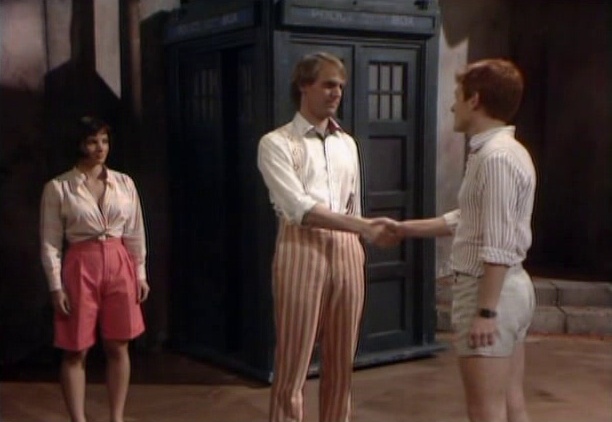
There’s also the business with Luke Ward turning into a tree which could possibly be the silliest thing ever in Doctor Who.  There’s plenty of competition, I know, but it’s difficult to watch the scene where the bendy tree stops Peri from venturing any further, without smiling.

Cast-wise, this is very strong.  Terence Alexander (at the time a familiar face from Bergerac) is good fun as the crusty Lord Ravensworth.  Gawn Grainger’s accent does wander from time to time, but he gives a nice turn as the somewhat bemused, but always obliging, George Stephenson.

Although Pip and Jane Baker’s use of the English language would sometimes find disfavour with some sections of fandom, they were also able to craft some entertaining dialogue, such as this –

RANI: Who’s this brat?
MASTER: My dear Rani, quite unwittingly you’ve made my triumph utterly complete. Allow me to introduce the Doctor’s latest traveling companion, Miss Perpugilliam Brown, although her traveling days will soon be over.
PERI: I thought he was dead.
MASTER: As you observe, I’m very much alive. Your erstwhile mentor, on the other hand, is about to, I believe your modern expression is, snuff the candle.
DOCTOR: Snuff the candle? You always did lack style.
MASTER: Style is hardly the prime characteristic of your new regeneration.
RANI: Oh, do stop squabbling and get on with it.

Another plus-point is Johathan Gibbs’ score.  He stepped into the breach quite late in the day after John Lewis was unable to complete the score due to illness (sadly Lewis died shortly afterwards).  Gibbs’ music is quite low-key and pastoral and fits very well with the rich visuals from the location shooting.  Lewis’ score for Episode One is available on the DVD as an extra and is worth a listen – although I do prefer Gibbs’ effort.

So whilst there may not be quite enough story to last 90 minutes, The Mark of the Rani, thanks to the location work, music and strong guest cast is a very enjoyable watch.  And Pip and Jane Baker certainly seemed to have nailed the 6th Doctor’s character – he still has the odd tantrum, but they also bring out his scientific curiosity as well as his sense of justice.  By this point in the season, Colin Baker and Nicola Bryant have formed a very effective team and they’re a pleasure to watch.
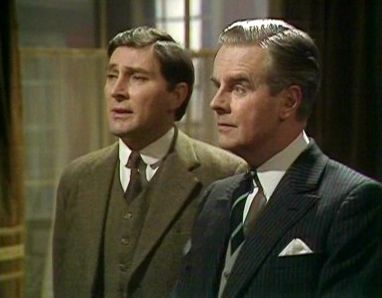
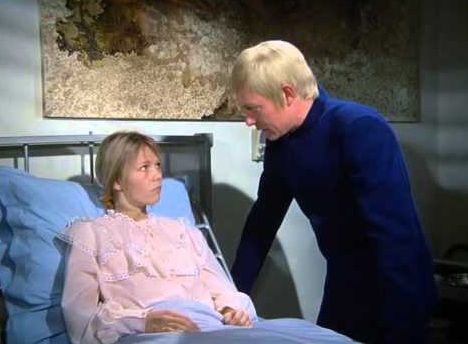
Ian Carmichael in Lord Peter Wimsey – Clouds of Witness (BBC 1972)

wimsey

Clouds of Witness was the first of five serials broadcast on the BBC during the 1970’s which featured Ian Carmichael as Lord Peter Wimsey.  Although Carmichael was older than the literary Wimsey, he very much made the part his own, and it’s his performance which is the chief delight of this run of adaptions.

Clouds was Dorothy L. Sayers’ second Wimsey novel, originally published in 1926.  The BBC version was broadcast in 1972 and was adapted by Antony Steven and directed by Hugh David.

There’s been a death at the Wimseys’ shooting lodge at Riddlesdale.  Denis Cathcart (Anthony Ainley) who was engaged to be married to Wimsey’s sister Mary (Rachel Herbert) is discovered in the grounds, shot dead.  And the tragedy strikes even closer to home when Wimsey’s brother, the Duke of Denver (David Langton), is arrested and charged with murder.

There certainly seems to have been motive – the Duke had just discovered that Cathcart was a bit of a bounder (he made his money by gambling at cards in Paris), but Mary also seems to have something to hide.  With the help of his faithful manservant Bunter (Glyn Owen) and Detective Inspector Parker (Mark Eden), Wimsey eventually unravels the mystery.

One of the chief pleasures of these adaptations are the first rate casts.  Carmichael, as I’ve said, is a compelling Wimsey – although he initially seems to be something of a silly ass, he also has compassion and insight, which is brought out by Carmichael’s skillful performance.

There’s a lovely connection between Wimsey and Bunter.  This generally goes unsaid, but a scene at the start of episode two helps to shed a little light on their relationship.  Wimsey has just woken up after a regular recurring dream – where he’s back in WW1 and finds himself buried underground.  He describes to Bunter his fear that no-one would come to dig him out, but Bunter says that (during WW1) he did.  A throwaway moment, but it helps to establish the bond that the two of them share.

David Langton (a familiar face from Upstairs Downstairs) has the same type of gravitas as the Duke (indeed, he could be the same character!) whilst Francis De Wollf has a nice turn as the Duke’s solicitor, Sir Impey Biggs, constantly frustrated that Wimsey’s investigations are making it harder for him to prove the Duke’s innocence.  Kate O’Mara has a small but memorable role as Cynthia Tarrant, who points Wimsey, by chance, in the direction of a new suspect whilst Mark Eden is very solid as Inspector Parker.

The only slightly discordant note is made by Rachel Herbert as Lady Mary Wimsey.  It may be how the part is written, but her hysterical outbursts seem somewhat out of place in the story, particularly when the rest of the cast are generally underplaying.

Hugh David’s direction is pretty good, although there are a few misteps (a couple of poor uses of CSO and a rather obvious model plane in the last episode, for example). It’s shot at quite a leisurely pace – five episodes running for 45 minutes each – and it possibly could have done with losing an episode, which would tightened things up.

But even though it does sag somewhat in the middle, it still hangs together pretty well.  The ending though, is a little disappointing, but that’s a problem with the original novel and there’s little Steven could have done about that.

Clouds of Witness isn’t the strongest Wimsey novel, but it’s a very decent adaptation and brought alive by the majority of the cast.  Next up – The Unpleasantness at the Bellona Club.

Thunderbirds titles in HD

Network continue to count down to Filmed in Supermarionation, due later this month, by releasing HD versions of the titles of various Anderson shows on their YouTube page.  More details can be found here. Below are HD titles for Thunderbirds.

Below are some previews of Filmed in Supermarionation.

In other Thunderbirds news, the Guardian has a very positive review of the new ITV remake. It’s due for broadcast in 2015 and features, amongst others, David Graham reprising his role as Parker and Rosamund Pike as the voice of Lady Penelope. It can be read here.

UFO watch (Episode 26 – The Long Sleep)

long sleep

Written by David Tomblin
Directed by Jeremy Summers

The Long Sleep is an oddity amongst UFO stories – as it’s able to be dated quite specifically.  We’re told that ten years have elapsed since Straker accidentally knocked down Catherine (Tessa Wyatt) and that it happened in 1974.  So the present day events occur in 1984.

After Catherine was hit by Straker’s car, she’s remained in a coma, until now.  Just before she lost consciousness she mentioned flying saucers, so her case-file is reactivated now that she’s woken up.  Straker feels a sense of responsibility, even though there was no way he could have avoided the collision, so he visits her in hospital to hear her story.

Ten years ago, Catherine had run away from home and met up with Tim (Christian Roberts).  The two of them then hitched a lift into the country and found a place to sleep – a deserted farmhouse.  Tim offered Catherine a couple of pills, promising her that they weren’t addictive.  But what occurred was a trip that was certainly bad for both of them.

One of the most striking things about the flashback scenes is that up until they take the drugs, all of the action set in 1974 is sepia toned.  Once they’re under the influence, there’s a sudden explosion of colour and everything slows down slightly – which effectively indicates the effects of the trip.  Things take a turn for the worse when they discover two aliens in the farmhouse’s basement, doing something with a strange object.  In their altered state, Catherine and Tim don’t realise the danger they’re in and they take part of the alien’s device.  Still under the influence of the drugs, Tim jumps off the roof and is apparently dead, whilst the aliens attack Catherine.

When she wakes up, the picture has turned back to sepia, indicating that the trip is over.  Dazed and confused, she sees the aliens drag Tim away and she staggers out of the farmhouse.  After an encounter with a truck driver who clearly had unhonourable intentions, she runs away from him and is mown down by Straker’s car.

Her story of the alien’s device is enough to convince Straker that it was a bomb.  This is a little bit of a leap, it has to be said.  Another unanswered question is why they haven’t come back to prime the bomb or replace it with another one.  What convinces Straker that it is a bomb is the time-frame – several days before Catherine’s accident there was an Earthquake in Turkey which killed 80,000 people.  Straker’s convinced that the Earthquake was caused by an alien bomb, and that there’s a similar device in England, waiting to do the same.  Again, this requires something of a leap of faith and also poses the question as to why the aliens wish to destroy large parts of the Earth, something they’ve previously never done (with the exception of Destruction).

Catherine is more than a little surprised to be visited in hospital by Tim, who, like her, doesn’t look a day older.  Quickly, it becomes obvious that he’s under the control of the aliens and he injects her with drugs in order to discover where she hid the bomb’s priming device.  This then leads to a final example of Straker’s ruthless side, when he elects to inject her with the same drug so that they can discover the hiding place and attempt to get there before Tim.  Dr Jackson warns of the dangers to Catherine, but as so often before, Straker has to weigh one life against possibly losing thousands.

Tim is caught, the bomb is dealt with, but there’s no happy ending for Catherine.  It’s perhaps fitting that the last recorded episode of UFO ends with a shot of an anguished Ed Straker.  Once again he’s protected countless people, but in order to achieve this, sacrifices have had to be made.

And that’s it – the 26th and final episode.  If you’ve never seen it, UFO is a series that has plenty to recommend it.  There’s the odd episode that doesn’t work and some do have gaping plot holes, but the main cast are excellent and the model-work (supervised by Derek Meddings) is never less than first rate.  Let’s sign off with the Power Themes 90 remix of Barry Gray’s UFO theme.

And cut it now. Doctor Who – Vengeance on Varos

varos

Vengeance on Varos is a story that seems even more in tune with current trends than when it was originally broadcast, nearly thirty years ago.  The rise and rise of reality television over the last few decades chimes perfectly with the similarly obsessed viewers of Varos.  It’s only a short step from Arak and Etta to the viewers seen each week on Gogglebox.

The ruling elite of Varos seek to pacify the population with a daily broadcast of torture and execution, in some ways similar to the entertainments offered to the Roman people – “bread and circuses”.  They also have a lucrative sideline in selling videos across the galaxy of the events seen inside the Punishment Dome – as they say, they literally have to “export or die”.

Interactive television is something we take for granted now (and Doctor Who also has had its brush with it, who could forget the difficult decision about whether to choose Mandy or Big Ron to assist the Doctors in Dimensions in Time?  Not me, and believe me, I’ve tried) and it made it’s first faltering steps in the late 1970’s.

In America, Warner Amex Cable Communications pioneered a system called Qube.  It offered a variety of interactive services, including home shopping and quiz shows.  Each user was provided with a handset which had a number of buttons, so that when, for example, questions were asked, the viewers could instantly give their opinion – and it’s clearly this type of technology that influenced Varos (witness the Varosians ability to vote on key matters, which has the side-effect of deciding whether the Governor lives or dies).

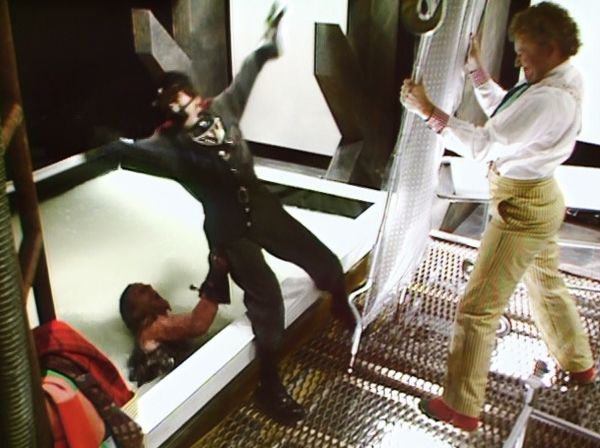
Television violence was in 1985, as it remains now, a hot topic – so a story that satirises violence was always going to be controversial.  As might be expected, there were complaints – not only from casual viewers and media watchdogs, but also from some fans who were concerned about the Doctor’s actions.  Personally, I don’t have a problem with the acid bath scene, as the Doctor doesn’t actually push anybody in – the one guard pulls in the other.  I do have an issue with the scene towards the end of episode one, where the Doctor leaves the machine that was about to obliterate Jondar pointing towards the pursuing guards, and we see one unfortunate guard killed.

"You'll forgive me if I don't join you"
“You’ll forgive me if I don’t join you”

If some of the visuals and dialogue are (intentionally) unpleasant, then no doubt Philip Martin and Eric Saward would say that that was the point.  Exactly how far the programme could (or should) go during Saturday tea-time viewing is another interesting debating point.

Moving on, it’s clear right from the start that this story is going to be something unusual.  Arak and Etta never interact with any of the other characters, they remain isolated from the action and only view the events on their screen and then pass comment on what they see.  For example, Etta remarks that she likes the Doctor, “the one in the funny clothes”.  And, like many viewers, they are also quite clear about what they like and don’t like.

ARAK: Why have they stopped? Oh, it’s pathetic. When did they last show something worth watching, eh? When did we last see a decent execution.
ETTA: Last week.
ARAK: What?
ETTA: The blind man.
ARAK: That was a repeat.
ETTA: It wasn’t. You’re thinking of that infiltrator. He wasn’t blind. Not at the beginning, anyway.

The opening fifteen minutes or so manage to set up the basics of the story very effectively.  We know that Varos is a military dictatorship which appeases the working population with violent broadcasts, whilst the Governer (Martin Jarvis) negotiates with Sil (Nabil Shaban) concerning the mining rights for Zeiton-7 ore.  This is, though, one of the major plot flaws in the story.  Zeiton-7 is one of the most precious substances in the Universe, so it beggars belief that nobody on Varos is aware of this or that Sil and his company have been offering them a pittance for it for centuries.

One problem with this elaborate world-building is that, like Attack of the Cybermen, the Doctor and Peri take a long time to actually connect to the plot.  If you treat Varos as a four-parter, then for the majority of episode one they’re stuck inside the TARDIS.

Once they arrive on Varos though, things do begin to happen.  They team up with the rebel Jondar (Jason Connery) and his wife Areta (Geraldine Alexander).  Both give rather stagey, unnatural performances, but there are stronger actors on Varos (particularly Martin Jarvis) so this isn’t too much of a problem.  And they’re certainly better than Rondel (Keith Skinner) who is mercifully killed off very quickly.

If the rebels on Varos are a bit wet, then the baddies are much better.  Forbes Collins (Chief Officer) gives a gloating performance as the power behind the throne.  Nicholas Chagrin isn’t subtle as the scarred, deranged Quillam – but it’s not a part that really demands subtlety.  Nabil Shaban as Sil has the showiest part and he clearly made enough of an impact to have a swift return to the series the following year.  Best of all though, is Martin Jarvis as the Governor.

The Governor isn’t an evil man – he just seems to be trapped in the system and has very little room for manouvere.  So he’s like many politicians then, although he – unlike them – is in constant danger of death from his people if he announces too many unpopular policies.  Something that has yet to be introduced here, popular though it undoubtedly would be!

nicola - vengeance

As the Doctor and Peri proceed through the Punishment Dome, they become an instant hit with the viewers of Varos (something that JNT obviously hoped would also be reflected in real life) but they find rather less favour with some of the ruling elite.  Quillam, especially, seems keen to arrange a painful death for the Doctor.

QUILLAM: I see you have a keen interest in the flora of Varos, Doctor.
DOCTOR: Just a passing fancy.
CHIEF: It’ll pass faster than you think. Kill them!
QUILLAM: Wait. This man has insulted me. He must suffer for my humiliation.
CHIEF: This is no time for revenge. Kill them quickly!
QUILLAM: And deprive Varos of an example of how traitors are dealt with? The cameras are still functioning. Let the show begin. I want to hear them scream till I am deaf with pleasure. To see their limbs twist in excruciating agony. Ultimately their blood must gush and flow along the gutters of Varos. The whole planet must delight in their torture and death.
DOCTOR: An excellent scenario. Not mad about the part.

Vengeance on Varos was Ron Jones’ final Doctor Who story as director.  Out of the all regular Doctor Who directors from the 1980’s he seems the most anonymous.  He was no Graeme Harper, but Varos, like his previous story, Frontios, is shot quite effectively.  Both were studio-bound, but Jones managed to couch good performances from the majority of the cast and whilst the camerawork is not particularly elaborate, he was able to lower the lighting and produce a decent atmosphere.  Music, from Jonathan Gibbs, is sparse, but it’s quite striking.  Today, it seems impossible to have a story without wall-to-wall music, so this is a trip back to a time when silence could be very effective.

Although it was originally planned to end the story with the Doctor and Peri inside the TARDIS, common sense prevailed, as the final scene, like the rest of the story, is deeply ironic.

GOVERNOR [on the viewscreen]: And that, fellow citizens of Varos, is my vowed intention. For without justice and peace and tolerance, we have no future. I know you will all work as hard as I shall for a glorious tomorrow. Thank you for allowing me into your homes. Thank you.
ARAK: No more exeutions, torture, nothing.
ETTA: It’s all changed. We’re free.
ARAK: Are we?
ETTA: Yes.
ARAK: What shall we do?
ETTA: Dunno.
(Static on the viewscreen.)

Stuart Fell interview

stuart fell

There’s a rather nice interview with stuntman Stuart Fell on this Last of the Summer Wine blog, Summer Winos.

It doesn’t just concentrate on his work on LOTSW though, there’s plenty of information about the rest of his long and varied career.  Well worth a read.

As is the blog, in which Bob Fischer and Andrew T. Smith work their way through every episode of Roy Clarke’s immortal comedy creation.  They’ve been a bit quiet of late, but hopefully they’ll come back to it soon as they’ve a long way to go – they’re only up to 1982 at the moment!

Wait, watch and learn. Doctor Who – Attack of the Cybermen

attack

Attack of the Cybermen (lousy title by the way) seems to have been born out of a fannish desire to recreate some of the Cybermen’s greatest moments.  With Tomb of the Cybermen apparently lost forever, there was a certain sense in creating a new story which revisited the Tombs on Telos (although the dinky cubicles in Attack lack a certain style – Tomb did it much better).

For those playing continuity bingo, Mondas and its destruction gets a mention (The Tenth Planet) and the Cybermen once more have a liking for the sewers and also keep their ship hidden on the dark side of the Moon (The Invasion).  And Michael Kilgarriff reprises his role as the Cyber Controller, eighteen years after Tomb.

"It is a fat controller"
“It is a fat controller”

The authorship of Attack has always been a slightly thorny issue.  Some maintain that Paula Moore (alias Paula Woolsey) never wrote a word of the script and that it was all Eric Saward’s (with suggestions from Ian Levine).  Although there are contrary opinions (Levine had greater input, Woolsey did contribute to the script, etc) for the sake of argument we’ll assume that the bulk was written by Saward, as it certainly bears his hallmarks (high body-count and violence, for example).

Lytton (Maurice Colbourne) who had been created by Saward in Resurrection of the Daleks returns. It’s tempting to think that Saward decided to reuse the character after watching Colbourne’s performance in Resurrection.  His first appearance was a fairly nothing part, but Colbourne (by the sheer dint of his personality) certainly made something out of it.

The Lytton in Attack is a subtly different character – for example he has a sharp sense of humour, which is seen in his exchanges with Russell, Griffiths and Payne in the first episode.  These early scenes are some of the best in the story and feel quite out of place in Doctor Who (although in a good way).  They could have quite easily come from a contemporary police series, like Strangers, and it’s a shame that they didn’t remain on Earth for the rest of the story – as a story with the Doctor and Peri tracking Lytton and his merry men through London’s underworld could have been a decent yarn.

Plot hole number one.  If Lytton’s two bogus policemen are still around, why does he need Russell, Griffiths and Payne?  It’s established later that a crew of three is needed to pilot the Timeship, so Lytton plus his two phony coppers would seem to be more than adequate.

"You said you came from Fulham".
“You said you came from Fulham”.

There’s one good reason for having Griffiths around, and that’s Brian Glover.  A familiar face (and voice) on British television for a number of years prior to this appearance, he’s terribly good value.  He often finds himself the butt of Lytton’s acid remarks, and this adds an unexpected twist of humour to the story.  Lytton’s unique take on employer-employee relations is best illustrated when he deals with some dissent from newcomer, Russell –

LYTTON: You are new to this group and have yet to gain my confidence, that’s why I tell you nothing. These two are muscleheads and wouldn’t understand what I said anyway.
GRIFFITHS: You’ve got a rough tongue, Mister Lytton.
LYTTON: Which you will learn to live with, Griffiths, otherwise you’re out. And as your earnings have never been better, that would be rather foolish, wouldn’t it? Let’s go. Come on, Payne, there’s work to be done.
PAYNE: Right.
(Payne gets down into the narrow access tunnel.)
PAYNE: Oh. Hey, how thick is the sewer wall?
LYTTON: Oh, nothing you can’t handle.
(Payne takes the heavy lump hammer.)
PAYNE: I used to use one of these when I worked for the council.
LYTTON: This time it’s for swinging, not leaning on

It turns out that Russell (Terry Molloy) is an undercover policeman, sent to investigate the mysterious Lytton.  Russell is a chance for Molloy to make a Doctor Who appearance as himself, rather than encased in latex as Davros.  He’s rather good, and as Russell he underplays very well, a sharp contrast to the creator of the Daleks.

Whilst all this is going on, what’s happened to the Doctor and Peri?  Well, they spend the early part of episode one not achieving very much – mainly dashing from place to place attempting to answer an intergalactic distress call.  This has little overall relevance to the plot and mainly seems to be designed to keep the Doctor out of the loop until Lytton has allowed himself and Griffiths to be captured by the Cybermen.

nicola

One side-effect of the move to 45 minute episodes, is that for a 90 minute story there would now only be one cliffhanger.  It’s a pity that the one in Attack is rather inept (“No, no, noooooooooooo!”) and the resumption in episode two is also slightly iffy.  The Cyberleader (for no apparent reason) orders the death of Peri and a Cyberman steps up to deal with her.  The Doctor, of course, pleads for her life, but there’s a long gap until the CyberLeader agrees.  Why did the Cyberman not kill Peri straight away?  Why listen to what the Doctor said?  He’d been given a clear order by the CyberLeader.

So we’re off to Telos, where all the characters meet up with the Cryons, who are a bit of a rum lot.  Sarah Berger, Sarah Greene and Faith Brown are amongst their number and they certainly are a memorable creation – I think it’s the long fingernails that does it.  The masks do look a little cheap, but overall they work quite well as an alien species with their own unique take on events.

Lytton and Griffiths, along with two escapees from the Cybermen’s work party (Stratton and Bates) attempt to steal the Cyber Controller’s Timeship.  Plot hole number two.  How did the Cryons and Lytton know that Stratton and Bates were at large on the surface of Telos and also planning to steal the ship?  Also, it’s fair to say that Stratton and Bates have to be the most pointless characters in the story.  We spend a long time with them as they make their attempt to escape from the work party, ambush a Cyberman, etc, but in the end this plot-thread doesn’t go anywhere.  And even when they team up with Lytton and Griffiths, they achieve nothing.

This being (probably) a Saward script, people start to die – Griffiths, Stratton and Bates are all quickly killed off, whilst Lytton is captured and taken to be turned into a Cybermen.  First, though, Lytton’s hands are crushed to a bloody pulp – one of the most infamous scenes of the story.

Although I haven’t mentioned him much, Colin Baker is already (in just his second outing) very assured as the Doctor.  There’s still a trace of the erratic behaviour of The Twin Dilemma but he’s much more in command here and more than able to hold his own against both the Cybermen and Lytton.  The best of his scenes in episode two come when he’s locked up with the Cryon, Flast (Faith Brown) who describes the Cybermen’s plans for Earth.

DOCTOR: How do they intend to destroy Earth?
FLAST: It would only be necessary to disrupt it.
DOCTOR: It would still take rather a large bomb.
FLAST: They have one. A natural one. In fact, it’s heading towards Earth at this very moment.
DOCTOR: Halley’s comet?
FLAST: That’s right. They plan to divert it, cause it to crash into Earth. It’ll make a very loud bang.
DOCTOR: Indeed it will. It’ll also bring about a massive change in established history. The Time Lords would never allow it.
FLAST: Who knows? Perhaps their agents are already at work.
DOCTOR: Well, if they are, they’re taking their time about it. For a start, why? Wait a minute. No! No, not me! You haven’t manoeuvred me into this mess just so I can get you out of it! It would have helped if I had known what was going on!
FLAST: You are a Time Lord?
DOCTOR: Yes. And at the moment, a rather angry one.

Although there’s a lot to enjoy about Attack (Baker and Bryant, Maurice Colbourne, Brian Glover) the ending does leave a little bit of a nasty taste.  It’s not the first Doctor Who story to end in violence and it won’t be the last, but there’s something a little off in seeing the Doctor blasting down the Cybermen.  The Doctor’s used a gun before (for example, the third Doctor in Day of the Daleks was quite happy to gun down Ogrons) but it’s a pity that the resolution of the story couldn’t have been a touch more imaginative.

Still, following the fairly calamitous opening stories of the previous two seasons (both courtesy of Johnny Byrne) as a season opener Attack is a definite step up in quality and a good marker for the type of stories to come during the rest of S22.

I am the Doctor, whether you like it or not. Doctor Who – The Twin Dilemma

twin

Perhaps the greatest problem with The Twin Dilemma is the sheer sense of anti-climax.  Any story following The Caves of Androzani would have had a difficult job anyway, but the sheer half-hardheartedness of Twin is very surprising.  As the debut story of a new Doctor, you would expect maximum effort – but there’s certainly something lacking here.

If Androzani was a story where nearly everything went right – helped by an enthusiastic first time Who director – then Twin is the diametric opposite.  Peter Moffatt was seen as a safe pair of hands – he would get the show made on time and on budget, but he wasn’t someone you would expect to deliver a great deal of visual flair.  Although to be fair, it does appear that the budget had pretty much run out (a regular occurrence for the final story of the season – see Time-Flight for example) which may explain the sight of computer terminals covered in tin-foil and other production shortcomings.

Twin’s other problems, like Womulus and Wemus, are well known, so there’s no point in dwelling on them.  A few words must be saved for Mestor though, an incredibly inept monster design.  After the perfection of Sharez Jek, it’s a bit of a shock for the Doctor’s next adversary to be a giant slug – and even more when a good actor like Edwin Richfield is totally wasted behind such an immobile mask, which negates all subtlety in performance.  So Richfield (excellent as Captain Hart in The Sea Devils) is forced to rant and rave in order to be heard (and the fact that Mestor’s cross-eyed is a problem too).

Sometimes, words just fail me.

There are some decent performers on Jaconda though.  Maurice Denham brings a much-needed touch of class to proceedings, even if he sometimes seems to struggle with the banalities of the script.  Olivier Smith (Drak) manages to make something out of nothing and Barry Stanton (Noma) is also able to bring a certain gravitas to proceedings.  Seymour Green (who had previously appeared in The Seeds of Doom) has some nice comic touches as the Chamberlain, whilst Kevin McNally relishes his role as Hugo Lang.

If you haven’t heard it, then the commentary track with McNally, Colin Baker and Nicola Bryant is well worth a listen.  McNally is quite the Who fan and there’s a refreshing enthusiasm from him when discussing his brief brush with the series.  His interview with Toby Hadoke, as part of Hadoke’s Who’s Round is also warmly recommended.

Of course, Twin is really about one thing and one thing only – the debut of Colin Baker’s Doctor.  He certainly makes an impact and is immediately very different from Davison’s Doctor.  Just as Davison’s Doctor was clearly designed not to be as dominating as the Tom Baker incarnation, so the pendulum swings again with Colin Baker.

The Sixth Doctor (like the Fourth) is happy to be the centre of attention and is capable of instantly dominating proceedings.  He’s far from stable here, of course, and this helps to fuel the drama as well as pushing the spotlight onto Nicola Bryant.  Apart from The Edge of Destruction, it’s hard to recall the Doctor ever being quite so unapproachable (although Pertwee’s Doctor could be a grumpy old so-and-so from time to time).

I’ve always enjoyed Colin’s take on the Doctor and look forward to revisiting his stories over the coming weeks.  It’s fair to say that he was short-changed during his time on the series (although the previous Doctors, bar Davison, had maybe left reluctantly, at least they all had a decent run in the series) and he never got to develop the character that would later blossom with Big Finish.  However there’s enough little touches throughout his two and a bit years on the show to hint at what he might have done with the part, had he had the time.

PERI: Did you have to be so rude?
DOCTOR: To whom?
PERI: Hugo. You could at least have said goodbye. Are you having another of your fits?
DOCTOR: You may not believe this, but I have fully stabilised.
PERI: Then I suggest you take a crash course in manners.
DOCTOR: You seem to forget, Peri, I’m not only from another culture but another planet. I am, in your terms, an alien. I am therefore bound to different values and customs.
PERI: Your former self was polite enough.
DOCTOR: At such a cost. I was on the verge of becoming neurotic.
PERI: We all have to repress our feelings from time to time. I suggest you get back into the habit.
DOCTOR: And I would suggest, Peri, that you wait a little before criticising my new persona. You may well find it isn’t quite as disagreeable as you think.
PERI: Well, I hope so.
DOCTOR: Whatever else happens, I am the Doctor, whether you like it or not. 

This last scene seems to be aimed not only at Peri, but also the viewers at home. As to whether they’d warm to the abrasive new Doctor, only time would tell.

You have the mouth of a prattling jackanapes but your eyes tell a different story. Doctor Who – The Caves of Androzani

caves

The Caves of Androzani is one of those rare Doctor Who stories where virtually everything – script, direction, acting, music, etc – is as good as it possibly can be.  The result is a story that’s nearly perfect.  The Magma Beast, of course, is a sign that nothing can ever be quite perfect – but given the rest of the story, a few shots of a rubbery monster is a small price to pay.

It had been five years Robert Holmes had contributed a script to Doctor Who and his previous one (The Power of Kroll) hadn’t been a happy experience for him.  Also, he hadn’t been able to get a script together for The Five Doctors (in retrospect, this was the worst thing to ask Homes to do as he never worked well with “shopping list” stories, he much preferred to create his own story from scratch).

So, Caves was the ideal commission.  He had to write out the 5th Doctor, but apart from that he had a free hand to fashion whatever plot took his fancy.  Holmes always liked to borrow from his favourite novels and Caves is no exception.  He’d already played with the concept of The Phantom of the Opera in The Talons of Weng-Chiang, but it’s even more explicit here, as Sharaz Jek – like the Phantom – kidnaps a beautiful young woman and takes her back to his underground lair.  Greel also liked to kidnap women, but he had quite another use for them!

This is the first time, but certainly not the last, that Peri will be the object of somebody’s lust.  Clearly Eric Saward thought it was a storyline that had legs, so poor Peri found herself mauled by the likes of Shockeye, the Board, Jobel and Yrcanos.  Although, to be fair, Shockeye was more interested in how she tasted, rather than how she looked.

What really brings the story to life is Graeme Harper’s direction.  Due to the nature of the programme (i.e. the very short time available to tape the story) few directors ever attempted to do anything particularly different.  There were exceptions, like Paul Joyce on Warriors’ Gate, who also pushed the series as far as it could go and produced a very stylish story – but there’s evidence to show that this was unpopular with both the crew and the cast.  And he certainly exceeded the budget, which ensured he was never asked back.

Harper was also imaginative and prepared to innovate, but he was able to do so within the time he was given – and he also managed to carry the cast along with him.  There seemed to be a general feeling during rehearsals and recording that this story was something unusual and special, so everybody seemed to pull together.  His style favours fades, jump cuts, dissolves and hand-held shots – all of which weren’t common to Doctor Who at the time.

Harper couldn’t possibly have cast this any better.  Key to the success of Caves are three actors – Maurice Roëves as Stotz, John Normington as Morgus and Christopher Gable as Sharez Jek.

It’s quite possible to believe in Roëves as a mercenary, as he certainly proves throughout the story exactly how mercenary Stotz is – ready to sell out anybody for personal gain.  Normington is nothing less than totally compelling.  His asides to camera (an accident that was kept in) add a certain frisson to his performance.  He’s also incredibly subtle at times – watch the scene where the President complains that gun-runners should be shot in the back.  Normington doesn’t reply, there’s just a twitch of a facial muscle to register what he’s thinking.

"The spineless cretins"
“The spineless cretins”

Elsewhere, Holmes gives him some wonderful material, such as –

TIMMIN: Trau Morgus?
MORGUS: Yes, what is it?
TIMMIN: The Northcawl copper mine, sir. There’s been a disaster. I thought you should know.
MORGUS: What kind of disaster?
TIMMIN: An explosion, sir, early this morning. The mine has been completely destroyed.
MORGUS: How sad. However, the loss of Northcawl eliminates our little problem of over-production. The news should also raise the market price of copper.
TIMMIN: Undoubtedly, sir.
MORGUS: As they used to say on Earth, every cloud has a strontium lining, Krau Timmin.
TIMMIN: Yes, indeed.
MORGUS: As a mark of respect for one of our late executives, I want every employee to leave his place of work and stand in silence for one minute.
TIMMIN: I’ll network that order immediately, sir.
MORGUS: No, on second thoughts, make that half a minute.
TIMMIN: Half a minute?

It’s reported that David Bowie was considered for the part of Sharez Jek, but nobody could have played it better than Christopher Gable.  It has to rank amongst the very best performances in Doctor Who, sitting comfortably alongside the likes of Kevin Stoney (Tobias Vaughn), Harrison Chase (Tony Beckley) and Scaroth (Julian Glover).

Sharez Jek has several electrifying speeches, the first coming 16 minutes into episode two.  It’s interesting to see how this was shot as Harper elected to record most of it “as live” on just one camera.  There’s not a cut until 1:55 into the scene, on the line “hanging from the bone”.  It’s tempting to suppose that Harper had planned to record the whole scene in one take and on one camera, but there was possibly a stumble which meant a brief cutaway had to be patched in.

This is part of the scene, and the dialogue is worth reproducing –

PERI: Why does he always wear that hood?
JEK: You want to know why? You, with your fair skin and features, you want to see the face under here? Do you!
(Peri squeals and runs into the Doctor’s arms.)
JEK: You’re wise. Even I can’t bear to see or touch myself. I, who was once, once comely, who was always a lover of beauty. And now I have to live in this exile. I have to live amongst androids because androids do not see as we see.
DOCTOR: What happened?
JEK: Morgus. Why I ever trusted that Fescennine bag of slime. I built an android workforce to collect and refine the Spectrox. We’d agreed to share the profits, but he’d already planned my death. When the mud burst caught without warning, how he must have gloated. But I tricked him. I reached one of the baking chambers and I survived, just.
PERI: You were burned?
JEK: Scalded near to death. The flesh boiled, hanging from the bone, but I lived. I lived so that one day I could revenge myself on that inhuman monster. And I shall.

During this monologue, Jek seems to turn into a character from a Victorian melodrama – “I, who was once comely” – which is possibly another nod by Holmes to The Phantom of the Opera.  It’s certainly an odd choice of words, and in the hands of another actor it could so easily have fallen flat, but Gable is outstanding here, as he is throughout the story.

"Do you think bullets could stop me now? You stinking offal, Morgus!"
“Do you think bullets could stop me now? You stinking offal, Morgus!”

I’ve previously touched upon how Eric Saward favoured a nihilistic view of the Universe.  It certainly comes across in Saward’s own Resurrection of the Daleks and it’s even more evident here.  There are no heroes (apart from the Doctor and Peri).  Krau Timmin (Barbara Neil) deposes the corrupt Morgus, but only so that she can take his place.  And Chellak (Martin Cochrane) is quite happy for the Doctor and Peri to be shot, even though he belives they are probably innocent.

As for the Doctor, although Davison doesn’t have a lot to say in the last episode (he’s mainly running about and crawling through unconvincing CSO caves looking for the Queen Bat) overall it’s a strong story for him and he rises to the occasion to give a really good performance.  He’s said that Caves was one where he actually had to do a bit of acting – witness his scenes with Gable, where he’s more than holding his own.

Caves is a story that never disappoints, has never been out of fashion and will surely always be around the top of any poll of favourite Doctor Who stories.  Classic is an overused word in Doctor Who circles, but Caves certainly deserves it.

UFO watch (Episode 25 – Mindbender)

mindbender

Written by Tony Barwick
Directed by Ken Turner

Mindbender might be my favourite UFO episode.  It’s certainly the most daring, as it comprehensively breaks the fourth wall.

A UFO crashes on the Moon and astronaut Andy Conroy (Al Mancini) retrieves a strange rock from the wreckage.  Once back at Moonbase, he starts to lose his grip on reality.  He’s an avid fan of Westerns, which may explain why he sees all of his colleagues turn into Mexican bandits.

Initially, he sees the bandits roaming Moonbase, which is odd enough but as he descends further into madness, to him Moonbase has become a dangerous Mexican town full of outlaws who he has to fight to the death.  During the scenes both Ken Turner’s direction and Barry Gray’s music offer numerous nods to the Spaghetti Westerns so beloved by Conroy.

UFO is the last place you’d expect to see a Western (except on the back-lot) and it’s this juxtaposition which is so startling.  Conroy is killed, but the mystery behind his madness remains unsolved.  The rock ends up back at SHADO HQ where it infects Beaver James (Charles Tingwell) who becomes convinced that SHADO has been infiltrated by the aliens.

It then finds its way into Straker’s office, and this is where the heart of the episode lies.  Straker and Henderson are having one of their usual arguments.  “Let’s get back to realities” says Henderson and immediately afterwards, somebody says “Cut and print”.

The camera pulls back to reveal that SHADO HQ is nothing more than a film set and Straker is actually Howard Byrne, the leading actor.  A dazed Straker exits onto the studio grounds and makes his way over to Theatre 7, where the rough-cut of his “show” is being screened.

There then follows a series of clips from Identified and A Question of Priorities.  This could be seen as a way of saving some money by recycling footage, but it’s a key part of the episode.  Straker is forced to watch the death of his son, whilst his co-star Mike (Michael Billington) leans over and tells him how it’ll make a great episode.

One recurring theme of UFO is how emotionally damaged Straker is, from both the break-up of his marriage and the death of his son, so it’s heartbreaking to see him have to relive those moments again.  Ed Bishop is wonderful here – he says very little, but you’re left in no doubt as to the impact these shots have.

But even when he’s driven to the point of madness, the steel-trap of Straker’s mind still functions and he works out a way to get back to reality.  He goes back into the office and repeats his argument with Henderson.  As he begins to take control over the situation, things start to return to normal and, in effect, the fourth wall (which was shattered) now reforms, ensuring that he’s back where he belongs.

It takes a certain amount of nerve to do a story like Mindbender, but it certainly pays off.  There’s a danger inherent in showing us “behind the scenes” as the camera reveals to us just how flimsy and small the sets are – Skydiver, Moonbase control, etc.  Of course, it’s also lovely to have this peek behind the scenes and understand a little about how the series was made.

Possibly there might have been a feeling that UFO probably wouldn’t be renewed, so they might as well go for broke story-wise.  Whatever the reason, I’m glad they did, as Mindbender not only works as a character piece for Straker, it also offers an ironic comment on the artifice of programme making.  Wonderful stuff.

Look after him, won’t you? He gets into the most terrible trouble. Doctor Who – Planet of Fire

fire

Although the main plot of Planet of Fire is a little dull (as it’s very difficult to care about the inhabitants of Sarn) there’s still plenty of interest – location filming on Lanzarote, the return of the Master, the departure of Turlough & Kamelion and the introduction of Peri.

Doctor Who had gone abroad twice before (Paris in City of Death and Amsterdam in Arc of Infinity) but both of those were still fairly close to home.  Lanzarote was a lot further away and this helps to give the planet of Sarn an epic look that the series had never had previously.  Today, of course, it’s nothing special, as Doctor Who often ventures abroad – but thirty years ago it was fairly eye popping.  The bulk of the location filming occurs in the first two episodes and it certainly helps to liven up what otherwise would be a fairly static story.

Peter Wyngarde is, of course, great value and very watchable as Timanov, chief elder of Sarn, but elsewhere the pickings are less fruitful.  Worst of all is Edward Highmore as Malkon, with a performance so wooden it’s probably just as well he never went too close to the fire.

"It can be a rewarding experience for those consumed in the flames. Unbelievers are such, such unhappy souls. "
“It can be a rewarding experience for those consumed in the flames. Unbelievers are such unhappy souls. “

Things pick up when the Master (or rather Kamelion as the Master) appears at the end of the first episode.  Anthony Ainley looks rather good in the black suit and he also gets to say Delgado’s classic line – “I am the Master and you will obey me”.  Great stuff, and this must rank as some of Ainley’s best work on Doctor Who, possibly because for once he doesn’t have a convoluted plan to enslave the Universe and destroy the Doctor – instead he’s motivated purely by survival.

Nicola Bryant (Peri) debuts here.  She wasn’t the first companion to have a fairly sketchy character which required some input from the actor in order to make it work, but she certainly does her best with what she’s been given.  It’s interesting that Peri doesn’t spend a lot of time with the Doctor in this story – the majority of her scenes are with the Master.   And it’s very clear that Peri doesn’t rate the Master at all, so there’s a certain amount of humour generated from their mismatched partnership.

MASTER: Give me that component immediately!
PERI: This thing belongs to the Doctor, so it’s the Doctor I give it to and no one else.
MASTER: You will obey me.
PERI: No.
MASTER: I am the Master!
PERI: So what? I’m Perpugilliam Brown and I can shout just as loud as you can!

master peri
Kamelion/The Master suffers labour/management problems

We bid farewell to Mark Strickson and learn a little more about Turlough along the way.  After the Black Guardian trilogy, Strickson has had few opportunities to shine, so his departure was always inevitable.  And with the departure of Turlough we are left with just a single companion to accompany the Doctor.  This was always Davison’s preference, so it’s somewhat ironic that it didn’t happen until his 20th, and final, story!

The reveal of the mini-Master at the end of episode three provides us with a wonderful cliff-hanger and the revived Master’s “death” in episode four was apparently – albeit briefly – to have been his final exit.  It didn’t end up that way of course, which is a shame as it would have been a good story for the Master to bow out on.

So the Doctor and Peri leave Sarn, bound for new adventures.  But their time together is strictly limited as a date with destiny awaits the Time Lord in the caves of Androzani.

UFO watch (Episode 24 – Timelash)

timelash

Written by Terence Feely
Directed by Cyril Frankel

It’s tempting to draw parallels between the final episodes of UFO and the final episodes of The Prisoner.  Although hopes were high at the time that another series of UFO would be made (eventually the concept of UFO series 2 mutated into Space 1999) there must have been some inkling that the series’ days were numbered.

Is this the reason why we had episodes like Timelash and Mindbender, which both pushed the series format in ways we’d never seen before?  This also happened on The Prisoner, where the final few episodes (The Girl Who Was Death, Fall Out) were very strange indeed.

Whatever the reason, Timelash has one of the most arresting openings of any the UFO story.  It seems to be a normal, humdrum day at SHADO HQ, but out of nowhere a disheveled Straker appears and starts smashing the equipment.  He then beats up a dozen or so SHADO personnel (it’s amusing that Foster seems to be cowering the corner, unwilling to take a pasting!) before running onto the studio backlot.  Foster and company eventually corner him, just as he discovers the unconscious form of Colonel Lake.

Taken back to SHADO HQ, Straker is injected with a drug which starts to bring him back to normality and since we’ve now seen the conclusion, we rewind back to the start of the story.  Straker and Lake had been returning to headquarters when they noticed a UFO on their tail.  Attempts to raise the alarm with SHADO get no response.  The reason why becomes obvious when they enter the grounds of the Harlington-Straker film studios.  Somehow, the aliens have managed to time freeze the whole area.

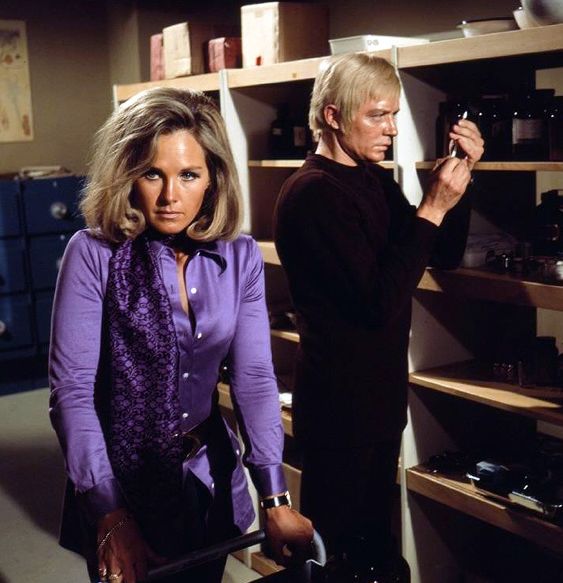
Every person is completely immobile and unresponsive (some lovely camera tricks here – a chair suspended in the air, smoke from a cigarette, etc) with Straker and Lake seemingly the only people not affected.  Watching the two of them in action, had UFO gone to another series they could have formed a very impressive partnership.  Ed Bishop and Wanda Ventham worked very well together and it’s a pity we didn’t get to see more stories with them paired up.

As they explore, Lake notices that one person has moved.  Turner (Patrick Allen) is a traitor who has sold out to the aliens.  Straker and Lake tool up with some impressive hardware and hunt him down through the studio backlot.  This is where the story takes on even more of a surreal edge, as Turner has the ability to move in time and therefore is able to stay a couple of steps ahead of them.

He also has a nice line in mocking taunts as he attempts to pay Straker back for every slight, either real or imagined, he’s suffered over the years as one of SHADO’s foot-soldiers.  And when Turner and Straker chase each other around the lot in children’s sports-cars you definitely know this isn’t a typical episode!

Eventually Straker works out a way to stop Turner and also manages destroy the UFO (although this is where there’s a little lack of logic – if the aliens are so powerful that they can freeze time, why send only one UFO?  In Reflections in the Water, also written by Terence Feely, they had a fleet of 25!).

This niggle apart, everything ties up by the end of the episode as we understand exactly why Straker was smashing up the equipment at the start of the story.  A complex, imaginative and ultimately satisfying tale, Timelash is a cracking episode.

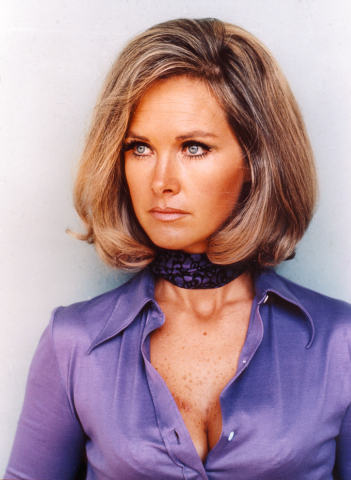
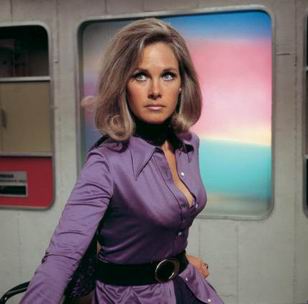
And Wanda Ventham looks absolutely gorgeous, which is the icing on the cake!

wanda 1

wanda 2

wanda 3

wanda 4

Captain Scarlet, Stingray and Joe 90 titles in HD

FIS

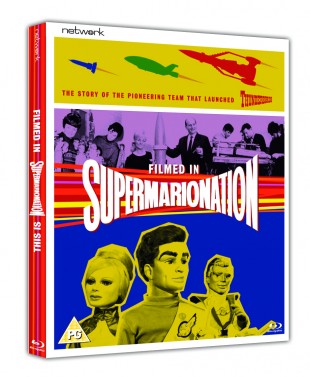
As a teaser for the forthcoming Filmed in Supermarionation releases, Network have released HD versions of the titles of various Gerry Anderson series on their YouTube account.

Filmed in Supermarionation is a new two hour documentary from Stephen La Riviere and looks to be a must watch for all Anderson fans. There are various different purchasing options, more details can be found here.

The YouTube compression means that obviously some quality is lost, so we won’t be able to see the full HD quality of the selected episodes until later this month. Time will tell whether complete HD series releases will follow in the future.

BFI DVD of Nineteen Eighty Four (BBC 1954) now cancelled

1984

It’s disappointing that the BFI DVD of Nineteen Eighty Four, adapted by Nigel Kneale, produced by Rudolph Cartier and starring Peter Cushing, is still in limbo.  The original release date was planned for the end of 2014, then it was pushed back to March 2015.  At the time of writing this update (07/03/15) the DVD is no longer listed on the BFI’s website and the provisional release date has vanished from e-tailers such as Amazon, which indicates that it’s not going to appear any time soon.

This isn’t the first time that a DVD has been mooted only for it to never materialise.  The story starts in 2004, when it was announced that it would be released by DD Video.  This was exciting news and when DD issued a press release it became clear that considerable effort had been expended in order to present the programme in the best possible quality.  Their 2004 press release is reproduced below –

BBC CLASSIC SF DRAMA PAINSTAKINGLY RESTORED

Classic TV specialist DD Home Entertainment claims to have set a new quality benchmark on its restoration work for the 1954 BBC drama Nineteen Eighty-Four.

This early landmark of British television, which will be available for the first time ever on DVD and video on November 8th, required extensive work on it, but viewers will – according to DD – find the restored picture even better than when it was first transmitted.  In December 1954 videotape recorders (even for broadcast use) were two years away and existed, if at all, only in prototype form in research laboratories.

Since 1947 BBC engineers had been able to make crude recordings of TV pictures simply by pointing a film camera at a monitor screen.  However, dramas were not recorded until 1953 and Nineteen Eighty-Four remains one of the earliest surviving examples of the art-form. It was recorded at the time using an ingenious system of modified telecine machines.

New transfers of the film recording were commissioned from BBC Resources using its highest quality Spirit datacine equipment. Special arrangements were made with the BBC Film and Videotape Library for access to the archive master material, which cannot normally be used.

The new copies of the play were graded. This is the process of taking each shot (or even part shot) and adjusting the brightness and contrast. Dirty cuts (where a frame is made of superimposed and distorted pictures from two cameras) were removed or, where possible, repaired using paintbox techniques.

Next, every frame of the play was examined and film dirt, scratches and other defects were laboriously re-touched and pointed out by hand. Finally a video process was applied to give the studio sequences the fluid motion appearance that they would have had on original broadcast.

The result – one of the earliest surviving examples of British television has been restored to exceptional quality.

Nineteen Eighty-Four will be available from November 8th 2004

But the DVD was never released in November 2004, instead it was announced that it had been postponed due to a dispute with the Orwell estate.  The 1984 film of Nineteen Eighty Four, starring John Hurt and Richard Burton, had been released on DVD in 2004 and it appears the Orwell estate didn’t want the BBC version to be available at the same time.

After this, everything went quiet until the BFI’s press release in July 2014 announced they would release it as part of their Days of Fear and Wonder SF season.  And the even better news was that they intended to use the restored master prepared in 2004.

It could be that it’s been delayed in order for the BFI to source more special features.  There’s some interesting material that could be added, most especially the 1965 version starring David Buck (a remake of the 1954 script).  Although it’s missing a few minutes, it would still be a very worthwhile (and long!) special feature. Further information about this production can be found here, in an article written by Kim Newman.

Or it could be that the Orwell estate are once again flexing their muscles.  If so, it’s their last opportunity, since in a few years their copyright claim to this production will have expired and they’ll no longer be able to block it.

It does seem bizarre that the BFI would announce the release without ensuring that all the necessary clearances had been obtained (but then the same thing seems to have happened a decade ago, with DD Video having spent money on a restoration that remains unseen).  Whilst it’s hardly difficult to source a copy of the unrestored print via the internet, it was the restored programme (along with some decent special features to place it in context – like the Out of the Unknown and the forthcoming Douglas Wilmer Sherlock Holmes DVDs) that the majority of us were keen to see.

For now, we’ll just have to wait and see if any more hopeful news surfaces in the future.  Anybody who is interested in more detail about the production may find this of interest.

Edit (Jan 2016).  Unfortunately the BFI DVD has now been cancelled.  The reason why isn’t known (possibly problems with the Orwell estate).  It does seem remarkable that both DD and the BFI prepared DVD releases which stumbled due to unspecified complications.  It possible that someone will try again in a few years time, but for now the restored version remains locked in the vaults.

It’s stopped being fun. Doctor Who – Resurrection of the Daleks

tardis

Back in 1984, there was somewhat of a buzz about this one.  Apart from a cameo in The Five Doctors we hadn’t seen the Daleks in a new story for five years and their previous appearance, in Destiny of the Daleks, had been a disappointment to many.

Thirty years on, Destiny is probably better regarded today than it was back then whilst Resurrection has lost a little of its lustre.  But although Eric Saward’s script has its faults, there are some things it does do right and it’s a clear pointer to the style the series would take in S22.

It’s fair to say that Resurrection is a bleak tale.  This nihilistic view of the universe reflects the direction in which Eric Saward wanted to take Doctor Who and he wasn’t the only writer to favour this style.  Robert Holmes penned very much the same type of story with The Caves of Androzani, but it has to be said somewhat better.  Therefore it’s not difficult to see that Holmes would from now on strongly influence Saward’s writing (Revelation of the Daleks with its Holmesian double-acts is surely the sincerest form of flattery).

But back with Resurrection, Saward wanted to tie up the loose ends from Destiny and resolve the Dalek/Movellan war.  He probably would have been better off ignoring this and starting afresh, as it does constrict the story (as do some of the other plot threads which go nowhere – such as the Daleks’ plan to duplicate the Doctor so he can go back to Gallifrey and assassinate the High Council).

The main part of the story revolves around the Daleks’ desire to find their creator, Davros, and use his skills to solve their current problems.  This is a re-tread from Destiny, but Saward does one important thing right here that didn’t happen in Destiny.  One of the clearest character traits of the Daleks is how single-minded they are, so it defied belief that they wouldn’t attempt to use Davros in Destiny for their own ends before discarding him.  But this never seemed to occur to Terry Nation.

In Resurrection, the Daleks are quick to realise that Davros is more trouble than he’s worth and they attempt to exterminate him.  But by then he’s already re-conditioned several Daleks, which establishes the general plot-thread of Dalek civil war which we see in Revelation and Remembrance.

As for the Daleks themselves, they do look a little worse for wear, it has to be said.  They’ve been given a fresh coat of paint, but since they’re a mixture of casings from the 1960’s and 1970’s they naturally do look like they’ve been around the block a few times.  For anybody who wants to delve further into the history of the Dalek casings, then Dalek 6388 is a fascinating website.

Michael Wisher was unable to reprise his role as Davros, so Terry Molloy stepped into the breach.  Molloy ended up playing the role three times and would go on to make it his own, managing to emerge from Wisher’s substantial shadow.  There’s less character for him to latch on here than he would enjoy in Revelation (which was much more of a Davros story than a Dalek one) but he still has some nice, ranting moments.

As for the humans, there’s an interesting ethnic mix on the space-station which is unusual for the series at the time.  There’s also signs of the increased gore that would appear during S22 (the Daleks’ disfiguring gas is pretty unpleasant and it’s debatable whether the close-ups should have been transmitted).

One problem with Saward’s scripts up to this point was that characters could often seem like cardboard cut-outs, existing just as long as they formed some plot function.  Once that ended, they would be quickly killed off (in order not to clutter up the screen).  Styles (Rula Lenska) and Mercer (Jim Findley) are good examples of this.  Rodney Bewes as Stein fares somewhat better and has the chance to play the hero at the end.

The Army bomb disposal squad, headed by Del Henney as Colonel Archer are also characters that don’t really go anywhere and it’s unfortunate that Tegan spends most of the story with them.  As a final story for Janet Fielding, Resurrection is a poor effort, as Tegan does little of consequence – but as is probably well known, the story was originally planned to close S20 (a BBC strike put paid to that) so her leaving scene had to be tagged onto the already-written story.

Turlough and the Doctor fare little better.  Turlough teams up with Styles and Mercer, although he does nothing to advance the plot.  The Doctor has one key scene (confronting Davros and proving that he’s unable to kill in cold blood) but apart from that there’s very few of the character traits that Davison so clearly enjoyed in Frontios.

Also skulking about is Lytton (Maurice Colbourne) who will return next season, although it’s worth pondering exactly how the Doctor in Attack of the Cybermen knows all about him, as here they only share one scene and never speak to each other.

After the mass slaughter, it’s difficult not to agree with Tegan that it’s all been a bit too much.  But it’s probably aged better than Earthshock and for better or worse, points clearly to the direction the series would take during S22.

UFO watch (Episode 23 – Reflections in the Water)

reflections

Written and Directed by David Tomblin

It seems an unwritten law that every science fiction/fantasy series has to have a doppelganger episode – and Reflections in the Water is UFO’s contribution to this genre.  But though it’s a decent run-around, there are some whacking plot holes which are difficult to ignore.

When a freighter in the Mid-Atlantic is destroyed by an underwater UFO, Straker sends Skydiver to investigate.  They discover the aliens have established a substantial underwater base (although why it’s underwater is a bit of a mystery).  Straker and Foster fly out to investigate personally (which is something else that’s difficult to find entirely credible.  Straker’s the head of SHADO, why does he need to endanger himself on a reconnaissance mission?).

Anyway, Straker and Foster pop on some diving suits and go for a swim.  While they can’t find a way into the dome on their first attempt, they are able to see inside and observe Lt Anderson (James Cosmo).  The pair head back to SHADO HQ to interrogate Anderson, which gives us yet another example of how ruthless Straker is.  He has no qualms in authorising Anderson to be injected with drugs in order to establish the truth and interestingly Anderson doesn’t argue about this too much.

Even after the truth drug, Anderson continues to protest his innocence so Straker and Foster go back and manage to infiltrate the dome.  Once inside, Straker and Foster split up and shortly afterwards Straker is attacked by Foster.  But it’s not Foster, it’s a double!

One of the main attractions of a doppelganger story is when the two identical parties meet, but we never see it here.  After Straker defeats the faux-Foster, the real Foster appears and is shown his duplicate.  We linger a little too long on a shot of Foster looking at someone that clearly isn’t him, which makes you wonder why they didn’t use a little split screen filming to have the two of them on screen at the same time.

We now come to the part of the episode which stretches credulity to breaking point. The aliens have recreated SHADO HQ (how?) and recruited look-alikes for all the main SHADO personnel (plastic surgery apparently).  Although the aliens have clearly spent a packet on getting the likenesses spot on, they obviously couldn’t afford a voice coach, so we see the doubles practicing by miming to the real voices of the SHADO staff which have been recorded on tape.

The aliens’ plan is to try and fool Moonbase into thinking this is the real SHADO HQ and then order them not to destroy the massed UFOs which are poised to attack.  It’s clever that the aliens have somehow been able to sample the voices and produce exactly the words they need to say, but what would happen if Moonbase asked a question that wasn’t recorded?  They’d be a little stuck.

A whopping explosion destorys the dome, so there’s just the 25 or so UFOs to worry about.  And via a load of stock footage (Interceptors, Moonbase rocket-launchers, Sky One) they are all dealt with.  This is the last thing that’s difficult to swallow.  We’ve seen SHADO struggle to stop one or two UFOs getting through in plenty of episodes so far, so could they really have shot down all 25?

Although the story makes little sense, it’s still as watchable as most episodes in the series.  It’s just that you have to disengage your critical facilities somewhat before starting.

The Professionals – Mk II – Network Blu-ray review

profs

The Professionals – Mk II is now available on Blu-ray from Network. The reason why they haven’t branded these releases as series is probably due to the somewhat haphazard way the programme was shot – with certain episodes made during one production block and then not transmitted until several years later!

There were five series broadcast on LWT in the late 1970’s and early 1980’s, but it does seem that Network will follow the path trodden by Contender’s DVD releases by releasing four sets in production, rather than broadcast, order.

Anybody who has previously bought the Contender DVDs or has ever caught a re-run on ITV4 will be well aware just how poor the episodes looked. This was because the previous home video releases and tv broadcasts were derived from twenty year old duplicated prints, which weren’t in the best of shape to begin with.

For many years it seemed that this would be the best we could possibly have, as the location of the camera negatives was something of a mystery. To cut to the chase, Network have been able to locate the negs and strike new prints – and the difference in picture quality is simply night and day.

Whether you buy the BR or the DVD (the DVD of Mk II has been delayed, but will be released early next year) for anybody familiar with the washed-out prints which have done the rounds for decades, the improvement here is nothing short of staggering. The Professionals was only shot on 16mm, so obviously there’s not the same level of detail that 35mm would have offered, but it’s still such a major upgrade in picture quality that it’s an essential purchase.  And if you’ve never seen the series before, then these releases are the ideal way to start.

Whilst The Professionals hit the ground running in series one, it certainly picked up more momentum with the episodes in this set. There’s plenty of good stories here, but if I had to pick one, then First Night is a cracker, full of the moments that made the series what it was – Bodie and Doyle’s banter, Cowley’s withering put-downs and some top-notch action.

As with MK I, there’s exhaustive production notes from Andrew Pixley that help to place these programmes in context and they contain a great deal of information that was new to me.

Warmly recommended.

UFO watch (Episode 22 – The Psychobombs)

pyschobombs

Written by Tony Barwick
Directed by Jeremy Summers

I’ve previously mentioned how a number of UFO stories have the same basic premise – the aliens take over a human being and force them to do their biding.  It seemed to be a particularly popular story device during production block two, as we’ve seen it occur in The Man Who Came Back, Destruction and The Cat With Ten Lives.

Is The Psychobombs any different from these and other stories?  Well, one innovation is that there are three human agents, rather than the more normal one, so this allows several different threats to be carried out at once.  And all three of the controlled humans are played by decent actors, so this is a plus point.

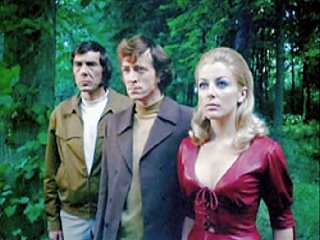
A UFO lands in a deserted woodland and sends out a hypnotic signal.  Three people answer the call – Linda Simmonds (Deborah Grant), Clem Mason (Mike Pratt) and Daniel Clark (David Collings).

Clark is straight into the action and flags down Straker’s car.  Given that the aliens have attempted to kill Straker before they miss a golden opportunity here.  Instead, Clark knocks Straker unconscious and puts a note into his pocket.  The note is an ultimatum – all SHADO operations must cease, otherwise Fairfield Tracker Station, Skydiver 3 and finally SHADO Control will be destroyed.

Clark manages to destroy the tracker station and Mason deals with Skydiver 3.  That leaves Linda Simmonds and SHADO HQ.  Whilst SHADO attempts to track Linda down, Dr Jackson shares a theory with Straker –

Dr. Jackson: I have a theory. But I must warn you, it’s pretty wild. A human body – muscles, brain – operates in a series of minute electrical charges, flowing around a complex of low voltage electrical circuits – the nervous system. Sometimes the electrical balance is disturbed. Imagine the situation where, for some reason, the balance swings violently off centre. The body becomes supercharged. Like a thunder cloud before a storm. If such a charged being could exist, it may be able to draw on all the primitive forces of the universe, attract them to itself. Space, time, light… electric potential, energy… they are all related. The result …

Straker: A human bomb.

Foster locates the girl and Straker orders that she be brought to SHADO HQ.  A rather rash act, you might think – and it seems to have backfired after she escapes from custody and is poised to blow up the building.  However, Sky 4 manages to destroy the UFO controlling Linda, though given the way previous stories have gone, I’ll leave you to decide if there’s a happy ending.

As I’ve said, there’s nothing particularly original here, but the number of threats posed by different people is an intriguing twist.  There’s also interest in spotting some faces that would become familiar television faces years later (Peter Blythe, Christopher Timothy and Oscar James, for example).

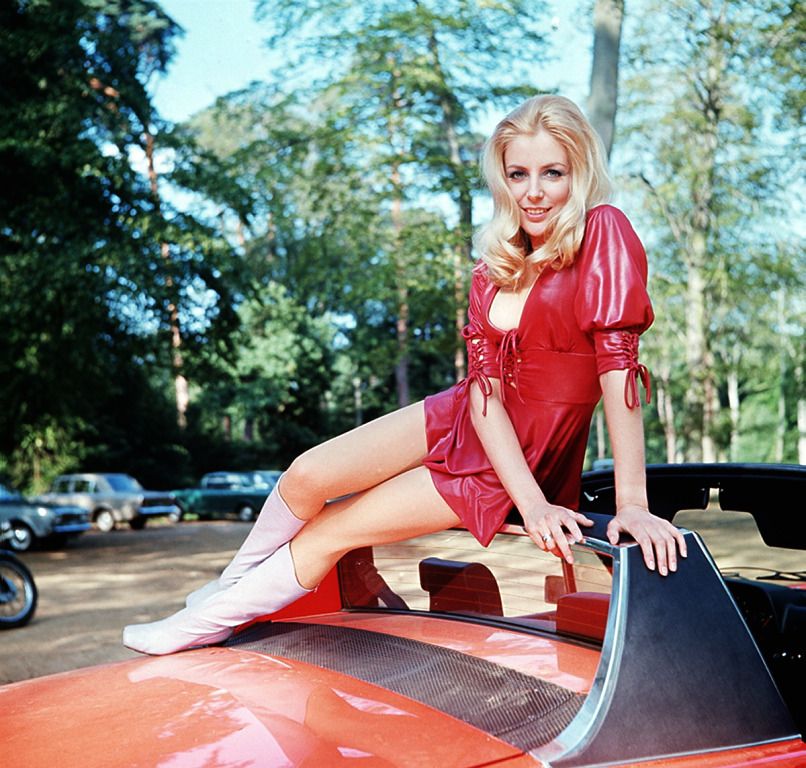
Trivia fans may notice that the rather nice red dress worn by Deborah Grant is also worn by Susan Jameson in The Sound of Silence.  It makes another appearance in the upcoming Timelash, so they certainly got their money’s worth from it!

deb 1deb 2