I’ve uploaded some more archive bits and bobs to my YouTube channel, including this fascinating edition of Late Night Line Up from the mid 1960’s, which takes a look behind-the-scenes at Z Cars.
Month: May 2015
Doctor Who – More than Thirty Years in the TARDIS
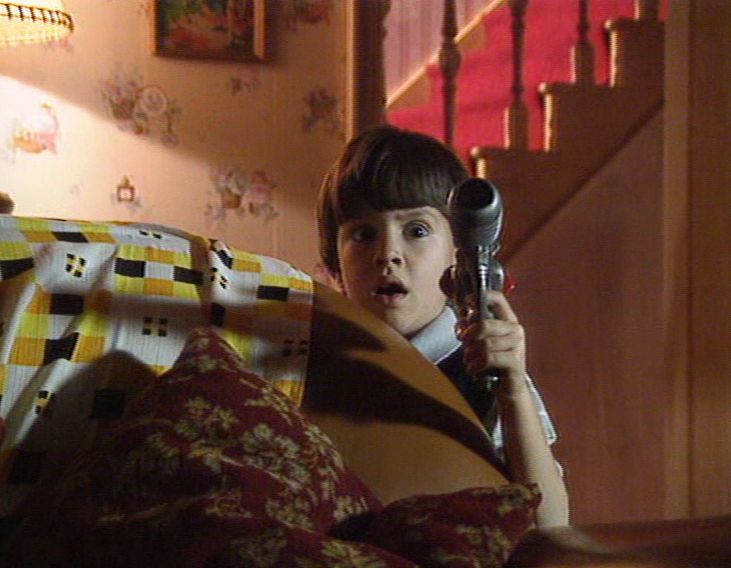
One thing that the range of Doctor Who DVDs (from An Unearthly Child to the TVM) isn’t short of is documentaries. Just about every release has a plethora of supplementary information – from story-specific features, interviews with people from both in-front of and behind the camera to more tangential featurettes (such as The Blood Show from the State of Decay DVD. A twenty minute documentary on the use and meaning of blood in society? No, me neither).
But back at the start of the 1990’s, things were very different. The only British-made documentary screened during the series’ original twenty-six year run was 1977’s Whose Doctor Who. Reeltime Pictures catered for the fan market during the 1980’s and 1990’s with the MythMakers series of interview videos, but these (like VHS releases of convention panels) were only preaching to the converted. A mainstream documentary on BBC1 seemed like a remote possibility.
But 1993 was Doctor Who’s 30th anniversary and even if the show had been off the air since 1989, it still had a certain presence (thanks to healthy VHS sales). Kevin Davies was keen to make a documentary celebrating the program and he had an impressive calling card – The Making of the Hitch-Hiker’s Guide to the Galaxy – a popular straight to video documentary that mixed archive footage, outtakes and new interviews.
Thirty Years in the TARDIS was to eventually take very much the same shape – although prior to this format being agreed Davies made numerous other pitches which were rejected. These included Tomb of the Time Lords which would have featured Ace searching the Doctor’s memory in the Matrix – which would have provided the excuse for a series of clips. Another intriguing possibility was The Legend Begins, a drama-documentary about the creation of the series (Davies suggested Pete Postlewaite as Hartnell). We would have to wait another twenty years, and Mark Gatiss’ An Adventure in Space and Time, for this idea to eventually hit the screen.
Thirty Years in the TARDIS was produced by The Late Show team and although Davies had been given a free hand, some higher-ups became concerned with the approach used. Davies wanted to take the nostalgic route to try and pinpoint why Doctor Who had been such as success whilst The Late Show team felt that the documentary should have a more factual basis and so additional interview material was shot.
In the end, this made the transmitted version a rather uneasy comprise between Davies and his producers. But even though it was a bit of a hodge-podge, there were still plenty of impressive moments (especially the drama recreations). However, Davies still felt that there was a better documentary that could be made from the material and so in 1994 More Than Thirty Years in the TARDIS was released on VHS.
Davies had free reign to re-edit the program to his wishes as well as adding an additional forty minutes (bringing the running time up to ninety minutes). From the perspective of 2015 it’s just another documentary, but back in 1994 it was something rather special.
Although the pirate video network (see Cheques, Lies and Videotape on the Revenge of the Cybermen DVD for more info) was still flourishing at the time (which meant that some of the rarer material featured – studio outtakes, for example – were in circulation) not everybody had access to them. So a major draw of the VHS were the snippets from studio sessions, including The Claws of Axos and Death to the Daleks , as well as ephemera like the Tom Baker/Lalla Ward Prime Computer adverts. Even the end credits were fascinating, as they were packed with clips of studio off-cuts.
Jon Pertwee, Colin Baker and Sylvester McCoy were interviewed, but Tom Baker and Peter Davison were conspicuous by their absence. Tom did make an appearance via archive footage though and given that many anecdotes were already calcified by this time (yes, Jon Pertwee does mention Yetis in Tooting-Bec!) this probably wasn’t too much of a drawback.
One notable new section concerned the thorny issue about who exactly created the Daleks (was it Terry Nation, Raymond Cusick or Davros?). This discussion was intercut with Jon Pertwee’s appearance on the Anne and Nick show where he disagreed that it was Terry Nation (much to the amusement of the studio crew!).
The DVD release of More Than is pretty much a direct port of the VHS master which means that many of the clips look rather grotty. Along with the staggering number of special features, the amount of restoration work carried out the DVD releases is really highlighted when you see exactly how badly the stories used to look.
If you didn’t live through the 1990’s as a Doctor Who fan, then More Than is probably not going to have the same special appeal today as it did then. Just about every scrap of interesting material can be found in a more complete form somewhere on the DVD range (you want the whole studio spool from The Claws of Axos? You’ve got it) but More Than does manage to compress twenty six years of history into an entertaining ninety minutes.
This obvious nostalgia apart, it remains a very decent documentary that does its best to explain the magic of the series and I’m glad it ended up on DVD.










Village Hall – Mr Ellis Versus the People
For visitors to the blog from outside the UK, today is General Election day. Of course, those from the UK will hardly need reminding of this as it’s been a constant topic of conversation in the media for some time. And should no party gain a majority tomorrow, no doubt the conversation will go on! But since I’ve made my trip to the polling station and cast a vote, it seems apt to dig out this episode of Village Hall, written by the late, great Jack Rosenthal.
The Village Hall has been turned into a polling station and present are three very different people. First there’s presiding officer, Mr Ellis (Ron Moody). Mr Ellis is a veteran of every election since 1945 and there’s nothing that could possibly happen which would surprise him. He’s assisted by the eager young Mr Martin (Brian Miller) and the equally young and eager Miss Robinson (Veronica Roberts).
Mr Martin is deeply aware of the solemn duty they are all undertaking and he’s incredibly keen to impress Mr Ellis (he’s also completely humourless and by-the-book irritating). Miss Robinson, for some unfathomable reason, is rather smitten with Mr Martin and she tries her best to impress him – but he has his mind strictly on the job in hand. As the day wears on, the three of them face an increasingly bizarre parade of characters, all of whom are keen to exercise their right to vote (even if many of them don’t understand even the basics).
Although this was made forty years ago, it’s interesting to see how little has changed. My polling station might be in a church hall, rather than a village one, but it’s still run on the same low-tech lines (just a few booths, a piece of paper and a pencil).
It sounds like an unpromising topic to fill fifty minutes, but Jack Rosenthal always had a keen ear for dialogue and this gives a very decent cast plenty of scope. There’s so many quotable lines, such as when Mrs Ellis (Majorie Yates) turns up and Mr Ellis tells her that he can tell she’s come for an row, because of her handbag! Ron Moody is excellent as the permanently harassed Mr Ellis, whilst Brian Miller (Mr Elisabeth Sladen) and Veronica Roberts both offer good support as two more irritants who conspire to make Mr Ellis’ long day even longer.
The setting of a poling station means that a disparate group of characters can enter, briefly cause havoc, and then disappear. During the day they have to deal with a woman who tells them she wants to vote Conservative but can’t grasp that she has to put a cross on the paper, a man who keeps on putting his cross in the wrong box and another woman who has to have the whole procedure explained to her (and then she further irritates Mr Ellis by asking him where to put the cross!).
There’s plenty of familiar faces, such as Bernard Hill (as a policeman), Michael Angelis, Liz Dawn and a young Richard Griffiths as Mr Ridealgh, who becomes rather belligerent when he’s told that he can’t vote (because Miss Robinson accidentally ticked his name off the list in error).
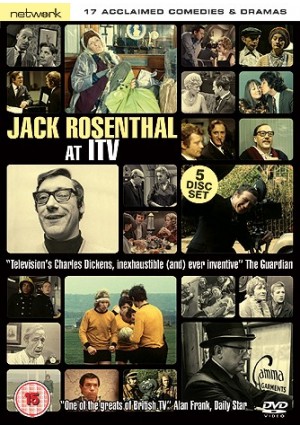
This is available either on the series one set of Village Hall or on the five-disc set Jack Rosenthal at ITV. Personally, I’d go for the Jack Rosenthal at ITV release as it’s packed with some lovely one-off plays as well as episodes from various series (including Coronation Street and The Lovers). For anybody who wants an introduction to his work, it’s warmly recommended.
Minder – Gunfight at the O.K. Laundrette
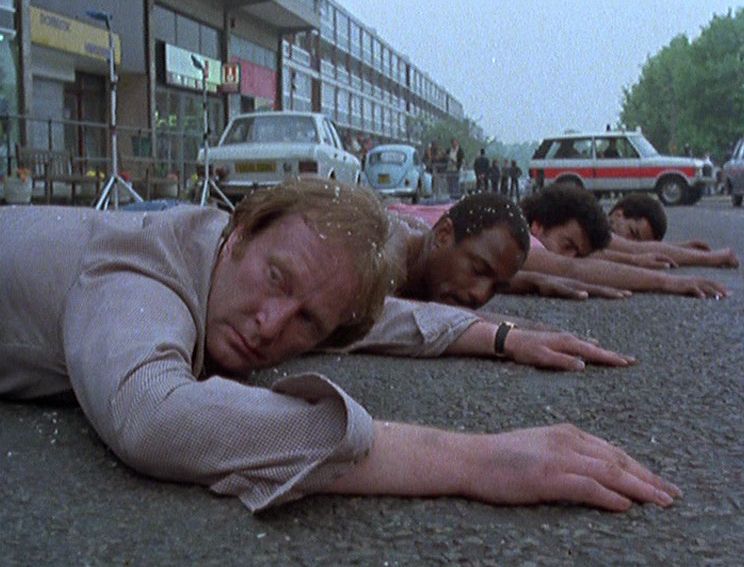
It should have been an easy job for Terry (Dennis Waterman) – a simple case of minding Alfie Cavallo (Dave King) as he collected the money from his string of coin-operated laundrettes. But a bungled armed robbery, led by Stretch (Trevor Thomas), meant that Terry, Alfie and the unfortunate Mrs Mayhew (Hilary Mason) are taken hostage and a tense stand-off with the police begins.
Richard Marson’s recent book about Verity Lambert describes how she green-lit Minder after listening to a five minute pitch. Her snap decision paid off as it remained one of ITV’s top-rated dramas for the next fifteen years. During that time the tone of the series certainly changed, as it became a more comedic, family friendly series – which wasn’t to the liking of everyone (especially Dennis Waterman, who left after the seventh series mainly because he’d felt the show had lost its edge).
Gunfight at the O.K. Laundrette, the first episode (originally broadcast on the 29th of October 1979), retains more of the harder edge of the earlier series, but there’s still plenty of humour mixed in. It does feel slightly odd though, mainly due to the library music used. Stock music was often used in Waterman’s (and Euston Films’) previous series, The Sweeney, but it just feels out of place in the early episodes.
The immediate aftermath of the bungled robbery (the shotgun accidentally goes off, wounding Alfie) is probably the weakest part of the episode. In story terms, it’s important that the police know what’s happened, but the timetable is too contrived. A shot goes off, a police-car appears from nowhere, an officer sees the hostages being moved to the back room and then calls for reinforcements. All this seems to take place in a matter of seconds!
Minder was originally planned to be a vehicle for Dennis Waterman and he’s certainly central to this story. George Cole is much more peripheral, although he’s still highly entertaining. I love the moment when he breaches the police barrier by the launderette, breezily telling a policeman that he’s with the serious crime squad. His ability to make money is also readily apparent – he’s able to sell a photo of Terry’s fiance (in fact a girl he’s only spoken to twice) to the newspapers for a tidy sum.
Terry, Alfie and Mrs Mayhew are moved into the back room by Stretch and his two accomplices, Winston (William Vanderpuye) and Cosmo (Leroi Samuels). Both of them are little more than kids and it’s obvious that they’re in way over their heads. Stretch is the dangerous one – as it seems likely that he’ll use the gun, Terry slowly begins to chip away at him.
He tells him that attempted armed robbery will get him seven years, but he’ll probably be out within five. When Stretch asks him how he knows so much, Terry wryly tells him that he used to keep bad company whilst Alfie chips in that he was bad company. Both Terry and Alfie are old lags, but they’ve done their time and have no wish to go back.
But whilst Terry is earning a (mostly) honest living, it’s one that he admits gives him little job satisfaction – since it consists of throwing drunks out of strip clubs and providing people with a bit of muscle. For someone who (as we’ll learn in more depth later on) could have been a contender, it’s something of a come-down.
Leon Griffiths (named after Leon Trotsky by his mother) had been contributing scripts to popular series since the early 1960’s. The Four Just Men, The Adventures of Robin Hood, Ghost Squad, Out of the Unknown, The Return of the Saint and Hazel were just some of the shows that benefited from his scripting.
But Minder was the first time that he’d devised a show, rather than take on somebody else’s characters and situations. Although in the end the number of episodes he wrote was fairly small compared to the total number made (15 out of 109) he still set the tone and template for all the writers who followed in his wake.
All the hallmarks of early Minder are contained within this one episode. Grimy, seedy London (with Terry a regular around the strip-bars of Soho), Arthur’s subtle (and not so subtle) manipulation of Terry and a confrontational relationship with the police. Terry might be straight now, but he knows that since he’s got a record, he’s a marked man and it’s his uneasy relationship with the law (as well as the conflict between him and Arthur) which would drive the series for a good many years.
Dixon of Dock Green – Conspiracy
No police series could ever hope to avoid the thorny topic of corruption within the force, but it’s fair to say that it was always a difficult one for Dixon of Dock Green to face. This is due to the overwhelmingly positive picture of the police force always painted by the series (which by the mid 1970’s made it clearly something of an anachronism).
Z Cars’ first episode (Four of a Kind, tx 2/1/62) showed us coppers who made bets on duty and would think nothing of giving their wife a black eye. So for all of Dixon’s strengths, Z Cars (and other later series including The Sweeney) did tend to be streets ahead when it came to showing the police’s weaknesses as well as their strengths.
But Dixon did occasionally tackle police corruption. The most famous example is The Rotten Apple (1956), largely because it’s one of only a handful of episodes from the 1950’s and 1960’s to survive. And the fact that the bent copper was a very young Paul Eddington also helped to keep it in the public consciousness (via clips in documentaries, for example).
A more recent episode, Eye Witness, also had an interesting throwaway moment – when the villain told his henchmen that they’d be able to track down the witness currently held in police protection since they had a pipeline into most police stations up and down the country. Nothing actually comes of this in story terms (the witness is found another way) but it’s an subtle acknowledgment that corruption was rife in the 1970’s.
N.J. Crisp’s Conspiracy (originally transmitted on the 10th of May 1975) is essentially a three-hander – shared between Dixon, Crawford and PC Len Warren (Andrew Burt). Dixon receives an anonymous letter claiming that Warren was seen drinking with a criminal out on probation, Ben Randall (Jon Laurimore). Warren is the chief prosecution witness in Randall’s upcoming case, which makes the allegations even more damaging.
Dixon regretfully tells Andy that ten years ago they could have simply thrown this letter in the bin, but now it has to be investigated. Andy’s keen to call in A10 (the department created to investigate matters like this) but Dixon wants to keep it in-house for now (which causes friction between them).
Warren is portrayed as an ambitious man, keen for promotion. His over-zealous nature and his strict adherence to the law means that he has few friends (either within or outside the force). He’s a loner, who likes to bend the rules occasionally, and Dixon tells Andy that he sees much of the young PC Crawford in him (although Andy doesn’t take this as a compliment!).
Although the circumstantial evidence of Warren’s guilt is strong (and the story does throw in a few scenes that seem deliberately designed to show him in a bad light, which is something of a cheat) eventually it’s proved that he didn’t accept a bribe from Randall. But he’s already decided to resign, since he found the investigations into his private affairs (such as questions about how he could afford to buy a new car) to be incredibly intrusive. Dixon tells him that it’s part of the price he has to pay for being a police officer, but for Randall it’s clearly unacceptable.
Conspiracy was originally planned to be the final Dixon episode (another series was only given the go-ahead very late in the day). When you know this, it’s easy to see how it was crafted in order to conclude the series. For one thing, Dixon is much much centre-stage than normal (by this time he’s usually relegated to giving sage advice from behind the station desk). There’s also several key speeches from Dixon which make specific points. The first is directed at Andy.
I remember, a long time ago now, a young copper on the beat pressing hard to get into CID. I remember that same young copper as a detective constable, always convinced that he knew best. And later as a detective sergeant who wasn’t above ignoring the book when it suited him. You, Andy. You’ve crossed your fingers and taken a few shortcuts in your time. Mostly they worked out but sometimes they didn’t. Do you know why it took you so long to become a detective-inspector? You got the reputation for bending the rules. But you’re a good copper. And so is Warren.
The second occurs a few minutes later and is directed at Warren. It’s a signature moment for Jack Warner and it’s very clear that he feels every word. As the camera slowly closes in on Dixon’s face, Warner seems to be struggling to hold his emotions together – as presumably he believed this would be the last time he’d play the role. It’s a beautifully delivered monologue.
All the years I’ve spent as a copper, I think every minute’s been worth it. Oh, the police force isn’t perfect. It can’t be. It’s manned by ordinary men. I know we talk about red tape and frustration when a villain goes free and the harm done by the occasional bent copper. But, for all the criticism, the police are there to protect the public, and that’s what we do. We curb violence. We do our best to deal with villains who want to prey on society. I’ve been proud to have been a part of that. Even a small part. It’s been my life for a long time now and I don’t regret any of it.
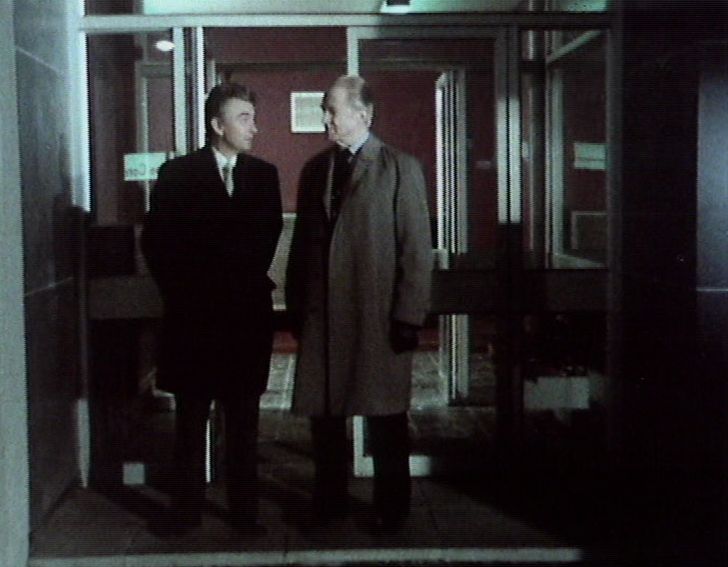
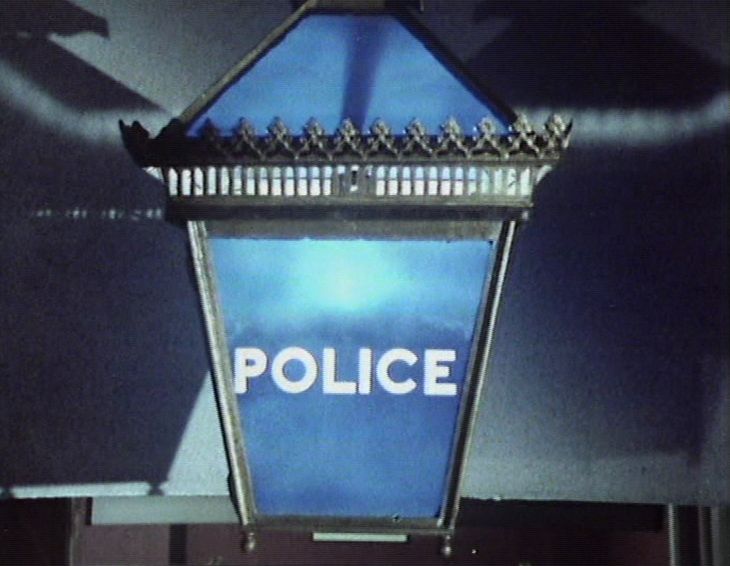
Dixon and Andy then exit the station as the camera tracks up to show the blue lamp above the door, which is followed by the end credits. This is a subtle nod to the original film and had the series ended there then it would have been a very decent conclusion.
Instead, we’ve one more series to look forward to, although Conspiracy is still the end of an era as Peter Byrne decided not to return. As a regular since the very first episode in 1955 (which was titled PC Crawford’s First Pinch) Crawford was as much a part of the fabric of the series as Dixon himself and his presence will certainly be missed.
Dixon of Dock Green – A Slight Case of Love
A Slight Case of Love opens in a non-linear fashion, but the reason why quickly becomes clear. We see a woman telling her fiance that their marriage is impossible, since she has to care for her invalid mother. This is repeated twice more – with different men but the same woman (although her appearance changes each time). We then see each of the men hand over a cheque for one thousand pounds.
And this is only the tip of the iceberg as the woman, Kate Harris (Moira Redmond), has also conned at least four other men. Crawford and Brewer have little to go on – apart from the irate responses of her victims. One of them, George Bunning (Alec Wallis), can probably be taken as typical, as he’s incredibly angry and demands immediate action from Crawford – warning him that if there’s not a satisfactory conclusion he’ll make Crawford suffer. Needless to say, Andy’s neither impressed or cowed by this.
This makes the response of Harris’ eighth victim, Lewis Naylor (Julian Glover), even more extraordinary. He’s also keen to find her, but he doesn’t want her to go to prison – he still wants to marry her and so wouldn’t want his wife to have received a prison sentence.
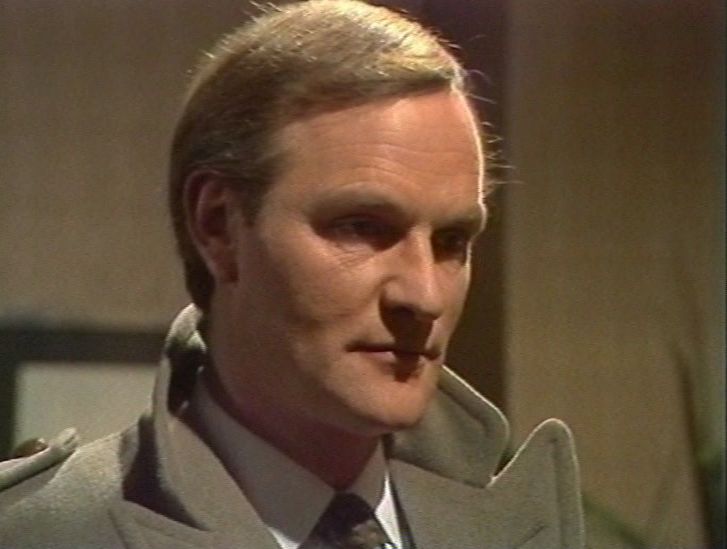
Naylor is a powerful man (a merchant banker) and it’s hard at first to know if his motives are quite what he claims them to be. This is due to Julian Glover’s icily efficient and clipped performance. It’s one we’ve seen from him many times before (his career has often consisted of him playing villains and rogues) so there’s a certain ambiguity in his playing. But it soon becomes clear that he’s completely sincere and, though he knows he’s not the first she’s conned, to him it doesn’t matter.
Later, we see why Kate has carried out these deceptions – together with her sister Fleur (Isla Blair) she owns a pottery business that is suffering from considerable financial difficulties. If they don’t find eight thousand pounds then the bank will foreclose on their loan. It explains why, although when the law catches up with her it’ll hardly be a defence.
Naylor does visit Dock Green but it becomes clear to him that whilst they also want to find the woman, when they do she’ll suffer the full penalties of the law. So he leaves to hire a private detective to track her down whilst Brewer ponders on the two mugshot pictures he’s picked out. No other victims were able to identify anybody from the photos held by the police, which strikes Brewer as a little odd. Dixon surmises that it may be because although Naylor knows they’re not the ones, he wants to question them to see if they know Kate’s true identity.
This is a reasonable assumption, but it’s never followed through and the true reason seems to be that it allows the Dock Green boys to visit the two suspects, add them both to the identity parades, and also bulk out the running time of the episode. But both encounters are good fun, especially Andy’s run-in with Heather (Mela White). Andy and Heather are old acquaintances, although she insists that she’s now going straight and tells him she’s writing a memoir of her colourful career entitled Horizontal Confessions. Andy caustically responds that it should be titled A Hard Time Was Had By All (!).
A Slight Case of Love is an interesting tale of morality. Both Kate and Fleur are unrepentant – they needed eight thousand pounds and they took it from people who wouldn’t miss a thousand each (Kate considers they would be able to write it off as petty cash). As a hard-headed, rational businessman, Naylor’s desire to marry her (even though he knows that she’s a serial con-artist) seems inexplicable – and can only be explained away by the fact that he’s in love.
Naylor’s private detective manages to find Kate, which allows the Dock Green coppers to take her into custody. Five of her victims are lined up to pick her out of an identity parade – four do so and one doesn’t (the one who doesn’t is, naturally, Naylor). Dixon’s outro tells us that Kate was convicted but also that on her release Naylor was waiting and he closes by saying that it’s “not every discharged prisoner who comes out to spend her honeymoon in the Bahamas.”
Julian Glover gives an excellent performance and he’s the main reason why this episode works as well as it does. A lesser actor might have struggled with the apparant contridications of his character, but Glover is never less than totally assured. Moira Redmond (a familar face from both films and television) has a hard role to play – does she love Naylor or is she simply marrying him for his money? But this ambiguity is something that Redmond can play with and it helps to provide a little spark to the story. Glover’s real-life wife, Isla Blair, played Fleur. It’s the less rewarding, more passive role, but it’s always a pleasure to see her.
This is one where the detection is pretty minimal (and it’s the private detective that does most of the work anyway, although Crawford is happy with that). Instead, the focus is on the rather mismatched pairing of Kate Harris and Lewis Naylor.
Timeshift – Live on the Night: The Story of Live TV Drama
I’ve uploaded some bits and bobs to my YouTube channel over the last few days and one of them is this Timeshift documentary from 2004.
It tells the story of live British television drama – from the early days and then right up to date. Covering programmes like the original Quatermass serials, Nineteen Eighty-Four, Dixon of Dock Green and Z Cars and featuring interviews with Nigel Kneale, Peter Byrne and Brian Blessed amongst others, it ties neatly into some of the shows that I’ve written about in recent months.
Dixon of Dock Green – Looters Ltd.
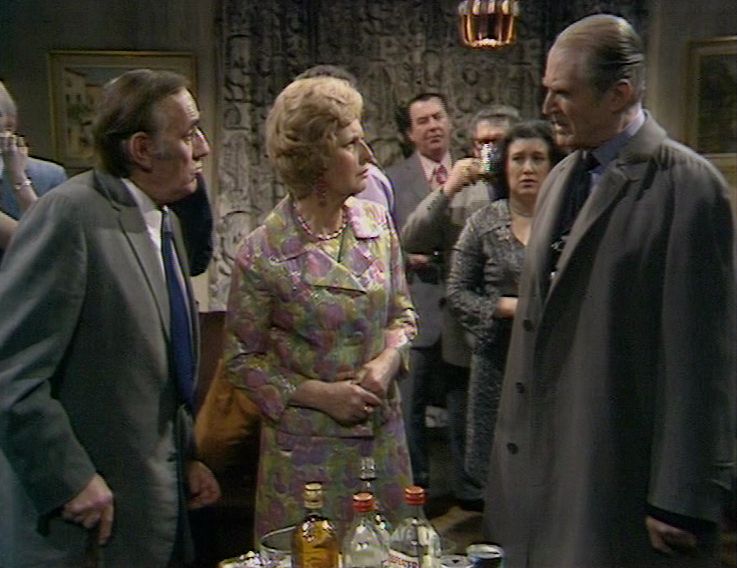
Charlie Barnet (Sam Kydd) is an old time villain, newly released from prison. In his prime he could scale any building – but a bad fall on his last job put paid to that and now he’s reduced to walking with a stick. On the way back to his welcome home party he notices a man (played by Robin Ford) being mugged and intervenes.
He leaves his name and address with Sgt Wills and promises to pop into the station later to make a statement. But when Dixon learns his identity, he realises that it’s unlikely that he’d make an appearance under his own steam, so he decides to gently gatecrash his party.
The relationship between Dixon and Charlie is a familiar one from the series (and in fact you can date it right back to the original film The Blue Lamp). Charlie may be a criminal, but he’s an honourable one and there’s something of a grudging respect shown by Dixon towards him – one professional to another. When Dixon crashes the party, there’s an awkward silence from most of the guests (mistrust of the police is obviously ingrained) but Charlie’s polite and hospitable, offering him a drink. Dixon accepts (compare this to Harry’s Back where we see Dixon look askance at a drink bought for him by Harry). George then offers to find Charlie some work.
At the start of The Blue Lamp, a voice-over contrasts the type of decent old-school criminal (like Charlie) with the younger, wilder criminal element who use violence without thinking. It’s an interesting dichotomy – which is also expressed in this story as on the one hand we have Charlie and on the other we see his son Ray (Terry Cowling).
By a remarkable coincidence, Ray was one of the muggers who attacked the man in the street (Ray later gave Charlie the mugged man’s gold wristwatch as a present). Charlie tells his son he’s ashamed of him, but doesn’t want him to go straight. “I’m talking about you learning a proper trade. I don’t want no son of mine to turn out to be a small-time mugger. A proper trade. Like I had.” He offers to have a word with one of his friends, but he’s told that “the young-un’s today, they’re too wild.” which reiterates the chasm between old-school career criminals and the younger ones.
The rest of the family are doing nicely – Charlie’s wife Olive (Margery Mason) and their daughter Diana (Gwyneth Powell) run a thriving business, offering virtually anything for sale at reasonable weekly installments. Naturally, all of their stock is stolen – they’re prolific shoplifters.
Sam Kydd delivers a nice turn as the head of a thoroughly criminal household and Gwyneth Powell (previously seen in Eye Witness), Margery Mason and Terry Cowling offer very solid support. And the opening party scene is great fun, with the sort of bad-taste visuals that clearly mark this as the mid seventies!
Gerald Kelsey was a prolific writer for Dixon (forty three episodes between 1963 and 1976) although the majority no longer exist. But on the evidence of this one he had a good grasp of what made the series tick – namely the conflict between the police and their prey.
Dixon of Dock Green – Baubles, Bangles and Beads
Baubles, Bangles and Beads opens with a scene that could have come from The Sweeney. A police car is in hot pursuit of another car which contains three dangerous-looking characters (played by Brian Glover, Johnny Shannon and Frank Jarvis). They’re desperately looking for a place to stash a bag of stolen jewellery, but the police car is too close behind. In desperation they fling it out of the window and it lands in somebody’s back garden. Unfortunately for them, it doesn’t remain there for long …..
Given how much of Dixon is lost (only thirty two episodes exist from over four hundred made) it’s hard to get a feel for the variety of stories that the series might have tackled. And one thing we haven’t seen so far with the colour episodes is one played for laughs, until Baubles, Bangles and Beads.
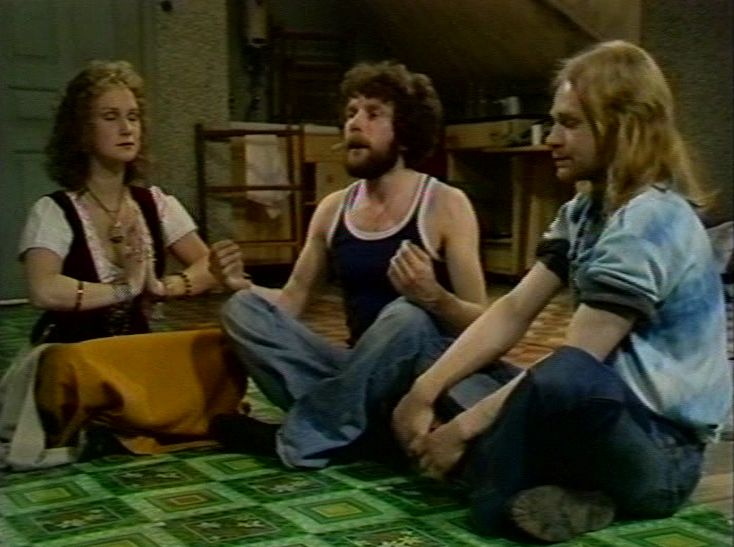
It’s an interesting culture clash as we see three old school villains – Chuck (Brian Glover), Bert (Jonnny Shannon) and Syd (Frank Jarvis) – confronted with the bewildering world of alternative religion. The bag of jewellery was found by Eric (Leon Vitali) who has been squatting with Phil (Peter Denyer). Both are seeking enlightenment – although Phil seems to be further down this road than Eric (which is something he takes great pleasure in pointing out to his unfortunate friend several times).
Eric’s a simple trusting soul whilst Phil is rather humourless and dogmatic. When Eric expresses dismay over Phil’s purchase of tomatoes (Eric can’t eat them as they make him sick) Phil has no sympathy. “That’s what I call giving in to your lower centres. Don’t you realise the body is always trying to subvert your higher consciousness?”
They move from the squat to another location and in the room opposite is Marion (Kitty Stevenson) and several of her friends. Like Eric and Phil, Marion and the others are also seeking enlightenment, although they do so in ways that shock Eric. When he pops over to ask for a match, he rushes back to Phil to tell him that they’re meditating – but with no clothes on. Phil takes the news quite calmly. “That’s nothing. That’s your trouble, that is. You’re carnal oriented. I’ll go see ’em.” Marion later explains that “to deny the body, one must first see it as it is, in all its gross intransigence.”
She’s learnt this from Guru Rhum Rhaji. His Temple – the Temple of Godly Effulgence – is close to their flat and Eric, iimpressed with what he’s learnt about him, joins Marion to pay homage. Eric’s delighted to hear that Rhaji doesn’t charge people to enter his Temple (unlike Phil’s guru, Shashti Ap Davies, who requires 10% of all his disciples earnings). Rhaji is pleased to accept gifts though – although he refuses the one offered by Eric (a rather indifferent picture). So the next time he goes along, Eric takes something that he’s sure will be acceptable – the bag of jewellery. And unsurprisingly, Rhaji accepts this offering.
Rhaji bears some similarity to the likes of the Maharishi Mahesh Yogi. By the mid seventies, he would have been best known by many people for his brief association with The Beatles (and also for their later denunciation of him as a fake). Baubles, Bangles and Beads also takes this line – that some religions are nothing more than a con. As Sgt Wills says, the people who believe (like Eric, Phil and Marion) are decent enough, but the inference is they’re nothing more than fools being misled by tricksters.
This is made plain when Rhaji and his sidekick are exposed as two very English con-men – Ernie Bishop and Gus Todd. This is a funny scene (although the fact they’re browned up and affecting cod Indian accents probably means that not everybody will see the joke). Once they’ve been rumbled by Dixon, they remove their false beards and turbans (with Gus changing from an Indian accent to a Cockney one, telling Dixon that it’s “nice to get this clobber off. Don’t half make you sweat, you know.”) Ernie’s unrepentant, telling Dixon and Wills that “we’ve all got to earn a crust haven’t we?” He then admits that there’s “more money in religion, pays quite well.”
Although the message of the story may strike some as a little narrow-minded, the comedic performances of Peter Denyer, Leon Vitali and Kitty Stevenson make up for it. Denyer (who died far too young, at just 62 in 2009) had two signature roles – Dennis Dunstable in Please Sir! and Ralph in Dear John. Both of those characters were rather dim, as is Phil here, but the difference with Phil is that he doesn’t realise it. Denyer perfectly captures Phil’s parrot-like nature (it’s clear that everything he says has been learnt by rote from Shashti Ap Davies and he has no original thoughts of his own).
Leon Vitali also appeared in Please Sir! (although just one episode) and later was a regular in the spin-off series The Fenn Street Gang. He also seems to have been a favourite of Stanley Kubrick (appearing in both Barry Lyndon and Eyes Wide Shut). Although Eric seems somewhat naive, he ends up in a much better position than Phil – since he elects to stay with Marion (who’s going to teach him mediation and maybe other things). One delightful scene later in the story occurs when Marion decides that the only way for Eric to conquer his carnal thoughts is to confront them head on – and as the camera tastefully pans away, the audience can guess the rest.
This was Kitty Stevenson’s sole television credit, which is a little surprising since she gives a deft comic performance. Elsewhere, Brian Glover, Johnny Shannon and Frank Jarvis are three very familiar television faces who help to enliven proceedings.
This is one of two episodes from series twenty one that only exists as an off-air recording (presumably made at the BBC, although domestic video recorders were available at the time). There’s some picture interference, but for a recording of this age it’s not too bad. It’s obviously several rungs down from the original VT, but it’s better to have it than not.
An unexpected comic episode, it may not be to everyone’s tastes but I found plenty to enjoy.
Dixon of Dock Green – Seven for a Secret – Never to be Told
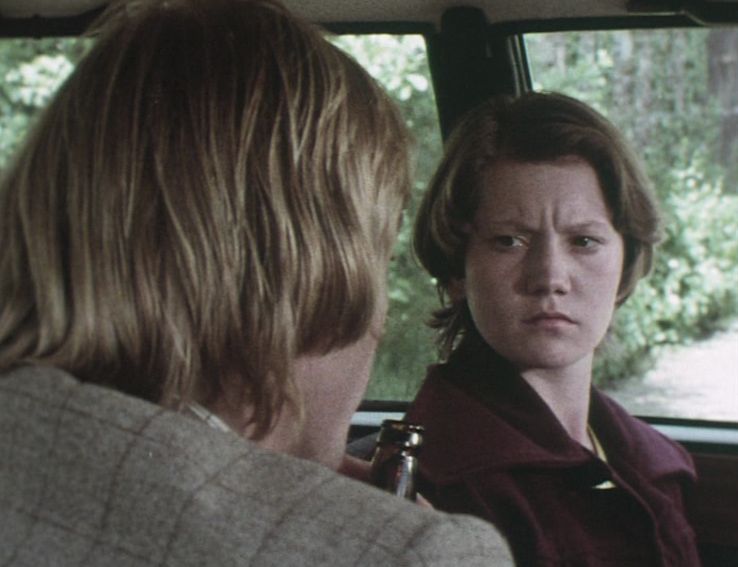
Seven for a Secret – Never to be Told has an eye-catching opening. A man enters a house, cigarette in mouth. Once inside he strikes a light and there’s a deafening explosion. Gas is the culprit, but it wasn’t a leak – all the gas points had been deliberately turned on. The discovery of a woman’s body points to suicide, but there’s a few things (such as an open window) which strike Dixon as odd.
The dead woman was called Mrs Pengelley. Her neighbour paints a less than flattering picture of her – an alcoholic who also enjoyed the company of many male friends. She did have a husband, Alf (Forbes Collins), but he claims not to have seen her for several years. One of her recent liaisons, Ralph Harding (Andrew Bradford), has disappeared – and what concerns the Dock Green officers is that he has the Pengelley’s sixteen-year old daughter Chrissie (June Page) with him.
Dixon’s pieces to camera, which traditionally top and tail the programme, can often set the mood of the episode as well as informing the viewer about the type of story they can expect. Here, Dixon’s quite upfront in telling us that there wasn’t actually a Pengelly case at all – which leads the viewer to suppose that no crime was committed. That’s a nice piece of misdirection and it keeps the story ticking along until all the pieces of the puzzle are put into place right at the end.
It’s clear from the start that there’s a bond of secrecy between Ralph and Chrissie (hence the title). The obvious inference is that he’s killed Mrs Pengelly and taken the girl away for reasons of his own. There’s certainly several indications that this might be so and Bradford gives a nicely off-kilter performance. Later, we learn that Ralph suffered as a boy at the hands of his abusive father and was institutionalised for several years. As for Chrissie, her father told Crawford and Brewer that she was “a bit backward, like.” June Page captures this well – giving her a child-like naivety and a blankness that marks her out as a potential victim.
This was another all-film episode and moving into the countryside in the second half (as Crawford and Brewer pursue Ralph and Chrissie) allows for a sharp change from the normal visuals. The Dock Green environs are rather grimy and rundown, so the beauty of the open countryside is very different. It’s just a pity that, as with all the film inserts we’ve seen, it now looks so poor (a decent restoration would have made a considerable difference).
Jack Warner has a few nice scenes, as he questions several witnesses, although his lack of mobility is pretty obvious. He’s either very static or if he has to walk, we only see him take a few steps before the camera cuts away. The most obvious example of this is at the fairground, where the brief shot of him walking makes it painfully obvious just how slow he now is.
Seven for a Secret – Never to be Told was the second story of the twenty first series (originally broadcast on the 22nd of February 1975). It’s odd that it followed the series opener, Target, since that was another all-film production (you would have assumed they’d want to spread the few film stories out a bit). It’s undeniably a slow, character piece but June Page and Andrew Bradford are both worth watching – as they’re a strangely mis-matched couple whose bond with each other only becomes clear right at the end.
Also good value is Denis Goacher as Sgt. Dawes, the country copper who assists Crawford and Brewer in tracking down Ralph and Chrissie. His performance has a delightful slowness to it and this clashes with the urgency of the London officers. But he’s no fool – he spots a clue that Crawford and Brewer miss and his knowledge of the area proves to be invaluable.
Not the most memorable Dixon episode to have survived, but Derek Ingrey’s script is not without merit. He was quite a prolific writer for the series – penning nineteen episodes between 1972 and 1976. Two more of his scripts from this series (Baubles, Bangles and Beads and A Slight Case of Love) exist as do all of the five stories he contributed to the final series in 1976.
 Archive Television Musings