Sion Tudor Owen makes the first of two appearances as English teacher Mr Dean. The actors name might be a bit of giveaway, as it turns out that Mr Dean is Welsh, very Welsh. He’s one of those teachers who attempts to adopt a chummy attitude with the pupils (as they dash off for their next lesson he tells them to be “careful out there” – clearly he was a fan of American police dramas).
Zammo tells Mr Bronson to keep his hair on. Oh dear. Zammo wasn’t referring to Mr Bronson’s still-unconfirmed hairpiece, but it irritates the touchy teacher. Michael Sheard continues to entertain ….
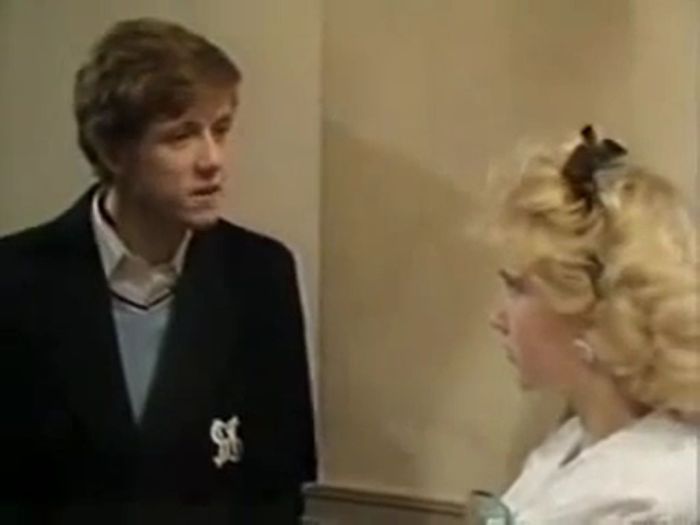
The Zammo/Jackie/Banksie triangle is still simmering away. Zammo can’t take Jackie to the UB40 concert as he’s working in the chipshop, leaving Banksie free to escort her to the gig. And the other love triangle – Stewpot/Claire/Annette – is reaching critical mass as Stewpot is taking Annette but starts to panic when Claire decides she wants to go as well. There’s a memorable encounter in the hallway between Claire and Annette. Claire tells Annette that if she was any thicker she’d clot!
Love continues to be in the air as Fay and Julian arrange a date at the concert (clearly UB40 have the power to bring numerous couples together). I do like the way that Stewpot greets Annette with a friendly kiss on the top of her head, given the difference in their heights it makes sense – he would have had to crouch down awkwardly to kiss her on the lips!
The fun stops when Claire turns up and Annette proudly tells him that Stewpot’s her man now. Claire offers him to the chance to leave with her, but he declines. Later, Precious tells her not to worry as there’s plenty more fish in the sea – we then cut to the fish shop as Kevin serves up a piece of cod. Well it amused me anyway.
One of the drawbacks about switching focus between the first and fourth years is that you sometimes have to wait a little while for continuing storylines to develop. So although we left (shock horror) Stewpot and Annette locked in an embrace at the end of the second episode, it’s only at the start of this instalment that the plot kicks forward.
Stewpot, still sporting something of a hangdog expression, has to confess to Annette that he’s yet to tell Claire that it’s all over. Stroppy Annette is far from pleased about this of course. Mind you, Claire is equally as stroppy so goodness knows how he’s going to choose between them – but his habit of lying to each of everybody is obviously going to catch him out pretty soon.
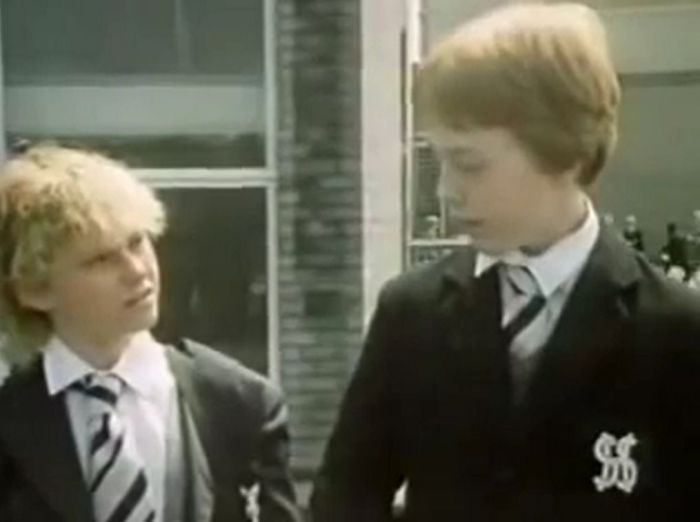
And Stewpot’s appearance, in school uniform, raises the interesting topic of uniform policy during series eight. Leaving aside for the moment why a sixth-former like Stewpot would be wearing school uniform (I can’t recall this happening at GH at any other time) we’re told early on that uniform is optional from the fourth form onwards. That some ex-Brookdale and Rodney Bennett pupils turn up at the start of term in their old uniforms is explained by the fact that they’re still clinging onto the memories and loyalties of their former schools. This doesn’t explain why so many of the old Grange Hill types in the fourth year are still wearing uniform though ….
There’s also something of a glaring continuity error between the studio and film sequences (fairly understandable since they were probably shot months apart). Inside the school Stewpot is wearing a blazer, jumper and no tie, but when he ventures outside he’s lost the jumper but gained a tie. It makes him look very odd, especially when Annette, two years his junior, is a vision beside him in orange.
The arrival of Mr Bronson sees something of a realignment of Mr Smart’s character. With Mr Bronson taking on the mantle of the hard (and occasionally fair) teacher, Mr Smart has become more conciliatory – although this may be simply due to the fact he enjoys baiting Mr Bronson. There’s a great example in this episode as Mr Smart nips into the last parking place in the school, leaving a highly aggrieved Mr Bronson with no other option than to park on the street. Watch how quickly Mr Bronson speeds off through the playground after he fails to persuade Mr Smart to give way – it’s lucky he didn’t knock anyone over.
Zammo continues to rail against the Brookies, whilst Banksie and Jackie get slightly closer. The constant fighting between the rival (and now non-existent) schools irritates Jackie no end, but all becomes clear – in story terms – when Miss Washington and Mr McCartney (Tony Armatrading) announce they plan to stage West Side Story. Casting Zammo and Banksie as the rival gang leaders with Jackie as the object of their rival affections is a perfect example of life and art imitating each other.
Calley’s latest wheeze is hypnosis, she certainly has a varied portfolio of interests. Meanwhile, the Grange Hill Bridge-Builders scheme (Mrs McClusky’s plan to help the local, aged community) and preparations for the school musical continue apace.
There are more thefts, including Ronnie’s Walkman (taken from the staffroom) and we also see Gripper’s sister, Emma (Bonita Jones), for the first time. Is there a connection between the two? Emma could have been developed as a regular – it’s been a while since GH has had a female bully – but instead she only makes a couple of appearances, meaning we have to wait until next year and the arrival of Imelda before the series gains such a character again.
Ronnie’s convinced that Gonch pinched her Walkman and Calley uses her hypnotic powers to try and confirm if this is so. But all it proves is that Gonch is a good actor as he manages to convince them all for a few moments that she really did hypnotise him.
The subject of Mr Bronson’s hair is touched upon. Previously it was believed that it was dyed (inevitably leading to the question about what it died of) but now everyone seems to know it’s a wig – or at least Precious does, especially after she collides with him. Mind you the way he anxiously checks it after the knock is a dead giveaway ….
Hollo plans to use the Bridge-Builders scheme to give his neighbour, Mr Light (James Ottoway) a helping hand. Of course, Hollo hasn’t bothered to ask him first, which makes things a little awkward at first. But after an unpromising beginning, Mr Light doesn’t quite turn out to be the stern curmudgeon we initially take him for (something of a cliché, true).
After unsuccessfully pursuing Miss Gordon for all of S7, Mr Smart’s on much firmer ground with Miss Washington – they’ve already fixed up a date at the squash court and it’s only episode three. He’s a quick mover! This episode also sees the first stirrings of Gonch’s skills as a salesman. He and Hollo have various things to sell, scavenged from the rubbish tip – and I do like the way he describes that they’ve come from a “tip-top” supplier ….
The ever patient CDT teacher Mr McKenzie (Nicholas Donnelly) appears for the first time. Donnelly would put in long service at Grange Hill, appearing for the next eight series and he’s perfect as the unflappable teacher (he seemed to specialise in such characters as he had an even longer-running but similar role in Dixon of Dock Green).
Calley is entertaining the others with some palm reading but Jane (Joann Kenny) is convinced it’s all a con. It’s plain that Calley is simply making stuff up, but we’re still invited to side with her as Jane’s plan to expose her backfires and she ends up as the one who’s ridiculed. This seems a little unfair, as Jane isn’t really positioned as a spiteful character.
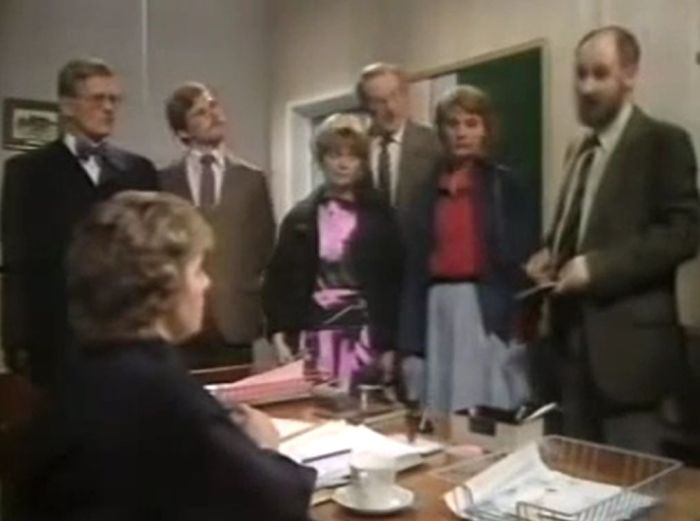
A wave of thefts are sweeping the school, including Mr Smart’s squash racquets. It’s just one of a number of niggles which convince the teaching staff to make a direct appeal to Mrs McClusky. Mr Bronson is less than impressed with Mr Smart’s missing racquets, he’s more concerned with the lack of car-parking spaces. Mr Baxter, someone who’s tended to appear mostly on film during the last few seasons, is now back to being a VT character as well – he leads the deputation, but is far from impressed at the outcome, telling the others that he feels like a “right nana” after they fail to reach a consensus.
The bickering continues into the staff room and descends into a male/female debate, only terminated when Mr Baxter blows his whistle, which shuts Mr Bronson up! This is good stuff and it’s nice to focus a little more on the staff, something which we’ll see more of in later years.
And I have to spare a word for a scene-stealing extras right at the start, who have a brief conversation about fish fingers.
Annette’s got a new boyfriend. She’s coy about his identity though, only giving the other girls one piece of information – his name begins with “S”. First name or last name, they ask? She won’t say, but it’s the name he’s best known by.
The hunt for Mr S occupies the imagination of Fay, Julie and Diane. They reel off a list of (never seen) potential victims, but later are briefly convinced it’s Mr Smart! This only comes about due to a major piece of plot contrivance – Annette and Mr Smart have a chat about Mr Smart’s prowess as a squash player, whilst the others (out of sight down the corridor) misconstrue their conversation. Although given that Mr Smart and Annette aren’t exactly shouting and the girls were a fair distance away, it stretches credibility just a little that they could actually hear them. Oh well, it passes a few minutes and Fay’s shocked reaction is retrospectively ironic when you consider what happens a year later.
Mr S’s identity is revealed at the end of the episode. This could have been spun out for a few episodes more, but no matter – we now know that Stewpot prefers the charms of Annette over Claire (although strictly speaking he’s enjoying them both, as it were, at present). Mark Burdis’ end of episode expression is a classic, sheepish best describes it. Given the effort Stewpot spent trying to re-establish his relationship with Claire, it seems bizarre he’d risk it all for a liaison with Annette (who’s no less annoying this series than she’s been previously). But love is blind I guess.
In the nineties, Grange Hill would introduce several disabled pupils who weren’t characterised by their disability – that was simply a part of who they are. Eric Wallace (James Hickling) is the reverse, his few appearances in S8 all revolve around the fact that he’s partially deaf. To begin with, nobody seems aware of this and the fact that he sometimes appears to ignore people is put down to general ignorance.
It rather stretches credibility that he would have kept his deafness a secret (surely his parents would have mentioned it to the staff?) but it does enable us to have a nice moment with Mr Bronson. When the exasperated Mr Bronson, annoyed that Eric turned to the wrong page in the textbook, asks him ironically if he’s deaf, Eric says that yes, he partially is. That silences Mr Bronson quite effectively …..
Tensions between Jackie and Zammo continue to simmer away. Zammo and Mr Bronson still aren’t hitting it off, whilst Zammo is torn between being one the boys and spending time with his girlfriend (expanding the theme from last year). There’s also signs that Fay and Julian might be interested in each other – when it’s revealed that Julian is opposed to animal experimentation, Fay tells him that she is too. “Good for you” he says. It’s a slightly clunky exchange, but then Douglas Chamberlain’s overtly earnest delivery is probably part of the reason why.
The opening episode of series eight sees a mass influx of new characters, possibly a “new broom” policy instigated by producer Ben Rea (who had just taken over from Kenny McBain). This is the first time that a fresh crop of first years had been seen since 1982, so they were a little overdue, but – thanks to the closure of Rodney Bennett and Brookdale – we also see the fourth form strengthened with an influx of refugees from those two schools (many still clinging to old, tribal loyalties) whilst several long-running teachers also make their debut.
Most of the pupils from N1 are familiar archetypes – Calley Donnington (Simone Hyams) and Ronnie Birtles (Tina Mahon) aren’t too dissimilar from Trisha/Cathy or Fay/Annette whilst Gonch Gardner (John Holmes) and Hollo Holloway (Bradley Shepherd) could be another Pogo/Stewpot partnership, especially Gonch who’ll develop, just like Pogo, into the ultimate free marketer. And the role of the class bully, formally filled by the likes of Doyle, is taken here by the initially imposing Trevor Cleaver (John Drummond). But Barry Purchese also shakes things up a little. Calley, from her first scene, is just a little odd and offbeat, carrying to school something mysterious in a box which she plans to return to the pet shop later.
Few of N1 seem to have known each other prior to the first day, so friendships (Calley/Ronnie and Gonch/Hollo) are swiftly forged. But after Hollo, riding his brother’s bike, knocks into Gonch and the passing Mr Smart seems (rather unfairly) to put all the blame onto Gonch’s shoulders, friendship seems unlikely. Despite being pint-sized, Hollo is itching for a scrap and plans to settle this score with Gonch after school (but their enmity is short-lived as they soon form an efficient double-act).
Trevor’s bullying is swiftly undercut. He may impress the squeaky-voiced Robbie Wright (John Alford) but it doesn’t take long before Trevor is cut down to size. For the remainder of his time on the show he’ll remain an occasionally aggressive character, but more often than not he’s played for laughs – Trevor’s certainly no Gripper that’s for sure.
As for the sixth form, there’s now only three old pupils remaining – Stewpot, Claire and Precious. We briefly see Stewpot and Claire in passing, but rather like the fifth-formers back in 1982 they don’t really have storylines of their own any more – instead they exist to interact with the younger pupils.
Visually the series looks a little different, thanks to using two different schools. The old Grange Hill site now houses the form rooms for the fourth, fifth and sixth forms whilst the former Rodney Bennett school is the home for the first, second and third years. Since Brookdale has been “left to rot” it rather begs the question as to how three schools worth of pupils can now be crammed into just two schools – especially since the classes in Grange Hill always seemed to be full ….
An old story staple reappears here – two teachers squabbling over one classroom. It’s an interesting wrinkle that we’d previously seen Mr Smart and Mr Knowles at loggerheads (with Mr Smart the aggressor) whereas here Mr Bronson is the one who’s happy to exercise his full range of arrogance whilst Mr Smart is placed in a subservient role.
Another interesting visual touch is seen in the opening few seconds as we see a board which states that Mrs McClusky has been demoted to deputy head, Mr Humphries is now the headmaster. There was potential for decent character conflict between the two, but alas Mr Humphries rather ends up like Mr Lllewellyn – a character who’s always just out of shot or in an important meeting and can’t be disturbed.
Jackie’s in the same class as Zammo, which makes them happy, but she’s less impressed to see some of her former Brookdale classmates, especially the loutish Banksie (Tim Polley). For a touch of contrast there’s also the well-spoken ex-Rodney Bennett type Julian Fairbrother (Douglas Chamberlain) who tells the others about their new form-tutor, the intimidating Mr Bronson (Michael Sheard).
Several new teachers are introduced here, but it’s clear that Mr Bronson (“you, boy!”) is the one with the most potential for conflict and drama. Upon entering the class he looks for someone to browbeat and the unlucky recipient is Zammo. This is the start of a repeated pattern, we’ll see that he enjoys victimising people over an extended period of time (unlucky later subjects include Ant Jones and Danny Kendall). Sheard’s wonderful from his first scene and he’s able to brighten many an episode over the next five years.
The long-running Miss Booth (Karen Ford) also appears for the first time, but Miss Washington (Caroline Gruber) was a one series character only, a pity since Gruber is really rather lovely ….
There’s a lot to pack in with just twenty four minutes to play with, but series eight hits the ground running.
Worrell and Liz are assigned to protect Emile Gurwin (Raad Rawi), a controversial author who has received death threats from Islamic radicals following the publication of his book Interim Prophets. The three travel to a remote part of Scotland where Gurwin plans to take a relaxing holiday, but a heavily armed gang has other ideas ….
It’s not hard to find a real-life parallel with Gurwin. Salman Rushdie’s 1988 novel The Satanic Verses sparked an identical storm of protest which saw Rushdie, like Gurwin, placed under sentence of death following the issue of a fatwa.
As ever with Bodyguards, political or ideological rights and wrongs aren’t pushed into the foreground. Liz might regard Gurwin with mild disdain (believing that his problems are self inflicted) whilst Worrell (who claims to have read and enjoyed the book) is somewhat more forgiving, but once the action starts there’s precious little time for philosophising.
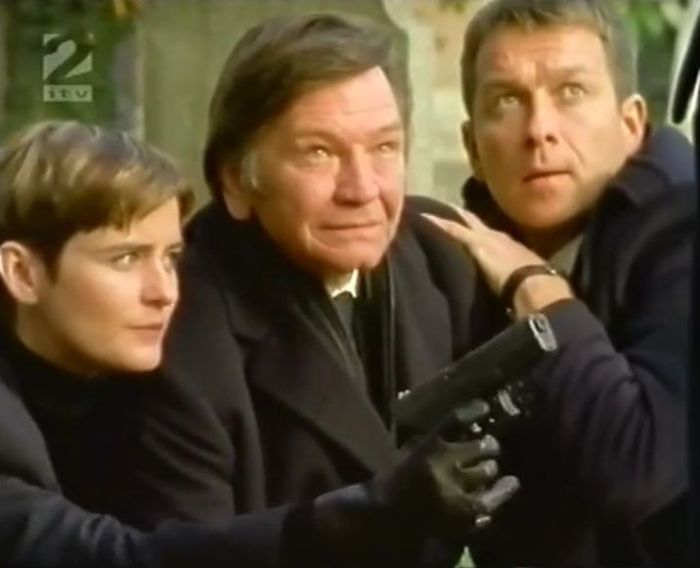
After their car is ambushed and then trapped on a bridge, they realise that the only way to escape is via the river. This is an impressive stunt – one of several – as we see Worrell, Liz and Gurwin diving for their lives. Gurwin comes off worst, with a broken arm, and the net result places the two agents in an incredibly difficult position – they’re wet through, in the middle of nowhere, possessing radios which no longer work and with the burden of an injured man.
After a few episodes which have been fairly light on action, Steve Griffiths’ script (his only one for the series) offers a sharp change of pace. Worrell gets to demonstrate his countryside skills, some of which he says were picked up with the Boy Scouts rather than on his RAF survival course!
One slight plot contrivance is that MacIntyre is present in Scotland (he was attending an unrelated conference in the area). Worrell later explains as to why he injured, rather than killed, one of their pursuers – an injured man is a burden for the others. It shouldn’t come as any surprise to learn that the ruthless group have no compunction in killing their wounded comrade – which is something of a cliché, to be honest if they hadn’t it would have been more surprising.
The Killing Ground brings to a conclusion this short, but interesting series. Creator Jeffrey Caine had previously devised The Chief, although Bodyguards was quite a different beast. The Chief had much more of a serial feel, with storylines overlapping multiple episodes. Bodyguards is much more in the tradition of the likes of The Sweeney or The Professionals, featuring one-off stories with minimum overlap (the death of Worrell’s wife is the only story beat which features in a number of episodes).
With the combined talents of Lombard, Pertwee and Shrapnel, it’s a little surprising that Bodyguards never progressed beyond a single series. A second run might have allowed for a more layered approach to the storytelling, certainly the potential was there.
The story so far. Following the death of Robert Hammond, control of his thriving haulage firm was split four ways – equal shares were distributed to his three sons – Ted, Brian and David – whilst the fourth equal share went to his mistress Jenny Kingsley.
With no-one in overall control, there’s a constant power-struggle as elder son Ted (currently managing director) finds himself under attack from his two brothers, both convinced they could run the company better than him. And the trauma in the boardroom is matched by equal strife in their respective bedrooms.
We’ve previously seen that David’s (Robin Chadwick) recent marriage to the lovely, if rather doormat-like Jill (Gabrielle Drake), has had a few wobbles, mainly because his roving eye was elsewhere. He hadn’t actually been unfaithful, but Jill’s suspicions created a definite rift which they attempt to heal during this run of episodes.
Middle son Brian (Richard Easton) suffered even more spectacular marriage problems during the third series, although he remained blissfully unaware. His bored wife Ann (a wonderful performance by Hilary Tindall) found solace in the arms of smooth advertising type Nicholas Fox whilst chugging down far too many sleeping pills and drinking heavily. Her unhappiness at feeling trapped in a loveless marriage culminated in an overdose, although she appears to be quite her old self again now, even to the extent of restablishing contact with Nicholas.
Elder son Ted (Patrick O’Connell) doesn’t have any complaints on the marriage front, but that’s only because he’s single. He has his eye on someone though – Jenny Kingsley (Jennifer Wilson). His desire to wed his father’s mistress has been a running thread for a while, although Ted’s mother, the powerful matriarch Mary (Jean Anderson), strongly disapproves. This might have been one of the reasons why Mary keeled over at the end of series three with a heart attack.
So as series four begins, all three brothers face challenges in their personal lives whilst the business of running Hammonds also continues to cause them tremendous strife. And waiting in the wings is ambitious merchant banker Paul Merroney (Colin Baker), a man who always has his own agenda …..
Colin Baker and Murray Hayne
The series four opener, Emergency sees Mary seriously ill in hosptal. She was discovered (off-screen) by Ted and Jenny who had returned from a brief holiday with life-changing news – Ted had proposed and Jenny accepted. But their happiness quickly evaporates as he blames himself for leaving his mother on her own.
We then see a nice visual signifier of the bond between mother and son. Whilst Ted goes to the hospital to await further news, Jenny stays behind to contact Brian and David as the camera lingers on a framed portrait of Mary and Ted. It’s a clever, unspoken touch which forshadows the dominance Mary will exert over her elder son.
When Mary gets better she has no compunction in telling Ted that he can’t marry Jenny. He might be a hard-headed businessman but he always seems to come off second best with his mother. And this is enough to convince Jenny that marriage to Ted would be impossible.
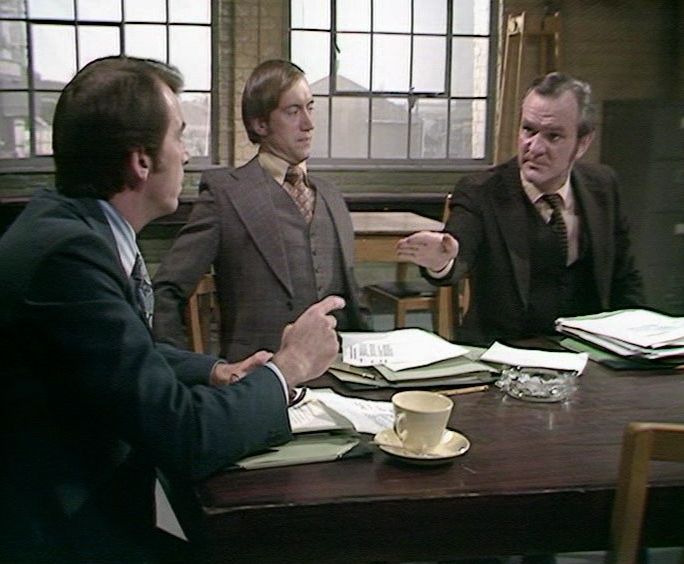
Business matters take centre-stage again with episode two, Secret Meetings, as Brian and David plan to offer merchant banker Martin Farrell (Murray Hayne) a seat on the board – the first step in their plan to make Hammonds a public company. Of course they’ve yet to mention this to Ted, so sparks inevitably fly when they do. Having said this, it’s surprising that Ted accepts their plan meekly, but he’s got an idea up his sleeve – if Bill Riley also joined the board then (provided he always votes Ted’s way) the status quo would remain. This is classic Brothers, featuring plot and counterplot.
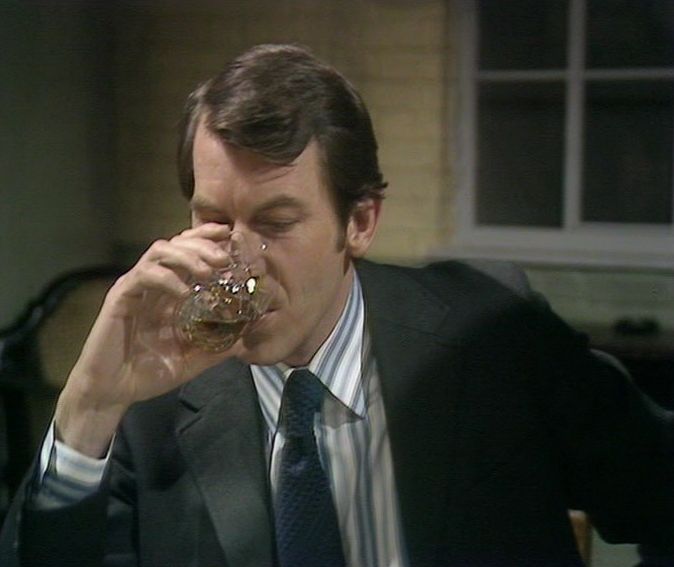
If David has always irritated me somewhat, then Brian is a much more sympathetic character, even if it’s impossible not to feel a little frustrated by the way he remained oblivious to Ann’s lengthy relationship with Nicholas Fox (Jonathan Newth). But even Brian’s blindness could only continue for so long without it seeming totally unbelievable, and when he finally twigs it’s the cue for high drama. His first reaction, of course, is to reach for a drink (heavy alcohol consumption, along with an equally herculean nicotine intake, is something of a feature of the series).
Richard Easton
Brian doesn’t confront Ann straight away, which enables him to calmly twist the knife and make her feel even more guilty than she already is. This is a good move – since you know the showdown will happen eventually, making us wait a little simply heightens the expectation. But Brian’s not backward in letting Ann know exactly what he thinks of her when the truth does emerge. “Your whole world begins and ends with yourself. You’re shallow, you’re superficial and utterly self-centered. Nothing matters to you but self, self, self!”
Ann doesn’t take this lying down. “You are a predictable bore, Brian. You don’t want a wife, you want a second mother. Somebody to cook and clean for you, and tuck you in and say, ‘there, there’ whenever you’re not feeling very well.” Both Richard Easton and Hilary Tindall are firing on all cylinders throughout (the end of episode five – Partings – as Brian knocks a shocked Ann to the floor is one of a number of stand-out moments). If Brian, following his separation from Ann, becomes something of a tortured figure then so does Ann herself. It slowly dawns on her that Nicholas Fox (a serial seducer) has no interest in a long-term relationship ….
David decides to become a racing driver (!) which means that Jill has to wait anxiously on the sidelines, hoping that he won’t be hurt. Frankly, this isn’t much of a role for Gabrielle Drake (compare and contrast to the plotlines dished out to Hilary Tindall) so it’s no surprise that she decided not to return for the fifth series.
Drake might also have been a little miffed that Jill didn’t turn up until the fourth episode and when she does finally make her first appearance it’s only to be once again verbally smacked down by David (he’s less than impressed with her anniversary gift to him – a penthouse flat – complaining that he doesn’t want to be a kept man). He eventually accepts it, but does so with his usual brand of charmless ill-grace.
Robin Chadwick and Gabrielle Drake
The on/off relationship between Ted and Jenny allows Martin Farrell to step in (much to Ted’s extreme annoyance) whilst Bill struggles with the responsibilities of having a seat on the board. He’s always been proud to have the respect of the men, will this change now he’s one of the executives?
Brian’s run of bad luck continues in Saturday, but the later part of series four focuses on company traumas. The decision to make Hammonds a public company offers up a new range of storytelling possibilities. Until now, boardroom squabbles have largely been confined between the three brothers, but now that anyone is free to buy shares everything changes.
And this is partly where Paul Merroney comes in. He’s introduced in the fifth episode as a colleague of Farrell’s, brought in to advise how Hammonds should go public and although his screentime throughout series four is quite limited, he’ll become more central in the years to come. But Colin Baker, in his first regular television role, certainly makes the most of the material he’s given.
The wonderful Richard Hurndall guests in Bad Mistake as Clifton, an influential investment manager crucial to Hammonds’ future. Ted’s blunt style leaves Clifton less than impressed, giving Hurndall a chance to demonstrate his familiar icy, amused detachment. This episode also marks the point where Merroney starts to have an influence on company policy, much to Ted’s disgust.
The series finale, the aptly named The Crucial Vote, sees Ted struggling to keep the board united as the infighting intensifies. There’s no doubt that there will be many more twists and turns to come in the battle for Hammonds, which bodes well for future series.
Interweaving numerous plot-threads across its fourteen episodes, series four of The Brothers continues to be highly addictive entertainment. Brian and Ann’s disintegrating marriage is the definite highlight although the unstable powder-keg that is Edward ‘Ted’ Hammond also entertains. Patrick O’Connell plays Ted as a man constantly struggling to keep his anger in check – which can be seen most clearly any time that Jenny and Martin Farrell exchange glances. David’s fleeting desire to be a racing driver is less easy to swallow, but at least the one racing-centric episode – The Race – is not without interest, especially for the authentic track footage.
If you’ve yet to sample the world of the Hammond brothers, then now – with the first four series available and the remaining three due out by the end of the year – would appear to be the ideal time to do so.
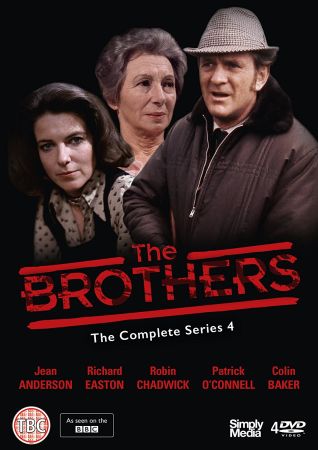
The Brothers – Series Four is released by Simply Media on the 9th of January 2017. RRP £29.99.
Richard Easton, Robin Chadwick and Patrick O’Connell
Maurice Boyd (Michael Williams), an ex-MI6 agent turned Russian defector, returns secretly to the UK to attend the funeral of his granddaughter. The Close Protection Unit are assigned to project him and have put a strict secrecy blanket in operation – since many people (including MI6) would be far from happy if it was known that Boyd was back in the country ….
Stand Off benefits enormously from the presence of Michael Williams. Maurice Boyd is something of a Kim Philby-like character and the audience’s knowledge of real-life defectors no doubt helps to fill in some of the blanks. There’s something of a personal edge to the story, as MacIntyre and Boyd had been close colleagues. Prior to his arrival, MacIntyre displays an understandable coolness towards his former friend (responsible for the deaths of many fellow agents) but we see something of a rapprochement as the story progresses.
Boyd later tells him that “I don’t regret what I did, I never will. But there are some things in my life that I do regret. And one of them is the rift between us.” Since Boyd is an arch dissembler it’s left unclear whether this is the truth or yet another lie. Throughout the story Boyd is presented as an affable, friendly sort – which means that reconciling his current behaviour with his previous actions is difficult, but that’s true of many real-life traitors.
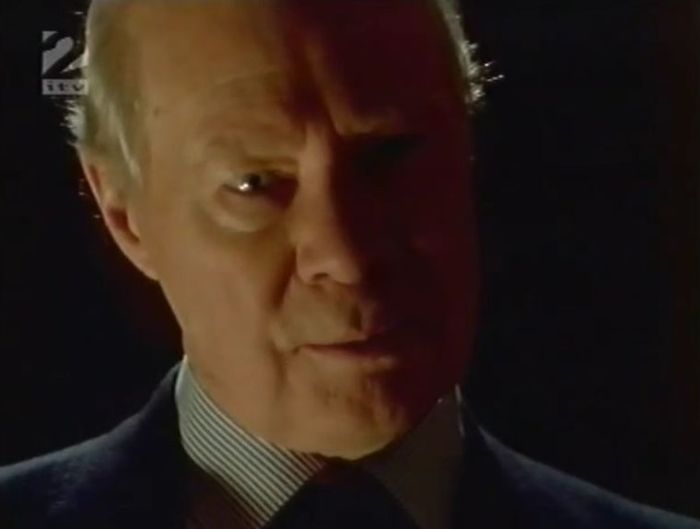
Anthony Bate, an actor not unfamiliar with spy dramas, has the small but pivotal role of Sir Thomas Glennie. It’s always a pleasure to see Bate, even in such a brief cameo, although it’s a little surprising that he didn’t return at the conclusion of the story. But then as we’ve seen previously in Bodyguards, the focus of the series is the protection of their subjects rather than the solving of mysteries.
Stand Off poses the question as to who wants Boyd dead and there’s a credible answer provided – a high-up government official who, like Boyd, is a Russian agent, although he, unlike Boyd, has remained undetected. With Boyd working on a book that (ala Peter Wright’s Spycatcher) plans to name names, this agent is keen to silence Boyd and so arranges for his granddaughter to be killed in order to lure him to the UK.
This part of the plot doesn’t quite hold water – if Boyd was preparing to betray his Russian masters by revealing the identity of a mole inside the British establishment, why haven’t the Russians taken steps to silence Boyd and his co-writer? It would have made more sense for the Russians to deal with Boyd in their own country rather than for the mole to spirit Boyd over to Britain.
A minor quibble, since – as previously touched upon – the mystery part of the story plays second fiddle to the job of keeping the target alive. Williams and Shrapnel only have a few scenes together, which is a shame, but they certainly make the most of them. Apart from a few explosions, Stand Off is fairly low-key – character interactions rather than gunplay drive it forward – but there are far worse ways to spend fifty minutes.



 Archive Television Musings