Paul Merton in Galton & Simpson’s Impasse

impasse

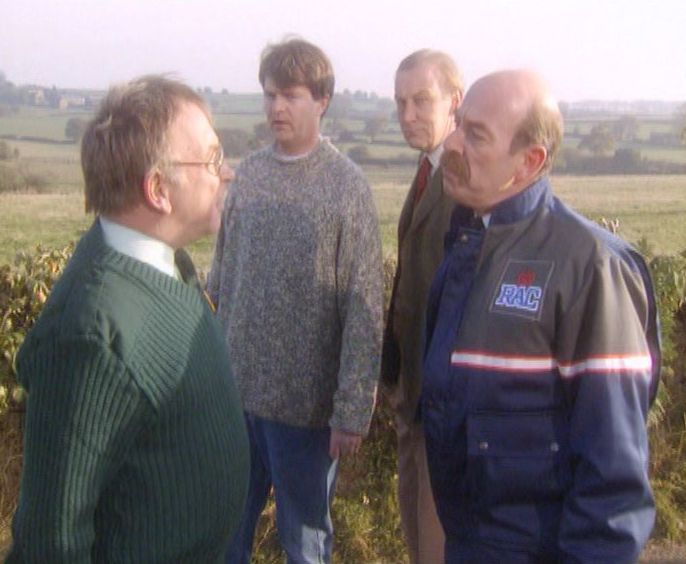
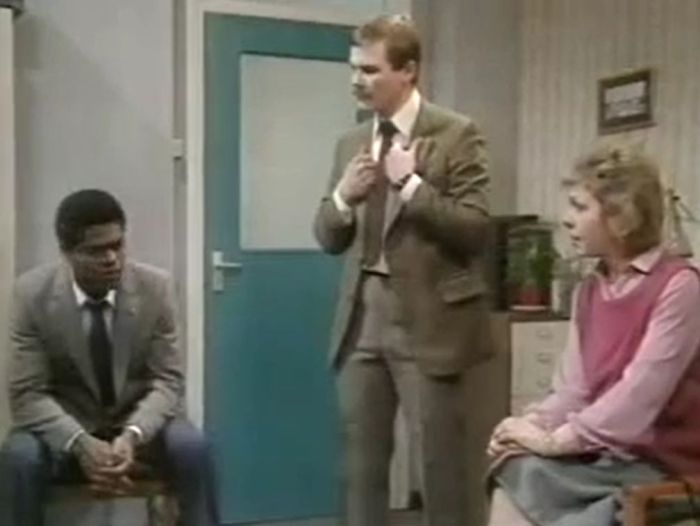
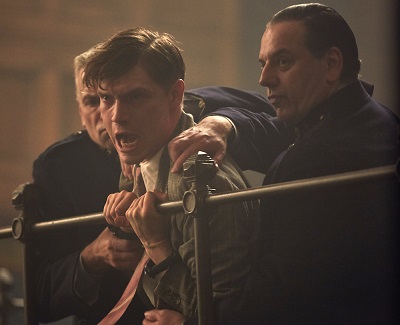
Two cars meet in a narrow country lane.  One will have to back up and give way, but neither Dave (Merton), driving a Volkswagen Beetle, nor Mr Ferris (Geoffrey Whitehead), behind the wheel of a Bentley, are prepared to give any quarter.  So a tense battle of nerves begins ….

The original version of Impasse was broadcast during the second series of Comedy Playhouse in 1963. Bernard Cribbins and Leslie Phillips were the implacable motorists, whilst Yootha Joyce and Georgina Cookson played their long-suffering wives.  Here, Tilly Vosburgh is Dave’s wife, Kirsty, whilst Phyllida Law plays Mr Ferris’ spouse.

You might expect the script to lean towards the side of Dave, the little man facing off against the rich and privileged Mr Ferris, but that’s not really the case at all.  Both are shown to be equally pig-headed and unlikable (it’s plainly no coincidence that they treat their wives in pretty much the same way – badly).

Mr Ferris has decided that Dave’s truculence is due to class envy, but maybe Dave just likes a fight.  They nearly come to blows a little later, although their fight is more notable for the way each circles around the other, throwing punches in the air.  It rather brings to mind a similarly non-contact scrap between Hancock and Sid in the classic radio HHH episode The Last Bus Home.

Just as you get the sense that the comic potential has been wrung out of this scenario, then help – in the form of an AA Man (Sam Kelly) turns up – shortly followed by an RAC Representative (Denis Lill).  Kelly and Lill are just as good (if not better) than Merton and Whitehead, with the AA Man standing firmly behind his member, Dave, and the RAC Man equally steadfast in defending the interests of his member, Mr Ferris.

I’ve said it before, and no doubt I’ll say it again, but it’s a joy to see the quality of the casts in this series.  It’s fair to say that Vosburgh and Law have little to do – although they do have a nice scene (not present in the original) where they’re able to pour scorn on their respective husbands. This leaves the field open for the two squabbling male sides to dominate proceedings and it’s amusing that the AA and RAC representatives carry on exactly the same sort of one-upmanship we’d previously seen from Dave and Mr Ferris.

The late arrival of a policeman (played by Roger Lloyd-Pack) who finally solves the impasse is another bonus.  The sting in the tail – the winner of the battle finds he is forced to back up anyway – brings events to a satisfying conclusion.  And unlike the original this benefited from being shot on location, rather than in the studio.

Connections – Simply Media DVD Review

connections2

James Burke (b. 1936) first came to prominence on Tomorrow’s World during the mid sixties, where his relaxed and conversational tone provided a sharp counterpoint to his co-presenter, the more precise and patrician Raymond Baxter.  His profile on TW meant that he was an obvious pick for the BBC’s Apollo coverage – he would go on to helm numerous hours of live television alongside Patrick Moore and Cliff Michelmore.

After leaving TW in 1971, Burke moved onto his own series, The Burke Special (1972 – 76), in which he examined various aspects of modern life and conjectured how they might develop in the future.  Already in place was Burke’s trademark style of swiftly jumping from one subject to another and some of the topics covered – such as test tube babies and gun control – ensured that the series generated a certain level of controversy.

Burke then moved out of the studio and onto film for Connections (1978).  Subtitled An Alternative View of Change, it sought to challenge the accepted linear view of technological progress.  Burke would argue that no part of the modern world can be regarded in isolation – instead you need to track back through history to find apparently unconnected events which can be linked together in order to show a continuity of change.

This interdisciplinary approach wasn’t to all tastes and neither was Burke’s presenting style – contradicting himself or walking out of shot during mid-sentence, for example.  But it’s fair to say that Connections was a programme which made a deep impression on a section of its audience and – whether you disagree or agree with all his theories – still provides substantial food for thought.

This three disc set contains the following –

The Trigger Effect – Original broadcast 17th October 1978

Death in the Morning – Original broadcast 24th October 1978

Distant Voices – Original broadcast 31st October 1978

Faith in Numbers – Original broadcast 7th November 1978

The Wheel of Fortune – Original broadcast 14th November 1978

Thunder in the Skies – Original broadcast 21st November 1978

The Long Chain – Original broadcast 28th November 1978

Eat, Drink and Be Merry – Original broadcast 5th December 1978

Countdown – Original broadcast 12th December 1978

Yesterday, Tomorrow and You  – Original broadcast 19th December 1978

connections-01

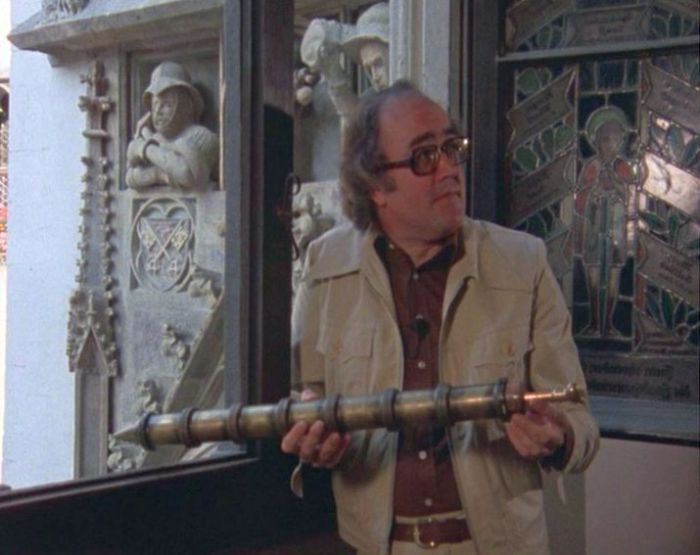
Burke’s idiosyncratic style is clear right from the opening moments of The Trigger Effect. He asks the audience (“would you do me a favour?”) to consider all the man-made objects in the room where they’re sitting (television, lights, etc) and the impact they have on their lives. He then moves out of shot, leaving an empty frame for a few seconds, an obvious visual cue which gives the audience some “thinking time”. It’s a good example of the way Burke challenges the viewers not to be passive observers, but instead to interact with the arguments and theories he’s generating.

In addition to Burke’s sometimes provocative statements, Connections boasts impressive visuals, thanks to the skills of director Mick Jackson. Jackson’s later and very varied CV includes the Whitney Houston/Kevin Costner movie The Bodyguard, the devastating nuclear drama Threads and the Ray McAnally political serial A Very British Coup.

Connections allowed Jackson a wide palette in which to craft some striking images.  And he was granted a very healthy budget – the series took fourteen months to shoot, travelled to nineteen countries and took in a hundred and fifty individual locations along the way.

Jackson’s eye for the unusual can be seen in the first episode as even the simple act of Burke travelling in a lift is presented in a memorable way. But this isn’t simply gloss for the sake of it – Burke makes the point that just as we have become increasingly dependent on technology, so our understanding of how it works has decreased sharply. Does he know how a lift works? No, he just accepts that it does.

I take going up in the world like that for granted. We all do. And as the years of the 20th century have gone by, the things we take for granted have multiplied way beyond the ability of any individual to understand in a lifetime. The things around us, the man-made inventions we provide ourselves with, are like a vast network, each part of which is interdependent with all the others.

This increasing dependency on technology is examined during The Trigger Effect as Burke looks back to a massive power-cut which engulfed New York in 1965. With discordant music (courtesy of Richard Yeoman-Clarke from the BBC Radiophonic Workshop) and the help of those who were present, re-enacting their roles, it’s presented in highly a dramatic fashion.
connections-02

“What does survival without technology look like?”. Burke effectively paints a nightmarish picture of the stuggles inherent in existing in a world without electricity (tapping into many of the themes developed in numerous post-apocalyptic dramas, such as Survivors) and then links this back to show how previous civilizations, such as the Ancient Egyptians, could be said to have been the first technological nations. He therorises that once an invention – such as the plough – is created, it must inevitably lead to further inventions through the ages (even if the connection between them isn’t immediately apparent).

The series’ aims are restated at the start of Death in the Morning.  Burke reflects that because knowledge of the future is impossible, tracing a modern man-made object back thousands of years is somewhat akin to a historical detective story, with twists and wrong turns along the way. He sets things up nicely by teasing us that the modern intention of this edition “affects the life of every man, woman and child on Earth” but doesn’t say what it is. Instead, his story begins two and a half thousand years earlier in the Eastern Mediterranean and is concerned with money, but will have become something totally different when we reach the present day. How we get from there to here, the intuitive leaps Burke makes and the visual imagery along the way, all help to make this a typically captivating instalment.

Highlights of later episodes include Burke’s imaginative arguments which connect the Little Ice Age of 1250 – 1300 AD to a whole host of later inventions, including the chimney and diverse objects as buttons and knitting (episode six, Thunder In The Skies).  Also of interest is Eat, Drink and Be Merry, which discusses how modern credit – the plastic credit card – can be traced back to the Dukes of Burgandy, the first state to use credit.  This then springboards into the problems of keeping food fresh (a particular issue for large armies in the nineteenth century) and Burke then presses on to show how these innovations led to the Saturn V rocket which took men to the moon.

The final edition, Yesterday, Tomorrow and You, neatly summaries everything that we’ve learnt in the series to date and returns to a theme posed by Burke posed at the start of the series, concerning the way that the world is developing increasingly advanced technology at a rate faster than our ability to understand it.  Should we be concerned about this, or just accept that change is inevitable?

With its globe-trotting camerawork, Connections engages on several levels.  Not only is it a visual treat, but it’s an intellectual one as well.  It may flit from subject to subject, but James Burke remains the series’ solid centre and his quirky approach helps to ensure that the series is much more than a series of dry lectures.  Picture quality is what you’d expect from material of this era – had fresh prints been struck from the negatives it could have looked much better, but as always it’s a question of cost.  What we have is perfectly watchable though.

Nearly four decades on, the series still engages, entertains and stimulates – a testament to the work of James Burke, Mick Jackson and the whole production team.  Warmly recommended.

Connections is released by Simply Media on the 7th of February 2017.  RRP £24.99.

connections 03.jpg

Hunter’s Walk – Disturbance

disturbance

Hunter’s Walk was a police drama created by Ted Willis (Dixon of Dock Green, Sergeant Cork) which aired on ITV during 1973 – 1976.  It bears some similarities to Dixon in both tone and pacing – you certainly could never mistake it for The Sweeney – and although the location was different (Dixon was set in London, Hunter’s Walk in a fictional Midlands town) the type of cases we see – from the mundane to the serious – could easily have also turned up in Dixon.

The series’ archive status is rather patchy.  Out of thirty nine episodes made, only ten exist and half of those are black and white telerecordings.  Given this, and approaching the first episode on disc one – Disturbance – with no foreknowledge, you might have been forgiven for assuming it was a mid season installment.  But no, it was the series’ debut (tx 4th June 1973) so it’s interesting to observe how Richard Harris’ script drops us into the setting pretty cold, using the trauma between Dennis Kenwright (Doug Fisher) and his estranged wife Janet (Helen Fraser) to illuminate the personalities of the regulars.

The chain of command is established fairly rapidly.  From Det. Sgt. Smith (Ewan Hooper) at the top, Sgt. Ridgeway (Davyd Harries) in the middle and PC Pooley (Duncan Preston) at the bottom.  Smith is shown to be an old hand, unflappable and methodical.  Ridgeway is not without compassion, but also has clear views about what is and isn’t police business.  Pooley is initially presented as something of an aggressive hothead, but we see another side to him later on.

All three interact individually with Kenwright and it’s worth taking a moment to consider their differing approaches.  Smith was called to a robbery at Kenwright’s place of work.  He tells Kenwright’s employer that he knows him – but this doesn’t seem to be in the police sense, simply that he’s familiar with Kenwright’s family.  Smith briefly questions him and Kenwright replies in a slightly touchy way.

Next, Kenwright ventures to the station to speak to Ridgeway.  This is an intriguing part of the episode – Kenwright wants to return home to speak to his wife and retrieve some of his possessions, but because Janet is now seeing someone else Kenwright would like a police presence.  The inference is that Kenwright is afraid of physical violence from Janet’s lover, although when we meet him that’s neatly inverted as Kenwright is the abusive one.  Was this more to do with the fact that Kenwright was aware he might lose his temper and wanted the police to protect his wife?

Whilst this part of the story could be said to lack a little logic, it’s not too much of a problem since it highlights Kenwright’s off-key and mildly disturbed nature (which increases as the episode progresses).  Ridgeway is slightly condescending, telling Kenwright that the police can’t get involved in domestic disputes, although they can have a man in the area.

Luckily they did, as Kenwright’s decision to take the record player sparks a row between him and his wife.  This scene also highlights Kenwright’s confused state of mind as he earlier told Ridgeway that he needed to pick up certain items urgently, but a record player doesn’t really seem to fall into this category.  He disturbs Janet’s new man, Ted Peters (John Ringham), who’s sitting in the living room, having his tea.

Ringham has little to do here, but he instantly catches the eye as Peters springs up out of his chair, knife and fork still in hand.  The way he holds onto the cutlery and his instinctive steps backwards are both non-verbal signifiers that Peters is not someone who will offer violence (borne out during the remainder of the episode – he’s a married man who wants the minimum of scandal).  Pooley turns up on the scene and forcibly brings peace to the house, although since he offers Ridgeway a lift home it’s plain that his bark is worse than his bite.

As Disturbance progresses, Kenwright starts to devolve.  He obtains a rifle, takes a potshot at Peters and then later holes up at a lonely spot, pinning down Smith, Ridgeway and Pooley.

This may seem to indicate that Disturbance is something of an action piece, but that’s really not the case.  Character is key here, both with the regulars and the guest cast.  We may have seen numerous Dennis Kenwrights before – men and women pushed over the edge – but Doug Fisher gives him a pleasing vulnerability.  Janet Kenwright is less sharply drawn, remaining more of a catalyst for the unfolding events rather than an active participant, although Helen Fraser is a vivid presence throughout.  It’s more than a little tragic that Janet’s affair is with a married man (and especially one as cowardly as Peters – lovely turn by Ringham).  Both husband and wife are the victims here.

The regulars might take a little more time to bed in, as none of them are particularly striking here.  Hooper is affable as Smith, although rather characterless.  Harries is an actor I’ve always found to be somewhat affected and mannered (the way he pronounces “off” as “orf” here is a slight indication of this).  But this may have something to do with the performances of his that I’ve seen, so it’ll be interesting to see if Ridgeway develops into more of a “real” character in later episodes.  It’s hard to disassociate Preston from his later comic roles, but he does nothing wrong as the young, and presumably inexperienced, constable.

Robert Tronson’s direction, especially the film sequences, are notable.  The first few minutes see Kenwright pounding the streets, past – I assume – real members of the public rather than extras.  Some unusual camerawork, low angles and partially obscured shots, help to make these moments stand out, as does the lack of music.  Silence can be powerful, especially when used to illuminate an isolated character like Kenwright.  I do wonder how moody some of these scenes would be if they weren’t in black and white though.

Disturbance is pretty slowly paced, so maybe wasn’t the most obvious series opener.  But even given the rather poor survival rate (six from series one, one from series two, three from series three) by the time I’ve reached the end of the set it may be more clear exactly how indicative it is of the series as a whole.

Paul Merton in Galton & Simpson’s Twelve Angry Men

twelve.jpg

The rather unwieldy titled Paul Merton in Galton & Simpson’s …. aired for two series during 1996/97.  The fifteen episodes cherrypicked both familiar and unfamiliar scripts from Galton & Simpson’s impressive back catalogue, with series one leaning heavily on adaptations of classic Tony Hancock shows.

Five of the eight series one episodes were based on Hancock material.  This one, The Radio Ham, The Missing Page, The Lift and The Bedsitter.  These choices no doubt helps to explain the rather muted critical reception the series received.  Tackling five comedy classics is asking for trouble –  since it’s highly unlikely that you’re going to match, let alone surpass, the originals.

It’s puzzling why they chose these ones.  Any G&S series had to include some Hancock, but it might have been better if they’d gone for less iconic picks (any of the missing episodes would have been obvious choices).   Possibly this had been taken onboard by the second series – only one episode was adapted from a Hancock script and it was a pretty obscure one.

Merton first came to prominence with the Comedy Store Players.  Their brand of improvised comedy lead directly to C4’s Whose Line is it Anyway? and R4’s The Masterson Inheritance.  He also found time to star in his own sketch series (imaginatively titled Paul Merton – The Series) between 1991 and 1993 and has been a regular panellist on Have I Got News For You since the series launched in 1990.

Merton wasn’t an experienced sitcom performer, which might explain why the supporting casts were so strong.  Sam Kelly, Geoffrey Whitehead, Michael Fenton-Stevens, Anne Reid, Jim Sweeney, Josie Lawrence, Roger Lloyd-Pack, Michael Jayston, Gary Waldhorn and Brian Murphy all appear in multiple episodes (often playing different characters – a very Hancockian touch) whilst an equally impressive list of performers make one-off appearances.

So let’s take a look at the first episode, which aired on the 26th of January 1996, Twelve Angry Men.

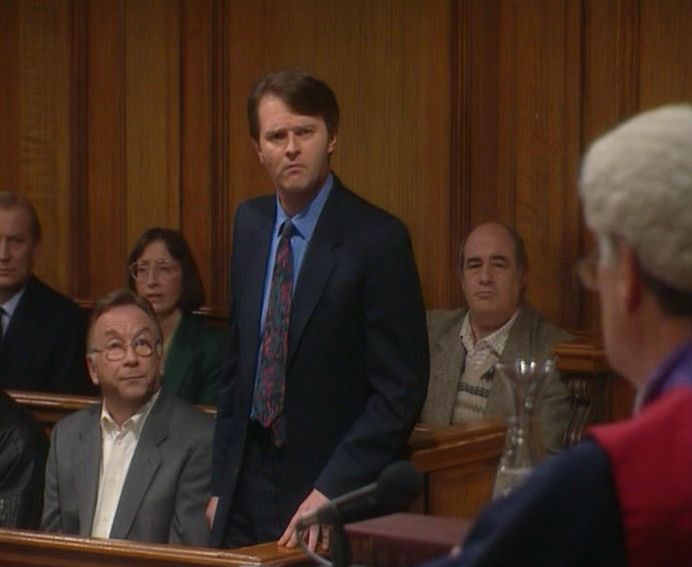
With the passage of nearly four decades, there’s numerous small topical references which have been retooled – for example, Paul regards the proceedings as the spit of Rumpole of the Bailey, rather than Hancock’s The Verdict Is Yours.  A few new gags are popped into the courtroom scene, which sound more like Merton than G&S.  This surreal exchange between Paul and Sam, for example.  “You know, my mother once changed a fillet of salmon for a pair of shoes. Well she had to pay the difference of course, well her feet were bigger for a start.”

Sam Kelly takes on the role played by Sid James in the original.  Kelly was no stranger to the world of sitcom (Porridge, Allo Allo!, On The Up) and is characteristically rock sold here. He’d appear in another four episodes of PM in G&S’s … and is great value each time.

There’s plenty of other familiar faces on show.  Peter Jeffrey plays the increasingly exasperated judge to perfection whilst Gary Waldhorn and David Daker spend the courtroom scene sitting directly behind Paul and Sam.  Waldhorn and Daker don’t have any dialogue until the action moves into the jury room, so during the first five minutes they have to be content to steal the attention of the audience with a glance or a facial expression.  And since both are old pros it’s hard not to find your eye drawn towards them ….

Daker is the farmer pining for his livestock, Waldhorn the company director fretting about losing money, whilst Geoffrey Whitehead is the juror most opposed to Paul’s increasingly bizarre flights of fancy as he continues to argue that John Harrison Peabody must be innocent. Another juror picking up a few lines is a young Rob Brydon, in one of his first television roles.

“Does Magna Carta mean nothing to you? Did she die in vain?”

As a Hancock fan, I’ve no doubt Merton relished delivering one of the Lad’s most famous monologues, although it’s fair to say that the Magna Carta line only receives a polite response from the studio audience.  Clearly they were weren’t Hancock aficionados.

A credible effort with Merton impressing.  It didn’t hurt that he was surrounded by talent though and whilst the original remains a comedy classic, this 1996 remake is more than watchable.

Grange Hill. Series Eight – Episode Eighteen

grange hill s08e18.jpg

Written by Barry Purchese.  Tx 22nd April 1985

The opening night of the school musical – Brighton Rock – is nearly here, but discord is still rife.  The lack of decent sets remains an issue, although Zammo is more concerned about the absence of any bikes, bitterly reflecting that they’re going to be the only Mods and Rockers who ever had to walk to Brighton.

Something certainly seems to be lacking and help comes from a most unexpected quarter – namely Mr Bronson.  After a year terrorising most of the pupils (and some of the staff!) he demonstrates his more approachable side after he corrals Vince into extracting sound effects from the film Death Race 2000.  Mr Bronson hopes that this will help to spice things up, although Mr Smart is less convinced.

Those with long memories will remember Gonch’s wheeze of copying tapes from the video shop owned by Vince’s dad (that explains how Mr Bronson discovered the tape of Death Race 2000 on the media resources machine).  Michael Sheard is on fine form as Mr Bronson informs Gonch that his old eyes get a little tired towards the end of term, but they’ll be undimmed at the start of the next.

It’s a pity that this new, briefly human, Mr Bronson doesn’t achieve rapprochement with Zammo.  After spending the year riling the boy, this part of the plot just fades away (next year Mr Bronson will have a new unfortunate – Ant Jones – to victimise and his contact with Zammo will be minimal).

Mr Baxter, standing in for the ever-absent headmaster, and Mrs McClusky are sandwiched either side of the Mayor, who regards the unfolding first night entertainment with a long suffering air.  Everybody seems convinced that something’s missing in the performance, although quite what is hard to say.

Banksie, after smashing up the sets, makes amends by persuading his brother Phil and some of his mates to bring their bikes into the auditorium.  When Mrs McClusky hears of this she’s not at all sure it’s a good idea (understandably) but Mr Bronson once again is on the side of the pupils.  Is this because he’s remembering his own salad days?  He seems to confess as much to Mr Smart at one point, although imagining Mr Bronson as either a Mod or a Rocker is something of a stretch ….

The bikes make an appearance, although since all they do is drive onto the stage and park up, you have to wonder whether it was worth all that effort.  The play comes to a decent conclusion thanks not to the bikes but because the final song is suitably stirring.  It claims that strife between warring groups can be settled if only everyone could learn to love one another.  It’s a nice, albeit hopelessly optimistic, sentiment and ties in neatly to the running theme of Grange Hill vs Brookdale vs Rodney Bennett.  Zammo and Jackie of course have been attempting to bridge this gap all year, although with limited success.

Whilst the 1985 Christmas Special touches on several topics (Roland’s lost love, the struggle between Cally’s real and adoptive mothers) developed during series eight, it was made as part of the production block for series nine, so series eight ends here.

Various characters – Jimmy Flynn, Julian Fairbrother, Annette Firman, Mandy Firth – all bow out with no ceremony.  Annette is at least mentioned at the start of the next series, the others join the list of the Grange Hill forgotten – pupils who simply disappear and are never referred to again.

Ben Rea’s sole year as producer introduced a host of characters who would have long term futures with the series and although at times the plotlines seemed not to be terribly well developed (frequently dropped or picked up again with little ceremony) it’s still an agreeable run of episodes.

Grange Hill. Series Eight – Episode Seventeen

grange-hill-s08e17

Written by Margaret Simpson. Tx 17th April 1985

Hollo has a brainwave about how to assemble a new set for the school play at short notice – raid the rubbish dump for suitable material.  Along with Miss Booth and the rest of E1 they head down to the dump to pick up numerous likely objects.  The fact that everything’s bound to be rusty and filthy doesn’t seem to concern Miss Booth, but I guess that needs must.

The new set doesn’t go down well with all the performers and Fay’s sporting commitments means that she’s not able to make a vital rehearsal.  This is all too much for Miss Washington who goes into something of a tizzy.  Miss Washington is sporting an interesting dress – something she’s worn before, but with a plain black dress over the top of it.

Roland’s back from his French misadventure and naturally enough doesn’t really want to talk about it.  Unluckily for him, Janet’s present to fill in all of the embarrassing details.  Now that Fabienne’s departed, so has Roland’s striped jacket and beret, although this particular storyline will be referenced again in the 1985 Christmas Special.

Jackie and Banksie are still serving their suspension.  Time is clearly hanging heavily on their hands, as we see them aimlessly wheel around on a roundabout in a deserted children’s playground.   There’s rather a nice bleakness to this scene – although it’s a sunny day, the inner-city feel of the location matches Banksie’s dialogue.  He tells Jackie they’d better get used to doing nothing, after all that’s what they’ll be doing after they leave school.

This nihilistic attitude has been aired by others before, with numerous pupils wondering why (like Jackie) they should be fretting about exams when there’s no jobs to go to after they leave school.  It’s not been touched upon for a while, so this moment helps to anchor the series in the mid eighties, when unemployment was still high.

Mr Smart continues to entertain (his transformation from the cold, unbending teacher of previous years is now complete).  Make no mistake, he’s not a man to cross, but his newly found sense of humour has certainly fleshed his character out.  Here he once again crosses swords with Gonch, who had popped into his office to retrieve Mr Bronson’s wig.  Simon Heywood doesn’t milk the comedy, but his incredulous reaction that the tattered hairpiece is Mr Bronson’s (at one point he gingerly pushes it across the desk with a pencil) is nicely done.  As is the moment when he hands Mr Bronson a small parcel containing his lost property.

With Mr Smart due to write to Gonch’s parents to tell them exactly how badly behaved he’s been all year (slightly odd that he hasn’t done so before) Gonch starts to fret about how well, or not, he’s going to do in the upcoming exams.  So naturally enough he decides to cheat ….

Even for Gonch, this is a particularly hairbrained scheme.  We’re told that Vince is a bit of a swot (not the first time this year that a character trait has been dropped on us out of the blue) and has prepared tapes which will help him in the exams.  Gonch “borrows” one such tape for a French exam, but Ronnie decides to swop it (for The Meteors – presumably it was 1985’s Monkey Breath) and everything goes downhill from there.  It’s quite interesting to see Trevor, introduced in episode one as something of a hard-man, tell Gonch that he’s mad to try and cheat in the exam.  For whatever reason it wasn’t decided to follow through and make Trevor the class bully – the introduction of Imelda will help to fill that gap.

The identities of the set smashers hasn’t been one of the series’ most taxing mysteries and N4 take their own brand out vengeance out on Banksie and his shadow, Loop.

Grange Hill. Series Eight – Episode Sixteen

grange hill s08e16.jpg

Written by Margaret Simpson.  Tx 15th April 1985

It’s time to bid a fond farewell to the French exchange students.  But Roland doesn’t seem to be too upset that he’s going to be parted from Fabienne, which no doubt has something to do with the fact that he’s decided to stow away with them on the return trip to France ….

Like the pelican crossing protests in the previous episode, this is another story beat that comes to us cold.  We’ve seen that Roland and Fabienne have been close, but since the ground for his misadventure hasn’t been laid at all, it comes across as a rather half-hearted escapade.  But it does give us our only chance this year to see Mike Savage as Mr Browning who, as ever, gives us his best hangdog expression when he learns the news, courtesy of the ever-zealous Janet (poor Mr Browning has had more than his fair share of strife with Roland over the years).

The cross-channel ferry crossing was done on the cheap – a quick bit of stock footage and then a cut to what is supposed to be a rough crossing (plenty of camera moves and overlaid mist).  Not terribly convincing, but then for such a short sequence it’s hardly surprising that they had to quickly cobble something together.

For those keeping up with the Zammo/Jackie relationship, it’s off again.  We never actually see Jackie (or Banksie) in this episode, but Julian breaks the bad news to Zammo that they’ve been seen together.  I have to admit that this eternal triangle is starting to wear a little thin with me, thankfully series nine shakes things up, as  Zammo spends the year otherwise engaged ….

Ronnie cleans Mr Bronson’s wig after Gonch asks her nicely.  Poor Mr Bronson has had to resort to wearing his emergency hair-piece, which causes a certain amount of merriment (even Mrs McClusky isn’t immune).  The question still remains about how they can return it though.

One of the longest running threads of series eight is finally brought to a conclusion as the identity of the thieves is discovered – Emma Stebson, her brother Gripper and Denny Rees.  Okay, let’s just stop for a moment and consider this – Gripper and Denny (both of whom would be recognisable to many of the pupils and staff) have apparently been wandering around the school corridors during the daytime for weeks on end, carrying out armfuls of swag.  Really?

It’s even more remarkable that we don’t even see them – we just hear their voices on Gonch’s Walkman.  At last his staffroom bugging came up trumps, it’s just a pity (for him) that Mrs McClusky, Mr McCartney and Mr Smart learn about it.  Mrs McClusky asks him, dangerously sweetly, if listening to the staff’s tittle tattle is very interesting.  Whenever Mrs McClusky is particularly pleasant you know there’s danger.  I also like the way that Mr Smart launches into full judicial mode when interrogating Gonch – grasping his lapels like he was at the Old Bailey.

With the robberies wrapped up, that just leaves the school play to sort out.  Everything seems to be going swimmingly, until it’s discovered that all the sets have been slashed.  Was this the work of Gripper or did someone else with a grudge against the school do the deed?

Grange Hill. Series Eight – Episode Fifteen

grange-hill-s08e15

Written by John Godber.  Tx 10th April 1985

Following her sons accident, Mrs Wallace (Zienia Merton), leads a spirited demonstration outside the school, calling for a pelican crossing.

This demo comes rather out of the blue, since we’ve seen no preparations previously.  But on the plus side it’s good to see Zienia Merton (probably best known for Space 1999) as a crusading parent.  What’s really interesting about these early scenes is that some of the other teachers – Miss Booth and Miss Washington – have already decided that Mrs McClusky is bound to react unfavourably.

It’s therefore ironic that Mrs McClusky is shown to be fully in favour of the aims of the demonstration.  She also calmly points out that blocking the road will do little good and instead will only serve to alienate both the police and motorists.  Mrs Wallace, in the white heat of anger, eventually comes around, but it’s much more surprising that Miss Booth or Miss Washington take so long to grasp this obvious point.

This episode is probably the best so far during series eight for Gwyneth Powell.  Mrs McClusky tangles entertainingly with Mr Bronson (always a delight when those two lock horns) and she also faces off against the builders.  They’ve returned to start work in earnest but have to shamefacedly admit that the reason they’re so far behind is because they’ve been nipping off to help the old folk with their house repairs.

Once again, there’s an inversion of our expectations – everything seems to be set up for Mrs McClusky to react in anger to this news, but instead she cues up Mr Bronson to splutter indignantly before swiftly cutting him off to sweetly praise them for their community spirit.  Lovely!

John Godber was a very infrequent contributor to the series (this was the third of his five scripts).  A pity, because there’s some sharp character work here (especially amongst the staff).  Another enjoyable moment comes when Mr Smart and Mr Baxter discuss Mr Smart’s forthcoming Hardy exhibition.  Mr Smart clearly assumes that Mr Baxter is unaware of Thomas Hardy, although Mr Baxter firmly makes the point that this isn’t so.  Mr Baxter’s disgusted expression is a delight (and continuity wise it ties back to series six, where we learnt that he has a great love of English literature).

There’s a nice literary joke when the builders confess to Mr Smart that everything’s taken so long because a good deal of the wood in the school is rotten and has to be replaced.  He wanders off, muttering that there’s “something rotten in the state of Denmark”, much to the builder’s bemusement (who later conclude he must have had a bad holiday there!).  I don’t know how many of the target audience would have got this Shakespearian joke, so maybe it was one for the parents watching.

The other running thread of the episode concerns Hollo’s new blazer and shoes.  This doesn’t really work, mainly because his blazer doesn’t look different from anybody else’s and we never see his shoes.  But it does allow Robbie to indulge in that time-honoured school gag (pinching Hollo’s clothes from the changing rooms, leaving the poor boy trouserless).

Hollo and Gonch have also done some pinching though, taking Mr Bronson’s wig (the teacher was enjoying a swim and had left it by the side of the pool).  It’s our first opportunity to see Mr Bronson sans wig (“he’s bald!” exclaims Hollo) and it leads into another great comic scene as the two boys, playing about with the hairpiece in the changing rooms, suddenly hear Mr Bronson approaching and have to swiftly hide the offending toupee.  Alas, Gonch shoves it in the rubbish bin, where it gets rather dusty!

So as the episode ends, Mr Bronson has lost his wig and Hollo is deficient in the trouser department.  Not the most dramatic of cliffhangers true, but an effective way to close one of the stronger episodes from series eight.

“I could play all day in my Green Cathedral.” Doctor Who and the Seeds of Doom

seeds

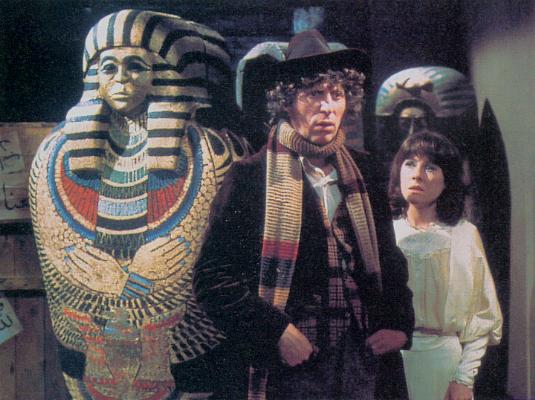
My irregular Doctor Who rewatch has reached Robert Banks Stewart’s second and last script for the series.  First things first, a few plot-holes that have always slightly irritated me.

In episode three, Dunbar tells Chase that he’s attended to the Doctor and Sarah (via a decoy chauffeur who’s rather handy with a gun).  We later learn that the chauffeur was on Chase’s payroll.  Eh?  Surely it would have made more sense for Chase to send the homicidal chauffeur to intercept our heroes, especially considering the way that Dunbar reacts in horror to the deaths in Antarctica.  So it doesn’t scan that Dunbar is happy to dispose of the Doctor and Sarah in cold blood.

Still, it’s some recompense that the chauffeur was played by Alan “Chuntzy” Chuntz, a familiar Doctor Who stuntman who rarely had the luxury of dialogue.  When you hear his rather stilted delivery, the reason becomes clear …..

The link between Chase and the stolen pod is done in an incredibly clumsy way – via Amelia Ducat’s painting, left in the car boot.  Surely Banks Stewart or Holmes could have found a slightly more nuanced way to bring Chase to the Doctor’s attention.

Another slightly baffling moment occurs when Amelia turns up at Chase’s palatial country house to demand payment for the painting.  That’s fine, but the revelation that she was sent there by Sir Colin makes little sense.  How did he know that the Doctor and Sarah had spoken to her?

But a few carps about the plotting aside (like Pyramids of Mars this had to be put together in extreme haste after other scripts collapsed) Seeds is gripping stuff.  Tony Beckley’s super-camp performance is an obvious highlight and from his first scene he’s an absolute joy (there’s no doubt that without him the story would sag a little).

Mark Jones’ role as Keeler is less showy, but equally impressive.  He’s clearly marked as doomed from the moment we first meet him and Jones is perfect as the twitchy, conscience-stricken scientist.

Possession has always been a theme in Doctor Who and it’s especially prevalent during the Hinchcliffe/Holmes era, where it’s usually tied in with a body horror theme (Noah in The Ark in Space, Sorenson in Planet of Evil).  It’s bad enough to be taken over, but even worse when it results in a grotesque physical change ….

Tom Baker’s Doctor dabbles in fisticuffs in a few other stories (such as knocking out Salamar in Planet of Evil) but this is certainly the serial in which he’s in full-on Duggan mode.  Had this happened more regularly it would have ended up as a touch monotonous, but there’s something undeniably appealing about the way that he becomes the man of action – springing through the skylight to duff up Scorby at the start of episode four is a definite highlight.  “What do you do for an encore Doctor?” indeed.

So although the tone of the story is odd and off-kilter (it rather feels like an ultra-violent TV Comic strip) it’s hard not to love The Seeds of Doom.  A little pruning (sorry) would have tightened things up – as a four-parter it would have been unbeatable – but I’m not unhappy with what we ended up with.

Grange Hill. Series Eight – Episode Fourteen

grange-hill-s08e14

Written by Barry Purchese.  Tx 3rd April 1985

There’s something a little odd going at the start of this episode.  Fay is agonising over how to tell Julian that she no longer wants to go out with him, but since they’ve never had that sort of relationship this doesn’t make any sense.  Julian’s got other things on his mind though – his beloved dog, Bumper, is nearing the end of his life, but Julian remains in denial, convinced that he’s going to get better.

Banksie’s latest plan for some quality time with Jackie involves taking his brother’s stock car for a spin, with Jean-Paul and Sarah tagging along.  Banksie might tell the others that his brother, Phil (John Blundell) is totally fine with this, but it doesn’t take a genius to work out that when Phil does make an appearance he’s going to be less than impressed.

Blundell (who had previously appeared in both the tv version and film of Scum) is menacing as Phil, probably because he doesn’t get angry.  His self-control, mildly telling his younger brother that it might be a good idea to flag down the car (Jean-Paul driving, Sarah sitting beside him) sooner rather than later, carries with it a certain chill as we can sense the inherent threat of violence behind his calm words.  This is put into action when he starts to give Banksie a few slaps and Jackie backs away in fear.

The next day Banksie turns up to school with a battered face, courtesy of his brother.  As with the familial beatings issued to pupils during the first few series, this isn’t dwelled upon – except in an obliquely approving way.  Since Banksie was in the wrong he deserved such a beating (which is certainly Zammo’s conclusion).

As for Jean-Paul and Sarah, he might have been a good driver but his luck finally runs out and he turns the car over (a nicely mounted stunt).  He walks away without a scratch but Sarah is hospitalised with a broken arm and facial bruising.  Sarah’s last moment in the episode – which also turned out to be Joanne Bell’s final scene in Grange Hill – is a powerful one, as she silently turns her ravaged face away from Jean-Paul who, finally shocked into a semblance of responsibility (or possibly he’s simply worried about the reception he’ll receive back home from his strict parents) visits her in hospital.

With Mr Humphries mysteriously absent once again, it falls to Mrs McClusky to host the parents meeting with Mr Wright, Mrs Wilks and Mrs Banks.  Mrs Banks was obviously played by a non-speaking extra though, so has nothing to say!  Mrs Wilks is much more voluble, although Mrs McClusky isn’t inclined to agree with her view that Sarah was totally innocent, so Jackie, Banksie and Sarah are all suspended indefinitely.

With Mrs McClusky now effectively back as the head, it does make you wonder why they decided to demote her to deputy if they weren’t going to follow through with any decent storylines on this topic.  It wasn’t the first and won’t be the last time that the head is an off-screen character, but at least here it’s not long until the matter is resolved.

With Banksie and Jackie suspended, that leaves an opening in the school play and Fay and Julian are drafted in at short notice.  It means they’ll have to work closely together, but now that the exciting, but reckless, Jean-Paul has returned to France, Fay regards the steady and reliable Julian more warmly.

Although since Julian doesn’t return in 1986, we’re not too far away from Fay’s next – and most catastrophic – choice of boyfriend …..

Grange Hill. Series Eight – Episode Thirteen

grange-hill-s08e13

Written by Frances Galleymore.  Tx 1st April 1985

Possibly inspired by Mr Baxter’s previous complaints that the others keep on finishing off the coffee without replacing it, the staff room is now the proud recipient of an imposing new vending machine.  Mr Smart and Miss Washington aren’t impressed though, she comments that it just makes a terrible groaning noise and doesn’t deliver, leading him to respond that it sounds like the school in general.  Mrs McClusky, of course, just happens to wander into the staff room at that precise moment ….

Caroline Gruber has another opportunity to demonstrate Miss Washington’s doe-eyed appeal after Mrs McClusky expresses her opinion that some of the first years (especially the ones in Miss Washington’s charge) are pushing the school uniform rules to the limit.  It’s plain that Mrs McClusky believes that the younger teacher isn’t setting them a good example, but politeness – and Mrs McClusky is sweetness personified during this scene – dictates that she doesn’t openly come out and say so.

There’s some later nice staff-room interplay (Mr Bronson complaining about the level of smoke and continuing to bemoan the fact that others have taken his seat) but the episode revolves around two main areas – Eric’s accident and the babysitting misadventures at the McCartneys.

Those with fairly long memories might recall that Eric, previously revealed to be partially deaf, featured in an earlier series eight episode.  The poor boy is now the recipient of Janet’s interest (who seems to have finally decided that Roland – constantly speaking French – is now totally absorbed with Fabienne) but she wasn’t there at the moment when Eric stepped out into the road and was knocked over.

I’m not sure whether Eric’s deafness is supposed to be a factor here – but this doesn’t make much sense if so, surely he’d have looked left and right to check the road was clear before crossing?  Possibly he was simply chosen because whilst not a main cast member (whose absence would be problematic) he was still someone with a higher profile than a non-speaking extra – and therefore his accident would carry a little more impact.

If that was the case, they could have used Diane.  Although she has a couple of lines in this episode, they only highlight just how underused she’s been throughout series eight (whereas during 83/84 she’d featured quite prominently).  It seemed that once her spots faded away so did any thoughts about developing her character, so she’ll not return in 1986.

One point of interest is the way that Mrs McClusky appears on the scene mere seconds after the accident.  How did she get from the school to the road outside so quickly?  Was she waiting in the playground for such an accident to happen?!

Real-life school politics of the mid eighties do get a brief mention when the fourth-formers are left to their own devices, thanks to a cover strike.  British schools were hit by waves of industrial action during this period, as teachers regularly worked to rule and refused to cover their colleague’s lessons.  Phil Redmond would have no doubt made capital out of this, but here it’s very much an incidental point – at this point in the show’s history, staff-room squabbles are more over coffee and chairs than politics ….

There’s an air of deceit running through this episode.  Fay agrees to babysit for Mr and Mrs McCartney and Julian offers to walk her home.  Fay, still not keen on the worthy-but-dull Julian, tells him that the babysitting’s been cancelled, so that Jean-Paul can go instead.  And with Annette and Stewpot also there, everything’s set for a cosy evening.  Which of course doesn’t go to plan.

If Fay lies to Julian, then Stewpot continues to lie to Annette.  Just as Claire’s been somewhat reduced in character during series eight, then poor Stewpot has also received the rough end of the scripting stick.  By continually stringing both Claire and Annette along – lacking the courage to choose between them – he’s portrayed as buffoonish at best and an insensitive idiot at worst.  Even here, he can’t bring himself to tell Annette that it’s over, but since he’s clearly not enjoying himself, why not?

Jean-Paul burns a hole in the McCartney’s carpet with his cigarette, providing us with yet another example of his flawed character.  His plan – chuck a scatter cushion over the offending mark and walk slowly away – also highlights that he never stops to think about the consequences of his actions.  This moment was no doubt one of several created in order to prepare the ground for episode fourteen.

Grange Hill. Series Eight – Episode Twelve

grange-hill-s08e12

Written by Frances Galleymore.  Tx 27th March 1985

So Claire and Stewpot’s on-off-on-off, etc relationship now seems to be on again.  I’m somewhat sorry that we didn’t see the scene where she agreed to have him back, as that would have been fun to watch.  Has anything changed?  Well Stewpot’s still making excuses when Claire attempts to arrange an evening out (this time he claims he has to help his father decorate the bathroom) so maybe not.  Surely he can’t still be juggling two girls, and both of them incredibly stroppy as well ….

I do feel a little sorry for Paula Ann Bland during this run of episodes, as Claire doesn’t really have anything to do except express disapproval at Stewpot, so she spends her time as a rather shrewish character with little light or shade.

But this does give us a lovely scene as Annette crashes into Stewpot, Claire and Precious and blithely arranges a date with him.  Claire’s response?  “Stewpot, you’d better not have chosen that tarty little fourth-year with the raggedy hair before me. ‘Cause if you have and you do see her on Friday night then you won’t be seeing me again.”  This gives Mark Burdis another chance to give us his best hangdog expression (something he’s had to do an awful lot this year).

The on-off-on-off relationship between Zammo and Jackie is now once more lurching into the off position, thanks to Zammo’s jealous and controlling nature.  Banksie invites Jackie to join him, Loop, Fay and Jean-Paul on a visit to the old Brookdale school.  She wasn’t sure, but after Zammo told her not to, it’s not hard to imagine the outcome ….

They decide to bunk off, which means that Fay spends the time in a highly stressed manner.  She may not quite be the goody-goody now she’s hooked up with the louche Jean-Paul, but she still knows right from wrong.

It’s odd that none of them seem to consider the possibility that there may still be a caretaker on site (if there wasn’t, why would there be a television set and a kettle?).  Of course there is (played by the wonderful Derek Deadman) which means there’s a short comic chase.  “Blast! Flipping kids!”


Grange Hill. Series Eight – Episode Eleven

grange-hill-s08e11

Written by Rosemary Mason. Tx 25th March 1985 

Mr Smart explains to E1 about the new timetables and homework arrangements.  Natasha (Patsy Palmer) has possibly her first line in the series, which sees her succinctly sum everything up.  “Bit of a fag, innit?”

It’s a system that seems to be deliberately confusing, so it’s possibly not surprising that Mr Smart mistakenly heads off for the upper school, convinced that’s where he should be.  It’s just a slight problem that it was Miss Washington who persuaded him to do so and when Mr McCartney points out that she was mistaken (mere seconds after Mr Smart has exited the staff room in a hurry) neither decide to rush out and stop him.  So you can’t really blame him for being a little miffed with Miss Washington later ….

There’s a fairly rare glimpse of the upper school corridors, which look incredibly dirty and run down.  But Mr Smart doesn’t haunt them for long as Mrs McClusky soon sends him back down to the lower school.  We haven’t had the old “two classes of pupils try to fit in one room” routine for a little while, so it was clearly overdue an airing.

This gives us a rare opportunity to see virtually all of E1 and N4 together at the same time (normally they tend to have their own episodes with minimal crossovers).  E1 might already be present in the room, but Banksie doesn’t believe that possession is nine tenths of the law.  Instead, he contends that since they’re older, they must prevail.  He makes this point forcibly to Miss Washington, which only serves to highlight the flaws in his character.

The stand-up row between Miss Washington and Mr Smart is good fun, as is Gonch’s plan to bug the staff room.  He’s convinced this will enable them to identify the thieves once and for all (presumably he doesn’t consider that they might be able to rob in silence).  Once again, security at Grange Hill is shown to be lax in the extreme as the staff room door isn’t locked, enabling Gonch to able to enter and secure a Walkman (hired off Vince for the princely sum of fifty pence per week) under the coffee table.  With the tape switched to record, what can possibly go wrong?  Mr Baxter making his way to the staff room is a bit of a problem, but Hollo, on guard duty, is able to distract him quite neatly.

The first fruits of their bugging is another episode highlight.  Gonch mentions “Grange Hill Watergate”, although quite how many children would have picked up on this reference is debatable.  One for the older members of the family watching I guess.  They manage to hear Mr Smart asking Miss Washington if she’d like to go out with him for a meal (he’s clearly recovered his equanimity), although this tender moment is cut short after Mr Baxter barges in and complains that once again they’ve finished off all the coffee!

Given that the longest cassette tape available would have been a C120, the most they could hope to record would be just an hour, so it’s not surprising that this is the only useful(?) part of the recording.  Clearly if they’re going to catch the thieves red-handed they’re going to have to be very, very lucky ….

Relationships, both real and fictional are key to this episode.  Annette and Fay are both shown to have less than ideal boyfriends, although it’s interesting to see that they react in different ways to being left on the sidelines (something which is mirrored later during rehearsals for the school play).  Annette is quite happy to hang around, watching Stewpot play football (to his obvious irritation) whilst Fay (once Jean-Paul joins in with the same game) is much less tolerant and heads off home alone.

Elsewhere in the episode, Mr Baxter pops up to remind Fay, and the audience, that her previously impressive sporting career is suffering.  And is Jean-Paul worth it?  He has inevitable Gallic charm, but apart from that he’s portrayed as rather feckless.  And all the time Julian stands on the sidelines, pining.  Mmm, maybe all will come right in the end.

The school play, centered around conflict between the mods and rockers in the 1960’s, takes shape.  Given what we’ve already seen, it can’t be a coincidence that both Mr Smart and some of the pupils aren’t terribly impressed that the plot is rather male-dominant (reducing the females to little more than appendages, standing on the sidelines).   Jackie, pencilled in to play the object of both Zammo and Banksie’s affection (perfect casting!) admits that having two boys fighting over her leaves her cold.

Another Six English Towns – Simply Media DVD Review

another

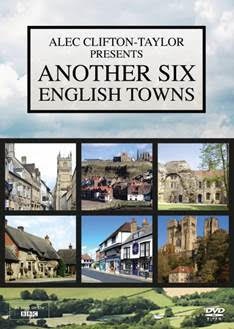
Another Six English Towns, originally broadcast in 1984, was the third and final series in which Alec Clifton-Taylor cast his expert eye over the architectural merits of a variety of English towns.  My review of the first two series can be found here.

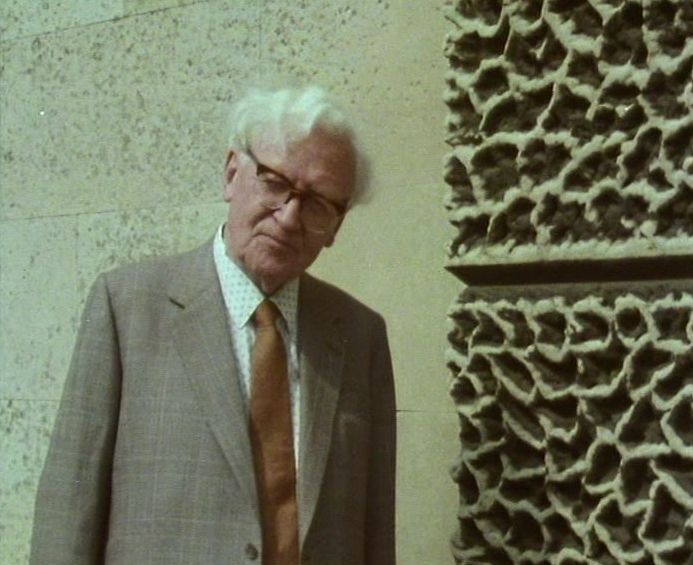
The format remains unchanged.  Architectural historian Clifton-Taylor inspects the streets and notable buildings of each town, dispensing approbation or disfavour as he sees fit and quietly applauding those towns which have managed to preserve their status without recourse to the horrors of modern life (high rise buildings and pebbledash being two particular bête noires of his!).

We open in Cirencester, the capital of the Cotswolds, which finds Clifton-Taylor in an approving mood.  He’s particularly taken with the pleasing mixture of styles on display, commenting that “in the market place, the buildings burst forth into a chorus of painted stucco”.  The town’s mansion, Cirencester House, complete with a ten thousand acre park, also catches his eye.

Up next is the fishing town of Whitby, which nestles on the North East coast.  The ruins of Whitby Abbey are striking and whilst St Mary’s Church may look somewhat unprepossessing from the outside, inside it’s quite a different matter.  Clifton-Taylor regards it as “a thrill. Absolutely unforgettable. Not a work of art, but a most illuminating social document.”

Bury St Edmonds has an impressive collection of Georgian buildings, created with different varieties of coloured clay, although Clifton-Taylor is a little miffed that “they are so smothered with Virginia creeper that one can hardly see what colour they are!”  This town has rich pickings elsewhere though – the town hall (reconstructed by the notable eighteenth century architect Robert Adam) appeals, as does the Theatre Royal, designed by William Wilkins, architect of the National Gallery.

Clifton-Taylor travels to Wiltshire for the fourth episode, his destination being Devizes.  He’s saddened that the twelfth century castle no longer remains (on the site is something he dubs as a pantomime recreation from the Victorian period) and reacts in horror when he sees that some of the eighteenth century timber houses have recently “been smothered with that most repellent material – pebbledash!”

He remains in a slightly caustic mood when he reaches Sandwich, sorrowfully reflecting that the original character of some of the 16th century brickwork has been submerged under fresh coats of paint.  But the Salutation, a house and garden designed by Sir Edwin Lutyens (1869 – 1944), is much more to his taste.  Clifton-Taylor has little hesitation in regarding him as “the greatest English architect of the last 100 years”

The series concludes with Durham.  He’s impressed with the Cathedral, especially the vaults, which have remained unchanged for eight and a half centuries.  Clifton-Taylor is also taken with a public convenience, built in 1841, concluding that “few loos, surely, can hold their heads so high!”.  An idiosyncratic, but delightful, moment.

A lovely snapshot of six English towns frozen in time some thirty years ago, Another Six English Towns will certainly appeal both to those who have already collected the first two series, as well as anyone who is familiar with the featured locations and wishes to compare then to now.

Shot on 16mm film, the picture quality is on a par with the earlier releases.  The prints are rather faded and dirty in places, but still perfectly watchable.

Alec Clifton-Taylor maintains the persona of a kindly headmaster, eager to give credit where it’s due, but also quite capable of expressing irritation and exasperation (albeit with his impeccable manners always intact).  An impressive series of travelogues, Another Six English Towns also educates and informs, as Clifton-Taylor is effortlessly able to show how different periods of architecture can live side by side in harmony (or not, as the case may be!)

Another Six English Towns is released by Simply Media on the 23rd of January 2017.  RRP £19.99.

towns

Pondering about Pyramids of Mars

pyramids

Rewatching Pyramids of Mars for the umpteenth time, a couple of things worried me in episode three.  Of course, given that Robert Holmes had to cobble the story together at very short notice (and had clearly run out of steam by episode four) it isn’t too surprising that the odd plothole remained ….

After Sarah and the Doctor discover Lawrence Scarman’s body, Sarah is perturbed that the Doctor seems unmoved by Lawrece’s violent death.  He responds that Lawrence isn’t Sutekh’s only victim, counting out the others. “Four men, Sarah. Five, if you include Professor Scarman himself.”

Hmm, okay.  Lawrence, Doctor Warlock, Ernie Clements (“murdering swine!”), Namin and Collins make five, six if you include Professor Scarman.  My first thought was that the Doctor was unaware of one of their deaths, or maybe he didn’t count Namin since he was a baddy?

And why did Marcus Scarman, after murdering his brother, gently prop him up into the rocking chair with such obvious care and attention?  It creates a shock moment but doesn’t make much sense.

Just how many service robots were there? In actuality there were three, so if that was also the true figure why didn’t Professor Scarman immediately twig that that the faux-Mummy (containing a grumpy Tom Baker) was an imposter? Two robots had been guarding the pyramid and Scarman had seen a disassembled third just before killing Marcus.

And I’m not even going to ponder exactly when Sarah became so efficient with a rifle.

Not that any of this matters as Pyramids of Mars is still great (if rather nasty) fun. Can it really be nearly thirty years since I bought it on sell-through VHS? And a mere twenty three years since I taped the episodic repeat from BBC2, enabling me to see the scenes snipped from the official release for the first time. Time passages ….

Grange Hill. Series Eight – Episode Ten

grange-hill-s08e10

Gonch and Hollo’s newest rubbish-dump acquisition is a plastic mannequin which they dress in school uniform and take to school.  Unfortunately they drop him in the middle of an oncoming car when struggling to cross the busy road outside the school gates.

Since we can see a Lollipop leaning against the wall, it rather begs the question as to why there isn’t a Lollipop man or woman on duty.  It’s mentioned that the teachers are currently assigned to road duty, with Mr  Bronson taking his turn today.  Alas, we don’t see him wielding the Lollipop, which is a shame.

Fay is increasingly infatuated with the laid-back Jean-Paul, much to Julian’s irritation.  All of Fay’s previously held principles (such as a horror of cosmetics being tested on animals) seem to be slipping way, demonstrated best when she much prefers Jean-Paul’s present – perfume – to Julian’s – a rabbit.

Zammo and Jackie’s on-off-on-off relationship now seems to be back on, which leads to further tensions with Banksie.  The school production of West Side Story comes to a crashing halt when they learn that copyright problems mean that they won’t be able to continue.  A pity they didn’t check beforehand really …

No matter, the show must go on, even if it’s a different show from the one they’d originally planned.

Mr Smart continues his quest to tempt Miss Washington out for an evening of squash, but once again he’s foiled – this time because she’s too busy with the school play.  Poor Mr Smart, he seems to have plenty of luck, all of it bad.

Gonch and Hollo liberate Henry, although taking it to Mr Baxter’s lesson probably wasn’t the wisest move. Michael Cronin, as ever, is on fine-form as Mr Baxter comes face to face with Henry.

Grange Hill. Series Eight – Episode Nine

grange-hill-s08e09

Written by Barry Purchese.  Tx 18th March 1985

Gonch’s latest money-making scheme is a video club, run during the lunchtimes with tapes “borrowed” from the shop where Vince’s dad works.  We briefly get a glimpse of the film they’re watching and it’s noticeable that the picture quality is authentically bad (loads of interference) which was often par for the course with tapes from video rental shops.  Although the picture here is so bad I would have been inclined to ask for my money back ….

There’s several snags with this arrangement – Vince can’t borrow the tapes for more than a day without his dad becoming suspicious and the lunch break is too short for the entire film to be seen, meaning they constantly have to fast-forward to the end, missing out most of the best bits.  Never mind though, as the ever-resourceful Gonch has yet another idea – use the media studies room to copy their own tapes, which they can then sell!

Given the wave of thefts still sweeping the school, it really stretches credibility to breaking point to learn that the key to the media studies room is kept on the doorframe.  Since there’s televisions and video-recorders aplenty inside you’d have assumed that a little extra security would have been taken in order to keep the equipment safe.  It’s easy to see why this was done in plot-terms though – Gonch and the others need to gain access to the room and can’t have been seen to steal the key – but it still feels a tad contrived.

The builders discover that Gonch and Hollo liberated some of their building supplies in order to help Mr Light.  Remarkably, they don’t seem terribly put out by this and are happy to do the repairs on Mr Light’s house for virtually nothing, although Gonch does promise to supply them with some good films on VHS.

Zammo, Mandy and Sarah observe a first-year girl being forced into a car against her will.  The girl is Calley and the woman is Angela, her real mother.  At first glance, this appears to be the latest instalment in Calley’s tale, but the focus quickly switches to the three fourth formers.  We never really find out exactly what happened at the car – it’s plain that Calley didn’t want to go with Angela and (presumably) her husband, but she later denies this.  Angela only has a few lines of dialogue, which means that this sequence is much more about providing an excuse for Zammo, Mandy and Sarah to be inside the school at lunchtime.  And this is the last we see of Angela, meaning that this plot-line rather splutters to a stop in a less than dramatic fashion.

Zammo, Mandy and Sarah run into Mr Bronson, who immediately decides they’re responsible for the theft of yet another of Mr Smart’s squash racquets.  All three, along with Mr Bronson and Mr Smart, head off to see Mrs McClusky, which leads into an interesting scene.  Zammo is voluble in his defence, stating that Mr Bronson has had it in for him since the day they met.  Mrs McClusky swiftly closes him down and asks the three of them to wait outside.  After they leave, it’s plain that she is far from convinced of their guilt, which somewhat wounds Mr Bronson.  That Mrs McClusky repeats Zammo’s doubts only after he’s left is something we’ve seen before – in front of pupils or parents she’ll always keep a united front with the staff, but behind closed doors it’s sometimes very different.

Having said all that, as Calley was nowhere to be seen when Zammo, Mandy, Sarah and Mr Bronson went to look for her, Mrs Clusky states that they’ll all still be in serious trouble unless she comes forward to collaborate their story.  How this can be I’m not quite sure, since there’s no evidence at all to link them to this, or any other, theft.  It helps to ramp up the tension – will Calley step forward to clear their name? – but it’s another moment which doesn’t quite work.

Grange Hill. Series Eight – Episode Eight

grange-hill-s08s08

Written by Barry Purchese.  Tx 13th March 1985

Episode eight opens in an unconventional way, as we see Robbie stepping away from the boy’s urinal!  It’s not unusual to feature scenes in the toilets, but offhand I can’t think of many times when we actually see people doing the business, as it were

The scene introduces us to Gonch’s groping grab as well as moving forward his truanting plans (Hollo provides him with a stack of dental appointment cards – all they have to do is fill them out and they’ve a perfect excuse for being off school premises).

But what really interests me is how shabby and dilapidated the toilets are.  There’s a whacking great piece of graffiti (“wham” – presumably somebody was a fan) which helps to make it look like the sort of place you really wouldn’t linger in.  This isn’t reflected in the dialogue though, it’s simply taken as quite natural that it’s run down.  We also saw this in the previous episode – one of the classrooms looked in quite a state, with nasty stains on the wall.

But if the children don’t appear concerned about the appearance of the school, it appears that others do, as two builders (played by Ben Thomas and Frank Jarvis) turn up to try and repair some of the damage.  Jarvis in particular had an impressive list of credits – turning up in a score of popular television series (The Saint, Z Cars, Adam Adamant Lives!, Manhunt, Budgie, Softly Softly:Task Force, Callan, The Brothers, Dixon of Dock Green, Warshp, Target, The Professionals, etc).  He also appeared in three different Doctor Who stories, although given that his final two were Underworld and The Power of Kroll, you can’t help but feel he rather drew the short straw ….

Ronnie’s hair has once again changed to “unconventional”, but this is a minor matter to begin with as Calley, having spent the night with her real mother, is in something of a state.  Ronnie asks Miss Washington to speak to her, and just before the teacher leaves the classroom she asks her form to mark themselves in the register.  This is an incredibly odd request (presumably a sign of Miss Washington’s inexperience) leading to an inevitably boisterous free-for-all.

Who should be passing at precisely this time?  Why Mrs McClusky of course and she’s far from pleased.  “I think this is the first time in all my experience I have ever heard of a teacher asking any class to mark themselves in.”  And when Ronnie reappears, Mrs McClusky is staggered at her unconventional appearance.  As previously touched upon, GH characters often tended to display echoes of those who had gone before them and Ronnie here has more than a touch of Trisha Yates about her.  Both frequently railed against the conformity of school uniform, so Mrs McClusky’s comments could equally have easily been directed at Trisha.

Gonch and Hollo plan to “liberate” some of the school’s building materials to help Mr Light, whilst Miss Washington’s purse goes missing from the staffroom (surely Gonch’s groping grab couldn’t have been responsible?).  And Patsy Palmer, an unspeaking extra, continues to steal a number of scenes as she prominently places herself in the frame …

The Witness for the Prosecution/And Then There Were None – Acorn/RLJ DVD Review

7160.JPG

The Witness for the Prosecution was an Agatha Christie short story, originally published in 1925.  Like many of her short stories it was written for magazine publication, only appearing some years later in book form (The Hound of Death, 1933).  Christie was never averse to reusing plots from her short stories and several ideas were later expanded into novels, but Christie elected to turn The Witness for the Prosecution into a stage-play, which debuted in 1953.

Although The Mousetrap is a theatre institution (running for sixty years and more), for me Witness for the Prosecution was Christie’s best play.  She expanded the fairly thin material very nicely, creating the central character of Sir Wilfred Robarts for example.  In 1957, the Billy Wilder film, starring Charles Laughton, Marlene Dietrich and Tyrone Power, hit the cinema screens and is for many the definitive version.

Sarah Phelps’ Christmas 2016 adaptation carried with it a certain weight of expectation then, partly because her work on And Then There Were None in 2015 had been so well received but also because the Wilder film remains popular with Christie aficionados.  Sadly, Phelps’ Witness is much more of a curate’s egg than And Then There Was None was.

It’s interesting that Phelps went back to Christie’s original story, rather than the play.  As the 1925 tale is rather brief and only features scanty characterisation, a large part of the teleplay had to be newly crafted by Phelps.  So whilst the Queen of Crime’s voice can be heard, it’s only very faintly.

And the foggy yellow filter on the camera was an interesting visual choice I could have done without …

But on the positive side, the core cast were impressive.  Toby Jones as Mayhew, a somewhat insignificant character at first glance, was faithful to the source material (albeit with a whole backstory created for him).  The character of Leonard Vole is key and Billy Howle was suitably bewildered and endearing (the story only works if the audience immediately identifies with Vole and takes his side).

7145.JPG

Emily French received something of a drastic makeover (a nice old lady in the Wilder film, a man-eating vamp here) but Kim Cattrall was entertaining enough and Annette Riseborough hit most of the right notes as Romaine Heilger.  This is by far the hardest role to play in the piece (previous actresses to tackle the part include Dietrech in Wilder’s film and Diana Rigg in the 1982 tv movie remake).

Julian Jarrold’s direction boasted some impressive sequences, none more so than the quick cut in episode one when Emily French’s dead body is revealed.  The traumatised visage of her maid and the way that her cat steps through the puddles of blood are both striking touches, and this section makes up for some of the more stodgy fare we see later.

Had it been a ninety minute one-off, it might have worked better, at two hours it rather outstays its welcome.  The Witness for the Prosecution is not without merit, but my preferred viewing option remains the 1957 Wilder film (certainly worth a look if you’ve never seen it).

The disc contains several featurettes, the most substantial being From Page to Screen (running just under 25 minutes).  This is of particular interest due to the way it highlights the differing expectations that may exist between a section of the audience (the Christie die-hards who know the original well) and the adapter, Sarah Phelps.  Phelps discusses how she enjoyed the process of extrapolating character development from throwaway comments contained within Christie’s story, although I’m sure that some will regard Phelps’ additions with a slightly jaundiced eye.

If Witness was a tad disappointing, then we’re on firmer ground with 2015’s And Then There Were None.  Originally published in 1939, Christie’s novel spawned several film adaptations, whilst she herself turned it into a successful stage play.

Eight people are invited to an isolated island by the mysterious Mr and Mrs Owen.  When they arrive, the place seems deserted apart from two servants, Thomas and Ethel Rogers.  And then they start to die, one by one, until none are left ….

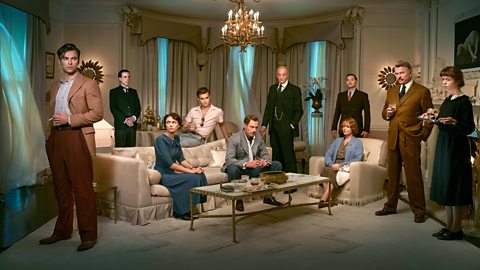
Starring Douglas Booth, Charles Dance, Maeve Dermody, Burn Gorman, Noah Taylor, Anna Maxwell Martin, Sam Neill, Aiden Turner, Miranda Richardson and Toby Stephens, And Then There Was None has an agreeable air of star quality.  Unsurprisingly there are a number of deviations from the original, but what remains is a much more faithful Christie experience than Witness was.

The most eye-opening change must be Detective Sergeant Blore’s (Gorman) crime.  Here, he’s alleged to have beaten up a homosexual suspect to death, in the book he’s accused of perjury.

The ending is of particular interest.  When Christie turned the novel into a play, she changed the denouement (which for me made the piece less effective).  Phelps doesn’t attempt to mirror the book’s conclusion, which is probably the right move, although what she leaves us with – something of a mash-up between the book and play – works very well.

And Then There None contains a substantial making-of featurette, running to just under 42 minutes, which features interviews with all the main cast as well as key behind-the-camera personnel.

Sarah Phelps is now working on an adaptation of Christie’s 1958 novel Ordeal by Innocence, which seems to suggest that the BBC are keen to have “A Christie for Christmas” each year.  Hopefully this next one will lean more towards And Then There Were None than The Witness for the Prosecution.

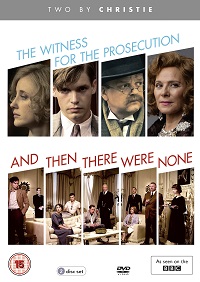
Two by Christie: The Witness for the Prosecution/And Then There Were None was released by Acorn/RLJ on the 9th of January 2017.  RRP £29.99.  Both titles are also available separately.

none.jpg

Grange Hill. Series Eight – Episode Seven

grange-hill-s08s07

Written by Margaret Simpson.  Tx 11th March 1985

The French exchange students arrive.  Mr Bronson is no doubt hoping for a rewarding cultural cross-pollination whilst I suspect that Fay and Julie are thinking about quite another form of pollination ….

Both seem impressed with the French boys, although it has to be said that most of the exchange students (both male and female) seem to be narcissistically self-obsessed.  This may be a little unfair though, as their limited English obviously hampers them (expect various “comic” moments of misunderstanding) and it’s true that the Grange Hill types give them a welcome which varies enormously.

Amusingly, they’re treated very much little cattle as they get off the coach (“what’s your one like, I don’t think much of mine”) with Zammo being the worst offender.  For some reason he’s very much taken against his one – a perfectly inoffensive chap – and proceeds to give him a hard time.  No doubt this is because he’s still smarting over his on-off-on-off relationship with Jackie, but it’s still a rarity to see him behave in such a boorish manner.

A party at Julian’s finds everybody (to the strains of George Michael’s Careless Whisper, the perfect mid eighties smooch record) pairing off – even Roland, who’s rather taken with Fabienne (Jessica Harrison).  Given that Roland is pretty anonymous during the rest of series eight, this is a nice piece of character development, especially given his long-running issues with making friends and forming relationships.

The other main thrust of the episode is the revelation that Calley is adopted and her real mother, Angela (Jean Heard), has returned to the area and is keen to establish contact with her daughter for the fist time.  It’s a challenging role for Simone Hyams and her lack of acting experience is possibly exposed when the camera focuses on a close-up of e, overhearing her parents talking.  We should be seeing horror, pain and confusion on her face, but instead Hyams can only manage mild inconvenience.

This is only a minor niggle though, since when she’s given dialogue she’s on much firmer ground.  Her adoptive mother (played by Deidre Costello) tells her that they didn’t tell her when she was little because they thought she wouldn’t understand – Calley’s plaintive rejoinder that she’s “not been little for ages” is very nicely played and remains a memorable moment.

Ian Redford makes the first of a handful of appearances as Mr Legge – in this one he spies the absconding Gonch and Hollo and steers them reluctantly to their home economics class.  Mr Legge is clearly something of a trendy teacher (sporting a lapel badge) and his easy-going nature, albeit also with a core of steel, comes across well here.  He’s another of those short-lived characters who could easily have become a regular.

The cooking lesson also gives us another example that Ronnie is rather an iconoclast and a rebel (she breaks an egg over Trevor’s head).  This part of the episode is also of interest thanks to the question of Ronnie’s hair.  It’s in something of a Toyah style (as acknowledged) but shortly afterwards it turns back into a more normal style.  I’m not sure exactly how she could have done this, so I’ll surmise it was done in order to match a later film sequence which featured her normal hairstyle.

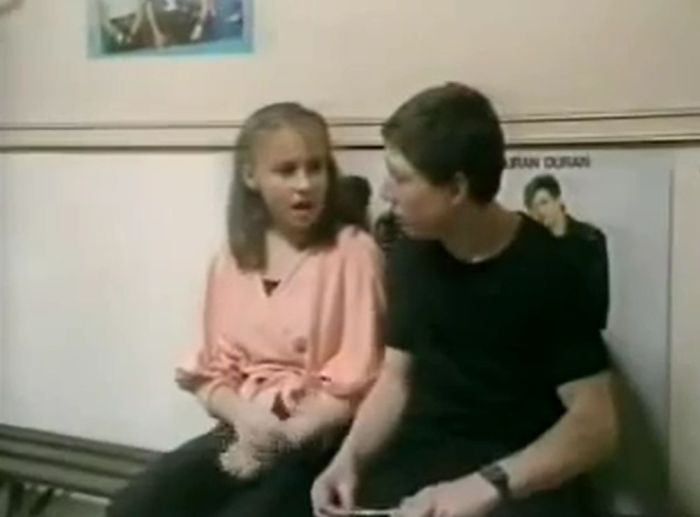
We close on a cliffhanger – it’s late in the evening but Calley hasn’t returned home.  Earlier, we’d seen her go off with Angela for a cup of tea, but where is she now?