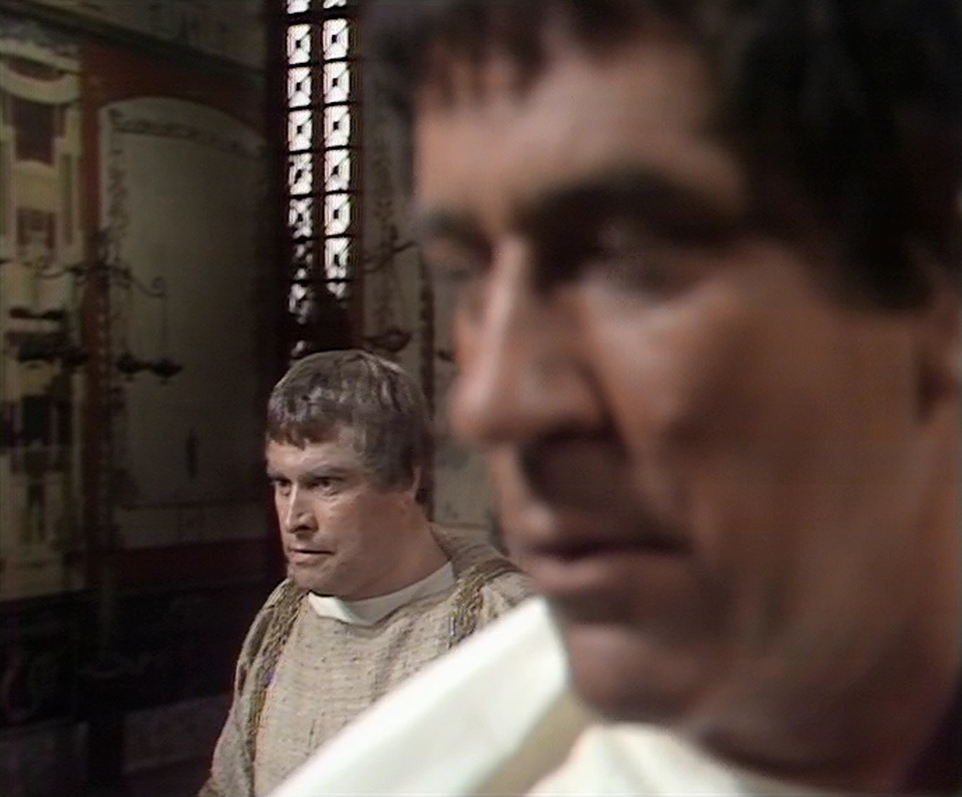
Jack Pulman’s adaptation of Robert Graves’ two novels (I Claudius and Claudius the God) spanned twelve episodes – with the first (A Touch Of Murder) being a double helping. For the American screening it was split into two 50 minute episodes (various other minor tweaks were also done – such as trimming down shots of the bare-breasted dancers seen in the opening minutes).
The original 100 minute edit is the better one though. Revisiting it once again, I can honestly say that the episode didn’t drag at all – a sure sign that the script and actors are totally engaging. As is well known, I Claudius is a completely studio-bound production – that’s sensible enough, as it would be difficult to find too many UK locations which could have convincingly replicated the grandeur that was Imperial Rome.
Tim Harvey’s production design is one of the serial’s unheralded triumphs. Subtle lighting effects (sun streaming through the palace windows) are used effectively and the outdoor locations (Augustus’ garden complete with fountain) also convinces (thanks to simple effects, such as a wind machine rippling the branches of the trees).
Pulman elected to retain the device of Claudius narrating the history of his strange family. This works on two levels – not only does it display fidelity to Graves’ original work, it’s also very handy for the television viewer (who otherwise – especially in this first episode – might find themselves overwhelmed by the large cast of characters who keep on appearing). So whenever the antecedents of a new arrival need to be explained, Claudius can pop up with a VO to explain all. As the serial progresses, and the regular characters become more familiar, this device is used less often.
Derek Jacobi (Claudius) appears only fleetingly, as at this point in the story Claudius is either not born or only a mewling infant. It’s Augustus (Brian Blessed), Livia (Sian Phillips) and Tiberius (George Baker) who drive the episode along.
There are some who express surprise that Brian Blessed could once upon a time have indulged in a spot of subtle acting (true, Augustus does like to shout a lot, but he tends to be more interesting whenever he’s calm and menacing). Those people probably never saw him in Z Cars then – maybe Blessed only started to go over the top when he grew the beard ….
His Augustus is a multi-layered creation. At times indulgent and child-like, he’s able to change direction in a heartbeat.
If Augustus is ebullient and expressive, then Livia is cold and calculating – prepared to play the long game as she removes all those who might ascend the throne ahead of her son, Tiberius. It’s interesting to see how Pulman greatly expanded the role Livia played in the death of Marcellus (Christopher Guard). To be honest, Marcellus is so irritating that his demise can almost be called a mercy killing. Pulman explicitly states that Livia poisoned him – whereas Graves only mentions in passing that Livia nursed him (possibly anticipating that his readers would join the dots).
Marcellus provides the first half of the episode with some spark, as does John Paul as Marcus Agrippa. Augustus’ strong right arm, the relationship between him and Agrippa is a fascinating one which could have been expanded a little more.
Their final scene together is a treat though. Agrippa is keen to strengthen his ties with the Imperial family and asks to marry Augustus’ daughter – the recently widowed Julia (Frances White). At first a shocked Augustus can barely get any words out, before – after a short period of reflection – he becomes reconciled and heartily agrees. It’s therefore a little jolting to then be told by Claudius that Agrippa, having married Julia, dies some years later (this all happens off-screen).
With Julia back on the market, she’s then married to an unwilling Tiberius – who’s forced to divorce the love of his life, Vipsania (Sheila Ruskin). The increasingly tangled relationships between the members of the Imperial family will only become more tangled over time, so it’s best to keep paying attention …
Out of all those who become Emperor, Tiberius has the fewest character quirks, which means that George Baker has to work hard to bring him to life. He’s served well in A Touch of Murder though – even if Baker doesn’t quite convince as the youthful Tiberius. Tiberius’ awkward and stilted relationship with his mother is nicely done as is the genuine love and affection he has for his younger brother, Drusus (Ian Ogilvy).
Like John Paul and Christopher Guard, Ogilvy is a one episode actor – required to make an impact with only a limited amount of screentime. This he does – firstly as the only man capable of dispelling the black clouds that hang over his elder brother and then later when Drusus, off to campaign in Germany, takes his leave of Augustus.
Drusus, a keen believer in the Republic, is comfortable enough in Augustus’ company not to keep his views secret. Watch out for the moment when their affable chat suddenly turns awkward – for just a brief moment – as Drusus realises that he’s overstepped the mark.
If Pulman makes it explicit that Livia poisoned Marcellus, then her involvement in the death of Drusus is more opaque. The elderly Claudius is convinced that something strange occurred, but doesn’t accuse Livia. True, she did send out to Germany the notable physician Musa (Renu Seta) who had also unsuccessfully treated Marcellus, but was Musa under her control? He seemed genuinely baffled at the death of Marcellus, so if he was later suborned by Livia, we never saw it happen.
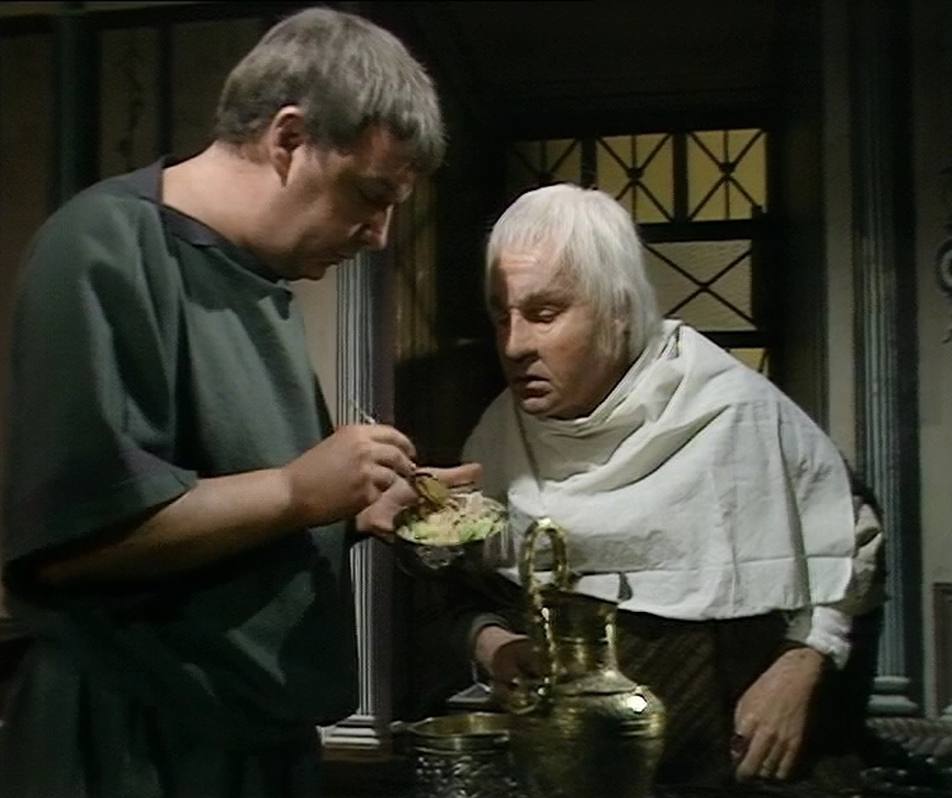
To round off, there’s a few minor performances worth noting. First, Carleton Hobbs as the Greek poet Aristarchus . For me, Hobbs was the definitive radio Sherlock Holmes and it’s always a delight to hear that well-remembered voice again. And Tony Haygarth, as Claudius’ slave, also makes a little go a long way – forced to taste his master’s food and wine, he can’t resist passing judgement on the indifferent culinary fare offered by the palace.
 Archive Television Musings
Thanks for this – studio-bound it may be, but remains unmatched since I first watched it 40 years ago at the insistence of my Latin teacher. And yes, Blessed could be subtle as required back in the day…
LikeLiked by 2 people
I was introduced to the serial when taking an evening course in Roman history and the lecturer espoused the virtues of such productions for visualising the period. We had one class devoted to the episode with the fall of Sejanus.
LikeLiked by 1 person
Interesting you make the point about hearing Carleton Hobbs’ voice – the quality of voice and speech is something I really admire from this era of television, and from these past generations of actors. I’ve just been revisiting the political drama Bill Brand, and it’s worth it just to hear actors like Peter Howell, Alan Badel, and many others making an artform out of speech but still making it sound natural and authentic.
LikeLiked by 1 person
George Baker always looked mature. His screen test for BEN-HUR when he was like 27, had him looking much older.
LikeLike