Donald Sinden’s recent death, at the age of 90, has encouraged me to dig out some of his many performances from film and television.
Whilst well known as a comic actor, he was no stranger to the classics, as seen (with other greats of the British stage) in this edition of Playing Shakespeare.
From amongst the numerous tributes paid to Sinden over the last week, there’s a lovely one from Michael Billngton here.
In retrospect, the 1970’s was an ideal time to be making documentaries about the Second World War. Some thirty years or so had passed since the war had come to an end, which was long enough for people to be more candid about some events and particularly (in the case of this series) for certain facts, hitherto not in the public domain, to be discussed.
Several years before, Thames Television’s The World At War had covered many areas of the conflict in detail, but one omission was the role played by the code-breakers at Bletchley Park. At the time The World At War was in production this information wasn’t public knowledge, which meant that The Secret War was one of the first programmes to describe this vital part of the war.
The Secret War was narrated and presented by William Woollard, a familiar face from Tomorrow’s World. It was comprised of six episodes.
Episode 1 – The Battle of the Beams. Early in the war, British Intelligence became aware that the Luftwaffe were using a series of radio navigational aids to accurately pinpoint targets, even in the dark. This first episode describes these developments as well as the jamming countermeasures developed by British scientists.
This episode, like several others, relies heavily on the input of R.V. Jones. Jones played a major part in the development of the jamming beams and his book Most Secret War is not only a fascinating read in its own right, it was also a useful guide for the programme-makers in the early stages of The Secret War’s production.
R.V. Jones
Episode 2 – To See A Hundred Miles. This episode discusses the development of Radar as well as British Intelligence’s efforts to discover German developments in the same field.
R.V. Jones appears again, as does Albert Speer – Hitler’s Minister of Armaments. Another key interviewee is Arnold Wilkins, co-creator of Radar. The presence of pioneers such as Wilkins is certainly one of The Secret War’s main strengths.
Episode 3 – Terror Weapons. The creation of Hitler’s vengeance weapons – the V1 and V2 – and the countermeasures taken to combat them.
Interviewees here include Duncan Sandys (Chairman of the War Cabinet Committee responsible for defence against flying bombs and rockets) and Raymond Baxter, Woolard’s Tomorrow’s World colleague, who describes his exploits as a spitfire pilot and his unsuccessful attempt to shoot down a V2 rocket.
Episode 4 – If. This episode describes numerous inventions that never came to pass. These include the Messerschmitt Me 321, a large cargo and troop aircraft which was intended for use in the German invasion of Britain – codenamed Operation Sealion. Also discussed are German bouncing bombs.
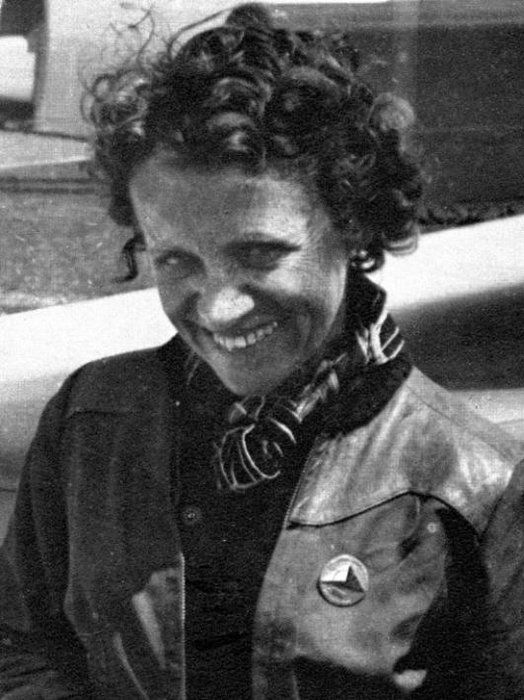
As well as further input from R.V. Jones and Albert Speer, also interviewed were Frank Whittle (creator of the turbojet engine) and Hanna Reitsch. Reitsch was a German test pilot and the only woman to be award the Iron Cross First Class. As might be expected, her unique status makes her a fascinating interviewee.
Hanna Reitstch
Episode 5 – The Deadly Waves. Episode 5 looks at the hazards of magnetic mines and the methods used to counteract them, including degaussing.
Lt Cdr John Ouvry, who defused a German mine on the shoreline at Shoeburyness is interviewed and this actual mine is used in the programme to re-enact the event.
Episode 6 – Still Secret. As previously mentioned, when The Secret War was in production the first information about the code-breakers at Bletchley Park began to emerge. So whilst this programme is far from complete (as much more information would emerge in the decades to come) it’s still a very interesting watch.
Discussed are the efforts to break the Enigma Code and the role played by the Colossus computer, designed by T.H. Flowers. In 1977 the Colossus was still on the secret list, so details are fairly sparse, but the programme benefits enormously from an interview with Flowers. And there are also valuable contributions from others present at Bletchley Park during WW2 such as Gordon Welchman, Harry Golombek and Peter Calvocoressi.
T.H. Flowers
Whilst there are numerous WW2 documentaries available, The Secret War is noteworthy for several reasons. The interviews with key pioneers on both sides is a major plus as is the wartime footage, some of which had not been widely seen until this programme. The series was produced in association with The Imperial War Museum, so the programme-makers were able to make full use of their archives to locate interesting material.
And finally, the series helps to tell some of the less familiar stories of the Second World War. Whilst the key battles and individual acts of heroism were already well known, The Secret War was able to explain that some of the real breakthrough moments of the war came not at the front, but in laboratories, far away from the fighting.
This is a first class documentary series and hopefully Simply will delve in to the archives again to unearth similar treasures.
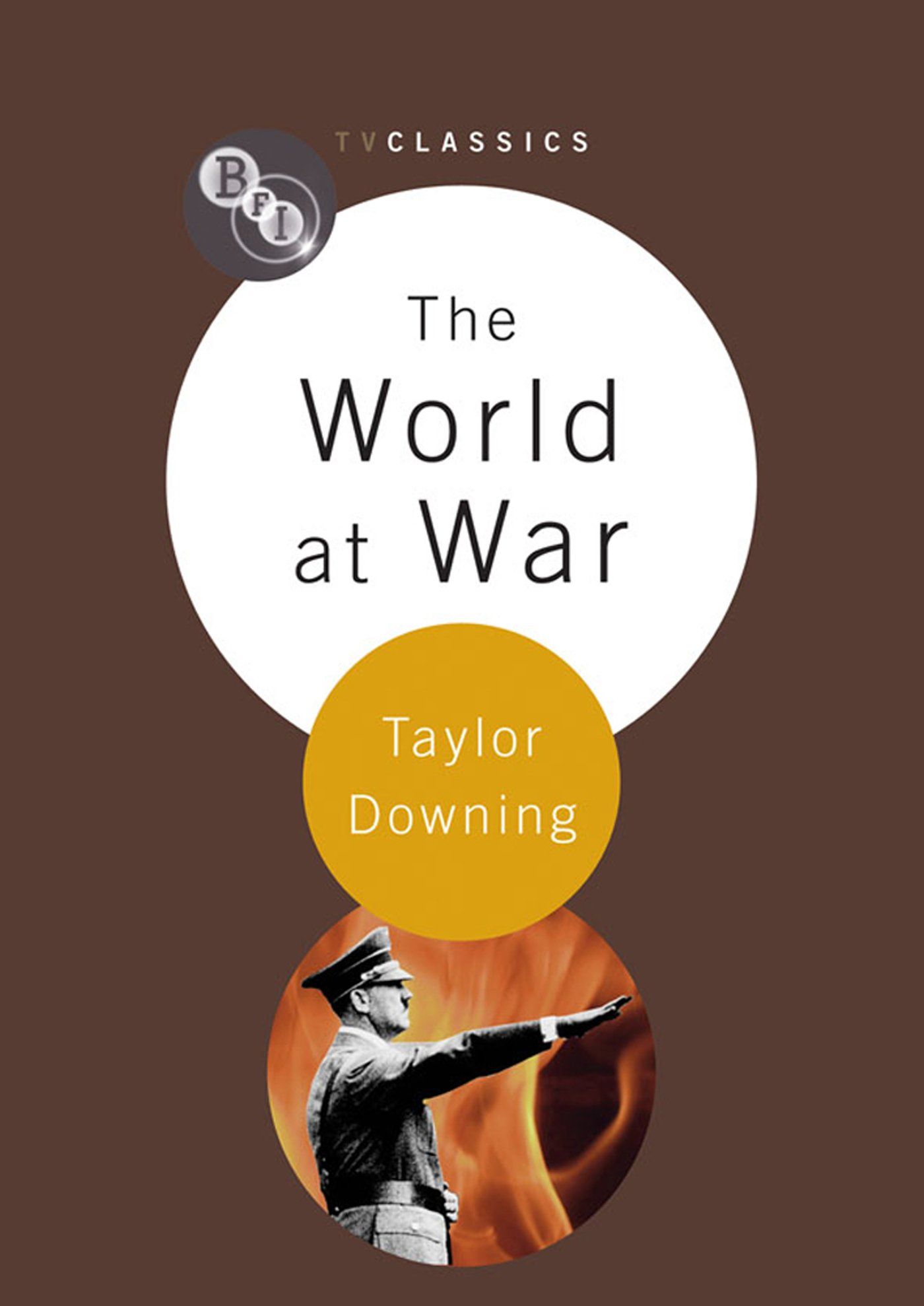
“The World At War is unique in factual television. Forty years after its first transmission it is as popular, possibly even more popular, than it was when first shown. Factual channels that were not in existence when the series was made eagerly compete to show it today. This is as true in the US and in many other major television markets, as it is in the UK. No other factual series can claim this.”
The stature and enduring appeal of The World At War makes it an ideal programme to merit an entry in the BFI’s Film & TV Classics series. Each book offers a concise, well-written overview of its subject as although Downing’s book is only 180 pages, it manages quite effectively to describe the factors that enabled Thames Television to undertake what was an expensive, time-consuming and potentially very risky programme.
When The World At War entered production in 1971, there hadn’t been a major British television documentary series produced about WW2. The BBC had been mulling over various ideas for some time but hadn’t made any firm commitments. And Paul Fox, the then controller of BBC1, was of the opinion that since the BBC had only recently launched colour television, a lengthy documentary series featuring mainly black and white footage wouldn’t be a good idea.
Over at Thames, there was more interest in the idea and the return to power of the Conservatives in 1970 was a key factor in kick-starting the production of The World At War. Under the previous Labour government, all the ITV companies were required to pay a hefty Levy to the government for the privilege of operating an independent television licence. The Conservatives substantially reduced the amount of the Levy, which immediately freed up substantial funds which could be put into new programming.
Jeremy Isaacs, an experienced programme-maker at both the BBC and ITV, knew that the reduction of the Levy meant that the time was right to make the series. The speed at which it was green-lit was remarkable and it’s impossible to imagine a similar scenario happening today. Within twenty-four hours the Managing Director of Thames, Howard Thomas, had agreed and the wheels started to move.
In retrospect this was a big risk, as the Thames board hadn’t been consulted and neither had the other ITV regions. At this time, the dozen or so ITV regions all had to agree to network their programmes, so if the other regions had decided not to take The World At War then it would have been a major blow. Twenty-six prime-time slots devoted to a WW2 documentary was a substantial undertaking, but Thames were happy to leave thoughts such as scheduling to a later date.
The first thing that Isaacs needed was to get a major figure onboard as a historical consultant. Dr Noble Frankland, Director of the Imperial War Museum was an obvious choice, but he had not enjoyed the experience of working with the BBC a decade earlier on their WW1 series The Great War.
Frankland felt that on far too many occasions The Great War had used archive footage incorrectly by failing to distinguish when it had been reconstructed or faked. He was heartened to learn that Isaacs shared his desire to be rigorous with the use of archive footage and happily agreed to work as the consultant on the series.
Taylor Downing deftly examines the various production processes that over the course of the next three years were responsible for bringing the twenty-six episodes into existence.
Several different directors worked on individual programmes and they all brought something different to the subjects tackled. The availability of footage and interviewees also affected each episode, so that some featured only scant footage and relied heavily on eyewitness testimony and vice-versa.
Downing also discusses the role played by composer Carl Davis and narrator Laurence Olivier. Olivier and Davis contributed to all twenty-six episodes and so they helped to give a unity to the overall series. The inclusion of a major figure like Olivier was deemed essential by Thames’ management, and was somewhat against the wishes of Isaacs, and Downing feels that his mannered delivery is something that now dates the series. I’d disagree with this as Olivier’s narration, for me, tends to always be spot on – and his narration is only used sparsely, as generally either the pictures or the eye witnesses are used to tell the story.
Also examined by Downing is the style of documentary that The World At War was and its enduring legacy. Whilst, he concedes, it was out of date almost as soon as it was first broadcast (the revelations of the code-breakers at Bletchley Park, for example, came to light just too late to be used) the programme’s main themes and its use of first-hand testimonies means that it remains a series that is still able to resonate with audiences today.
Episode 20, Genocide, which documents the terrible events of the Holocaust, is just as uncomfortable to watch today as it was forty years ago, but the impact of both the footage and the eye-witnesses from both sides remain undimmed. Many episodes of The World At War are outstanding, but surely none more so than this one.
Downing concedes that the series isn’t perfect, as although it presented a more global picture of the war than had previously been seen, there are still omissions – China and Poland, for example, are barely mentioned.
Overall, Downing’s book provides the reader with a clear overview and is the perfect companion to this landmark British documentary series.
The Square Triangle starts, as many episodes do, with the Moonbase interceptors scrambled to meet an incoming UFO. But one interesting difference is that the sequence is played out with no music. Usually Barry Gray’s unmistakable score underpins such action, but not here. I assume it was a directorial decision and it certainly does give the scene a different feeling.
When Straker learns that the UFO will land in Southern England he orders the interceptors not to attack and to return to base. Although it’s unfortunate that the stock footage used shows them all returning without their missiles!
Foster leads the mobile units in the hunt for the UFO. As ever, there’s some first rate modelwork, particularly the glowing UFO in the forest, which is very effective.
Rather less effective is the subplot concerning Cass Fowler (Patrick Power) and Liz Newton (Adrienne Corri). Together, they’ve hatched a plot to kill Liz’s husband, but their best laid plans go awry when the alien walks through the door instead. Liz shoots the alien dead.
As Foster put it: “it’s just lucky for her that an alien came through that door instead of her husband.”
Liz and Cass are taken back to SHADO HQ for questioning and Foster is convinced that they intended to murder Liz’s husband. Straker doesn’t see what they can do, as there’s no actual evidence and he tells Foster that “we are not in the morality business.” After the amenisa drug is administered, Liz and Cass are sent on their way.
The ending is nicely ambigious as we see Liz visiting a grave that could be her husband’s. For once, the downbeat closing music doesn’t play out over a shot of the moon, instead it follows Liz as she leaves the church. Liz is met by Cass and when he appears the music strikes a particularly sinister note, which was a nice edit.
Patrick Mower has never been an actor that I’ve particularly warmed to, so it’s probably his presence that makes this one of the less effective UFO episodes for me.
There are some good points though, such as the moral dilemma that the SHADO team have to deal with – can they effectively condone a possible murder? But short of keeping Cass and Liz constantly under surveillance 24 hours a day there’s not much they could have done. And once the amnesia drug was administered the two of them would have forgotten about everything that had happened anyway, so how could anything have been proved? it’s another insight into Starker’s single-minded SHADO operation.
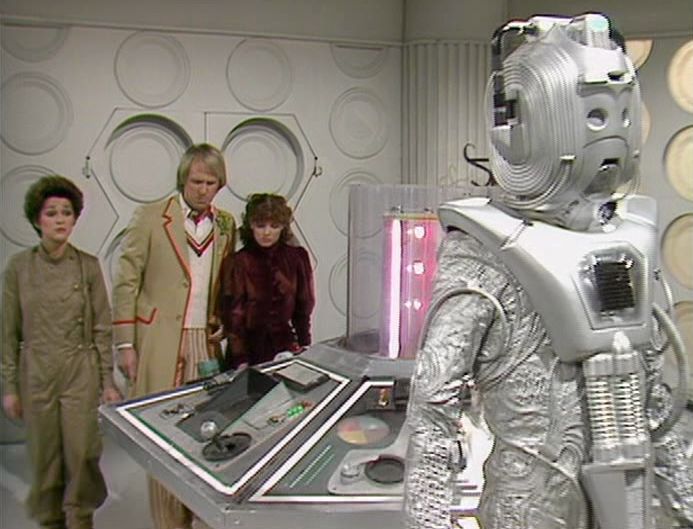
Time has maybe not been too kind to Earthshock. In 1982 it was a clear fan favourite, voted as the best of the year in every story poll. But over the years its popularity has dipped a little, possibly because when you take away the impact of the Cybermen’s return the rest of the story does seem to be a little hollow.
The Cybermen’s last appearance was in Revenge of the Cybermen some seven years earlier. In 1981, Cyber co-creator Gerry Davis submitted a story outline on spec entitled Genesis of the Cybermen. There isn’t any evidence to suggest that the story was ever seriously considered for production, or that the submission was even acknowledged, which upset Davis.
Speaking a few years later, he expressed dismay at his treatment: “I’ve had one in mind for a long time which is a Genesis of the Cybermen story and I’d love to do it. But every time I turn around and go back to America I find Nathan-Turner’s commissioned another Cyber-script and I’m not even invited to do it. It wasn’t very pleasant to be snubbed like that.”
When Christopher Priest’s script The Enemy Within proved to be unworkable, this left a hole in the S19 schedule that was ultimately filled with a new Cybermen adventure. Eric Saward was keen to write the story and although the script-editor wasn’t generally allowed to commission themselves, a solution was found. Anthony Root, who had briefly worked as script editor earlier in the season, was credited as Earthshock’s script editor although there’s no evidence that he actually did any work on it.
The first episode or so is set in some very nicely lit studio caves and concerns what we later learn to be a bomb, guarded by two androids, who have been programmed to kill anybody who gets too close.
The bomb has been planted by the Cybermen who intend to use it to destroy the Earth. They aren’t too disappointed when the Doctor deactivates it though, as they have a back-up plan (a rather impressive back-up plan it has to be said, almost as if they knew the bomb wouldn’t work).
“This one calls himself the Doctor, and he does nothing but interfere.”
This transports the Doctor and his friends to a deep space freighter where they encounter a rum bunch of characters. Ringway (Alec Sabin) is a traitor who has sold out to the Cybermen and is cursed with poor dialogue, such as: “I’m tired of your snide remarks and bullying ways”. Given this, it’s not surprising that the character never comes alive, but he’s not the only one.
Scott (James Warwick) is a bluff, gruff soldier who is drawn pretty broadly. Warwick chooses to intone each line with such deadly earnest that the performance often teeters on the edge of parody.
And then there’s Beryl Reid as Briggs. Doctor Who has often cast against type, many times with great success (Russell Hunter in Robots of Death and Nicholas Parsons in The Curse of Fenric, for example). Reid is a little more of a stretch but she’s not too bad, even if she sometimes seems to be a little lost.
There’s no denying the impact that the return of the Cybermen had in 1982, but this is about all the story has going for it. The plot is a little wooly at times (something Saward could often be guilty of). Perhaps the best example of this is when the freighter starts to travel backwards in time in episode four. How is this possible? Anything’s possible, says Adric, when you have an alien machine overriding your computer. Hmm, okay.
There’s certainly a place for this type of story in Doctor Who. The Caves of Androzani managed to combine a high level of action/adventure but also had rich chacterisation. Earthshock has the action, but the characters simply don’t engage.
Matt Finish
The story did make the brave move of killing off a companion, as Adric dies in a futile attempt to stop the freighter crashing into the Earth. This is another shock in the story, but like a whodunnit when you know the identity of the murderer, the shocks lessen when the story is watched again, so that ultimately Earthshock feels somewhat less than the sum of its parts.
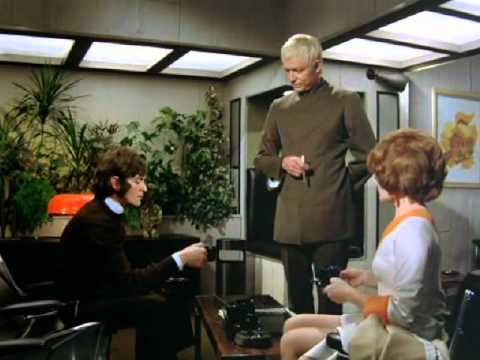
Straker dislikes having to do PR work for his cover job as head of the Harlighton-Straker film studio, but perks up when he realises that journalist Joe Fraser is actually Jo Fraser (Jane Merrow). But it doesn’t take him long before he decides that she is “intelligent, attractive and a possible security risk”, Is she an undercover reporter sniffing out clues on SHADO? Or can she really be in love with him?
This is the main plot of The Responsibility Seat and it gives Straker a chance to get out of the SHADO bunker. It’s a slightly unexpected turn of events to see him exchanging sweet nothings over a candlelit dinner but it’s nice to see him unwind for once. Needless to say, she’s a wrong ‘un and it doesn’t end well.
With Straker off in hot pursuit, this leaves Alec Freeman in charge of SHADO HQ. He’s got a busy time of it, with a possible UFO in the Earths atmosphere as well as a runaway vehicle heading on a collision course direct to Moonbase.
This episode also gives a little more exposure for Lt Keith Ford (Keith Alexander). Ford has been a familiar presence at SHADO HQ since the first episode and he’s usually been given the odd line or two to confirm that UFO’s have broken through the Moon’s defences. Here he gets a slightly larger role in proceedings as he raises an eyebrow or two when Freeman begins to find the Responsibility Seat something of a hot potato.
And the third part of the plot enables Paul Foster to share in the action as he climbs aboard the out of control vehicle and manages to stop it before it crashes into Moonbase. For once, this wasn’t due to alien interference – instead the crew had been suffering from anoxia or lack of oxygen.
A solid episode, although it’s difficult to believe that Straker would be turned by a pretty face quite so easily. But it gives both Ed Bishop and George Sewell a chance to do something a little different, so for those reasons it’s a good watch.
Black Orchid is a fairly simple tale, but there are some plot flaws, particularly in episode two, which impact the story.
It was the first two-parter since The Sontaran Experiment in 1975 and there are times when it’s easy to see why this wasn’t a regular format for the show. On occassions a little more time would have worked to the benefit of the story such as in the opening sequence, when we see in quick succession a man being murdered, somebody who looks like Nyssa sleeping whilst a mysterious man spies upon her and then we see someone tied up on a bed.
It’s the same person – George Cranleigh – who killed the man, spied upon the girl and is tied up on the bed, but although there’s a cross-fade between the second and third sequence this isn’t particularly obvious. A little more time spent on the opening could have made this much clearer.
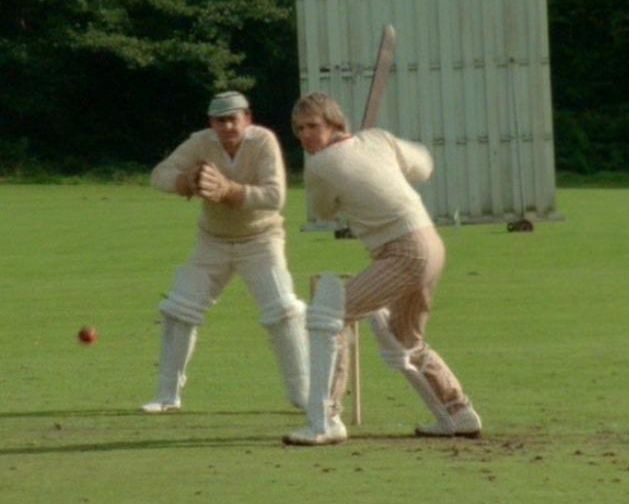
The TARDIS has landed in the 1920’s where, thanks to a case of mistaken identity, the Doctor takes part in a local charity cricket match (he is, of course, an expert at the game) and is later invited, along with his companions, to a party at Cranleigh Hall.
Another one goes for four
Sarah Sutton gets the chance to play two parts, as well as Nyssa she’s also Ann Talbot (who is engaged to Lord Cranleigh). The split-screen shots work very well, although some of the sequences when her double is also in the frame are less convincing.
The party is quite a sight. It was recorded in October and as might be expected the weather wasn’t terribly kind. There’s strong wind in virtually every scene and they clearly had some rain as well, but they do their best to convince us it’s a glorious summers day.
The mysterious man in the attic Is a very tidy chap. After taking the Doctor’s fancy dress costume, killing a servant and carrying off Ann, he then returns the costume to the Doctor’s room. This is so the Doctor can then put it on and be misidentified by Ann as the murderer.
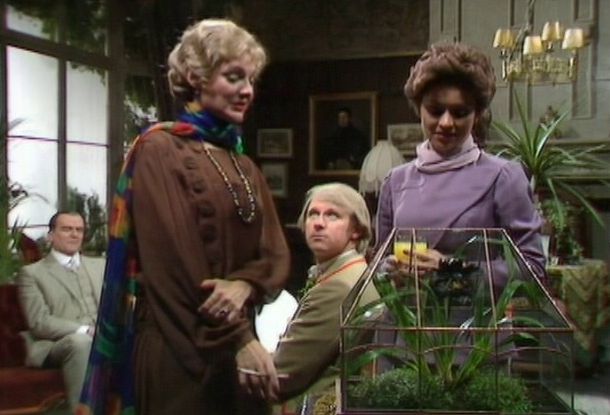
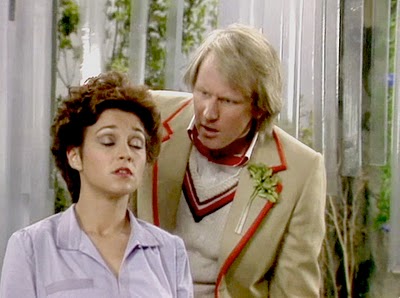
Tegan is quite the botany expert
With the Doctor suspected of murder and taken off to the police station, things look bleak. Ideally it would have been good for the Doctor to prove his innocence by uncovering some clues, but instead he shows the TARDIS to the police, which does the trick. This is a rather lazy piece of writing and indeed the whole trip to the police station is a little unnecessary, it would have been better if everyone had stayed at Cranleigh Hall until the truth was uncovered.
Eventually the identity of the mysterious man in the attic is revealed to be George, the elder brother of Lord Cranleigh. George Cranleigh had been engaged to Ann before his disappearance some years previously and he carries off Nyssa in a case of mistaken identity. There then follows a rather odd sequence. George Cranleigh has started a fire and has taken Nyssa to the roof. The Doctor and Adric run up the stairs but decide it’s too hot to follow them.
Everybody goes outside, then the Doctor goes back inside and does follow them this time (what had changed?). He also makes the point that Nyssa’s life would be in danger if George realised the girl wasn’t Ann. So what’s the first thing he does when he confronts George? Tells him that the girl isn’t Ann! Poor George, who didn’t seem to have had much of a life, then plummets to his death, so that this particular family secret is brought to a conclusion.
Black Orchid has some very decent guest actors (Barbara Murray, Moray Watson, Michael Cochrane) and it chugs along nicely, but the flaws in the plot are a bit of a problem. If you want an expanded take on the story then Terence Dudley’s novelisation (available as an audiobook read by Michael Cochrane) does help to fill in the background and make the story feel more coherent.
Although Antony Root was only attached to the Doctor Who production office for a few months as a temporary script editor, he made one important decision that would shape the course of the series for several years to come.
One of the scripts Root worked on was The Visitation, by a writer new to Doctor Who – Eric Saward. Root was impressed with the script and when John Nathan-Turner asked him if had any ideas about who would be a good permanent script editor, Root suggested Saward.
Eventually the JNT/Saward partnership would implode in spectacular fashion when Saward quit the series in 1986 (during production of The Trial of a Time Lord) taking his script for the final episode with him. I’m sure we’ll come back to the troubles between the two of them in future posts, but for now let’s take a look at Saward’s debut script.
By his own admission, he hadn’t followed the series very closely for some years, so The Visitation does feel like a little bit of a throwback to a previous era. It bears some resemblance to the likes of The Time Warrior and The Masque of Mandragora, both of which featured aliens interfering in Earth’s history. The Time Warrior is the closest fit, since that story was also concerned with a stranded alien using human labour to achieve his goals.
I’ve previously touched upon the difficulties in writing for three companions. So far this season, Castrovalva put Adric In the background and Nyssa only made a token appearance in Kinda. All four regulars appear throughout The Visitation and after the opening sequence Saward only features two other main speaking parts (Richard Mace and the Terileptil leader) which does help matters.
Richard Mace (Michael Robbins) and The Doctor (Peter Davison)
But even this doesn’t hide the fact that Adric is very much surplus to requirements. After escaping from the Manor House in episode three, he spends part of the episode hanging around the TARDIS with Nyssa before deciding to go and look for the Doctor. He quickly gets captured by the villagers and is taken away (very slowly it has to be said). Eventually he escapes and makes his way back to the TARDIS. Therefore in the course of an episode or so, he’s done very little of consequence. But a solution to the overcrowded TARDIS was just around the corner.
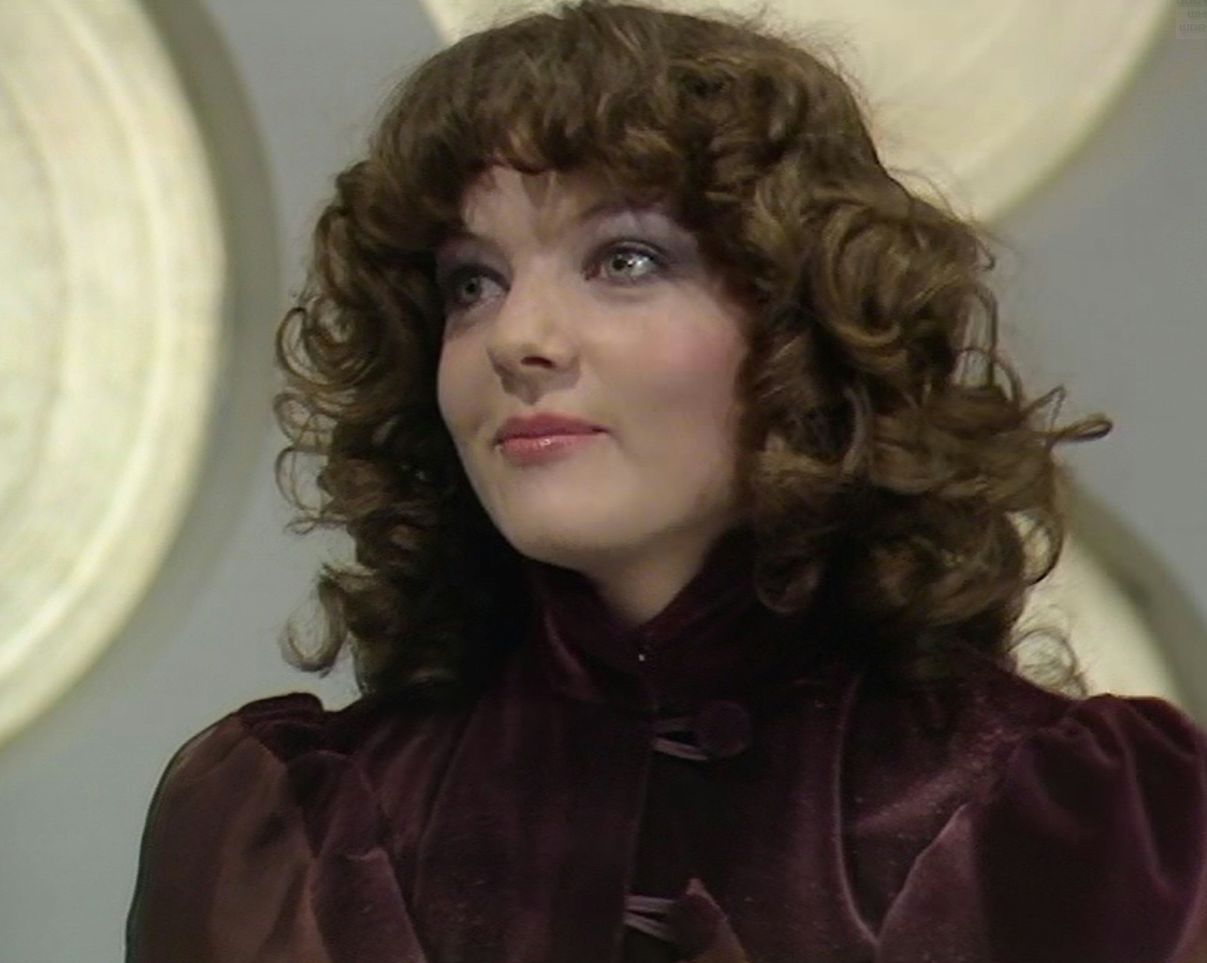
Nyssa (Sarah Sutton) looking lovely
Nyssa’s sub-plot (building a device to destroy the Terileptil’s android) isn’t terribly interesting but it does give her something to do. That leaves Tegan, who is closest to the action during the story. But it’s clear that Saward is most interested in his own creation, Richard Mace,
It’s a feature of Saward’s scripts that they often feature characters (such as Lytton or Orcini) that you sometimes feel he would be happier writing about, without that pesky Doctor always getting in the way. Richard Mace is the first example of this, as he gets many of the best lines. And like Kinda, Peter Davison benefits by linking up with a guest actor for a good part of the story (Nerys Hughes in Kinda and Michael Robbins here).
If the majority of the story is quite traditional, with few surprises, then the opening is a little different. We’re introduced to the inhabitants of the Manor House, who we assume will feature in the story, but after this scene we never see them again and their fate is only confirmed during episode three. They’ve been disposed of by the Terileptil leader (played by Michael Melia).
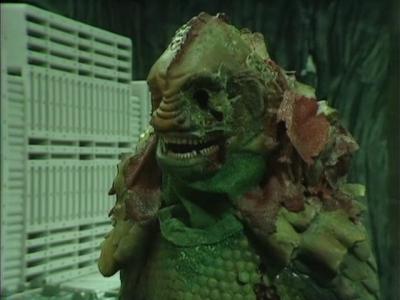
Given the heavy mask, Melia’s performance isn’t particularly subtle and it’s a shame that his voice wasn’t treated – since he sounds like a man speaking through a heavy mask. But although the design of the costume is a little crude, it does have some nice animatronic touches, such as an impressive curling lip.
The Terileptil leader (Michael Melia) looking slightly less lovely
The Terileptil’s plan to wipe out all of humanity does recall Tom’s line from Terror of the Zygons when he queries whether the Earth isn’t just a bit too big for only six Zygons (and there’s only three Terileptils!).
Overall then, The Visitation is a good story with a strong guest performance by Michael Robbins. If it feels a little insubstantial then that’s probably due to the small number of main characters. The villagers never tend to say much apart from “kill the strangers” which means that we don’t have a great deal of perspective about the world outside the Manor House. But it’s a decent enough story midway through a solid season.
Going from the previous episode, A Question of Priorities, to this one is truly a journey from the sublime to the ridiculous.
One interesting point, however, is that reportedly it would originally have been Carlin (Peter Gordeno) abducted rather than Foster. As silly as this episode is, it would have given a bit more screen time to Carlin’s character, who apart from the debut episode has had little to do.
The re-write may have been a factor in Gordeno deciding to leave the series after recording just six episodes, so his appearance in the previous episode was his final work for UFO.
Anyway, onto the episode. We open at a marvelously groovy party that in no way resembles a party from the early 1980’s, unless of course they were having a late 1960’s retro bash. And after bopping the night away, Colonel Foster has to check himself into SHADO’s Research Centre for a full physical examination.
After a heavy work-out in the gym, Foster is relaxing in the sauna when he notices the door has been locked. Aliens have infiltrated the building, killed everybody else and they drag the barely conscious Foster away. He’s taken aboard their flying saucer and forced to wear one of their space-suits. As soon as the helmet is put on, it’s flooded with the green fluid that the aliens need to survive in Earth’s atmosphere.
Straker, despite knowing that Foster is aboard the UFO, demands that it be shot down. Captain Waterman in Sky One (replacing the departed Carlin) can’t bring himself to kill his friend so he doesn’t fire a fatal shot. But the UFO is already damaged and crashes on the Moon, although Foster survives this impact.
But can Foster be separated from the alien space-suit and the breathing apparatus? We’ll come to that in a minute.
Good things about the episode? I love the opening party scenes which are just so 1969. And there’s yet another example of Straker’s ruthless streak when he orders the UFO with Foster aboard be destroyed. Colonel Freeman can hardly believe it and says to Straker: “You just better hope I’m never in a position to press the button on you!”
The scenes of Foster’s abduction look very good as do the final scenes with the Moonbase crew desperately trying to save his life.
But this is all negated when it’s revealed at the end that it was just a dream. Possibly he partook of something at the party that he shouldn’t have? It’s such a ridiculous ending to the story that it almost beggars belief.
Given this, it seems churlish to pick holes in the plot, such as why the aliens decide to abduct Foster and how they know he would be at the health farm and even that the health farm exists. Everything we’ve seen so far has told us that the aliens can only survive on Earth for a couple of days, so the amount of forward planning is impressive to say the least. But as it was all just a dream, there’s no point in arguing any of these points too vigorously.
It seems that Tony Barwick’s original script made it much clearer very early on that everything was unreal, but unfortunately the direction didn’t follow this. So either the director should have emphasised the dream-like nature of the story or they should have treated it for real and worked out a reasonable explanation of how to extract Foster from the alien’s clutches. Neither was done, so we’re left with the worst of both worlds.
Like Warriors’ Gate, Kinda was written by someone new to television and required a substantial rewrite before it was of broadcast standard. And while Christopher Bailey, like Steve Gallagher before him, had a very clear vision of what he wanted to achieve, there had to be a comprise between his original story concept and what script editors Christopher H. Bidmead and Eric Saward required from him in order to produce a Doctor Who story.
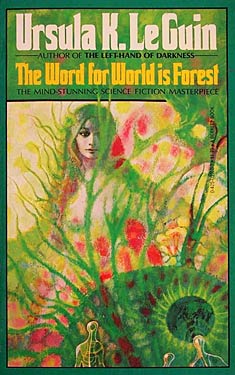
Bailey approached the Doctor Who production office in 1980 with a story outline entitled The Kinda. The inspiration for The Kinda was derived from Ursula K. Le Guin‘s 1976 novel The Word for World Is Forest.
The Word For World Is Forest by Ursula K. LeGuin
Le Guin’s novel is set several hundred years in the future and concerns a human colony which has been established on the planet Athshe. Athshe is an unspoilt paradise which the humans regard as rich for exploitation. The Athsheans appear to be docile and primitive and have a culture based on “dream-time” in which they share their thoughts.
Although Kinda does superficially resemble this brief outline, Le Guin’s novel develops in quite a different way as some of the humans, particularly Captain Davidson, enslave large portions of the Athsheans and his cruelty eventually results in a revolt from the Athsheans with a considerable loss of life.
In Kinda nobody dies (except Panna, and as her knowledge and experience were passed over to Karuna, it’s debatable if we can regard this as a “death”). The disappearance of three of the expedition party (Roberts and two others) prior to the TARDIS crew arriving is more of a mystery and is never explained. Hindle (Simon Rouse) does, like Davidson in Le Guin’s novel, enslave some of the natives and poses a considerable threat to them, but unlike Davidson, Hindle is redeemed.
Christopher H. Bidmead was very impressed with The Kinda. For him, it was exactly the sort of intelligent science fiction he was always striving to find. Bailey was commissioned to provide a full story breakdown in summer 1980. He was briefed to include two companions (as this was before Nyssa was added to the crew) and as Tom Baker hadn’t yet decided to quit, it was written with the fourth Doctor in mind.
Bidmead found plenty of interest in the story breakdown but was well aware that a great deal of work needed to be done in order to turn it into a Doctor Who story. One major problem was that it lacked any villains – instead the conflicts came from the various choices and temptations faced by the characters. One of Bidmead’s first recommendations to Bailey was to make the Mara much more of a tangible, corporeal presence.
Although rehearsal scripts had been delivered by August 1980, it was clear that it wouldn’t be ready in time to form part of S18, so it was deferred until S19. By this time Tom Baker had been replaced by Peter Davison and a third companion, Nyssa, had been added to the mix. And by early 1981, Eric Saward was now in the script editors chair and he continued to work with Bailey on the scripts.
One early decision made by Saward was not to ask for the scripts to be rewritten in order to include Nyssa. It was felt that her absence would benefit the story as it would allow the other characters more room for development.
Thanks to Bidmead’s input, episodes one and two were in a workable shape but episodes three and four still required a substantial amount of work. For example, Saward would later comment that he always had a great deal of difficulty in getting Bailey to understand the importance of including a strong cliff-hanger at the end of each episode.
Saward’s major contribution to the script was the ending, where the Mara is drawn from the body of Aris and banished from Deva Loka forever. Bailey understood in the end that dramatically the serial needed such a conclusion, originally he had written something much more low-key.
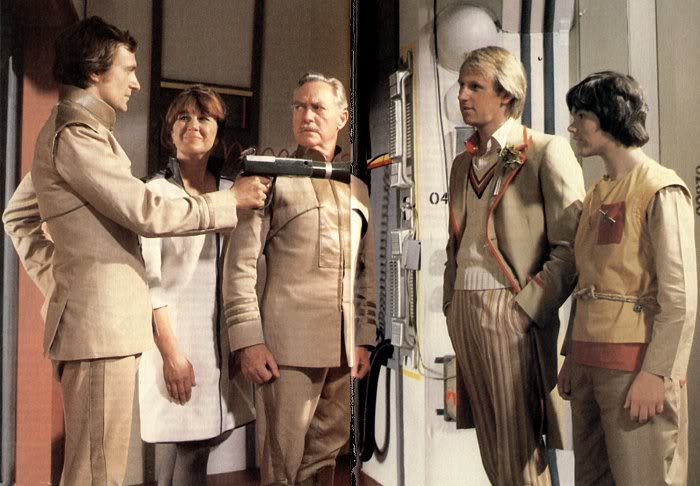
Eventually, filmable scripts were delivered and John Nathan-Turner assigned Peter Grimwade to direct. Although they were later to have a spectacular falling out, at the time Grimwade was one JNT’s favourite directors. He had already directed Full Circle and Logopolis and would direct Earthshock towards the end of S19. Grimwade would also pen three stories for Davison’s Doctor – Time-Flight, Mawdryn Undead and Planet of Fire.
Grimwade was able to assemble an impressive cast, headed by Richard Todd. Todd had been one of the major stars of British cinema during the 1950’s (probably best known for The Dam Busters) but the decline of the film industry in the 1960’s meant he had spent more time acting on the stage during the 1970’s and by the early 1980’s he had also instructed his agent to look for interesting television roles.
Nerys Hughes was a familiar television face, thanks to her ten-year stint on The Liver Birds. Following the end of that series she had found other television work harder to come by, so this was a welcome role for her to re-establish her profile.
Mary Morris had had an extensive career in film, stage and television. For fans of British telefantasy though, she was probably best known for her roles in A For Andromeda and The Prisoner.
Simon Rouse was still a number of years away from his defining role as DCI Meadows in The Bill, but he was in good company in Kinda, as several other Sun Hill regulars such as Jeffrey Stewart (Dukkha) and Graham Cole (member of the Kinda tribe) were also present.
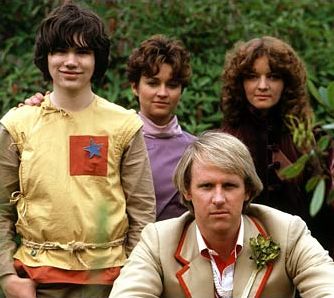
L-R Simon Rouse, Nerys Hughes, Richard Todd, Peter Davison and Mathew Waterhouse
The decision was made to shoot the entire story in the studio. Although this meant that the forest would occasionally look a little stagey it worked quite well, although there were some problems. Early on it became clear that the movement of the TSS machine and the cameras caused the covering of leaves to be swept away and revealed the studio floor underneath. For later days, more leaves were brought in, but the floor can still be seen at various times during the story.
Story-wise, Kinda is interesting in that there are two main plot-threads (Hindle’s madness and the Mara crossing over in to the real world via Tegan/Aris) which run totally independently of each other. Both of the plot-threads offer the same possibility of destroying the Kinda and starting again the wheel of life as described by Panna in episode three.
As episode one begins, we see Adric and Nyssa playing draughts outside the TARDIS. The fact that Adric is easily able to beat her is a clear indication that she is not herself. The Doctor rigs up a delta wave augmenter in order to allow her to have 48 hours worth of uninterrupted sleep whilst the Doctor, Adric and Tegan explore their new surroundings.
As happens so often in Doctor Who, the three are very quickly separated. The Doctor and Adric end up at the Dome whilst Tegan sleeps alone under the wind chimes. One intriguing aspect of the story is how events are repeated. For example, when Tegan enters the dreamscape she encounters two old people playing chess which mirrors the same scene between Adric and Nyssa. Are the people in Tegan’s dream her subconscious representations of Adric and Nyssa?
“You will agree to believe in me sooner or later. This side of madness or the other.”
As Tegan is offered a way out of her nightmare by Dukkha (which like many of the names in Kinda has a Buddhist translation, this one means suffering or anxiety) the Doctor and Adric meet the survivors of the survey team. They seem to be all quite recognisable archetypes – Sanders is the uptight leader and a stickler for discipline, Hindle is the rigid security officer who probably believes he should be in charge and Todd is the scientist with probably the best grasp on the reality of the situation. Two of these three will change dramatically during the course of the story.
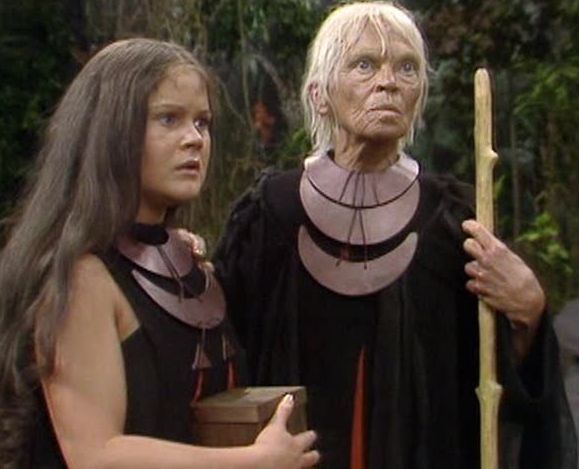
Sanders decides to solve the mystery of his three missing team members and ventures into the forest. There he meets Panna (wisdom) and Karuna (compassion) who offers him the Box of Jhana (meditation).
The properties of the Box of Jhana do seem to change during the story. At this point it’s designed to send a message to the humans in order to bring them to the cave so that Panna can explain about the wheel of life and why they must leave Deva Loka.
The only problem with this is that the Box of Jhana can only be opened safely by a woman. Since five of the six members of the survey team were probably male, this is a bit awkward. Why Panna couldn’t visit the Dome and leave a more straightforward message is a plot-hole that is never explained.
When Sanders opens the box he regresses to childhood, although this is only temporary. Eventually he re-emerges as a whole and better-adjusted person than he seemed to have been at the start of the story. Hindle becomes dangerously psychotic so that when he looks into the box it resets the balance of his mind. The Doctor concludes that the Box of Jhana is a Kinda healing device, which is somewhat different from the start of the story when it was designed to send a message. Perhaps it does both at the same time?
Sarah Prince and Mary Morris
Tegan is still trapped in her dreaming and agrees to let the Mara (the personification of unwholesome impulses) take over her body. Janet Fielding’s three previous broadcast stories had all been somewhat problematic for her character and Kinda is the first time that she’s been allowed to really act. But given that this is seen as a Tegan-centric story, it’s a little surprising that she doesn’t have all that much screen time.
All of her key scenes are in the first two episodes, although if you added up all the sequences in the dreamscape then they wouldn’t run for too long. Her re-emergence into Deva Loka, now possessed by the Mara, is another stand-out moment (but again it’s a fairly short scene). She’s then pretty much absent for episode three and only rejoins the narrative in the last episode. But this is definitely a story where quality outweighs quantity and what she does is certainly memorable.
Matthew Waterhouse has more screen time and spends a large amount of the middle part of the story sharing three-handed scenes with Richard Todd and Simon Rouse. The story of Waterhouse offering the vastly experienced Richard Todd tips on acting is legendary, but Waterhouse doesn’t fare too badly against these two quality actors.
At the start of the story we know perfectly well what sort of character Sanders is. We’ve seen his type in countless films, books and television programmes before (indeed, his name is a direct lift from the British empire yarn Sanders of the River). So his return to the Dome as a wide-eyed childish innocent is a major jolt.
By far the most difficult role in the story is portrayed by Simon Rouse. Doctor Who has portrayed mad and unbalanced people before, but none quite like this. It’s a tour-de-force performance.
Eventually the Box of Jhana is delivered to somebody that can understand the message and Dr Todd and the Doctor venture out to find Panna. With Tegan isolated for much of the story and Adric teamed up with Sanders and Hindle this leaves the Doctor and Todd together.
Nerys Hughes worked very well with Davison, indeed she could have made a very interesting companion. There’s certainly more of a connection between the two of them than there has been between the Doctor and Adric, Nyssa and Tegan in his first few stories.
The Kinda, like many of the civilisations seen in S18, exist in a form of stasis. Panna explains to Aris, the Doctor and Todd why the presence of the Dome and the Mara threatens the Kinda’s idyllic existence –
PANNA: Please. What are you going to do?
ARIS: We shall destroy the dome. The Not-we must be killed. This is our duty.
PANNA: You fool, you blind male fool. Do you think it ends there?
ARIS: We shall be free.
PANNA: Of course not. It doesn’t end there. That is how it all begins again, with a killing. It doesn’t end. That ends as it has always done, in chaos and despair. It ends as it begins, in the darkness. Is that what you all want?
DOCTOR: Did you see the design on his arm?
TODD: What design?
PANNA: The sign of the snake.
DOCTOR: Yes, that’s right.
PANNA: It is the mark of the Mara, the evil ones.
TODD: Doctor, I really think we should …
DOCTOR: What do you know of the Mara?
PANNA: It is the Mara who now turn the wheel. It is the Mara who dance to the music of our despair. Our suffering is the Mara’s delight, our madness the Mara’s meat and drink. And now he has returned.
The Mara (in the body of Aris) doesn’t, it has to be said, seem to pose much of a threat. The Kinda lack any weapons and Aris’ decision to build his own TSS Machine (from wood) might work symbolically but is no match for the real machine even when piloted by the inexperienced Adric.
Hindle is a much more immediate threat, but luckily he opens the Box of Jhana just in time, which solves that problem. This only leaves the job of extracting the Mara from Aris and banishing it from Deva Loka.
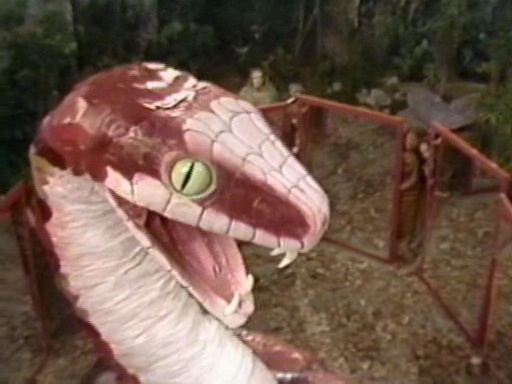
With the help of the Kinda, the Doctor traps the Mara within a circle of mirrors. As he says: “No Mara can bear the sight of its own reflection. It must recoil from itself. Understandably, don’t you think, given it’s nature.”
The plan works, although for some the sight of the puppet snake is a major problem. Luckily there is now a CGI snake option for those that object to the original.
It’s better than the Skarasen, anyway.
After its initial transmission in 1982, Doctor Who fandom was split over the merits of this story. Let’s look at some of the differing opinions.
“Kinda was by far the most mind-taxing story of the season, [but] despite the complex nature of the story I thoroughly enjoyed watching it — every moment was brilliant.”
(Michael Emmerson, Views, News and Reviews)
“The one feature cursed by all and sundry though was that wretched snake. With its balance of good and bad scenes Kinda was good, but not, like so much of this season, excellent.”
(Cloister Bell)
“I felt Kinda was an exceptionally good story, but it lacked something. I regret having to put it last in the DWAS poll, but the other stories far surpassed normal standards.”
(Tim Westerman, Laseron Probe)
“Kinda was one of the most visually striking stories since the Hinchcliffe era. Television is a visual art, but it is a rare treat to see work of such high artistic quality.”
(Simon Lydiard, Skaro)
The 2014 DWM poll ranked it at number 63 out of 241 stories, which is fairly respectable. It probably should be higher, since for me it’s an exceptional story that manages to transcend the limitations of the studio environment to produce a story of some depth. It’s certainly a story that repays multiple rewatches in order to discover the various different layers of meaning contained within.
A Question of Priorities is a key Straker episode. Ed Bishop always had a difficult role to play in UFO, since Straker is usually such a single-minded, humourless man. A Question of Priorities is one of two episodes (Confetti Check A-Ok is the other) which helps to shine a light on his personal life.
After returning his son, Johnny, home to his ex-wife Mary after a day out, the boy is hit by a car. He’s in a critical condition and requires a special anti-allergenic antibiotic that is still on the experimental list. Straker orders that a supply of the drug be flown on a SHADO craft from the USA.
However, news of a crashed UFO in Ireland causes Freeman to divert the craft. Mary is understandably distraught when she learns that something has delayed the arrival of the drugs. So what is the top priority for Straker? Capturing the alien or the life of his son?
This is one of the best stories in the whole run and manages to juggle both plot threads – the rush to save Johnny’s life as well as the mystery of the alien – very well.
As mentioned previously, it brings the human side of Straker into sharp relief. His ex-wife Mary (an excellent performance by Suzanne Neve) clearly has many resentments still lingering (which will be explained in a later episode) and expresses some of this frustration when Straker tells her that something important has delayed the delivery of the antibiotics: “Important!? What can be more important than your own son’s life!?”
The ever-dependable Philip Madoc hasn’t much to do as Mary’s new partner except glower (although he’ll have a better role as a different character in a forthcoming episode).
After visiting his son in the hospital, Straker returns to SHADO HQ. He hasn’t told anyone, not even Freeman, about his son’s accident although Freeman senses that something is amiss. This is another sign of the rigid compartmentalisation of Straker’s life – when he’s at SHADO then nothing else, not even the fact his son is fighting for his life, is allowed to interfere with the job.
The Ireland sub-plot is interesting, we see the alien set up a transmitter in the house of an elderly blind woman (Mary Merrell). The alien apparently wanted SHADO to pick up his transmissions as it seems he wished to defect, an interesting story development.
The ending of the story is bleak beyond belief. The alien is killed by another UFO and Johnny dies as well. Straker’s juggling of priorities couldn’t have turned out worse, SHADO failed to get any information from the alien and he has also lost his son.
If A Question of Priorites tells us anything, it’s that whilst Straker has ordinary, human feelings, his devotion to duty and to SHADO would appear to be his overriding motivation. And it cost him his marriage and now the life of his son.
Whilst the modelwork and the bright day-glo nature of the settings have caused many to bracket UFO along with Anderson’s 1960’s Supermarionation series, there are often much more adult themes running through the series than anything he previously produced. Some of the episodes are fine kids fare, but others, like this one, do certainly pack an emotional punch.
I like Four To Doomsday. It’s by no means perfect, but there’s plenty of good things that balance out the elements that work less well. Let’s start by looking at some of the positives.
Stratford Johns as Monarch. I’ve written here about how much I enjoyed the first series of Softly Softly: Task Force, and one of the major strengths of that series was Stratford Johns’ performance. So if you ever fancy seeing what he looks like when he’s isn’t dressed like a frog then the DVD is well worth getting.
Although encumbered by the make-up, Johns is still able to bring a real personality to Monarch. At times charming, but also able to change to murderous rage in an instant, it’s a lovely guest performance.
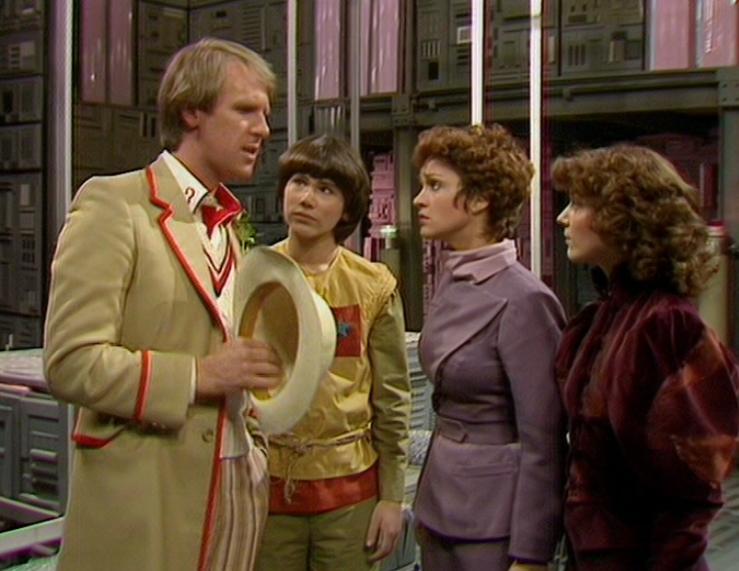
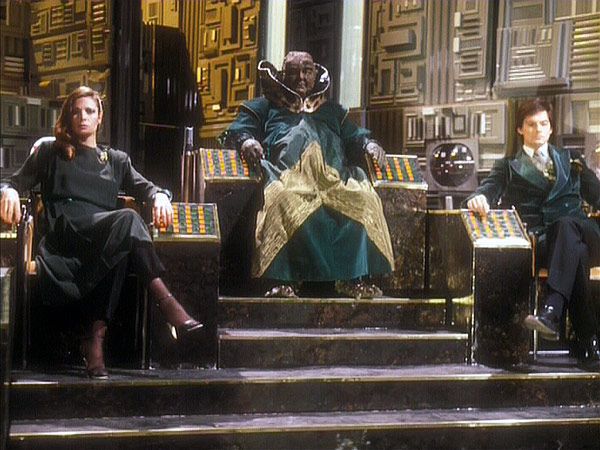
“A frog with a funny hairdo”. L-R Enlightenment (Annie Lambert), Monarch (Stratford Johns) and Persuasion (Paul Shelley)
Tony Burrough’s sets. Whilst Four To Doomsday wasn’t the first story to feature sets with ceilings, there was a real novelty to this at the time, as it allows what otherwise would be fairly static and dull corridor scenes to be lit much more interestingly. And all of the sets look pleasingly solid, there’s no S17 wobbling sets here.
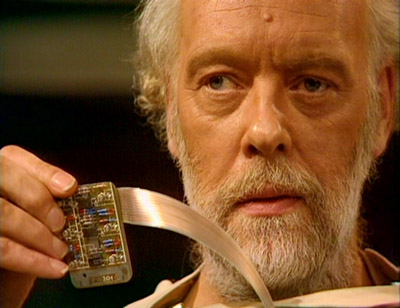
Philip Locke as Bigon. The ending to episode two may lack a little, effects wise, but his final line as he holds up the printed circuit that contains his personality and reason is still compelling.
“This compound is not me. This is me.”
Roger Limb’s score. It’s a shame that there wasn’t an isolated soundtrack on the DVD (and the fact that there was an iso track for his frankly awful Terminus score demonstrates that there’s no justice in the world).
Peter Davison. This was Davison’s first recorded story, but you wouldn’t know that from his performance. Some have claimed that he plays the Doctor somewhat differently here, but I can’t really see it. He’s totally confident and able to hold his own against the scene-stealing Stratford Johns.
So. that’s the good, what about the bad?
Adric and Tegan. Both aren’t at all well served by the script. It was a feature of his stories that Adric would sometimes pretend to side with the baddies (State of Decay, Castrovalva) but here he swallows Monarch’s claim that he’s the saviour of humanity hook, line and sinker even though he knows that Nyssa is in danger. Any way you try to rationalise it, this is an amazing display of gullibility that does the character no favours at all.
This was only Janet Fielding’s second recorded story and whilst much better was just around the corner (Kinda), here (particularly in episode three when Tegan hysterically tries to take off in the TARDIS) she’s not given much in the script to latch onto and therefore doesn’t come over very well.
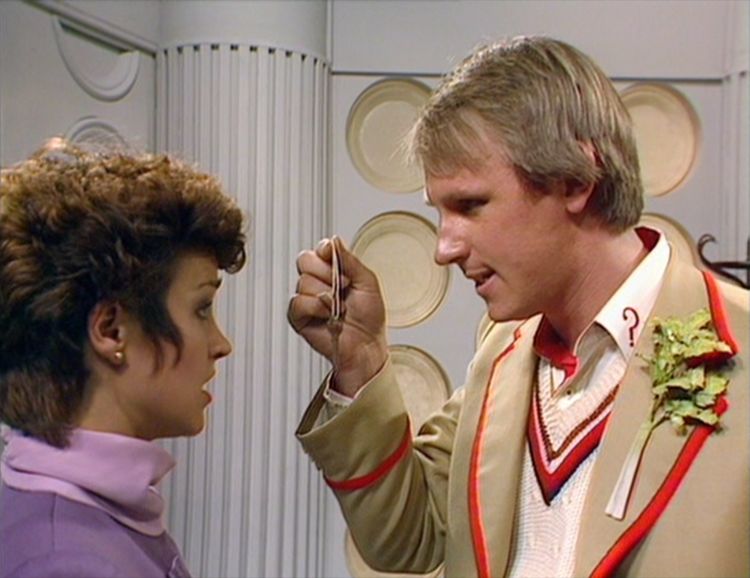
Giving Tegan the TARDIS key is just asking for trouble …..
Terence Dudley’s script is a mixture of the good and bad. The basic plot doesn’t make a great deal of sense. It’s hard to imagine that the likes of Lin Futu and Bigon would be able to persuade the peoples of Earth that Monarch means them no harm, but for what other reason has he taken them onboard? Also, Bigon tells us that he can’t rebel due to his programming, but Lin Futu is able to replace Bigon’s personality chip (surely a rebellious act?) and then Bigon is quite capable, like the other leaders, to happily incite rebellion.
In my post on Castrovalva I mentioned how there was an air of the Hartnell era about that story and this is certainly also present in Four To Doomsday. Terence Dudley had directed a S18 Story (Meglos) but if you’d told me that prior to that he hadn’t watched the series since about 1965 I would have believed you.
It’s very possible to imagine the first TARDIS crew stepping into Monarch’s ship and expressing amazement at the technological wonders contained within. Whilst 1960’s Doctor Who sometimes had a pessimistic view of science (The Daleks, Planet of Giants, etc) in general there was a fairly positive vibe that scientific progress was a good thing. But as the early 1970’s dawned this was replaced with a more consistantly downbeat tone (Colony in Space, The Mutants, The Green Death, etc).
And just as in Marco Polo, where everybody settles down for a story from Ping Cho, here we see the action stop in both episodes two and four whilst a whole host of different cultures entertain us. This does help to slow down the pace of episode two to an almost glacial level, but like most of Four To Doomsday there’s something strangely compelling about the whole mise en scène.
And that’s much like the whole of Four To Doomsday. As I said at the start, it’s got problems (particularly in the characterisations of Adric and Tegan) but there’s an earnest charm about it that has always appealed to me.
The opening of The Dalotek Affair is quite interesting. Dr Frank E. Stranges (author of numerous books on UFO’s) plays himself in a brief chat show segment. He cites the widely reported positive views of General MacArthur on UFOs, although it seems that MacArthur was misrepresented, see here.
We then switch to a very groovy restaurant where Foster and Freeman are enjoying a meal. Foster spies a young woman that he knows, Jane Carson (Tracy Reed), but who doesn’t know him. How is this possible? It’s all to do with the Dalotek Affair, some six months back. Cue echoing soundtrack as we travel back to find out what he means.
UFOs are targeting apparently empty sections of the Moon, there’s interference with Moonbase communications and a meteorite has landed near the Dalotek installation (a private research base working on the Moon, much to Straker’s disgust). A more grumpy than usual Straker tells Foster to investigate.
It doesn’t take long for Foster to start making eyes at Carson, although not everyone approves (check out Joan Harrington as Foster and Carson have a little chit-chat, some unrequited love there, possibly?)
Foster gets to the bottom of the mystery eventually but his passion for Jane Carson goes no further as her short-term memory is wiped (as she’s seen SHADO’s operations on Moonbase, something no civilian can do). Another example of SHADO’s frightening amount of power.
A so-so episode, with the Foster/Carson subplot (and the shot of them after the amnesia drug has taken effect has to be seen to be believed) helping to liven up proceedings.
As soon as Peter Davison had been announced as the Doctor there was speculation as to how he would play the part. JNT believed that he had cast a “personality” actor, similar to Jon Pertwee or Tom Baker, so assumed that Davison would effortlessly inject his own persona into his portrayal.
Davison was less sure that he was that sort of actor and so went back to the tapes to study his predecessors. Castrovalva has some obvious nods to past Doctors (particularly in the first episode) but going forward what Davison seemed to mostly draw upon were elements from the Hartnell and Troughton incarnations.
Jon Pertwee and Tom Baker’s Doctors tended to automatically dominate proceedings, whereas Hartnell and Troughton might stay a little more in the background before emerging with the solution. Davison’s Doctor would also, like Troughton’s, be happy to play the fool in order to lull people into a false sense of security.
If elements of his portrayal harked back to Hartnell and Troughton, then having three companions was another link back to the 1960’s. However this worked better then than it did in 1982, for several reasons.
Firstly, as the 1960’s series ran virtually all year round, a larger regular cast helped to fill the gaps when one of the lead actors took a holiday. The stories also tended to be longer, therefore there were more opportunities to split the narrative between the Doctor and his companions.
But possibly the most obvious reason why the dynamic of the Doctor/Ian/Barbara/Susan worked so well was down to how each character operated within the structure of the series as it was during S1. To put it somewhat crudely, the Doctor provided the scientific know-how, Ian provided the practical know-how, Barbara was the moral centre and Susan screamed and needed rescuing.
Somewhat of a rough generalisation, but in essence that was how things worked. The S1 Doctor was mostly motivated by a desire to return to the safety of the TARDIS and if he helped anybody along the way it was often incidental. It was Barbara and sometimes Ian who most often tried to help others (or interfere as the Doctor would say, in The Aztecs for example).
Over time the Doctor would take over the characteristics of Ian and Barbara, so that by the early 1970’s the Doctor only needed a single companion – to ask questions, scream and be rescued (again, to put things slightly crudely).
“Well, I suppose I’ll get used to it in time.”
The problem of the overcrowded TARDIS was obviously picked up during the scripting of S19, so in Castrovalva Adric takes a back seat which allows Nyssa and Tegan to take the lions share of the action. Nyssa then sits out Kinda so that Adric and Tegan can enjoy a more substantial role in proceedings.
Christopher H. Bidmead obviously loved the concept of the TARDIS and the first episode and a half are set within the ship. During this time we see flashes of the Doctor-to-be from Davison and Nyssa and Tegan’s friendship starts to develop.
Whilst the Doctor is weak and vulnerable for much of the story, particularly in the opening couple of episodes, there’s enough signs to demonstrate that Davison already has a good grasp on the part (although this story was actually recorded fourth). His character wouldn’t really emerge until the end of episode four, but it’s a confident enough performance.
Unlike Patrick Troughton or Tom Baker, Davison could never take a so-so script and turn in a performance that would help you to ignore the average material. But give him a good script and a well written character (Frontios, Androzani) and he would deliver the goods.
Once the TARDIS crew enter Castrovalva then the story really begins to motor. There are fine performances from Frank Wylie (Ruther), Michael Sheard (Mergrave) and Derek Waring (Shardovan) and the dialogue has a pleasing, lyrical nature. It’s maybe a shame that they didn’t pitch up here an episode earlier.
Michael Sheard was always such a dependable performer, both in Doctor Who and in general, and there’s a typically good performance from him in this story as Mergrave. This is complimented by Frank Wylie and together they make a nice double-act.
“If we could cook your memories, Ruther, we would feast indeed.”
Most interesting of all is Derek Waring as Shardovan. There’s a clear sense of misdirection at play here as everything is directed to make the audience believe that he’s the villain (he’s dressed in black for example whilst the Portreeve is dressed in white) but he turns out to be a man struggling with the concepts of reality and illusion.
As for the Master, Anthony Ainley has a bit of a sticky wicket. In the first few episodes he’s stuck in a cupboard and forced to share numerous two-handed scenes with Matthew Waterhouse – a difficult task for any actor. He then gets to indulge in a bit of dressing up as the Portreeve. The Master’s love of disguises would reach a peak in The King’s Demons, for which I find it difficult to find adequate words to describe the full majesty of his performance. Once I reach that story I promise to try though!
The mad hatter
He’s more restrained as the Portreeve, but it still begs the question as to whether it was designed to fool the audience or the Doctor and his friends. It’s hard to imagine that the audience wouldn’t have failed to notice it was Ainley dressed up, so let’s be generous and assume that the Doctor didn’t twig because of his post-regenerative state and the atmosphere of Castrovalva affected Nyssa and Tegan’s senses.
Apart from the Master’s dressing up games, it has to be said that this is one of the most bizarre and convoluted schemes he’s ever been responsible for. It’s therefore possible to posit that somewhere between The Deadly Assassin and The Keeper of Traken the Master went completely, totally, mad. This would explain the incredibly over-elaborate plan he’s concocted here.
Somehow he knew that the Doctor would die in Logopolis, knocked up a duplicate Adric with block transfer computation, switched him for the real one, got the faux Adric to programme the TARDIS to fly back to Event-One, and if that failed to destroy the ship then the TARDIS would journey onto the non-existant Castrovalva, as well as inputing information about the planet in the TARDIS data-bank. Faux-Adric only flicks a few buttons on the TARDIS console, but it’s enough to do all this. Clever, that!
Then the Master creates a whole world, down to the smallest details, in order for what exactly? His great plan seems to consist of nothing more than a wish to prise open the zero cabinet so he can take one last look at the Doctor before killing him. Couldn’t he have just killed him on Earth? It would have saved a lot of bother.
Ainley’s performance when the Master is attempting to open the zero cabinet with a poker is a little embarrassing, although maybe that was what they were aiming for, as it clearly shows the Master’s grip on reality has gone completely. But the final shot of the Master, as he’s pulled back in the city by the Castrovalvans, is very well done – it has a suitably nightmarish quality.
Overall then, Castrovalva is a decent opening story for Peter Davison with some good guest performances. It wraps up the plot threads from S18 and allows a fresh start for the further adventures of the new Doctor and his young group of companions.
Conflict is a good episode for both Ed Bishop and Michael Billington. Straker gets to lock horns with James Henderson (Grant Taylor), who as President of the International Astrophysical Commission is responsible for approving the funding level for SHADO. And in the interests of good drama, Straker is always pushing for more whilst Henderson is always trying to cut back.
This conflict is at the heart of the episode. Straker believes that the various items of space junk orbiting the Earth are a hazard to SHADO spacecraft and wants them removed. Henderson doesn’t agree and won’t release the funds.
This is one of several key episodes that examines the conflict between Straker and Henderson and both Ed Bishop and Grant Taylor are excellent at portraying two totally single-minded individuals who both believe they are always right.
Shortly after their meeting, a SHADO lunar module is destroyed on reentry. Straker is rightly convinced that the aliens were responsible – they have infiltrated the space junk with limpet mines. But their ultimate aim strikes somewhat more closer to home.
Michael Billington gets another solid episode as Foster disobeys the ban on lunar flights to test a hunch. It nearly gets him killed, but he proves to his satisfaction that there is alien involvement. But Henderson isn’t convinced and after he thinks that Straker has left SHADO HQ undefended and in imminent danger of a UFO attack he attempts to remove him from command.
I’ve said it before, but the modelwork (particularly the lunar shots) are absolutely breathtaking. Derek Meddings would later design the miniatures for the 1979 James Bond film Moonraker and some of the shots here wouldn’t have looked out of place in that film.
This isn’t an action-packed episode but the spat between Straker and Henderson is strong enough to drive the episode and makes it one of the stronger entries in the early part of the series.
A UFO lands on the moon and the alien shoots out a window on Moonbase, killing a SHADO worker. As so often, the aliens’ motives remain unclear – why travel all that way for such a minor attack?
As the UFO is still on the Moon, Straker is keen to capture it. New Moonbase commander Paul Foster is more interested in killing the alien in order to avenge the murder of one of his men, but things don’t quite go as expected.
As ever with UFO, there’s some gorgeous modelwork – the lunar surface is particuarly impressive. The full size lunar landscape looks very good too, although some of the rocks do have a tendency to wobble when somebody is thrown against them!
The main plotline develops in an interesting way, Foster leads a party to capture the UFO but it’s destroyed by the interceptors after the Moonbase party is attacked. Foster is reported as missing, believed dead. The alien is still alive though, saves Foster’s life and together the two of them begin the long trek back to Moonbase.
It’s surprising that everybody gives Foster up for dead so quickly. Even if they were convinced that he couldn’t have survived you would have thought that they would have gone back to retrieve his body. But his apparent death leaves a vacancy which Straker proposes to fill with Mark Bradley.
Bradley is reluctant for several reasons, not least his colour. Straker is unconvinced by this, telling him that racial prejudice burned itself out five years ago. This, of course, must stand as UFO’s least convincing predication of the future! After winning him round with such winning words as “I don’t care if you’re polka dot with red stripes, do you want the job?”, Bradley agrees.
The lunar scenes with Foster and the alien are quite slow paced, understandable in a way because they have to simulate the lack of gravity and also since the alien and Foster can’t communicate. But they could have done with a bit of trimming, as this section does drag a little.
But it’s a key story as it’s the first to portray the aliens in, for want of a better word, a more human light and not as implacable killers. But as the series always had a fairly pessimistic viewpoint it’s probably no surprise that Foster’s new-found friendship is very short lived.
And so after seven long years it all came to an end on a set cobbled together from leftover pieces from The Hitchhiker’s Guide to the Galaxy and Top of the Pops.
Tom Baker still casts a long shadow over Doctor Who – he was voted No 1 in the DWM 2014 poll which is a fair indication that his support amongst older fans remains secure whilst many younger ones have also succumbed to his charms. If there’s one certainly, it’s that in five or ten years time Matt Smith will have slipped from the No 2 position but Tom Baker seems indomitable at No 1, ready to outsit eternity you might say.
Is Logopolis a good story to bow out on? Yes, pretty much. It’s by no means perfect, but it does give Tom some good moments whilst also moving into place the line-up that would accompany Peter Davison through S19.
Introduced in this story is Tegan (Janet Fielding). An unwilling traveler at first, to put it mildly, Tegan would take several stories (probably until Kinda) before she really settled in. In Logopolis, this may be partly be because she’s much more broadly Australian than later on, when her accent is notably toned down, or it could be that from Kinda onwards she was simply a better written character.
Like Adric and Nyssa, Tegan joins the Doctor after a close relative is murdered – coincidence or a definite story plan, I wonder?
Both Nyssa and Tegan have lost loved ones at the hands of the Master who makes a full appearance here, in the guise of Anthony Ainley, following his brief appearance at the end of The Keeper of Traken.
Entropy increases
Christopher H. Bidmead seemed to hold the opinion that the Delgado Master simply wasn’t evil enough, so the Ainley Master has notably less charm than the Delgado incarnation. But this does seem to fundamentally misunderstand the role of the Master during the Pertwee era.
The Doctor’s been cut down to size
Whether by accident or design, Pertwee’s Doctor largely ended up as a moral, rather humourless figure, so Delgado’s Master was allowed to have all the charm and wit that the Third Doctor rarely showed. Remove this aspect from the Master and there’s little left. But the Doctor and the Master do enjoy a little byplay in Logopolis, such as this scene –
MASTER: The Pharos computer room.
DOCTOR: Yes. I envy you your TARDIS, Master.
MASTER: Excellent, Doctor. Envy is the beginning of all true greatness.
DOCTOR: Shush.
(A technician returns to the room. The Master points a device at him. The Doctor snatches it away.)
DOCTOR: No!
MASTER: It’s the lightspeed overdrive, Doctor. You’ll need that to accelerate the signal from the transmitter.
DOCTOR: I’m so sorry. I thought you meant to shoot him.
MASTER: Oh, Doctor. You can explain.
DOCTOR: Yes.
DOCTOR: Ahem. Good morning. Good evening.
(The Doctor notices the Master now has a weapon in his hand and drags the technician’s chair aside before the Master can fire)
DOCTOR: He’s unconscious.
MASTER: Never mind. I feel we’ve been spared a very difficult conversation.
The return of the Master wasn’t the only link to the Pertwee era. Possibly it was the influence of Barry Letts as executive producer that saw several lifts from Third Doctor stories (the radio telescope as seen in Terror of the Autons and the Master’s TARDIS inside the Doctor’s TARDIS from The Time Monster).
Barry Letts was also on hand to read the scripts and offer his advice, although often it wasn’t taken. He wasn’t happy, for example, with the Master’s line that although Tremas was dead his body remained useful, feeling that the concept of an animated corpse was rather disturbing. He also queried the rather large plot hole concerning the lash-up job that the Doctor and the Master made at the Pharos Project to save the Universe.
The Doctor and his humble assistant
What would happen to the Universe, asked Letts, if the Pharos Project switched it off? This is quietly forgotten at the end of the story and the impact of the imminent death of the Universe is rather swept under the carpet.
Letts also disliked the concept of the Master broadcasting his threats to the entire Universe. How, he reasoned, could they respond? Still, he wasn’t alone in pointing out how idiotic that was!
But whilst the script does feel somewhat bitty in places, there is a definite sense of impending doom as the Doctor finds himself shadowed at every turn by the Watcher. And despite the end taking place in a hastily cobbled together set made from bits and pieces from other programmes, it’s a sequence that still (particularly for those of a certain age) resonates today.
Doctor Who would go on, but Tom Baker would be a very hard act to follow.
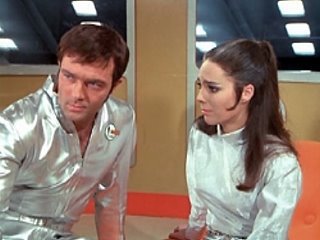
Exposed is the introductory story for Paul Foster (Michael Billington). Foster is a test pilot who gets tangled up in a battle between Sky 1 and a UFO. Foster remains adamant that he saw a UFO but nobody will believe him. He keeps on digging though and eventually the trail leads to Ed Straker.
This episode allows us to see SHADO from an outsiders point of view. Billington is good value as he tangles with various different characters on the way to his meeting with Straker. But what he doesn’t realise is that everything has been coordinated by the SHADO boss in order to test Foster’s reactions and see if he’s a possible recruit.
If he responds in the right way then a job in SHADO will be his but it’s interesting to wonder what would happen otherwise. There must have been other people over the years who stumbled onto the truth about UFOs and it’s hard to imagine that they’d all have been SHADO material. Everything that we’ve seen so far seems to indicate that Straker would have no problem in silencing them for good, but luckily for Foster he makes the grade.
Also debuting is Vladek Sheybal as Dr Doug Jackson. Jackson pops up regularly during the series and is particularly prominent in the forthcoming episode Court Martial. There’s always something slightly unsettling about Sheybal’s performance and he contrasts well with the more straightforward members of SHADO. With Jackson, you never quite know if he’s following a different agenda from everybody else.
Exposed gives us a chance to see the backlot at MGM Borehamwood, where the first production block was shot. The studio is the place where Straker and Foster meet for the first time and Straker has a unique way of determining whether Foster is the man for the job. This seems to consist of pointing a wind machine at him and then pretending to shoot him at point blank range!
It’s hardly a surprise that he does get offered a post with SHADO, particularly since he’s been on the credits since the first episode, but overall this is still a decent episode. Not outstanding, but it’s a good chance for Michael Billington to make a strong first impression.







 Archive Television Musings