The 1982 BBC Classic Serial adaptation of Hound, starring Tom Baker as Holmes and Terence Rigby as Watson has been released on DVD in Australia by Madman –
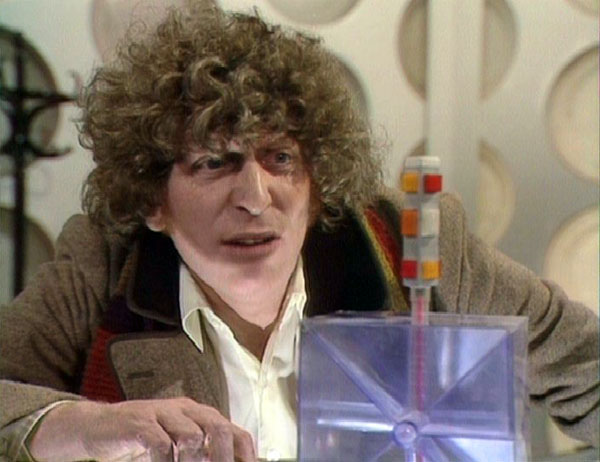
The carrot of this release is a commentary track with Baker on all four episodes, highlights in the clip below.
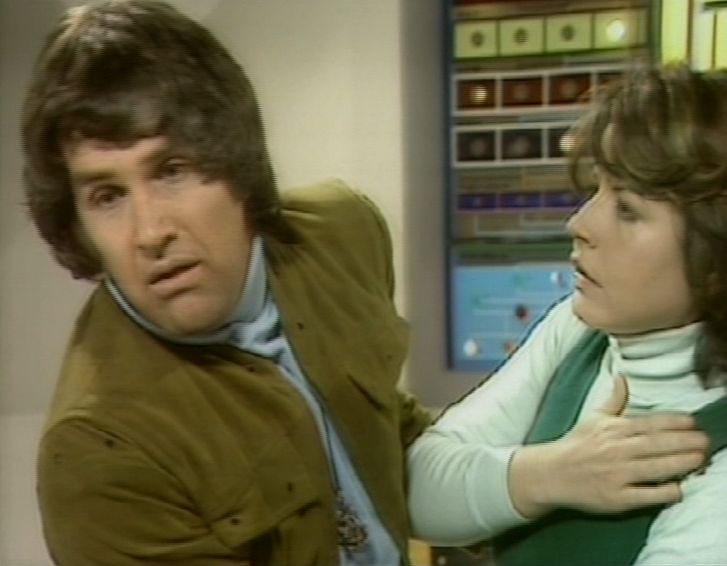
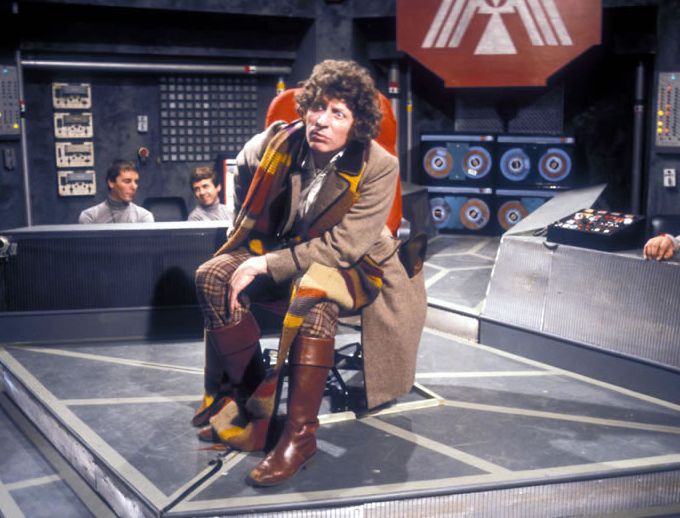
Whilst this version of the story does have its faults (I’ve never cared for Rigby’s performance, for example, which is a problem since Watson is centre stage for a large part of the story) Baker is a commanding Holmes and it’s a very faithful adaptation of the novel.
Timeslip was a childrens drama serial broadcast on ATV between September 1970 and March 1971.
Comprising 26 episodes of 25 minutes duration, it was split into four serials –
The Wrong End of Time (6 parts)
The Time of the Ice Box (6 parts)
The Year of the Burn Up (8 parts)
The Day of the Clone (6 parts)
Writer Bruce Stewart was approached by ATV who were looking for a series that could rival Doctor Who. Along with series creator Ruth Boswell they devised the series format of a boy and girl who are able to travel through time. Unlike Doctor Who though, they wouldn’t have access to a time machine. Instead, they would ‘timeslip’ into the past and the future via weak points in the fabric of time.
Although the series was fantasy, the programme makers attempted to inject some scientific accuracy. They approached Geoffrey Hoyle (son of the respected astronomer Sir Fred Hoyle) to act as a consultant, although Bruce Stewart is unsure how many, if any, of his suggestions were taken up.
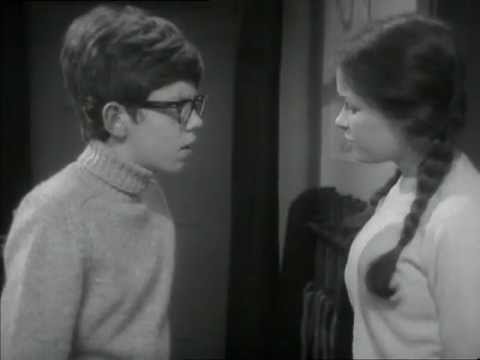
Cast in the two main roles of Liz Skinner and Simon Randall were Cheryl Burfield and Spencer Banks.
Simon and Liz
Liz was written as a twelve-year-old, but the eighteen year old Burfield so impressed the producers that they revised the characters age up by three years.
Banks had little acting experience before Timeslip (his only previous television role was in the BBC classic serial Germinal) but he would continue to notch up a steady list of television credits during the 1970’s and 1980’s.
The Wrong End of Time
Liz and Simon, who are holidaying with Liz’s parents in St Oswold find themselves transported back in time some thirty years. To their amazement they are still in St Oswold, but the year is now 1940 and England is at war. Liz’s father was stationed at the local naval-base during the war and there’s no doubt that the young man she meets at the base called Skinner is her father – but at an age before she was born.
Mr Skinner (Derek Benfield)
There’s no time to ponder this though as a small group of Germans attack the base – although their objectives are not clear to begin with. Are they after the radar research or is there something even more secret being worked on? And how does Traynor (in 1940 the base commander, in 1970 holidaying in St Oswold) fit in?
Cheryl Burfield
This is a solid opening story that sets up some of the plot threads that will develop during the remaining serials. Although Liz and Simon aren’t initially the most sympathetic of leading characters (particularly Liz who has a tendency to be annoyingly whiny) they do settle down as the adventure continues.
Traynor (Dennis Quilly) quickly becomes a character of interest. Present during 1940 and 1970, he seems to know much more than he’s letting on – and his plotline will be developed during the series’ run. It’s a shame though that the 1970 Traynor couldn’t have aged more, as the only concession to the passage of thirty years is that his hair is slightly grey.
The Germans are perfectly hissable villains and since the story was made at a time when most middle-aged people would have had direct experience of WW2 their involvement would have probably struck a chord with many on first broadcast. They are somewhat unobservant though, particularly in the scene at the end of episode 3 when Liz, attempting to cross back to 1970, gets her sleeve caught in the fence and struggles to free herself for a considerable time without them noticing!
At the end of episode 6 Liz and Simon pass through the time barrier again, but they don’t return to 1970. Instead they find themselves in an icy wasteland, where they are quickly overcome by the extreme cold ….
Fascinating BBC coverage of the Apollo 13 splashdown from April 1970, hosted by James Burke, Cliff Michelmore and Patrick Moore.
A fair amount of the BBC’s footage of the Apollo missions fell foul of the archive purges of the 1970’s (the Apollo 11 broadcasts, for example, were particlarly hard hit by wipings) so it’s fortunate that this survives and also has escaped to the wider world via YouTube.
Enroute to the moon, the number 2 oxygen tank in the module exploded. The damage meant that a lunar landing was impossible, so the decision was made to abort the mission. But returning to earth safely was far from straightforward, as the footage below indicates.
In 2013 the six part Jon Pertwee story, The Mind of Evil, was released on DVD in colour.
Nothing surprising about that you may think, but after the original colour tapes were wiped in the mid 1970’s only black and white film prints remained. A process called chroma dot recovery, developed several years ago, was used to restore the colour embedded in episodes 2 – 6.
Episode 1 didn’t have chroma dots though and the cost of computer colourisation was far too high. Things looked bleak until Stuart Humphryes (otherwise known as Babelcolour) entered the fray.
This short video briefly explains the painstaking work that brought the first episode back to colour as well as presenting the best moments of the episode in a stylish trailer.
Ranking a lowly 211 out of 241 stories in DWM’s recent poll would imply that The Creature from the Pit isn’t a favourite of many. But apart from one (admittedly large) problem it’s difficult to see why.
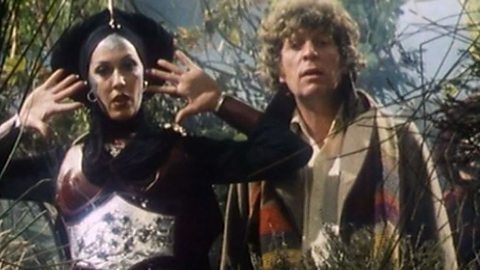
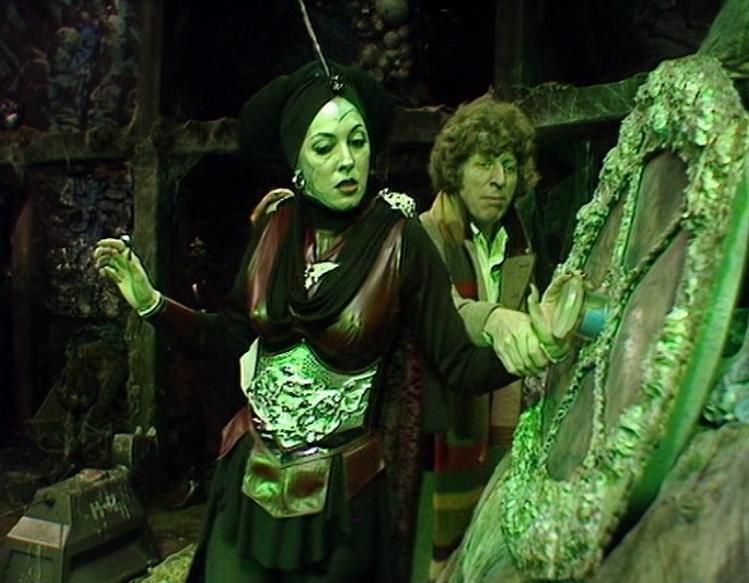
The positives far outweigh the negatives – the jungle scenes at Ealing give the episodes a glossy sheen, Myra Frances is a gloriously hissable villainess, Tom’s on great form, Lalla looks lovely and there’s an entertaining guest turn from Geoffrey Bayldon.
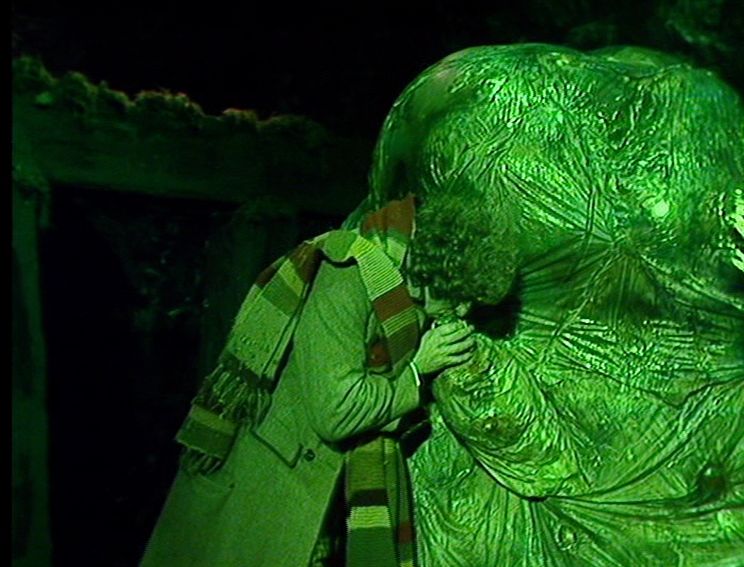
The problem? Well you can’t really avoid it. Erato is a vast, shapeless blob that is said to stretch for miles. How do you realise that on Doctor Who’s budget in 1979?
The answer is, of course, that you can’t. So Erato looks like an inflatable green bag with a rude appendage. But the scenes in the pit are nicely lit and Erato’s green glow is quite eerie, so it’s not a total write off.
No, sorry I can’t think of a caption. Please add your own.
Producer Graham Williams was in no doubt that the special effects department had let the programme down and after transmission made this point in an internal memo. But it’s hard to imagine how this monster could ever have been successfully created, so you do have to wonder why this was never queried at the scripting stage.
New script editor Douglas Adams wasn’t terribly experienced, but Graham Williams had been around for a while and should have twigged that a mile wide green blob was simply asking for trouble. But whatever the merits and demerits of Erato, there’s plenty to enjoy in this story, so let’s take a closer look.
Chloris is a planet rich in vegetation but low on metal. The Lady Adrasta (Myra Frances) owns the only metal mine on the planet and therefore is able to rule with a reign of terror.
But the arrival some years ago of an ambassador from the planet Tythonus has threatened her grip on the planet. Erato proposed a trade – they have plenty of surplus metal but Tythonus is extremely low in vegetation which Erato’s people need in vast quantities.
Adrasta quickly understood that if she no longer had the metal monopoly then her power would dissipate. So she arranged to banish Erato to the pit and would henceforth throw anybody who displeased her down there.
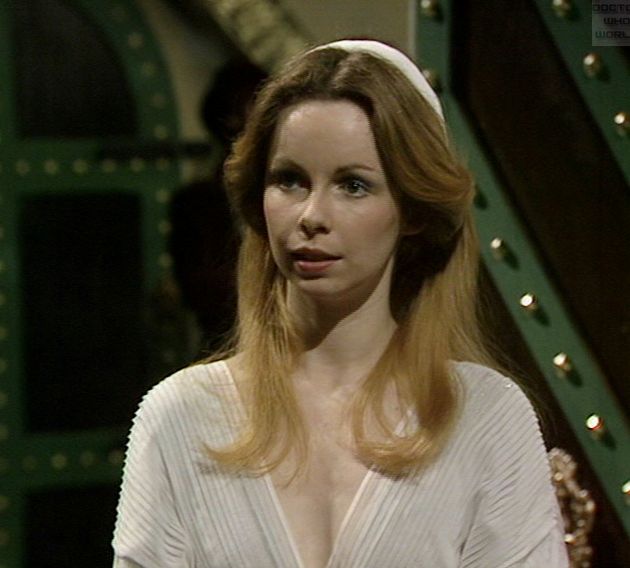
Although transmitted third, this was the first story of Season 17 to be recorded, so it was Lalla Ward’s acting debut as Romana. Her performance here is subtly different as she was still feeling out the part. There’s some nice moments from her though – particularly when she confronts the bandits in their lair.
Sigh.
The guest cast is uniformly solid. Myra Francis manages to be gorgeous and deadly at the same time. Eileen Way (Karela) had appeared in Doctor Who’s first story back in 1963 and is good value as Adrasta’s right hand woman.
Organon (Geoffrey Bayldon) is a hapless astronomer who falls foul of Adrasta and found himself flung into the pit. Managing to avoid being crushed by the monster he has lived a lonely existence until the Doctor turned up. Bayldon, best known for Catweazle, sparks off Tom very well and their scenes together are highly entertaining.
Also skulking around the jungle are a group of inept bandits, lead by Torvin (John Bryans). There has been some criticism of this character over the years, so the viewer will have to decide if he’s a riff on a Fagin-like character or simply a broad Jewish stereotype – “My lovely boys”.
Myra Francis and Tom Baker
So while Creature has its flaws, if you can ignore the glowing green bag there’s plenty of entertainment here. Unloved for decades due to its feeble dinosaurs, in recent years there seems to be more appreciation for Malcolm Hulke’s Invasion of the Dinosaurs (1974). So maybe one day the same thing will happen here and fandom will learn to stop worrying about Erato and love The Creature from the Pit.
For those who subscribe to a strictly linear view concerning British police drama it is possible to draw a line something like this –
In the beginning (the 1950’s) there was Dixon of Dock Green. It was fine for its time, but the launch of Z Cars in 1962 made it an obsolete dinosaur. Z Cars was fine for its time, but the launch of The Sweeney in 1975 made it an obsolete dinosaur, etc.
Of course, the true picture isn’t nearly as straightforward. Acorn DVD’s recent releases of the majority of existing Dixon episodes from the early to the mid seventies reveal a series of considerable interest. And whilst the 1970’s Z Cars lack the edge and spirit of the earliest episodes from a decade earlier, they also have merit and in many ways point towards the style and format of later series, such as The Bill.
A brief potted history of Z Cars. It was created in 1962 by Troy Kennedy-Martin, who spent a period of illness confined to bed and listening to police messages on his radio. The range of calls that they answered, from trivialities to more serious matters, convinced Kennedy-Martin that there was considerable scope for drama which had hitherto been untapped.
Assembling a first rate cast, including Stratford Johns as DCI Barlow, Frank Windsor as DS Watt, Brian Blessed as PC Fancy Smith and James Ellis as PC Bert Lynch, the series was an instant success and ran until 1965. Stratford Johns and Frank Windsor went into the spin off Softly Softly and Z Cars itself was revived in 1967 in a twice weekly soap opera format of 25 minute episodes twice a week. In 1972 it returned to a weekly 50 minute format and stayed that way until the final episode was transmitted in 1978.
Like many series of the 1960’s and 1970’s there are some gaps in the archive, although it fares better than Dixon which only has 30 or so episodes in existence from over 400 transmitted.
From around 800 episodes made, Z Cars has just under 400 present in the archives. Certain years are hard hit (patchy selections from 1967, 1969 and 1970, nothing at all from 1968 or 1971) whilst other years are virtually complete.
With so much available, there’s plenty of scope when selecting episodes for DVD. And whilst the logical choice might have been to choose a run of episodes from the first series, Acorn instead have chosen to start at July 1972.
The first DVD, released last year, contained episodes from July – September 1972 and this new DVD contains the next six episodes, which takes us up to the end of October 1972. With the survival rate being rather poor for the next year or so it will be interesting to see what Acorn do next (provided of course there is another release). But one plus point of releasing a run of consecutive episodes is that we can get a handle on the nuances of the regular characters, something that is harder to do with the Dixon DVDs due to the large gaps in the archives.
It’s 1972 and the Z Cars team continue to patrol the fictional Newtown. Back in 1962 the name was well chosen, as it was a new town, with newly built housing estates where the working classes found themselves rehoused. A decade later there’s a general feeling of decay which is quite prevalent in a considerable amount of early 1970’s television, particularly the Dixons of this time. Everything looks grimy and rundown and there’s a feeling that people are just hanging on.
First episode on the set is Witness by David Ellis. This episode, like many others, juggles several plot lines at once, something which would be a hallmark of later series like The Bill. The main plot concerns the witness to a forthcoming trial facing intimidation and threats whilst the second plot line sees Det Sgt Stone (John Slater) face an unwelcome visitor from his past. George Appleton (Campbell Singer), a now retired colleague of Stone’s, decides to pay Stone a visit.
John Slater
Stone is a middle-aged copper who seems to have reached his peak, career wise. This he puts down to the efforts of Appleton in years gone by, whose constant belittling seems to have irrevocably damaged Stone’s confidence. Slater is one of the stand-out performers of this era of the programme, and whilst this plot thread is fairly minor, thanks to Slater it’s the best part of the episode.
Next up is Takes All Sorts by Leslie Duxbury. Inspector Pratt (Graham Armitage) is a by-the-book officer who is despised by some of the more maverick coppers, such as PC Yates (Nicholas Smith). Yates is an old-fashioned bobby who sees nothing wrong in dishing out a bit of summary justice or accepting the odd drink or meal whilst on the beat. This brings him into direct conflict with Pratt, although there’s plenty of other things happening on this night shift, such as the theft of a yellow dumper truck and the arrival at the station of Jean Knight (Gwyneth Powell) who has evidence that will put her criminal husband away for a long time.
Takes All Sorts, thanks to the interweaving plot threads, is one of the best episodes on this release. Nicholas Smith (well known for playing Mr Rumbold in Are You Being Served?) is good value here, and also in several other episodes on the DVD.
The last episode on disc 1 is Sins of the Father by Bill Lyons. There are two main plot threads – a robbery at a local supermarket and the travails of a mother and her wayward son. Like the majority of the stories of this era, the crimes are fairly low key, but it’s a solid enough episode.
Damage by P.J. Hammond is the first story on the second DVD. It does stand out from the episodes around it, which is no bad thing, thanks to it’s slightly unusual tone.
Burglar Terry Moon (John Shedden) gets more than he bargained for when he attempts to break into a house in Newtown. He finds his hand trapped in the door, tied up with string and then burnt with matches. Stone doesn’t consider that the woman who carried out the attack was responsible for her actions – rather he blames the parents for their treatment of her. This is a chance for Slater to shine again, particularly at the end of the episode.
Day Trip by Bill Barron sees the return of Det Sgt Haggar (John Collin). As soon as he’s back in Newtown he spots a familiar face – Dilly Watson (Hilary Tindall). Dilly’s a known thief, only petty thefts, but a irritant nonetheless. Haggar thinks he’s run her out of town, but Dilly returns and together with Rose (Elisabeth Sladen) plans a job to embarrass Haggar.
Chiefly notable for the appearance of Sladen, this is a somewhat forgettable episode that has all the elements, but doesn’t ever quite click into life. Elisabeth Sladen would appear several times in Z Cars (each time playing a different character) and it was this flexability that would later impress Barry Letts and prove to be a major factor in his decision to cast her as Sarah-Jane Smith in Doctor Who.
Final episode on the set is Public Relations by Leslie Duxbury. Ken Knowles (Gareth Thomas) runs a news agency and is distinctly ambitious. Upset that Haggar never seems to tip him off when a big case breaks, he decides to go and find his own.
The clash of wills between Knowles and Haggar is the highlight of the episode, and Gareth Thomas (and his coat!) are very impressive. A good story to end this release on.
Ian Cullen
Apart from the actors already mentioned, both James Ellis (Sgt Lynch) and Ian Cullen (PC Skinner) are solid presences throughout all the episodes. Ellis had been with the series from the start and would remain firmly in place until the final episode. Cullen would leave a few years later, not by choice – as he discusses in a newly shot interview on disc one, which is one of a number of short interviews with cast members produced for this release.
For the hardened archive television fan, if you have the first release and enjoyed it then this is definitely worth purchasing. If you are more selective, then I would recommend either of the Dixon DVDs or series one of Softly Softly Task Force (provided you can find a re-released copy and not the original release with the major encoding fault) ahead of this.
Apart from Damage, there’s nothing stand-out here, but the humdrum cases were the bread and butter of Z Cars. If you want squealing tyres and armed robbers then try The Sweeney. The cases in Z Cars are much more low-key but they’re not without interest for a number of reasons, particularly the quality acting – both from the regulars and the guest casts.
Running for most of the 1960’s, The Avengers transformed itself from a humble domestic series shot on VT to a glossy all-film vehicle that enjoyed a successful run on American network television.
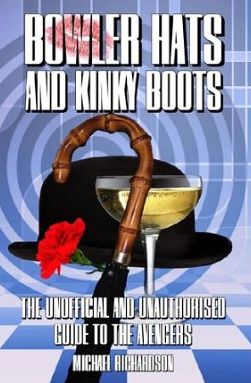
Whilst there have been a number of books about the series previously published, there has never been any which have discussed the production history of the programme in any great depth, until this one.
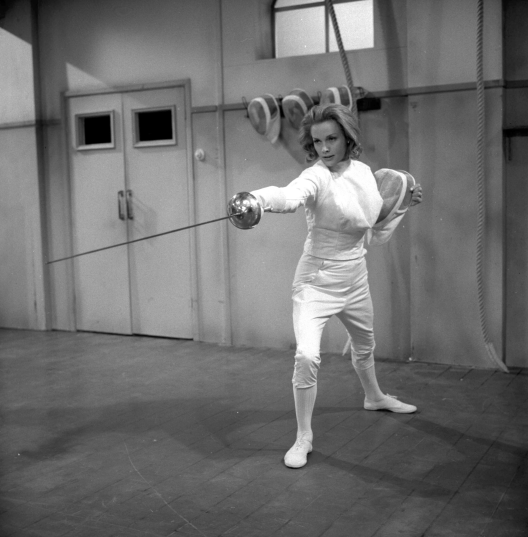
Ian Hendry and Patrick Macnee
This has clearly been a labour of love for Michael Richardson as years of research and writing has finally been distilled into a heavyweight tome – clocking in at an impressive 810 pages.
Honor Blackman
The first section of the book is devoted to an indepth production history of the original series and The New Avengers, season by season and story by story. There’s plenty of information that was new to me, and Richardson has made use of all the available production paperwork to paint as full a picture as could be expected. Rewrites, proposed storylines from various writers which were never made, network feedback, production wrangles, etc all help to illuminate the production process.
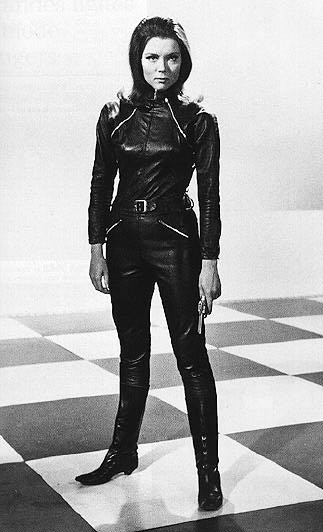
Diana Rigg
The later sections of the book look at the various spin offs (the 1970’s play, the South African radio series and the 1990’s film amongst others). There’s also a lengthy appendix devoted to listing as much as is known concerning the production filming dates. Not all the paperwork exists, but it’s fascinating reading to look at certain stories and see exactly where and when they were shot – and also how the shooting of various stories overlapped. Of niche interest maybe, but I’m glad it’s been included.
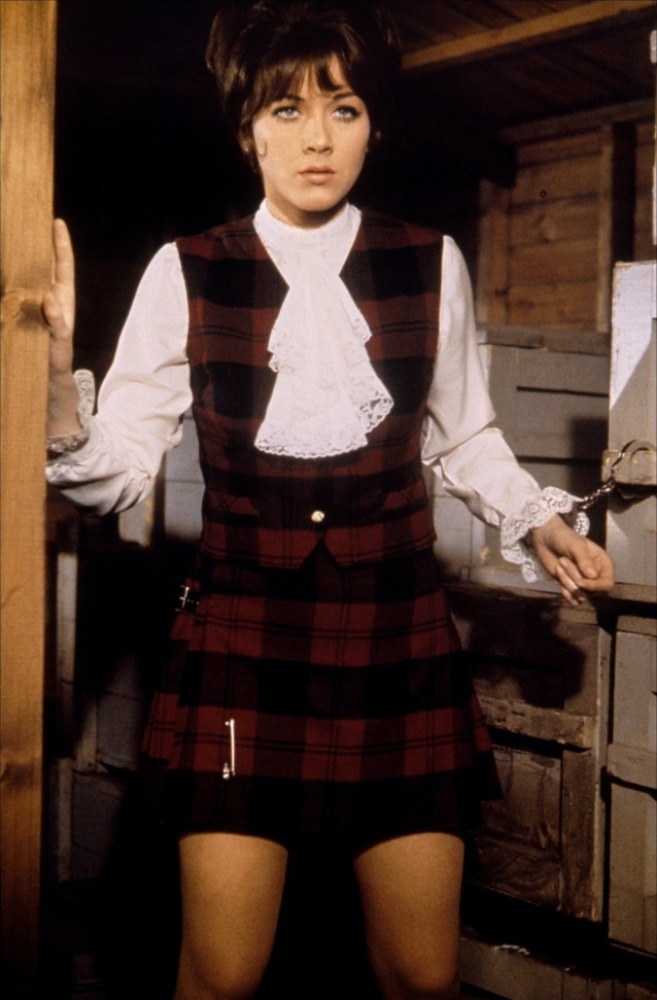
Linda Thorson
This is very much a factual book, so if you’re looking for reviews and analysis then this might not be the book for you. It’s more in the line of Andrew Pixley’s writings and probably isn’t something that is necessarily best read from cover to cover – rather it’s an ideal companion to a chronological rewatch of the series.
The paperback is currently retailing for around the £25.00 mark (and given the pagecount I do wonder how long it would be before the spine begins to show evidence of wear and tear). Given this, I went for the much more affordable Kindle option – which is currently selling for around £5.00. The first Kindle edition didn’t have a table of contents and there were also a few typos, but these have now been corrected and all is as it should be.
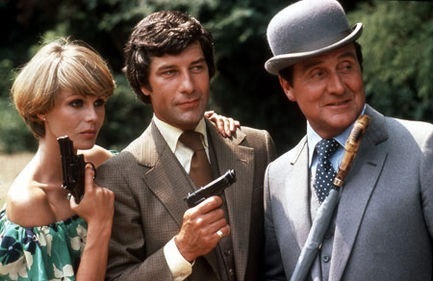
L-R – Joanna Lumley, Gareth Hunt and Patrick Macnee
For anybody interested in the production history of The Avengers, this is an essential read.
It’s slightly sobering to think that more than thirty years have passed since The Computer Programme was first broadcast on BBC2.
At that point in time the home computer revolution was just beginning and the BBC were keen to produce a series that introduced the concept and abilities of the modern computer to a wide audience.
The BBC obviously didn’t want to use an existing computer – and then be accused of offering free advertising – so they designed their own.
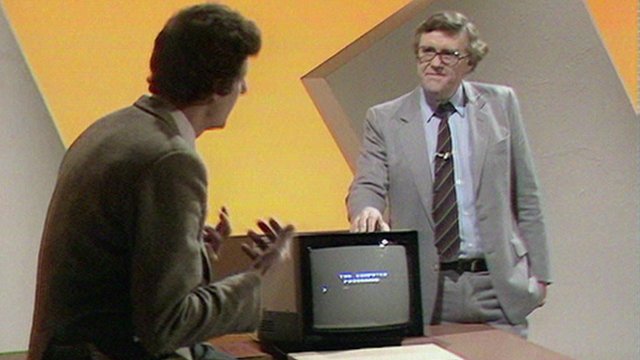
Ian McNaught-Davis was the avuncular expert and Chris Searle stood in for the viewer, asking all the obvious questions.
Chris Searle and Ian McNaught-Davis
There were ten episodes in total –
It’s Happening Now (11 January 1982)
Just One Thing After Another (18 January 1982)
Talking to a Machine (25 January 1982)
It’s On the Computer (1 February 1982)
The New Media (8 February 1982)
Moving Pictures (15 February 1982)
Let’s Pretend (22 February 1982)
The Thinking Machine (1 March 1982)
In Control (8 March 1982)
Things to Come (15 March 1982)
Looking back at the series, it’s amazing to consider how far we’ve come in just a single generation. All the episodes are available on YouTube (something that would have seemed like science fiction in 1982) and the programmes are fascinating watching, both for those of us who were there at the time and also for younger people who can get a flavour of how computers used to be In the dim and distant past.
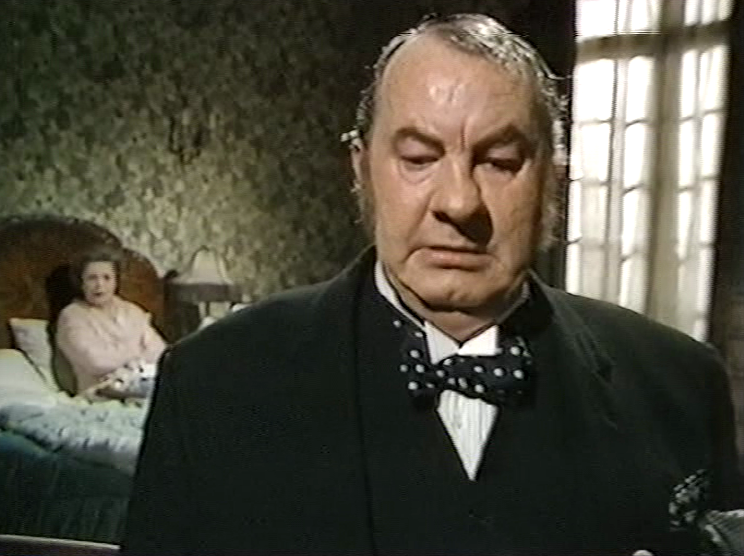
After watching A Foreign Field I wanted a little more Leo McKern, so digging out the Play for Today in which Horace Rumpole made his debut seemed a logical choice.
Rumpole of the Bailey would become a popular and long-running series, although it seems that the BBC didn’t consider that the character or concept had legs, so Play for Today producer Irene Shubik took it to Thames where it ran for seven series between 1978 and 1992.
The development of the series was still several years off when this play was made and it does seem that this was produced purely as a one-off. So although there’s plenty that’s familiar to viewers of the later series, there are also various interesting differences.
An obvious difference is that Hilda is played by Joyce Heron, rather than Peggy Thorpe-Bates or later Marion Mathie. At the end of the story she portrayed as a drunk with a strong hint that this is a regular occurrence. This is something we never see again, as the implication that Hilda drinks to drown the sorrow of her hollow life with Horace is presumably too bleak to bear repetition. Instead, whilst the Thames Hilda may sometimes bemoan her lot and life with Horace, it’s done with considerably more humour.
Horace Rumpole himself, apart from one important character beat which we’ll come to shortly, is quite recognisable as the Rumpole from the Thames series. He indulges in lengthy internal monologues as he makes his way to work and he also laments the fact that it’s impossible now to get a decent lunch anywhere. There’s only sandwiches and other convenience foods – which horrifies the traditionalist Rumpole.
“Hack? Not exactly a hack. Been at it for longer than he can remember, Rumpole has. No flies on Rumpole. Cut his teeth on Rex v Magwitch and the Penge Bungalow Murders. I could win most of my cases if it wasn’t for the clients. Clients have no tact, poor old darlings, no bloody sensitivity. They will waltz into the witness box and blurt out things that are far better left unblurted.”
Rumpole is at the Old Bailey to defend Ossie Gladstone (Herbert Norville), accused of stabbing a man outside Lords Cricket ground in a motiveless attack. And this is where we see the major difference between the Play for Today Rumpole and the Thames Rumpole. Here, he is very keen for Gladstone to plead guilty and even after Ossie maintains his innocence he is reluctant to consider a not guilty plea.
The Thames Rumpole never liked to plead guilty and was always ready for a fight, but maybe this Rumpole is simply more of a realist. If the evidence is strong then what’s the point of delaying the inevitable and possibly only increasing the sentence by pleading not guilty?
Or maybe Ossie is right when he taunts Rumpole that his case isn’t sufficiently interesting and too much like hard work to fight. This certainly seems to strike a chord with Rumpole in a way that it would be impossible to consider happening in the later series where the character was always much more straightforward.
So the decision is made to fight, although as the police have a signed confession it seems like a forlorn hope. Rumpole spends the morning toiling away at the police evidence before the lunch-break brings a chance to grab a last chat with his son Nick (David Yelland) who is shortly due to fly to America to take a University post.
David Yelland
The pub lunch with Rumpole and Nick is the heart of the play, as Nick confronts his father about their strained relationship. Nick and Rumpole both have very different views about Nick’s childhood – Rumpole remembers the good times in the holidays – teas, pantos, visits to the Old Bailey – whilst Nick remembers the long time spent at various boarding schools from the age of seven.
This is another relationship that is adjusted when the series debuted in 1978. During the first series the chronology was rewound, so the first story was set in 1969, some five years before this one. Therefore we get to see Nick during the time he was at school and also enjoying a much more cordial, though sometimes still distant, relationship with his father. But even when the series reached the point where Nick departed for America it was done in a subtly different way, with much less angst and Nick never displayed the same anger again that he does here.
With lunch concluded, Rumpole is able to engineer a breakthrough when Detective Inspector Arthur (Edwin Brown) states under oath that Ossie read his statement back to him. A simple ruse in the cells proves that Ossie can neither read or write and this revelation is enough to dent the police’s case and so the jury issue a not guilty verdict.
But here, as with some of the earliest stories in the Thames series, there’s some ambiguity. Although Ossie has declared his innocence, Rumpole is forced to admit that he may well be guilty – there’s simply no way to be sure. He could have admitted his guilt to the police and the confession may be geniune, but Inspector Arthur’s decision to overstate his case was enough to sow a seed of doubt in the jury’s mind.
There are other examples of this in the early Thames series, where we see that Rumpole isn’t always able to depend on the honesty of his clients. As the series became more mainstream, this, along with the various other points discussed, were gradually smoothed away so that a more family friendly, mainstream character emerged. The later Rumpole always pleaded not guilty, almost always won and could always rely on the honesty of his clients. This is not to say that the later series are not well written or well acted, but they lack a little of the bite and intensity of this Play for Today and the first two Thames series.
It goes without saying that Leo McKern is excellent here, as he was throughout the series. But as this play has more character beats he is able to instill a little more character to the part.
The closing words of the play, as Rumpole and Hilda face each other over the dinner table – “Who am I exactly?” – echo the comments of Nick at lunchtime, who tried to break the public facade of his father. At the end of the day it seems that even Horace Rumpole has his doubts. He knows what he does, and what he does well, but has his own identity become submerged under the numerous character quirks of an Old Bailey Hack?
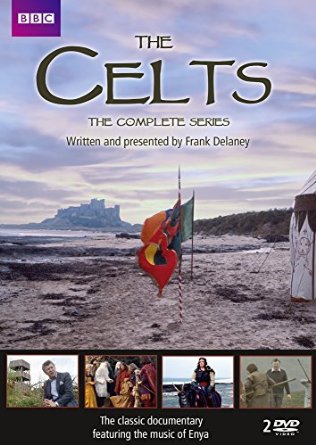
The Celts, a 1987 documentary series presented by Frank Delaney is showing as forthcoming on Amazon.
The series was comprised of six episodes –
“The Man with the Golden Shoes”
“The Birth of Nations”
“A Pagan Trinity”
“The Open-Ended Curve”
“The Final Conflict”
“The Legacy”
The Celts was notable for introducing the public at large to the music of Enya. Formally a member of Clannad, The Celts soundtrack was Enya’s first solo release.
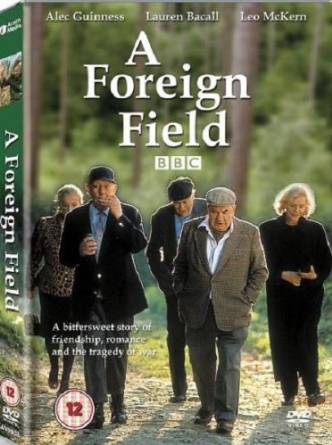
The recent centenary commemorations of the start of WW1 has inspired me to pull this Screen One production from September 1993 down from the shelf for a rewatch as although it’s concerned with the events of WW2, the themes of sacrifice and comradeship are universal and timeless.
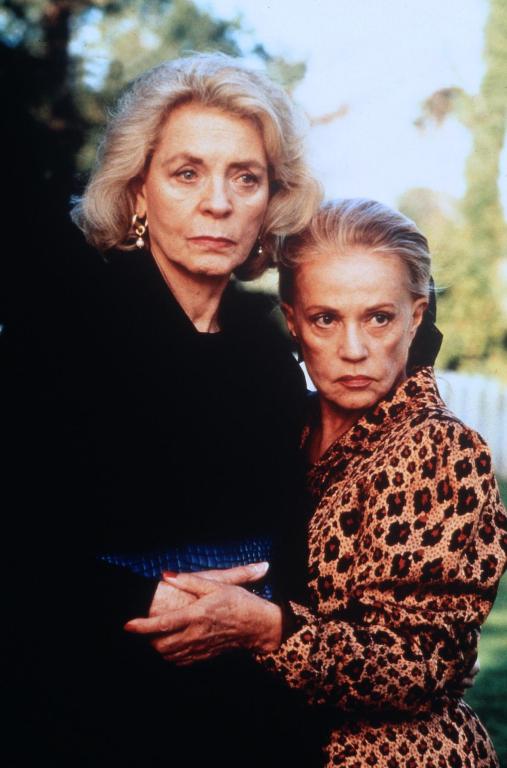
Cyril (Leo McKern) and Amos (Alec Guinness) are two D-Day veterans who have returned to Normandy to visit the graves of their fallen comrades. Both of them have been scarred by those fateful days in 1944 – particularly Amos, who is virtually mute and seems to have the mind of a child.
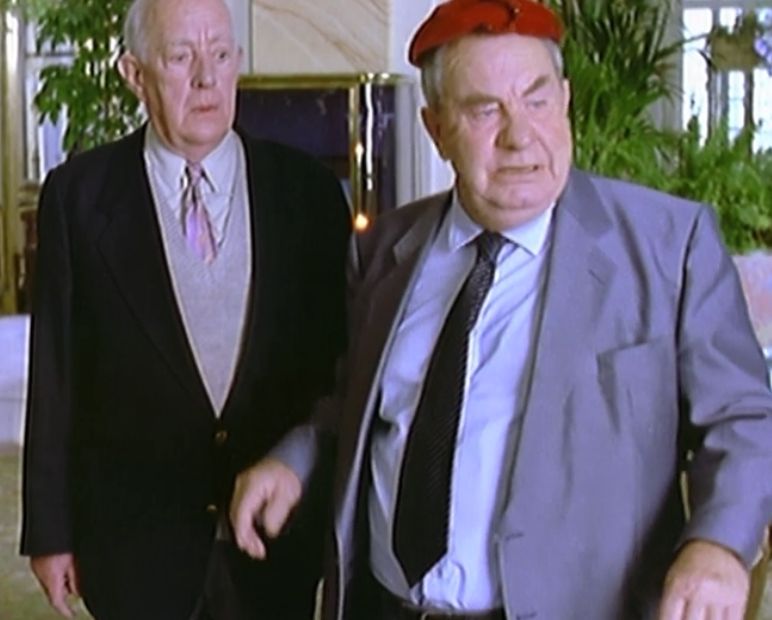
Alec Guinness and Leo McKern
Cyril has another reason for the trip, as he is looking to track down his wartime sweetheart Angelique (Jeanne Moreau). The fact he hasn’t seen her for nearly fifty years doesn’t discourage him, nor does the fact that he has a rival for her affection – Waldo (John Randolph), an American veteran visiting the area with his son (Edward Herrmann) and daughter-in-law Beverly (Geraldine Chaplin).
John Randolph
After fighting for Angelique’s affections, Cyril and Waldo decide to join forces as they both treat her to a day out and then together with the mysterious Lisa (Lauren Bacall) the mismatched party eventually find their way to the graves to remember those they have lost.
A Screen One production from 1993, A Foreign Field was written by Roy Clarke. Although he has a varied CV, the record-breaking Last of the Summer Wine is undoubtedly the series he is best remembered for. That series’ longevity and the critical mauling and polite indifference that the later runs generated have tended to mask that Clarke is a very talented writer with a keen ear for dialogue. This is a hallmark of A Foreign Field, particularly as Cyril and Waldo give full vent to their simmering Anglo-American resentment.
Lauren Bacall and Jeanne Moreau
As good as Clarke’s teleplay is, it clearly doesn’t hurt that the likes of McKern, Guinness, Randolph, Moreau and Bacall are cast members. Frankly, this is a dream lineup, with particularly fine performances from Guinness and McKern. Alec Guinness has probably the showiest part – lacking virtually any dialogue he is able to insert various bits of business in order to steal any scene that takes his fancy. The eye is automatically focused on him because, well, he’s Alec Guinness, but he still manages to instil a sense of dignity into the character of Amos.
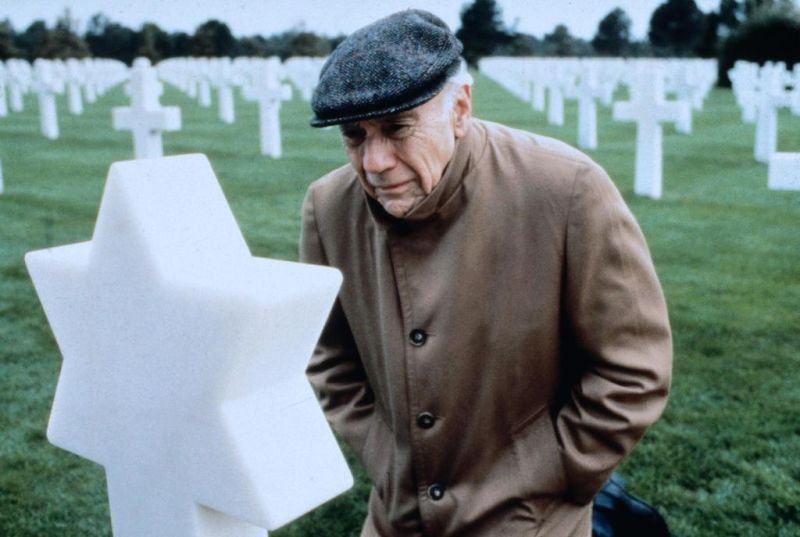
Best of all is Leo McKern. Well known for his long run in Rumpole of the Bailey, McKern here is able to produce a moment of subtlety and pathos that is heart stopping. Outwardly bluff, his mask slips when discussing the beachhead landings in a wonderful monologue.
The conclusion, with the mystery of Lisa’s pilgrimage solved, brings the story to a satisfactory conclusion and the point made, whilst subtle, is clearly understood. Available on DVD from Acorn, this is a fine production that could have so easily tipped over into mawkish sentimentally. The fact it doesn’t is a tribute both to the writing and the acting choices of the principal cast. A production that is well worth tracking down and treasuring.
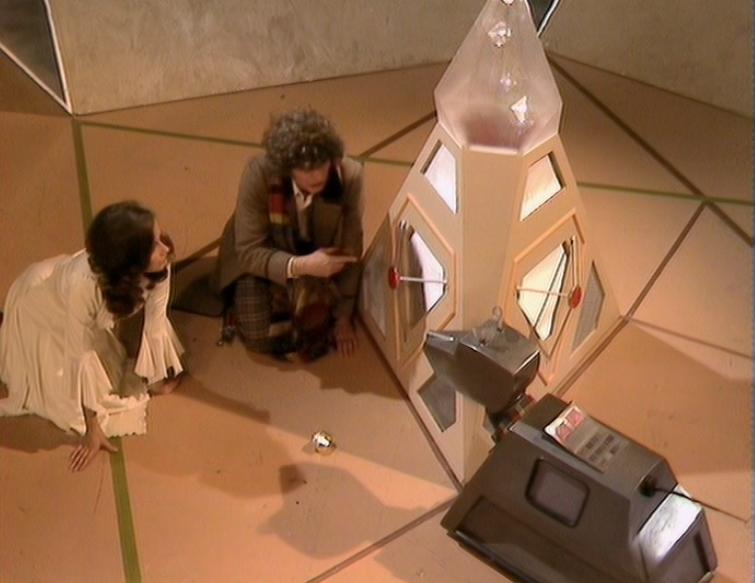
A nice clip of Nationwide from 1980 with Lalla Ward and K9. A rare public outing for Roger Brierley as the voice of K9 (Brierley had taken over K9’s vocal duties for a year after John Leeson left the series following the conclusion of the Key to Time season).
When Barry Letts and Terrance Dicks decided their time on Doctor Who was coming to an end, they chose to originate a new series, which if it proved successful they could then work on full time. Moonbase 3 was the result, broadcast in 1973, although in the end it only ran for six episodes before being wiped and largely forgotten.
It wasn’t until twenty years later, in 1993, that co-producer 20th Century Fox found NTSC copies of the six episodes in their archives – and these prints were returned to the BBC and issued on VHS and then later on DVD.
So is it a lost classic or just better off lost? Letts and Dicks always seemed inclined to the latter opinion, but that doesn’t mean that the series is a total write off. Moonbase 3 has its problems, but for fans of 70’s BBC SciFi there’s plenty of interest.
Letts and Dicks’ episode “Departure and Arrival” opens the series. It sees the arrival of Dr David Caulder (Donald Houston), newly appointed director of Moonbase 3. His predecessor has just died in a shuttle accident and one of Caulder’s first tasks is to examine the reasons for the crash. Harry Saunders (Michael Wisher) suffered a nervous breakdown while piloting the shuttle. But was it an isolated incident or do the problems run deeper?
The introduction of a new character (Caulder) into the Moonbase setup also allows the viewers to be introduced to all the personnel on the base at the same time. It’s an old storytelling trick maybe, but it’s still effective. The senior staff under Caulder’s scrutiny are deputy director Dr Michel Lebrun (Ralph Bates with an interesting French accent), no-nonsense director of operations and maintenance Tom Hill (Barry Lowe) and base psychologist Dr Helen Smith (Fiona Gaunt).
L-R – Ralph Bates, Fiona Gaunt, Donald Houston and Barry Lowe
After a quick whistle-stop tour, Caulder puts his plan into action in order to demonstrate to Lebrun, Hill and Smith just how dangerous the Moon is. Frankly, Caulder’s actions are reckless in the extreme as he seems happy to risk their lives just to prove a point. But by the end of the story Caulder is able to close his enquiry on the shuttle deaths, so life on the moon can get back to normal.
One of the pleasures of the series is the high quality supporting casts, which includes many familiar faces such as Peter Miles (in “Behemoth”), Edward Brayshaw (in “Achilles Heel”) and John Hallam (in “Outsiders”).
But one major problem the series faced was that in order to generate drama and conflict it meant at least one member of the Moonbase staff had to act in an irrational or dangerous manner per episode. Had the series continued it would have been difficult to see how this problem could have effectively been dealt with. The later series Star Cops (1987) solved this by depicting a Moonbase which had a constant influx of departures and arrivals. The closed nature of Moonbase 3 doesn’t allow such freedom though.
The fifth story, “Castor & Pollux” sees Tom Hill adrift in space and although Caulder is keen to organise a rescue mission, he can’t do it without Russian assistance. The slowest paced episode of the series (and given the zero gravity environment, none of the others exactly race along) there is nevertheless a mounting sense of tension and it’s the best chance for Barry Lowe to shine.
The sixth and final episode of the series is “View from a Dead Planet”, guest starring Michael Gough. When the Arctic Sun Project appears to have destroyed all life on the planet, the Moonbase personnel face the prospect that they are the only human beings left alive – although given the limited supplies they have, this won’t be for long.
And then it was over. Critical and audience response were muted to say the least – a BBC Audience Report found the series “banal, predictable and slow”. And viewing figures were fairly disastrous as it debuted at 6 million whilst later episodes dropped as low as 2 million before recovering slightly at 4 million. But for a mainstream Sunday night BBC1 slot this effectively sealed the programme’s fate.
Why did it fail to capture the public imagination? The team of Letts and Dicks had worked together on Doctor Who since 1970 and had pulled that series around to make it a ratings winner and an important part of the BBC’s Saturday evening schedule. Moonbase 3 was a different beast though. It was hard science fact (with James Burke acting as story consultant) rather than science fiction or fantasy and it didn’t seem to work in the Sunday timeslot.
Donald Houston, whilst never the most subtle of actors, had a certain presence and made Caulder a compelling character. The needle and one-upmanship between Lebrun and Hill added some spice and conflict, which leaves Dr Helen Smith as somewhat of a fourth wheel. As her job was to identify which Moonbase crew-members were operating under stress or were potential risks, it’s embarrassing that so many passed her by. Quite how she managed to keep her job is anyone’s guess.
Watch out Dr Smith! Another one’s going round the bend!
Although it has its problems and weaknesses, it’s still a series that I find myself taking down from the shelf and rewatching most years. Maybe it’s the 70’s BBC futuristic setting, which is now somewhat comforting, but for whatever reason it’s a series that, dodgy NTSC picture notwithstanding, does repay multiple rewatches.
The Second Sight DVD has long since been deleted and now goes for silly money, so YouTube is probably the best way to sample this forgotten piece of 1970’s futurism.
The Secret War, a six part WW2 documentary made by the BBC in association with the Imperial War Museum, is due for release in September 2014 by Simply HE.
Originally broadcast in 1977, it was presented by William Woollard, with each episode looking at the various different ways that science and intelligence helped the Allies to win the war. Episode titles are as follows –
Episode 1 – The Battle of the Beams
Episode 2 – To See A Hundred Miles
Episode 3 – Terror Weapons
Episode 4 – If
Episode 5 – The Deadly Waves
Episode 6 – Still Secret
Topics covered include the breaking of the Enigma code, Hitler’s terror weapons (the V1 and V2) and the development of Radar. Interviewees include Hitler’s Minister of Armaments, Albert Speer.
Nobody loves The Armageddon Factor. Ranked 204 out of 241 stories in the recent DWM poll would appear to be a fairly accurate confirmation of its low standing.
But before we turn our attention to the story, lets have a quick look and see how its rated by some other bloggers. Philip Sandifer considers that it’s “a painful squandering of good will in a way that only deepens the concern that the series has lost its way” whilst the Wife In Space called it a complete waste of time and rated it 4/10.
In his three years as producer, Graham Williams never had much luck with season finales. Season 15 was going to conclude with a story by David Weir, until it was realised that his draft scripts would have needed a Star Wars-sized budget to make them work. So Williams and script editor Anthony Read had to cobble something up at the eleventh hour. The resulting story, The Invasion of Time, was something of a shambles – not helped by a BBC strike which meant that the production lost half of its studio allocation, so they were forced to decamp to a disused hospital to record some of the interiors.
Season 17 was even worse. Douglas Adams’ Shada was also hit by a strike, but this time there was no opportunity to record the material affected by the stoppage, so the programme was never completed or transmitted. But over the last thirty years it has spawned VHS, DVD, audio and book releases – and a notoriety that the original story probably never deserved.
This leaves the last story of Season 16 – The Armageddon Factor. This was not affected by strikes or last minute rewrites, but there does seem to be something somewhat lacking. In late 70’s Doctor Who if you weren’t careful, by the end of the season you may have run out of money so your season finale would end up looking a little threadbare. This is how Armageddon looks – no location filming and rather basic sets.
But the early episodes are helped no end by John Woodvine’s appearance as The Marshall. Woodvine is a quality actor and he also has the welcome benefit of making Tom Baker raise his game. There are other examples of this – Julian Glover in City of Death for example – so casting strong actors in late 70’s Who was clearly a good way to get Tom to focus on the matter in hand.
Tom restrains his enthusiasm
By this time, Tom had been in the role for five years. No actor had played the part for longer, and he still had another two years to go. Given this, it’s probably not surprising that there were times when he either seemed to go through the motions or dropped in the odd outrageous ad-lib. Having said that, the commonly held view that Baker was playing the fool throughout the Graham Williams era is quite clearly untrue. There’s the odd double take and painful pun, but for most of the time he plays it straight – although not everyone else is on the same page.
For example, Davyd Harries, as Shapp, puts in various bits of business that either director Michael Hayes approved of or didn’t notice. It’s amusing enough though and does help to pass the time during some of the less interesting passages in the first half of the story.
Because apart from Harries and Woodvine, the guest cast are fairly small and not of great interest. Lalla Ward would quite soon prove to be very important both to Doctor Who and Tom Baker, but there’s very little for her to latch on with the character of Astra. And Ian Saynor has even less of a character, if that’s possible, with the irredeemably wet Merak.
That leaves William Squire as the main villain, The Shadow. Squire was a good actor, probably best known for playing Hunter in the two Thames series of Callan. But The Armageddon Factor takes the strange decision to put him in a mask and also treated his voice, thereby making him unrecognisable. The Shadow isn’t much of a part anyway, as he tends to speak only in evil-villain talk and then give the odd maniacal chuckle. It’s a long way from the best villains of the Hinchcliffe era, such as Davros, Sutekh, Harrison Chase and Magnus Greel. The Shadow seems to have no interest beyond obtaining the last segment of the Key to Time, and therefore he can’t expect to hold the audience’s interest.
“You never know the answer when it’s f*****g important do you?”
The story was scripted by Bob Baker & Dave Martin, who had been writing for the series since 1971. This was their last joint story for the series and it’s probably fair to say that very few people have ever expressed any regret that they didn’t carry on writing for the show. They were not always bad, and sometimes quite good, but they tended usually to be pretty average. But a safe pair of hands then, and just what Graham Williams needed to bring The Key to Time Season to a conclusion.
This they do, although the ending in particular has always been viewed as something of a damp squib. After a season of the Doctor and Romana searching the universe for the six segments of the Key to Time, the conclusion of this epic quest is thrown away in such a perfunctory way. Script editor Anthony Read should have been able to fashion something better, but didn’t – unless the original proposal was even worse.
But having said all this, is the story totally unwatchable? No, of course not. The first half of the story is better than the second, since John Woodvine gets stuck in a time loop in episode four and has little to do from then on. We are also denied Davyd Harries’ comedy pratfalls later on, and Barry Jackson – as cockney Time Lord Drax – is no substitute. Remember me to Galifree.
“There’s no such thing as free will, only my will as I possess the Key to Time”
Tom Baker and Mary Tamm are both still giving it their all though. It might have been a long season, but they are committed and do their best to make the most of the thin material. This was to be Tamm’s last television appearance as Romana and although she tended to be overshadowed by Lalla Ward’s portrayal of Romana II, Tamm had a good rapport with Baker throughout the Key To Time season and remained popular with fans right up until her untimely death, at the age of 62, in 2012.
Sigh.
Overall then, The Armageddon Factor is never going to be regarded as a great or even a good story – but there’s far, far worse out there and Tom Baker, Mary Tamm and John Woodvine all do their best to to inject some energy into it. If I had to rate it, then a solid 6/10 would seem about right.
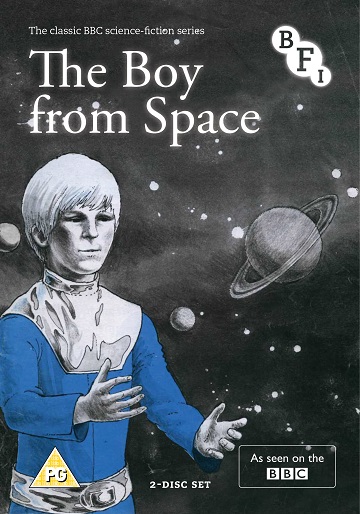
The Boy from Space is one of a number of British TV science fiction titles due to be released shortly by the BFI. Originally broadcast in 1971 as part of BBC Schools’ Look and Read strand, it has gained a certain cult status over the years.
Written by Richard Carpenter (Catweazle, Robin of Sherwood), the original broadcast tapes were wiped following transmission, although the Boy from Space drama inserts were retained.
This meant that when, in 1980, Look and Read were looking for a cheap new production, it was decided to use the original 1971 inserts with newly shot studio footage featuring presenters Cosmo and Wordy.
The two disc release includes –
The 1980 series (10 episodes, each running for 20 minutes).
A new feature length edit of the drama inserts (70 minutes).
An audio version of the 1972 BBC Schools LP (running time 55 minutes) narrated by Charles Collingwood (Wordy).
A new presentation, syncing audio from the BBC Schools LP together with footage from the television broadcast.








 Archive Television Musings