After the success of Remembrance of the Daleks it was inevitable that Ben Aaronovitch would be asked to contribute another script. Battlefield began life as a three-parter which was later expanded to four episodes, although Aaronovitch was to express his dissatisfaction with the story as it appeared on screen – feeling that it too obviously a three-part story with an extra episode bolted on.
But whilst there are script problems, there are also some rather dodgy performances which do drag the story down. It’s probably (apart from Time and the Rani) Sylvester McCoy’s worst Doctor Who performance. He’s all over the place and far too many times his line delivery is very poor (“There will be no battle here!”, ” If they’re dead”, etc, etc). Comparing this and Ghost Light back to back is particularly instructive. He’s at his best in Ghost Light (restrained and still) and very much at his worst in Battlefield (ranting and over-expressive).
Sophie Aldred has her poor moments as well (“Boom!”) whilst Christopher Bowen’s turn as Mordred is on the ripe side, to put it mildly. Angela Bruce settles down as the story progresses, but she’s also not especially good to begin with (“Shame!”).
The start of a beautiful friendship?
It’s not all bad though – Marcus Gilbert has a nice comic touch as Ancelyn and James Ellis is always watchable. His Tennyson ad-libs (“ Thou rememberest how, in those old days, one summer noon, an arm rose up from out the bosom of the lake clothed in white samite, mystic, wonderful, holding the sword“) work very well and it’s nice that Michael Kerrigan allowed him some space to indulge himself.
The main guest roles were filled by Nicholas Courtney and Jean Marsh. Marsh manages to bring out the contrary nature of Morgaine, as she’s someone who is more than capable of destruction but also has her own moral code (observing remembrance for the dead and restoring Elizabeth’s sight).
Ben Aaronovitch was quite clear that bringing back Lethbridge-Stewart and UNIT was something of a fannish indulgence. In many ways this undoes some of the good work from Mawdryn Undead. It would have been the easy option in 1983 to have the Brigadier back with UNIT and fighting monsters, but instead they went for a more interesting story with a retired and somewhat broken-down figure.
“Ware this man. He is steeped in blood”
Here, it’s pure fannish wish-fulfillment to have the Brig back in his old uniform and in charge (albeit temporarily) of UNIT. It’s hard to believe, to be honest, that any military organisation would reinstate a retired soldier like this, so it may have been more credible to have had him along as a civilian advisor, due to his knowledge of the Doctor. Courtney’s always good value (especially when facing down the Destroyer in the last episode) but after Mawdryn, this can’t help but feel like a little bit of a let-down.
As with many stories script-edited by Andrew Cartmel, some interesting material never made the screen (although it was restored for a special edition of the story when it was released on DVD). Chief amongst the cuts was the disdain that Ace has for the Brig, something that is totally absent from the transmitted story.
The story is a little incoherent with various plot devices (a stranded nuclear missile convoy is introduced in the first episode and then forgotten about until the last ten minutes of the final episode) not used particularly well. And the reason for Morgaine traveling to this universe is never made clear – has some catastrophe affected her own, maybe? The plot is a little wooly at times, it’s made clear that Morgaine knows she’s traveled to another dimension, but at another point in the story the Doctor maintains that the Earth will be a battleground for a conflict that doesn’t belong here – implying that Morgaine is unaware she’s no longer in her own universe.
The reveal of the Destroyer at the end of the third episode does give the story a little more impetus and it has to be said that the design is wonderful. Some seven years earlier, the Terileptils in The Visitation were able to curl their lips but that’s nothing compared to the lip-curling that the Destroyer indulges in. It’s a good indication just how animatronics and technology in general had evolved over the course of seven years or so.
Flawed though Battlefield is, it’s still enjoyable – but it’s very much the weak link in S26. And a special mention must go out to the closing scene. Keff McCullough’s comedy tune as the girls leave is perhaps a fitting ending to a real curate’s egg of a story.
The Greatest Show in the Galaxy was originally slated for S26 as a studio-bound three-parter. It was brought forward to form part of S25 and the episode count was upped to four – with an allocation for location filming.
Although the location work took place in a quarry (not an unusual location for Doctor Who) – Warmwell Quarry in Dorset was something special. Visually, it looks stunning and the production was fortunate to have good weather, which along with the setting really helped to give the early part of the story an epic feeling.
When the planned studio sessions had to be cancelled due to an asbestos scare, the production set up shop in the car park at Elstree studios. It wasn’t always easy, but there was a feeling that this story was something special, so nobody wanted it to go the way of Shada.
There are two main themes that Stephen Wyatt develops across the tale – the first is that clowns are somewhat sinister and the second is that you should never trust a hippy. By his own admission, Wyatt was never a free-spirit during the 1960’s and his distrust for the “free-love” generation is clearly on show. And what is Deadbeat, if not a warning about what happens if you do lots of drugs?
The founders of the Psychic Circus (including such far-out characters such as Flowerchild, Peacepipe and Juniperberry) had a dream to forge a real workers collective. According to Bellboy, “We had such high ideals when we started. We shared everything and we enjoyed making people happy. If we had a problem we’d all just sit round and talk it through. Oh, we were so happy. At least, I think we were”.
But something went wrong. Somehow the Gods of Ragnarok infiltrated the circus and it became a killing machine for their personal pleasure. Are the Gods (with their constant cries of “entertain us”) designed to parody the television audience or are they poking fun at the BBC management who seemed to be increasingly indifferent to Doctor Who?
Whizzkid (Gian Sammarco) is another meta-textual character – designed (although Wyatt was later to dispute this) as an archetypal Doctor Who fan. But when he has lines such as –
Although I never got to see the early days, I know it’s not as good as it used to be but I’m still terribly interested.
It’s hard to see how anyone could possibly dispute this, as by the late 1980’s it was common practice for the majority of Doctor Who fans to hark back to the glory days of the 1960’s and 1970’s and despair of the direction the current series was taking. As an aside, I love the comment on the audio commentary when Jessica Martin asks if any fans were offended by this character and Toby Hadoke responds that Doctor Who fans have a default setting of being offended!
Whizzkid isn’t the only odd character drawn to the circus. There’s also Captain Cook (T.P. McKenna) and Mags (Jessica Martin). The Captain and Mags seem to have been written as a pastiche of the Doctor and Ace – another aspect of the story which is feeding off itself to create story ideas. McKenna gives a lovely turn as the amoral, boorish explorer and Martin is very appealing as his side-kick. A definite Doctor Who companion that never was, I think.
I think the Captain is about to launch into another long-winded anecdote
Greatest Show has some lovely imagery (the clowns driving in a silent hearse, for example) and a strong guest cast. There’s nice cameos from the likes of Peggy Mount and Daniel Peacock whilst Ian Reddington shows exactly how clowns can be creepy.
Given that S25 generally portrayed the Doctor as a cosmic schemer, this story is very much the odd one out. He fails to sense that there’s anything wrong at the end of the first episode (whilst Ace can hear Mags’ screaming) and he also doesn’t pick up on the signs that Mags is a werewolf. As Captain Cook says, “You really were extremely stupid this time, Doctor”.
Although there’s plenty to enjoy in Greatest Show, it might have been better off as a three-parter after all. The story virtually grinds to a halt in episode three and episode four is also a bit of a disappointment. The resolution happens very quickly, so it probably would have been better to have a more coherent ending and slightly less of the Doctor’s conjuring tricks. It was no doubt good fun for McCoy, but the finale should have been a little more involving than simply some business with eggs, rope and straightjackets.
But even though the story rather dribbles away, the visual sweep, performances and the story ideas make up for the limp ending. The Greatest Show in the Galaxy? Mmm, at times I’d probably say it was.
The Doctor is custodian of an ancient Gallifreyan artifact of almost unimaginable power. One of the Doctor’s oldest enemies wants it (as do others) and after various adventures they acquire it. But far too late they discover that they’ve fallen into the Doctor’s trap.
Sounds familiar? It should do, since it’s the plot of Remembrance of the Daleks. And then a month later exactly the same story was used in Silver Nemesis. It’s hard to believe that Andrew Cartmel would have commissioned two writers to pen the same story, so presumably it was a coincidence. But when the similarities became apparent, Silver Nemesis really should have been rewritten.
To be honest, Silver Nemesis really isn’t very good. It’s similarity to Remembrance is only one of its problems. I’ve always found the notion that the Doctor set his pocket watch to remind him that the Nemesis statue would crash to Earth in 1988 to be bizarre. He has a time machine, so why didn’t he nip forward 350 years as soon as he’d launched the statue, in order to deal with the consequences?
And the scenes with the skinheads are particularly painful. Why keep them in, since they don’t advance the plot at all, when other cuts were made which did impact the narrative? The story would have probably been better as a four-parter, or a re-drafted three-parter, but what was transmitted was a bit of a mess. The VHS edit (incorporating some of the cut footage) was an improvement – but the DVD only had the broadcast version. If ever a story needed a re-edit, then it was this one – but sadly the DVD didn’t get it.
The Cybermen aren’t much cop (there’s a train of thought that posits it was all downhill for them after The Tenth Planet). Even the briefest touch from a golden arrow is enough to kill them (whereas in Earthshock the Doctor had to grate Adric’s batch into their chest unit) and even worse, they run away when they spot gold on the ground. As Ace would say, wimps!
Anton Diffring adds a touch of class as De Flores. It’s not much of a part (he’s the leader of an inept bunch of neo-Nazis) but he does what he can. Fiona Walker makes a fairly forgettable villain, although Gerard Murphy as Richard gives a nice, comic performance.
Silver Nemesis is also notable for dropping hints about the “truth” concerning the Doctor. All this “more than a Time Lord” business was covered in depth later in the New Adventures, which was probably the best place for it.
This story is a perfectly inoffensive 75 minutes, but as its sandwiched between two stories that have considerably more scope and depth, it can’t help but look a little threadbare.
The Happiness Patrol is one of the greatest Doctor Who stories of all time. That’s not possibly a view that’s particularly widely shared (it ranked only 172 out of 241 stories in the DWM 2014 poll). But then The Gunfighters could only manage a ranking of 202 in the same poll, which is even more bizarre.
After watching The Happiness Patrol on its orignal transmission back in 1988, my first thought was that it was like Paradise Towers – only done right. There’s a lot to enjoy in Paradise Towers, but some of the performances do let it down. Happiness is cast so well, with no weak links.
Sheila Hancock is Helen A, an autocratic leader who has little time for anybody else’s point of view. Saddled with an apparently subservient husband, Joseph C (Ronald Fraser), they were seen at the time as obvious caricatures of Margaret and Denis Thatcher. The tone of Hancock’s delivery, for example, is clearly modeled on Thatcher. Hancock told DWM in 2001 that she hated Mrs Thatcher “with a deep and venomous passion” so it’s not surprising that she took the material in the script and pushed it, possibly, even further.
Sheila Hancock and Ronald Fraser
But though Helen A can be seen as a Thatcher-clone, the script is pointing in another direction. Take the final scene between Helen A and the Doctor.
HELEN: They didn’t understand me.
DOCTOR: Oh, they understood you only too well. That’s why they resisted you.
HELEN: I only wanted the best for them.
DOCTOR: The best? Prisons? Death squads? Executions?
HELEN: They only came later. I told them to be happy, but they wouldn’t listen. I gave them every chance. Oh, I know they laughed sometimes, but they still cried, they still wept.
Helen A had been running a reign of terror, with mass murders, referred to as “disappearances”. Whilst Margaret Thatcher had many faults, “death squads and executions” weren’t amongst them. This aligns Helen A and Terra Alpha much more with countries such as Chile, where political opponents of the military junta in the 1970’s also “disappeared”, never to be seen again.
Helen A has some loyal soldiers to call on – such as Daisy K (Georgina Hale) and Priscilla P (Rachel Bell). Both Hale and Bell are great value, Hale’s drawling style of delivery can make the most out of even fairly mundane lines, whilst Bell is given some good scenes which highlight exactly how much of a fanatic she is (and just the type of solider Helen A requires when things turn desperate).
PRISCILLA: I used to work with explosives when I was in Happiness Patrol B, the anti-terrorist squad. We worked the night shift. I like working late at night.
ACE: Not interested.
PRISCILLA: Night times are when they come out.
ACE: Who?
PRISCILLA: The killjoys. Depressives, manic reactive indigenous. We got them. All of them.
ACE: What do you mean, got them?
PRISCILLA: They disappeared.
ACE: You make me sick.
PRISCILLA: I did a good job, and then they put me on this. It’s not fair. I know the streets. I’m a fighter.
ACE: No, you’re not. You’re a killer.
John Normington (Trevor Sigma) and Lesley Dunlop (Susan Q) had both guest-starred in S21, but had very different roles here. Trevor Sigma is a much less showy part than Morgus (Trevor Sigma exists only on the periphery of the plot and his major contribution is to confirm exactly how many people have disappeared on Terra Alpha in the last six months).
Dunlop is much more central to the action and gives a very nice, understated performance (which isn’t easy in that costume). In episode one she discusses the futility of her life and how she welcomes the possibility of her own death – something that it’s hard to find many examples of in the series, prior to this story.
But I did wake up one morning, and suddenly something was very clear. I couldn’t go on smiling. Smiling while my friends disappeared, wearing this uniform and smiling and trying to pretend I’m something I’m not. Trying to pretend that I’m happy. Better to let it end. Better to just relax and let it happen. I woke up one morning and I realised it was all over.
Sophie Aldred and Lesley Dunlop
Ronald Fraser has little to do throughout the story except react to other characters (although his final scene is a gem). But Fraser’s lovely as the befuddled consort and he adds another touch of class to the story . Richard D. Sharp (Earl Sigma) is very solid and provides a good foil for McCoy’s Doctor, which leads us onto the most controversial aspect of the story.
Yes, the Kandyman looks like Bertie Bassett. For those who can’t get beyond that, The Happiness Patrol is clearly a disaster. But the Kandyman is a wonderful creation – visually he looks great, he’s got some killer lines and despite the heavy costume, David John Pope gives him a definite character.
And there’s a fabulous relationship between the Kandyman and Gilbert M (Harold Innocent). Virtually every scene they have together is laugh-out-loud funny, starting with the first when Gilbert returns to the Kandy Kitchen and the Kandyman angrily asks him “What time do you call this?“.
I also love this exchange in episode two.
KANDYMAN: What’s affected me? Help me!
GILBERT: It’s quite simple. Created as you are out of glucose based substances, your joints need constant movement to avoid coagulation.
KANDYMAN: What do you mean?
GILBERT: You’re turning into a slab of toffee. I saw this at the planning stage, and then I realised what the solution was.
KANDYMAN: What’s that?
GILBERT: I’ve forgotten.
The Kandyman does rather fade out of the story after episode two though. He only has one good scene in the last episode before meeting a rather sticky end. So whilst many people, I’m sure, would have been happy if he had fewer (or no) scenes, when re-watching the story I’m always disappointed he doesn’t have more.
The Doctor and Ace are in the thick of the action. Ace gets to make friends with Susan Q and the Pipe People, as well as tangle with Helen A’s pet, Fifi. Aldred continues to impress, especially since given her inexperience she’s always mixing with actors who have had much more experience than her – but she more than holds her own.
McCoy has several stand-out moments – the final scene with Helen A and the encounter with the two snipers in episode two (“Why don’t you do it then? Look me in the eye, pull the trigger, end my life. Why not?”). This is a defining moment for the Seventh Doctor, which McCoy pulls off very well. As previously mentioned, when he downplays, McCoy’s very effective.
The notion of the Doctor initiating a regime-change during the course of one night does seem a little unlikely, so it’s best to suppose that the rebellion was already well under way and the Doctor’s arrival was simply the spark that lit the flame.
There’s very little that I can find fault with – although I do wish that it had ended on the pull-back shot of Helen A comforting Fifi. That seemed to be the ideal ending – and the typical good-bye scene with Susan Q and Earl Sigma that actually closed the story did seem like something of an anti-climax.
It would have been the easy option to fill all the stories from S25 with old monsters, but thankfully with The Happiness Patrol they wanted to do something different and they certainly succeeded.
In 1988, Doctor Who celebrated it’s 25th anniversary. So bringing back the Daleks (and setting the story in the location and timescale of the first episode from 1963) seemed to be as good a way as any to kick off the anniversary year. Although there are various nods to the past (Coal Hill School, Totters Lane, etc) they aren’t allowed to overwhelm the story, which is traditional in some ways but also quite different in others.
On the traditional side, the Doctor and Ace link up with the military, who function as a surrogate UNIT. Group Captain Gilmore (Simon Williams) is visually and character-wise a dead ringer for the Brigadier whilst Sgt Mike Smith (Dursley McLinden) performs the functions of Yates/Benton. The Doctor’s role as scientific adviser is filled by Dr Rachel Jensen (Pamela Salem) and Allison (Karen Gledhill).
The early action in episode one is impressive. After the fairly lightweight S24, it seems that Remembrance was an attempt to get back to basics. The Doctor is a more withdrawn, mysterious figure than the open and, at times, guileless character from S24. As with some of his earlier incarnations he has a lack of patience with the floundering humans (“Nothing you possess will be effective against what’s in there!”).
The thing “in there” was a Dalek and it’s the first one we see in the story and also the first to be destroyed. This must be the Dalek story, to date, with the highest number of destroyed Daleks. And whilst the Doctor put paid to this one with a few cans of Ace’s Nitro 9, he was mistaken about the military being unable to deal with them. Some of their weaponry would later prove to be very useful.
If you like explosions, then Remembrance is certainly your sort of story, although there’s still time for some quieter, character-driven sequences. One of the best occurs in episode two, as the Doctor is musing over whether he’s right to do what he’s decided to do.
JOHN: Can I help you?
DOCTOR: A mug of tea, please.
JOHN: Cold night tonight.
DOCTOR: Yes, it is. Bitter, very bitter. Where’s Harry?
JOHN: Visiting his missus. She’s in hospital.
DOCTOR: Of course. It’ll be twins.
JOHN: Hmm? Your tea. Sugar?
DOCTOR: Ah. A decision. Would it make any difference?
JOHN: It would make your tea sweet.
DOCTOR: Yes, but beyond the confines of my tastebuds, would it make any difference?
JOHN: Not really.
DOCTOR: But
JOHN: Yeah?
DOCTOR: What if I could control people’s tastebuds? What if I decided that no one would take sugar? That’d make a difference to those who sell the sugar and those that cut the cane.
JOHN: My father, he was a cane cutter.
DOCTOR: Exactly. Now, if no one had used sugar, your father wouldn’t have been a cane cutter.
JOHN: If this sugar thing had never started, my great-grandfather wouldn’t have been kidnapped, chained up, and sold in Kingston in the first place. I’d be a African.
DOCTOR: See? Every great decision creates ripples, like a huge boulder dropped in a lake. The ripples merge, rebound off the banks in unforeseeable ways. The heavier the decision, the larger the waves, the more uncertain the consequences.
JOHN: Life’s like that. Best thing is just to get on with it.
Tea and sympathy
Eventually it becomes clear that the Doctor has lured the Daleks to Earth in order to allow them to steal the Hand of Omega (a mystical Time Lord device that the first Doctor dropped off sometime prior to the events of An Unearthly Child). This story marks the start of the Doctor as a cosmic manipulator which after the series was cancelled was developed much, much further in Virgin’s range of New Adventures novels.
I have to admit to being somewhat uneasy with the Doctor’s actions in this story. All of the deaths can be laid at his door, because if he’d removed the Hand of Omega from Earth then there would have been no reason for the Daleks to come here. And when you tot up the number of people who died (as well as the fact that the Doctor also destroyed an entire planet – Skaro) it’s hard to argue that it was worth it.
The Doctor has been ruthless in the past (destroying the Ice Warriors’ fleet in The Seeds of Death, for example). But at least in Seeds you could say that the Ice Warriors made the first move by attempting to invade Earth. Here, the Doctor appeared to initiate events for no other reason than he fancied wiping out the Daleks.
The original Dalek story was concerned with, as Ian put it, “a dislike for the unlike” or as Ace says, “racial purity”. This is also developed here, as we see two Dalek factions – the Renegades and Imperials. It’s something of a surprise to find that Davros is now leading the Imperial Daleks, particularly when you remember he was captured by them at the end of Revelation of the Daleks. Clearly Davros was a smooth talker!
The Dalek factions are intent on wiping each other out, since both sides consider the other to be an abomination, and this is also paralled with the humans. It may seem a little crude now, but Mike’s views – “You have to protect your own, keep the outsiders out just that your own people can have a fair chance.” and the sign in the boarding house run by Smith’s mother (“No coloureds”) are attempts to connect Doctor Who to the real world, something which had rarely happened in the series before.
On a more trivial level, Daleks can now climb stairs and the cliff-hanger to episode one is a glorious moment. The Daleks’ new extermination effect is very impressive as well and the Daleks themselves look pretty good – although they do have a tendency to wobble when out on the streets. Historically, the Daleks always moved best on a smooth studio floor and whenever they were called out onto location they tended to be placed either on boards or tracks. A new system was tried for this story, which allowed the Daleks to move more freely, although on cobbled streets they did tend to rock from side to side!
From Genesis onwards the Dalek stories were dominated by Davros, so only having him appear right at the end was a good move. The battle computer was a clear attempt to fool the audience into believing that it was Davros, and this works quite well – particularly the creepy moment when the girl (Jasmine Breaks) is revealed. But as she was seen watching Radcliffe in the scene prior to this, it’s something of a mystery how she was able to get back to Radcliffe’s yard before he did.
“That’s some serious hardware. Did you see that, Professor? Unsophisticated, but impressive.”
Sophie Aldred has some good material to work with here. She gets to attack the Daleks with a baseball bat (“Who are you calling small?”) and enjoys a close relationship with Mike that is instantly soured when it’s revealed he’s inadvertently helped the Daleks.
Remembrance also allows us to bid farewell to a number of Doctor Who stalwarts, all making their final contribution to the series. Michael Sheard and Peter Halliday had both appeared in numerous stories dating back to the 1960’s whilst John Scott-Martin and Roy Skelton had also racked up numerous credits since the 1960’s as monsters and monster voices respectively.
Although I have issues with the Doctor’s actions, there’s no denying that Remembrance is a well-made story with some fine performances. The return of the Daleks was a canny move, since it generated some good publicity and as the story didn’t disappoint it was surely responsible for hooking some new viewers into tuning in for the following adventure.
Back in 1987 Dragonfire topped the DWM best story poll. Maybe this was because it was the most “traditional” story of the season and that was why it appealed to the fans. But though it’s a decent enough romp, the lack of logic in the plot (and some of the performances) are a bit of a problem.
Edward Peel, as the villanious Kane, is one of Dragonfire’s highlights though. Peel doesn’t have to do a great deal – except loom menacingly – but he looms very well. He does has the benefit of playing against Patricia Quinn as Belazs, who has a nice line in frustration and despair. Tony Osboa as Kracauer isn’t so good though – he’s rather overplaying throughout all his scenes. And Kracauer is clearly not too bright. Having agreed with Belazs that it would be a good idea to kill Kane, he then waits around after sabotaging the temperature controls for Kane to wake up and kill him. Not a good move!
I also have to mention the ice statue created of Kane’s dead partner, Xana. He’s clearly delighted with it – “A work of artistry, my friend. Incandescent artistry. I could almost believe Xana lives again.” – but it doesn’t look very impressive to me and not even a terribly good likeness of Xana from the brief picture of her that we see.
The Doctor and Mel are on the hunt for a Dragon, assisted, in his own unique way, by Glitz (Tony Selby) and Ace (Sophie Aldred). The icy lower levels allow McCoy plenty of opportunities to slip and slide, whilst episode one ends with a notorious cliffhanger – as the Doctor, well, hangs off a cliff. Apparently it should have been made clear that the Doctor had to go down since he couldn’t go back – but why wouldn’t he have waited for Glitz? And how did Glitz get down in order to rescue the Doctor?
Bonnie Langford was uncertain for a long time whether or not to return for S25. When Dragonfire was written it still wasn’t decided, so there were two endings scripted – either Mel went off with Glitz and Ace joined the Doctor, or Ace left with Glitz. As it was, shortly after the first studio session Langford decided to leave after all, so Ace would become the Doctor’s new traveling companion.
Kane has a tempting offer for Ace
Sophie Aldred was incredibly inexperienced (Dragonfire was the first time she’d been inside a television studio) but she acquits herself well. The character of Ace is not as well defined in this story as it would become – but given the fact that many companions never develop at all during their time on the show, the growth and journey of her character is quite remarkable. For some fans in the late 1980’s, it was Aldred’s show with McCoy playing second fiddle.
Some of the plot-threads in this story will be picked up and developed across the next two seasons, and already we have the sense of a damaged girl hiding behind a tough, streetwise facade.
MEL: You’re from Earth?
ACE: Used to be.
MEL: Whereabouts on Earth?
ACE: Perivale.
MEL: Sounds nice.
ACE: You ever been there?
MEL: No.
ACE: I was doing this brill experiment to extract nitroglycerine from gelignite, but I think something must have gone wrong. This time storm blows up from nowhere and whisks me up here.
MEL: When was this?
ACE: Does it matter?
MEL: Well, don’t you ever want to go back?
ACE: Not particularly.
MEL: What about your mum and dad?
ACE: I haven’t got no mum and dad. I’ve never had no mum and dad and I don’t want no mum and dad. It’s just me, all right?
MEL: Sorry. What about your chemistry A level, then?
ACE: That’s no good. I got suspended after I blew up the art room.
MEL: You blew up the art room?
ACE: It was only a small explosion. They couldn’t understand how blowing up the art room was a creative act.
Things tick along quite nicely for the first two episodes. The Doctor/Glitz and Mel/Ace make two good teams but everything collapses in episode three as there’s no escaping the major plot flaws. Kane’s been imprisoned on Svartos for three thousand years, so why has he only decided now to escape? And if the Dragon (the biomechanoid) is his jailer (and how exactly does this work?) then why does it contain the key which enables him to escape his exile?
And the silliest part of all – are we really supposed to believe that during the last three thousand years, when he’s been running the galactic equivalent of Bejam, he’s never once checked to see how things were going on his home planet of Proamon? It was destroyed by a super-nova two thousand years ago and nobody thought to tell him or he didn’t discover this for himself?
There’s an echo of The Hand of Fear here, but at least Eldrad had a good excuse for not knowing about the current situation on Kastria as only his fossilised hand remained, buried deep in the Earth’s surface for millions of years. Therefore you can’t blame him for not keeping up to date with the latest news (unlike Kane, of course).
Episode three also has the rather uninspiring bug hunt with McLuhan and Bazin and rather too much of the cutesy Stellar (Miranda Borman) for my taste. So ultimately Dragonfire is a bit of a damp squib, though the future was looking brighter.
S23 and S24 had been difficult times for the series, but S25 and S26 would see something of a creative rebirth. As it remained scheduled against Coronation Street there was a general public indifference and the critics were rarely kind either. Doctor Who might have become a beleaguered and largely unloved series, but it still had a few tricks and surprises up its sleeve.
Delta and the Bannermen is another good story from Doctor Who’s most unfashionable season. It may be pretty light fare but there’s something infectious about the production that induces a feel-good factor. Well, for some people anyway. Others can’t get beyond the Ken Dodd factor.
Doddy is something of an infamous guest star, but he’s only on screen for a couple of minutes so he’s not really much of a problem. His appearance does indicate that this isn’t going to be the most serious of stories, but while there may be plenty of comic moments everybody tends to play it pretty straight, well most of them anyway.
Richard Davies, as Burton, was a familiar face from British sitcoms (a regular on Please Sir and a guest at Fawlty Towers, for example) and his performance is pitched at that level. After all, it’s difficult to deliver lines such as “now, are you telling me that you are not the Happy Hearts Holiday Club from Bolton, but instead are spacemen in fear of an attack from some other spacemen?” without having a certain comedy knack. Davies has the knack and his bewildered but enthusiastic presence is one of Delta’s many strengths.
Hawk (Morgan Deare) and Weismuller (Stubby Kaye) are also good value, although they don’t have a great deal to do with the main plot and their subplot (looking out for an American satellite) is rather odd, to say the least. But it’s Stubby Kaye! In Doctor Who! He may be dressed as the oldest teenager in town but he gives a charming turn.
The main plot (Gavrok hunting down the Chimerons) remains somewhat vague. We never know why Gavrok hates the Chimerons, so he’s ultimately a rather sketchy villain. This lack of motivation meant that it required a good actor to make something out of a fairly nothing role and Don Henderson certainly delivers. Henderson was a popular television face (The XYY Man, Strangers and Bulman) and he’s able to generate a suitable level of boo-hiss villainy.
Sadly, the object of his pursuit (the Chimeron Queen, Delta) is something of a weak link. Belinda Mayne gives a rather colourless, passionless performance and it’s hard to really connect with her or sympathise with the plight of her people. The other main female lead (Sara Griffiths as Ray) was much better. It’s easy to see why Ray was originally planned as companion material, although if she had joined she would needed to have brushed up on her end of episode acting. At the end of episode one she’s threatened with death, but there’s a singular lack of anxiety on her face – just a look of mild inconvenience!
The rather lovely Sara Griffiths
Given the comic-strip nature of the story, Gavrok’s destruction of the Nostalgia Tours bus at the end of the second episode is very jarring. The murder of thirty or forty people should be shocking (particularly those we know, like Murray) but it never really registers. Partly because the effect doesn’t convince but also because it seems out of place in the story to date.
The likes of The Myth Makers had three episodes of comedy followed by a dark, violent fourth episode. If things had taken a similar turn in Delta then this scene may have worked better, but events carry on as normal in episode three (with, for example, the bees attacking the Bannermen – a rather silly scene).
With two female guest roles and only three episodes, Bonnie Langford is a little sidelined in this story (she doesn’t do much at all in the last episode). Sylvester McCoy is on fine form though. I love his scenes with Ray in episode one, where he does his best to console her after she’s discovered that Billy (David Kinder) only has eyes for the lady from another planet. His hesitant comforting of the sobbing girl shows a tender side to the Doctor that we don’t see very often.
“Love has never been known for its rationality”
And his confrontation with Gavrok at the end of episode two is very good, especially the last line.
GAVROK: Give me Delta and I will give you your life.
DOCTOR: Life? What do you know about life, Gavrok? You deal in death. Lies, treachery and murder are your currency. You promise life, but in the end it will be life which defeats you.
GAVROK: You have said enough. I have traversed time and space to find the Chimeron queen. I will not be defeated.
DOCTOR: As you will. I came here under a white flag and I will leave under that same white flag, and woe betide any man who breaches its integrity. Now step aside! Release those prisoners.
(A Bannerman moves to obey.)
DOCTOR: Gavrok, it’s over. You’re finished, and we’re leaving.
(But as the Doctor, Mel and Burton walk to the motorbike and sidecar, they hear the sound of cocking weapons behind them.)
DOCTOR: Actually, I think I may have gone a little too far.
All this, plus a guest appearance by the legendary Hugh Lloyd (Hugh and I, Hancock’s Half Hour) and a stack of great 1950’s music makes me genuinely puzzled as to why this remains amongst the also-rans in every Doctor Who poll. You wouldn’t want every story to be like it, but once in a while it’s good to let your hair down and have a bit of a party – and Delta and the Bannermen certainly delivers that.
Like the rest of S24, Paradise Towers remains somewhat unloved by Doctor Who fandom. Out of 241 stories, the 2014 DWM poll places Time and the Rani at 239, Paradise Towers at 230, Delta at the Bannermen at 217 and Dragonfire at 215.
Is Paradise Towers really the 11th worst Doctor Who story of all time? I don’t think so, and whilst it has serious faults (hello Richard Briers, especially in episode four!) there’s plenty of things that do work.
Firstly, Sylvester McCoy is very good. His performance is far removed from the prat-falling Doctor seen in Time and the Rani. Here, the Doctor is content to watch and listen, and at times there’s a nice sense of stillness from him. As will become clear when we move through his era, McCoy is at his best when he’s downplaying and at his worst when he has to shout and emote.
Most of his best scenes are with the Caretakers, and this one is a particular favourite.
DOCTOR: I suppose how you guard me is in that rulebook.
DEPUTY: Yes. Rule forty five B stroke two subsection five.
DOCTOR: I wouldn’t mind having a look at that rulebook, if that’s not against the rules. I mean, after all, I am a condemned man.
DEPUTY: Hmm.
(The Deputy consults the rule book.)
DEPUTY: Yes, we can count that as your last request. You’re entitled to one if you’re to undergo a three two seven appendix three subsection nine death. Not a pretty way to go.
(The Deputy passes over the rule book and the Doctor leafs through it.)
DOCTOR: How extraordinary. No, no. It can’t be true.
DEPUTY: What’s that?
DOCTOR: Oh no, no. It’s. You couldn’t possibly.
DEPUTY: If it’s there, it’s true. Rules are rules. Orders are orders.
DOCTOR: If you say so. I don’t want to make a fool of you.
DEPUTY: Read out what it says.
DOCTOR: Oh, very well, but I find it hard to credit
DEPUTY: Read it!
DOCTOR: It says here about a three two seven appendix three subsection nine death, that after you’ve been guarding the condemned prisoner for (checks his wristwatch) thirty five minutes, you must all stand up.
DEPUTY: But if we
DOCTOR: Yes, I know, I know, I find it extraordinary. I don’t really expect you to do it. But it is in there.
(The Deputy and the Caretaker stand up.)
DOCTOR: The Caretakers present must then move five paces away from the prisoner.
(They do so.)
DOCTOR: Five. Close their eyes and put their hands above their head.
(The Doctor tiptoes up to the back of the Deputy and carefully picks his trouser pocket, removing his wallet containing a selection of cards.)
DEPUTY: How long do we do this for?
DOCTOR: For about a minute and a half. You see, that’s how long the prisoner needs.
(The Doctor takes his umbrella from the Caretaker.)
DEPUTY: To do what?
DOCTOR: Find the key card to the door and escape.
DEPUTY: Sorry?
DOCTOR: Find the key card to the door and escape.
Rules are rules
Clive Merrison, as the Deputy Chief Caretaker, gives a lovely comic performance throughout. As everybody’s come up against the relentless grind of bureaucracy at some time, the rule-book spouting Deputy is something of a joy. Richard Briers, as the Chief Caretaker, is pretty good in the first three episodes (although there are signs of the problems to come) but everything falls to pieces when he gets to episode four.
Once the Chief has been taken over by Kroagnon, Briers’ performance goes into free-fall. It’s astonishingly bad and the question has to be why did JNT and director Nick Mallet allow him to do it? This is probably the reason why the story is so poorly regarded, but even so, there’s some good material and performances in the rest of the story.
Tilda (Brenda Bruce) and Tabby (Elizabeth Spriggs) are great fun as the two old dears who want Mel to stay for lunch, as it were. Their eventual fate (vanishing down the waste-disposal unit) is one of many points in the story which signify that this isn’t a Doctor Who that’s operating on a realistic level. The tone of the piece and the performances are pitched more in the style of a slightly twisted fairy tale rather than the straight-ahead realism of, say, The Caves of Androzani.
The Kangs are interesting, with a slang language all of their own – but the casting seems a little off. They appear have been written as gangs of teenage girls, but the actresses playing them look too old and sound too middle-class. There’s possibly nothing that could really have been done though, since younger actresses would have had limitations on the hours they could have worked, which would have been a problem for the production.
There’s some nice satirical points in the story, particularly on the problems of urban decay. At one time, tower blocks were seen as the only solution to the post-war housing problem, but only a few years after they were built they had become virtual prisons for some of their inhabitants. Kroagnon’s opinion that Paradise Towers would be fine if only it wasn’t full of people is one that was shared by certain other architects. But a building has to be designed to be lived in, not just to exist as a form of modern sculpture.
This type of tale is naturally not going to be to everyone’s tastes. A frequent criticism of Paradise Towers is that it looks and feels like a children’s programme (an odd comment to make about a Doctor Who story surely) but I’d sooner have something like this, which is attempting something different, than another Dalek or Cybermen story.
Back in the late 1980’s, a term was coined for these types of stories – “Oddball”. And whilst the series would later give the fans some of the things they wanted – the return of the Daleks, Cybermen, the Brigadier, etc – they would also throw a few Oddball stories into the mix. And some of the Oddballs have aged pretty well, certainly they stand up to scrutiny better than the likes of Silver Nemesis or Battlefield.
It’s hard to imagine Paradise Towers ever being reclaimed as a classic (or even a halfway decent story) by most people, but thanks to some good performances (McCoy and Merrison particularly) it’s well worth pulling off the shelf and revisiting.
Time and the Rani seems to be nobody’s favourite Sylvester McCoy story (including McCoy himself). It was a rather uneasy collaboration between old-school writers Pip and Jane Baker and the new script editor Andrew Cartmel. Although I’m sure we’ll have more to say on Cartmel’s work as we move through the McCoy era, one positive step he took was to find and encourage new writers.
Eric Saward had always found the job of locating new writers to be a problem, but everything Cartmel commissioned (Time and the Rani was in preparation before he joined the series) was from writers new to Doctor Who. And although Cartmel had a fairly low opinion of Time and the Rani there wasn’t time to do a major re-write, so the story went into production pretty much as written.
This, of course, marks Sylvester McCoy’s debut as the Doctor and his performance is, broad, to put it mildly. There’s plenty of clowning and pratfalls (which naturally didn’t please some sections of Doctor Who fandom at the time) and it doesn’t take long before the new Doctor demonstrates his ability to play the spoons (twice!). But buried amongst the humour are some quieter, still moments which hint at the Doctor he will become.
Mel gets to scream (an awful lot) and forge a friendship with the hot-headed rebel Ikona (Mark Greenstreet). Like the other main characters, Ikona is very much a generic Doctor Who character (we also have Donald Pickering as the noble leader and Wanda Ventham as the proud, supportive wife and mother). There’s a slight sense that three good actors are being wasted in fairly nothing roles, but the story does benefit from having them here.
The Rani’s back! And since she’s no longer has the Master hanging around, she needs another Time Lord to help her with the fiddly bits of her master-plan (this all gets explained in the last episode but it’s not really worth waiting for). She snares the Doctor by diverting his TARDIS with a very small gun. It’s worth wondering how long she spent on the planet’s surface, looking up to the heavens, waiting for the Doctor’s TARDIS to appear. Actually, it’s probably best not to dwell on this, because it is a very silly idea.
Seemingly unconcerned that she’s triggered a regeneration for the Doctor, the Rani then plays dress-up (see The Mark of the Rani for another example of her cosplay skills). This time she’s dressed as Mel and there’s some fun to be had with Kate O’Mara’s wicked mimicking of Bonnie Langford.
Although the story is fairly derided, it does chug along quite nicely. The small cast means that the focus is very much on the Doctor, Mel and the Rani. How much this appeals does depend on your opinion of all three actors – so for some this is clearly not a good thing at all. The Tetraps are a bit iffy though – they look like men in costumes, wearing masks (which is what they are, but it’s a bad sign when they look so fake).
But whilst I can’t make the case that this is an overlooked classic, it’s possibly not quite as bad as some would have you believe. It’s certainly not Underworld bad, which is one of those stories where I find my brain switching off during episode two and by the time the credits for episode four have rolled it’s very hard to remember exactly what’s happened during the last 75 minutes (apart from bad CSO, rocks, more bad CSO and more rocks).
Given the rather indifferent nature of The Trial of a Time Lord, S24 really needed a substantial opening story that would refire the public’s imagination. Time and the Rani certainly wasn’t it (in fact we’d have to wait another year and Remembrance of the Daleks for the first signs that Doctor Who was starting to recover it’s strength) but Time and the Rani is a diverting enough way to spend 100 minutes.
If The Ultimate Foe brings The Trial of a Time Lord to a slightly disappointing conclusion, the somewhat chaotic nature of the scripting of the story is probably the reason why.
Eric Saward had commissioned Robert Holmes to write the two concluding episodes. Holmes was mid-way through episode thirteen when he was hospitalized and sadly, he was to pass away shortly afterwards. With Holmes in hospital, Saward completed episode thirteen and, working from Holmes’ story outline, wrote the concluding episode.
JNT wasn’t happy with Saward’s ending (the Doctor and the Valeyard were trapped, apparently for ever, in a Time Vent) and asked for it to be changed. Saward refused and then resigned as script editor, taking his script with him. He also attempted to stop his section of episode thirteen from being used, but was unsuccessful.
Pip and Jane Baker were commissioned to write a new concluding episode. For copyright reasons they couldn’t be given any details of Saward’s script. So all they had to go on was episode thirteen and to make matters worse they had only a few days to deliver a workable episode.
Holmes’ section of episode thirteen runs up until the Doctor enters the Matrix. After that (with one exception) the rest was scripted by Saward. What’s interesting about Holmes’ scenes is how he takes yet another opportunity to tarnish the reputation of the Time Lords. Holmes had started this process some ten years earlier with The Deadly Assassin. And in many ways, The Ultimate Foe is really The Deadly Assassin II.
Episode thirteen answers some of the unanswered questions from The Mysterious Planet (although it’s debatable how many people actually remembered the points that are tidied up). Glitz and Mel are called as star witnesses and the Master pops up. I love the reveal of Ainley on the Matrix screen as well as his comment that he’s been sat in the Matrix watching everything and “enjoying myself enormously”.
The Master has the best seat in the house
All of the Time Lords’ dirty schemes are revealed (they’re somewhat complicated it has to be said) and there then follows a scene which could have been a game-changer in the direction of the series.
MASTER: You have an endearing habit of blundering into these things, Doctor, and the High Council took full advantage of your blunder.
INQUISITOR: Explain that.
MASTER: They made a deal with the Valeyard, or as I’ve always known him, the Doctor, to adjust the evidence, in return for which he was promised the remainder of the Doctor’s regenerations.
VALEYARD: This is clearly
DOCTOR: Just a minute! Did you call him the Doctor?
MASTER: There is some evil in all of us, Doctor, even you. The Valeyard is an amalgamation of the darker sides of your nature, somewhere between your twelfth and final incarnation. And I may say, you do not improve with age.
The origin of the Valeyard is something of a mystery and is never addressed. There was further mileage in an evil anti-Doctor (possibly taking over from the Master as the Doctor’s main nemesis) but it was never explored again (on television at least). But these two episodes do give Michael Jayston a chance to flex his acting muscles (and lose the hat!) and whilst the Valeyard never develops beyond a fairly stereotypical villain, Jayston does give him a bit of class.
Mel – “As truthful, honest, and about as boring as they come.”
Given the scripting race against time, episode fourteen is actually a lot better than it could have been. There’s some nice set-pieces (the Doctor apparantly convicted in a fake trial room and the unmasking of Popplewick aka the Valeyard) but the Valeyard’s ultimate plan (to assassinate various key Time Lords) is a little less than impressive. But there’s some prime examples of the Bakers unique use of the English language to enjoy – “a megabyte modem” and “there’s nothing you can do to prevent the catharsis of spurious morality” amongst others.
And then it’s all over. The Doctor is free to go and leaves with Mel (paradoxically before he’s actually met her!) and the Valeyard lives to cackle another day. Colin Baker’s final words “carrot juice, carrot juice, carrot juice” are perhaps not the most impressive last words he could have had – but, of course, it wasn’t planned to be his final story.
Over the last three weeks or so, I’ve really enjoyed revisiting all of Colin Baker’s stories for the first time in a number of years. He was something of a victim of circumstances and had things been different he could have gone on for several more years and really established himself as one of the best Doctors. But even given his rather compromised stint, there’s still plenty to enjoy in S22 and S23 and it’s with a little regret that I bid him farewell.
Anybody who’s ever studied the tortured production history of S23 will probably be aware that Eric Saward had some trouble in finding workable scripts. Various writers were approached and submissions were made, but many of them came to nothing. So it’s fair to say that Pip and Jane Baker weren’t his first choice to fill episodes nine to twelve – they were commissioned more as an act of desperation when everything else had fallen through.
Not that Saward had much to do with the story. The dispute over his script for episode fourteen (which I’m sure we’ll touch upon when we reach The Ultimate Foe) triggered his resignation and Terror of the Vervoids went through the production process without a designated script-editor (JNT assumed these duties).
The lack of Saward isn’t really notable – as the Bakers were quite able to script a decent story off their own bat (although as per all their stories, sometimes the characters are saddled with very unnatural sounding dialogue). Vervoids is an entertaining whodunnit, packed with suspects and red-herrings galore. It may (like the rest of S23) look a little cheap (some of the Hyperion III seems to be cobbled together from stock) but there’s a decent set of actors and minimal interference from the trial, which makes this one of the highlights of S23.
Professor Lasky gets caught by the Vervoids
Chris Clough was assigned director of the final six episodes and his influence is notable from the first shot – he’s turned down the lights in the Trialroom and everything instantly looks a great deal better. Although there are a few instances when it appears that the Matrix has again been tampered with, this doesn’t impact the story as badly as it did Mindwarp. And episode nine allows the story time to develop with the trial sequences book-ending the episode – it’s nice, for once, to have an episode where there aren’t delays every few minutes which are devoted to discussing meaningless points.
It’s maybe just as well that the Internet didn’t exist in 1986, as the casting of Bonnie Langford would have caused it to melt. She wasn’t exactly welcomed with open arms by a certain section of Doctor Who fandom (who clearly saw her casting as the final straw) but looking back at this story she’s perfectly fine. She does lack any sort of background (inevitable since we’re introduced to her cold in this story) but Mel’s young, keen, headstrong and with a knack for getting into trouble. She can also scream in tune with the closing sting on the theme music, which is a good trick!
True, her opening scene is somewhat iffy –
MEL: This will wake you up.
DOCTOR: Carrot juice?
MEL: It’ll do you good. Honestly, carrots are full of vitamin A.
DOCTOR: Mel, have you studied my ears lately?
MEL: It’s your waistline I’m concerned about.
DOCTOR: No, no, seriously, though. Is it my imagination or have they started to grow longer?
MEL: Listen, when I start to call you Neddy, then you can worry. Drink up.
DOCTOR: You’ll worry sooner when I start to bray.
But things do pick up after this. It’s also interesting to note how mellow Colin Baker’s Doctor is – he’s a million miles away from the abrasive character of S22, all his previous arrogance and bluster have gone.
Once aboard the Hyperion, the Doctor and Mel mix with the guests and staff and start to uncover various conspiracies. Clearly one whodunnit wasn’t good enough for the Bakers, so there’s a diverse series of events and problems which need to be solved.
Honor Blackman and Michael Craig are the main guest stars. Blackman is good fun as the constantly bad-tempered Lasky, whilst Craig (although he sometimes has the air of a man who wishes he was elsewhere) is solid enough as Travers. David Allister is quite compelling as Bruchner, the scientist with a conscience, whilst the late Yolande Palfrey manages to make something out of nothing, as the stewardess Janet.
Lurking in the air-conditioning are the Vervoids, who aren’t the most impressive monsters that the series has produced. They’re just too polite to be particularly threatening (“we are doing splendidly”) and it doesn’t help that the actors in the suits tend to do typical monster acting – lurching from side to side and waving their arms about.
A scary cliff-hanger (something of a rarity in S23)
But if the Vervoids do lack a little something, then there are still a few scares to be had in the story. Since the majority of cliff-hangers this season have ended on a crash-zoom of the Doctor’s pouting face, it’s nice to have two that buck the trend. Episode nine gives us a chance to hear Mel’s ear-splitting scream as the Hydroponic centre explodes whilst episode ten has the creepy reveal of Ruth Baxter.
After twelve weeks, we’re now into the trial’s endgame. Episodes thirteen and fourteen will either provide a satisfying conclusion to the previous three months or, well, they won’t. The ultimate foe awaits ….
Mindwarp is the story which suffers most for being part of the Trial format. Like The Mysterious Planet the action stops periodically whilst not terribly interesting points are debated in the Trialroom. For example, in episode five, there are six courtroom scenes, several of which don’t serve any particular purpose (apart from providing some exposure for guest stars Michael Jayston and Lynda Bellingham).
But more serious than this is the Doctor’s growing realisation that what he’s watching on the screen varies significantly from his own memories. Story-wise, this is interesting – but it does damage the narrative, how can we care about what we’re watching if it might not be true?
This concerned Colin Baker, who in rehearsals queried whether certain scenes were real or created by the Matrix. Eric Saward was unable to clarify, so this leaves sections of the story feeling a little unsatisfactory. We can say that the Doctor’s interrogation of Peri on the Rock of Sorrows in episode six and the end of episode eight are at least two examples of faked pictures.
On the original transmission, the end of episode eight was a shock (even allowing for the crash-zoom into the pouting face of Colin Baker). That this ending is negated later in the season is a fatal flaw. It would have been far better to have it revealed that the Time Lords were responsible for Peri’s death – since they took the Doctor out of time before he could save her. Instead, we have the fudge that it never really happened.
If we put aside the problems with the Trial format, then Mindwarp is still a solid, if unspectacular, Doctor Who story. Brian Blessed is the main guest star and he produces a typical Brian Blessed performance. Even by the mid 1980’s, he was (in)famous for his larger than life performances and he delivers a typical one here. He has a greater range than this though (at times he’s quietly menacing in I Claudius) so it’s a pity he couldn’t have had a more subtle character to play.
Nabil Shaban returns as Sil, much more of a comic relief than he was in Vengeance on Varos. Christopher Ryan (clearly an actor who can’t appear in Doctor Who unless he’s encased in latex) is very good as Kiv, Sil’s boss. Patrick Ryecart gives a typically smooth performance as the unscrupulous Crozier whilst Thomas Branch is able to overcome the difficulties of restricting make-up to deliver a touching turn as Dorff. It’s not all good news though, as Gordon Warnecke is monumentally wooden as Tuza, but his bad performance is an exception.
This is Nicola Bryant’s last story and, as has become a familiar story trope, she spends the majority of it fighting off somebody’s unwelcome attentions. It surely can’t be unintentional that Yrcanos shares a number of character traits with the Doctor (they both shout a lot, for example). The Peri/Yrcanos romance must be the least convincing since Leela/Andred and it’s interesting to ponder exactly how much of a say Peri had in matters. After the Doctor was removed from Thoros Beta she clearly had few other options than to stay with Yrcanos, but after the Doctor realises she’s still alive he never seems particularity interested in visiting to see how she is. Poor Peri!
“Protect me. I am your lord and master”
Nicola Bryant does have some good material though (her final scene is stunning) and there’s some nice exchanges between Peri and Yrcanos.
PERI: Why do they want Tuza?
YRCANOS: Execution one at a time, that’s how it will be.
PERI: Oh. Oh, it’s strange. Ever since we came to Thoros Beta I’ve been homesick. Not so much for a place, but a time. I just want to be back in my own time with people I love.
YRCANOS: What is that? Love?
PERI: Well, it’s when you care for someone or something more than yourself, I guess.
DORF: More than yourself?
PERI: Well, I know it sounds crazy, but, sometimes more than life.
YRCANOS: I care nothing for mine.
PERI: How can you say that, Yrcanos?
YRCANOS: Well, on my planet of Krontep, when we die, our spirit is returned to life, to be born in a more noble warrior.
PERI: Until what? Where do you end after all your brave deaths?
YRCANOS: You become a king! Me, after my next death, I join the other kings on Verduna, the home of the gods.
PERI: To do what?
YRCANOS: Why, to fight! What else?
PERI: Well, that figures
If the Trial sequences don’t help the story, then the decision to have the Doctor act out of character for several episodes is also not a great move. Colin Baker’s abrasive performance during parts of S22 hadn’t found favour with some, so S23 (particularly with its reduced running time) should have concentrated on making him a more accessible character. Of course, at the time nobody knew that Baker would shortly be sacked by BBC management – if he had stayed on then this wouldn’t have mattered so much.
Mindwarp seems to be a slightly less focused story than Vengeance on Varos. Varos had a clear satirical point to make, whilst Mindwarp doesn’t – and at times feels much more like generic Doctor Who. It’s also saddled with some pretty poor dialogue – “Nobody likes brain alteration” – which suggests that Eric Saward’s attention was elsewhere. Indeed, he’d soon be gone and his eleventh hour walkout would be another blow to an already beleaguered season.
Doctor Who’s fall from grace in the mid 1980’s was dramatic and sudden. In 1983 the series celebrated its 20th Anniversary and still seemed to be regarded as one of the nation’s favourties. But by 1985 the series was tagged as old fashioned, violent and dropping in popularity.
Doctor Who needed friends in high places, but it was sadly out of luck. Previously, executives and programme controllers had both enjoyed the series as well as recognising its importance in the BBC1 schedules. But by the mid 1980’s a new breed was in place – Michael Grade and Jonathan Powell disliked the show and their dislike became public knowledge.
Therefore, in 1986 it was clear that the series was in trouble. Initial omens for S23 weren’t good. The episode count was slashed to fourteen 25 minute episodes, film was replaced by VT for exterior shots and there was a general feeling that the budget was much tighter than before. If the reduced episode count had ensured that more money was spent on each story then that would have been understandable, but apart from the odd impressive FX shot the series looked as cheap as it had for a long time. Foreign filming (a regular occurrence during the previous three seasons) now seemed to be a thing of the past.
With only fourteen episodes, the programme needed to make an instant impact, but it’s fair to say that the most calamitous decision was to have an overall umbrella theme of the Doctor on trial. Given that the series was fighting for its life with the BBC executives, it clearly struck JNT and Eric Saward as a witty idea to have the Doctor do the same.
As it stands, the Trial sequences slow each story down, as periodically the action is paused for the Doctor, the Valeyard (Michael Jayston) and the Inquisitor (the late Lynda Bellingham) to debate what we’ve all been watching. The Trial only really comes into its own in the last two episodes, but at the start of the series that’s three months away. How many people would stick with it throughout all fourteen episodes and remember the plot threads from this first story which are only answered three months later? The ratings tell their story on that one.
I foresee many objections in the weeks to come
The Trial starts with The Mysterious Planet which was Robert Holmes’ final complete script for the series. Holmes died whilst writing the first of the two episodes designed to wrap the season up and it’s long been regarded that his illness played a factor in the slightly underwhelming nature of this story.
The Mysterious Planet feels like a first draft and although there are familiar Holmesian traits (such as the roguish Sabalom Glitz) there’s a certain lack of sparkle. It’s a perfectly serviceable story (although it draws heavily on Holmes’ own back-catalogue) but after being off-air for 18 months, Doctor Who needed to come back with a bang and this was a little disappointing, It’s certainly no Caves of Androzani, that’s for sure.
Whilst looking for inspiration, Holmes seems to have drawn upon his debut Doctor Who script, The Krotons. Drathro, like the Krotons, remains unseen by the population and regularly takes the two most intelligent work-units to live with him. Although Drathro actually puts their genius to some use, unlike the Krotons.
While the story is a little underpowered, there’s still plenty of good moments. The relationship between the Doctor and Peri has noticeably softened since S22 and therefore it’s a shame that Nicola Bryant’s days were numbered, particularly since this is the last story where she has decent interaction with the Doctor. And as with The Two Doctors Colin Baker benefits from having Robert Holmes write his dialogue.
DOCTOR: I know how you feel.
PERI: Do you?
DOCTOR: Of course I do. You’ve been traveling with me long enough to know that none of this really matters. Not to you. Your world is safe.
PERI: This is still my world, whatever the period, and I care about it. And all you do is talk about it as though we’re in a planetarium.
DOCTOR: I’m sorry. But look at it this way. Planets come and go, stars perish. Matter disperses, coalesces, reforms into other patterns, other worlds. Nothing can be eternal.
Tony Selby seems to be enjoying himself as Sabalom Glitz. Glitz is derived from other Holmes creations, such as Garron, but there’s a slightly harder edge to Glitz (at least in this story).
GLITZ: You know, Dibber, I’m the product of a broken home.
DIBBER: You have mentioned it on occasions, Mister Glitz.
GLITZ: Which sort of unbalanced me. Made me selfish to the point where I cannot stand competition.
DIBBER: Know the feeling only too well, Mister Glitz.
GLITZ: Where as yours is a simple case of sociopathy, Dibber, my malaise is much more complex. A deep-rooted maladjustment, my psychiatrist said. Brought on by an infantile inability to come to terms with the more pertinent, concrete aspects of life.
DIBBER: That sounds more like an insult than a diagnosis, Mister Glitz.
GLITZ: You’re right there, my lad. Mind you, I had just attempted to kill him. Oh, I do hate prison psychiatrists, don’t you? I mean, they do nothing for you. I must have seen dozens of them, and I still hate competition.
Glitz, Robert Holmes’ final comic creation.
The core of the story (a group of primitives who treat various technological devices as items for worship) is a very familiar one and Joan Sims is, at best, merely acceptable as Katryca. We’ve seen far too many similar civilizations in previous Doctor Who stories for the Tribe of the Free to make any particular impression, sadly.
But although The Mysterious Planet is uninspired, it’s not particularly bad. On it’s own merits it’s perfectly watchable and would have slotted in very comfortably mid-season to many a series of Doctor Who. As a season-opener for what looked like a make-or-break year, it falls somewhat short though.
Eric Saward’s previous scripts (The Visitation, Earthshock, Resurrection of the Daleks and Attack of the Cybermen) had all been fairly straightforward action/adventure yarns. So back in 1985, Revelation of the Daleks (a black, black comedy concerned with various forms of death) was unexpected, to say the least.
Saward hadn’t been particularly happy with the way Resurrection had turned out (as he felt he’d been strait-jacketed into adhering to previous Dalek continuity). Revelation is very much his own story and is all the better for it. Although, in fact, it’s not really a Dalek story as they only appear briefly throughout. Llike Genesis, it’s very much Davros’ story.
Terry Molloy is spellbinding throughout. Despite being stuck in a perspex tube for most of the two episodes, he’s a constant, malevolent presence. Graeme Harper tends to shoot him largely in close-up and this helps to create a sense of claustrophobia. Harper is also skillful in dealing with the Daleks. Seen head-on, they’re never that impressive – so Harper elects to shoot them close-up (so we only see a part of them gliding through the frame) or from low-angles (which makes them loom over people). Another interesting shot is when Davros offers Tasambeker immortality as a Dalek – and a Dalek eye-stalk comes into view on the right-hand side of the screen.
Although Harper’s direction isn’t as immediately impressive as The Caves of Androzani, there’s still more than enough interesting visual touches to mark this as something above the norm. And like Androzani, he’s assembled a first-rate cast.
As a devotee of Robert Holmes, Saward seems to have inherited one of Holmes’ familiar story traits – namely that of the double act. Indeed, Revelation is full of them (Kara/Vogel, Tasambeker/Jobel, Takis/Lilt, Orcini/Bostock, Grigory/Natasha as well as, of course, The Doctor/Peri).
Saward obviously enjoyed writing for these combinations and the only drawback is that the Doctor is pretty much superfluous to the first episode. He and Peri arrive, get attacked by a mutant, climb over a wall and then a statue appears to collapse on top of the Doctor – that’s the end of part one and we’re half-way through the story. In fact, the Doctor could have turned up a minute before the episode finished and it probably wouldn’t have impacted the story at all.
He has slightly more to do in the second episode, but it’s the likes of Orcini that Saward seems to be much more interested in. As is probably well known, Eric Saward never really cared for the Sixth Doctor and Revelation (either consciously or unconsciously) has virtually written him out of the narrative. His infamous Starburst interview from 1986 was the first time it became public knowledge that he didn’t consider Colin to be Doctor material and this was enough to sever their relationship forever. So for example, you knew that if Eric Saward was present for a Sixth Doctor DVD commentary, then Colin Baker wouldn’t be.
Bostock and Orcini
But if the Doctor struggles to make an impact, the rest of the characters fare much better. William Gaunt is lovely as the world-weary assassin Orcini, wishing for one final, honourable kill, accompanied by John Ogwen as his grimy squire, Bostock. They are hired by Kara (Eleanor Bron) and her fawning, obsequious secretary, Vogel (Hugh Walters) to assassinate the Great Healer (aka Davros). The initial meeting between Kara and Orcini is a good example of Saward’s new-found comic touch.
VOGEL: Be seated, gentlemen.
ORCINI: We prefer to stand.
KARA: Of course. How foolish. As men of action, you must be like coiled springs, alert, ready to pounce.
ORCINI: Nothing so romantic. I have an artificial leg with a faulty hydraulic valve. When seated, the valve is inclined to jam.
VOGEL: Perhaps you would like one of our engineers to repair it for you.
ORCINI: I prefer the inconvenience. Constant reminder of my mortality. It helps me to keep my mind alert.
KARA: Oh, Vogel, we have a master craftsman here. I feel humbled in his presence. Oh, no wonder your reputation’s like a fanfare through the galaxy.
ORCINI: I take little joy from my work. That I leave to Bostock. I prefer the contemplative life. It isn’t always easy to find, so, to cleanse my conscience I give what fee I receive to charity.
KARA: Such commitment. Oh, you are indeed the man for our cause.
Davros has been busy since we’ve seen him last, and when he and the Doctor finally meet he (like all villains down the ages) is more than happy to explain his evil scheme in great detail.
DAVROS: I am known as the Great Healer. A somewhat flippant title, perhaps, but not without foundation. I have conquered the diseases that brought their victims here. In every way, I have complied with the wishes of those who came in anticipation of one day being returned to life.
DOCTOR: But never, in their worst nightmares, did any of them expect to come back as Daleks.
DAVROS: All the resting ones I have used were people of status, ambition. They would understand, especially as I have given them the opportunity to become masters of the universe!
DOCTOR: With you as their emperor. But what of the lesser intellects? Or will they be left to rot?
DAVROS: You should know me better than that, Doctor.I never waste a valuable commodity . The humanoid form makes an excellent concentrated protein. This part of the galaxy is developing quickly. Famine was one of its major problems.
DOCTOR: You’ve turned them into food?
DAVROS: A scheme that has earned me great acclaim.
DOCTOR: But did you bother to tell anyone they might be eating their own relatives?
DAVROS: Certainly not. That would have created what I believe is termed consumer resistance. They were grateful for the food. It allowed them to go on living.
DOCTOR: Until you take over their planets.
DAVROS: Precisely.
If some of the plot doesn’t really hang together (it’s hard to believe Davros would have rigged up the collapsing statue that pretended to crush the Doctor, it’s really not his style. And why was Tasambeker exterminated after killing Jobel? That’s what Davros told her to do) the overall experience is certainly a rich one and something tonally very different from the norm.
“I am to become a Dalek. We are all to become Daleks”
There are plenty of highlights, for example Alexei Sayle as the DJ broadcasting to the dead and Alec Linstead as Stengos, encased within a glass Dalek and slowly turning into a monster. It’s a pity that just as the series had hit imaginative new heights it was taken off-air for eighteen months. But the style that S22 had pushed all year had clearly gone too far for some at the BBC, so that when Doctor Who returned in 1986 it would be a radically different series.
Whatever else Timelash is, it certainly isn’t dull. But although it’s difficult (if not impossible) to argue that it’s an overlooked classic, it does have some decent elements and the bad ones are, very often, good for a laugh.
The first problem comes directly after the opening credits. It should have started with the escape of Aram, Tyheer and Gazak. This short scene manages to info-dump some important information quite well (the planet has a Citadel, a rebel encapment and the planet is ruled by the Borad) and it has a sense of urgency. Instead, we open with a bickering TARDIS scene between the Doctor and Peri.
Whilst the Doctor and Peri remain stuck in the TARDIS, arguing about the Time Corridor and waiting to enter the main plot, events are happening on Karfel. Timelash has a real range of performances, which travel the scale from Denis Carey (excellent and menacing in a small role) right down to Paul Darrow. The opening scene in the inner sanctum allows us to observe some good examples of this.
It’s probably a relief that the rebel Gazak (Steven Mackintosh) is cast into the Timelash so early on. His delivery of the lines “I’m no rebel. I love this planet. My crime is merely a concern for our world, our people, our loss of freedom, and the growing danger of an interplanetary war. ” is delivered in such a flat, lifeless way that his death is really a mercy killing.
Much better is Neil Hallett as Maylin Renis. He also departs from the story quite quickly, which is a little bit of shame. Hallett was a decent actor with decades of experience (a familiar face from series such as Ghost Squad) and his early demise allows Paul Darrow to step into the breach as the new Maylin.
Much has been written about Paul Darrow’s performance. Arch, would be a good way to describe it (other less polite words are also available). Like many parts in the story, it’s rather underwritten, so Darrow seems to to be doing his best to make it memorable, which he undeniably does. But for a true masterclass in good-bad acting, you can’t beat Graham Crowden in The Horns of Nimon. Darrow’s not in the same league.
Tracy Louise Ward is appealing as Katz. There’s nothing particularly interesting about her character, but she still manages to be very watchable. Easily the best from the guest cast is David Chandler as Herbert. He’s got the sharpest-written character (with some nice humourous moments) and he forms a good rapport with both Vena (Jeananne Crowley) and Colin Baker.
And if there’s one person holding this together, then it’s Colin Baker. Although he may have realised that the story wasn’t working, there’s no sense of that in his performance – he still gives 100% and his energy and enthusiasm help to lift proceedings immensely. But it’s not a good vehicle for Nicola Bryant as she spends the majority of the story chained up and menaced by an unconvincing rubber monster. The Board is the latest in a long line of aliens who has taken a shine to her, and sadly that’s about the extent of her involvement in the plot.
Poor Peri is menaced by an unconvincing rubber monster. The fate of Doctor Who companions down the ages.
Speaking of rubber monsters, there’s the glorious appearance of the Bandril ambassador pleading for more grain, which is another highlight. There’s also some fun to be had from the gratuitous info-dumping that happens from time to time, a sure sign that the script needed at least a few more redrafts (for example, “all five hundred of us?” which very clumsily establishes how many people are present in the Citadel). The visual realisation of the Timelash, seen at the photo at the top of this post is breathtaking (for all the wrong reasons). The sight of Colin Baker dangling on a rope whilst struggling to get back to safety is something that’s not easily forgotten.
The Borad is quite an impressive villian (at least visually) and he sounds suitably menacing, thanks to Robert Ashby. His “shock” return after apparantly being killed (it was a clone that died) doesn’t really work though – as it feels like another ending tagged on to bolster an underruning episode. And as the lengthy TARDIS scene in the second episode was recorded because the episode was short, so like The Mark of the Rani there’s a sense of the story running out of steam mid-way through episode two.
But having said all this, I can’t find it in my heart to actually dislike Timelash. It’s not slapdash and shoddy like The Invasion of Time, dull like Underworld or just plain irritating like The Web Planet. It’s never going to win any popularity contests, but it’s not all bad either. Like the majority of S22 it remains fairly unloved by fandom, which is a shame, but whilst it has many faults, the commitment of the leading man certainly isn’t one of them.
The Two Doctors is, to put it mildly, a real mixed bag. Robert Holmes was asked to include a number of elements – a foreign setting (originally New Orleans, later Seville), the Second Doctor and Jamie and the Sontarans. We’ve previously discussed how Holmes disliked “shopping list” stories – this was the reason he didn’t complete his draft script for The Five Doctors for example – so placing so many restrictions on him was possibly asking for trouble. Another problem was that it was effectively the same running time as a six-parter (which was a length of story Holmes loathed).
Given all this, it’s a little surprising that The Two Doctors turned out as good as it did. Its tone is uncertain at times (Holmes always had a dark sense of humour and was probably delighted to find his whims indulged by Eric Saward) and it’s surprising to see that Troughton is somewhat wasted, but there’s plenty to enjoy here, so let’s dive in
The opening fifteen minutes or so are pure bliss. Back in 1985, the sum total of my exposure to Patrick Troughton’s Doctor comprised of The Krotons and The Three Doctors from the Five Faces repeats in 1981 and The Five Doctors from 1983. They were enough to convince me that Troughton was a brilliant Doctor and this story only cemented my appreciation of him. Although Troughton looks much older and greyer than before, there’s still a spark there and his byplay with Shockeye and Dastari is lovely. Frazer Hines, somewhat remarkably, didn’t look much older than when he bade the Doctor farewell in The War Games, some sixteen years earlier. Whilst Hines works well later on with Colin Baker and Nicola Bryant, it’s a pity he’s separated from Troughton for the majority of the story.
The incomparable Patrick Troughton
Given the length of the story, it’s odd that Troughton is absent for such a long period (he vanishes fifteen minutes into the first episode and doesn’t re-appear until fifteen minutes into episode two – some forty five minutes). And after such a strong start, he’s a somewhat impotent character for the remainder of the story. He spends episode two tied up (although he has a few good scenes) and suffers the indignity of being turned into an Androgum in episode three, something of a lowlight of the story. But back to episode two, there’s a delightful scene between Troughton and Stike (Clinton Greyn).
DOCTOR: Tea time already, nurse?
STIKE: I do not understand.
DOCTOR: Just as well. A face like yours wasn’t made for laughing.
STIKE: The operation must begin at once. I am needed at the front.
DOCTOR: Yes, I heard you. What was it, a vital strike in the Madillon Cluster? Oh, dear me. Nothing changes, does it? You and the Rutans have become petrified in your attitudes.
STIKE: Nothing can change till victory is achieved. But, but I fear I might have made a tactical error.
DOCTOR: Oh? I thought the Sontarans never made mistakes.
STIKE: It is not easy being commander. The loneliness of supreme responsibility.
DOCTOR: Why don’t you resign, Stike? Take a pension.
STIKE: When I die, it will be alongside my comrades at the front. Doctor, you have a chance, in death, to help the Sontaran cause.
DOCTOR: How can I do that?
STIKE: Tell Dastari where your symbiotic nuclei is located in your cell structure. Vital time will be saved and I can be on my way.
DOCTOR: Is that what Chessene’s offered you, the knowledge of unlimited time travel? In that case, you should watch your back, Stike.
STIKE: What?
DOCTOR: She’s an Androgum! A race to whom treachery is as natural as breathing. They’re a bit like you Sontarans in that respect!
(Stike slaps the Doctor.)
STIKE: That is for the slur on my people!
DOCTOR: And for that I demand satisfaction!
STIKE: You know that is impossible.
DOCTOR: I am challenging you to a duel, Stike. That is traditional among Sontarans, is it not?
STIKE: Oh, I would dearly love to kill you, but unfortunately you are needed alive.
DOCTOR: Release me, Stike. You are not only without honour, you’re a coward as well.
STIKE: As you are not a Sontaran, Doctor, you cannot impugn my honour.
(Stike leaves.)
DOCTOR: Well, that didn’t work, did it?
It does worry some people that Troughton’s Doctor is working for the Time Lords (and that Jamie knows all about them). This has given rise to the Season 6b theory, but the basic truth is that this was the latest attempt by Robert Holmes to demystify the Time Lords. Holmes disliked the way they had been portrayed in The War Games (aloof, august, etc) and instead he took every opportunity to portray them as out of touch and basically corrupt. The Deadly Assassin (which so upset a vocal minority of fandom at the time) was the clearest demonstration of this and The Two Doctors, more subtly, carries this on. Holmes would, of course, continue this theme the following year in his episodes of The Trial of a Time Lord. This interview excerpt with Holmes sheds some light on exactly what he was attempting to achieve.
When I wrote The Two Doctors, it was no mistake that the Troughton Doctor knew he was being controlled by the Time Lords. The theory which myself and others who worked on Doctor Who began to conceive was that the Time Lords were in dual control of the TARDIS all the time. The first trial was a mockery, a public relations exercise, because the Doctor had become involved too close to home and something had to be done about him. That’s why he is almost half-hearted about attempting to escape, which normally he never was. He knew that they were in complete control and had been all along. To operate as sneakily as this, you would have to be corrupt, and that’s what came later, when I was the script editor. Did they not condemn the Doctor to exile for interfering in the affairs of other planets? And yet who had sent him on these missions? They had!
Episode one has some rather strange plot holes (although it’s possible to argue these away). What was reason for displaying the image of the Second Doctor apparently being put to death? If nobody was left alive then who would have seen it? And it’s incredibly sloppy to leave the equipment in place, so that when someone came to investigate they would instantly see that the Doctor’s death was a fake.
And if the Second Doctor’s death was phony, why should the Sixth Doctor be affected? It’s also a remarkable co-incidence that when the Sixth Doctor decides to seek medical advice he not only chooses Dastari (out of all the medical men and women in the Universe) but lands the TARDIS at exactly the point in time immediately after the Sontarans have attacked the space station. The only possible explanation for these whacking great plot holes is that the Time Lords were aware the Second Doctor had been kidnapped and subtly influenced the Sixth Doctor in order to get him to investigate.
Robert Holmes always had a gift for language, which is very much present in this story. True, it sometimes edges towards the macabre (there were plenty of examples of this in the 1970’s and it does seem that Saward was keen to exploit this). Colin Baker benefits from Holmes’ writing – he’s impressed me in his stories so far, but here (thanks to Holmes) he goes up another couple of notches. This is a good example of morbid Holmes.
PERI: Ugh! Oh, Doctor, it’s foul. Are you sure it’s safe?
DOCTOR: Plenty of oxygen.
PERI: Yeah, but that awful smell.
DOCTOR: Mainly decaying food (sniffs) and corpses.
PERI: Corpses?
DOCTOR: That is the smell of death, Peri. Ancient musk, heavy in the air. Fruit-soft flesh, peeling from white bones. The unholy, unburiable smell of Armageddon. Nothing quite so evocative as one’s sense of smell, is there?
PERI: I feel sick.
DOCTOR: I think you’ll feel a good deal sicker before we’re finished here.
And this is lyrical Holmes.
DOCTOR: She can’t comprehend the scale of it all. Eternal blackness. No more sunsets. No more gumblejacks. Never more a butterfly.
There are problems with The Two Doctors, and the major one is the Sontarans. Although they have the reputation of being a classic Doctor Who monster, they were remarkably ill used, particularly in the original series. Linx was great, thanks to a wonderful performance by Kevin Lindsey and an impressive mask. Styre was comprimised by only appearing in one episode and a slightly less impressive mask (made to ease the strain on Kevin Lindsey). Stor was pretty rubbish and the Sontarans were generally pretty ineffectual anyway in The Invasion of Time.
Which leads us on to their next appearance, in this story, and it does seem to be a case of diminishing returns. The masks here are the worst yet seen – they look far too obviously like masks (just compare them to Linx from a decade earlier). Both Stike and Varl are very tall as well, which looks a little odd – nasty, brutish and short should be how the Sontarans look. Holmes writes them quite well, and Stike has a nice military swagger, but it’s clear they’re not the focus of the story and it probably would have worked just as well with just the Androgums.
The Sontarans (and their ill-fitting masks) fail to impress
The debate about violence during S22 was a fairly hot topic and there are two main talking points here – the death of Oscar and the death of Shockeye. Oscar (James Saxon) seems to be an archetypal Holmes figure (think Vorg in Carnival of Monsters or Jago in Talons of Weng Chiang). They exist to bring a little light relief to the story with their cowardly antics, but they come good in the end – by showing unexpected reserves of courage. Holmes was never afraid to kill off sympathetic characters (Lawrence Scarman in Pyramids of Mars, for example) but the death of Oscar is a jolt.
Although he wasn’t used as much as Jago, there would have been a similar shock if Greel had knifed Jago to death in the last episode of Talons. His death is supremely pointless too – although maybe that’s Holmes’ point. Throughout the story we’ve seen how groups of characters treat the species’ they consider to be lesser than them. The Doctor and Dastari consider the Androgums to be a lower form of life, just as the Androgums regard humans as little more than animals whilst Oscar has no compunction in killing moths, which he does simply for the pleasure their mounted displays brings him.
The Doctor’s killing of Shockeye isn’t a problem – it’s obviously self defence as Shockeye was out for blood. It’s just unfortunate that we have a few shots of the Doctor smiling whilst preparing the cyanide. The sight of the Doctor apparently relishing what was about to happen is more than a little disturbing – although this may not have been the intention and simply how it was cut together.
So whilst the story flags somewhat in the last episode (like City of Death and Arc of Infinity they can’t resist a run-around so they can show off the foreign location) it’s never less than entertaining across all three episodes. It’s a pity that Troughton wasn’t used better and also that the two Doctors were kept apart for the majority of the story, but apart from these niggles it’s a very decent script from Robert Holmes and in many ways it was the last one he wrote where he was fully on top of his game.
After the somewhat bleak and violent stories already seen in S22 (Attack of the Cybermen and Vengeance on Varos) The Mark of the Rani was, literally, a breath of fresh air.
A scheduling quirk meant it was allocated double the amount of location filming a story of this length would normally have had, which is certainly a great benefit. Ironbridge Gorge Museum (where the bulk of the filming took place) is a lovely location and director Sarah Hellings certainly made the best use of it.
This is best demonstrated in the opening scene of the story. Hellings elected to use all the available extras in a n expansive tracking shot showing the miners leaving work for the day and proceeding down the main street. She knew that she wouldn’t be able to have so many extras available for the remainder of the shoot, but by creating an impressive opening it allows the viewer to fill in the blanks later on when there are fewer actual people about.
Although the story features the return of the Master (so he didn’t die in Planet of Fire, no surprise really!) it’s much more concerned with the machinations of the Rani (Kate O’Mara). Originally it was scripted that the Rani acted as, effectively, the Master’s assistant (ala the Doctor and Peri) but once Kate O’Mara was cast the plans changed and she became the dominant character.
This does mean that the Master (a second-rate villain at the best of times) is made to look even less impressive as the Rani slings a series of insults his way, for example referring to him as an “asinine cretin” and she also offers a good summation of his, frankly, often bonkers schemes, “It’ll be something devious and overcomplicated. He’d get dizzy if he tried to walk in a straight line.”
“There are more things in heaven and earth than are ever dreamed of in your barren philosophy.”
Why the Master was dressed as a scarecrow at the start of the story is a mystery that’s never solved, as is the reason he chooses to divert the Doctor’s TARDIS (it’s almost as if he wants to make his evil plans as difficult as possible to achieve). His scheme here is a little undercooked it has to be said, as he plans to harness the brainpower of Telford/Davy/Faraday/Stevenson and make the Earth an unbeatable superpower. Yes, they were all geniuses – but could they really have raised the technological level of the planet to the degree the Master wants?
Episode One is great fun – plenty of location filming and nice scenes with O’Mara, Ainley and Baker all facing off. Episode Two does sag a little though – so maybe this would have worked better as just a single 45 minute story. We’ve already seen the Doctor attacked by the augmented locals in Episode One, so when we see it again in Episode Two there’s a sense of deja vu.
There’s also the business with Luke Ward turning into a tree which could possibly be the silliest thing ever in Doctor Who. There’s plenty of competition, I know, but it’s difficult to watch the scene where the bendy tree stops Peri from venturing any further, without smiling.
Cast-wise, this is very strong. Terence Alexander (at the time a familiar face from Bergerac) is good fun as the crusty Lord Ravensworth. Gawn Grainger’s accent does wander from time to time, but he gives a nice turn as the somewhat bemused, but always obliging, George Stephenson.
Although Pip and Jane Baker’s use of the English language would sometimes find disfavour with some sections of fandom, they were also able to craft some entertaining dialogue, such as this –
RANI: Who’s this brat?
MASTER: My dear Rani, quite unwittingly you’ve made my triumph utterly complete. Allow me to introduce the Doctor’s latest traveling companion, Miss Perpugilliam Brown, although her traveling days will soon be over.
PERI: I thought he was dead.
MASTER: As you observe, I’m very much alive. Your erstwhile mentor, on the other hand, is about to, I believe your modern expression is, snuff the candle.
DOCTOR: Snuff the candle? You always did lack style.
MASTER: Style is hardly the prime characteristic of your new regeneration.
RANI: Oh, do stop squabbling and get on with it.
Another plus-point is Johathan Gibbs’ score. He stepped into the breach quite late in the day after John Lewis was unable to complete the score due to illness (sadly Lewis died shortly afterwards). Gibbs’ music is quite low-key and pastoral and fits very well with the rich visuals from the location shooting. Lewis’ score for Episode One is available on the DVD as an extra and is worth a listen – although I do prefer Gibbs’ effort.
So whilst there may not be quite enough story to last 90 minutes, The Mark of the Rani, thanks to the location work, music and strong guest cast is a very enjoyable watch. And Pip and Jane Baker certainly seemed to have nailed the 6th Doctor’s character – he still has the odd tantrum, but they also bring out his scientific curiosity as well as his sense of justice. By this point in the season, Colin Baker and Nicola Bryant have formed a very effective team and they’re a pleasure to watch.
Vengeance on Varos is a story that seems even more in tune with current trends than when it was originally broadcast, nearly thirty years ago. The rise and rise of reality television over the last few decades chimes perfectly with the similarly obsessed viewers of Varos. It’s only a short step from Arak and Etta to the viewers seen each week on Gogglebox.
The ruling elite of Varos seek to pacify the population with a daily broadcast of torture and execution, in some ways similar to the entertainments offered to the Roman people – “bread and circuses”. They also have a lucrative sideline in selling videos across the galaxy of the events seen inside the Punishment Dome – as they say, they literally have to “export or die”.
Interactive television is something we take for granted now (and Doctor Who also has had its brush with it, who could forget the difficult decision about whether to choose Mandy or Big Ron to assist the Doctors in Dimensions in Time? Not me, and believe me, I’ve tried) and it made it’s first faltering steps in the late 1970’s.
In America, Warner Amex Cable Communications pioneered a system called Qube. It offered a variety of interactive services, including home shopping and quiz shows. Each user was provided with a handset which had a number of buttons, so that when, for example, questions were asked, the viewers could instantly give their opinion – and it’s clearly this type of technology that influenced Varos (witness the Varosians ability to vote on key matters, which has the side-effect of deciding whether the Governor lives or dies).
Television violence was in 1985, as it remains now, a hot topic – so a story that satirises violence was always going to be controversial. As might be expected, there were complaints – not only from casual viewers and media watchdogs, but also from some fans who were concerned about the Doctor’s actions. Personally, I don’t have a problem with the acid bath scene, as the Doctor doesn’t actually push anybody in – the one guard pulls in the other. I do have an issue with the scene towards the end of episode one, where the Doctor leaves the machine that was about to obliterate Jondar pointing towards the pursuing guards, and we see one unfortunate guard killed.
“You’ll forgive me if I don’t join you”
If some of the visuals and dialogue are (intentionally) unpleasant, then no doubt Philip Martin and Eric Saward would say that that was the point. Exactly how far the programme could (or should) go during Saturday tea-time viewing is another interesting debating point.
Moving on, it’s clear right from the start that this story is going to be something unusual. Arak and Etta never interact with any of the other characters, they remain isolated from the action and only view the events on their screen and then pass comment on what they see. For example, Etta remarks that she likes the Doctor, “the one in the funny clothes”. And, like many viewers, they are also quite clear about what they like and don’t like.
ARAK: Why have they stopped? Oh, it’s pathetic. When did they last show something worth watching, eh? When did we last see a decent execution.
ETTA: Last week.
ARAK: What?
ETTA: The blind man.
ARAK: That was a repeat.
ETTA: It wasn’t. You’re thinking of that infiltrator. He wasn’t blind. Not at the beginning, anyway.
The opening fifteen minutes or so manage to set up the basics of the story very effectively. We know that Varos is a military dictatorship which appeases the working population with violent broadcasts, whilst the Governer (Martin Jarvis) negotiates with Sil (Nabil Shaban) concerning the mining rights for Zeiton-7 ore. This is, though, one of the major plot flaws in the story. Zeiton-7 is one of the most precious substances in the Universe, so it beggars belief that nobody on Varos is aware of this or that Sil and his company have been offering them a pittance for it for centuries.
One problem with this elaborate world-building is that, like Attack of the Cybermen, the Doctor and Peri take a long time to actually connect to the plot. If you treat Varos as a four-parter, then for the majority of episode one they’re stuck inside the TARDIS.
Once they arrive on Varos though, things do begin to happen. They team up with the rebel Jondar (Jason Connery) and his wife Areta (Geraldine Alexander). Both give rather stagey, unnatural performances, but there are stronger actors on Varos (particularly Martin Jarvis) so this isn’t too much of a problem. And they’re certainly better than Rondel (Keith Skinner) who is mercifully killed off very quickly.
If the rebels on Varos are a bit wet, then the baddies are much better. Forbes Collins (Chief Officer) gives a gloating performance as the power behind the throne. Nicholas Chagrin isn’t subtle as the scarred, deranged Quillam – but it’s not a part that really demands subtlety. Nabil Shaban as Sil has the showiest part and he clearly made enough of an impact to have a swift return to the series the following year. Best of all though, is Martin Jarvis as the Governor.
The Governor isn’t an evil man – he just seems to be trapped in the system and has very little room for manouvere. So he’s like many politicians then, although he – unlike them – is in constant danger of death from his people if he announces too many unpopular policies. Something that has yet to be introduced here, popular though it undoubtedly would be!
As the Doctor and Peri proceed through the Punishment Dome, they become an instant hit with the viewers of Varos (something that JNT obviously hoped would also be reflected in real life) but they find rather less favour with some of the ruling elite. Quillam, especially, seems keen to arrange a painful death for the Doctor.
QUILLAM: I see you have a keen interest in the flora of Varos, Doctor.
DOCTOR: Just a passing fancy.
CHIEF: It’ll pass faster than you think. Kill them!
QUILLAM: Wait. This man has insulted me. He must suffer for my humiliation.
CHIEF: This is no time for revenge. Kill them quickly!
QUILLAM: And deprive Varos of an example of how traitors are dealt with? The cameras are still functioning. Let the show begin. I want to hear them scream till I am deaf with pleasure. To see their limbs twist in excruciating agony. Ultimately their blood must gush and flow along the gutters of Varos. The whole planet must delight in their torture and death.
DOCTOR: An excellent scenario. Not mad about the part.
Vengeance on Varos was Ron Jones’ final Doctor Who story as director. Out of the all regular Doctor Who directors from the 1980’s he seems the most anonymous. He was no Graeme Harper, but Varos, like his previous story, Frontios, is shot quite effectively. Both were studio-bound, but Jones managed to couch good performances from the majority of the cast and whilst the camerawork is not particularly elaborate, he was able to lower the lighting and produce a decent atmosphere. Music, from Jonathan Gibbs, is sparse, but it’s quite striking. Today, it seems impossible to have a story without wall-to-wall music, so this is a trip back to a time when silence could be very effective.
Although it was originally planned to end the story with the Doctor and Peri inside the TARDIS, common sense prevailed, as the final scene, like the rest of the story, is deeply ironic.
GOVERNOR [on the viewscreen]: And that, fellow citizens of Varos, is my vowed intention. For without justice and peace and tolerance, we have no future. I know you will all work as hard as I shall for a glorious tomorrow. Thank you for allowing me into your homes. Thank you.
ARAK: No more exeutions, torture, nothing.
ETTA: It’s all changed. We’re free.
ARAK: Are we?
ETTA: Yes.
ARAK: What shall we do?
ETTA: Dunno.
(Static on the viewscreen.)
Attack of the Cybermen (lousy title by the way) seems to have been born out of a fannish desire to recreate some of the Cybermen’s greatest moments. With Tomb of the Cybermen apparently lost forever, there was a certain sense in creating a new story which revisited the Tombs on Telos (although the dinky cubicles in Attack lack a certain style – Tomb did it much better).
For those playing continuity bingo, Mondas and its destruction gets a mention (The Tenth Planet) and the Cybermen once more have a liking for the sewers and also keep their ship hidden on the dark side of the Moon (The Invasion). And Michael Kilgarriff reprises his role as the Cyber Controller, eighteen years after Tomb.
“It is a fat controller”
The authorship of Attack has always been a slightly thorny issue. Some maintain that Paula Moore (alias Paula Woolsey) never wrote a word of the script and that it was all Eric Saward’s (with suggestions from Ian Levine). Although there are contrary opinions (Levine had greater input, Woolsey did contribute to the script, etc) for the sake of argument we’ll assume that the bulk was written by Saward, as it certainly bears his hallmarks (high body-count and violence, for example).
Lytton (Maurice Colbourne) who had been created by Saward in Resurrection of the Daleks returns. It’s tempting to think that Saward decided to reuse the character after watching Colbourne’s performance in Resurrection. His first appearance was a fairly nothing part, but Colbourne (by the sheer dint of his personality) certainly made something out of it.
The Lytton in Attack is a subtly different character – for example he has a sharp sense of humour, which is seen in his exchanges with Russell, Griffiths and Payne in the first episode. These early scenes are some of the best in the story and feel quite out of place in Doctor Who (although in a good way). They could have quite easily come from a contemporary police series, like Strangers, and it’s a shame that they didn’t remain on Earth for the rest of the story – as a story with the Doctor and Peri tracking Lytton and his merry men through London’s underworld could have been a decent yarn.
Plot hole number one. If Lytton’s two bogus policemen are still around, why does he need Russell, Griffiths and Payne? It’s established later that a crew of three is needed to pilot the Timeship, so Lytton plus his two phony coppers would seem to be more than adequate.
“You said you came from Fulham”.
There’s one good reason for having Griffiths around, and that’s Brian Glover. A familiar face (and voice) on British television for a number of years prior to this appearance, he’s terribly good value. He often finds himself the butt of Lytton’s acid remarks, and this adds an unexpected twist of humour to the story. Lytton’s unique take on employer-employee relations is best illustrated when he deals with some dissent from newcomer, Russell –
LYTTON: You are new to this group and have yet to gain my confidence, that’s why I tell you nothing. These two are muscleheads and wouldn’t understand what I said anyway.
GRIFFITHS: You’ve got a rough tongue, Mister Lytton.
LYTTON: Which you will learn to live with, Griffiths, otherwise you’re out. And as your earnings have never been better, that would be rather foolish, wouldn’t it? Let’s go. Come on, Payne, there’s work to be done.
PAYNE: Right.
(Payne gets down into the narrow access tunnel.)
PAYNE: Oh. Hey, how thick is the sewer wall?
LYTTON: Oh, nothing you can’t handle.
(Payne takes the heavy lump hammer.)
PAYNE: I used to use one of these when I worked for the council.
LYTTON: This time it’s for swinging, not leaning on
It turns out that Russell (Terry Molloy) is an undercover policeman, sent to investigate the mysterious Lytton. Russell is a chance for Molloy to make a Doctor Who appearance as himself, rather than encased in latex as Davros. He’s rather good, and as Russell he underplays very well, a sharp contrast to the creator of the Daleks.
Whilst all this is going on, what’s happened to the Doctor and Peri? Well, they spend the early part of episode one not achieving very much – mainly dashing from place to place attempting to answer an intergalactic distress call. This has little overall relevance to the plot and mainly seems to be designed to keep the Doctor out of the loop until Lytton has allowed himself and Griffiths to be captured by the Cybermen.
One side-effect of the move to 45 minute episodes, is that for a 90 minute story there would now only be one cliffhanger. It’s a pity that the one in Attack is rather inept (“No, no, noooooooooooo!”) and the resumption in episode two is also slightly iffy. The Cyberleader (for no apparent reason) orders the death of Peri and a Cyberman steps up to deal with her. The Doctor, of course, pleads for her life, but there’s a long gap until the CyberLeader agrees. Why did the Cyberman not kill Peri straight away? Why listen to what the Doctor said? He’d been given a clear order by the CyberLeader.
So we’re off to Telos, where all the characters meet up with the Cryons, who are a bit of a rum lot. Sarah Berger, Sarah Greene and Faith Brown are amongst their number and they certainly are a memorable creation – I think it’s the long fingernails that does it. The masks do look a little cheap, but overall they work quite well as an alien species with their own unique take on events.
Lytton and Griffiths, along with two escapees from the Cybermen’s work party (Stratton and Bates) attempt to steal the Cyber Controller’s Timeship. Plot hole number two. How did the Cryons and Lytton know that Stratton and Bates were at large on the surface of Telos and also planning to steal the ship? Also, it’s fair to say that Stratton and Bates have to be the most pointless characters in the story. We spend a long time with them as they make their attempt to escape from the work party, ambush a Cyberman, etc, but in the end this plot-thread doesn’t go anywhere. And even when they team up with Lytton and Griffiths, they achieve nothing.
This being (probably) a Saward script, people start to die – Griffiths, Stratton and Bates are all quickly killed off, whilst Lytton is captured and taken to be turned into a Cybermen. First, though, Lytton’s hands are crushed to a bloody pulp – one of the most infamous scenes of the story.
Although I haven’t mentioned him much, Colin Baker is already (in just his second outing) very assured as the Doctor. There’s still a trace of the erratic behaviour of The Twin Dilemma but he’s much more in command here and more than able to hold his own against both the Cybermen and Lytton. The best of his scenes in episode two come when he’s locked up with the Cryon, Flast (Faith Brown) who describes the Cybermen’s plans for Earth.
DOCTOR: How do they intend to destroy Earth?
FLAST: It would only be necessary to disrupt it.
DOCTOR: It would still take rather a large bomb.
FLAST: They have one. A natural one. In fact, it’s heading towards Earth at this very moment.
DOCTOR: Halley’s comet?
FLAST: That’s right. They plan to divert it, cause it to crash into Earth. It’ll make a very loud bang.
DOCTOR: Indeed it will. It’ll also bring about a massive change in established history. The Time Lords would never allow it.
FLAST: Who knows? Perhaps their agents are already at work.
DOCTOR: Well, if they are, they’re taking their time about it. For a start, why? Wait a minute. No! No, not me! You haven’t manoeuvred me into this mess just so I can get you out of it! It would have helped if I had known what was going on!
FLAST: You are a Time Lord?
DOCTOR: Yes. And at the moment, a rather angry one.
Although there’s a lot to enjoy about Attack (Baker and Bryant, Maurice Colbourne, Brian Glover) the ending does leave a little bit of a nasty taste. It’s not the first Doctor Who story to end in violence and it won’t be the last, but there’s something a little off in seeing the Doctor blasting down the Cybermen. The Doctor’s used a gun before (for example, the third Doctor in Day of the Daleks was quite happy to gun down Ogrons) but it’s a pity that the resolution of the story couldn’t have been a touch more imaginative.
Still, following the fairly calamitous opening stories of the previous two seasons (both courtesy of Johnny Byrne) as a season opener Attack is a definite step up in quality and a good marker for the type of stories to come during the rest of S22.
Perhaps the greatest problem with The Twin Dilemma is the sheer sense of anti-climax. Any story following The Caves of Androzani would have had a difficult job anyway, but the sheer half-hardheartedness of Twin is very surprising. As the debut story of a new Doctor, you would expect maximum effort – but there’s certainly something lacking here.
If Androzani was a story where nearly everything went right – helped by an enthusiastic first time Who director – then Twin is the diametric opposite. Peter Moffatt was seen as a safe pair of hands – he would get the show made on time and on budget, but he wasn’t someone you would expect to deliver a great deal of visual flair. Although to be fair, it does appear that the budget had pretty much run out (a regular occurrence for the final story of the season – see Time-Flight for example) which may explain the sight of computer terminals covered in tin-foil and other production shortcomings.
Twin’s other problems, like Womulus and Wemus, are well known, so there’s no point in dwelling on them. A few words must be saved for Mestor though, an incredibly inept monster design. After the perfection of Sharez Jek, it’s a bit of a shock for the Doctor’s next adversary to be a giant slug – and even more when a good actor like Edwin Richfield is totally wasted behind such an immobile mask, which negates all subtlety in performance. So Richfield (excellent as Captain Hart in The Sea Devils) is forced to rant and rave in order to be heard (and the fact that Mestor’s cross-eyed is a problem too).
Sometimes, words just fail me.
There are some decent performers on Jaconda though. Maurice Denham brings a much-needed touch of class to proceedings, even if he sometimes seems to struggle with the banalities of the script. Olivier Smith (Drak) manages to make something out of nothing and Barry Stanton (Noma) is also able to bring a certain gravitas to proceedings. Seymour Green (who had previously appeared in The Seeds of Doom) has some nice comic touches as the Chamberlain, whilst Kevin McNally relishes his role as Hugo Lang.
If you haven’t heard it, then the commentary track with McNally, Colin Baker and Nicola Bryant is well worth a listen. McNally is quite the Who fan and there’s a refreshing enthusiasm from him when discussing his brief brush with the series. His interview with Toby Hadoke, as part of Hadoke’s Who’s Round is also warmly recommended.
Of course, Twin is really about one thing and one thing only – the debut of Colin Baker’s Doctor. He certainly makes an impact and is immediately very different from Davison’s Doctor. Just as Davison’s Doctor was clearly designed not to be as dominating as the Tom Baker incarnation, so the pendulum swings again with Colin Baker.
The Sixth Doctor (like the Fourth) is happy to be the centre of attention and is capable of instantly dominating proceedings. He’s far from stable here, of course, and this helps to fuel the drama as well as pushing the spotlight onto Nicola Bryant. Apart from The Edge of Destruction, it’s hard to recall the Doctor ever being quite so unapproachable (although Pertwee’s Doctor could be a grumpy old so-and-so from time to time).
I’ve always enjoyed Colin’s take on the Doctor and look forward to revisiting his stories over the coming weeks. It’s fair to say that he was short-changed during his time on the series (although the previous Doctors, bar Davison, had maybe left reluctantly, at least they all had a decent run in the series) and he never got to develop the character that would later blossom with Big Finish. However there’s enough little touches throughout his two and a bit years on the show to hint at what he might have done with the part, had he had the time.
PERI: Did you have to be so rude?
DOCTOR: To whom?
PERI: Hugo. You could at least have said goodbye. Are you having another of your fits?
DOCTOR: You may not believe this, but I have fully stabilised.
PERI: Then I suggest you take a crash course in manners.
DOCTOR: You seem to forget, Peri, I’m not only from another culture but another planet. I am, in your terms, an alien. I am therefore bound to different values and customs.
PERI: Your former self was polite enough.
DOCTOR: At such a cost. I was on the verge of becoming neurotic.
PERI: We all have to repress our feelings from time to time. I suggest you get back into the habit.
DOCTOR: And I would suggest, Peri, that you wait a little before criticising my new persona. You may well find it isn’t quite as disagreeable as you think.
PERI: Well, I hope so.
DOCTOR: Whatever else happens, I am the Doctor, whether you like it or not.
This last scene seems to be aimed not only at Peri, but also the viewers at home. As to whether they’d warm to the abrasive new Doctor, only time would tell.
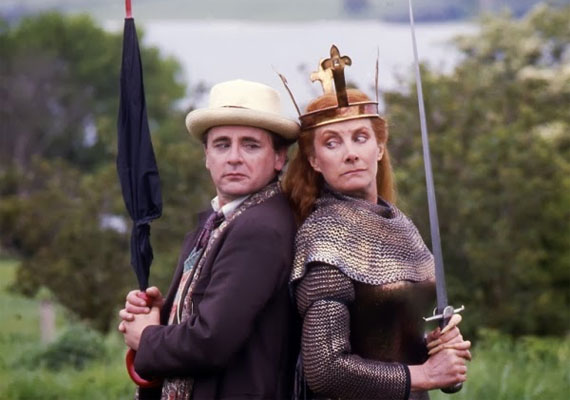
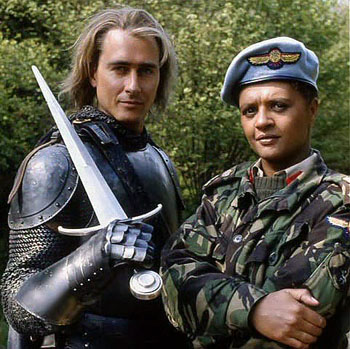
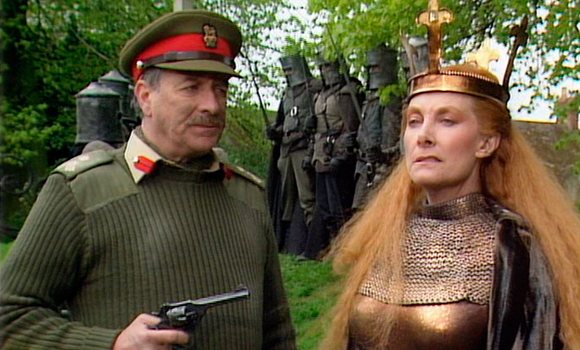
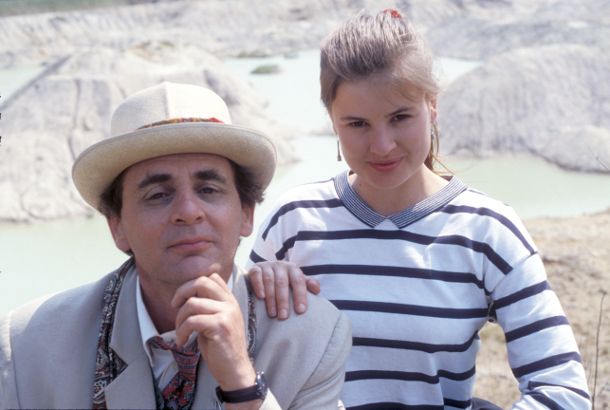
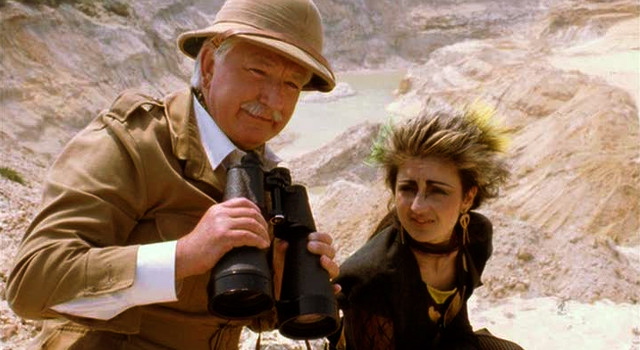
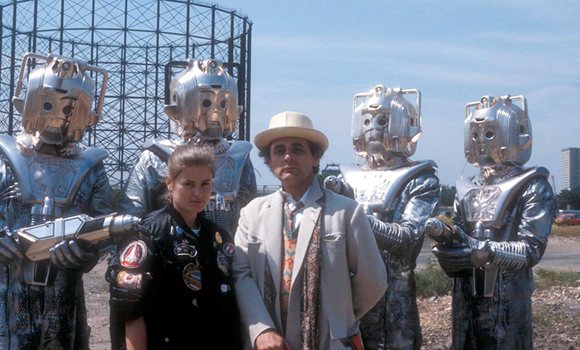
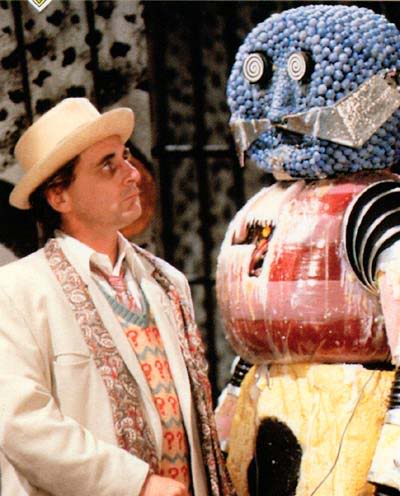
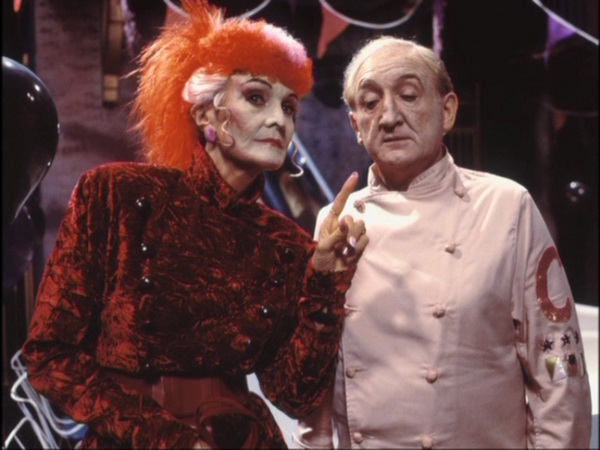
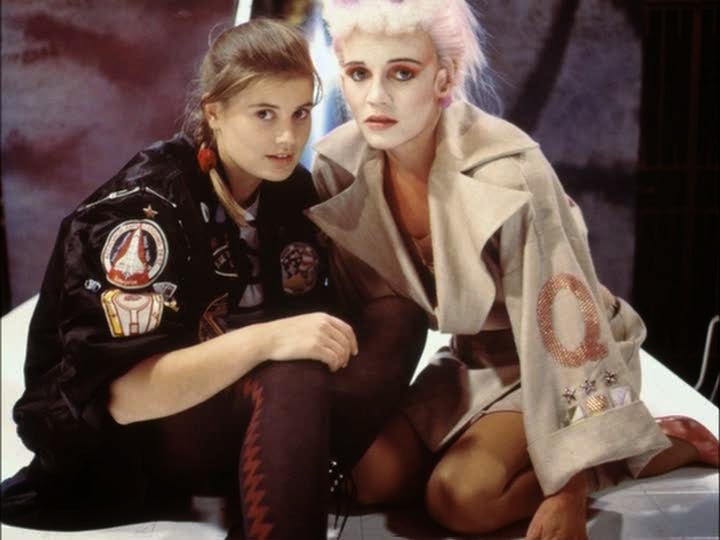
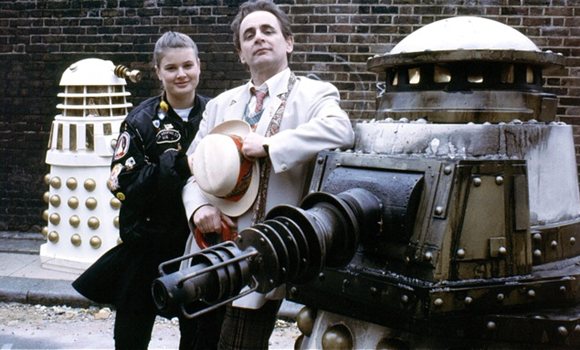
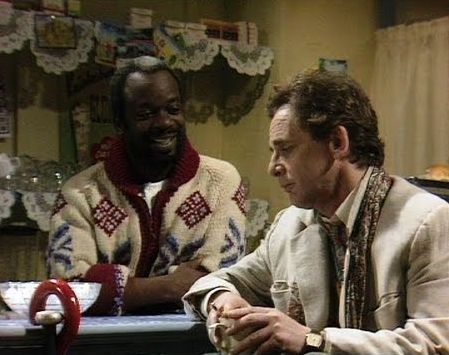
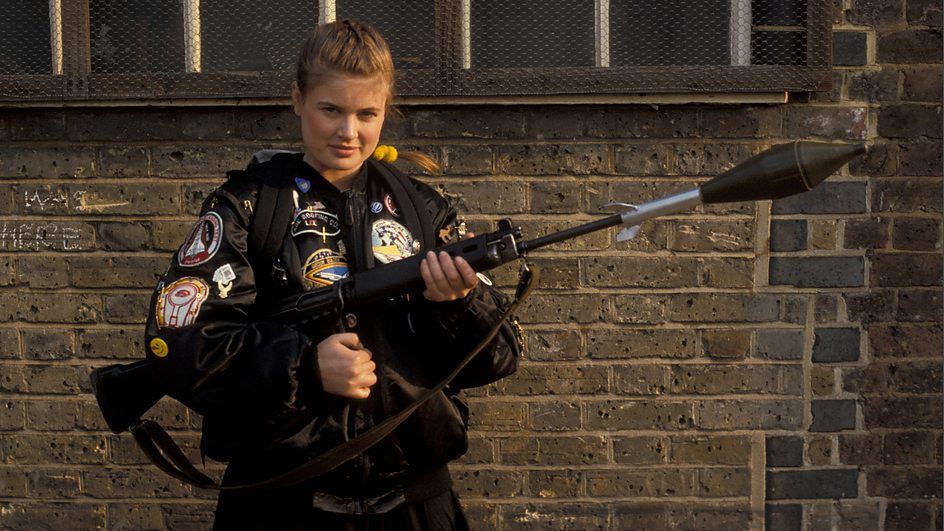
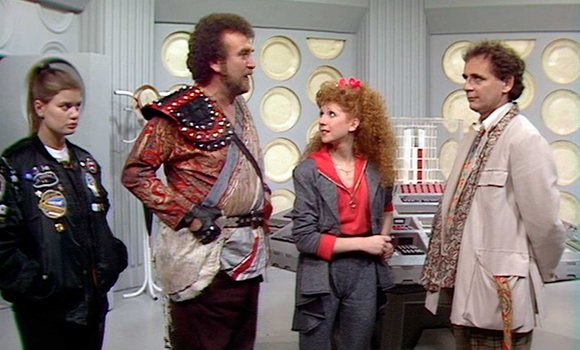
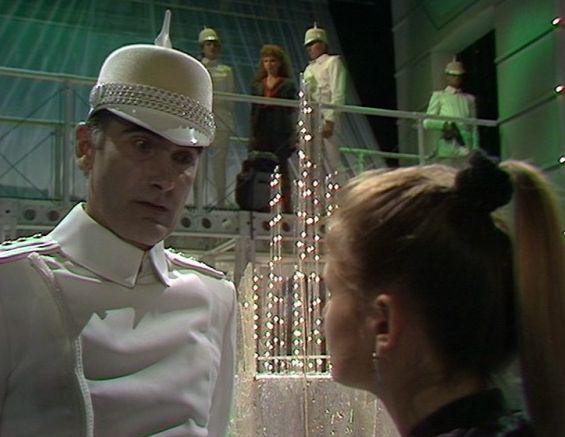




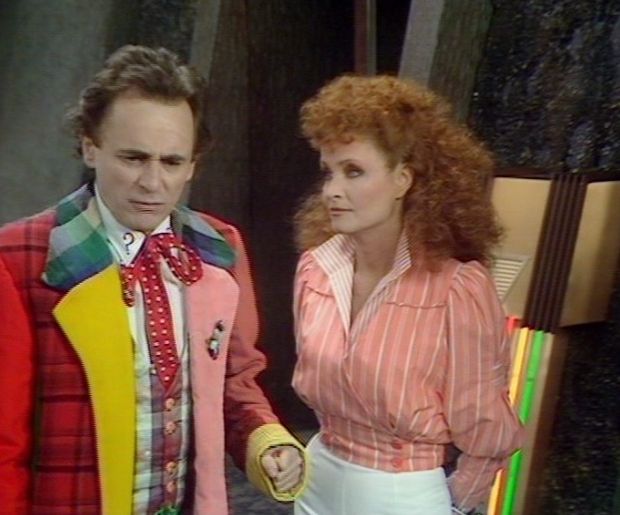
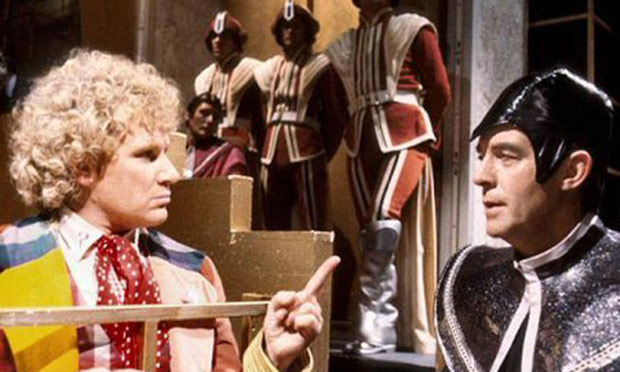
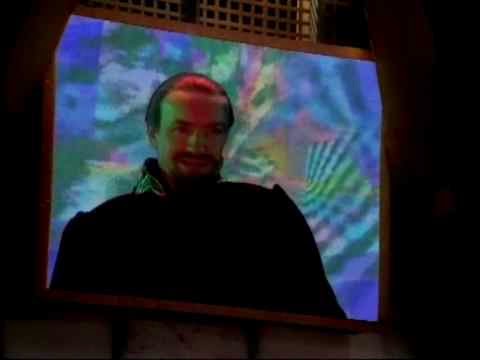
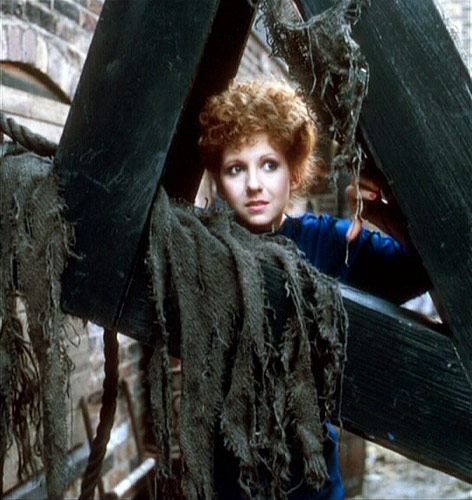

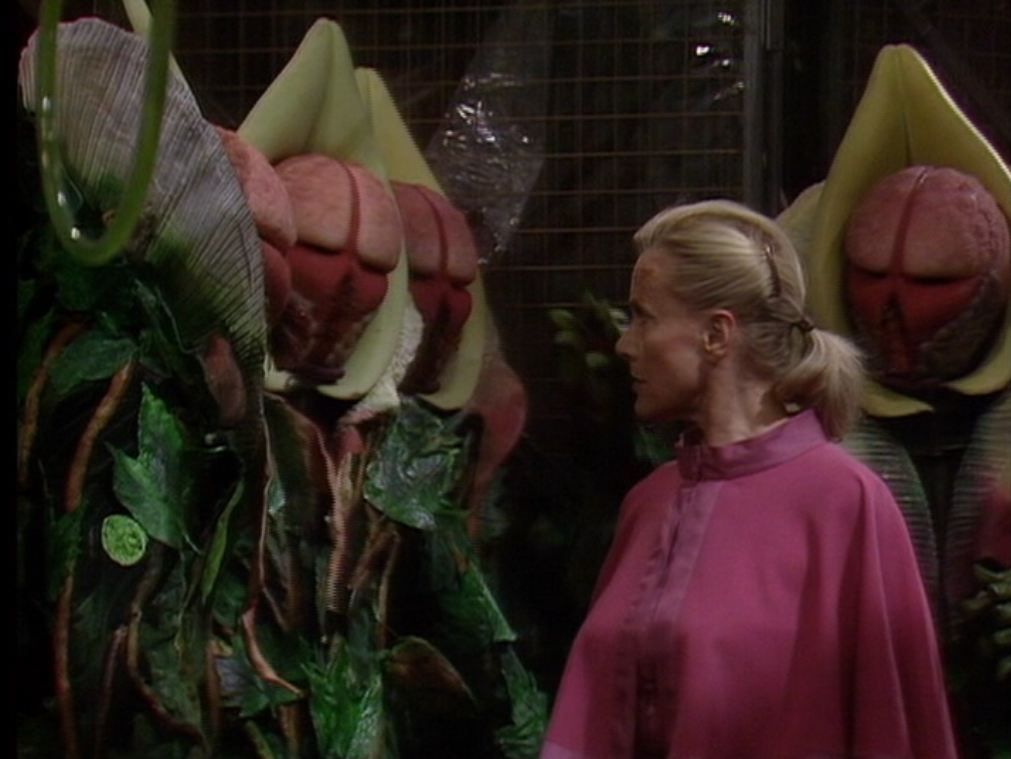
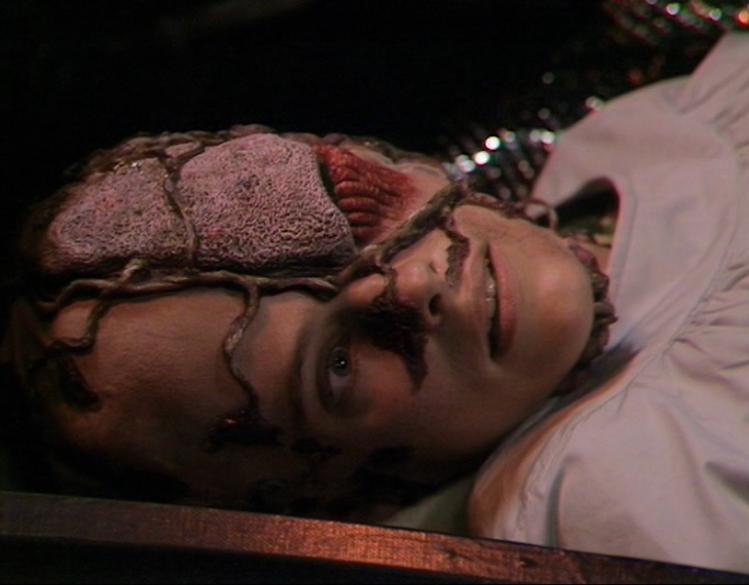
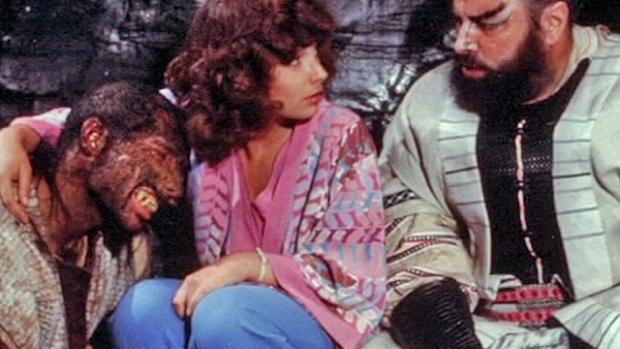
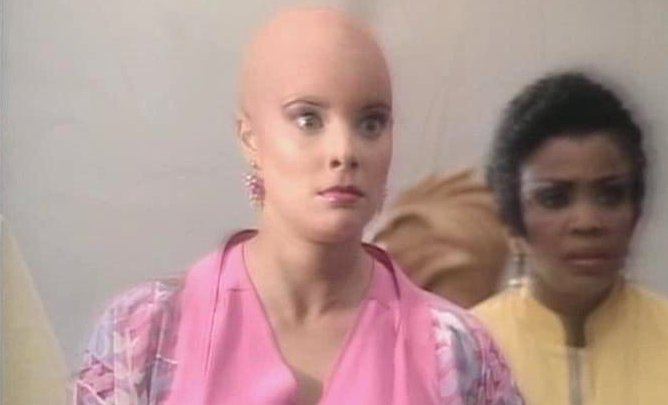

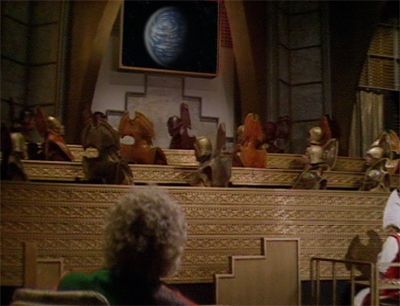
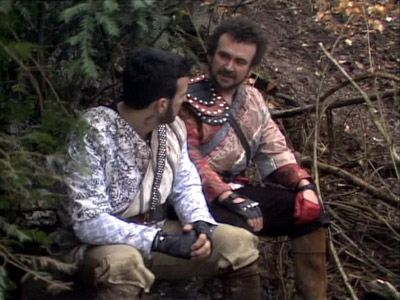
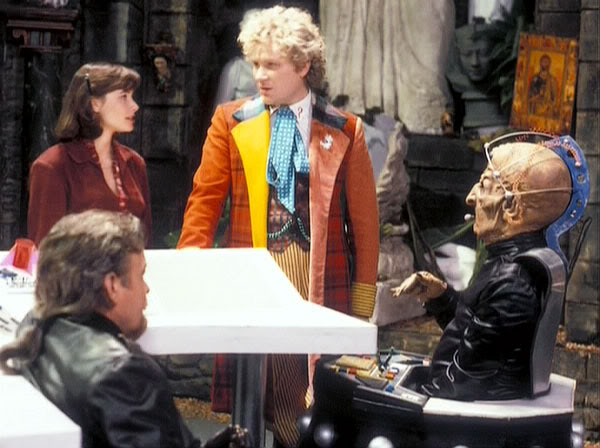
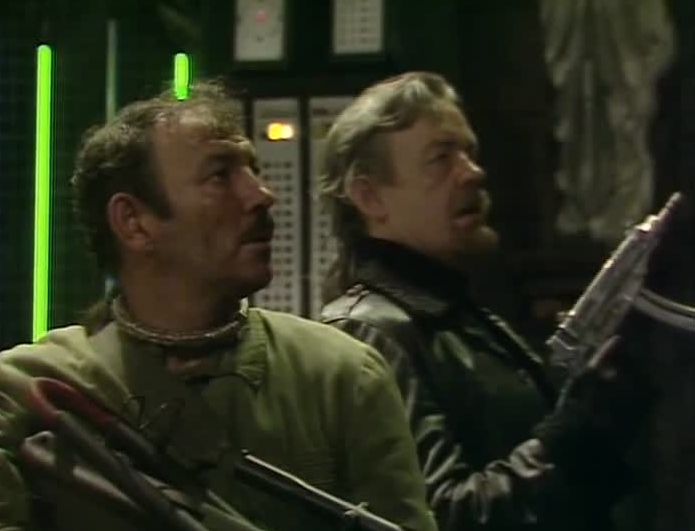

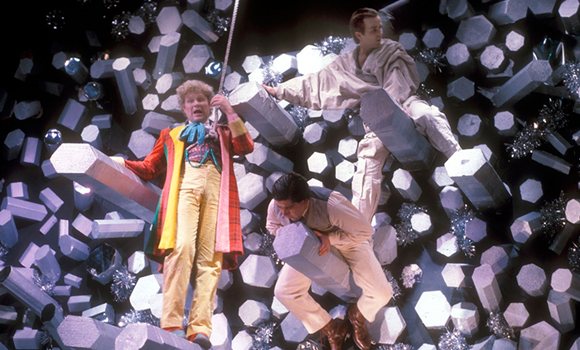
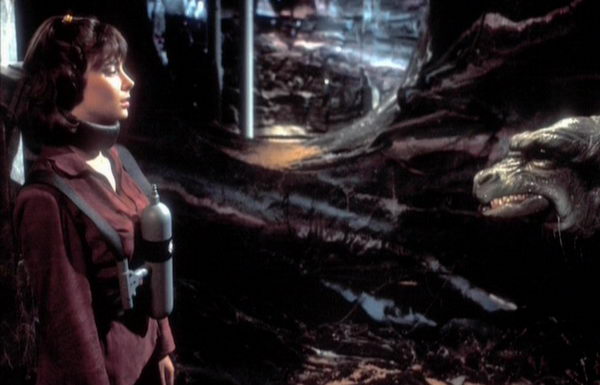
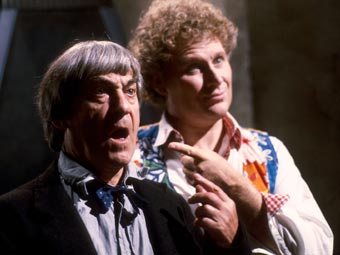
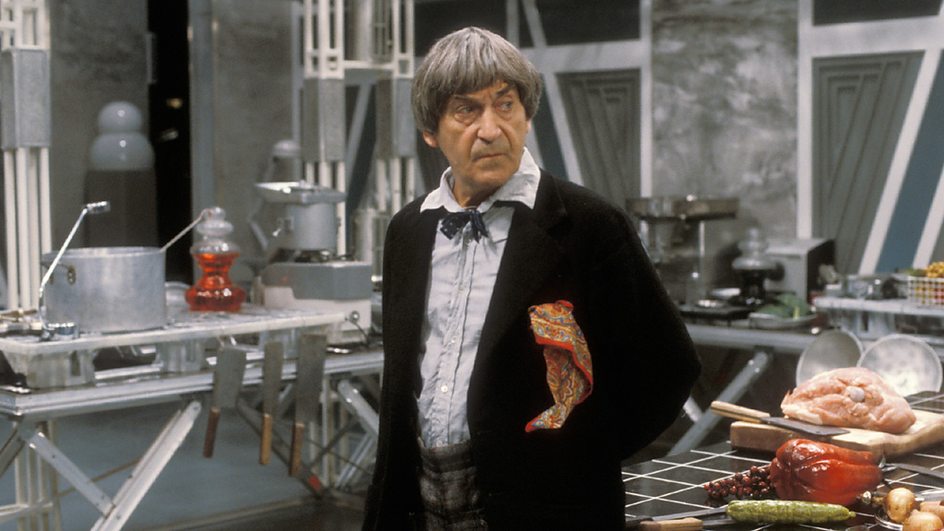

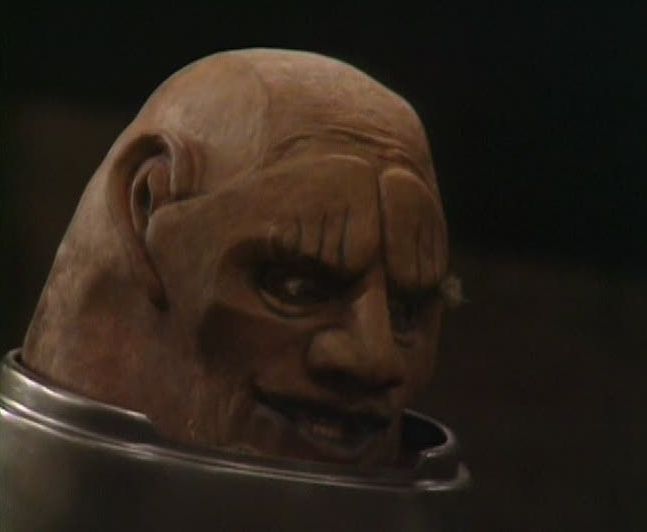
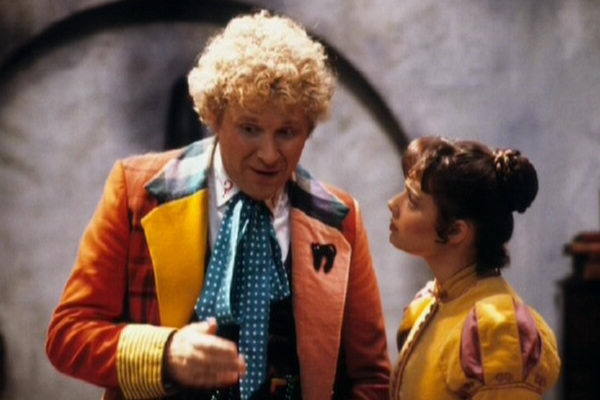
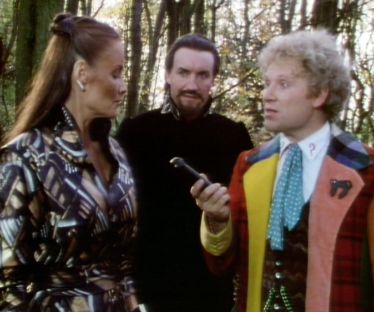
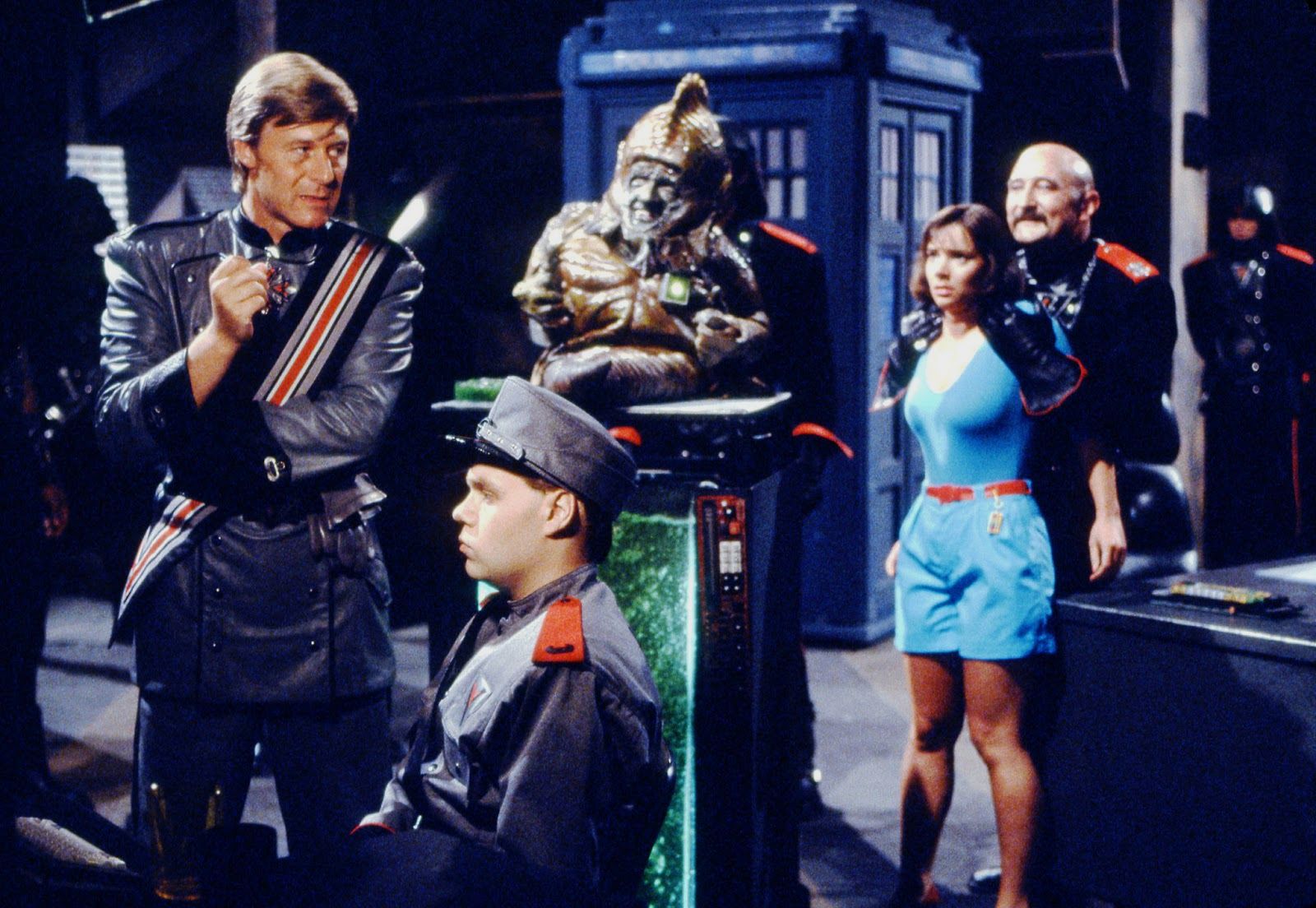
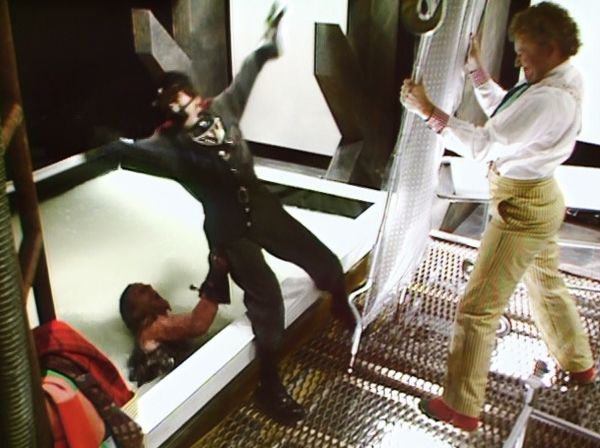
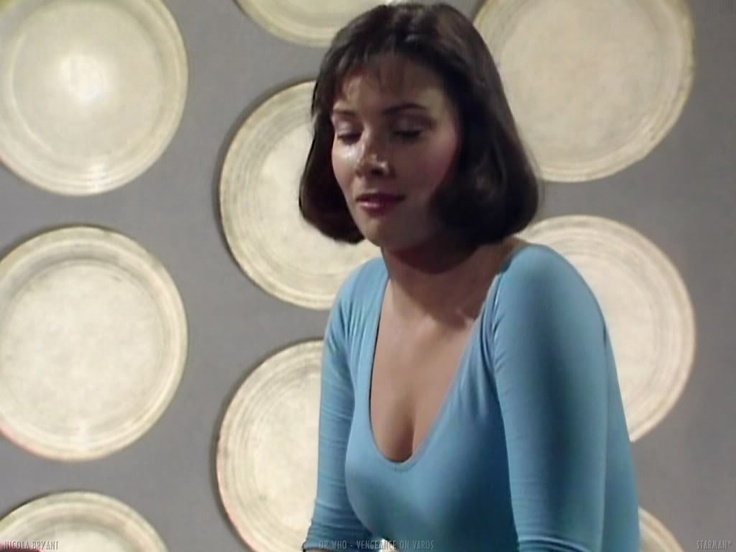
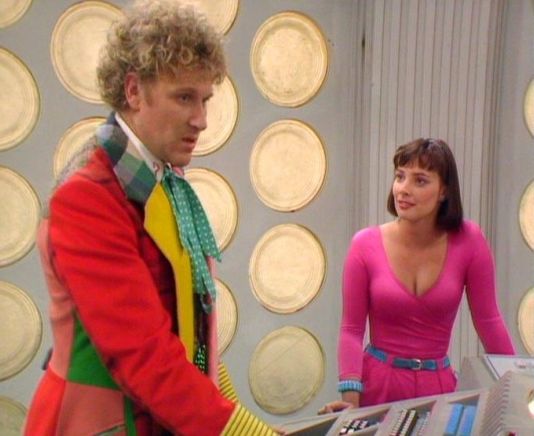
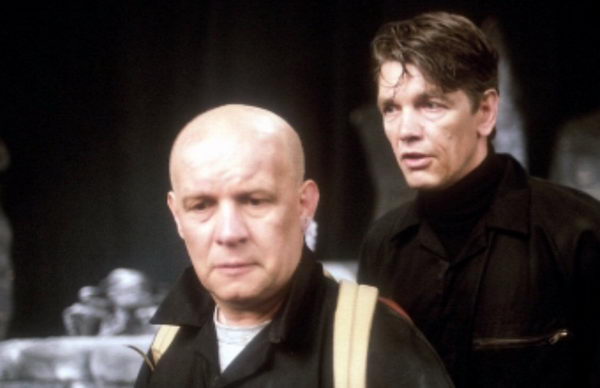
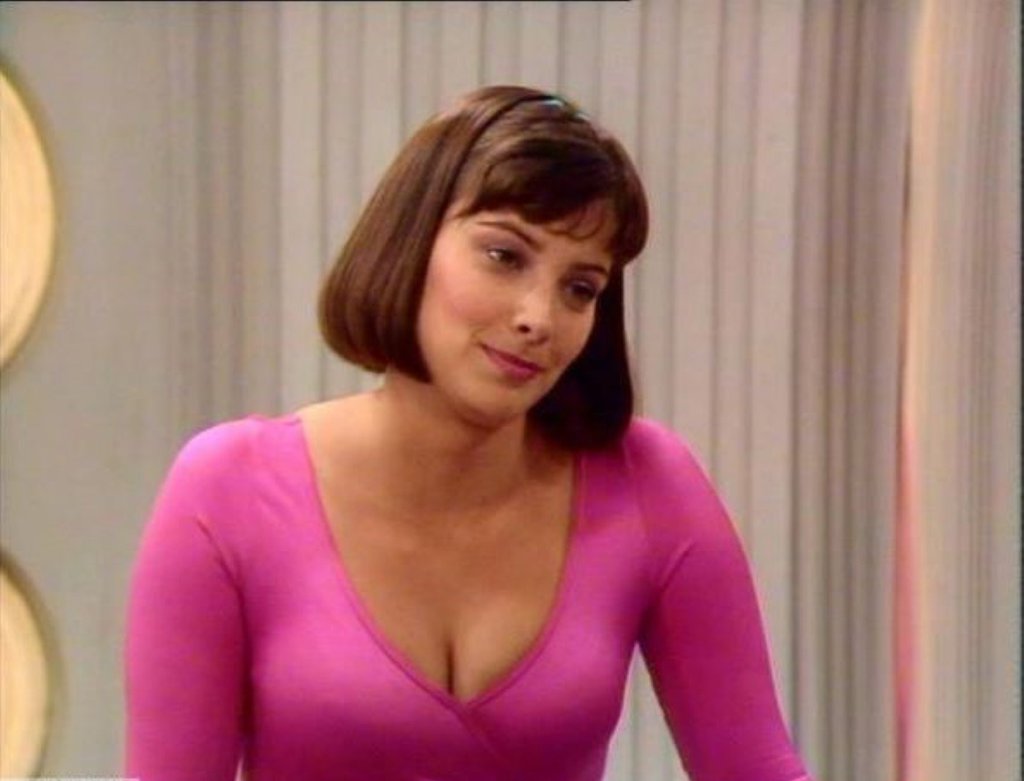
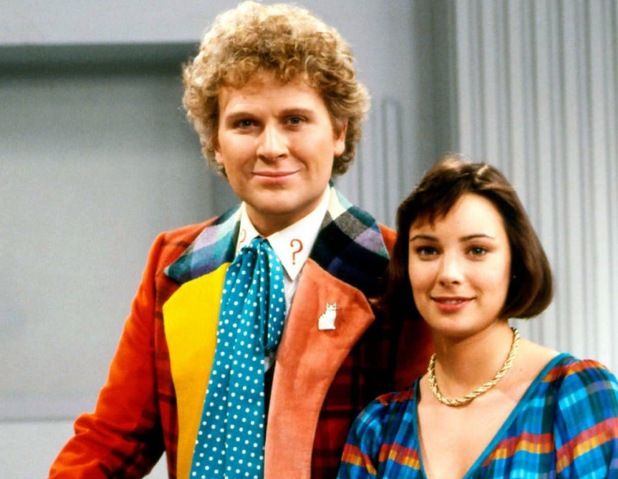
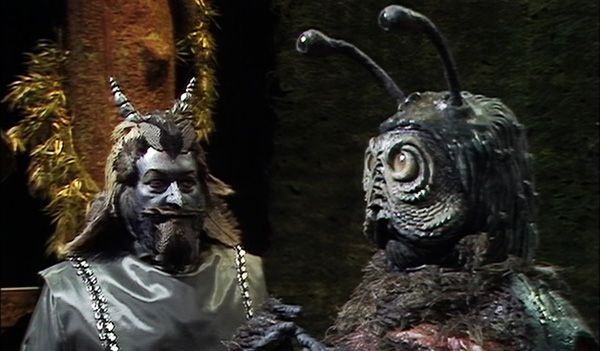
 Archive Television Musings