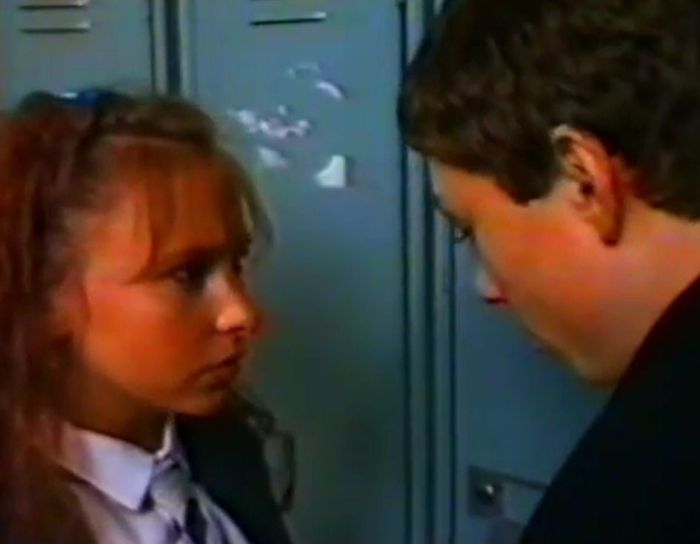
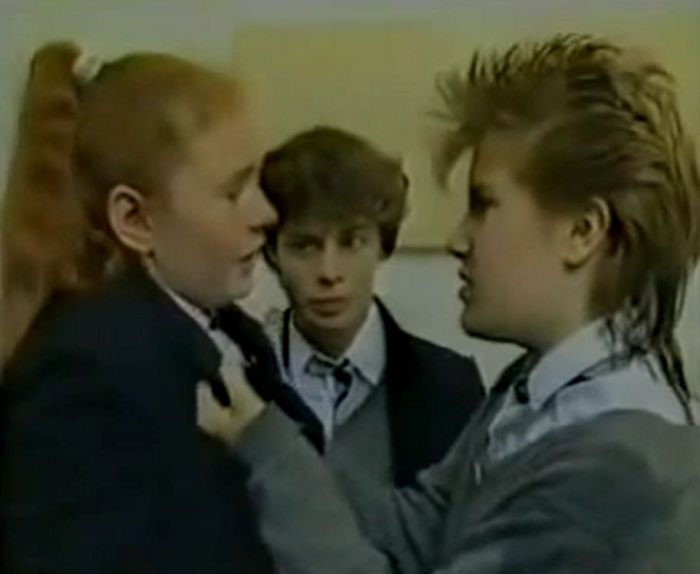
Grange Hill – Series Nine, Episode Thirteen

grange hill s09e13.jpg

Written by Margaret Simpson.  Tx 18th February 1986

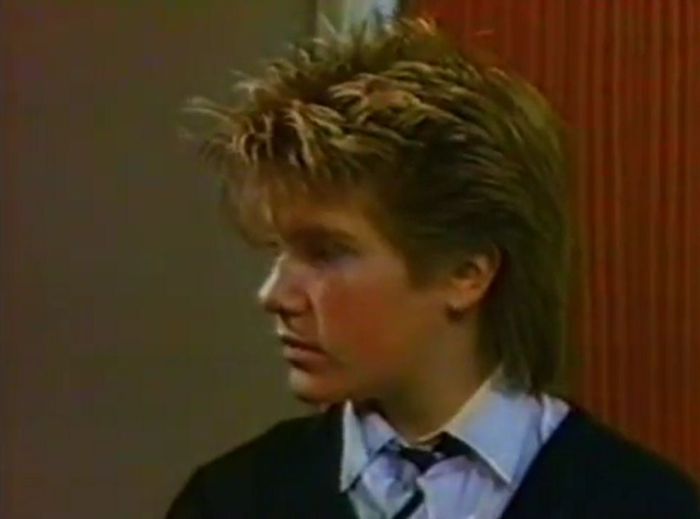
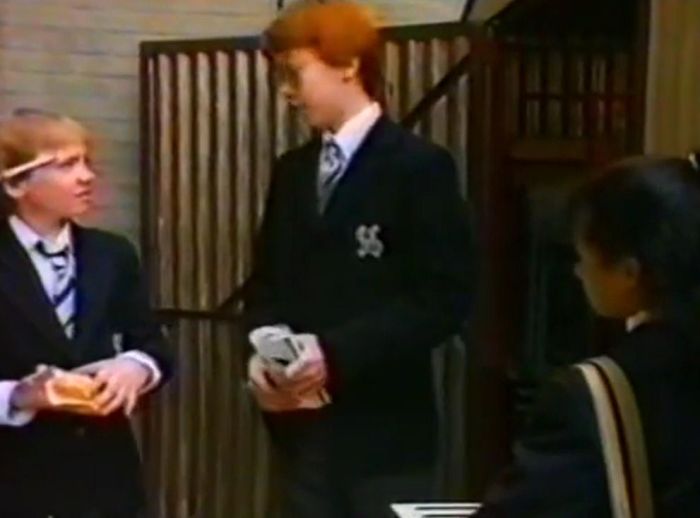
It’s half term, which is the cue for two episodes worth of out of school antics.  Ziggy and Robbie’s misadventures on the streets of London runs across this episode only whilst the travails of Roland/Zammo and Laura/Julia are spread across both.

Robbie elects to show Ziggy the sights, but since they don’t have any money the boys are forced to be creative.  For some reason (maybe budget related) there wasn’t a school trip this year, so these two episodes function as our main opportunity to see a handful of characters outside of the school environment.  That Margaret Simpson concentrates on only six regulars (although Louise also makes a brief appearance) helps to ensure that all the characters are afforded a decent amount of character development.

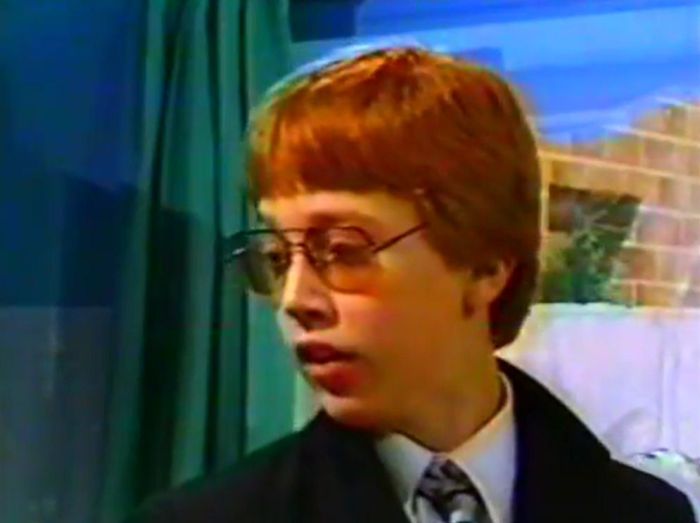
Robbie and Ziggy do a spot of ducking and diving (blagging their way onto a Thames pleasure boat for example) which gives their meanderings a slightly nihilistic feel.   It isn’t overstated, since they remain optimistic and cheerful, but there’s a vague sense that they’re dead-end kids with nothing to do and nowhere to go.  Later, when they run out of money the pair are forced to jump the barriers at the Tube station (and dodge the inevitably angry ticket collector).

But whilst both may be a little naughty at times they also still retain their child-like view of the world.  Ziggy’s belief that the Duke of Edinburgh had an intense interest in chalk, for example, or here – as Robbie elects to take Ziggy to a church where some years ago he saw bodies lying in an open crypt.  Unsurprisingly it’s a massive waste of time (the church has been turned into flats and the poor occupant they buzz is naturally perplexed by their request to see the bodies!).

For those who enjoy playing spot the well-known extra, look out some five minutes in as Pat Gorman makes a brief appearance (as man on escalator).

Across the years we only very rarely (Ray, Tucker) saw ex-pupils return to the series as adults.  This is a slight shame as it would have been interesting to have seen which ones sank and which ones swam.  Based on their time in school and their efforts here, it’s hard to imagine either Robbie or Ziggy having a glittering future once the doors of Grange Hill have closed on them for the last time.  But you never know ….

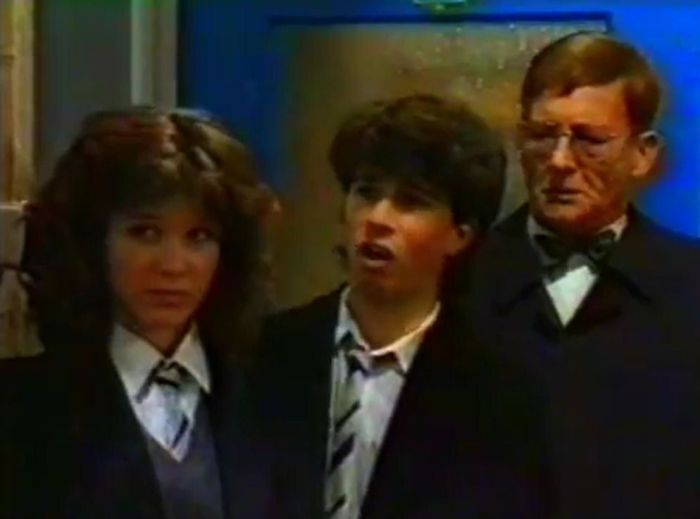
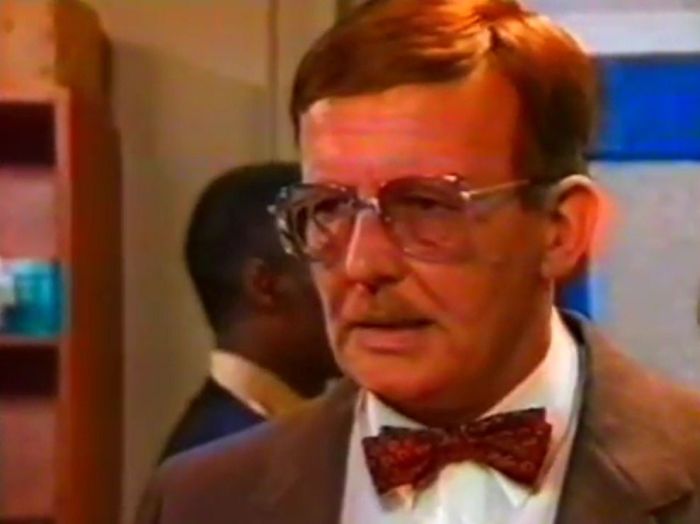
Laura and Julia are different cases altogether.  Both are intelligent, articulate and blessed with well-off parents, but neither of their home lives are necessarily always straightforward with Julia probably faring the worse.  We’ve already been primed that Julia’s father, Mr Glover (Vincent Brimble), is something of a tyrant and so it proves as we meet him for the first time.

Bad tempered would best sum him up. He’s far from happy with his daughter (especially the way she hogs the phone) and is firmly of the opinion that Laura and her mother are very bad influences on her. That he’s heading out to interview Mrs Reagan for the vacant post of head of sports at Grange Hill only adds a little spice to proceedings ….

Earlier in the series it was revealed that Mr Glover had blocked Mrs Reagan’s application. So either this is a second interview or somehow the plotline had become a little fractured (slightly sloppy script-editing maybe?)

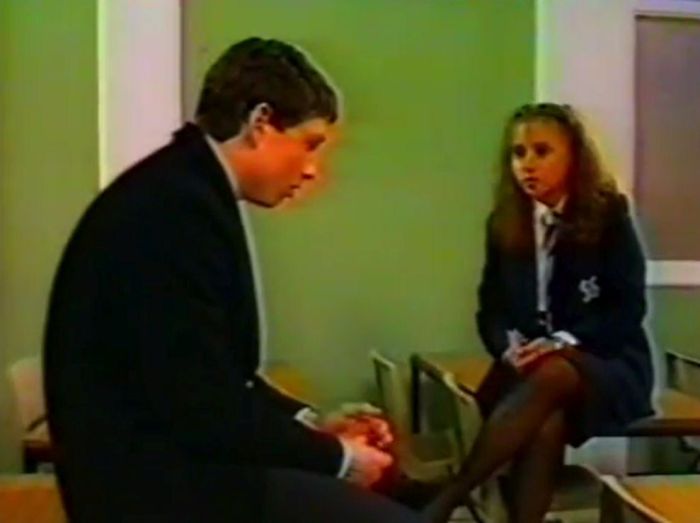
Julia and Laura want to go to an all-night party but it’s plain that Mr Glover would never give his permission.  So they decide to go anyway (telling Julia’s parents and Laura’s mother that they’ve gone to visit Julia’s father).  Although Mr Glover might be painted in a somewhat two-dimensional way, it’s difficult not to admit that – as we’ll see next time – his judgement wasn’t the one which was lacking.

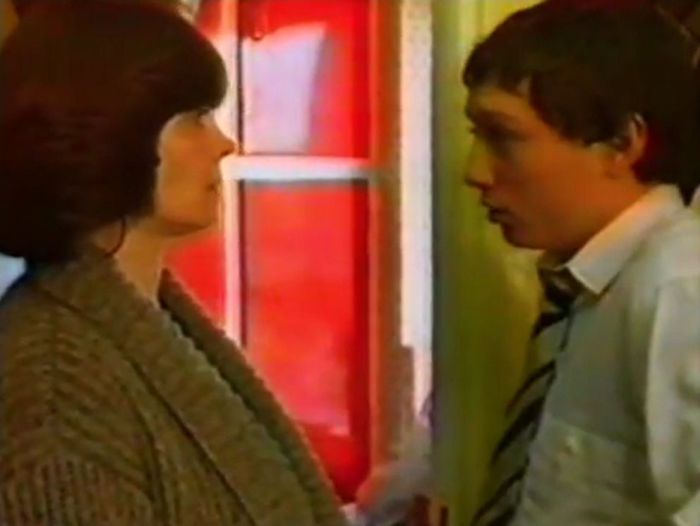
The mystery of Louise’s homelife is teased out a little more after she runs into Laura and Julia.  It’s obvious that Louise, with younger brothers in tow, doesn’t want to stop and talk, leaving the uncomfortable impression once again that all isn’t well at home.

It’s worth remembering that Mrs Reagan had asked the girls a while back to see if they could find out what the problem with Louise and her sister was.  But hey don’t appear to have done a great deal about this so far and it’s quite noticeable that although they do express a flicker of concern that Louise seems rushed off her feet, seconds afterwards they ignore her and return to the hot topic of whether Julia should have her ears pierced.

It has to be intentional that there’s a sharp cut early on from Ziggy’s bleak homelife (he shares a grimy one room flat with his parents) to the relatively palatial homes of both Laura and Julia. After Ziggy tells Robbie that anything (even traipsing around the city) has to be better than being stuck inside, the contrast between them and the two girls (chatting on the phone about boys they fancy and who – maybe – fancy them) is striking.

Meanwhile, Zammo’s story is reaching crisis point.  Zammo, along with Doug, Howard (Mike Smart) and Tamsin (Tracey Willmott) make their way to the arcade where Roland is working part-time.  All of Zammo’s companions are of the dubious variety, which instantly makes Roland a little suspicious – but he agrees that they can use the backroom (so that Tamsin can cut Zammo’s hair).  We later see them exit, with Zammo’s hair unchanged, so whatever happened in the room didn’t involve hair. By now the attentive viewer should have a good idea exactly what has been going on – which will be confirmed next time.
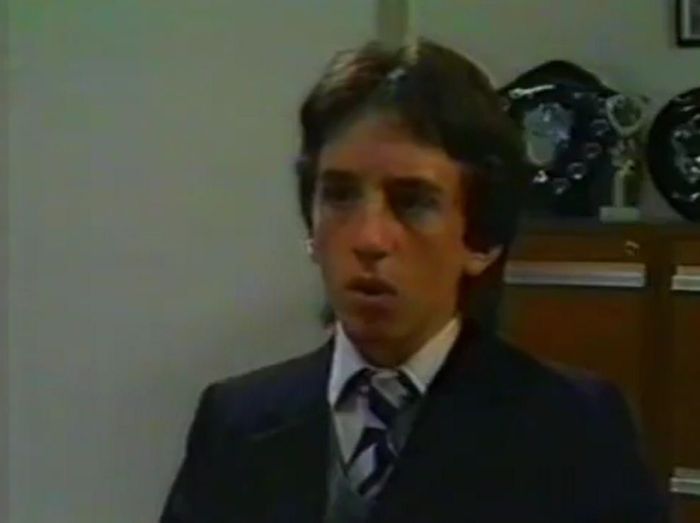
Grange Hill – Series Nine, Episode Twelve

grange hill s09e12-1

Written by Barry Purchese. Tx 14th February 1986

It’s a filthy wet day outside, which possibly might explain why Grange Hill is graced with Danny’s presence for the whole day.  That’s not to say he keeps out of trouble though – an early skirmish with Mrs Reagan means that he’s sent to Mr Baxter’s office.

This is an episode which really examines what makes Danny tick.  His self-contained nature and reluctance to engage have been seen before – although it’s now suggested that he’s tried the patience of just about every teacher in the school.  Danny just wants to be left alone, which is obviously never going to happen.  He might be an (unwilling) member of the school but doesn’t accept that any of the school rules should apply to him.

We’ve not really seen him encounter Mr Bronson before.  In the future Mr Bronson and Danny will share some dramatic storylines, but here the teacher is almost genial (or as genial as Mr Bronson ever gets).  Knowing that Danny is likely to stray if left unattended, Mr Bronson takes charge of him and escorts him to Mr Baxter’s office (“you have a tendency to veer off course, don’t you Kendall? Like a defective supermarket trolley”).

Mr Baxter’s heart to heart with the boy is again played out against the backdrop of rain lashing against the windows.  This helps to create a sense of claustrophobia as the teacher then leaves Danny alone to ponder his future, although Danny believes he hasn’t got one – at Grange Hill at least – since he’s already been marked down as a troublemaker.  Although there still might be hope for others.

Given that he’s rarely interacted with either his fellow pupils or the teachers on a friendly basis, it’s slightly surprising that he speaks to Laura on behalf of Georgina (Georgina wants Laura to have a word with her mother about Ant’s feud with Mr Bronson).  True, Danny doesn’t say anything when Georgina asks him, but he does do it – even though he later tells Ant that he should apologise to Mr Bronson.  He doesn’t have to mean it, he only has to say the words …..

One of the problems with creating a character like Danny, who appeared out of nowhere during series nine as a third year, is that his previous school life is a complete blank.   There’s the first hint that he might just have an interest in a school activity – he speaks to Miss Booth about the competition to create a new school logo – but this suggests that he’s spent several years displaying no artistic talent whatsoever.  Given that he later seems to live in the art room, this is a little hard to believe.

Nominations for the staff/pupil editorial committee are made.  Laura is desperate to be elected (and is) whilst Gonch (unwillingly) as well as Calley and Fay (willingly) are also voted on.  Fay then suggests they have a male member of staff to compliment Miss Booth and Miss Partridge.  She suggests Mr King (does Julie slightly roll her eyes at this?).  It’s been a few episodes since Fay expressed her feelings for Mr King (she really likes him but doesn’t, repeat doesn’t, fancy him).  Hmm, this is plainly set up as an accident waiting to happen.

There’s been a nice touch of continuity this year as we’ve seen several teachers with colds.  First it was Miss Partridge and now it’s Mr Bronson.  It’s hardly a major plot point, but it’s noticeable nonetheless.  This episode is also noteworthy for the brevity of Mrs McClusky’s appearance – she pops up in the first scene, exchanges a few words with Mrs Reagan, and then vanishes.  Hopefully Gwyneth Powell recorded scenes for some other episodes on the same day, otherwise it seems a bit of a waste to drag her out just for thirty seconds.

Mr Bronson and Mr Baxter break the bad news to Ziggy that the Duke of Edinburgh isn’t coming to Grange Hill.  Well, Mr Baxter breaks the bad news (Mr Bronson isn’t too sympathetic).  I love the way that Mr Baxter points out that Ziggy’s letter is an obvious forgery, making the reasonable suggestion that the Duke would know how to spell Edinburgh!  Gardener and Holloway clearly haven’t been paying attention during their English lessons …..

grange hill s09e12-2

Grange Hill – Series Ten, Episode Eleven

gramge hill s09e11 - 1

Written by John Godber. Tx 11th February 1986

Ziggy and Robbie are diligently collecting every scrap of chalk they can find, convinced that a grateful Duke of Edinburgh will be delighted with their efforts.  I love the way that most of the teachers – Mr King, Mr Kennedy – also swallow this story hook, line and sinker but suspicious old Mr Baxter proves much harder to convince.  It’s a small character beat, but it demonsrates that Mr Baxter has been round the block several times and doesn’t take anything on trust.

Calley’s school fanzine (or the school magazine as it now seems to be) has Mrs McClusky’s blessing, although she obviously wants some form of editorial control to be wielded by the staff.   This isn’t the sort of news that Calley, Ronnie, Laura, Fay and Julie want to hear, but Mrs McClusky – skilled politician that she is – seems to have gotten her way.  These days Mrs McClusky seems to be a more relaxed individual than the control freak of the early 1980’s, although possibly she’s just the same – it’s just that the ratio between velvet glove and iron fist has changed.  So whilst she may appear to be more conciliatory there’s still the same drive to ensure that she always gets her own way.

A little time seems to have passed since the recording of the previous episode (maybe there was a mid-season break?) as several pupils, notably Helen are now sporting new hairstyles.  But whilst Helen might look slightly different, she’s still Imelda’s yes-woman (Georgina remains Imelda’s maybe-woman).  Imelda’s latest wheeze is demanding money with maximum menaces – twenty pence from every first year and once they’ve paid up the edge of their timetable is clipped (confirming that they’ve paid).

This seems like a sensible plan, although there’s a few obvious flaws, not least the fact that some resourceful first-years clip their own timetables, thereby fooling the older girls.  This lack of forward planning, as well as Imelda’s own recklessness, spells the end for her as her scheme is rumbled and she’s suspended.  This gives the others a temporary respite, but she’ll be back …..

She did take a little catching though, as Mr Baxter and Mr Griffiths found out.  Still, once Mr Griffiths had a firm hold of her, Mr Baxter’s anger was enough to quieten her down.  This is another good episode for Michael Cronin – as we also see Mr Baxter share a few nice scenes with Ant and display disbelief that the Duke of Edinburgh would ever consider visiting a place like Grange Hill.

Georgina is distraught. Now that Imelda’s been caught she knows she will be next to face the wrath of Mrs McClusky.  What will her parents say?  Ant attempts to console her (this involves holding her close) but one again the fates are against him as Mr Bronson happens to walk by.  “In case you have forgotten, this is a school Mr Jones, not a harem!”

The viewer hardly has time to draw breath from this beautifully delivered line from Michael Sheard before the action ramps up several notches.  Mr Bronson pulls Ant from the bench where he and Georgina are sitting and eyeballs him – Ant then roughly pushes him away, causing Mr Bronson to fall over (naturally, his first action when he hits the ground is to check that his wig is still in place!)

What’s fascinating about this moment is that Ant claims that he never touched him when it’s plainly obvious that he shoved the teacher quite violently.  Ant may like to play the victim but the facts don’t always equate with this (as has been seen before).  Mr Bronson’s not best pleased as you might expect.  “You’ve done it now, Jones.  Assault, that’s what this is. Assault”.

It’s been a while since we’ve seen Mrs McClusky’s faithful, but non-speaking secretary, Janet. She has one of her finest moments here as Mr Bronson frog-marches Ant and Georgina into Mrs Clusky’s office and stammers that Ant assaulted him.  Although it’s when he divulges that Ant and Georgina were kissing that Janet pulls a wonderful face.  Lovely stuff!

Ant is given an ultimatum.  If he apologies to Mr Bronson then the matter will be considered closed.  But the headstrong Ant can’t bring himself to do so ……

gramge hill s09e11 - 2

Grange Hill – Series Nine, Episode Ten

gramge hill s09e10 - 1.jpg

Written by Sarah Daniels. Tx 7th February 1986

The temporary classrooms finally arrive – this spells trouble for Mr Bronson’s car which, if he doesn’t move it, is likely to be turned into a pile of scrap metal.  Mr Baxter is understandably not terribly concerned (believing that it would probably be worth more to him as scrap!) but eventually deigns to send the ever-helpful Janet up to the staffroom to warn him.

There’s obvious comic potential in the sight of Mr Bronson running to the aid of his car, which is heightened when it’s revealed that the crane driver is – wait for it – a woman (played by Holly De Jong).  Calley and Ronnie, watching from an upstairs window, debate the merits of female crane drivers (Ronnie wonders how on earth a woman could have possibility got such a job).  The reactions from the older male teachers are equally as nonplussed.  Mr Baxter blurts out “you’re a woman” to her.  She replies that yes she is, and wonders if he teaches biology!

Mr Griffiths’ hero worship of Mrs McClusky is always a joy to behold.  Here, she tells him that it’ll be some time before they can go back to the old school, so the temporary classrooms will be around for a while.  He’s not delighted at the news (“oh my god”) but the look of pleasure and pride on his face when she tells him that he’s the first person she’s told about this – ahead of all the staff – is worth the price of admission alone.  Puffing out his chest and standing straight like a soldier, he assures her that his staff will give the school their 100% co-operation.  If only everybody could be as easily manipulated as Mr Griffiths …..

Ziggy and Robbie continue their never-ending quest to gain revenge on Imelda.  This week it’s water balloons.  I don’t really need to tell you that this ends in total catastrophe for them, do I?  In other news, Robbie’s had a haircut.  Not the most thrilling nugget of information I know, but when watching the series back-to-back things like this stand out.

Speaking of Ziggy, he’s had a reply back from the Duke of Edinburgh.  Since he’s absent, Gonch asks if he can pop round to his flat to deliver the letter.  That sounds remarkably helpful, so you probably won’t be shocked to learn that Gonch plans to substitute the rather bland and non-committal reply with something much more creative – which will lead Ziggy to believe that the Duke will shortly be visiting Grange Hill and will be pleased to receive as many chalk ends from Ziggy as can be collected.

Will Ziggy fall for such an obvious falsehood?  Course he will!  To further their devilish plans, Gonch and Hollo visit a local newsagents to run off some blank headed paper with the Duke of Edinburgh’s crest, which will enable them to write their own letter.  The shop is a lovely time capsule of the period – complete with mouth-watering jars of sweets behind the counter (although they were surely an anachronism even back then) – and a friendly shopkeeper (played by the very recognisable Brenda Cowling) happy to help the two lads (she believes they’re working on the Duke of Edinburgh’s award scheme).

A slight sliver of reality is introduced when they bluff her that the Duke is interested in the travails of inner-city life.  She sympathizes with this and tells them that running a shop in an area like this is no joke, due to the amount of shoplifting that goes on.   It wouldn’t have been a surprise to see them take advantage of such a kindly woman and indeed Hollo does stuff some chocolate bars into his pocket when she isn’t looking, but Gonch (“how would you like it if she was your Nan?”) makes him put them back.  He has his standards then.

There’s a lovely visual gag as the pair exit the shop and run back to school.  They pass a church which displays an ominous sign (be sure your sin will find you out).  And since the sign handily tells us that it’s Leavesden Road Baptist Church, a quick skim through Google Maps will find the same location today.  When I’ve got the time it might be interesting to try and pinpoint some of the other GH locations from this era.

Zammo’s devious plan to convince his mother that he hasn’t sold her decanter (instead he broke it in an accident) is played out here.  Part one requires pinching a glass beaker from a lab assistant (played by Tom Keller).  Whilst we know that Zammo isn’t the most together of people these days, this is odd.  For one thing, the smashed beaker wouldn’t resemble in any way the smashed decanter and for another, it’s difficult to see how dropping the decanter a couple of feet would have caused it to break (surely for something that sturdily built it would have to have fallen from a great height).

It’s therefore more than a little interesting that Mrs McGuire seems to swallow this unbelievable story so readily.  True, she does wonder where the stopper is (Zammo, thinking quickly, tells her that he’s sold it) but otherwise Zammo’s plan seems to have worked.  Or has it?  There’s several different ways this scene can be interpreted – either Mrs McGuire does believe her son’s story or she can’t yet bring herself to confront his lies and evasions.

The disappearance of her bike (presumably stolen and sold by Zammo like everything else) is another of those moments where it’s left dangling as to whether she believes his protests of innocence or not.  What’s noticeable about this scene is that Zammo seems more together and lies more fluently than he recently has been able to do to Jackie (he also looks his mother in the eye, something he hasn’t been able to do with Jackie).  There are several possibilities to explain this – either he feels more guilty when he lies to Jackie or he’s recently been drugged up and is therefore temporarily back in control.  Nothing’s ever explicitly stated, so the viewer is left to draw their own conclusions.

gramge hill s09e10 - 2

Grange Hill – Series Nine, Episode Nine

grange hill s09e09

Written by Sarah Daniels.  Tx 4th February 1986

The overcrowding becomes chronic as Mr Kennedy is forced to conduct a drama lesson with G3 on the stairs. Most enter into the spirit of things although Laura isn’t pleased about the way having to squat on the stairs is dirtying her uniform whilst Danny just isn’t pleased. He makes it plain that he’d sooner be anywhere else but here – pretending to be a passenger aboard a spacecraft just isn’t his forte.

Ziggy and Robbie’s plan to gain revenge on Imelda continues.  They conjur up a noxious, sticky brew and are all set to deliver the killer blow.  I wonder what happens next?  Oh yes, Mr Griffiths just happens once again to be in the wrong place at the wrong time and ends up being the unwilling recipient of their hard work.  There’s an undeniable predictability about this, but a touch of knockabout farce is always welcome plus it helps to balance out the more serious themes elsewhere.

A fair amount of this episode takes place outside the school grounds. Therefore we’re presented with ample local colour as Ant and Georgina walk past the canal (with towerblocks in the distance) and elsewhere Jackie stalks Zammo down the local high street. The early series of GH had a strong inner-city feel, which has tended to fade away more recently, so these scenes help to reconnect the characters to their environment.

Mrs Reagan is convinced that all is not well with Louise’s family and asks Laura and Julia to investigate. Laura’s initially reluctant to act as a spy, but soon enters into the spirit of things.

But it’s Zammo and his problems which are dominating.  This episode gives Doug (Paul Vincent) his first dialogue – a few episodes back Jackie had spotted him and Zammo in the distance.  Just by looking at him we can tell that Doug’s bad news – and if any further evidence was needed, the way that he and Zammo rifle through Mrs McGuire’s belongings, looking for anything decent they can sell, should confirm our suspicions.

Doug finds slim pickings, but a cut glass decanter makes his eyes light up (Barry Manilow records less so). The flat scene was recorded on location rather than in the studio which means that like the previous location scenes it helps to firmly ground this episode in mid eighties London.

Mrs McGuire makes the first of her handful of series nine appearances next time.  It’s slightly odd that she’s been held back until this point as you’d have assumed there would have been a certain amount of dramatic mileage to be gained from her interactions with Zammo.  Maybe the intention was not to foreground precisely what Zammo’s problem was too soon, but it does feel slightly odd.
Zammo’s increasing isolation from his friends and family makes sense, but it’s notable that – Jackie apart – we’ve not seen anybody express concern about him.  Apart from the dramatic possibilities missed, this maybe sends out the wrong message – friends and family should be the ones primed to spot danger signs and then attempt to help. Maybe the message here is that had Zammo’s friends been more active the situation wouldn’t have spiraled out of control.

This was the first GH episode written by Sarah Daniels.  Daniels (b. 1957) came to prominence as a playwright in the early 1980’s and by the time that decade was over had penned a series of challenging plays, all of which had a strong feminist streak.  Critic Carole Woddis once called her “the only radical lesbian feminist to have made it into the mainstream”.

The same year that she debuted on Grange Hill, her play Neaptide was running at the National Theatre.  Neaptide has recently been performed again at the National as a rehearsed reading (it launched the National’s short Queer Theatre season).  It’s interesting to ponder whether the school setting of the play informed any of her work on GH.

Grange Hill wouldn’t seem at first glance to be the obvious television programme for her, but clearly she found working on the series to be stimulating, since she would go on to write sixty six episodes between 1986 and 2007.  This impressive unbroken run, stretching from series nine to series thirty (although for some reason she didn’t return for the series’ thirty first and final series), is easily her most substantial television contribution (elsewhere she penned a handful of episodes for EastEnders and Medics).

Grange Hill – Series Nine, Episode Eight

grange hill s09e08.jpg

Written by Frances Galleymore.  Tx 31st January 1986

The mark of a decent bully is how effective they are at extorting money from others.  Gripper was, of course, a past master at this – but so far Imelda has lagged behind somewhat.  So this episode gives her the chance to catch up as she decides that a piece of Gonch’s toast business would be very welcome.

Gonch is having none of this though, which makes him – and more especially his trousers – a target for Imelda and the others.  Have I mentioned that Imelda’s gang is nicknamed the Terrahawks?  That’s one up on Gripper who never had a name for his gang.

There’s possibly an article to be written about the number of times boys are relieved of their trousers in Grange Hill (although this isn’t the time or place you may be thankful to learn).  Imelda only wanted the money in Gonch’s pockets, so why she couldn’t have just reached in his pockets is a slight mystery.

No matter though as it’s an opportunity to show the usually self-reliant Gonch under pressure.  He can stand up to most people – the way he bats off the approach of Trevor and Vince (also keen to get a slice – sorry – of the toast action) is a treat – but Imelda’s a special case.

Ziggy’s also engaging in his own battles with Imelda.  Unfortunately Mr Griffiths is in the wrong place at the wrong time and becomes collateral damage (a bucket of paint on the head).  Mr Griffiths blames the innocent Ziggy for this, so there’s plenty of fist shaking and chases around the school as Frances Galleymore takes the opportunity to ramp up the comedy.  Ziggy and Robbie’s attempt to breach the girl’s changing room – all in the course of justice, naturally – is another entertaining scene. It’s also notable as the first real time they join forces – from now on the pair will pretty much be inseparable.

Prior to Imelda’s involvement, Gonch and Hollo’s toast business had been thriving although they had to deal with the odd consumer complaint (“There’s an earwig in my butter!”) Gonch attempts to pour oil on troubled waters by telling Jane that it was only a small one.

Georgina and Helen share another quiet scene. Georgina’s desire to break away from Imelda’s influence becomes ever more apparent whilst Helen continues to tread a fine line between the pair of them. Another oft-stated theme is repeated here – Georgina is keen to settle down and pass her exams, a statement which Helen reacts to incredulously. What’s the point in working when there won’t be any jobs for them after they leave school?

Mr Bronson’s cruel streak is very much in evidence.  A recent letter-writing initiative saw Roland write to Fabienne and – after he’s perused it – Mr Bronson asks the boy to read the letter out in class.  It’s somewhat personal in nature and the fact that Mr Bronson knew this but still asked Roland to proceed is a telling moment.

This is a rare visit to N5’s class. It’s not commented upon, but Zammo is very conspicuous by his absence ….

Grange Hill – Series Nine, Episode Seven

grange hill s09e07

Written by Frances Galleymore.  Tx 28th September 1986

Julia contnues to moon over Ant whilst Georgina continues to avoid Imelda.

Mr Bronson’s not a happy chappy (the overcrowded staff room is just one of many irritations). Some of the non-speaking extras are also dischuffed – banging down empty coffee containers in a petulant manner – but Mr Bronson is the one who voices the discontent many feel.

A solution to their problems has been found – portacabins.  But when they don’t turn up on time Mr Bronson isn’t terribly pleased (to put it mildly).  That he chooses Mr Baxter to be the recipient of his anger is understandable since he’s not foolish enough to tackle Mrs McClusky head on – so the pair once again lock horns in an entertaining fashion. As ever, Mr Bronson favours the direct approach, bluntly accusing Mr Baxter of using his position as deputy head to ensure that the sports department gets the best of everything whilst the rest of the staff suffer.

You don’t need to be a mind reader to work out that he’s entirely wrong (Mr Baxter has funded extra-curricular activities, like the swimming team, out of his own pocket). This is another clear sign of Mr Bronson’s character defects – if you’re going to accuse a colleague of misconduct it’s best to have clear evidence. Alas, he never seems to learn this basic rule.

Danny is the recipient of some decent dialogue which goes a little way to explaining exactly what makes him tick. Enjoying a smoke in the chemistry lab, he’s unabashed when discovered by Julia and Laura and goes on to explain his worldview. “That’s what it’s all about in an institution, breaking down independence, everyone joins in doing it”. Imelda, like Gripper before her, is the more obvious example of an uncontrollable pupil but Danny’s a little different as he flies under the radar most of the time. That he’s vocal about keeping his identity and not letting the system crush him might suggest that a close family member has recently seen the inside of a prison.

That old chestnut – two teachers squabbling over who should be in a certain classroom – gets another airing here. Mr Bronson is in possession and is disinclined to give it up in favour of Mr King. Mr Bronson crows about his victory somewhat after a passing Mrs McClusky suggests that Mr King could use part of the canteen, but his celebration is shortlived after Mrs McClusky (in her deceptively sweet way) makes it plain that maturity and tact are key to solving problems like this. Ouch!

Georgina is worried that she’ll be a target for Imelda, but Ant – continuing to play the alpha male – tells her not to worry, he’s got her back.  Bless!  If you haven’t guessed what happens next then you’ve possibly not been paying attention – Ant’s nemesis Mr Bronson once again appears at the most inopportune moment to harangue the boy – leaving Ant frustrated and Georgina forced to join forces with Imelda once more ….

Given that Mr Bronson is still smarting from the oblique rebuke he’s just received from Mrs McClusky, the arrival of Ant – seven minutes late – isn’t going to improve his temper one little bit. Ant has his familiar excuse (Mr Baxter) which serves as the trigger to send Mr B into meltdown. Michael Sheard hits the heights here (imagine this dialogue delivered by Sheard at full-throttle). “Aaaaaah, Mr Baxter! That explains everything. Every time you are late it is Mr Baxter’s fault. Why?”

Further delights are to be found after Mr Bronson tells Ant that they will settle this with Mr Baxter once and for all immediately after school. Ant, who has arranged to meet Georgina, tells him he’s not free. Sheard once again comes up trumps. “Not free? Change your social diary”. Wonderful stuff.

Ant is discovered to have been a little economical with the truth (Mr Baxter might have been the reason why he missed registration, but he still could have made Mr Bronson’s lesson on time) which means that the boy faces a double-pronged attack from both teachers who temporarily forget their own differences to turn on him.

Mr Kennedy’s letter writing lessons continue. Ziggy tells him that he plans to write to the Duke of Edinburgh. Remember this, it’ll become important later ….

Grange Hill – Series Nine, Episode Six

grange hill s09e06

Written by Margaret Simpson.  Tx 24 January 1986

Gonch has been a little quiet this year (although given the influx of new characters that’s possibly not too surprising).  But after a fallow period he comes roaring back to life here with yet another brilliant scheme – a sandwich-making business.  And Gonch being Gonch he starts off by selling shop-bought sandwiches at a profit.  Truly he is Pogo Patterson reincarnated.

But as we’ve seen so often, the life of the businessman is littered with pitfalls.  He has to find premises to maintain his sandwich production and it’s not surprising that his mother bristles at the way her kitchen has been turned into a café. So where now?

Gonch’s sandwich plan is a sound one – with no tuckshop and the canteen full to breaking point there’s a clear opening to make a little money. We drop into the canteen to see a green young teacher left at the mercy of the rather feral pupils (custard smeared on the tables and the likes of Imelda refusing to clear their table doesn’t help). The rest of the pupils also rush out – all but Laura and Julia, the goody-goodys! Tamsin Heatley, later to appear as Bella in The Tweenies, plays the very put-upon teacher.

Whilst it’s understandable that series nine is mainly remembered for Zammo’s heroin addiction, other interesting plotlines were also developed.  Possibly in any other year the relationship between Fay and Mr King would have generated more publicity, but with the blanket Just Say No campaign dominating the airwaves it’s understandable that Grange Hill’s first attempt to depict a suspect relationship between a teacher and a pupil seemed to pass by unremarked.

It’s gently teased out to begin with as we see Fay confide to Julie that she thinks Mr King is really nice (although she immediately denies that she fancies him).  Fay’s been here before of course, although her crush (if that’s what it was) on Miss Gordon back in series seven was handled in a understandably oblique manner. It’ll be a short while before this story develops, but the seed has definitely been sown.

It’s been a few years since the school magazine storyline has reared its head, but it makes a comeback here – with Calley keen to create a school fanzine.  Essentially this would be a school magazine, so the distinction between the two isn’t too clear – except there’s no doubt that she wouldn’t be inclined to run the content past the staff first.  Is this going to end well?  Hmm, I wonder.

Imelda has words with Georgina after Georgina’s relationship with Ant becomes public knowledge.  Quite what a nice girl like Georgina is doing hanging out with a nasty piece of work like Imelda is a bit of a mystery.  You can assume that she decided it was safer to be a part of Imelda’s gang rather than stay on the outside, but one drawback of S9 is the way that a number of new characters tend to rush through various plotlines.

When Denny appeared to turn his back on Gripper in S6 it carried a certain resonance as we’d seen him act as Gripper’s right hand man all the way through S5.  Georgina’s shifting allegiance doesn’t carry the same weight as we’ve only seen her in a handful of episodes.

It’s interesting that both Helen and Georgina are different – and nicer – people away from Imelda’s influence (although Helen’s still shown to be quite spiteful). They both cheer on Ant during the swimming gala (he, of course, wins his race. Mr Perfect, he is). Ant’s victory is the only highlight though, which irritates Mr Baxter no end.

Jackie’s suspicions about Zammo grow. He’s not only spent all the money she lent him but he’s gone ahead and sold his bike to Kevin anyway (she lent him the money so that he wouldn’t have to do this – or so she thought). Once again, Zammo can’t look her in the eye and this – together with his hesistant delivery – is a further sign there’s something up.

If he’s this disconnected most of the time then it’s hard to see how it could go unremarked during lesson time (unless Grange Hill’s teachers are spectacularly unobservant). But as yet, apart from Jackie it seems that nobody’s noticed there’s anything amiss with the boy.

grange hill s09e06-2.jpg

Grange Hill – Series Nine, Episode Five

grange hill s09e05

Written by Margaret Simpson. Tx 21st January 1986

The cramped, multi-class environment of the gym continues to be a stressful experience for teachers and pupils alike.  Mr Bronson stalks around from class to class, saying nothing but clearly far from pleased (signified by the way he taps his pencil in a frustrated manner).  He spends several minutes standing silently by Miss Partridge’s class and it’s instructive that although he observes that Danny is the one who’s being awkward, Mr Bronson’s ire is directed at Ant.

Miss Partridge is eventually able to convince him that Ant was blameless but it’s intriguing that Mr Bronson is clearly shown to victimise Ant without any evidence.  The way that Mr Bronson targets certain pupils is something of a running thread during his time at the school (Zammo, Ant and – later – Danny).

But if Mr Bronson’s intervention was partly due to his disdain for Ant, then Miss Partridge is convinced that it also had something to do with the fact that she’s a woman (“I wouldn’t mind but he didn’t interfere with Peter King’s class”).  Mrs Reagan sympathises.  Mr Glover, a school governor, blocked her application to become head of sport, although quite how he could do this isn’t clear.

Now that Mr Baxter is a suit (deputy head) he finds himself a target as few of his colleagues are happy with the current state of affairs.  He weakly wonders whatever happened to the Dunkirk spirit, although that doesn’t seem to go down terribly well (Mrs Regan’s whispered “men” signifies what she thinks, although this isn’t really an argument that can be divided across male/female lines).

There’s a slight lapse in continuity here.  Last episode we were told that the old Brookdale building couldn’t be reopened because it had been extensively vandalised but this week we learn that it’s half way to becoming a multi-story car park.  Presumably a similar fate has befallen Rodney Bennett, as nobody ever mentions using that school on a temporary basis.

We haven’t seen Zammo since episode three.  There we learnt that he’d sold a present given to him by Jackie, now he’s on the verge of selling his pride and joy – his bike – to Kevin.  He’s clearly on a downward path – when Jackie speaks to him he’s hesitant and can’t look her in the eye – but it’s still not clear what his problem is.  Jackie is still prepared to stand by him and is happy to give him all the money she has in her post office savings account – twenty five pounds.  He’s grateful and promises to pay her back, although it seems unlikely.  It’s noticeable that they only feature very briefly across the twenty five minutes.  This may turn out to be the dominant plotline of series nine but it’s being set up in a very sparing manner.

Trevor is convinced that Julia Glover fancies him.  No, really.  This is even more unlikely than an Ant/Ronnie team up, but it sets us up for the inevitable comic reversal later.  Trevor has a brilliant plan to get a little on-one-on time with the woman of his dreams, he and Vince will rock up to Cheryl’s party, complete with a bottle of cider (lovely touch that) and blag their way in by claiming to be guests of a non-existent friend who’s already inside.  What could possibly go wrong?

This scene between Trevor and Vince is a delight.  It’s very much in the tradition of Laurel and Hardy where one – Laurel/Vince – is stupid and the other – Hardy/Trevor – is even stupider but thinks he’s cleverer.  Trevor’s promise to tutor Vince in the art of female seduction is a mouth-watering one (“watch me at the party, watch a master at work”) as is the way Trevor casually straightens his tie in a knowing manner.

With a little help from Paul Young on the stereo, the party at Louise’s is soon jumping although older sister Cheryl (Amma Asante) disapproves.  Asante must be one of Grange Hill‘s most distinguished former pupils as she’s gone on to enjoy an award-winning career as a director.  Belle (2004) and A Way of Life (2013) have both picked up numerous awards.

Luckily Kevin’s acting as a bouncer, so Trevor and Vince have to skulk off home and sadly we’re denied the opportunity to see Trev’s skills as a lothario at first hand.  Pity!  Kevin later acidly sums them up as “Meat Cleaver and Planet of the Apes”.  Harsh but fair.  Ant is more successful in gaining admittance, although given his comment (“I’m the drummer with Duran Duran, but I’m incognito tonight”) I feel that Kevin was well within his rights to give him a slap anyway.

Unable to catch Ant’s eye, Julia finds solace with alcohol instead.  It’s plain that this isn’t going to end well and so it proves with Mrs Regan forced to pick up the pieces.

Grange Hill – Series Nine, Episode Four

grange hill s09e04

Written by David Angus. Tx 17th January 1986

Big sister Jackie and younger brother Robbie are walking to school.  Jackie is complaining that she has to do numerous household chores whilst Robbie gets off scot free.  Robbie doesn’t see anything wrong with this (after all, she is a girl).  Following this moment of pure sexism (sure to raise the hackles of a certain section of the audience) the attention turns to Robbie’s new earring.  He’s only just had his ear pierced and is more than a little sensitive about letting his friends see it – hence he removes it just before encountering Trevor and Vince.  Melissa Wilks pulls a lovely face here to signify Jackie’s disdain at Robbie’s chicken-heartedness!  As might be expected, the others tease him mercilessly.  All except Trevor who – surprisingly – is supportive.

The characters of Laura and Julia are developed a little more.  Laura, as befits a pupil who has a parent for a teacher, sees herself as something of an outcast although this is possibly only something which exists in her imagination.  Julia is a warm-hearted and friendly type of person, best demonstrated when she attempts to engage Mr Bronson in conversation.  This is a lovely scene.  Mr Bronson, still sporting a large sticking plaster on his neck, is on playground duty and possibly because he’s outside of his natural environment – the classroom – and also talking directly to the girls is surprisingly vulnerable.  He finally admits that his injury was caused by a parrot.  This nugget of information amuses them but Mr Bronson insists that “they can be quite vicious you know. It was a very painful experience”.

If he’s almost human here, then elsewhere he’s his normal, abrasive self.  And once again it’s Ant who’s on the receiving end of his anger.  There’s a painful inevitability in the fact that Mr Baxter turns out to be the reason why Ant doesn’t reach Mr Bronson’s tutorial group on time.  And it’s just as inevitable that Ant, smouldering away, will once again bow to Mr Bronson’s authority with a very ill grace.

Ricky Simmonds had clearly been cast as this year’s GH heartthrob – a rebel without a cause, destined to set female hearts fluttering.  So far this year he and Georgina have already exchanged smiles whilst Ronnie has been gazing wistfully in his direction for a while, although there’s no indication that he even knows who she is.  This is demonstrated when both Ronnie and Georgina head independently to the lunchtime disco and – remarkable coincidence this – happen to stand close together.  Ant ambles towards them, Ronnie nearly faints with excitement but Ant make a beeline for Georgina.  Poor Ronnie.

Apart from these various character interactions, the main thrust of the episode is the way that the one remaining school building is pushed to breaking point.  With capacity for 800 pupils, how can they cram 1,500 in?  The answer, in part, is by installing numerous classes into the gym, although this open-plan and noisy environment is far from ideal – as might be expected Mr Bronson is far from pleased with this solution.  Later he advocates taking industrial action (Mrs McClusky rolls her eyes at this).  It’s a reasonable suggestion, but maybe Mrs McClusky has an alternative plan up her sleeve.

Louise is granted a few more lines as plans for a party at her house are mooted.  Laura and Julia are both keen, although Julia frets that she’ll have to lie about it to her father.  Julia’s father, Mr Glover, has yet to make an appearance but his character type – stern, disapproving – has already been deftly set up here.

Grange Hill – Series Nine, Episode Three

grange hill s09e03.jpg

Written by David Angus. Tx 14th January 1986

The episode opens with Kevin, Fay and Julie chewing the lunchtime fat with Mr Kennedy and Mr Baxter.  A sticking plaster on Mr Bronson’s neck (Kevin believes it’s a love-bite) is a hot topic of conversation.  I love this bit of banter as well as the way that Mr Bronson self-consciously touches the plaster when Mr Kennedy and Mr Baxter sidles past his table.

It’s noticeable that Zammo’s conspicuous by his absence during this merry-making.  Later we see him eating alone before Jackie joins him.  Zammo’s distracted state is once again in evidence – he doesn’t want to go along with Jackie to the lunchtime disco (can’t really blame him for that as it’s not exactly a hip and happening scene) or indeed do anything else with her.  She still wants them to be an item (despite their sniping in the first episode) but Zammo’s non-committal.  That he sold a present she gave him (a calculator) was either a thoughtless gesture or another indication that something’s seriously wrong.  Jackie’s teary state and Zammo’s inability to comfort her suggests the latter.

The wonderful George A. Cooper is on fine form as he takes it upon himself to keep an eye out for the miscreants who are using part of the school as a smoking den.  Mr Griffiths proudly tells Mrs Reagan that during his army days he was known as “the chameleon. That’s what, no lie”.

Last time it wasn’t clear whether Imelda knew how damaging the fibreglass was.  Here we’re left in no doubt on this score – Mr King spells out that it’s nasty stuff – but she still presses ahead to use it in her plan to gain revenge on Ziggy.  This serves as an indication that she’s not merely naughty, but possesses a strong malicious streak.  It’s just a slight pity that her attack on Ziggy was rather little bungled (he starts screaming before she pushes the fibreglass down his back – presumably a second take was out of the question).

Fire! It’s worrying to see that some teachers don’t respond instantly when the fire alarm sounds.  Mr MacKenzie is a little reluctant (it’s obviously another false alarm) but quickly bows to the inevitable.  Mr Bronson eventually also has to accede, although he does so with an ill grace that’s quite in character.  But there’s smoke billowing out of the building so it must be the real thing.

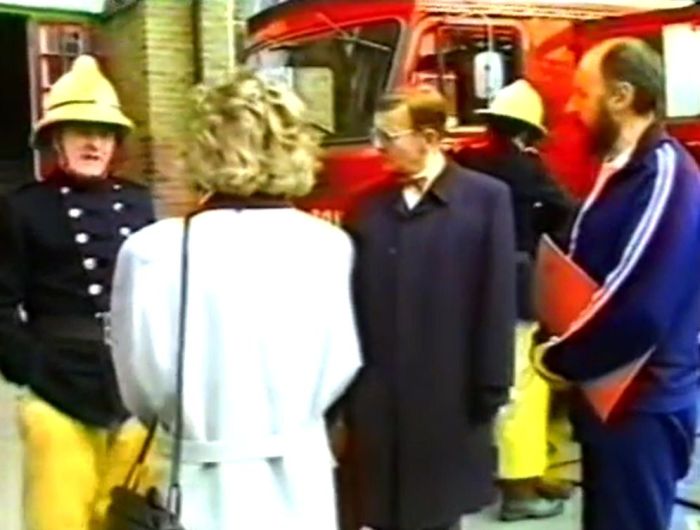
It was clearly something of a big-budget day as not only do we see a substantial number of schoolchildren (at least a hundred) milling in the playground but there’s also a couple of fire engines thrown in for good measure.  Always a pleasure to see the late Peter Childs, here as a fireman, even if it’s only for a few moments.  The playground scenes also serve as our last opportunity to see the old Grange Hill school in all its Victorian glory (once asbestos is discovered it’s closed for good).

Grange Hill – Series Nine, Episode Two

grange hill s09e02

Written by Barry Purchese. Tx 10th January 1986

Zammo’s descent into heroin addiction would become the defining theme of series nine (and possibly of the entire thirty one year run).  But dramatically there’s a few missed opportunities along the way.  It’s very noticeable that we never see the reaction of key characters – especially Jackie – when they learn the news for the first time.  Roland’s chosen to be the one who discovers his secret, but again there’s no scene where he discusses this news with the others.
You’d also have expected that his increasingly erratic behaviour would have been commented on by his classmates but after the next episode we aren’t really privy again to many classroom scenes with the fifth formers.  Possibly this was an intentional move though – from now on Zammo’s an isolated character and rarely interacts with his former friends.

Although it’s still early days with this plotline there’s clearly something up with Zammo.  He’s short of money (already in debt to Kevin) and attempts to cheat in the great moustache weighing competition.  Mr Kennedy – aware that Banksie is feeling self-conscious about his moustache – offers to shave off his own facial hair as well.  Banksie’s will be weighed and the class will then be able to use that figure as a control in order to estimate the weight of Mr Kennedy’s moustache.  There’s a twenty five pence entry fee and if anybody guesses the weight correctly they win six pounds, if not the money goes towards the school fund.

It’s an interesting wrinkle that Banksie is the one who discovers Zammo’s cheating ways.  He manages to ensure that Zammo doesn’t profit, but he also doesn’t reveal Zammo’s secret to the others.  Was this because he intended to hold this piece of information back, all the better for using it to manipulate and embarrass Zammo at a later date, or has Banksie turned over something of a new leaf?  He does later tell Mr Kennedy that it’s better that the money goes towards the school, although given that we’d only recently seen him and Trevor attempting to cheat at one of the games during the Christmas Special, this holier-than-thou attitude is slightly hard to swallow.

Mr Kennedy’s affability and ability to connect with the pupils is clearly demonstrated here.  He’s an inspirational teacher and therefore couldn’t be further removed from the bitter and twisted Mr Bronson.  There’s a lengthy staff-room scene at the start of this episode in which Mr Bronson, quietly spitting venom, caustically comments on Mrs McClusky’s choice for acting deputy head.  Mr Baxter? A sports teacher? It’s obvious that he saw himself in the role (or more possibly as the head itself) but instead has to sit on the sidelines, quietly fuming.

As for Mr Baxter himself, he’s the recipient of a fine scene where he firstly berates the second years for their poor quality gym kits and then conscripts the unwilling Gonch, Hollo and Robbie into the newly reformed Grange Hill swimming team.  As ever, Michael Cronin is a joy.

1986 was the last hurrah for the old Grange Hill school.  Shortly to be closed for good following an asbestos scare, it’s in a remarkably run down and dingy state.  This ties into the conversation between Mr Kennedy and the fifth formers (who bemoan the fact that it’s impossible to do projects since the school library has so few books – hence their small fund-raising effort).  The way that Grange Hill has always struggled with funding has been a subtle running theme for a number of years and given the turmoil in the real world during the mid eighties (teacher strikes were at their height) it’s not surprising that it’s touched upon again here.

My recollection is that although it was stated that a character would become addicted to heroin, their identity wasn’t known, meaning that that Danny Kendal seemed to be the obvious choice.  Despite his diminutive size he was unafraid to take anybody on (older pupils, teachers) and there’s further early evidence of his erratic behaviour here as he runs amok with a wrench.  But it would have been obvious – too obvious no doubt – to make him the one and the dramatic potential of turning a previously likeable character like Zammo around was clearly too tempting to avoid.

Imelda’s reign of terror continues.  This week it’s shoving fibreglass down the backs of unfortunate first years.  Everybody around at the time – including Gonch, Hollo and Robbie – find this to be a huge joke, although they aren’t present when the painful lacerations are revealed.  This allows us to understand that they maybe weren’t as heartless as they first appeared, although Calley and Ronnie have sharply differing opinions about Imelda’s part in this.  Calley believes that Imelda also couldn’t have known what damage it causes whilst Ronnie isn’t so sure.  Next time we’ll discover the answer to this question.

Grange Hill – Series Nine, Episode One

grange hill s09e01

Written by Barry Purchese. Tx 7th January 1986

If the Christmas Special, in part, harked back to the past (featuring last hurrahs for some old favourites) then the first episode of series nine was an exercise in looking forward.  This is partly symbolised by an unattractive piece of modern art – aptly titled “New Horizons” – but it’s mostly to do with the various arrivals and departures, courtesy of new producer Ronald Smedley.

The merger between Grange Hill, Rodney Bennett and Brookdale (which had been a running thread during series eight) is now quietly forgotten.  This means that several characters (Banksie’s mate Loop and Julian Fairbrother) were probably deemed surplus to requirements although Banksie and Jackie – now assimilated as Grange Hill types – still had roles to play.

School uniforms, which had previously been abolished for the upper years, are quietly reintroduced.  Nobody ever seems to comment on this which is a little odd (I’m sure Trisha, back in the old days, wouldn’t have taken this decision lying down!).  The dramatic possibilities of Mrs McClusky continuing to chafe at only being the Deputy Head are quickly nullified when it’s revealed that the Headmaster, Mr Humphries, has died in a car accident.  In time-honoured soap style this happens off screen (a quick and easy way to write a redundant character out).

But at least Mr Humphries merited a mention.  Poor Loop and Julian Fairbrother are amongst those who join the long list of the Grange Hill vanished (characters who disappear and are never mentioned again).  Annette’s absence is deemed worthy of comment (she had been in the series for five years though) when it’s revealed that she’s now living in Milton Keynes.  A fate worse than death it’s implied.

With the episode count increased from eighteen to twenty four, some new blood was obviously required.  Deep breath ….

Georgina Hayes (Samantha Lewis) is revealed to be the third member of Imelda’s gang.  Georgina – like Helen – is positioned as someone who could be a good person if only she was able to escape from Imelda’s orbit.  All three have been at the school for the last year (obviously always off-camera during series eight) but one genuine new arrival this episode is Ziggy Greaves (George Wilson).

Ziggy loves spiders (hence his nickname, although I daresay that most of the target audience – like Robbie – wouldn’t have heard of the David Bowie album which gave him his moniker).  With a broad scouse accent, Ziggy is clearly an exotic and unusual creature.  This ensures he ruffles a few feathers (crossing swords with Imelda and a frog whilst Trevor chunters away quietly that the newcomer is taking liberties).  In time Ziggy will team up with third-wheel Robbie, thereby generating a new partnership to sit alongside that of Gonch/Hollo.  Their friendship is tentatively begun here, although since there’s so many new arrivals and plotlines to set up it doesn’t go much further than a quick hello.

It’s not been uncommon for new characters to suddenly appear with everybody pretending they’ve been there for years (Kevin during series seven for example) but this episode goes one better as we see a whole form suddenly materialise out of nowhere.  Laura Regan (Fiona Mogridge), Julia Glover (Sara McGlasson), Louise Webb (Alison McLaughlin), Ant Jones (Ricky Simmonds) and Danny Kendall (Jonathan Lambeth) are a bunch of third years no doubt less than delighted to learn that Mr Bronson is their new form tutor.

Laura and Julia both have influential parents (the games mistress and a school governor respectively).  Louise isn’t given any lines here whilst Danny is shown to be completely disconnected – happy to flout school rules with seemingly not a care in the world.  We’ve seen anti-authority figures before, but Danny is something different.

Ant doesn’t hit it off with Mr Bronson.  Last year Zammo was his whipping boy and it seems that Ant will perform that same function this term.  Once again we see a battle of wills between master and pupil, with both believing that they’re in the right.  Ant had a good excuse for being late for Mr Bronson’s tutorial – a meeting with Mr Baxter – but Mr Bronson isn’t prepared to listen.  Mr Baxter later confronts his fellow teacher and is less than cordial.  “Insisting you’re right when you’re wrong won’t get you respect, it’ll get you resentment”.

On the teaching front, Mrs Reagan (Lucinda Curtis), Miss Partridge (Karen Lewis), Mr Kennedy (Jeffrey Kissoon) and Mr King (David Straun) all make their debuts.  Miss Partridge hardly has the chance to open her mouth in assembly before a frog causes chaos (quite why the unnamed extra reacted with such terror at the frog – placidly sitting inside a crisp bag – is a slight mystery, but we can blame the script).  Mr King fares a little better.  His inexperience is shown (bringing the wrong register to the classroom) although his form group – E2 – don’t make capital out of this.  He may be young, but he’s capable and good humoured and right from the start it’s plain that he has the respect of the pupils.  His replacement next year won’t fare nearly so well ….

With so much going on, there’s still time to set up a few important plotthreads which will simmer away for a while.  The relationship between Zammo and Jackie is a key one (it’s shown to have fractured, with them spitting venom at each other).  Zammo’s also shown to be a little distracted, although the reasons for this aren’t elaborated on.  Banksie’s brave but doomed attempt to grow a moustache amuses Fay, Julie and Jackie no end.  Kevin’s tickled too – he mimics Banskie with a Sieg Heil salute – a little touch which you probably wouldn’t see today.

Possibly introducing the new arrivals of the course of a few episodes would have been more sensible, but although this first episode doesn’t stop to pause for breath, by the end Grange Hill‘s New Horizons have been firmly laid out.

grange hill s09e01 p2.jpg

Ivanhoe – Simply Media DVD Review

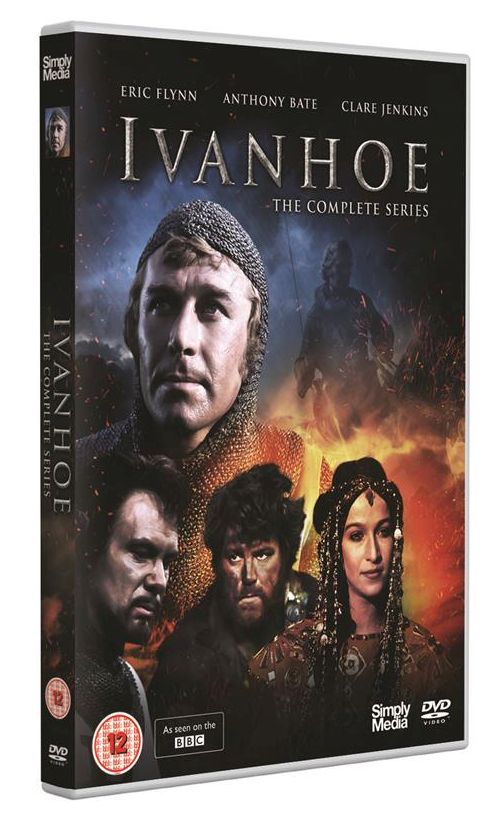
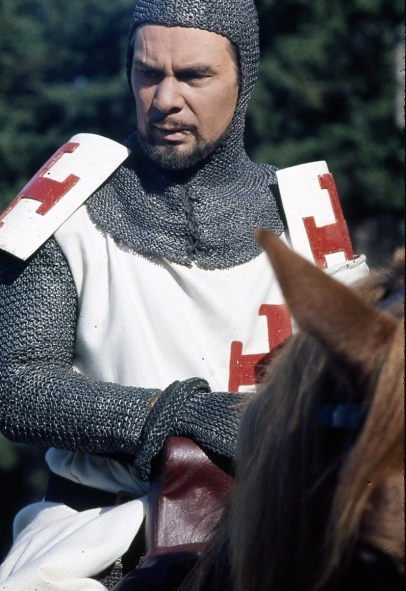
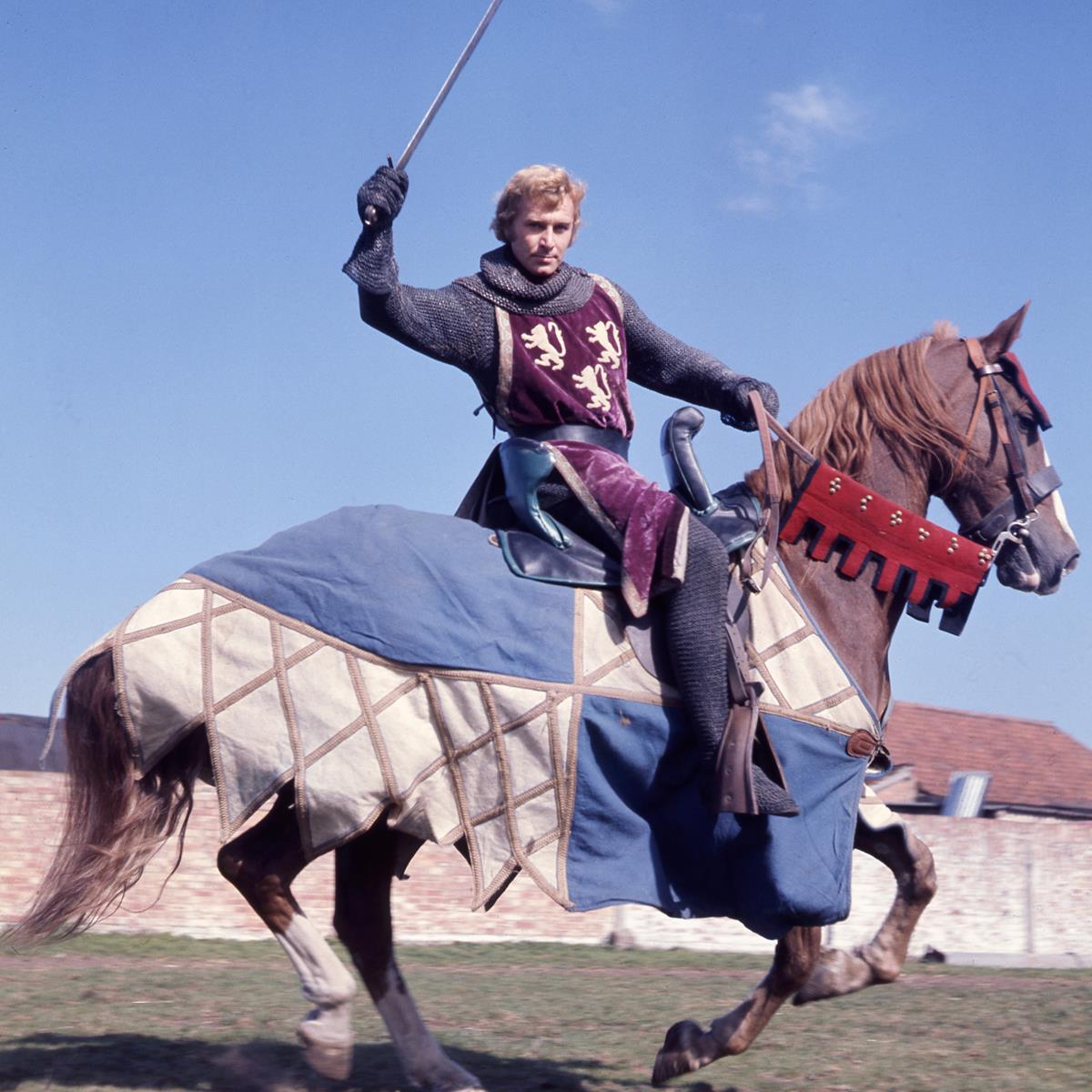
The year is 1194.  Sir William of Ivanhoe (Eric Flynn) has returned home to England following the disastrous Third Crusade in Palestine.  Ivanhoe’s father, Cedric (Peter Dyneley), one of the few remaining Saxon nobles in an England now dominated by the Normans, has broken off relations with his son due to Ivanhoe’s support for King Richard.

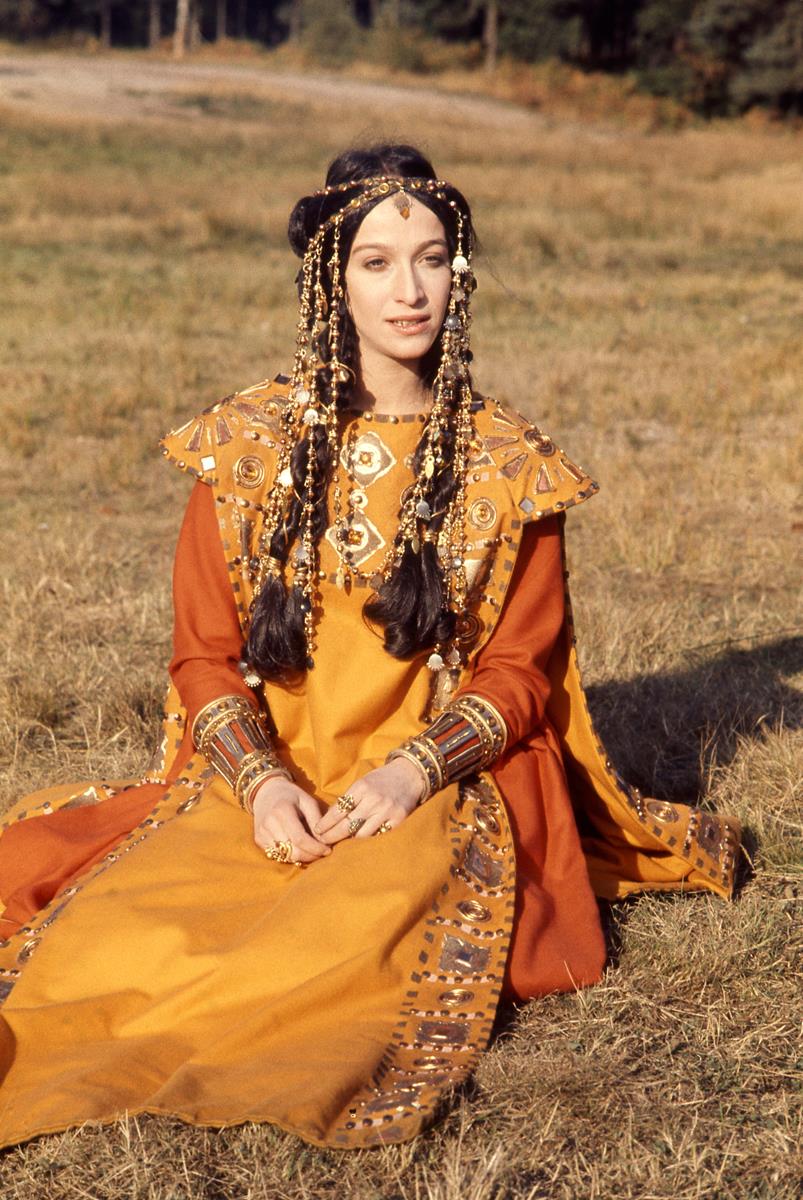
The young Ivanhoe doesn’t seem too disheartened by this familial disapproval though, as he has scores to settle – most notably with Sir Brian de Bois Guilbert (Anthony Bate), a member of the Knights Templar.  They will not only clash on the tournament field but also off it and two desirable young women – the Lady Rowena (Clare Jenkins) and Rebecca (Vivian Brooks) – will both have parts to play in their bitter feud.

Meanwhile, King Richard and Prince John find themselves locked in a grim battle for control of the English throne ….

Published in 1820 across three volumes, Ivanhoe – A Romance has proven to be one of Sir Walter Scott’s most enduring works.  Its mixture of Medieval derring-do and romance is an intoxicating one, with numerous film and television adaptations serving as a testament to the timelessness of the story.

Possibly one of the most notable things about Ivanhoe is how Scott’s novel helped to solidify the modern myth of Robin Hood.  Robin (referred to as Locksley for most of the serial) appears throughout and his characterisation here – a freedom fighter first, an outlaw second – chimes with how we view Robin today (the Robin Hood of the earlier ballads was a much less likeable and noble chap).

Scott wasn’t the first writer to set the struggles of Robin Hood during the reign of Richard I, but this story undeniably helped to create the template which many in the future would emulate.  Certain aspects of the Robin Hood myth are established here – most notably the way that Robin splits the arrow of his challenger during a test of skill.  It’s also interesting how subsequent writers took aspects of Ivanhoe’s character – his return to England from the Crusades, for example – and grafted them onto Robin.

The opening episode wastes no time in creating a sense of place and time. With the rightful King of England, Richard, believed to be languishing in a foreign jail, his brother John sees an opportunity to sieze power. The downtrodden Saxons find themselves suffering under the rule of the Normans, whilst Sir Brian casts a baleful shadow over proceedings.

hi014546802-e1504956112893.jpg
Anthony Bate

Right from his first appearance, Anthony Bate impresses as Sir Brian. Although Bate tended to play establishment types and professional men, he throws himself into this role – a black-hearted villain, albeit one with his own code of honour – with gusto.  Eric Flynn, as Ivanhoe, is perfectly cast as the square-jawed hero. Whilst it’s true that Bate, as befits a baddy, has the more interesting role to play, Flynn has a boyish charm which suits the character.

Ivanhoe’s first acknowledged appearance is held back until the end of the opening instalment (although it’s rather obvious that the mysterious hooded pilgrim who makes several enigmatic comments throughout the episode is Ivanhoe). That he and Sir Brian (bitter rivals from the Holy Land) happen to run into each other at the castle of Ivanhoe’s estranged father is something of a coincidence ….

Clare Jenkins, as Rowena, makes for a very appealing herione (coincidentally she and Flynn had appeared together a few years earlier in the Doctor Who story The Wheel In Space). Rowena and Ivanhoe are in love but he has a challenger for Rowena’s affections, the arrogant de Bracy (David Brizley), a Norman lord.

Rebecca (Vivian Brooks), daughter of the despised Jewish moneylender Isaac of York (John Franklyn-Robbins), is somewhat taken with Ivanhoe (she nurses him back to health after Sir Brian gains the upper hand during Prince John’s tourney) but she’s doomed to be unsuccessful as Ivanhoe only has eyes for Rowena.  Sir Brian later attempts to woo Rebecca, but she shuns his advances.

Ivanhoe was Vivian Brooks’ third and final television job (following appearances in Thirty Minute Theatre and Z Cars).  It’s a slight mystery why she didn’t go on to have a longer career as she’s really rather good here, especially when she and Bate cross verbal swords. Brooks may have been very inexperienced compared to Bate, but she more than holds her own during the scenes where Sir Brian and Rebecca warily circle each other.  Vivian Brooks certainly has the meatier of the two main female roles (Clare Jenkins’ Rowena doesn’t have a great deal to do except pine for Ivanhoe).

Vivian Brooks

Although Vivian Brooks only racked up a handful of credits, most of the other main roles were filled by very familiar faces.  That Ivanhoe was directed by David Maloney should be fairly obvious by taking a quick glance at the cast list.  The likes of Graham Weston, John Franklyn-Robbins, Tim Preece, Michael Napier Brown, Bernard Horsfall, Noel Coleman and Hugh Walters had already appeared or would later appear in other productions directed by Maloney.  David Maloney, like many other directors, tended to use a “rep” of actors – dependable people he knew would deliver the performances required.

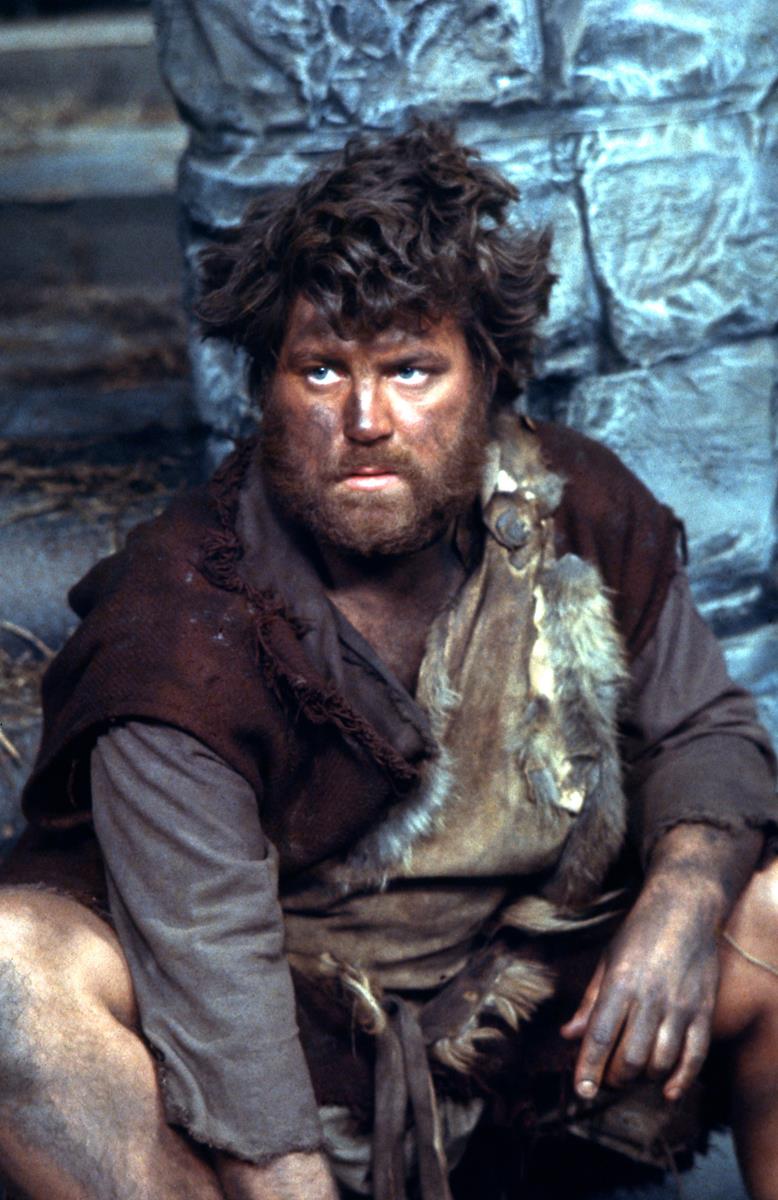
The strength in depth of the cast is one of the reasons why this serial works as well as it does.  Tim Preece entertains as the capacious and vain Prince John, Hugh Walters is pleasingly off-kilter as Cedric’s fool Wamba, Bernard Horsfall is suitably imposing as the Black Knight, John Franklyn-Robbins impresses as the persecuted Isaac and Noel Coleman is characterically strong as Fitzsurse, one of John’s advisors.  Clive Graham, as Locksley, also offers a vivid performance and it’s always a pleasure to see Michael Craze, here as one of Lockley’s men (Thomas).

Graham Weston, clearly one of David Maloney’s favourite actors (apart from Ivanhoe, Maloney cast him in two Doctor Who stories – The War Games and Planet of Evil), gets a chance to display his skills with a quarterstaff when his character – Ivanhoe’s loyal servant, Gurth – tangles with the outlaws. It’s not a badly directed sequence, although like all fight scenes taped in the studio it pretty much had to be done in a single take (had it been shot on film then it could have been edited much more tightly).

Graham Weston

With Ivanhoe injured and insensible during the middle part of the serial, other characters move to the forefront of the action. Bernard Horsfall’s mysterious Black Knight (a vision in blond wig and beard) has an entertaining tustle with Barry Linehan’s disolute Friar. The Friar, living the life of a hermit deep within the forest, may claim to exist on a diet of peas and water but the truth is rather different!

When Ivanhoe, Cedric, Isaac, Rebecca and Rowena are captured by a group of Norman knights led by Sir Brian, they find themselves the prisoners of Godfrey Front de Boeuf (Francis de Wolff). Godfrey has usurped Ivanhoe’s lands and now seeks his death in order to secure his position. de Wolff cackles with evil intent (like Peter Dyneley he’s somewhat of a stranger to subtlety).

Rebecca is later denounced as a witch by the leader of the Templars – angered by Sir Brian’s infatuation with her – and is sentenced to death. She claims the right of trial by combat and nominates Ivanhoe to be her champion. And with Sir Brian in the opposite corner it seems that the final reckoning between them is now at hand ….

Although the Classic Serials had just moved into colour, this ten part adaptation (broadcast during January, February and March 1970) maintained the same production model from the black and white days.  Therefore the bulk of each episode was recorded on videotape in the studio, with film inserts used to open out the narrative.  Whilst this means that it isn’t as glossy or filmic as some of the later television versions, the quality of the performances are more than adequate compensation for the occasional production shortcomings (such as the unconvincing beards and the way some battles largely take place off screen).

Although some of the turns are rather on the ripe side (there are times when it’s impossible not to be reminded of Monty Python and the Holy Grail) there are subtler pleasures to be found elsewhere – Anthony Bate, for example, is excellent throughout. Overall, this is a strong and faithful adaptation of a sprawling epic and certainly deserves a place in your collection.

Ivanhoe is released by Simply Media on the 18th of September 2017.  The RRP is £19.99 and it can be ordered directly from Simply here.

Eric Flynn

Grange Hill – 1985 Christmas Special

grange hill 85 xmas special

Written by Phil Redmond.  Tx 27th December 1985

Broadcast a couple of weeks before the start of series nine, the 1985 Christmas Special performed a duel function. It not only served as a coda for certain storylines from series eight (the return of Calley’s real mother, Roland’s estrangement from Fabienne) but it also looked ahead to the forthcoming run by introducing several new characters.

Rather annoyingly, when the first seventeen series of GH were repeated during the 1990’s this episode (like the 1980 Christmas Special before it) was omitted, meaning we were denied the introduction of Imelda Davis (Fleur Taylor). Mind you, that also meant we didn’t see the arrival of Harriet the Donkey, so it wasn’t all bad ….

Since Gripper’s fall from grace in series six, the position of school bully has been vacant. Jimmy McLaren was too lightweight to be considered a real bully during series seven whilst series eight didn’t even have a token bully figure (although Gripper’s sister, Emma, seemed ready made to fulfil that function). So the time was certainly right for Imelda to make her mark. Ruth Carraway debuts as Helen Kelly, at this point Imelda’s right-hand woman.

The series had also lacked a regular caretaker figure since Mr Thomspon disappeared at the end of series five, so the arrival of George A. Cooper as Mr Griffiths was long overdue. Having an actor of Cooper’s quality and experience was very welcome, since it saved Mr Griffiths from being just the two-dimensional grumpy figure he could so easily have otherwise been. Mr Griffiths stayed with the series for a good while (leaving at the end of series fifteen) which gave plenty of time for various facets of his character to be explored. Yes, he could be the traditional irate caretaker, shaking his fist at those pesky kids, but at times he was also treated as a character in his own right.

Claire and Stewpot bowed out, as did Gripper (who makes a surprise fleeting return, slight recompense for his audio-only appearance during series eight). Another character appearing for the last time was Simon Haywood as Mr Smart. Since this episode was made as part of the series nine production block (confirmed by the fact that incoming producer Ronald Smedley, rather than S8’s Ben Rea, was credited) it seems odd that he was contracted for this one-off appearance, especially since it only amounted to a single, short scene.

What’s really notable about this one is that it was Phil Redmond’s first script for the series since the 1981 Christmas Special. Does his presence mean a return to the harder-hitting issues-led episodes from the early years? Not really. The fact he introduces Harriet the Donkey is a good indication of the episode’s general tone.

We’ll come back to Harriet when she returns as a regular in S10, as she could be said to be the point at which GH jumped the shark – or at the very least it was when the series appeared to lose a little impetus. When many people think of GH it’s the first nine years that probably stand out – from Tucker’s first appearance to Zammo’s downfall. This is more than a little unfair on the next twenty years of the show which had plenty to offer, but there’s no denying that from 1987 onwards the series’ profile dipped.

A befits a Christmas episode, it’s fairly light-hearted fare with the rampaging Harriet taking centre stage.  Left at the school for some unknown reason by its previous owner, Harriet runs amok in a rather unconvincing fashion.  Gonch and Hollo are the fall guys who discover Harriet and then attempt to round her up when she disappears.  You would assume that a donkey would be a fairly slow-moving animal, so suspension of disbelief is required during the scenes where they keep on finding and losing her in quick sucession.

Possibly the best example can be seen when our two hapless heroes spot Harriet at the end of the corridor.  Harriet takes a right turn, they dash after her a few seconds later, but the donkey’s disappeared.  How?!  Harriet then seems to display supernatural powers by re-entering on the left hand side.  Quite how she managed this is probably something it’s best not to dwell on.

Remaining in grumpy nit-picking mode, when Gonch and Hollo accidentally run into Ronnie we’re witness to one of the most unconvincing collisions ever – as all three gently lower themselves to the floor …..

But on the positive side, Redmond knew how to write for Mr Baxter.  If you’re a fan of Michael Cronin then it’s worth braving the donkey-related antics for a good dose of Mr Baxter at his sarcastic best.  Gonch and Hollo are at the receiving end of his withering put-downs as Mr Baxter always seems to appear just at the point when they’re doing something they shouldn’t.  Mr Bronson – chuntering about Christian values – also fares well with a couple of nice scenes.

Dramatically, it’s Roland who receives the meatiest storyline.  There’s a real sense of bleakness at the start as his father – now plying his trade as a long-distance lorry driver – tells his son that they’ll have to delay their Christmas until the 27th (he’s away on a job until then).  It’s difficult to blame Mr Browning for this – as a single-parent he has to put money on the table (and it’s not as if Roland isn’t provided with an alternative Christmas Day arrangement, via a neighbour).  Although Roland (maybe Redmond here was harking back to the boy’s earlier characterisation) isn’t too happy, since he’s convinced he’ll only receive small portions.

So he decides that a trip to Paris (to visit Fabienne no doubt) would be in order.  Logic would tell him this is doomed to failure – witness his ill-fated attempt to stow away with the French exchange students at the end of S8 – and luckily for him his vague scheme never gets any further than attempting – and failing – to win top prize at one of the Christmas Fare games.  The ever-present Janet, falling into her usual role as an interrogator of Rottweiler-like tenacity, continues to badger him until he admits that his dad won’t be home for Christmas.

The warm-hearted Janet then invites him to share Christmas with her family and surprisingly he agrees.  Does this mean that after all these years Roland has finally seen the goodness in Janet?  Hmm, I don’t think so.  It seems to be more along the lines that he realises her family goes in for a full Christmas with all the trimmings.  So Roland’s thinking with his stomach rather than his heart or his head.

That this isn’t quite the normal type of episode is capped off by the ending which sees the whole cast turn to camera and wish the viewers a Merry Christmas.  William Hartnell couldn’t have done it better …..

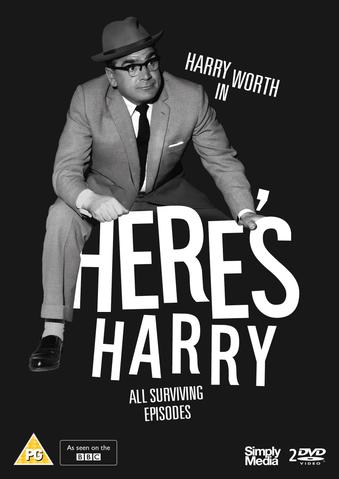
Here’s Harry – Simply Media DVD Review

harry.jpg

Although largely forgotten today, Harry Worth was a major television star of the sixties and seventies.  His rise to the top was neither straightforward or quick though – born Harry Bourlan Illingsworth in 1917, he left school at 14 and went straight to work down the local mine (he stuck it out for eight years, despite hating every minute of it).

As with so many entertainers of his generation, World War II was to prove defining.  Even when he’d been a miner, Worth had continued to hone his showbiz skills (practising his ventriloquism act whilst hewing coal for example).  Prior to WW2 he’d begun to ply his trade by working as a ventriloquist in the numerous working men’s clubs dotted around Yorkshire, but appearing in RAF shows gave the young Worth further valuable experience.

Following his demob, and still attempting to make it big with his wooden friends (at this point he was dubbed ‘The Versatile Vent’), Worth began his slow ascent to the top.  Like many of his contemporaries he played the notorious Windmill Theatre (“we never clothed”) as well as just about every variety theatre in the country.  During the forties and fifties the variety circuit was still thriving (although the rise of television would eventually kill it off) and Worth was able to make a living, just.

Frequently bottom of the bill, Worth’s career seemed to be heading nowhere, although a tour with Laurel and Hardy in 1952 would prove to be crucial.  After watching him from the wings, Oliver Hardy persuaded Worth that he should abandon his vent act and concentrate on becoming a comedian instead.  This was valuable advice and within a few years Worth would make his television debut, which in time would lead to his own series.

worth 01

John Ammonds, forever associated with the classic BBC Morecambe & Wise shows, would produce Worth’s debut series The Trouble With Harry (1960) and the bulk of the follow-up, Here’s Harry (1960 – 1965).  His next series, simply titled Harry Worth, would enjoy four successful runs between 1966 and 1970, at which point he decided to jump ship and join Thames (Morecambe & Wise and Mike Yarwood would later do exactly the same thing).

Like many other series of this era, Here’s Harry has a rather patchy survival rate.  Out of sixty episodes made, only eleven now exist (although it’s pleasing to note The Musician, recently recovered by Kaleidoscope, is included in this release).  Here’s what’s contained on the two DVDs –

Series Two

The Bicycle – 4th May 1961.  Featuring Wensley Pithy, Sam Kyd, Ivor Salter and Anthony Sharp.

The Holiday – 11th May 1961.  Featuring Ballard Berkeley, Ronnie Stevens, Meg Johnson and Reginald Marsh.

The Request – 18th May 1961.  Featuring Jack Woolgar and John Snagge.

The Medals – 1st June 1961.  Featuring Anthony Sharp and Totti Truman Taylor.

The Voice – 8th June 1961.  Featuring Jack Woolgar, George Tovey, Sydney Tafler, Joe Gladwin and Meg Johnson.

Series Three

The Dance – 14th November 1961.  Featuring Ronnie Stevens, Reginald Marsh, Colin Douglas, Vi Stevens and Harold Goodwin.

The Plant – 21st November 1961.  Featuring Vi Stevens and Patrick Newell.

The Birthday – 5th December 1961.  Featuring Jack Woolgar, Vi Stevens and Ivor Salter.

The Overdraft – 12th December 1961.  Featuring Gwendolyn Watts, Joe Gladwyn and Jack Woolgar.

The Last Train – 26th December 1961.  Featuring Harold Goodwin, Tony Melody, Jack Woolgar and Reginald Marsh.

Series Five

The Musician – 22nd November 1963.  Featuring Geoffrey Hibbert, Jack Woolgar and Max Jaffa.

What’s interesting about the surviving episodes is that – apart from the recently recovered The Musician – everything we have either comes from the second or third series.  Series two is virtually complete (only one episode missing) whilst the survival rate for the third series is also pretty good (five out of eight).

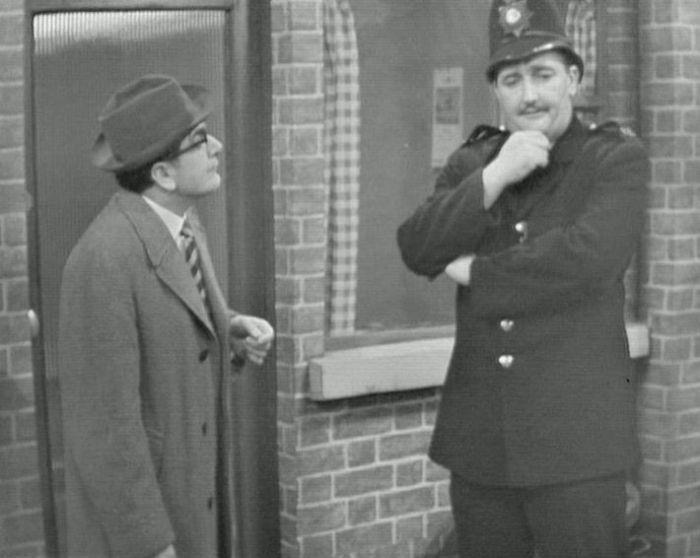
The various opening titles help to set the tone for the show. The iconic shop window sequence doesn’t debut until later (it’s only featured in this set on The Musician) so in series two and three we observe Harry strolling down the street, politely raising his hat to unseen passers by and almost colliding with a lampost. That he raises his hat to the lampost is a characteristic touch.

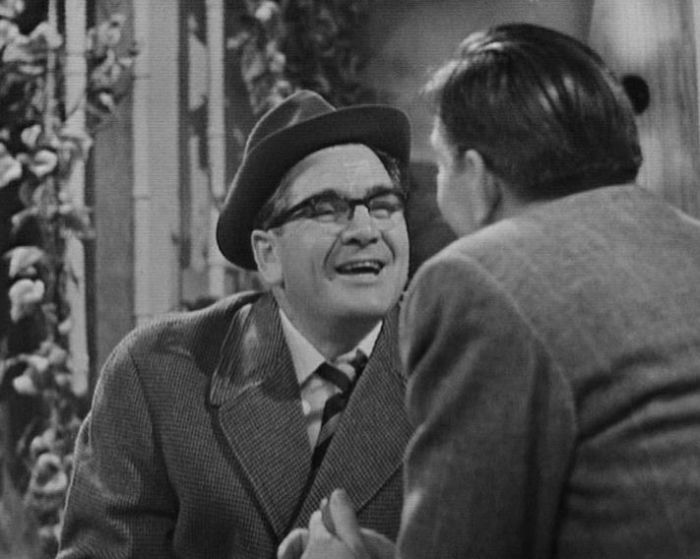
Worth, who lives in the fictional town of Woodbridge (at 52 Acacia Avenue with his cat, Tiddles, and his never seen aunt, Mrs Amelia Prendergast) is a familiar comic creation.  Buffeted by events, he rarely seems to be in control of his own destiny – instead he’s at the mercy of officialdom which is sometimes friendly and sometimes not.  But this never concerns Harry as he treats everybody with kindness and always remains totally oblivious to the fact that his presence serves as the catalyst for terrible disasters.

worth 02

Other similar character types – Tony Hancock, Frank Spencer, Victor Meldrew – can easily be brought to mind but Worth’s style is quite different as there’s a warmth about his befuddled comic persona that’s very appealing.

Vince Powell and Harry Driver were the most prolific writers across the seven series, which should allow you to gauge the general level of scripting (both were competent scribes, although hardly in the same league as Galton & Simpson or Clement & Le Frenais).  Not that this really matters as the scripts are simply the starting point – Here’s Harry stands or falls on Worth’s ability to make his shtick work (and when he’s placed in opposition to a decent performer then things chug along very merrily).

The Bicycle serves as a perfect example of the way the show operates. Harry is more than upset when a total stranger regularly decides to leave his bicycle outside his house and decides to seek legal advice, although the solicitor (played by Anthony Sharp) is naturally nonplussed about exactly how he can help. Over the course of about ten minutes Harry’s amiable idiocy is enough to reduce Sharp’s solicitor to a gibbering wreck. But when Harry learns that the bike belongs to Ivor Salter’s police constable, Harry (who’s hidden the bike in his shed) becomes frantic with worry ….

Later tangles with Sam Kyd’s postman and Wensley Pithy’s chief constable are further examples of the way Harry so often leaves a trail of devastation in his wake. The “sit” part of this comedy is remarkably slight (a missing bicycle) but it’s plain that each situation is simply the excuse for Worth to move from one authority figure to the next, each time causing mayhem.

Harry’s child-like nature and undeveloped view of the world is further evidenced in The Holiday (he believes that it’s perfectly possible to catch a bus straight from London to Monte Carlo). A long-suffering travel agent is the latest person to suffer from Harry’s presence, although he gets off relatively lightly (Ronnie Stevens’ remarkably camp photographer – tasked with the job of taking Harry’s passport photos – doesn’t fare so well). Ballard Berkeley and Reginald Marsh – both wonderful performers – are also lined up to take their dose of punishment from Mr Worth.

There’s a touch of gentle satire at play in The Request as Harry turns up at the BBC, keen to ensure that a request for his Auntie gets played on Housewives Choice. Due to a barely credible misunderstanding he gets mistaken for a singer (Worth does croon a little bit of Are You Lonesome Tonight quite well though) and then decides to roam the corridors of the BBC, causing chaos wherever he goes (such as interrupting the iconic newsreader John Snagge mid broadcast). His face may not be familiar, but Snagge’s voice is unmistakable and it’s lovely to see him end up as Harry’s latest victim.

The remaining surviving episodes of series one – The Medals and The Choice – maintain the high standard, with Anthony Sharp, this time as a Brigadier, returning in The Medals to once again cross swords with Harry.

worth 03

Amongst the surviving shows from series three, both The Overdraft and The Last Train are highlights.  A visit by Harry to the bank in The Overdraft has plenty of obvious comic potential.  He informs the long-suffering assistant that he wishes to deposit three pounds ten shillings (to enable him to draw out precisely the same amount!) This is so he can extract his money in a bewildering and precise series of coins, all the better for then depositing them in a plethora of tins (for the gas bill, newspapers, etc, etc).

The Last Train finds a festive Harry patiently waiting for his train home.  It seems a bit odd for trains to be running on Christmas Day but it helps to explain why some of the staff are rather downcast.  Harry’s not of course, he’s a regular ray of Christmas sunshine – although his well-meaning efforts to entertain and help don’t always have the results he’d hoped for.  Not that this concerns Harry who – as always – breezes through each and every situation, totally oblivious to the havoc he’s causing.

The final existing show – the recently returned The Musician – features a guest appearance from Max Jaffa.  Like John Snagge, Jaffa’s a good sport (the typically dense Harry knows that Jaffa is someone famous, he just can’t remember who).  The moment when Jaffa tells him who he is and Harry removes his hat in respect is a delight as is the way that Harry initially mistakes him for the music hall comedian Jimmy Wheeler (for good measure Harry throws in Wheeler’s famous catchphrase – “Aye, aye, that’s your lot!” – to increasingly befuddle his famous companion).

Whilst it’s undeniably formulaic, the surviving episodes of Here’s Harry are also undeniably entertaining. The combustible combination of the well-meaning but inadvertent loose cannon that is Harry and the range of authority figures he finds himself encountering (some pleasant, some not) is the reason why the show works as well as it does. The situations may often be slight, but the way that Harry and his co-stars interact is always a joy.  Something of a neglected comic treat it’s a pleasure to see it available on DVD and comes warmly recommended.

Here’s Harry is released by Simply Media on the 11th of September.  The RRP is £19.99 and it can be ordered directly from Simply here.

worth 04

Doctor Who – Horror of Fang Rock. Part One

horror 01-01

Doctor Who fans tend to break down sections of the show into recognisable eras.  Usually this is done by producer and not lead actor (which is understandable when, say, analysing Tom Baker’s seven year stint as his three producers – Hinchcliffe, Williams, JNT – all had very different styles).

The only problem with this method is that the cut-off is never absolute.  Horror of Fang Rock is a prime example – in mood and style it can comfortably sit alongside Talons (that it shares the same Victorian/Edwardian setting doesn’t hurt on this score).  It’s also possible to find echoes of the Williams era in several Hinchcliffe stories (when the Doctor bumps into Styggron in The Android Invasion, his cheery greeting could easily have played virtually anywhere in S15/S16/S17).

This bleeding of styles was rarely acknowledged back in the day.  In the 1980’s, when Graham Williams was still beyond the pale for many, things seemed much simpler.  His three years in charge were plainly a disaster from start to finish, not least for the unsubtle humour and schoolboy larking about.  If the Doctor mocked his adversaries and didn’t treat them with fear or respect, why should the audience?

As we’ve seen, the line between Hinchliffe/Williams wasn’t absolute, but this distinction tended not to be acknowledged.  One of my favourite summations of Graham Williams’ producership can be found in issue three of the fanzine Mondas, published in 1984.  We’ll be kind and not name the writer (a familiar name from Doctor Who fandom).  Graham Williams was apparently the man “who (unwittingly or not) almost cold-bloodedly butchered our programme, leaving it only in a fit state for recycling as dog meat”.

Hmm.  I’m slightly more of a fan ……

When he took over as producer, Graham Williams had three immediate problems to contend with.

  1. A requirement to tone down the violence and horror in the show.
  2. Galloping inflation, which meant that in real terms he had less to spend on the show for each of his three years.
  3. Tom Baker.

All three were bequests from Philip Hinchcliffe in one way or another.  The first seems to be Williams’ overriding legacy on the show, but there’s also evidence to suggest that even if the BBC management hadn’t insisted on change he would have done so anyway.  Williams (like Barry Letts) had been critical of the sadistic tone which had crept into the show during the mid seventies and was keen to steer the programme in a slightly different path (one example quoted by Williams was the moment in Genesis where Sarah is dangled over the edge of the rocket gantry by a Thal guard – a scene he never would have countenanced).

Philip Hinchcliffe liked to overspend, but it was Graham Williams who had to face the consequences. When Williams took over he discovered that budgets now had to be strictly adhered to (which led to some sticky later moments).  If the Hinchliffe era had been made in the same cash-strapped environment then it’s probable we’d think a little less of it.

Tom Baker. Ah, where do you start.  Tom and GW didn’t enjoy the best of working relationships to put it mildly.  Many believe that because Tom was by now so firmly entrenched in the series he was disinclined to listen to anybody else’s point of view.  But it’s possible to argue that Tom was simply looking to do the best for the programme (railing against unimaginative scripts) and that his actions weren’t motived by pure self-ego.  The truth probably lies somewhere inbetween.

The series had suffered from testy relationships between the lead actor and producer before.  William Hartnell and John Wiles were never a marriage made in heaven whilst Patrick Troughton’s interactions with both Peter Bryant and Derrick Sherwin weren’t much better. Terrance Dicks’ portrait of Bryant – a barely functioning alcoholic – is a rather unflattering one, but it suggests the reason why the professional Troughton felt frustrated towards the end of his stint on the show.  That Sherwin and Troughton didn’t get on can clearly be evidenced by Sherwin’s commentary on The War Games.  Whenever Sherwin’s in the chair and Troughton’s on the screen an acid put-down is never far away.

But if the turmoil between Baker and Williams would spill out onto the screen in later stories, at this point in time there’s no hint of what was to come.  Part one of Horror of Fang Rock is a model of efficient storytelling – establish your location (a lighthouse), your first wave of principal guest characters (the three lighthouse keepers – Ben, Rueben and Vince), introduce the Doctor and Leela, mix well and stand back.

The three keepers are, handily, of different generations.  So we have the old man, Rueben (Colin Douglas), the middle-aged Ben (Ralph) and the youngster Vince (John Abbott).  That they’re of varying ages is an obvious touch as it quickly helps to differentiate their characters.  Say what you like about Terrance Dicks, but he understood the basics of storytelling.

Rueben might be the oldest, but he’s not the senior man in charge here (a point which no doubt rankles with him).  Ben and Rueben articulate two very different viewpoints – science and superstition.  Indeed, had Ben not met his imminent death then it would have been interesting to see him and Rueben develop through the serial, almost as a surrogate Doctor and Leela.

Ben embraces the brave new world of electric-powered lighthouses whilst Rueben harks back to the good old days of oil.  Both, in their own ways, are entrenched in their own positions, although we’re no doubt meant to side with Ben.  That partly helps to explain why he’s first for the chop – having a level-headed sensible chap around is far less fun than the doomy, superstition-ridden Rueben (“‘taint natural”).  Vince occupies the middle ground as he’s prepared to listen to both of them (and the Doctor as well).

Louise Jameson was never too enamoured of this script (mistakenly believing that it had been written for Sarah-Jane).  I can’t see many causes for complaint though as Leela’s provided with some good material throughout.  The moment when Leela changes out of her wet clothes in front of a scandalised Vince (“I’m no lady Vince”) is just one nice character beat.

Tom Baker is in full brooding mood.  This may be because the script required it, but the evidence seems clear that at this point in time he wasn’t enjoying a harmonious relationship with his co-star (the fact that a female director had been assigned simply darkened his mood even more).  But if his playing here is partly informed by his off-screen irritations, then no matter – it’s also the perfect choice for the story.

Another interesting wrinkle is the air of mystery that hangs over Fang Rock.  We have a dead body – Ben – but the Doctor doesn’t know who killed him or why.  And it’ll be a long time before he finds out (Tom’s Doctor might often characterised as an unstoppable know-all, but that’s not the case here).

The cliffhanger (a toy boat runs aground) might be a little anti-climatic, but there’s little else to complain about here.  Some forty years to the day when this episode was first broadcast, Horror of Fang Rock part one still engrosses.

horror 01-02

Watergate (BBC, 1994)

nixon

I’ve recently been rewatching Watergate, the five part BBC2 documentary series from 1994.  One of the most remarkable things about the programme was the way that – Nixon excepted – virtually every living participant was not only willing to talk on camera, but did so extremely candidly.  It was written and narrated by Fred Emery, who also penned a tie-in book which is an excellent print summation of this most fascinating of political stories.

Emery’s skill is in letting the participants speak for themselves.  What emerges from their oral history is that the Watergate affair was bungled right from the start – this was no controlled mission, rather it was a collection of loose cannons ricocheting off each other. And loosest of all must be G. Gordon Liddy, the former FBI agent who was the chief architect of the Watergate break in.  Liddy is a mesmerising interviewee, not least for the moment when he recalled that he would have been quite happy to murder Jack Anderson, a Washington reporter who was something of a thorn in the side of the Nixon administration, had the order been given.  Just one of a number of jaw dropping revelations from Liddy, easily the most entertaining interviewee.

Although Richard Nixon, who coincidentally died just before the programme was broadcast, didn’t take part, he’s still very much present – thanks not only to the David Frost interviews but also via the infamous White House tapes which would eventually lead to his downfall.

Watergate is a quality documentary that’s well worth four hours of your time.

Out of the Blue – Series Two, Episode Six

blue s02e06

The team investigate the death of a fourteen year old prostitute called Justine Painton (Caroline O’Hara) ….

We’re pitched straight into the action. It’s late at night and in a run down part of town, Justine’s body is discovered. With a plastic bag over her head and rope marks on her wrists it seems that natural causes can be ruled out.

The officers stand around cracking weak jokes in the time honoured fashion (anything to take their minds off the actuality of the present situation). A brief moment of levity is provided when Becky sets the record straght about her night of limited passion with Lew (she knows that he would have already spun them his version of events). The only problem is that he hasn’t said a word ….

Justine’s mother, Fran (Siobhan Finneran), maitains a shrine to her daughter at home. Numerous school photos and beauty pagent trophies act as reminders of the girl she was, not what she’d become. Wasted potential (Becky and Warren view the cleaned up girl on the mortuary slab and Warren mentions how beautiful she was) is a theme of the story.

Family-man Ron finds the case a little hard to deal with. It’s not dificult to understand why (girls the same age as his daughter leading a dissolute life). One of Justine’s friends, Kirsty (Sarah Jane-Potts), tells him and Marty that Justine embraced life on the streets wholeheartedly. Is this the truth or simply an obfuscation? And what precisely did her mother know about her daughter’s new life?

One very striking moment occurs when Kirsty is speaking about Justine. The scene is overlaid with photographs of a younger Caroline O’Hara, which serves as an effective counterpoint between the past and the present.

It’s a remarkable coincidence that Richard Shaw (Pip Donaghy), the father of Warren’s ex-girlfriend Lucy, knew Justine intimately (he took bondage photographs of her). He offers to share his information, provided the police can arrange a meeting with his estranged daughter. Warren knows precisely where she is, because he’s been keeping tabs on her (mmm, a touch obsessive).

Local celebrity, boxer Vinnie Harper (Adam Kotz), was involved with Fran. But was he also intimate with Justine? The big guns (DI Temple and Lew) are wheeled out for a pulsating interrogation as we see Vinnie hauled over the coals.

Although Caroline O’Hara (making her screen debut) has very limited screentime (after all, her character is dead when we first see her) Justine still permeates every part of the story. Her death means that she’s robbed of her own voice, so others have to ascribe her with motivations and fill in her character for us.

Although answers are provided, justice is harder to come by. This was one of the strengths of Out of the Blue, a series which never felt obligated to pretend that life was fair. One of the final scenes – in which a distraught Lew makes this point to a resigned Temple – could be seen as a setup for the third series which never came. Would series three have finally been the point where Lew went too far?

We’ll never know, but while Out of the Blue never became a mainstream success, twenty years on it stands up as a flawed – but fascinating – series.

Out of the Blue – Series Two, Episode Five

blue s02e05

Three homeless people (one of them played by the highly recognisable Andy Devine – who would later appear as Shadrach in Emmerdale) are poisoned after a seemingly good Samaritan offers them a drink of champagne laced with prescription tranquillisers.

Temple’s mildly curious, but doesn’t regard it as much more than a sick joke.  It’s a sign of the times that the office only seems to have one computer and – as the victims use it to put together an identikit picture of their well-heeled poisoner – Temple gripes about the expense.  “Have you any idea how much that computer takes out of my budget? It’d be cheaper to hire Walt Disney”.

Temple’s given some good lines in this one.  A few minutes later he asks Becky and Warren exactly what they’re going to do.  “Put out an All Points Alert for Burlington Bertie?”  That’s a rather obscure reference which – back in the pre-internet nineties – would probably have perplexed a section of the audience.

Elsewhere, Bruce, Lew, Marty and Ron go in mob-handed to tackle Gibbs (Peter Jonfield), who appears to have a shop full of stolen goods – although annoyingly none of his stock appears to be on the stolen property register.  By racially taunting Bruce, Gibbs successfully manages to get under his skin – making him all the keener to nail him, although it also might serve to make him more reckless.

This subplot somewhat moves into the background once it’s discovered that Jackson (Devine) has been attacked again, only this time he’s dead.  Is it connected to the previous poisoning?  The descriptions of the suspects indicate not and the fact that one of them had red hair gives Marty the chance for a droll comeback.  “That’s handy, I’ve been looking for an excuse to arrest Mick Hucknall”.

They trawl the drug rehabilitation centres for clues, which sees Lew and Tony take diametrically opposing views on their usefulness.  It’s no surprise that the humanitarian Tony believes they help to prevent crime as well as getting people back on the straight and narrow whilst the more cynical Lew begrudges the fact that his taxes are used on such people.

Bruce has been operating on a tight-fuse for a while.  And after Warren makes an offhand remark (wondering if his obsessive nature is a family trait) Bruce takes it as a dig directed at his father and fisticuffs ensue.  This creates a nice sense of tension which, together with Lew’s off-kilter personality, means that the team have never been more dysfunctional.

Another soap favourite, Maggie Jones (Blance Hunt from Coronation Street) makes a brief appearance as Joan Palmer.  Bruce wants Joan to identify the property from Gibbs’ shop as hers, but when she’s unable to do so Bruce is once again frustrated.  Emma Bird, who also would have been a familiar face at the time (she’d played Maxine during the 1992/93 run of Casualty) makes an impression as Nikki, another of the poisoned down and outs.  She’s an actor who seems to have slipped off the radar, as her last screen credit (an episode of Liverpool 1) was all the way back in 1999.  And the eagle-eyed might spot a young Benedict Wong making a brief appearance as a wages clerk.

The team arrest a suspect, Eamon Timmer (Simon Tyrell), for Jackson’s murder.  He’s very talkative before the tape starts rolling (“I killed Jackson Hanley! I did it. And I’ll kill every tosser in this room”) but doesn’t say a word after the red light goes on.

Although none of the plots really engage, the interactions between the team (especially the continually wise-cracking Marty) helps to keep the interest levels up.  The final scene is especially intriguing. After Becky’s attempt to console Warren (still smarting over the end of his relationship with Lucy) comes to nothing, she winds up in bed with Lew.  Her post-coital expression makes it plain that she realises what a terrible mistake it was ….