Tom’s boat – the Flying Fish – wins the Commodores Cup. The whole family are delighted but their joy is pretty short-lived as Tom drops a bombshell. He’s been made redundant ….
The extent of the Howard’s victory feast (including lashings of champagne) is an obvious pointer that they’re well off – but for how much longer? It’s hard to feel too sorry for them though (Boys from the Blackstuff this isn’t). Perhaps they could sell a few paintings (unless they’re all reproductions) or even the house and then downsize.
It’s interesting to see how the others process this news. Jan feels betrayed that Tom didn’t tell her earlier and then reacts with horror when he raises the possibility of a job overseas. How could she leave Tarrant and her friends and family? Jan doesn’t come over very well here I’m afraid, as she appears to be completely self-centered.
Maybe it runs in the family as Lynne is quite similar. Although she finds the news upsetting, as long as she can sail the Flying Fish she’ll be quite happy. Uh oh …
Meanwhile Leo decides that he doesn’t want to go to university and would much sooner get a job instead. Edward Highmore’s performance is often as wooden as Jack Rolfe’s beloved boats, but since Leo was initally written as somewhat gauche, it’s not entirely his fault.
We also meet Jack and Avril. Jack’s aware that the Mermaid Yard is in deep financial trouble, but Miwcawber-like simply assumes that something will turn up. Avril, desperately trying to dig her father out of his financial mess, finds it hard to be so calm.
Jack needs a hundred thousand pounds to keep the yard afloat, Tom has his redundancy money. It’s a perfect solution, at least to Jack. Avril’s appalled – how can they ask him to risk all his money in a business that still may go bust?
Our first sight of Ken Masters is a hoot. Jan rings him up to arrange a meeting (she already works for him two days a week and hopes he’ll agree to her going full time). He’s in bed (bare-chested, medallion on display) with a shapely blonde by his side. He tells his blonde companion not to worry, Jan Howard’s no competion – she’s just a housewife. How wrong can one man be.
We learn that Avril has a broken heart (she cuts a folorn figure, lying all alone in her bed in a rather attractive pair of pyjamas) but perks up when she runs into Tom for the first time in years. Meanwhile, Ken is clearly interested in Jan. It’s not hard to guess the direction the series will go in, but there’s still some unexpected twists and turns ahead ….
Having recently been watching The Brothers (my posts about series three and four can be found here and here) I’ve had a hankering to rewatch the other soapy series co-created by Gerald Glaister, Howards’ Way.
Given how popular The Brothers had been, it wasn’t surprising that Glaister would eventually try his hand again at something similar (this time with Allan Prior as his co-creator). There are clear parallels between the shows – the way that personal and business matters continually clash, for example – but there are also some notable differences.
Since Howards’ Way was a creature of the mid eighties, it’s not surprising that it has a strong air of conspicuous consumption – after all we’re deep in the heart of the Thatcher era, where a self-made entrepreneur was a most desirable thing to be. And that’s one of the major differences between Howards’ Way and The Brothers – both Tom and Jan Howard start their business adventures pretty much from scratch, meaning that we’re with them as they try to make something happen (in Jan’s case she has a remarkable transformation from housewife to successful fashion designer, which is more a little hard to swallow. This is something I’m sure to come back to …)
Contrast this to the Hammonds in The Brothers, who are the complete opposite of self-made. They inherited the business from their late father, so all of the initial groundwork has been done for them – the drama comes from the conflicting dynamic between the three brothers as they squabble for supremacy.
Howard’s Way also has a glossier feel. As it arrived in the wake of both Dallas and Dynasty, it’s easy to imagine this was the BBC’s attempt to mount something similar – so power-dressing, complete with shoulder pads and (worst of all) jackets with rolled up sleeves are to the fore. The yachts and marinas of Tarrant provide the series with a visually pleasing gloss, a far cry from the grimy lorry depot where much of The Brothers was set.
Mmm. Co-creator Allan Prior had worked on Blakes 7, I wonder if that could have provided the inspiration for naming the town Tarrant?
Before we get into the series posts, let’s take a look at the main characters.
Tom Howard (Maurice Colbourne). He starts the series at a crossroads in his life – recently redundant, he’s pondering what to do with the rest of his life. When he makes his decision it’s not one that pleases …
Jan Howard (Jan Harvey), Tom’s wife. Tom’s decision to put all his redundancy money into a venture which Jan regards as risky in the extreme increases the pressure on their already rocky marriage. Jan decides that she needs to find a job for herself, which moves her into the welcoming arms of ….
Ken Masters (Stephen Yardley). You’ve got to love Ken. As we’ll see, he gets kicked around by everyone else, but still manages to cling on, just.
Tom’s redundancy money is burning a hole in his pocket. He decides to invest it in the Mermaid Yard, run by the bluff alcoholic Jack Rolfe (Glyn Owen). Jack, like Ken, provides a great deal of the entertainment throughout the series. The parameters of Jack’s character are set up right from the start – he’s a traditionalist at heart, to him boats should be made of wood (anything else just isn’t right). Tom’s injection of funds comes at just the right time, as the Mermaid Yard is in dire financial straits, something which is apparent to Jack’s daughter ….
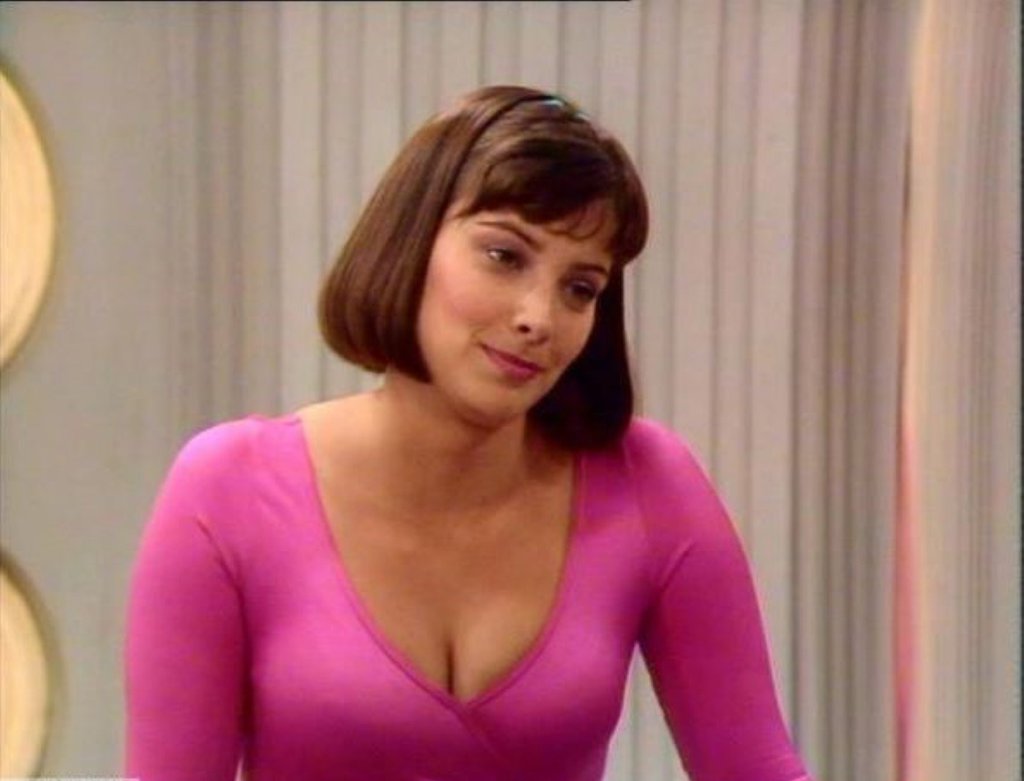
Avril Rolfe (Susan Gilmore). It doesn’t take long before she and Tom are making eyes at each other. This causes concern for his children ….
Leo (Edward Highmore) and Lynne (Tracey Childs). Bless them, neither are particularly well-written parts (although Highmore stuck it out for all seventy eight episodes, Childs for about half that). Leo is keen on the environment and Lynne is keen on the Flying Fish (all will become clear as the series progresses).
Charles Frere (Tony Anholt) doesn’t make an appearance until a few episodes in, but once he does the series shifts up a gear. He’s Howards’ Way’s JR, a ruthless and successful businessman who thinks nothing of crushing the less fortunate under his feet. Essentially, Charles is everything that Ken Masters wishes he was but so obviously isn’t – which means that any time Charles and Ken attempt to do business it’s a treat.
Charles’s right-hand man is Gerald Urquhart (Ivor Danvers), locked into a loveless marriage with the self-obsessed Polly (Patricia Shakesby). Polly and Jan are best friends, whilst Leo would clearly like to be more than best friends with Gerald and Polly’s daughter ….
Abby (Cindy Shelly). By the end of the final series her character had totally changed, but here she’s in her initial setting – sullen, withdrawn and deeply unhappy.
So join me next time as we take a look at episode one, which sees Tom drops a bombshell ….
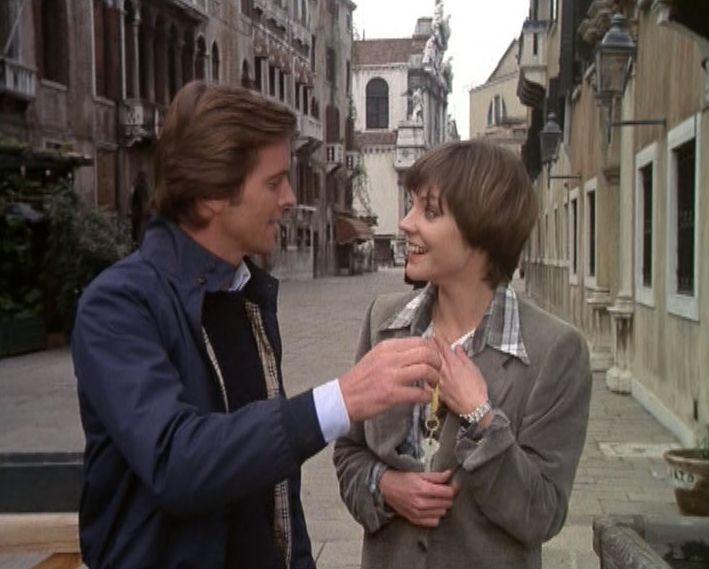
When the daughter of one of his oldest friends is kidnapped in Venice, the Saint faces a desperate race against time. Linda (Cathryn Harrison) has been abducted by Jed Blackett (Maurice Colbourne). Blackett and Simon have crossed paths before – five years ago in Mozambique.
Ever since, Blackett has been waiting for the opportunity to exact his revenge and Linda finds herself the unfortunate bait in his trap. Simon has just six hours to find the girl, but luckily for him he has assistance from an attractive gondolier called Claudia (Carole Andre) …
Ian Ogilvy’s favourite episode, it’s clear that the star of Duel in Venice is the city itself. Had it been set in London it would have been a decent runaround but nothing special. The gorgeous sights and sounds of Venice make all the difference.
It’s a pity that the storyline bears some similarities with the previously transmitted episode The Nightmare Man (an adversary from the Saint’s past is out for revenge) but that’s down to the vagaries of scheduling I guess. And the problem of dubbing raises its head again – everybody (especially Maurice Colbourne) sounds like they’re dubbed for large parts of the episode.
Colbourne has a nice line in hysterical giggling and portrays Blackett as a completely deranged character. It’s by no means a subtle performance, but since his screen time is quite limited (he mainly just pops up every now and again to taunt Simon) it’s not really a problem. Cathryn Harrison has little to do except react to Blackett’s villainy with wide-eyed fear – such as when he fits her with an acoustic necklace (any loud sound would cause it to instantly tighten, killing her instantly).
So the bulk of the story is a two-hander with Simon and Claudia. Carole Andre gives a lovely performance as the headstrong, argumentative Claudia and it’s her local knowledge which helps the Saint to eventually track Blackett down.
We never find out exactly how Simon and Blackett originally met. Since Blackett is a mercenary and he claims that Simon left him for dead, the inference is that they were both fighting on the same side in some war. It seems an uncharacteristic thing for the Saint to have done, but there’s another moment in the story which does hint at a darker side to Simon Templar.
Early on, Simon approaches Guido (Enzo Fiermonte) for assistance. He’s a man of great knowledge and power (presumably a local gangster) but is initially reluctant to help, until Simon (with the aid of a gun) persuades him. When the Saint threatens to put a hole in his head, it’s possible to believe that he’s bluffing – but he might not be.
It’s easy to believe that Leslie Charteris’ Saint would have been prepared to shoot, since the literary Saint was a much more amoral, violent character (when transferred to television, the Saint was greatly watered down). This (and the reference to Mozambique) helps to imply that the relaxed, affable playboy that Simon Templar appears to be may not the whole picture.
Helped by the location, Duel in Venice scores four halos out of five.
Six years have passed since the events seen in episode five. Bill and Jo now have a young son and Susan, the girl Bill effectively adopted, is growing up. They, together with a blind couple who live with them, have managed to keep their small community ticking over.
There are problems though and these are mostly Triffid related. Although they regularly destroy them, the Triffids always come back. Bill has built an electric fence – but powering it constantly isn’t possible. There’s a very effective sequence early on, when Jo opens the curtains to find a group of Triffids right outside. Just the small glimpse that we can see of them makes them even more disturbing.
The unexpected arrival of Coker offers a way out. He’s established a community of several hundred people on the Isle of Wight and since it’s an island, it can be defended against Triffids. Coker asks Bill and the others to join them and work on a way to eradicate the Triffids once and for all. He then talks a little about how the community functions.
Those of us all over there have all agreed we’re not out to reconstruct the world as it was. We want to build something new, better. Some people don’t agree with that, they want to keep a lot of the bad, old features. If anybody doesn’t like us, or we don’t like them, we ask them to move somewhere else.
Shortly after Coker leaves, they are visited by a number of people in military fatigues headed by a man called Torrance (Gary Olsen). The book makes it explicit that he’s the same red-headed man who shot at Bill and the blind people earlier in the story, This doesn’t happen here, so you could be forgiven for thinking they’re two separate people. Torrance wants to move another eighteen blind people into Bill’s community and whilst he admits that it’ll be hard work for them all to survive on the land for the next few years, after that he tells them they’ll be able to relax a little.
Bill comes to realise that Torrance is effectively inviting him to become a feudal lord. Torrance, like Coker, is given a chance to outline how their community operates.
Supreme authority is vested in the council. It will rule. It will also control the armed forces. Then, of course, there’s the rest of the world to consider. Everywhere must be in the same sort of chaos. Clearly, it’s our national duty to get on our feet as soon as possible and assume a dominant role and discourage any aggressors from organising against us.
It is the diametric opposite of Coker’s community. Coker wants to build something new and different, whilst Torrance is seeking to rebuild the new world very much along the lines of the old. Given that there’s been a general feeling throughout the story that any rebuilding must be an improvement on the old ways, it’s no surprise that Bill and the others reject Torrance’s offer and they leave him and his men to deal with the Triffids whilst they head for the Isle of Wight.
Earlier in the episode, Bill and Jo discuss exactly how the catastrophe happened. Jo, like many people, believes that the comet was a natural phenomenon, but Bill isn’t so sure.
Do you know how many satellites were going round up there? How many weapons? Or what was in the weapons? They never told us. They never asked us. I suppose one of these weapons had been specially constructed to emit a radiation that our eyes couldn’t stand. Something that would burn out the optic nerve. Suppose there was an accident. This weapon would operate at low levels, only blinding people they wanted to blind. But after the accident, it went off so far up that anyone on earth could receive direct radiation from it.
Back in 1981 this would have seemed horribly possible, so when you realise that it was part of Wyndham’s novel (published in 1951, six years before the first satellite was launched) it’s an impressive feat of prediction for him to anticapte the weaponising of space. Torrance’s aggressive militarism seems set to repeat these same mistakes, so it’s understandable that Bill and his friends reject him.
In conclusion, this is a creepily effective serial that has only improved with age. It naturally had a limited budget, so in earlier episodes it couldn’t show the devastation of London in any particular detail – but it did manage to efficiently imply it via sound effects (gunshots, cries, etc). If you want to watch a faithful adaptation of the novel, then this is the only one to go for – as both the film and the 2009 TV version veer wildly from Wyndham’s original.
Something of a classic, this deserves a place in anybody’s collection.
Episode Five concerns itself with Bill’s quest to find Jo, which leads him out of London and into the country. Coker joins him for the trip. One of the major plus-points of this episode is Maurice Colbourne, who was always such a watchable actor with a very strong presence. Although he appeared briefly in a few previous episodes, he’s much more central in this one. After he and Bill rest in an abandoned pub, it’s Coker who can clearly see the way forward.
We must be part of a community to have any hope for the future at all. At the moment we’ve got all we need. Food, supplies, everything. But the food will go bad, the metal will rust, the petrol to drive the machines will run out. Before that happens, we have to learn to plough and learn to make ploughs, and learn to smelt the iron to make the ploughshares. We must learn to make good all that we wear out. If not …. we say goodbye to civilisation and we slide right back into savagery.
Bill and Coker find the community at Tynsham, but Jo isn’t there. A number of the survivors have also moved on, due to a serious disagreement. The remaining survivors at Tynsham are led by Miss Durrant (Perlita Nelson) and they’ve rejected the notion that pro-creation is key to survival – instead they plan to exist by strictly Christian principles and they put their faith in God to save them.
Coker decides to stay with them, as he believes that he can make something of the community, and Bill travels on. Along the way he effectively adopts an orphaned young girl, Susan (Emily Dean). It’s interesting to see how this, like so much of The Day of the Triffids, was directly paralleled in Terry Nation’s Survivors. Essentially Survivors is The Day of the Triffids writ-large, but without any Triffids.
Wyndham gave Susan more of a back-story (about the death of her parents and her fears and feelings) which isn’t used here, that’s a bit of a pity as without it she’s something of an underdeveloped character.
Together they eventually manage to find Jo (along with a few others) and they all decide to return to the community at Tynsham. But disease has struck – many are dead and the others have left. Of Coker, there’s no sign. So they face the prospect of having to establish their own small community, whilst all around the Triffids are looming …..
There’s certainly more Triffid action in this episode. Bill gets to shoot a few of them – with both a rile and a Triffid gun. When Coker asks Bill if the Triffids frighten him he says yes, “and they sicken me, too. And what sickens me the most is that inside this mess they are the only things that are going to fatten and thrive”.
Whilst there weren’t that many Triffids in London, there seems to be more of them in the countryside – whether they’re breeding or whether there were tens of thousands in captivity who’ve escaped is never made clear. But they seem to be an ever-growing menace (even more so in the final episode).
A word about Christopher Gunning’s score. It wouldn’t have been a surprise (because of period when this was made) for the BBC Radiophonic Workshop to have provided the incidental music, but instead Gunning uses more traditional instruments (instead of the synthesizers favoured by the Radiophonic Workshop).
In episode five’s score, the piano dominates – and as Bill’s search for Jo reaches a happy conclusion, the music reaches an appealing crescendo. Given how dark the majority of the story is, Gunning’s music helps to provide a sliver of light and hope.
Bill and a number of other people (including Jo) have been captured by Coker – who staged the phony fire at the end of episode three. He allocates one sighted person to a party of blind people and assigns them to a district. They have to find a place to live and make regular trips to locate food – which will keep everybody alive until (Coker says) more organised help turns up.
Bill doesn’t believe that any help is coming but Coker’s a good enough judge of character to know that once he gets to know them, Bill won’t leave his party. Whilst he was previously able to discuss (in abstract terms) that keeping the blind alive was ultimately fruitless, when he has to deal with actual people his humanity will ensure that he’ll do everything he can for them.
But even with his best efforts, there are numerous dangers. Several are killed by a red-haired man (Gary Olsen) who’s leading a rival party. His motivation for shooting them isn’t clear here, but he’s a character that will return later in the story.
The Triffids also claim some victims in another nicely directed scene. As mentioned before, as they haven’t featured for a while their sudden reappearance in the middle of the episode comes as something of a jolt.
Disease thins Bill’s party even more and he’s powerless to prevent their deaths. As London becomes even more of a health hazard, it’s clear that the longer he remains, the more danger he’s in. Bill seems to be on the point of leaving when he’s visited by a young woman (Eva Griffith) who asks him to stay and offers herself to him. It’s a heartbreaking scene and like so much of Douglas Livingstone’s adaptation, it’s taken directly from Wyndham’s novel.
Shortly afterwards, she dies and the few survivors flee in panic. So Bill’s left alone once more. but this time he has an aim – he needs to find Jo.
Brian Aldiss once notoriously dubbed the works of John Wyndham in general and The Day of the Triffids in particular as “cosy catastrophes”. Aldiss wrote that “the essence of the cosy catastrophe is that the hero should have a pretty good time (a girl, free suites at the Savoy, automobiles for the taking) while everyone else is dying off”.
I have to admit, I don’t find anything particularly “cosy” about either this adaptation or Wyndham’s original novel. True, Wyndham’s novel did tend to feature mostly middle-class characters (another point which upset Aldiss) and this is changed here by making Bill (courtesy of John Duttine) more working class – but the concepts and themes developed thus far are pretty bleak.
After Bill and Jo escape from the maurding pack of blind people, they find a place to hole up for the night. After enjoying a good meal and a decent mug of wine, they both learn a little more about each other – although Jo says, “but all that, all the details of my life, they were yesterday. It’s the same with you. I think I’d like to know you from today and you know me from today. You might not like what I was yesterday. I might not like what you were”. The sense that yesterday is a closed book and that the future starts today is a theme that is picked up again later in the episode.
They then discuss what to do next. Bill is keen to get out of London as he tells Jo that soon, “the city will begin to stink like a great sewer. There are already corpses lying around. Soon they’ll be more. That may mean cholera, typhoid. God knows what”.
But a light in the distance changes their plans and the next morning they meet a group of thirty or so survivors who all have sight. They see another sighted man, called Coker (Maurice Colbourne), who’s leading a group of blind people. He asks the others for help in finding food, but they refuse. This is a debate that has cropped up before and Bill and Jo discuss it again shortly afterwards. Bill says that Coker is right and wrong. “We could show some of them where to find food for a few days or for a few weeks. But what happens afterwards?”.
They then meet the leader of the sighted group, Beadley (David Swift). He proposes moving out of London and establishing a community that will isolate itself for a year (in order to protect against disease). One of the other members of their ad-hoc committee explains how the community will function.
The men must work. The women must have babies. We can afford to support a limited number of women who cannot see, because they will have babies who can see. We cannot afford to support men who cannot see. In our community, babies will be more important than husbands. It follows from this that the one man/one woman relationship as we understand it will probably become an illogical luxury.
As for the Triffids, they only appear in a single scene (where they attack an old couple who we’ve never seen before). As their appearance (although it’s very nicely shot at night) is divorced from the main narrative, it seems to have been put in simply to remind the audience that they’re still out there. And since they don’t feature much in this episode, it helps to make their sudden reappearance in episode four even more striking
At the end of this episode, Bill and Jo (along with the rest of the potential community members) are settling down for the night when a fire alarm is raised. Bill rushes down the stairs, trips over and awakes to find himself tied up …..
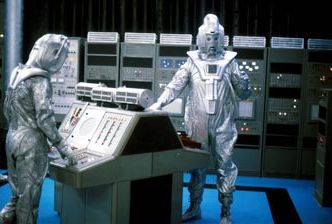
Attack of the Cybermen (lousy title by the way) seems to have been born out of a fannish desire to recreate some of the Cybermen’s greatest moments. With Tomb of the Cybermen apparently lost forever, there was a certain sense in creating a new story which revisited the Tombs on Telos (although the dinky cubicles in Attack lack a certain style – Tomb did it much better).
For those playing continuity bingo, Mondas and its destruction gets a mention (The Tenth Planet) and the Cybermen once more have a liking for the sewers and also keep their ship hidden on the dark side of the Moon (The Invasion). And Michael Kilgarriff reprises his role as the Cyber Controller, eighteen years after Tomb.
“It is a fat controller”
The authorship of Attack has always been a slightly thorny issue. Some maintain that Paula Moore (alias Paula Woolsey) never wrote a word of the script and that it was all Eric Saward’s (with suggestions from Ian Levine). Although there are contrary opinions (Levine had greater input, Woolsey did contribute to the script, etc) for the sake of argument we’ll assume that the bulk was written by Saward, as it certainly bears his hallmarks (high body-count and violence, for example).
Lytton (Maurice Colbourne) who had been created by Saward in Resurrection of the Daleks returns. It’s tempting to think that Saward decided to reuse the character after watching Colbourne’s performance in Resurrection. His first appearance was a fairly nothing part, but Colbourne (by the sheer dint of his personality) certainly made something out of it.
The Lytton in Attack is a subtly different character – for example he has a sharp sense of humour, which is seen in his exchanges with Russell, Griffiths and Payne in the first episode. These early scenes are some of the best in the story and feel quite out of place in Doctor Who (although in a good way). They could have quite easily come from a contemporary police series, like Strangers, and it’s a shame that they didn’t remain on Earth for the rest of the story – as a story with the Doctor and Peri tracking Lytton and his merry men through London’s underworld could have been a decent yarn.
Plot hole number one. If Lytton’s two bogus policemen are still around, why does he need Russell, Griffiths and Payne? It’s established later that a crew of three is needed to pilot the Timeship, so Lytton plus his two phony coppers would seem to be more than adequate.
“You said you came from Fulham”.
There’s one good reason for having Griffiths around, and that’s Brian Glover. A familiar face (and voice) on British television for a number of years prior to this appearance, he’s terribly good value. He often finds himself the butt of Lytton’s acid remarks, and this adds an unexpected twist of humour to the story. Lytton’s unique take on employer-employee relations is best illustrated when he deals with some dissent from newcomer, Russell –
LYTTON: You are new to this group and have yet to gain my confidence, that’s why I tell you nothing. These two are muscleheads and wouldn’t understand what I said anyway.
GRIFFITHS: You’ve got a rough tongue, Mister Lytton.
LYTTON: Which you will learn to live with, Griffiths, otherwise you’re out. And as your earnings have never been better, that would be rather foolish, wouldn’t it? Let’s go. Come on, Payne, there’s work to be done.
PAYNE: Right.
(Payne gets down into the narrow access tunnel.)
PAYNE: Oh. Hey, how thick is the sewer wall?
LYTTON: Oh, nothing you can’t handle.
(Payne takes the heavy lump hammer.)
PAYNE: I used to use one of these when I worked for the council.
LYTTON: This time it’s for swinging, not leaning on
It turns out that Russell (Terry Molloy) is an undercover policeman, sent to investigate the mysterious Lytton. Russell is a chance for Molloy to make a Doctor Who appearance as himself, rather than encased in latex as Davros. He’s rather good, and as Russell he underplays very well, a sharp contrast to the creator of the Daleks.
Whilst all this is going on, what’s happened to the Doctor and Peri? Well, they spend the early part of episode one not achieving very much – mainly dashing from place to place attempting to answer an intergalactic distress call. This has little overall relevance to the plot and mainly seems to be designed to keep the Doctor out of the loop until Lytton has allowed himself and Griffiths to be captured by the Cybermen.
One side-effect of the move to 45 minute episodes, is that for a 90 minute story there would now only be one cliffhanger. It’s a pity that the one in Attack is rather inept (“No, no, noooooooooooo!”) and the resumption in episode two is also slightly iffy. The Cyberleader (for no apparent reason) orders the death of Peri and a Cyberman steps up to deal with her. The Doctor, of course, pleads for her life, but there’s a long gap until the CyberLeader agrees. Why did the Cyberman not kill Peri straight away? Why listen to what the Doctor said? He’d been given a clear order by the CyberLeader.
So we’re off to Telos, where all the characters meet up with the Cryons, who are a bit of a rum lot. Sarah Berger, Sarah Greene and Faith Brown are amongst their number and they certainly are a memorable creation – I think it’s the long fingernails that does it. The masks do look a little cheap, but overall they work quite well as an alien species with their own unique take on events.
Lytton and Griffiths, along with two escapees from the Cybermen’s work party (Stratton and Bates) attempt to steal the Cyber Controller’s Timeship. Plot hole number two. How did the Cryons and Lytton know that Stratton and Bates were at large on the surface of Telos and also planning to steal the ship? Also, it’s fair to say that Stratton and Bates have to be the most pointless characters in the story. We spend a long time with them as they make their attempt to escape from the work party, ambush a Cyberman, etc, but in the end this plot-thread doesn’t go anywhere. And even when they team up with Lytton and Griffiths, they achieve nothing.
This being (probably) a Saward script, people start to die – Griffiths, Stratton and Bates are all quickly killed off, whilst Lytton is captured and taken to be turned into a Cybermen. First, though, Lytton’s hands are crushed to a bloody pulp – one of the most infamous scenes of the story.
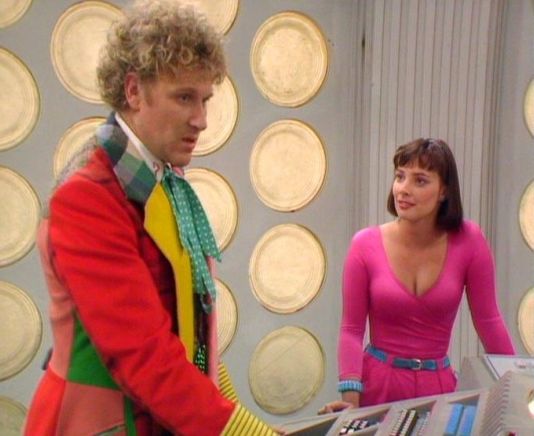
Although I haven’t mentioned him much, Colin Baker is already (in just his second outing) very assured as the Doctor. There’s still a trace of the erratic behaviour of The Twin Dilemma but he’s much more in command here and more than able to hold his own against both the Cybermen and Lytton. The best of his scenes in episode two come when he’s locked up with the Cryon, Flast (Faith Brown) who describes the Cybermen’s plans for Earth.
DOCTOR: How do they intend to destroy Earth?
FLAST: It would only be necessary to disrupt it.
DOCTOR: It would still take rather a large bomb.
FLAST: They have one. A natural one. In fact, it’s heading towards Earth at this very moment.
DOCTOR: Halley’s comet?
FLAST: That’s right. They plan to divert it, cause it to crash into Earth. It’ll make a very loud bang.
DOCTOR: Indeed it will. It’ll also bring about a massive change in established history. The Time Lords would never allow it.
FLAST: Who knows? Perhaps their agents are already at work.
DOCTOR: Well, if they are, they’re taking their time about it. For a start, why? Wait a minute. No! No, not me! You haven’t manoeuvred me into this mess just so I can get you out of it! It would have helped if I had known what was going on!
FLAST: You are a Time Lord?
DOCTOR: Yes. And at the moment, a rather angry one.
Although there’s a lot to enjoy about Attack (Baker and Bryant, Maurice Colbourne, Brian Glover) the ending does leave a little bit of a nasty taste. It’s not the first Doctor Who story to end in violence and it won’t be the last, but there’s something a little off in seeing the Doctor blasting down the Cybermen. The Doctor’s used a gun before (for example, the third Doctor in Day of the Daleks was quite happy to gun down Ogrons) but it’s a pity that the resolution of the story couldn’t have been a touch more imaginative.
Still, following the fairly calamitous opening stories of the previous two seasons (both courtesy of Johnny Byrne) as a season opener Attack is a definite step up in quality and a good marker for the type of stories to come during the rest of S22.
Back in 1984, there was somewhat of a buzz about this one. Apart from a cameo in The Five Doctors we hadn’t seen the Daleks in a new story for five years and their previous appearance, in Destiny of the Daleks, had been a disappointment to many.
Thirty years on, Destiny is probably better regarded today than it was back then whilst Resurrection has lost a little of its lustre. But although Eric Saward’s script has its faults, there are some things it does do right and it’s a clear pointer to the style the series would take in S22.
It’s fair to say that Resurrection is a bleak tale. This nihilistic view of the universe reflects the direction in which Eric Saward wanted to take Doctor Who and he wasn’t the only writer to favour this style. Robert Holmes penned very much the same type of story with The Caves of Androzani, but it has to be said somewhat better. Therefore it’s not difficult to see that Holmes would from now on strongly influence Saward’s writing (Revelation of the Daleks with its Holmesian double-acts is surely the sincerest form of flattery).
But back with Resurrection, Saward wanted to tie up the loose ends from Destiny and resolve the Dalek/Movellan war. He probably would have been better off ignoring this and starting afresh, as it does constrict the story (as do some of the other plot threads which go nowhere – such as the Daleks’ plan to duplicate the Doctor so he can go back to Gallifrey and assassinate the High Council).
The main part of the story revolves around the Daleks’ desire to find their creator, Davros, and use his skills to solve their current problems. This is a re-tread from Destiny, but Saward does one important thing right here that didn’t happen in Destiny. One of the clearest character traits of the Daleks is how single-minded they are, so it defied belief that they wouldn’t attempt to use Davros in Destiny for their own ends before discarding him. But this never seemed to occur to Terry Nation.
In Resurrection, the Daleks are quick to realise that Davros is more trouble than he’s worth and they attempt to exterminate him. But by then he’s already re-conditioned several Daleks, which establishes the general plot-thread of Dalek civil war which we see in Revelation and Remembrance.
As for the Daleks themselves, they do look a little worse for wear, it has to be said. They’ve been given a fresh coat of paint, but since they’re a mixture of casings from the 1960’s and 1970’s they naturally do look like they’ve been around the block a few times. For anybody who wants to delve further into the history of the Dalek casings, then Dalek 6388 is a fascinating website.
Michael Wisher was unable to reprise his role as Davros, so Terry Molloy stepped into the breach. Molloy ended up playing the role three times and would go on to make it his own, managing to emerge from Wisher’s substantial shadow. There’s less character for him to latch on here than he would enjoy in Revelation (which was much more of a Davros story than a Dalek one) but he still has some nice, ranting moments.
As for the humans, there’s an interesting ethnic mix on the space-station which is unusual for the series at the time. There’s also signs of the increased gore that would appear during S22 (the Daleks’ disfiguring gas is pretty unpleasant and it’s debatable whether the close-ups should have been transmitted).
One problem with Saward’s scripts up to this point was that characters could often seem like cardboard cut-outs, existing just as long as they formed some plot function. Once that ended, they would be quickly killed off (in order not to clutter up the screen). Styles (Rula Lenska) and Mercer (Jim Findley) are good examples of this. Rodney Bewes as Stein fares somewhat better and has the chance to play the hero at the end.
The Army bomb disposal squad, headed by Del Henney as Colonel Archer are also characters that don’t really go anywhere and it’s unfortunate that Tegan spends most of the story with them. As a final story for Janet Fielding, Resurrection is a poor effort, as Tegan does little of consequence – but as is probably well known, the story was originally planned to close S20 (a BBC strike put paid to that) so her leaving scene had to be tagged onto the already-written story.
Turlough and the Doctor fare little better. Turlough teams up with Styles and Mercer, although he does nothing to advance the plot. The Doctor has one key scene (confronting Davros and proving that he’s unable to kill in cold blood) but apart from that there’s very few of the character traits that Davison so clearly enjoyed in Frontios.
Also skulking about is Lytton (Maurice Colbourne) who will return next season, although it’s worth pondering exactly how the Doctor in Attack of the Cybermen knows all about him, as here they only share one scene and never speak to each other.
After the mass slaughter, it’s difficult not to agree with Tegan that it’s all been a bit too much. But it’s probably aged better than Earthshock and for better or worse, points clearly to the direction the series would take during S22.




 Archive Television Musings