Story by Isaac Asimov, Adapted by Jeremy Paul
Directed by John Gorrie
Although time-travel is impossible, the chronoscope is the next best thing – as it allows the user to focus in on events from the past. The problem is that there’s only one such device in existence and its use is strictly regulated by the authorities. Historian Arnold Potterley (George Benson) has been waiting two years to use it in order to study his special area of research (Ancient Carthage) but he’s finally been refused permission by Thaddeus Araman (David Langton).
Potterley rails against the walls of government bureaucracy built by men like Araman, so he decides to find somebody to build him a personal chronoscope. Jonas Foster (James Maxwell) does so, but the results are far from what Potterley and Foster expected ….
The Dead Past, originally published in 1956, quickly became a favourite amongst Asimov’s readership (and it was also well regarded by Asimov himself). This, plus the fact that it could be made with a small cast and a handful of sets, obviously ensured it was an ideal candidate for Out of the Unknown.
It’s very much a story of ideas and not action so it may not hold the attention of everybody. But the cast help to bring the story to life – particularly David Langton, Sylvia Coleridge and Willoughby Goddard.
Langton (best known for his role in Upstairs Downstairs) is very good as the bureaucrat who may not be quite as faceless as he seems. Coleridge plays Arnold Potterley’s wife and whilst Potterley wishes to use the chronoscope to delve into the mysteries of the ancient past, she wants to go back twenty years or so to see their dead child. Coleridge’s performance in those scenes is heartbreaking. Goddard (complete with cloak and eye-patch) provides some welcome comic relief.
The twist in the tale brings this thoughtful, reflective story to a satisfying conclusion.
I’ve uploaded the 1000th live edition of Tomorrow’s World to YouTube. Made in the early 1990’s, it also looks back at some of the more memorable moments of the long-running BBC science programme.
Charles Wilson (Peter Copley) stands at the window of his flat, his eighteen year-old son by his side. Wilson tells him that “down there swarm the ordinary millions. When they stumble across anything they are not used to they panic, they destroy”.
Wilson’s son, known simply as “Boy” (played by Richard O’Callaghan) is the thing they would seek to destroy. Boy is a mutant – he possesses amazing mental powers which allow him to read minds and command anybody to instantly obey his will. Because of these gifts, his parents are forced to move him from place to place whenever anybody becomes suspicious.
But it seems that wherever they go, they will always attract attention. Brown (John Paul) has moved into the flat next door and seems very intersted in Boy. It becomes clear very quickly that he’s part of a team (headed by Evans, played by Jack May) who have a very definite interest in him. Then Boy becomes infatuated with Paula (Justine Lord), a beautiful young actress, but she also has her own agenda. Will he be able to control himself or will they all push him into terrible acts?
After two futuristic tales, OOTU came back to contemporary Earth with a bump. Although the majority of stories from the first three series were adaptations of existing material, there were also several original ones – of which this, written by David Compton, was the first.
It’s a pity that the original film inserts no longer exist, as this renders the opening sequences (where we see Boy wandering the streets pursued by a mysterious stranger) somewhat indistinct. Richard O’Callaghan (the son of Patricia Hayes) is engaging as the confused, gentle Boy who has powers that he sometimes finds difficult to control.
John Paul (later to star in Doomwatch) is smooth as the mysterious Brown, whilst his future Doomwatch co-star Joby Blanshard also appears (he’s the unfortunate Hall who’s forced into the path of a lorry by Boy). Brown blames Boy for Hall’s death and becomes increasingly antagonistic towards him.
As might be expected, the ending is pretty downbeat. Featuring few science fiction trappings, this operates much more as a slice of contemporary drama (although there is a slightly surreal edge to Alan Bridges’ direction, as he tends to focus things from Boy’s point of view – best seen in the opening film sequences).
Whilst this does feel a little drawn out at just under 60 minutes, the quality of the cast (Richard O’Callaghan, John Paul, Peter Copley and Justine Lord amongst others) helps to maintain the impetus of the episode.
Story by Alan Nouse, Adapted by Philip Broadley Directed by George Spenton-Foster
After the somewhat sedate opening episode, The Counterfeit Man offers a sharp change of pace – with much more of a hard-SF feel and a theme of body horror. As we’ll see as we make our way through the series, this was always one of OOTU’s great strengths – the tone would change from week to week, so you could never predict the type of story that would turn up next.
The crew of a space-ship are returning home to Earth after a mission to one of Jupiter’s moons – Ganymede. However, Dr Crawford (Alexander Davion) is perturbed by the medical records of one of the crew, Westcott (David Hemmings). Westcott has a blood sugar level of zero, which is impossible. Crawford is convinced that Westcott was killed on Ganymede and his form was then assumed by an unknown alien entity.
Crawford decides that the only way to be certain is to push Westcott to the point of madness and force the alien to reveal its true nature ….
A year before he achieved international fame in Blow Up, Hemmings took the lead role in this creepily effective OOTU. Westcott is so normal and well-balanced that it’s impossible to believe he could be a murderous alien. Hemmings is able to portray very effectively Westcott’s descent into madness as Crawford initiates a witch-hunt against him.
Due to all the crew sporting similar haircuts, it took a little while for me to twig that Crawford was played by Alexander Davion (who had starred alongside John Gregson in Gideon’s Way). Davion goes a little over the top at times, but it’s still a good turn – especially the ending which he plays very well.
The space-ship has a very pleasing design – there’s something about the 1960’s version of the distant future which is quite effective. All the solid-state technology may look a little out of date, even now, but it does have an undeniable charm. Music is generally quite sparse, except for the visual sequences of Westcott’s disintegration. Some of the sound effects will be very familiar to anybody who’s ever watched the black and white Doctor Who’s.
A strong episode, with good performances and an unsettling ending.
I’ve just uploaded to YouTube the Z Cars edition of Stars Reunited from 2003. Dale Winton reunites four cast members from Z Cars – James Ellis, Colin Welland, Frank Windsor and Brian Blessed.
It’s often been commented upon that Survival was a story that pointed towards the style adopted by NuWho. Like some of the early NuWho stories, there’s a sense that the story is located in a real, definable modern location. Other Who stories of the time (such as Silver Nemesis) were also set on contemporary Earth, but Survival takes us onto the streets and into the tower-blocks of contemporary London, a place where the series rarely ventured.
It’s also possible to imagine the story working very well as a 45 minute story (like the majority of NuWho). Had it done so, then the majority of the first 25 minutes could easily have been jettisoned. There’s some nice moments, such as Ace’s friend Ange who’s surprised to see her as she thought she was dead (“either you were dead, or you’d gone to Birmingham”) but far too much of the episode drags.
The business with Hale & Pace as well as the Doctor faffing around with the cat food is all pretty throwaway stuff. But we do get to meet the arrogant Sergeant Paterson (“Have you ever heard of survival of the fittest, son, eh? Have you ever heard of that? Life’s not a game, son. I mean, I’m teaching you the art of survival. I’m teaching you to fight back. What happens when life starts pushing you around, son, eh? What’re you going to do then?”). The constant repetition of “survival of the fittest” during the first episode is a far from subtle foreshadowing of what was to come.
It’s interesting that Survival is a very episodic story (The Keys of Marinus is another where the location would change from episode to episode, but I can’t think of many other examples from the original series off the top of my head). Episode one takes place on Earth, episode two on the planet of the Cheetah People whilst episode three returns us to Earth.
Episode two is probably the best of the three. The Cheetah People’s planet is very well realised, with subtle video effects used to change the colour of the sky, etc. It’s certainly a good deal more effective that the garish Paintbox effects on Mindwarp. I also love Dominic Glynn’s music here – so it would be nice if SilvaScreen restarted their release programme of Doctor Who soundtracks with stories like this one.
And the Master’s back! Although his interpretation wasn’t to everybody’s taste, I’ve always had a soft spot for Anthony Ainley (and considering how the New Series has treated the Master, Ainley is a model of restraint). Survival is probably his best Doctor Who appearance as the Master (although his best appearance overall as the Master can be found on the links of the Destiny of the Doctor CD-ROM game).
For once, he has no grand scheme – like everybody else he’s just fighting for survival. But once he returns to Perivale, things do fall apart. The sight of the Master recruiting a gang of teenagers from the local Youth Club is bizarre, to say the least, and his motivations at the end of the story seem confused. At one point, he tells the Doctor that he has control over the power and that he’ll use it to destroy him. In the very next scene, the Master and the Doctor are back on the planet of the Cheetah People and the Master’s attitude has completely changed – now he wishes to die, as he doesn’t want to live as an animal. As happened so often, script editor Andrew Cartmel seems to has overlooked plot-holes like this, which would have been easy to fix.
Although it’s not really visible, the Master’s murder of Karra (Lisa Bowerman) is quite vicious and serves as a reminder that he could be ruthless when the situation demanded it. Karra is the Cheetah Person who forms a strong link with Ace. And Ace’s prominent role in the story is another link to NuWho, where the companion is often more important to the story than the Doctor (although Survival is not unique in this respect – and in fact this is the last in a loose trilogy which put Ace to the fore).
Whilst Ghost Light was the last story from the original run to be recorded, Survival was the last to be transmitted and it’s really the end of an era. Doctor Who would survive – initially as books, then a one-off TVM, then audios and then finally the relaunched series in 2005 which achieved levels of success (in the UK and also worldwide) both commercially and critically that the original series only enjoyed somewhat intermittently.
Story by John Wyndham, Adapted by Stanley Miller
Directed by Peter Potter
Ever since his home planet of Earth was destroyed, Bert (Terence Morgan) has been scratching a living on Mars as an odd-job man. Mars isn’t such a bad place – the indigenous population are unspoilt and friendly, but he yearns for a chance to build a new Earth.
When he hears about the colony on Venus, it seems like just the chance he’s been looking for. But he quickly realises that it’s a brutal totalitarian regime that ruthlessly exploits the primitive locals (the Griffas). Bert is attached to a work-party run by the merciless Khan (George Pastell). Khan mocks Bert’s idealism and asks him to name one great civilisation that wasn’t built on exactly this type of labour.
Eventually Bert comes to realise that his future doesn’t involve creating a new Earth, instead it’s back on Mars with the people that he loves and who love him.
Out of the Unknown producer Irene Shubik wasn’t keen to launch the series with this episode, but head of drama (Sydney Newman) insisted. Then, as now, the name of John Wyndham was a considerable draw.
Whilst No Place Like Earth isn’t the strongest story from the early run of the series, it still has plenty of interest. Terence Morgan (a familiar face from the ITC swashbuckler Sir Francis Drake) is good value as the idealistic Bert. Alan Tilvern is smoothly persuasive as Blane, the man who recruits Bert to work on Venus whilst George Pastell is suitably boo-hiss evil as the brutal Khan.
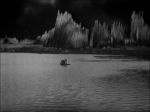
The moral of the story isn’t particularly subtle, but it’s a reasonable enough message which deserves to be heard. The matte shot at the start of the story (showing Bert piloting his craft on the Martian lakes) is very impressive. The exploding spaceship at the end is, sadly, rather less impressive.
As I’ll be posting individual reviews of each episode as I move through the set during the next month or two, I’m going to take a quick look here at the content in general, the picture quality and also examine the special features. The episodes and special features are spread across the seven discs like this –
Disc One
No Place Like Earth (+ audio commentary) (53 minutes)
The Counterfeit Man (59 minutes)
Stranger in the Family (53 minutes)
The Dead Past (+ audio commentary) (60 minutes)
Stills Gallery 1 (6 minutes)
Disc Two
Time in Advance (+ audio commentary) (58 minutes)
Come Buttercup, Come Daisy, Come…? (61 minutes)
Sucker Bait (+ audio commentary) (59 minutes)
Stills Gallery 2 (4 minutes)
Disc Three
Some Lapse of Time (+ audio commentary) (60 minutes)
Thirteen to Centaurus (60 minutes)
The Midas Plague (+ audio commentary) (63 minutes)
Stills Gallery 3 (3 minutes)
Disc Four
The Machine Stops (+ audio commentary) (51 minutes)
Lambda I (51 minutes)
Level Seven (+ audio commentary) (60 minutes)
Tunnel Under the World (52 minutes)
Stills Gallery 4 (9 minutes)
Disc Five
The Last Lonely Man (50 minutes)
Beach Head [reconstruction] (50 minutes)
The Naked Sun [reconstruction] (50 minutes)
The Little Black Bag [incomplete] (31 minutes)
An Interview with James Cellan Jones (16 minutes)
Stills Gallery 5 (19 minutes)
Disc Six
The Yellow Pill [reconstruction] (50 minutes)
To Lay a Ghost (50 minutes)
This Body is Mine (+ audio commentary) (49 minutes)
Deathday (48 minutes)
Deathday film insert (1 minute)
Stills Gallery 6 (8 minutes)
Disc Seven
Welcome Home (+ audio commentary) (50 minutes)
The Man in My Head (+ audio commentary) (48 minutes)
The Uninvited [reconstruction] (47 minutes)
Return of the Unknown (42 minutes)
Stills Gallery 7 (8 minutes)
The video was restored by Peter Crocker and the audio by Mark Ayres. Both names will be familiar to some people via their work on the Classic Doctor Who DVD range, but the PQ on OOTU is a little more variable than the Doctor Who releases. Crocker discusses the various reasons why this is the case in the booklet included with the DVD. For the majority of the B&W episodes, existing tape transfers were used and then cleaned up as much as possible, although some (like Tunnel under the World) had so much damage that a full restoration was impossible. Generally though, the picture quality is as good as could be expected. The film sequences on some stories are out of phase (a common occurrence on material of this age) but it’s difficult to see how, given the time and budget, things could have been any better.
The menu screens are quite simple, with a static image and no music.
Apart from the audio commentaries (where the ever-cheerful Toby Hadoke teases reminiscences from both actors and technical staff) and a new 42 minute documentary, the most substantial extras are four reconstructed episodes. Anybody who’s ever seen a Doctor Who recon will be familiar with how three of them (Beach Head, The Naked Sun and The Yellow Pill) are presented. Available publicity photographs (along with a little CGI) have been married up to the original soundtrack to produce a pretty watchable experience. The audios all sound pretty good (and subtitles can be switched on if there’s ever any muffled dialogue). The audio of The Naked Sun is incomplete, so subs help to explain what’s happening during the audio-less sections. Photographs for The Uninvited are thin on the ground, so the audio for this recon is matched up to the camera script.
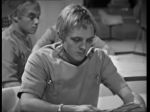
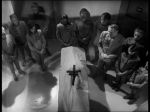
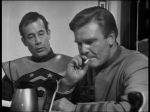
Below are a number of screenshots from a variety of episodes. Although I’ve only scratched the surface of this release, it looks an impressive package, with a healthy selection of special features which help to place the original stories in context.
Norris Karloff has posted what must be one of the best videos ever on YouTube, which sees the Crackerjack gang (Ed Stewart, Peter Glaze and Bernie Clifton) cover XTC’s song with hilarious consequences.
With the release of Out of the Unknown less than a week away, the BFI have put this rather nice trailer up.
This link will take you to the BFI’s website, where there’s highlights of an Out of the Unknown panel moderated by Toby Hadoke and featuring director John Gorrie, SFX sound engineer Brian Hodgson and author Mark Ward.
For more info on the DVD set, please look here, here and here.
The Curse of Fenric is a bleak, cynical story. So it’s hard to believe that, for many people at the time, Doctor Who was still seen very much as children’s television – although some of the performances, which we’ll come to later, did have a feel of “children’s tv” about them.
One of the interesting things about Fenric is how it portrays the British during their darkest hour. The government are seen to hatch a plan which will cause mass slaughter in Russia at some unspecified point in the future. It doesn’t go as far as to say that Churchill knew about it, but the implication is there.
MILLINGTON: Just think what a bomb full could do to a city like Dresden or Moscow.
DOCTOR: It’s inhuman.
MILLINGTON: It could mean the end of the war.
DOCTOR: And Whitehall thinks that Moscow is careless enough to let you detonate one of those things inside the Kremlin?
MILLINGTON: Oh, that’s the beauty of it, Doctor. We won’t detonate it. They’ll do it themselves. They’ll use the machine to decrypt our ciphers, but Doctor Judson has programmed it to self-destruct when it tries to decrypt a particular word. And, once the political climate is appropriate, we will include the word in one of our ciphers.
DOCTOR: And the word is?
MILLINGTON: What else could it be, Doctor? Love.
As the above extract indicates, there’s a little confusion in the scripting. At one point, Millington (Alfred Lynch) discusses how the chemical weapons could signal the end of the war – but he plans to use them against the Russians, not the Germans, so how is this possible?
Faith is an important part of the story. The Reverend Wainwright (Nicholas Parsons) doesn’t have faith any more and it proves to be his undoing. I remember the outcry amongst a certain section of fandom back in 1989 when Parsons’ casting was announced – it seemed that another Ken Dodd comedy turn was expected. But Parsons was wonderful as the conflicted Wainwright (not that this should be a surprise, since he had plenty of acting experience). He has some lovely moments in the story, such as this scene with Ace.
ACE: Funny church, this, isn’t it?
WAINWRIGHT: I was just remembering when I was a child. My father was the vicar here then. It seemed such a warm, friendly place in those days.
ACE: Things always look different when you’re a child.
WAINWRIGHT: Now I stand in the church every Sunday, I see all the faces looking up at me, waiting for me to give them something to believe in.
ACE: Don’t you believe in anything?
WAINWRIGHT: I used to believe there was good in the world, hope for the future.
ACE: The future’s not so bad. Have faith in me.
But sadly he didn’t have faith in her or anyone else, so he meets his end at the hands of Jean (Joann Kenny) and Phyllis (Joanne Bell). They’re two of the weak links in the story – they’re not particularly impressive before they’ve been taken over, but afterwards they’re somewhat diabolical. Maybe it’s the fingernails or the stilted delivery, but it’s not good.
There’s better acting elsewhere though. Dinsdale Landen has a nice touch of humour as the wheelchair-bound Judson and is even better when taken over by Fenric in the last episode. But it’s a pity that episode three didn’t end on a close-up of him, rather than a shot of the Doctor looking mildly worried (but it’s not the first cliff-hanger of the era to end on a limp shot of the Doctor by a long chalk).
Fenric was always a story that didn’t quite work in its original broadcast format and both the VHS and the DVD had different edits which benefit the story by including various scenes that had to be cut out due to time restrictions. There’s possibly too much plot in the story for the episode count – the Haemovores, the Ancient One, Millington’s agenda, the Russian’s plan to steal the Ultima machine, the return of Fenric, it’s certainly all going on.
Losing a few of these threads (particularly the Haemovores who contribute little to the plot) would have tightened things up a little. And episode four, whilst it has some great drama (especially when Sorin has been taken over by Fenric) can’t help but feel like something of an anti-climax. It is a little hard to take Fenric that seriously when he wants to drop everything to pick up the game he was previously playing with the Doctor. Yes, I can see that chess is a metaphor – but it’s a somewhat clumsy one.
The scene where the Doctor attempts to destroy Ace’s faith in him is nice though – and it’s either a skillful weaving together of plot-threads from various stories during S24 & S25 or an opportune scramble to explain some of the plot-holes from those same stories. I’ll leave you to decide.
SORIN: The choice is yours, Time Lord. I shall kill you anyway, but if you would like the girl to live, kneel before me.
ACE: I believe in you, Professor.
SORIN: Kneel, if you want the girl to live!
DOCTOR: Kill her.
SORIN: The Time Lord finally understands.
DOCTOR: Do you think I didn’t know? The chess set in Lady Peinforte’s study? I knew.
SORIN: Earlier than that, Time Lord. Before Cybermen, ever since Ice World, where you first met the girl.
DOCTOR: I knew. I knew she carried the evil inside her. Do you think I’d have chosen a social misfit if I hadn’t known? She couldn’t even pass her chemistry exams at school, and yet she manages to create a time storm in her bedroom. I saw your hand in it from the very beginning.
ACE: Doctor, no.
DOCTOR: She’s an emotional cripple. I wouldn’t waste my time on her, unless I had to use her somehow.
ACE: No!
I’ve never quite understood how Ace never twigged that the baby was her mother. Did she not know her maternal grandparents or did she just think it was a strange coincidence that Kathleen and her husband had exactly the same names as her Nan and Grandad? And the less said about the “Sometimes I move so fast, I don’t exist any more” scene the better, I think.
Not a perfect story then, but there’s enough going on to make it a worthwhile, if sometimes flawed, watch.
Victoria Wood was always faintly unimpressed, visually, with the way that dinnerladies turned out. She had pictured it shot with hand-held cameras but was told that it wasn’t possible. So what she got was something that looked like a traditional sit-com (although this isn’t really any bad thing). It seems to be an ever-present fixture on Gold, along with the likes of Porridge and Steptoe and Son, and it’s a good indication of dinnerladies’ quality that it doesn’t seem out of place when broadcast alongside the comedy greats of the 1970’s.
Whilst it may have rankled with Wood that the style of the series was so resolutely traditional (particularly when the likes of The Royal Family and The Office were able to quite easily eschew this format) dinnerladies was a sit-com that probably wouldn’t have benefited from the sort of wobbly-cam single camera shooting that was to dominate comedy in the years to come.
It’s written, essentially, as a stage-play with just a single location (and it’s probably not surprising to know that most of the scripts were adapted successfully for several theatre tours). We may hear about the world outside but the focus remains firmly on what happens inside the canteen.
Wood was able to assemble a first-rate cast, some of whom (Duncan Preston, Ceila Imrie, Julie Walters) had enjoyed a long association with her, whilst others (Thelma Barlow, Andrew Dunn, Shobna Gulati and Maxine Peake) were newcomers. She obviously knew what Preston, Imrie and Walters could deliver, but the characters of the others (as well as Anne Reid, who had appeared in Victoria Wood – As Seen on TV) would maybe only really begin to develop towards the end of the first series and into the second as she began to tailor their parts based on her experience of working with them.
As the creator, writer and co-producer, Wood had an enormous amount of power that she was able to wield. But whilst the overall arc of the two series is the story of Bren and Tony, Wood doesn’t dominate each episode and nor does she give herself all the best lines. She was comfortable enough to sometimes remain in the background as a passive figure, whilst the others enjoyed the biggest laughs.
If the series was shot in a traditional way, the actual recording process was quite different. It would be shot on a Friday evening and then Wood and co-producer Geoff Posner would view the results, with Wood re-writing the script which would then be re-recorded on the Saturday evening. Although this was common practice for American sit-coms, it was unusual, if not unique, for a British sit-com.
It would be lovely one day to have DVD sets released with both the Friday and Saturday recordings, so that we can see exactly what was changed, but I’m not going to hold my breath. The DVD releases we have are resolutely bare-bones, with no commentaries or special features, which indicates that Victoria Wood isn’t particularly keen to spend a great deal of time analyzing her work.
First up is a Restaurant sketch with Cleese and Idle as husband and wife. Idle is good value as the complaining wife (“Ooh I don’t like this, Ooh I don’t like that. Oh I don’t think much to all this. Oh fancy using that wallpaper. Fancy using mustard. Oo is that a proper one? Oo it’s not real. Oh I don’t think it’s a proper restaurant unless they give you finger bowls. Oo I don’t like him. I’m going to have a baby in a few years”).
The sketch then goes off into several different directions, best of which is Jones offering himself as the dish of the day (“I hope you’re going to enjoy me this evening. I’m the special. Try me with some rice”).
I love the authentic looking cinema adverts (“After the show why not visit the La Gondola Restaurant. Just two minutes from this performance”) which is followed an intermission with Cleese as a cinema usherette who’s only got an albatross for sale (“Course you don’t get bloody wafers with it”). For such a typically throwaway moment it enjoyed a long life, right up until the farewell shows at the O2 earlier this year.
The historical impersonations sketch (“I would like to see John the Babtist’s impersonation of Graham Hill”) really belongs to Palin, both for his suitably smarmy host and his turn as Cardinal Richelieu impersonating Petula Clark.
Also good is the police sketch (“Yes, we in Special Crime Squad have been using wands for almost a year now. You find it’s easy to make yourself invisible. You can defy time and space, and you can turn violent criminals into frogs. Something which you could never do with the old truncheons”).
A long sketch brings the series to a close. Cleese is a psychiatrist who finds Palin a difficult case to solve. He keeps hearing guitars playing and people singing when there’s no one around and what’s worse is that it’s mostly folk songs (“Oh my god”). He’s sent along to see Chapman’s surgeon, who happily slices him open and discovers he has squatters inside him.
Squatter: Too much man, groovy, great scene. Great light show, baby.
Surgeon: What are you doing in there?
Squatter: We’re doing our own thing, man.
Surgeon: Have you got Mr Notlob’s permission to be in there?
Squatter: We’re squatters, baby.
Surgeon: What? (to nurse about Notlob) Nurse, wake him up. (she slaps his face)
Squatter: Don’t get uptight, man. Join the scene and other phrases. Money isn’t real.
Surgeon: It is where I’m standing and it blows my mind, young lad. (looks inside Notlob) Good Lord! Is that a nude woman?
Squatter: She’s doing an article on us for ‘Nova’, man.
Girl: (her head also appearing through slit) Hi everyone. Are you part of the scene?
Surgeon: Are you rolling your own jelly babies in there?
Notlob: (waking up) What’s going on? Who are they?
Surgeon: That’s what we are trying to find out.
Notlob: What are they doing in my stomach?
Surgeon: We don’t know. Are they paying you any rent?
Notlob: Of course they’re not paying me rent!
Squatter: You’re not furnished, you fascist.
Apart from a brief Gilliam animation and a Cleese voice over (“When this series returns it will be put out on Monday mornings as a test card and will be described by the Radio Times as a history of Irish agriculture”) that’s the end of the series. Not having seen it for a good few years, it still stands up very well. Whilst the groundswell of opinion that Python is overrated does seem to have increased over the last ten years or so, there’s still more than enough across the thirteen episodes to justify the reputation that Python has always enjoyed. The strike rate of decent sketches is good and even the things that don’t quite work are lifted by the Pythons themselves.
After posting the clip of the One O’Clock news from 1991, I stumbled across these fascinating posts from Newsbunny. It’s a chance to eavesdrop on the increasingly frantic behind-the-scenes scrambling (“We haven’t got any stories Mike”) that usually the viewer never gets to hear.
Ghost Light is definitely a story that’s bursting with ideas, although it could be that there were simply too many ideas and concepts for three episodes – as over the years many people have complained that the script is incomprehensible.
For me, whilst there are holes in the plot (although it’s hardly a unique Doctor Who story in that respect) the main thrust of the story and the performances have always been more than enough to draw me back to it. And often when re-watching, I’ll pick up on another aspect that I’d previously overlooked.
There are other Doctor Who stories from the original run which can be said to have rich subtexts buried under the visible plot-lines (Warriors’ Gate and Kinda for example) but these were pretty much the exception that proved the rule – generally Doctor Who stories from 1963 – 1989 operated on a very linear level.
Ghost Light doesn’t always adhere to this. Most of the answers are there (although you sometimes have to read between the lines) but some questions remain unanswered. For example, if we accept that Josiah was one of Light’s specimens who managed to escape from the stone ship in 1881 and sent the house’s owner, Sir George Pritchard, to Java, how has he managed to evolve so quickly? The evidence indicates that he was barely humanoid when he emerged (the husks) so it’s difficult to understand how he could evolve into a Victorian gentleman in a matter of a few short years. And how could Nimrod have evolved from a Neanderthal into the perfect butler during the same short space of time?
Some of these points probably explain why Ghost Light has remained a frustrating experience for some, but for me the first rate cast more than makes up for these unanswered questions.
It’s probably the best-cast McCoy story. Ian Hogg (a familiar face at the time from Rockliffe’s Babies) is wonderful as Josiah, managing to turn from menacing to pitiful at the drop of a hat. Sylvia Syms has more of a one-note character for the majority of the story, although she does have a moment of tenderness in episode three (ironically just before Light deals with her). Katharine Schlesinger has a very fresh-faced appeal as Gwendoline. Although she and her mother were both under the control of Josiah, the Doctor delivers a rather chilling verdict about her, “I could forgive her arranging those little trips to Java, if she didn’t enjoy them so much”.
Gwendoline
Michael Cochrane, Frank Windsor, Carl Forgoine and John Nettleton all add to the overall quality of the cast and the demise of Windor’s Inspector Mackenize gives us one of the great sick jokes of the series (“The cream of Scotland Yard”).
Sharon Duce is, interesting, as Control. It’s certainly a performance that’s somewhat at odds with the rest of the cast, but although she’s initially off-putting it does work better after a few re-watches. John Hallam is surprising fey as Light, but as with Duce it’s an acting choice that, after the initial surprise, does work.
Following Battlefield which didn’t do McCoy and Aldred any favours, they’re both back on top form in this story. With the Doctor deciding to take Ace back to the place where the ghosts of her past linger, this does put the spotlight on Aldred, which she’s more than able to deal with.
Maybe it was the studio environment or possibly the good actors around him, but McCoy’s at his best here. The clip below shows just how good McCoy could be. It’s slightly frustrating that he was rather inconsistent from story to story, but when he was good, he was very good.
If Light is defeated a little easily at the end (an occupational hazard of portraying powerful figures – the more powerful they are, the more of an anti-climax when they’re dealt with. See Sutekh for another example of this) it’s possibly more important that the Doctor has cured Ace of the lingering trauma she felt about the events of 1983.
From the moment we met her in Dragonfire, it was clear that Ace was something of a damaged character – and this is another example of the Doctor subtly sorting out her psyche. See also The Greatest Show in the Galaxy where he cured her fear of clowns and more seriously the upcoming Curse of Fenric where he attends to the tricky problem of her mother.
It’s possible to argue that the Doctor shouldn’t really be doing this, and it’s certainly not something he’s done before, but then he’s never really had a companion with quite so many problems as Ace. And her journey is all the more remarkable when you consider that Aldred only appeared in 31 episodes. Many companions have enjoyed far greater episode counts but few had the sort of character development enjoyed by Ace.
And her journey, central to this story, is one of the reasons why Ghost Light remains an outstanding example of late 1980’s Doctor Who.
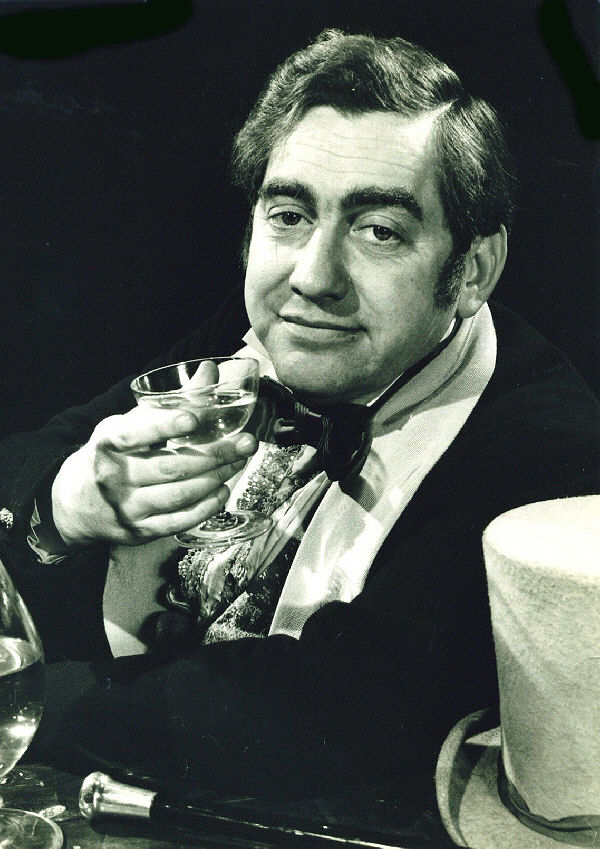
In 1958 Tony Hancock was riding high as the star of Hancock’s Half Hour, which was running on both BBC television and radio.
On the evening on the 9th of February 1958 he gave a rare straight acting performance in the BBC World Theatre production of Gogol’s The Government Inspector.
Hancock was bolstered by an impressive supporting cast (including Wilfred Brambell, Peter Copley and Noel Howlett) and he acquitted himself well – although he’s still recognisably Hancock. Indeed, it would be easy to believe that some of his lines were written by Galton & Simpson, which is possibly why it was felt that this play would be a perfect fit for him.
This was such an obvious extra to include on the Hancock’s Half Hour DVD boxset, released a few years back, that its omission was baffling. The only time it’s surfaced in recent years was when it was one of the programmes offered as part of the BBC Archive Trial (an online test service) in 2007.
Given that the BBC seem to have no interest at present in making this commercially available, I’ve decided to upload it my YouTube account. Hopefully it’ll stay there for a while, which will allow a wider audience to enjoy this unique Hancock performance.
I’ve just created a YouTube channel, where I’ll post, from time to time, some interesting clips and programmes from my archive of VHS recordings from the 1980’s and 1990’s.
First up is a nice little piece on Derek Meddings from 1995, where he discusses his work on Thunderbirds and Captain Scarlet.
The Naked Ant opens with Idle and Cleese as two office workers who watch as their colleagues jump to their deaths.
Idle: Did you see somebody go past the window?
Cleese: What?
Idle: Somebody just went past the window. That way. (indicates down)
Cleese: Oh. Oh.
Idle: Another one.
Cleese: Huh?
Idle: Another one just went past downwards.
Cleese: What?
Idle: Two people have just fallen out of that window to their almost certain death.
Cleese: Fine, fine. Fine.
Palin: Look! Two people (another falls) three people have just fallen past that window.
Cleese: Must be a board meeting.
Idle: Oh yeah. (another falls past) Hey. That was Wilkins of finance.
Cleese: Oh, no, that was Robertson.
Idle: Wilkins.
Cleese: Robertson.
Idle: Wilkins.
Cleese: Robertson.
(Another falls.)
Idle: That was Wilkins.
Cleese: That was Wilkins. He was a good, good, er, golfer, Wilkins.
Next up, Palin is good as a hyperactive television presenter (“Too early to tell’ … too early to say… it means the same thing. The word ‘say’ is the same as the word ‘tell’. They’re not spelt the same, but they mean the same. It’s an identical situation, we have with ‘ship’ and ‘boat’ but not the same as we have with ‘bow’ and ‘bough’, they’re spelt differently, mean different things but sound the same. But the real question remains. What is the solution, if any, to this problem? What can we do? What am I saying? Why am I sitting in this chair? Why am I on this programme? And what am I going to say next?”).
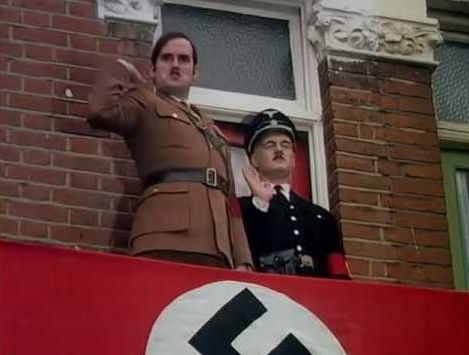
Mr Hilter and the Minehead by-election is one of my favourite Python sketches. It opens with Idle as a monumentally boring man who, along with his wife, has arrived at a boarding house run by a nice lady (Jones). Idle had a knack for writing long droning monologues, of which this an excellent example, as he describes in great detail exactly how they traveled down.
Johnson: Well, we usually reckon on five and a half hours and it took us six hours and fifty-three minutes, with the twenty-five minute stop at Frampton Cottrell to stretch our legs, only we had to wait half an hour to get onto the M5 at Droitwich.
Landlady: Really?
Johnson: Then there was a three mile queue just before Bridgewater on the A38. We usually come round on the B3339 just before Bridgewater, you see…
Landlady: Really?
Johnson: Yes, but this time we decided to risk it because they’re always saying they’re going to widen it there.
Landlady: Are they?
Johnson: Yes well just by the intersection, there where the A372 joins up, there’s plenty of room to widen it there, there’s only grass verges. They could get another six feet…knock down that hospital… Then we took the coast road through Williton and got all the Taunton traffic on the A358 from Crowcombe and Stogumber …
This could have made a decent little sketch on its own, but when the Johnsons enter the dining room they meet three strange characters who spin the sketch into a totally different direction. Mr Hilter (Cleese), Ron Vibbentrop (Chapman) and Heimlich Bimmler (Palin). All three are dressed in full Nazi regalia, which makes their attempts to hide their identities by slightly changing their names even more ludicrous.
Chapman has the least the do, Palin has a great monologue (“How do you do there squire, also I am not Minehead lad but I in Peterborough, Lincolnshire was given birth to, but stay in Peterborough Lincolnshire house all during war, owing to nasty running sores, and was unable to go in the streets play football or go to Nürnberg. I am retired vindow cleaner and pacifist, without doing war crimes“) but the bulk of the sketch rests on Cleese’s shoulders who is suitably manic as Adolf Hitler, forced to be polite to people he obviously considers to be his inferiors.
I love the concept of Hitler relaunching his quest for power via the Minehead by-election, as well as the puzzled stares of passers-by (who I assume weren’t extras and were just members of the public) as Hilter’s election campaign makes its way through the streets.
The 127th Upperclass Twit of the Year Show is another well known early Python sketch (it was re-filmed for And Now For Something Completely Different). Cleese is a suitably hysterical commentator and he starts by introducing the runners and riders.
Vivian Smith-Smythe-Smith has an O-level in chemo-hygiene. Simon-Zinc-Trumpet-Harris, married to a very attractive table lamp. Nigel Incubator-Jones, his best friend is a tree, and in his spare time he’s a stockbroker. Gervaise Brook-Hampster is in the Guards, and his father uses him as a wastepaper basket. And finally Oliver St John-Mollusc, Harrow and the Guards, thought by many to be this year’s outstanding twit.
|n order to be crowned champion they have to complete a number of demanding tasks, such as walking in a straight line, kicking the beggar, reversing their sports car into an old woman, insulting the waiter and finally shooting themselves.
Palin is suitably grotty as Ken Shabby, who has come to ask Chapman for his lovely daughter’s hand in marriage.
Father: Mr Shabby… I just want to make sure that you’ll be able to look after daughter…
Shabby: Oh yeah, yeah. I’ll be able to look after ‘er all right sport, eh, know what I mean, eh emggh!
Father: And, er, what job do you do?
Shabby: I clean out public lavatories.
Father: Is there promotion involved?
Shabby: Oh yeah, yeah. (produces handkerchief and cleans throat horribly into it) After five years they give me a brush… eurggha eurgh … I’m sorry squire, I’ve gobbed on your carpet…
The final sketch (featuring Chapman as a politician who has fallen through the Earth’s crust and is forced to continue his broadcast whilst swinging upside down on a rope) doesn’t really engage, although Chapman is game to dangle about. But overall this a strong show, particularly with the Minehead by-election and the Upper-Class Twits.
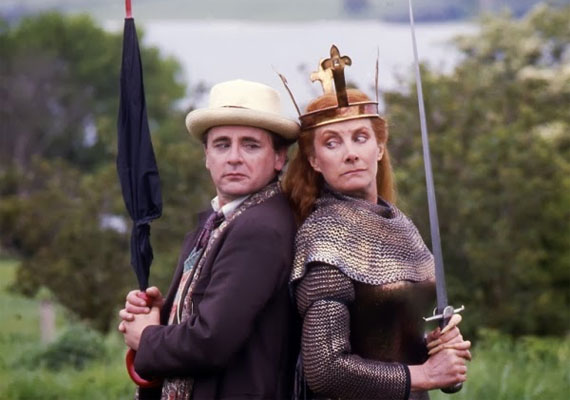
After the success of Remembrance of the Daleks it was inevitable that Ben Aaronovitch would be asked to contribute another script. Battlefield began life as a three-parter which was later expanded to four episodes, although Aaronovitch was to express his dissatisfaction with the story as it appeared on screen – feeling that it too obviously a three-part story with an extra episode bolted on.
But whilst there are script problems, there are also some rather dodgy performances which do drag the story down. It’s probably (apart from Time and the Rani) Sylvester McCoy’s worst Doctor Who performance. He’s all over the place and far too many times his line delivery is very poor (“There will be no battle here!”, ” If they’re dead”, etc, etc). Comparing this and Ghost Light back to back is particularly instructive. He’s at his best in Ghost Light (restrained and still) and very much at his worst in Battlefield (ranting and over-expressive).
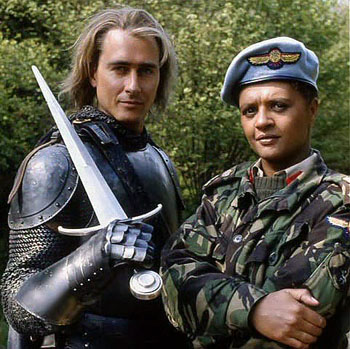
Sophie Aldred has her poor moments as well (“Boom!”) whilst Christopher Bowen’s turn as Mordred is on the ripe side, to put it mildly. Angela Bruce settles down as the story progresses, but she’s also not especially good to begin with (“Shame!”).
The start of a beautiful friendship?
It’s not all bad though – Marcus Gilbert has a nice comic touch as Ancelyn and James Ellis is always watchable. His Tennyson ad-libs (“ Thou rememberest how, in those old days, one summer noon, an arm rose up from out the bosom of the lake clothed in white samite, mystic, wonderful, holding the sword“) work very well and it’s nice that Michael Kerrigan allowed him some space to indulge himself.
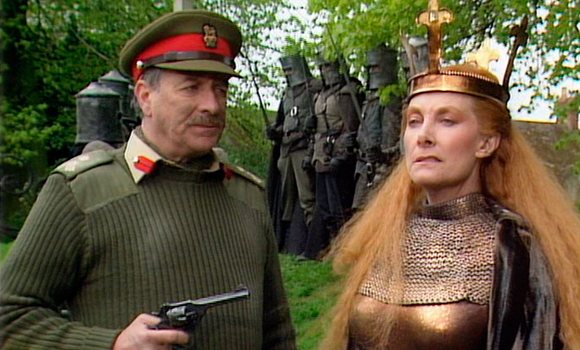
The main guest roles were filled by Nicholas Courtney and Jean Marsh. Marsh manages to bring out the contrary nature of Morgaine, as she’s someone who is more than capable of destruction but also has her own moral code (observing remembrance for the dead and restoring Elizabeth’s sight).
Ben Aaronovitch was quite clear that bringing back Lethbridge-Stewart and UNIT was something of a fannish indulgence. In many ways this undoes some of the good work from Mawdryn Undead. It would have been the easy option in 1983 to have the Brigadier back with UNIT and fighting monsters, but instead they went for a more interesting story with a retired and somewhat broken-down figure.
“Ware this man. He is steeped in blood”
Here, it’s pure fannish wish-fulfillment to have the Brig back in his old uniform and in charge (albeit temporarily) of UNIT. It’s hard to believe, to be honest, that any military organisation would reinstate a retired soldier like this, so it may have been more credible to have had him along as a civilian advisor, due to his knowledge of the Doctor. Courtney’s always good value (especially when facing down the Destroyer in the last episode) but after Mawdryn, this can’t help but feel like a little bit of a let-down.
As with many stories script-edited by Andrew Cartmel, some interesting material never made the screen (although it was restored for a special edition of the story when it was released on DVD). Chief amongst the cuts was the disdain that Ace has for the Brig, something that is totally absent from the transmitted story.
The story is a little incoherent with various plot devices (a stranded nuclear missile convoy is introduced in the first episode and then forgotten about until the last ten minutes of the final episode) not used particularly well. And the reason for Morgaine traveling to this universe is never made clear – has some catastrophe affected her own, maybe? The plot is a little wooly at times, it’s made clear that Morgaine knows she’s traveled to another dimension, but at another point in the story the Doctor maintains that the Earth will be a battleground for a conflict that doesn’t belong here – implying that Morgaine is unaware she’s no longer in her own universe.
The reveal of the Destroyer at the end of the third episode does give the story a little more impetus and it has to be said that the design is wonderful. Some seven years earlier, the Terileptils in The Visitation were able to curl their lips but that’s nothing compared to the lip-curling that the Destroyer indulges in. It’s a good indication just how animatronics and technology in general had evolved over the course of seven years or so.
Flawed though Battlefield is, it’s still enjoyable – but it’s very much the weak link in S26. And a special mention must go out to the closing scene. Keff McCullough’s comedy tune as the girls leave is perhaps a fitting ending to a real curate’s egg of a story.














 Archive Television Musings