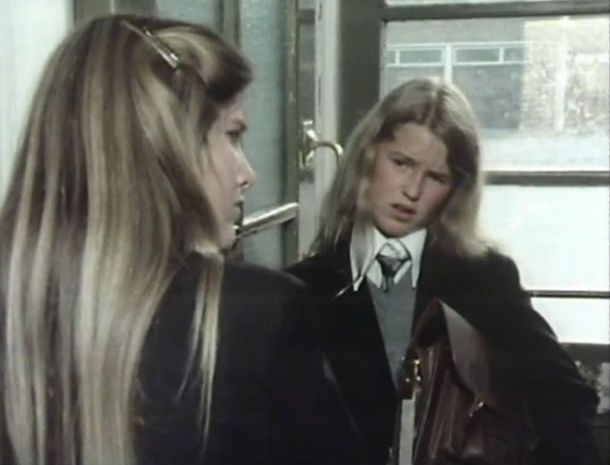
Written by Phil Redmond. Tx 22nd February 1978
Judy Preston is still deeply unhappy at Grange Hill, bemoaning the fact that nobody ever speaks to her. Although, as her mother points out, she probably needs to put a little more effort into trying to make friends. But the next day it seems as if the first tentative steps towards a friendship are established after Trisha rescues her from the boisterous attentions of Tucker and Benny.
Tucker isn’t best pleased to find himself bested by a girl and offers her a knuckle sandwich – before belatedly remembering that he doesn’t hit girls. Always a charmer, the young Peter Jenkins!
But Trisha isn’t around when Judy finds herself facing the unwelcome attentions of three fifth-form girls, led by the spiteful Jackie Heron (Miriam Mann). All three clearly have a great deal of experience in bullying those younger than themselves and there’s something quite disturbing about these scenes.
Possibly it’s because we’ve seen how isolated and friendless Judy is, so we know that she’ll be totally unable to put up a fight. After rummaging through Judy’s possessions, Jackie spots a rather nice pen. Judy pleads with her not to take it, as it was a present from her late Grandfather. Jackie tells her that she can have it back – if the price is right.
Later, Trisha becomes aware of what’s happened and instantly decides to help. This gives us an early insight into Trisha’s character – she’s always keen to help the underdog and never seems to realise when she’s outnumbered. In this case, two first-years facing off against three fifth-years is clearly an unequal battle, but the prospect of defeat never seems to have entered Trisha’s head.
In the end, Trisha’s sister Carol (Julia Gale) saves the day. Like Jackie, she’s a fifth-former and is able to confront her on equal terms and so forces her to give back the pen. This episode has a clear message at the end as Carol tells the two girls that “people like Jackie Heron never pick on someone who’s able to stand up to them. So if you can’t do it, the answer’s simple – get someone who can. Look, if anything like this happens again, tell someone.”
Short of Carol looking directly down the camera and adding that that goes for everybody else watching at home too, the moral couldn’t have been more clearly stated.
 Archive Television Musings
It was a nice episode this. I think Trisha Yates is a fascinating character. She’s a bit of a Shakespearean Tragedy really living out the last real vestiges of complete inequality in schools, a good heart but suffering almost from what seems like depression from very early on. She rarely ever seems happy.
Woefully underused towards the end. The storyline about her asking to do metal-work and being told it’s only for boys (God to think Schools did that then) was never resolved. A real loss.
You could not help but watch her and feel as though she needed a mentor to real help her reach her amazing potential. …yet ultimately you could see that wasn’t going to happen. I’ve found that even sadder to watch a second time round.
LikeLiked by 2 people
Them bully girls were scary. Scarier than Gripper cos they looked like 30 year old women!
LikeLike
@ Brian, the actress who played Jackie Heron was 26, so was very much past school leaving age. It was the same with Please Sir from the start of the decade, the actors who played the fourth formers were almost as old as John Alderton, who was supposed to be their form master.
LikeLike
I watched this last night and saw a small mistake.Tricia asks Judy early on did she see Top of the Pops.She said no,making it a Friday.But it sounds like a normal School day after Friday.Should just have gone for a series shown early in the week and that would have been avoided.Otherwise a fine early episode.
LikeLike
A fairly good episode, the first to really look at bullying. It is interesting that the series’ original bully(s) are female, not yet the likes of Gripper or such. Although these early outings are far tamer than what the series would evolve into around Series Three or so (Phil Redmond has said a number of times that it wasn’t until a series or two in that he could really start tackling issues that he wanted to look at), even so this one does feel rawer than the typical “happy school days” fare of vintage children’s television. Poor Judy being hounded by Jackie Heron and her cronies is actually quite strong by early series standards… for some reason, the moment when Jackie helps herself to Judy’s fountain pen, a gift from her late grandfather, and Jackie asks her “snuffed it, has he?” really gets me.
There’s a minor blooper of sorts, on the scene where Jackie and co. accost Judy outside the sweet shop – Jackie seems to refer to her supposed birthday as happening “yesterday” and “today” within the space of just a minute or so, suggestion some confusion over the timescale of the episode.
This is also the first real (sort-of) character study we get of Trisha, although we will get a closer study of her in a couple of episodes time. A headstrong character, morally she tries to do ‘the right thing’ but can be rather stubborn and reckless with it.
The episode also revolves around a couple of conveniences plot wise, and the fact that Trisha’s older sister Carol was aware that Trisha, and by extension Judy, were moments away from getting a good hiding from Jackie, but had planned to leave it ’til the last moment to come to the rescue “to teach Trisha” a lesson, don’t quite ring true to me, with there being no particular indication of this being the case prior. Carol’s final speech about “always telling someone” feels nothing short of being one of those old Public Safety Films aimed at children. But despite all of those niggles, this is a pretty good third episode, and a reminder of those terrifying school days where you feared running afoul of the school bully … even more terrifying if you were an only child such as Judy (and indeed, I was too) without and hope of backup or support.
LikeLike
A fairly key Series One episode for fleshing out several characters, and for forming the early friendship between Judy and Trisha. It also captures the feel of being new and alone in a new school quite well.
Also of some note is it is the first time we see the series being more realistic and “gritty” than pretty much all previous school-set serious previously – when the bullying Jackie Heron grabs Judy’s prized pen given to her by her grandfather, Jackie asks brazenly “snuffed it, has he”. Nothing compared to some of the harder hitting stories in years to come, but still notably quite blunt and stark compared to things that had gone before on TV.
After some digging around on-line, Miriam Mann was circa 24 years old when she filmed these scenes in September 1977 (her age is given as 12 in a 1966 newspaper article about her) and her “well past being a schoolgirl” age does show; However that doesn’t detract from her being quite an intimidating character.
It is interesting that Phil Redmond made what is technically ‘Grange Hill”s first bully character female instead of the more “traditional” male (long before the slightly unbalanced Imelda Davies would be roaming the playground with her Terrorhawks), maybe a sign of how he was keen to do things differently.
I love the early, Series One-version Trisha which we get a lot of in this episode, stropping along in her school uniform, hair hanging down, slightly sulky. Not yet quite the rebellious character she would grow into, but still strong willed and hardheaded.
Most of Series One’s location work was filmed in North London around Kingsbury High School which served as the first Grange Hill school; however some scenes were filmed closer to the studios in Ealing – including, in this episode, the shop in which Jackie and co. accost Judy for a second time. Nowadays, the shop and the one next to it have been converted into houses.
And then there’s that final scene, where Trish’s sister Carol saves Trisha and Judy from, potentially a beating from Jackie and her minions. It’s striking in how “message to the viewers” it’s done … one could almost expect Charlie the Cat to appear in shot at any moment! Well meaning but not quite fully in the style to which the series would become accustomed.
LikeLike