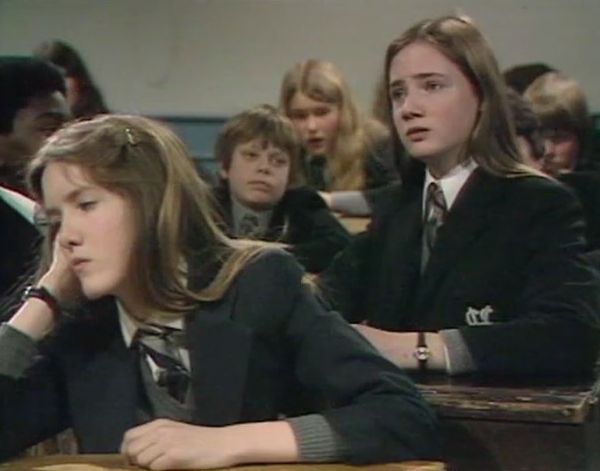
Written by Phil Redmond. Tx 22nd March 1978
Perhaps the most significant part of this episode concerns Michael Doyle’s (Vincent Hall) transfer to Mr Mitchell’s class. It’s spelled out very early on that Doyle is bad news (he and his friends were bullying other pupils so it’s been decided to split them up).
Over the next few series he’ll lock horns with Tucker time and again, but in this episode he’s more concerned with Ann Wilson, who’s running for election to the school council. First though, she has to win the vote from her form (which she does, beating Tucker into second place).
It’s a shame that Lucinda Duckett didn’t return for series two, but it’s clear to see that her character (serious, hard-working) was simply re-created several times – firstly with Penny Lewis and then later with Pamela Cartwright. It’s quite possible to imagine Ann Wilson doing everything that Penny Lewis later did – clashing with Doyle, writing endless articles for the school magazine, etc.
Her path to election success isn’t straightforward though, as Michael Doyle uses all the tricks in the book (including intimidation) to ensure that his preferred candidate wins. But after a last minute adjustment to the voting (which I’m not sure was strictly legal) Ann is declared the winner.
This episode sees the first of three appearances by Carole Nimmons as Miss Mather. Nimmons has had a long and successful career, which includes the rather good series Bird of Prey, starring Richard Griffiths.
 Archive Television Musings
I’m not sure how far the whole election was governed by law. Were school council elections mandatory at the time or a fad of individual schools?
The election does have a lot of elements that will be familiar to those involved with them – joke candidates, cynical attitudes to local government, canvassing, populist undeliverable promises, poster wars, vandalism, media write-ups, indecisive voters who muck up ballot papers, Returning Officers who screw up the declaration and an incredibly tight marginal result (the third placed candidate only four votes behind the winner). It also has the corrupt and illegal practices of “treating” (offering food and drink) and “undue influence” (intimidation of voters) and a challenge to the declared result.
And yes the way the challenge is handled would not be legal in a public election. The grounds for the challenge are good – an accusation of “undue influence” by the candidate and his campaign manager (who a court would recognise as the agent) using threats to get votes. But the Returning Officer’s power is limited and they can’t simply overturn results there and then. Nor would you change a result simply on the basis of an accusation that someone thinks is credible. Instead you have to bring a formal challenge known as a “petition” supported by either another candidate in the election or by four people eligible to vote with a special election court hearing the case and deciding whether the initial candidate is “duly elected”, whether it was an “undue election” (another candidate won the valid votes) or a “void election” (the seat is declared vacant and the poll rerun).
LikeLiked by 1 person
I really like this episode. The early, original cast work really well together by this stage, and whilst the series would noticeably develop and develop more of it’s regular ‘pattern’ of sorts in Series Two, it is around the point of this episode that the series feels to be properly finding it’s footing. It is most notable of course, for the introduction of the sly, bullying, “My Dad’s on the council” Doyle, who will go on on to play a role in several key plots over the next couple of series. Whilst Series 1 has already had female bully Jackie Heron (who does continue on to Series 2), Doyle is a far more immediate nuisance (and occasional threat) than the older Jackie, and the series does benefit from his addition. A nasty, could-happily-slap-him-’round-the-face-character, it’s easy to overlook how good Vincent Hall is in the role.
I really like the scene in the cloakroom with Alan and his classmate, and then Ann, Trisha and Mary (the latter one of those semi-secondary characters who would occasionally come to the fore more in the odd episode, but hardly a classic character) trying to ensure Tucker and Benny’s vote. In a way it’s a scene about nothing, but the dialogue carries it well, and Tucker’s character is slowly becoming more rounded at around this point. Benny has the best line, regarding the subject of abolishing school uniform – “That’s it then, you’ve lost my vote… I’ve already abolished half my school uniform!” (The campaign against uniform of course will become a bigger plotline in the following series).
I’ll also give special mention to Michael Percival as “original teacher” Mr. Mitchell, an decent firm-but-usually-fair and often sardonic character; a likeable performance by Percival and who on hindsight really holds many of the first series episodes together as the only real recurring character in Series One, appearing in every single episode. Saying that, we also get the debut of semi-recurring teacher Miss Mather, played by Carole Nimmons, whom Miss June Summers in Series Two might be argued to be a replacement-of-sorts for. Nimmons is a likeable actress and, whilst we’ll see her in a few further Series One episodes, it’s a pity she wasn’t used more.
The election outcome and how it is ‘corrected’ after it is discovered what Doyle and his mob have been up to, is dubious to say the least. If this had been anything from Series 2-onwards, this whole election plot would most likely have been played out over several episodes and likely resolved a bit more convincingly. It does however mark the first introduction of elections and politics into the series; something which Redmond was clearly very keen to utilise, and would come into play in a number of ways over the next few series. With that and the introduction of Doyle too, in some ways this might be seen to be a key early episode, and maybe one reason it works so well.
(Oh, by the by, I believe this is the first time Tucker uses the nickname “Pongo” for Trisha in the series, though I may have missed any previous use, I’ll have to go back and check sometime. The origin of this nickname are never really given on-screen, but it’s easy to formulate one’s own likely backstory for it…!)
LikeLike