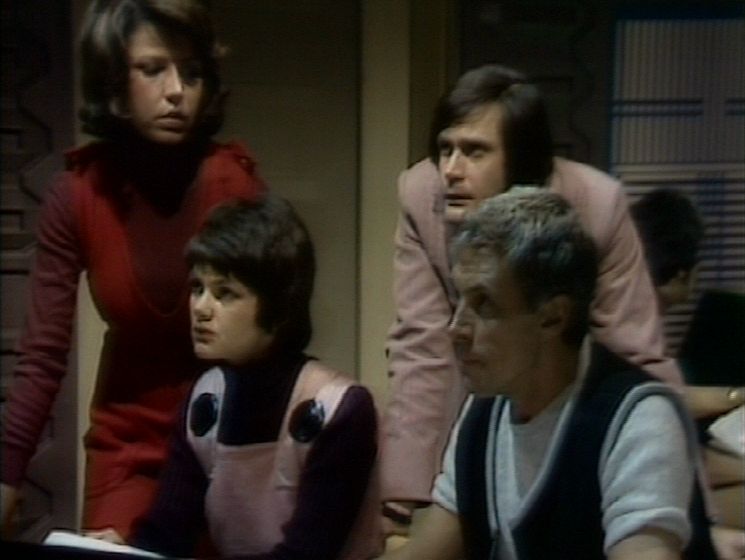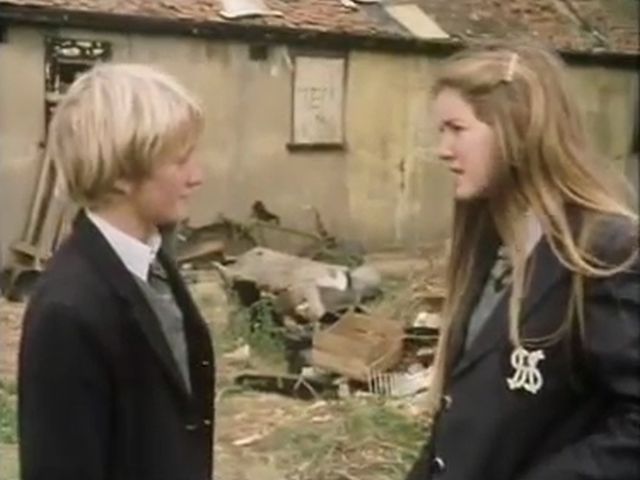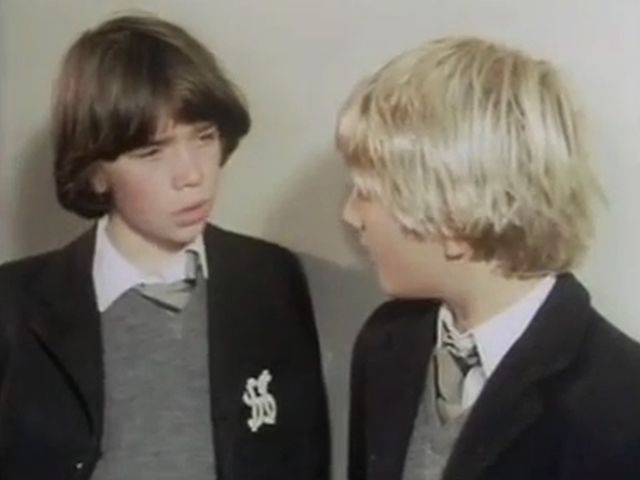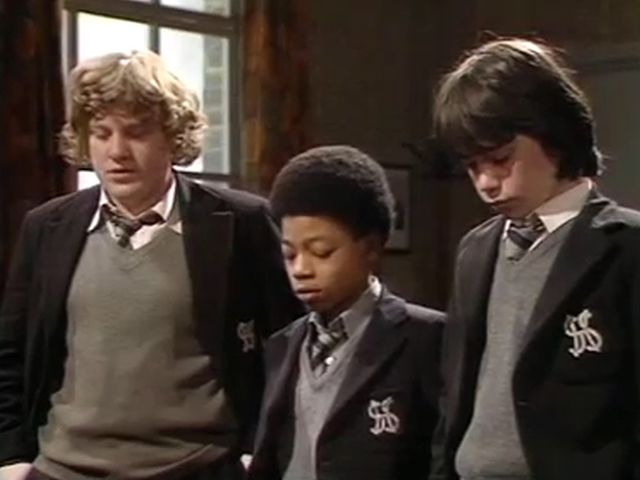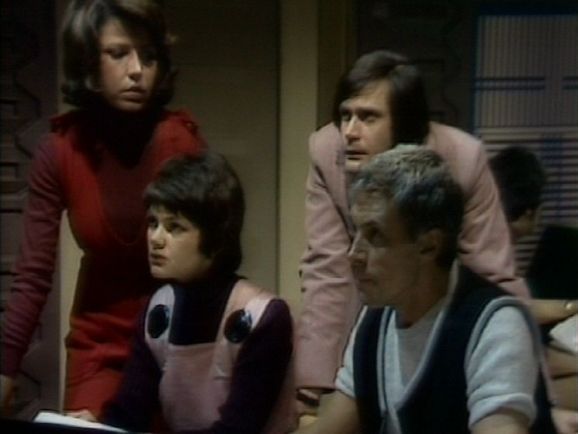
Grange Hill. Series Two – Episode Fourteen

grange hill s02e14

Written by Phil Redmond. Tx 16th February 1979

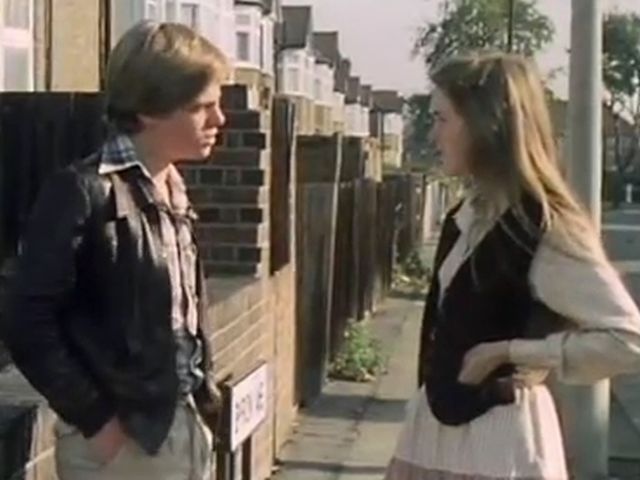
Following SAG’s recent disruptions of school-life, Mr Llewellyn has instigated various procedures which he hopes will tighten up the pupils behaviour.  These include a zero-tolerance policy on late arrivals – which means that Mr Baxter is present at the front gate, making a gleeful note of every latecomer!

This is bad news for Tucker, who turns up some twenty-five minutes late.  Partly this is because he’s missed the bus, but it’s also because he was waylaid by three Brookdale boys on the way to school.  The running battles between the Grange Hill pupils and the Brookies would be a recurring theme during the next few years and even when the schools were merged in series eight the arguments and fights would rumble on for a time.

Tucker, Benny, Alan and Hughes are at their most boisterous in this episode.  A spot of fighting during lunch time is spotted by a teacher who decides they can drop a letter off at the secretary’s office since they’ve clearly not got anything better to do.  Tucker decides that if they do they won’t have time to go to the chippy, so Benny pops the letter into his blazer pocket to deliver later (the fact they don’t deliver the letter straight away seems set up to be important, but it later turns out to have no bearing on the plot).

They’re just as uncontrollable when they get to the chippy.  Tucker declares that he won’t have the chop-suey as he’s convinced that cats and dogs are put into it.  Instead, he decides he’ll have something that you can be sure is fine – a sausage (even though Hughes tells him that it’s made up of sawdust!).  Tucker’s slitty-eyed impersonation of the Chinese owner of the shop (highly politically incorrect of course) proves to be the final straw and all of them are forced to leg it.

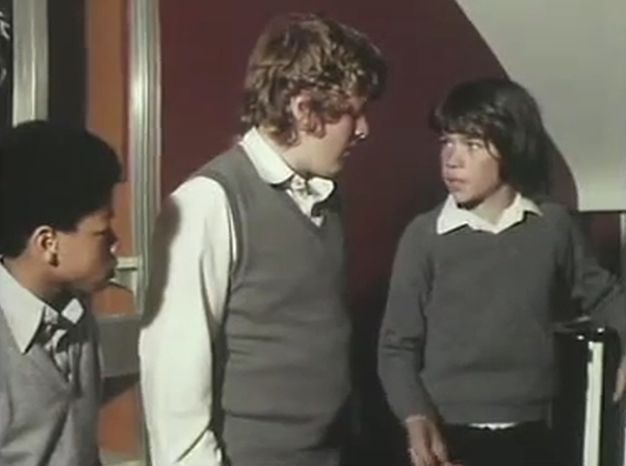
More battles with the Brookies on the way back to school result in them taking Benny’s blazer.  This means that Tucker, Alan and Benny have to infiltrate the enemy territory of Brookdale in order to retrieve it.  As they pace the unfamiliar school corridors, there’s a rare use of incidental music to heighten the tension.  Since music wasn’t something the series used at this time it’s a little jarring to hear it in these scenes – but it does help to enhance this largely dialogue free section of the episode.

This episode is rather a throwback to the rough-and-tumble Tucker of series one, but since there hasn’t been a decent Tucker-centric episode for a while it’s a welcome one.

Grange Hill. Series Two – Episode Thirteen

grange hill s02e13

Written by Margaret Simpson. Tx 13th February 1979

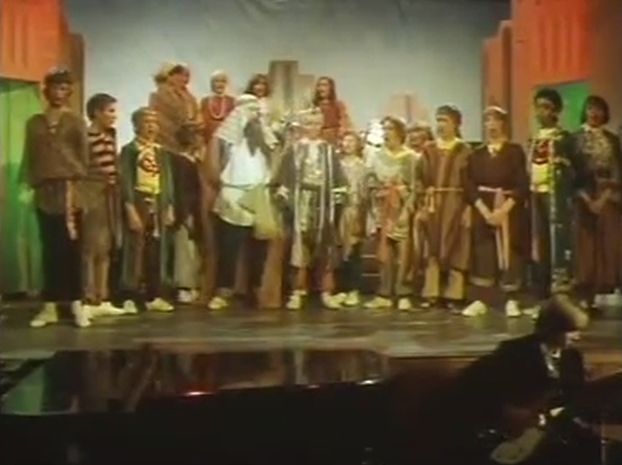
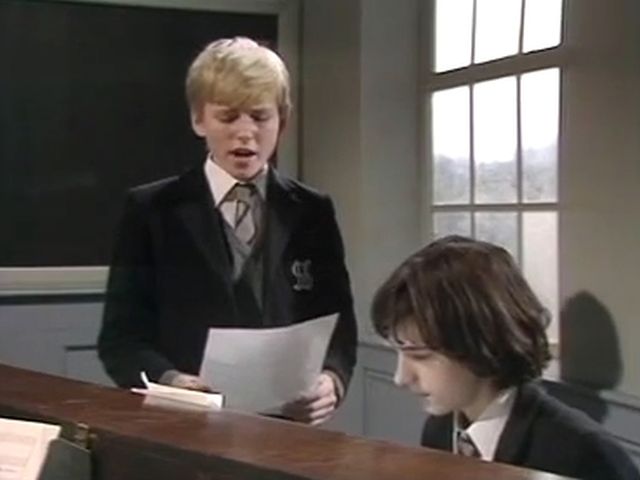
It’s the day of the school play, Joseph and his Amazing Technicolor Dreamcoat, and Joseph (Andrew Stanton) is feeling the pressure.  But is he really sick or is it just nerves?  But even though Andrew seems a little listless, others continue to put maximum effort into ensuring that everything goes right on the right.

None more so than Tucker, whose artistic side is displayed after he customises a bike to serve as Joseph’s chariot.  But his well-intentioned efforts to ensure that everything is perfect means that he decides to skip Mr Keating’s maths class to finish off working on the bike – which naturally doesn’t go down very well with the intimidating teacher.

This is the first real chance we’ve had to see Mr Keating at work.  Robert Hartley is spot on at portraying the type of teacher that every school seemed to have – you just know there would never be any disruption in his class as he’d have no qualms in issuing detentions to any miscreants.  He does so to Tucker when he tracks him down and after the boy complains that this means he’ll miss his tea, Mr Keating remorselessly tells him that he’ll just have to miss his tea!

Aside from enjoying a lengthy acting career, from the early 1950’s to the early 1990’s, he also spent the latter part of his career, during the 1980’s and 1990’s, composing music for various television series (including all fourteen episodes of the Keith Barron vehicle Haggard).

If Andrew’s complaints of feeling sick and his flat-as-a-pancake singing in the final rehearsals aren’t enough to drive Mr Sutcliffe to despair, then there’s worse to come.  Jackie Heron and her friends, having been irritated at being put into detention by Miss Summers, decide to wreck the props and costumes for the play.  Tucker’s chariot is damaged and paint is thrown over the coat of many colours as well as the scenery.

It’s Tucker who discovers the devastation, closely followed by Mr Sutcliffe who instantly decides that Tucker must have been responsible.  Thankfully, Miss Summers also turns up and is able to convince Mr Sutcliffe that there’s no way that Tucker would have done this – he certainly wouldn’t have damaged his own bike, not after all the hard work he put into it.

James Wynn has some good comedy moments in this scene. They work especially well since Mr Sutcliffe is usually a rather laid-back person – but with everything collapsing in disaster around him, the increasing irritation he feels (only compounded when he sits down on Tucker’s chips!) rings the changes somewhat.

As might be expected, it all works out fine in the end – Tucker repairs the bike and he manages to find a replacement coat.  Although it comes as a surprise to his mother when she realises that Tucker’s taken one of her coats without asking.  But as so often with Peter Jenkins, she regards him more with indulgence than irritation.

Moonbase 3 – View of a Dead Planet

view

The Arctic Sun Project is a highly controversial scheme which has divided opinion .  The plan is to detonate a hydrogen bomb above the Arctic Circle and the resulting explosion will melt the polar ice-caps and create vast areas of new land (dubbed the new Garden of Eden).

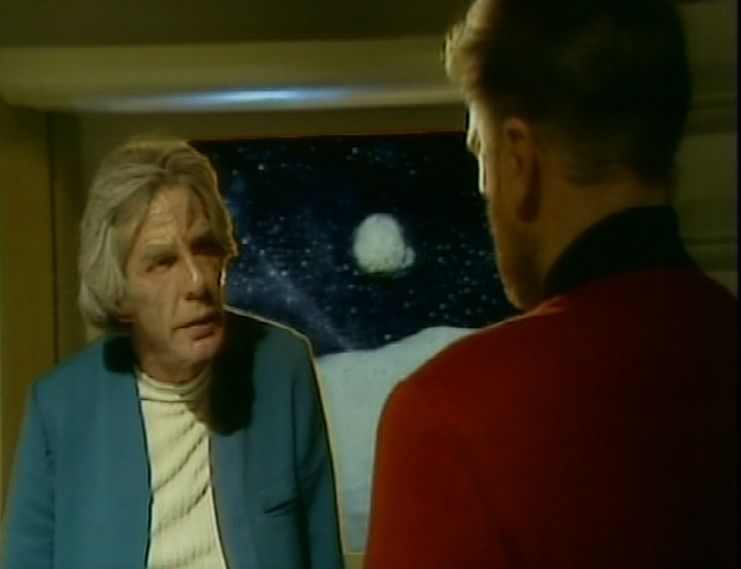
The creator of the project, Sir Benjamin Dyce (Michael Gough), has just arrived on Moonbase 3 for a visit and Caulder is naturally keen to hear directly from him about this tremendous feat of scientific endeavour.  But he, and the rest of the team, are surprised and perturbed to be told by Dyce that the Arctic Sun Project will destroy all life on Earth.

Dyce is a brilliant scientist (amongst his many distinctions is a Nobel prize) but after his diatribe some of the others decide that he’s lost his grip on reality.  However, when all contact with Earth is lost and the whole planet is engulfed in a peculiar mist, it appears that his doom-laden predictions have come true …..

View of a Dead Planet was Arden Winch’s only script for Moonbase 3.  It’s notable for presenting us with a much more affable and pleasant Lebrun than we’ve previously seen.  He spends the early part of the episode making ironic remarks and is later pleased when the others decide to surprise him by celebrating Bastille Day.  It’s hard to imagine them making any sort of effort for the distant and surly Lebrun we saw in previous episodes!

The opening few minutes also gives us a rare glimpse of the Moonbase 3 personnel at rest and play.  We see Tom Hill playing a game of long distance chess with his opposite number in the Russian Moonbase.  I wonder if this was a homage to a similar scene in the Hancock classic The Radio Ham?

But there’s not too much time for fun as within a matter of hours the Earth looks to be dead.  It’s a staggering coincidence that the architect of the Arctic Sun Project happened to be on the Moon at precisely the right time and was therefore able to explain to the staff (and the viewers at home) exactly what he believes would happen – via a large info-dump.

Michael Gough’s not terribly good in this, which is strange because he was usually such a reliable actor.  Maybe part of the problem is that Dyce is supposed to be a much older man than Gough (he was fifty seven when this was made).  The wig doesn’t help either.

Once all hope looks like it’s lost, it’s instructive to see how everybody copes.  Lebrun gets drunk and demands to know when Caulder plans to kill them all, whilst Bruno Ponti (Garrick Hagon) gets drunk and mauls Dr Helen Smith.  It’s rather eye-opening that his attempted rape of Helen is later dismissed quite casually (he was under pressure, like the rest of them, but it still seems remarkable that no further action was taken).

Caulder and Tom Hill meet to discuss what they should do.  With limited food and oxygen, they can only last for a few weeks at most.  Caulder isn’t keen for everybody to carry on until the final scrap of food is eaten, so the ever-practical Tom suggests introducing carbon-monoxide into the atmosphere.  It’ll just make everybody drowsy and they’ll gradually drift away into a sleep they’ll never awake from.

View of a Dead Planet has more of a hard-SF edge than some of the earlier episodes, although human interaction is still very much to the fore.  Since the acting is rather variable (always a slight problem with Moonbase 3) it’s not the strongest episode, especially thanks to the rather cop-out ending.

If Barry Letts and Terrance Dicks had been aware that the show wouldn’t be recommissioned, it would have been suitably bleak (rather like most of the series) to have ended with the complete destruction of the human race.  As it is, just before Caulder orders everybody to be gassed, communication is restored with Earth.  The detonation of the bomb caused considerable atmospheric disturbances, but this seems to be only temporary, so in time everything should return to normal.

After being so certain the the end was nigh, Dyce has to back-peddle somewhat – but he’s still able to provide the moral of the story (which sounds like it might have come direct from Barry Letts himself) by stating that mankind has been lucky this time, but they can’t afford any more mistakes.  With such potent and powerful methods of destruction, all humanity is placed on a knife’s edge. Another miscalculation could result, next time, in complete annihilation.

It’s not perfect, but Moonbase 3 is a programme that’s well worth your time.  And it wouldn’t be the last time that the BBC would create a SF series based on the Moon.  Fourteen years later, Star Cops would have an equally brief run (clearly Moon-based shows just aren’t popular!) and that’s going to be the next series that I’ll dig out to rewatch.

Grange Hill. Series Two – Episode Twelve

grange hill s02e12

Written by Phil Redmond. Tx 9th February 1979

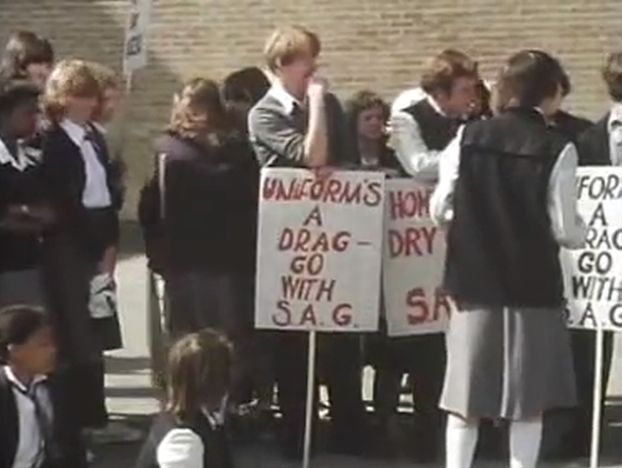
SAG continues to demonstrate (with placards bearing the catchy slogan “Uniform’s a drag – go with SAG”).

The noise irritates the mild-mannered Mr Sutcliffe, but Mr Llewellyn seems quite unconcerned, regarding it as “one of the problems of living with democracy, having to tolerate elements you don’t agree with.”  He asks for a delegation to air their grievances – which is led, of course, by the young militant Jessica Samuels.  We know by now exactly what Jess will say (and the Headmaster knows as well, hence his slightly mocking tone).

He makes the point that he’s not prepared to do anything until it can be proved that the majority of pupils are in favour of abolishing uniform – a concept which SAG never seem to have contemplated.  He offers to raise it at the next staff/pupil council meeting – where the proposal to abolish uniform is defeated by nine votes to two.  Coincidentally, Penny Lewis is gathering support for a referendum to accurately gauge everybody’s opinions (which would seem to be the obvious way to prove, once and for all, what the majority of pupils actually want). It’s therefore odd that neither SAG or Mr Llewellyn ever seem to consider the possibility of a referendum themselves.

Naturally, Jess and the others don’t take this latest setback at all well and decide to organise a sit-in, barricading themselves into the secretary’s office.  Maximum embarrassment is created for Mr Llewellyn when Jess calls the local paper – but he’s able to diffuse the situation by telling the reporter that it’s hardly a full-scale riot – just a handful of individuals.  When the SAG members sees the reporter has left without speaking to them, this is the final straw and they begin to wreck the office (much to the dismay of Trisha and Cathy).

After the heavy artillery (Mr Baxter) is brought in to restore order, the SAG leaders are expelled whilst Trisha and Cathy are suspended for seven days.  It brings to an end one of the most confrontational plot-threads that the series would ever attempt.  Off hand, it’s difficult to recall any other teacher/pupil conflicts on such a scale as this. Although Grange Hill would deal with many contentious issues in the decades to come, this sort of open disobedience would rarely be seen again.

Moonbase 3 – Castor and Pollux

castor

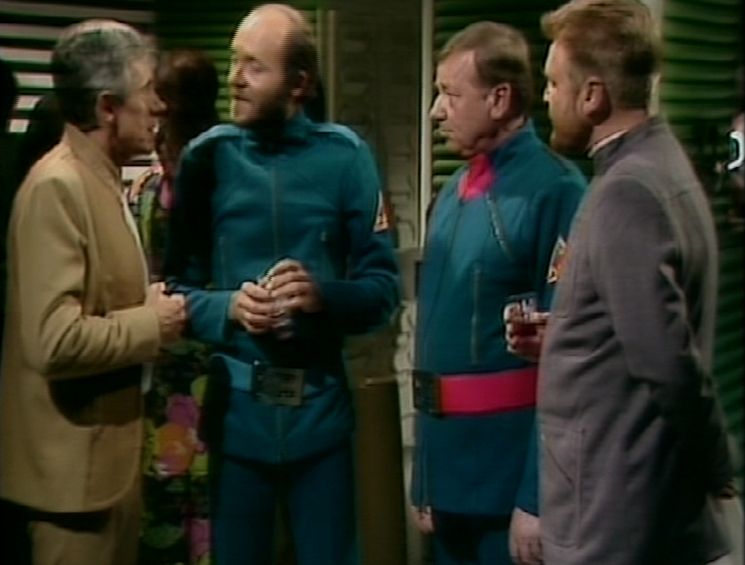
Moonbase 3 hosts a reception for a group of Russian dignitaries.  Their party includes the top cosmonaut Colonel Dimitri Gararov (Milos Kirek) who’s delighted to finally get the chance to meet Tom Hill.  In his day Tom was a notable astronaut and Gararov makes no attempt to hide the admiration he feels for him.  As he said, during training whenever a tough question was posed, he’d ask himself what Tom Hill would have done in such a situation.

The leader of the Russian Moonbase, General Alexis Trenkin (George Pravda), has an interesting meeting later with Caulder.  Caulder is very keen to try and interest the Russians in a joint project.  Since Europe are very much the poor relation in space, teaming up with the Russians on a prestigious venture would be a certain way to increase their funding.  Trenkin casually tells him that for 350 million they could be a partner in a proposed manned flight to Venus.

But any thoughts of co-operation seem to be unlikely after Tom runs into difficulties whilst on a routine mission to service a malfunctioning satellite.  A faulty computer command has sent his capsule spinning out into deep space.  He can be rescued, but it would take a top astronaut to do so – somebody like Gararov.

Trenkin flatly refuses to send him as Gararov is soon to depart for a new orbital station, so he’s not prepared to risk his life.  But Gararov decides to go anyway, which naturally pleases Caulder – but Trenkin’s displeasure becomes apparent when he requests that Caulder is removed from command during the remainder of the rescue mission.  Lebrun therefore takes charge, but since he’s already questioned the wisdom of the mission, will he be prepared to make the right call at the critical moment?

After a run of episodes with similar themes, John Lucarotti’s Castor and Pollux makes a refreshing change.  For once, there’s no unstable personalities – instead the drama comes from the rescue mission.

The debate over how to rescue Tom highlights the differences between Caulder and Lebrun.  Caulder will not accept for even a moment the possibility that a rescue is impossible and he’ll do anything in order to make it happen.  If it means that his cherished dream of collaboration with the Russians is scuppered, then so be it.

Lebrun, on the other hand, maintains an icy detachment for most of the story.  He professes to be sorry about Tom, but he considers that he’s as good as dead – and if so, why risk more lives in a futile rescue attempt?  The irony is that he’s the one who finally orders Gararov to make the very risky manoeuvre that ultimately saves Tom’s life.  He later says that it was the logical choice, but it was still a gamble – and had it not worked it would have been his career on the line.

Castor and Pollux is a good story for Barry Lowe.  Tom Hill’s by far the most naturalistic of the male leads (Donald Houston’s Caulder frequently lurches over the top whilst Ralph Bates’ Lebrun tends to be rather wooden) and this episode helps to fill in some of his back-story.  A respected and highly experienced astronaut, his current work on Moonbase 3 might be seen as something of a comedown, but Caulder is well aware just how important he is.  As he says, it’s Tom that keeps them all alive – and in the unforgiving vacuum of space that’s a vital skill.

Moonbase 3 was never the fastest paced of series and it’s fair to say that this episode is slower than most.  Since the bulk of it revolves around Tom’s problems, there’s an awful lot of scenes showing people gazing anxiously into monitors whilst Tom flicks buttons in his capsule.  Modelwork is also fairly limited, which probably reflects the series’ fairly low budget.

It’s always a pleasure to see the dependable George Pravda.  Born in Hungary, he carved out a very decent career playing a variety of East European nationalities, including Russians of course.  And whilst he stumbles over a few early lines, Milos Kirek is solid as Gararov.

Although the current political climate is rarely touched upon during the series, we can assume that by 2003 (the year in which Moonbase 3 was set) the Cold War has ended.  There seems to be no mistrust of the Russians, for example, and Caulder’s desire to work with them (plus Trenkin’s comment that if the Europeans aren’t interested in a joint venture to Jupiter, they’ll approach the Americans instead) confirms that.

With the fairly down-beat endings we’ve seen so far, you could be forgiven for expecting this one to finish badly as well.  But for once, there’s a positive outcome – Tom is rescued and both he and Gararov make it back safely.  Trenkin is pleased and this demonstration of European/Russian co-operation only seems to have strengthened any possible future alliance.

Grange Hill. Series Two – Episode Eleven

grange hill s02e11

Written by Phil Redmond. Tx 6th February 1979

SAG are becoming increasingly militant.  The first flashpoint occurs over a dispute in the school canteen, but much to their dismay Mr Llewellyn accedes to their demands.  So they decide to target extra-curricular sport activities – which means that they’ll meet Mr Baxter head on …..

This episode is a fascinating time capsule of the period.  Industrial unrest was an everyday occurrence in late 1970’s Britain and here we see that Grange Hill isn’t immune.  SAG decide to organise picket-lines across the changing-rooms and do their best to stop their fellow pupils crossing them.  The rhetoric spouted by Jess and her followers has become increasingly heated.  Whereas in the earlier episodes it was possible to believe that they had a genuine desire to abolish school uniform on a point of principle, here it appears that they’re simply looking for any cause that’ll allow them to create the maximum amount of disruption.

Was this Phil Redmond having a none too subtle dig at the unions?  The speedy resolution of the canteen crisis seems to confirm this, as Jess seems very disappointed that Mr Llewellyn accepted that all their points were valid.  The problem centered around a table designated for those (such as Benny) who were receiving free school dinners.  The stigma this causes, which Doyle gleefully uses to pick a fight with Tucker and Benny, has been a bone of contention for some time.

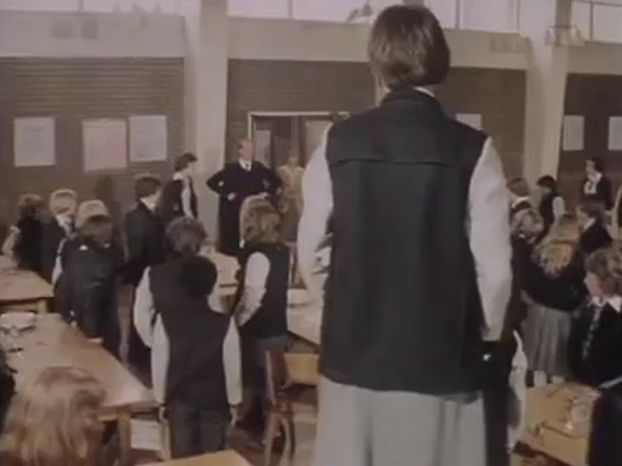
There’s another example of (mild) bad language, which is nevertheless a surprise to hear.  But this pales into insignificance when Jess stands on the table, insisting that the Headmaster is brought to them immediately.  Others follow suit and all of the pupils make a lot of noise.  It’s not exactly a riot, but it’s still a scene that would have no doubt provided more ammunition for those who contended that Grange Hill was a bad influence.

When Mr Llewellyn arrives, Jess outlines their grievances.  “This is merely a demonstration to highlight the humiliation, the degradation and the embarrassment a lot of students have to suffer. Not only due to their family circumstances, but because they’re forced into a situation which stigmatizes the poor.”  It’s another dramatic moment which shows how the series had evolved from the fairly low-key first series.

Tucker is also able to wring from the Headmaster another concession – that the older pupils will no longer serve the younger ones with their meals.  He’s unhappy that some, like Booga Benson, have been short-changing them.  This is the first time that Booga (later to become Tucker’s nemesis) is mentioned but it’ll be some time before we actually see him in the flesh.

Mr Baxter later refers to the SAG committee as louts and there’s a telling confrontation between him and the SAG leaders on the playing fields.  They might be able to intimidate some of the other teachers, but there’s no doubt that Mr Baxter isn’t going to back down.  However, he does require the help of some of the older pupils (led by Gary Hargreaves) to ensure that the cricket team (heading off to play a match against Brookdale) are able to reach the school bus unmolested.

Several players are pressurised to step down, so Tucker, Alan and Justin step in.  This leads to some classic comedy moments between Tucker and Mr Baxter.  Tucker is keen as mustard – he wants to be the wicket-keeper, but Mr Baxter tells him to get out into the field instead.  And when it’s their turn to bat, he’s constantly trying to get onto the pitch, but Baxter tells him that he’ll only get a turn when he’s given up hope!

Moonbase 3 – Outsiders

outsiders

Moonbase 3 is under pressure.  Part of the reason for the base’s existence is to carry out scientific research projects – several look promising, but Caulder needs one of them to show definite results.  And the sooner the better since Franz Hauser (Victor Beaumont) is on the way from Earth for an inspection.

Hauser is one of the people responsible for Moonbase 3’s appropriations budget.  If Caulder can’t prove that any progress is being made, it’s possible their funding will be drastically cut.  Mineralogist Peter Conway (John Hallam) may be close to a breakthrough, but he tells Caulder that nothing’s certain yet.  When Caulder complains that they’ve spent too much money for negligible results, Conway counters that that’s the price you pay for research.

Stephen Partness (Tom Kempinski) is also working hard and seems close to success in his field.  Partness has ruffled more than a few feathers, including Caulder’s, but if he can come up with something then presumably all would be forgiven.

Outsiders was the second script penned by John Brason.  Whilst the three previous episodes have all had their dark sides, Outsiders is the bleakest yet as there’s precious little comfort that can be taken from the conclusion of the story.

Peter Conway seems, at times, to be a deeply unhappy man – although his lapses into melancholy are only temporary.  But Dr Smith has noticed his changing moods and is concerned.  It doesn’t appear that his problems are connected to the stresses of living on the Moon – it’s probable that he would feel the same back on Earth.  Conway is just grasping for the reason why – there must be some other truth, he says, than just scientific truth.  During the course of an intimate counseling session with Helen in his cabin he remarks that “I can see that a tap for water is a great convenience, but something went out of the world when we stopped going to the communal well.”

Hallam’s excellent in this scene, as he is throughout the story.  Helen decides he’s a man out of time – a romantic – who seems to be cast adrift in a hostile environment.  She ends their discussion by kissing him on the lips.  It’s notable that this is the second episode in a row where she’s become attracted to one of her subjects.

The uneasy compromise between pure scientific research and the necessity to generate a profit is an interesting theme which is well developed here.  Given the expense of space research, it’s reasonable that the European government would seek to try and recoup as much money as possible – but research isn’t something that can be hurried (or if it is, then mistakes can occur).

But everything seems to be going Caulder’s way when both Conway and Partness announce that they’ll be able to demonstrate their successful processes to Hauser. However, Partness has faked his work in order to try and keep his career afloat.  He was on the verge of something, but the pressure of having to produce instant results meant that he resorted to subterfuge in order to buy himself a little more time.

It doesn’t take long before the truth comes out, although Caulder is able to keep it away from Hauser.  And whilst Caulder is a moral and honest man, he has no scruples in covering up Partness’ falsifications for the good of the base.

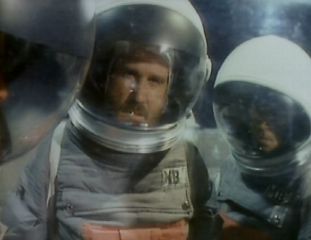
Conway’s breakthrough is highly significant, but he’s become increasingly detached and decides that he no longer wishes to continue living.  He dons a spacesuit and walks out onto the Moon’s surface, leaving the following note behind.

It is the coming of a new age in which I have no place. The new truths are not my truths. I think I am the perennial dodo. I belong to a thing like Athens, a mother of a mode of life which shall renew the youth of the world. A thing like Nazareth. Change is a delusion. It is of new things that Men tire, of fashions and proposals and improvements. ‘Tis the old things that are forever young. I have no place here. It is time to leave.

The death of Conway does give Partness a second chance.  Caulder was initially planning to send him back to Earth as soon as possible, but partly because Conway respected him, Caulder allows him to stay and finish his research.  It’s about the only crumb of comfort that can be taken from the events of the episode.

Outsiders might just be my favourite episode of Moonbase 3, thanks to the fine performance of John Hallam.

Grange Hill. Series Two – Episode Ten

grange hill s02e10

Written by Phil Redmond. Tx 2nd February 1979

The fall-out from Miss Summers’ resignation is still rumbling on. The staff, led by Mr Baxter, go on strike – which means that the children get an unexpected day off. This gives Mr Garfield a nice line where he bemoans that “nobody thinks about me. I never had this trouble with Mr Starling.” Most of Graham Ashley’s dialogue is matter-of-fact (he was never given the same comic material that, say, Timothy Bateson would later enjoy) so his deadpan delivery here is all the more memorable for its rarity.

Cathy and Madelin decide to go out somewhere. Cathy does offer Trisha an olive branch by asking if she wants to join them, but Trisha’s not interested. Madelin’s later comment that Trisha is a “stuck up bitch” is a little jarring – it’s a mild enough profanity (and pretty much every real school-child would have used far worse) but it’s still a surprise to hear it uttered in a BBC children’s series.

The pair head for the local shopping precinct. This is a lovely slice of late 1970’s Britain, complete with piped music, and we’ll see it again in series three (during the episode where Antoni Karamanopolis dies). Madelin decides that a bit of shop-lifting will pass the time and Cathy reluctantly agrees.

The first things that Madelin steals are a couple of apples (Cathy puts hers in the bin, which is a telling moment). They then take some empty record sleeves, to put on their bedroom walls. After this, it’s time for the big one – as they steal some clothes from the Clockwork Orange boutique (I wonder if this was a real shop or if the name was scripted? I hope it’s the former!)

As might be expected, they don’t get away with it – although if they had left when Cathy suggested, they might have done – for some reason Madelin decided to hang about, giving the shop assistants time to check that some of their stock was missing. A chase ensues and eventually the pair are cornered – but not before the sneaky Madelin has put the stolen top into Cathy’s bag and blamed her for the crime.

Many of the topics we see in the early series of Grange Hill will be done again in later years (some several times). Mainly this is because certain themes, such as shop-lifting, always remain relevant. And in the future I think the subject was handled a little better and with more depth than we see here.

Cathy is told at the end of the episode there will be no further action and Mr Mitchell advises her to settle her differences with Trisha. With Cathy’s delinquent streak only lasting two episodes it does feel rather rushed. When Grange Hill next tackled shop-lifting (about a decade or so later) the story was allowed more time to develop which meant that the ramifications for a character who had previously (like Cathy) led a blameless life carried greater weight.

Moonbase 3 – Achilles Heel

achilles

Whilst attending to routine maintenance work on the Moon’s surface, Bill Knight (Malcolm Reynolds) nearly dies after he runs out of oxygen.  It seems incredible that he wouldn’t have checked he had a sufficient supply to last for the duration of his work-period, but it appears that he’s not alone in making basic errors.

Professor Kate Weyman (Anne Ridler) has to admit to Caulder that she must have left the cut-out disabled on a vital piece of equipment.  The resulting damage will cost both time and money to put right.

Caulder is aware that Moonbase 3 is like a functioning organism – everybody depends on everybody else.  And when efficiency starts to slip it could spell disaster for the whole base.  But what’s to be done?  Lebrun knows what he would do – enforce strict penalties for anybody who breaks the rules.  Caulder, on the other hand, doesn’t believe that such an inflexible policy would work – these people are scientists, he says, not children.

Eventually Dr Smith begins to wonder the accidents weren’t quite as accidental as they appear ……

Achilles Heel was the first of two scripts written by John Lucarotti.  It may not come as a complete surprise to learn that it’s probable the crisises were triggered by an unstable personality, but unlike the first two episodes it looks like it’s deliberate sabotage.

Adam Blaney (Edward Brayshaw) always seems to be about when problems occur – he was the one that rescued Bill Knight, for example – and all the evidence suggests he’s engineered these problems for his own ends.

He’s also able to wage a psychological war of nerves with some of the other Moonbase personnel, playing on their own fears and prejudices. So when talking to Lebrun, he casually mentions how lax he feels Caulder’s administration is – knowing full well that Lebrun will agree. It takes a while for Helen and Caulder to put all the pieces together and by the time they do, both Helen and Bill are placed in danger.

Why didn’t Dr Smith, who was the most qualified, identify that something was wrong with him?  Sadly, she’s taken in just like everybody else. Indeed even more so – she starts to become romantically attached to him.  This does seems rather inappropriate (like a doctor/patient relationship would be).

Edward Brayshaw enjoyed a lengthy career, but he’ll always be best known as the constantly perplexed Harold Meaker in Rentaghost.  He’s smoothly convincing as Adam, although it’s a difficult role – especially at the end, when Helen rejects his advances and his irrational side has to come to the fore.

The reason for his behaviour stems from his rejection as a pilot on a prestigious mission to Venus.  As he was denied the chance to end his career on a high, it appears he’s decided to ruin everybody else’s.  His actions suggest that he’s seriously unbalanced and the question must be how he was able to clear the physiological profiling which passed him fit for duty on the Moon.  But if the profiling had managed to weed out all the unstable characters there would have been very little drama in this series …

The opening minutes, with Bill Knight struggling on the Moon’s surface, is effectively shot – especially from his POV.  It’s just a pity that, impressive as the Moon surface is, once again we see the ground obviously move when anybody steps on it (a consequence of the way the set was built – presumably it would have been far too expensive to create a totally solid landscape).  But since all these scenes were prefilmed it’s surprising that they didn’t choose just to cut away from any especially unconvincing moments.

Although Helen is convinced that Adam was responsible for the sabotage, even if she doesn’t believe he was aware what he was doing, there’s no actual evidence to prove that both incidents weren’t genuine accidents. But his erratic behaviour provides Caulder with more than adequate grounds to ensure he’s returned to Earth.

Whilst Adam’s last-minute lurch into madness does feel a tad melodramatic, Achilles Heel is still a good story thanks to the guest performance of Brayshaw.

Grange Hill. Series Two – Episode Nine

grange hill s02e09

Written by Margaret Simpson. Tx 30th January 1979

Almost as quickly as Cathy’s father turns up, he leaves again. As a character he’s not remotely important (we only hear him utter a handful of words) and he simply serves as a trigger to push Cathy into a series of delinquent misadventures.

The first sign of the trouble to come is when Cathy and Trisha fall out. And the even worse news is that Cathy finds a new friend straight away in Madelin Tanner. It’s pretty clear from the start that Madelin’s a bad lot – she encourages Cathy to bunk off from sports in order to go for a smoke in a secluded part of the school. There they meet Jackie Heron and her friend, but it isn’t long before their peace is shattered by the arrival of Mr Garfield.

Although they make a run for it, Mr Garfield and his colleague manage to run them down. I love the way Mr Garfield’s colleague brandishes a broom in their general direction – almost like he’s herding sheep!

This is only the start of Cathy’s naughty behaviour though and the bad feeling between Trisha and Cathy finally comes to a head during their art class. A brief fight between the pair of them breaks out and when Miss Summers intervenes, she accidentally strikes Cathy. Madelin is quick to insist that she hit Cathy deliberately and Cathy goes along with her.

The meeting in Mr Llewellyn’s office, with Cathy, Madelin and Miss Summers is rather instructive. Mr Llewellyn displays the same rather inflexible nature that’s already caused a certain amount of friction amongst the staff.  Refusing to discuss the matter with her in private leaves Miss Summers no alternative but to hand in her resignation.

Moonbase 3 – Behemoth

behemoth

Series creators Barry Letts and Terrance Dicks were keen to ensure that Moonbase 3 was science fact first and science fiction second.  Most obviously this meant that Cauder and his team couldn’t expect to be visited by bug-eyed monsters – every danger they faced had to be scientifically credible.

Although having said that, it’s intriguing that Behemoth does tease the audience that there could be something strange out on the lunar surface.  Several unexplained disappearances are rumoured to be the work of mysterious space monsters.  These bizarre stories cause a certain amount of panic amongst even the most rational of people, which forces Caulder to venture onto the lunar surface to investigate.

One of Moonbase 3’s most fruitful areas of dramatic tension revolved around how a disparate group of people managed to live and work in the stressful, zero-gravity environment on the Moon.  But this might also be the reason why the series was so short-lived – after all, there’s only so many stories you can craft about people who are slowly cracking under the strain.

When watching the next two episodes (Achilles Heel and Outsiders) this should be borne in mind and I’m sure we’ll come back to the thorny issue of exactly how Dr Helen Smith manages to keep her position as the base psychologist.  Surely after yet another seemingly normal person has gone loopy, endangering the rest of the base, you’d think that somebody would be questioning her ability.  Although to be fair, she did have concerns about Professor Heinz Laubenthal (Peter Miles) which Caulder chose to ignore.

But then it isn’t always clear who’ll be the next to buckle.  Some, like Laubenthal seem obvious candidates right from the off, whilst others, like Dr Peter Conway (John Hallam) do appear to be normal and rational.

It could be that Peter Miles has sometimes played characters who aren’t sinister or deranged, but if he has then I must have missed them.  To be honest, if you cast Miles then you’re as good admitting from the off that the character he’s playing is a wrong ‘un.  Maybe it’s the slightly odd, staccato way he delivers his lines (or possibly his space cardigan) but the Professor doesn’t seem to be completely normal.

After Caulder bans any work being carried out in the Mare Frigoris region, following the disappearance of two seismologists, Laubenthal reacts angrily.  He’s carrying out research work in the area, but exactly what he’s doing is a closely guarded secret.  And after an explosion in his lab kills him, it’s precisely the secretive nature of his work which allows the wild rumours to flourish, helped along by Peter Conway.

After a brief appearance in the first episode, Conway has a slightly larger role here – although his main episode will be the fourth one. Hallam makes Conway a charming man, albiet one who seems to be troubled by something.  Dr Smith is perplexed as to why he delights in spreading scare stories about monsters on the Moon. She wonders if it’s simply his way of letting off steam or whether his actions are masking deeper problems.

Elsewhere, Lebrun clashes with the prickly weather expert Juan Benavente (John Moreno).  Benavente has an astonishing accent, which Lebrun  comments unfavourably upon.  Given Ralph Bates’ fake French accent, this is a bit rich!

Behemoth and the later episode Outsiders were both written by John Brason.  Like Arden Winch, who scripted the series finale View from a Dead Planet, he didn’t have a background in science fiction.  Winch had written for The Wednesday Play, for example, whilst Brason had contributed to Colditz.  This seems to be part of the drive by Letts and Dicks to recruit writers who would be able to craft good drama.

The presence of James Burke, as technical advisor, was another sign they were keen to be as accurate as possible.  Barry Letts had decided that by 2003 there would be Moonbases and whilst the benefit of hindsight has enabled us to see that this was hopelessly optimistic, some of Burke’s reasoning at the time still remains sound.The

By 1973, the love-affair with the Moon was already over.  The last manned mission had taken place in 1972 and Burke reasoned that nobody would be interested in returning there until at least the 1990’s – as it would take at a decade or so to study all of the materials brought back from the various lunar missions.

With scientific accuracy therefore very much to the fore, it shouldn’t come as a surprise there’s a rational, logical solution to the mystery.  Both of Brason’s episodes are highlights of the series and it’s the mysterious nature of this story which helps to keep the interest level up.

Grange Hill. Series Two – Episode Eight

grange hill s02e08

Written by Alan Janes. Tx 26th January 1979

This episode sees Cathy Hargreaves move centre-stage for the first time. Up until now we’ve learnt very little about her, apart from the fact that her father died when she was a baby.

The news that a man has been spotted following several Brookdale girls sparks concern and the school is visited by a policeman who is keen to stress some basic safety tips. The reaction of the pupils to this news (they’re very unruly and Mr Llewellyn struggles to quell them) is quite interesting. It’s the first time we’ve really seen the kids behave badly en-masse – and with the SAG protests about school uniform still bubbling away it’s a taste of things to come.

Trisha and Cathy are busy collecting signatures for the petition to abolish school uniform. Trisha’s sister Carol refuses to sign, telling her younger sister (probably quite rightly) that “you’d be out here, whatever the issue. You just like stirring it.”

Later, the two girls are sent to post a parcel and after Trisha leaves to go home, Cathy is followed by a man (who was also seen hanging around the school at the start of the episode). There’s an obvious inference, but the reality is somewhat different – the man is Cathy’s father. It takes a while before this is revealed though, so the sequence of Cathy’s growing realisation that somebody’s following her is rather disturbing.

The obvious fall-out when Cathy realises that her dead father isn’t dead after all will be seen in the upcoming episodes – as Trisha and Cathy fall out and Cathy hooks up with a nasty piece of work called Madelin Tanner (Lesley Woods).

Moonbase 3 – Departure and Arrival

dep 1

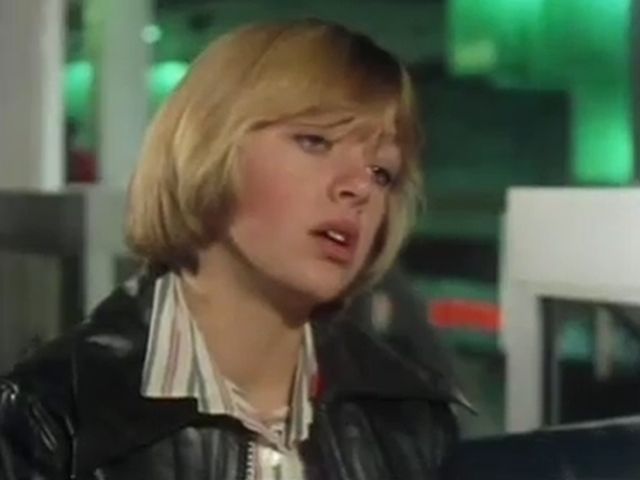
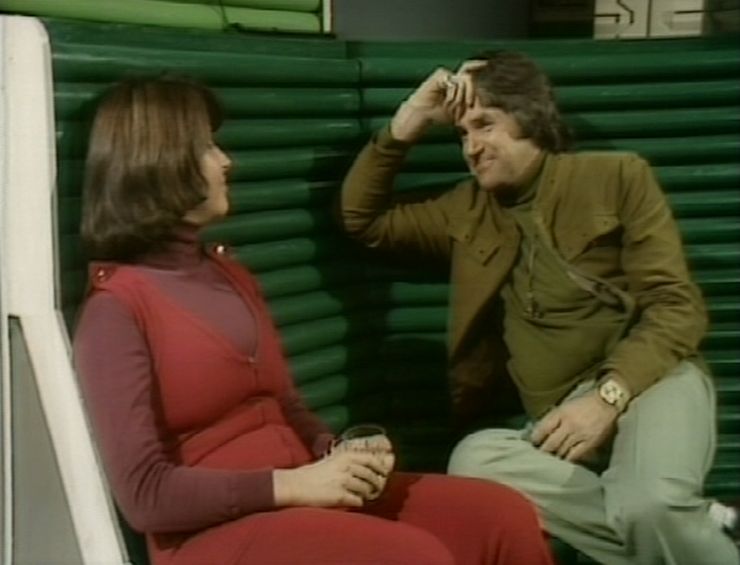
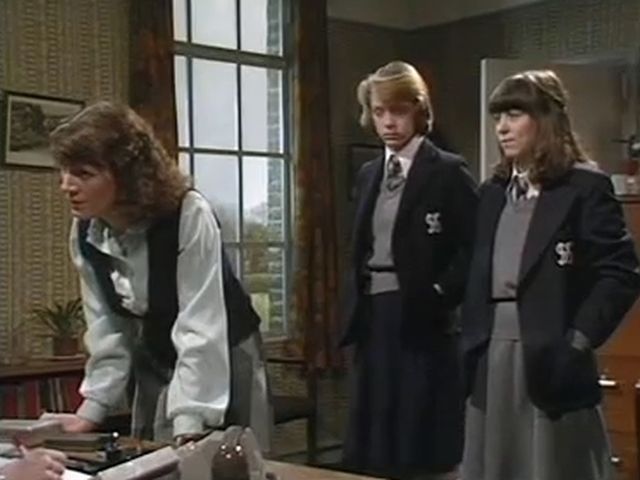
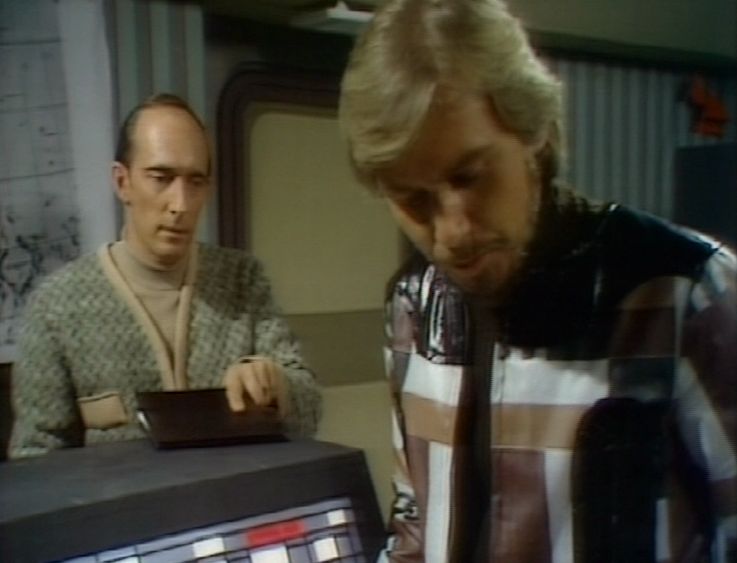
Last year I blogged a quick overview of Moonbase 3 where I mentioned that it’s a series that I like to revisit most years.  Quite why this is, I don’t know, as I own many other series that are, by any quantifiable reckoning, “better” programmes than Moonbase 3, but they don’t get viewed nearly as often.  There’s just something about this series that I find both compelling and comforting.

As I work my through the six episodes again, perhaps I’ll work out why I enjoy it so much.  Partly, I think it’s the 1970’s sci-fi vibe.  If you love Doctor Who of this era, then there’s plenty to enjoy in Moonbase 3.  They’re totally different series – Moonbase 3 tended to deal with fact, not fantasy – but there’s many familiar faces who had made notable appearances in Doctor Who.  And Dudley Simpson’s music is, of course, another very Who-ey connection.

The year is 2003 and there are five Moonbases – the Americans, Russians, Brazilians, Chinese and Europeans all have one apiece.  From the opening scene though, it’s clear that the European Moonbase is struggling to keep afloat.  Money, or the lack of it, is the problem.  The European Moonbase director Dr Tony Ransome (Michael Lees), can only look on enviously at the American and Russian bases, which have all the facilities they could possibly need.

When the director is killed in a shuttle crash, the political storm is another threat to the survival of Moonbase 3.  The shuttle pilot, Harry Sanders (Michael Wisher), had been rated as their top pilot, but psychologist Dr Helen Smith (Fiona Gaunt) had vague concerns about him.  These weren’t enough to persuade Dr Michel Lebrun (Ralph Bates) to request his removal though.

As the episode then revolves around the new director, Dr David Caulder (Donald Houston), arriving to initiate an enquiry into the accident, it’s worth taking a moment to consider the actions of both Helen and Lebrun.  Helen seemed convinced that Sanders would be removed from duty, but Lebrun was unwilling to do so – as she’d offered no clear reasons why.  Helen agreed that there was no evidence, just her instinct, but as the base psychologist you would have assumed that even a vague doubt would have been enough to initiate Sanders’ replacement as pilot.

The characters of both Helen and Lebrun are therefore quite sharply defined very early on.  Dr Smith operates on instinct (although we’ll see several later examples of her poor judgement, which makes you wonder how she manages to keep her job) whilst Dr Lebrun is very much a by-the-book character.  If Helen had given him a clear report (rather than just suspicions) then he would have acted – otherwise he wasn’t prepared to do anything.

Michael Wisher, who’d already made several notable Doctor Who appearances (with his memorable turn as Davros a few years in the future) is good value in the small, but key, role of the increasingly twitchy Harry Saunders.  At first, he seems fine – just a little tetchy at being delayed.  But once the shuttle lifts off and Lebrun, Smith and Tom Hill (Barry Lowe) on Moonbase become concerned, we see Saunders become more and more paranoid.

The theme of Departure and Arrival is how fragile life on the Moon can be.  Just one weak link, like Sanders, can spell disaster for everybody – which is something the new director, Dr Caulder, tries to impress on the senior staff.  The fact that he does so in such a bizarre and risky way does rather undermine his point though!

Before that, Caulder’s arrival is a useful dramatic device since it allows the viewers to follow him around as he’s introduced to the various different sections of Moonbase 3.  Donald Houston is very bluff and very Welsh here – Caulder doesn’t actually call anybody “boyo”, but you get the feeling that he could do so at any moment.

One nice touch is that on his tour he’s introduced to various scientists such as Dr Peter Conway (John Hallam) and Professor Heinz Laubenthal (Peter Miles).  Both of them will appear in upcoming episodes, so seeing them briefly here helps to sell the illusion that all these people are really working closely together.  With most episodic series, the guest-cast will change from episode to episode –  meaning that each week we tend to meet new people but never see them again afterwards.

Caulder tells Lebrun, Smith and Hill that he holds all three of them responsible for the deaths of Ransome and Saunders and they’ll all travel back to Earth by the next available shuttle.  But shortly after taking off there’s a problem and the shuttle has to make an emergency landing back on the Moon’s surface.  Incredibly, Caulder has staged this in order to make the others understand just how dangerous the Moon can be.  The fact he nearly gets them all killed whilst proving his point seems to pass everyone by.  Indeed, it’s remarkable that nobody suggests they should hold anothet enquiry to examine his reckless actions which so nearly resulted in another tragedy.

Although the Moon’s surface is a little springy, that doesn’t detract too much from the tense closing moments, which are nicely directed by Ken Hannam.  Once they’re rescued in the nick of time by the American Moonbase commander (played by Robert La Bassiere, whose most prominent credit on his limited CV was as a Kroton in a Patrick Troughton Doctor Who story) Caulder tells them that they’ll be no further action taken.  In his opinion, nobody but Saunders was responsible for the accident.

It’s a bit of a slow-burn, but Departure and Arrival is a decent set-up episode,  especially it brings the main characters into clear focus.

dep 2

dep 3


Grange Hill. Series Two – Episode Seven

grange hill s02e07

Written by Phil Redmond. Tx 23rd January 1979

The next day, Benny continues to fret about Simon’s safety. Tucker’s not concerned though – they went back into the school and he wasn’t there, so he must have got out alright. Tucker being Tucker, of course, can’t help himself by telling the concerned Benny that if they did discover a charred corpse they’d be able to identify it from the dental records!

It turns out that Simon’s fine, although the fire damage is quite costly and money has to be taken from the funds raised by the recent jumble sale.

His inability to read is eventually revealed when he confesses this fact to Trisha. As previously mentioned, it does stretch credibility to breaking point that he’s survived so far into the first year without his problem being recognised.  We saw in the previous episode how he was able to get out of reading by feigning sickness – are we supposed to think that he’s been doing the same thing all the year?! Trisha, of course, loves a lame duck and takes it upon herself to teach him (telling the boy he needs to address her as Miss Yates and give her an apple!)

Simon tells her why he’s kept his problems with reading a secret – he doesn’t want to have to leave Grange Hill and be placed in a “special school”. Dyslexia really became a recognised condition in the 1980’s – prior to that, as Simon says, people who couldn’t read were usually labelled “thick or stupid.” It’s another early example of the series’ public-service ethos – undoubtedly some of the audience would have identified with Simon’s problems and Mr Sutcliffe’s sympathetic reaction would have helped to reassure them.

Having said that, it’s slightly concerning that Simon will, after all, have to transfer elsewhere – with all the stigma that attending a special school entails. This may have been seen as quite reasonable back in the late 1970’s, but it does strike a slightly discordant note today.

Grange Hill. Series Two – Episode Six


grange hill s02e06

Written by Phil Redmond. Tx 19th January 1979

Simon’s rather upset to be dropped from the school football team by Mr Baxter. He’s not able to give a reason why he missed a recent practice session – there was a notice put up, said Baxter, couldn’t he read? As Simon reacts angrily to this (plus the other hints we’ve had in earlier episodes) we can surmise this is uncomfortably close to the truth.

Tucker decides to cheer him up by initiating him into his gang, the Tremblers (this is obviously something that Tucker’s created on the spur of the moment). In order to become a member, Tucker tells him he has to climb up to the top of the school tower. Simon says he”ll do it, provided he sees the others do it first. All goes well until Mr Garfield discovers them and, not realising that Benny had already reached the top of the tower, locks him in.

Mr Garfield (Graham Ashley) was the first in Grange Hill’s long line of put-upon caretakers, and many of them followed the Garfield archetype (bad-tempered and irritable). Sadly, Ashley died in 1979 at the age of only 52 – with his final appearances as Mr Garfield airing the year after his death, in 1980. He had a very solid acting career with plenty of guest-spots in popular series (such as Porridge, Some Mother’s Do ‘Ave ‘Em, Colditz and The Avengers) and was a regular in Dixon of Dock Green, although most of his episodes were wiped. Another notable credit was as Gold Five in the first Star Wars movie.

More excuses from Simon in Mr Sutcliffe’s English class – he says he can’t read as he feels sick. This break from lessons allows Simon to release Benny from the tower, but he pretends to Tucker that he couldn’t – ensuring that the others decide to return to the school in the evening to free him.

Simon’s practical joke (involving a skeleton and a candelabra!) backfires spectacularly when it accidentally causes a fire. The “flipping ‘ecks” are liberally sprinkled about as Tucker, Alan and Benny “leg it” but they don’t realise that Simon hasn’t followed them. He’s tripped over a cable and knocked himself out – leaving us on a decent cliff-hanger as the other three worry that he might be in some danger.

Grange Hill. Series Two – Episode Five

grange hill s02e05

Written by Margaret Simpson. Tx 16th January 1979

The staff/pupil council was a popular theme during the early series of Grange Hill, but after series five it rarely surfaced again. This is a little surprising, since it offered a rare opportunity for all members of the school community to have a say (even if, of course, the teachers tended to win the day most of the time – much to the pupil’s chagrin).

The thorny topic of school uniform, a running thread through series two, is brought up here. There are some, such as third-former Jess (Sara Sugarman), who are strongly opposed to uniforms – later in the episode she mutters that they might as well just brand them all and be done with it. Sugarman’s performance is so deadly earnest that it does raise a smile – for some reason the issue of school uniform seems to obsess her intensely.

Penny Lewis, as the new first year rep, has less contentious topics on her mind. She wants the school to create a bookshop, whilst the other first years want a tuck shop instead. Poor Penny – when she asks for a show of hands to support her proposal for a bookshop, none are raised, but everybody supports the idea of a tuckshop.

Her mother later suggests an obvious solution – why not have a combined tuck and bookshop. And it’s instructive to hear her pass off the idea next day in school as her own! She’s a sneaky one, is that Penny Lewis.

The school council meeting also gives us a chance to see Michael Doyle’s father, the very important (at least in his own mind) Councillor Doyle. Like his son, he’s not the nicest of chaps – Doyle Snr is pompous and officious and seems keen to block any suggestions made by the pupils. His character is in sharp contrast to Mr Llewellyn, who is prepared to listen to suggestions (and is much more approachable than his successor, Mrs McClusky would ever be).

Elsewhere, this is one of the first episodes where the trio of Tucker, Benny and Alan is clearly established. Alan was a very peripheral character in the first series, but we’ll see him become a much more central figure over the next few years. And by the time of series four he’s supplanted Benny as Tucker’s best friend (especially when Benny fades away from view in the second half of the series).

In this episode they get into trouble for taking to the school jumble sale a chaise-long they thought was left for the binman. The owner of the antique shop (or junk shop, as Tucker more accurately called it) wasn’t best pleased – but it seems that an honest mistake was made, so once the boys lug it back to the shop all was forgiven.

It’s an eye-opener to hear that the clothes sold at the jumble sale were going for five pence each. I know this was 1979, but that seems like a bargain even then! It’s even more impressive when it’s revealed that the jumble sale made £435.00. How many items at five pence a time must they have sold to make that amount of money?!

Another lovely Tucker moment occurs when he shamefacedly realises he’s sold Mrs Bennett’s rather expensive coat for five pence! Although he did honestly think it was part of the jumble, so we can’t blame him for that.

Grange Hill. Series Two – Episode Four

grange hill s02e04

Written by Margaret Simpson. Tx 12th January 1979

Love is in the air for Trisha, as both Simon Shaw (Paul Miller) and Gary Hargreaves (Mark Farmer) vie for her attention.

Simon Shaw was a rather short-lived character – he’s a central figure in the early part of series two before leaving for another school later the same year. It’s clear from the start that he’s someone with a problem – all the evidence points to the fact he has difficulty reading and writing.  Although since we’re mid-way through the school year it’s difficult to understand how this has gone unnoticed for so long. He’s clearly interested in Trisha, but she doesn’t seem to notice him – Trish has only got eyes for the fourth-form football star Gary Hargreaves (Mark Farmer).

Mark Farmer (later to turn up as a semi-regular in Minder) certainly has the gift of the gab, but Trisha’s mother warns her that he’s too old for her. Gary will pop up now and again over the next few series, almost always when the plot is football related.

Elsewhere, Mr Mitchell is appalled at the standard of grammar and punctuation in his class and Mr Baxter continues to rail against Mr Llewellyn’s timetable arrangements.

This is the first of Margaret Simpson’s scripts for Grange Hill. She’d go on to clock up nearly sixty writing credits on the show over the next decade or so (her last being the series finale in 1992).

Gange Hill. Series Two – Episode Three

grange hill s02e03

Written by Alan Janes. Tx 9th January 1979

This episode (the twelfth in the series) was the first not to be written by Phil Redmond. It was penned by Alan Janes who’d go on to script another eighteen episodes during the next four years or so.

Whereas series one concentrated on one class, in series two the focus often switches between two different classes and this is the first episode not to feature any of the characters who have until now been the main focus of attention (Tucker, Benny, Trisha, etc). Instead, we concentrate on two new arrivals – Antoni Karamanopolis (Vivian Mann) and Andrew Stanton (Mark Eadie).

Antoni is always falling asleep in class and a concerned Miss Summers (Philomena McDonagh) wants to know why. Since he’s Greek it’s maybe not a surprise (in clichéd television terms anyway) that his family own a restaurant and he’s been helping out several times a week. These late nights are clearly taking their toll, so Miss Summers pays his parents a visit.

Mr Karamanopolis (Alexandros Mylonas) is gloriously unrepentant about working his son so hard, but he quickly sees the error of his ways. Indeed, his change of heart does feel rather too rapid and it’s another indication that the series at this point was more comfortable in telling self-contained stories, episode by episode.

Andrew Stanton and Justin Bennett strike up a friendship, based on their love of music, but it’s hard-going at first since Andrew is constantly angry and upset. Eventually he reveals that he believes his parents are on the verge of splitting up – although by the end of the episode that doesn’t seem to be so.

This was a plot-thread that did have some legs – the Stanton’s marital problems are mentioned again in the third series and by series four Andrew’s father has finally left home (taking his younger sister with him) which drives Andrew to drink (literally – as Tucker and his friends have to try and look after the inebriated boy in a memorable episode).

Grange Hill. Series Two – Episode Two

grange hill s02e02

Written by Phil Redmond. Tx 5th January 1979

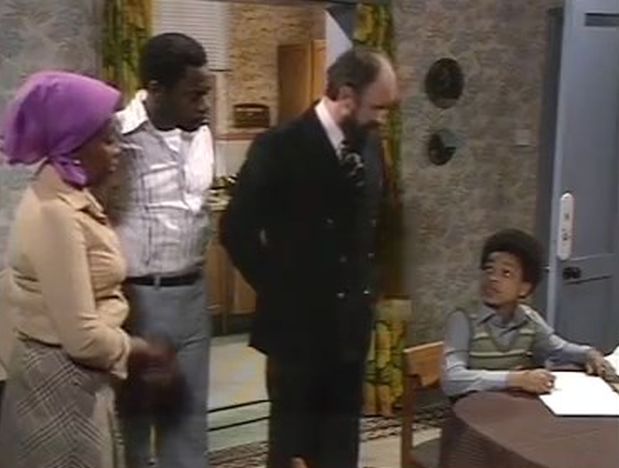
Benny’s still under suspicion and it’s enough to make him disinclined to go to school. So his parents decide to pay Mr Llewellyn a visit.

This particular story is wrapped up by the end of the episode, which does feel a little rushed (had it played out over a few more episodes then much more drama could have been mined from it). Over the years, we’ll see how Grange Hill would begin to interweave numerous plot-lines across the season. Although having said that, when Andrew Stanton is introduced in the next episode it’ll begin a storyline that isn’t resolved until the fourth series!

The true culprit is caught and punished, but it still leaves Benny feeling hurt and upset. Was he victimised because of the colour of his skin and his poor background? It’s interesting that the previous episode is quite explicit in showing how Benny came by his fifty pence (he found it lying on the ground on the way to school). Had they not done this, then there might have been some doubt as to whether he was telling the truth when he protested his innocence..

We also bid farewell to Judy as she leaves Grange Hill for Brookdale – although she’ll reappear in the final episode of series two.

Grange Hill. Series Two – Episode One

grange hill s02e01

Written by Phil Redmond. Tx 2nd January 1979

There’s an influx of new faces in the first few episodes of series two. This is because the number of episodes were doubled from series one (from nine to eighteen) so more characters had to be created to share the various plot-lines

Cathy Hargreaves, Susi McMahon and Penny Lewis would all become central characters, whilst others (such as Andrew Stanton and Antoni Karamanopolis) would be placed more in the background, but did step into the limelight occasionally.

Mr Baxter, Mr Sutcliffe and Mr Keating all debuted as well (and would all be major figures in the development of the series during the next few years). A new headmaster, Mr Llewellyn (Sean Arnold) also makes his first appearance here and it doesn’t take long before he’s ruffled more than a few feathers amongst the staff.

Mr Baxter (Michael Cronin) views the new headmaster with disfavour – in his eyes he’s a progressive and his approach is doomed to failure. The Baxter formula for keeping order is quite simple – let them know who’s boss and don’t take any nonsense. Cronin’s pitch-perfect from his first scene as he’s able to bring a nice degree of resigned weariness to Baxter as well as a finely honed sense of irony.

Mr Baxter (like some of the other new arrivals) has presumably been at the school for a while – it’s just that we’ve never seen them. This is something that happens quite often down the years at Grange Hill – pupils and teachers just appear and everybody acts as if they’ve been there for years. And as we work our way through the entire series we’ll see that the reverse is also true – some characters just vanish, with never a word spoken about their fate.

At least the departures in series two (Ann Wilson and Judy Preston) aren’t brushed under the carpet – and in the case of Judy she does appear in the first few episodes before transferring to Brookdale. Ann Wilson is mentioned in the first episode, but we never see her (and by episode three we’re told that she and her family have moved abroad).

It’s interesting to ponder why Judy Preston was written out – as Penny Lewis essentially inherited the character of Ann, Judy could have been moved alongside her as her best friend (instead, another new character – Susi McMahon – was created). Perhaps it was felt that Judy was nice, but too wet.  Her place as Trisha’s friend is taken by Cathy Hargreaves (Lindy Brill). There’s certainly no doubt that Cathy is a more interesting character than Judy and the combination of her and Trisha seemed to click from the start.

Dramatically, this episode seems to be pitched at a higher level than most of series one. After Tucker’s high-jinks accidentally breaks a classroom window, Mr Mitchell finds himself publicly criticised by Mr Llewellyn for leaving his class unattended. The fact that Mr Llewellyn berates him in front of his class is a source of considerable annoyance to him and it’s the first sign that some of the staff are finding relationships with the new head to be rather difficult (this is something that will rumble on for the next few episodes).

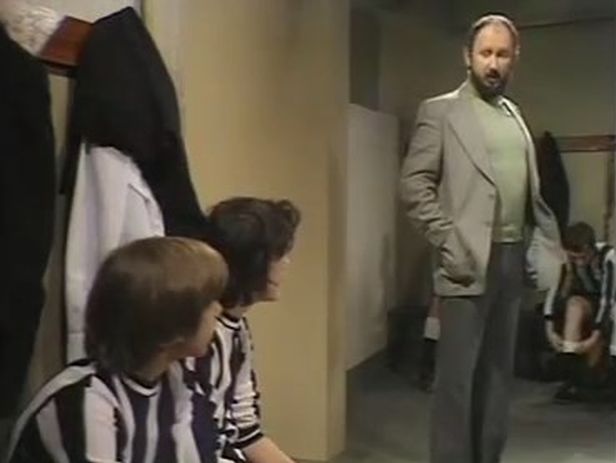
The other major plot-thread of the opening episode concerns Benny, who finds himself accused of stealing fifty pence. The theft occurred during a football match between Grange Hill and Brookdale, and Benny was the last person to leave the changing room. He is in possession of a fifty pence piece, which is suspicious, but it’s not solid evidence. However, it’s enough to convince some of his team-mates, who tell Mr Baxter that they won’t play if Benny’s in the team.