Doctor Who – The Creature from the Pit. Episode Two

creature 02-01

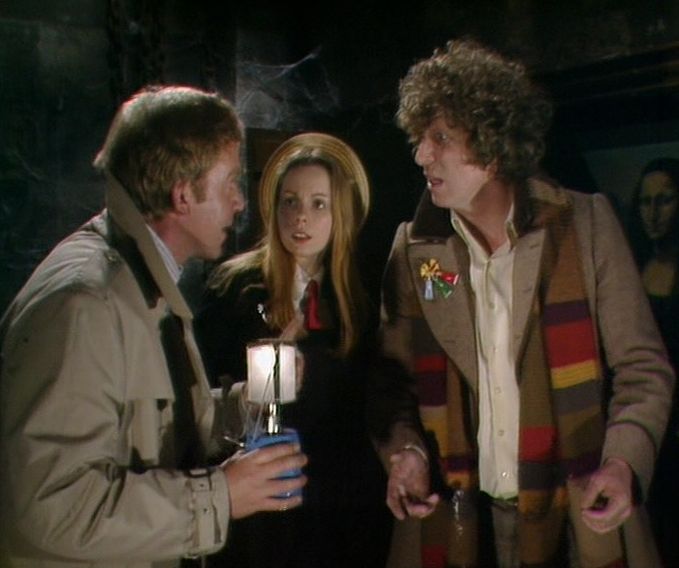
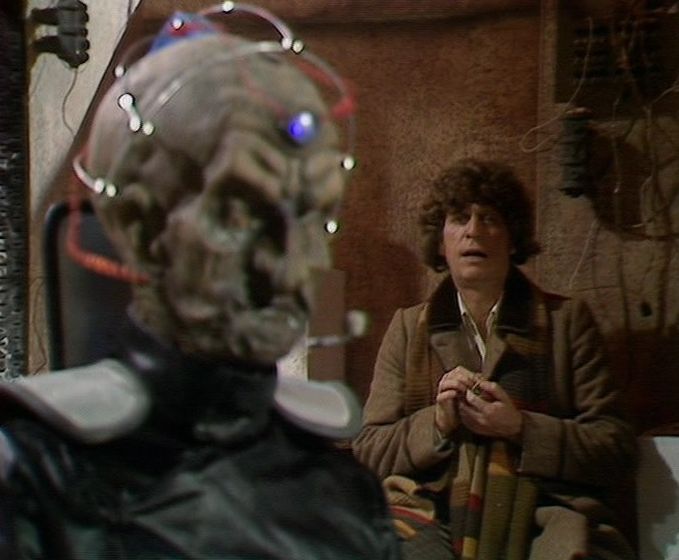
At the end of episode one the Doctor decided to join Doran in the pit.  This was rather unexpected, although it appears that he merely planned to hang about until everyone had left and then climb out.  Quite why no-one could spot him from the pit entrance is a slight mystery, but no matter.

There then follows the (in)famous scene where the Doctor attempts to climb his way out of the pit with the aid of a book, Everest in Easy Stages.  Unfortunately it’s in Tibetan so he then pulls out another handy book – Teach Yourself Tibetan.  If you’re not a fan of the humour present in the series at this time then I don’t think this gag is going to impress.

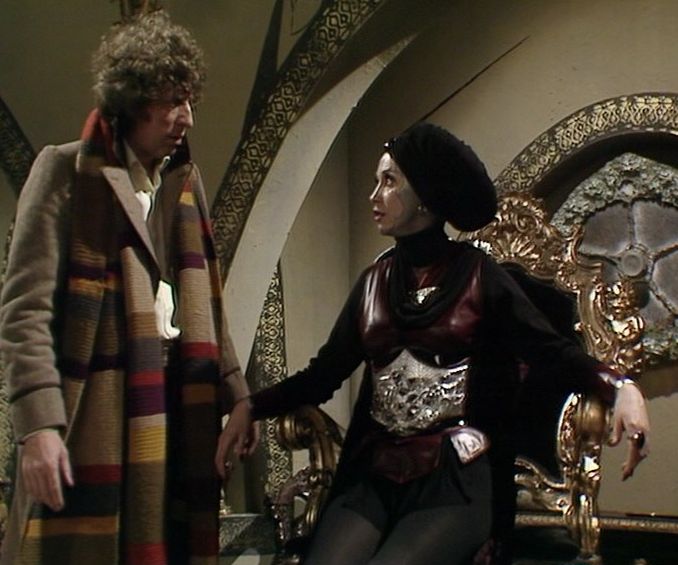
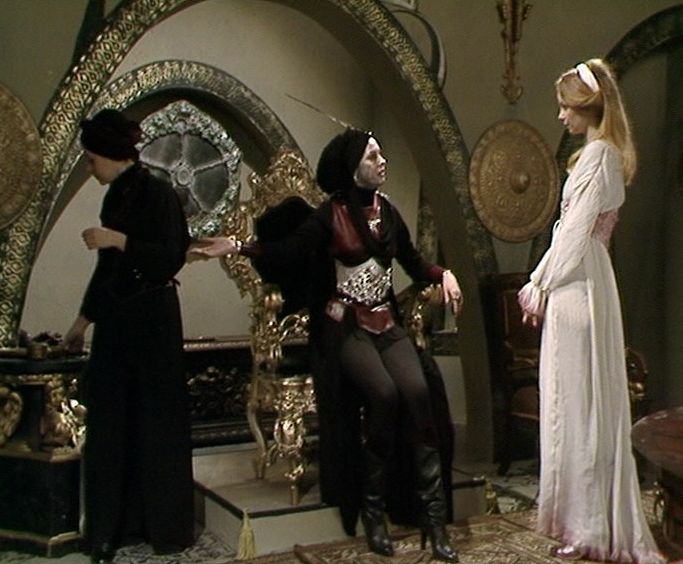
With the Doctor apparently dead, Adrasta is keen to utilise Romana’s knowledge to destroy the creature.   There’s a nice hard edge to Adrasta, which is demonstrated after she gives the wise-cracking Romana a swift slap.  Ouch!

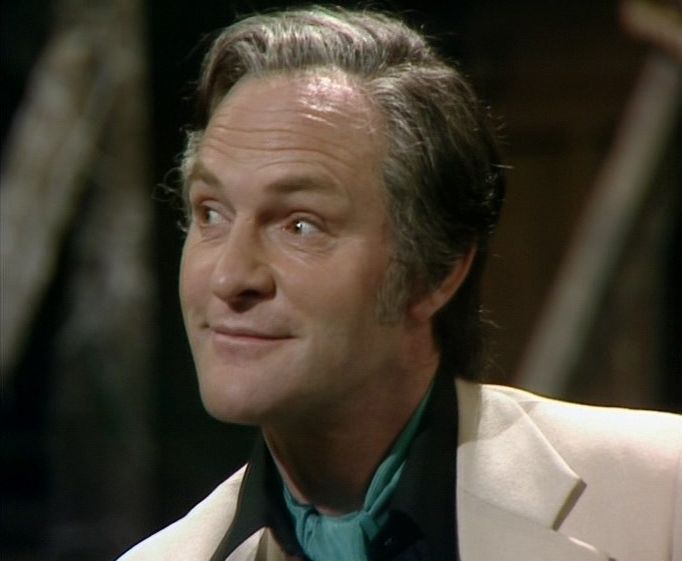
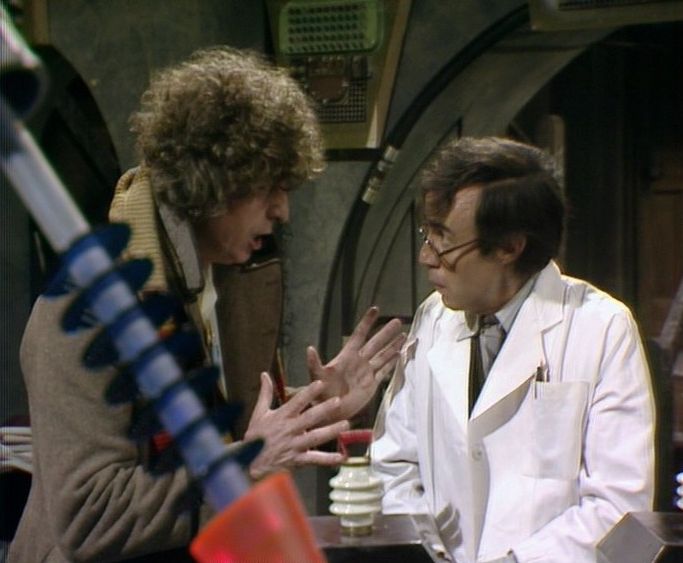
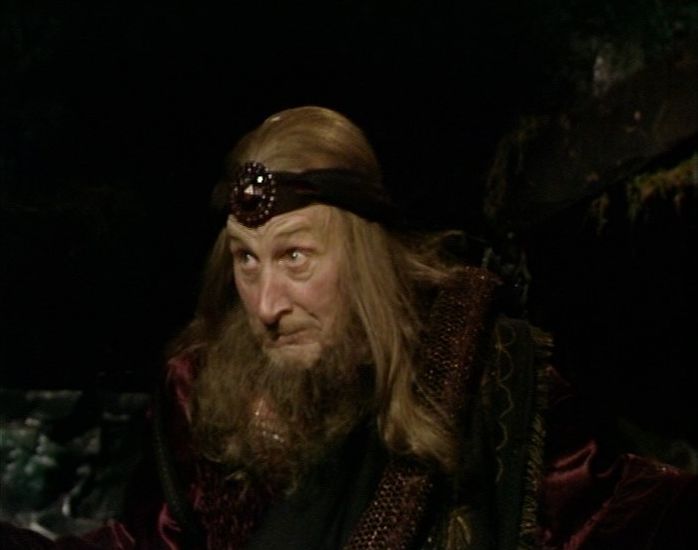
The Doctor, having fallen into the pit, then makes the acquaintance of Organon (Geoffrey Bayldon).   Bayldon is simply delightful as the cowardly astrologer and is obviously one of the serial’s trump cards.   He gets plenty of good lines (“Seer to princes and emperors. The future foretold, the past explained, the present apologised for”) and works excellently with Tom Baker.  Tom always seemed to thrive when he had strong actors to bounce off against and Bayldon is a fine example of this.

And then the creature turns up.  It’s not good (although the model shots don’t look too bad).  What’s fairly astonishing is that none of the production team appear to have seen it before it was unveiled on the first studio day.  You’d have assumed someone would have kept an eye on how things were going, but no.  In the post-mortem that followed, Graham Williams put the blame firmly on the shoulders of the visual effects department, but this seems more than a little unfair.  With a very limited budget, just how do you create a monster of almost unimaginable size?

That neither Williams or Douglas Adams ever stopped to ask whether such a creature could be effectively realised on Doctor Who’s budget is very perplexing.  But whilst the monster doesn’t impress, the byplay between the Doctor and Organon does.

ORGANON: Ahem. What do we do when we find the monster? Have you thought of that?
DOCTOR: Shush. I don’t know.
ORGANON: You don’t know? What do you mean, you don’t know?
DOCTOR: I haven’t made up my mind yet.
ORGANON: Well, haven’t you got a plan?
DOCTOR: A plan? Oh yes, I’ve got a plan.
ORGANON: Well then?
DOCTOR: I just don’t know how to apply it, that’s all.
creature 02-02

Doctor Who – The Creature from the Pit. Episode One

creature 01-01.jpg

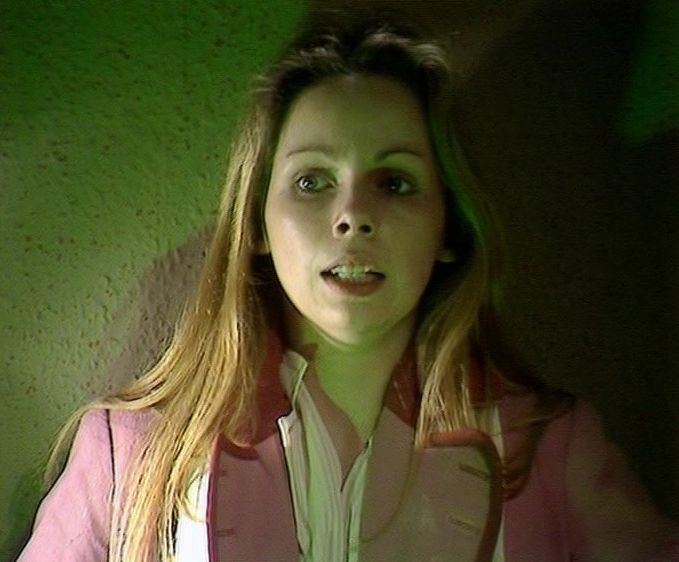
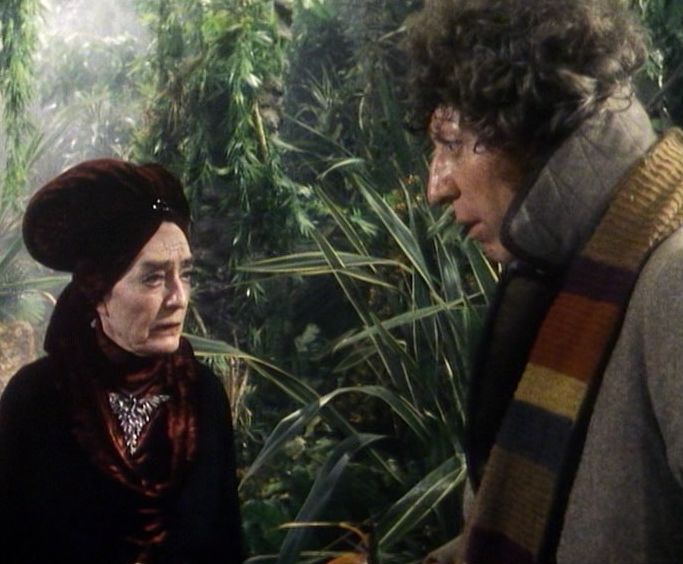
Watching episode one with no knowledge of the (very large) problematic monster to come, this is more than decent fare. The jungle filming at Ealing is glossy and well mounted (that Tom is made to look a little sweaty heightens the illusion that we’re in a lush, tropical environment).

Adrasta might be a rather one-note villain, but Myra Frances does her best with the material and the fact she’s rather easy on the eye doesn’t hurt.   There’s also a gang of comedy bandits lurking about, led by Torvin (John Bryans).  Torvin is the least subtle Jewish stereotype (“my lovely boys”) you’re ever likely to see, for all the world he seems to be playing Fagin from Oliver Twist.

I have to confess it was only recently that I connected him to his Blakes 7 roles (Bercol and Shrinker) which just goes to show what a beard and a broad accent can do.  Romana is captured by Torvin and his associates, although she’s not terribly impressed by them.  “I’m a traveller. I’m a Time Lord. And I am not used to being assaulted by a collection of hairy, grubby little men”.  Few actresses could do haughty like Lalla Ward, it just seems to come naturally ….

As an actor, Terry Walsh was a great stuntman.  Bless him.  But it makes sense to give him a speaking part, since his character, Doran, would be the next victim to be thrown into the pit to be consumed by the mysterious creature.  And the sight of Walsh’s terror stricken face as he spies something off-camera, glowing green, is another well-mounted moment.  At present, with the creature still unseen, the imagination can work overtime to create an impression of what it could possibly look like.

I wonder if the reality will match our imaginations?  Next time we’ll find out.

creature 01-02.jpg

Doctor Who – City of Death. Episode Four

city 04-01

Both the Doctor and Scarlioni have one last encounter with the Countess, although Scarlioni’s is rather more deadly. The Doctor once again switches from playful joshing to a more serious persona in a (double) heartbeat.  Tom’s in full pop-eyed form here.  Whereas the Count once again gets to show his true features, which comes as something of a surprise to his wife ….

This is another of those odd moments. The Egyptian scroll depicting a splinter of Scaroth had white skin with a green blobby face – was this a touch of artistic licence, or are all Scaroth’s splinters like that?  It would make undressing a little easier, as surely otherwise the Countess would have noticed that her husband was not as other men.  There’s the possibility that they shared separate bedrooms, but the way that the Countess went on the hunt for the Count at the end of the first episode implies otherwise.

I also have another burning question – how did Scaroth manage to make face masks throughout time and why did he always use the same face?  I’d have assumed he’d have wanted a touch of variety.

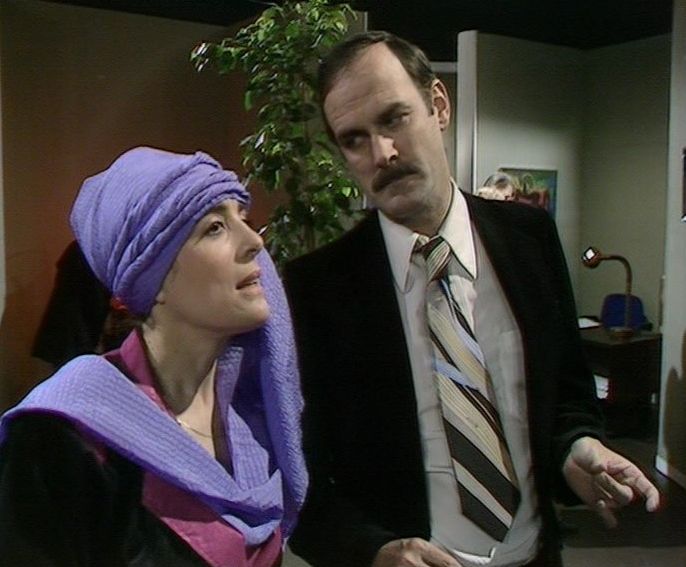
John Cleese and Eleanor Bron pop up briefly and are excellent. But everybody knows that.

There’s a chance to luxuriate with Ian Scoones’ modelwork again as the story reaches its conclusion. Unlike the cut-price effects on, say, Nightmare of Eden, there’s no scrimping here – film, instead of videotape, was used and the difference is quality is startlingly obvious.

For once, Duggan’s propensity for hitting everything that moves turns out to be a good thing. It’s another gag moment, but it works – although the following brief scene (as Scarlioni returns to 1979) has always seemed to be something of a bodge.  Possibly the clock was ticking ever closer to ten o’clock, which meant that something had to be cobbled together.  What we have – a brief shot of Scaroth and Hermann, an even briefer explosion and then an abrupt jump cut to the Doctor and Romana saying farewell to Duggan – is a little disorientating.

DUGGAN: Where do you two come from?
DOCTOR: From? Well, I suppose the best way to find out where you’ve come from is to find out where you’re going and then work backwards.
DUGGAN: Where are you going?
DOCTOR: I don’t know.

They don’t make them like this anymore. Indeed, they didn’t really make them like this back then, which is all the more reason why City of Death should be savoured.  Because it’s like a fine wine, with an attractive bouquet, etc, etc …

city 04-02

Doctor Who – City of Death. Episode Three

city 03-01

The Doctor jaunts back to 1505 in order to ask Leonardo Da Vinci why he painted so many copies of the Mona Lisa and runs into another mystery. A man – Captain Tancredi – who not only looks exactly like Scarlioni, but also has all of his memories ….

Peter Halliday is good fun as the harassed guard captain. Barely recognisable as the sadistic Packer from a decade earlier (maybe it was the hat) this is a character who’s no match for the wily Doctor.  Even if Tom delivers one of the least convincing punches ever seen to knock him out.  He should have taken lessons from Tom Chadbon.

Luckily for us, Tancredi is a very garrulous sort of chap who’s happy to stop and explain the plot (“the knowledge will be of little use to you, since you will shortly die”). This is something of a cop-out, but also a dramatic convention – how often does the villain not kill the hero, but instead chats to him about his wicked plans?  Possibly Douglas Adams intended this to be an obviously groanworthy moment or it might just have been that the clock was ticking and he had to make an info-dump and quick.

Back in 1979, Romana and Duggan are too late to stop the Mona Lisa from being stolen. I haven’t mentioned how wonderful Lalla Ward’s Romana is yet, which is a terrible oversight.  She’s wonderful.  Whilst the debate about a female Doctor continues to rumble on, it’s plain that we pretty much had one right here – Romana as the Doctor with Duggan as her dim companion?  Yep, I’d go for that.

The dialogue continues to sparkle as Romana propounds a theory.  “Perhaps Scarlioni has discovered a way to travel in time. Yes, perhaps he went back in time, had a chat to Leonardo, got him to rustle up another six, came forward in time, stole the one in the Louvre, and now sells all seven at enormous profit. Sound reasonable?”  To which poor Duggan can only respond that when he used to do divorce cases they were never like this!

Isolating the Doctor from pretty much all of the 1979 action during this episode obviously allowed Romana to take his place. She’s a more than adequate substitute, as seen when she dices with Scarlioni, but there’s still a hint of her inexperience (touched upon during the Key to Time season, where it was stated on more than one occasion that her knowledge lacked the Doctor’s practical edge).  It’s hard to imagine the Doctor agreeing to build Scarlioni a time-field interface so readily, but since it needed to be done to advance the plot and also because Duggan was threatened it doesn’t make her seem too dim or easily duped.

One of my favourite moments of the entire story occurs right at the end of the episode. After Kerensky ages and dies before the horrified gaze of Romana and Duggan, the Count flashes them an amused stare.  There’s something about Julian Glover’s coolness which appeals immensely.

city 03-02

Doctor Who – City of Death. Episode Two

city 02-01

The opening of this episode features some classic Tom Baker clowning (“what a wonderful butler, he’s so violent”) but back in 1979 many fans weren’t impressed. Browsing through the various fanzines which circulated during that era, it’s fascinating to take the pulse of Doctor Who fandom – for some it was pretty much a case of Tom Baker Must Go!  The levels of humour during the Graham Williams era continues to be an issue which divides opinion – although this period of the programme has picked up in popularity somewhat in recent decades (this first occurred during the early nineties when JNT was firmly out of favour).  That’s the nature of fandom, if someone’s out of fashion, like JNT, then that allows someone else (Williams) to be back in.  Personally, I don’t have an issue with enjoying both Williams and JNT, but that’s a whole other debate ….

Let’s take a look at some of this Tom-foolery –

Doctor: Hello, I’m called the Doctor. That’s Romana, that’s Duggan. You must be the Countess Scarlioni and this is clearly a delightful Louis Quinze chair. May I sit in it? I say, haven’t they worn well? Thank you, Hermann, that’ll be all.
COUNTESS: Doctor, you’re being very pleasant with me.
DOCTOR: Well, I’m a very pleasant fellow.
COUNTESS: But I didn’t invite you here for social reasons.
DOCTOR: Yes, I could see that the moment you didn’t invite me to have a drink. Well, I will have a drink now you come to mention it. Yes, do come in, everybody.
DOCTOR: Romana, sit down over there. Duggan. Now, Duggan, you sit there. Do sit down if you want to, Count… Oh, all right. Now, isn’t this nice?
COUNTESS: The only reason you were brought here was to explain exactly why you stole my bracelet.
DOCTOR: Ah, well, it’s my job, you see. I’m a thief. And this is Romana, she’s my accomplice. And this is Duggan. He’s the detective who’s been kind enough to catch me. That’s his job. You see, our two lines of work dovetail beautifully.

The Doctor continues clowning as he, Romana and Duggan are escorted downstairs and locked into a small cell. It’s only then that his expression and manner changes and he becomes completely serious.  This, for me, is key – I don’t have an issue with the Doctor mucking about if it’s made obvious (as here) that it’s just an act, designed to make his opponents underestimate him.  So once Scarlioni’s gone, the Doctor reverts back to being business-like and focused.

I can’t see a great deal of difference between this style of performance and the clowning of Troughton’s Doctor (who could equally turn serious when it was required). In every Williams-era story that I can think of, the Doctor “earns” his right to clown, by demonstrating at various points that there’s much more to him than meets the eye.

The Doctor’s interaction with Kerensky is also interesting. Keresnsky tells him that although Scarlioni is a true philanthropist he doesn’t ask too many questions, to which the Doctor tells him that “a scientist’s job is to ask questions.”  This harks back to similar exchanges in the past, such as with Sorenson in Planet of Evil, where the Doctor makes it quite plain that a scientist has definite obligations – not just to himself, but to the wider community.

city 02-02

Doctor Who – City of Death. Episode One

city 01-01.jpg

Given the fact that the script was written at great speed (or re-written, depending on how many of David Fisher’s original concepts actually made the final cut) City of Death sparkles throughout. It would be easy enough to quote huge chunks of the script, but I’ll restrain myself to the odd choice selection, such as –

DOCTOR: What Paris has, it has an ethos, a life. It has …
ROMANA: A bouquet?
DOCTOR: A spirit all of its own. Like a wine, It has …
ROMANA: A bouquet.
DOCTOR: It has a bouquet. Yes. Like a good wine. You have to choose one of the vintage years, of course.
ROMANA: What year is this?
DOCTOR: Ah well, yes. It’s 1979 actually. More of a table wine, shall we say. Ha!

For the first time, the series had actually travelled abroad – which gave the production a considerable extra gloss. It was obviously something of a guerrilla operation though, as seen by the way that some members of the public appear to be a little dazed and confused as they pass through the various scenes (presumably Michael Hayes and the others just pitched up and started filming).  This episode, as well as part four, certainly makes the most of the locations and – allied with Dudley’s music (the change of scenery seemed to have done him the world of good as well) – there’s a pleasing travelogue feel to these sections.

Yes, there’s nothing much going on during the first few minutes, but we’re in Paris! In the Springtime! The same trick would be repeated later, for example when Peter Davison’s Doctor spent the last episode of Arc of Infinity running around Amsterdam in a similar way to Tom’s Paris sprinting here.  But it was very much a case of diminishing returns.  Once you’ve seen the Doctor rushing through the streets of one town, you’ve rather exhausted that avenue ….

If one were being picky, I’ve never understood why the artist who sketches Romana was sitting directly behind her. Since that meant he couldn’t see her face, it seems a little odd.  It’s mentioned in the script (“I wonder what he thought I looked like?”) but it’s still a slightly strange piece of staging.  And his sketch (“a crack in time”) makes for a nice visual moment but goes unexplained otherwise.

City of Death has two prime guest performances – Julian Glover as Scarlioni and Tom Chadbon as Duggan. Catherine Schell is also more than solid as the Countess, although her character does lie in the shadow of her husband throughout.  David Graham’s Kerensky is amusing, although his comedy accent means that it’s impossible to take the character that seriously.

Glover just oozes class, charm and hard-edged villainy and without him the story would be much poorer. It’s possible to argue that he gives more of a James Bond style villain performance here than he did when he appeared in For Your Eyes Only.

city 01-02

Doctor Who – Destiny of the Daleks

destiny 01.jpg

There may be a few production missteps (tatty looking Daleks, David Gooderson squeezed into Michael Wisher’s old mask) and scenes which should have gone to a second take (“spack off!”)  but the positives far outweigh the negatives.

Tom’s on fine form, switching from playful to serious in a heartbeat (for example, the moment when the Doctor learns he’s on Skaro).  The Doctor might have plenty of gags, courtesy of Douglas Adams, but there’s also a pleasing somberness about him, especially in episode one as he and Romana explore the mysterious planet (the lack of incidental music increases this sense of unease).

Ken Grieve’s low-angled shooting favours the Daleks but it’s also used to good effect elsewhere.  And these low angles make it clear that several sets, including the TARDIS, have ceilings – which is very unusual, especially during a period when the series was rather cash-strapped (you’d have assumed it was an extravagance the show could ill afford).

Lalla Ward is Romana.  Within a few minutes any thoughts of Mary Tamm have been banished and although Romana II might be somewhat hysterical at times (especially when confronted by the Daleks) possibly we can put this down to post-regenerative trauma.

But her fear and panic during the Dalek interrogation scene does help to sell the notion that the Daleks are powerful and dangerous opponents, something which is rather negated as the story progresses.  The nadir of this comes with the unforgettable sight of the sad suicide Daleks shuffling awkwardly across the Skaro plains.

Terry Nation ends as he began, with a trip to Skaro.  Familiar Nation tropes are given a final outing – such as an obsession with radiation and the sight of the TARDIS made inaccessible.  Although it’s a little bizarre that the radiation subplot goes nowhere (the Doctor warns Romana that they have to take radiation pills regularly, she’s then separated from the Doctor and the pills, but no matter since they’re never mentioned again). Also, it’s a little irritating that Nation seems to regard the Daleks as purely robotic, a far cry from David Whitaker’s devious schemers.

Holding back Davros until the end of episode two was a good move, since it gave the second half of the story fresh impetus.  Although it does mean we have to consider the Davros problem.

It seems that poor David Gooderson has never been regarded with a great deal of affection by the majority of Doctor Who fandom, although in his defence he was dealt a pretty rough hand.  His Davros doesn’t have any of the signature moments that Wisher enjoyed and this – together with the reused mask – ensured he was always going to come off second best.  But he’s by no means bad and is certainly closer to the original than Terry Molloy’s frustrated Ena Sharples from Resurrection was.

It may be comfortable and rather predictable, as only a Terry Nation story could be, but there’s plenty to love across these four episodes.  So long Terry and thanks for all the scripts.

destiny 02

Go Girl – Give Me A Ring Sometime

go girl

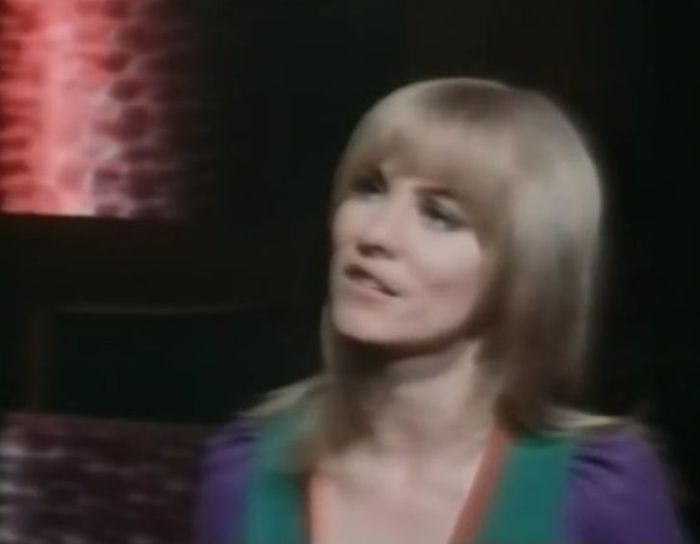
Go Girl was a thirteen part series from the early seventies about a crime-fighting Go-Go dancer (no really).  The show was beset by financial problems and never made it to air. Most of it was then wiped, with only the pilot episode now known to exist (this did eventually surface on VHS a decade after it was made and is currently available as a bonus feature on the UK DVD of Take An Easy Ride).

Luan Peters is the eponymous go girl, Carol.  Probably best known for playing an attractive New Zealand guest in Fawlty Towers, it’s obvious to see why Peters was cast – she’s perfect eye candy, capable of go-go dancing at the drop of a hat (and able to look remarkably cute in a bikini too).

It’s hard to work out whether Go Girl is a comedy, drama or something inbetween.  Events kick off aboard a boat, where a group of well-heeled guests are eagerly tucking into a generous selection of food and drink.  The direction favours extreme close-ups of the partygoers, which creates something of a claustrophobic feel.  Meanwhile, elsewhere on board somebody’s rummaging through a safe ….

Following the title sequence (“when she moves, she is out of this world, she has got to be a go girl”) we cross to a swinging discotheque, where Carol and her friends are go-going like mad to Slade’s Coz I Luv You.  After they take a break, a man called Juan (Walter Randall) trips her up and then plies her with champagne.

Long story short, he’s the man who’s stolen a pile of loot from the boat.  Carol may be blonde, but she’s not completely dumb and doesn’t buy his smooth chat up lines (“you must think I’ve just fallen off a Christmas tree”).  And the smile’s wiped off his face even further when he notices a man at the bar with a tattoo on his hand.

Juan disappears but he leaves behind an envelope.  Carol and her boyfriend Adam (Simon Brent) open it to find …. a treasure map!  They charter a boat to travel out to where x marks the spot, but by an incredible coincidence the boat is under the control of Rick (George Margo), who turns out to be the man with the tattoo (presumably Juan’s partner).  Oh, and Juan’s on board, he’s just very, very dead.

It’s a ridiculous plot twist, which suggests this is more comedy than drama.  The climatic fight on the very studio-bound island between Rick and Adam makes this even clearer.

Give Me A Ring Sometime is thirty minutes of gormless fun.  It was never going to win any awards, but there’s plenty of incidental pleasures.  Luan Peters is impossibly cute, medallion man Simon Brent (also the co-producer) is an effective sidekick whilst Randall and Margo both chew the attractive looking scenery with aplomb.  The way the live-action gives way several times to brief animated sequences is also an interesting touch.

Shot in Spain, it comes across as an exploitation-style take on a typical ITC adventure series and whilst it’s no lost classic, it’s diverting enough.

The Three Ronnies

ronnie.jpg

One of the many joys of revisiting The Two Ronnies is the chance to hear Ronnie Hazlehurst’s iconic opening and closing music. It was just one of his many credits, as he also penned the themes for Are You Being Served?, Some Mothers Do ‘Ave ‘Em, Last of the Summer Wine, The Fall and Rise of Reginald Perrin, To the Manor Born, Yes Minister and Yes, Prime Minister amongst others.  Not a bad CV to have ….

The below recording comes from his album, Sixteen Small Screen Greats, and is a fairly close approximation of the original (albeit with a Piggy Malone/Charley Farley sidestep in the middle).

Few themes, especially the closing section, are quite so evocative.  It instantly conjures up a sense of warmth and security as the memories of decades gone by come flooding back.  Thank you Ronnie H.