The first step in Leo’s quest to become a tycoon starts here. He can’t help but crow a little to his mother and grandmother about the fact he’s now a man of business – albeit bankrolled by a shady lady. Series three was obviously the point when it was decided to turn Leo Howard into the series’ hunk, as these days he seems to spend some time each episode with his shirt off. Although it’s nice to see that equality between the sexes is maintained – last time we were invited to ogle at Sarah’s backside, this week it’s Leo’s rear which is prominently displayed (and also receives a slap from Amanda for good measure).
Meanwhile, Sarah’s frantic. Mark’s disappeared and she’s fretting that he’s gone straight to a solicitor to initiate divorce proceedings. You won’t be surprised to learn that Ken’s taking things much more calmly, although his male ego is clearly bruised after Sarah tells him that her husband means more to her than he does. But he doesn’t want to lose Mark either – good business partners are hard to find. Jan continues to be a hard-headed businesswoman as we see her effortlessly managing to negotiate the best price for the latest part of her ever expanding business empire.
Anna needs a heart to heart with someone and in Jan’s absence naturally gravitates towards Kate. Where’s Jan? Back noshing at the big house with Sir Edward and crowing about what a top businesswoman she is. Mmm, given that Tom’s looking slightly more hopeful these days (convinced that he can prove the catamaran design is sound) there must be an equal and opposite downturn on the cards for Jan soon.
Just as Bill has taken over some of Avril’s function in the yard (as a sounding board and a buffer between Tom and Jack) so Avril herself has rather displaced Gerald as Charles’ closest confidant (and their personal lives are becoming ever closer too). Their latest wheeze is selling business units to the “right people” and Jan is an interested party, although when she learns that she’d have to deal with Avril it’s not surprising she’s rather less keen. They do meet though – a delightfully awkward experience for both of them, although Jan once again manages to put her business ahead of any personal feelings.
Charles is a hard-headed rational businessman, except where his father’s concerned. At that point he loses all reason – if he feels threatened by him then he’s going to go all out to attack, no matter what the financial consequences might be. This reckless attitude appals Gerald, who angrily wonders why Charles bothers to pay him if he won’t listen to his advice. The cracks in their relationship are beginning to show and it concerns Charles enough to seek out Polly. Is Charles operating under the guise of friendship or is it purely business? Business of course.
Polly discovers the identity of Gerald’s terminally ill friend – James Gittings – and he explains that he’s paying his passage to America as there’s a chance that new medical research there might help him. It’s not spelt out yet exactly what’s wrong with him, but it’s not difficult to guess.
Tom meets Emma Neesome (Sian Webber). She’s an engineer who may be able to help him in his quest to vindicate his design for the catamaran. Tom’s offer to buy her the most expensive dinner she’s ever had doesn’t seem to impress her that much (but we shouldn’t judge by first impressions).
Amanda and Leo continue to enjoy each other’s company – frolicking in the sea following a powerbike ride for example. But then her father, Allan Parker (Leon Tanner), pops up and drops the bombshell that Amanda’s already engaged, which manages to wipe the smile off Leo’s face.
Tom and Jan celebrate their divorce with a glass of champagne. They seem much more at ease with each other now that their marriage is over (which has lead many to surmise that had Maurice Colbourne not died and HW had gone to a seventh series, Tom and Jan would have got back together.
Mark – briefly – returns and although he doesn’t get the chance to duff up Ken he does exit very much in a blaze of glory.
Leo’s continuing to keep an eye on his father. A spot of father/son sailing takes Tom’s mind off his troubles – but only temporarily, as always in the background is the shadow of the broken catamaran. As I’ve touched upon before, good weather in Tarrant is usually a rarity and this sailing day is no different – so quite why Leo’s wearing sunglasses when they get back to the dock is anybody’s business.
One of my favourite Ken moments occurs about five minutes in when he stares at Sarah’s shapely bottom as she’s bending over doing a spot of filing (typical Ken!). But Sarah’s backside fades into the distance, as it were, after Mark grizzles that Ken’s entered the big powerboat race (£10,000 to the winner) without informing him. So Mark vows to enter as well, setting up a juicy head to head between them (not only the race of course, but the question of Sarah too).
One of the more unusual developing relationships (even harder to swallow than Leo and Amanda) is that of Jan and Sir Edward. After Jan makes her presentation to Sir Edward and the board, he suggests they discuss her work further over dinner. Uh oh ….
It’s interesting that Jan won’t tell Leo who she’s going to be having dinner with. Leo’s more forthcoming, telling Kate that he’s heading out for a date with Amanda. It’s a small world, as Kate is able to tell him that Amanda’s grandfather used to be a beau of hers.
It’s not only a small world but Tarrant is obviously also a small place since Jan and Sir Edward choose the same restaurant as Ken and Sarah. Sarah’s impressed with Jan’s dinner-date (“not bad, if you’re attracted to the mature type”) but Ken’s convinced that Jan’s interest is purely financial. The way Ken laughs off Sarah’s suggestion that he’s jealous of Jan’s new companion is nicely done.
Leo might have been a bit quiet on the causes front recently, but the inequality of life clearly still rankles with him. And Amanda, one of the idle rich, becomes his latest target as he asks her whether she ever feels guilty about her aimless existence. “Driving around in a fancy car, owning a boat you never use, doing nothing with your life”.
Leo’s clearly not one for diverting smalltalk then, admitting to Amanda that he’s never really had a girlfriend. He briefly chats about Abby – mainly touching upon the fact that she’s everything that Amanda isn’t. Then Amanda decides that she’d like to invest her money in Leo – they’d become partners (not only in business, but personally). This has all the hallmarks of ending very badly ….
The Dixon of Dock Green connections continue. Last week it was Gregory de Polnay, this time it’s Nicholas Donnelly (here playing Peter Melrose, the solicitor placed in opposition to Jack and Tom). The general opinion is that there was a design fault with the catamaran – something which Tom doesn’t take at all well (although his spasm of anger is brief).
While Tom continues to suffer, Jan’s upward mobility continues. After mentioning to Sir Edward that she’s always admired his country house, he spies an opening and invites her for lunch and a guided tour. Although he claims not to be lonely, the reality seems somewhat different as he rattles around his country pile. Like Charles, his business is his life, but is Sir Edward looking for something more?
I think that Jack thinks more logically when he’s drunk. Although he’s weaving dangerously from side to side at the Jolly Sailor, he still manages to come up with a good idea – if they can put the pieces of the catamaran back together then they’ll be able to prove that the break-up wasn’t a design fault. Glyn Owen was always a top drunk actor (let’s be honest, as Jack he had plenty of practice). Compared to him then, Maurice Colbourne’s pretty much a novice (he’s not a bad drunk actor, simply not in Owen’s class). Jack’s attempt to lead the reluctant drinkers at the Jolly Sailor in a chorus of For He’s A Jolly Good Fellow is something of a treat.
It’s all smiles between Charles and Avril as they stand on the quayside as the big powerboat race is about to begin (Charles will be handing over the prize at the end, hopefully to Relton’s own boat). Simon May cranks up the incidentals – wailing saxophones ahoy – as the boats set off. But the smiles are soon wiped off their faces as Ken comes in first and Mark second. Ken – a vision in yellow – can’t help but crow ever so slightly as he accepts his winnings from Charles.
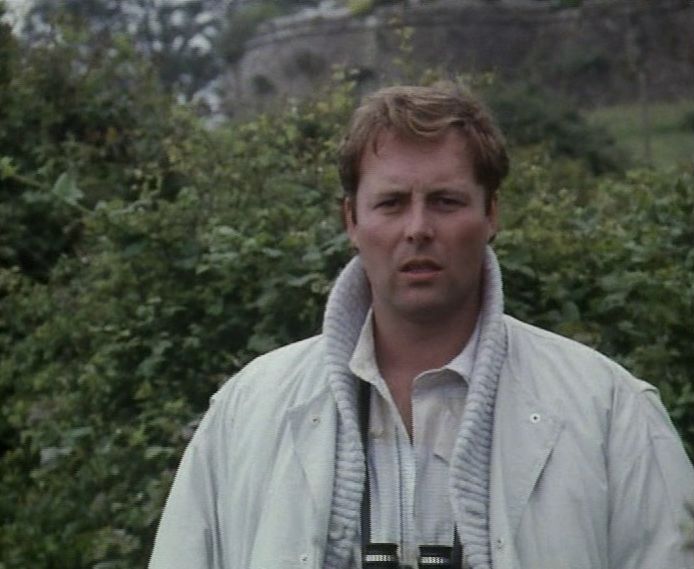
There’s a sense that the rather misfiring love triangle between Ken, Sarah and Mark is finally coming to a head. Mark’s apparently set off on a business trip – but that’s just a ruse. As Sarah and Ken canoodle aboard a boat, he’s standing on the shore, binoculars in hand, wearing a resigned expression (“oh dear” says Ken when they spot him). But given how far the boat is away from Mark, they must have extremely good eyesight ….
Since the Tarrant weather once again isn’t very appealing, you have to give top marks to Sarah Varley for wearing a bikini without shivering. As for the cuckolded Mark, he’s failing to exhibit much in the way of hurt or anger – mild inconvenience yes, anger no. Will he finally decide to give Ken a well-deserved duffing up next time? Fingers crossed ….
A recent post by Simply Media has inspired me to select my favourite Agatha Christie adaptations (due to the parameters of this blog I’ll concentrate on television only).
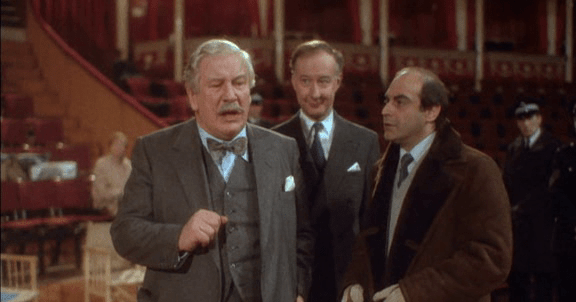
06. Peter Ustinov in Thirteen at Dinner (1985). I’ve a lot of time for the 1980’s American Christie television movies. They may take liberties with the source material (this one, for example, is updated to the present day – giving us the odd sight of Poirot guesting on David Frost’s chat show) but you can’t help but love Ustinov’s idiosyncratic and entertaining Poirot.
It boasts a wonderful guest cast – David Suchet as Japp!, Faye Dunaway in a duel role with Bill Nighy, Diane Keen, John Barron and Jonathan Cecil as the ever-loyal Hastings offering solid support. Certainly well worth a look.
05. Francesca Annis and James Warwick in Why Didn’t They Ask Evans? (1980). Prior to the 1980’s, Agatha Christie adaptations on television were a rarity. This was due to Christie and later on her estate not wishing to see her stories distorted (although given some of the, ahem, more interesting adaptations during recent years I guess the copyright holders now hold a more relaxed view). Therefore the early 1980’s ITV adaptations were something of a trial run – with Poirot and Miss Marple off-limits, ITV had to scrabble around amongst the more obscure corners of Christie’s catalogue in order to prove that they could do her works justice.
Why Didn’t They Ask Evans? isn’t classic Christie, but it’s a more than decent mystery. Annis and Warwick, as Lady Frankie Derwent and Bobby Jones, team up nicely (a few years later they’d return to the world of Christie as Tommy and Tuppence Beresford). Evans has another cast to die for – a pre-Marple Joan Hickson, James Cossins, Madeline Smith, Eric Porter and an amusing cameo from John Gielgud. It’s maybe slightly too long, but it’s still very agreeable.
04. And Then There Were None (2013). I may loathe Sarah Phelps’ adaptation of The Witness for the Prosecution with a passion, but there’s no denying that And Then There Were None is a quality production. The main problem I have with Witness is that it’s mostly Phelps with very little Christie showing. And Then There Were None is more recognisably Christie, albeit with a few tweaks. An all-starish cast helps to bring to life one of her darker works.
03. The Moving Finger (1985). Whilst the debate about the best Sherlock Holmes isn’t clear cut, surely there can’t be much of a question about who was the best Miss Marple? In every respect Joan Hickson wipes the floor with her ITV counterparts (as well as Margaret Rutherford – a fine actress, but no Miss Marple). If Hickson is first-rate, then so too are the twelve BBC adaptations she starred in. All-film productions, with high production values, they just ooze class and style.
With Roy Boulting on directing duties and some fine performances (always a pleasure to see John Arnatt and Richard Pearson, amongst others) The Moving Finger is one of the best of the early Hickson Marples. It may not be the most taxing mystery Christie ever wrote, but it has more nuanced characters that we sometimes saw – for example, the relationship between Gerry and Megan is an atypical touch.
02. David Suchet in The Third Floor Flat (1989). The Suchet Poirots were clearly following in the footsteps of the Hickson Marples with a similar glossy all-film style. That Suchet managed to film the entire canon is laudable, although it’s a little sad that some of the later adaptations began to veer severely away from the originals. Possibly this is why I’m most fond of the earlier runs which began by concentrating on Christie’s short stories. It’s true that some of them are a bit thin (Christie’s early short stories can be fairly perfunctory in some respects) but the television versions are nicely bulked out thanks to the sympathetic adaptations.
01. Joan Hickson in The Body in the Library (1984). Back to Hickson for her debut as Miss Marple, broadcast on BBC1 during Christmas 1984. Sarah Phelps has recently restarted the tradition of a “Christie for Christmas” – hopefully her next one won’t be quite so depressing though.
Allo,Allo! fans will be able to spot a pre-Crabtree Arthur Bostrom, Jess Conrad is perfect as the pearly-white Raymond Starr, Andrew Cruickshank is an intimidating Conway Jefferson whilst David Horovitch and Ian Brimble begin their careers as Slack and Lake – two police officers destined to always be at least two steps behind the elderly spinster who may look harmless but possesses a mind like a steel trap.
It’s interesting to see how Bill’s moved more into the office this year (effectively replacing Avril as a – less attractive – buffer between Tom and Jack). Tom’s not a happy man – the production of Barracuda has been temporarily suspended and he’s convinced that Charles is pursuing a vendetta against him. Jack’s delightfully laid back about it all, as usual he’s quite happy that something will turn up to save them.
Tom and Avril have another confrontation. I have to confess that Avril’s puffy sleeves captured my attention for a few seconds, but once Maurice Colbourne started ramping up the drama I snapped back into following the plot. Tom’s paranoia continues to bubble away. Given the breakup of the catamaran it’s possibly no surprise that the Barracuda also has to be considered suspectl but he clearly doesn’t see it like that. Instead it’s obvious to him that Charles is interested in breaking him due to his relationship with Avril.
The thrusting wheeler-dealer that is Ken Masters has negotiated a deal with Robert McIntyre (Fraser Kerr). Mark isn’t happy though, he’s convinced that McIntyre’s boats aren’t the sort of thing they should be selling (suddenly Mark’s turned into a mini-Jack, concerned about quality and craftsmanship). Or does he suspect that his wife is embroiled with Ken? Hmm.
Jan effortless rise to the top continues apace. Anna’s father, Mr Lee (Burt Kwouk), seemed to be a potential problem – but he quickly agrees that his daughter can go and work for Jan. This seems all too easy – surely there must be a few roadblocks ahead? Compared to Tom, who seems to be on an equally effortless rise to the bottom, Jan is leading a charmed life at present. And then she spies an advert from Sir Edward Frere – offering venture capital for new businesses (her eyes light up at this).
There’s another brief insight into Gerald’s private life when he takes a call from a Dr Reynolds. Even before we hear what the call is, the soundtrack helpfully (or too obviously, depending on your point of view) makes it plain that it’s bad news. Polly hears the call (bad news about someone) but once again Gerald can’t – or won’t – share his worries.
But the tightly-wound Gerald can clearly not be wound any further. When he discovers that Polly’s been on yet another spending spree, he reacts by smashing her latest purchase. But this is only a pretext – it’s not her that he’s railing against, instead it’s his own internalised pain. To give her credit, Polly is concerned and wants to help, but at present Gerald still can’t let her in.
Gregory de Polnay, probably best known as DS Mike Brewer in Dixon of Dock Green or possibly D84 (“I heard a cry”) in the Doctor Who story The Robots of Death, pops up as the slightly shady businessman Werner Grunwald. His accent – I believe it’s supposed to be Swiss – is something to behold.
Do you remember the time when Avril wouldn’t even let Charles through her front door without a shudder? Maybe it’s the passage of time, but now she’s moved into a swanky new flat things seems to have changed. She accepts a housewarming present from him – an expensive picture – with an expression of delight (last year she probably would have smashed it over his head!) But the increasing closeness of Charles and Avril does serve an important plot purpose – it allows Charles to articulate the feelings he has (mainly bad) about his father.
The ever-optimistic Leo decides to set up in business by himself as a general boat handyman. And his first customer? Amanda, of course. Amanda is still madly keen on Leo, whilst he’d sooner just repaint her boat (he’s a strange lad). She tells him it’s such a lovely day they should be enjoying themselves (that’s stretching it somewhat – it’s typically overcast in Tarrant). So they go dry skiing – Amanda’s good, Leo’s not so good. But he seems to be smiling a little more – which suggests he’s slowly coming round to her charms, although he initially refuses her later invitation to kiss him (he doesn’t refuse for long though).
Dulcie Gray’s husband, Michael Denison, makes his first appearance as Admiral Francis Redfern. It’s only a brief appearance here, but he adds a touch of class to proceedings.
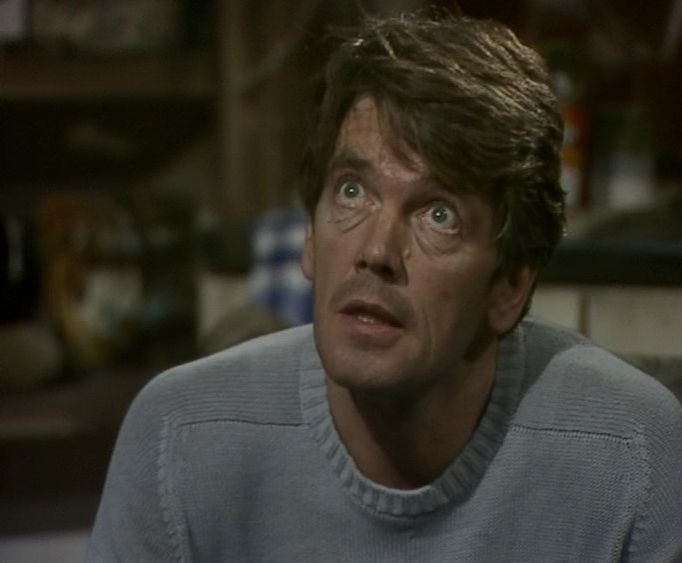
Tom’s moved out of The Jolly Sailor and is currently living in the paint store at the Mermaid Yard. This – along with his wild-eyed, unshaven appearance – is a good indication just how far he’s fallen. Jack knew about his problems but didn’t offer to give him a bed at his house. So it falls to Leo, so often the conscience of the family, to step in. He’s concerned about his father and wants to help – which leads into a nice moment of father/son bonding.
Jack’s wearing a suit, so he and Tom must be on their way to the inquest. For those who need this to be spelled out, walking in front of them is a barrister in a white wig. The drama of this storyline isn’t milked very much as we don’t see inside the courtroom – instead Tom and Jack simply trudge wearily back to the yard later, with Tom breaking the bad news that an open verdict, pending a surveyor’s enquiry, was delivered. So the waiting goes on …
Before this we see Bill fielding calls from interested parties, concerned about whether the inquest will impact the yard. Possibly this is another example of cost-cutting – much cheaper to have Bill on the phone, pretending to be speaking to someone, than it would be to hire a couple of extras, as reporters, to mill around the yard asking questions.
Charles isn’t able to visit Relton for another round of icily polite fighting with Avril, so Gerald is sent to deputise. He’s as affable and friendly as Charles is brusque and unforgiving. But whilst Gerald claims that he’s merely here as an observer and has no wish to interfere, it could very well be that he’s of the same mind as Charles – it’s just that his style is much more conciliatory.
Where’s Charles? Off for a painful meeting with his father. Based on what we know of this family so far, it’s entirely in keeping that Charles should tell Sir Edward’s butler that he has a meeting with his father at ten o clock. The notion that Charles could simply turn up for an unscheduled chat is clearly unthinkable.
It’s quickly established that they haven’t seen each other for some considerable time, although exactly how long isn’t clear. The constantly shifting power dynamic between the two of them is established right from the start and over the most trivial matters – Sir Edward was hopeful that they could have lunch but Charles demurs, he’s far too busy. But Sir Edward rallies and is at least able to offer his son some coffee.
There’s some lovely character building moments as we see Sir Edward attempting to reconnect with his son. He asks Charles if he remembers the time when, as a boy, he climbed a tree in the grounds of their palatial country house and refused to come down (he was reluctant to return to school). Charles replies that he does and also recalled that his father was away on business at the time, which leads Sir Edward to formally respond that “I was fully informed of the incident by your mother”.
Like father, like son – Charles has clearly fashioned himself in his father’s image (a driven, single-minded businessman) although he’d no doubt be appalled if anybody attempted to draw this comparison. Sir Edward wants them to join forces – Charles isn’t interested – but the look on Nigel Davenport’s face as Charles and Sir Edward part makes it clear that a whole heap of trouble is on the way for Frere Jnr ….
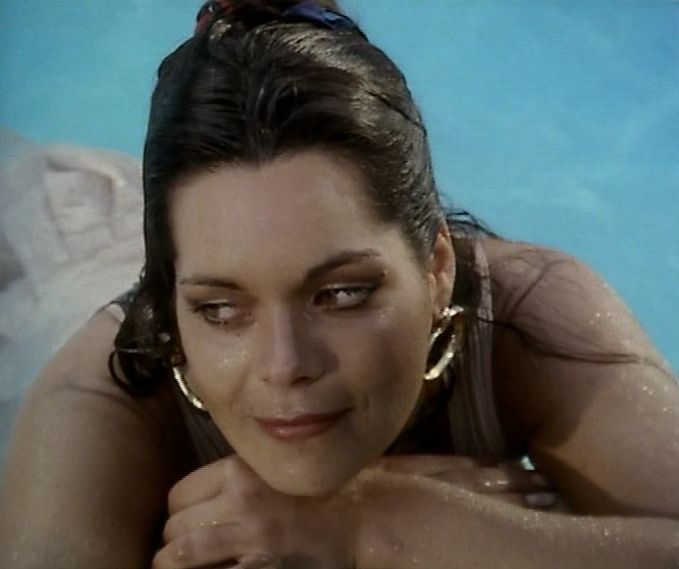
Amanda begins her pursuit of Leo and turns up at the yard. She has a pretext – her boat requires some work – but it’s the unfathomable and mysterious Leo which has clearly drawn her to the Mermaid like a moth to the flame. Most young men would be flattered by her approach, but Leo continues to glower at her. Maybe it’s the poolside dip he enjoyed or possibly it’s her playful nature, but at present there seems to be no connection between them. The fact she later unwittingly dupes Leo into sailing a boat which she doesn’t own (the arrival of the police confirming this) is another example that she’s a rollicking loose-cannon and just about everything that he isn’t.
Polly’s back at the boutique, snapping up clothes like they were going out of fashion (sorry). This ties back to the previous episode which saw a distraught Polly railing at the futility of her empty life to a concerned, but ineffectual Gerald. He suggests a charity job – but this didn’t go down well. It seems that, for all their fighting, she’s missing Abby (at least when her daughter was at home she had someone to talk to, even if the conversations were rarely civil).
Gerald does do his best to be supportive, but – as ever – finds Charles in his way. Gerald’s plan for a quiet dinner with Polly is shattered after Charles demands his presence elsewhere. Polly doesn’t take the news well. “I fully understand. Your business is clearly far more important to you than you wife”. Relations at Chez Urquhart look set to be distinctly chilly from now on, especially since Gerald has personal problems of his own – although he’s unwilling to discuss them. The sight of Gerald and Polly, sitting in their comfortable living room, drinks in hand, unable to connect to each other is a slightly chilling one.
You have to accept that a few plot contrivances will occur from time to time, but the way that another totally unknown, very talented, designer drops into Jan’s lap is a little hard to swallow. There are several things in Anna Lee’s (Sarah Lam) favour though – she doesn’t have a silly French accent nor does she posses a ponytail. Maybe somebody on Howards’ Way was a fan of The Adventure Game – Sarah Lam had been a regular during its final series whilst Charmian Gradwell, who would appear throughout HW’s sixth and final series, had been another Adventure Game regular.
There’s been a distinct lack of Jack so far this series, but there’s a nice scene in this episode. A downcast Jack, still smarting at the inquest verdict, is alone in his office, bottle of whisky at hand. Everything that we know of him suggests that he’ll shortly be drowning his sorrows but no – he heads out into the other office for a coffee instead. It’s an impressive act of self-control, but how long will it last? Answer, not very long.
It’s very marked that the closer Jan and Tom get to their divorce going through, the closer they seem to become on a personal level. They share another convivial meal whilst Tom’s later dinner initiation to Avril looks set to be a more sticky affair (she agrees, but doesn’t look delighted). Tom seems to conduct most of his conversations these days with a knife and fork in his hands although when Avril tells him that it’s over between them he doesn’t have a mouthful of food, which makes a change.
The tangled Ken/Sarah/Mark triangle hots up a little more. Mark finally seems to have twigged that Ken’s been making googly eyes at his wife whilst the unexpected arrival of Jan (keen that Ken should sell his minority shareholding in the boutique) makes Sarah just a little jealous.
Meanwhile Tom and Jack have a stand-up row in the yard about the state of the Mermaid’s finances. We’ve been here before of course, but this time it seems that there’s no other option than to lay off some of the men. And since that means last in, first out, Leo will be set for the chop.
When we left Tom and Jan at the end of the second series both were suffering business traumas – the collapse of the catamaran had damaged the credibility of both Tom and the Mermaid Yard whilst the death of pony-tailed clothes designer Claude Dupont seemed to have halted Jan’s attempts to conquer the fashion world.
Polly’s looking on the bright side though. Now that Claude’s dead, his designs are bound to go up in price, so she pops over to the boutique to snap a couple up before they all disappear. Kate, once again stuck behind the counter, views her with politely-bred disdain. Kate’s still very good at that sort of thing.
Tom’s rather down in the mouth about the catamaran and for new viewers who need to be brought up to speed there’s a handy moment when Jack picks up a newspaper report about it. But since the camera only lingers on the newspaper for three seconds you would have either have to have been a fast reader or gone back later and paused your VHS recording. Still, it’s a nice way to info-dump without having the characters laboriously spell out the ins and outs of the current situation.
The triangle of Sarah, Mark and Ken continues to simmer away, although Mark’s still totally oblivious that there is a triangle whilst Ken continues to eye the cool Sarah with longing. His interest is so obvious that it’s a wonder that Mark hasn’t twigged yet, so maybe he really is a man who only lives for his racing. Ken’s later pawing of Sarah (he kisses the top of her shoulder in a way that only Ken could) doesn’t quite bring him the result he was looking for though ….
Charles pays a flying visit to Relton Marine and isn’t particularly happy with what he finds. He tells Avril that things will have to change (their icily polite conversation is an early series delight). Charles continues to be in a snippy mood when he encounters Gerald later.
The big-money signing for this new series is, of course, Nigel Davenport as Sir Edward Frere. He tells Sir John that it’s good to be home, which suggests he’s been away for some time. But now he’s back there’s no doubt that sparks will fly between him and his son.
The other major new cast member debuting here is Francesca Gonshaw as Amanda Parker. Gonshaw, thanks to her role in Allo Allo!, was a familiar television face and – having left that series – was clearly looking for new opportunities. Series three of Howards’ Way would be her last regular television role though.
Before we see Amanda for the first time, we observe Leo gazing wistfully at a picture of Abby and attempting to write her a letter. The number of scrunched-up balls of paper suggests that he’s being attempting this for some time. I’ve commented before on Jan’s breath-taking indifference to her son and there’s another prime example here – she asks him what he’s doing, but isn’t really interested (she’s more concerned that he moves somewhere else, since the consultant from the bank is due to arrive soon).
But to give Jan some credit, she does attempt to gee him up a bit as she tells him that he shouldn’t spend his time reliving the past. Especially wonderful is her comment about Lynne. “She’s not sitting around moping about Claude, and he’s dead”. It takes real skill to deliver dialogue like that with a straight face.
So Leo, taking his mother’s advice, heads out for a pool party. You can tell it’s the 1980’s as Leo’s wearing a jacket with rolled-up sleeves. Nooooooooooooooooo!
Since he’s fully clothed he obviously doesn’t intend to take a dip (at least not intentionally) and instead gravitates towards a group of beautiful(ish) young(ish) people gyrating to the hit sounds of Stevie Wonder. And wouldn’t you know it, at exactly the point when Stevie sings “Isn’t she lovely?” the camera focuses on Amanda, who is – well – lovely.
There then follows a rather odd piece of direction. Amanda, sitting with a male chum who’s sporting a rather colourful shirt, decides that Leo’s looking very miserable and the pair go off to cheer him up. Maybe it was scripted that Leo was down in the dumps – staring wistfully into the distance, moping about Abby – but onscreen he’s talking animatedly to a couple of people. Mind you, the brief snatch of Leo’s dialogue suggests that he’s pontificating about the woes of the world, so I daresay Leo’s companions were only too delighted to be rescued from his polemical onslaught!
That Leo continues droning on whilst the delightful Amanda is replenishing the others with champagne in characteristic, as is the fact that when she pours him a drink he chucks it away. And then she pushes him into the pool. The beginning of a beautiful friendship? Well since he then chucks her in, possibly (this might very well be a Tarrant mating ritual). Amanda later confesses that she likes his style. Takes all sorts I guess.
Jack and Kate – both recovering addicts – compare notes. Jack’s doing his best to stay off the drink whilst Kate admits that she’s had another flutter and is therefore happy to treat Jack to lunch. Jack’s appalled – a woman paying for lunch? But he comes round eventually.
Jan needs a new designer and fast. She also needs £150,000 in order to open a chain of boutiques. With no designer currently on board it seems more than a little risky to expand at this point, but Jan’s faith in her own abilities is clearly boundless. There’s also the problem of Ken. Jan wants to buy his minority shareholding of the boutique, but will he be agreeable? Hmm, I wonder.
Avril and Tom have an awkward business lunch. Charles’ presence at Relton Marine continues to concern Tom, who’s convinced that the interests of the Mermaid won’t now be her top priority. And Tom’s jealous as hell too, of course (just as well he didn’t know that Charles dubbed him a “loser” in the business world then).
Although Charles and his father have yet to meet onscreen, there’s an early signifier of the battles to come – Charles finds himself outbid on a painting (a snip at a mere £225,000). And the telephone buyer? Of course it’s Sir Edward Frere ….
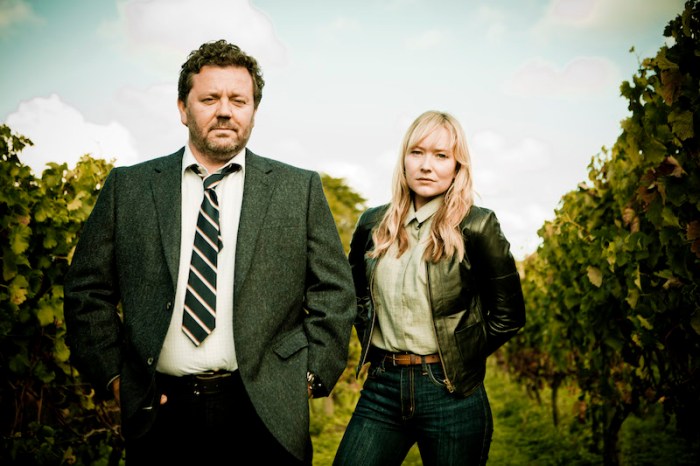
Welcome to the town of Brokenwood. A sleepy farming town in the middle of New Zealand where you’d assume that nothing ever happens. But their crime rate is extraordinarily high for such an idyllic spot as barely a week seems to go by without a mysterious death occurring.
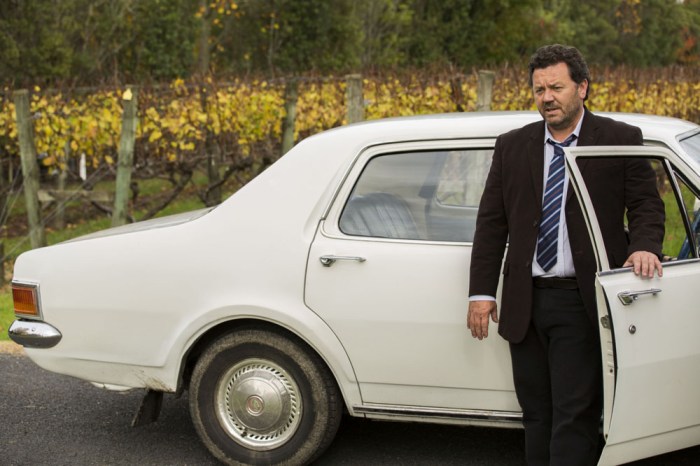
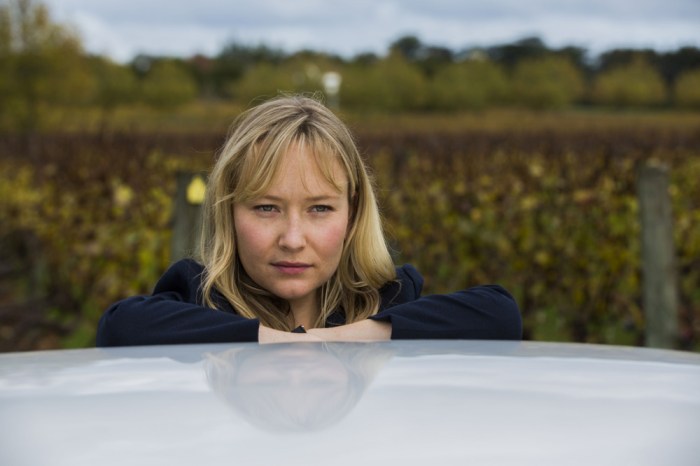
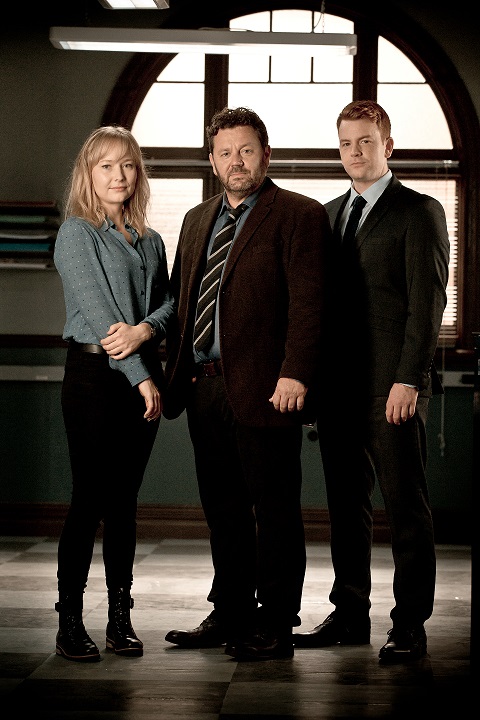
One such murder brings the experienced Detective Mike Shepherd (Neill Rea) up from the city. An unconventional maverick, he’s partnered with the much younger and much more by-the-book Detective Kristin Sims (Fern Sutherland) and, as might be expected, to begin with they don’t hit it off. But as inexplicable murder follows inexplicable murder, it’s also to be expected that they’ll start to form a bond as Mike adjusts to life in the country, where everybody seems to be connected to everybody else and deep, dark secrets abound ….
Brokenwood is a small place. The population seems to be around five thousand, although it’s constantly decreasing (depending on how many people get killed in any given episode). Brokenwood’s bucolic beauty is one of the series’ selling points – no wonder that some have dubbed the show “A New Zealand Midsomer Murders” – whilst the interplay between Mike and Kristin is another obvious plus-point.
It’s hardly an original concept for a series. A mismatched partnership – male/female – with very different takes on just about everything. But since the formula works it’s not surprising that it gets repeated again and again. The Brokenwood Mysteries might not bring anything particularly new to the table, but it does what it does very well.
Neill Rea
It’s always handy to start a new series with an outsider, since they can function as the audience identification figure and we can learn along with them. Mike Shepherd is pitched headlong into the town of Brokenwood in the opening episode – Blood and Water – which sees a local farmer – Nate Dunn (Chris Sherwood) – fished out of the river. Did he commit suicide or was it a case of murder? The parameters of the series are firmly set here – a leisurely running time (90 minutes plus per episode), lashings of country music (Mike’s a firm fan) and a story where long-hidden secrets hold the key to solving the mystery.
Neill Rea instantly appeals as Mike Shepherd. Mike is a friendly and slightly rumpled character, easily able to put just about everybody he meets at their ease (a useful skill for a detective). His private life is a bit of a mystery though. There are definitely ex-wives in his past, although exactly how many isn’t known. That he elects to stay in Brokenwood after solving the first case suggests that he had nothing or no-one special to return home to (he’s very much a self-contained person, happy with his own company).
He does have passions though – a 1971 car he’s very proud of (although nobody else agrees with him) and a large supply of country music cassettes. He prefers music on cassette and he loves country music because “they’re the best three-minute crime stories ever sung. There’s heartache, adultery, jealousy, divorce, death”. His quirks – he likes to crack inappropriate jokes when inspecting bodies (“too soon?”) as well as conversing with the corpses – ensures that he stands out from the rank and file.
His strengths are matched in equal and opposite ways by Kristin Sims (Fern Sutherland). Kristin is everything that Mike isn’t – young, meticulous and computer savvy. Initially she rubs Mike up the wrong way, but it isn’t long before they settle down and form a fairly harmonious working relationship, although Kristin can still sometimes be appalled at Mike’s reluctance to follow procedure. But as time goes by there’s a definite Ying/Yang feel to their relationship as both have positive character traits that the other lacks.
Fern Sutherland
Those familiar with the parameters of this type of series should be easily able to spot the upcoming murder victim during the opening minutes of the second episode, Sour Grapes. Brokenwood is an area with a thriving wine industry, so it’s no surprise to learn that the annual wine contest always sparks a great deal of interest. Amanda James’ (Josephine Davison) winery has walked away with the top prize for the last five years, therefore she is appalled when judge Paul Winterson (Alistair Browning) overlooks her this time.
The appearance of dead Winterson’s body is a jolting reveal – it comes bobbing to the surface from one of Amanda James’ vast wine vats – and his presence there means that Amanda is a prime suspect. But although The Brokenwood Mysteries has no qualms in embracing predictability at times, with ninety five minutes to fill it’s pretty obvious that the solution isn’t quite as cut and dried as it first appears.
The remaining two episodes of the first series – Playing the Lie and Hunting the Stag – maintain the high standard already established. Arresting reveals of the dead or dying is something of a Brokenwood trait and Playing the Lie certainly doesn’t disappoint on this score. The sight of Adele Stone (Roz Turnbull), owner of the Brokenwood Golf Club, lurching towards a group of golfers – her face red and distorted – is certainly something out of the ordinary. Death by poisoning? That’s what Mike and Kristen have to establish.
In Hunting the Stag, Hayden Renner (Francis Mountjoy) elects to combine his stag party with the hunt for a real animal, so he and his friends head out into the forest. But bride-to-be Renner never makes it back – he’s shot through the head. At first it appears to be a tragic hunting accident, but since none of his friends will admit to shooting him and all of them discharged their rifles, things turn out to be quite complex.
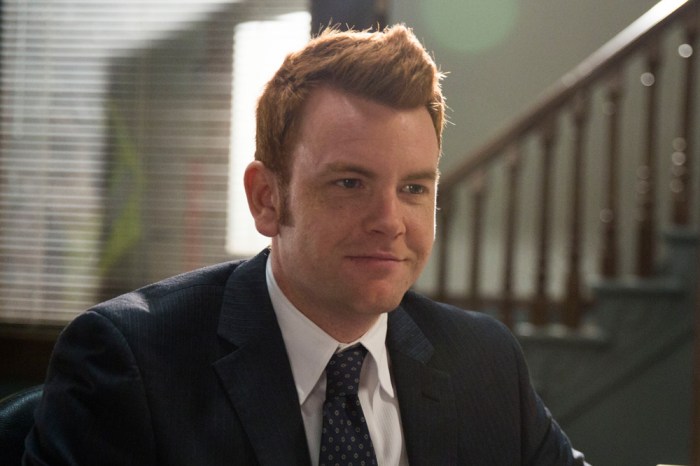
As series one progresses, we begin to learn a little more about the other regulars. Detective Constable Sam Breen (Nic Sampson) is always on hand to do a spot of research or provide some necessary exposition. Playing third banana on a police show isn’t a terribly rewarding job, but Sampson does the best with the material he’s provided with.
Nic Sampson
Pana Hema Taylor has a more interesting role as Jared Morehu. When Mike moves to Brokenwood, Jared becomes his neighbour as well as his drinking buddy and confidant. In his early twenties, Jared has the air of a wide-boy who enjoys skirting around the edges of the law. Possibly it’s a case of opposites attracting, but he and Mike quickly form a bond (there’s a surrogate father/son vibe about them) and Jared sometimes finds himself assisting – totally unofficially, of course – Mike in the odd investigation.
Gina Kadinsky (Christina Serban Ionda) is Brokenwood’s idiosyncratic medical examiner whilst Meredith Wilmott (Andi Crown) appears in several episodes. Meredith is the Head of Police Communications as well as being one of Mike’s ex-wives, so there’s inevitable mileage to be found in their personal and professional conflicts.
Strange murders keep occurring as the series enters its second series. In Leather and Lace, Arnie Langstone (Phil Vaughan), coach of the Brokenwood Cheetahs rugby team, is discovered dead, stripped naked and tied to a goalpost with a pair of women’s underwear stuffed down his throat. The Brokenwood Cheetahs are a record-breaking side – with an incredible losing streak of fifty straight games – so Arnie’s death doesn’t distress many at the club. But then a second body turns up …
One of the strengths of the series is the way that it hops from different groups and sections of society (winegrowers, rugby teams, etc). The next episode, To Die or Not To Die, maintains this run as Mike and Kristen investigate a mysterious death at the Brokenwood Theatre Society. The back-stabbing world of amateur dramatics is a fertile area for both drama and comedy, making this episode a highlight of series two.
Fern Sutherland, Neill Rea & Nic Sampson
Catch of the Day poses yet another baffling mystery. When Jared discovers a severed human hand in a crayfish pot, the team have to consider several questions – who does the hand belong to and are they still alive? This one may feel a little drawn out, but the interplay of the regulars ensures that it still ticks along quite nicely.
After that slight dip, series two ends on a strong note with Blood Pink. As we’ve seen, Mike is a big country music fan and is naturally delighted when his favourite singer, Holly Collins (Browwyn Turei), arrives in Brokenwood for a gig. No surprises that she doesn’t make it out alive – which immediately points the finger at her dysfunctional band members – Slim Fingers (Peter Dabue), Waylon Strings (Jordan Maguer) and Jesse James (Colleen Davis).
Like other long-form detective dramas – Midsomer Murders, Inspector Morse – the lengthy running time of The Brokenwood Mysteries can be both a blessing and a curse. Whilst it means that the mysteries are given time to unfold, there are also occasions when a less than engaging story can feel like something of a slog. But luckily there’s more hits than misses across these two series, so this isn’t too much of a problem.
Both releases include a number of short special features. Series one has two interviews – the first with Neill Rea and Fern Sutherland and the other with head writer Tim Balme whilst series two has a Behind the Scenes featurette. The brief running times of the interviews and featurettes (five minutes each for the interviews, three minutes for the Behind the Scenes feature) means that they obviously can’t go into any great depth, but they do help to place the series in context. Both series also include photo galleries, each running for around a minute.
The Brokenwood Mysteries is an engaging series which should definitely appeal to crime fans. Recommended.
Series one and two of The Brokenwood Mysteries are released by Acorn Media on the 14th of August 2017. Both series cost £19.99 each.
With the jungle on fire, Conway and the others struggle to reach the safety of the rocket ….
Brown’s fanaticism – he broadcasts back to Earth a message that everyone else is dead and the planet is hostile – is plainly on show here. His attempt to sabotage the rocket is a little half-hearted though (since Conway is able to quickly to reverse his damage).
There’s another example of Brown’s disregard for the others – Wilson is attacked by a Venusian in the forest and Brown elects to leave him there. But what’s worse is that Wilson was looking after Hamlet at the time. So poor Hamlet’s lost in the forest – clearly Brown is a monster of the first degree …..
Will Wilson and Hamlet make it back to the rocket before Conway has to blast off? Hmm, I wonder.
The dramatic music goes into overdrive as Conway believes they can’t leave the planet as the Russian rocket, carrying the fuel for the return trip home, appears to have crashed. So they seem doomed to spend the rest of their lives on Venus. If so, how will they live? Brown’s rather keen, but the others less so.
The sudden unexpected appearance of Colonel Korolyov (Robert James) therefore comes as quite a surprise as he tells them that there’s no reason why they can’t return to Earth. Given that the Cold War was still icy at this point, it’s possible to view the image of Korolyov and Wilson, working together in harmony, with a rather jaundiced eye.
But there’s also a subtler reading that can be made. Wilson admits that his secret mission in space was to establish an outer-space telephone relay system. Korolyov genially tells the others that he’s glad there was no other motive for Wilson’s flight (which still leaves us with the inference that Wilson hasn’t been completely straight with them. Maybe there was another – military – motive behind his mission).
Brown stays behind on Venus but the possibility that the Russians or Americans (or even the British) would return one day to plunder its natural resources remains a possibility. Whilst Pathfinders to Venus generally presents an optimistic picture of space exploration, there’s still the hint that the future might see political or monetary concerns win out over pure scientific research.
Pathfinders to Venus might be a couple of episodes too long, but you can’t help but be impressed by it’s scope and scale. Attempting to mount an epic tale with a less than epic budget took some nerve and whilst it’s easy to view all three of the Pathfinders tales purely in terms of the way they anticipated Doctor Who, they still stand up as engaging serials in their own right. Pulpy fun, it’s true. But fun nonetheless.
The episode title – The Valley of Monsters – would no doubt have raised the audience’s expectations, so possibly that was why our first sight of the monsters – stock footage of animated flying reptiles – provided the previous episode with its cliffhanger. At least that way most people would know what they were going to get here.
This instalment was especially fascinating since it was used for an academic study into children’s viewing habits and opinions. To this end, eight deliberate production mistakes (in addition to any inadvertent ones) were introduced into the episode. Several groups of children were then shown the episode, with their interest levels and comments closely monitored.
It was discovered that young children were just as demanding and critical as any other viewing group. As producer Sydney Newman later noted. “The most important thing we learnt is that if anyone thinks a young audience can be fooled or won sloppily or ‘on the cheap’ he is sadly mistaken”. No doubt these lessons would have been taken on board when Newman moved to the BBC and initiated the creation of Doctor Who.
I have to confess that none of the production mistakes were particularly apparent. Maybe I was just unobservant or possibly too wrapped up in the story?
Our heroes manage to escape the dangerous stock footage flying reptiles and they then proceed to make their way through the forest on the long trek back to the rocket. The forest clearing, where they pitch up for a rest, is pretty bare but a later sandstorm is effectively done.
There’s more animated stock footage (a Tyrannosaurus Rex battles a Stegosaurus as our heroes look on in awed wonder). The models are a little small and grubby, but the dramatic music – and acting – sells the illusion resonably effectively.
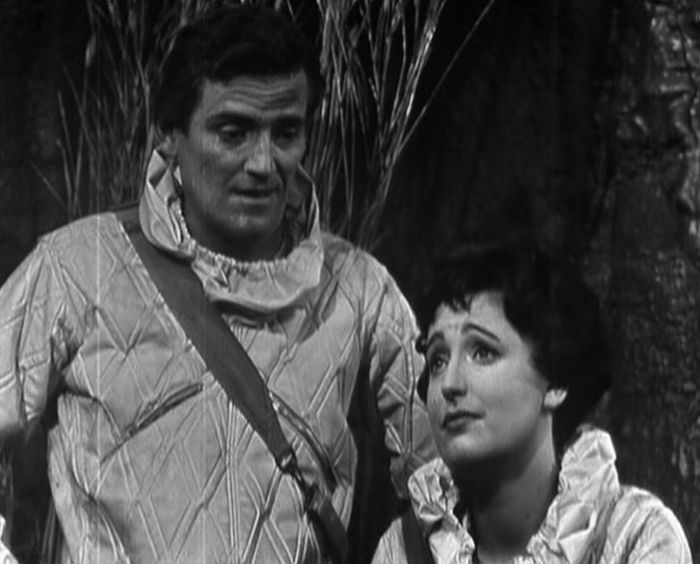
Latest Kisswatch update – Conway and Mary enjoy a passionate kiss on the lips. Hurrah! Marriage doesn’t seem to be on his mind though, unless he’s being very subtle. But he does ask if they can work together when they return to Earth, so maybe this is the first step in his plan to woo her.
We return to Buchan Island for the first time since the opening episode. The Russian rescue rocket has nearly reached Venus, but with no evidence that Conway and the others are still alive, it’s likely to just turn around and go home.
Malcolm Hulke tended to pepper his Doctor Who scripts with political, moral or environmental messages. Pathfinders never really went down these routes but this episode – for example, Wilson sees a chance to make a great deal of money by plundering Venus of its plentiful diamond supply – does supply us with a vague message.
It does mean that Wilson, up until now a level-headed chap, suddenly turns into an avaricious monster. This moment quickly passes, but the discovery of uranium is another flashpoint. Wilson paints a vision of Venus as a colonised world, its natural reasources mined for the benefit of Earth (America), a prospect which disgusts Brown. Wilson tells Brown that “you can’t stop progress”.
It’s interesting thar Brown’s desire not to see Venus strip-mined isolates him from the others. But when the way back to the rocket is blocked by raging forest fires, he gleefully tells them that nobody will ever leave the planet. Instead, they’ll become the first of the new Venusians ….
In yet another remarkable coincidence, Margaret and the Venusian child locate Conway and the others. That just leaves Brown to free from his polystyrene rock and then everyone will be back together.
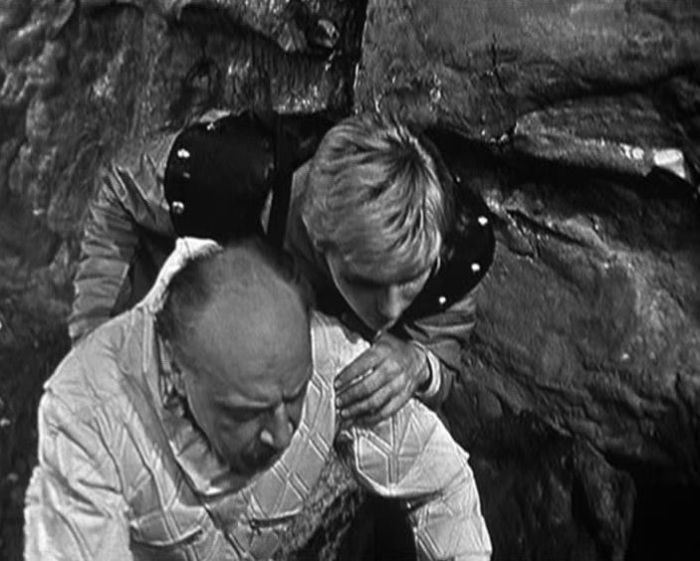
Brown is remarkably noble (“save yourselves” he tells the others). But they’re not prepared to leave him to the mercy of the approaching lava and after considerable effort (I wonder if they taught this type of acting – pretending that lightweight objects were very heavy – at RADA?) they manage to free him.
They’re all delighted to finally have emerged from the caves into the open air. And I have to confess, so am I. The city they can see in the distance is impressive. Brown calls it “the creation of an advanced people with a sense of beauty of form”. But how does that connect with the mute primitives they’ve already tangled with?
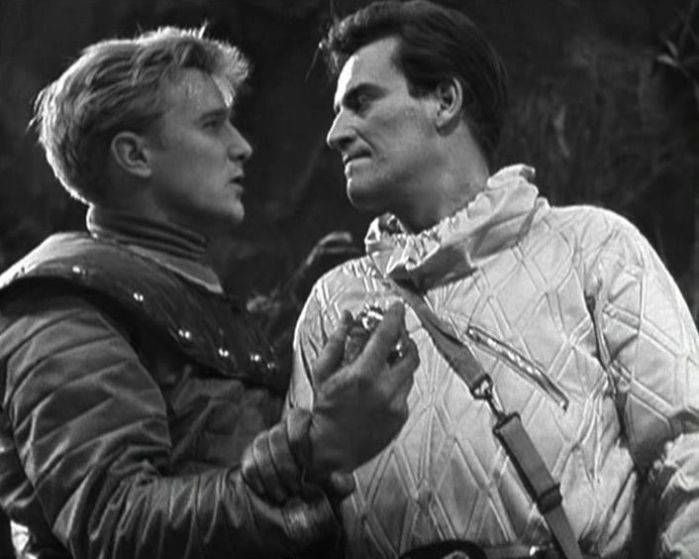
Eventually Conway decides that they’ll all take a look at the city. But Brown can’t wait for Conway, so he sets off alone. Hasn’t he learnt by now that bad things happen when they split up? Tsk, he’ll never learn. As Brown makes his way towards the city, we’re privy to his internal thoughts as he ponders the best way to make contact, which is a nice little touch.
For those keeping track of the Conway/Mary kisswatch, this episode he’s heading closer to her lips (via a peck on the cheek). But maybe his close attention was something of a plot point, since he notices a mark on her face. Made by an insect possibly?
This episode (and the final one – Planet on Fire) were directed by Reginald Collin (the other six were directed by Guy Verney). This was Collin’s first directing credit, although he’d later be more prolific as a producer (notably on Callan).
All of Brown’s hopes are dashed after he learns that the city isn’t a city after all – instead it’s a massive tomb where the Venusians bury their dead. It’s a pity that after all this effort the city turns out to be nothing more than a Maguffin. Oh well.
But his disappointment quickly moves into the background as Mary begins to falter – the insect bite is clearly more serious than it first appeared and the others need to come up with an antidote quickly.
This T/R isn’t in a great shape – very notable tramlines throughout – but given that a good deal of this era of television doesn’t exist at all there’s no point in grumbling.
With Mary still weak, they have to improvise a stretcher to carry her (which they knock up very quickly and impressively, it has to be said). Venus is a planet full of surprises – this week’s cliffhanger finds them menaced by flying dinosaurs!
The lights are even lower at the start of this episode then they were at the end of the previous one, so the Venusian cave-man is much less distinct than he was before. This low-lighting seems to have foxed the vision mixer – at one point Margaret screams that he’s “breaking though” as the camera cuts to what appears to be an empty frame.
As the Venusian (Bob Bryan) ambles out of the cave, we get a closer look at him. I think it’s fair to say that he’s possibly not going to be a terribly interesting conversationalist.
The Venus People gives us a break from watching everybody traipsing through the forest as instead they spend their time traipsing through caves instead. As ever, things aren’t straightforward – Margaret gets separated from the others but (as luck would have it) she runs into Brown and Wilson.
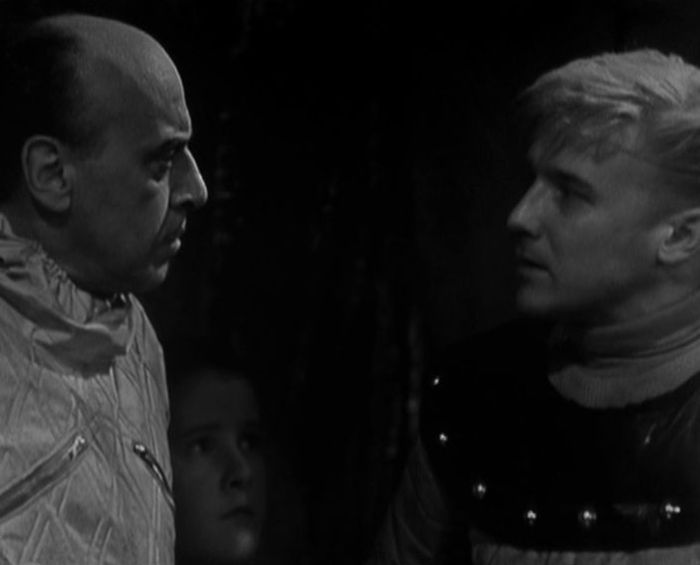
Brown has to do a little bit of quick talking since he’d convinced Wilson that everyone else on the rocket was dead. He does admit that he lied, but Wilson doesn’t seem too bothered about being deceived. During these scenes you have to admire Hester Cameron. Margaret has been forced to carry Hamlet for some time, which must have been a little irritating.
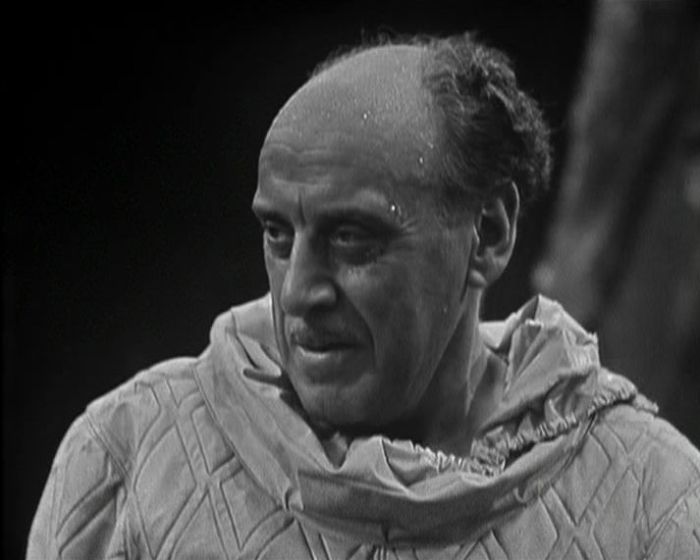
Brown finds a narrow ledge which he believes leads to the city. He’s happy to risk his life crossing it, but Margaret and Wilson are less keen. But when they hear the wails of the Venusians, she has no choice but to follow. There’s a bit of a technical blip here – we see Brown cross over, but then George Coulouris walks through the back of the frame, presumably making his way to the next set.
Wilson meets up with Conway and the others and they too attempt to cross. The dramatic stock music goes up a few notches as Brown is trapped by a large rock. A Venusian child (Brigid Skemp) appears to offer Margaret a way out ….
By this point the narrative has split four ways. Geoff is alone in the jungle, Mary and Margaret are trapped in the rocket (whilst something large and unfriendly appears to be attempting to force its way in), Conway has disappeared whilst Brown and Wilson are making their way to what Brown believes is a Venusian city.
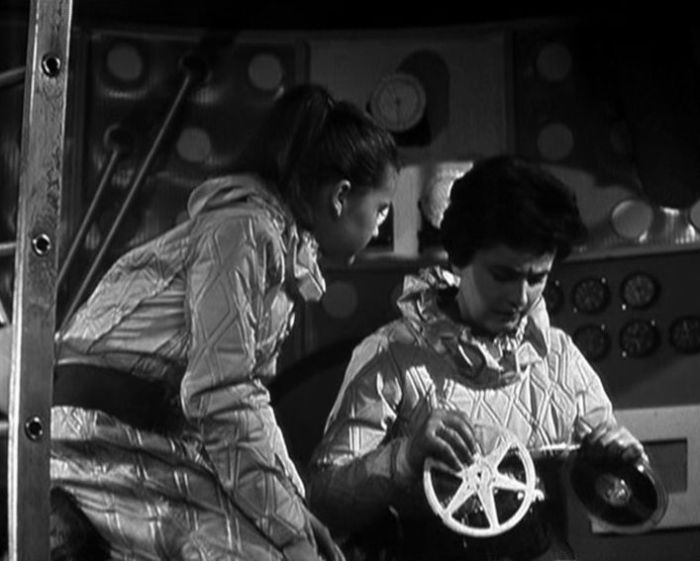
Mary eventually twigs the way that Brown deceived them – chopping a few words out of Wilson’s tape recording – whilst the tension of Geoff, Mary and Margaret’s predicament quickly dissipates. Geoff returns to the rocket and the mysterious creature disappears.
The logical Professor Mary Meadows believes that the creature only appears when they’re alone, so Geoff decides they should rope themselves together and that’ll deal with it. Eh? I’m not entirely convinced about this statement.
Brown and Wilson continue their slow trek to the city. They find a cave which displays evidence that the Venusians have discovered fire (and presumably are flesh eaters). This doesn’t chime with Brown’s assertion that the Venusians are harmless and friendly, but he’s not downhearted and quickly bounces back. At this point poor George Coulouris suffers a line fumble worthy of William Hartnell. “Three thousand miles, err three thousand, three hundred years ago …”
The point about fire is an interesting one – in the previous scene Mary was confident that they could use it as a weapon, since she thought it was unlikely the Venusians would have discovered it. Although as no-one ever mention fire again it turns out to be a totally redundant plot-point.
A few clips of stock footage are used throughout the serial. This episode is slightly more low-rent though – as we hear the sound effect of thunder followed by a picture of lightening. It’s only on the screen for a second so they just about get away with it.
Gerald Flood’s had an easy episode so far. We don’t see him until we’re about half way through when Conway promptly wakes up, calls for Geoff and the others – who just happen to be close by – and they’re all happily reunited.
Brown and Wilson debate the ethics of technology. Brown despairs about the way that scientific progress has ravaged the Earth and fears that the same thing will happen one day to Venus. Wilson makes the logical point that without science they’d never have reached here in the first place. Then Wilson reaches for a cigarette. It’s somewhat jarring to see an astronaut having a quick puff (unless they were special space cigarettes) but then it was the early 1960’s.
The most entertaining part of the episode is poor Hamlet’s plight. Trapped inside a flesh eating plant, it looks like curtains for the space-faring guinea pig. Margaret doesn’t take this trauma at all well – she’s frantic with worry as Conway manfully attempts to rescue Hamlet from within the flappy plant. Don’t worry, Hamlet fans, he eventually escapes unharmed.
The last few seconds give us our first sighting of a Venusian. He’s lurking in the shadows somewhat, but think cave-man and you’ll be on the right track.
As also often happened with Doctor Who, the end of episode cliffhangers were re-recorded the next week. This is very evident here, since both Stewart Guidotti and Hester Cameron are much more restrained at the start of this episode than they were at the end of the previous one.
Geoff and Margaret, locked inside Wilson’s rocket for safety, are pondering exactly what powerful creature could have caused such damage. Geoff has plenty of ideas. “For all we know it might have been a reptile, or a bird with a huge beak. Or an insect with some kind of nippers like a crab”. Given the series’ budget, I’ve a feeling it’ll be somewhat less impressive than these wild imaginings ….
It’s plain that they’re not alone though. For a while, the camera has sometimes shot from behind flapping branches, giving the impression that someone or something is observing them. As with the previous serials, this one is also in no hurry to show its hand (understandable, with eight episodes to fill).
So The Living Planet concerns itself with the continuing hunt for Wilson whilst Brown burns with a desire to explore what he believes to be a Venusian city. The parallels between this story and The Daleks seem pretty obvious, was this a coincidence or did Terry Nation tune in back in 1961? One difference is that Brown just decides to wander off by himself to explore the alleged city (unlike the Doctor, who had to trick the others into accompanying him).
Another Doctor Who connection is the distinctive piece of stock music which appears some ten minutes about ten minutes in, which also cropped up during the Hartnell era, The Space Museum to be precise.
Brown meets up with Wilson and the pair head off for the city together. For those keeping a watch on the Conway/Mary relationship, there’s another kiss here – albeit it’s just a smacker on the top of her head.
Graydon Gould, as Wilson, starts to emerge as a more defined character in this episode, helped by the fact he finally has someone to talk to. Gould might not have been an American, but he was the next best thing (Canadian) so at least he sounds pretty authentic. Brown and Wilson don’t exactly see eye to eye – Brown believes that the only aggressors in the solar system are to be found on Earth and despairs that the Americans rocket was kept a secret (presumably because it contained military secrets).
You probably won’t be shocked to learn that Conway and Geoff venture out to find Wilson and Brown whilst Mary and Margaret remain behind in the safety of the rocket. Although maybe it’s not that safe since something breaks into the rocket and begins to menace the girls.
And then Conway disappears which is the cue for Geoff to start over-emoting again. We must be close to the end of the episode ….



 Archive Television Musings