The Day of the Triffids (BBC 1981). Episode Five

triffids 05

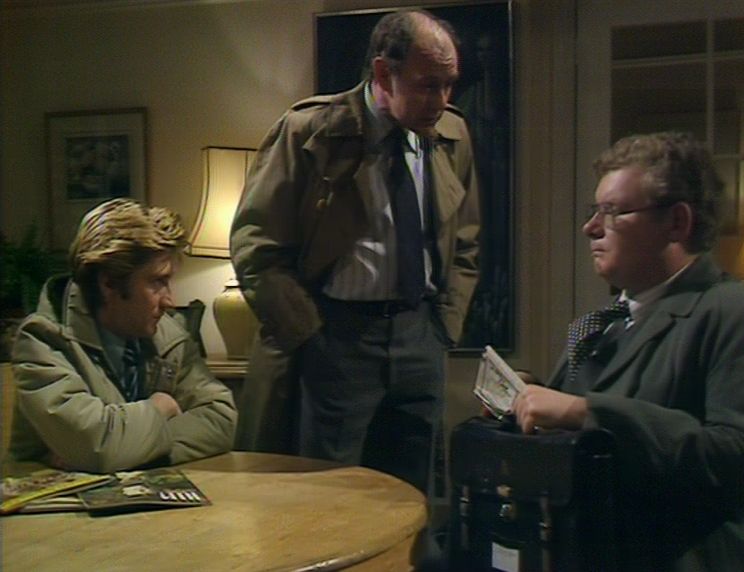
Episode Five concerns itself with Bill’s quest to find Jo, which leads him out of London and into the country.  Coker joins him for the trip.  One of the major plus-points of this episode is Maurice Colbourne, who was always such a watchable actor with a very strong presence.  Although he appeared briefly in a few previous episodes, he’s much more central in this one.  After he and Bill rest in an abandoned pub, it’s Coker who can clearly see the way forward.

We must be part of a community to have any hope for the future at all.  At the moment we’ve got all we need.  Food, supplies, everything.  But the food will go bad, the metal will rust, the petrol to drive the machines will run out.  Before that happens, we have to learn to plough and learn to make ploughs, and learn to smelt the iron to make the ploughshares.  We must learn to make good all that we wear out.  If not …. we say goodbye to civilisation and we slide right back into savagery.

Bill and Coker find the community at Tynsham, but Jo isn’t there.  A number of the survivors have also moved on, due to a serious disagreement.  The remaining survivors at Tynsham are led by Miss Durrant (Perlita Nelson) and they’ve rejected the notion that pro-creation is key to survival – instead they plan to exist by strictly Christian principles and they put their faith in God to save them.

Coker decides to stay with them, as he believes that he can make something of the community, and Bill travels on.  Along the way he effectively adopts an orphaned young girl, Susan (Emily Dean).  It’s interesting to see how this, like so much of The Day of the Triffids, was directly paralleled in Terry Nation’s Survivors.  Essentially Survivors is The Day of the Triffids writ-large, but without any Triffids.

Wyndham gave Susan more of a back-story (about the death of her parents and her fears and feelings) which isn’t used here, that’s a bit of a pity as without it she’s something of an underdeveloped character.

Together they eventually manage to find Jo (along with a few others) and they all decide to return to the community at Tynsham.  But disease has struck – many are dead and the others have left.  Of Coker, there’s no sign.  So they face the prospect of having to establish their own small community, whilst all around the Triffids are looming …..

There’s certainly more Triffid action in this episode.  Bill gets to shoot a few of them – with both a rile and a Triffid gun.  When Coker asks Bill if the Triffids frighten him he says yes, “and they sicken me, too.  And what sickens me the most is that inside this mess they are the only things that are going to fatten and thrive”.

Whilst there weren’t that many Triffids in London, there seems to be more of them in the countryside – whether they’re breeding or whether there were tens of thousands in captivity who’ve escaped is never made clear.  But they seem to be an ever-growing menace (even more so in the final episode).

A word about Christopher Gunning’s score.  It wouldn’t have been a surprise (because of period when this was made) for the BBC Radiophonic Workshop to have provided the incidental music, but instead Gunning uses more traditional instruments (instead of the synthesizers favoured by the Radiophonic Workshop).

In episode five’s score, the piano dominates – and as Bill’s search for Jo reaches a happy conclusion, the music reaches an appealing crescendo.  Given how dark the majority of the story is, Gunning’s music helps to provide a sliver of light and hope.

The Day of the Triffids (BBC 1981). Episode Four

triffids 04

Bill and a number of other people (including Jo) have been captured by Coker – who staged the phony fire at the end of episode three.  He allocates one sighted person to a party of blind people and assigns them to a district.  They have to find a place to live and make regular trips to locate food – which will keep everybody alive until (Coker says) more organised help turns up.

Bill doesn’t believe that any help is coming but Coker’s a good enough judge of character to know that once he gets to know them, Bill won’t leave his party.  Whilst he was previously able to discuss (in abstract terms) that keeping the blind alive was ultimately fruitless, when he has to deal with actual people his humanity will ensure that he’ll do everything he can for them.

But even with his best efforts, there are numerous dangers.  Several are killed by a red-haired man (Gary Olsen) who’s leading a rival party.  His motivation for shooting them isn’t clear here, but he’s a character that will return later in the story.

The Triffids also claim some victims in another nicely directed scene.  As mentioned before, as they haven’t featured for a while their sudden reappearance in the middle of the episode comes as something of a jolt.

Disease thins Bill’s party even more and he’s powerless to prevent their deaths.  As London becomes even more of a health hazard, it’s clear that the longer he remains, the more danger he’s in.  Bill seems to be on the point of leaving when he’s visited by a young woman (Eva Griffith) who asks him to stay and offers herself to him.  It’s a heartbreaking scene and like so much of Douglas Livingstone’s adaptation, it’s taken directly from Wyndham’s novel.

Shortly afterwards, she dies and the few survivors flee in panic.  So Bill’s left alone once more. but this time he has an aim – he needs to find Jo.

Brian Aldiss once notoriously dubbed the works of John Wyndham in general and The Day of the Triffids in particular as “cosy catastrophes”.  Aldiss wrote that “the essence of the cosy catastrophe is that the hero should have a pretty good time (a girl, free suites at the Savoy, automobiles for the taking) while everyone else is dying off”.

I have to admit, I don’t find anything particularly “cosy” about either this adaptation or Wyndham’s original novel.  True, Wyndham’s novel did tend to feature mostly middle-class characters (another point which upset Aldiss) and this is changed here by making Bill (courtesy of John Duttine) more working class – but the concepts and themes developed thus far are pretty bleak.

The Day of the Triffids (BBC 1981). Episode Three

triffids 03

After Bill and Jo escape from the maurding pack of blind people, they find a place to hole up for the night.  After enjoying a good meal and a decent mug of wine, they both learn a little more about each other – although Jo says, “but all that, all the details of my life, they were yesterday. It’s the same with you.  I think I’d like to know you from today and you know me from today.  You might not like what I was yesterday.  I might not like what you were”.  The sense that yesterday is a closed book and that the future starts today is a theme that is picked up again later in the episode.

They then discuss what to do next.  Bill is keen to get out of London as he tells Jo that soon, “the city will begin to stink like a great sewer.  There are already corpses lying around.  Soon they’ll be more.  That may mean cholera, typhoid.  God knows what”.

But a light in the distance changes their plans and the next morning they meet a group of thirty or so survivors who all have sight.  They see another sighted man, called Coker (Maurice Colbourne), who’s leading a group of blind people.  He asks the others for help in finding food, but they refuse.  This is a debate that has cropped up before and Bill and Jo discuss it again shortly afterwards.  Bill says that Coker is right and wrong.  “We could show some of them where to find food for a few days or for a few weeks.  But what happens afterwards?”.

They then meet the leader of the sighted group, Beadley (David Swift).  He proposes moving out of London and establishing a community that will isolate itself for a year (in order to protect against disease).  One of the other members of their ad-hoc committee explains how the community will function.

The men must work.  The women must have babies.  We can afford to support a limited number of women who cannot see, because they will have babies who can see.  We cannot afford to support men who cannot see.  In our community, babies will be more important than husbands.  It follows from this that the one man/one woman relationship as we understand it will probably become an illogical luxury.

As for the Triffids, they only appear in a single scene (where they attack an old couple who we’ve never seen before).  As their appearance (although it’s very nicely shot at night) is divorced from the main narrative, it seems to have been put in simply to remind the audience that they’re still out there.  And since they don’t feature much in this episode, it helps to make their sudden reappearance in episode four even more striking

At the end of this episode, Bill and Jo (along with the rest of the potential community members) are settling down for the night when a fire alarm is raised.  Bill rushes down the stairs, trips over and awakes to find himself tied up …..

The Day of the Triffids (BBC 1981). Episode Two

triffids 02

After leaving Dr Soames in an office, Bill tells him that he’ll go and find some help.  Soames knows there’s nothing to be done and he’s right – everyone else in the hospital is blind.  Along the way, Bill meets a patient in one of the wards who asks him to draw the curtains and when he has, the man tells him to stop playing about and draw the curtains.

This is another scene taken directly from the novel, although it might have been a good idea to omit it.  It’s impossible to believe that somebody couldn’t tell the difference between it simply being dark and being blind.  Even in the dark, it’s possible to distinguish shapes and outlines.

Elsewhere, he sees groups of people milling about anxiously and when he returns to the office he finds Dr Soames has jumped to his death.  As Bill ventures out onto the streets he finds no better news, until he spots a girl who can see.  He follows her into a house and meets her father, John (Stephen Yardley).  John and his wife are blind, but their daughter can still see.

John vacillates between believing that the problem is only local and temporary and pondering the implications if the majority of the population are now permanently blind.

Well, everybody will be like us at first. They won’t know what’s happened. They’ll be too frightened to move. Then they’ll get hungry and start looking for food. I mean this town’s nasty at the best of times. In two or three days it won’t just be hooligans, it’ll be people you thought butter wouldn’t melt killing each other for scraps of food.

There’s a great deal of truth in this, as we see pockets of the blind fighting each other for food, whilst one woman sits on the ground with a packet of washing powder in the mistaken belief that it’s edible.  Elsewhere, a group of football supporters are led by a sighted man and they grab a woman.  Their intentions are obvious and although Bill tries to intervene, it’s probable that his attempt was fruitless (we don’t see the conclusion).  As we witness other examples of people in distress, how will Bill decide which ones to help and which ones to leave?

Earlier in the episode, Josella (Emma Relph) was captured by a blind man and forced to be his eyes.  Bill discovers them and frees her.  Together they seek refuge in a pub and when she decides to find her father, Bill asks if he can come with her.  Jo agrees instantly and tells him it’s “not because I’m afraid of getting caught again.  I’ll watch out for that.  It’s just the dreadful sense of loneliness, being cut off from everybody else”.

Jo’s father is dead, killed by a Triffid and Bill and Jo only manage to escape after Bill kills another.  This the first major Triffid attack scene in the story and thanks to some tight framing and intense acting from Duttine it works well.  Whilst they’re not the most mobile of creatures, the occasional glimpse of them (as well as the eerie sound they make) is quite effective.

The episode has already discussed how the vast majority of the population could, because of their blindness, be turned into a mob – and this looks like it’s coming true at the end.  Bill and Jo’s car is surrounded by a group of blind people and whilst none of them are intrinsically evil, their desperation to hold onto any sighted person is somewhat disturbing.

triffid

The Day of the Triffids (BBC 1981). Episode One

triffids 01

John Wyndham Parkes Lucas Beynon Harris was born in 1903 and began his writing career in the 1930’s under a variety of names. Following the Second Word War he started writing again and produced his first novel as John Wyndham. That was The Day of the Triffids which was published in 1951.

The Day of the Triffids was an instant success and it established Wyndham’s reputation as one of Britain’s top science fiction writers.  It was faithfully adapted for the radio in 1957 (and the same script was re-recorded in 1968).  There was also a film version in 1962 which deviated substantially from the original book (as did the 2009 BBC adaptation).

In-between those two was this 1981 BBC adaptation by Douglas Livingstone.  It was directed by Ken Hannam and comprised six 26 minute episodes which were re-edited into three 52 minute episodes for overseas sales.  Livingstone did a remarkable job of faithfully transferring Wyndham’s novel to the small screen.  There are some changes (the action is moved from the 1950’s to the 1980’s and some minor characters are different) but overall there’s a great deal of fidelity to Wyndham’s original book.

In Livingstone’s teleplay, as in the novel, the thrust of the story is concerned with how the survivors of a global catastrophe will be able to survive after the technological infrastructure they’ve taken for granted has been destroyed.  The later BBC adaptation was much more of a straightforward adventure yarn, pitting the survivors against the Triffids.  But here, like in the book, the Triffids only pop up from time to time and they aren’t the most pressing problem.

The story opens with Bill Masen (John Duttine) recovering in hospital after an operation on his eyes.  He works at a Triffid farm and was stung by one of them – hence the operation.  Hopefully, once the bandages are removed he’ll be able to see again, but nothing is certain.

One annoying side-effect of his temporary blindness is that he was unable to witness the remarkable light-show the previous evening.  The precise origin of this natural display which lit up the night sky for hours (visible all over the world) was a mystery, but the morning after things feel different.  Where there should be noise and bustle (as befits a busy hospital) there is only an ominous silence …..

Both the novel and Livingstone’s adaptation open with Bill in hospital and work back from there to explain the history of the Triffids.  In Wyndham’s novel, Bill is writing the whole story to explain to those who were born after the catastrophe exactly what happened.  In the television version, Bill narrates how the Triffids came to exist onto cassette for his colleague Walter, who’s planning to write a book about them.

This is a decent framing device as it allows Bill to narrate over various scenes which explain where the Triffids came from and precisely the danger they pose. Walter (Edmund Pegge) works with Bill at the Triffid farm and in one of the flashbacks he discusses with him some of his theories.

Look at when they attack. They almost always go for the head. Now a great number of people who have been stung but not killed have been blinded. That’s significant of the fact they know the shortest way of putting a man out of action. If it were a choice of survival between a blind man and a Triffid, I know which I’d put my money on.

One interesting change by Livingstone is that to begin with, Bill still believes it’s the middle of the night – but we can clearly see the daylight streaming through the window and the time on the clock (the novel opens with him instantly aware that things aren’t right). This means that the viewers know more than Bill and so are aware, before he is, that something is seriously awry.

John Duttine spends the majority of the episode alone in his hospital room with his eyes bandaged.  It needed a good actor to make the character come alive, with so little to work with, and Duttine certainly delivers.  As time goes on, and still nobody comes, his self control begins to crack – until he decides to take off the bandages himself.

The irony that he’s now able to see whilst the majority of the world have gone blind isn’t something that’s overtly stated, but it’s obvious nonetheless.  As the episode ends, he meets the blind Dr Soames (Jonathan Newth) whilst the Triffids start to prowl …..

Bird of Prey (BBC 1982). Episode Four – Printout Urgent

prey 04

The last in a four-part thriller for the electronic age featuring Richard Griffiths
Episode 4: Printout Urgent
Henry is at bay. His home in ruins, his allies and hard-won evidence all destroyed. Face to face with the gathering strength of ‘Le Pouvoir’ and the grandiose scheme of its protégé – Euro MP Hugo Jardine.
(Radio Times Listing, 13th May 1982)

With Henry believing that one of the explosions from the end of part three killed Anne (instead it was the unfortunate Tomkins who perished) he moves into attack mode.  He substitutes himself for Jardine’s chauffeur and drives him to an abandoned warehouse.  His original plan is to kill Jardine and then make as much trouble as he can for Jardine’s organisation before his own death – but when he learns that Anne is still alive he agrees to a swop.

There’s no denying that Henry’s abduction of Jardine stretches credibility as it’s difficult to believe that such a powerful man would travel with no protection at all.  Jardine (Christopher Logue) is a good example of the banality of evil, which makes his confrontation with Henry very interesting.

When Henry first speaks to Jardine he believes that Anne is dead – but Jardine professes not to know about her death or any of the others.  He tells Henry that “I know nothing of the names you mention. I have people imposed upon me. I have no say in their methods. Because your heart is broken does not license you to stop mine”.  How much of a pawn Jardine is in other people’s plans is a matter of conjecture, but it does highlight that there never seems to be a single person sitting in total control at the top of the pyramid – everybody always seems to answer to somebody else.

Elsewhere, Bridgnorth explains to Hendersly exactly what Jardine’s scheme is, in a scene that would be an unbearably egregious info-dump if it wasn’t for that fact that Nigel Davenport was such a good actor well able to rattle off such exposition-heavy dialogue with great aplomb.

Jardine, along with the shadowy Italian conglomerate, has tabled a bid to build a deluxe Channel tunnel.  Bridgnorth says that it will create “125,000 new jobs in construction and engineering. 50 or 60 thousand new service and retail jobs. Only Jardine has the political will and the financial clout to stitch a deal like this together. Road and rail links side by side. The Rolls Royce solution to the Channel link”.  With a potential fortune to be made, trouble-makers like Henry would appear to have a very limited life expectancy.

The hand-over between Jardine and Anne goes ahead – although not quite as some of the players might have expected.  Henry and Anne are safe though, but their future seems less certain.  Henry was able to broker a deal with Rome – he agreed not to release the files he has on them and in turn they pulled out of the Channel bid.  And if Henry doesn’t input a counter-instruction code every three months, the files will be released to every government computing centre across Europe.

This will keep Henry and Anne safe for now, but he’s well aware that they’ll try to break his code and if they do then their lives will be rather short (which sets us up nicely for the sequel Bird of Prey II).

Overall, this is a very decent thriller.  Although trailed in the Radio Times as a story for the electronic age, computers really don’t feature very significantly at all (except for the ending, where it’s the information contained within the computer that’s keeping Henry and Anne alive).  Production-wise, it’s typical of the era – VT interiors and film for exteriors.  If it had been all-film (like an increasing number of serials during the early to mid 80’s) then it might have been more stylish.  As it is, the direction is workmanlike but rather flat, with only the odd moment standing out.  Instead, it’s the actors (rather than the camerawork) which makes the story.

Richard Griffiths shines as the undemonstrative Henry and Nigel Davenport is impressive as his main rival.  As the DVD was deleted some time ago it now tends to sell for silly money – but if you can track down a reasonably priced copy then it’s certainly worth a look (particularly if you like drama of that era).

Bird of Prey (BBC 1982). Episode Three – Process Priority

prey 03

A four-part thriller for the electronic age featuring Richard Grifiths
Episode 3: Process Priority
One name recurs in Henry Jay’s single-handed investigation into the affairs of ‘Le Pouvoir’ – Euro MP Hugo Jardine. With British Intelligence now implicated in the cover-up, Henry has a story to sell – if he can stay alive long enough.
(Radio Times Listing, 6th May 1982)

Generally, the third part of a four part story is a bit of a problem. You’ve set up the plot and characters in the first two parts but you’re still one away from the conclusion – so part threes generally involve a good deal of running on the spot.

While it’s true to say that Process Priority does conform to this rule, on the plus side it introduces an interesting new character, Rochelle Halliday (Ann Pennington).  Rochelle runs a commercial intelligence consultancy and she had contact with Henry when he was drafting his report on computer fraud.

She’s a playful, irreverent character, which is highlighted when she asks Henry to read the notes she made about him after their previous meeting.  “First impressions are that he would be out of his depth in a car park puddle, but first impressions may be deceptive. Give him a couple of months then try sex or straight cash. Say five hundred. He shouldn’t be expensive”.

Ann Pennington is a major reason why this part three doesn’t feel too draggy.  It’s a pity that this is her only episode – but as has been mentioned before, many characters in Bird of Prey have a very short shelf life.

Rochelle sends Henry off to speak to Julia Falconer (Mandy Rice-Davies).  Julia is the proprietor of a high-class call-girl agency which has links to Hugo Jardine.  She’s able to fill in a few blanks, but these scenes are of primary interest due to Mandy Rice-Davies herself, since along with Christine Keeler she will be forever remembered for her role in the Profumo affair.  It could be regarded as stunt-casting, but since she’s a decent actress I wouldn’t say so.

Elsewhere, Hendersly (Jeremy Child) is starting to have his doubts about Bridgnorth (Nigel Davenport).  It’s been a fairly thankless role for Child so far, as his character has been drawn as a colourless, yes man.  But now the worm turns and he tells Bridgnorth that he’s compromised his career “to protect Hugo Jardine, who you advised me is risking his life in a long, drawn out and elaborate intelligence operation. On a need-to-know basis, you’re the only person I’ve had any contact with. As this operation staggers from one blunder to the next, I’ve just kept my head down and assumed that you’ve known what you’ve been doing. I find myself questioning that now. And even more seriously, questioning who it is that I’m ultimately working for and with whom your loyalties lie”.

After a speech like that (and given what we’ve already seen) it’s interesting to ponder what his life expectancy will be …..

As the end of the episode approaches it’s clear that matters are building to a head.  The cliffhanger is certainly arresting – as we witness two separate explosions (although the second is admittedly a little weedy).  Both explosions help to thin out the cast a little more but Henry is still unscathed and he appears to be heading for a showdown with Jardine.

Next Episode – Printout Urgent

Bird of Prey (BBC 1982). Episode Two – Mode Murder

prey 02

A four-part thriller for the electronic age, featuring Richard Griffiths.
Episode 2: Mode Murder
Murder and the power to subvert officialdom: Henry Jay has good reason to believe in ‘Le Pouvoir’ and its link with the growing evidence of a financial conspiracy. A dead detective’s legacy is a file pointing to a Euro MP and a girl in Brussels – which leaves Henry no option but to pick up the trail.
(Radio Times Listing, 29th April 1982)

Henry needs answers – so he sells his stamp collection and uses the money to rent a room under an assumed name and also buy a computer.  It’s the latest model and the salesgirl informs him that it has “64K memory, disk drive main, storage for 120,000 characters”.  Which was cutting edge stuff in 1982!  Henry’s computer hacking also raises an eyebrow – since it consists of him ringing up various people and asking for their passwords.

Whilst this will either seem charmingly naive or rather clumsy (depending on how forgiving you are) it does allow Henry to track down Hannah Brent (Sally Faulkner).  Hannah was the girlfriend of Louis Vacheron (a crook murdered in episode one) and Henry hopes she’ll have a lead that will lead him closer to the heart of the conspiracy, so he flies out to visit her in Brussels.  Before DI Richardson was murdered, he left a file for Henry (inside were clippings which mentioned a European MP and businessman called Hugo Jardine).  Hannah doesn’t recognise the name but promises to try and find out what she can.

A hallmark of a good conspiracy thriller is that nobody can be trusted.  Hannah Brent would have known about a simple code that Vacheron taught her (the Owl and the Pussycat in French).  The girl with Henry doesn’t, so he knows she’s not the real Hannah Brent.

This revelation moves us to the heart of the episode as we’re introduced to Charles Bridgnorth (Nigel Davenport). Bridgnorth works for British Security and the faux Hannah Brent works for him. As for the real Hannah? Bridgnorth surmises she’s “in the foundations of a Brussels office block most likely”.

Bridgnorth tells Henry that Jardine works for them and is part of a project stretching back several years – and that both his and Richardson’s investigations may have compromised Jardine’s safety. He also explains to Henry a little more about the Power (the mysterious force alluded to by Vacheron).

The Power is more a loose federation of people than a solid structure. People who temporarily find it an advantage to work with each other to repay each other for favours past and future. There’s a grey area in this sort of business, Henry. Terrorism shades into organised crime, into police undercover operations, into how the state security apparat responds to the chaos which mobile internationally-minded crooks and politicos have been creating since the early ’60’s, especially in Europe. Even those who did the killing may be unaware of what favour they are repaying to whom.

Henry doesn’t find this particularly comforting – so Richardson and Vacheron may have been killed by criminals or possibly by members of the police and security services.  Bridgnorth is pretty non-committal, but tells Henry that his involvement is over.

Get out of here, civilian. This is where the dirty work gets done. Dirty work that means that people like you can catch the 8:15 every morning and lead your boring little lives. Be thankful for the 8:15, Henry. Be thankful for your boring little life and the fact that we allow you to go back to it in one piece … or at all.

It’s a convincing story, but as it’s only the end of episode two there must be more revelations to come.  Henry knows they’re lying to him and explains to Anne that “an exceedingly elaborate construct has been made up of all the bits and pieces and odds and ends they know I know about. It concerns one of the many branches of Intelligence claiming Jardine for their own. They lied about Richardson going to Brussels. I had a computer agency check the relevant flight listings and he never made it”.  It’s only a small point, but Henry has to go on – he has to know if that was the only lie or if the whole story was false.

The episode ends with a few more bodies – DS Eric Vine (Richard Ireson) and the Department’s security officer Trevor Chambers (Trevor Martin) have been waiting for Henry to return to his rented flat.  Chambers is killed by someone who calls him Mr Jay, which adds another layer of mystery.  Bridgnorth has been keeping close tabs on Henry, so he knows exactly what he looks like.  Therefore it appears there are new players in town.

Next Episode – Process Priority

Bird of Prey (BBC 1982). Episode One – Input Classified

prey 01

Henry Jay: Civil Servant, mid-30s, good head for detail
Prospects: Steady promotion. Index-linked pension
Hobbies: Philately, Hi-fi
Current Project: Computer Fraud Report for Whitehall Trade Ministry.
Altogether a seemingly puny obstacle to a massive financial conspiracy – with the bureaucratic clout to silence the inquisitive.
(Radio Times listing, 22nd April 1982)

Bird of Prey, written by Ron Hutchinson, was a four-part conspiracy thriller broadcast in 1982.  It starred Richard Griffiths as Henry Jay, who is a mild-mannered, middle-aged civil servant and therefore just about the last person you would expect to be caught up in the middle of a vast and dangerous conspiracy.

That, of course, is one of the reasons why it works so well – had Henry been a more conventional hero (either in looks or approach) then the dramatic tension would have been far less.  But since Henry seems so ill-suited to the role of a crusading hero, it creates an interesting dynamic.  Whether the story manages to keep a sense of credibility as the bodies start to pile up, we’ll have to wait and see – but let’s start by taking a look at the first episode.

Henry Jay works for the Department of Commercial Development and has a special interest in computer security.  At the start of the story he has the following info-dump speech which he delivers to his boss Hendersly (Jeremy Child).

The Americans are considering restricting the publication of research into cryptography – code breaking. Well, you see, telephone networks are now, more or less, computer networks, as are modern office accounting and money transfer systems, and the Americans have only just woken up to the security aspects of the unregulated publication of research into cryptography because it offers ways of breaking into those networks.

Since Bird of Prey is commonly regarded as a computer thriller, it’s noticeable that we don’t see a single computer in the first episode.  Henry’s office, which he shares with Harry Tomkins (Roger Sloman), is computer free – instead there’s just typewriters and plenty of conventional files.  It’s certainly a window into a vanished world, where computers were still something of a rarity.

But if the possibility of everyone either owning a computer at home or using one in work was still a slightly alien concept in 1982, there certainly was a feeling that computers were beginning to have an increasing influence on people’s daily lives – hence Bird of Prey came out at the right time (even if the technology we’ll see in later episodes now looks rather quaint!).

The opening and closing titles are rather nostalgic for anybody of a certain age, since they mimic the computer graphics common at the time.  Dave Greenslade’s title music and score is also very evocative of the era.

It’s Henry’s report, “Fraud And Related Security Problems In The Age Of Electronic Accounting”, which is the catalyst for all of his problems.  He’s been liaising with Detective Inspector Richardson (Jim Broadbent) who shares his concerns about computer fraud and Richardson has been passing him information to use in the report.  One piece of information concerns a recent attempted bank fraud centered on Turin and London.

Louis Vacheron (Nicholas Chagrin) was caught at the London end, but he tells Richardson that he’s confident he’ll be released in a matter of months as their organisation has connections at the highest levels.  He mentions le Pouvoir (the Power) but when Vacheron is killed, it’s clear that the Power has silenced a weak link.  And Richardson believes that the Power will also remove any other links (which is a problem for Henry, since there’s a reference to this fraud in his report).

Of course, nobody, especially Henry’s wife Anne (Carole Nimmons), believes him at first.  Their marriage is best described as frosty and she spells this out quite succinctly.

I do a routine and boring job as well, only I don’t have to manufacture drama and excitement out of it. Some are born civil servants. Others achieve being civil servants. Others have being civil servants thrust upon them. You were born. Now after seven years of marriage, I accept that and the fact that you will never change or be anything else, so if you’re trying to make your job sound desperately important and exciting for my sake, don’t bother. When I said yes to you, I settled for cocoa, not champagne. Now I’m prepared to live with that. Sourly at times, mostly with mute acceptance.

Shortly afterwards, Henry is accused of soliciting an underage boy, although it’s clearly a set-up (which is confirmed by the two police officers as they leave Henry’s house).  Henry sees this as a warning – leave well alone or the next time they’ll make the charges stick.  Unfortunately for the shadowy conspiracy, they then send another policeman along to tell Henry that a woman at his office has made a complaint that he’s been following her.  But as Henry says –

So, how was I fitting in my importuning of young boys in public toilets whilst pursuing Miss Callaghan? I mean, how common is this condition I’m suffering from, that renders me such a menace to young people of either sex indiscriminately?

The first episode ends with the murder of Richardson at Henry’s office (Bird of Prey and its sequel does have a pretty high body count – so it’s best to get used to the idea that many characters won’t last the series out).  Quite why he was murdered isn’t clear at present – although the fact that they can strike at Henry’s office means that he’s not safe anywhere.

So Henry is literally on the run, armed with only a few files from the office as he tries to stay one step ahead of the people who want his head.

Next Episode – Mode Murder

The Hound of the Baskervilles (BBC 1982) now available on DVD from Australia

hound

The 1982 BBC Classic Serial adaptation of Hound, starring Tom Baker as Holmes and Terence Rigby as Watson has been released on DVD in Australia by Madman –

http://www.madman.com.au/catalogue/view/23503/sherlock-holmes-the-hound-of-the-baskervilles-starring-tom-baker-1982

The carrot of this release is a commentary track with Baker on all four episodes, highlights in the clip below.

Whilst this version of the story does have its faults (I’ve never cared for Rigby’s performance, for example, which is a problem since Watson is centre stage for a large part of the story) Baker is a commanding Holmes and it’s a very faithful adaptation of the novel.