Doctor Who – The Chase. Part Three – Flight Through Eternity

flight

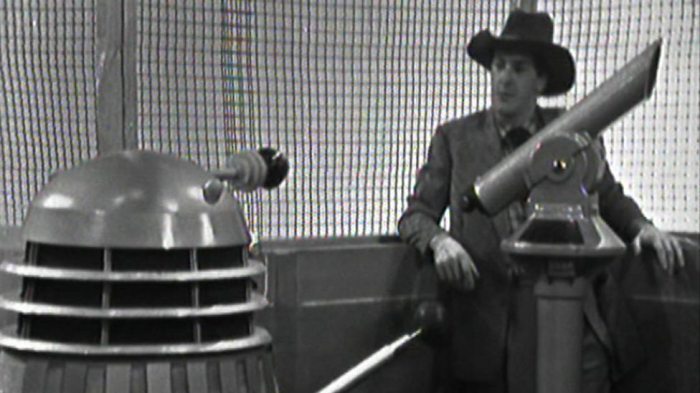
The opening scene in the Daleks’ time machine looks pretty impressive. The set (designed by Raymond Cusick) feels substantial and has some groovy 1960’s embellishments such as the spinning wall designs. It’s also populated with quite a few Daleks – true, at least one is a cardboard cutout and others are cannibalised from the Peter Cushing movie, but it all helps to create the impression of a decent fighting force.

It’s therefore a pity that one of the Daleks is rather hesitant (“umm err”) which rather dissipates this good start. This wasn’t scripted and seems to have been a gag dropped in during rehearsals. It’s another moment which chips away at the invulnerability of the Daleks, although there’s worse to come ….

The TARDIS next drops our intrepid time-travellers off at the top of the Empire State Building. This is the cue for a number of interesting American accents. The first comes from Arne Gordon playing the guide. If you’re bored with the story at this point you can always amuse yourself by counting the number of times he says “err”. Gordon had also played Hrostar in The Web Planet, although you’d be forgiven for not realising this. There’s no excessive hand movements or mutterings of “Zaaaarrbbiiii” for example.

Next up is hillbilly Morton Dill, played by Peter Purves. As is well known, Purves’ small role so impressed Verity Lambert that she offered him the role of series regular Steven Taylor a few weeks later. Quite what she liked about Morton Dill is a bit of a mystery to me as Purves overplays horribly, although you could argue that The Chase is hardly the story where naturalistic acting is required.

I’d assume it must have been Purves’ off-camera persona which convinced her that he’d work well with Hartnell (and she was quite right as he would provide Hartnell with solid support during the next year or so).

Dill’s brief run-in with the Daleks is another instructive moment – he’s convulsed with laughter at their appearance and refuses to take them seriously. Had he then been blasted into nothingness it would have reminded the audience about the power of the Daleks (to coin a phrase). This doesn’t happen, so Skaro’s finest remain something of a joke.

Mercifully, we don’t spend too long in New York. The TARDIS is on the move again, landing the Doctor and his friends on an old-fashioned sailing ship. As with the Empire State Building sequence, it’s over and done with so quickly that only very superficial characterisation can be established.

A gag from The Romans – Ian is knocked out by one of his crewmates, this time Vicki – is reused and once again the Doctor leaves before the Daleks arrive. But whereas they couldn’t be bothered to deal with Morton Dill, here they’re in a much more bloodthirsty move and elect to exterminate all the crew.

This does give us some nicely shot film sequences, showing hapless crew members jumping from the ship into the sea (including, rather disturbingly, a mother and her child). As with the events in the previous episode, you have to wonder why the Doctor never seems to worry that almost everywhere he’s visiting is then obliterated by the Daleks. This is a throwback to the self-centered Doctor of season one, where his survival (and that of his companions) was his sole interest.

The reveal that the ship was the Mary Celeste is a rather groanworthy one, but at least it gives us an explanation for this age-old mystery. The crew and passengers were exterminated by the Daleks! It’s as good a solution as any other.

Doctor Who – The Chase. Part Two – The Death of Time

death

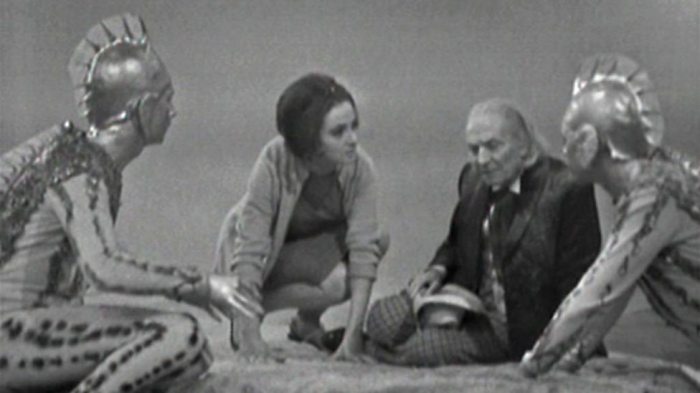
It’s pulpy sci-fi thrills all the way for the duration of The Death of Time. The appearance of the Aridians (they live on an arid planet, do you see?) isn’t a highpoint of the story as not only do they look ridiculous but they’re forced to deliver fairly uninspiring dialogue in a very stilted way.

These scenes are mainly of interest thanks to the appearance of Hywel Bennett as Rynian. Like Martin Jarvis in The Web Planet there’s a morbid curiosity in watching someone who’d go on to have a long and successful career looking ridiculous. With only a short amount of screentime the Aridians are very lightly sketched. They give the Doctor and his friends an account of their history, but since it’s not naturally delivered it feels like little more than info-dumping.

The Daleks present the Aridians with a stark ultimatum – hand over the Doctor or their planet will be destroyed. It’s no surprise that the Doctor’s able to escape but it’s slightly more of a surprise that he doesn’t seem to feel any obligation to the Aridians and is quite content to leave them to their fate. Because the Aridians are such pallid, comic-strip characters it’s hard to feel that invested about what happens to them, but it still feels a bit off for the Doctor just to beat a hasty retreat.

For those keeping an eye on the technical imperfections of the story, 16:45 in is a good one. For several seconds nothing seems to happen, then Jacqueline Hill is covered with unconvincing polystyrene rocks. It’s one of a number of moments that was crying out for a take two. A minute later, Richard Martin lingers over a shot of the Mire Beast. If you’ve ever seen it then you’ll know why that wasn’t a terribly good idea.

There’s now just one Dalek between the Doctor, Ian and the TARDIS. Do you get the feeling that they aren’t treating this Dalek with all due seriousness? Ian distracts the Dalek with the memorable call of “yoo-hoo! Dalek! Over here, friend!” whilst the Doctor gets in on the act with “yoo-hoo, Archie!” Dudley Simpson’s jaunty music doesn’t help to engender a sense of menace either. Treating the Daleks as comic characters is a dangerous road to go down as once you so it’s harder to recreate their sense of power.

And what exactly does The Death of Time refer to? Sometimes I get the feeling that Terry Nation just drew his episode titles from a hat, not caring that they sometimes bore no resemblance to the events of the script.

Doctor Who – The Chase. Part One – The Executioners

executioners

For those who regard Terry Nation as nothing more than a hack writer, The Chase must surely be exhibit A.  It’s easy to dismiss it as nothing more than six episodes of random nonsense, held together by the thinnest of plots (the Doctor is now the Daleks’ deadliest enemy and they’ve decided to hunt him down through all time and space.  Mmm, we’ll come back to that one).

It’s true that it’s not helped by having Richard Martin in the director’s chair.  Martin was the go-to guy for the big stories of season two, although it’s hard to see why.  He’s a decent director of film sequences, but much less assured when it comes to the multi-camera studio environment.  And since Doctor Who was largely recorded in the studio that’s something of a problem ….

If many of Nation’s story ideas are odd and/or silly (Morton Dill, the Haunted House sequence, etc) then Martin’s direction doesn’t help.  The Chase is one of the most technically inept productions we’ve seen so far – although whilst it’s true that the script was far too ambitious for the series at that time, with the right director (say Douglas Camfield) something could have been salvaged.

It’s no surprise that when The Daleks’ Master Plan was mounted the following season (which is pretty much The Chase 2) Camfield managed to produce a much more appealing effort (at least based on the evidence of the surviving episodes).

But having said all that, I find it impossible not to have a sneaking love for The Chase.  It’s shoddy and illogical but there are some moments of magic scattered throughout its six episodes.

The Executioners opens with the Daleks swearing vengeance on their arch enemy Doctor Who.  After only two meetings (and since the Daleks were apparently wiped out in the first one, who was keeping the records?) this is a bit hard to swallow.   I can understand why Nation did it – the personal angle is a decent one – but like the rest of The Chase it just feels a bit off.  Maybe it’s because it’s rather like a TV Comic story come to life.

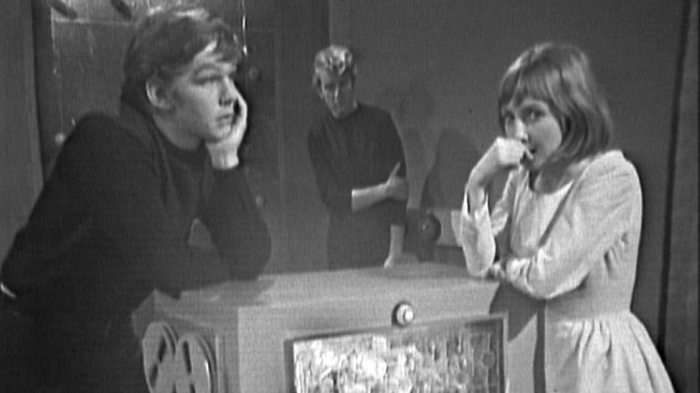
The Doctor and his friends remain oblivious for the moment.  They’re relaxing in the TARDIS in a sort of lazy Sunday afternoon mode.  The Doctor’s tinkering with a piece of equipment he’s picked up from the Space Museum, Ian’s engrossed in a lurid book about space monsters, Barbara (being the sensible one) is doing some needlework whilst Vicki’s just bored.  They make a perfect family unit and it’s a charming little moment of peace before the mayhem begins.

The Doctor proudly demonstrates his new acquisition – a Time and Space Visualiser (it’s a time television which allows the operator to view any event in history).  Ian asks to see Abraham Lincoln deliver the Gettysburg Address (actually he doesn’t – he specifies a time, place and date and the Visualiser just focuses on Lincoln.  Clever that).

Barbara is curious to see the court of Queen Elizabeth and we eavesdrop on a meeting between her, William Shakespeare and Francis Bacon.  Vicki is keen to see the Beatles.  Ian’s dad dancing is a legendary moment and Vicki’s comment (“well, they’re marvellous, but I didn’t know they played classical music”) is an odd one.  Maybe in the future Vicki didn’t have access to the futuristic equivalent of YouTube and hadn’t already seen them (possibly there was no WiFi on Dido).

All this helps to pad out the episode, which you feel was Terry Nation’s first objective.  Simply find enough material to create a twenty five minute installment and worry (or not) about whether it was any good later.

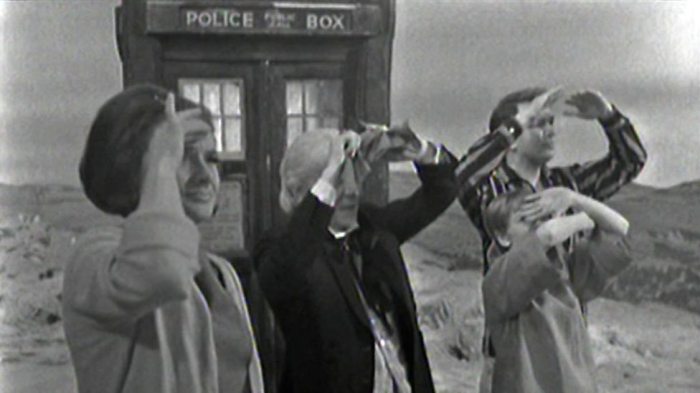
Their television viewing comes to an end when the TARDIS lands on an arid, desert planet.  Vicki and Ian head off to explore, whilst the Doctor and Barbara relax and soak up the sun.  The Doctor’s clearly in a good mood as he starts singing.  Barbara, distracted by the sound from the Visualiser, asks the Doctor what the awful noise is.  Amusingly, the Doctor believes she’s turned into a music critic.  “I beg your pardon? Awful noise? That’s no way to talk about my singing!  Ha! I can charm the nightingales out of the trees.”  It’s not much of a gag, but Hartnell’s always good value whenever he’s given a comedy moment.

The Visualiser then shows us the Daleks.  And by a remarkable coincidence it’s honed in on precisely the moment when they announce their intention to target the TARDIS crew.  What were the chances of that, eh?  It’s interesting that the Terry Nation formula of not revealing the Daleks until the end of episode one wasn’t quite set in stone yet.  Not only do the Daleks appear right at the start (reprising the cliffhanger from the previous episode) but they also have a substantial scene mid way through.

This would have been a good point to end the episode on, but alas there’s still a little way to go (Vicki’s hysterical outbursts are especially odd.  Were they as scripted or had Maureen O’Brien just lost it?).  The cliffhanger’s just about worth waiting for though – a coughing, spluttering Dalek rising from the sand.

Doctor Who – The Space Museum. Episode Four – The Final Phase

sm4

This episode brings The Space Museum to a less than thrilling climax. The first thing which stands out is the fact that Barbara and Dako have spent almost a whole episode (from the middle of episode three to the middle of episode four) coughing, spluttering and attempting to escape from the museum. This helps to give the impression that the museum covers a great deal of ground, but also that Jones had run out of anything remotely interesting to do with Barbara.

Once he’s unfrozen, the Doctor delights in asserting his superiority over Lobos. But as in episode two, his glee doesn’t last for long as he’s soon captured again. When Barbara and Vicki are also rounded up, the four time-travellers are together again once more. They debate whether they’ve done enough to change the future – or have all their actions just been moving them closer and closer to the exhibit cases? Ian attempts to smash the Morok’s freezing equipment (in a very ineffectual way, it has to be said) but the Doctor murmurs that he doubts it’s the only one they have.

The classic line “have any arms fallen into Xeron hands?” never fails to raise a smile. It surely must be intentional, surely nobody could write something that silly with a straight face? Maybe that’s The Space Museum‘s greatest failing – had it been made in the late 1970’s it would have been obvious that the Moroks and Xerons were faintly ridiculous stock characters and so more humour could have been developed from their interactions. Easy to imagine Tom having a ball with the script ….

We eventually get an explanation as to why the TARDIS jumped a time track. It’s tempting to wonder if this was a relic of David Whitaker’s work on the script (he commissioned it and later passed it to Dennis Spooner) as it has a definite echo of the gammy spring story from The Edge of Destruction. The Doctor waves a small object about and explains:

DOCTOR: You know, it’s a funny thing how it happened. It got stuck. I don’t know whether you’ve gone into a room and switched on the light and had to wait for a second or two before the thing lit itself up.
BARBARA: Yes, I have. I think most people have.
DOCTOR: Well, this is the same kind of problem, you see. We landed on a separate time track, wandered around a bit, and until this little thing clicked itself into place, we hadn’t actually arrived.
IAN: Ah. Well, thanks very much for explaining it.

Yes, that makes everything quite clear. Umm, maybe.

By far the most interesting part of The Final Test is the cliffhanger which teases us with the return of the Daleks. Although it’s fair to say that The Chase will turn out to be something of a bumpy ride …..

Doctor Who – The Space Museum. Episode Three – The Search

sm3.jpg

Introduced as a direct substitute for Susan, Vicki has – until now – rarely been a character who has initiated events. In her previous stories she’s spent most of her time with the Doctor, which has fostered the impression that she’s a young and inexperienced girl who needs guiding.

But whilst she may be young there’s also been various hints along the way that the schooling she received in the future was well in advance of anything that Ian and Barbara would have taught their pupils. In this way she’s very much a proto Zoe – immature but with a strong intellect.

This is the episode where she steps out of the Doctor’s shadow, as we see her organise the Xerons into a revolutionary force. Like the rest of the story this is a little hard to swallow (Vicki is an unlikely revolutionary) but by all accounts Glyn Jones’ original draft scripts were much more light-hearted (script editor Dennis Spooner removed most of the overt comic moments) which might explain why the end product feels a little disjointed.

The Xerons explain to Vicki that the Moroks devastated their planet. “They destroyed everything, even our people. Only the children were spared, to work.” This is slightly odd – quite how efficient children would have been as a working force is debatable, surely it would have been better to keep the adults alive to work as slaves? But it’s a heart-wrending story and provides Vicki with a good incentive to help them, although her desire to ensure that she and the others don’t end up as exhibits in the museum is an even stronger one.

Vicki’s skill with computers (another trait she shares with Zoe) is sort of demonstrated when we see how she bypasses the electronic brain which guards the Xeron’s armoury. The computer is designed to only open the door if the answers received to a set series of questions are both truthful and correct.

Vicki is able to bypass this by speaking the truth when she tells it that she’s Vicki and she wants the guns for revolution.  Best just to ignore this massive cop out I think. As you might expect, what we see is a typical 1960’s vision of a computer – a very bulky, solid-state affair, with whirring tapes spools housed in big cabinets.

Whilst Vicki’s running around having most of the fun, what of the others? The Doctor’s been sitting this one out and won’t return until the next episode, Ian has spent his time getting into fights and waving a gun around whilst Barbara hasn’t had a great deal to do (mainly she’s been attempting not to choke from the poison gas pumped in the museum by Lobos).

Peter Diamond, who teamed up with William Russell in The Romans, makes another appearance here – although this time, as a Morok soldier, he and Ian are on opposite sides. Once again working as both an actor and a fight arranger, Diamond was able to choreograph some reasonably decent fight scenes which allow Ian to throw various Moroks about in a nifty fashion.

Ian reaches Lobos’ office and he orders the Morok commander at gunpoint to release the Doctor. Lobos tells Ian that it’ll achieve nothing if he kills him. Ian responds “possibly, but it might be enjoyable.” This comment is so uncharacteristic that you have to assume he’s bluffing, or maybe all the fisticuffs and gunplay have made him imagine he’s James Bond?!

The episode ends with Ian horrified to see a frozen Doctor. Well sort of. Hartnell’s still on holiday, so Ian has to react to nothing and the audience is required to fill in the blanks.

Doctor Who – The Space Museum. Episode Two – The Dimensions of Time

sm2

It’s possible to feel the goodwill of the opening episode ebbing away during the first scene of part two. Lobos (Richard Shaw) is the Morok commander responsible for administering the Space Museum (on what we quickly learn is the planet Xeros). He’s given a remarkable opening speech.

I’ve got two more millums before I can go home. Yes, I say it often enough, but it’s still two thousand Xeron days and it sounds more in days. Yeah, I know, I volunteered, you were ordered. If the truth were known, I was just as bored on Morok. Still it was home and youth never appreciates what it has. Oh, I don’t know what I’m going to do now. Still, let’s get on with it, shall we? I have to make these reports. I don’t know.

Are the Xerons one of the most boring alien races we’ve seen so far, or are they just one of the most bored? There’s a train of thought which suggests they’re deliberately written in a tongue-in-cheek manner, and in some ways Lobos’ first speech does support this view.

The mighty Morok empire seems to be not quite as mighty as it once was and he’s clearly chafing at being stuck on the backwater of Xeros, running a museum that nobody ever visits. Of course, one of the reasons why the museum doesn’t seem to be very popular could be down to Lobos’ apparent desire to turn any newcomers into exhibits – that’s the sort of thing which would discourage passing trade!

Richard Shaw was a very decent actor (his turn as Sladden in Quatermass and the Pit is an excellent one) but he rather struggles here. He’s hardly alone in that though as the dialogue doesn’t do any of the guest cast any favours.

If the Moroks, with their funny hairdos, look a little strange, then the earnest young Xerons are even stranger. With a very limited budget how do you show that they’re aliens? Give them pronounced eyebrows of course! But this does become rather distracting, as your eye does tend to be drawn to their eyebrows all the time.

Tor (Jeremy Bulloch), Sita (Peter Sanders) and Dako (Peter Craze) are three Xerons with a burning desire to overthrow their Morok overlords. All of them are so impossibly wet that once again it’s possible to wonder if they’ve been deliberately written this way. Or am I being too generous and the end result is simply a combination of ineffectual scripting and acting?

One of the highlights of the episode is the meeting between the Doctor and Lobos. The Doctor is characteristically superior and isn’t keen to submit to Lobos’ interrogation. When he’s asked where he comes from, the Doctor projects an image of some walruses onto Lobos’ screen. He then displays an image of himself in a bathing costume. I’d like to think that this wasn’t just a primitive example of photoshopping and Hartnell really did dress up.

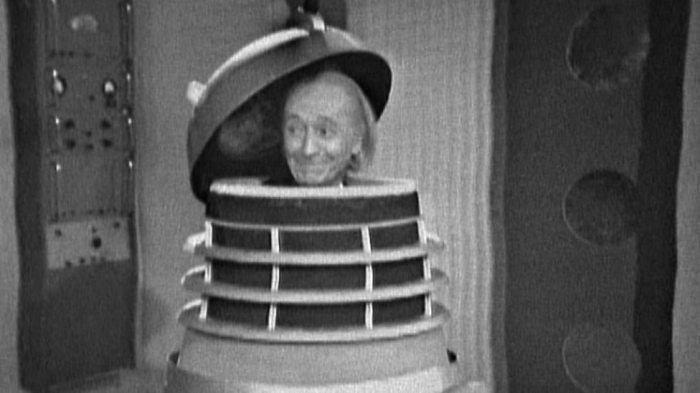
The other highlight is the moment when the Doctor decides to climb inside the Dalek exhibit. Naturally he can’t resist doing the voice as well! (“I fooled them all! I am the master!”) It’s a lovely moment and helps to make up for some of the less successful scenes elsewhere in the episode.

Doctor Who – The Space Museum. Part One – The Space Museum

sm1

The common consensus about this story is that it has an intriguing first episode but this early promise is then squandered as the remaining three installments consist of little more than a lot of tedious running about. Some, like Rob Shearman, have mounted vaillant defences on its behalf – but I think its reputation as an also-run is fairly safe.

Although saying that, it’s not a total disaster and it’s true that the opening episode does show plenty of promise. What’s unusual about this one is that it does attempt to show some of the consequences and paradoxes of time travel – an area which the series rarely tackled during its original run (Day of the Daleks, Pyramids of Mars and Mawdryn Undead are three fairly rare examples off the top of my head).

We open with a mystery – in the first few seconds the four time-travellers are still dressed in their garb from The Crusade, but seconds later they’ve changed into more familiar clothes. But since they don’t remember doing it, how has it happened?

The Doctor at first doesn’t quite get Ian’s drift when he tells him that they’re wearing their clothes (“well, I should hope so, dear boy. I should hope so”) but then airily dismisses their concerns. “You know, it’s so simple. It’s time and relativity, my dear boy. Time and relativity.” When asked to explain further, the Doctor claims he doesn’t have the time, but it’s obvious that he doesn’t have a clue!

Other strange instances – time runs backward after Vicki breaks a glass – are further puzzles, although these are harder to explain. If the Doctor’s later conjecture that they’ve jumped a time track is correct then that could explain the clothes issue – somehow the TARDIS has pushed them into their own future, so it would be reasonable they weren’t wearing their crusading costumes – but the glass/water mystery is more inexplicable.

Of course it could be that our old friend the TARDIS was attempting to raise the alarm that something was wrong (as it did during The Edge of Destruction). If that’s the case then it was with just as much success (i.e. not very much).

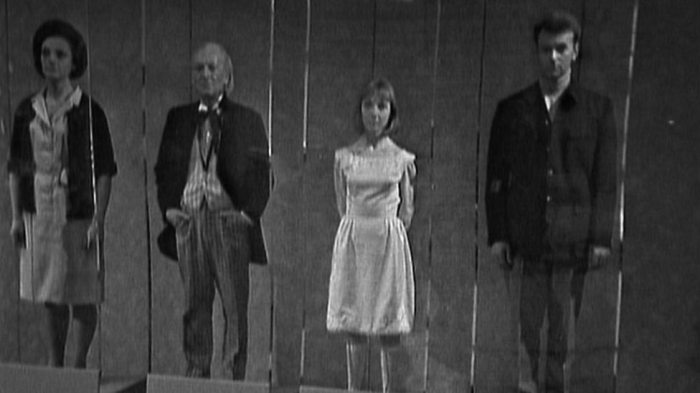
There’s an eerie feel to their initial investigation of the Space Museum. Although the four time-travellers seem corporeal and solid, it’s later revealed that they’re little more than insubstantial phantoms – unable to leave footprints in the dust, touch objects or speak to the inhabitants. When they find themselves displayed as immobile exhibits in the museum it’s a striking moment. In this version of the future the Doctor and his friends were captured and turned into exhibits, but that’s only a possibility – it doesn’t have to come to pass.

So they have the chance to change the future and ensure that this grisly occurrence doesn’t come to pass, but how to proceed? Should they go straight back to the TARDIS and leave? Or would that lead directly to the cases?

This part of the story is undoubtedly the highlight as it helps to raise the stakes of the adventure a little more (if they fail then they already know their fate). It’s also fair to say that had this started as just a normal adventure, without this timey-wimey subplot, then The Space Museum would be even less of interest than it currently is.

And we get to see a Dalek! Albeit as an immobile museum exhibit like everything else. It’s a nice foreshadowing of their imminent reappearance (you have to love Ian’s comment that it’s highly unlikely they’ll ever meet them again – I doubt many in the audience were convinced). What’s slightly odd is Vicki’s comment that she’s never seen an image of a Dalek, although she’s read about them in her history books. It’s hard to imagine that there wouldn’t be some visual evidence or photographs of them available during Vicki’s time.

The stock music is at times rather overpoweringly dramatic, although some of the tracks are successful in creating the required odd atmosphere. With the four regulars the only actors with speaking parts (at least speech that we can hear) it’s an excellent vehicle for all of them. For example, Vicki gets some dialogue which shows that whilst she (like Susan) may be sometimes written as a mid twentieth century girl, she’s most evidently not. “Time, like space, although a dimension in itself also has dimensions of its own.”

A more than decent opener, but what will happen when we meet the Moroks and Xerons?

Doctor Who – The Crusade. Part Four – The Warlords

If the previous three episodes of The Crusade tended to concentrate on the court intrigue at both Richard and Saladin’s camps, then The Warlords offers a sharp change of pace.

Saladin, Saphadin and Joanna are all absent and Richard himself only features in a single scene.  His brief appearance is partly to reassure the Doctor and Vicki that he knew they didn’t reveal his plan to Joanna (he was aware it was the Earl of Leicester, but confesses it was politically expedient not to confront him directly).

The scene also allows the Doctor to inform Vicki and the viewers at home that Richard would, ultimately, be unsuccessful in his aims.  He may only have a short amount of screen-time in The Warlords, but once again Julian Glover is unforgettable.

DOCTOR: There is something important, sire. If you are able to defeat Saladin in this battle, can you hold the city?
RICHARD: Win the battle, lose the war. The greatest fear we have. We’ve come so close. I must see Jerusalem. I must.
DOCTOR: You will, sire.
RICHARD: You think so?
DOCTOR: I am certain, sire. And when you look upon the city itself, you will be able to find the answer to the problem of this war. May we now take our leave, sire?
VICKI: Are we going back to the ship?
DOCTOR: As fast as our legs can carry us, my dear.
VICKI: Doctor, will he really see Jerusalem?
DOCTOR: Only from afar. He won’t be able to capture it. Even now his armies are marching on a campaign that he can never win.
VICKI: That’s terrible. Can’t we tell him?
DOCTOR: I’m afraid not, my dear. No, history must take its course.
(The Doctor and Vicki leave.)
RICHARD: Help me, Holy Sepulchre. Help me.

Ian (still on his mission to find Barbara) has unfortunately run into the villainous Ibrahim (Tutte Lemkow) who has devised a novel way to discover where Ian’s money is stashed.

A little pot of honey, made from pounded dates and very, very sweet. There, my lord, a little bit on your wrists and a little bit on your chest. Now, over there is a hungry home, full of ants that go wild for date honey. We must be generous to them. Lay a little trail across the sand, like this. And I will sit in the shade of the trees and dream of all the treasures I will get when the ants discover you. If you crane your neck around, my lord, you will soon see what you take to be a black line along the honey. Why, you will be able to see it getting closer and closer. My little ones! Such ecstasy!

Lemkow is good value, especially when Ian turns the tables on Ibrahim and forces the little thief to take him to El Akir’s palace.  From then on, Ibrahim becomes servile and keen to assist Ian (although there’s no doubt that he would be happy to change sides again at the first opportunity).

At the start of the episode Barbara is once more in El Akir’s clutches – although yet again she’s able to escape from him fairly easily.  This unfortunately doesn’t do the character of El Akir any favours – and his limited screen time during all four episodes does ultimately means that he’s not one of Doctor Who’s most tangible or memorable villains.

El Akir is more of a plot-device (initiating the story by attacking Richard and his friends, kidnapping Barbara to ensure that the Doctor can’t leave) than a fully-rounded character.

If you compare him to the likes of Tegana or Tlotoxl then he seems even more underwritten, although had this story been a six-parter there might have been more scope to develop him. As it is, he seems to be denied even a particlarly impressive death scene as the soundtrack suggests that Haroun quickly dispatches him quite abruptly. 

Since Haroun rescues both his elder daughter Maimuna and Barbara it unfortunately rather negates Ian’s mission (he turns up shortly afterwards).  It’s a little surprising that Ian doesn’t get the heroic fight with El Akir – particularly since William Russell was well able to handle a sword (he had previously starred in The Adventures of Sir Lancelot).

Ian and Barbara then head for the forest at exactly the same time as the Doctor and Vicki.  This is slightly sloppy plotting, as it would have been more logical for Ian and Barbara to return to Richard’s court (they had no way of knowing that the Doctor and Vicki had made an enemy of Leicester).

But clumsy though this moment is, it does give us a nice final scene as Ian is able to spirit the Doctor and Vicki away from under Leicester’s gaze.  Leicester watches in horror as the four time-travellers disappear in the TARDIS and resolves to “not speak of this. Let this story die here in this wood or we’ll be branded idiots, or liars. Poor Sir Ian, brave fellow. Spirited away by fiends. What dreadful anguish and despair he must be suffering now?”

If The Warlords doesn’t quite match the scale and sweep of the previous three episodes (and who are the titular Warlords anyway?) overall The Crusades is still a first class story which thanks to the cast and Douglas Camfield manages to transcend the limited budget and studio-space and produce something quite magical.

If the two missing episodes are never recovered, maybe one day animated versions can be produced – as it’s a story that certainly deserves to sit on the shelf alongside the rest of the second season.

Doctor Who – The Crusade. Part Three – The Wheel of Fortune

crusade-08

For me, The Wheel of Fortune is the best episode of The Crusade. It has three moments of special interest – Haroun’s life story as told to Barbara, the clash between Leicester and the Doctor and the confrontation between Richard and Joanna.

Haroun (George Little) lives for one reason only – to kill El Akir. He tells Barbara the reason why.

HAROUN: Last year my house was a fine and happy place. A gentle wife, a son who honoured and obeyed me, and two daughters who adorned whatever place they visited. Then El Akir came to Lydda and imposed his will. He desired my eldest daughter Maimuna, but I refused him.
BARBARA: So he took her?
HAROUN: Yes. When Safiya and I were away, he came and burned my house. My wife and son were put to the sword.

It’s a perfectly pitched and dignified performance by George Little. Whilst the character invites our sympathy, Little never overplays – instead he allows the script to do the work.

Equally good is Petra Markham as Safiya. Her father has never explained what happened to the rest of their family, but she has faith that all will be well. “It is a strange mystery. They’ve gone away and we must simply wait for their return. It is the will of Allah”.

Jacqueline Hill is also excellent these scenes – for example, the way Barbara listens in horror to Haroun’s story and later when nearly revealing the truth to Safiya about her missing family. Another key moment is when Haroun leaves Safiya in Barbara’s care. He leaves his knife behind and insists that she use it to kill Safiya and then herself if they’re discovered by El Akir’s men. Barbara is appalled (“No. Life is better than this.”) but Haroun is insistent. Again, Hill plays the scene very well, her performance helping to reinforce how cruel El Akir must be.

The spat between the Doctor and the Earl of Leicester (John Bay) is a very interesting one. It’s another of Whitaker’s lovely Shakespearian pastiches that Hartnell and Bay both deliver with aplomb.

Although the Doctor usually takes the moral high ground, he doesn’t really have it here. His dismissal of Leicester as having no brain doesn’t seem at all fair. Leicester is a soldier, trained to fight, and it’s difficult to argue with his statement that “armies settle everything”.

LEICESTER: Sire, with all the strength at my command I urge you, sire, to abandon this pretence of peace.
DOCTOR: Pretence, sir? Here’s an opportunity to save the lives of many men and you do naught but turn it down without any kind of thought. What do you think you are doing?
LEICESTER: I speak as a soldier. Why are we here in this foreign land if not to fight? The Devil’s horde, Saracen and Turk, posses Jerusalem and we will not wrest it from them with honeyed words.
DOCTOR: With swords, I suppose?
LEICESTER: Aye, with swords and lances, or the axe.
DOCTOR: You stupid butcher! Can you think of nothing else but killing, hmm?
LEICESTER: You’re a man for talk, I can see that. You like a table and a ring of men. A parley here, arrangements there, but when you men of eloquence have stunned each other with your words, we, we the soldiers, have to face it out. On some half-started morning while you speakers lie abed, armies settle everything, giving sweat, sinewed bodies, aye, and life itself.
DOCTOR: I admire bravery and loyalty, sir. You have both of these. But, unfortunately you haven’t any brain at all. I hate fools.

Saladin and Saphadin discuss the marriage proposal. Saladin is extremely cautious.

Have England, France and all the rest come here to cheer a man and woman and a love match? No, this is a last appeal for peace from a weary man. So you write your letter and I’ll alert the armies. Then on either day, the day of blissful union or the day of awful battle, we will be prepared.

And sadly that’s the last we see of Saladin and Saphadin as they, along with Joanna, don’t feature in the final episode. This does give The Warlords something of an anti-climatic feel, but we’ll discuss that in more detail next time.

When Joanna learns that Richard plans to marry her off to Saphadin, it’s fair to say that she’s not best pleased. The scene is a thrilling moment, as both Julian Glover and Jean Marsh attack it at full-throttle. It’s hard to find many examples of Doctor Who scenes pitched at such a level – which makes this one all the more special.

JOANNA: What’s this I hear? I can’t believe it’s true. Marriage to that heathenish man, that infidel?
RICHARD: We will give you reasons for it.
JOANNA: This unconsulted partner has no wish to marry. I am no sack of flour to be given in exchange.
RICHARD: It is expedient, the decision has been made.
JOANNA: Not by me, and never would be.
RICHARD: Joanna, please consider. The war is full of weary, wounded men. This marriage wants a little thought by you, that’s all, then you’ll see the right of it.
JOANNA: And how would you have me go to Saphadin? Bathed in oriental perfume, I suppose? Suppliant, tender and affectionate? Soft-eyed and trembling, eager with a thousand words of compliment and love? Well, I like a different way to meet the man I am to wed!
RICHARD: Well, if it’s a meeting you want.
JOANNA: I do not want! I will not have it!
RICHARD: Joanna!

As this is the last surviving episode of the story, it’s worth taking a moment to praise Douglas Camfield’s direction. He always had an eye for unusual camera angles, plus he isn’t afraid to place the actors in unusual configurations. This helps to make the frame more interesting than just having them stand in a line (something many other directors would have been content to do).

Barbara is back in El Akir’s clutches at the end of the episode (the second that’s ended with Barbara in peril). El Akir’s final words here are truly chilling, thanks to Walter Randall’s matter-of-fact delivery. If El Akir had been an eye-rolling villain then it would have been easier to discount his threats. It’s his calmness that’s somewhat disquieting.

The only pleasure left for you is death. And death is very far away.

crusade-09

Doctor Who – The Crusade. Part Two – The Knight of Jaffa

knight.jpg

Richard’s in something of a better temper at the start of this episode – in part due to the Doctor’s wily manoeuvrings. It’s interesting to note how the Doctor has easily lapsed into the speech patterns at Richard’s court, he’s started throwing “methinks” around quite casually!

RICHARD: There is a jest here, albeit a grim one with our friends dead. But Saladin must be just as much out of temper over this affair as we are.
DOCTOR: Your messenger might offer to exchange a hundred prisoners for the knight he holds.
RICHARD: We think we value Sir William highly. We do, but it would not be good to let Saladin know.
DOCTOR: He might think you undervalue his men. One hundred men to one of yours. Methinks a fair bargain, sire.
RICHARD: By my father’s name, you have wit, old man. Guard, call the Chamberlain. We recognise the service you have rendered us and will be pleased to see you in our court.

With the Doctor and his friends in Richard’s debt, this allows Ian (once he’s been knighted as Sir Ian, Knight of Jaffa) to begin his quest to find Barbara. This also handily removes William Russell from the main storyline (and he’s on holiday next week, so only appears briefly on film). When a story rich in plot-threads like The Crusade only lasts four episodes, it can be a problem finding things for everybody to do, so this simplifies matters – the Doctor and Vicki remain at court and Barbara finds herself in the clutches of El Akir.

As with first episode, David Whitaker’s dialogue (especially when spoken by actors as good as Julian Glover) is something to savour. Richard ponders the strange relationship he has with Saladin –

Saladin sends me presents of fruit and snow when I am sick, and now his brother decorates you with his jewels. Yet with our armies do we both lock in deadly combat, watering the land with a rain of blood, and the noise of thunder is drowned in the shouts of dying men.

The notion that Saladin’s brother, Saphadin, is captivated by Joanna (Jean Marsh), Richard’s sister, sets the King thinking. Could this be a way to bring the war to an end? He sets about drafting a proposal, although crucially he doesn’t think to speak to Joanna first.

And not only this kingdom, its towns and fortresses, shall be yours, but also the Frankish kingdom. Our sister, the Princess Joanna, whose beauty is already spoken of wherever men of judgement and discernment are, is a fit match for one who not only enjoys so grand. No, not grand, eminent. So eminent a brother as the Sultan Saladin but who also possesses an element of his own. Prince Saphadin, we beg you to prefer this match and thus make us your brother.

Richard is pleased with this and takes the Doctor and his friends into his confidence (which helps to bring them back into the main narrative). A story like this, focusing on the machinations of Kings, will inevitably tend to sideline the Doctor – although this isn’t something that David Whitaker necessarily had a problem with. He was of the opinion that when the Doctor travelled back in time he should be content to be merely an observer and not interfere.

Dennis Spooner (as can be seen in The Romans and The Time Meddler) had the opposite view, so this story (written by Whitaker, script-edited by Spooner) is something of an uneasy compromise between them.

But even if the Doctor is rather a passive figure at times, he does have some fun by bamboozling his adversaries. There’s another fine example in this episode, when we see the Doctor running rings around the unfortunate Chamberlain.

CHAMBERLAIN: This and this, stolen from me.
DAHEER: And stolen from me.
DOCTOR: Yes, now there really is a point there, isn’t there? If I stole from you, my lord Chamberlain, how could I steal from him?
DAHEER: You did. You did steal from me.
DOCTOR: Then how could I steal from him, eh, you blockhead?
CHAMBERLAIN: Please, please. Now, I had the clothes first.
DOCTOR: Oh, how nice for you.
DAHEER: And I had them second.
VICKI: Did you buy them?
DAHEER: Yes.
VICKI: From us?
DAHEER: No.
DOCTOR: Then whoever it was stole them from you must have sold them to you. Now, don’t you agree?
CHAMBERLAIN: Er, yes.

The episode ends with Barbara escaping from El Akir’s guards. She runs through the streets of Lydda, desperate for a hiding place. But will she find friend or foe?

Doctor Who – The Crusade. Part One – The Lion


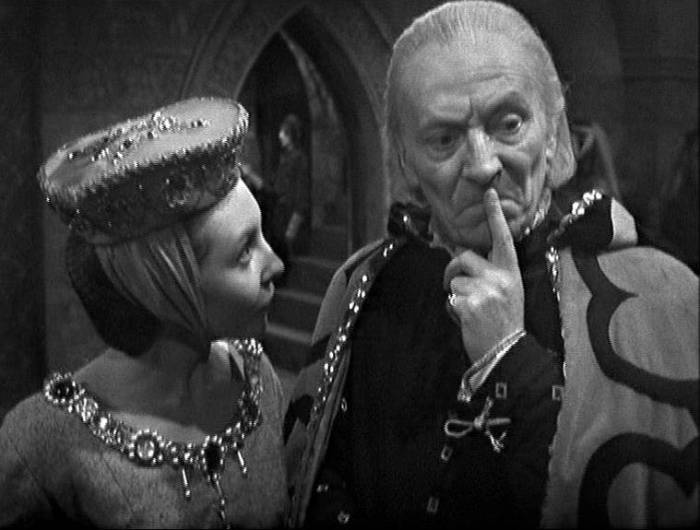
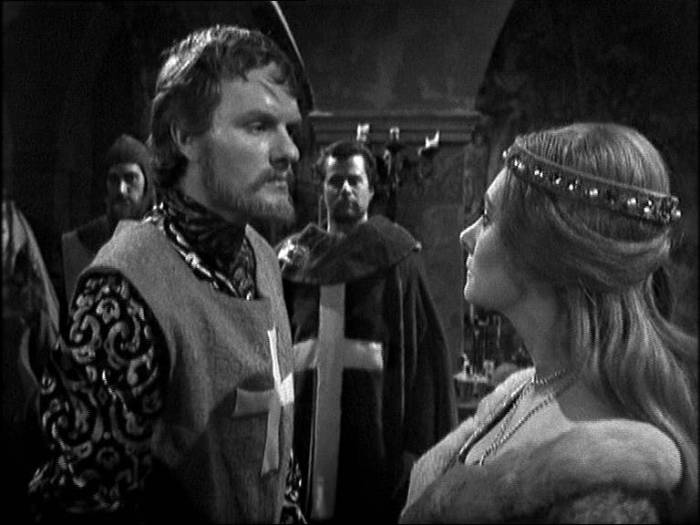
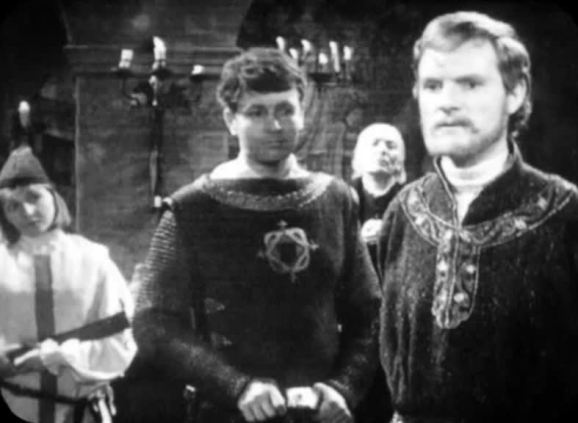
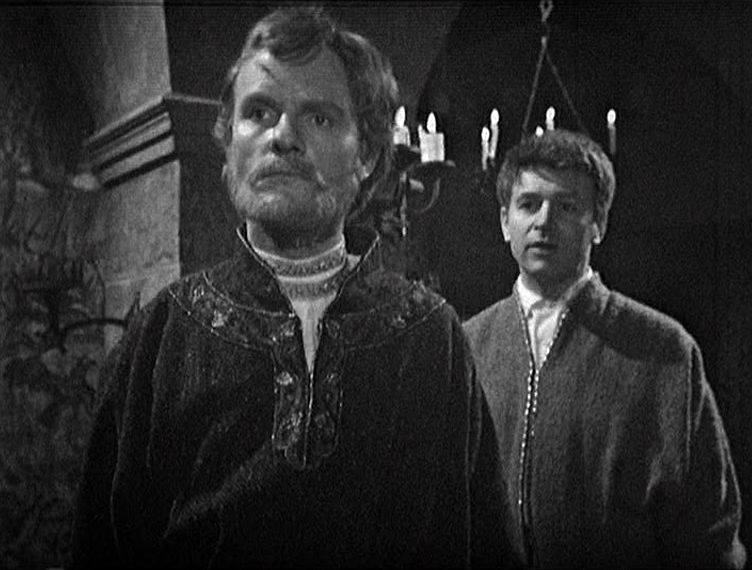
The Crusade brings the TARDIS to the Holy Land at the time of the Crusades.  Whilst the Doctor, Ian and Vicki eventually join the court of King Richard (Julian Glover), Barbara finds herself in the enemy camp, captured by the evil El Akir (Walter Randall) and brought face to face with Saladin (Bernard Kay).

Given that this story was made in 1965, it does have a rather surprising revisionist feel about it.  Since Richard the Lionheart had for so long been portrayed as one of England’s greatest heroes (the Robin Hood saga often hinges on the hope that one day Richard will return to right the wrongs of his brother) it’s a jolt to find him painted as a somewhat unheroic and uncertain character.

The episode opens with Richard and his friends relaxing in the forest.  Sir William des Preaux (John Flint) fears an attack – but Richard is arrogantly dismissive.  It quickly transpires that des Preaux was correct and shortly after many of Richard’s friends are slain.

Barbara and William des Preaux are captured by the Saracens, whilst the only other survivor (apart from Richard himself) is Sir William de Tornebu (Bruce Wightman).  de Tornebu owes his life to the intervention of the TARDIS crew – thanks mostly to Ian, although the Doctor plays his part (it’s always a treat to see William Hartnell in fighting mode!).

William des Preaux claims to be the King in order to draw attention away from Richard. At this point in the story the cramped nature of the studios is quite noticeable – as good a director as Douglas Camfield was, it’s impossible not to notice that Richard was lying very close to where des Preaux was captured.  It’s therefore difficult to believe that El Akir and the other Saracens couldn’t see him.

After the Doctor finds some suitable clothes for himself, Ian and Vicki (via the sort of comedy business moment that Hartnell always excelled at) there are two main scenes left in the episode – Barbara’s meeting with Saladin and the Doctor, Ian and Vicki’s first encounter with Richard.

Despite being caked in brown make-up, Bernard Kay is mesmerising as Saladin.  He has the power of life and death over Barbara – and many others as well – but he has no need to be demonstrative.  He remains thoughtful, restrained and articulate as he probes the reason for Barbara’s presence.

SALADIN: Please talk. It helps me to consider what I have to do with you.
BARBARA: Well, I could say that I’m from another world, a world ruled by insects. And before that we were in Rome at the time of Nero. Before that we were in England, far, far into the future.
SALADIN: Now I understand, you and your friends, you are players, entertainers.
SAPHADIN: With little value in an exchange of prisoners with the English King, brother. This is a trivial affair. I do not know why you waste your time.
SALADIN: I cannot dispense life and death lightly. If Sir William is to be returned, he must make good report of our mercy. Perhaps that is the factor in your favour.
BARBARA: I don’t believe you’re as calculating as that.
SALADIN: Then learn more of me. You must serve my purpose or you have no purpose. Grace my table tonight in more suitable clothes. If your tales beguile me, you shall stay and entertain.
BARBARA: Like Scheherazade.
SALADIN: Over whose head hung sentence of death.

By contrast, Julian Glover’s Richard is highly emotional (no doubt the difference between Saladin and Richard was an intentional touch from Whitaker).  Richard berates the loss of his friends, although it’s difficult not to concede that his own reckless actions were, in part, responsible for the calamity.

The Crusade is one of those stories where, as we’ll discuss later, the Doctor and his friends are largely superfluous. Julian Glover is so good (and he’s provided with some lovely Shakespearean-type speeches by David Whitaker) that it’s very easy to imagine this story as a straight play without the TARDIS crew being present.

Once again, I am in your debt. But I’d give this for de Marun and the others. My friends cut down about my ears or stolen. My armies roust about the streets and clutter up the streets of Jaffa with the garbage of their vices. And now I learn my brother John thirsts after power, drinking great draughts of it though it’s not his to take. He’s planning to usurp my crown, and trade with my enemy, Philip of France. Trade! A tragedy of fortunes and I am too much beset by them. A curse on this! A thousand curses!

Terrance Dicks (1935 – 2019)

td

Growing up, Terrance Dicks’ Doctor Who novelisations were my staple reading diet. The Target range had other writers of course, but some of their books (like the two by David Whitaker) seemed a bit intimidating (especially the dense Crusaders).

Terrance may sometimes have been criticised for being a plain, straight-ahead sort of writer, but it’s undeniable that his books were perfectly pitched for his young readership. When I was slightly older I had the confidence to tackle The Crusaders, but had Terrance not been there first then maybe I wouldn’t have made the leap.

It’s a common refrain to hear people say that Terrance Dicks taught them to read, but it’s also true in so many cases ….

His contribution to Doctor Who in general was immense.  He wrote and co-wrote some excellent stories, but his work as possibly the series’ most efficient script editor really stands out. Having witnessed the script chaos which bedevilled the series during the late Troughton era, Dicks (with Barry Letts as a strong and supportive producer) brought stability back to the production office.

Dicks’ formula was simple – find a small group of writers you could depend on (Robert Holmes, Brian Hayles, Terry Nation, Malcolm Hulke, Robert Sloman, Bob Baker & Dave Martin) and then keep on recommissioning them. Sounds simple, doesn’t it?

Outside of Doctor Who, his work as first script editor and then later producer on the Classic Serials is worthy of further investigation. Like Doctor Who they had to get by on fairly small budgets and this might be one of the reasons why eventually they fell out of favour. By the mid eighties, glossy all-film productions of classic novels were the way forward and the humbler Classic Serial began to look second best by comparison. But many have stood the test of time well and still entertain today (such as the 1984 Invisible Man).

I’m also prepared to fight the corner of Moonbase 3, a series which I have a great deal of love for. It’s far from perfect (indeed Letts and Dicks’ series opener is especially stodgy) but it’s something I find myself drawn back to again and again. Although I’m not quite sure why ….

This evening I’ll be spinning Horror of Fang Rock in tribute. Not only is it a great story, it’s also a perfect example of Dicks’ no-nonsense style. Forced at the eleventh hour to cobble together a new story (after his previous submission was vetoed) Dicks didn’t panic – he simply rolled up his sleeves and got on with it.

Fang Rock is archetypical Doctor Who – take a group of bickering characters, trap them in an enclosed space with no hope of escape and then kill them off one by one.  It’s hard to go wrong with such a formula and Dicks didn’t disappoint.

He was inadvertently helped by Tom Baker who was in an even more stroppier mood than usual – but his disdain for the script, his co-star, Pebble Mill studios, director Paddy Russell and just about everybody and everything else actually seemed to work in Fang Rock‘s favour. Tom’s Doctor was never more alien and foreboding than he was in this story – and even if this was something to do with the fact that Tom was missing his regular Soho drinking haunts, no matter.

The Fang Rock DVD also boasts a lovely Terrance Dicks documentary and a lively commentary track where Dicks, Louise Jameson and John Abbott swop stories (often about Tom of course).

Judging by the way Terrance is trending on Twitter at the moment I’m sure I won’t be alone in paying tribute tonight. RIP sir and thank you.

terrance

A few thoughts on humour in late seventies Doctor Who

kroll.jpg

Spurred on by TV Years sharing this late seventies audioclip of Jon Pertwee rubbishing K9, I’ve been having another ponder about the state of Doctor Who during that time. Personally, I love this era of the show – but I’m aware that not everybody shares this view.

At least today it has more love amongst fans than it did at the time (although the general public, fools that they were,  seemed to enjoy it). At the time, as can be evidenced from that short clip, it wasn’t just Pertwee who was dissatisfied. Mind you, I’ve always had the strong sense that Jon Pertwee never forgave Tom Baker for being more successful than him in the role ….

But it’s true there was a vocal section of Doctor Who fandom who were convinced that Tom Baker and Graham Williams were ruining the show. Everything was just too silly for them – if only DW could recover its gritty roots, then all would be well.

This viewpoint lasted well into the eighties. Having leafed recently through a number contemporary fanzines, it’s not uncommon to come across articles which write off all of Graham Williams’ three years as a total disaster. By the early nineties the balance had changed though – Williams was in and JN-T was out.

That’s the way fandom worked – if you disliked S17 then you liked S18, if you liked S18 then you disliked S17. Liking (or indeed disliking) both or bits of both didn’t seem to be an option. You had to nail your colours to a mast (Williams for ever, JN-T never, etc).

It always surprises me when somebody today vouchsafes the opinion that humour in late seventies Who ruined the programme.  This rather ignores the fact that DW light-heartedness didn’t begin in 1977 (Hartnell, Troughton and Pertwee all had their comic moments).

Also instructive is the way that certain Hinchcliffe stories (The Android Invasion, The Brain of Morbius) display a wisecracking Doctor very similar to the later Williams model. Slicing DW into discrete eras depending on when the various producers arrived and departed is something we’ve always done, but it doesn’t always work (see also Meglos, something which easily could have slotted into S17).

I’ve never bought into the assertion that S15-S17 are total gigglefests from start to finish. There are plenty of gags and comic moments, but there’s drama as well.  I sometimes feel I’m ploughing a lonely furrow when I declare my love for the likes of The Creature From The Pit or The Horns of Nimon but that’s okay.  Who needs to be popular?

nimon

“What has happened to the magic of Doctor Who?”

dead1.jpg

I’ve recently been re-reading Licence Denied, Paul Cornell’s 1997 anthology of Doctor Who fanzine articles. The first entry in the book was Jan Vincent-Rudzki’s 1976 demolition of The Deadly Assassin.  Reproduced in full below, it’s an absolutely fascinating read.

Few Who stories go very much against what has been done before, but recently this has changed. First, there was “Genesis of The Daleks,” then “Revenge,” “Morbius,” and now “Deadly Assassin,” or rather “Deadly Continuity.” But first let us look at the programme as someone who hardly ever watches. The costumes and sets are quite effective, but a little too Flash Gordon. It has a good cast and was well acted. The story was fair but did not hold together too well.

Now let’s look at the story as Doctor Who viewers. The following is not only my view, but that of many people (including people who aren’t avid fans). First, congratulations to Dudley Simpson for using Organ Music for the Time Lords, but thumbs down for not using his excellent Master theme. Then there’s the more than usually daft title. Have you ever heard of an assassin that isn’t deadly?

On to the ‘story’. Before we even started we heard the same boring cliche: ‘the Time Lords face their most dangerous crisis’. I suppose Omega was a minor nuisance! The next blunder was the guards. Why were there any? The Time Lords were supposed to be very powerful, so much so that anyone strong enough to invade would swat the guards with ease, and Time Lord technology should be able to deal with minor intrusions.

Then came the TARDIS. Before, it was MK 1 and the Master’s and Monk’s were very different marks of type 40 TT capsule, but why only one missing? As for such and advanced race being unable to find someone in 52 (sometimes 53) storey building. Ridiculous! I’ve always thought Time Lords names were secret and unpronounceable, so why do we suddenly know their names?

‘C.I.A’ was certainly not appreciated, nor Time Lords with bad hips. There is a time and place for humour and this wasn’t it. Particularly Runcible whose demise I was certainly not sad about. This story really showed up the infatuation for Earth people in Doctor Who. It could have been set on Earth and no one would have known the difference. Doesn’t R. Holmes realise that Time Lords are aliens and do not need to conform to human motivations whatsoever? This fact was well brought out in ‘War Games’, but ignored here.

Elgin said that premonition does not exist. Yet the Doctor had them in ‘Time Monster’, ‘Frontier In Space’, ‘Evil of The Daleks’ and ‘War Machines’. I was surprised by the Doctor saying that Time Lord machinery was ‘prehistoric’. Mr Holmes seems to have forgotten that the whole Time Lord way of life is to ‘observe and gather knowledge’.

So apart from the fact that they are supposed to be one of the most advanced civilisations (brought out so well in ‘War Games’ and ‘Genesis’) they could have easily copied more advanced races. For instance in ‘The Three Doctors’ the Time Lords were amazed that there was a force more powerful than themselves. They were pretty powerful pre- ‘Deadly Assassin’.

In ‘Deadly Assassin’ the Time Lords seem to have forgotten the Doctor yet we’ve always been led to believe it’s very rare for a Time Lord to leave Gallifrey. So he should be remembered, particularly as in ‘Three Doctors’ he saved Gallifrey (and the universe of course!) from destruction, and Borusa said they needed heroes.

The trial of the Doctor was another R. Holmes farce. The ‘War Games’ trial was so excellent, but of course this had to be in Earth norms, and was pathetic. Then later the Doctor and co. go to look at the public register system to see that really happened at the ceremony. Now we were, I believe, dealing with Time Lords, so why couldn’t they and look at a time scanner and see the truth?

Also, why need the brain machine to predict the future? Another fact forgotten is that Time Lords are immortal. In ‘War Games’ the Doctor said they could ‘live forever barring accidents’. This had never been changed until ‘ Morbius’ where we learnt that the Time Lords used the Elixir if they had trouble regenerating. So why didn’t the Master use the Elixir? We also saw in ‘Morbius’ eleven incarnations of the Doctor (‘though in ‘Three Doctors’ Hartnell was rightly the first) so now we’re left with one more Doctor, according to ‘Deadly Assassin’.

Then there wasn’t Part 3 which must be the biggest waste of time ever in ‘Doctor Who’. A ten-minute trip into the matrix would have sufficed, but 25!

One minute Elgin was saying there’s no way to tap the machine, the next he was taking the Doctor down the other ‘old part of the city’ which looked just like all the other parts. When Goth was discovered we heard the daft reason for him helping the Master, for an exchange of knowledge. Again ignorance of the Time Lord way of life is shown by R. Holmes. Goth should have been quite able to go to the extensive library and sit at a Time Scanner for a few decades or so, and find out everything himself. He could even have followed the Master’s travels on the scanners!

Borusa recognised the Doctor, but since the Doctor and the Master were at school together wouldn’t Borusa remember the Master? Also what’s this rubbish about the Doctor being expelled? We know he has a Time Lord degree in ‘Cosmic Science’ (and that was revealed in R. Holmes story!)

I was stunned to discover that the Doctor doesn’t know his own people’s history! The Time Lords would have their own history completely documented. After all, they can look back at time, so what’s all this nonsense about myths? And surely somebody would have wondered what that lump and two holes in the Panopticon floor were.

Of course, part 4 saw the return of the same old story. It couldn’t just be Gallifrey in danger, it had to be a hundred other planets in danger.

You’d have thought that not much else could be wrong with the story, but there was more to come. Time Lord power sources are well known to be novae etc., as Omega produced, not some silly black box with tubes. I would also like to know how the Doctor managed to climb up a 100′ shaft with smooth side and with plastic rocks falling on him.

Also, even if the Master was protected by the sash when everything was to be swallowed up, what point would there be to floating around in space – not much! Things get even more ridiculous when the Master falls down the deep hole (his yell lasted a long time) and he’s back very soon, regenerating (due to absorbing energy). If all he needed was energy why didn’t he use his TARDIS, like anybody else, to regenerate?

For some of these blunders you could argue that the story was set far into the future eat a time when the Time Lord race is degenerating. but it can’t be as the Doctor was recognised. No, the new rule for Doctor Who seems to be the reason, which is ‘anything pre-Holmes needn’t exist’, which can’t be good for a script editor.

What must have happened was that at the end of ‘Hand of Fear’ the Doctor was knocked out when the TARDIS took off, and had a crazy mixed-up nightmare about Gallifrey. As a Doctor Who story, ‘Deadly Assassin’ is just not worth considering. I’ve spoken to many people, many of whom were not members, and they all said how this story shattered their illusions of the Time Lords, and lowered them to ordinary people.

Once, Time Lords were all-powerful, awe-inspiring beings, capable of imprisoning planets forever in force fields, defenders of truth and good (when called in). Now, they are petty, squabbling, feeble-minded, doddering old fools.

WHAT HAS HAPPENED TO THE MAGIC OF DOCTOR WHO?
dead2

TV Comic – The First Doctor. On The Web Planet

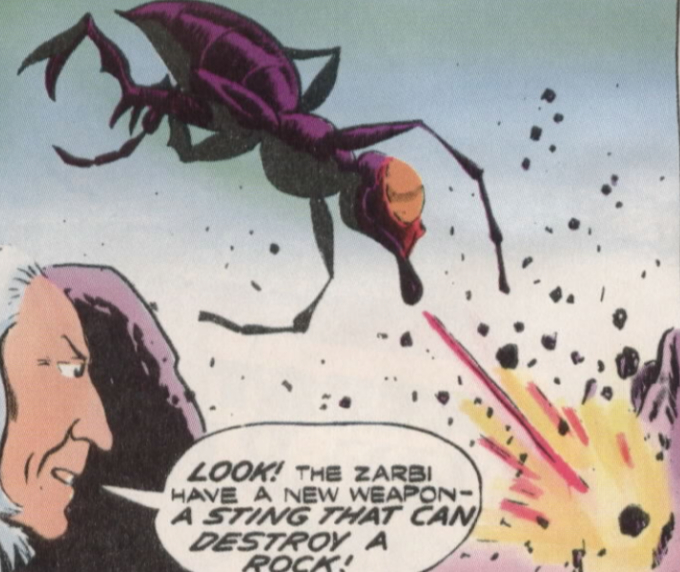
The Doctor returns to Vortis – only to tangle once again with the Zarbi. Thanks to TV Comic’s usual brisk efficiency we only have to wait until the fourth panel on the first page before Doctor Who confronts his old enemies.

But wait! Now they can fly … and that’s not all. “LOOK! The Zarbi have a new weapon – A STING THAT CAN DESTROY A ROCK!” Easy Doctor, no need to shout ….

But there are familiar allies on Vortis as well.  The friendly Menoptera (who unlike their television counterparts don’t have names) quickly befriend Doctor Who and explain to him that all the trouble seems to emanate from a mountain area. It’s from there that the Zarbi have somehow learnt to fly ….

That the Menoptera aren’t the most proactive of races is made clear after the Doctor discovers a spaceship on top of the mountain. “We did not know this was here” exclaims the Menoptera.  That’s a little hard to believe, just how long have the Zarbi been flying about and blasting them to atoms? Surely after a while someone would have thought it might just be worthwhile to explore the mountain?

A mysterious mushroom-like object suddenly rains down a hail of gunfire on our heroes.  But Doctor Who is beginning to see the light (after ducking for cover).  Picking up a piece of rock, he declares that it’s Glavinium X – the rarest mineral in the universe.  It just looks a mouldy old piece of rock to me, but I’ll bow down to the Doctor’s greater scientific knowledge.  He then explains that the mineral could be used to build bombs of terrifying power.

Gillian, who so far has done precisely nothing (at present we’ve reached the final panel of the second instalment, so we’re four pages in), is given a close-up as part two ends on the cliffhanger of a Zarbi menacing her.  But John quickly bops it on the nose with a rock at the start of part three, so this mild crisis is averted.

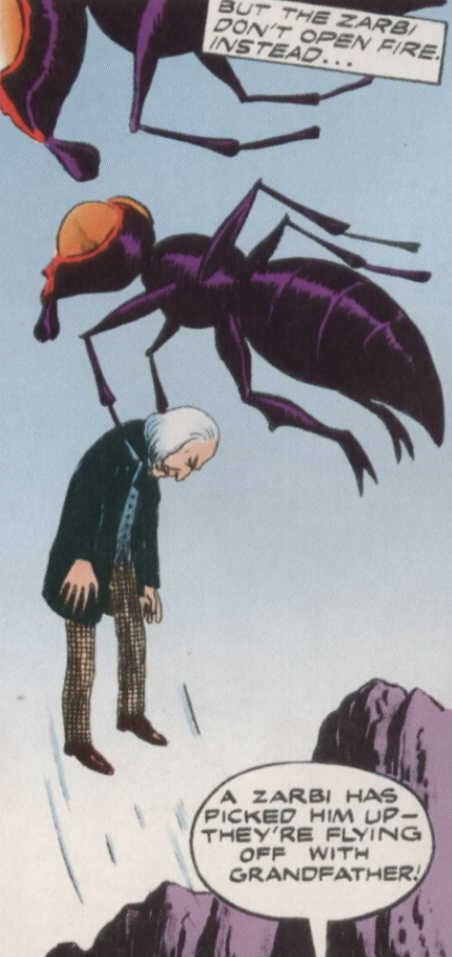
We then see the Doctor casually handling a spacegun as he amuses himself by picking off the Zarbi. “Got it! That’s one less to deal with!” Possibly it’s the Doctor’s trigger-happy nature which makes him a target – as shortly afterwards a passing Zarbi drops a rock on his head (“grandfather has been struck by a flying rock” says John, stating the patently obvious) and swoops down to carry him away.  The sight of the Doctor in the clutches of the Zarbi is a striking image.

If the story wasn’t strange enough, then things then get a little stranger.  John discovers that the Zarbi are nothing but hollow shells, operated by a warlike race called the Skirkons who don’t believe in small talk. “Soon we will be masters of the universe”. It’s always good to think big.

Quite why the Skirkons (who piloted the mysterious mountain ship to Vortis of course) elected to masquerade as the Zarbi is a puzzle that’s never answered.

The concept of a hollowed out Zarbi seems to have been a popular one, since it also featured in a story in the first Doctor Who annual. What’s interesting is the fact that this TV Comic strip was published during March and April 1965 whilst the annual wasn’t released until September 1965.  Was David Whitaker, who wrote all the stories in the first annual, inspired by this story? It might have been so ….

Zarka, leader of the Skirkons, taunts Doctor Who and then straps him to a table. Unless the Menoptera surrender, the Doctor will be neatly sliced in two by the venom ray.  This is so reminiscent of a scene from Goldfinger that it’s a great shame that the Doctor doesn’t ask Zarka if he expects him to talk. 

But John and Gillian, disguised in a Zarbi suit, are on hand to rescue the Doctor. John keeps the Skirkons covered with a gun, although Zarka remains confident.  “You won’t get away with this. No one can stop my plans, no one”. He’s not the most interesting of conversationalists, that’s for sure.

How does the story end? With a rather large explosion of course, as once again Doctor Who delights in blowing his enemies to pieces. Not quite in the spirit of the television series, but there you are.  The Menoptera are chuffed though and as the TARDIS goes spinning off into space, they have the last word. “They have gone – into the mysterious depths of time and space again!”

Doctor Who – The Web Planet. Part Six – The Centre

Picking the silliest moment from The Centre is difficult, mainly because there’s so many to chose from.  But Hilio, Hrostar and Hylina screeching “Zaaarrrrbbiiiii” whilst flapping their arms about in an attempt to distract the Zarbi does take some beating.  It’s a little over three minutes into this episode if you want to check it out for yourself.

Whilst the Menoptera and Barbara are fooling about with the Zarbi, the Doctor and Vicki are taken to the Centre.  The Animus is revealed in all its glory – a mass of writhing tentacles.  There’s an uncharacteristic spot of overacting from Hartnell, when he delivers the line “this infernal light is too bright for my eyes”.

The Doctor then collapses, which leaves Vicki to resist the power of the Animus by herself.  The set is quite moodily lit, which helps to sell the illusion that the numerous rubber tentacles are actually part of a controlling intelligence (and not just being pulled off-camera by the crew!)

A major disappointment is that revelation the Animus’ ultimate aim concerns the invasion of Earth.  “What I take from you will enable me to reach beyond this galaxy, into the solar system, to pluck from Earth its myriad techniques and take from man his mastery of space.”

Since this has been such a strange, other-worldly adventure it’s incredibly jarring to find that the Animus seems to be fascinated with the totally unremarkable planet Earth.  Although if it believes the Doctor to be human that might explain its assumption that human beings have mastery over space.

The defeat of the Animus is a bit of a damp squib (Barbara waves the Isotope around for a few seconds).  After six episodes you’d have hoped for something more impressive than that.  But at least it allows Barbara to save the day.

And then it was over.  I’ve developed a little more appreciation for the story thanks to this rewatch, but it still proved to be something of a trial (especially over the last few episodes).

Doctor Who – The Web Planet. Part Five – Invasion

Whilst the ratings for The Web Planet were high, the Reaction Index went on a decreasing slide week after week.  Things started brightly enough, with a rating of 56% for episode one (an improvement over The Romans, although a few points lower than most of the Doctor’s space adventures to date) but by episode six the figure had tumbled to 42% (the lowest RI rating the series had received so far).

It’s not hard to understand why the general reaction was so unfavourable.  As I said earlier, had it been a four-parter they might have just got away with it, but by Invasion there’s a real sense of treading water.  Watching Hartnell turn a Zarbi into his compliant pet does have a certain comedy value, but these moments only stretch so far.  Vicki’s quite taken with the friendly Zarbi though, nicknaming him Zombo.

But although parts of the story are painful and/or dull, there are still some occasional lyrical moments of scripting which almost makes it all worthwhile. In this scene, Prapillus (Jolyon Booth) and Barbara enter the temple of light.

BARBARA: It’s beautiful, Prapillus. Oh, it’s absolutely beautiful!
PRAPILLUS: It must be a Temple of Light. The ancient song-spinners of our race sang of their beauty, but I thought they could never be found again.
BARBARA: There are others?
PRAPILLUS: So the legends say. Sewn into the craters and plateaus of Vortis, been slowly un-woven by the silence of time and their entrances long forgotten by our species. But our Gods have not forgotten us, Barbara. This was indeed deliverance.

Another positive part of the serial is that Barbara, thanks to her association with the Menoptera, is probably the most proactive of all the TARDIS crew.  Although visibly frightened by the events of episode one, she quickly recovers and teams up with her new friends in order to find a solution to beat the Zarbi and the Animus.  The downside is, of course, that she spends most of her time surrounded by the ridiculously overacting Menoptera, but then you can’t have everything.

Something that’s noticeable about Invasion is how little ambient noise there is.  A slight echo effect is given to the cave and tunnel sets, but that’s about all.  Combined with very minimal incidental music it does create a rather “dead” atmosphere.  One plus point is that there’s very little Zarbi chirping in this one – although when that’s removed they do seem even less convincing than before.

The Optera make another appearance.  Pity anybody who happens to be watching these scenes when a non-fan enters the room.  How would you be able to explain them?  Not easily, that’s for sure.  But even though they still look very silly, as with Prapillus there’s the odd inspirational moment of dialogue.  “A silent wall. We must make mouths in it with our weapons. Then it speak more light.”

Whilst Barbara’s raised several possibilities about how the Menoptera could fight the power of the Carsinome, it’s only when she’s reunited with the Doctor and Vicki that the planning can begin in earnest.  The Doctor takes instant control in a very characteristic way.  He and Vicki then elect to return to the Animus, which provides us with a very unsettling cliffhanger – the pair of them are frozen into solidity, surrounded by gently bobbing Zarbi.

Doctor Who – The Web Planet. Part Four – Crater of Needles

crater

Uh oh, it’s the Optera. Underground cousins of the Menoptera, they look and sound ridiculous. During this story they’re hardly alone in that, but it was their hopping movements which proved to be the final straw for me. This is a pity, as their dialogue has promise. Here, Hetra (Ian Thompson) outlines the Optera’s philosophy. “We know that from the roof comes hate! The liquid death! Creeping destroyer of we Optera. Yet you stand upright. We will consult the chasm of lights and if you come from above, you will die!”

Last episode was quite Menoptera light, but they’re back in force in this one. That means plenty of dialogue delivered in a sing-song manner and excessive hand movements. And as the majority of the episode is set on the planet’s surface, it’s back to the vaseline-smeared camera shots, which continue to be somewhat distracting. This is undoubtedly the point of the story where you know it’s going to be a long, hard slog to the finish line.

There are a few amusing moments though, such the continuing question as to why the Zarbi are frightened of a tiny (and very dead) spider. Barbara and the Menoptera’s attack on one of the venom guns is another notable incident – the high camera angle enables the actor under the costume to crawl away, which allows one of the Menoptera to pick up the empty shell and squish it against the wall, rather like one would deal with a bug.

You have to respect William Russell – an actor who never gave less than 100%. Even when surrounded by the Optera he ensures that Ian doesn’t for a moment give the audience the impression that this is all faintly ridiculous. It’s a difficult balancing act – with a less skilled actor, Ian would simply become po-faced and unbelievable – but Russell manages to ensure that Ian keeps his credibility at all times.

By far the most notable new arrival is that of Hilio (Martin Jarvis). Over the last fifty years or so he’s become one of Britain’s most distinctive actors, thanks to numerous film, stage, television and radio appearances. It’s hardly surprising that he’s not so recognisable here, but his familiar vocal tones are present and correct.

This wasn’t the easiest of episodes to navigate, but at least we’re four down with two to go.

Doctor Who – The Web Planet. Part Three – Escape to Danger

Ah, Escape to Danger.  I wonder if Terrance Dicks tuned into this episode and mentally filed away the title for later use, as it often turned up as a chapter heading in his Target Doctor Who novelisations.  Indeed, just to read those three words transports me back to the 1970’s and that strange world where old Doctor Who was only accessible via the Target book range.  But that’s a blog post (or series of posts) for another time.

Back to this Escape to Danger, the Doctor finds himself quizzed by the Animus who is convinced that the Doctor and his friends are the Menoptra.  This instantly begs the question, does the Animus not know what the Menoptra look like?  Is the Animus blind or might the script implying that all humanoid shapes look the same to it?  In another story it may be reasonable to assume that this was just a case of sloppy scripting, but on the bizarre world of Vortis nothing can ever be taken for granted.

Speaking of sloppy scripting, a moment later Vicki stumbles on a control panel which, according to the Doctor, realigns the fluid link and thereby restores the TARDIS’ power.  Eh?  This is obviously a nod back to The Daleks – although had the fluid link been removed from the ship this would have made more sense (although the image of the Zarbi, with their flapping arms, burrowing under the TARDIS console doesn’t bear thinking about!).

We have to assume that the Animus is so powerful that it can disable a vital function of the ship from a distance.  It’s very convenient that Vicki’s blundering reverses this action, but that’s hardly the worst flaw in the story.

The Doctor’s pleased as punch about this and moves to the front of shot to deliver the following short speech.  “Trying to destroy my ship, you will achieve nothing. Nothing! I have great secrets in my ship. We could help you.”  After more than a few wobbles earlier in the story Hartnell is on much firmer ground here and – with his hands clasped – shows the Doctor at his imperious best.  With Vicki and Ian framed in the background it’s a nice, still, moment.

We then see the first flying Menoptra and also witness the Zarbi’s puzzlement as to where they might have gone.  They look at the ground rather than up in the sky, but due to their restrictive fibreglass costumes that’s hardly surprising!  This episode also has the immortal moment where one of the Zarbi rushes headlong into a camera, making an audible thump (although the noise was sadly toned down a little for the DVD release).

Whilst Ian nips off to look for Barbara, the Doctor and Vicki remain behind at Zarbi HQ.  Ian’s fight with a Zarbi has to be seen to be believed – and although brief it was obviously uncomfortable for poor Robert Jewell, stuck within the unforgiving Zarbi costume.

According to contemporary reports, after the scene was completed he was left in considerable pain following the moment when Ian knocks the Zarbi to the floor.  Ian’s escape is also the cue for the remaining Zarbi to rush about like headless chickens, beeping all the time.  As I’ve said before, a little of this goes a long way, but unfortunately  we’re only about halfway through the story.

Ian makes the acquaintance of Vrestin (who refers to him as Heron for the rest of the story).  Vrestin is able to fill in the backstory for the audience. “The Zarbi are not an intelligent species, but they were essential to the life pattern here. We lived at peace with them, until they were made militant by the dark power. The Animus. At that time, the Carsinome appeared. Grew like a fungus. We had no weapons. We had not had the need. And by the time we sensed the danger, the Zarbi were too strong.”

Had The Web Planet been a four-parter it might possibly be better regarded as I’m still just about hanging on in there.  But things might get rougher over the next few episodes …..

Doctor Who – The Web Planet. Part Two – The Zarbi

The Doctor’s being rather dense at the start of The Zarbi.  He spends several minutes totally perplexed at the disappearance of the TARDIS before Ian points out the rather obvious marks on the planet’s surface, which indicate that it’s been dragged away.  Let’s be kind and surmise that the lack of atmosphere has slightly affected his usually sharp intellect.

The model shot of the TARDIS moving over the surface of Vortis is rather sweet whilst inside the ship Maureen O’Brien does some sterling staggering-about acting.

The appearance of a Zarbi on the TARDIS’ monitor is an unsettling one.  Vicki’s expression conveys a nice air of silent dread (although it was scripted that she should scream).  If I’d been Richard Martin I would have chosen this as the moment to reveal the Zarbi for the first time.  This brief close-up would have been an intriguing moment – what does the rest of the creature look like? – before the full reveal of several of the creatures surrounding the Doctor and Ian a little later.

Barbara is rescued by the Menoptra.  Unlike the Zarbi they can speak and have personalities, although their strange hand movements and voices do get a little wearing after a while.  Roslyn De Winter, who played Vrestin, was responsible for their choreography, earning her the oddest credit on any Doctor Who episode (“Insect movement by Roslyn De Winter”).

When Ian and the Doctor are surrounded by the Zarbi, there’s a high shot which give a decent sense of scale to proceedings.  Such camerawork wasn’t often seen in the series at the time, no doubt because it would take too long to set up, so it’s welcome to see it here. A small recompense for many of the other, more clumsy, moments.

Hartnell’s been more settled in this episode, although his bizarre hand gestures when he attempts to communicate with the Zarbi is yet another oddity in this most odd of stories.

One of the obvious problems with the Menoptra all looking so similar is that when there’s several of them in a scene it’s hard to tell who’s who.  This was certainly the case earlier on when Barbara was surrounded by Hrhoonda, Hrostar and Vrestin.

But towards the end of this installment Barbara and Hrostar are captured by the Zarbi and although they don’t appear in episode three, they do share some decent two-handed scenes in episode four which allows time for Arne Gordon to give Hrostar a very definite personality.

There’s another strong cliffhanger as the Doctor, Ian and Vicki find themselves at Zarbi HQ.  A tube descends over the Doctor’s head and the voice of what we later learn to be the Animus (Catherine Fleming) asks “why do you come now?”

Two episodes down and I’m hanging on in there.