Coronation Street – 23rd December 1960

corrie 601223

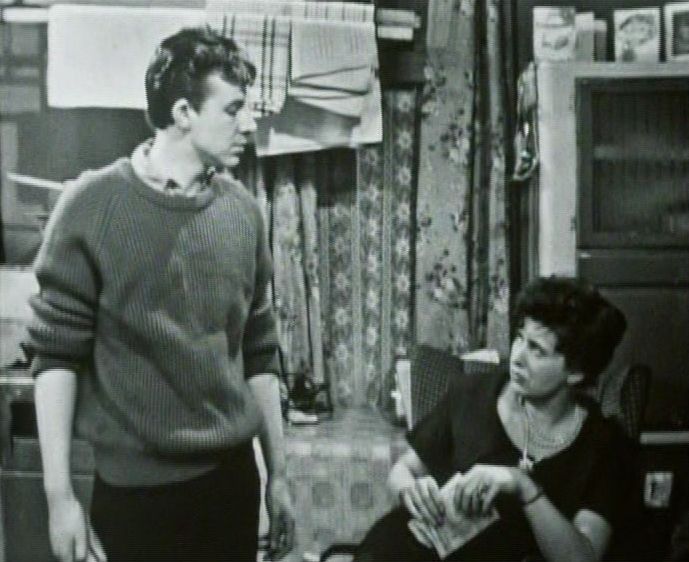
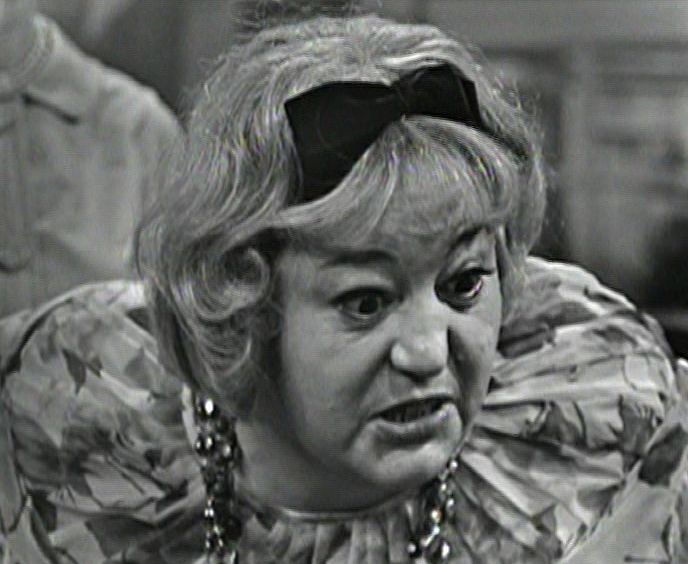
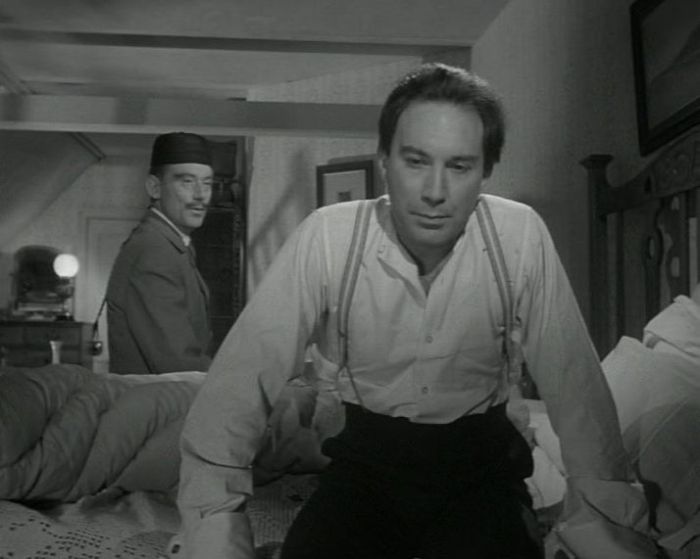
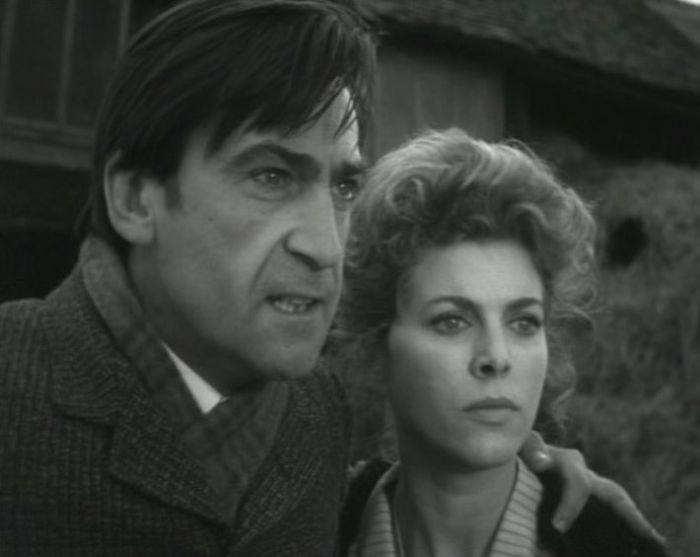
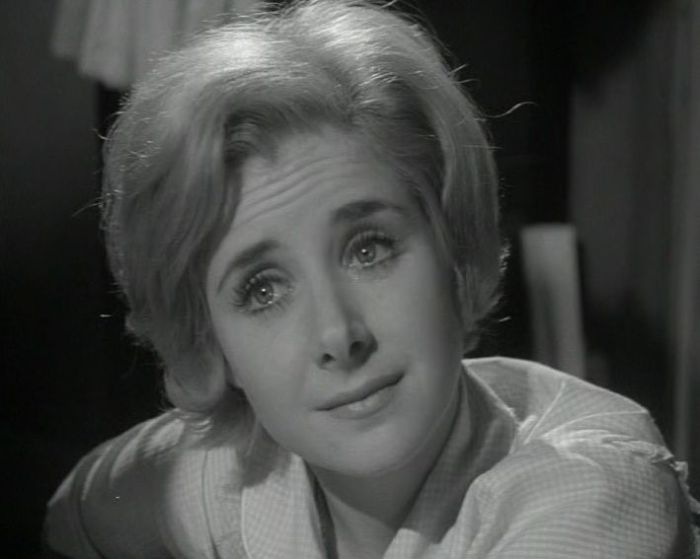
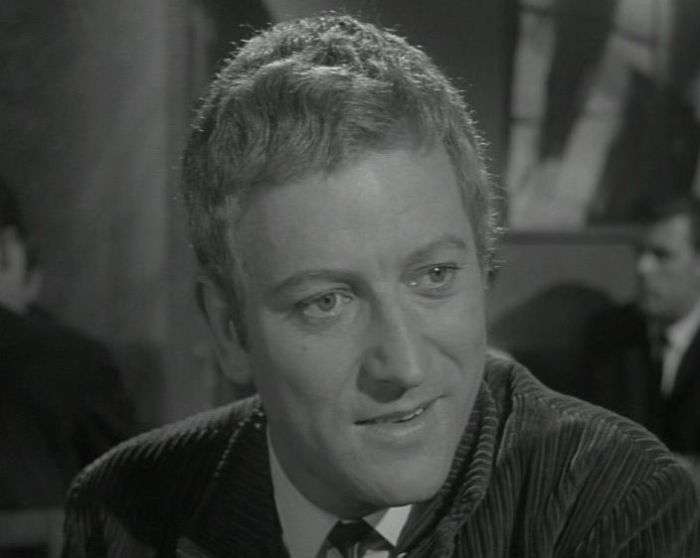
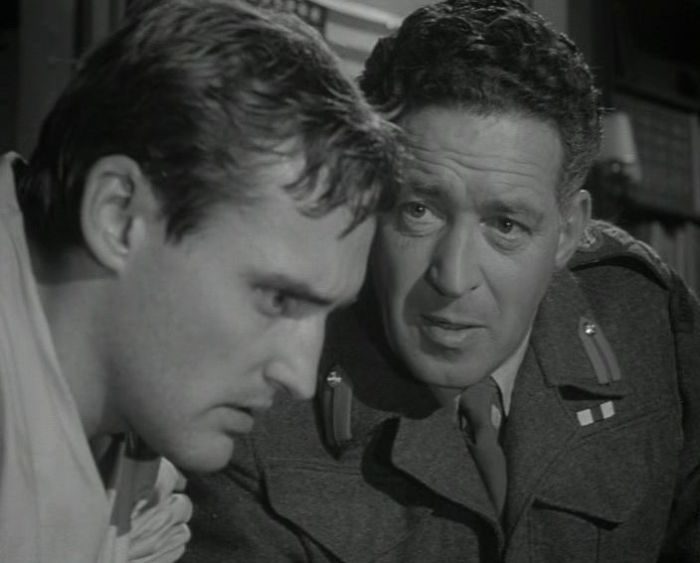
The episode begins with Elsie and Dennis rowing (which so far seems to be their default setting).  Elsie’s suspicious about the fact he returned home with twenty five pounds but eventually she believes his story about winning it on a dog race.  It’s another good scene between the pair of them although Philip Lowrie does suffer a major dry some two minutes in (luckily Pat Phoenix covers for him and he soon gets back on script).

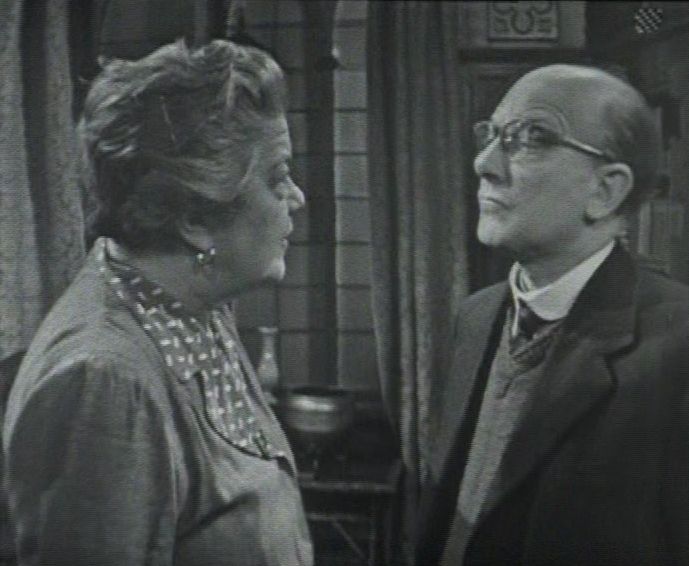
Martha asks Mr Swindley if he has any news about Ena.  He tells her that she doing quite well at the local hospital, which reassures her and she resolves to make a visit shortly.  There’s a lovely little character moment when Martha tells him that she would have telephoned herself, but she’s “never learnt the phone”.  It’s just about credible in 1960 that some older people might still have a lingering suspicion about telephones.

Mr Swindley bemoans Ena’s absence and wonders if Martha might like to lend a hand in the hall.  He tempts her with the prospect of money, which seems a little odd (previously we’d learnt that Ena doesn’t receive a wage – only lodgings and coal).  Martha is interested, but I wonder what Ena will have to say about it?

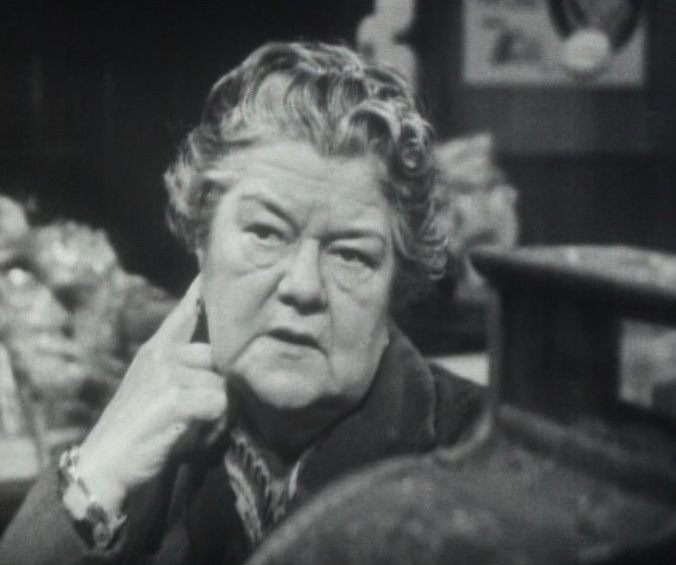
This is the first time we see Ena with a hairnet (from this point on it’ll be her headwear of choice).  So what sort of patient do we think she is?  Patient and pliant or endlessly complaining and argumentative?  The latter of course.  Nobody’s safe from her acid tongue – as her daughter Vera (Ruth Holden) finds out.

It’s true that Vera’s something of a drippy sort, but you have to imagine that a childhood spent with Ena as a mother would have sapped the will of even the strongest of types.  Ena’s not pleased with the gift she’s brought (a pot plant) and is even less impressed when Vera decides to nip off almost as soon as she’s arrived.  Vera tells her that she’s desperate for a cigarette, something which cuts no ice with her mother.  “If god had intended women to smoke he’d have put chimneys in their heads”!

There’s a score of great lines from Ena.  Here she waxes lyrical about her doctors and her food.  “You know I had three doctors around me this afternoon and one of them was black as the chimney bag. Oh he was clean, you could tell. His face shone like black leather. Oh the food’s terrible, They’re always trying to make me eat boiled fruit. I said to that nurse, I said ‘it’s all right for folks as like it, but I like something that has looked over a wall'”.

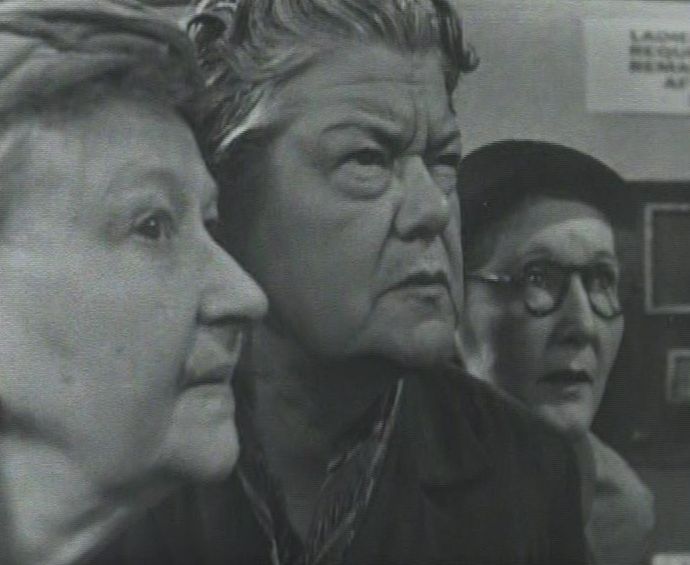
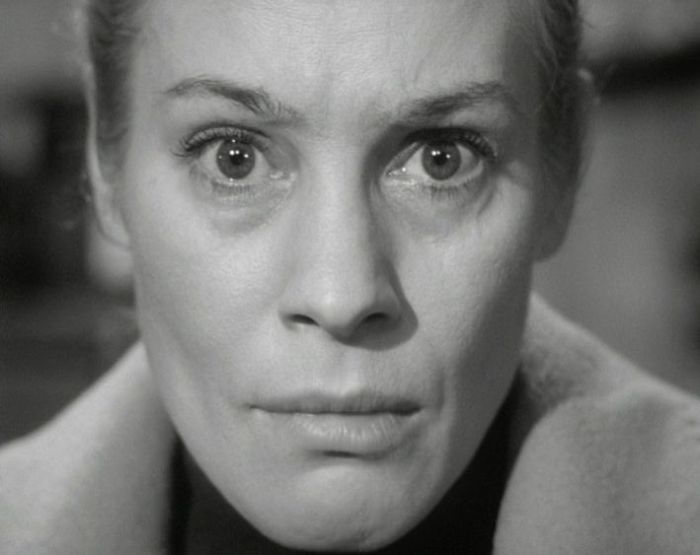
Then Martha turns up and Ena learns that her friend has been helping out in the mission.  Or as Ena sees it, attempting to snatch her job whilst she lies close to death in hospital.  Ena bellows “I know what you’re after, you’re after me vestry” before the camera closes in on her for an extreme close-up.  After this frightening moment, there’s a moment of peace as a group of young choir boys entertain the sick with a carol or two.

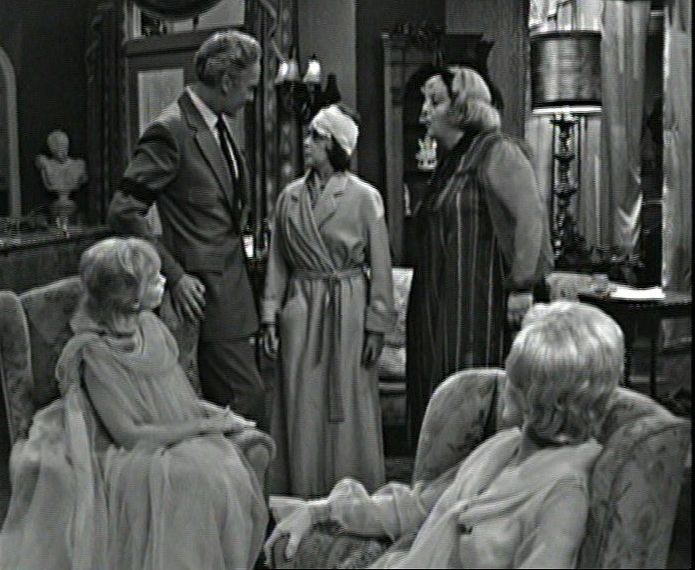
The Barlows appear for the first time for a few episodes, but they don’t drive any plot threads themselves in this one – instead they get caught up in the hunt for the missing Lucille.  The absence of Lucille has made Esther frantic with worry, but although she tells Ida that she’s primarily concerned about the girl, Ida makes a face which suggests she believes Esther has set her sights on snaring Harry.  But it looks like Esther has competition, as Concepta Riley (Doreen Keogh) has just returned from Ireland and also seems interested in Mr Hewitt.  Clearly Harry has hidden depths ….

Don’t worry about Lucille, she turns up safe and sound and bearing gifts.  It’s quite noticeable that Esther seemed much more worried about her than Harry.  I’ve still not warmed to him yet – goodness knows what Esther and Concepta see in him.

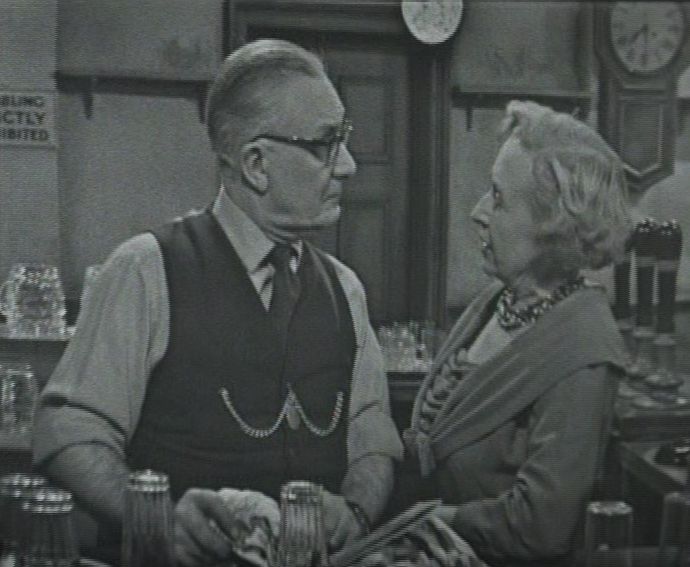
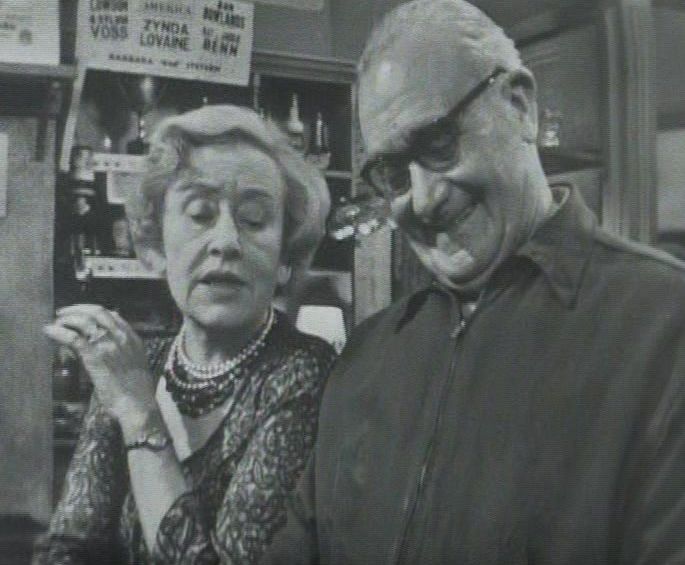
Concepta is welcomed back by Annie and Jack, who are more than happy to let her take up her old position behind the bar.  The first of several rather jarring moments when characters look straight into the camera occurs when Jack and Annie see Concepta for the first time.  This is slightly unsettling, but as discussed above, it’s nothing to the sight of Ena on the warpath (that’s that stuff of nightmares!)

Ray Mort, a very familiar face, makes the first of a handful of appearances as the chirpy insurance salesman Ron Bailey.  And for trivia fans, this is the first episode to mention Rosamund Street.

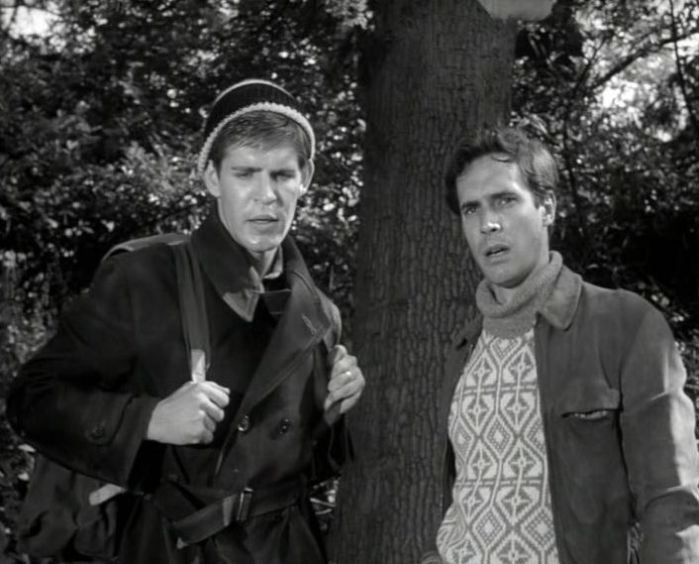
Another well-known actor, Anthony Booth, also appears for the first time as Christine’s boyfriend Malcolm Wilkinson.  Unlike Mort, Booth isn’t as recognisable at first – with his dark hair he doesn’t look like the “randy scouse git” he’d later be best remembered for.  Malcolm only appears in three episodes, but Booth would later pop up decades later as a different character (he also married Pat Phoenix shortly before her death in 1986).

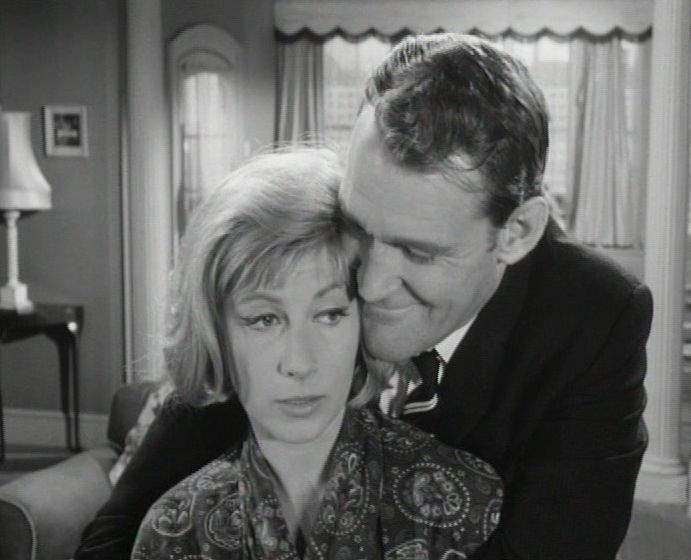
Although peace on earth seems to be the order of the day at the Tanners, this fragile entente cordiale is broken when a policeman comes looking for Dennis …..

Coronation Street – 21st December 1960

corrie 601221

Poor old Jack’s in the doghouse.  Annie’s been giving him filthy looks since the second episode but it’s only at the start of this one that we find out the reason why.  Tucked in the back of his bowling bag was a copy of London Lovelies Number 4.  Annie is incensed – it’s not only a sure sign of moral deviance, but it also poses other disturbing questions ….

Is Jack entertaining a fancy woman?  Quite why Annie should jump to this conclusion isn’t quite clear (surely if Jack had another woman he wouldn’t need a magazine!).  But she’s also concerned about where he bought it from –  surely not from somewhere local.  As we see time and time again in these early episodes, many of the characters are very much concerned with the opinions of others.  This is very plain in Annie’s case – her social status would take something of a knock if it became known that her husband was a purchaser of off-colour books.

We never really learn too much about London Lovelies, although it does seem to be pretty tame stuff (pictures of young women in bathing costumes possibly).  And whilst Jack squirms for a few minutes, the truth soon emerges – Harry lent it to him, since they both believed that one of the Lovelies was the granddaughter of a hoity-toity chap down at the bowling club.  So all is well.

Ena, Martha and Minnie have taken up their usual position in the snug and are joined by a mysterious fourth woman.  Rather like Minnie in episode two, she’s mute (she also spends the scene with her back to the camera so we never see her face).  Director Michael Scott chooses a slightly unusual high angle for some of the snug shots – given the cramped nature of the sets it’s good to see something different being done.

With Christmas fast approaching, the weighty topic of Christmas cards is broached.  Ena’s incensed that Minnie’s not received hers (since she posted it the day before) and is also acerbic on the topic of carol singers.  Maybe the pennies and halfpennies donated to the church carol singers helps to explain why the vicar’s wife can afford a new fur coat ….

We then hear the sound of carols from the public bar, although this cue seems to have been a little bit late (both Violet Carson and Lynne Carrol take a few extra swigs of their drinks whilst waiting for the action to start).  It turns out that Mr Swindley is leading them – surely his only intention was to catch Ena in the act of forcing down a milk stout.  All of Ena’s defiance from episode three seems to have dissipated, as she now seems incredibly conscience stricken (a little odd, but maybe Ena’s just relishing being a drama queen).

Ena’s later rendition of My Drink is extraordinary.  Back in her room in the mission, she warbles “my drink is water bright from the crystal stream” for the benefit of Mr Swindley, ear-wigging from the other side of the door!  All this stress and singing is too much though and she swoons into Mr Swindley’s arms.  He calls for Miss Nugent, although the unnamed extra who pops her head around the door isn’t Eileen Derbyshire (who wouldn’t appear until episode fifteen).

Is Harry having his daughter Lucille (Jennifer Moss) home for Christmas?  Nope, he seems to think she’d be much better off in the orphanage.  This is very hard to understand – it’s true that Harry’s working over Christmas, so looking after her would be a problem (but if he really wanted to, surely he could have booked some time off?)  The inference seems to be that he’s decided to work because otherwise he’d be all by himself over the festive period.

So Lucille decides to take matters into his own hands by running away from the orphanage and back home.  Eventually a reluctant Harry does agree she can stay for Christmas, although his burden is lifted when the ever-understanding Esther Hayes (Daphne Oxenford) at Number Five offers to lend a hand.  Fair to say that so far Harry’s come across as a rather selfish and self-centered character.

As with the previous episode, the credits play out over a rolling caption of the street – stopping to flash up the names of the characters who live at each house. Although here the Mission Hall is shown to be next to the Rovers, not on the other side of the street.

Coronation Street – 16th December 1960

corrie 061216

The opening of this episode has something of a Coronation Street rarity – a restaged cliffhanger.  This gives us an opportunity to marvel once again at the man who’s quickly become my favourite extra (you can’t miss him, he’s wearing a checked cap and has a habit of staring straight into the camera).

Linda and Ivan have a set-to in the Rovers bar, their every move observed by Ena, Martha and Minnie (watching from the safety of the snug).  As you might expect, the trio exhibit a mixture of prurient disapproval (the language!) and sadness that they can’t quite hear all the juicy details ….

Minnie gets to utter her first words, but it’s plain that she’s very much at the bottom of the pecking order at present – Ena first, then Martha, then Minnie.  When Ena decides to head home for a cup of cocoa, she invites Martha but doesn’t include Minnie.  Not that Minnie seems too bothered (presumably she’s used to this sort of treatment by now).

Ena and Martha’s cocoa is interrupted by Leonard Swindley (Arthur Lowe).  Making his debut here, Swindley is the chairman of the Glad Tidings Mission Hall (Ena acts as caretaker).   Although she’s not paid, she does receive free board (and coal) which is the reason why Swindley feels able to tell her that the committee aren’t at all happy with her conduct – namely the fact that she frequents licenced premises.  Oh dear ….

Ena’s not going to take this sort of thing lying down.  At one point she raises her arm as if to strike the unfortunate Swindley, but instead settles for a frank exchange of views.  Ena’s isn’t prepared to change her habits for anyone, something which she makes abundantly clear to the unfortunate Swindley.  Arthur Lowe only has a brief scene here, but it’s long enough to sketch out Swindley’s main character traits – he’s a pompous and officious type.  Of course, Lowe would later play a not dissimilar character in Dad’s Army, meaning that it’s easy to draw parallels between the two.

We finally learn why Linda’s been acting so erratically – she’s pregnant but was convinced that Ivan didn’t want children (hence the reason why she ran away).  But he seems more than happy with the thought of becoming a father, so all seems well.  For the moment.

The confrontation between Ivan and Dennis is interesting.  Dennis makes a disparaging comment about Linda’s unborn child, which infuriates Ivan.  Although Dennis cast a menacing shadow across the opening episode, when Ivan squares up to him he’s dramatically reduced in stature (it’s rather like a man facing a boy).

Once again, children provide a sense of discord.  Last time they vandalised Susan’s car, here they’re shouting abuse at May Hardman (Joan Heath).  May’s troubles (she’s suffered a nervous breakdown) were touched upon in episode two and it’s clear that she’s more than a little worried about the reception she’s going to receive from the neighbours.  Right from her first scene she’s marked as a victim – so it doesn’t come as too much of a surprise to learn that her time on the street will be very limited.

Coronation Street – 14th December 1960

corrie 601214-01.jpg

Poor Florrie hasn’t been in charge of the corner shop for more than a few hours and she’s already in trouble with the police.  Although you do have to say that the undercover officers (a man and a woman) were a bit naughty – acting as agent provocateurs, they asked for a packet of fire-lighters after 7.00 pm, knowing full well that such a sale would be illegal.  If Florrie had been a little more experienced maybe she would have picked up that the pair were acting in a somewhat shifty manner (I think it was the man’s moustache that did it for me).

What really upsets Florrie is the prospect that she might be fined and see her name in the newspapers.  The thought of such public humiliation causes her obvious pain.

More of the regulars are introduced in this episode.  I absolutely love Jack Walker (Arthur Leslie), the long-suffering husband of Annie.  Although this era of the series has a strong matriarchal streak, which reflects Tony Warren’s own experiences when younger, most of the men are more than simply fall-guys.  Jack may find himself somewhat under the thumb of the dominant Annie, but there’s always more of a dash of humour and lightness in Leslie’s performance.

Ken continues to fret that Coronation Street is no place for a girl like Susan.  More than once he tries to dissuade her from visiting the Rovers, but eventually she has her own way (another sign of female dominance?).  She’s made a good impression with Ken’s parents (Frank seems especially taken with her) although Ken himself is still incredibly tense (ashamed of his humble surroundings, no doubt).

Susan’s borrowed her father’s car to visit Ken.  It would have been impractical in such a small studio to show it, but the illusion is neatly created when we hear, off screen, a number of small urchins playing with the horn.  They also scratch the bonnet and shove nails into the tyres – making it plain that Coronation Street is very much at the wrong end of town.

Ena continues to dominate every scene she’s in.  She’s incensed when Florrie refuses to serve her with some ham, but even better is to come when Christine Hardman (Christine Hargreaves) pops into the corner shop to give Ena a piece of her mind.  One of Ena’s defining character traits – she’s a woman who speaks her mind, irrespective of the hurt it might cause others – is made plain here.

Christine’s mother has suffered a nervous breakdown, but Ena seems to have displayed little sympathy (on the contrary, we can assume that she’s relished talking about it).  Ena uses the phrase “pots for rags” to describe Christine’s mother (presumably anybody who gives away good pots to the rag and bone man in exchange for rags must be a little loopy).  There’s little else you can do but just stand back and admire Ena in full flight.

Over at the Rovers we meet Harry Hewitt (Ivan Beavis) who seems rather cheerful, despite the fact that his daughter’s stuck in an orphanage.  We later learn that Harry’s wife died the year before and since he was unable to cope with his daughter, Lucille, the poor girl was placed in care.

Also at the Rovers, the triumvirate of Ena, Martha Longhurst (Lynne Carrol) and Minnie Caldwell (Margot Bryant) take up their positions in the snug.  It’s noticeable that Minnie doesn’t speak a single word – all she does is nod vigorously as the other two make various points.  A pity, but she’ll make up for it later with a score of deliciously vague bon mots.

We’re denied that here, but Ena and Martha do have this wonderful, oft quoted, exchange.

Ena: You know sometimes I think I’m just about ready to go off down to that cemetery, but if I had my way I’d just like to go like me mother did.
Martha: Eee, that were a beautiful ending.
Ena: Oh, lovely. She just sat up, broke wind and died.

What can you say? Simply wonderful.

Elsie and Linda spend a quiet evening in (although this illusion is somewhat spoilt by the sound of someone coughing elsewhere in the studio). Their scenes help to put a little meat on the bones of both their characters – especially Elsie, who doesn’t appear to have adjusted to the fact that the war is over. Back then, with a GI on her arm, she was someone. Now she’s just another faded woman with ever decreasing horizons.

Both decide to go for a drink at the Rovers Return, where they find Ivan waiting …..

corrie 601214-02.jpg

Coronation Street – 9th December 1960

corrie 601209.jpg

Coronation Street‘s debut episode (it, like the following eleven, was written by series creator Tony Warren) uses Florrie Lindley (Betty Alberge), a newcomer in Coronation Street herself, as the audience identification figure.  So as she slowly begins to learn about her new neighbours, so do we.  Florrie’s just taken over the corner shop and is strongly advised that whilst a little credit isn’t a bad thing, there are some she has to watch.  The Tanners at Number Eleven for example ….

It’ll be a little while before we see a full street set, so for the moment Coronation Street consists of a brief exterior shot of the corner shop whilst the rest of the street is represented by photo captions.  Jumping to Number Eleven immediately after we’ve been warned about the Tanners wayward ways is an obvious touch, but it serves as a decent primer for the audience.  This is clearly a family to watch.

Head of the household Elsie (Patricia Phoenix) is middle-aged and regards herself with a critical and weary air (“Ee, Elsie, you’re just about ready for the knacker yard”).  Her general air of stress isn’t helped by her wayward son Dennis (Philip Lowrie).  As the sixties wear on, Dennis will become a much lighter, comic character but at this point he’s firmly cast in the role of a juvenile delinquent.  Just out of prison, unemployed and facing an uncertain future, he radiates teenage angst.  And in another fairly seamless transaction, he mockingly tells his mother that no doubt she’d much prefer if he was like that nice young Kenneth Barlow at Number Three ….

It doesn’t take long to realise that we’ve now cut to that household, which sees Ken (William Roache) and his father Frank (Frank Pemberton) and mother Ida (Noel Dyson)  having their tea.  As with the Tanners, Warren wastes no time in developing generational conflicts (Elsie might believe that the Barlows never argue, but as we’ll see, she’s a little wide of the mark).

Frank is an honest-to-goodness, blunt, plain-speaking man – working-class to the core and proud of it.  Ken – thanks to his scholarship – has a chance to better himself and the fact he’s already started to move in rarefied circles is causing a little tension between him and his father.  But it’s not as simple to say that Frank’s an ogre and his son is the innocent party – since we see that, even this early on, Ken’s somewhat insufferable.  For example, the way Ken rolls his eyes as his father sloshes sauce onto his food does support the suggestion made later by next-door neighbour Albert Tatlock (Jack Howarth), that he’s turning into something of a snob.

True, Frank does lay down the law in no uncertain terms – telling Ken that he can’t meet his lady-friend at the Imperial Hotel (since Ida works in the kitchens, it goes against his principles for a son of his to fling money about in the place) – but this is something he later regrets.  But it’s plain that Frank’s much more connected to his other son, David (Alan Rothwell).  Frank and David can easily bond (chatting casually and repairing a puncture on David’s bike) in a way that Frank and Ken can’t.

There’s a brief visit to the Rovers Return (where the extra at the dartboard makes the most of his five seconds of fame).  Annie Walker (Doris Speed) has a brief scene, although it exists mainly to develop the characters of both Dennis and Ken.  Their meeting is as awkward as you might expect, with Dennis (chip firmly on shoulder) gently mocking the young wonder-kid Ken.

Later we learn that Dennis was unfairly accused by Elsie of pinching two bob out of her purse. Instead it was her daughter, Linda Cheveski (Anne Cunningham), who took it (in order to buy some ham from the corner shop). Linda’s marriage problems are touched upon, but we’ve yet to meet her other half – Ivan.  This scene has another example of Warren’s fine ear for dialogue (something which later writers would mimic).  Elsie gently tells Linda that her legs are nothing to get exited about.  ” I’m afraid you’ve got the Tanner side of the family to thank for that. You know, without a word of a lie, your grandma Tanner were that bandy she couldn’t have stopped a pig in an entry”.

There’s one more notable person that we have to meet in this opening episode, Ena Sharples (Violet Carson). Ah, Ena. Right from this first scene, Violet Carson makes an indelible impression. Here she’s discussing religion with Florrie (who’s non-committal on the subject).

Oh, it’s like me sister’s husband. You know he were made head of the plumbing where they live and it give her ideas. She said, ‘We’re civic dignitaries now, we must head for t’church’. Within a week they were received, christened and confirmed and within a fortnight she was sitting up all night sewing surplices. I’ll take a packet of baking powder.

A star is born.

There’s just time to twist the knife about Ken’s angst concerning his common family once more as we observe that his lady-friend, Susan (played by Patricia Shakesby, later to be a Howards’ Way regular), has turned up at his house.  She’s had to sit and watch Frank and David’s bicycle repairs (although she seems fairly unconcerned, even when David offers her a greasy hand to shake).


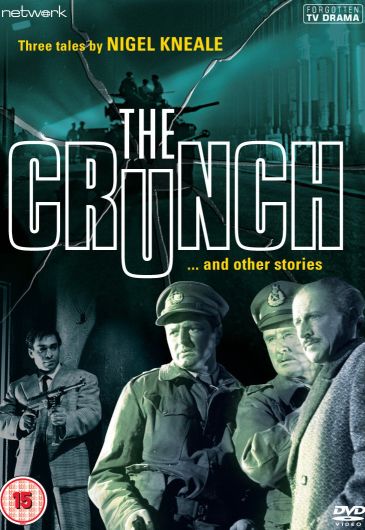
The Crunch and Other Stories – Network DVD Review

crunch

The Crunch and Other Stories collects three short plays by Nigel Kneale, broadcast between 1964 and 1988.

Studio 64: The Crunch (1964).  Harry Andrews stars as a prime minister attempting to avert a nuclear catastrophe in London; Maxwell Shaw, Anthony Bushell and Peter Bowles are among the co-stars.

Unnatural Causes: Ladies’ Night (1986).   A chilling story of misogyny as members of a gentlemen’s club turn on a woman who ridicules them; a strong cast includes Alfred Burke, Ronald Pickup and Bryan Pringle.

The ITV Play: Gentry (1988). Roger Daltrey stars in a blackly comic suspense drama in which a couple buy a shabby house in an up-and-coming area but find themselves drawn into the aftermath of an armed robbery.

This is the third in a series of curated DVDs under the ‘Forgotten TV Drama’ banner (the first two were The Frighteners and The Nearly Man).  The following excerpt from the press release for The Frighteners provides a little detail about the aims of these releases.

Broadcast only once (or at most twice) in a time before on-demand, catch-up or the video recorder, most of the drama made for British television up until the early 1980s has lain unseen for generations. Since 2013, The ‘History of Forgotten Television Drama in the UK’ research project at Royal Holloway, University of London, has existed to investigate and celebrate the tremendous wealth of neglected dramas made for British TV, unearthing forgotten treasures and presenting them again to new audiences.

Forgotten TV Drama’ is a new range of DVDs presented by Network Distributing Ltd in association with the project. Selected and curated by TV experts Lez Cooke, John Hill and Billy Smart, the collection will make a wide selection of unseen titles from the ITV archive available once again. The range aims to encompass a broad spectrum of plays, series and serials; comic and tragic, realistic and fantastical, film and videotape, lavish and intimate.

The Forgotten TV Drama blog is worth checking out – hopefully some of the programmes discussed there might feature on future releases.

Nigel Kneale rose to prominence in the 1950’s via the Quatermass trilogy and his controversial adaptation of George Orwell’s 1984.  In the decades to come he would occasionally return to the series or serial format (BeastsKinvig, a fourth and final Quatermass story) but he tended to concentrate more on one-off plays and adaptations.

Adaptation wise, his retooling of Susan Hill’s The Woman in Black is well worth tracking down (a R2 DVD release is long overdue). Sharpe wouldn’t have been the sort of series you’d have expected to have recruited Kneale as a writer, but he did contribute an episode – Sharpe’s Gold – which, unsurprisingly, jettisoned most of Bernard Cornwell’s original novel in favour of something much odder and off-kilter.

Although Kneale is fated to always be remebered primarily for Quatermass, it can often be rewarding to dig through some of the more obscure nuggets from his back catalogue – and the three plays on this release all qualify on that score.

The Crunch opens on what appears to be a normal London street.  We see a man walking his dog, a woman riding her bike and a milkman making his rounds.  But these signifiers of normality clash uneasily with the constant honking of car horns in the distance.

Within a matter of minutes it becomes clear that all three people were part of a military operation designed to penetrate the Mekagense Embassy.  Mekang, an ex-colonial state, is demanding reparation for the way its natural resources were plundered for British gain.  And if the British don’t accede to their requests then a nuclear device will destroy London ….

Although we’re not privy to the wider London scene, the continual sound of car horns in the distance (and occasional television reports) help to reinforce the general state of panic.  The power of the media is amusingly demonstrated after a reporter broadcasts that the emergency seems to be over.  A group of soldiers, watching the television from their command post just around the corner from the Embassy, are delighted – seemingly more willing to believe what they see on screen as opposed to their own military intelligence!

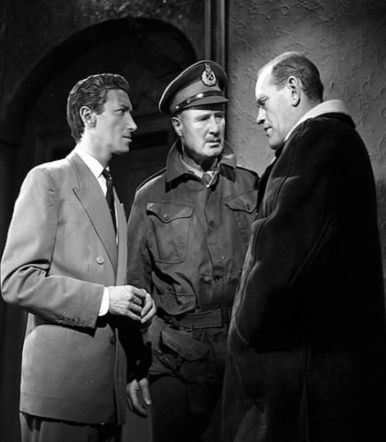
The Crunch centres around three characters – British prime minister Goddard (Harry Andrews) and two members of the Mekagense government – President Jimson (Wolfe Morris) and Ambassador Mr Ken (Maxwell Shaw).
crunch.jpg

Andrews plays a pleasingly pro-active prime minster who’s right in the thick of action (he goes alone into the embassy to negotiate).  This might be a little far-fetched, but no matter.  Sadly, some of the themes of the play are just as relevant today as they were some fifty years ago. Goddard is aghast to learn that Ken is prepared to sacrifice himself and his wife and children (not to mention the rest of London) for the sake of his beliefs.  Goddard finds it hard to believe that any religion could support such a monstrous action.

Ken does have his reasons and he articulates them well.  Shaw offers a very still, nuanced performance (which is particularly apparent when he’s placed opposite Wolfe Morris’ blustering, unhinged President) and is easily able to command the screen.  Ken’s vision of Mekang – a desolate country which will turn into a utopia once they’ve received reparations from the British – sounds too good to be true, so it possibly won’t surprise you to learn that things don’t turn out quite the way he planned.

Although The Crunch seems to be a straight, contemporary drama, during the last few minutes it lurches into telefantasy.  The final shot – held for what seems like an age – reinforces this sudden change in emphasis (as does the fact we then cut to the credits – there’s no mopping up scene to contextualise what we’ve witnessed).

The cast offers strength in depth.  Anthony Bushell, who had memorably portrayed the blinkered Colonel Breen in Quatermass and the Pit, appears as another military man here – Lt. Gen. Priest.  Priest might only have a fraction of Breen’s screentime but there’s more than a hint that he’s a character drawn from the same cloth.  A young Peter Bowles is the enthusiastic Captain Buckley (forever itching to storm the embassy single-handed) whilst the unmistakable sound of Frank Crawshaw’s whistling speech impediment makes him an actor who can be identified by sound alone.

Picture quality is pretty good (the location scenes, recorded on videotape, are a little smudgy though) and the soundtrack, whilst hissy, is pretty clear.  A nice bonus is the 35mm insert for the climatic scene – ideally it should been dropped back into the programme but having it available as an extra is the next best thing (as the sequence on the telerecording is, naturally enough, not nearly as sharp).

When considering forgotten television drama, it’s hard not to think of Alfred Burke.  There can be few actors so beloved by archive television fans yet so totally under the radar of modern television watchers.  Possibly his final role, as Professor Dibbet in Harry Potter and the Chamber of Secrets, may have brought him a smidgen of late recognition, but his lengthy career seems to be comprised of programmes which have now faded from view (even Public Eye, a major success for a decade but not a series that’s endured in the memory of the general public).

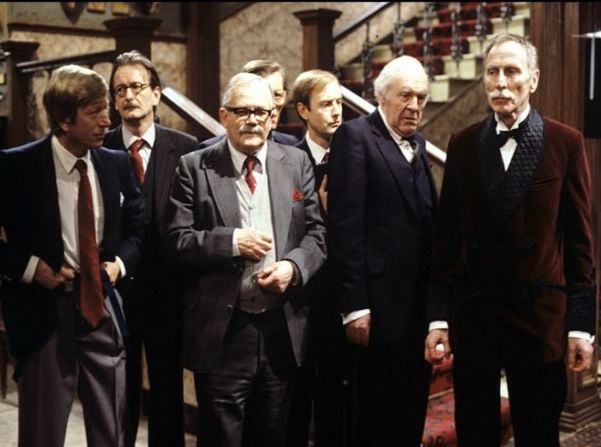
But for those who like their television programmes old, Burke continues to be cherished and he’s a major attraction in the second play in this set – Ladies’ Night.  Broadcast by Central in 1986, Burke is the crusty Colonel Waley, outraged that his beloved Hunters Club allows ladies through its hallowed portals every Monday evening.
ladies.jpg

Burke’s in good company – Brian Pringle, Ronald Pickup, Nigel Stock and John Horsley also appear – whilst Fiona Walker, as Evelyn Tripp, plays the rather annoying wife of James (Pickup).  Evelyn’s presence proves to be crucial as she and her husband have a somewhat violent disagreement which then involves all the other members.  Directed by Herbert Wise (I Claudius), Ladies’ Night, like I Claudius, favours long takes which allow the actors to remain in control.

It’s unusual to see Burke essay such a grotesque performance, but it suits the surroundings of the Hunters Club – the Colonel, like the club, is mired in the past and totally unable to accept the realities of the present.  Women are just one of his problems – the decline in the club’s finances means that a merger or a sale of part of the building is desirable.  But Colonel Waley is not a man who can countenance any form of change.

If Burke is excellent, showing how Waley grows ever more unhinged as the evening wears on, then he’s matched by the rest of the cast (especially Ronald Pickup).  This extends down to the minor roles such as Abigail McKern’s frightened and flustered Ann Holroyd (although she’s much more relaxed when she’s drunk).  The members can’t help rolling their eyes at her choice of drink (a tequila sunrise) whilst she makes the mistake of attempting to pat the stuffed aardvark which sits forlornly in the entrance hall.  All members have to touch the aardvark on arrival and any who don’t are firmly reminded by the Colonel. But any women attempting to take such a liberty will face the full force of his fury.

A dark (and occasionally violent) comedy, Ladies’ Night isn’t subtle, but Kneale’s script, the performances and Wise’s direction all combine to produce a bracing, if uncomfortable, fifty minutes.  It’s good to finally have it available on DVD.

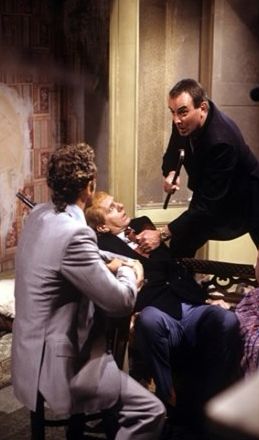
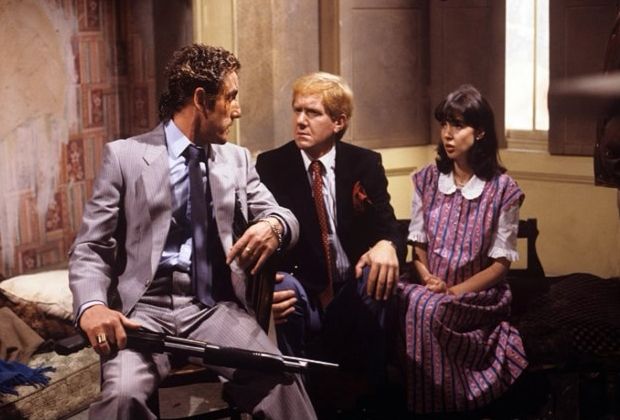
Following The Who’s first farewell tour in 1982 (apart from a couple of one-off performances they wouldn’t tour again until 1989) Roger Daltrey found he had plenty of time on his hands to restart his acting career.  He’d already appeared in a handful of films during the seventies and early eighties (Tommy obviously, Listzomania and most notably McVicar) but during the mid to late eighties he really began to rack up the credits.  In Gentry (1988), Daltrey plays Colin, an East End gangster who clashes with the upwardly mobile Gerald and Susannah (Duncan Preston and Phoebe Nicholls).
gentry 2

The gentrification of the East End of London is one of the obvious themes of this play.  The first few minutes shows us various well-heeled types (walking dogs, stowing golf clubs into their car) who have begun to infiltrate this once run-down area.  Gerald wants to be the next – although Susannah’s far from happy that he’s already bought a house (for just under one hundred thousand) without telling her.  When they discover the seller upstairs in the bath (very, very dead) it’s the first sign that their day is not going well …

Colin and his gang (Michael Attwell as Slatter, Tim Condren as Doug) are old-school criminals (Gerald, a solicitor, is also corrupt – but his criminality doesn’t involve violence).  Gerald may initially appear to be in control, but it’s not long before his pompous, self-important persona is pricked.  This is very apparent when Colin and the others come calling – it’s Susannah who remains calm whilst he rather goes to pieces.

The first part, concentrating on Gerald and Susannah, offers some amusing comic moments but it’s the arrival of Colin (initially concealed behind a scarf – masking his recent injuries) just before the first advert break which moves the story up several gears.  Daltrey offers a magnetic performance – alternating between charm and violence – and commands the screen whenever he’s on.  Attwell is amusingly over the top as the homicidal Slatter.

The lead performances of Daltrey, Preston and Nicholls ensures that Gentry holds the attention – the brief bond formed between Colin and Susanna (he’s pining for the old East End which she gently tells him has gone forever) is just one of several interesting areas developed.

Including a booklet featuring a foreword by Gentry director Roy Battersby and concise but insightful viewing notes by Billy Smart, The Crunch and Other Stories is an attractive package which showcases some of Nigel Kneale’s lesser-known works.  Recommended.

The Crunch and Other Stories is available now from Network and all good retailers.
gentry 1

A Choice of Coward – Blithe Spirit

blithe 01

Charles Condomine (Griffiths Jones), a successful novelist in the process of writing a new book about the occult, is keen to experience some authentic colour.  To this end he invites the eccentric medium Madame Acarti (Hattie Jacques) to hold a séance at his house.  Madam Acarti is so obviously a fake that nobody – not Charles, nor his second wife Ruth (Helen Cherry) or their friends – expect the evening to generate anything more than a little light mockery at Madame Acarti’s expense.

So when the spirit of Charles’ first wife, Elvira (Joanna Durham) is conjured up from the other side, he’s more than a little taken aback.  Especially as he’s the only one who can see or hear her …..

Coward had been mulling over writing a play featuring ghosts for a little while, but it wasn’t until his flat was destroyed during the Blitz that he decided to turn these vague notions into reality.  Holidaying with the actress Joyce Carey at Portmerion (later immortalised in The Prisoner) he rapidly churned out the play in a mere six days and afterwards would comment that with “disdaining archness and false modesty, I will admit that I knew it was witty, I knew it was well constructed, and I also knew that it would be a success”.

Premiering in mid 1941, with Cecil Parker as Charles and Margaret Rutherford as Madame Acarti, the play was an immediate success (until the juggernaut run of The Mousetrap, Blithe Spirit was the longest-running non musical West End production).  Rather wonderfully, a few years ago a telegram from Coward to Christie, congratulating her on beating his record, was discovered.

Coward was aware that some people might find the notion of a play revolving around ghosts to be a slightly distasteful subject to pitch during wartime, but he had a ready reply.  Although a comedy, it was deliberately written as a heartless piece.  “You can’t sympathise with any of them. If there was a heart it would be a sad story”.

This is certainly true.  Neither Charles, Ruth or Elvira are in any way admirable characters.  We open with Charles and Ruth discussing his first wife.  Charles, a befits a professional writer, is smooth with his compliments (and able to not commit himself when Ruth asks him if Elvira was prettier than her) but there’s a brittleness to this conversation.

When Elvira unexpectedly pops up the cracks begin to get bigger.  Although it takes a little while for Ruth to believe the truth of the situation, once she realises that Charles isn’t mad or drunk she becomes rather jealous of her dead rival.  After the initial shock, Charles adjusts relatively quickly to Elvira’s presence, but it’s hard to argue that the ghostly Elvira is a symbol of an idyllic past marriage.  Evidence is provided that their relationship was somewhat rocky.  Elvira reminds him that he hit her with a billiard cue (only gently, he says) whilst neither seems to have been totally faithful.

But in her own way she still loves him and so decides to kill him, as that way they’ll both be spirits and together once more.  But it shouldn’t be too much of a surprise to learn that her plans backfire and, after tampering with Charles’ car, she ends up killing Ruth instead (quite how a non-corporeal spirit could do such a thing is a question which the play quite rightly ignores).

This then sets up the denouement, which sees Charles haunted by both of his wives (in mounting desperation he requests that Madame Acarti’s perform an exorcism).  Jacques may not have the largest role, but she’s wonderful comic value whenever she’s on the screen.  With a boundless enthusiasm (Madame Acarti is almost beside herself when she learns that her séance actually conjured a manifestation) Jacques wrings every last comic moment from the script.

Joan Kemp-Welch (who directed all four plays in this short season) appears to have given Jacques her head.  It’s not a subtle performance – Madame Acarti leaps about like a giddy schoolgirl as well as being prone to sudden dramatic swoons – but it’s certainly an eye-catching one.  Coward himself approved, commenting that it was the first time someone had done something with the role that could bear comparison to Margaret Rutherford’s imposing stage and film performances (she reprised the part of Madame Acarti in David Lean’s 1945 movie).

The ending of this adaptation stays true to the original play (unlike Lean’s film, which Coward disliked) and sees a carefree Charles – once Elvira and Ruth have been reduced to silent, invisible spirits – head out for a lengthy holiday aboard, happy in the knowledge that his ghostly ex-wives won’t be able to follow him.  It’s not exactly what you could call a happy ending, but it fits in with the general tone of the piece.

As acknowledged by Coward, it’s hard to warm to any of the characters (apart from the deliciously dippy Madame Acarti) which is probably the reason why Blithe Spirit never quite engages as fully as it could have done.  Amusing, but icy.

blithe 02

A Choice Of Coward – Present Laughter

present 01

Like many of his contemporaries, Noël Coward found the 1950’s to be a critically lean period.  He may have created a string of hit plays during the 1920’s, 1930’s and 1940’s, but in the brave new world of the angry young men his style seemed to be hopelessly dated.

But everything comes round again eventually and by the mid sixties the Coward revival was in full swing.  His new plays continued to attract only polite interest, but revivals of his classics tended to garner both popular and critical acclaim.

Therefore 1964 was the ideal time for Granada to turn their Play of the Week strand over to Coward for four weeks.  Featuring introductions from the Master himself before each of the four plays, A Choice of Coward kicked off with Present Laughter.

Written in 1939 and first staged in 1942, Coward’s introduction makes it clear that the play was written with a single thought in mind – to provide him with a star vehicle.  The character originally played by Coward – Garry Essendine – is the centre of the play and the recipient of most of the best lines.  There’s obviously a strong sense of autobiography at play (which wouldn’t have been lost on the audience at the time) as Garry is a fortyish, elegant, dressing-gown clad figure, who continues to deliver bon mots with practised ease even as his world descends into chaos.

Garry isn’t the only character to have a clear real-life counterpart.  Garry’s loyal and long-suffering secretary Monica is a straightforward analogue of Coward’s equally devoted secretary, Lorne Lorraine, whilst Garry’s almost ex-wife, Liz, is said to be partly modelled on Joyce Carey, who played Liz in the original production.

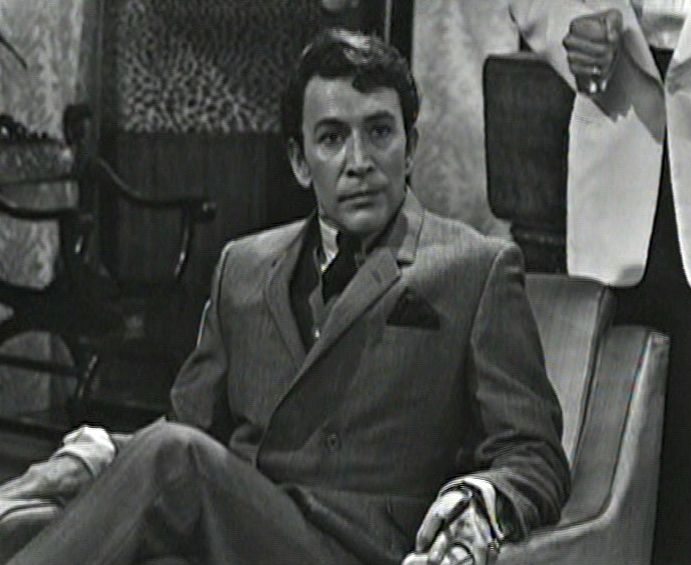
Garry Essendine (Peter Wyngarde) is the bright star around which his devoted satellites – Liz (Ursula Howells), Monica (Joan Benham), manager Morris (Danvers Walker) and producer Henry (Edwin Apps) orbit.  But it would be wrong to call Garry a despot, he appears to be much more affable than that.  Although as he’s an actor it’s difficult to know whether any of the emotions he exhibits are genuine.  This might have been a fruitful area for the play to examine, but as this is a lightweight confection (albeit with the odd barb) it tends to steer clear of psychological analysis.

The play opens with Daphne Stillington (Jennie Linden) exploring Garry’s flat.  A would-be actress and a devoted admirer of Garry, she has stayed the night (albeit in the spare room).  When Garry eventually rises, he firmly, but charmingly dispatches her (an early sign of how he tends, almost absent-mindedly, to pick up and then discard people at will).  Linden is very appealing as the naïve and fresh-faced young woman besotted with the stylish Garry.  Daphne exits but returns later, when she helps to raise the comic tempo.

present 02.jpg

Daphne’s presence doesn’t faze Monica, no doubt it’s something of a regular occurrence.  Coward may have given Garry most of the best lines, but he didn’t forget his co-stars completely and Monica is the recipient of some good lines, as is Liz.  Liz and Garry may be separated but she’s still part of his inner circle and very much involved in every part of his life.  That she too regards Daphne will cool disinterest speaks volumes about her husband and their strange relationship.

James Bolam is great fun as Roland Maule.  Maule is an earnest young playwright, entranced and repulsed by Garry’s star quality in equal measure.  Maule is flattered to be in Garry’s presence but is forthright in explaining how Garry’s work in the commercial theatre is totally without artistic merit.  Coward, who always valued popular success over critical acclaim, plainly uses Maule to take a not-terribly subtle dig at his detractors.

By the time Barbara Murray appeared here as Joanna (Henry’s wife) she was a familiar television face thanks to her role in The Plane Makers as Pamela Wilder.  Joanna wouldn’t really have been too much of a stretch for her, since both characters share similar traits – not least a desire for male conquests.  Joanna is already conducing an affair with Morris and now she sets her sights on Garry.  Wyngarde and Murray both cross verbal swords in a very appealing manner with Garry eventually forced to succumb to the inevitable ….

By now the plot is simmering away nicely and this leads into the frantic conclusion which sees Garry – about to set off for a theatrical tour of Africa – learn to his horror that Daphne, Morris and Joanna have independently bought tickets for Africa as well and are all dead-set on accompanying him.

Eventually matters are resolved, although those expecting the characters – especially Garry – to have learnt anything will be disappointed.  As touched upon earlier, this an exercise in farce, not realism.

Adapted by Peter Wildeblood, it runs to just over seventy minutes, so a certain amount of filleting had to be done in order to bring it down to the required length.  This means dropping some characters, such as Garry’s valet Fred, and cutting some decent lines, but on the plus side this editing means that it zips along at a fine pace.

Peter Wyngarde dominates of course.  He would later become well-known for playing a similar womanizing character, Jason King, so Garry Essendine could almost be said to be a dry run.  Clearly relishing Coward’s dialogue, Wyngarde’s a treat from beginning to end.

One of Coward’s evergreen classics (over the years it’s been revived numerous times, with Donald Sinden, Simon Callow, Peter O’Toole, Tom Conti, Peter Bowles, Rik Mayall and Albert Finney amongst those taking on the role of Garry) this cut-down version of Present Laughter is an impressive production.

present 03

Probation Officer to be released by Network – January 2017

probation.jpg

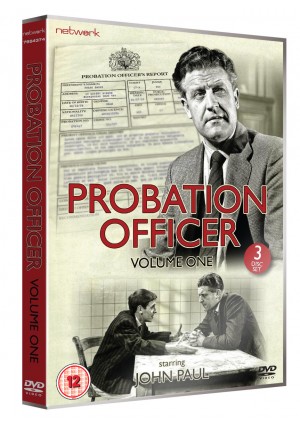
Volume One of Probation Officer (containing the twelve earliest surviving episodes) can be pre-bought now at Network.  Payment will be taken immediately, although the DVD won’t be dispatched until late January. For Doomwatch fans, it’s a chance to see a young John Paul, but it also looks like an absorbing, black and white videotaped drama in its own right, with a mouth-watering roster of guest actors.

An early hit for ATV, this absorbing, rigorously researched and very human drama series centres on the work of a team of probation officers based in London, and the lives of the men and women of all ages and backgrounds who come under their care. Drawing on the documentary skills of creator Julian Bond and produced by Emergency – Ward 10’s Antony Kearey, Probation Officer was broadcast at a time – a time when the service was increasingly coming into focus as a progressive response to rising crime.

Future Doomwatch star John Paul stars as newcomer Philip Main, alongside The Avengers’ Honor Blackman as Iris Cope, the team’s only female officer. Guests include Alfred Burke, Susan Hampshire, Charles Lloyd Pack, Richard Vernon and Peter Vaughan – while Earl Cameron and Lloyd Reckord star in a blistering tale of racism and intolerance which features one of the earliest interracial kisses ever broadcast on British television.

Probation Officer does not exist complete in the archive – this volume contains the twelve earliest surviving episodes from series one.

Espionage – The Light of a Friendly Star

star 01

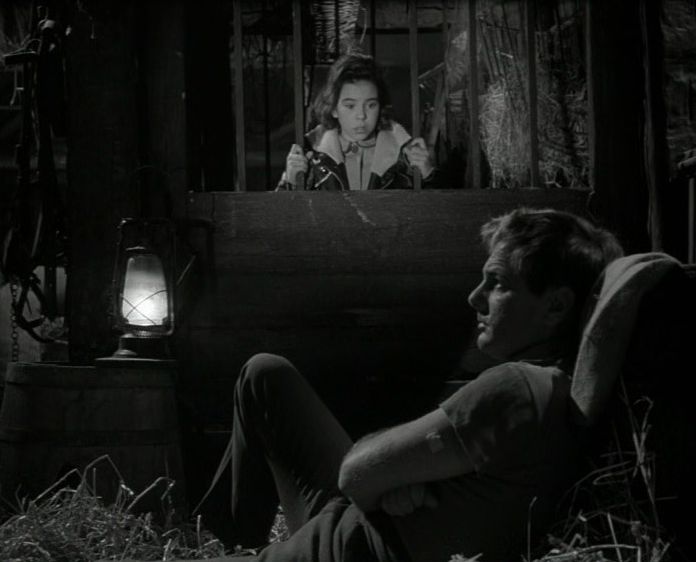
Leo (Carl Schell) attempts to break into the British Embassy. He claims to be a refugee and pleads for political asylum. The ambassador, Arnold Morely (Ronald Howard), listens sympathetically to his tale and agrees he can stay for a while.

But Leo is a spy for “the other side” and after aquiring some secrets he makes his escape. He doesn’t go empty handed though, as he takes a hostage, the ambassador’s ten-year old daughter Kit (Loretta Parry), with him …..

The Light of a Friendly Star has a slightly odd tone. From the first time Kit sets eyes on Leo, she’s very taken with him – telling her father that his (made up) story of persecution is tragic and also that his dark, dark eyes (“darker than Heathcliff, darker than Captain Ahab”) are very compelling. This initial speech demonstrates that Kit is a most precocious child, but her infatuation would have worked better if she had been older, say in her late teens.

Is Stockholm Syndrome at play here? Kit could have escaped from him on several occasions, but didn’t. Instead she uses manipulation (sabotaging his car, mentioning that if she was picked up by the police she’d have to tell them all she knew) to make him realise she’ll be less of a danger if he takes her along.

Her father doesn’t seem terribly surprised to learn that Kit may have been kidnapped and confides to one of his aides, Wilson (Donald Pickering), that Leo may have been forced to take her. He doesn’t elaborate, but we’ve already had numerous examples of how strong-willed the girl is.

Kit later sadly confides to Leo that she’s over educated, the inference being that emotionally she’s a woman trapped in a girl’s body. But she still has childish traits, telling Leo that she knows he won’t hurt her because of his eyes. “I think anyway one’s eyes are really what one is”.

Poor Leo never really stands a chance, as the hapless spy finds Kit running rings around him. And when we later learn that the secrets he obtained were out of date and therefore worthless, it makes his efforts seem all the more futile.  Incidentally, the British Embassy seems to be the sort of place where guests can wander about at night, unchallenged, and go where they wish. Have they never heard of security?

It could be that the story was attempting a Hayley Mills/Tiger Bay vibe, but there’s only one Hayley Mills and Loretta Parry’s performance does begin to grate after a while. This could be intentional though – she’s not supposed to be a victim in Leo’s power, if anything Kit’s the one in control ….

If there’s a point to the story, then it seems to come when the mismatched pair are forced to shelter from the rain in a barn. Kit asks him why he spies and he tells her that it’s an honest profession which appeals to him. He begins to open up a little and mentions that he has no family, they were killed by a bomb years ago. The incidental music swells in sympathy and Kit places her hand on his arm. It’s a nice touch that as soon as he shrugs her off the music stops.

Leo seems to be a totally isolated figure, although Kit senses this is nothing more than a fraud. She tells him that he could love someone if he wanted – even her. Again, this is a strange conversation for a ten-year old girl to be having with a grown man.

Carl Schell gives a self-contained performance as Leo, the man with friendly eyes. The supporting cast is characteristically strong, with Ronald Howard (a former Sherlock Holmes) providing a reassuring presence. The likes of Donald Pickering and George Pravda are always worth watching even if, as here, they only have small roles.

Largely a two-hander, The Light of a Friendly Star does have a few interesting points to make about espionage. Leo sees himself as a professional spy – with no national alligence – which is confirmed when it’s revealed he used to spy for the British, leaving Wilson to dismiss him as someone who’ll work for the highest bidder. Is this a purer, more honourable form of spying than if it’s done in the national interest? Leo seems to think so, but as a professional dissembler can we ever trust anything he says?

star 02

Callan: This Man Alone – Network DVD Review

this man alone

Callan: This Man Alone is a three disc set released in 2015 by Network.  The feature attraction, This Man Alone, is an exhaustive 130 minute documentary which covers every aspect of the character – from the Armchair Theatre pilot, the four series, the spin-off short stories and novels, the 1974 film and the not terribly well received one-off revival in 1981.

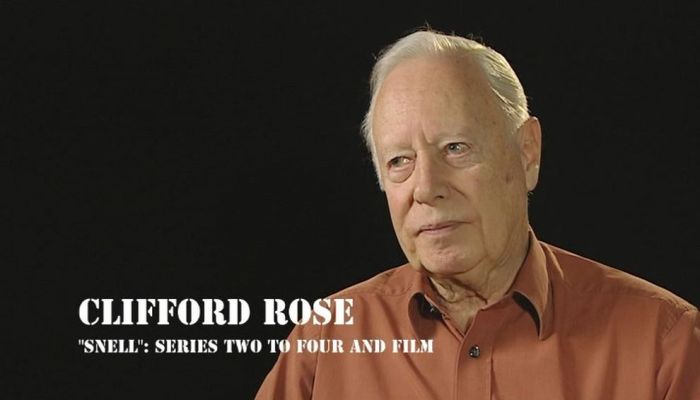
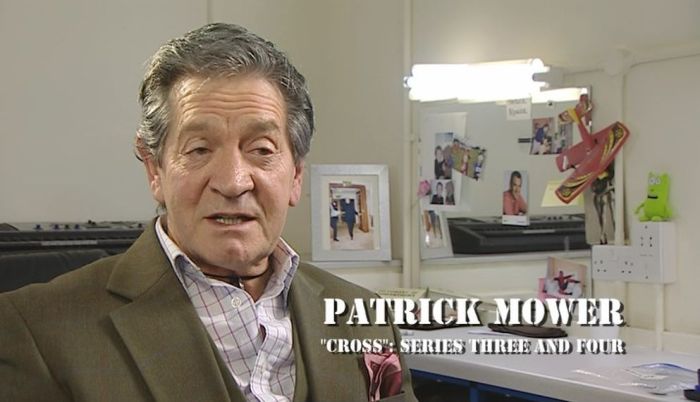
A host of key personnel who worked on the series (both in front of and behind the cameras) – Reginald Collin, Mike Vardy, James Goddard, Piers Haggard, Patrick Mower, Trevor Preston, Clifford Rose, Robert Banks Stewart, Ray Jenkins – were interviewed for the documentary, whilst Dick Fiddy is on hand to set Callan in its cultural and historical context.  Another very enlightening interviewee is Peter Mitchell, the son of Callan‘s creator, James Mitchell.  The pride he feels in his father’s legacy is palpable and, like the others, he has plenty to contribute.

callan 02

Although a number of people, including James Mitchell, Edward Woodward, William Squire and Russell Hunter, are no longer with us, they are represented via archive material.  This is mainly derived from a series of audio interviews conducted in 1987.  Presumably these were intended for transcribing purposes and not for broadcast as they’re a little indistinct in places.  Although Woodward sadly passed away before the documentary came to fruition, there’s still a family connection as This Man Alone is narrated by Peter Woodward, Edward Woodward’s son.

All of the key parts of the production – developing a series from the pilot, casting the regulars (and in the case of Hunter, numerous re-castings), moving from ABC to Thames, from black and white into colour, the public’s reception of the show and the decision to bring it to an end – are all covered.  Possibly the only aspect that I was surprised wasn’t discussed concerns the reasons for writing out Cross, Patrick Mower’s character, in series four (I’ve always assumed it was done in order to facilitate the return of Meres, played by Anthony Valentine).

Although the pair do have a brief cross-over period, it seems that once Valentine was available again (he’d declined to appear in series three) it was decided to write out Mower.  It would have been interesting to hear from Mower as to whether he thought that was the case, or if he was happy to leave on a high (his final story certainly was a dramatic one).

Unlike some series, Callan seems to have been a very harmonious production, so there aren’t too many story of back-stage bust ups.  The second Hunter, Michael Goodliffe, found the role not to his liking and was quickly written out, whilst Woodward wasn’t entirely sure that promoting Callan to Hunter in series four was a good idea, but that’s about it.

With an additional twenty five minutes of interview footage that didn’t fit into the documentary, disc one is as comprehensive as you’d might hope.

callan 01

Disc two has new transfers of two episodes, the Armchair Theatre pilot  A Magnum for Schneider and the first story of series one, The Good Ones Are All Dead.  The previously issued version of A Magnum for Schneider came from the transmission tape, but since the story was transferred to film prior to transmission (a not uncommon practice for VT programmes at the time, as it offered more flexibility for editing) Network were able to locate the original film recording and have produced a new transfer from it.  Both episodes offer a considerable upgrade on the previous versions issued on DVD.

Also on disc two is the complete studio tape for The Worst Soldier I Ever Saw.  Running to 78 minutes, this offers the viewer a unique chance to see how an episode of Callan was recorded, as all the takes and re-takes are included.  To be honest it sounds more interesting than it actually is, but it’s obviously nice to have.

Disc three has a real curio – the only surviving episode of The Edward Woodward Hour.  It’s taken from a domestic recording, so the picture quality isn’t quite broadcast standard, but that’s no problem.  It offers us a chance to see Woodward flex his singing muscles and the unforgettable comedy sketch in which Callan and Lonely meet the cast of Father Dear Father!  This bizarre encounter is touched upon in the documentary, with both Edward Woodward and Russell Hunter (especially Hunter) remembering it with a distinct lack of fondness.  Amusing or toe-curling?  I think that’s up to personal taste.

Semi-mute rushes of James Mitchell from 1969, recorded for A World of My Own, are also featured on disc three, but the main attraction is the extensive PDF archive.  All the scripts for the series are included (many of the early ones have both rehearsal and camera versions) whilst there’s also the original series outline, publicity material, audience research, etc.  There’s certainly a wealth of reading here and most importantly it’s lovely to be able to read the scripts for those episodes which are missing from the archives.

Whilst Callan: This Man Alone might feel like a three disc set of special features, if you have all of Network’s previous Callan releases (the monochrome series, the colour series, Wet Job, Andrew Pixley’s book) then it’s the perfect companion piece.  Quite why all these individual elements haven’t been collected into a boxset is a slight mystery, but no matter – if you love the series then it’s a very worthwhile purchase.

callan 03

Espionage – To The Very End

to the very end

The scene is a Paris cafe.  Paul (James Fox), Jacques (David Buck) and Nicole (Heather Fleming) are three young people who react with scorn and disfavour at the news that France now has atomic capability.  Their vocal disapproval catches the attention of two soldiers and, after a few choice insults are exchanged, a fight ensues.

The three friends manage to make their escape, aided by a young American called Bob (Michael Anderson Jr).  Bob quickly becomes friendly with them and they decide – spurred on by the intense Paul – to try and reason with France’s top nuclear scientist, Professor P.J. Moreau (Clifford Evans).  But Paul has a hidden agenda of his own ….

From the outset it’s plain that Paul is the driving force.  The others, especially the affable Bob, are simply caught in his orbit.  Bob reacts with unease when Paul abducts Moreau from his flat at gunpoint, although Nicole seems quite calm about it.  She tells Bob that whilst she didn’t know Paul had a gun, nothing he does surprises her.  Yet this may not be the strict truth as she later backtracks a little.

Moreau is taken to a deserted house where’s he forced to watch a film documenting the human suffering inflicated by the atomic bombs dropped on Japan in 1945.  This footage, albiet brief, lingers in the memory, although it doesn’t seem to have the desired effect on Moreau.  Possibly Paul was expecting the Professor to be repulsed, but he calmly tells them that “I spent two months in Hiroshima and believe me these pictures only give a second-hand idea of the effects of gamma radiation on the human body.” He begins to explain about the devastating effects of the blast, but is cut short by Paul, no doubt irritated that he’s no longer in control.

Moreau is summed up by Bob as having a mind like a steel trap.  The American sees no point in hanging onto him since his views (France must have the bomb, since others have it) appears to be inflexible.   But Paul, who was his star pupil, professes to know him better.  “He’s full of specious arguments and he doesn’t believe any of them.”

Whilst the British actors playing Chinese characters in The Dragon Slayer seemed to be careful to speak in their own normal tones, there’s no such rule in place in this episode as ripe French accents are the order of the day.  James Fox, under his real name William Fox, had been a child star in the early 1950’s, and his role here was a fairly early one in his adult career.  Paul is a simmering mass of resentment from the off and – as various revelations are made – he becomes more and more frayed around the edges.   It’s a fairly unsubtle turn, but Fox is still very watchable.

Perhaps wisely, Clifford Evans doesn’t attempt a French accent.  Probably best known for playing the wily Caswell Bligh in The Power Game, Evans is characteristically solid as Moreau (even if he’s a very Welsh sounding Frenchman!)

The, forgive the pun, power game between Paul and Moreau is at the centre of the story.  Paul blames Moreau for the fact that his father (also a scientist) died in disgrace, but Moreau is adamant that Paul’s father was a Nazi colloborator.  Paul reacts angrily to this and presses on with his plan to force Moreau to resign.

Essentially a five-hander, To The Very End is a claustrophobic tale.  There’s space for a debate on the rights and wrongs of atomic weapons, but the suspicion that Paul is simply out for revenge also means there’s a conventional crime-story feel.  It’s fair to say that it does lack a little suspense or tension – as the kidnappers (even Paul) seem misguided rather than fanatical and Moreau, puffing away contentedly on his cigarettes, doesn’t spend a great deal being treated as a prisoner.

But is there a twist in the tale? Their plans come to naught, so Paul decides to kill Moreau.  The final scene between Fox and Evans is played at an intense pitch (cross-cutting between close-ups of the two actors).   The resolution probably won’t come as a surprise, but it feels like the right decision. A fairly low-key entry then, but Fox and Evans do their best to raise the stakes.

Espionage – The Dragon Slayer

dragon

The Dragon Slayer opens in late 19th Century China.  Sun Yat-Sen (Lee  Montague) is committed to the overthrow of the ruling Manchurian dynasty.  Following heavy fighting he’s forced to flee to England, where he seeks to raise both awareness and money.  But  the Chinese government, fearful of his public profile, decides to imprison him in their London consulate. If he renounces his radical views then he’ll be set free, if not …..

Like He Rises on Sunday and We on MondayThe Dragon Slayer is based on real-life events.  Although Sun Yat-Sen probably isn’t too well known in the West, he did later succeed in bringing an end to the Manchu dynasty and served as China’s first president.  But if you do know his background then it rather saps the tension of the story, as it’s obvious that no harm will have befallen him by the end of the episode.

Although Sun Yat-Sen is just as driven as Roger McBride from the previous story, The Dragon Slayer has a more layered narrative since others challenge and contradict his point of view.  Shortly after arriving in London, Sun finds himself invited to an exclusive reception.  As he fingers his tuxedo, it’s obvious that he feels like a fish out of water, but he’s driven by his mission to find benefactors who can supply money and arms.  Sir Leslie Parrott (Peter Dyneley) seems such a man – he’s a successful businessman, so he’s certainly rich enough.

But Sir Leslie isn’t going to be swayed by Sun’s picture of a free, democratic China or vague promises of trade monopolies.  The bottom line is profit – if there’s no money to be made then he won’t take the risk.  As Sun feels Sir Leslie lose interest, the camera tracks away to settle on a well-dressed woman dripping with diamonds – a visual beat which helps to suggest that his plea is doomed to failure (in such genteel society, talk of war is made to feel very out of place).

Sun puts the blame for all of China’s problems firmly at the feet of their rulers, to which Sir Leslie responds that you can’t blame governments for everything.  And the Englishman concludes by telling Sun that he might be the menace – not the Manchu – if he leads his people into a massacre.  That not all China’s ills are due to the Manchu is a point also later made by Sun’s uncle – helping to reinforce the point that no war can ever be black and white.

I’ve yet to touch upon the area of The Dragon Slayer which will probably be the most problematic for a modern audience, namely that the main Chinese roles are played by British actors.  This was very common during the 1960’s and 1970’s – the pool of ethnic actors was so small there was really no alternative.  But it’s very strange viewing nonetheless, as a selection of familiar faces try and convince us that they’re Chinese.

Lee Montague (born in Bow, London in 1927 and still going strong today, I’m delighted to say) probably comes off best – Sun might be a fanatic, ready to spill the blood of others for his cause, but Montague manages to capture the contradictory compassion of the man as well.  On the other end of the scale there’s Patrick Cargill as Colonel Tung.  Cargill didn’t attempt to modulate his normal cut-glass tones (which to be honest was probably wise – had any of the cast attempted “me velly solly” accents that would have just made things worse) so at first you do come away with the impression that his character is an Englishman dressed up. But whilst Cargill doesn’t remotely convince as Chinese, he still manages to invest Tung with a restrained menace. Tung, acting as Sun’s jailer and interrogator, doesn’t need to rant and rave – he holds such a clear position of power that he can afford to treat his captive with amused, icy contempt.

Alan Tilvern and Cyril Shaps (both first-rate actors, but not known for their Chinese looks) are also drafted into service – playing P’Eng Pat and Lao Han respectively.  Thorley Walters also appears, but fortunately he’s playing an Englishman, Dr Cantile.

Sam Kydd impesses as Crutchley, an English servant working at the Chinese consulate. Tung tells him to take Sun his meals, but also informs him that he should ignore anything he hears. Sun tries to get Crutchley on his side by telling him that he’s a Christian, but this doesn’t cut any ice with the Englishman. “I may be a butler, but I’m a scientific man myself. You see sir, I’m a Darwinist. I believe that man is descended from monkeys. Oh no offence intended sir, but how could the world ever have been made in six days?” When Sun reveals that his captors plan to kill him, Crutchley calmly replies that as a Christian he’d have assumed that’d be something he’d look forward to! As this isn’t a story with a great deal of levity, Kydd’s scenes help to lighten the mood a little.

So there’s an excellent cast at work here, even if some performances are a little compromised.  Three writers were credited for the script, Raymond Bowers, Albert Ruben and Halsted Welles (who previously contributed the first-class story The Incurable One).  Since Ruben and Welles were American and Bowers was British it suggests that some rewriting took place.  And the committee-like nature of the writing might be one of the reasons why the story never quite seems to work as well as it could.

Espionage – He Rises on Sunday and We on Monday

rises

Ireland, 1916.  Roger McBride (Patrick Troughton) and two friends are scanning the coastline, anxiously waiting for the arrival of a German submarine.  The submarine will be carrying Sir Roger Casement (Andrew Kier) who has spent the last few years in Germany, gathering support for an armed Irish rebellion against the English.

A shipload of guns is due to arrive shortly.  Without it, the planned uprising on Easter Monday is doomed to failure.  But whilst Sir Roger arrives, the guns don’t.  Despite the entreaties of his wife Doreen (Billie Whitelaw), McBride seems content to lead his men into battle anyway, where they’ll face certain slaughter.  But then he seems to have a change of heart ….

Whilst He Rises on Sunday and We on Monday features some fine actors (including Andrew Kier and T.P. McKenna) the bulk of the story revolves around Patrick Troughton and Billie Whitelaw.  Although Troughton’s Irish accent does come and go a little, this is a small price to pay for his intense, fanatical performance.  Make no mistake, McBride is a fanatic – something which is made clear very early on.  When Doreen asks what they’ll do if the guns don’t arrive, McBride retorts that “we’ll make our rebellion with bricks and clubs and hobnail boots and the fearless Irish hearts that are beating inside of us.”

If Troughton is his usual excellent self, then he’s matched every step of the way by Billie Whitelaw.  Whitelaw, who has the only female speaking role, essays a stunning performance as Doreen.  She loves her husband, but he only has thoughts for a free Ireland.  Angrily she tells him that “you’re a man of brave courage, John McBride. Oh, if only you had the courage to take the wife who loves you in your two arms and share your fear with her.”  This is a scene that crackles with intensity, helped by the conflicting emotions that play across Troughton’s face.

Robert Monteith (Maurice Good) was one of the men who has travelled to Ireland with Sir Roger Casement.  With Casement now captured by the British and no guns, he can forsee a massacre if the rising goes ahead.  McBride could stop it – but only he knows the codeword that will stand everybody down.  Despite physical force, Monteith is unable to make him talk.  But Doreen is able to win him round and in a tender scene – again it’s another excellent two-hander for Troughton and Whitelaw – he agrees to pass on the code.

After Monteith delivers the message he discovers that McBride has tricked him.  The codeword he passed on was “go” not “stop”.  Later, McBride explains to Doreen and his friends.  “When this rising’s over they’ll be thousands of us dead in the streets and they’ll be arrests and trials and hangings and we’ll have failed. This time we’ll have failed. But if we make a start this time, one day we’ll succeed. And our children and grandchildren will live in a free Ireland. But by all that’s good and all that’s holy, unless we make that start this time we’ll never succeed.”

Armed with only a pitchfork he walks forward into a hail of bullets from a police machine-gun.  His speech seemed to have inspired the other men, as they too are also cut down – leaving a distraught Doreen alone, surrounded by dead bodies.  It’s a stirring ending, but it does leave a few questions unanswered, most especially why did the police open fire?  Rather than make martyrs of the men, they simply could have arrested them.

He Rises on Sunday and We on Monday doesn’t make any attempt to present both sides of the story.  Whilst it’s laudable in one way that the English aren’t depicted as inhuman monsters, this is because they hardly feature at all.  Alvin Sapinsley’s script (especially McBride’s final speech) makes it quite clear which side he supports.  For most of the story McBride seems to be a man alone – the others follow him, but they don’t seem to share his burning desire.  It’s only when they see him shot down in a futile gesture that they too become totally committed and also perish.  Even with the shocked reaction of Doreen, Sapinsley strongly implies that it’s a glorious thing to die for a cause you believe in.

It may be on the polemical side, but the performances of Troughton and Whitelaw make this an episode worth watching.

Espionage – The Gentle Spies

gentle 01

Gerry Painter (Barry Foster) is assigned to infiltrate a group of peace protestors who have somehow gained access to sensitive government secrets.  The government, in the shape of the Minister (Michael Horden), wants the mole identified and punished.  Gerry begins by attaching himself to Sheila O’Hare (Angela Douglas), a highly idealistic member of the group.  But his increasing feelings for her make it hard for him to concentrate on the matter in hand …..

The Gentle Spies is a fascinating time capsule of the mid sixties and also, after three very intense episodes, is quite a change of pace.  Although the topic it covers (unilateral disarmament) is weighty, it’s done in a fairly light-hearted manner.  This is best seen at the start when Gerry attempts to catch Sheila’s eye.  Foster, later to star in Van Der Valk, shows a deft comic touch whilst attempting to woo a very disinterested Douglas.

Ernest Kinoy’s script is firmly on the side of the protesters.  He takes great pains to depict them as totally non-violent – indeed, the only fracas occurs when Gerry (attempting to impress Sheila) throws a punch at a policeman.  He seems to boyishly assume this will get him into her good books, but it only serves to irritate her.  As for the information they release via leaflets (the location of the government’s secret bomb shelter, an accident involving a plane carrying a nuclear warhead) Kinoy seems to be suggesting that although they’re official secrets it’s in the public’s interest that they be released.  WikiLeaks is an obvious modern parallel.

Horden’s Minister is less forgiving though. “In a way it’s a lot worse than if the information had been leaked to a bona-fide Russian spyring. At least they’re professionals, you expect to lose a certain number of wickets to them.”  The Minister goes on to complain that he’s under pressure from Washington, so it seems that political expediency is driving his desire to find the mole.

The protestors are led by Lord Kemble (Alan Webb).  Kemble is a public figure (a former Nobel prize winner) and therefore a major thorn in the Minister’s side.  Kemble is a staunch believer in unilateral disarmament, although the rights and wrongs of this are only lightly touched upon.  Towards the end, the Minister tells him that this course of action would be suicide – if one side has the bomb, then the other must have it too.

At one point, Gerry runs into Willi Hausknecht (Eric Polhmann). Willi, an East German agent, has also attached himself to the protestors. For a moment it looks as if he’s the one supplying them with the information but it turns out that he’s aiming to find the source of the leak so he can obtain further intelligence for his masters. Nothing comes of this, as Gerry has him arrested, but it shows how idealists can be manipulated by the unscrupulous (Callan has several good examples of this).

Since the political and moral arguments of The Gentle Spies remain rather undeveloped, it’s the performances of Barry Foster and Angela Douglas that keep the story moving along.  If Foster is a strong leading man (albeit with a sense of humour) then Douglas essays a typically winsome performance.  Sheila is so whole-heartedly honest and open that it’s no real surprise that Gerry falls for her in a big way.

The reveal of the mole is practically an afterthought – it was the Minister’s wife, Sara (Joan Hickson).  Hickson, later to gain small-screen immortality as the definitive Miss Marple, holds the viewer’s attention for the last few minutes.  The Minister finds he can do nothing – which once again appears to be a demonstration of political expediency (if his wife was revealed as the mole then his career would be finished) and so the status quo remains in place.

As previously touched upon, The Gentle Spies is chiefly of interest due to the way it captures a snapshot of the mid sixties peace movement.  Sensible jumpers, placards and endless chorusus of “we shall overcome” are the order of the day.  It’s not the most complex episode of Espionage but neither is it without interest or merit.

gentle 02

Espionage – The Weakling

weakling

The Weakling opens in North Africa during WW2.  Ferno (Dennis Hopper) is a highly insubordinate American soldier (in his opening scene he shows his disregard for authority by getting tangled up in a barroom brawl) which makes him pretty much the last person you’d entrust with a mission vital to the war effort.

But Colonel Ballin (John Gregson), a British intelligence officer, believes that Ferno is exactly the right man for the job he has in mind.  Ferno is told the time, date and place where the Allied invasion of Europe is due to begin and is parachuted into France to deliver this information to the leader of the Free French underground.

After Ferno is captured by the Germans, he’s subjected to extreme torture in order to make him talk.  But Ferno proves hard to crack.  This should be good news, but it turns out to be exactly the opposite ……

There’s a wonderful clash of styles in the first act of The Weakling.  Not only between Ferno and Ballin but also between Dennis Hopper and John Gregson.  They could hardly have been more different as actors.  Hopper (1936 – 2010) was a devotee of the method school of acting and his off-screen life seemed to mirror Ferno’s.  It’s often been observed that Hopper tended to play himself so the anti-authoritarian, twitchy Ferno shouldn’t have been too much of a stretch for him.

Although his career had began promisingly in the 1950’s (appearing in several films with James Dean, a man he idolised) by the time he recorded this episode of Espionage he’d hit something of a brick wall.  His problems, like Ferno’s, were mostly self-inflicted as he proved to be an uncontrollable loose-cannon (more than one director told him he’d never work in Hollywood again).  But thanks to the intervention of John Wayne, Hopper slowly began to work his way back into favour, culminating in the sleeper hit Easy Rider (1969).

John Gregson (1919 – 1975) could hardly have been more different.  He’d forged a successful career playing supporting roles in many popular British films (Scott of the Antarctic, Whisky Galore!, The Lavender Hill Mob, Genevieve, Above Us The Waves, The Battle of the River plate, etc).  When the British film industry began to contract in the 1960’s he moved seamlessly in television, guest-starring in numerous series as well as starring as the avuncular George Gideon in Gideon’s Way.  Gregson always appeared to be the very model of stolid reliability, a trait which seems to be shared by Ballin.

Indeed, as Ferno rants and raves at Ballin, it’s instructive to watch the two actors at work.  Hopper has the showier material and he certainly goes for it – wringing everything he can from the script.  Gregson is still, silent and barely moves – but he still catches the eye, a clear demonstration that less is more.

When Ferno reaches France he makes contact with Jeanne (Patricia Neal), a doctor who agrees to set up his meeting with the resistance.  The year after The Weakling was broadcast Neal would win an Oscar for her role in Hud, so she was something of a catch for the series.  The scenes between Jeanne and Ferno are played at an intense emotional pitch – Jeanne tells him that she supplies the Nazis with narcotics and is unrepentant about it.  She appears to be just another victim of the war – a woman forced to sacrifice her principles – but the truth is much darker.  She’s an addict herself and is also revealed to be a collaborator, betraying him to the Nazis.  Ferno manages to make his escape and frantically radios to Ballin for help.  Ballin hears the message but doesn’t reply.  This is another quiet triumph for Gregson as Ballin says nothing – he simply buries his head in his hands.

The truth is revealed shortly afterwards by Ballin.  The information Ferno carries is false and the intention all along was that he would be captured, interrogated and finally be forced to give it up.  But since Ferno is the sort of man who can withstand a great deal of pain he won’t break easily, which means that the Germans should be convinced that what he tells them is genuine.

Jeanne is charged with getting him to speak, but despite all the drugs at her disposal it’s no easy task.  So Handler (Steve Plytas) decides to use more old-fashioned types of persuasion.  When we cut back to the room there’s a blow-torch in the background, which tells us all we need to know.

There’s an unspoken irony about The Weakling.  The very title seems to suggest that Ferno was chosen because he was supposed to crack under pressure reasonably quickly – but this is contradicted during the scene where Ferno, and three others, were put through rigorous tests to see which of them would fare best under interrogation.  Ferno seemed to be least affected, which surely wasn’t what was needed?

Although Ballin knew he was sending Ferno to suffer, he’s not portrayed as a cold-blooded monster.  As Ferno continues to struggle against his interrogators, Ballin (sitting alone in his office) seems to hear his screams and silently urges the man to talk.  Eventually, pushed beyond the limits of human endurance, Ferno does.  But the cost is great – the American ends up as a shell of the man he used to be.

The closing scene, as Ballin visits him and begs for his forgiveness, is another memorable one.  And for one last time we see their two styles at play – Hopper emotes freely, whilst Gregson, leaving the room with a tear trickling down his eye, is much more restrained.

If The Weakling has a flaw then it’s probably some of Dennis Hopper’s dialogue.  At times Ferno talks with 1960’s idioms, which sit uneasily with the wartime setting.  It’s possible that Hopper himself dropped these into the script and, given all we know about his personality, refused to compromise.  His full-throttle approach may not appeal to all, but it’s the difference between him and Gregson (as well as the moral complexities of the story) that make this such a fascinating watch.

Espionage – Covenant with Death

covenant

Covenant with Death opens in 1942, with two young men – Magnus Anderssen (Bradford Dillman) and Ivar Kolstrom (Don Borisenko) – leading an elderly couple through the woods.  Joseph and Sarah Blumfield (Arnold Marle and Lily Freud-Marle) show signs of flagging and stop for a rest.  Magnus and Ivar then both pick up rocks and it’s clear that they intend to kill the Blumfields.

The action then moves to a courtroom shortly after the end of WW2.  Magnus and Ivar are in the dock, accused of the Blumfields’ murder.  But why would two war heroes (they had been members of the Norwegian resistance) kill a defenceless couple?  The prosecutor (Allan Cuthbertson) is convinced of their guilt, whilst their defense attorney (David Kossoff) struggles to find a way to prove their innocence.  As might be expected, there’s more to this story that meets the eye …..

After the opening credits, a caption helpfully tells us the exact setting and time – Tonstrand, Norway, October 9th 1947.  You might wonder why so many Norwegian nationals (like Cuthbertson) speak perfect English, but that’s par for the course with a series shot in the UK.  It may be a little incongruous but it’s preferable to everybody attempting dodgy Norwegian accents.  And as touched on previously, the fact this was an American co-production necessitated that the two Norwegians in the dock, Magnus and Ivar, were played by an American and a Canadian respectively.

Allan Cuthbertson is his usual immaculate self as the prosecutor.  He seems to have a very solid case – both Magnus and Ivar confessed their guilt to the police and when Ivar was arrested he had Joseph’s gold pocket watch in his possession (he also admitted to the police that he took the watch from Joseph’s dead body).

A recess provides an opportunity for Ivar and Magnus’ attorney to speak to them.  He urges them to change their plea to guilty, but Magnus refuses – they may have killed the couple, but he tells him it wasn’t murder.  This intriguing statement drives the rest of the narrative as slowly the events of five years earlier are uncovered.

Several lengthy flashbacks help to stop the story from being a static courtroom tale.  The first flashback also helps to bring the character of Joseph Blumfield into sharp focus – his Jewish heritage meant that he was under increasing pressure from the Nazis, one of the reasons why he and his wife decided to flee.

Kossoff, like Cutherbertson, impresses, as he slowly teases out the story from the defendants.  Ivar tells the court what happened immediately after the deaths of Joseph and Sarah.  “After we did it, it was suddenly very quiet. Like we’d killed everything in the forest except ourselves. The old man bled a lot, for some reason the woman didn’t seem to, but we knew they were both dead.”  Don Borisenko is perfect as the twitchy Ivar, a man who lacks the certainty of his friend Magnus that they did the right thing.

Although Joseph and Sarah have been presented as harmless and helpless victims, Peter Stone’s screenplay constantly teases us that there must be more to the story than a simple tale of opportunistic murder and robbery.   It’s strongly hinted on several occasions that during wartime people have to do things which would be unthinkable during a time of peace.  If Magnus and Ivar felt that the security of their organisation was threatened by the old couple it would explain why they had to die.

Apart from Cuthbertson and Kossoff, other familiar faces pop up, most notably Alfred Burke and Aubrey Morris.  In the present day, Burke (as Ivar’s brother, Gustave), sports a natty eye patch, which is absent when the action flashes back to 1942.   Burke’s contribution is small but he was such a good actor that he could make even a handful of lines come alive.  His jousting with Cuthbertson is a special treat – Gustave angrily wonders why the court is attempting to prosecute two war heroes, which incenses the prosecutor.  “Many of the men in this room, and the women too, risked their lives in the struggle against the Nazi occupation. Some of us suffered just as much as you. Torture, imprisonment under death sentence, but we didn’t sink so low as to murder those we had pledged to protect, to save our own skins.”  It’s an electrifying scene.

Covenant with Death shows how moral absolutes are a luxury often denied during a time of war.  The scene of Joseph and Sarah in the moments before their deaths is very powerful – both know they will shortly die, both are afraid, but they’re also reconciled that it’s the only way.  But was it?  It’s is a question that remains right until the end and no doubt each viewer will have their own opinion as to whether Magnus and Ivar were guilty or innocent.

Although espionage doesn’t form any part of the story, this is a deeply thought-provoking tale that, even when the verdict is delivered, doesn’t seem to bring closure for the men in the dock.

Espionage – The Incurable One

incurable

Espionage was an ITC film series which ran for twenty four episodes between 1963 and 1964.  An anthology programme, each edition explored the theme of espionage in various ways and with a mixture of styles (both modern day and historical settings were featured).

Three of the episodes (A Free Agent, The Frantick Rebel, Never Turn Your Back on a Friend) were directed by Michael Powell (director of many notable films including A Matter of Life and Death, The Red Shoes and Black Narcissus).  Powell wasn’t the only film director to turn his hand to television – Charles Crichton became a mainstay of many ITC series – but Powell’s story is quite interesting.  His 1960 film Peeping Tom caused such an outcry that it appears to have killed his film career stone dead.  He barely worked again afterwards, with only a handful of television and film credits during the remainder of the 1960’s and 1970’s – a somewhat sad end to an illustrious career.

Although many ITC series remained in circulation for decades, not only in the UK but also worldwide, Espionage vanished after its original run.  Maybe this was because at times it’s a bleak and uncompromising series (illustrated during the title sequence, designed by Maurice Binder).  The titles are an exercise in creating a sense of unease –  real-life photographs of war and death are briefly glimpsed and help to state the nature of the series.  This isn’t, like most ITC series, a lighthearted thriller or detective series, Espionage tends to go a little deeper.

Because of this, and the typically excellent guest casts, it’s a show to be treasured – although it’s true that the mixture of styles does mean that some scripts are better than others.  However, across the twenty six I feel that the strike-rate is pretty good.

During WW2, Captain Andrew Evans (Steven Hill) trained Celeste (Ingrid Thulin) to be a killer.  He was very successful, but Celeste has carried on fighting, even though the war has been over for several decades …..

When we first see Celeste she’s attending a consultation with Mr Smith (Martin Miller).  Smith is an astrologer (the sign outside his office proudly proclaims that he’s a councillor to the troubled) and it appears at first that Celeste is being positioned as a helpless victim to the predatory Smith.  He offers to spend more time dealing with her problems and suggests that she meets him at his flat – much more comfortable, he says, than the office.  But it quickly becomes clear that she’s the cat and he’s is the mouse.  She asks him if he’s German and – a little surprised – he admits that he is, although he’s clearly uncomfortable about talking about his past.

Miller, who coincidentally had appeared in Powell’s Peeping Tom, impresses in the small but pivotal role of Smith.  He was a familiar face on both the big and small screens (a few months after this broadcast he’d pop up in the Doctor Who story Marco Polo as Kublai Khan, for example)

Scenes of Celeste walking through busy London streets seem to imply that she’s an isolated figure – even amongst the multitude she’s very much alone.  A detour into a Soho strip club sees her indulge in a spot of pick-pocketing – the marks (distracted by the girls on the stage) are easy prey, but this scene poses questions.  Why is the outwardly respectable Celeste doing this?

The threads of the story come together as we see her pursued at a discrete distance by Evans.  Evans, an American, has come to England to see her again and he clearly wants to help her.  But there’s an uncomfortable sense, even early on, that Celeste is a damaged individual who won’t be easily repaired.

When Evans and Celeste meet again, they kiss – which segues neatly into the next scene. They’re still kissing, but now we’ve rewound twenty years or so.  The flashback sequences help to flesh out how Evans came to recruit Celeste – to begin with she was reluctant, but Evans was convinced she would be a first-class agent.  Stock footage of real-life wartime explosions are intercut with studio shots of Evans and Celeste in action (although it’s quite a leap that the story presents Celeste as an effective cold-blooded killer immediately after the scene in which she doubted her abilities).

Evans and Celeste have very different views about the world they’re now living in.  Evans believes that the Londoners may now look dull, but they hanker after the old, exciting days of war.  Celeste disagrees and tells him that “the war didn’t bring them one single thing worthwhile.  Because if it did, they wouldn’t look dull, they’d still be enjoying it.  Because war doesn’t end.  That’s the big myth, that you can end a war by signing a treaty. But you can’t, the war goes on, goes on.  You can see that, can’t you?”

A generous help of location filming on the streets of London helps to make this episode memorable.  Smithfield meat market is an unexpected location, but the sight of Evans and Celeste walking past pig’s heads is certainly an arresting one.  Elsewhere, Michael Gwynn (today probably best known for one of his final roles – as the ersatz Lord Melbury in the first episode of Fawlty Towers) provides strong support as George Case.  Case is the head of British security who faces a dilemma concerning Celeste.  She’s the recipient of the George Medal and a personal letter of commendation from Winston Churchill, but Case finds it impossible to ignore the fact that she’s responsible for several murders.

He plans to hand her over to the police – with regret – but there’s no other option.  The real hammer-blow, in plot terms, comes when Case tells Evans that one of Celeste’s victims might have been German, but he had no Nazi connections.  Her lack of judgement is reinforced after she murders her latest victim – Smith.  He slumps forward on the desk, revealing a number tattooed on his arm (conforming he was a Jewish prisoner of war).  This is never mentioned in dialogue and it’s also never stated whether Celeste is aware of her mistake – an example of the subtle nature of the scripting.

Steven Hill is perfectly acceptable as Evans, although apart from one monologue and the closing scene with Thulin he’s a little colourless (but with American co-production money in the series it’s no surprise that American actors will occasionally pop up in leading roles).  The Incurable One really belongs to Ingrid Thulin, who’s perfect as the damaged Celeste – someone who manages to be both heroine and victim.  And whilst the ending is telegraphed well before the end it still carries an considerable emotional punch.  Shot as the pilot episode, The Incurable One is a quality production.

Gideon’s Way – The Perfect Crime

perfect 01

Todd (Patrick Allen) and Casey (Patrick Bedford) have formed a profitable criminal partnership.  The mysterious Todd is a well-connected man who always seems to know when wealthy marks will be away from home – but he needs the skills of Casey, a noted safebreaker.

They’re very different characters though.   On their latest job, Todd thinks nothing of clubbing down an au pair who unexpectedly returns to the flat they’re burgling (with an off-hand comment of “stupid cow”).  This perturbs Casey, who hates violence and recoils at the sight of blood.  Casey’s wife, Sandra (Jean Marsh), urges him to cut his ties with Todd, but as he’s earning good money he’s prepared to ignore his scruples.

When the au pair dies and Casey is arrested on another job, things look bleak for him.  But a wily lawyer sees a chance to blame Casey’s self-inflicted injury on police brutality – with Gideon in the frame …..

The incomparable Patrick Allen – possessor of the type of voice I could listen to all day – is in fine form as Todd.  By night he’s a violent criminal, but by day Todd’s a respectable stockbroker, moving in the best of circles with his cultured and beautiful girlfriend, Anne Beaumont (Ann Lynn).  Lynn’s one of those actresses who, if you love television of this era, you can’t help coming across.  Sergeant Cork, Public Eye and Minder are just three series graced with her presence.

perfect 03

Elsewhere, Jean Marsh is a vivid screen presence as Sandra.  Following her husband’s arrest, Sandra attempts to extract the money he’s owed from Todd, with fatal results.  The moment of Sandra’s murder is nicely done.  As so often in GW, we don’t actually see the fatal blow struck (the camera is elsewhere at the time) but the quick cuts – and Todd’s expression afterwards – still make it a chilling moment.

It’s an amusing character touch that whenever Todd’s in criminal mode he wears a pair of dark glasses.  Even when indoors!  How can he see what’s going on?!   It’s also noticeable how he’s able to edit his personality – when spending time with his girlfriend and their wealthy friends he’s urbane and pleasant.  But when he’s discussing the next job with Casey he’s blunt and business-like, seemingly uncaring that the au pair is hovering close to death.  When confronted by Sandra he explains why he’s embarked on a life of crime.  “I do it because stocks and shares are pedestrian, dull, inanimate. When I’m on a job with Casey I’m alive, quick turning in my guts of fear, excitement, even sensuality. There’s no rational explanation.”

It’s jarring to see Gideon accused of hitting a suspect.  Jack Regan maybe, but not the avuncular George Gideon.  This feels like a theme drawn more from the books, which tended to paint Gideon’s world in shades of grey, as opposed to the resolutely black and white world of the television series.   In Creasey’s novels, Gideon had to traverse a more morally corrupt landscape, where even his own colleagues couldn’t always be counted upon.  But whilst the series caught the flavour of the books they also tended to rub off the sharp edges (although the ending of this episode is rather bleak).  However I’m glad they never carried over the practice of having Gideon referred to by his colleagues as “Gee Gee”.  It wouldn’t seem right to me for John Gregson to be referred to that way!

There are some series which I’m glad to have, but don’t tend to get rewatched that often.  Gideon’s Way isn’t one of them.  Gregson and Davion form a solid partnership, the scripts are generally very strong, the guest casts can rarely be faulted and the extensive location filming in and around London is yet another reason why this is a programme to be cherished.  Possibly because it didn’t fit the usual template for ITC filmed series, it’s never had the profile of the likes of The Saint, but Gideon’s Way is an endlessly entertaining series that I can come back to time and time again.

perfect 02.jpg

Gideon’s Way – Morna

morna

Everybody loved Morna Copthorne (Angela Douglas).  Or nearly everybody.  When she’s found shot dead, Gideon is tasked to investigate her murder – and he finds that a much more complex character emerges.

The opening scene is an interesting one – we see a fisherman discover Morna’s body and then we observe him rush off to inform the police.  But it’s all dialogue-free, instead the incidental music almost seems to be acting as a substitute.  It feels slightly odd, but it works.

We then cut to Gideon’s house as he, Kate and Matthew are planning a day out, although there’s no prizes for guessing that an important call will shortly force Gideon back on duty.  Kate looks far from happy (indeed, it’s pretty much the most disgruntled I can recall her looking throughout the whole series).

Morna was the daughter of an important man, Sir Robert Copthorne (Robert Adams), and some discrete strings have been pulled to ensure that Gideon heads the case.  During the early part of the episode we hear several fulsome tributes to the dead girl, starting with her father.  “What was Morna like? She was exquisite. She was like a rose, soft, fragile, lovely. Everything thing about her was beautiful.”  Poor Sir Robert seems a broken man.  Later he tells Gideon that since Morna was born late in his life, he now has nothing to look forward to.  The fact that he looks at his wife, Lady Copthorne (Shelagh Fraser), when he makes this statement is telling.

Gideon and Keen then travel to Morna’s exclusive public school, which is run by Harriet and Leonard Bright (Kay Walsh and John Justin) who continue the praise of the girl.  Harriet tells them that Morna was her favourite pupil (“she had all the qualities that make up a wonderful human being. She was so warm, so vital, so alive”).  Leonard is no less effusive. “She had a quality, you know. Same sort of quality a star has. She glowed.”

If all this sounds far too good to be true, then it’ll come as no surprise to learn that it is.  Everybody who praised Morna so fulsomely  had their own reasons and for many there’s an element of self deception.  For example, Lady Copthorne is the first to illuminate a chink in Morna’s armour – she drank.  Sir Robert seems disbelieving, but it’s more likely that he knew all along about her frailties, he just wouldn’t admit them.  Lady Copthorne then makes a damning statement about their child – by giving her every material gift they could, they ended up spoiling her.  She admits that they attempted to buy her affection, leaving the possibility open that Morna never cared for them at all.

Although Morna’s dead at the start of the episode, via flashbacks we do get to see her.  Because we’re effectively viewing her through the eyes of various people – her best friend Lydia Merritt (Alita Naughton), her fiancé Michael Usher (Norman Bowler) – there’s the possibility that the Morna we’re watching has been “edited” by them.  This doesn’t seem to be the case though.

Through various testimonies, we discover that Morna kept a flat in London, enjoyed gambling, marijuana and was pregnant.  She owed nightclub owner Chay (Johnny Sekka) eight hundred pounds and this seems at first to be the crisis she faced on the day of her death.  I’ve written elsewhere about how impressive Sekka was in the Z Cars episode A Place of Safety, and he’s equally good here.  Chay is someone with a chip on his shoulder – he’s a black man in a white man’s world – so below his charming exterior is a mass of resentment.  It bubbles to the surface after Gideon takes him in for questioning.  This interview is probably one of the most hostile seen in the series – compared to the likes of The Sweeney it’s tame stuff, but it pushed the series into an area that it didn’t often cover.

Angela Douglas (like Kay Walsh) was one of a select group of actors who played two different roles in Gideon’s Way.  Morna, like Cathy Miller in The “V” Men, is a vulnerable character.  Our perception of Morna certainly changes as the episode progresses, but she doesn’t suddenly turn into an “evil” person.  I think that Alun Falconer’s screenplay was attempting to make the point that she’s neither saint or sinner – just an ordinary person with human frailties.  And if she was painted by some as an untouchable goddess, then that was simply because they had agendas of their own.

As a big fan of Moonbase 3, my heart was warmed to see Barry Lowe in the small role of a forensics officer.  He clearly wasn’t a terribly good one though, as his examination of the boat house, close to where Morna’s body was found, failed to spot a bullet hole in the wall!

Kay Walsh had been the central figure in The Housekeeper, so the role of Harriet Bright appears, at first, to be much less interesting.  It’s certainly a smaller part, but it turns out to be a vital one.  John Justin is terribly good as her husband, a man who seems to have rather an inflated opinion of his teaching abilities.  Alita Naughton only had a handful of credits and there’s something a little distancing about her performance, which I think is down to the dubbing.  Her character, Lydia, was American, so possibly Alita’s American accent wasn’t terribly good and she was later redubbed?

Another good story, enlivened by some decent performances (most notably Johnny Sekka).