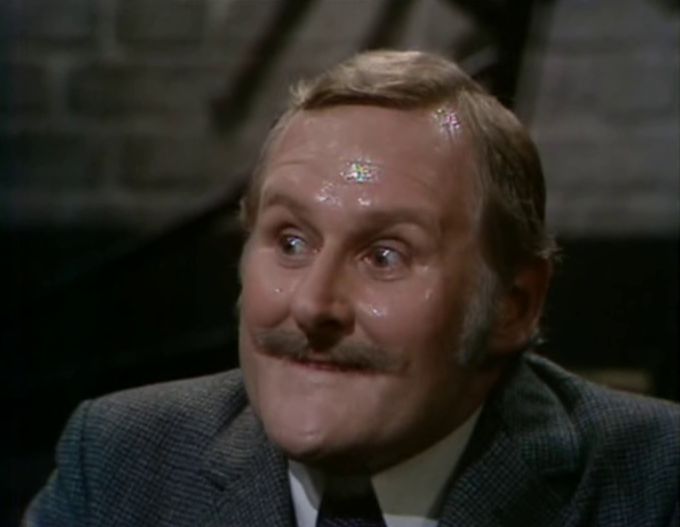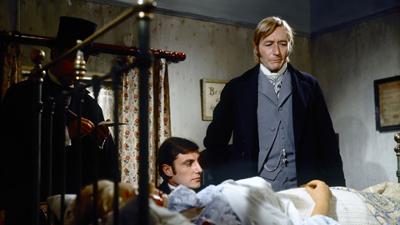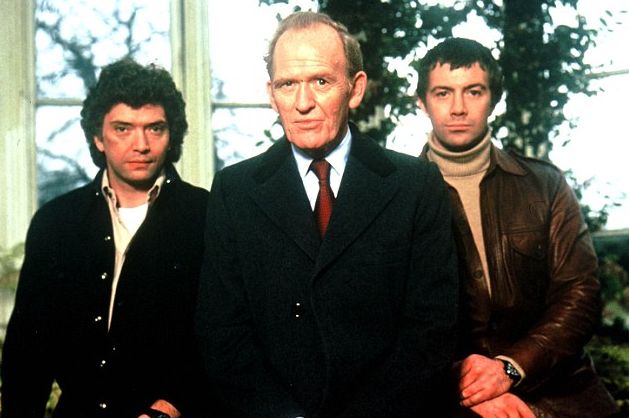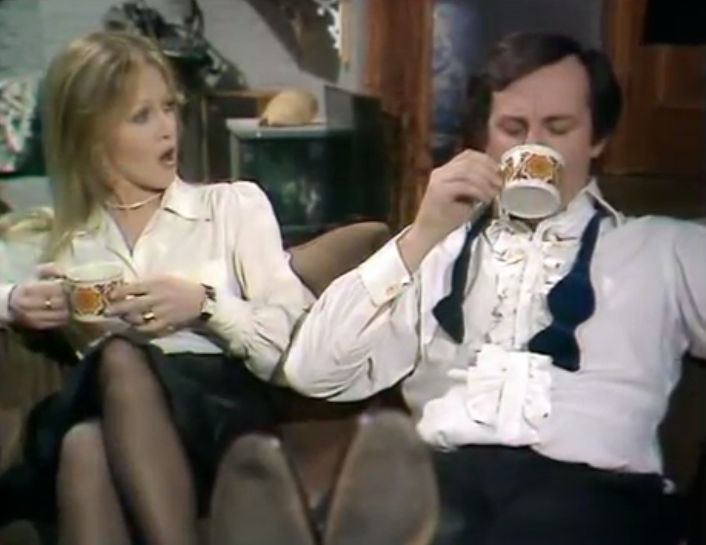
Zodiac – The Horns of the Moon

horns

Written by Peter Yeldham
Directed by Joe McGrath

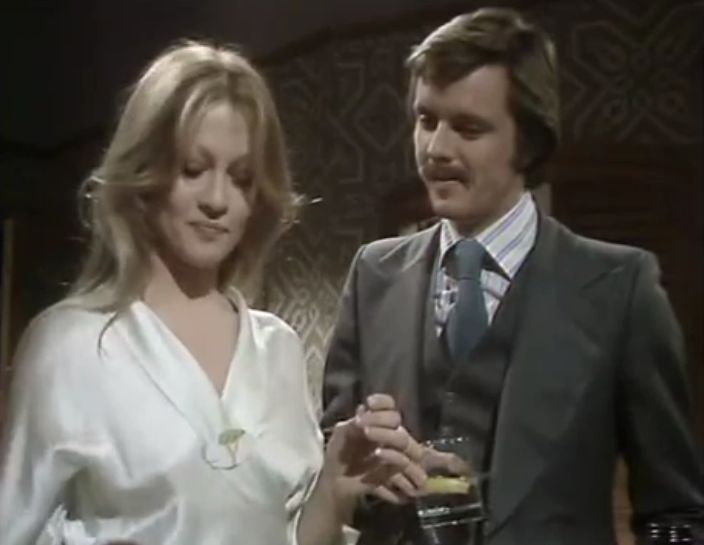
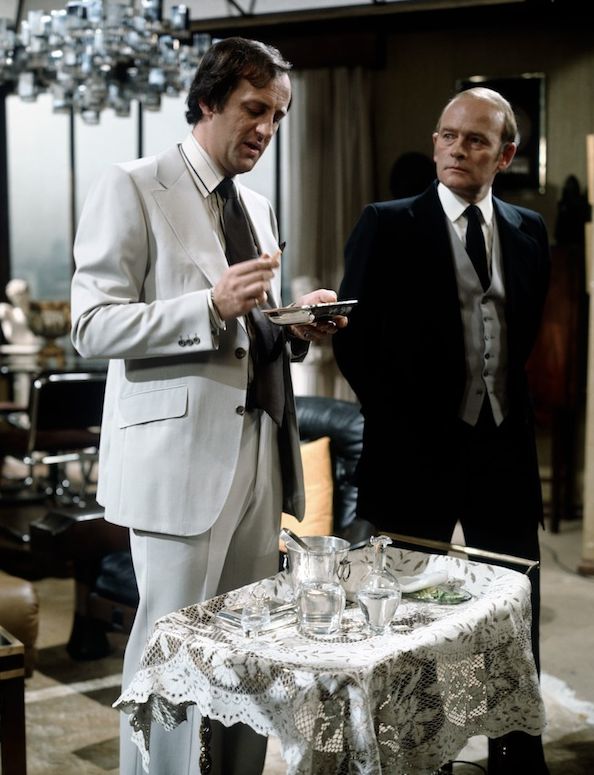
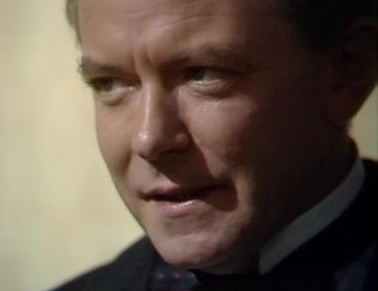
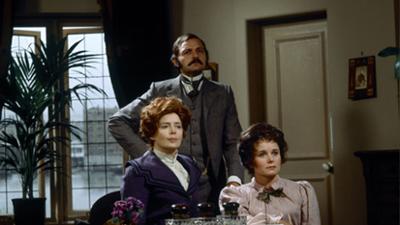
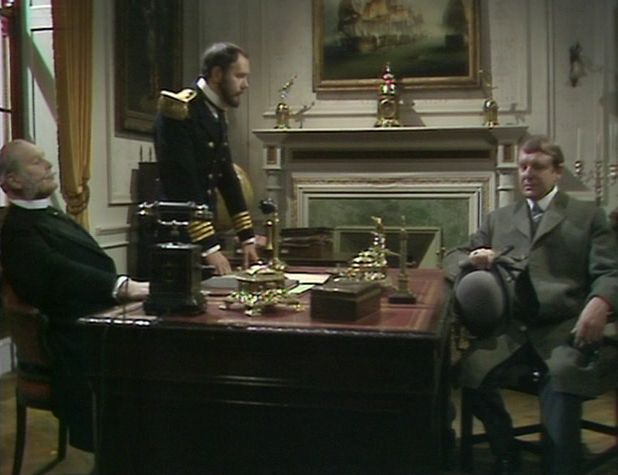
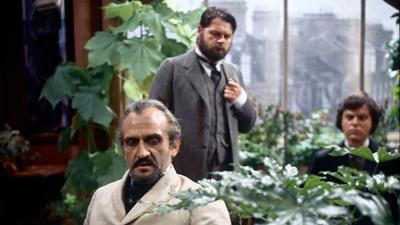
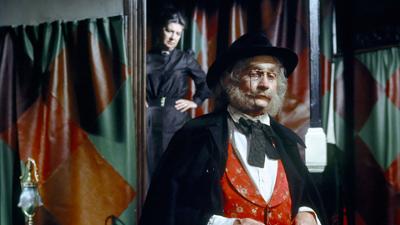
General Weston (Peter Jones) is the autocratic chairman of a small merchant bank.  He wishes to initiate a merger (which effectively means selling the bank).  His fellow directors and his son Tony (Peter Egan) are against the plan, but the General always gets his way – and he does so again.

But shortly afterwards, he falls down the bank’s lift shaft.  As Tony later remarks, anybody else would have broken their neck, but he escaped with just a sprained arm.  However, it does seem to indicate that somebody at the bank wishes him harm.

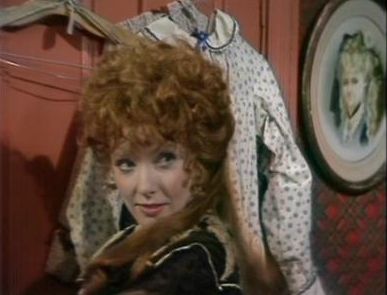
There’s no shortage of suspects.  His son would inherit everything on his death, whilst the vampish Julie Prentiss (Michele Dotrice) seems to have the General wrapped around her little finger.  The other directors, Rodney Tyce (Graham Crowden), Ian Rentoul (Ronald MacLeod) and Agnes Courtney (Gillian Raine), could all have motives whilst the servant Dobbs (Norman Chappell) is another possibility.

Tony is a regular client of Esther’s and he calls on her to ask for advice.  He wants to leave the bank and break free from his father – but only if she confirms that the stars are correctly aligned.  She visits him at the bank to deliver the horoscope and he suggests they have a drink.  It comes as something of a surprise to find the General frozen solid in the fridge …..

The Horns of the Moon is by far the best mystery of the series since, as the above list indicates, there’s no shortage of suspects.  Once again, Esther is at the scene of the crime when the body is discovered, much to Gradley’s despair.  He’s also a little peeved at having to leave his dinner companion.  “You may not know it but I was at a charity dinner, escorting a debutante of the year.”  When Esther asks which year, he tells her it was quite a recent vintage.

Gradley quickly gets a feel for the list of suspects and it’s clear that Tony is his favourite.  Esther violently disagrees as she says it’s astrologically impossible for him to have committed the murder.  Gradley doesn’t arrest Tony straight away as he knows he’ll make his way to Esther’s flat in order to unburden himself.  This he does and what Tony says is pretty damming.  “What would you say if the files showed that I embezzled two hundred thousand pounds from the firm and the gun that killed the General was in my desk and that I wiped it clear of fingerprints and put it back in the boardroom and I took the files and put them in the cellar?”

Tony protests his innocence – he looks guilty, but that’s only because somebody has framed him.  Later on, even more evidence pointing to his guilt comes to light and Gradley arrests him.  Esther remains unconvinced and continues to nag at him to consider the other possibilities.

As with all the episodes, there’s a lovely group of actors here.  It’s a shame that Peter Jones doesn’t last longer as he’s got some nice comic business as the General.  Peter Egan is a bundle of nerves as the perpetually twitchy Tony whilst Graham Crowden is quite restrained as Tyce.  Tyce is a character that exists on the outskirts of the majority of the story, but he does have a part to play later on.

The banter between Gradley and Esther also helps to keep the interest chugging along.  Both of them, especially Anton Rodgers, have great comic timing and it’s their partnership which is one of the main strengths of the show.

The Horns of the Moon was the final story of this short series.  The real murderer is eventually found and Tony is set free, but that’s the end of the line for Gradley and Esther.  The premise of the series (detective and astrologer teamed up) was an intriguing one, although it’s fair to say that some of the plotting was a little loose in several of the episodes .

The partnership between Hempel and Rodgers as well as the guest casts more than made up for this though and there was certainly enough potential for a further run of episodes.  It wasn’t to be though, which is a shame since Zodiac is a nice little series and provided you don’t mind studio-bound drama (not a single location shot in the six episodes) it’s well worth tracking down.
Zodiac – Sting, Sting, Scorpio!

scorpio

Written by Roger Marshall
Directed by Piers Haggard

Madame Lavengro (Anne Dyson) is a fortune-teller who lives and works in Brighton. Two maids from a local hotel visit her for a reading. Brenda (Jeananne Crowley) waits in the other room whilst Peggy (Susie Blake) goes first.

Whilst she looks like the archetypal fake fortune-teller (complete with headscarf and crystal ball) it’s clear that she has genuine insight. She knows that Peggy has problems with her boyfriend and that he possesses money that doesn’t belong to him.  A moment later she realises that he’s the Brighton Hotel robber.

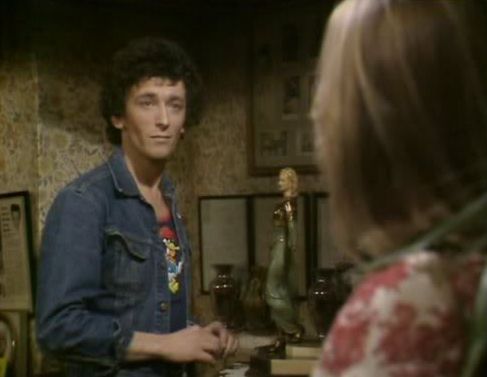
Like Peggy, her boyfriend Brian (Robert Powell) works at the same hotel. He knows that he has to silence the fortune-teller – which he does. The day after, Esther pays a visit to Madame Lavengro and discovers her body. Esther was a friend and admirer of Madame Lavengro, so she takes the lease on her shop and tells Gradley she’s determined to track down her murderer.

Esther’s in something of a huff with Gradley as he’s reluctant to get involved in the case (it’s well outside his patch). He does eventually travel down to join her, after taking some leave, but they still indulge in a good deal of bickering once they do team up. There’s also another sighting of Anton Rodgers in denim (not good) and later he sports an interesting cravat (also not good).

A curly-headed Robert Powell is the villain of the piece. He’s not really known for playing baddies, which is probably why the character doesn’t quite have the dangerous edge he should have. The rest of the cast also features some familiar faces. Wensley Pithey (a regular in the early series of Special Branch) is Inspector Duggan, Susie Blake is the sadly doomed Peggy and Frank Gatliff brightens up the screen briefly as the camp-as-anything Felix Pettigrew.

Another eyebrow raising performance is given by Bob Sherman as the hippy singer Bob Thomas. Sherman’s probably best known for playing an American spook in The Sandbaggers, so this role is something rather different. Although the 1960’s was long over by this point, Thomas is obviously a throwback (“Yeah baby, I’d really freak out man”). He doesn’t contribute anything to the plot, but he’s a nice bit of local colour.

Anouska Hempel obviously had a cold whilst the story was being recorded, as her voice is pretty strained at times. This is referred to right at the end, presumably via an adlib, as Gradley declines to kiss her because of her cold and she threatens to spit all over him!

Sting, Sting, Scorpion! is a nicely plotted tale. There’s one example of Esther’s special powers (she receives a vision that Peggy has drowned) but that doesn’t affect the solving of the crime too much, so it isn’t a particularly large cheat.

Another strongly-cast and well-acted story.

Zodiac – Saturn’s Rewards

saturn 1

Written by Pat Hoddinott
Directed by Don Leaver

Richard Meade (Peter Vaughan) is awoken by noises from the flat opposite.  He opens his bedroom window to investigate and is shocked to see a man attacking a woman.  He rushes to the phone, but then stops – the woman sharing his bed isn’t his wife and since he’s an MP he can’t afford any scandal.  Next day, Gradley visits him to ask if he saw anything the previous night.  Meade responds in the negative.

A few days later, Esther is entertaining Meade’s daughter Deborah (Joanna David), her mother Susan (Dinah Sheridan) and Deborah’s new boyfriend Martin Seacombe (Ian Ogilvy).  Martin is a smooth-talker, but he doesn’t believe in astrology – which causes Esther’s hackles to rise slightly.  One of her gifts is an ability to tell the star-sign of anybody, just by looking at them.  She declares that Martin is a Scorpio, but he tells her he was born in May – which would make him an Aries.

Esther simply doesn’t believe him or that she could be so wrong.  His insistence would already be enough to mark him out as a wrong ‘un, but he was also the man we saw at the start, committing the murder, so he’s clearly going to be the villain of the piece.  When Meade arrives to pick up his wife and daughter he’s shocked to see Martin with his daughter.  He knows the man’s a murderer, but if he tells anybody then the story of his infidelity will come to light, and this puts him in something of a quandary.

Anouska Hempel & Ian Ogilvy

Saturn’s Rewards isn’t the first episode of Zodiac to use some outrageous coincidences, but the ones here are worth repeating.  Meade’s daughter’s fiance chooses to commit a murder in the flat opposite Meade (it’s never explained why he’s in that flat).  Gradley is the detective assigned to investigate the murder, whilst Esther is an old friend of Meade’s daughter, Deborah, which is how Esther becomes involved.  Too many coincidences!

The studio-bound nature of the production becomes rather apparent when we see the murder committed.  The gap between the two flats isn’t very wide and it’s impossible to believe that Martin didn’t see Meade looking at him.  Obviously he didn’t, otherwise the story simply wouldn’t work, but the camerawork seems to imply otherwise.

Whilst the plot has its problems, we can take solace with the cast.  Peter Vaughan is good fun as a rather shifty, untrustworthy politician and Ian Ogilvy (complete with a moustache that may be fake, I think it is) is the charming, but dangerous Martin.  Joanna David and Dinah Sheridan have less to do, but having two good actresses in those roles is some consolation for their slightly underwritten parts.

Esther and Gradley are kept apart for a while, which is a pity, since the series really sparkles when the two of them are together.  When they eventually meet up, Gradley tells her a little about the murder case but then says he doesn’t need her help on this one.  Esther is incredulous. “It must be straightforward. What happened, did you find the killer drunk on the floor, prints all over the murder weapon and a signed confession in his top pocket?”

Undeniably, this is clumsily plotted, but once again the performances of both the regulars and the guest cast manage to make something out of the fairly thin material.

Zodiac – The Strength of Gemini

gemini

Written by Philip Broadley
Directed by James Ferman

Paul Derring (Norman Eshley) is a smooth-talking conman who targets beautiful, young, upper-class women.  He spies his latest mark, Elizabeth Charmont (Jenny Hanley), and moves in.  Elizabeth has never met him before – but he seems to know everything about her.  “Although we’ve never met, I know you. There is an empathy between us.”  He goes on to tell her things about herself that no stranger could possibly know.  Initially it seems that he’s an astrologer like Esther, but it turns out he’s been abusing Esther’s gifts for his own ends – which proves to be his downfall.

Since Esther writes a successful horoscope column (under the name of “Sibyl”) she receives many requests for personal horoscopes.  One such letter strikes a chord and she suddenly realises that recently she’s been sent numerous pleas for horoscopes – apparently from different people – but now it dawns on her that they’ve all come from the same person.  The names are different each time, but a handwriting expert called Toby (Charles Lloyd Pack) confirms that the signatures are all from the same hand.  So Esther calls in Gradley – she wants to find out who’s been doing this and why.

Since the opening of the story is Esther-centric, Gradley doesn’t appear until thirteen minutes in – but it’s worth waiting for, as Anton Rodgers is a vision in denim.  Maybe he was dressed down in order to make Hempel (who’s wearing a rather nice black evening dress) look even more stunning?  Esther shows him the letters and they decide that the first one – sent by a Paul Derring – is probably genuine.  So can they locate Derring?

Jenny Hanley & Norman Eshley

The system he’s worked out to provide himself with victims is quite neat – he has a confederate called Penny (Deborah Norton) who works at a flower shop which is frequented by the upper-classes.  Whenever somebody visits to buy flowers for a likely target’s birthday, Penny makes a note of their birth-date and address and passes the information onto Derring.  He then requests a horoscope from Esther and therefore is able to astound his latest conquest with a host of impressive facts about their life.

Philip Broadley’s script follows the template laid down by Roger Marshall’s first two stories.  There’s plenty of banter between the two leads and a general lightness of touch throughout.  Whilst Derring is a conman, he also has a sense of humour and the script and direction help to accentuate this by throwing in the odd, wrong-footing moment.  My favourite is the scene that opens with a close-up on Derring’s face.  He looks quite serious, but as the camera pans down it becomes clear that he’s merely standing in his underpants, ironing his trousers!

The obvious plan is for Esther to present herself to Derring as his latest victim, which causes Gradley a little pain as she artfully stokes up his jealousy by casually mentioning how charming Derring is.  Fashion-wise, Hempel sports a variety of costumes, from the aforementioned black dress to a towel (and looks good in all of them).  Thankfully, Rodgers’ denim interlude is quite brief and he spends the rest of the story more conventionally attired.

One unusual thing about the series to date is that it’s completely studio-bound.  It wasn’t unheard of for some 1960’s series (like Sergeant Cork) to be almost entirely recorded in the studio (although that, I assume, was probably due to the show’s Victorian setting – it would have been difficult to film outside without major redressing of most locations).  Since Zodiac was a contemporary series, that problem didn’t apply – and the lack of location work does make the programme feel a little claustrophobic at times.

Zodiac – The Cool Aquarian

cool

Written by Roger Marshall
Directed by Don Leaver

Whilst Gradley was a confirmed astrological sceptic in Death of a Crab, at the start of this episode he seems to have revised his opinion somewhat when he calls on Esther to ask her advice. Of course, it just might be that he wants to spend more time in the delectable Ms Jones’ company – which is completely understandable.

Gradley has received a tip-off that something’s going to happen on Thursday evening.  He doesn’t know what and he doesn’t know where, but he hopes that Esther will be able to provide him with the answers.  Esther is incredulous.  “You mean, 4:45 Lloyds Bank, Lower Sloane Street, a ginger-headed man with a thirty denier nylon mask and a left-footed limp? Of course I can’t. You really do have some strange ideas about astrology.”

Whilst Gradley is left to ponder on this problem, the episode develops two seperate plot-lines.  The first concerns two businessmen – Reuben Keiser (Michael Gambon) and Mark Braun (George Baker).  They’re very different types – Keiser is somewhat sharp and unscrupulous (as he says himself he’s “more barrow boy than Harrow boy”) whilst Braun is more refined and keener to do the right thing.

The second sees Gradley pay a visit on George and Paula Sutton (Bill Maynard and Betty Alberge).  Their niece, Sheila, has disappeared and shortly afterwards they receive a note to say she’s been kidnapped.  The two plot-threads converge when Kesier receives a ransom note.  He’s never met Sheila, but unless he pays one hundred thousand pounds the girl will die.

As the kidnap happened on Thursday evening, Esther wonders if this is the job that Gradley received a tip-off about.  Although that does seem unlikely, since it transpires the kidnap was a one-person job – why would they inform on themselves?

Remarkable coincidence number one is that Esther already knows Keiser and Braun (she’s supplied both of them with astrological readings).  Remarkable coincidence number two is that when Braun persuades Keiser to call the police, it’s Gradley who’s assigned to the case.

Like Death of a Crab, the solution to the mystery isn’t particularly taxing, but producing a baffling puzzle doesn’t seem to be this series’ raison-d’etre.  Instead, Marshall’s script focuses more on the characters, especially Gradley and Esther.  Just two episodes in, there’s an obvious “will they, won’t they” vibe about their relationship.

The story boasts a cracking guest cast.  Gambon and Baker are two actors that enhance any production and whilst Bill Maynard’s role is a little more serious than many of his signature parts, it’s still a pleasure to see him.  He does have one good comic scene though, when he and his wife manage to give a description of Sheila to Gradley that takes an age – mainly because they can’t agree on the most basic questions (her height, whether she’s pale or not, etc).

Also well worth watching is the ever dependable Trevor Baxter as Esther’s temporary butler, Neville.  He proves to be an invaluable help to Gradley (picking out a few clues from the ransom note) and Gradley’s way of thanking him seems to involve putting on an apron and helping him clean the silver!

Esther saves the day by casting a horoscope which leads the police to the place where Sheila is being held.  This is a slight cop-out and is probably one of the series’ main flaws.  As previously mentioned, the temptation to use Esther to pull a rabbit out of the hat can be damaging to the integrity of the narrative.

But although this is a problem and the mystery isn’t that mysterious at all, The Cool Aquarian is still an enjoyable fifty minutes.

Zodiac – Death of a Crab

"Death of a Crab" TX 25/02/1974 Thames Television Production

Written by Roger Marshall
Directed by Raymond Menmuir

Although not as familiar a name as, say, Brian Clemens, Roger Marshall is something of a British television drama legend. He co-created Public Eye and wrote many of its best episodes (including all of the first Thames series).  During the 1980’s he created and wrote two well received series, Travelling Man and Floodtide.

He was also very adept as a writer-for-hire, crafting quality episodes for programmes like The Avengers, Van Der Valk and The Sweeney.  Another outstanding Marshall script was provided for series two of Survivors (Parasites, tx 2nd June 1976).

Having said all this, I can’t put my hand on my heart and claim that Zodiac (which he created and wrote three of its six episodes) is a highlight on his CV, but it does have its moments – mainly thanks to the lead performances of Anouska Hempel and Anton Rodgers, some witty dialogue and a number of quality guest stars.

Rodgers is David Gradley (a most unusual policeman) and Hempel is Esther Jones (an astrologer) and together they solve crimes that hinge, more or less, on the signs of the Zodiac.  Alas, it seemed that public and critical indifference ensured that they only managed to cover six of the twelve signs.

The opening five minutes of Death of a Crab could be seen as an exercise in testing the patience of the audience. Since it’s a new series, you might expect a good, swift hook to capture their attention – instead we see Parker (Peter Childs) making himself at home at the luxury penthouse apartment owned by Aikman (John Rhys-Davies).  Aikman isn’t there, but he’s left a recorded message inviting Parker to treat the place as his own.

So Parker wanders about, examines the fixtures and fittings, pours himself a drink, has a cigar, draws a bath and settles down to enjoy his scotch.  By now, five minutes have elapsed – but just before you wonder exactly when the story will start, Parker slumps in his chair, unconscious.  Next morning, the maid discovers his dead body in the bath and the police, in the form of Gradley, are called.

Whilst this has the hallmarks of a police series (with a mystical edge) one thing that’s missing are (with the exception of Gradley) the police.  Unusually, he’s the only representative of the force we see.  He doesn’t have a sidekick (something later mentioned by Esther) and there’s no sign of fingerprint or forensic officers at the scene of the crime either.

When he and Esther meet for the first time she expresses incredulity that he’s a policeman (presumably because of his, by 1974 standards, natty clothing).  He responds that “we no longer sport the blue serge and silver buttons.”

Gradley is intrigued by Esther’s trade, but is unconvinced (at least to begin with).  “An astrologer?  Shouldn’t you be in gypsy kit, polishing your crystal ball?  I hear your union is pressing for a universal ban on tea bags.  Any truth in it?”  When Esther asks him if he’s a bigot or sceptic, he replies “neither, I just think it’s a load of old … Taurus.”

The clash between the rational police procedure of Gradley and the mystical intuition of Esther is obviously one of the series’ selling points, although the elements do sit rather uneasily together.  If the series had run for longer then maybe Esther’s skills could have been integrated better into the stories – on the evidence of the first episode she tends to deliver uncannily accurate predictions based on people’s astrological signs with the occasional leap into the unknown. Having somebody with that level of insight does create problems in telling a straightforward story – if the writer’s in a hole, then it’s tempting for Esther to have a vision and provide Gradley with previously unknown information.

The revelation that Esther was married to Parker does (briefly) make her an object of suspicion – but to be honest, this is a murder mystery with only one suspect.  That does sap a little of the interest, but Hempel is gorgeous and Rodgers is amusing, and their witty byplay is good enough to keep this viewer interested.

The Rivals of Sherlock Holmes – The Case of Laker, Absconded

laker

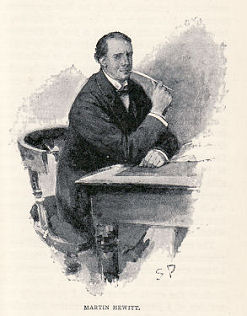
Peter Barkworth as Martin Hewett in The Case of Laker, Absconded by Arthur Morrison
Adapted by Philip Mackie.  Directed by Jonathan Alwyn

Martin Hewitt (Peter Barkworth) and Jonathan Pryde (Ronald Hines) have a new contract.  They’ve been retained by the City Guarantee Society, an insurance company who guarantee the integrity of bank employees.  So in the case of fraud or theft, the City Guarantee Society are naturally keen for the culprit to be apprehended as quickly as possible.  And so are Hewitt and Pryde (they earn no fee, but collect a percentage of the monies recovered).

The case of a junior bank clerk called Laker seems to be open and shut.  Laker is a walk-clerk, responsible for collecting money from various banks during his round and then returning it to his own bank – Messrs Liddle, Neal & Liddle.  But after collecting fifteen thousand pounds, he disappears.

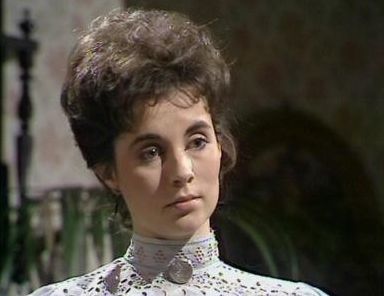
His fiance, Emily Shaw (Jane Lapotaire), remains convinced of his innocence and she begs Hewitt to help her.  When the evidence of his guilt starts to pile up, even she starts to doubt him.  But Hewitt wonders if some of the trail is just a little obvious – it’s almost as if he wanted to be tracked.  Emily tells Hewitt that Laker is a clever man, so why has he acted in such a careless way, throwing clues about?

The Case of Laker, Absconded was the third and final Martin Hewitt story by Arthur Morrison to be adapted for the first series of The Rivals of Sherlock Holmes.  The original story appeared in The Chronicles of Martin Hewitt, published in 1895, and it can be read here.

Jonathan Pryde, the Hewitt substitute from The Case of the Dixon Torpedo appears briefly, but this is very much Hewitt’s case.  He spends the majority of the episode in the company of Emily Shaw and together they attempt to prove or disprove Laker’s guilt.  Barkworth is his usual solid self and Jane Lapotaire impresses as a woman who remains unswervingly devoted to her finance – even though all the evidence suggests that’s he’s jilted her and run away to the continent with a horde of stolen money.

There’s two possible solutions to the story and it quickly becomes clear which is the more likely.  So this isn’t a complex or surprising tale – instead the enjoyment comes from the lead performances of Barkworth and Lapotaire, as well as some of the supporting cast.

Chief amongst these are Leslie Dwyer and Toke Townley as two lost property men at the local railway station.  Laker’s lost umbrella (which Hewitt recovers) is a minor plot point, but the main pleasure in these scenes is the comic timing of Dwyer and Townley.

Toke Townley isn’t the only connection to Emmerdale (he played Sam Pearson from 1972 to 1984) as Mr Wilks himself, Arthur Pentelow, appears as Inspector Plummer.  Like many of the other policemen in the series, he’s always a couple of steps behind the private detective but Plummer doesn’t seem to mind – especially since with Hewitt’s help he manages to round up a dangerous gang of crooks.

The Case of Laker, Absconded brought the first series of The Rivals to a close.  Overall, it was a very consistent run of episodes with some strong central performances from the various detectives.  The series would return for a second, and final, series – which promised new detectives and more baffling cases for them to solve.

The Rivals of Sherlock Holmes – The Ripening Rubies

rubies

Robert Lang as Bernard Sutton in The Ripening Rubies by Max Pemberton
Adapted by Anthony Skene.  Directed by Alan Cooke

When an ex-con called Jaffe (Ron Pember) attempts to sell a valuable ruby necklace, he makes the mistake of taking it to Bernard Sutton (Robert Lang).  Sutton was the jeweler who made the necklace in the first place and he’s well aware that it was recently stolen from Lady Faber (Lally Bowers).

Jaffe insists he didn’t steal the necklace – he bought it from a Dutch sea captain with a wooden leg.  It seems an implausible story, but that’s only part of the problem.  London society has been gripped by a wave of jewel robberies recently – and this is the first piece to have been recovered.

Sutton returns it to Lady Faber and she insists that he attend the grand ball she’s throwing that evening.  Everybody who is is anybody in polite society will be there – and it seems certain that the thief will strike again.  Sutton tries to demur, insisting that he’s a jeweler and not a detective, but Lady Faber is used to having her own way and reluctantly Sutton agrees.

The Ripening Rubies was written by Max Pemberton and was one of ten short stories featuring Bernard Sutton that were published in the book Jewel Mysteries: From a Dealer’s Notebook in 1894. It can be read here.

As Sutton says, he’s not a detective and can’t claim to have any special knowledge of crime or criminals.  However, in Pemberton’s short story of The Ripening Rubies he does explain a little about what motivates him.

I have said often, in jotting down from my book a few of the most interesting cases which have come to my notice, that I am no detective, nor do I pretend to the smallest gift of foresight above my fellow man. Whenever I have busied myself about some trouble it has been from a personal motive which drove me on, or in the hope of serving some one who henceforth should serve me. And never have I brought to my aid other weapon than a certain measure of common sense. In many instances the purest good chance has given to me my only clue; the merest accident has set me straight when a hundred roads lay before me.

Robert Lang gives a steadfast performance as Sutton.  He’s quite prepared to pull a gun on Jaffe to stop him leaving his shop and at the end of the story he confronts the gang with steely determination.  It’s interesting that Inspector Illingworth (Windsor Davies) seems to suspect that Sutton himself has a hand in the robberies.  Given some of the corrupt detectives we’ve seen in the series, that wouldn’t have come as a surprise – but Sutton proves to be totally honest.

Since the identity of the villains isn’t much of a shock, it’s fair to say that the majority of the pleasure in this one comes from the journey, rather than the destination.  Lally Bowers is good fun as the autocratic Lady Faber and Richard Hurndall is his usual dependable self as Lord Faber.

Moira Redmond as the charming Mrs Kavanagh catches Sutton’s eye at the party.  She has an impressive collection of jewels, which Sutton takes a keen interest in, and her witty byplay helps to keep up the momentum in the middle of the story.  She’s not all she seems though – and events come to a head to provide a suitably dramatic finale.

There’s a terrible use of CSO right at the start (the background behind Sutton’s shop is CSO, but it stays static as the camera zooms in on the real shopfront – it’s astonishingly inept) but that apart, this is a pretty decent story with Robert Lang and Moria Redmond both on top form.

Next Episode – The Case of Laker, Absconded

The Rivals of Sherlock Holmes – The Assyrian Rejuvenator

sinden

Donald Sinden as Romney Pringle in The Assyrian Rejuvenator by Clifford Ashdown
Adapted by Julian Bond. Directed by Jonathan Alwyn

Sergeant Hawkins (Victor Platt) calls on Romney Pringle (Donald Sinden) to ask for his help – a conman called Henry Jacobs (Derek Smith) is selling a potion called the Assyrian Rejuvenator.  He claims it’s a remarkable tonic that will restore their lost youth, but it obviously does no such thing.  Hawkins can’t proceed until somebody makes a complaint and he concludes that nobody will – since they’re all too embarrassed to admit they’ve been conned.

When Pringle asks why Hawkins has come to him, the policeman’s answer is straightforward – “set a thief to catch a thief”.  Pringle’s office door might declare him to be a private detective, but it’s clear that he’s more than happy to break the law when it serves his best interests – and he quickly sees how to turn the affair of the Assyrian Rejuvenator to his own benefit,

Romney Pringle was created by R. Austin Freeman and John Pitcarn (writing as Clifford Ashdown) and the character appeared in a series of stories written at the turn of the twentieth century. The Assyrian Rejuvenator was included in the book The Adventures of Romney Pringle and it can be read here.

Pringle is a rogue, very much in the mould of Horace Dorrington, and he’s quickly able to deal with Jacobs (by scaring him out of town).  He then proceeds to take over Jacobs’ operation, which also means inheriting Doris (Alethea Charlton).  Pringle’s an arch manipulator and he quickly has poor Doris hanging on his every word.

Donald Sinden gives a typically ripe performance as Pringle, although he never manages to make the character even remotely likeable. Peter Vaughan’s Dorrington was similarly unscrupulous, but he had a certain charm, thanks to Vaughan.  Also, whilst Dorrington never quite managed to pull of the big con in either of the two stories adapted for The Rivals, here we see Pringle make a tidy profit from Jacob’s operation – and he shows little remorse when both Jacobs and Doris are caught by the police and charged with running the whole operation.  Which isn’t, when you consider how he manipulated Doris to serve his own interests, a very admirable trait.

Jo Rowbottom
Jo Rowbottom

It also doesn’t help that the story is a little mundane, although there are a few compensations such as Jo Rowbottom as Suzy Shepherd, Music Hall artiste, and Michael Bates as Colonel Sandstream, an elderly duffer who’s somewhat smitten with her and will try anything (including the Assyrian Rejuvenator) to improve his chances to, as it were, satisfy her.  Rowbottom is rather alluring and Bates (star of It Ain’t Half Hot, Mum and Last of the Summer Wine) has a nice line in comic bluster.

They both help to compensate for an episode which is one of the less engaging from the first series.

Next Episode – The Ripening Rubies

The Rivals of Sherlock Holmes – The Affair of the Tortoise

peter

Peter Barkworth as Martin Hewitt in The Affair of the Tortoise by Arthur Morrison
Adapted by Bill Craig. Directed by Bill Bain

Martin Hewitt (Peter Barkworth) visits Miss Chapman (Cyd Hayman) to inform her that she stands to inherit a considerable fortune, following the death of a distant relative.  As Miss Chapman lives in genteel poverty, this is very welcome news.

When Hewitt is talking to her, he hears a dreadful din coming from elsewhere in the house.  Miss Chapman explains that the noise is made by one of the other residents – Rameau (Stephan Kalipha).  He’s a very strange fellow, he favours sliding down the bannisters, is frequently drunk and makes the life of Goujon (Timothy Bateson) a misery by playing practical jokes on him.

When Rameau’s latest practical joke results in the death of Goujon’s beloved tortoise, Goujon declares that he’ll kill him.  And shortly afterwards, the maid Millie (Cheryl Hall) discovers Rameau on the floor of his rooms, covered in blood, with an axe beside him.

It’s a clear case of murder – but when the police enter the room, Rameau’s body is gone.  Goujon has also left and he’s obviously the prime suspect – but Miss Chapman isn’t convinced and she commissions Hewitt to investigate.  Another resident, Captain Cutler (Esmond Knight), tells Hewitt that he’s seen a man hanging around for a while, watching for Rameau.  The discovery of a voodoo doll in Rameau’s rooms and the knowledge that the man lived in fear of strangers are enough to convince Hewitt that there’s more to this case than meets the eye.

Like The Case of the Dixon Torpedo, this was written by Arthur Morrison and appeared in the collection of stories entitled Martin Hewitt, Investigator which was published in 1894.  The book can be read here.

But unlike the Dixon Torpedo, Martin Hewitt appears in this adaptation and he’s expertly played by Peter Barkworth.  One of the pleasures of watching archive television on a regular basis is that you tend to see the same faces appear again and again.  Recently I’ve seen Barkworth in an episode of Out of the UnknownTo Lay a Ghost as well as an early edition of Public EyeNobody Kills Santa Claus.  Any performance by Peter Barkworth is worth treasuring since he was such a meticulous, tidy actor and he fits the role of Martin Hewitt (modest, undemonstrative but forthright) perfectly.

Not only was he a first class actor, but he taught at RADA during the late 1950’s and early 1960’s and the likes of Anthony Hopkins, Simon Ward and Diana Rigg were amongst his pupils. He later remarked that “of all the jobs I have ever had, teaching at RADA is the one I should least like to have missed”.

With Barkworth providing a solid foundation as Hewitt, he was supported by a very decent cast of fellow actors.  The gorgeous Cyd Hayman had appeared alongside him the year previously in the WW2 drama Manhunt, whilst Timothy Bateson makes a decent attempt at a French accent and Stefan Kalipha is suitably unhinged as Rameau.  As neither Bateson or Kalipha have a great deal of screen-time, they have to make a strong impression early on, which they both do.

Cyd Hayman
Cyd Hayman

Inspector Nettings (Dan Meaden) naturally favours Goujan as the murderer, but when it’s proved that he’s innocent, the policeman is in a bit of a quandary.  It’s a staple of detective fiction to have the police baffled whilst the private detective runs rings around them, but even allowing for this, Nettings is exceptionally dim.  As Hewitt says “I have heard the opinion expressed that Inspector Nettings couldn’t find an omnibus in Oxford Street. But I don’t share that opinion. On the other hand I’m not convinced he could find the one he was looking for”.

Much as I love Barkworth, I’m never quite sure if the scene where he questions a cabman (and adopts a rough approximation of a lower-class accent) is deliberately meant to be unconvincing (to indicate that Hewitt didn’t really go in for that sort of thing) or whether Peter Barkworth just wasn’t very good at accents.

Whilst the solution to the mystery seems clear fairly early on, nothing’s quite as it seems and there’s a number of twists and turns in the story – which could quite easily sit alongside many of Conan-Doyle’s Sherlock Holmes tales.  With Holmes having apparently faced his Final Problem in 1893, Martin Hewitt proved to be a very acceptable substitute and his stories (prior to being collected in book form) were published in various magazines, including The Strand (which had been the home of Sherlock Holmes).  Sidney Paget’s illustrations (like they did for Holmes) also added a touch of class.

hewitt

It does seem remarkable no series were spun out of The Rivals of Sherlock Holmes as many of the stories we’ve seen so far have demonstrated that there was definite mileage in taking the characters further.  So a series with Barkworth as Hewitt wasn’t to be, unfortunately, but he’ll return in one more tale – The Case of Laker, Absconded.

Next Episode – The Assyrian Rejuvenator

The Rivals of Sherlock Holmes – The Woman in the Big Hat

hat

Elvi Hale as Lady Molly in The Woman in the Big Hat by the Baroness Orczy
Adapted and Directed by Alan Cooke

When a customer is found dead at a tea shop, Lady Molly of Scotland Yard (Elvi Hale) and her faithful assistant Mary Grandard (Ann Beach) are on hand to investigate.  As a female detective in a predominately male environment, Lady Molly is something of a pioneer – and certainly she’s the right person to uncover the tangled threads of this baffling murder.

Lady Molly was created by the Baroness Orczy, best known for writing The Scarlet PimpernelLady Molly of Scotland Yard was published in 1910 and contains twelve adventures, of which The Woman in the Big Hat was the tenth.  The book can be read here.

Her precise rank in the police force is something of a mystery as she’s only ever referred to as Lady Molly – but since she speaks to Inspector Saunders (Peter Bowles) as an equal, presumably she’s on a similar level.  Saunders appears to be on hand to be someone who’s essentially well-meaning but lacks the subtle approach of Lady Molly (for example, he picks up the teacup which held the poison, much to the dismay of Lady Molly, who chides him about fingerprints).

The murdered man was Mark Culledon, a member of a very good family – and it appears someone beyond reproach.  Considering Lady Molly’s rarefied status and the fact that the members of the working class we see (such as Katie Harris, played by Una Stubbs) are portrayed as untrustworthy at best and criminal at worst, it does appear at first to be a story that’s sympathetic to the struggles of the upper classes.

But things aren’t so cut and dried and it becomes clear that even behind the most genteel of drawing room doors, passions can run high.  However, the first thing Lady Molly needs to to do is to track down the woman in the big hat.  Mark Culledon was seen having tea with a woman wearing a rather large hat and after she left, he was found dead.  It therefore seems obvious that Culledon was poisoned by the woman.

A prime-suspect is found, Elizabeth Löwenthal (Elizabeth Weaver).  She admits that she had a relationship with Culledon in the past and that she visited him after he was married – and she certainly possesses a big hat, but is she the one?  Saunders is convinced, but Lady Molly isn’t so sure.

Elvi Hale plays Lady Molly with great gusto.  She’s clearly somebody who has to work in rather makeshift surroundings (the sign on her office says “stores”, over which has been hung another sign saying “female department”) but she makes the best of things.  She shoots a gun as well as any man and is dismissive when Grandard tells her that Saunders is a great believer in her intuition.  Lady Molly counters that he has to call it intuition, he simply can’t believe that a woman can think for herself.

Peter Bowles is on hand to do the leg-work whilst Ann Beach as Grandard is there to take notes, swoon over Molly’s deductions and effectively act as Watson to her Holmes (Grandard was the narrator of the Lady Molly stories).

Elsewhere, Catherine Lacey gives a rather individual performance as Culledon’s aunt, Mrs Steinberg.  Catherine Lacey was by this time a veteran actress and had appeared in many notable films, including Hitchcock’s The Lady Vanishes and Whisky Galore.  She gives a rather stagey, unrealistic turn, which might possibly have been what director Alan Cooke (who also dramatised the story) was aiming for – but for me, it’s a little jarring.  Francis White is more composed as Culledon’s widow and there’s a nice demonstration of low-cunning from Una Stubbs as Culldeon’s ex-maid, Katie Harris.

Since Mark Culledon is dead when we see him for the first time, the story never gives us a chance to understand what he was like as a character, first hand.  Instead, as the story progresses, more layers are lifted away as more people are questioned about him – until finally we see exactly what sort of a man he was and when we know that, the reason for the murder becomes quite clear.

In terms of a whodunnit, it’s probably one of the most interesting yet seen in the series, and this helps to make The Woman in the Big Hat one of the more memorable episodes of The Rivals.

Next Episode – The Affair of the Tortoise

The Rivals of Sherlock Homes – The Case of the Dixon Torpedo

dixon

Ronald Hines as Jonathan Pryde in The Case of the Dixon Torpedo by Arthur Morrison
Adapted by Stuart Hood.  Directed by James Goddard

Jonathan Pryde (Ronald Hines) has been hired by the British Admiralty to keep an eye on a curmudgeonly, but brilliant, inventor called Dixon (Derek Francis).  Dixon is working to develop a new torpedo and the Admiralty are worried that it could be acquired by an unfriendly power.  And when the unthinkable happens – the plans are stolen – Pryde will need to use all of his ingenuity to solve the mystery.

Arthur Morrison wrote three volumes of stories featuring private detective Martin Hewitt.  They were Martin Hewitt, Investigator (1894), The Chronicles of Martin Hewitt (1895) and The Adventures of Martin Hewitt (1896).  The Case of the Dixon Torpedo was featured in Martin Hewitt, Investigator and it can be read here.

Series one of The Rivals of Sherlock Holmes adapted three Martin Hewitt adventures – this one, The Affair of the Tortoise and The Case of Laker, Absconded.  Rather oddly, Hewitt didn’t feature in this adaptation – instead a new detective (Jonathan Pryde) was created.  Maybe it was felt that having three stories with the same detective would have been a slight case of overkill.

Ronald Hines gives a low-key performance as Pryde.  Unlike some of the other detectives we’ve seen in The Rivals, Pryde doesn’t possess any particular quirks or interesting character traits – he’s simply a dogged, thorough investigator

If Pryde is a bit of a dull fellow, then there’s compensation elsewhere.  Derek Francis is full of bluster as the bluff Dixon, whilst James Bolam and Bill Wallis form a decent double-act as Dixon’s employees.  Jacqueline Pearce (forever Servalan from Blake’s Seven) has a small part as Pryde’s wife and it’s always a pleasure to see Cyril Shaps (the voice of Mr Kipling).

The Case of the Dixon Torpedo is also notable for featuring a wide array of facial hair (much of it fairly false-looking, it must be said) whilst Dixon’s achilles heel are prostitutes (“two at a time!”).  It’s this particular vice that proves to be his undoing and enables the plans to fall into Russian hands (although Pryde is on hand to sort out the mess).

But though the plans are recovered, Pryde is appalled by the way that both the British and Russian governments are prepared to cover up the various deaths that have occurred along the way.  When he’s asked if he’d like to take on further cases for Admiralty, he replies “no, I don’t think so. I prefer crime. It’s more honest”.  Many future detectives will express similar sentiments.

This story of missing plans may have been influenced by the Sherlock Holmes story The Naval Treaty and it’s interesting to wonder if Morrison’s story was an influence on Conan-Doyle when he wrote the later Holmes tale The Bruce-Partington Plans.

It’s not a particularly complicated story and whilst I’d have preferred to have had Peter Barkworth’s Hewitt in the main role, the quality supporting cast are a major point in this episode’s favour.

Next Episode – The Woman In The Big Hat

The Rivals of Sherlock Holmes – Madame Sara

dixon

John Fraser as Dixon Druce in Madame Sara by L. T. Meade and Robert Eustace
Adapted by Philip Mackie.  Directed by Piers Haggard

Jack Selby (William Corderoy) approaches private detective Dixon Druce (John Fraser) with a strange story.  His new wife Beatrice (Jasmina Hilton) is one of three people who have a chance of inheriting their family fortune (which stands at two million pounds).  The other two are Beatrice’s sister Edith (Caroline John) and their step-brother Silva (Roger Delgado).

The capital is held in trust and will go to the last surviving family member.  Dixon quickly sees the danger that the sisters may be in – and this seems to be confirmed when Edith dies, poisoned in a most mysterious manner.  Silva would seem to be the prime suspect, although Inspector Vandeleur (George Murcell) favours Dixon’s client, Jack Selby.  If Selby disposes of the other two, then he (through his wife) will have access to the money.

But what part does the mysterious Madame Sara (Marianne Benet) play in this devilish affair?  She’s a friend of both Beatrice and Edith (although Edith seemed to live in fear of her).  According to Selby, she’s “a professional beautifier. She claims the privilege of restoring youth to those who consult her. She also declares that she can make quite ugly people handsome”.  She captivates Dixon Druce with her beauty and he confesses that he’s somewhat in love with her.  But Madame Sara is a complex creature, who isn’t quite all that she seems ….

Dixon Druce tangled with Madame Sara over the course of six short stories which were published as The Sorceress of the Strand in 1902.  The tales were written by L. T. Meade and Robert Eustace.  Although there had been female criminals before (such as “the woman” Irene Adler) Madame Sara is of particular interest since she’s very much in the super-criminal mode, which is much rarer.  During the six stories, she appears each time with an outlandish scheme, Dixon Druce gets to hear about it and stops her – but always she lives to fight another day.  For those who want to sample the original tale, Madame Sara can be downloaded here.

As Madame Sara was the first story in The Sorceress of The Strand, it made sense to adapt it for The Rivals, since it sees Dixon and Sara meet for the first time.  Sara is a strange figure, seemingly ageless (thanks to her many mysterious potions) and there’s no doubt that she captures Dixon’s heart, which makes the fact that he has to hand her over to the authorities something of a wrench for him.

John Fraser is forthright and upstanding as Dixon Druce.  To be honest, he’s not the most interesting or charismatic detective we’ve seen so far, so Fraser does sometimes struggle to make an impression (and the somewhat florid dialogue is also a problem at times).  Marianne Benet doesn’t act evil, which is a good thing – her Madame Sara is a businesswoman, rather than a cackling villain.

For any Doctor Who fans, there’s two good reasons to watch this one.  Caroline John is Edith (a subdued performance) and Roger Delgado, even though he’s confined to a wheelchair, dominates the scenes he’s in (playing the apparently invalided Silva).

delgado

Whilst Dixon appears to be more of a thinker than a man of action, he can still make the odd surprising move – such as when he wrenches a tooth from the unfortunate Beatrice with a pair of pliers (it makes sense when you’ve watched the story).

Not the strongest story, but it’s entertaining enough and the further adventures of Dixon Druce and Madame Sara would have made a decent (if short) series.

Next Episode – The Case of the Dixon Torpedo

The Rivals of Sherlock Holmes – The Case of the Mirror of Portugal

dorrington

Peter Vaughan as Horace Dorrington in
The Case of the Mirror of Portugal by Arthur Morrison
Adapted by Julian Bond.  Directed by Mike Vardy

A penniless Frenchman called Jacques Bouvier (Michael Forrest) spins Dorrington a strange tale. During the French Revolution his family acquired one of the French Crown Jewels – known as The Mirror of Portugal. The diamond is worth one hundred thousand pounds and Jacques feels that it should be his by right – although at present it’s in the possession of his cousin Leon (Oscar Quitak).

It’s a tale that intrigues Dorrington, although he ejects Jacques from his office and tells him that he wants nothing to do with the case. Afterwards, he explains to Farrish and Miss Parrot that “he wanted me to steal that diamond. He wanted me to do it for nothing and give him three quarters of the proceeds”. Naturally, Dorrington plans to steal the diamond and keep one hundred per cent of the proceeds. But someone beats him to it – and it wasn’t Jacques ….

The Case of the Mirror of Portugal was the second Dorrington tale adapted for the series.  It, along with Arthur Morrison’s other Dorrington stories, can be read here.

There’s some, interesting, French accents in this story.  Clearly French actors were thin on the ground, so the Welshman Michael Forrest essays the sort of accent that Inspector Clouseau would have been proud of.  It certainly helps to liven up the beginning of the story.

A young Jeremy Irons pops up in a blink-and-you’ll-miss-him role as a silly young ass (“What larks eh?”).  There’s a more substantial part for Paul Eddington later on in the story as Hamer and Ingrid Hafner is also very good as Hamer’s wife, Maria.

It turns out that Hamer stole the diamond and it’s currently in Maria’s possession.  Dorrington attempt to force them to hand it over, but she throws it into the Thames, rather than give it to Dorrington.  If she can’t have it, then she’d sooner that nobody did.

As might be expected, this doesn’t please Dorrington, but he quickly recovers his equanimity.  And after Jacques and Leon visit his office and tell him they’ve decided to join forces to recover the diamond, he’s happy to tell them exactly where it is (once they’ve paid him eighty guineas for the privilege, of course).

“At the bottom of the Thames. Approximately in the middle, I’d say, where the steps lead down to the towpath at Richmond lock. How do you get it back? Well, you could buy a boat and try fishing for it.  But if that doesn’t appeal, you could wait for some future age until the bed of the Thames is rediscovered as a diamond field, I suppose”

As with The Affair of the Avalanche Bicycle & Tyre Co. Ltd, Dorrington doesn’t get the ultimate prize – although he doesn’t come too badly out of it.  Peter Vaughan is, once again, smoothly ruthless as Dorrington.  Given that he’s a crook and a swindler, you don’t really want to see him finish on top – but Vaughan is just so entertaining in the role and it’s his charisma that drives this (it must be said, fairly slight) story along.

Next Episode – Madame Sara

The Rivals of Sherlock Holmes – The Horse of the Invisible

carnacki

Donald Pleasence as Carnacki in The Horse of the Invisible by William Hope Hodgson
Adapted by Philip Mackie.  Directed by Alan Cooke

Captain Hisgins (Tony Steedman) is a worried man.  According to family tradition, if the first-born is a female then she will be haunted and ultimately killed by an invisible horse during her engagement.  And for the first time in several generations, there is a first-born female.  Mary (Michele Dotrice) has heard the horse and her fiance Charles Beaumont (Michael Johnson) injured his arm when he tried to protect her from the apparition.

Hisgins doesn’t want his daughter to die, so he calls on Carnacki (Donald Pleasence).  Most detectives would raise an eyebrow at this story, but Carnacki is a ghost detective.  He doesn’t discount the supernatural possibility, although he also concedes that it could all be achieved by trickery.  But as he spends some time at the Hisgins home, the strange events come thick and fast ….

Thomas Carnacki was created by William Hope Hodgson and appeared in a number of short stories published between 1910 and 1912. These were collected together as Carnacki the Ghost-Finder and they can be read here.

The Horse of the Invisible is certainly different, that’s for sure.  It’s pitched at such a level of melodrama (with suitably dramatic music) that it’s difficult to take it entirely seriously.  The major saving grace is Donald Pleasence.  He plays Carnacki in a slightly absent-minded, self-effacing way that’s very effective.  When everyone around him is descending into hysteria, he’s very much the still point.

It’s fair to say that it’s a story that tries to have its cake and eat it – since it’s revealed that some of the hauntings were faked, but at the end we do witness a real ghost horse as well.  And Carnacki is quite honest in admitting that whilst he can explain some of the events, others are a mystery to him.

The last five or ten minutes, when we discover the identity of the faker (and for good measure he’s dressed as a horse!) might be the point when many people lose patience with the tale.  Quite why he went through all this rigmarole is something that’s never made that clear – surely there were easier ways for him to achieve his ends?

Michele Dotrice is suitably winsome as Mary, although Tony Steedman is slightly odd casting as her father.  At the time he was only in his early forties and he’s obviously made up to be much older – complete with a false moustache and a white wig.  This is a little distracting, and it begs the question as to why an older actor wasn’t cast.

The Horse of the Invisible is very watchable, thanks to Donald Pleasence, although it’s probably not a story that will appeal to all.

Next Episode – The Case of the Mirror of Portugal

The Rivals of Sherlock Holmes – The Duchess of Wiltshire’s Diamonds

duchess

Roy Dotrice as Simon Carne in The Duchess of Wiltshire’s Diamonds by Guy Boothby
Adapted by Anthony Steven.  Directed by Kim Mills

Simon Carne (Roy Dotrice) is a charming socialite who is totally at ease mixing with the highest in the land.  He’s recently returned to England after a period abroad and is met by his friend, Lord Amberley.  On the journey to Carne’s new flat, Amberley mentions that over the last month all of London has been following the exploits of a detective called Klimo.  Carne professes disinterest in the detective’s exploits and is further dismayed when Amberley tells him that his new flat is next to Klimo’s.

After Carne has heard a little more about the detective, he seems to have slightly amended his views and suggests that the Duke of Wiltshire calls in Klimo to advise on how best to protect the Duchess of Wiltshire’s diamonds.  But nobody realises Carne is living a double life – he’s also Klimo.

Simon Carne and his alter-ego Klimo first appeared in A Prince of Swindlers by Guy Boothby, which was published in 1897.  The concept of the gentlemen thief, able to remain undetected due to his exalted position in society, is a concept that remains familiar today – thanks to A.J. Raffles.  But Carne got there first, as Raffles didn’t appear in print until the following year.  A Prince of Swindlers can be downloaded here.

The opening paragraph of Boothby’s story is interesting, since he dares to compare Klimo to Sherlock Holmes –

To the reflective mind the rapidity with which the inhabitants of the world’s greatest city seize upon a new name or idea and familiarise themselves with it, can scarcely prove otherwise than astonishing. As an illustration of my meaning let me take the case of Klimo – the now famous private detective, who has won for himself the right to be considered as great as Lecocq, or even the late lamented Sherlock Holmes.

Klimo might be a great detective, but he never catches the criminal – understandable since the crimes are carried out by Simon Carne.  In print, the notion of the criminal and detective being the same person works perfectly well, but on television the conceit stands or falls based on how convincing Roy Dotrice is as the two separate characters.

Carne sports a false hunchback which he naturally removes when playing Klimo, which helps to put people off the scent.  How can the youngish, slightly deformed Carne possibly be confused for the older Klimo?  And was the use of disguises another nod from Boothby to Sherlock Holmes?

There are some nice touches in the story, such as the handy idea that Carne and Klimo have adjoining apartments, with a different servant in each (both of whom are aware of the con).  He also has a rotating desk which moves between the two flats, so he can switch disguises and apartments as required!

Carne might be a rogue (like Dorrington) but unlike Dorrington, he’s a charmer who’s very much in the Raffles mode, and it’s easy to cheer him on.  Early on, it’s revealed that he’s taken to crime in order to restore the family fortunes and he admits that it’s particularly satisfying “when it’s done at the expense of those so-called friends who could well have offered to help, when help was needed.  But never lifted a finger”.

Dotrice clearly has some fun playing the aged Klimo, complete with Irish accent and there’s the usual high-quality cast, including Peter Cellier and Barbara Murray as the Duke and Duchess of Wiltshire, John Standing and Felicity Gibson as Lord and Lady Amberley and the always dependable John Nettleton as Belton.

It’s a fairly complicated story, although everything becomes clear at the end (especially the reason why Carne gave his servant, Belton, such detailed instructions).  And if you can suspend your disbelief that nobody guesses that Carne and Klimo are one and the same, there’s plenty to enjoy in this one.

Next Episode – The Horse of the Invisible

The Rivals of Sherlock Holmes – The Affair of the Avalanche Bicycle & Tyre Co. Ltd

dorrington

Peter Vaughan as Horace Dorrington in
The Affair of the Avalanche Bicycle & Tyre Co. Ltd by Arthur Morrison
Adapted by Julian Bond.  Directed by James Goddard

Horace Dorrington (Peter Vaughan) is a private detective who always puts his own interests first.  The information he’s gleaned about a new bicycle company should provide him with a good payday, provided he can outwit an opponent who’s just as double-dealing as he is.

Series one of The Rivals of Sherlock Holmes leant heavily on stories from Arthur Morrison.  There’s another one with Horace Dorrington to look forward to (The Case of the Mirror of Portugal) as well as three stories which Morrison wrote for his other sleuth, Martin Hewitt (Peter Barkworth).  Although not all of those adaptations actually featured Hewitt, which we’ll discuss when we get to to them.

Morrison only wrote seven stories featuring Dorrington and they were published in magazine form in 1897 and were also collected into a book the same year entitled The Dorrington Deed Box.  It can be downloaded here.

Whilst Morrison’s earlier detective, Martin Hewitt, was a fairly conventional sleuth, Horace Dorrington is a much more interesting character.  He’s unrepentantly amoral and is happy to stoop to any means necessary (be it blackmail, murder or theft) in order to achieve his ends.  Such a character gives plenty of scope for a good actor and Peter Vaughan is perfect casting.  Vaughan is a master of sinister charm (for example, his brief, but career-defining appearances in Porridge) and this comes over very well here.  Dorrington is able to appear affable when it suits him, but his true nature shows through from time to time.

There’s a good example of Dorrington’s unscrupulous nature early in the story.   He’s been able to recover a series of incriminating letters stolen from the lovely Mrs Chalmers (Sheila Gish) but he sorrowfully informs her that he had to pay the blackmailer two hundred guineas to get them back.  When she tells him that she would have happily paid double for their recovery, we see a momentarily spasm of pain on his face.  Which is understandable after we learn that he stole them from the blackmailer, so he’s made a tidy profit! This is typical of Dorrington, he’s happy to do the right thing if there’s a decent profit in it for him.

Dorrington is debating whether to invest in the Avalanche bicycle company.  Bicycles are the coming thing and large profits can be made, but he wants to know more.  He cultivates the friendship of Stedman (John Carlisle) who works for a rival company, the Indestructible Bicycle company.  Stedman tells him that he wouldn’t invest in Avalanche himself, although if an Avalanche bike wins the big race on the weekend things would be different.

Gillet (Paul Angelis) is the favourite for the race and since he races for Indestructible, Stedman invites Dorrington to see him train.  As they watch, there’s a nasty crash and Gillet is carried off injured.  It clearly wasn’t an accident, so who was to blame? The boss of Indestructible, Mallows (John Stratton), offers a reward for information leading to the arrest of the perpetrator, but Dorrington has his eyes on a bigger prize.

The Affair of the Avalanche Bicycle & Tyre Co. Ltd
is an enjoyable fifty minutes, mainly thanks to the slimy performance of Peter Vaughan.  Also worth watching are Kenneth Colley and Petronella Barker as his very much put-upon employees, Farrish and Miss Parrott.

Unfortunately for Dorrington, things don’t work out quite the way he’d hoped for.  But he lives to fight and scheme another day and as the episode ends we see him consoling another young woman who’s lost some incriminating letters.  He tells her not to worry, as he’s had plenty of experience in this field ….

Next Episode – The Duchess of Wiltshire’s Diamonds

The Rivals of Sherlock Holmes – The Missing Witness Sensation

max

Robert Stephens as Max Carrados in The Missing Witness Sensation by Ernest Bramah
Adapted by Philip Mackie.  Directed by Jonathan Alwyn

Dennis Rank (Dave Carter) has been committed to trial, accused of attacking Lizzie Baxter at the Ayr Street post office.  The case intrigues Max Carrados (Robert Stephens) who sees it as more than just a simple robbery gone wrong.  His friend Inspector Beedel (George A. Cooper) agrees and is able to fill in some of the blanks.  Rank is a member of the Irish Republican Brotherhood and although Beedel isn’t sure exactly what he was up to, he’s convinced that they’ve got the right man.

The defence’s case is strengthened by a convincing character witness called Thaxted (John Wentworth).  Thaxted claims that at the time of the robbery he encountered Rank at Richmond Park.  However, Carrados knows that Thaxted is lying since he met him at Richmond Park at exactly the same time Thaxted claims to have met Rank.

Carrados is happy to appear for the prosecution, but Beedel’s one concern is whether the jury will believe him (since Carrados is blind).  But whilst he may lack vision, he makes up for it with his other senses and he’s able to provide a very good portrait of Thaxted.  “The man I sat and walked with is an ardent Carnation grower, smokes Algerian cigars, bites his fingernails, has varicose veins in his left leg and wears an elastic stocking”.

As the Inspector says “you see more with no eyesight than most people with”.  Carrados is in danger though, as he’s kidnapped by members of the Irish Republican Brotherhood who plan to keep him out of circulation until the trial is over.  And since there’s no guarantee that he’ll get out alive afterwards, Carrados will have to use all of his wits to extricate himself from this dangerous situation.

Max Carrados was created by Ernest Bramah and appeared in a series of stories originally published in The Strand Magazine.  This made him a direct contemporary of Sherlock Holmes and his adventures were as popular, if not more so, than Holmes at the time – although like many of the detectives featured in The Rivals, he quickly faded from the public consciousness.  The original short story can be read here.

Robert Stephens is delightful as the rather fey detective genius who has managed to overcome the handicap of his blindness by developing his other senses to an impressive degree, as he demonstrates to one of his captors.  “Did you know that each man’s footstep is individual and unmistakable?”.  This example gives something of an insight into how Carrados is able to make his series of amazing pronouncements.

I recently enjoyed Stephens’ performance in The Box of Delights and Carrados is an equally good turn, although a totally different character.  He’s something of a dandy but also shows his steel when facing down the Irish Nationalists.  Elsewhere in the cast, George A. Cooper is a suitably bluff policeman whilst Christopher Cazenove is a member of Irish Republican Brotherhood who’s afflicted with a conscience.

Thanks to Robert Stephens, The Missing Witness Sensation is an entertaining fifty minutes and it’s a shame that it was Stephens’ only outing as Carrados.

Next Episode – The Affair of the Avalanche Bicycle & Tyre Co. Ltd

The Rivals of Sherlock Holmes – A Message From The Deep Sea

deep

John Neville as Dr Thorndyke in A Message from the Deep Sea by R. Austin Freeman
Adapted by Philip Mackie.  Directed by James Goddard

The Rivals of Sherlock Holmes was a Thames programme which ran for two series during the early 1970’s.  As the title suggests, its aim was to highlight some of Sherlock Holmes’ contemporaries.  A huge amount of crime fiction was published during the Victorian and Edwardian era, but Holmes apart, the popularity of the majority of these detectives didn’t endure.

The Rivals not only showcased some decent stories by largely forgotten authors, it also starred some of the best British actors of the time.  As with any anthology programme, some episodes are better than others – but overall The Rivals is a very strong series.

The first episode was A Message from the Deep Sea, adapted from the story by R. Austin Freeman.  Dr Thorndyke had a lengthy career – with Freeman penning novels and short stories featuring him between 1907 and 1942.  The original short story, together with a selection of others, can be read here.

Dr Hart, one of Dr Thorndyke’s (John Neville) old students asks for his help. Hart is the assistant to the local police surgeon and has just been called to his first case.  Thorndyke is reluctant at first, but when he learns it’s murder he perks up considerably.

Thorndyke and his assistant Dr Jervis (James Cossins) examine the body with Hart.  She’s a young woman, who’s been stabbed through the neck and clutched tightly in her hand are some strands of red hair.  A clue to the murderer maybe?  Thorndyke isn’t convinced, but when Hart’s superior Dr Davidson (Bernard Archard) and Detective Sergeant Bates (Terence Rigby) turn up, they consider it to be an open-and-shut case.

Thorndyke tries to give them a few gentle hints but they aren’t interested.  He claims he’ll walk away and let them make fools of themselves – but he continues to take an interest in the case and it’s his evidence that will be responsible for unmasking the murderer.

A Message from the Deep Sea is something of a joy, thanks to the first-rate cast.  For anybody who loves old British television, there’s a host of familiar faces here.  Apart from Neville and Cossins, we have an impossibly young, fresh-faced Paul Darrow as Dr Hart, who makes the most of his part despite being saddled with some very florid dialogue.  “Good god. Some infernal cowardly beast has done this. He shall hang. My god he shall hang”.

Elsewhere, Ray Lonnen (complete with a very fake moustache), Morris Perry, Nicholas Smith and Stanley Lebor are not a bad supporting cast at all.  Bernard Archard as a police surgeon icily sure of his facts and Terence Rigby as a rather stupid policeman are two more quality actors who find themselves outsmarted by Thorndyke.

And what of John Neville?  Dr Thorndyke is a man with a very high opinion of himself and Neville manages to capture his smug superiority very well. Thankfully though, Cossins’ Dr Jervis is able to direct a few barbs at him, which means he isn’t completely insufferable.  Like Sherlock Holmes, Thorndyke is sometimes exasperated when others can’t see things that are perfectly clear to him.  “My dear Jervis, pray don’t indulge in mental indolence. You have the essential facts as I have them. Consider them separately, collectively and in relation to the circumstances”.

The solution of the mystery is interesting enough but undoubtedly the chief pleasure of the story is watching a fine group of actors at work.  Dr Thorndyke was one of several detectives who would make more than one appearance in The Rivals, although in his series two appearance a new actor – Barrie Ingham – took over the mantle.

Next episode – The Missing Witness Sensation

The Professionals – Mk II – Network Blu-ray review

profs

The Professionals – Mk II is now available on Blu-ray from Network. The reason why they haven’t branded these releases as series is probably due to the somewhat haphazard way the programme was shot – with certain episodes made during one production block and then not transmitted until several years later!

There were five series broadcast on LWT in the late 1970’s and early 1980’s, but it does seem that Network will follow the path trodden by Contender’s DVD releases by releasing four sets in production, rather than broadcast, order.

Anybody who has previously bought the Contender DVDs or has ever caught a re-run on ITV4 will be well aware just how poor the episodes looked. This was because the previous home video releases and tv broadcasts were derived from twenty year old duplicated prints, which weren’t in the best of shape to begin with.

For many years it seemed that this would be the best we could possibly have, as the location of the camera negatives was something of a mystery. To cut to the chase, Network have been able to locate the negs and strike new prints – and the difference in picture quality is simply night and day.

Whether you buy the BR or the DVD (the DVD of Mk II has been delayed, but will be released early next year) for anybody familiar with the washed-out prints which have done the rounds for decades, the improvement here is nothing short of staggering. The Professionals was only shot on 16mm, so obviously there’s not the same level of detail that 35mm would have offered, but it’s still such a major upgrade in picture quality that it’s an essential purchase.  And if you’ve never seen the series before, then these releases are the ideal way to start.

Whilst The Professionals hit the ground running in series one, it certainly picked up more momentum with the episodes in this set. There’s plenty of good stories here, but if I had to pick one, then First Night is a cracker, full of the moments that made the series what it was – Bodie and Doyle’s banter, Cowley’s withering put-downs and some top-notch action.

As with MK I, there’s exhaustive production notes from Andrew Pixley that help to place these programmes in context and they contain a great deal of information that was new to me.

Warmly recommended.