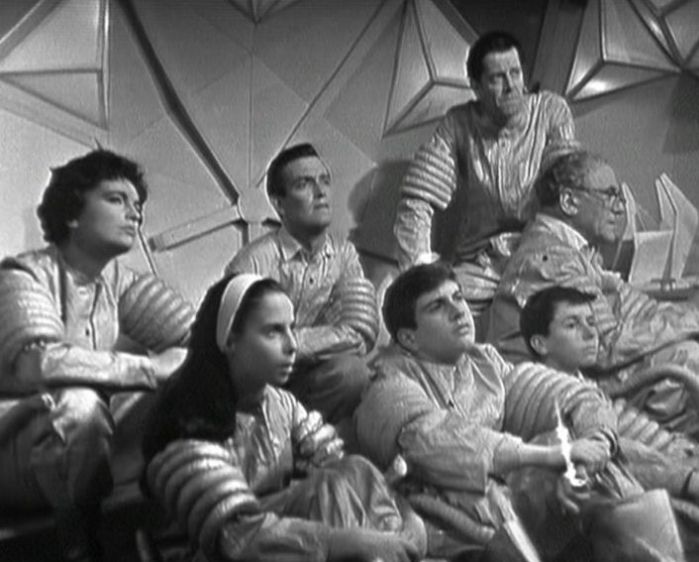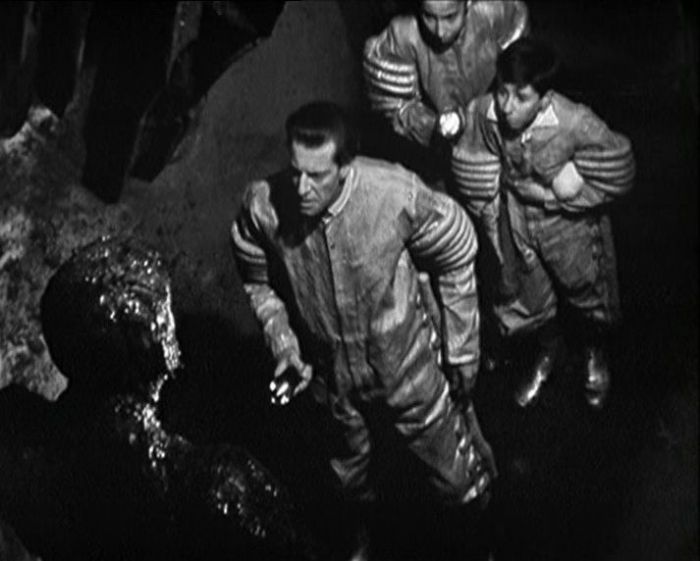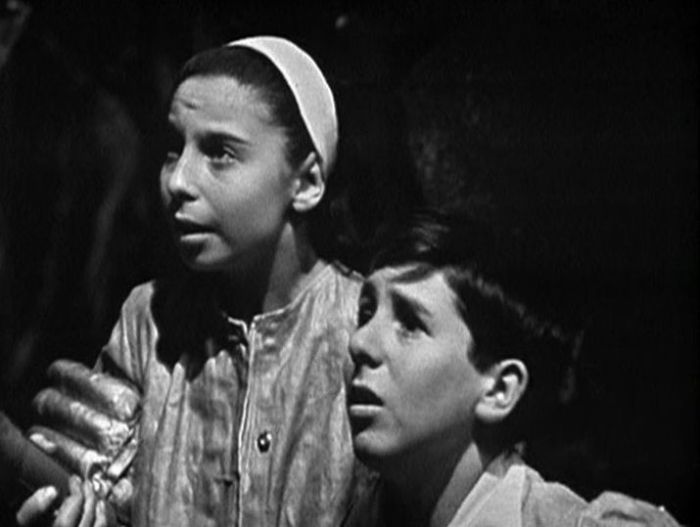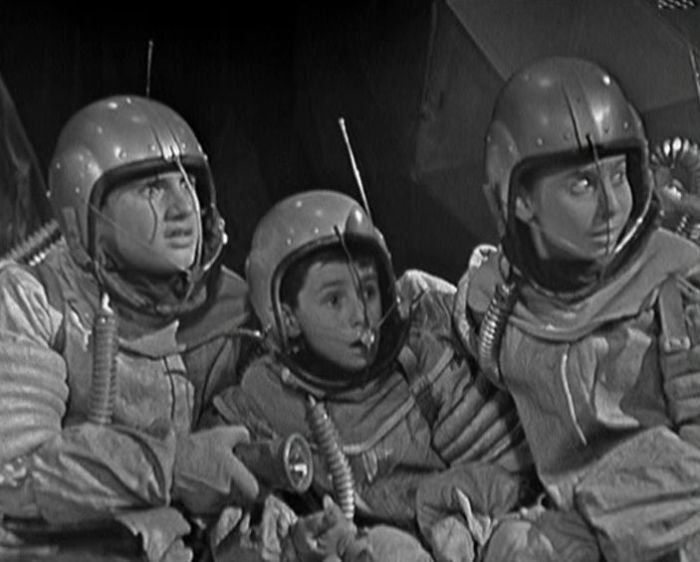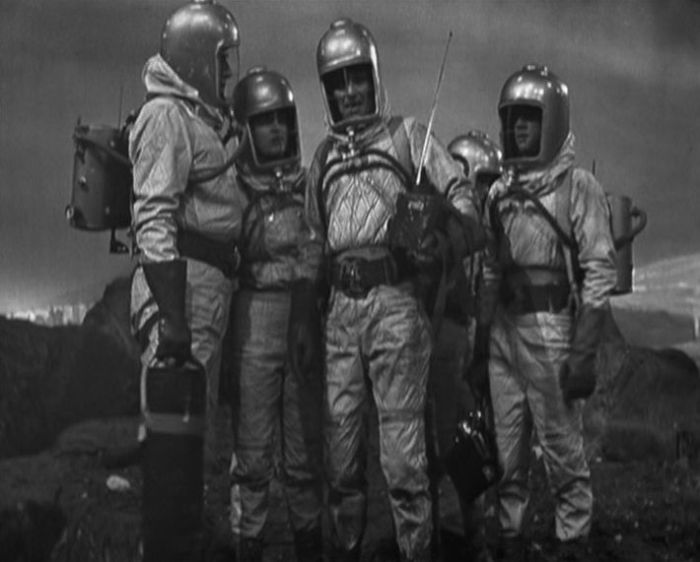
Pathfinders to Mars – Zero Hour on the Red Planet

mars 05

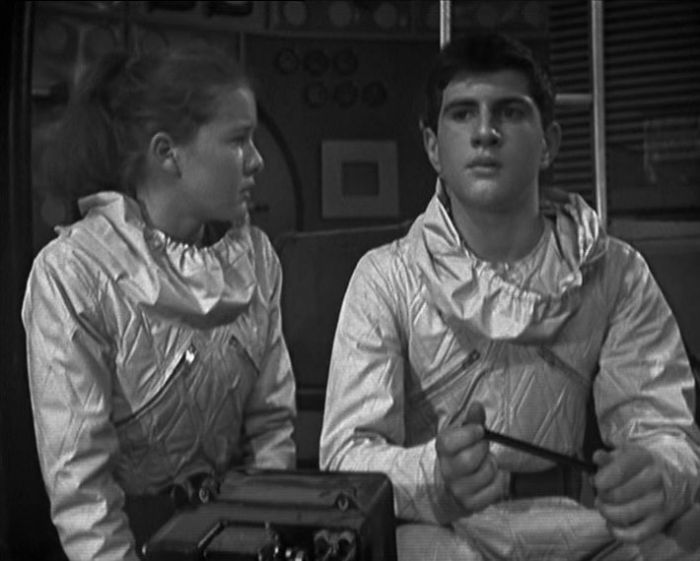
Gerald Flood, what a trooper!  He spends the first few minutes of Zero Hour on the Red Planet doing his very best to convince the audience that he’s being attacked by Martian lichen.  Alas, it’s painfully obvious that the lichen is plastic and inanimate, which requires Flood to wriggle about frantically in order to sell the illusion that the plants are moving.  It’s not at all convincing, but you have to give him top marks for effort.

As for the others, Brown reveals that the life he’s observed is plant-life.  After four episodes of his imaginative world building, it’s something of a disappointment that we haven’t met the thriving Martian civilisation he promised us.  This highlights the way that the Pathfinders series to date has trod a delicate line between science fiction (a twelve year-old girl with no space experience wants to become an astronaut? No problem!) and science fact (throughout the serial Brown has been the only one to believe that there could be intelligent life on Mars, with the others – even the children – adamant that only plant life could exist).

I did fleetingly think that a Martian was going to make an appearance at 6:41  during this episode, but it was only a guest appearance from a camera!  It quickly bobs out of shot in a rather apologetic way.

Stewart Guidotti demonstrates that Geoffrey’s concerned about the fate of Henderson and Mary by shouting an awful lot.  It’s very much a performance that’s lacking in subtlety (to put it mildly) and with Hester Cameron emoting in a similar way, the pair of them are rather trying.  Thank goodness for George Coulouris.  Harcourt Brown may have been forced to accept that his vision of a Martian civilisation is now looking very unlikely, but he chooses to underplay, rather than overplay, his scenes.

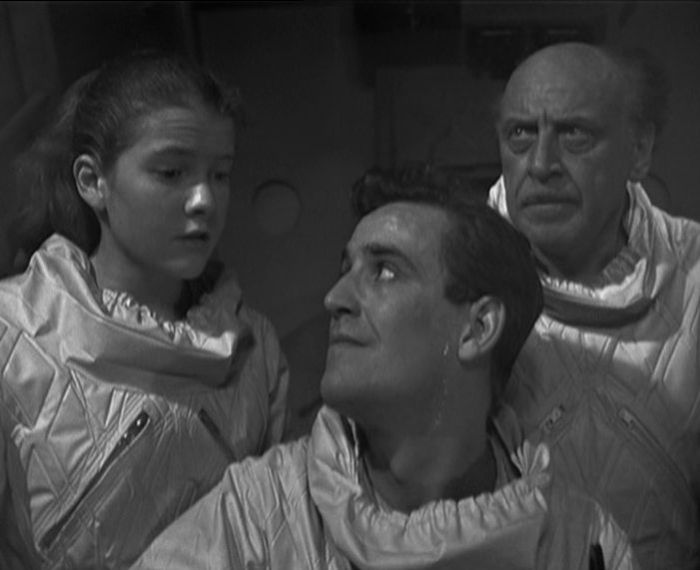
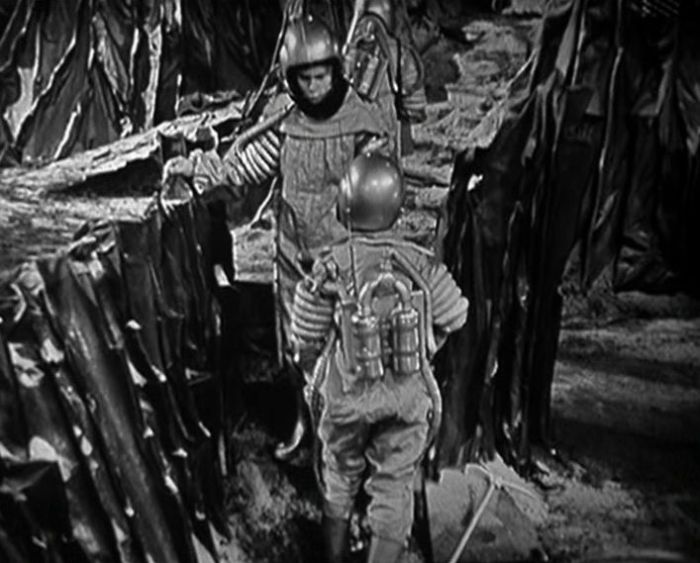
Brown, Margaret and Geoffrey set off to look for Henderson and Mary.  The pair have little oxygen and are being menaced by approaching lichen.  Normally you’d have expected Henderson to have given Mary a comforting kiss by now, but since they’re wearing space helmets it’s not possible (the clash of heads would probably be rather painful).  It slightly stretches credibility that within a few minutes they’re all reunited – although there’s a problem (Henderson and Mary are standing on the other edge of a crevice).

Cue several minutes of Brown and the children turning their supply sled into a bridge.  Mary makes her way across (Pamela Barney doing her best to convince the audience that if Mary fell she’d plummet hundreds of feet) and Henderson follows.  Hmm, for no good reason he decides to walk across agonisingly slowly – so you can guess what’s going to happen next.  The bridge collapses and he ends up clinging to the edge of the crevice for dear life. It’s another of those moments that’s problematic, which is down to the limitations not only of the studio but also the fact they were recording “as live”.  A few more takes and tighter editing would have sold the illusion much better.  This moment of jeopardy is short-lived as the others easily pull him up.

Whereas Pathfinders in Space was a rather thoughtful sci-fi parable (the story of how an advanced civilisation was destroyed by war) Pathfinders to Mars has tended to eschew that path and has gone instead for pulp thrills.  We’ve had the aggressive lichen, Henderson clinging on to the edge of a crevice for dear life and now Mary tumbles into Martian quicksand, with Henderson risking his life to save her.  And even though this serial was an episode shorter than the previous one, these moments of jeopardy feel  very much like padding – they’ve run around the Martian surface for twenty five minutes but have achieved very little.

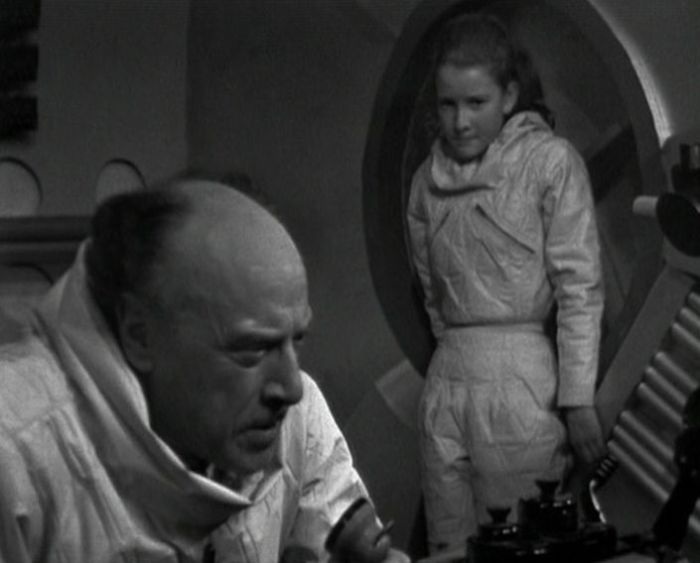
Zero Hour on the Red Planet does have a cracking cliffhanger though – Brown elects to leave the others behind and pilot the rocket back to Earth by himself.  He can’t bear the thought that they would expose his vision of Mars as a sham – so he’s prepared to leave them all (even the children) behind to die.  But as he prepares to lift off, lichen forces itself into the control room …..
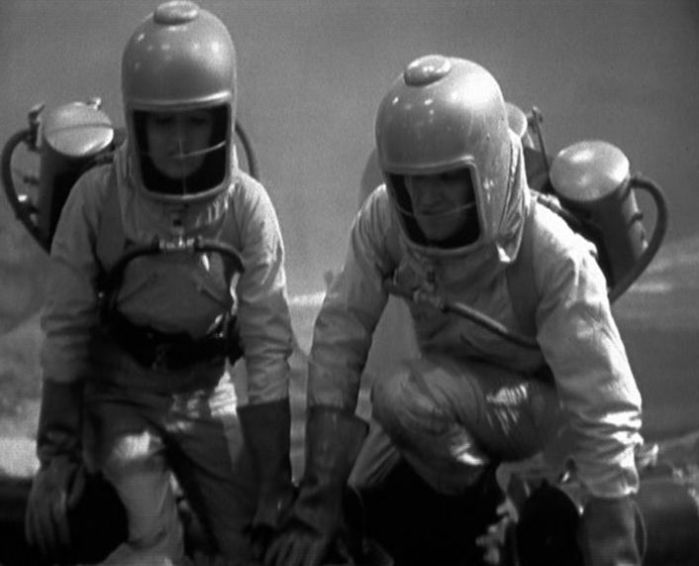
 

Pathfinders to Mars – Lichens!

mars 04-01

Given that Pathfinders to Mars must have had a pretty limited budget, the Martian landscape is an impressive set.  With dry ice providing an eerie mist it looks pretty convincing to these eyes and on the lower definition televisions of the 1960’s no doubt would have looked better still.

Margaret and Geoffrey are given the honour of being the first humans to set foot on Mars, but Henderson doesn’t want them to go any further and orders them to stay in the rocket, monitoring the radio.  Margaret’s very disappointed, but Henderson tells her that they haven’t come here to explore – all they want is to find sufficient water for the journey home.

This presumably means that they have enough fuel for the six week return journey.  Considering that the rocket was only supposed to make a trip to the Moon and back (which wouldn’t have taken more than a week) it seems remarkable they were stocked up with three months fuel.

Margaret and Geoffrey observe a large cloud of dust heading towards them at enormous speed.  Stewart Guidotti has the unenviable task of delivering the line “look at Hamlet – he’s frightened”.  Cut to a shot of a guinea pig pottering about, quite unconcerned.  But if Hamlet doesn’t look bothered then both Guidotti and Cameron are teetering on the edge of hysteria as Geoffrey and Margaret wonder if Brown was right all along.  Are the Martians coming to them?!  Short answer, no.

Henderson continues to kiss Mary.  He’s getting closer to her lips, as this one lands on her cheek.  The pair of them, along with Brown, are slowly reconnoitring the surface, looking for water.  Brown is keen to head off by himself to investigate the canals, but Henderson tells him that they’re here for one reason only – to find water – and Brown, grudgingly, agrees.  This is another moment that’s later echoed in Doctor Who – in The Daleks, the Doctor is keen to explore the city, but Ian refuses.

Henderson, Mary and Brown are caught up in the dust storm.  After it passes, Brown is missing.  Henderson decides he must have fallen down a crevice and although he’s regretful about the older man’s fate, he tells Mary that they can’t do anything to help him, so it’s best to press on and try to find the water they need.

Of course, Brown isn’t dead – instead he turns up at the rocket to tell Geoffrey and Margaret that Henderson and Mary are the ones who fell down the crevice.  They don’t believe a word of it though, with young Mary earnestly stating that “I don’t believe they’re dead, I won’t.”  Brown wants the pair of them to join him in his exploration of the planet.  Margaret immediately smells a rat – if they go and Henderson and Mary return, then they wouldn’t be able to take off (as she astutely observes, Brown’s attempting to use them as hostages).  But alas, she eventually agrees to go with Geoffrey (who’s much more keen) and the three of them set off.

A healthy downpour of rain sees Henderson and Mary menaced by aggressive Martian plant-life.  And that’s not a sentence you tend to type every day.  It’s an ambitious sequence which is, thankfully, brief – had it lasted any longer it would have quickly lost its credibility.

So apart from plants, is there any other life on the planet?  We’ve yet to meet Brown’s Martians, but the cliffhanger teases us that we’re getting closer.  He climbs a hill, looks over and returns to tell Margaret and Geoffrey that he has found life, although it’s not what he was expecting …..

mars 04-02

Pathfinders to Mars – The Hostage

mars 03

Brown tells them that the trip to Mars will take six weeks.  Given that modern estimates place the journey between six and eight months, there’s a certain amount of dramatic licence at play here.

What’s made clear is that the journey to Mars is going to be strictly one way – as even if, by some miracle, they reach their destination they’ll have no water or other supplies for the return journey.  Brown is quite calm about this – he still maintains that Mars is a thriving civilisation, so he no doubt assumes the Martians will be able to supply them with whatever they need.

Although Brown’s actions, reckless in the extreme, position him as the villain of the piece, he’s presented in a reasonable light here.  This isn’t too surprising as later episodes will see him integrated back with the others as they all combine to find a solution to their problems.  Indeed, he’s quite affable to Margaret as he explains about the canals of Mars, not taking offence when she disagrees with his assertion that they prove there must be life on Mars.  Hester Cameron impresses with the two-handed scenes she shares with George Coulouris.

Possibly the most notable part of the episode is the sequence where Henderson attempts to break into the control cabin by exiting the rocket and attempting a spacewalk.  There are several reasons why – firstly, I love the periscope that slowly turns to observe him (I think it’s probably because the notion of a periscope is such a delightfully old fashioned concept).  I also like the way that he loses his grip on a spanner which then goes flying into space.  It was clearly on a piece of wire, but it helps to sell the illusion that he’s in space.

But the main reason why this is so memorable is because the same scene, virtually unchanged, turned up thirteen years later in the Doctor Who story Frontier in Space.  That story was written by Malcolm Hulke, the co-writer of Pathfinders to Mars, so it can hardly have been a coincidence.

The lack of supplies seems to be one of the reasons why the relationship between Henderson and Mary is deepening.  He kisses her again – albeit only on the forehead, remember this is children’s television!

As The Hostage draws to a close, they finally reach Mars.  Whilst the others (now released) are still gently dismissive about Brown’s claims of a great Martian civilisation, it’s obvious that we’ll soon be able to find out for ourselves.  It may have taken three episodes but we’re finally there.

Long Shadow: The Great War – Simply Media DVD Review

164454- Chief Crazy Horse Sleeve.indd

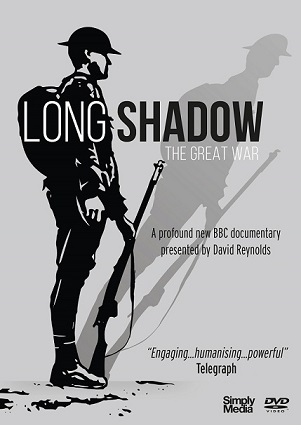
With the centenary commemorations of the Battle of the Somme still fresh in the memory, it feels like the ideal time for Long Shadow: The Great War to be released on DVD in the UK for the first time.  Although as we’ll discover, David Reynolds (the writer and presenter) has concerns about how certain events – most notably the Somme – have come to dominate our understanding of the war.

Long Shadow was one of a raft of BBC Great War programmes announced in late 2013.  It’s an ambitious (and still ongoing) project – more than 2,500 hours of programming across television, radio and online to appear between 2014 and 2018.

This breadth of programming, covering both drama and factual, allows for a range of approaches to be taken when discussing the events of 1914 – 1918.  Long Shadow, broadcast in September 2014, asks us to both remember and reassess what we know (or what we think we know) about the Great War and how the conflict shaped the rest of the twentieth century.

Speaking to History Extra, Reynolds makes the point that the Somme, terrible though it was, has clouded our understanding of both the war and its legacy.  “Our view of the war has become focused almost on one day. We need to get out of the trenches and take a broader view of the conflict.  That’s what I mean by becoming a caricature – it’s become simplified down. A caricature is not necessarily untrue, it’s just a sharp oversimplification of what is going on.”

Reynolds, a Cambridge academic, follows in the footsteps of many illustrious predecessors.  Needless to say, presenter-led documentaries stand or fall on the quality of the man or woman in front of the camera.  Thankfully for Long Shadow, Reynolds is an engaging presence – he’s capable of deftly describing the bigger picture, but can also change gears to illuminate smaller-scale, individual stories. Reynolds rarely seems to stand still – he’s often seen walking to his next location – but this hyperactivity (and his sometimes highly dramatic intonations) doesn’t detract from the story he has to tell.

Over the decades, a certain perspective of WW1 has become solidified (“lions led by donkeys”) and this has been reflected in popular satire (Oh! What a Lovely War, Blackadder Goes Forth).  Long Shadow attempts to peel away this familiar (and, he argues, inaccurate) viewpoint in order to make sense not only of the war, but of the very different world that both the victors and vanquished returned home to.

Post 1918, the British were keen to honour their dead (Reynolds has some interesting points to make about Edwin Lutweyn’s Cenotaph) but since the public at large found it hard to visualise exactly what had happened on the battlefields between 1914 and 1918, the war slowly faded from the public’s consciousness. But a play, Journey’s End by R.C. Sheriff (which debuted in 1928), would help to reignite interest in the conflict. Reynolds argues that for many, Journey’s End helped to illustrate the futility of war – “never again”.

In Germany there was a very different sentiment in the air. If the British were saying “never again”, then some Germans were of the opinion that the war had never ended. It was simply that they had been betrayed by a spineless ruling elite who had forced the country into signing a humiliating armistice. So the seeds for Adolf Hitler’s rise to power were already in place.

But if, as Reynolds argues, WW2 came to be seen as a just war – fought against an evil and corrupt regime – this would have consequences for the Great War. Post WW2, the Great War would be known instead as WW1. It was no longer “The War To End All Wars”, instead it was seen as a failed attempt to end global war (if it had been successful there would have been no need for a Second World War). Reynolds admits this renaming could seem to be a trivial matter, but it was a factor that helped to shape the modern viewpoint that the Great War achieved nothing, except mass slaughter.

Reynolds also examines the unfamiliar British landscape that emerged following the 1918 armistice.  Democracy had come to Britain for the first time with both the working classes and women eligible to vote.  Also discussed is the way that the Great War strengthened a section of the United Kingdom – as both Wales and Scotland took pride in joining with their English counterparts to defeat a common foe.  Had this not happened it’s tempting to wonder whether the union between the three nations would have fractured.  But if the war was a unifying force for England, Scotland and Wales then it was a very different picture in Ireland.  The Easter Rising in 1916 was a watershed moment for Catholics, just as the Battle of the Somme in 1918 was for their Protestant counterparts.

In conclusion, if you’re looking for a documentary solely focused on the military conflict between 1914 and 1918 then this possibly isn’t the programme for you.  Long Shadow concerns itself with documenting the aftershock WW1 inflicted on the world at large, with Reynolds demonstrating how this brutal conflict helped to shape the modern world.

The series uses very little archive footage, which is a good move.  Iconic and stirring though these pictures are, the scratchy black and white images also tend to automatically distance the viewer from the events portrayed.  Running for three 50 minute episodes (Remembering and Understanding, Ballots and Bullets, Us and Them), Long Shadow is an accessible and thought-provoking documentary.

Long Shadow: The Great War is released by Simply Media on the 4th of July 2016.  RRP £19.99.

6568

Pathfinders to Mars – Sabotage in Space

mars 02

There’s quite a lengthy recap at the start of this episode (nearly three minutes) which suggests that it was underrunning a little.  Sabotage in Space is a rather static instalment – understandable since most of the action takes place aboard the rocket.

But the enclosed nature of the episode isn’t all bad news as it allows Brown’s discordant presence to slowly become more apparent.  That he’s a fish out of water is evident right from the start – he doesn’t know how to strap himself into his take-off seat, for example – and there are numerous other signs that he’s not the man he claims to be.

Noticing that Geoffrey’s still carrying his book (although as yet nobody knows that he’s the author), he launches into an earnest debate about life on Mars which both Geoffrey and Margaret gently disagree with.  Henderson is more forthright, labelling Brown’s book as “tripe”!

Mary is far from happy.  The man that Brown replaced, Professor Hawkins, should be working with her – but Brown spends all his time glued to the radio.  When Mary complains to Henderson he doesn’t seem to be terribly bothered about her problems.  He tells her to be a good girl, gives her a kiss and saunters off!  Mary then pulls a “ooohhhhh” face which tells us all we need to know.  This may be the space age, but this scene indicates that there’s still some way to go before we see equality between the sexes.

Buchan Island discover that Professor Hawkins isn’t present on the rocket when he turns up at the base.  One point – Hawkins is supposed to be Australian, but neither Horsfall or Coulouris have the trace of an Australian accent.  It might have been fun for both of them to attempt one, but on second thoughts perhaps not.

Ian quickly works out that the imposter is Harcourt Brown, a Mars obsessed fanatic.  But the others on the rocket remain in ignorance since Brown was able to destroy the receiver before Buchan Island could transmit the news.

As for Professor Wedgewood, he’s nowhere to be seen.  A line of dialogue explains that he’s headed off for hospital, but since he’s only got a broken arm you’d have assumed he’d have hung around a little longer to see everything was all right.  But in story terms the Professor is now surplus to requirements and his absence from the rest of the story means that the production saves a little money (that’s one less actor they have to pay).

By the end of this episode the MR4 has reached the Moon’s orbit.  Whilst Brown remains behind, Henderson, Mary, Geoffrey and Margaret rendezvous with the supply rocket which is now in their orbit.  Margaret returns with the new radio, but Brown then closes the hatch and fires up the motors, leaving Henderson, Mary and Geoffrey locked out of the control room.  He reveals his true identity and then tells them all that he’s heading for Mars ….

Pathfinders to Mars – The Imposter

mars 01-01

Although the opening episode of Pathfinders to Mars was only broadcast a mere six weeks after the conclusion of Pathfinders in Space, quite a few changes had been made.

Jimmy and Valerie are gone, although those hoping that Hamlet the guinea pig would also be absent will be disappointed.  To replace them we have Henderson’s twelve-year old niece Margaret (Hester Cameron), who even at this tender age is something of a scientist.

As for Professor Wedgewood, he only appears in the opening episode – thereafter Conway Henderson becomes the male heroic lead.  Ian Murray returns, but he’s now resident on Buchan Island rather than a member of the crew.  Also back are Professor Mary Meadows and Geoffrey Wedgewood.

The cast re-jigs leave us with a better mix on the MR4 – with two groups of characters that naturally gravitate towards each other (Henderson and Mary, Geoffrey and Margaret) plus a wildcard – Harcourt Brown (George Coulouris).

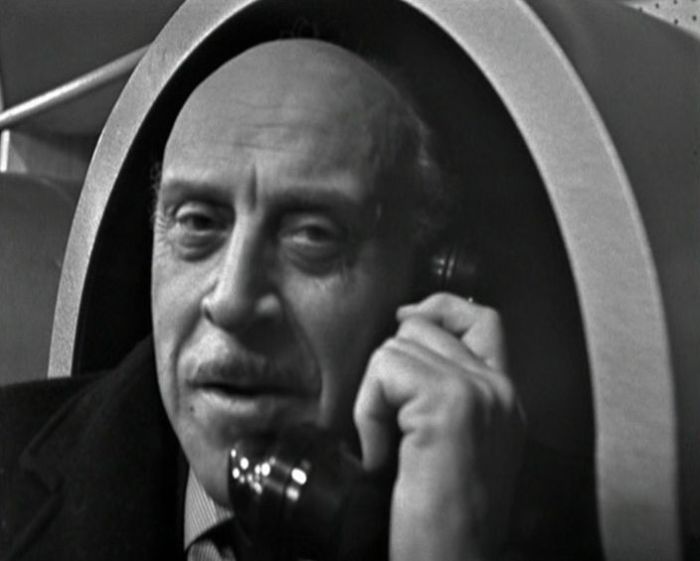
Brown adds a sense of danger and unpredictability into the narrative, something which was largely missing from Pathfinders in Space.  True, Dr O’Connell did occasionally act irrationally, but his moments of madness soon passed.  With Brown we have someone who has a burning desire to pursue his own agenda, even if it means risking the lives of the others.

The opening minutes of The Imposter sees the dramatic intensity pitched to at least eleven.  Partly because of the highly melodramatic stock music, but also due to the way that Ian reacts (or overacts, depending on your point of view) with horror at the events unfolding on the launchpad.  There’s an accident, somebody’s hurt …. oh my goodness it’s Professor Wedgewood!  The tension ramps down a little when it’s revealed that he’s only got a broken arm, but it explains why he won’t be taking any part in the planned mission to the Moon.

So once again Henderson is pressed into service.  As before, he only turned up to Buchan Island to cover the launch for his newspaper but finds himself strapped into the hotseat.  Suspension of disbelief is required again  – why aren’t there more trained astronauts?  And even if there aren’t, what’s so urgent about this mission that it can’t wait until Wedgewood recovers?

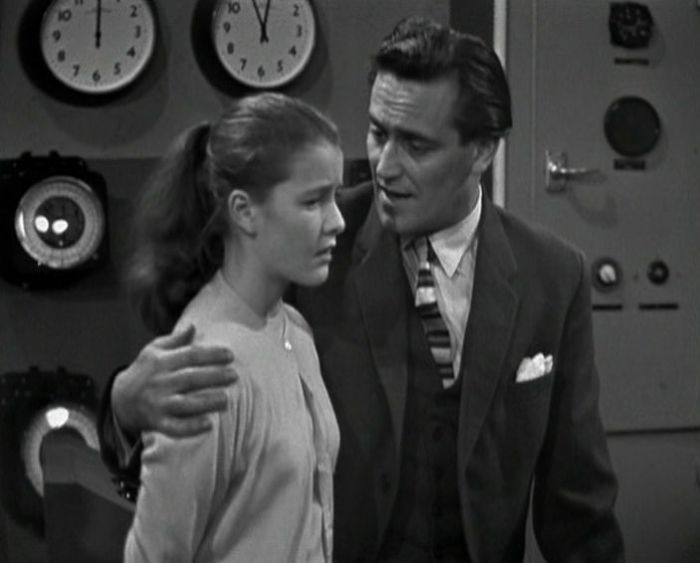
Our first sight of Margaret isn’t that promising.  Like Valerie she’s rather squeaky and earnest, but maybe she’ll settle down.  After haranguing the security guard she eventually manages to gain access to the control room thanks to the intervention of Geoffrey.  The guard tells him that “she’ll be a right problem when she grows up, you’d better keep your eye on her.”  Geoffrey’s response is short and world-weary.  “Girls”!

Once Margaret knows that her uncle is piloting the ship she’s as keen as mustard to join him.  “I could look after supplies, I can cook and I know first aid”.  Wedgewood, puffing on his pipe, is sold although Geoffrey is far from pleased at the prospect.  When Mary arrives, that just leaves Professor Hawkins (Bernard Horsfall) to complete the crew.  But Hawkins is waylaid by Brown who takes his place, hence the episode title.  A pity that Hawkins didn’t join the others as Horsfall’s always an actor worth watching, but our first sight of the duplicitous Brown shows that he’s a character with plenty of scope.  He certainly contrasts nicely with some of the other more earnest (or wooden) performers.

Although it’s easy to mock some of the plotting, other elements are quite neatly handed.  For example, we see Geoffrey with a book which posits there might be life on Mars.  Margaret disagrees and the pair have a mildly heated argument.  As the pair leave the room, the camera focuses on the book and the author’s name – Harcourt Brown – is shown.  For the moment that wouldn’t mean anything to the first-time viewer, but all will become clear later on.  It’s a nice piece of shorthand that establishes Brown’s character – even when he’s not on the screen – and lets us know what he believes in and what his plan will be.

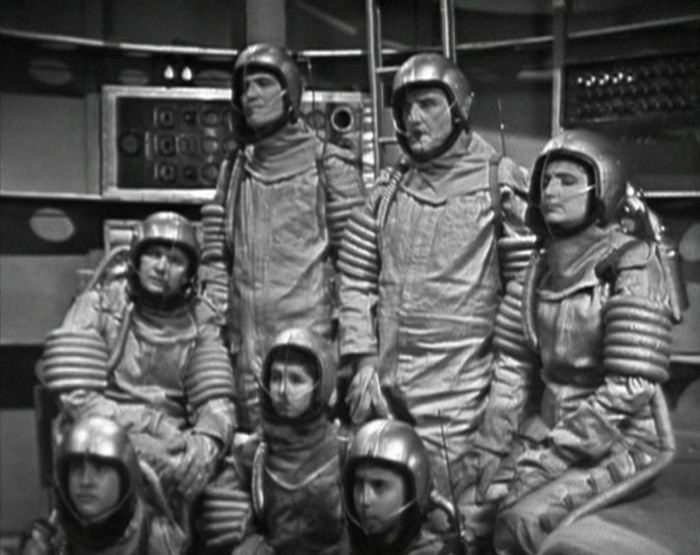
I’m pleased to see that the crew are wearing their spacesuits on take-off as it just didn’t seem right that they were all lounging around in cardigans last time!  So its time to strap yourself in and enjoy the ride …..

mars 01-02


Gordon Murray (1921 – 2016)

gordon murray

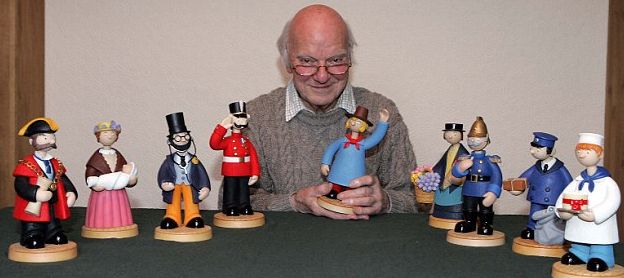
The news of Gordon Murray’s death closes another door on the golden age of British children’s television.  Camberwick Green (1966), Trumpton (1967) and Chigley (1969) were repeated for decades by the BBC and were then later picked up by Channel 4 and Nickelodeon Junior.

All three series were remastered a few years ago and are therefore available on DVD to enchant yet another generation.  And I see no reason why the magic of the Trumptonshire trilogy shouldn’t endure for years to come – as all three series have a timeless feel.

Murray didn’t make the shows on his own – Bob Bura, John Hardwick and Pasquale Ferrari were responsible for the animation, Freddie Phillips wrote the music, Alison Prince provided the scripts for Trumpton, Andrew and Margaret Brownfoot constructed the sets, whilst the unmistakable tones of Brian Cant enchanted a generation.

Why has Murray’s world endured?  In a 1996 interview for the radio series Trumpton Riots (this title was a sly nod to Half Man Half Biscuit’s legendary song) Murray felt it was due to the air of innocence that pervaded all three series.  “There’s no crime you know in Trumptonshire, it’s a happy world, and a lot of people say ‘well you shouldn’t encourage children to think that the world’s like that’. Some people throw their children into the deep end of the swimming bath at an early age and say ‘swim’. You know, that’s the way to learn, life’s hard. Hard things are coming to you. I don’t believe in that. I believe that you must protect your children while they are children for as long as possible from this dreadful world we’re living in.” You can listen to the episode here.

Another reason why they have such appeal is the sense of repetition.  For a pre-school programme this is quite important, as the audience will no doubt enjoy the comfort and stability of the same things happening again and again.  If most people were asked their memories of the shows, they might mention the music box, or Pippin Fort, or the Trumpton Clock, or Pugh, Pugh, Barney McGrew, Cuthbert, Dibble and Grubb, or Lord Belborough’s train, etc etc.  These things remain in the memory longer than the individual plots.

All the series had memorable opening and closing sequences.  Camberwick Green had the music box (“Here is a box, a musical box, wound up and ready to play. But this box can hide a secret inside. Can you guess what is in it today?”). Trumpton opened with the town clock (“Here is the clock, the Trumpton clock. Telling the time steadily, sensibly, never too quickly, never too slowly. Telling the time for Trumpton”) whilst they ended with the fire brigade entertaining the locals at the bandstand. True, the opening of Chigley was less iconic than the previous two series, but the closing sequence of the dancing workers from the biscuit factory made up for it.

Thank you Gordon, from millions of children of all ages.  RIP.

The Glory Boys – Episode Three

glory 03

Helen reports back to Jones and is scathing about what she’s witnessed, describing it as a shambles.  As for Jimmy, she tells her boss that he’s “a knight in shining bloody armour ” setting off in hot pursuit.

Jimmy’s desire to finish the job is self evident.  Despite the fact he told Sokarev he’d be right beside him every step of the way, once he can scent blood in the air he’s off and running.  Although it’s probable there wasn’t a backup terrorist team in place – designed to take Sokarev out on his way back to the hotel maybe – Jimmy didn’t know this for sure.  But his dereliction of duty is never really remarked upon.

He tracks McCoy and Famy to a quiet cul-de-sac.  And when we see McCoy force his way into Norah’s house it becomes obvious that he wasn’t simply driving at random.  Before that, there’s a brief gun battle with Jimmy and the British agent hits him in the shoulder.  McCoy responds by lobbing a grenade under Jimmy’s car, which causes quite an explosion (although it’s odd that the neighbours are slow to investigate).

That we’re very much in the pre-mobile age is shown via a nice scene with Jimmy and an old man in one of the adjacent houses.  Jimmy’s desperate to use the phone but the man, no doubt spooked by the gunfire and explosion, tries to close the door on him, trapping Jimmy’s foot in the process!

The juxtaposition between a quiet suburban house and the onslaught of loud, ugly violence is striking.  McCoy, dripping with blood and brandishing a rifle, quickly rounds up Norah and her mother and father.  Famy darts out the back door, heading to Heathrow where he’ll have one more chance to complete his mission.  So for McCoy the position is clear – he has to stay holed up as long as possible.  The longer he can last out, the more time he buys Famy.

Because of his injury, he forces Norah to tie up her mother and father.  Although maybe this is also an exercise in control and fear – it’s certainly an effective moment as we see the girl attempting to bind her mother’s legs with a pair of tights.  As Norah is instructed to pull tighter, her mother reacts with distress.

When Jones arrives, Jimmy asks if he can go in with the assault team.  Jones, naturally enough, refuses.  Jimmy’s request reiterates his desire to be in at the kill – it isn’t enough to be close by, he wants to be right in the thick of the action.  He heads off to slump dejectedly in the back of a patrol car, another nicely played scene by Perkins.

Torture is seen several times in The Glory Boys.  The opening scene of episode one features Elkin and Mackiewicz brutally torturing a suspect whilst in this episode Jimmy indulges in a milder form of abuse following McCoy’s extraction from the house.  In some ways this makes Jimmy a proto Jack Bauer – a single-minded agent determined to do whatever it takes to complete his mission.  But Jimmy’s not acting without authority – Jones tacitly gives his approval (in front of McCoy) to do whatever he has to do.

So in the world of The Glory Boys, the ends justifies the means.  If the rights of prisoners are abused then so be it – provided it happens behind closed doors.  As is seen later, Jimmy’s downfall occurs after he decides to demonstrate his methods in public.

A little psychology and pain forces McCoy to admit that Famy’s going to make a last-ditch attempt to kill Sokarev immediately before he boards the plane.  But the security cordon is tight enough to nullify Famy’s attempt.

As Famy lies helpless – already downed by several shots from the ring of armed soldiers around the plane – Jimmy comes rushing over.  He couldn’t take part in the mission to extract McCoy and he wasn’t close enough to prevent Famy from launching his attack at the airport, but now he can finish the job.  As Famy struggles to get up, Jimmy aims his gun at his opponent’s head and pulls the trigger.  A quick cut to a roaring jet engine is a clever way of hiding the fact that we don’t see the fatal shot fired, but the power of the moment is still strong as we see Jimmy walk away, with a ring of onlookers behind him.

This most public of executions means that Jimmy is now highly toxic and the Minister (Ian Cuthbertson) tells Jones to fire him.  So Jimmy’s out of a job and Sokarev has safely left the country.  But there’s a final ironic twist, quite in keeping with the bleakness of the tale, which amuses a drunken Jimmy. We leave him as he slowly wends his way through the darkened London streets (with the haunting title music by Philip Japp and Julia Downes playing).

The Glory Boys has an excellent cast, although it’s pity that several familiar faces have very little to do.  The likes of Anthony Steel, Ian Cuthbertson, Alan MacNaughton and Robert Lang were all good enough actors to have taken major parts, but instead they only make the briefest of appearances.  Steiger and Perkins naturally dominate, although Alfred Burke has a quiet assurance as Jones.  Bur Joanna Lumley, despite being fourth billed, has little to do – Helen’s main usefulness seems to be that she can sense the real Jimmy behind the heroic façade.

YTV were no doubt hoping that this serial would repeat the success of their previous Gerald Seymour adaptation (Harry’s Game, 1982).  This didn’t really happen and the critical reaction was muted (with some newspaper reviews, latching onto the gunplay and violence, unimaginatively dubbing the series “The Gory Boys”).  The fact that it’s never been released on R2 DVD is another reason why it maintains a fairly low profile (although it’s available in R1).

As a time capsule of the mid eighties and also as a vehicle for both Rod Steiger and Anthony Perkins it’s well worth seeking out though.  It’s not perfect (and the 105 minute “movie” edit is tighter and more satisfying than the 3 x 50 minute serial) but the themes and characters continue to resonate down the decades.

The Glory Boys – Episode Two

glory 02

Famy’s inexperience is demonstrated at various points throughout the serial. McCoy is appalled to discover that he doesn’t have a plan to kill Sokarev – Famy has to weakly admit that the others (now dead) had the plan – and he further complicates matters by killing a woman who was rifling through his possessions at the flat where he and McCoy were holed up.

This means they’re on the run – which delights Jones, as he believes this leaves them in no shape to make the hit. Jimmy isn’t convinced and Jones quickly picks up on the vibe that Jimmy’s hoping that they’ll attack anyway. “You want to be in work, cheering them on. That makes me sick.” For Jimmy, the thrill of the chase (not to mention the kill) is all.

Although Rod Steiger’s performance can be florid at times, he still manages to throw in some subtle touches. One occurs as he prepares to say goodbye to his wife, prior to flying to London (she’s been forbidden from traveling with him). As they embrace, his eyes dart around in a worried fashion, but he manages to put on a brave face as they pull apart.

We see Norah’stifling home-life, complete with a father (played by Hubert Rees) who reacts to the news of Famy’s murder of the girl by muttering that the killer should be strung up. Of course, neither he or Norah’s mother realise that their daughter’s boyfriend is involved. But although Norah now knows what sort of man McCoy is, her love for him overrides every other consideration. But does he have any feelings for the girl, or is he simply using her?

The difference between Famy and McCoy – the one who’s prepared to give up his life for the struggle he believes in and the other who has no interest in a suicide mission – is restated. Famy tells him that “because my people have suffered, are suffering now, they trust me, for what I will do for them. In my country, the martyrs of our movement are honoured”. McCoy responds by telling him to shut up, proving that the ideological gulf between them is too wide to be breached. But while McCoy doesn’t share Famy’s hope for a glorious martyrdom, he does seem to have some sympathy for him.

Whilat a modern terrorist would probably plant a bomb, Famy’s eventual plan is much more old school – a rifle through the window and, hopefully, a clear shot at the podium where Sokarev is speaking. It’s possible to see the ease with which Famy and McCoy breach the elaborate security procedures set up to protect Sokarev as a weakness of the story or it could be deliberate.

Windows from the lecture room are accessible from the street outside, but although the street is cordoned off no thought seems to have been given to positioning substantial numbers of police or security officers outside these very vulnerable spots. Jones suggests it’s due to lack of resources, but that seems strange given the number of officers deployed elsewhere.

So the pair are able to run across the road and – as McCoy gives him a leg up – Famy breaks the glass in the window and takes aim at Sokarev. His lack of experience is highlighted again as he fires off multiple shots but isn’t able to hit the target. In desperation he throws a grenade in, which is leapt on by Mackiewicz.

Mackiewicz therefore protects both Sokarev and the others, but at the cost of his own life. It’s a chilling moment which brings home the point that often a bodyguard’s job is to take the bullet (or grenade) intended for the person they’ve been charged to protect.

With McCoy now injured from a brief gun battle with one of the security officers outside, he and Famy make their escape. Once more Famy’s inadequacies are displayed when he admits he can’t drive a car – forcing the badly injured McCoy to take the wheel as Jimmy follows close behind.

The Glory Boys – Episode One

glory 01

Palestinian terrorists hatch a plan to assassinate Professor David Sokarev (Rod Steiger), an Israeli nuclear scientist, during his forthcoming visit to Britain.  He has his own people protecting him – Maciewicz (Michael J. Jackson) and Elkin (Ron Berglas) – but the head of SIS, Mr Jones (Alfred Burke) plans to put his own man next to Sokarev every step of the way.

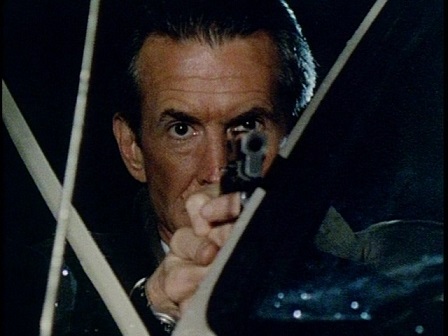
Jimmy (Antony Perkins) was the best, but in many people’s eyes he’s yesterday’s man.  His skill with a gun is still razor sharp, but he’s also inclined to be reckless and insubordinate.

Three terrorists attempted to reach Britain.  Two were killed in France, leaving one survivor – Famy (Gary Brown).  He makes contact with McCoy (Aaron Harris) a member of the Provisional IRA and together the mismatched pair begin to hatch a plan …..

The Glory Boys was a three-part serial, based on the novel by Gerald Seymour, made by Yorkshire television and broadcast over three consecutive evenings during October 1984.  That it was stripped across three nights indicates that it was seen as “event” television, and no doubt the two star names at the top of the credits helped to strengthen this feel.

Both Rod Steiger and Anthony Perkins were bona fide film stars, although it would be fair to say that their stock had fallen a little by the mid eighties, which probably explains how YTV were able to snag them.  But it was still a coup to see Steiger (On The Waterfront and In The Heat of the Night) and Perkins (Psycho) in a British television drama.

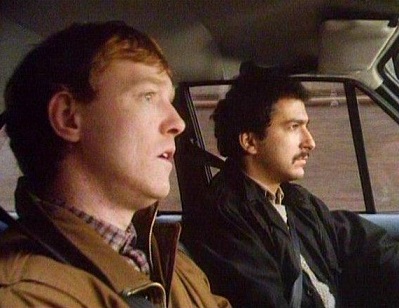
Steiger plays Sokarev in a very deliberate, ponderous way.  Sokarev is not a politician or a soldier, he’s a scientist and in his early scenes gives the impression that he’s somewhat unworldly.  He treats the news about the threat on his life with alarm and is keen to cancel his British trip.  But he’s told in no uncertain terms that this is impossible – it would send out a signal to the terrorists that they’ve won and Israel would then become a country under siege.  He eventually sees the logic in this.

Perkins’ British accent has met with mixed opinions down the years.  I think it’s pretty good and Perkins certainly impresses as the alcoholic, chain-smoking, cold-hearted killer.  If Steiger tends to be a bit wooden, then Perkins’ easy charm (although always with the sense that there’s something nasty lurking just below the surface) provides a nice counterpoint.

It’s no surprise, especially for this era of television, that the Palestinian terrorist Famy was played by a British born actor, Gary Brown.  It’s not a problem though as Brown is quickly able to sketch out Famy’s character quite effectively.  He was the youngest of the three terrorists and the most inexperienced.  But like them he has a fanatical desire to carry out his mission, even if it costs him his life.

This desire to die for a cause will be something that’s unfortunately all too familiar from modern acts of terrorism, but for British audiences watching thirty years ago it would have been more unusual.  The point is driven home by McCoy who tells Famy that he’s not prepared to throw his life away – McCoy might be IRA, but that doesn’t mean he has any desire to die.

Famy’s political ideology remains somewhat nebulous.  At one point he does attempt to explain his views to McCoy, but is cut off.  As for McCoy, in this first episode we learn that he has a British girlfriend, Norah (Sallyanne Law).  She seems an odd choice for an IRA terrorist, since she’s in her late teens and very innocent (with her love of cuddly toys she seems little more than a child at times).

The SIS we see is very much in the pre-computer age and for all intents and purposes it could just as easily been a snapshot of the 1950’s.  The offices are large, gloomy and old fashioned, complete with furniture that’s seen better days.  When Jones prepares to sleep in overnight, Helen (Joanna Lumley) makes up his camp-bed, complete with a hot water bottle.  To complete this very British picture, he spoons Ovaltine into a mug.

The first time Jones mentions Jimmy he looks at a picture on his wall, showing a wartime scene.  It’s a cliché moment for sure, and later the story is spelled out.  Jones and Jimmy served in Malaya back in the 1950’s and Jimmy saved Jones’ life.  So Jones feels he owes Jimmy a debt ever since, even up to and including today.  Did Jones chose Jimmy for this job because he’s still haunted by the events of Malaya or did he really think Jimmy was the best man to carry it out?

Alfred Burke, even with a fairly small part, catches the eye – as does Joanna Lumley.  Helen works for Jones and is Jimmy’s girlfriend, so her loyalties are somewhat divided.  Lumley has even less to do than Burke, but like him she’s a notable presence.

Pathfinders in Space – Rescue in Space

space 07-01

We left our heroes on the horns of a dilemma last time.  The rocket can only carry one adult and one child back to Earth, so what’s going to happen to the rest of them?  If only there was another ship they could use ….

The final instalment of Pathfinders in Space only ran for seventeen minutes (rather than the normal twenty five).  This was due to the rather unusual decision to launch a new (unconnected) serial following the commercial break.  It’s no great hardship though, since the shorter running time gives the episode a certain urgency.

Wedgewood decides that Henderson and Valerie should return to Earth.  That leaves the rest of them on the Moon with only fifteen hours of oxygen.  Wedgewood is matter of fact about their situation – it’ll give them time to complete their researches and their work will be of value to future expeditions.  Obviously it’s a bit of a pity they’re all going to die, but he maintains a suitably British stiff upper lip.

It’s no surprise that Jimmy asks if his pesky pet guinea pig can also make the trip to Earth.  His father agrees, so that’s one weight off everybody’s minds I’m sure!

The others don’t take their impending deaths with the same quiet equanimity as Wedgewood does.  Mary asks him how he can be so dispassionate when his two sons are going to die.  He doesn’t really have an answer, seemingly he just can.

But then (rather out of nowhere) he decides to pilot the alien craft back home.  This piece of dialogue by Wedgewood is priceless.  “First we’ve got to master those controls, then you’ve got to get that atomic power working, that’s going to take all of three hours.”  Work out how to pilot an alien craft that’s lain dormant for four hundred million years and restart its atomic motors within three hours?  Of course, it should all be quite straightforward ….

Since Wedgewood states that he first had the idea of piloting the ship when their rocket blew up, why hasn’t he mentioned it before?  It seems a little cruel to make his sons, not to mention the others, believe they were fated to die of oxygen starvation.

It proves to be a doddle to get the ship working and also out of the cave (although we never see this on screen).  Once it’s on the lunar surface then the wobbly ship can take flight (although the strings aren’t as visible here as they were in the last episode).  Everything so far has gone so swimmingly, but there’s a problem when they hit the Earth’s atmosphere – the ship breaks in two.  Hmm, strange that they’re not at all harmed by this catastrophe and it’s also lucky that Henderson’s on hand to mount a daring rescue.   It’s another impressive effects shot bearing in mind the era in which the programme was made (although once again, when considering the scientific plausibility of what you’re watching it’s important to suspend your disbelief).

Overall, Pathfinders in Space is very much a mixed bag.  Although it would be easy to mock the modelwork, most of it is very competently done.  It’s easier to mock some of the acting though and it’s interesting to see which characters were dropped for the next serial, Pathfinders to Mars.  In the main I think they made the right decisions, plus the introduction of George Coulouris as Harcourt Brown was a strong addition

The script, by Eric Paice and Malcolm Hulke, has a mix of pulpy moments and hard scientific facts.  It’s an odd juxtaposition, but it does work quite well most of the time.  One downside is that the production only seemed to have a handful of music cues and they do get played an awful lot (by the final episode it’s rather grating).

Not perfect then, but given the year this was made (1960) and the budget, Pathfinders in Space is never less than highly entertaining.  Now it’s onwards to Mars …..

space 07-02


Pathfinders in Space – Disaster on the Moon

space 06

Wedgewood and O’Connell, after only a very brief time with the logs of the alien craft, seem confident to tell their story.  Astonishingly, there’s also a film record as well, which shows their (admittedly, very wobbly) craft taking off and heading for the Moon.

The fate of the alien’s planet is a bleak one – two rival factions fought for supremacy and their civilisation was destroyed.  When Jimmy wonders what the invisible death mentioned in the log could be, Geoffrey replies that it must refer to radioactivity from hydrogen bombs.  In the early sixties the shadow of the bomb was never far away – so this would been a highly topical touch, even if it seems an odd inclusion in what, until now, has been fairly light, escapist fare.  It’s an effective parable though which would have left the young audience with food for thought.

Henderson suggests that this other species could also have come from the Earth and after they destroyed themselves millions of years ago in a devastating war, it paved the way for the arrival of homo sapiens.  Although there are one or two problems with this theory, it does help to ground Pathfinders in Space to a certain level of reality – it would have been tempting to introduce little green men from a totally alien civilisation, but Paice and Hulke decided to keep things more down to earth, as it were.

Back on Buchan Island, Jean Cary (Irene Sutcliffe) is starting to feel the pressure.  She’s been a comforting and reassuring presence throughout the serial but now, with the possibility of heavy meteorite showers, she’s becoming much more anxious.

As with other programmes of this era, music and sound effects had to be added during the recording (post-production didn’t really exist).  This explains why the echo effect in the caves is rather inconsistent throughout the serial – at times it’s not really there and at others (as here) it just sounds odd, as if the correct setting hadn’t been made.  But time was at a premium, meaning that the luxury of retakes was a rarity.

As the episode title suggests, things aren’t going well.  The rocket which is due to take them all back to Earth is hit by a meteorite shower.  It’s destroyed in a blaze of stock footage whilst Ian manages to escape with his life. It’s remarkable that when he dives for cover behind a rather wobbly rock just a few feet away he doesn’t suffer any injuries. Clearly Moon rock has strange properties ….

All’s not quite lost. They can use the other rocket, but it’ll only be able to carry one adult and one child.  Cue everybody looking at everybody else as they wonder who’ll be the lucky ones …

Pathfinders in Space – The World of Lost Toys

space 05-01

Although Pathfinders in Space was broadcast only a few months after Target Luna, all of the roles were recast (presumably this was the choice of new director Guy Verney).  This is a slight pity as it would have been interesting to see some of the actors featured in Target Luna (Frank Finlay as Henderson, Michael Craze as Geoffrey) carry on.  And quite what the audience made of the changes at the time isn’t recorded ….

At the end of the last episode, Valerie discovers a calcified figure.  Wedgewood decides it’s a stalactite, whilst O’Connell declares that it’s been there for at least four hundred million years.  So at the time when life on Earth had barely begun, a similar looking race had landed on the Moon.  Quite how and why this humanoid became calcified is a mystery though.

Jimmy, of course, can’t resist showing the figure to Hamlet.  It’s a little surprising to learn that Richard Dean (Jimmy) was actually older than Stewart Guidotti (Geoffrey).  Dean’s small stature ensured that he played characters younger than his actual age and whilst it’s true that Jimmy is rather irritating and juvenile, when you know that Dean’s older than Guidotti it does raise the possibility that Dean was giving a skilful acting performance all along.

Scattered about the cave are children’s toys – the toys of the children from this other, long vanished civilisation.  It seems that children from all over the galaxy have similar tastes in toys – stuffed animals, spaceships – and it helps to fill in a little more background.  Although I can’t help thinking that when Henderson returns to Earth and writes his story, nobody’s going to believe him.  After all, if Neil Armstrong returned from the Moon with a cuddly toy under his arm, what sort of reaction would he have received?!

Whilst everyone else has been having adventures on the Moon’s surface (and below) poor Ian’s been stuck in the spaceship by himself.  And it’s only after his long distance games of chess with Earth that I realised who he reminds me of, Tony Hancock in The Radio Ham!  There’s an extraordinary performance by Terence Soall as a Russian technician who broadcasts an urgent message (which turns out to be nothing more than a suggestion for his next chess move) to Ian in the rocket.  Let’s be kind and say Russian accents weren’t his speciality.

The news that a shower of meteorites is heading for the Moon could spell disaster for the two precious rockets.  If they’re damaged, then Wedgewood and the others will never be able to return home.

space 05-02

Pathfinders in Space – The Man in the Moon

space 04-02

Jimmy’s made an impressive discovery – another spaceship – and this one’s deep in an underground cavern.  It’s a bit of a mystery though, how did the ship get there?  Henderson and the others join Jimmy to puzzle it out, but soon find themselves trapped underground ….

Budget limitations are rather exposed at the start of this episode, as our intrepid explorers puzzle over the mysterious ship.  The script no doubt called for an impressive landslide to trap them, but what we saw on screen was not so much a landslide, more of a trickle.

Professor Wedgewood’s party are hopelessly lost.  With only limited oxygen, this isn’t good news and Dr O’Connell continues to be a rather gloomy companion.  Once again, Wedgewood’s lack of forward planning is exposed – he suggests they try over there (more out of hope than from any sort of scientific judgment).  But when they find a mysterious marking in the ground – similar to the ones discovered by Henderson – it suggests they’re close to Henderson’s rocket.  This is a bit of a stretch – why couldn’t these marks be all over the Moon? – so you have to admit that the pessimistic O’Connell does have a point.  Wedgewood might be enthusiastic but he seems to bumble from one crisis to the next.

Wedgewood and the others reach Henderson’s rocket, but of course they find nobody there.  They’re still trapped in the cave and with their oxygen running out face certain death.  Jimmy responds by going a little stir-crazy (enthusiastic over-acting, shall we say) but just when it seems all is lost they’re rescued by Wedgewood.  It’s all a tad convenient, but no matter – everyone’s together and they can now set up camp and try and solve the mystery of the alien spaceship.

There’s some hard – well hardish – science fiction talk as Wedgewood and O’Connell ponder over the ship.  And then Hamlet goes missing, which means that Jimmy heads off to look for him.  I think we have to be very grateful that when Doctor Who was set up they didn’t decide to give Susan a pet which would run off every five minutes and therefore create an excuse to put her into danger.  Four episodes in, I’m getting a little tired of Hamlet.

We have to wait until the final shot of the episode before Valerie discovers the man in the Moon.  It’s maybe not what was expected, but it’s a very effective cliffhanger.

space 04-01

Pathfinders in Space – Luna Bridgehead

space 03

Following a near collision with a mysterious ship orbiting the Moon, Henderson is forced to make an emergency landing.  After a slightly tricky descent, they land safely – although they find themselves some distance from Professor Wedgewood’s rocket.  The Professor, Mary and Dr O’Connell set out to find them, whilst Henderson and the others rig up a signalling beacon.

Jimmy is given the honour of being the first man to set foot on the Moon, but later they discover strange markings in the lunar surface – which indicates that others have been here before them …..

Gillian Ferguson, as young Valerie, certainly dials up the intensity at the start of this episode.  Her film and television career was fairly short lived (her last credit, an episode of Dixon of Dock Green, was broadcast the following year, 1961), so like many child actors she never carried on once she became an adult.  Her playing of Valerie lacks a certain naturalism, shall we say, which possibly isn’t too much of a surprise since the script is pitched at rather a melodramatic level.

Hamlet’s spacesuit is either a mark of genius or the silliest thing ever.  I’m leaning towards the latter at the moment.  As for the humans’ spacesuits, the most noticeable thing about them is that they lack any visors.  This was obviously done for dramatic purposes – otherwise we wouldn’t be able to see or hear the actors – but it does take a few moments before you can put out of your mind the fact they all should have suffocated as soon as they set foot on the lunar surface.

Henderson has a good explanation as to why they’re not bouncing about on the Moon’s surface – their spacesuits help to cancel out the lack of gravity, meaning that they can stroll about just as if they were out for a walk in the park.  That’s convenient of course,  since the studio wouldn’t have been set up to deal with the problem of demonstrating weightlessness!

The model shots of the lunar landscape continue to impress, and if the descent of Henderson’s rocket is a little wobbly then it seems churlish to be too critical.  The full-size lunar landscape is a little less convincing though, but the small budget and technical considerations obviously played a part in this.

I’m quite taken with Pamela Barney as Professor Mary Meadows.  With Dr O’Connell having once again slipped into “doomed, we’re all doomed” mode, she’s called upon to be the sensible voice of reason.  Apart from a role as a nurse in the film During One Night (also 1960) all of her other credits come from the Pathfinders trilogy.

With seven episodes to fill, the serial can afford to take its time.  So in this episode we’re teased with a few more revelations – the strange ship orbiting the Moon seems to have been abandoned, whilst marks in the lunar surface suggest that the inhabitants of the shp landed – but are they still here?  It seems impossible, but you never know.

Young Jimmy falls down a shaft and discovers more evidence of their handiwork.  His gobsmacked expression is a little extreme, but it sets us up nicely for episode four – The Man in the Moon.

Pathfinders in Space – Spaceship from Nowhere

space 02

In a highly unsurprising plot-twist, it’s revealed that Valerie has stowed away.  It’s also no surprise that the Professor’s far from impressed to discover that his three children are present with Henderson in the rocket.  He wants them to remain in orbit around the Earth, but Valerie – demonstrating a sly cunning – suggests to both Henderson and her father that it would be safer if they travelled on and orbited around the Moon instead.

A moment which warms the heart occurs when we see news of the Professor’s feat transmitted around the world.  In the UK this is represented by some over-acting extras, but the best is yet to come.  We travel to France (accordion music, a couple of sailors sitting outside a café), Canada (a man fishing in the wilderness with some very obvious cardboard mountains behind him) and Australia (a man in a stable with a piece of straw in his mouth).  It may be a touch stereotypical, but it’s a nice piece of shorthand that shows how, very much like the real Moon landings in 1969, this trip to the Moon was something that the whole world could share.

There’s a rather impressive weightless effect which shows Jimmy floating about.  In the years before CSO, I don’t think this inlay effect would have been that easy to produce (I can’t remember any similar examples in 1960’s Doctor Who, for example).

This episode gives us a chance to get to know the Professor’s crew.  Given the era this was made, it’s a progressive touch that a woman, Mary Meadows (Pamela Barney), is aboard.  And she didn’t have to stow away!  As we’ll see in a minute, Dr. O’Connell (Harold Goldblatt) is currently operating in full Private Frazer mode (he doesn’t go as far as telling them that they’re all doomed, but it’s close).  And for the moment, Ian Murray (Hugh Evans), hasn’t had a great deal to do.

Dr O’Connell’s a worried man.  He’s convinced that disaster awaits them if they attempt to land on the Moon – and he uses force to try to prevent the Professor from doing so.  You’d have assumed that the Professor would have screened his crew beforehand to prevent any such problems, oh well.  Luckily, once they manage to land O’Connell regains his composure and it’s smiles all round again.

I do like the scene where Mary is describing the Moon landscape, prior to the moment when they touch down.  The Moon we see through the viewscope looks pretty much like the real thing, so they clearly must have done some research.  We’ll see next time how accurate the full-size surface looks though …

Whilst the trouble in getting to the Moon has been the main plot-thread so far, the episode closes with an intriguing mystery.  The Professor spots a ship on the other side of the Moon and naturally assumes it’s Henderson.  But it’s not, so where has this unidentified ship come from?

Pathfinders in Space – Convoy to the Moon

space 01

Target Luna and the subsequent Pathfinders trilogy (Pathfinders in Space, Pathfinders to Mars and Pathfinders to Venus) are of interest for several reasons.  Firstly because you have to admire the sheer gumption of the programme-makers (attempting to depict space travel to the Moon, Venus and Mars with a shoestring budget back in the early sixties certainly took nerve!) but also because of the proto-Doctor Who feel of the series.

Target Luna (sadly wiped) and the Pathfinders trilogy (rather amazingly all twenty one episodes still exist) were broadcast on ABC television during 1960 and 1961 and all four serials were produced by Sydney Newman.  It can hardly be a coincidence that when Newman jumped ship for the BBC a few years later and was looking for a Saturday tea-time serial to run throughout the year, the show that eventually became Doctor Who bore a strong resemblance to Pathfinders.

Both featured a strong, reassuring leading man (Conway Henderson in Pathfinders, Ian Chesterton in Doctor Who) and there was also a “kid to get in trouble” (three of ’em in Pathfinders in Space/Susan Foreman).

But most striking of all, the later Pathfinders serials (Mars, Venus) featured an older man “with some character twist”.  To begin with, we were never meant to identity with him directly – since he tended to do things which endangered our heroes – but ultimately he would demonstrate that his heart was in the right place.  The proto-Doctor in the last two Pathfinders serials was Harcourt Brown, played by George Coulouris.  Coulouris had worked with Orson Welles, most notably in Citizen Kane, and was no doubt (like William Hartnell later on) seen as rather a left-field choice to play in a children’s science fiction series.

And one last Doctor Who link – the scripts were written by Eric Paice and Malcolm Hulke.  Hulke would – after several abortive attempts – become a respected Doctor Who script-writer.

But although the connections to Doctor Who are of undoubted interest, do the serials hold up as good examples of children’s serial television in their own right?  That’s what this rewatch will discover …..

After opening with some dinky-looking model work, a well-dressed man, Conway Henderson (Gerald Flood), turns up at the gates of the Buchan Island Rocket Research Station.  This was still very much the era of Quatermass, so formidable (and British!) installations such as these were the order of the day.  It’s a slight pity that the opening dialogue between Henderson and the security guard is a little clunky (the guard greets him with the words “och, it’s yourself, Mr Conway Henderson”).  Why would the guard greet Henderson by telling him his own name?!  But on the plus side it helps to introduce him straightaway and the script also wastes no time in explaining that Henderson is a scientific journalist.

You may be wondering how a journalist manages to wangle his way aboard a rocket for seven weeks of action-packed adventures.  Good question!  There’s something endearingly charming about the way that Pathfinders in Space is so casual about space-travel.  In a way it harks back to the classic BBC radio serials of the 1950’s (starting with Journey into Space) and it’s possibly not a coincidence that the first Wallace & Gromit adventure, A Grand Day Out, seemed to have a similar vibe.

Henderson bumps into Valerie Wedgewood (Gillian Henderson), a rather squeaky girl.  Also somewhere on the base are her brothers, Geoffrey (Stewart Guidotti) and Jimmy (Richard Dean).  Their father, Professor Wedgewood (Peter Williams), is in charge and tells Geoffrey that he’s going to keep an eye on all of them – no more jaunts into space for his kids (as seen in Target Luna).  I wonder how successful he’s going to be.

It’s probably fair to say that the amount of pleasure which can be derived from Pathfinders in Space is strongly connected to how irritating you find the juvenile leads.  Geoffrey is the older, more sensible one, Jimmy is always worried about his pet guinea pig Hamlet, whilst Valerie spends her time worrying about the other two.

Professor Wedgewood’s trip to the Moon is announced in a very matter of fact way.  The scene where he briefs the other crew-members is a classic – the rocket hasn’t really been tested at this distance before, but no matter as he cheerily tells them that this will be the test flight!  He then states that there will be two rockets – the other one will carry supplies and be computer-controlled. Wedgewood’s crew have no need for spacesuits when they blast off – comfortable cardigans are the order of the day.

The model rocket taking off looks rather like a, well, model – but the brief animation of the rocket when seen above the Earth is a simple, but very effective shot (we see the secondary stage jettisoned).

Disaster!  A rogue screwdriver (no, me neither) destroys the automatic pilot in the secondary rocket.  Since this rocket is due to carry all the supplies, it spells serious problems for Wedgewood and the others.  It’ll take six days to repair the automatic pilot, but what other possibility do they have?  Luckily (well that’s one word for it) Henderson is a trained jet pilot and offers to fly the second rocket.  It seems a little remiss of Wedgewood not to have any stand-by astronauts, but I don’t think this is a series that you can really critique in too deep a fashion.

The plot’s been designed so that Henderson – and the enthusiastic kids – can pilot a rocket to the Moon.  Henderson’s happy to have the sensible Geoffrey along, whist Jimmy also bags a place.  But what about Valerie?  Her brothers aren’t happy – she’s a girl so is bound to be scared.  She seems to be reconciled to being left behind, but I’ve a feeling that the discussion about stowaways earlier in the episode was put there for a reason.

Gideon’s Way – The Perfect Crime

perfect 01

Todd (Patrick Allen) and Casey (Patrick Bedford) have formed a profitable criminal partnership.  The mysterious Todd is a well-connected man who always seems to know when wealthy marks will be away from home – but he needs the skills of Casey, a noted safebreaker.

They’re very different characters though.   On their latest job, Todd thinks nothing of clubbing down an au pair who unexpectedly returns to the flat they’re burgling (with an off-hand comment of “stupid cow”).  This perturbs Casey, who hates violence and recoils at the sight of blood.  Casey’s wife, Sandra (Jean Marsh), urges him to cut his ties with Todd, but as he’s earning good money he’s prepared to ignore his scruples.

When the au pair dies and Casey is arrested on another job, things look bleak for him.  But a wily lawyer sees a chance to blame Casey’s self-inflicted injury on police brutality – with Gideon in the frame …..

The incomparable Patrick Allen – possessor of the type of voice I could listen to all day – is in fine form as Todd.  By night he’s a violent criminal, but by day Todd’s a respectable stockbroker, moving in the best of circles with his cultured and beautiful girlfriend, Anne Beaumont (Ann Lynn).  Lynn’s one of those actresses who, if you love television of this era, you can’t help coming across.  Sergeant Cork, Public Eye and Minder are just three series graced with her presence.

perfect 03

Elsewhere, Jean Marsh is a vivid screen presence as Sandra.  Following her husband’s arrest, Sandra attempts to extract the money he’s owed from Todd, with fatal results.  The moment of Sandra’s murder is nicely done.  As so often in GW, we don’t actually see the fatal blow struck (the camera is elsewhere at the time) but the quick cuts – and Todd’s expression afterwards – still make it a chilling moment.

It’s an amusing character touch that whenever Todd’s in criminal mode he wears a pair of dark glasses.  Even when indoors!  How can he see what’s going on?!   It’s also noticeable how he’s able to edit his personality – when spending time with his girlfriend and their wealthy friends he’s urbane and pleasant.  But when he’s discussing the next job with Casey he’s blunt and business-like, seemingly uncaring that the au pair is hovering close to death.  When confronted by Sandra he explains why he’s embarked on a life of crime.  “I do it because stocks and shares are pedestrian, dull, inanimate. When I’m on a job with Casey I’m alive, quick turning in my guts of fear, excitement, even sensuality. There’s no rational explanation.”

It’s jarring to see Gideon accused of hitting a suspect.  Jack Regan maybe, but not the avuncular George Gideon.  This feels like a theme drawn more from the books, which tended to paint Gideon’s world in shades of grey, as opposed to the resolutely black and white world of the television series.   In Creasey’s novels, Gideon had to traverse a more morally corrupt landscape, where even his own colleagues couldn’t always be counted upon.  But whilst the series caught the flavour of the books they also tended to rub off the sharp edges (although the ending of this episode is rather bleak).  However I’m glad they never carried over the practice of having Gideon referred to by his colleagues as “Gee Gee”.  It wouldn’t seem right to me for John Gregson to be referred to that way!

There are some series which I’m glad to have, but don’t tend to get rewatched that often.  Gideon’s Way isn’t one of them.  Gregson and Davion form a solid partnership, the scripts are generally very strong, the guest casts can rarely be faulted and the extensive location filming in and around London is yet another reason why this is a programme to be cherished.  Possibly because it didn’t fit the usual template for ITC filmed series, it’s never had the profile of the likes of The Saint, but Gideon’s Way is an endlessly entertaining series that I can come back to time and time again.

perfect 02.jpg

Gideon’s Way – Morna

morna

Everybody loved Morna Copthorne (Angela Douglas).  Or nearly everybody.  When she’s found shot dead, Gideon is tasked to investigate her murder – and he finds that a much more complex character emerges.

The opening scene is an interesting one – we see a fisherman discover Morna’s body and then we observe him rush off to inform the police.  But it’s all dialogue-free, instead the incidental music almost seems to be acting as a substitute.  It feels slightly odd, but it works.

We then cut to Gideon’s house as he, Kate and Matthew are planning a day out, although there’s no prizes for guessing that an important call will shortly force Gideon back on duty.  Kate looks far from happy (indeed, it’s pretty much the most disgruntled I can recall her looking throughout the whole series).

Morna was the daughter of an important man, Sir Robert Copthorne (Robert Adams), and some discrete strings have been pulled to ensure that Gideon heads the case.  During the early part of the episode we hear several fulsome tributes to the dead girl, starting with her father.  “What was Morna like? She was exquisite. She was like a rose, soft, fragile, lovely. Everything thing about her was beautiful.”  Poor Sir Robert seems a broken man.  Later he tells Gideon that since Morna was born late in his life, he now has nothing to look forward to.  The fact that he looks at his wife, Lady Copthorne (Shelagh Fraser), when he makes this statement is telling.

Gideon and Keen then travel to Morna’s exclusive public school, which is run by Harriet and Leonard Bright (Kay Walsh and John Justin) who continue the praise of the girl.  Harriet tells them that Morna was her favourite pupil (“she had all the qualities that make up a wonderful human being. She was so warm, so vital, so alive”).  Leonard is no less effusive. “She had a quality, you know. Same sort of quality a star has. She glowed.”

If all this sounds far too good to be true, then it’ll come as no surprise to learn that it is.  Everybody who praised Morna so fulsomely  had their own reasons and for many there’s an element of self deception.  For example, Lady Copthorne is the first to illuminate a chink in Morna’s armour – she drank.  Sir Robert seems disbelieving, but it’s more likely that he knew all along about her frailties, he just wouldn’t admit them.  Lady Copthorne then makes a damning statement about their child – by giving her every material gift they could, they ended up spoiling her.  She admits that they attempted to buy her affection, leaving the possibility open that Morna never cared for them at all.

Although Morna’s dead at the start of the episode, via flashbacks we do get to see her.  Because we’re effectively viewing her through the eyes of various people – her best friend Lydia Merritt (Alita Naughton), her fiancé Michael Usher (Norman Bowler) – there’s the possibility that the Morna we’re watching has been “edited” by them.  This doesn’t seem to be the case though.

Through various testimonies, we discover that Morna kept a flat in London, enjoyed gambling, marijuana and was pregnant.  She owed nightclub owner Chay (Johnny Sekka) eight hundred pounds and this seems at first to be the crisis she faced on the day of her death.  I’ve written elsewhere about how impressive Sekka was in the Z Cars episode A Place of Safety, and he’s equally good here.  Chay is someone with a chip on his shoulder – he’s a black man in a white man’s world – so below his charming exterior is a mass of resentment.  It bubbles to the surface after Gideon takes him in for questioning.  This interview is probably one of the most hostile seen in the series – compared to the likes of The Sweeney it’s tame stuff, but it pushed the series into an area that it didn’t often cover.

Angela Douglas (like Kay Walsh) was one of a select group of actors who played two different roles in Gideon’s Way.  Morna, like Cathy Miller in The “V” Men, is a vulnerable character.  Our perception of Morna certainly changes as the episode progresses, but she doesn’t suddenly turn into an “evil” person.  I think that Alun Falconer’s screenplay was attempting to make the point that she’s neither saint or sinner – just an ordinary person with human frailties.  And if she was painted by some as an untouchable goddess, then that was simply because they had agendas of their own.

As a big fan of Moonbase 3, my heart was warmed to see Barry Lowe in the small role of a forensics officer.  He clearly wasn’t a terribly good one though, as his examination of the boat house, close to where Morna’s body was found, failed to spot a bullet hole in the wall!

Kay Walsh had been the central figure in The Housekeeper, so the role of Harriet Bright appears, at first, to be much less interesting.  It’s certainly a smaller part, but it turns out to be a vital one.  John Justin is terribly good as her husband, a man who seems to have rather an inflated opinion of his teaching abilities.  Alita Naughton only had a handful of credits and there’s something a little distancing about her performance, which I think is down to the dubbing.  Her character, Lydia, was American, so possibly Alita’s American accent wasn’t terribly good and she was later redubbed?

Another good story, enlivened by some decent performances (most notably Johnny Sekka).

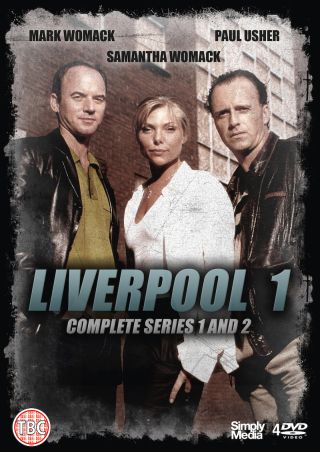
Liverpool 1 to be released on DVD by Simply Media on 15/8/16

164454- Chief Crazy Horse Sleeve.indd

Liverpool 1 will be released on DVD by Simply Media on the 15th of August 2016.  Review here.

Liverpool: the home of heroes and legends. Football, The Beatles, Ferry Across the Mersey – people know this city. At least, they think they do… Merseyside CID know another Liverpool. Day to day, on the streets, they’re at the sharp end of the fight against the drug pushers, porn barons, paedophiles and pimps who run this great port’s crime networks.

Liverpool 1 is a gritty drama that originally aired on ITV in the late 1990s, from BAFTA award-winning directors Ken Horn and Terry McDonough. Starring a wealth of great British acting talent including Samantha Womack (Eastenders, Game On), Scot Williams (Mersey Beat, Meadowlands) and Mark Womack (Murphy’s Law, Babylon) and featuring the inimitable Carry On favourite Leslie Phillips CBE, it comes to DVD for the first time in the UK thanks to Simply Media.

DC Isobel de Pauli has taken on a new job, in a new city where she soon discovers she is a stranger to the ancient, hidden connections that tie Liverpool’s criminals together… and its cops. On arrival she comes face to face with John Sullivan, the city’s most charismatic and influential crime boss. He’s as fascinated by her as she is by him—but Sullivan is the least of her worries.

Her new partner, the silent and indistinctive DC Mark Callaghan, knows this world inside out ­– and he’s doing everything in his power to shut de Pauli out of it. Callaghan is the subject of an internal police investigation, and de Pauli has some serious suspicions about his links to Liverpool’s criminal underworld.

This uncompromising drama pits cops versus criminals, but who is on whose side? Liverpool 1: Complete Series 1 and 2 comes to DVD as a bumper 4-disc set on 15 August 2016.