Dixon of Dock Green – Reunion

reunion

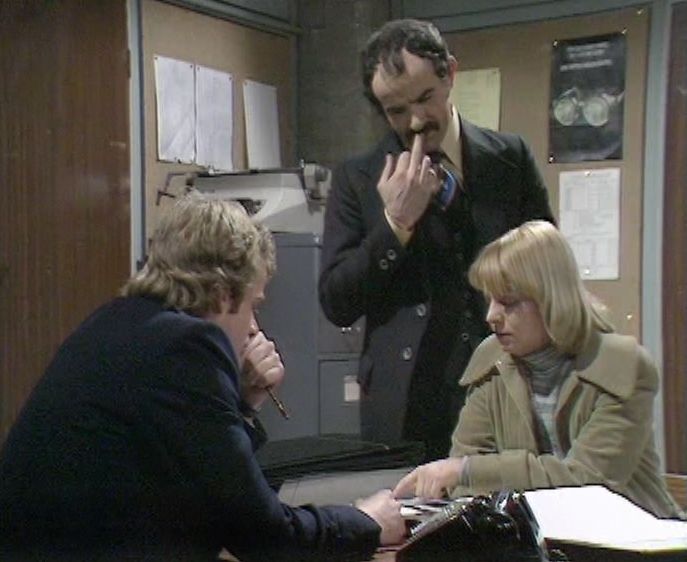
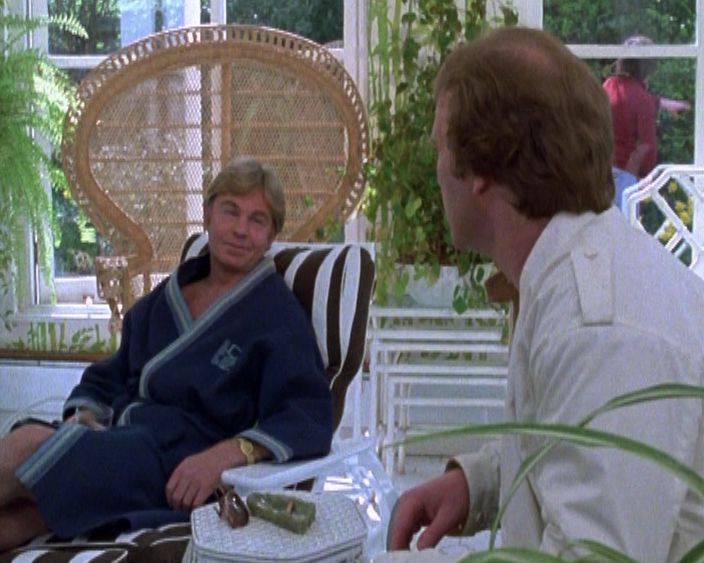
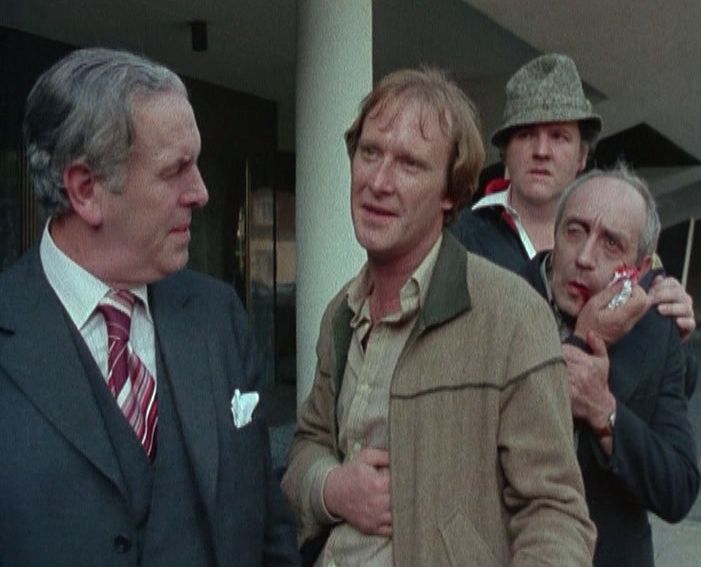
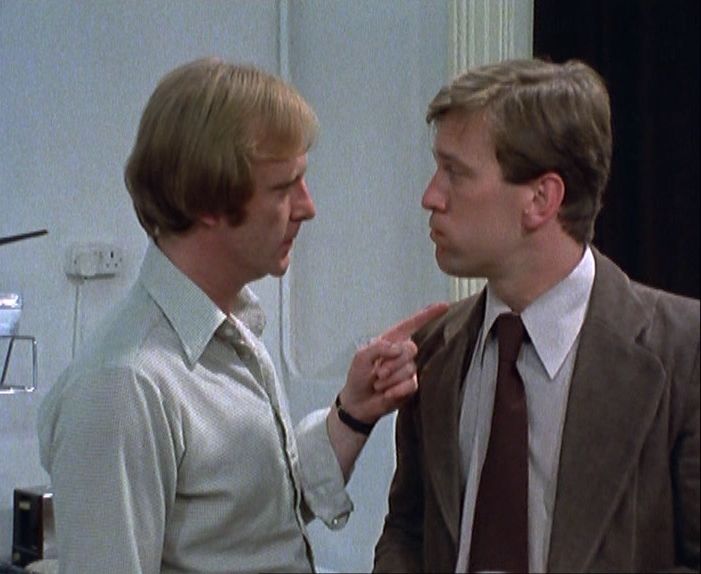
Twenty years ago a number of officers, including George Dixon, were involved in a major operation at the Docks.  Information received suggested that a well-known villain called Trunky Small was planning to steal half a million pounds in silver from a ship called the Galveston Bay.  Trunky and his gang were caught, but the operation wasn’t without incident as one of the officers lost his life that night.

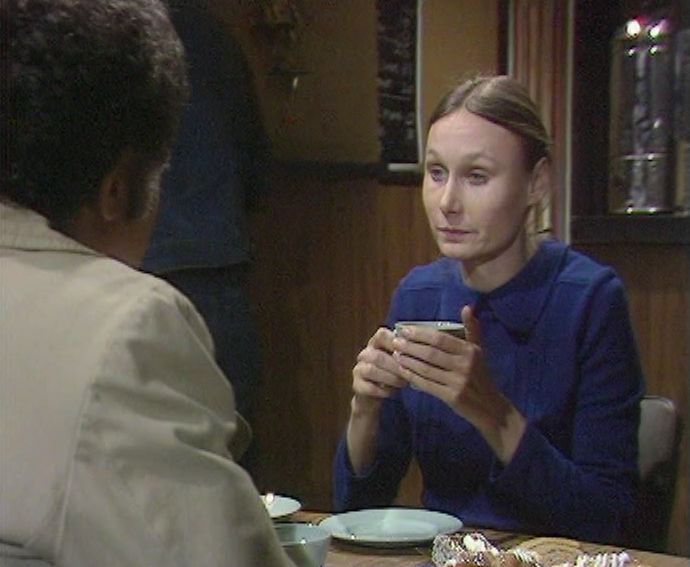
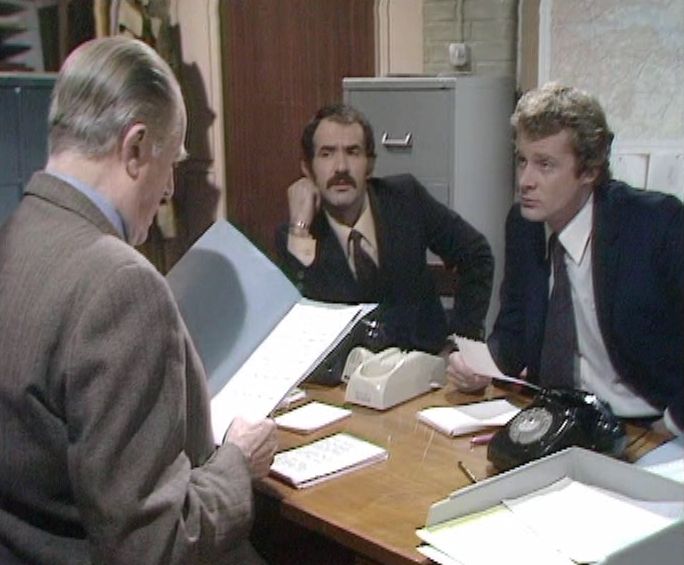
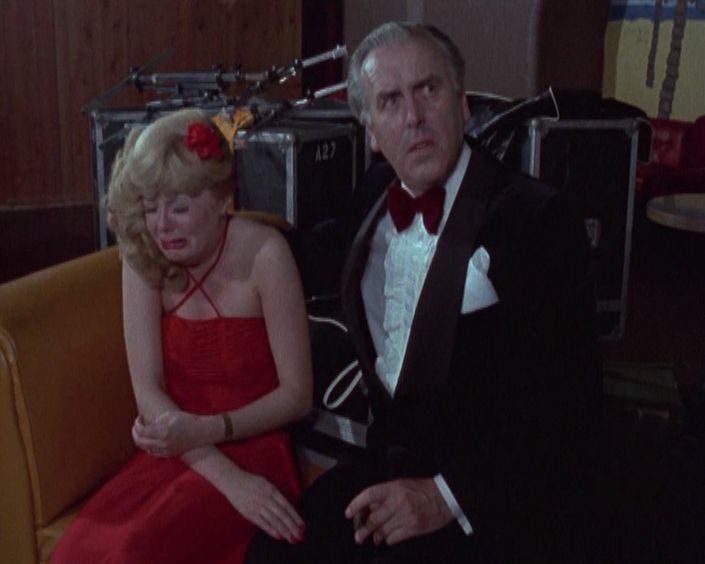
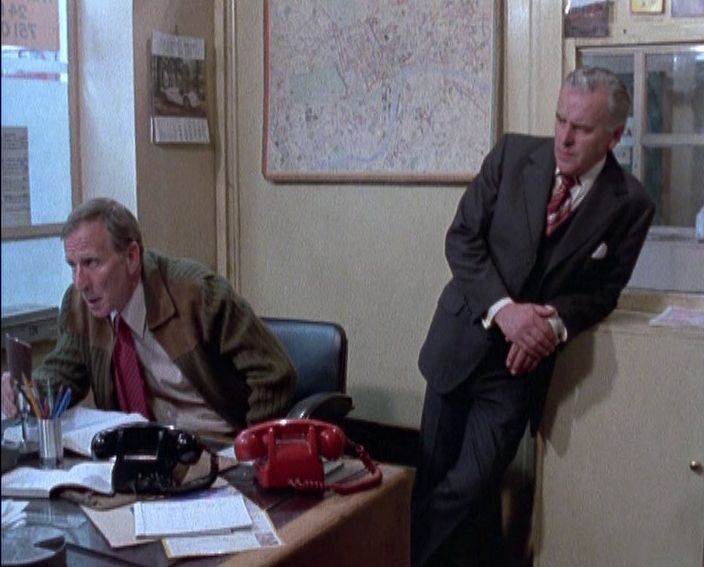
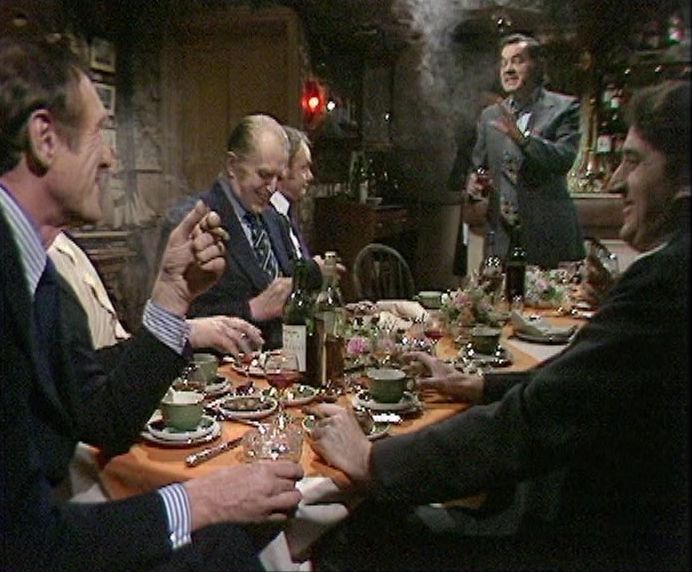
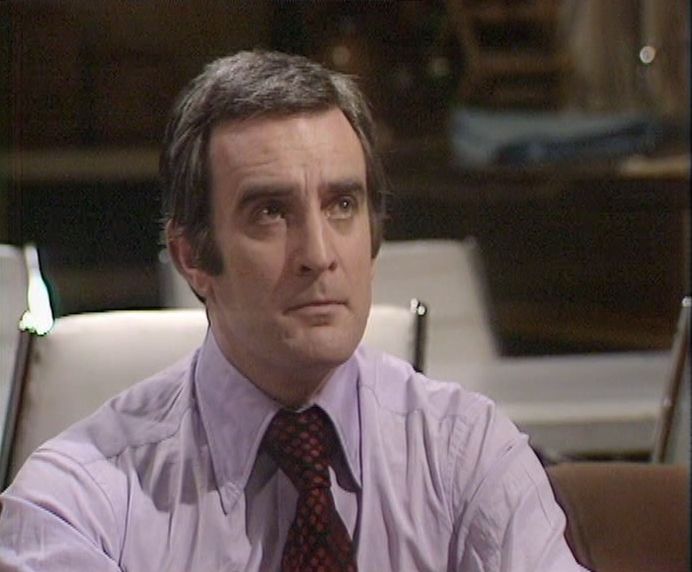
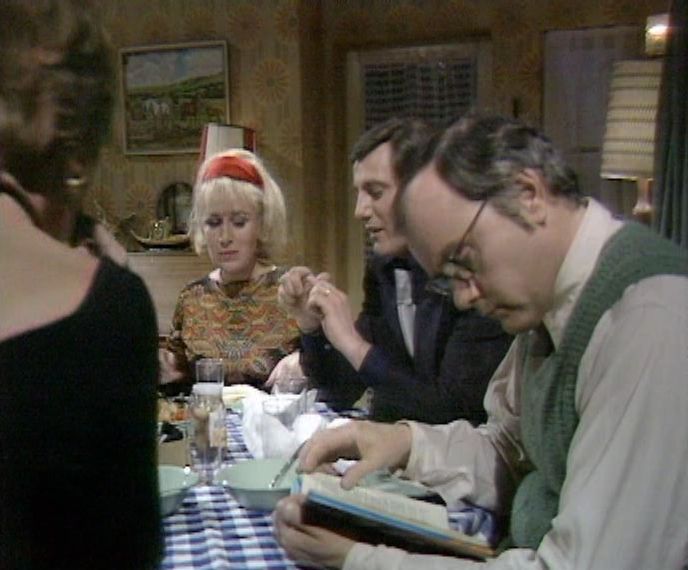
Cope (Glynn Edwards), now a detective sergeant, has organised a reunion dinner.  It appears at first to simply be a chance for old colleagues to meet up and compare notes, but Cope clearly harbours animosity against Ashe (Jack Watson).  At the time Ashe was the DI in charge, today he’s risen to the rank of Commander.  As the evening wears on it seems obvious that revelations will be made.

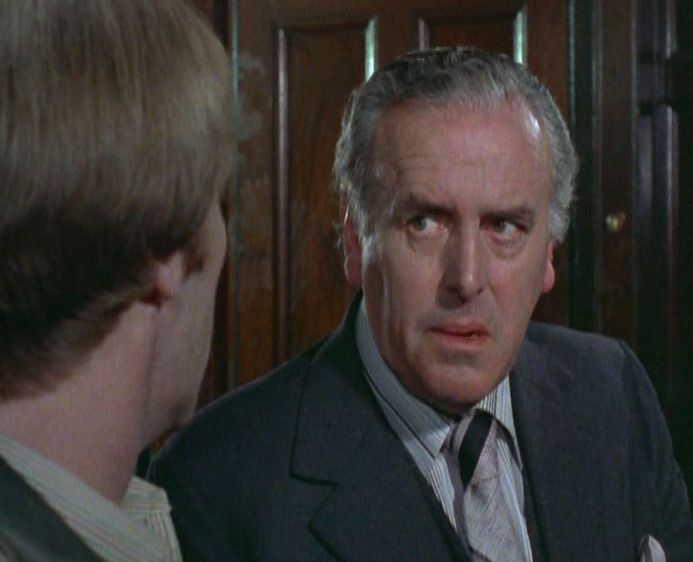
The final episode of Dixon of Dock Green, Reunion doesn’t acknowledge this, even obliquely, so when Dixon bades us good night at the end there’s no sense that it’s a final goodbye.  But when you consider that the last episode of the previous series, Conspiracy, was very obviously crafted as a farewell episode (Dixon’s final monologue about his life in the police, the shot of the blue lamp as the credits rolled) it’s understandable they didn’t decide to play the same trick twice.

It does place Dixon more in the centre of things though, which was reasonable enough, although even here he’s still in his familiar role as an observer – watching proceedings, occasionally asking the odd question, but never directing events.  It’s Cope who’s in charge.  He set up the dinner and also arranged for an extra place to be set (in honour of their dead colleague).  Like the rest of the evening this is for Ashe’s benefit – as is the fact that the waitress, Joyce (Jo Rowbottom), was the dead officers wife.

Glynn Edwards might be best known as the long-suffering Dave in Minder, but his CV is a long and impressive one.  He guest-starred in many popular series during the 1960’s and 1970’s, such as The Baron, The Saint, The Avengers, Public Eye, Out of the Unknown, Callan,Target and many others.  He also had a regular role in the later series of The Main Chance and appeared in films such as The Ipcress File and Get Carter.

And like many other actors he also racked up a number of credits in Dixon, playing several different characters.  He appeared as Jackie Silver in two 1963 episodes and would later play Chief Inspector Jameson in several stories during the late 1960’s and early 1970’s (one of these, Jig-Saw, still survives).  The fact that he then turned up several years later playing a different copper shouldn’t come as a surprise, as it was a very common occurrence.

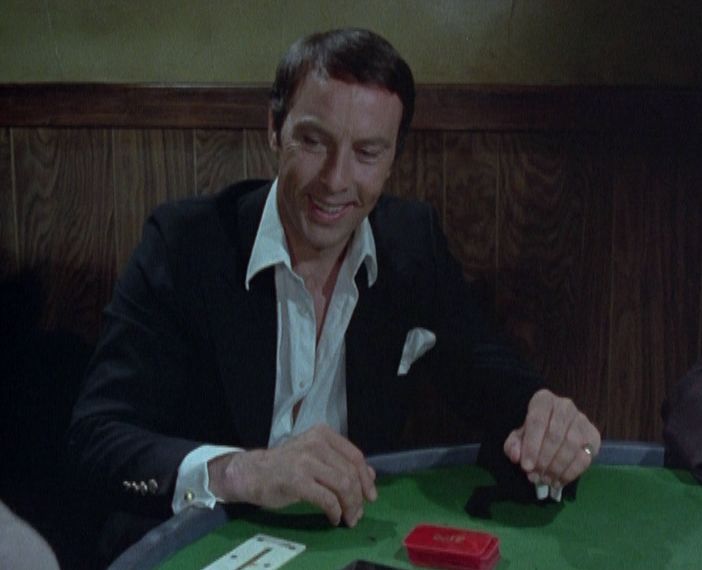
Alan Tilvern is another example of this.  In Reunion he plays Morrie Finn, now an ex-policeman and someone doing very nicely indeed on civvy street.  This was Tilvern’s seventh Dixon appearance, each time playing somebody different.  His previous role had only been the year before – in the wiped episode It’s a Gift (although an infamous outtake still exists, showing Tilvern sharing a scene with Victor Maddern who finds it impossible to say the words “Dock Green Nick”).

I’ve mentioned it several times before, but the guest-casts of this final series have been very strong.  Apart from Edwards and Tilvern, there’s also Jack Watson as Ashe.  Another very familiar face from both films and television, Watson pitches his performance perfectly – showing an increasing unease as the evening wears on.

The resolution of the story is quite understated and low-key.  It later becomes clear that Ashe was made aware that one of his officers had fallen into the dock.  He could have stopped and rescued him, but that would have meant Trunky Small would have escaped.  So he chose to ignore this and press on.

It’s a mystery why nobody has ever brought this up during the last twenty years, but even after it’s made public here that’s as far as it goes.  Joyce has the chance to finally confront Ashe, but there’s no anger as she tells him that “I feel sorry for you. It can’t have been easy. Not then, nor since.”  And that seems to be that, as there’s no suggestion that any proceedings will follow.  As Joyce makes clear, the burden Ashe himself carries is punishment enough.

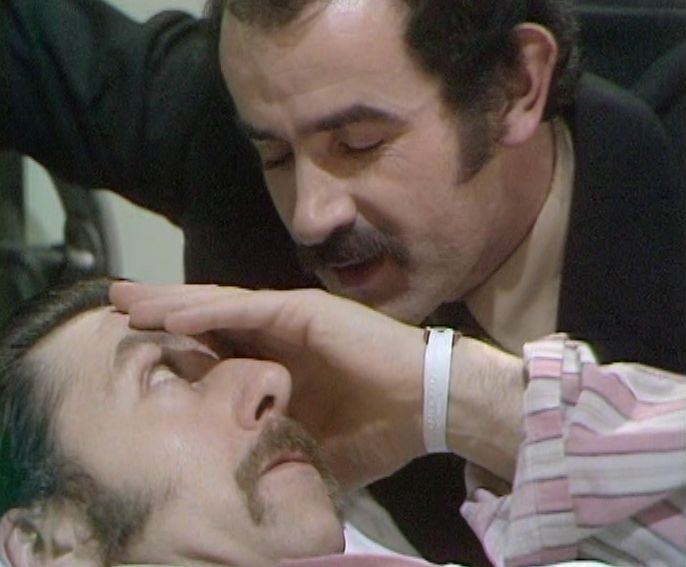
Another piece of the puzzle is supplied by Sam Platte, a man rescued from drowning by Harry Dunne.  For most of the episode this appears to be just a secondary story, but at the end Platte’s connection to the events of twenty years are uncovered.  He’s Joyce’s father and was the man who tipped off the police that Trunky Small was planning to rob the Galveston Bay.

It’s an outrageous coincidence that Platte should turn up on the same night as the reunion dinner and it can’t help but feel like rather clumsy plotting, but Bill Dean is excellent as a merchant seaman reflecting on a lifetime of toil with little to show for it.  It also allowed Stephen Marsh (as Dunne) a chance to shine.  For the majority of this series he’s had the fairly unenviable task of operating as the junior collator (largely existing to feed Dixon lines).

Low-key it might be, but Reunion is also a satisfying fifty minutes of drama.  With one exception, it’s very pleasing to have all the colour episodes of Dixon of Dock Green available on DVD and hopefully the black and white ones will follow soon.
Dixon of Dock Green – Legacy

legacy

After a couple of years in Wormwood Scrubs, Jack Montelbetti (Tom Adams) has an unusual homecoming after he discovers a dead body in his flat.  The dead man, Bruno Pacelli, was an old-time criminal, specialising in jewel robberies.

Jack knew Bruno well (he was engaged to his daughter Julia at one time) and though he died from natural causes that’s only the starting point of the case.  After years out of the game it appears that Bruno went back to his old tricks and pulled a diamond heist in North London and was then keen to use Jack’s skills as a fence.  The jewels were stolen from Van Heerden (John Savident) who issues Jack with a stark choice – the jewels or his life.

This was Tom Adams’ second appearance as Jack Montelbetti (the first, Jack the Lad was broadcast in 1974 and like most episodes of Dixon it sadly no longer exists).  Adams gives Jack a cool, laconic presence – he’s a man who’s rarely perturbed, even when he stumbles over a corpse.  And though he’s a convicted criminal the old-timers at Dock Green (especially Dixon) seem to have a grudging respect for him.

But a newcomer to the manor, Len Clayton, doesn’t share their views.  He knows that Jack’s a newly-released prisoner and is extremely aggressive when questioning him.  This might have been another slight attempt to toughen up the series – at one point Clayton asks him if he’d like a slap in the mouth – but equally it might have been designed to show that rough-and-tumble tactics don’t always work.

Jack doesn’t take to Len Clayton at all and doesn’t waste any time in telling him exactly what he thinks of him.  “I spent two years banged up with a pair of incontinent morons. I worked six hours a day in a laundry for ten fags and a jar of jam. I said yes sir, no sir to the biggest shower of illiterate screws you ever met in your life and then when I come home I get you. Oh brother, life can be hard.”  He goes on to say that he’s not prepared to answer any of his questions, due to Len’s attitude, so he’ll wait for Bruton to turn up instead.

Jack and Julia were estranged several years ago (at the start of the episode Julia flinches when she hears his name) but it doesn’t take too long before they re-establish their old love.  With several different plot-threads running at once there’s not a great deal of time spent on their relationship, but Adams and Gigi Gatti do their best with the limited time available .  Gatti’s film and television CV is quite small (several appearances in Survivors as Daniella later in 1976 are possibly the highlight) and her lack of credits is quite surprising as she’s an appealing presence.

John Savident makes the most of his role, affecting a Dutch accent and waving a gun around.  There’s not a great deal of menace with his character though, possibly due to Dixon‘s status as a pre-watershed series.  The Sweeney would have been able to get away with displays of violence from Van Heerden (to prove that he could follow through on his claim he would do Jack serious harm) but that would never happen in Dixon.

The ending is another example that crime sometimes does pay.  Van Heerden is arrested but Jack gets away (and it’s implied he’s pocketed the jewels).  Dixon, in his end of episode summing-up, doesn’t sound at all aggrieved about this – another sign that Dixon of Dock Green operated on a different level from most police series.

For Dixon a conviction isn’t everything – sometimes villains will walk free (especially if they’re seen as basically decent people) and there’s a tacit acknowledgment that although the strict letter of the law hasn’t been followed maybe it’s for the best.  This certainly sets the series apart from many cop shows where the “result” is all that matters.

Dixon of Dock Green – Jackpot

jackpot

Harold Tovey (Kenneth Cope) is a bookish, mild-mannered man who continually finds himself hen-pecked by his wife Margaret (Pat Ashton).  When she tells him to take a relaxing holiday abroad by himself, he’s suspicious – as he’s certain she’s involved with the smooth-talking Mickey Walker (Tim Pearce).

But if there was any fight in him, it appears to have long gone and he dutifully plods off to the airport.  However, when his flight is cancelled he heads home to see his wife and Mickey heading out together.  This is the catalyst for a series of unlikely adventures, which start when he appropriates a large sum of money previously stolen by his brother-in-law Tony Kinsley (Paul Darrow).

Jackpot is a comic treat with Kenneth Cope (Coronation Street, TW3, Randall and Hopkirk) on fine form as the bookworm who turns.  The first fifteen minutes or so constantly reinforce the notion that Harold is a complete and utter nonentity – his wife says so, Tony Kinsley says so, even the boys at Dock Green nick say so!  But even the mildest-mannered man can only take so much and his eventual revolt is a delight.

He turns up at a posh hotel, complete with chauffeur, and proceeds to take the grandest suite.  He’s also acquired a nice new suit and, best of all, a full head of hair (thanks to a very impressive wig).  Outrageously tipping the hotel porter (Eric Mason) ensures that he gets the very best service – including some female company to help him relax.  His encounter with the escort Sybil (Pamela Moiseiwitsch), is another highlight of the episode as he does everything he can to impress her.  “Do you have a bucket of caviar for dinner every night?” she asks him

The performance style of the guest-cast is best defined as “broad”.  The likes of Pat Ashton tended to play comedy anyway whilst Paul Darrow’s broad cockney accent also raises a smile, although that probably wasn’t the intention.  Darrow’s very entertaining though, even if it’s hard to accept he’s a hard-bitten villain.

The comedic antics of Harold do contrast somewhat with the more serious scenes at Dock Green nick.  The two different environments don’t really connect very well – probably because the Dock Green officers aren’t integrated into Harold’s story (in fact, we could have concentrated solely on Harold and we probably wouldn’t have missed the input of Dixon and the others).

Quite a short episode, clocking in at just over forty-six minutes, it’s another one that succeeds thanks to the guest cast, especially Kenneth Cope.

Dixon of Dock Green – Alice

alice

Mohinder Singh (Renu Senta) is involved in the trafficking of illegal immigrants.  Forty individuals are currently in Ostend, awaiting shipment to Britain – but they won’t be going anywhere until the captain of Dutch vessel is paid in cash.

Singh contacts a dodgy import/exporter called William Keeley (Harry Landis).  Keeley is unwilling to make the trip himself, but a likely candidate presents herself at just the right moment.  Alice Benfield (Angela Pleasence) is a gifted music student who rents a room above Keeley’s office.  She appears to be vague and lacking in any social skills, which encourages Keeley to use her as an unwitting courier.

But Alice isn’t quite as innocent as she appears and is more than willing to undertake the job, provided the price is right.  And this isn’t the only surprise that Alice springs …..

Alice takes a while to get going (the first twenty minutes or so drag somewhat) but once we get into the heart of the story things pick up nicely.  Angela Pleasence, daughter of Donald Pleasence, gives an intriguing performance as the titular Alice.  When we first meet her she’s incredibly vague and hardly seems able to string two words together.  Is this an act?  By the end of the episode (after she’s pocked the money from Singh and taunted him that he’s powerless to do anything) she’s transformed completely.

Keeley ends up as her partner in crime (Dixon’s closing piece to camera states that they later went into business together).  Harry Landis is hardly pushed, but is good anyway, as the sharp Jewish businessman not averse to accepting a crooked deal.

The one discordant note comes from Tania Rogers as Keeley’s secretary Samantha Jones.  Her jive talking (referring to white people who annoy her as “honky”) hasn’t aged well and her acting in general is rather brittle and forced.  A sample of some of her other performances during this period, such as Zilda in the Doctor Who story The Robots of Death, shows that she did tend to overact.

Renu Setna is much better value as Singh – a man who professes he only wants to help his fellows, but isn’t averse to making a healthy profit out of them.  Refugees and migrants remain a hot topic today – although they’re not not really the focus of the episode.  As we never see them, the migrants are only used a plot device to put the sum of money into Alice’s hands and it could have equally been drugs or pornography Singh and Keeley were dealing in.

This is an episode where it seems that crime does pay, as Alice uses the money she’s stolen from Singh to give a recital at the Wigmore Hall.  All Dixon can offer any viewers concerned to hear she’d got away scot-free is the news that the critical response was poor!

Although the opening is dull and Alice’s character transforms rather too completely over the course of the episode for my tastes, this is decent enough fare.

Dixon of Dock Green – Everybody’s Business

business

Mrs Hooker (Queenie Watts) is a familiar presence at Dock Green nick.  She might be motivated by a strong sense of public duty (or could simply an officious busybody).  Her suspicious nature is a running joke with her tenants, such as Dave Palmer (Rod Culbertson) and Rita Batty (Cheryl Hall).

When Dave tells an incredulous Rita that Mrs Hooker examines their rubbish (in the hope of finding something incriminating) they decide to play a joke on her by drawing a plan of a fictitious robbery and popping it in the next bag of rubbish.  Naturally enough she finds it and goes rushing off to the station to report her latest find.

But whilst Dave and Rita are planning make-believe crimes, a real one is happening right next door.  Mrs Collins (Sylvia Coleridge) has become quite the local celebrity, following a piece in the local paper about how she discovered one of her paintings was worth forty thousand pounds.  This makes her a target and Walker (George Sweeney) and Ron Fielding (Roger Lloyd-Pack) plan to relieve her of this precious work of art.

When Ron Fielding turns up at Mrs Hooker’s house, looking for a room, it’s pretty clear from the outset that something’s not quite right.  Although he’s offered a nice, quiet room at the back he prefers the smaller one at the front.  Problem is that Rita has the front room and doesn’t want to move.  Ron spins Mrs Hooker a yarn about how his wife has moved in over the street with another man, which gives Queenie Watts a lovely moment as she purses her lips and declares that spying on people isn’t nice at all.

Of course, he’s simply interested in the room because of its location to next door and the painting.  But though he doesn’t get the room he still plans to use it – as soon as Rita leaves to work at the pub that evening.  Alas, she comes back too soon and finds herself bound and gagged by Ron and Walker.

Everybody’s Business is another good character-based story.  Roger Lloyd-Pack and George Sweeney (both to later find fame in John Sullivan sitcoms – Lloyd-Pack in Only Fools and Horses and Sweeney in Citizen Smith) exude a certain menace.  Their initial meeting, in a bleak and rubbish-filled street, is another snapshot of how grim many areas of London were back in the 1970’s.

Cheryl Hall (who would also later appear in Sullivan’s Citizen Smith, alongside her then husband Robert Lindsey) is rather appealing as Rita.  She has a mischievous streak, brought on by Mrs Hooker’s snooping, but also finds herself tramautised after spending the night tied up.  Sylvia Coleridge, who had a lengthy career largely playing eccentric old women, plays somewhat to type as Mrs Collins.

Bruton is very brusque with both Rita and Dave (it appears that he doesn’t believe her story to begin with) and this causes Dave to call him a pig, once he’s out of earshot of course.  It’s quite rare for the police in Dixon to behave quite so off-hand to witnesses, so this is possibly a sign that the series was gently trying to toughen up a little.  There’s also a very brief, Sweeney-like, bit of action at the end as we see police cars racing through the urban wasteland to nab the criminals.

With the crime only taking up a small part of the running time, Everybody’s Business is much more about character interactions and because the story is so well-cast this makes it one of the stronger episodes from this final run.

Dixon of Dock Green – The Vagrant

vagrant

A vagrant (John Carson) is knocked down by a car in the street.  An eye-witness, Fred Smethwick (Bill Treacher), is insistent that the car deliberately drove into him and his statement catches the interest of the Dock Green police.  The vagrant is later identified as Joseph Conway, a career criminal who turned Queen’s Evidence a few years previously.  He helped to put two criminals, Gerald Tate (Johnny Shannon) and Bert Flower (John Hartley), behind bars and since they’re both now back in circulation it seems likely one of them was the driver.  But the truth is rather more complicated …..

The Vagrant benefits from John Carson’s guest turn.  Whilst he’s rarely been a leading man, he’s a quality actor who enhances any production he appears in.  Still active (he popped up in an episode of Midsummer Murders a few years back) he’s enjoyed a lengthy career stretching back to the 1950’s.  The Doctor Who story Snakedance and the Out of the Unknown episode This Body Is Mine are two of his credits which have been covered previously in this blog (both of which are enriched by Carson).

He’s rather cast against type here as a down-and-out.  The part calls for him to adopt a hoarse and hesitant voice and a rather vague manner, but it’s obvious from fairly early on that there’s more to Conway that meets the eye.  He may appear now to be a broken wreck of a man but that wasn’t always the case (in fact he’s not even Joe Conway).

His real name is Francis Spurling and the reason for him changing his identity helps to spin the story off in another direction completely.  After Spurling and Joe Conway swapped identities, it allowed him to drop out of circulation (Conway’s dead body was mis-indentifed as Spurling).  His wife, Margaret (Suzan Farmer), has since remarried and naturally views his return with horror.  But Spurling hasn’t returned to make trouble – he simply wants to try and make amends with Margaret and also help his friend Percy (a lovely turn from Paddy Joyce).

The Dock Green boys take a back seat in this one as the bulk of the episode revolves around Conway/Spurling, although Clayton and Bruton do entertain themselves by questioning Tate and Flower (Johnny Shannon is wonderfully belligerent as Tate).  As I’ve said, Paddy Joyce is very entertaining as Conway/Spurling’s fellow vagrant Percy and whilst he adds little to the plot, he’s a colourful character who enriches the episode no end.

There’s little for George Dixon to do and the story does somewhat splutter to a conclusion, but as ever, the first-rate guest cast (John Carson, Paddy Joyce, Johnny Shannon, Suzan Farmer), helps to keep the interest bubbling along.

Dixon of Dock Green – The Job

target

Sgt Wills fishes a barely conscious petty criminal called Phil Harvey (George Innes) out of the river.  It wasn’t suicide though – as Harvey was bound and gagged.  After he’s taken to the hospital Wills in unable to get any useful information from him.  DC Clayton is equally unsuccessful with Harvey’s wife, Jessie (Mela White).

The first breakthrough comes when Harvey’s car is found – close to the office of Stephen Gilles (David Lodge).  Gilles is a target criminal and therefore of special interest to the Serious Crimes Squad.  Dixon contacts DCI Bassett (Stephen Greif) who’s been keeping Gilles under observation and suggests they pool their resources.

There’s some effective film-work at the start of The Job as we see Wills rescue Harvey.  It once again shows that one of Dixon‘s strengths during this period was the dock-based location filming (which helps to break up the generally studio-bound, static feel of the series).  There’s not a lot of location work in this one but every little helps to open out the show a little.

The opening of the story also brings Sgt Johnny Wills a little more into the centre of the action.  Between 1960 and 1976 Nicholas Donnelly chalked up over two hundred appearances and was therefore as much a fixture at Dock Green as Jack Warner or Peter Byrne were.  Donnelly was able to give Wills a likeable, friendly air which fitted in well with the general tone of the series.

Here, he spends most of the story at the hospital – cadging endless cups of tea from a friendly young nurse (played by Glynis Brooks).  She only appears to have eyes for the dashing young DS Bruton though and later views Wills’ habit of listening at doors with a little disfavour.  Wills is unabashed though – if it means gaining information then it’s a legitimate tactic.

As ever, there’s a very decent guest cast.  George Innes (Upstairs Downstairs, Danger UXB) gamely opened the episode by being caked in mud and submerged in the river (kudos to him, considering the early hour the scene was shot and how cold it looked).  Mela White (best known as Diamante Lil from Bergerac) is gloriously vacant as his wife.  But is she really that slow on the uptake or is it just a way of concealing what she knows?

It’s possibly not a surprise that it’s Dixon (rather than Bruton or Clayton) who realises that Serious Crimes have been keeping tabs on Gilles which is confirmed after he arranges a meeting with DCI Bassett.  It’s another subtle demonstration that whilst he may be getting on, Dixon’s knowledge still remains formidable.  Greif’s scenes are rather distracting, thanks to his false-looking moustache, but his meet with Dixon is a good excuse to get Jack Warner out of the studio and onto film.

David Lodge, an actor with an impressive list of comedy credits (appearing alongside the likes of Peter Sellers and Spike Milligan), has a fairly small role but casting a name actor helps to make it a memorable appearance.

As so often with television of this era, it’s the period feel which makes it an interesting watch.  The Harvey’s house (especially the wallpaper) screams out that it’s the 1970’s and some of the film-work – as Bruton and Clayton tail Gilles down the local high-street – is also rather evocative.  This filming also highlights the somewhat ad-hoc way these programmes were made.  Often it appears that they’d just turn up and start filming, without attempting to close off the street.  Meaning that you’ll often see members of the public unable to resist the temptation of staring straight down the lens!

The second of Derek Ingrey’s five scripts for series twenty-two, it’s another effective, character-based story.

The Last Detective – Pilot

last

“Dangerous” Davies was created by Leslie Thomas and first appeared in Thomas’ novel Dangerous Davies: The Last Detective which was published in 1976 (three further books would follow – in 1987, 1993 and 1997).

Davies’ first small-screen appearance came in 1981, in an adaptation of Thomas’ 1976 novel which saw Bernard Cribbins play Davies and Bill Maynard appear as Mod.  We then fast-forward some twenty or more years to The Last Detective which starred Peter Davison and Sean Hughes and ran for four series between 2003 and 2007.

Peter Davison has always had a tendency to play somewhat bewildered everymen, so was perfectly cast as Davies.  Dangerous Davies (an ironic nickname, as he’s anything but) is an old school copper who’s genuinely interested in people and is content to listen to what they have to say and help if he can.  This earns him barely disguised contempt from his younger colleagues who are much more interested in just nicking villains.

There’s no solace to be gained from his superior, DI Aspinall (Rob Spendlove), either.  It’s Aspinall who tags him the Last Detective – i.e. he’d always be the last detective chosen to investigate any important case.  So Davies ends up with the jobs nobody else wants to tackle – which is how he stumbles across a twenty year-old unsolved missing persons case and decides, completely on his own authority, to re-investigate it.

Josie (Joanne Froggatt) was a seventeen year-old girl who went missing in 1982 and hasn’t been seen since.  When leafing through files relating to a connected case, Davies becomes intrigued by the story and decides to take a look at it, although the potential consequences of reopening such an old investigation are quickly spelled out.  Josie’s mother (played by Rachel Davies) has never got over her disappearance and there’s the uncomfortable suggestion that if Davies doesn’t come up with anything he’ll simply have raised her hopes only to have them dashed again.

Talking about Josie also impacts on her sister Celia (also played by Joanne Froggatt).  Ceila was conceived shortly after Josie went missing and has lived her whole life knowing that in some respects she’s a replacement for her.  Her lack of identity and also her relationship with Davies (which shifts between vulnerability and hardness) is a key part of the story.

The picture of exactly what sort of person Josie was is slowly built up as Davies questions the people closest to her.  As he meets each witness we see a flashback to events back in 1982 and they help to bring her character into sharper focus.  There’s several potential suspects, although the mystery element of the story is fairly weak since the culprit is somebody that was never even considered.  This can’t help but feel like a bit of a cheat.

As Davies continues to uncover the facts he finds a useful sounding board in his friend Mod (Sean Hughes).  With Davies seemingly shunned by his colleagues, Mod effectively becomes his partner and is always on hand to listen to his theories.  The notion that Davies could operate with no supervision might have been more likely when the book was originally published but it does strain credibility a little in 2003.  Still, television doesn’t have to be real to life so it’s best just to go with the flow and just enjoy the comic banter between Davison and Hughes.

The pilot also introduces us to Davies’ estranged wife, Julie (Emma Amos).  If his career is a bit of a disaster then it’s obvious that his marriage was as well.  This does sort of ram home the point that he’s a loser – but thankfully Davison is able to bring some light to proceedings (otherwise things would be even more depressing than they are).

But there is a dark tone to this story.  Although Josie’s mother tells Davies that all she wants is closure – if she knew Josie’s fate then she could find some sort of peace – the solution to the mystery isn’t one that provides anybody with a neat, happy ending.  Should Davies have just left well alone?  At one point he does confess that he’s possibly only continuing the investigation because he wants to prove to himself that he can solve it (rather than considering what the consequences of his actions will be).

David Troughton, who had starred alongside Davison in A Very Peculiar Practice, makes a welcome guest-appearance as Sergeant Yardley.  Like Davies, he’s an old-fashioned copper and the pair seem to have a certain connection.  Rachel Davies and Leslie Schofield both impress as Josie’s parents, but the stand-out performance comes from Joanne Froggatt as Josie/Celia.  Now a familiar face, thanks to a regular role in Downton Abbey, she had still managed to rack up an impressive list of credits between her television debut in 1996 (in an episode of The Bill) and this production.

Thanks in part to Peter Davison’s unshowy performance, this is a strong opener.  Richard Harris’ adaptation skillfully manages to take the best from the novel whilst presenting a less comedic adaption than the 1981 version.  Rather bizarrely, the series isn’t available as a R2 DVD, although R1s and R4s are available (it’s also just begun a rerun on the UK channel Drama) so it’s worth checking out if you can find it.

Dixon of Dock Green – Domino

domino

When Annabelle Sturmer (Sally Faulkner) moors her impressive-looking yacht at Dock Green she instantly catches the eye of dock-worker Ron Mason (Alan Lake).  Annabelle and Ron share a drink and everything seems friendly enough – but in an instant her mood changes and there’s a struggle.  She returns with a gun and then a shot is heard.

Ron is seen leaving the boat, pausing to throw something in the water.  When Annabelle’s disappearance is noted, the boys at Dock Green investigate.  All the evidence suggests that Ron murdered her – but things aren’t quite as straightforward as they first appear …..

Domino was the first episode of Dixon of Dock Green‘s twenty first and final season.  This series saw several changes to Dixon‘s tried and tested format.  Firstly, we’re told that Andy Crawford (Peter Byrne) had transferred to another area, so there’s several new faces in CID – DS Alan Bruton (Richard Heffer) and DC Len Clayton (Ben Howard).

As for Dixon himself, he’s moved from being the desk sergeant to taking up the post of collator.  In some ways this wasn’t too drastic a change – as per the previous few series George stays in the station and provides the others with nuggets of information that enable them to run the criminals down.

As is probably well known, Jack Warner had some trouble moving about, so Dixon tends to remain either seated or standing upright.  He does walk about a bit, but not very far (his days of pounding the beat were long, long over).  But the job of collator was an inspired one, as it allowed him to still have a decent input into the stories as well as giving him a chance to mentor a younger officer, PC Harry Dunne (Stephen Marsh), who we’re told will take over from him in due course (was there thought given to continuing the series following Warner’s retirement?).

Whilst Peter Byrne’s departure was a loss, Richard Heffer is a very welcome addition to the cast.  A familiar television face already (Captain Tim Dowling in Colditz and JImmy Garland in Survivors were amongst his numerous roles) he brings a touch of class and charm to Dock Green nick.  Ben Howard, as Len Clayton, provides a nice contrast, since he seems to have an ironic sense of humour as well as possessing a harder streak.

Derek Ingrey’s script sets up a mystery which isn’t resolved until the closing minutes.  Sally Faulkner doesn’t have a great deal of time to make an impression, but still manages to do so.  Annabelle Sturmer appears to be a spoiled little rich girl, who took her father’s yacht without permission and sailed it back to Britain.  The implication is that she’s an alcoholic, which would explain her fondness for drinking early in the morning as well as her violent mood swings.

Alan Lake, who died at the very early age of forty three in 1984, might be best remembered as Diana Dors’ husband, but he also had an impressive list of acting credits (including eight appearances in Dixon, playing eight different characters).  He didn’t tend to do subtle very often, but that works perfectly well here. Ron Mason needs to be a twitchy, unpredictable character, that way it makes the question as to whether he’s harmed the girl harder to answer

Lake is one of the episode’s chief attractions and he enjoys a generous amount of screen-time.  Also worth watching are Gwyneth Powell (in her fifth and final Dixon appearance) as Mason’s long suffering wife and Simon Lack (later to star with Richard Heffer in LWT’s Enemy at the Door) as Annabelle’s father.

The down-beat ending might have been easy to guess, but it still has a certain impact.  A solid, if not spectacular, series opener.

Minder – You Gotta Have Friends

gotta

Billy Gilpin (David Buck) is a wanted man.  The police want to question him about the attempted murder of Lord Ingrave, whilst local villain Bobby Altman (George Baker) is also keen to track him down.  Billy worked for Altman and has absconded with seventy thousand pounds worth of bearer bonds.

As Terry gave Billy a lift, that makes him an object of interest for both the police and Altman.  The police are fairly easy to deal with but the barely stable Altman is another matter.  He’s convinced that Billy gave Arthur the bonds and issues a stark ultimatum – if Arthur doesn’t return them, his life expectancy will be very short.

Moments of levity are few and far between in You Gotta Have Friends.  They mostly occur at the start, as we see a very drunken Arthur making his way home after a night spent with his friends at the Lodge.  He’s accosted by Billy who urgently needs a ride out of town.  Arthur’s in no fit state to drive (some lovely drunk acting from Cole in this scene) but he knows just the man – Terry, of course.  It may be the middle of the night, and Terry’s rather preoccupied with the lovely young Valerie, but this doesn’t really register with Arthur.

After this, things take a darker turn when Terry’s picked up by the police for questioning the following day.  In the years to come he probably would have been quizzed by either Chisholm or Rycott and that would pre-condition the viewer to know that nothing particularly serious is going to happen.  But here we have the more imposing form of D.I. Barnett (Allan Surtees).

Although Terry’s never really in serious trouble, it’s the tone of the scenes at the station which feel different from similar moments from later series.  The bleak, whitewashed walls do seem to have a more oppressive feeling here.  Even Terry’s temporary cell-mate, Whaley (a decent cameo from Roy Kinnear), might not be all that he appears.  On the surface, Whaley looks like a friendly chap, genuinely interested in Terry’s plight – but is he one of Barnett’s tame grasses, there to act as a possible prosecution witness?  We never find out for sure, so Terry may just be acting a little paranoid (possibly brought on by his brief confinement).

George Baker is imposing and powerful as Bobby Altman.  His meeting with Terry demonstrates he has trouble keeping his temper under control.  This, together with his group of minders (including Brian Hall and Prentis Hancock), give us an early indication that he won’t be a pushover.  When Altman tells Terry that he’s going to kill Arthur, we believe him.  And whilst Terry could easily take the older Altman, he’s told quite plainly that with the superior numbers on his side, Altman would always emerge victorious.

There’s a fairly heavy use of library music in this episode and since most of the cues tend to be dramatic and suspenseful ones, that simply adds to the tension.

Later, Altman abducts Arthur and gives him one more chance to tell him where the bonds are.  As Arthur doesn’t have them he can’t do this – but Altman has long since passed the point of reason.  A health-fanatic, he forces Arthur to go for a jog with him and pushes him to the point of collapse.  When Terry rescues him, it’s slightly played for laughs, but before this it’s another disturbing scene.

Luckily for Arthur, Terry arrives in the nick of time with the bonds, which had been in the possession of Lady Ingrave (Deborah Grant).  Despite their mis-matched backgrounds, she was in love with Billy and the pair planned to disappear together (although his death – he’s later fished out of the river – puts paid to that).

The Arthur/Terry dynamic is quite obviously what makes Minder work.  Arthur might be self-centered and manipulative, but there has to be some kernel of respect between the two of them – otherwise the series simply wouldn’t work.  This is demonstrated when Terry finds a barely-conscious Arthur, with Altman towering above him.  He hands over the bonds, but has no hesitation is aiming a well-thrown punch in Altman’s direction, knocking him down.

Honour is therefore satisfied.  Altman’s got his bonds back, but Terry’s struck a blow for his friend.  And despite the power (and man-power) Bobby Altman has, he knows that this is one time he should walk away.

You Gotta Have Friends brought the first series of Minder to a conclusion.  It would be Leon Griffiths’ last script for a few years, due to ill-health, but he’d set up a very firm foundation which ensured that the many writers who followed in his footsteps would have plenty to work with.

Minder – The Dessert Song

dessert

Terry and Arthur rescue a Greek-Cypriot called Charlie (Peter Bland) who was being attacked in the street by three men.  They take him back to a restaurant, run by his cousin Christina (Diane Keen), who although initially unwelcoming later seeks Arthur’s help.

She tells him she’s being hounded by Omar (Godfrey James) – the brother of Christina’s late husband, who wants to take over the running of the restaurant.  Arthur’s rather taken with Christina and agrees that Terry will keep an eye on the place.  But things turn out to be slightly more complicated than they first appear …..

One notable thing about The Dessert Song is that all the actors playing Greeks – Diane Keen, Godfrey James, Peter Bland, Daniel Hill (as Johnny) and Michael Angelis (as Nick, the waiter) – are British.  It was common enough during this era of British television, as the pool of ethnic actors was much smaller than today, but it is a little distracting.

Still, it’s always a pleasure to see Diane Keen (one of those actresses who was ever-present during the Seventies and Eighties) and it’s plain that Arthur’s equally taken with Christina.  Just one episode after his misadventure with Sharon, he seems prepared to make a play for Christina’s affections.  Although it’s probable that her restaurant is more appealing to him than she is!

Once Terry is installed as the restaurant’s minder, Arthur’s quick to take advantage – dropping in for a meal (on the house, of course) and delighting in ordering Terry about.  Understandably, Terry doesn’t appreciate this, nor does he really like having to wear a shirt and tie.

Peter Bland is rather endearing as Charlie.  He appears to be harmless, if a little eccentric, but things take a strange turn when he pulls a gun on Terry and Arthur.  Luckily, no harm is done – he’s come to England to right an old family wrong and doesn’t mean them any harm – and Christina resolves to put him on the next plane back to Cyprus.  But the conniving Johnny is easily able to manipulate him into attempting to kill Omar – which means that once again Terry has to wade in and save the day.

Terry and Arthur are slightly less prominent in this episode, although Terry has some decent fight scenes and even Arthur manages to be proactive (trapping Johnny in a telephone box).  The banter between the pair of them (Terry ribbing Arthur about his interest in Christina, Arthur treating Terry like a waiter – clicking his fingers and asking for a menu!) is, as ever, top notch.

The first of twelve episodes written by Andrew Payne (including the feature-length Minder on the Orient Express from 1985) The Dessert Song might feel a little inconsequential (there’s no impressive bad guys – Omar’s quite a reasonable chap after all and Johnny’s obviously no match for Terry) but it’s still an entertaining fifty minutes.

Minder – Monday Night Fever

monday

Arthur is convinced that Sharon Dobbs (Sheila White) is a singing sensation just waiting to be discovered.  He’s so enamoured of her, both personally and professionally, that he hands over six hundred pounds to Chris Lambert (Eric Deacon).  Lambert runs a local nightclub and tells Arthur he’ll use his record business contacts to invite some top people down to hear her sing.

But the evening ends in disaster for Sharon (a combination of the sparse audience’s disinterest and her own flat singing) and Arthur (when he realises that Chris has conned him).  Arthur demands that Terry goes round to give him a spanking and retrieve his money, but Terry refuses.  Those days, he says, are over – since it’s a certain way to ensure he goes back inside.  So Arthur fires Terry and seeks an alternative …..

Whilst Monday Night Fever has some gags, at heart it’s a very bleak tale.  And the bleakness mostly revolves around Arthur as it shows us just how out of touch and insignificant he is.  He blithely assumes he’ll be able to get Sharon engagements at all the top West End nightclubs – only to be told by Terry that they all shut down a decade or so earlier.  His portrayal as yesterday’s man is reinforced when he later tells Terry that he’s still a respected man around the manor.  In a few drinking clubs and car auctions maybe, says Terry, but nowhere else.

Arthur’s relationship with Sharon is the most intriguing part of the story.  He’s clearly attracted to her (although he reacts strongly to Terry’s label of her as the “singing scrubber”).  We see them kiss and after he’s thrown out of his house by ‘Er ‘Indoors, he even floats the possibility of them moving into a flat together.  But this, just like his promise to her that he’ll be able to use his contacts to get her a record deal, is nothing but a pipe dream.

There doesn’t seem to be anything malicious or exploitative in his relationship with her.  He does seem to genuinely believe she’s talented (although he’s in a minority there) and thanks to his deluded belief in his own importance once he’s told her that he’s a connected man in the business, he can’t back down.

This leads him to Chris Lambert, who cons the usually astute Arthur very easily.  Maybe this is because he’s outside of his comfort zone – if it was dodgy jeans or perfume then he’d drive a hard bargain, but Sharon’s clearly impairing his judgement.

Sheila White gives a nice performance as the seemingly innocent and naive Sharon.  She appears to have genuine affection for Arthur, but later we see her shacked up with a keyboard player who’s offered to show her some chromatic scales.  This suggests that like everyone else she’s used Arthur for her own ends.  Her singing had to tread a delicate path between being slightly off-key, but not so bad that Arthur’s interest in her would strain credibility.  And it works, just!

Arthur and Terry’s falling-out is another key part of the story.  It demonstrates that, despite Terry’s protests, he does have genuine affection for Arthur (his girlfriend Penny reminds him that he’s mentioned how he looks upon him as a father figure).  So when Arthur enlists the unstable Vic Piner (Anthony Heaton) to help him get his money back from Lambert, Terry can’t sit on the sidelines.  As Dave says, if things go wrong then Arthur will be in the frame for conspiracy to murder.

As might be expected, all is sorted out in the end and Arthur and Terry are reconciled (once Terry’s felled Vic with a single punch).  He may have lost the girl, some of his money and everything from his lockup but at least he’s got his minder back.

Minder – Come in T-64, Your Time is Ticking Away

t-64

Candy Cabs, a minicab firm that Arthur has a share in, has suffered a series of attacks over the last few weeks – drivers have been beaten up and cars torched.  Arthur enlists Terry’s help by giving him the most clapped-out car imaginable and adding him to the drivers roster.  It soon becomes clear that these aren’t random acts of violence though, there’s a definite reason behind them.

The first of twenty Minder scripts written by Tony Hoare (his last, The Long Good Thursday, aired in 1994 and was the final episode of the original run).  He would end up writing more episodes than series creator Leon Griffiths, and whilst Griffiths’ contribution was absolutely key, in many ways Hoare would be as important as Griffiths in shaping the direction of the series.

Come in T-64 has its comic moments, but it’s also very much a product of Minder‘s earlier, more gritty, period.  It captures the late seventies run-down nature of London perfectly – Candy Cabs is located in a dilapidated part of town and whilst Arthur dreams of taking the business more upmarket and appealing to a more refined clientele, it’s clear that this will remain just a dream.

Early on, one of the drivers is attacked by two young tearaways.  Terry drives him home and before he drops him off he wonders why he’s spending his time mini-cabbing.  Terry’s told that he doesn’t have a choice – he married young, at nineteen, and has a wife and two children to support.  They live in three crummy rooms and in order to try and get on the property ladder he works nights in a bakery and spends the afternoons and evenings driving a cab.  It sounds like quite a bleak existence.

There are a few lighter moments though.  Terry agrees to spar with the local boxing champ as his regular partner hasn’t turned up.  Whilst he’s in the ring, Arthur turns up and gives Terry plenty of, no doubt well-intentioned, support even though it’s clear that Terry’s coming off second best.  When he’s knocked down again, Arthur’s incensed – he tells the barely conscious Terry that this is very damaging to his (Arthur’s) reputation!

One of Terry’s customers is Debbie (Diana Malin) who works as a stripper (the first of five appearances she’d make in the series).  Terry’s instantly attracted and it doesn’t take too long before they get together.  The next morning, Arthur calls to see him and is shocked by her nakedness (“oh my good gawd”).  This is the more familiar, prurient, Arthur that we’d grow used to seeing – always disapproving of Terry’s numerous liaisons – and is far removed from the lecherous Arthur of the earliest episodes.

By far the best comic moment comes when Kevin walks out, leaving Arthur in charge of the office.  His increasingly frantic efforts to keep track of the calls and direct the cabs makes him more and more stressed!  It’s a lovely comic sequence from George Cole.

Come in T-64 also highlights Arthur’s ruthless nature.  Although he’s invested £5,000 into the business, Kevin bitterly complains that he leaves him to do all the work.  Kevin’s keen to buy Arthur’s share, that way he claims he’d be able to make a decent living, but Arthur’s not interested – unless Kevin can come up with £8,000, some three thousand more than Kevin was expecting.

As might be expected, Alfred Burke is excellent as Kevin.  Best known for Public Eye, Burke brings a similar level of laconic weariness to this character.  There’s a few other familiar faces that pop up, such as Oscar James who’d later be a series regular in the early years of Eastenders.

In the end, both Arthur and Terry do quite well.  Arthur ends up buying Kevin’s share of the business (for a mere two thousand) and it’s plain that he’ll make a great deal more money once the site forms part of a new redevelopment.  It was Kevin, of course, who was behind the attacks – attempting to panic Arthur into selling his stake cheaply, so that he could benefit.  And even Terry, who spends most the episode being conned by Arthur, manages to make some money (a rare victory for Terry at this early point in the series).

Minder – The Bengal Tiger

bengal 01

Mr Mukerjee (Saeed Jaffrey) is offered Terry’s assistance to help guard his newsagents shop following a series of attacks.  Initially it seems to be the work of kids, but it quickly becomes obvious that Mukerjee has been less than honest with either Arthur or Terry.

He’s offered his daughter’s hand in marriage to multiple families (collecting a hefty fee each time).  Unfortunately for him, Mr Aslam (Ahmed Khalil) was one of his victims and now he wants his money back.  And Mukerjee’s daughter, Indira (Shireen Anwar), doesn’t want to take part in an arranged marriage – she only has eyes for Kev (Mike Grady).

The Bengal Tiger is a fascinating time capsule of the period.  Partly because of Mukerjee’s newsagents shop, which is piled high with long vanished products.  For example, I spotted copies of the comic Misty on the shelves – this might have been a girls comic, but thanks to its spooky supernatural stories it was one I was happy to read back then!

The other thing that dates the story is, of course, the attitudes and opinions that we see expressed.  Mukerjee, although nicely played by Jaffrey, is something of a cliche.  He may, or may not, be an illegal immigrant (he’s been in the country for decades but can’t remember if he has official citizenship) and during this time he’s picked up certain English speech mannerisms which are intermingled with his strong Indian accent.  But although he’s a broad stereotype (reinforced by the fact he’s sold his daughter umpteen times) there’s a certain twinkle in Jaffrey’s performance which prevents him from being a totally unlikable character.

If Mukerjee still retains something of his ethnic roots, then his daughter Indira is the complete opposite.  She has a broad Cockney accent and has no interest in even contemplating an arranged marriage.  Shireen Anwar is delightful as the outspoken Indira and whilst it’s clear that she immediately captures Terry’s attention, she only has eyes for the gormless Kev.  Mike Grady has made a good career out of playing gormless characters (Citizen Smith, Last of the Summer Wine) and Kev is another addition to this list.  There doesn’t seem to be any obvious reason why the vivacious Indira should be attracted to him – so it must be love.

There’s some great banter between Arthur and Terry in this episode.  It doesn’t advance the plot at all, but it’s just lovely to see.  Early on, Terry tells Arthur that he’s thinking of jacking the job in – throwing drunks out of pubs and repossessing cars isn’t a fulfilling career for him.  He then mentions that he’s contemplating a career in computers, much to Arthur’s intense amusement.  Arthur tells him he can’t even work a pocket calculator, so how would he be able to deal with a computer?  After a moment, Terry reluctantly agrees, but remains convinced he could learn!

Later, Arthur drops off a number of frost-damaged freezers (yes, Terry wondered how freezers could be frost damaged as well!) to Terry’s flat in the early hours of the morning.  This is classic Arthur, as the notion that Terry may not be keen to take delivery of the freezers obviously never even crossed his mind.  And when Terry wonders why Arthur couldn’t store them at his house, he has plenty of decent excuses.  They wouldn’t go with the flock wallpaper for a start and what would happen when his friends from the Lodge came over for a drink?  It wouldn’t create the right impression, would it?

There’s some familiar faces on view.  Stanley Lebor, later to play Howard Hughes in Ever Decreasing Circles, here takes his more familiar 1970’s role as a heavy (his fight with Terry concludes the story).  Spencer Banks (probably best known from Timeslip) plays a young drunk who Terry throws out of a pub.  I knew his face was naggingly familiar, but it wasn’t until the credits that it clicked exactly who he was.  Roy Evans, a very recognisable face from this era in both films and television, has a small role as a customer in the newsagents.  He’s credited as “Elderly Man” which is interesting since he was only forty-eight at the time.  Clearly he had one of those lived-in faces.  And lastly, Graham Stark keeps on popping up to harangue Terry.  Stark gives a broad performance, but it’s a nice bit of comic relief (even if the story itself isn’t terribly serious anyway).

Thanks to Terry’s diplomacy, everything is sorted out in the end and Indira and Kev don’t have to elope.  Given the time that’s elapsed since the original broadcast (back in 1979) some of themes, especially the interracial marriage, would have seemed far more controversial back then than they do now.  Attitudes have certainly changed – for example, Kev is casually able to mention that he and Indira need to find a place of their own since they can’t stay with his mother (she doesn’t mind living next door to them, but she doesn’t want one in the house).

Another solid script from Leon Griffiths.

bengal 02

Minder – Aces High and Sometimes Very Low

aces

Professional gambler Maurice Michaelson (Anthony Valentine) has a problem – he’s simply too good at his job.  Because of his skill at poker, he’s found himself barred from a local casino and is later robbed of his winnings.  He’s convinced that he can make good though, thanks to a high stakes poker game run by some shady Greeks.

With Terry onboard as his minder, Maurice loses heavily.  Convinced the game was crooked he manages to persuade Arthur to advance him some more stake money (using his Jaguar as collateral) and prepares to do battle once more.

Some of the regular television characters that Anthony Valentine had played in the past tended to follow a familiar pattern.  For example, Toby Meres in Callan (charming and borderline psychotic), Major Horst Mohn in Colditz (not charming and borderline psychotic) and Raffles (charming and not borderline psychotic at all), etc etc.  Maurice Michaelson, on the other hard, is charming but he’s not really a criminal type or a sufferer of any form of neurosis – he’s just been blessed with a skill that he can’t exploit to the full.

Both Terry and Arthur take something of a back-seat in this one, as Maurice’s gambling exploits are the key focus.  But although they aren’t as prominent in the narrative as usual, they do have some good moments.  Terry tangles with the alluring Stella (a pre-Star Trek:The Next Generation Marina Sirtis) whilst Arthur naturally attempts to make the maximum amount of profit from Maurice’s car (much to Terry’s amusement).

This episode also gives us the unusual, if not unique, sight of Terry and Arthur sitting in the Winchester playing cards.  It’s obvious though that the scene only exists so that Maurice can turn up and criticise Arthur’s playing style (and their low stakes – a penny a point) and then demonstrate his own undoubted skills.

Maurice would return in the series two episode, You Lose Some You Win Some, and whilst the later episode is my favourite of the two since it has a more entertaining storyline (Maurice recruits a group of non-gamblers to work undercover at a casino he’s barred from) this one does have an authentic, seedy and smoky atmosphere – conjured up by Minder’s creator, Leon Griffiths.

Minder – The Bounty Hunter

bounty

When Arthur learns that an old friend of his, Jo (June Richie), is somewhat down on her luck he does his best to help.  Following her husband’s death, she decided to sink all her savings into a Spanish villa.  Unfortunately, the villa was never built as the company responsible, Sunworthy, went bust and all her money (along with a great many other people’s) was lost.

He knows just the man for the job – Terry, of course.  And after traipsing around the streets, Terry manages to run down Freddy Fenton (Derek Jacobi) – who was the brains behind Sunworthy.  He pleads poverty, but it’s clear that he’s a skilled con-man who’ll be a tough nut to crack.

The first episode of Minder to be filmed, The Bounty Hunter is chiefly memorable for Jacobi’s turn as Freddy Fenton.  Initially, he seems to be a broken man, living on social security, but it’s later revealed that he lives in a palatial house, complete with servants and a gorgeous lady-friend, Val (Rikki Howard – best known as a yellowcoat from Hi-De-Hi!).  And even when Terry tracks him down, Fenton remains as slippery as ever.  He tells Terry that he owns nothing – everything is leased.

Jacobi’s spot on as the arrogant wide-boy, convinced that Terry’s threats are meaningless.  In the immediate years following his career-defining appearance in I Claudius (BBC 1976) he only made a handful of television appearances, so there must have been something in the character of Fenton that appealed to him.  Speaking of I Claudius, I wonder if it’s just a coincidence that Christopher Biggins (who appeared as Nero) also has a role in this story?

George Layton, as Des the mechanic, would be a semi-regular during Minder’s early years.  Here we see him con Terry into stealing cars (Terry, trusting as ever, believes that Des has authorisation to remove them!).  But he’s able to later put Des’ skills as a thief to good use when they steal Fenton’s Rolls-Royce and refuse to return it unless he pays them the money he owes Jo.

Like some of the other early episodes, this one is fairly heavy on the library music tracks (which would tend to diminish in later series).  But although some of the cues are a little on the cheesy side and the story is quite slight, Jacobi’s presence makes it well worth watching.

Minder – A Tethered Goat

goat

Terry’s latest job is acting as a bodyguard for an Arab banker Bassam Sayin (Lee Montague) who has flown into the UK to transact some business deals.  Sayin and Terry don’t quite hit it off as he’s far from impressed with Terry’s skills as a bodyguard (mainly because he doesn’t carry a gun).

Naturally, Arthur’s convinced Terry that this will be easy money, so the idea that he would need to be armed instantly sets alarm bells ringing.  But perhaps he should have been, as later Terry and Sayin find themselves menaced by a group of armed men ….

A Tethered Goat is one of my favourite episodes from series one of Minder – not only for the sparkling script from Murray Smith (incredibly his only contribution to the series) but also for the first rate guest cast.  The pick of the bunch is Kenneth Griffiths as Sayin’s temporary valet, Dai Llewellyn.  Dai’s Welsh (in case you haven’t guessed) and also likes a drink (or two).  He’s pure comic relief and gets some of the best lines, such as when he spots armed men approaching the house. “Terry, shooters! Oh my god!”.  It may not sound like much, but it’s all in the delivery and Griffiths is first rate.

Lee Montague, an actor still going strong today, has a great deal of presence as Sayin.  His relationship with Terry is the key to this episode and it’s fascinating to chart how their opinions of each other change (from distrust to mutual respect).  Another couple of very familiar television faces, Michael Sheard and Nadim Sawalha, provide the menace whilst Jenny Lee-Wright (who was well-known at the time for the likes of The Benny Hill Show but is now a leading Foley artist, working on a score of major films) provides the glamour.

As for Arthur, he attempts to ingratiate himself with Sayin in such an obvious way that it’s almost painful to witness.  Sayin’s reaction to Arthur’s hustling is a joy to behold!  But you have to give Arthur credit, he keeps on trying to make a profit – even when the bullets are flying.

Minder – The Smaller They Are

smaller

When Scotch Harry (Phil McCall) and his faithful friend Big Stan (David Jackson) steal a case from the airport they get more than they bargained for – it contains half a million dollars. And when Arthur learns of this he’s keen to offer his services, for a small commission naturally.

He tells Harry they’ll have to give it back, whoever these people are for this sort of money they won’t hesitate to get very nasty indeed.  Arthur agrees to negotiate the case’s return, although the presence of DC Rycott (Peter Childs) is an added complication.

It’s clear that The Smaller They Are is a very early Minder episode for several reasons – one of the most obvious is Arthur’s lecherous nature.  He casts an appreciative eye over a young woman wearing a tight pair of jeans in the Winchester and later attempts to chat up the pleasant airline receptionist (played by Hilary Ryan, probably best known for playing Rodan in the Doctor Who story The Invasion of Time).  Arthur’s roving eye is something that’s phased out pretty quickly, shortly after this he’ll leave that sort of thing to Terry!

We also see the first appearance of Peter Childs as Rycott.  Another sign that it’s the early days of the series is the notion that Rycott is corrupt.  After nabbing Scotch Harry, Rycott delivers him to the gang – rather than taking him to the nick – and on the way offers an oblique justification why (after years of solid service he’s still only a DC, due to a previous indiscretion).  Maybe Rycott was planned as a one-off character and when it was decided to reuse him his previous corruption was forgotten.  There’s certainly no suggestion after this episode that he’s a wrong ‘un.

Scotch Harry is such an unlikeable character (especially when he’s drunk, although he’s pretty bad when he’s sober) that it’s no surprise Terry’s keen to give him a slap to sort him out.  David Jackson (Gan from Blake’s 7) is his loyal, but none-too-bright friend.  Hans Meyer (best known as Hauptmann Franz Ulmann from the classic BBC series Colditz) is suitably intimidating as Bonnett, the leader of the money smuggling operation.

Although Meyer radiates intimidation, the episode does rather end in farce after Arthur, Terry and Big Stan return the case to him.  Stan’s upset to find that Harry’s been badly beaten up and attempts to retaliate – he’s not very successful, but Terry’s rather more so.  In the melee, Arthur attempts to take the case back (given all he’s previously said about how dangerous these people are, that does seem rather reckless).  He doesn’t succeed, but in the general confusion Bonnett ends up dropping the case on his foot and hops around the room in pain, whilst Arthur manages to take another wad of money before leaving!

But it has to be shown that crime doesn’t pay and it’s down to Dave to break the bad news – the notes are forgeries and therefore worthless.  Even this early on, it’s clear that Arthur’s only going to end up on top very infrequently.

Minder – Bury my Half At Waltham Green

bury
After jumping ahead to sample from episodes from series seven, it’s back to series one and the second episode – Bury My Half at Waltham Green.

Arthur convinces Terry that it’s the easiest money he’ll ever earn – all he has to do is mind Albert Stubbs (Nicky Henson) for a few days.  Stubbs has just been released from prison and is keen to dig up a large stash of money stolen by him and his associates. Rose Mellors (Ann Lynn) is the formidable wife of one of Stubbs’ old colleagues and she, along with her gorilla of a minder Jack (Tony Selby), is hot on their trail.

Terry’s got problems though – Stubbs is erratic and unpredictable and he quickly makes Terry’s life a misery.  When Jack pays them a visit, he manages to extract him from Terry’s grasp and proudly takes him back to Rose.  She’s far from impressed though – she doesn’t know who he is, but he’s certainly not Albert Stubbs …..

Bury My Half at Waltham Green is an excellent early example of Arthur’s highly devious nature.  Knowing full well that Stubbs would be a hunted man from the moment he was released, he arranged for Terry to mind a decoy.  The man that Terry thought was Stubbs is actually a character called George Wilson.  It’s fair to say that Terry’s far from pleased at being manipulated in this way, but he’s going to have to get used to it as it’s going to happen on a regular basis from now on.

Nicky Henson’s good value as the ebullient Stubbs Mk 1 whilst the ever-dependable Kenneth Cope is just as solid as the real, if rather less jovial, Stubbs.  Ann Lynn is a memorable femme-fatale who’ll stop at nothing (including bedding Terry) to find out where Stubbs is.  When Arthur learns that Terry’s slept with Rose, his expression is a joy to behold!  Tony Selby rounds off the first-rate cast as the accident prone, but intimidating Jack.  Both Lynn and Selby would return as Rose Mellors and Jack in the series two episode Diamonds are a Girl’s Worse Enemy.

If you want to be picky, then it’s hard to believe the rather elaborate decoy scene which sees Arthur and Stubbs drive off in a car (watched by Rose, Terry and Jack).  Rose and Jack follow them, but don’t realise they’re actually following an identical car, which contains Terry and George.  This scheme seems to have been dreamt up by Terry within a very short space of time and it does beggar belief that he’d be able to rustle up two identical cars (plus a lorry to drive one of the cars into) so quickly .

After various adventures, Albert digs up the money, although his joy is short lived as Rose steps in to relieve him of it.  Arthur also manages to get a small share, but the sting in the tail is left until the end – as it’s revealed that the money (comprised of one pound notes) is no longer legal tender, because those type of notes were phased out the year before.

It’s maybe a coincidence that the very next episode also revolves around a large sum of money which turns out to be worthless.

The Sandbaggers – Operation Kingmaker

kingmaker

Following Sir James Greenley’s sudden retirement, the position of C is vacant.  Despite all their run-ins, Burnside isn’t averse to Peele taking over, reckoning that the devil you know is always better than the devil you don’t.  He maintains that although Peele would be a minor disaster as C, someone they didn’t know would be a major one.

And when Burnside learns that John Tower Gibbs (Dennis Burgess) is the front runner, Peele becomes more and more attractive.  Gibbs and Burnside have a long and painful history and if he did become C there’s nothing to suggest that future relations would be any more cordial.  So Burnside assigns both Sandbaggers with a new mission – Operation Kingmaker.  Its objective is to find compromising material on Gibbs whilst at the same time promoting Peele as a worthwhile candidate.

With no world shattering events to deal with in Operation Kingmaker, office politics are the order of the day.  It has a lighter tone than most of the previous episodes, especially when depicting the relationship between Peele and Burnside.  To begin with, Peele is at his most genial – as he’s attempting to use Burnside and Wellingham’s close relationship to his advantage (hoping that Burnside will be able to persuade Wellingham that he’s a serious candidate for the job).

Burnside though is already ahead of him, as he’s already pushed Peele’s credentials to a slightly incredulous Wellingham.  Wellingham has no particular liking for Peele and correctly surmises that Burnside is simply keen to ensure that anybody but Gibbs gets the job.

This isn’t the only change afoot though, as Burnside’s secretary, Elizabeth, hands in her resignation.  She’s leaving to get married and Burnside is characteristically far from delighted at the news.  He fails to congratulate her and when he realises she won’t reconsider, insists that she appoints a replacement before she leaves.  A further example of his monumental lack of tact is when he mentions he doesn’t want anybody young – someone about her age would be fine!

Finding a replacement is hard though, as nobody seems to want the job (Burnside’s fearful reputation has preceded him, much to Willie’s amusement).  But eventually she does uncover a potential candidate – Marianne Straker (Sue Holderness).  Although Marianne is younger than Burnside would like, twenty-seven, she does have the sort of outspoken attitude that appeals to him.  She used to work for Peele, but was dismissed because, according to Elizabeth “she wasn’t deferential enough.”

Sue Holderness had been acting since the early 1970’s, although she was still a few years away from her career-defining role as Marlene in Only Fools and Horses.  She only has a limited amount of time in this episode, but her brief appearance suggests that she’ll make a decent foil to Burnside.  The tone is set after he discovers she doesn’t have a regular boyfriend and he asks what’s wrong with her.  She counters that he’s considerably older than her and isn’t married, which is a decent retort.  He offers her the job and as the door closes behind her, we see something quite rare – a smile from Burnside.

Another character making her exit is Jana Shelden as Karen Milner.  She appears to have been positioned as a potential romantic interest for Burnside, though in the end this didn’t amount to anything mainly because the scars of Berlin seemed to be too fresh in his mind.  A pity she didn’t return, as she also made a good working partner for Willie (as seen in Decision by Committee) although regular team-ups between the SIS and the CIA would have probably stretched credibility a little.

Neither Willie or Mike appear to be delighted with Operation Kingmaker.  Willie doesn’t have any moral qualms about sabotaging Gibbs’ chances, he’s more concerned about what would happen to Burnside if it was discovered.  But Mike does seem a little apprehensive about what he’s been asked to do, although this may just be Michael Cashman’s acting choice as it helps to make his contribution stand out (given his fairly small role in the story).

Finding dirt on Gibbs is difficult though.  Willie asks D. Int. if he knows anything and he tells him that Gibbs has “the brain of a computer, the stamina of an ox and a bite that’s considerably worse than his bark.” They do finally uncover something promising and Burnside casually mentions it to Wellingham.  But it later becomes clear that Wellingham knew about Gibbs’ indiscretion anyway and this decades-old scandal doean’t prevent him from being appointed as the new C.

Whilst Operation Kingmaker lacks the dramatic punch of the series one closer, it sets us up nicely for the conflicts that would play out during the third (and as it turned out) final series.