Secret Army – Guilt (26th October 1977)

Carrying on the story from Lost Sheep, Guilt is an episode of two halves. The first is rather low-key (but not without interest) but it’s the second half where the plot really kicks into gear.

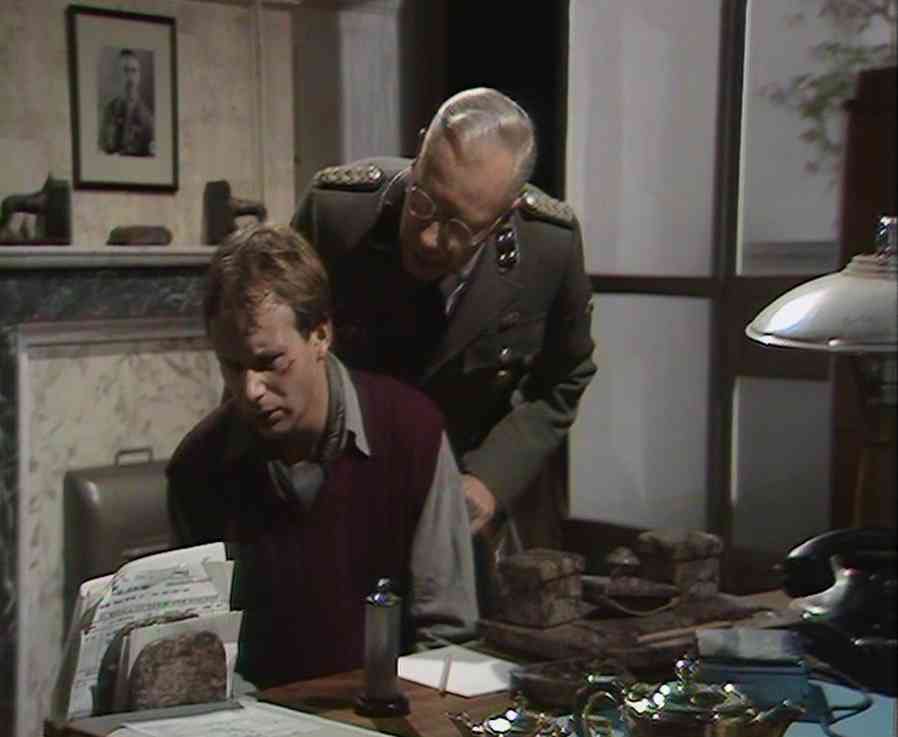
Curtis is smarting that the RAF’s latest technological wonder has been splashed all over the papers (thanks to the loose-lipped Peter Romsey) and becomes desperate to find out who betrayed Romsey and Victor. So he heads out into the French countryside, with the untrusting Lifeline close on his heels ….

Albert is the most suspicious about Curtis’ motives. Director Paul Annett heightens the pressure during these early scenes by ensuring that the camera tightly frames each member of Lifeline as they debate what to do. The decision is made to send Monique after Curtis – to observe what he does and liquidate him if he turns out to be a spy.

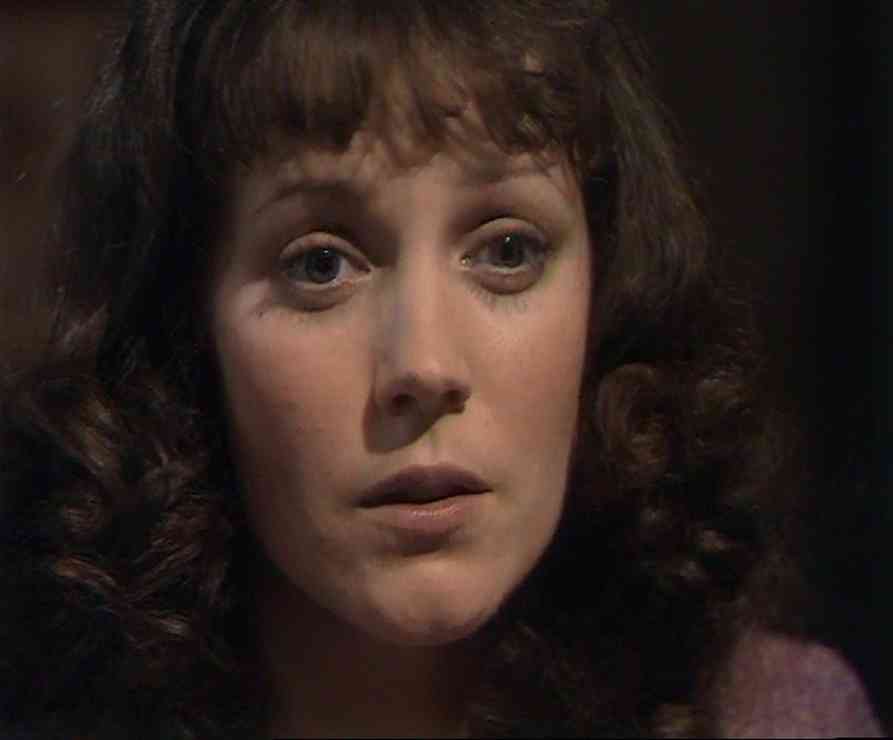
This gives Angela Richards a little more to do than usual. Up until this point in the series her main plot function has been to complain at regular intervals about the way Albert pays more attention to his wife than he does to her. Don’t worry though, she still manages to do that today.

For a while it looks like Monique has Curtis closely under tabs, even if she appears to be hideously conspicuous (her dark glasses don’t help). Thankfully, Curtis turns out to be a sharp operator and has been aware of her presence all along. In the episode’s first key scene he confronts her in a two-hander that crackles with energy. “I worry about being shot, getting caught, being tortured. So what’s new apart from that?”

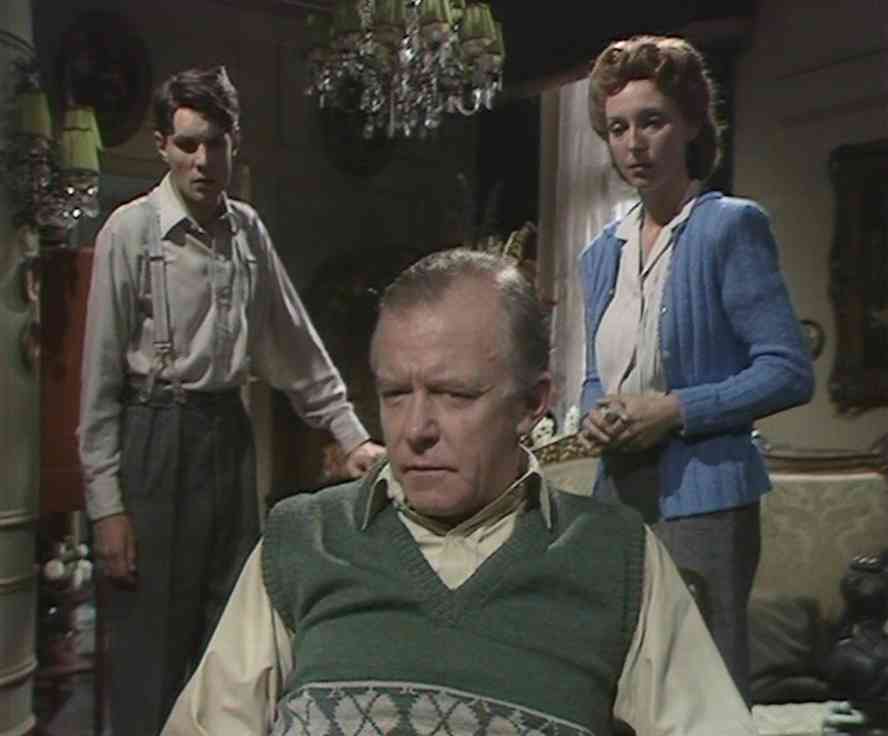
Peter Barkworth and Joanna Van Gyseghem don’t really feature until the last twenty minutes or so. That makes sense since the characters of Hugh Neville and his wife Dorothy were well established in the previous episode . In this one there’s merely the question of establishing their guilt or innocence.

After curfew, Curtis calls on them – begging a bed for the night. For some reason, Curtis is affecting a Leeds accent (or so he says) which is a tad distracting, but once the scene really kicks into gear it proves to be less of a problem. This is the point where the episode really picks up momentum as Barkworth and Neame face off (with Van Gyseghem stuck in the middle as a rather baffled outsider).

It doesn’t take much prompting by Curtis for Neville to reveal his hatred of war. “I should have been playing cricket for my school but I was fighting on the Somme instead. Mud, filth, corpses, so many corpses it was hideous. Your country needs you. I saw screaming men trying to hold in their own intestines”.

There then follows a philosophical debate where the honours are about even. But early next morning, Neville’s admission that he told the police about Romsey seals his fate. Curtis, flick knife in hand, advances menacingly although it’s interesting that we don’t see the blow struck (nor, when Dorothy later returns, his body). Instead, Van Gyseghem is required to sell this key moment purely by her reaction.

The episode’s coda (a battered and weary Curtis travels back on the train to Belgium with Monique) is almost (no pun intended) derailed by some very obvious CSO. But the quality of their conversation – Curtis admitting that Neville was the first man he’d killed face to face (dropping bombs doesn’t count) – saves the day.

This is a slow burner of an episode, but once it gets going it carries a real punch. Curtis reveals that he liked Neville, but he had to be executed anyway. That it’s possible to see why Neville acted the way he did (and even to sympathise with him) is what makes Traitor so powerful. Secret Army rarely produced simplistic stories of good & evil/black & white and that’s one reason why the series stands up so well today.

Upstairs Downstairs – The Wages of Sin

Despite its bleak premise – Sarah, revealed to be pregnant again, faces the prospect of losing her job and being cast out onto the streets – The Wages of Sin is an episode that if it isn’t quite played for laughs, certainly has a streak of mocking humour running throughout it.

This tone is established from the first scene in which Mrs Bridges (suspicious about Sarah’s sudden increase in appetite) leaps to the correct conclusion and brings in Mr Hudson to hear Sarah’s unwilling admission of guilt.

All three actors are given their chances to shine. Angela Baddeley makes the most of lines such as Mrs Bridges’ caustic summation of Sarah’s character (“You know, our Sarah reminds me of the Salvation Army banner. Thousands have been this way before, there is plenty of room for thousands more”).

Hudson, although he’s stern and foreboding after learning the news, can’t help but soften when Sarah apparently breaks down in tears (knowing Sarah’s passion for theatrically though, I have my doubts about how genuine her contrition is).

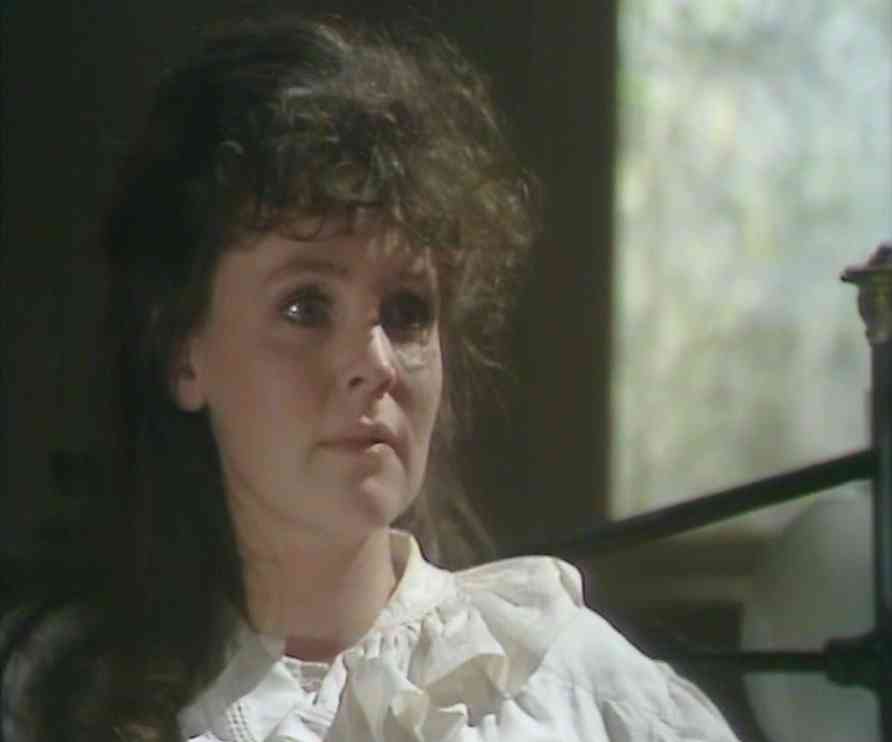
Pauline Collins gets most of the best lines as Sarah (desperate not to reveal that Thomas is the baby’s father) wildly extemporises under the withering glares of her two superiors and desperately cobbles together a rather unconvincing tale about how she was plied with drink and taken advantage of by a rich gent.

Collins’ performances across the series have been something of a mixed bag and so whilst I can’t confess to being that sorry to see the last of Sarah, at least she exits on a high.

As does John Alderton as Thomas, whose capacity for scheming remains finely tuned (although I do like the end of part two moment when it appears that he’s overplayed his hand and lost everything). If there’s any oddity with the script, then it’s slightly strange to end part one with Thomas refusing to acknowledge or help Sarah and then go straight into part two where he coolly ambles along to Mr Bellamy and asks for permission to marry the girl.

From Richard’s viewpoint this seems like the perfect solution, but later on, Lady Marjorie – returning home from aboard – is appalled when she hears the news. That she immediately counteracts his instructions makes it quite plain who wears the trousers at 165 Eaton Place.

Lady Marjorie’s harsh and ruthless streak bubbles to the surface as she tells Thomas that if he still wants to marry Sarah then both will have to leave their employ and as quickly as possible. This leaves him in a desperate position, but he has one last throw of the dice – a later brief meeting with Richard and Lady Marjorie in which he subtly raises the prospect of blackmail.

It doesn’t say a great deal for Richard (an MP, remember) that Thomas’ politely menacing words appear to have sailed right over his head. Luckily Lady Marjorie understands nuance a lot better than he does and sends the long-suffering Richard off to fix the problem.

Although last week money seemed a little tight, today that doesn’t seem to be a problem – Richard buys Thomas off with a £500 cheque (allowing the Welshman to realise his dream and buy a garage).

The episode then concludes with downstairs jollity as Thomas and Sarah celebrate their engagement – the festivities only slightly pausing when Richard and Lady Marjorie pop down to wish the couple well. There’s a delightful awkwardness in the scene from some of the servants to the arrival of their employers although eventually the party gets going again with a final reprise of ‘Uncle Albert’ – a song which has a very familiar tune ….

Although the episode opens in traditional style (an “oh Ruby” from Mrs Bridges) at the end Ruby actually gets something to do for once – revealing to Joan (Jane Carr) that she knows Thomas is the father of Sarah’s child.

Joan is another of those parlour maids who arrives from nowhere, but at least in her case there was a good reason. Christopher Beeney had been hospitalised after a motorcycle crash which occurred just before the recording of this episode, so all of Edward’s lines were given to this hastily created character.

So farewell Thomas and Sarah. They would later reappear in their own spin-off series, which didn’t last long and by all accounts was a far from happy production. Possibly when my UpDown odyssey has ended, it might be time to dig it out for a reevaluation.

Secret Army – Lost Sheep (26th October 1977)

En route to Paris via the escape route, Flight Lieutenant Peter Romsey (Christopher Guard), is separated from his colleagues. Disembarking from his train in a rural French village, he desperately searches for help – eventually stumbling across an English writer, Hugh Neville (Peter Barkworth), who appears to offer sanctuary ….

Lost Sheep opens in a fairly striking way. During this first scene where Curtis interrogates Romsey, the airman remains seated and passive whilst Curtis strides up and down – almost bumping into the camera. So while Curtis is foregrounded and creating an oppressive figure, Romsey and Lisa (silently smoking) are placed in the background.

Out of the regulars, Curtis probably gets the most to do. Later – when Romsey’s identity has been verified – the pair have a convivial chat, but even this early on it’s clear that Romsey is something of a liability (the navigator of an advanced Mosquito, he carries in his head information that the Germans would dearly love – and he seems distressingly happy to chat about such things at the drop of a hat).

N.J. Crisp’s script (the first of nine Secret Army efforts) is really centered around the guest performers. Guard is perfectly cast as the seemingly naïve and far too trusting Romsey. Although given that he’s a veteran of many hazardous flight missions it may be that, as opined by Curtis, he’s simply burnt out and is no longer thinking clearly.

After all, instead of trying to make his way to Paris, he stumbles around asking perfect strangers for help – seemingly trusting that they won’t turn him in. His first approach (a fisherman) does fetch the local police, but luckily Romsey had made a dash for it by then.

So he ends up at a palatal house owned by Hugh Neville and his wife Dorothy (Joanna Van Gyseghem). Dorothy is instantly welcoming, but Neville himself, whilst convivial, keeps his own counsel. Peter Barkworth was no stranger to WW2, having spent the best part of six months starring in Manhunt (a sometimes engrossing, sometimes infuriating LWT drama) and his casting is a major plus point. Barkworth never gave a bad performance and there’s plenty to enjoy and mull over in this one.

Neville is an English writer firmly ensconced in France. He doesn’t share Romsey’s patriotic leanings (“I was on the Somme in the Great War. Saw a generation slaughtered for nothing”). And later, Neville snorts at the idea that France will one day be liberated – for him, life has gone on under German occupation pretty much as it always has. Thanks to the area’s rich farmland, there’s no such thing as rationing and he claims never to have seen a German soldier in the area.

This statement is undercut by the very next scene, in which Dorothy – out cycling – spies numerous German troops beginning an intensive search for Romsey. At first it’s possible to believe that Neville is a fantasist who up to this point has simply ignored anything unpleasant, but later it does seem that the Germans have only just moved into the area, so his comments – self-centered though they may be – do seem to be accurate.

Dorothy isn’t as well-drawn a character, but there’s still enough there for Van Gyseghem to work with. Given that she and her husband exist in an atmosphere of chilly politeness, it’s possibly not too difficult to work out why Dorothy greets the arrival of a handsome young stranger so warmly (although this is never spelled out explicitly).

Plot-wise, Lost Sheep then stumbles a little. Given that Neville is the only Englishman in the area, his house would be the obvious place to find Romsey – and yet the Germans never search there. Instead, Neville’s friend – Inspector Pierre Dubois (Bruce Montague) – does so but makes sure to give him fair warning. Barkworth and Montague share several nice scenes, ones in which Dubois and Neville carry out two very different conversations at the same time (one implicit, one explicit).

Credibility is also stretched by the fact that not only do Lifeline have a man – Victor (Ivor Roberts) – in the area, but he also manages to locate Romsey with embarrassing ease. If he could do so, why couldn’t Brandt and his merry men?

After an episode of tension, there seems to be a happy ending – Victor leads Romsey away to safety. But there’s an ambush and Victor is shot dead whilst Rosmey is delivered into the welcoming hands of Brandt. And, as feared, it seems likely that the charming Brandt will be able to get the ingenious Romsey to talk ….

Had this been a single episode story, then this ending would have been nicely ambiguous.  It’s hinted that Neville may have betrayed Romsey to save his own skin, but it’s equally likely that Dubious – convinced that Neville was sheltering Romsey but possessing no proof – could have decided to stake the place out.

As it is, Crisp will develop and conclude the story in next week’s episode – Guilt.

Upstairs Downstairs – The Fruits of Love (5th January 1973)

At the start of this episode, Rose and Miss Elizabeth’s relationship (which was somewhat strained, for obvious reasons, at the end of the previous installment) seems to have righted itself. We can maybe credit this to Rose’s remarkable powers of recovery – although the mood becomes a little cloudier when Elizabeth mentions the name Julius Karekin again ….

Elizabeth has always tended to be in a pretty depressive state – spending a large amount of her time railing against her ordained place in society. Today, she looks longingly at Rose and wishes she – like her – had a job of work to do. Although she might think otherwise if she actually had to carry out the duties of a house parlour maid.

But now her relationship with Julius has tipped her over the edge and she’s in a giddy state of ecstasy. After the dark rigors of A Special Mischief, this comes as a dose of light relief. The morning-after bedroom romping between Elizabeth and Julius (she copies the antics from a florid romantical novel, he attempts to escape from her clutches in order to leave for the City) is rather nicely done. Throughout her time in Upstairs Downstairs, Nicola Pagett had few opportunities to indulge in comedy so possibly these scenes offered her a welcome change of pace.

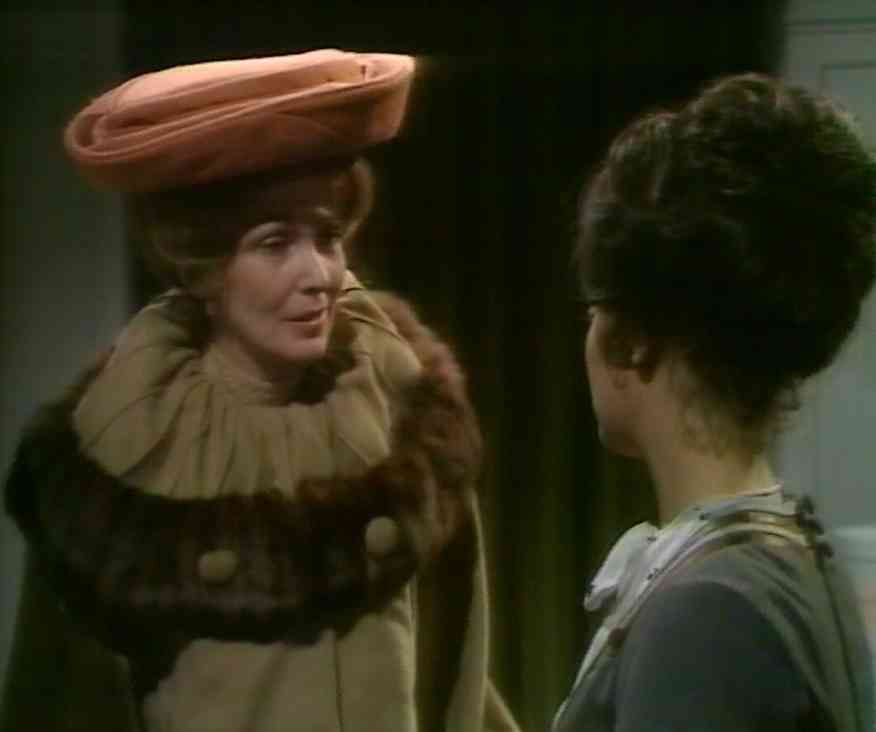
The central part of the episode is also entertaining – Juluis has gifted Elizabeth a hat shop and she throws herself into running it with gusto. When Elizabeth breaks the news to her parents, they react predictably. Lady Marjorie is horrified that her daughter is going into trade whilst Richard (who earlier had bemoaned how much money Elizabeth continues to cost him) can hardly contain his delight that she’ll finally be a wage earner!

There’s also a rare moment of genuine affection between father and daughter as Richard helps her to choose a name for the shop – Madame Yvonne (named, as Lady Marjorie acidly reminds him, after one of his old girlfriends – a dreadfully common woman who dyed her hair).

Madame Yvonne caters for the well-heeled gullible by claiming to stock genuine Paris fashions (which are nothing of the sort). They are smoothly sold by Mademoiselle Jeanette (Mairhi Russell) who is as genuinely French as the hats ….

Margot Boyd essays a lovely little cameo as Lady Spennilove, a wealthy (but, as Lady Marjorie would say, frightfully common) woman who walks away with a hat that looks to my eyes positively awful. But I will confess that ladies’ hats are not my specialty.

All seems to be going swimmingly. until the vengeful Margot Descort (Wendy Gifford), still smarting that Julius has spurned her in favour of Elizabeth, breaks the news about Elizabeth’s new lover to Lady Marjorie.

Julius is wealthy but without any breeding – the most heinous crime in Lady Marjorie’s eyes. This leads into by far the best scene of the episode – a confrontation between Lady Marjorie and Elizabeth in which several home truths are aired. Elizabeth confirms that she’s Julius’ mistress and then gently taunts her mother about her own past indiscretion.

Rachel Gurney is so good here as Lady Marjorie slowly realises that her hidden secret is not as hidden as she’d hoped (even the servants know about it). It’s a pity that Gurney’s time with the series is fast running out (it won’t be long before Lady Marjorie takes a one-way trip on the Titanic) but had she had more scenes like this, possibly she would have been encouraged to stay on.

The major irony of the episode is saved for the last few minutes. Thanks to her father’s crippling death duties, Lady Marjorie has to face the prospect of selling 165 Eaton Place. But just when all seems lost, Julius buys the house and gifts it to Elizabeth, who gifts it to her parents.

Lady Marjorie is then forced to invite Julius round for tea and polite conversation while Richard – well aware by now of Julius’ substantial personal wealth – is keen to show him round the Houses of Parliament and introduce him to some of his friends.

So everybody seems to be a winner – Julius (barely tolerated up to this point by the establishment) has begun to buy his way in whilst the stability of life at 165 Eaton Place is – on the surface at least – maintained.

The Fruits of Love is very much an Upstairs story. Only Rose and Mr Hudson featured from Downstairs – Hudson gets a handful of memorable lines whilst Rose plays her usual role as Miss Elizabeth’s confidant and stern conscience. Although there’s at least one moment of pleasure for Rose, as Elizabeth tells her to choose any hat she’d like from the shop. Initially reluctant, she can’t help herself and soon is overcome as a variety of appealing headwear swims into view ….

Secret Army – Growing Up (12th October 1977)

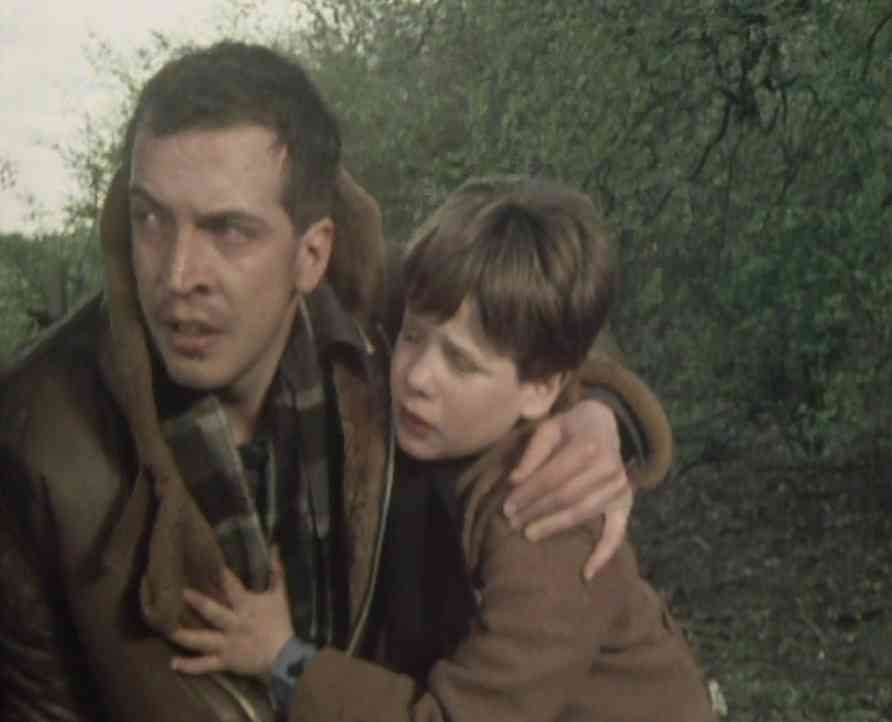
A downed airman, Sgt. Clifford Howson (Norman Eshley), is injured and hiding out in the countryside. By chance, a young boy called Jean-Paul Dornes (Max Harris) finds him and promises to do all he can to help …

Growing Up is very much a story of two halves. Initially, the tone is quite subdued with only a low level of tension as Cliff befriends Jean-Paul (or is it the other way around?) and the pair quickly bond. Jean-Paul’s wide-eyed admiration not only for the heroes of the RAF but also for his countrymen’s underground struggles against the Germans is plain to see. But as the episode title suggests, the time will come when Jean-Paul will be forced to learn that not everything is quite as black and white as it first appears.

The first discordant note sounds when the boy returns home and discovers a German soldier, Corporal Emil Schnorr (Brian Glover), chatting easily with his mother, Anna (Susan Tracy). Glover did just about everything during his career – seasons with the National Theatre and the Royal Shakespeare Company, a stint as an all-in wrester (Leon Arras, the man from Paris), a number of writing credits (including several Play for Todays), not to mention an impressive list of television credits (both dramas and comedies).

The relationship between Anna and Schnorr quickly develops (one criticism would be that it’s rather too quick).  But on the other hand, Glover and Tracy share a very nice scene in which their characters open their hearts and discuss the things they have in common (both are widowers). And although Schnorr appears intimidating at times towards Jean-Paul it seems that, at heart, the German is a kindly man (he’s no rabid Nazi – instead he comes across as someone keen to learn a trade and better himself).

Max Harris is the glue which holds the story together. This is a big ask for such a young actor (although he already had television experience – most notably The Phoenix and the Carpet a few years earlier). The scenes he shares with Norman Eshley are well played by both of them and it seems that an experienced actor like Eshley brought out the best in him.

Holed up in a remote quarry, eventually Cliff is reached by Lisa and Albert (as happens so often, despite being a secret organisation someone always seems to be able to contact Lifeline as and when required). There then follows a slightly strained part of the episode – due to his leg injury Cliff is unable to walk, so Lisa pretends that he’s fallen from a horse and needs help. That’s just about reasonable, but by a remarkable coincidence they stumble across Anna and Schnorr who are out for a walk. What were the chances of that?

With Cliff now safely in Brussels, the danger seems over. But in fact the story has yet to really kick into gear. Anna discovers the RAF badge gifted to Jean-Paul by a grateful Cliff and flies into a rage. This is another slightly odd sequence. Although everything we’ve seen so far suggests that Anna, if not an active collaborator, is very keen not to get involved with the war anymore, why does she feel compelled to report this to the German authorities?

With Cliff no longer in the area, had she kept quiet then there would have been no way for anyone to connect the airman to her son. Possibly you can argue that she was keen to inveigle herself into Schnorr’s good books (she sets out to lay the whole matter before him) but that’s not quite how it plays. Possibly a little tightening of the script would have helped here.

Events then take a tragic turn when, on her way to the barracks, Anna is run down by a member of the resistance (played by Stanley Lebor) thus silencing her for ever. Luckily, for Jean-Paul’s peace of mind, he seems unaware that he was indirectly responsible (after his mother left, a tearful Jean-Paul went to the resistance man’s house). This part of the script also doesn’t quite play right – not least in terms of the timescale.

But minor niggles apart, the aftermath (an impressively mounted funeral with a distraught Jean-Paul) certainly carries an emotional punch. And the graveside rapprochement between Jean-Paul and Schnorr is another stand-out moment. Although there’s no dialogue, Harris and Glover are both at their best here. Schnorr literally becomes a shoulder to cry on and as the pair leave the cemetery hand in hand (Jean-Paul only slightly pausing to toss away the RAF badge – a symbol of his past life) we’re left with the strong impression of a growing bond between a surrogate father and son.

Willis Hall’s second SA script, Growing Up possibly could have done with some editing and redrafting in places, but the human drama at its heart is still compelling.

Upstairs Downstairs – A Special Mischief (29th December 1972)

For the first time in a little while, the relationship between Miss Elizabeth and Rose forms the centrepoint of an episode. Time hasn’t softened Elizabeth at all – she’s still hopelessly self-centered (refusing to visit her daughter at the seaside) whilst it’s notable that Rose seems more inclined to speak back to her (“my Rose has thorns”, comments Elizabeth early on in the episode).

Possibly this is because virtually all of the household are in Scotland, with only Elizabeth from upstairs and Rose, Edward and Ruby remaining from the downstairs staff. Rose therefore is keen to keep things running smoothly with a reduced staff, although she couldn’t have predicted quite how things would turn out ….

In an episode light on levity, there’s one brief bright spell early on – Ruby makes a cake, all the time carrying on an imaginary conversation with the absent Mrs Bridges (at one point calling her a cow!). This jollity soon dissipates once the main plot kicks into gear though.

Inspired by her friend Ellen Bouverie (Claire Nielson), Elizabeth has become a suffragette – throwing herself into their world with enthusiasm. Although their aims are laudable, others – especially Rose – react with horror. Elizabeth later comments that she finds that her life is now exciting.  But with Rose deciding that the suffragettes are simply her new toy, it’s impossible not to draw the conclusion that Elizabeth is nothing more than a dilettante – looking to fill her aimless life with some purpose (for the moment the suffragettes have filled that hole).

Upstairs Downstairs tended to use videotape for its location film work, but this episode featured night filming. I’m glad they spent the money, as it adds a little extra gloss to the scenes of the suffragettes, led by Ellen and Elizabeth, gleefully trashing the house of Arthur Granville, M.P. (Harold Innocent). Rose, tagging along in a vain attempt to keep Elizabeth out of trouble, is arrested with all the others and that’s where the trouble really begins.

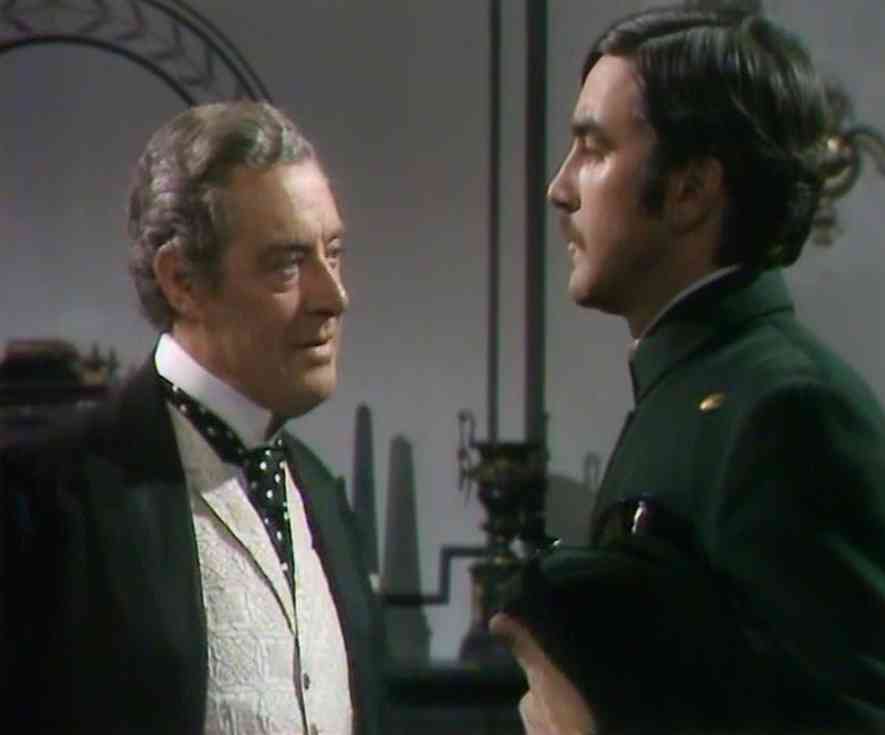
Elizabeth is spared jail-time thanks to the intervention of Julius Karekin (Donald Burton) but Rose is not so fortunate – she faces the unnerving prospect of two months in Holloway Prison. Elizabeth retires to Julius’ palatial house for tea and acid banter (she’s more than a little miffed that he’s prevented her from becoming another suffragette martyr).

At this point in the story, Elizabeth does express concern about Rose’s situation, although she makes no particular move to win her freedom. Had she called her father then no doubt he could have pulled some strings, but Elizabeth is keen to keep this from him (swearing Edward and Ruby to secrecy). And it says a great deal about her character (none of it good) that she couldn’t be bothered to visit Rose in prison.

When the by now wretched Rose hears that she’s got a visitor, she eagerly rushes out (expecting it to be Miss Elizabeth). The sight of Edward and Ruby is small comfort, as is the cake brought by Ruby (Rose has been forced by the others to undertake a hunger strike).

And this is where the story gets even darker, as the women are later force-fed with a tube (either down the throat or up the nose).  Whilst we don’t see it used on screen, Ellen’s later description of it (and the hoarse voices of the women after their “treatment”) more than adequately paints the picture.

These prison sequences – despite the odd wobbling wall – are pretty uncompromising, and since the blameless Rose is one of those suffering there’s even more impact. Luckily, both for Rose and the audience, the suffragettes are released shortly afterwards thanks to the intervention of Julius (spurred on by Elizabeth’s description of their plight).

And although a seemingly chirpy Rose tells Elizabeth that she’ll be “right as a trivet” once she’s had a cup of tea, the fact that the episode ends with Rose – all alone – dissolving into tears, tells its own story.

Elizabeth and Julius disappear upstairs. Elizabeth might have displayed contrition to Rose and agreed that the life of a suffragette wasn’t for her, you don’t really get the feeling that she’s learnt anything from this adventure. Indeed, as has happened previously, she simply blithely sails on – unheeding of the damage left behind her.

It’s not jolly Sunday evening fare, but A Special Mischief lingers long in the memory. With only a small regular cast, there’s room for some nicely judged guest performances (Rosamund Greenwood, Veronica Doran and Deirdre Costello as three of the more prominent suffragettes, for example).

Secret Army – Second Chance (5th October 1977)

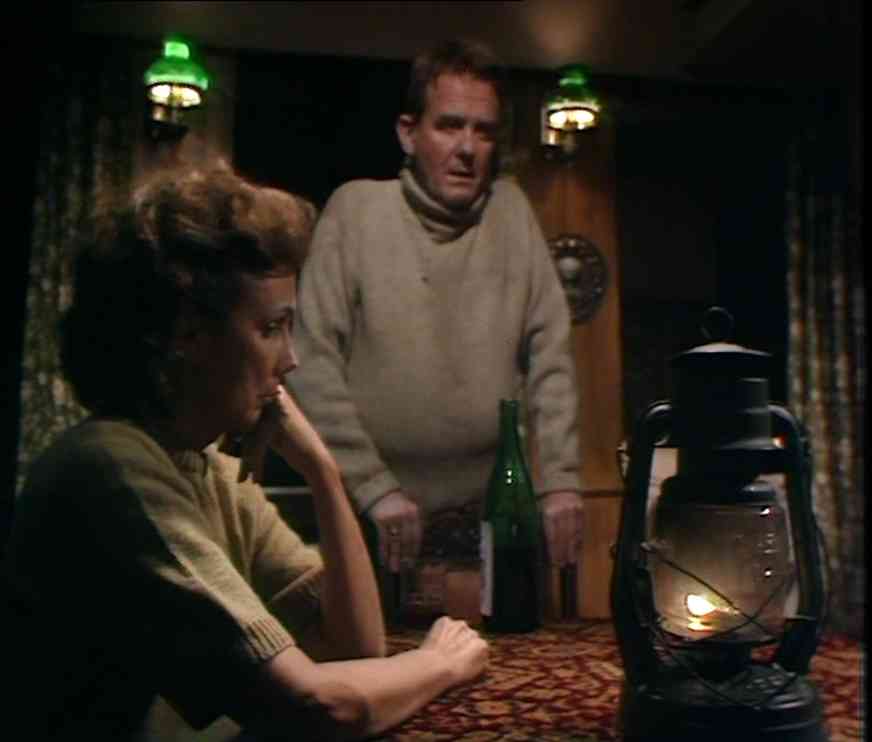
Rear-gunner Eric Finch (Paul Copley) is seeking refuge in Switzerland (Finch, sickened by the war, is determined not to return to England to fight again). A bargeman called Hans Van Broecken (Gunnar Möller) offers to help, but can he be trusted?

An uncompromising episode, from early on there’s an air of doom that settles around Eric Finch. Injured, weary and frightened, he’s a far cry from most of the airmen we’ve met in the series so far. One or two have been a touch on the nervy side, but in the main they’ve all been rather gung-ho and blithely unconcerned about their fate.

Another British airman, Alan (Richard Austin) who briefly features today, certainly falls into this latter category. Sidelined with a foot injury, he’s anxious to get up and about but still has time to flirt with Lisa (surprisingly, Lisa is quite keen to respond – which is the first time we’ve seen her in quite so playful a mood).

There’s no such jollity with Finch though, who’s deftly brought to life thanks to Paul Copley’s sensitive performance. Late on in the episode he’s given a very decent speech in which he outlines his philosophy – not only to Van Broecken and his wife, Lena (Marianne Stone) but also to Natalie and Curtis who have been brought in to try and help.

Matching Copley’s fine performance, are two equally good turns from Gunnar Möller and Marianne Stone. To begin with, both Finch and the viewer at home might be unsure whether Hans can be trusted – he claims he wants to help, but at times he casts a sinister shadow. This is only heightened when he reveals that he’s not, as he initially claimed, Dutch but is in fact German. But as a German deserter from the First World War, he’s able to sympathise instantly with the slightly crumpled and pathetic figure of Finch.

Lena is more fearful though – not only for herself and her husband should Finch be discovered, but she’s also been worn down by the strain of Hans’ double life over the last twenty years or more.

Hans and Lena will both return later in the series, but Finch is less fortunate – coldly sacrificed by Lifeline in order that they can strengthen their reputation with the German authorities. It’s a chilling moment, although it’s only afterwards that a few questions bubble to the surface – most notably, what would have happened if Finch hadn’t been shot dead? Had the Gestapo questioned him, it’s certain he would have revealed all he knew about the escape line (Curtis, Natalie, etc) so surely Curtis was running an incredible risk by betraying him.

But on the positive side, it means that Gestapo man Dupont (David Trevena) is now be happy that the Candide is a hotbed of collaborators and will no longer keep them under surveillance. The future ghost of Allo! Allo! is strong with Dupont – maybe it’s the hat or the spectacles, but there’s something unintentionally comic about him. Oh, and why choose an undercover man who sticks out a mile as he does? Yes, maybe that has its positives, but surely selecting someone who blends in just a little would have been more sensible.

Other brief items to report – Hetty Baynes makes her first appearance as bitchy Candide waitress Yvonne (Yvonne and Monique entertain themselves by spitting fire at each other), Monique sings for the first time and Curtis and Lisa continue to enjoy an awkward relationship – not least because of the possible feelings each has for the other.

Second Chance is quite an ironic title, as Finch was denied one. The way the Candide regulars react to his death is quite instructive – Monique is shaken whilst Curtis confesses to feeling rather sick. On the other hand, Albert, Lisa and Natalie appear to shrug it off more easily. Natalie is by far the most outspoken, telling the others that they risk their lives to get airmen back to the UK (since Finch didn’t want to fight any more, he now has his wish).

Whether she’s really so ruthless or is simply good at compartmentalising her feelings is something that the viewer will have to decide for themselves. The first of a handful of Secret Army scripts by James Andrew Hall, the quality of this one suggests that the others will be worth looking out for.

Upstairs Downstairs – An Object of Value (15th December 1972)

An Object of Value continues a run of episodes defined by the arrival of an outsider to 165 Eaton Place who has an immediate destabilising effect on the household. Today it’s Lady Marjorie’s recently widowed mother, Lady Southwold (Cathleen Nesbitt), and her companion Miss Hodges (Nancie Jackson) who, almost as soon as they step through the door, begin to put the cat amongst the pigeons ….

Although Lady Southwold is a suitably imposing figure in public, in private she comes across as a fairly genial old soul. Mind you, it’s understandable that she’s rather short tempered once she believes her irreplicable butterfly brooch has been stolen. Miss Hodges is the one who mainly suffers at Lady Southwold’s hands, although you get the sense that her flashes of anger don’t last long (and if Miss Hodges wasn’t such a terrible snob, maybe Lady Southwold would be able to hold her tongue a little more).

If Lady Southwold kicks off proceedings by deciding that she’s been robbed, then Miss Hodges stokes the fire by confiding to Hudson that she thinks (with no real evidence) that Miss Roberts is guilty.

The simmering enmity between Hodges and Roberts is nicely teased out at the start of the episode as is Hodges’ strange limbo-like position. She considers herself to be a cut above the servants and wouldn’t think of taking her meals with them, but whilst she’s present in the drawing room with Lady Marjorie, Richard and Lady Southwold, her menial status is made clear very quickly (she remains standing whilst the others sit, and her comments tend to be politely ignored).

Richard instructs Hudson to make discreet enquires amongst the staff. This is the cue for a ladle of humour (the unfortunate Edward compares Hudson to Sherlock Holmes, unaware that the cat-like Hudson has crept up on him and can hear every mocking word) and also drama (Roberts explodes into hysterics after she decides her position and integrity are under attack).

An Object of Value is one of those self-contained stories, never setting foot outside 165 Eaton Place. Apart from the regular cast (for once, all the servants are present and correct) there’s only four guest actors – Cathleen Nesbitt and Nancie Jackson are both quite key, even if they don’t have a great deal of screentime (Lady Southwold and Hodges exist mainly to kick the plot into action) as is Christopher Biggins as Mr. Donaldson, although his big scene comes right at the end of the episode.

Donaldson is an acquaintance of Thomas and someone who the chauffeur hopes to go into partnership with. Sarah – on Thomas’ bidding – steals a bottle of wine from the cellar, all the better for him to sweeten Donaldson. This action is a little hard to swallow – why would Sarah risk everything, especially since she didn’t seem to benefit? At first I thought that maybe it would be used later by Hudson as an example of Sarah’s untrustworthiness (if suspicion fell on her that she stole the brooch) but as that didn’t happen, we can just take as a spot of colour which enlivens the early part of the episode.

John Alderton gets plenty of good material to work with today. Thomas continues his pursuit of Sarah and eventually gets her into bed although it’s his confrontation with Rose that really stands out. First, Rose finds it impossible to articulate quite why she cares so much about Sarah’s burgeoning friendship with Thomas (although the innuendo is quite plain) and then Thomas roughly manhandles her (demonstrating that beneath his thin veneer of affability that’s won round some of the staff, such as Mrs Bridges, there’s something rather nasty lurking).

When Hudson later asks him to explain who his visitor was, Thomas stands his ground and refuses. There’s strong energy in these scenes with Gordon Jackson and John Alderton – Hudson might be able to browbeat the rest of the staff, but it’s plain that Thomas is an immovable object. Thomas even stands his ground with Richard, although eventually he does concede and explain.

Then an unspoken irony comes into play. Thomas is off the hook because Richard knows that Mr. Donaldson is a respectable man, but that’s only his public face. In private Donaldson is revealed to be somewhat degenerate – pawing Sarah and limbering up for something more, before Thomas bursts in and they slug it out.

We don’t see many fight scenes in Upstairs Downstairs, which makes the Thomas/Donaldson one quite noteworthy. Christopher Biggins isn’t the sort of actor who tends to indulge in a great deal of fisticuffs, so it’s not entirely convincing (although you have to say that recording fights in a multi-camera vt studio never offered the director or actors the same flexibility as single-camera film work did). It’s not a total disaster though, and the pair certainly threw themselves around with abandon as flimsy prop chairs and tables get demolished with alacrity.

After that’s over and Sarah finds herself bonded ever tighter to Thomas (although we still don’t know if he cares for her at all) there’s just time for the mystery of the missing brooch to be solved (no spoilers – but it’s a happy ending).

This is another good script from the always reliable Jeremy Paul. Apart from the smooth-running of the main plot, there’s plenty of incidental moments to also enjoy. Such as Sarah teaching Ruby to read with the baby’s blocks from the nursery and Mrs Bridges instructing Ruby (it’s her day to learn) about the best way to slice a cucumber. I also appreciated Rachel Gurney’s wistful underplaying during the scene where Lady Marjorie confides that she wished she’d known her father better. Gurney delivers the line in such a detached way that it almost feels like Lady Marjorie is referring to a distant acquaintance, rather than one of her closest relatives.

Secret Army – Child’s Play (28th September 1977)

Brandt is given an article written by an American airman who escaped over the Pyrenees. Although the writer changed many details in order to safeguard the identities of the people who helped him, Brandt still believes that he can use it to pinpoint the escape line. So he travels into the French countryside, meeting up with a policeman called Malaud (Ian McCulloch) ….

If you watch enough of Gerard Glaister’s series, then you’ll see the same faces cropping up time and time again. That’s evident today, as Child’s Play’s key role is taken by Ian McCulloch, who had previously appeared in the Colditz episode Odd Man In.

Coincidentally (or maybe not) both episodes were written by Arden Winch.  This would be his only Secret Army credit, but he’d work with Glasiter again (in 1981 for example, writing the six-part thriller Blood Money which starred a gaggle of former Secret Army actors – Bernard Hepton, Juliet Hammond-Hill and Stephen Yardley).

Child’s Play is an oddly static tale. Several lengthy two-handed scenes between McCulloch and Michael Culver take up a fair amount of its running time – but whilst on the surface everything seems fairly mundane (Brandt and Malaud slowly debating where the safe house could be) the combative interaction between them is very nicely done.

Unlike Kessler, Brandt is conciliatory – happy to pay for information that leads to the arrest of British airmen. Malaud, a capable officer exiled to a countryside backwater because of his ‘crime’ of speaking his mind, seems initially reluctant to help – but eventually does so. Not for money (to Brandt’s surprise) but simply as a way of proving to his superiors that he’s still a good policeman.

Malaud is outspoken in his loathing of the Gestapo (understandable, since they’d previously pulled out his fingernails). Kesller wouldn’t have stood for this sort of talk, but Brandt (of the Luftwaffe) just lets it go by. It’s an early indication that Brandt is no fanatical Nazi, unlike his Brussels colleague.

We meet Sophie and Madeline Chantal (Mary Barclay and Ruth Gower) for the first time. A pair of elderly sisters, they’re an important link the escape route – Madeline is the suspicious one, whilst Sophie is warm-hearted and welcoming (always keen to greet new airmen and sorry when they have to leave so suddenly).

As for today’s airmen (played by Jonathan Coy, Jonathan Darvill, Nigel Greaves and Richard Reeves) they’re fairly anonymous types – albeit several are rather boisterous and irritating. Maybe this was intentional, although it means that when Brandt and Malaud capture them I can’t confess to being too upset.

Thankfully they’d left Sophie and Madeline by then, so at least the sisters live to fight another day.

Given that earlier in the episode Malaud was very pessimistic about locating the safehouse, it seems a little hard to swallow that he later pinpoints it without too much trouble. But it does mean that the pace dramatically lifts during last fifteen minutes, as Lisa is forced to abandon the airmen to their fate whilst she goes into hiding with Baroja (Ken Stott). Later, they’re discovered by Malaud ….

Back in Brussels there’s not too much to report. An unseen Andree contains to cast long shadows over Albert and Monique. It’s fascinating that she won’t actually reappear in person until episode thirteen, but a few knocks on the ceiling means that her presence is still well and truly felt today.
James Bree and Maria Charles share a nice scene in which, once again, Louise expresses her fears for her husband and her niece. In retrospect, knowing how things turn out, these moments carry a little extra weight.

Thanks to Ian McCulloch in full-on brood mode, Child’s Play isn’t without interest. It’s not the best that the series had to offer, but Arden Winch was one of those writers who, over the course of twenty years or so, contributed to a varied selection of drama series, so any examples of his work will always be of interest.  It’s slightly surprising that he never wrote for SA again, as his work on, say, Manhunt and Colditz suggest it would have suited him very well.

Upstairs Downstairs – Out of the Everywhere (8th December 1972)

The episode opens with a cross-fade from the empty hallway (albeit with a new object – a perambulator – prominent) to the kitchen and parlour, where the servants are all in silent contemplation. Given Upstairs Downstairs‘ large cast, it’s rare for an episode to feature every regular – and so it proves today as Rose and Ruby are absent.

It’s a mystery where Ruby is (not to mention who’s doing her work in her absence) but at least Rose gets a namecheck. Given that Out of the Everywhere sees the return of Miss Elizabeth (complete with her baby daughter) it’s a little surprising not to see Rose, but in her absence, Sarah steps forward to fill the void as Elizabeth’s moral conscience.

There’s a rare moment of contentment downstairs after Hudson, welcoming Richard and Lady Marjorie back home, passes on the news that Elizabeth has given birth to a baby girl. Although Mrs Bridges can’t resist a spot of gentle chiding – Hudson (as befits a man) failed to ask any further questions, such as the baby’s name or weight ….

Even the sour-faced Roberts joins in the jollification as Hudson agrees (after a moment’s pause) that they can wet the baby’s head with a tot of beer. Although it doesn’t take too long for the peace to be shattered once it’s revealed that Nanny Webster (Daphne Heard) is returning to take charge of the child.

Hudson reacts to the news with barely surpassed dismay, telling Lady Marjorie that he’d thought she might have retired (“you mean you hoped she had” mutters Richard out of the corner of his mouth). Nanny Webster appears, in episode terms, about five minutes later – which is still long enough for a sense of foreboding to begin to build.

It’s interesting that we don’t see the response of the other staff to the news of her arrival, instead there’s a sharp cut to the front door, where – a vision in black – the imposing Nanny Webster, scowling at Hudson, impatiently demands to be let in. That she comes in through the front door, rather than the servant’s entrance, and the fact she’s remarkably outspoken to Lady Marjorie (despairing that she’s not wearing her corset) marks her out as a servant with very special privileges.

This really is Heard’s episode, and she dominates it from her first to her last scene, deftly creating the complex character of Nanny Webster in around forty minutes of screentime. Although Nanny Webster is autocratic and capable of finding fault with everything that Sarah does, there’s no denying the love she has for her little charge. There’s also no suggestion that she’s deliberately cruel or careless, it’s simply that her failing energy means that a disaster seems ever more likely as time goes on.

With Richard and Lady Marjorie urgently called away to Southwold (as always, an excellent plot device whenever characters need to be moved offstage for a while) it falls to Sarah to break the news about Nanny’s incapacity to Elizabeth. This isn’t easy though, as Elizabeth initially doesn’t seem at all bothered.

Elizabeth has tended to be painted as rather selfish and self-absorbed since her debut appearance, and today’s episode carries on this trend. That she seems more concerned about going out to a party or finishing her book than learning about her child hardly paints her in the best light.  It’s quite notable that she only visits the nursery quite late on in the episode, although that might be down to her own awkward relationship with Nanny Webster rather than disinterest in her daughter.

And to give her some credit, eventually she does begin to take more of an interest and although she can make no headway with Nanny herself, she ensures that Lady Marjorie gives her her marching orders. This is an exquisitely played scene between Rachel Gurney and Daphne Heard, in which all of Nanny’s arrogance is stripped away to reveal the real woman underneath (one who accepts that she can’t carry on, but still has her pride – sticking to the fiction that she’s only leaving because the stairs are too much for her).

Also of interest is the final appearance by Ian Ogilvy as Lawrence Kirbridge. It’s very low-key (he slips away from the christening never to return) but it works – in this case, less is more.

A strong episode then, although not one with any shocks or surprises (it seemed pretty obvious from the start that Nanny Webster would turn out to be unsuitable). A pity that both Christopher Beeny and Pauline Collins separately indulge in spots of overacting, but you can’t have everything.

Secret Army – Radishes with Butter (21st September 1977)

Curtis, having played a relatively minor role in the previous episode, now steps to the forefront. His relationship with the escape line – most notably Lisa and Albert – is still (to put it mildly) an uneasy one. The reason for Lisa’s antipathy is teased out across the course of the episode and by the end they appear to reached an uneasy truce. Albert is a different matter though – he’s quite prepared (if Lisa gives to word) to have Curtis killed. Fortunately for Curtis, the word isn’t given ….

Gaston Colbert (played by James Bree) also enjoys his first major chunk of screentime. Bree was an actor who could, at times, tip over into embarrassingly histrionic playing (see Doctor WhoThe War Games) or high camp (see Softly Softly: Task ForceJustice). His SA role is quite different though – it’s subtle, underplayed and very impressive.

Gaston’s links with Curtis – providing him with papers to pass onto a Jewish family and handling British funds which turn out to be forged – helps to keep him in the thick of the action.

Although their total screentime isn’t more than a few minutes, it’s the desperate Jewish family, led by Michael Burrell as Schliemann, who leave an indelible mark in the memory (as well as providing the episode with its title). The Germans are deporting vast numbers of Jews in strict order – by the colour of their identity cards. Gaston hopes to buy the Schliemanns a little extra time by giving them new cards in a “safe” colour.

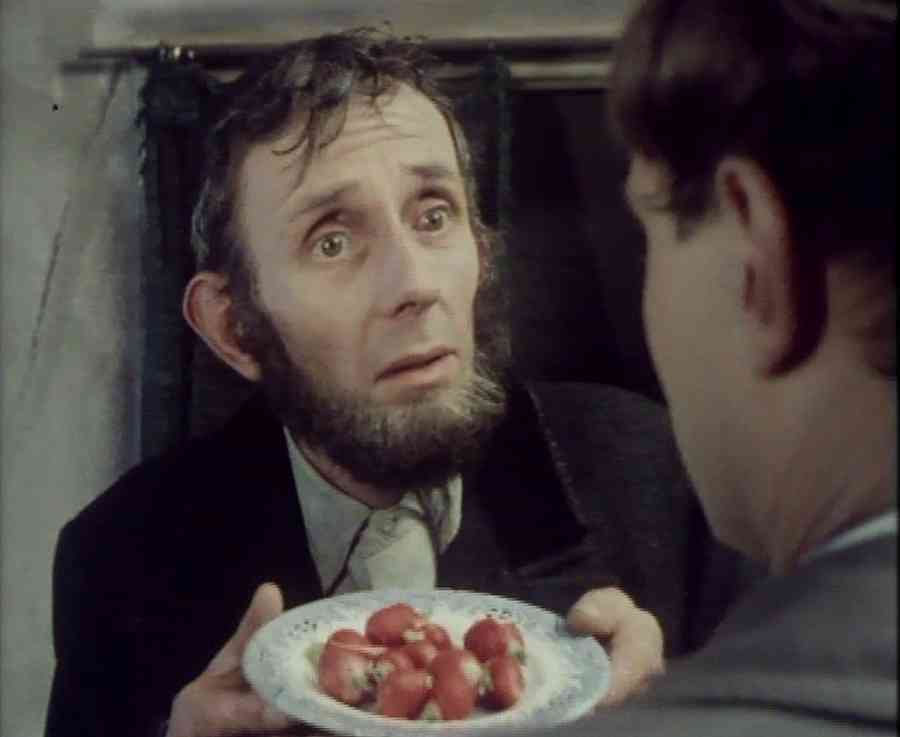
After Curtis and Lisa hand over the cards, a clearly moved Schliemann offers both of them a treat – a small radish on a plate. Lisa politely declines but Curtis accepts with alacrity, wolfing down the radish (despite the fact there’s no butter) with every sign of genuine enjoyment.  As he says later, he knew that it was all they had but he felt compelled not to refuse – had he done so then Schliemann would have been robbed of his last small shred of dignity.

This scene of squalid despair can be contrasted with Kessler and Brandt’s convivial (on  the surface anyway) coffee meeting – with real coffee and English biscuits (not named, but they’re clearly bourbons). The Kessler/Brandt conflict takes a back seat today, but it’s still clearly bubbling away – the fact that Kessler ends the episode by opening a secret Gestapo file on his colleague indicates that things are only going to get worse.

Later, there’s one more scene with the Schliemanns as Curtis returns with some meagre supplies and a small tub of butter for their radishes. Once again Schliemann is pathetically grateful, even more so when Curtis tells them that there might be a chance for them to escape Brussels.

It won’t be via Lifeline as they – for good operational reasons – don’t take Jews but despite this, Curtis can’t help but angrily ask Lisa if she doesn’t care about their fate. This doesn’t help their already bumpy relationship ….

There’s no one plotline which dominates in Radishes with Butter. Curtis inadvertently passing over forged money to Lifeline is another subplot (as is Kesser’s unsuccessful attempt to find the forgers).  The plight of the Jews also bubbles away – with some discussion about their ultimate fate (everyone seems aware that the concentration camps they’re being sent to are just a cover) – whilst there’s also an RAF evader, Vidler (Anthony Smee), to be dealt with.

Vidler isn’t too important a character in his own right – he exists mainly to bring Lisa and Curtis closer together. When the Germans close in on Vidler’s hiding place, all three are forced to flee across the rooftops. This sequence – shot on film and at night – clearly would have cost a fair bit and helps to give the episode a little gloss (although if one were being cynical, you could say that it’s also a good way to pad out the running time).

This scene almost ends in farce when Lisa misses her footing, slides down the roof and ends up hanging by her fingertips (with nothing but a sheer drop beneath her). There’s some not entirely convincing back projection in this scene (showing the Germans on the ground) and it also puzzles me that the Germans fail to notice the dangling Lisa. Were they blind or simply not very efficient?

Curtis, of course, hauls her to safety and you can probably guess what happens next. They lock eyes and then lock lips (thankfully there’s no corny swell of incidental music).  Lisa later regrets this moment of madness and later tells Curtis that there can be nothing between them, recounting her own backstory (just one tragic tale amongst so many).

Another occurs at the end of the story when Curtis learns that the next batch of Jews to be deported includes the Schliemanns. He rushes to try and save them, but he’s too late – the only sign that they were ever in their room is a plate with a couple of discarded radishes and a dab of butter.

Radishes with Butter is a really good character piece for both Curtis and Lisa, with Gaston also benefiting. The silent menace of the Germans – invading the Candide to haul out another unfortunate – is also effective as is the continuing enmity between Kessler and Brandt. Three episodes in and the series is now really up and running.

Upstairs Downstairs – Your Obedient Servant (1st December 1972)

If (and it’s a big if) you can accept the central conceit of Your Obedient Servant (Hudson aping his betters) then there’s a great deal to enjoy in this episode. And even if you can’t, Fay Weldon’s script still sparkles.

The opening scene intercuts between Hudson (in his parlour) and Richard Bellamy (in the morning room) both of whom are more than a little irritated by the constant loud banging and showers of dust appearing all around the house. This is due to a new electric bell system which is being installed by a group of workmen (led by Larry Martyn).

Martyn (probably best known for playing the slightly more aged Mr Mash in Are You Being Served?) is an early recipient of some of Weldon’s top notch dialogue.

That the episode begins with Hudson and Richard Bellamy seems apt, as both are required to deal with the same issue – the surprise arrival of their brother – although their storylines conclude in very different ways.

Even before we learn that Hudson has a brother, Weldon provides him with a lovely little monologue (delivered, as always, exquisitely by Gordon Jackson) in which he lectures a slightly baffled Edward. “A brother, in any walk of life, is someone to whom much is owed. The greatest consideration, the greatest formality, no matter how the exigences of fate have led each into different paths, into different fortunes”.

Hudson certainly abides by these words, although it’s more than a little surprising when he leaves 165 Eaton Place without permission and nips out to hire himself a fine suit of clothes (plus a cane and gloves). It’s all part of his plan to ensure that his brother, Donald (Andrew Downie), his sister-in-law Maudie (Marcia Ashton) and his niece Alice (Kim Hardy) believe him to be a gentleman about town rather than a common servant.

The problem is that nothing we’ve seen of Hudson to date has prepared us for this. Extreme pride in his position has always been his defining feature – possibly it would be easier to understand had Donald had been an aggressive or foreboding man, but on the contrary he’s cheerful and welcoming. True, Maudie is a bit of snob (commenting that waiters aren’t people) but it’s hard to imagine Hudson going through all this rigmarole for her benefit.

If Donald is a thoroughly nice chap, then the same really can’t really be said of Richard’s elder brother, Arthur (John Nettleton). Nettleton (in reality some years younger than David Langdon) gets most of the best lines in the episode and delivers them with relish (his description of Hudson – “a furtive looking fellow with whisky on his breath” – is just one of many).

The regulars aren’t forgotten either. Mrs Bridges has several standout moments, the first being when she recalls an early crisis after the cook fell dead over dinner and she had to step into the breach. “I was only the kitchen maid. They wasn’t grateful. They sent the hollandaise back Said it was curdled. Well the look on that poor dead woman’s face. Enough to curdle anything it was”.

Later she passes over her life savings – thirty pounds – to Hudson. That she’s content to do this (asking no questions) is remarkable. She has total faith that Hudson will be able to repay her one day and hopefully he did so. If he ended up squandering all his savings (not to mention hers) just to entertain his brother for a few days then it would leave a bad taste in the mouth.

Roberts was probably the regular who always had the least to do (although Patsy Smart could work wonders with just a look or a disapproving purse of her lips). Today she’s given a nice monologue in which Roberts recalls how an early love of hers was chased away by her disapproving parents. It’s just a short speech, but it lays bare her lonely and unfulfilled life since.

Despite Arthur’s general waspishness, there are occasional signs that a rapprochement with Richard might be on the cards. But it’s quite telling that Richard eventually spurns him after he attempts to embarrass Hudson. And although Hudson fears for his position when Richard encounters him and his brother eating in the same swanky restaurant as he is, the viewer – no doubt knowing that the series wouldn’t be foolish enough to let Gordon Jackson go – will be one step ahead of Hudson and secure in the knowledge that the master/servant balance will shortly be restored.

A slightly strange episode then, but one that zings with such excellent dialogue that I’m prepared to cut it a great deal of slack. Other things to report – Edward attempts to smoke a pipe which doesn’t go down well with Hudson (“tobacco slows the nervous reflexes and yours are quite slow enough! Put that abominable instrument away and lay out two trays”) and a new parlour maid, Violet (Angela Savy), appears out of nowhere and is never seen again after this episode.

Secret Army – Sergeant on the Run (14th September 1977)

Although they’ve barely had time to become acquainted, already the enmity between Kessler and Brandt is simmering away nicely. On observing Kessler’s departure to personally locate evading British airmen, Brandt is mildly amused. “Isn’t there a saying about having a dog and barking oneself?”

Kessler icily counters that he bites rather than barks and follows this up by stating that “I suspect there is one fundamental difference between us. My work matters to me”. Not the beginning of a beautiful friendship then, but the conflict between them (sometimes open, sometimes concealed) will provide the motor which drives many episodes during Secret Army‘s first two series.

There’s a lot to enjoy in John Brason’s Sergeant on the Run, even if certain parts (which I’ll get to in a minute) are rather baffling. Positives first. There’s a noticeable shift in tone from the series’ opening episode in terms of how the escaping airman are portrayed. In Willis Hall’s script everyone seemed to treat it as a bit of lark, but that’s certainly not the case here.

A fair amount of this episode was shot on film. Director Viktors Ritelis certainly makes his mark during a lengthy film sequence set in a café. Three extremely nervous British airmen are waiting to be collected – all they have to do is act naturally, but even that seems beyond them.

You could argue that Ritelis’ work is a little showy and obvious (a close up on a fly trapped in some flypaper mirroring the desperation of the airmen as they see enemies all around them) but all these visual touches manage to create a sense of tension and unease which – due to the length of the scene – becomes almost unbearable.

When eventually the airmen are spotted by some German soldiers, two make a break for it and are shot dead. The third, Sergeant Walker (Martin Burrows), hides and eventually slips away.

My first query is why the Germans didn’t seem to realise that there were three suspects not two. There were three meals on the table, so why not hunt for the missing third man? Maybe they were just happy with shooting two ….

Given the episode title, we’re now set up to assume that Walker’s evasion from capture will be the focus of the story from now on. Well, not really. After some more disorientating film work he’s rather easily picked up and delivered into Kessler’s hands.

Burrows excels at teasing out Walker’s character – he’s no laconic hero, rather he’s a bewildered and frightened young man desperately searching for a way out.  When he spies that there’s no guard on the door (yes, really – Kessler’s security leaves a lot to be desired) he makes a break for it. Having only got a few hundred yards he chucks himself over the stairwell, plummeting down multiple floors, rather than face recapture.

This is another well executed film sequence – not only Walker’s fall (which looks pretty convincing) but also its sequel, where an incensed Kessler attempts to question the bloody and broken Sergeant while an appalled Brandt looks on. Their brief battle of wills – won by Brandt who orders an ambulance – is another of those moments that’s a gift for both Culver and Rose.

Another plot oddity is that our first glance at Walker in hospital shows him to be in a pretty bad way – a bandaged leg in traction, arm in a sling, neckbrace – and yet shortly afterwards he’s lost all of these things and looks pretty much like his old self. And then a scene or two later he’s beginning to walk with crutches and gets on with them so well that he’s able to hotfoot it away from the doctor (Brandt’s guards – like Kessler’s – seem woefully inadequate).

Whilst all this is going on, the Candide regulars are beginning to enjoy some more character development. Albert and Monique share a nice relaxed scene in which Albert wistfully recalls the first time they met (this brief moment of peace is rudely interrupted by the angry knocking of Albert’s bed-ridden wife). We don’t actually see her in this episode, but then we don’t need to – just the banging and Monique’s anguish at being the mistress of a man still guiltily devoted to his wife tells us all we need to know.

The end of the episode feels like it could have done with a redraft, but since John Brason was also the series’ script editor he had no-one to blame but himself. Walker, having endured a nightmarish travelogue, hasn’t found anyone to help him (his inability to speak the language being a bit of a problem). Having collapsed on the street in despair, he’s immediately collected by two ambulance men.

In the next and final scene Albert tells the others that Walker is dead – shot with a German bullet. Since we’ve already seen Albert preparing a gun, the inference is clear (Walker, a weak man who knows far too much about the escape line, has been silenced for the good of Lifeline). 

What’s slightly jarring is the fact that Albert didn’t seem to be present when Walker was picked up, not to mention that if they’d got him to the ambulance, surely they then could have taken him to a safe house (no German soldiers seemed to be in the area).

Albert as killer is a powerful way to end the episode, demonstrating even this early on that he’s quite prepared to do any dirty work that’s required (it won’t be the last time either). It’s just a pity that the moment seems slightly bungled – and this, not to mention the way the Germans lose Walker twice, slightly drags the episode down.

A pity, because otherwise it’s a taut tale thanks to Martin Burrows’ turn as Walker. Surprising that his film and television credits were so slight (seven other roles between 1977 and 1982) as he more than holds his own here.

Upstairs Downstairs – The Property of a Lady (24th November 1972)

Lady Marjorie’s past indiscretion comes back to haunt her ….

The lack of a writing credit on the episode is a sure sign that its genesis was a troubled one (and indeed, that was the case – Peter Wildeblood was incensed that his script was so heavily written and asked for his name to be removed).

There aren’t too many outward signs of any production travails though – even if the story (despite a dollop of location filming) feels quite enclosed and restricted. It’s notable that it has a very small cast with only six regulars (Thomas, Sarah, Mr Hudson, Rose, Lady Marjorie and Richard Bellamy) and a sole speaking guest actor – Desmond Perry as Michael Dooley, a fast-talking Irish ex-soldier with blackmail on his mind.

Dooley claims to have been batman to Captain Charles Hammond, an officer who fought and died on the North West frontier of India. In Dooley’s possession are a tranche of letters of an intimate nature exchanged between Hammond and Lady Marjorie (see the series one episode Magic Casements). Although why he should want to take these missives to a war zone is anyone’s guess.

Whilst Dooley isn’t exactly the most three-dimensional character, Perry gives a very effective performance, deftly altering Dooley’s tone from deferential to implacable whenever he spies that he’s gaining the upper hand. Initially turfed out of the front door of 165 Eaton Place by Hudson (who seems equally appalled that he’s a beggar and an Irishman) he finds a more ready confidant round the back, where Thomas is tending to the motor car.

Of course, the poor hapless Dooley never realises that in Thomas he’s run into someone who’s far more devious and underhand than he is ….

This is really John Alderton’s episode. He plays the episode’s two key scenes (Thomas approaching independently both Lady Marjorie and Richard to inform them of Dooley’s blackmail) very well. When Thomas pulls over the car to have a private word with Lady Marjorie, there’s some excellent byplay between the two – Lady Marjorie’s initial disdain turning to panic which is soothed by Thomas’ level-headed support (even though the audience – by now fully primed about his character – knows that he’s on the make).

Having acquired £200 (after her Ladyship pawns her jewels) Thomas then collects the same sum from Richard. Thomas correctly assumes that neither would dream of speaking to the other about the matter, allowing him to make a tidy profit.

And given that Dooley – asking for £200 – is eventually bundled out of the mews after handing over the letters with nothing to show for it, Thomas is able to walk away with all £400. Or is he?

There’s no getting around the fact that the wheels come off towards the end of the episode. Thomas talks Sarah into impersonating Lady Marjorie and together the pair bamboozle the unfortunate Dooley. To give her credit, Pauline Collins was less mannered and arch in this scene than I was expecting, but it still feels a little off.

Possibly the script in its original form had a little more bite, but I still enjoyed the delicate hypocrisy displayed by all the characters (except Rose, who remained in total ignorance). When talking to Lady Marjorie and Richard, Thomas’ true feelings are kept discreetly veiled as befits a good servant – but there’s no doubt that all parties know exactly what the truth is (but are compelled, for forms sake, to maintain an air of decorum).

The same goes for Hudson as he discusses the matter with Thomas. When they’re together, Hudson pours scorn on Dooley’s claims but after Thomas leaves it’s plain that Hudson is perturbed.

Sarah makes Thomas give all the money back. That Thomas does so (albeit receiving £10 from Lady Marjorie and £20 from Richard) is hard to swallow. What was there to stop Thomas pocketing some or all of it and not telling Sarah? This sudden burst of conscience seems more than a little out of character (especially since she could never have spoken to Lord or Lady Marjorie to discover the truth) but his duplicitous nature is restored when out of his £30, he only gives Sarah £3!

The Property of a Lady feels a little stretched – the plot is decent enough, but it’s quite a basic one to fill a 52 minute episode. Maybe an unconnected subplot would have given it a little more impetus.

Secret Army – Lisa, Codename Yvette (7th September 1977)

The debut episode of Secret Army, Lisa – Codename Yvette is required to hit the ground running as it has to introduce all of the regular characters and set up the parameters of the series within the space of fifty minutes.

Willis Hall’s script deftly achieves this, although with so much ground to cover it’s not surprising that fairly broad brush strokes are used (future episodes will begin to explore the recurring cast in more detail).

At the Candide (in its series one incarnation as a fairly earthy café/bar) Albert is in charge – caught between his bedridden and suspicious wife (Andree) and his mistress (Monique). Also on hand is Natalie whilst Alain (later established as the escape line’s radio operator) spends this episode pounding the streets.

Albert might run the Candide, but the escape line (Lifeline) is controlled by Lisa Colbert, who, as the episode title suggests, has the codename of Yvette. Why Lisa should be the only member of Lifeline to have a codename is never made clear.

Working as an assistant to Dr. Keldermans allows her to break curfew whilst the doctor’s surgery is a useful place to temporarily store airmen in transit. Lisa’s uncle and aunt – Gaston and Louise – also make an appearance. Gaston is a key Lifeline member (handling documents) whilst Louise, apparently, remains ignorant about her niece’s and husband’s extra-curricular activities.

Over in Britain, Flight Lt. John Curtis, who has knowledge of Lifeline’s work, prepares to return to Brussels in order to act as a liaison between the escape line and the airmen.

On the German side, there’s Major Erwin Brandt, the cliché of the ‘good German’ – a Luftwaffe officer who – whilst keen to capture all the British airmen he can – has a humane streak. No such humanity can be detected in Sturmbannführer Ludwig Kessler – the newly assigned Gestapo officer for the area.

As I said, that’s quite a hefty cast list (not to mention today’s guest artistes who also have to be catered for).

Particular highlights today include Bernard Hepton’s weary Albert (juggling a wife and a lover, not to mention escaping airmen, obviously isn’t good for the nerves) and the early conflict between Brandt and Kessler.

At certain points in the series, the Germans emerge as the more interesting and three-dimensional characters and we get an early taste of that here. The episode opens with Brandt and his men searching a farmhouse for a suspected evader – they find nothing, but take the farmer and his wife away for questioning (leaving two young children behind). After they’ve gone, Natalie escapes from her hiding place (those German soldiers weren’t very good then) and tells the children that their parents will be home soon. Her words seem brittle and unconvincing, but when Albert agrees it’s likely, we feel a little better.

But our optimism turns out to be misplaced as Kessler later tells Brandt that he’s shipped all four members of the family to a concentration camp. Even though it happens off screen, it still has quite an impact. This moment ties into a comment earlier in the episode where a fairly boisterous airman is told that if he’s caught he’ll be sent to a prisoner of war camp – but those who have helped him will more than likely be killed. It’s an early reminder of just how high the stakes are for every member of Lifeline and their associates.

It’s also established that Lifeline have no connection with the resistance or any other escape routes. This helps to keep them safe but also isolates them.

If anybody suffers for lack of characterisation in this episode then it’s the British airmen. They’re fairly anonymous types – although one stands out a little (because he’s played by Neil Dickson, later to portray the ultimate WW1 flying ace, Biggles).

Kenneth Ives’ direction has a few unusual touches, such as the handheld camerawork when Curtis returns to the Candide and is questioned by a suspicious Lisa (offhand I can’t remember a great deal of handheld camerawork in this era of vt drama).

Upstairs Downstairs – Guest of Honour (17th November 1972)

Guess who’s coming to dinner? Only the King of England, Edward VII ….

There’s a neat switch around halfway into this episode. Up until that point the focus – not surprisingly – has been on the Royal visit (first the preparations and then the arrival of his august Majesty).

Hudson is the first to learn the news and he immediately makes haste for the kitchen where he (eventually) tells Mrs Hudson. To begin with he amuses himself by discounting her many suggestions as to who the honoured guest might be (Mr Asquish and Mr Balfour are just two of the names she suggests) before he finally puts her out of her misery.

Hudson then displays a slightly surprising cynical edge to his character. No doubt if the younger servants were present he would have held his tongue, but with only Mrs Bridges there he’s quite comfortable in admitting that whilst he respects the institution of monarchy he has certain reservations about the person of the sovereign.  He then comments that he’d sooner have a Stuart on throne, before shrugging and stating that “we’ll just have to make do with what we’ve got”!

The King himself (played by Lockwood West) turns out to be a rather uninteresting fellow and his fellow dinner guests aren’t a great deal better. This has to be a deliberate touch – but just as the first pangs of disappointment for the viewer might be kicking in, the unexpected arrival of Sarah gives the episode new impetus as it sharply changes direction.

Sarah, pregnant with James’ child, has run away from the bucolic seclusion of Southwold and – by a feat of remarkable timing – goes into labour just minutes after she steps through the back door of 165 Eaton Place. There then follows some strange pantomimic scenes as the staff – aided by Lady Marjorie – attempt to spirit Sarah upstairs (all the while hoping that their guests don’t spot that anything is amiss).

The obvious question to ask is why they take her up the main stairs rather than the servants’ back stairs? The obvious answers would be that had they done so the episode would have fallen a little flat not to mention running about five minutes shorter.

When it’s all over, Rose returns downstairs to tell the others that Sarah’s all right and the child was a little boy. The use of the past tense makes it plain what’s occurred and Hudson – after a beat – comments that it might have been for the best (in series terms I’d agree, as Sarah is now freed from any familial obligations).

It’s quite striking that both Hudson and Mrs Bridges (neither of whom have been that sympathetically inclined towards Sarah in the past) now seem to have rather more consideration for her. Although Hudson can’t resist opining a homily about how Sarah is a good example of the dangers which occur when you attempt to exceed your station in life.

It’s left to the ever mournful Roberts to cast a late discordant note. The other members of staff are happy for Sarah to take her meals with them, but Roberts most certainly isn’t. She begins by labelling her a “slut” before launching a fuller tirade.

She’s a stuck-up, lying minx! Huh! Thinks she’s better than all of us… puts on airs! Gets Captain James into such trouble that he has to be sent to India. Then she thinks she can walk in here as though nothing has happened!

But eventually, seeing that hers is the minority opinion, Roberts relents and a delighted Rose is able to tell Sarah that she’s been welcomed back into the “family”. It’ll be just like old times, Rose says, although this time Sarah will need to behave. I wouldn’t hold my breath on that score though ….

Guest of Honour is an interesting episode. One of the best remembered from the entire run of Upstairs Downstairs, as touched upon before it’s very much a game of two halves. The upstairs portion seems to be the bit that most people remember, which is surprising as nothing really happens. Once again downstairs is where all the action is.

Coronation Street (9th September 1964)

The discovery of an unexploded bomb in Albert’s back garden forces the residents to take shelter in the Mission Hall cellar. This rekindles memories of their wartime experiences in the very same room ….

The fourth of six Tony Warren penned episodes from 1964 (it would be 1967 before he’d next return to the series) this is simply glorious. It’s a pity that it wasn’t included on Network’s 1964 DVD, but with only eight episodes to play with each year it’s possibly not surprising that so many worthy possibilities failed to miss the cut.

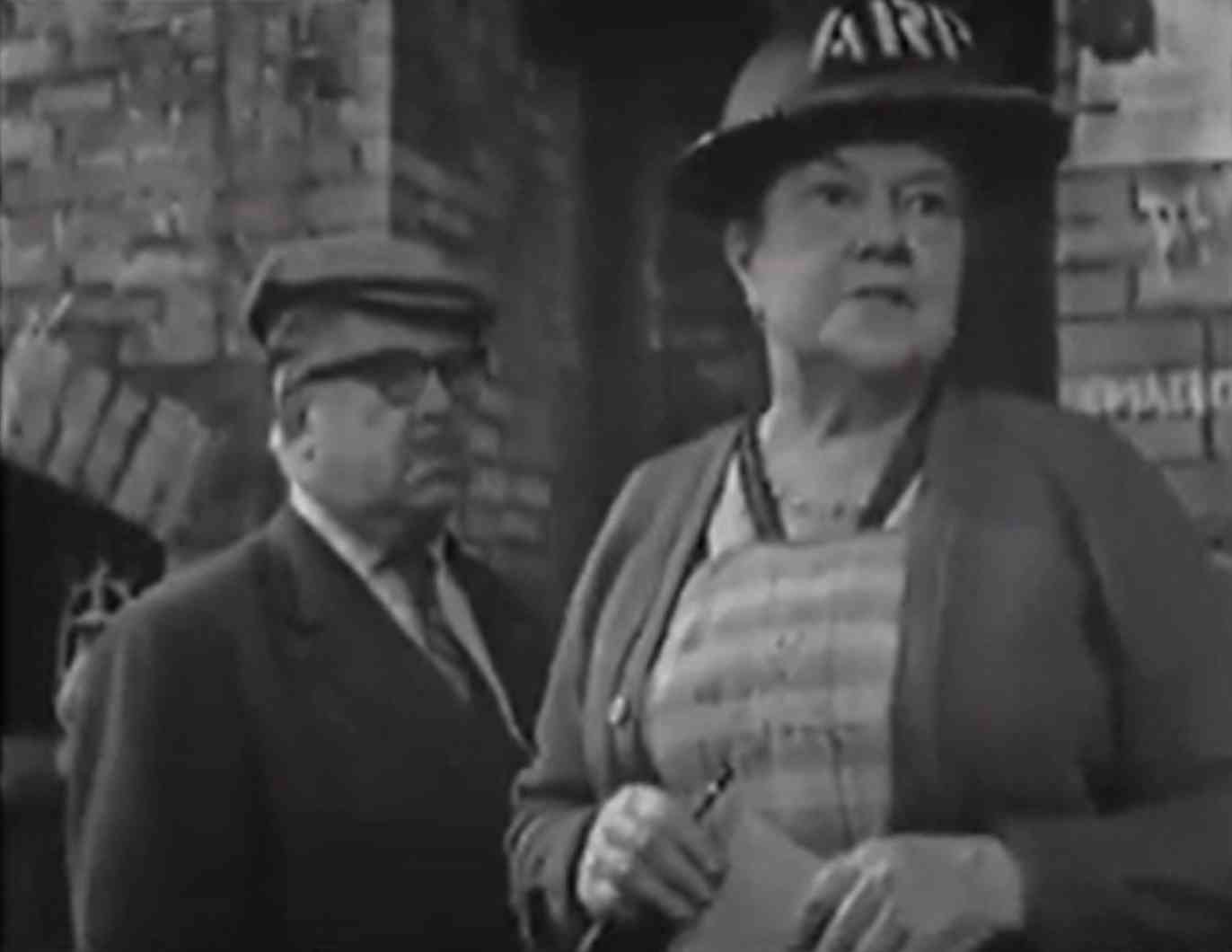
Amongst the highlights is a wonderful scene between Jack and Mrs Walker in which she declines to leave the Rovers without seemingly taking half the contents of the building (Jack, as ever, is the very definition of long suffering). Whilst Ena, complete with her ARP tin hat and gasmask, effortlessly slips back into the dominant role she enjoyed twenty years earlier.

There’s a wistful longing from her for a return to the good old days of the war, where the community spirit was strong. “When there’s a war we get a lot of new songs, everybody’s nice to everybody else, nobody bothers about dressing up. It’s funny what war does for folk”.

The way that Stan and Hilda force the depressed and dejected Florrie to join them in the cellar is one example of how the wartime spirit has been temporarily reactivated. On her own Florrie seemed to be almost suicidal, but once she begins to mingle with the others (who are gearing up for a nice sing-song) her spirits began to lift.

It’s easy to argue that this is all a tad unrealistic, but then Coronation Street was never (at least in its earliest decades) designed to be a hard-hitting drama. Instead, at its core was a nostalgia for an earlier (and obviously idealised) past where neighbours looked out for each other and came together in times of stress and strife.

Even by 1960, with the rise of high-rise flats, the community pictured in Coronation Street was something of an anachronism – but then treating the series as a document of social history is something that’s rife with problems (although it’s true that the series could, at tImes, reflect current trends quite deftly).

As the old-un’s begin to sing wartime songs and reminisce about their radio favourites (Minnie stops Albert from mimicking Lord Haw-Haw in an underplayed moment that nevertheless is nicely handled by Margot Bryant) the young-ones (Irma and Dennis) can only shake their heads at this baffling display of jollity.

Whilst this is going on, Captain Platt (John Quayle) and Corporal Dixon (Duncan Livingstone) have the tricky job of dismantling the bomb. Quayle is especially good value in their scenes together – as both Platt and Dixon are given their own opportunity to reminisce about their wartime experiences as children (a good reminder that even those in their thirties at this time would have had some memories of WW2).

Even if Coronation Street isn’t a programme that’s often on your radar, you’d do worse than setting aside half an hour to watch this episode. It’s a heart-warming and amusing effort from the Street‘s creator.

Coronation Street (8th February 1961)

Frank Barlow’s stern words, during the previous episode, about never buying anything on credit comes back to haunt him when it’s revealed that his wife, Ida, has had items on tick from the local tally man, Johnny Gibson (Gerald Cowan). It’s pretty modest fare – seat covers for the front room suite – but Gibson’s visit to No 3 doesn’t go unnoticed by Ena who (unsurprisingly) has a few choice words later in the Rovers’ snug regarding Frank’s apparent hypocrisy – loudly proclaiming about the evils of credit whilst sneakily indulging,

Ah, Ena. This is an episode dominated by the snug musings of Ena, Martha and Minnie. With Ena slow to make an initial appearance, it allows Minnie and Martha to indulge in some gossip about their friend – was she really the one in charge during the recent gas leak evacuation at the Mission? Ena’s sudden arrival is beautifully timed, as is Minnie’s change in expression from delighted expectation (as she anticipates hearing the truth about her friend’s conduct) to downcast sorrow as Ena turns up and they have to hurriedly change the conversation.

The dialogue drips with quotable gems (“there’s only one set of folk that doesn’t get talked about and that’s them as does nowt”) and monologues (Ena’s bus travails). All three initially fall into their default positions. Ena is forthright and domineering, Martha is acidly disapproving of everything while Minnie is vague and always keen to steer their conversation down weird tangential alleys.

Maybe it was Lynne Carol’s relative youth (she was 46 at the time this episode was recorded, considerably younger than Margot Bryant or Violet Carson) but there’s often something about Martha that rings false with me – it’s an excellent performance, but it always feels too much like a performance for comfort.

I love the way that the normally pliant Minnie suddenly takes charge (“sit down Ena and don’t be so touchy and you shut up Martha”) to the shock of her two friends. Even better is the way that neither Ena or Martha feel able to comment on this, merely exchanging a startled look as the conversation resumes.

There’s more discord between Elsie and Dennis. Their latest row results in Dennis getting a slap, although I find it hard to believe in Elsie’s comment “that’s what you’ve been missing all your life”. Everything we’ve seen to date of her suggests that she would have been quite happy to give the young Dennis a slap or two in years gone by.

The intensity of this moment is then allowed to dissipate a little as he finally reveals where all his money has gone – to a striptease artist called La Composita (real name Joyce) whose act involves a snake. Already Dennis’ flirtation with the entertainment world is up and running with many, many delights (such as a couple of Sea Lions frolicking in the Rovers’ bathtub) to come.

Elsewhere in the episode there’s two brief highlights. One is the first appearance of Brian Mosley as Alf Roberts. It’s just a short scene – he’s only present so that Frank will have someone to pour out his troubles to – but it’s the start of a healthy run in 1961 as a supporting character (clocking up 21 episodes in all). During the rest of the sixties his appearances would be more intermittent (4 in 1962, 11 in 1963 and then he’s not heard from again until 1967 when he notches up a further 9 episodes before finally returning in 1971 as a regular).

Another familiar face is that of Prunella Scales as Eileen Hughes (making the third of four appearances). She pokes her head round the Rovers’ door just as the big darts match is in progress. This is enough to put Harry Hewitt off his stroke, especially when he learns that she’s the mascot of the rival team …

https://youtu.be/19Z578Ce4E8


Coronation Street (3rd February 1961)

A handful of new (to me anyway) episodes of Coronation Street have recently surfaced on YouTube. Chronologically, this is the earliest one – episode seventeen – which was broadcast in early 1961.

We open at Number 11 with Elsie and Dennis. By this point Dennis has evolved from the malignant delinquent of the earliest episodes although he’s still not quite the loveable idiot he’d later become. True, he’s fairly charming and solicitous towards Elsie, but that’s only because he wants to tap her for a loan (and when she exits the house after a row, he’s quite happy to search the place for money). He comes up empty handed though and as the scene ends with him looking resigned rather than angry, it confirms how the softening process of his character had already begun.

Next it’s over to the Barlows for breakfast. As always, Ken and his father Frank are bickering – Ken wants to buy a record player on (effectively) H.P. but Frank quickly lays down the law (nothing comes into this house that they haven’t paid for). The payoff to this plotline doesn’t occur until later this episode and the next, so the scene is chiefly memorable for Frank Pemberton’s unscheduled coughing fit which causes his co-stars (chiefly Noel Dyson) to ad-lib until he gets over it.

Highlight of E17 is scene three inside the Rovers.  Annie Walker was somewhat less regal in these early installments than she’d later become – not only is the accent slightly coarser but it’s difficult to imagine the 1970’s or 1980’s incarnation of Mrs Walker wearing a headscarf.

Feverish activity is occurring because Annie and Jack’s daughter, Joan, is due to arrive with her fiancé, Gordon Davies (Cavan Malone). Well, Mrs Walker is feverish while Jack and Billy are their usual phlegmatic selves – both drawing pints at 10 am to test the beer as Mrs Walker looks on disapprovingly.  As ever, Arthur Leslie is such good value – this might be a matriarchal series, but Jack always more than holds his own.

The arrival of Joan and Gordon is splendidly awkward – the bookish schoolteacher Gordon is left in Jack’s care and he finds that conversational topics quickly dry up ….

Doreen and Sheila spend some time in the corner shop, deciding what they’ll have to eat. They decide on two barm cakes (yes, this was an era when not every scene – or indeed any of them – were crash, bang, wallop action ones). You won’t find me complaining though as it’s all good character stuff.

The other episode highlight is a fairly brief Ena scene where she berates the hapless Harry Hewitt (“do you know what jobs carry the highest mortality rate through stomach ulcers?”).

This was the only installment of Coronation Street written by Alick Hayes and it shows that even this early on the writing team had already managed to successfully mimic Tony Warren’s style (Warren had written the first twelve episodes and I’d say that the casual viewer would be hard pressed not to believe this was another Warren script).

https://www.youtube.com/watch?v=awyitnvvo7Y

Back to 1982 – 14th August 1982

And so we come to the end of my week in 1982. It’s certainly served as a reminder that August was a month of repeats, old films and cheap fillers. You could usually find something of interest, but the stations did tend to feel like they were in a holding pattern until the new season launches in September.

I can’t source today’s edition of The David Essex Showcase on BBC1, but this half-hour studio tape (from, I believe, the following week) might be of interest to some.

For me today it’s repeats all the way – Kelly Monteith on BBC1 plus Space 1999 and Catweazle on ITV. There’s also another chance to see Early Days by David Storey, starring Ralph Richardson, also on ITV.