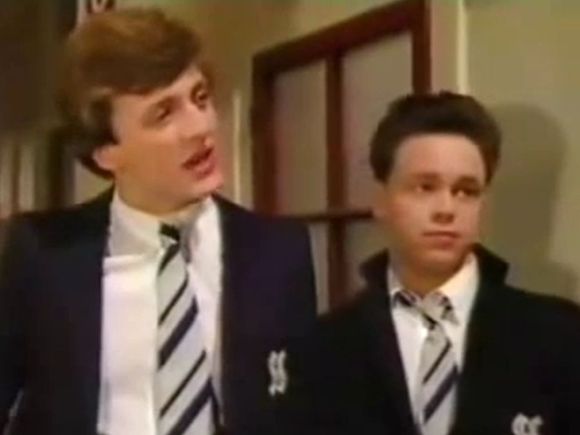
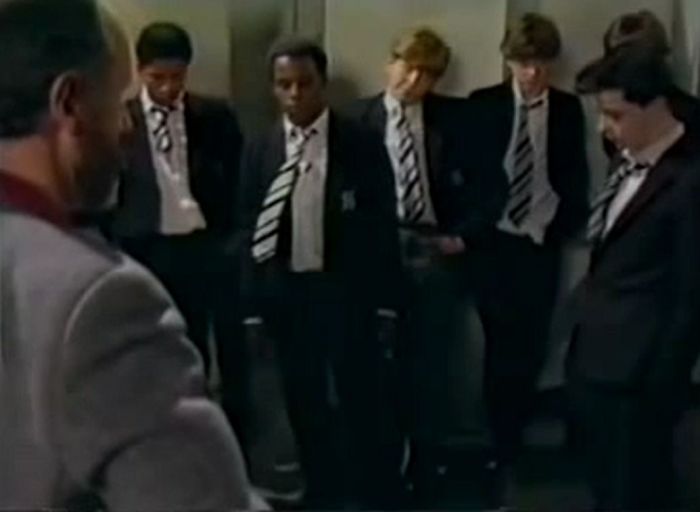
The opening scene gives us our first look at Jimmy McClaren (Gary Love) and his ever-present sidekick Nigel Flavin (Gary Hailes). Although Jimmy has somewhat stepped into the void left by Gripper, he also bears more than a little resemblance to Pogo.
Jimmy’s a fixer – he’s happy to relive others of their money, but he likes to provide a service in return (unlike Gripper, who just liked the money). Here, we see him plot to get someone onto the school football team (with the wheeze of stealing another boy’s boots) whilst Nigel later receives a payment after agreeing to arrange that a boy has his pick of the desks (he doesn’t like his current place and no-one else will move).
This transaction is overheard by Mr Keating and it provides us with the spectacle of Robert Hartley ear-wigging in the background as he desperately tries to hear what’s being said. This will be Hartley’s final series as Mr Keating and I’m going to miss his firm (and usually fair) methods.
Gary Hailes would be another actor who’d make a seamless transfer from Grange Hill to EastEnders. Gary Love would later become a regular in Soldier Soldier as well as maintaining a parallel career as a director. Although neither continue in Grange Hill after 1984, they both manage to liven up the few episodes they do appear in.
Although Jeremy’s absent – suspended – following his bus-pass forgery, he continues to cast a shadow over Zammo. Kevin doesn’t believe that Jeremy would ever get one of them into serious trouble, but Zammo isn’t so sure.
Annette dreams of stardom and decides to enter a fashion competition. Her self-delusion is made plain after she boasts that she’ll have professional pictures taken, only to later be seen emerging from a photo booth, glammed up to the nines. This storyline will pay off in a couple of episodes time.
After appearing in a one-off episode last year, Chris Jury’s Mr Knowles has now become a regular. I’m not sure whether it was a performance choice or simply a stumble, but at one point Mr Knowles seems to forget Annette’s name for a second and then almost pronounces “historical” as “hysterical”. An actor’s fumble maybe, but it’s also very in character for someone who’s no longer the helpless teacher we’ve previously seen, but isn’t yet totally in command of the class.
And there’s an outbreak of nits. Eek!
An anonymous phone call to Mrs McClusky spells trouble for Zammo. Nigel was passing at the time and is able to give Zammo a heads up – much to the despair of Jimmy, as he’s given away information for free! Zammo believes that Gluxo was behind it, and recruits his friends for a showdown. Unfortunately they start to drift away one by one after they fail to find him. So that by the time the Brookdale boy does make an appearance, only Zammo and Kevin are left.
How Gluxo learnt that Zammo’s bus-pass was used by Jeremy is a mystery, which makes it much more likely that the anyonomous call was made by Jeremy (or someone on his behalf). This ties back to Kevin’s comment earlier in the episode and although Jeremy wouldn’t have benefitted from grassing Zammo up, it seems like just the sort of thing he’d do. So why didn’t Zammo consider the possibility?
There’s something in Jeremy’s nature which means he can’t help being deceitful. Even if it doesn’t gain him anything, he still delights in misdirection and falsehoods. Because of this it’s a pity he didn’t stay in the series a little longer, as there would have been considerable mileage for this sort of insidious character.
At the start of this episode he tells Zammo that there’s no point in waiting for Jackie – she’s left without him (in a car, with a strange young man). It’s all a complete tissue of lies as we see Jackie failing to catch up with them and then later stropping in the Brookdale playground because she can’t understand why Zammo didn’t wait for her. Why do it? Zammo was bound to find out the truth eventually, but even when he does Jeremy won’t admit that he lied – merely that he must have been mistaken. He has all the makings of a first class politician.
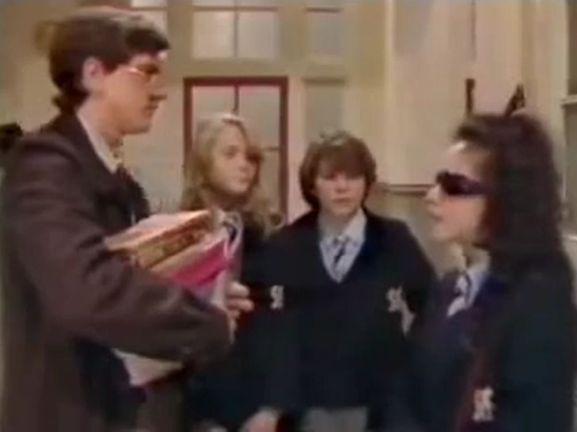
Annette continues to flout the school rules by wearing make-up, but this goes unnoticed since (on doctor’s orders) she’s able to wear sunglasses indoors. This seems rather futile – why bother to wear make-up if no-one can see it?! – but there you go. Her man-eating tendencies are commented upon, as Julie mentions she fancies anything in trousers. Annette responds that it’s better than fancying someone in a skirt. She quickly backtracks and mentions a Scotsman, but the inference is that Fay’s keen interest in Miss Gordon has not gone unnoticed by her. Unsurprisingly this would be a topic that Grange Hill would skirt around very delicately – although as series seven develops, the chatter that Fay has a crush on her form teacher begins to intensify.
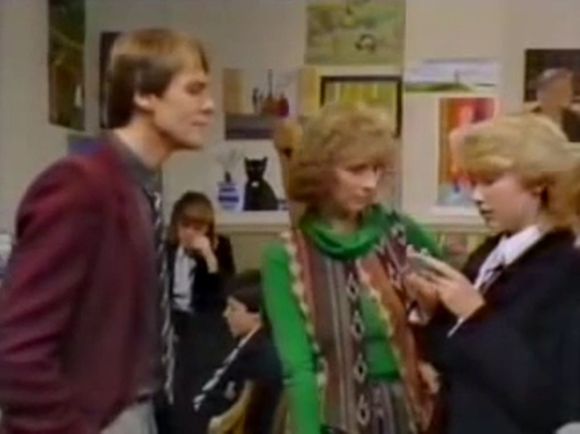
But then Miss Gordon clearly has a certain something, as both Mr Smart and Mr Howard are both still valiantly attempting to broach her defences. First, Mr Howard offers her a lift as he’s going her way (she innocently asks him which way is that?). Alas, Mrs McClusky steps in and asks him to cover Mr Keating’s detention which leaves him very downcast. Mr Smart finds it hard to hide his jubiliation though! Mr Smart pops round to the art room later, but he finds himself no further forward as she politely declines his offer of a lift as she already has one. This leaves Mr Smart perplexed, does this mean there’s another rival for her affections?
Roland’s still looking scruffy, although his transformation from victim to bully (well sort of) begins here. He starts a money-lending business, with interest charged on late repayments and there seems to be no end of people willing to take him up on it. When he later joins forces with Jimmy McClaren (still to make an appearance) his change of sides is even more pronounced.
Jeremy gets nabbed by the bus inspector, who was never going to fall for his fake pass. Why didn’t he just pretend he didn’t have the fare? He would have got slung off the bus, but that would have been better than waving a forged pass about.
Although Mr Smart is aware that he needs to unbend a little and show a more human side to H5, old habits die hard. When Claire, clutching a biorhythm calculator, asks him for his date of birth (in order to work out his physical, mental and emotional states) he tells her not to be impertinent. His date of birth is clearly information that he doesn’t wish to share.
But as if to demonstrate his inflexibility, later Miss Gordon and Mr Howard (Michael Osborne) are both happy to let the girls know their dates of birth. This scene, whilst demonstrating how friendly and approachable they both are, also signifies the start of Mr Howard’s campaign to woo Miss Gordon. It’s obvious to Claire and the others that he popped into her class on the merest pretext – he basically just wanted a little quality time with her.
They all approve – in their eyes Miss Gordon and Mr Howard would make an ideal couple and they don’t consider the age difference (some four years) to be a problem! Prior to this, I can’t think of many instances where the private life of a teacher was considered an acceptable story topic (apart from the trials and tribulations of Mr Sutcliffe and Miss Mooney) so this seems to mark a subtle change in the series’ format as from now on the teachers will tend to become more rounded characters. Mr Howard is another person who has apparently been at Grange Hill for years, but always out of shot. Michael Osborne makes Mr Howard relaxed and friendly – clearly a teacher who’s a favourite amongst the pupils.
But he has a rival in love, as Mr Smart is also interested in the fragrant new art teacher. It must be said that he’s rather forward – placing his arm on her shoulder as he steers her down the corridor. Mr Smart also approaches her under a flimsy pretext (in his case, advice about sets for the school play) and at present it’s far too early to say which (if either) is going to get the nod from her. Indeed, this is a story that’s going to run and run …..
After being a key figure during series six, Randir is much more low profile this year (this episode is probably his most substantial contribution). He offers to sell Pogo one of his chain letters – for a mere five pence. Pogo spies a money-making opportunity and buys all of them so he can start his own chain (this naturally ticks off Randir).
The nature of chain letters, how they work (or don’t) and exactly how you can apparently make a fortune is discussed in some detail. With a fair bit of mathematical discussion, this is probably one of Grange Hill‘s most educational episodes.
Although there are warnings that chain letters always fail, for the moment Pogo seems to be in the money. But Claire warns him that Jimmy McClaren will want his cut – the first mention of the unseen (as yet) successor to Gripper. Following Gripper was always going to be difficult, so it was probably quite wise that they chose to make Jimmy McClaren a very different character.
The opening episode of series seven begins with Zammo rushing to meet someone. So far, so familiar (it brings to mind a similar scene from the start of series six) but when we learn that he’s not meeting Jonah, it’s the first of several instances which demonstrate that change is in the air.
Jackie Wright (Melissa Wilks) is Zammo’s new (first?) girlfriend and together they set off for her school, Brookdale. Although they hold hands on the way, Jackie complains that it’s like holding hands with a plank! Is this because he’s ashamed to be holding hands with a girl or because he has to drop her off at Brookdale? They part at the school gates and exchange a peck on the cheek, to the intense annoyance of Gluxo Remmington (David Rippey).
Gluxo presumably goes to Brookdale (although it’s more likely that his attendance record is slim to non-existent). Maybe he spends his time roaming the streets, duffing people up? He’s certainly keen to hand out a beating to Zammo, but the younger boy manages to escape (following an entertaining chase where joggers and children in the park are just some of obstacles to be overcome). WW2 reference number one – as Zammo rides to freedom on a handy bus he raises his arm to Gluxo in an ironic Nazi salute.
There are major changes with the teaching staff, as both Mr Hopwood and Miss Mooney have left. Mr Smart is assigned to be H5’s form tutor and there’s a very revealing scene where he confesses to Mrs McClusky that his performance the previous year was, in many ways, an “act”. But in order to connect with H5 and function effectively as their form tutor he realises that he needs to show them a little more of his real personality – which isn’t something he finds easy. This moment is the start of the humanizing of Mr Smart which will develop more fully in series eight where he’s, at times, a totally different character from the abrasive martinet of series six.
Miss Gordon (Kara Wilson) is N3’s new form tutor. She makes a very strong first impression on both Fay and Annette, albeit for different reasons. Fay does her best to be friendly and welcoming (with Annette characteristically remarking that she’s a bootlicker!). No surprise that Annette is neither friendly or welcoming, not only to Miss Gordon but to everyone else as well. Annette’s first appearance – plastered in make-up – is a startling one and Fay’s comment to Julie that she was rather odd during the holidays is the first hint that something may be wrong with Ms Firman.
Other plot-threads are started (why does Roland have so much money and why is he so scruffy?) but there’s no need for them to be answered in this episode. It’s simply a mystery that can be tucked away for later.
One of my pet hates is when a new character is introduced and everyone reacts as if he/she has been there for years and we’ve simply never seen them on screen before. Kevin Baylon (Mmoloki Chrystie) is a classic case in point. With the absence of Jonah it’s easy to believe that he was created to fill this gap, but that wasn’t the case at all.
Jonah was to have appeared in the first few episodes, before meeting a watery end in the school swimming pool. Either the actor, his parents or his agent didn’t fancy this, so the character of Jeremy Irvine was drafted in to take his place. In a way it’s a pity that Jonah didn’t feature, as certain parts of the plot – Zammo and Jackie’s relationship, for example – would have had more resonance if Jonah had been the one on the outside, slightly irritated that his best-friend Zammo was spending all his time with a girl.
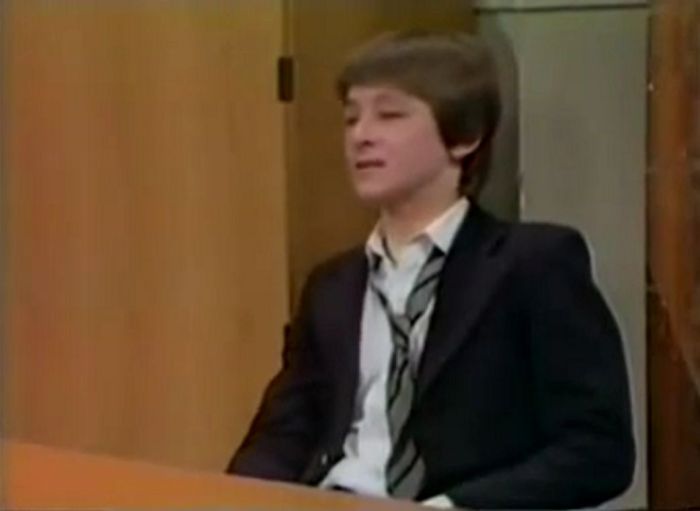
Within a short space of time Jeremy manages to annoy virtually all of his new class-mates and he ends the episode proudly displaying the forged bus-pass he made in art class. I wonder how this will end for him ….
It’s interesting that Jeremy’s parents decide to transfer him to Grange Hill because they’ve heard rumours that Rodney Bennett (Jeremy’s old school) and Brookdale are due to merge. Series eight would see a three-school merger (with GH too, of course) so I wonder if this was an early foreshadowing of that. More likely it was just a throwaway line that someone later realised had plenty of dramatic potential.
WW2 reference number two – as H5 wait for the arrival of Mr Smart, Stewpot does his best impression of him (if he was played by Adolf Hitler that is). It’s a little hard to imagine a modern children’s serial peppered with references to the Second World War, if only for the fact that many of the audience might not understand the references.
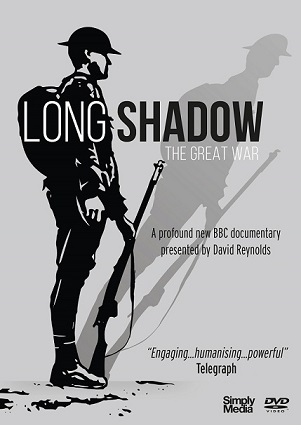
With the centenary commemorations of the Battle of the Somme still fresh in the memory, it feels like the ideal time for Long Shadow: The Great War to be released on DVD in the UK for the first time. Although as we’ll discover, David Reynolds (the writer and presenter) has concerns about how certain events – most notably the Somme – have come to dominate our understanding of the war.
Long Shadow was one of a raft of BBC Great War programmes announced in late 2013. It’s an ambitious (and still ongoing) project – more than 2,500 hours of programming across television, radio and online to appear between 2014 and 2018.
This breadth of programming, covering both drama and factual, allows for a range of approaches to be taken when discussing the events of 1914 – 1918. Long Shadow, broadcast in September 2014, asks us to both remember and reassess what we know (or what we think we know) about the Great War and how the conflict shaped the rest of the twentieth century.
Speaking to History Extra, Reynolds makes the point that the Somme, terrible though it was, has clouded our understanding of both the war and its legacy. “Our view of the war has become focused almost on one day. We need to get out of the trenches and take a broader view of the conflict. That’s what I mean by becoming a caricature – it’s become simplified down. A caricature is not necessarily untrue, it’s just a sharp oversimplification of what is going on.”
Reynolds, a Cambridge academic, follows in the footsteps of many illustrious predecessors. Needless to say, presenter-led documentaries stand or fall on the quality of the man or woman in front of the camera. Thankfully for Long Shadow, Reynolds is an engaging presence – he’s capable of deftly describing the bigger picture, but can also change gears to illuminate smaller-scale, individual stories. Reynolds rarely seems to stand still – he’s often seen walking to his next location – but this hyperactivity (and his sometimes highly dramatic intonations) doesn’t detract from the story he has to tell.
Over the decades, a certain perspective of WW1 has become solidified (“lions led by donkeys”) and this has been reflected in popular satire (Oh! What a Lovely War, Blackadder Goes Forth). Long Shadow attempts to peel away this familiar (and, he argues, inaccurate) viewpoint in order to make sense not only of the war, but of the very different world that both the victors and vanquished returned home to.
Post 1918, the British were keen to honour their dead (Reynolds has some interesting points to make about Edwin Lutweyn’s Cenotaph) but since the public at large found it hard to visualise exactly what had happened on the battlefields between 1914 and 1918, the war slowly faded from the public’s consciousness. But a play, Journey’s End by R.C. Sheriff (which debuted in 1928), would help to reignite interest in the conflict. Reynolds argues that for many, Journey’s End helped to illustrate the futility of war – “never again”.
In Germany there was a very different sentiment in the air. If the British were saying “never again”, then some Germans were of the opinion that the war had never ended. It was simply that they had been betrayed by a spineless ruling elite who had forced the country into signing a humiliating armistice. So the seeds for Adolf Hitler’s rise to power were already in place.
But if, as Reynolds argues, WW2 came to be seen as a just war – fought against an evil and corrupt regime – this would have consequences for the Great War. Post WW2, the Great War would be known instead as WW1. It was no longer “The War To End All Wars”, instead it was seen as a failed attempt to end global war (if it had been successful there would have been no need for a Second World War). Reynolds admits this renaming could seem to be a trivial matter, but it was a factor that helped to shape the modern viewpoint that the Great War achieved nothing, except mass slaughter.
Reynolds also examines the unfamiliar British landscape that emerged following the 1918 armistice. Democracy had come to Britain for the first time with both the working classes and women eligible to vote. Also discussed is the way that the Great War strengthened a section of the United Kingdom – as both Wales and Scotland took pride in joining with their English counterparts to defeat a common foe. Had this not happened it’s tempting to wonder whether the union between the three nations would have fractured. But if the war was a unifying force for England, Scotland and Wales then it was a very different picture in Ireland. The Easter Rising in 1916 was a watershed moment for Catholics, just as the Battle of the Somme in 1918 was for their Protestant counterparts.
In conclusion, if you’re looking for a documentary solely focused on the military conflict between 1914 and 1918 then this possibly isn’t the programme for you. Long Shadow concerns itself with documenting the aftershock WW1 inflicted on the world at large, with Reynolds demonstrating how this brutal conflict helped to shape the modern world.
The series uses very little archive footage, which is a good move. Iconic and stirring though these pictures are, the scratchy black and white images also tend to automatically distance the viewer from the events portrayed. Running for three 50 minute episodes (Remembering and Understanding, Ballots and Bullets, Us and Them), Long Shadow is an accessible and thought-provoking documentary.
Long Shadow: The Great War is released by Simply Media on the 4th of July 2016. RRP £19.99.
This is an all-film school-based episode (something which was quite common during previous series but not so during this year). The main theme is how Mrs McClusky is able to manipulate events to her best advantage.
She’s already decided to reinstate Mr McGuffy, but that presents a slight problem – since the staff are well aware of the impending demo by the pupils to demand his return. Mr Smart, rather delightfully, is the only teacher brave enough to query whether she’s been at all influenced by their protests. As ever, Gwyneth Powell gives Mrs McClusky a wonderful mixture of sweetness and steel as she tells him that no, she always makes her own mind up.
Mr Smart is in a scene-stealing mood. As Miss Mooney and Mrs McClusky discuss how gifted Jonah is, and whether he’s planning to sacrifice academic achievement in order to maintain his popularity, Mr Smart looms in the background, making tea and not speaking a word – although the eye is irresistibly drawn to him!
Jonah’s not terribly popular at the moment though. He’s disinclined to get involved with the demo at first, but then changes his mind as he decides to create an impressive banner. But his ambition outstrips his ability and despite all the previous comments about his brilliance, he doesn’t seem to notice that he’s not left enough space to get all the letters in. This alienates him from the others even more, but he makes amends by opening the locked school doors, which enables the protestors to occupy the assembly hall.
And that’s his last contribution to the series. Also bowing out in this episode are Miss Mooney and Mr Hopwood and, like Jonah, they just fade away with no acknowledgement made that they won’t be returning. A slight pity, as both Lucinda Gane and Brian Capron had been notable presences over a number of years, but it’s not the first or last time that staff and pupils at Grange Hill just vanish with no ceremony.
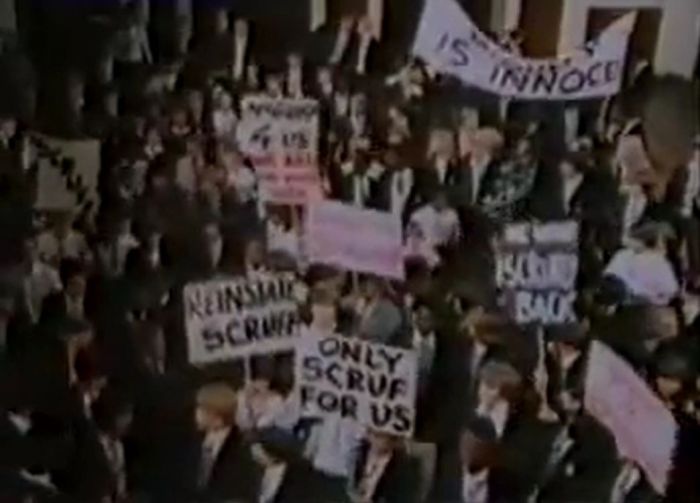
The return of Mr McGuffy is a gloriously awkward moment. As the impressively large body of pupils chant for his return, they then eerily fall silent as he does appear and slowly makes his way to the front. Claire, Suzanne and the others are appalled to discover that he was reinstated the previous day, so they feel they’ve made all this effort for nothing. The irony that they’re not even slightly pleased to see him (despite the banners and chanting) is picked up by him – and there’s also a real sense that they used Mr McGuffy simply as the figurehead for all their frustrations about the school. If Mr McGuffy had been reinstated due to their pressure they would have been delighted, but since the decision was taken out of their hands it only serves to reinforce how impotent and powerless they are.
Mrs McClusky does offer the olive branch of possibly allowing the pupils to take more of a role in future decision making, but – like her manipulation of the flexi-time referendum – you can be sure she’ll always end up on top.
And with the long-range reveal of Pogo’s girlfriend (an unnamed pupil from St Mary’s) series six draws to a close. Always a favourite series of mine, it still impresses, more than thirty years on.
It’s the day of the referendum. Jonah decides to guarantee that the result is positive by doctoring a number of voting slips. Elsewhere, Stewpot and Duane initiate the Pogo Patterson Girlfriend Sweepstake. They plan to sell twenty tickets at 50 pence each, meaning that the winner stands to collect five pounds (whilst Stewpot and Duane are also guaranteed a fiver). The only problem is that they don’t know her identity and Pogo isn’t telling ……
This episode sees some interesting character development for Jonah. On the one hand, he’s still the same reckless boy we already know from numerous previous scrapes – attempting to spoil the exam papers was foolish in the extreme (as Mrs McClusky says, it was obvious that the same hand had written on all the papers). This action suggests that his intelligence isn’t the greatest, but later we see him breeze through his exams in record time. In the next episode it’s confirmed that he could be a first class student if he only concentrated, but his desire to lark about has set him back. Had Lee Sparke returned for series seven then this theme could have been developed further (would he have become estranged from Zammo as they moved into different streams?)
This wasn’t to be though, as the programme makers had intended to kill him off at the start of the next series. It would have been the first time that a regular central character had died (Antoni Karamanopolis had tumbled to his death during series three, but he was someone who only existed on the periphery of events). It seemed that a sudden death didn’t appeal to either Sparke or his parents, so Jonah didn’t return – causing a hasty rewrite, which we’ll discuss when we get to the episodes in question.
Fay continues to be defined by her love of sport. She’s therefore similar to Benny in that respect – for him it was football, for her it’s hockey. She’s delighted to have made the District Team and is rather impatient with the complaints of the others (which she sees as petty). Diane’s still concerned about her spots (although they appear much fainter here – the script implies they’re as bad as ever, so it must be just a poor case of make up) and Annette’s worried that she may have to wear a brace for a year or two. Fay’s heartless nature is neatly paid off at the end of the episode, allowing Diane the chance to adopt a mocking attitude for a change.
The Pogo sweepstake is great fun, although Stewpot and Duane are under pressure from the others to reveal the correct name. If they don’t, then they’ll have to give back all the money they’ve earned. And they’ve only got one episode left to find out!
Claire, Suzanne and Christine arrange another edition of the underground magazine to insist on Mr McGuffy’s reinstatement. Slightly surprisingly it’s Claire who’s the prime mover, whilst the nominally more radical Suzanne and Christine are initially hesitant.
Christine’s also involved in the most memorable part of the episode. Mr Hopwood, in Mr McGuffy’s absence, has to take his English lesson. He and N4 debate the importance of exams. It isn’t the first time that we’ve heard pupils take a rather pessimistic view of exams – why bother, when there’s no jobs out there? Mr Hopwood concedes that times are hard, but it’s still better to have qualifications than not. Christine then tells him about her cousin, who along with forty four other people applied for a job as a shelf-stacker. And she has a University degree. There’s nothing to be said that can counter this, so the scene ends on a close up of Mr Hopwood’s face. This, and the rally in the next episode, are echos of GH‘s more radical past.
Roland’s (pretend) sprained ankle means that, to his great delight, he’s unable to take part in any more activities with the others. Instead he’s set another task – to bake some Welsh bread, cover it with Welsh jam and butter, eat it on a Welsh hillside and then compose a poem. Mr Price stumbles across the dozing boy, who’s baked a very decent loaf of bread but hasn’t got very far with the poem. Maybe, Mr Price says, that’s because he’s used New Zealand butter! It’s another nice scene for Roland and it does suggest that the trip has been a positive experience for him.
Diane also eventually enjoys herself, as she tackles the canoeing with gusto and she’s also on hand to spot that Zammo’s in difficulty and raises the alarm. This is another example, though, of how lax the supervision is. Simon spends his time nattering to one of the other children about a hole in their canoe, totally oblivious to the fact that Zammo’s floundering about in a capsised canoe.
But it’s a well-directed sequence by an uncredited Kenny McBain (who also directed the previous episode). Since McBain was also the producer he didn’t receive a directors credit – a not uncommon thing to happen on BBC credits at the time. With the camera placed close to the stricken Zammo, there’s a real sense of how dangerous and unforgiving even a fairly shallow piece of water can be.
It also has to be observed that Miss Mooney filled out a wetsuit very well, to the obvious amusement of Mr Baxter! This was to be Lucinda Gane’s penultimate episode as Miss Mooney. After GH she’d pop up in a few more series (notably as a regular in Mapp & Lucia) before dying at the far too early age of 55 in 2005.
The others are sampling the delights of abseiling from a great height – although Mr Baxter is far from keen. It’s another nice comedy moment for Mr Baxter who knows he can’t back down – the loss of face would be more than he could bear – but his genuine terror is also quite apparent. In the end he plucks up his nerve, goes for it and is clearly relived when he’s back on terra firma. A nice touch is when Janet asks him if he was scared. He tells her he wasn’t scared, he was terrified.
The disco in Mr Price’s barn allows Miss Mooney and Mr Baxter to show the young ‘uns how it’s done as they strut their stuff to Wot by Captain Sensible. It’s a memorable end to the episode as the music and dancing plays out over the closing credits.
N2, along with Miss Mooney and Mr Baxter, are in Wales, at the Rhowniar Outward Bound Camp. It’s no surprise that Mr Baxter is present – his character was always good value on school trips (the doomed French Trip during series four immediately springs to mind).
It’s clear within the opening minutes that Roland is going to give him more than a few headaches during the week. Everybody else has been sensible enough to pack their belongings in a suitcase, but Roland being Roland decides that plastic bags will suffice. Needless to say, once Mr Baxter removes them from the back of the coach they split open, exasperating the teacher.
Miss Mooney and Mr Baxter are introduced to Simon (Leo Doe), Doug (John Ratcliff) and Anne (Matyelok Gibbs) who will steer the children and teachers through the week’s programme. They favour informality – first names only, for example – although neither of the two teachers seem delighted with this, since it means the kids will be able to call them Teri and Geoff.
The two children who will clearly struggle the most during the week are Roland and Diane. Roland, because of his weight, finds certain tasks (such as clambering over a wall) to be an insurmountable problem, whilst Diane, due to her physical slightness, is placed at a disadvantage whatever she attempts.
Roland doesn’t seem to care though. When Doug leads the others down a very narrow opening to explore a dirty tunnel (which surely Roland could have never fitted through) the boy simply remains above ground and tags behind the others when they re-emerge. This scene does highlight that the instructors aren’t terribly observant (something which we’ll return to in the next episode). Doug doesn’t notice that Roland isn’t amongst his party as they set off – you’d have expected he’d have done a quick head count to ensure that everybody was present and correct. For all he knew, the boy could have been trapped underground!
Another odd moment occurs later in the episode. Roland is sent back by Mr Baxter to change into proper mountaineering boots. Fair enough, but the next time we see him he’s changed into trainers and a jumper (before this, he had on a crash-helmet and waterproofs). The script seems to imply that he’s got lost on his way back to the outward bound camp, but his change of clothes makes no sense of this. But if he had made his way back, changed, and was heading back to Mr Baxter this makes no sense either, as now he’s wearing totally the wrong clothes for mountaineering.
No matter, since isolating Roland from the others was simply a way to make him meet Mr Price (Mostyn Evans). Mr Price is a local farmer and is able to reassure Roland that he was in no danger from a field full of bulls (they were cows). He’s able to teach the boy some words of Welsh, tell him about the type of cows he had a close encounter with, and generally give the town-based Roland an insight into life in the Welsh countryside. It’s a nice part of the episode, developed further next time, which shows that although Roland may not be able to join in with many of the outward bound activities, he’s still able to gain something from the trip.
No such luck so far for Diane though, who continues to cut an isolated and tragic figure. Although most of the girls – even the tactless Annette – are friendly, there’s still the odd one (like Sarah) who continues to treat her as something of a pariah.
Later, we see that Miss Mooney looks rather fetching in dungarees as she pours out her recent romantic heartbreak to one of the outward bound tutors. She’s clearly hoping for some solace, although Mr Baxter (Michael Cronin once again in good comic form) seems less than sympathetic as he harrumphs from his corner of the room.
The episode ends in time-honoured comic fashion as the boys rig a trap in their dorm which empties a bucket of water over Mr Baxter’s head. Although in the ensuing merriment Roland falls off the bunk bed, spraining his ankle. Not the most high-octane cliffhanger then …..
We’ve reached episode fourteen and it’s the first time this year we’ve seen Mr Baxter on videotape. Hurrah! Michael Cronin’s only two previous appearances this year were brief film inserts, so it’s long overdue that we should have an episode where he makes a more substantial contribution.
The first scene is between Mr Baxter and Randir. In Mr Baxter’s world, if you’re good at sports then you’re good, full stop. Randir’s prowess on the football field has long been established and his decision to carry on playing during a vital school match even though he was carrying an injury (later discovered to be a fractured wrist) clearly meets with Mr Baxter’s unspoken approval.
The return of Gripper begins the endgame of his storyline which has dominated the series since the first episode of episode five. It had to come to an end – indeed, it seems a little unrealistic that he’d not been expelled before – and Barry Purchese was charged with making his exit as memorable as possible.
Before that happens, there’s some other business to attend to – not least Mrs McClusky’s decision to suspend Mr McGuffy. It’s a gloriously played comic scene between Gwyneth Powell and Fraser Cains. When Mr McGuffy protests at Mrs McClusky’s criticism of his conduct and dress, she snaps back that “I haven’t called you here for a debate, Mr McGuffy!” as months of long held exasperation clearly bubble to the surface.
A good demonstration of Mrs McClusky’s skills as a politician is provided when she initiates a referendum into the question of flexi-time. Mr Hopwood is more than a little surprised, but when she tells him that the referendum will only decide whether to refer the matter to the board of governors, things become clearer. The governors will dismiss it out of hand, but Mrs McClusky will have been seen to have done something to address the situation, even if it was ultimately futile. As I said, a skilled politician.
Gripper’s persecution of Randir is an early flashpoint. Along with his increased mob, he’s cornered the boy in the toilets and their fun is only brought to an end when Mr Baxter storms in. “Not back in the school five minutes and you’re spewing out your poison.” When Gripper calls Mr Baxter a paki-lover the teacher reacts with fury, thrusting Gripper’s head into the sink and threatening to wash his mouth out with soap. It’s a moment that crackles with electricity, although you have to say that Mr Baxter was lucky to escape a charge of assault.
If Mr Baxter is furious with Gripper, then he’s even angrier with his mob. “As for you bunch of slimy no-goods, you’re worse than he is. He’s rotten, but you lot … you just feed off him like a bunch of maggots.” When Georgie makes a dismissive sound, Mr Baxter steams over, grabs him by his shirt and points a finger in his face. The look of fear in the eyes of one of the boys in the background helps to sell the intensity of the scene.
Now that Gripper’s got his own firm he reopens for business. First is on his list is Pogo – Gripper decides that an exchange of notes (a pound note for the note he’s acquired from Pogo’s girlfriend) is fair. Yes, Pogo has a girlfriend! Considering that in the previous episode he was railing against girls in his usual way, this is a little surprising. Finding out her identity will be a small running thread that’ll continue until the end of series six as Stewpot and Duane (now friends again) continue to be intrigued by his mystery girl.
Mr McGuffy’s suspension means that Mr Baxter is drafted into covering his English lesson, much to the amusement of the fourth-formers. Precious is convinced that once he sees what they’re studying that’ll be the end of the lesson. But Mr Baxter isn’t quite the uncultured man he might appear to be. “Elizabethan verse romances? Oh yes, this is the stuff of literature this is. Drayton, Marlowe, Shakespeare, my word. Wasted on you bunch of philistines of course.” Another lovely scene which demonstrates just how much Michael Cronin has been missed this year.
Aside from demanding money with menaces again, Gripper’s also got other scores to settle. One of them is with Claire, thanks to the article on him that she wrote for the underground school magazine. His choice of revenge – a dirty mop thrust into her face – is suitably unpleasant and provides the episode with yet another dramatic moment. Stewpot’s naturally incensed and is all for rushing out and dealing with Gripper there and then, but Duane manages to talk him around. Instead, they team up with Glenroy, who’s already teamed up with Randir. Rather like the opening episode of series six, it shows how opposing factions in the school can be united because of their hatred of Gripper.
Once again, the mayhem is cut short by the timely arrival of Mr Baxter. “No, I’m sorry lads. I can’t allow it. Not vigilante groups. Doesn’t matter how justified you may feel. But we let you all down though, haven’t we? There’s no excuse, not really. That evil toe-rag should never have been allowed back on school premises, but he was. And in the space of one morning he’s attacked people because of their colour, because of their sex. I also hear you’re back to demanding money with menaces, Stebson. What an utter and complete charmer you are lad.”
As the picture freeze-frames on a shot of Gripper walking to Mrs McClusky’s office to face expulsion (with the cheers of the others ringing in the background) it’s an apporiate way for his time at Grange Hill to end. Gripper would later make a few one-off apperances, but his absence would leave something of a void. GH would create many more bullies over the course of the next few decades, but some of them struggled to escape from the long shadow cast by Mark Savage’s intimidating performance.
Claire and Stewpot, still serving their suspension, meet clandestinely in the local Spar. This scene appeals for several reasons, not only for the fun in spotting long-vanished products on the shelves but also for Stewpot’s impressively striped jacket! Both have been forbidden from meeting each other and it’s plain that Stewpot’s father blames Claire just as much as Claire’s mother blames Stewpot.
So when Mrs Scott and Mr Stewart both independently head up to Grange Hill to try and convince Mrs McClusky to change her mind, it might be assume that sparks will fly. Mr Hopwood certainly thinks so and he gently berates Mr McGuffy for showing Mrs Scott into Mrs McClusky’s office. Mr McGuffy was unaware that Mr Scott was already there, but seems convinced that Mr Hopwood deliberately engineered the situation in order to create discord. We’ve previously seen (during Suzanne’s very brief infatuation with Mr McGuffy) that there’s been some needle between them, and this boils over now as they indulge in a blazing row.
The arrival of Mrs McClusky puts an end to it and they both slink away, somewhat abashed. I do like the later scene where Mrs McClusky informs Mr Keating of the argument. After learning the identity of both teachers involved in the fracas, he unbelievingly says “Mr Hopwood?” Clearly he has no problem in believing that Mr McGuffy could be involved in such a disturbance, despite the fact that we’ve rarely seen him raise his voice. Poor Mr McGuffy’s card is already marked though, as Mrs McClusky is convinced he’s behind the underground school magazine.
The meeting between Mrs Scott and Mr Stewart is a fascinating one. They both start off in a very defensive manner, blaming the other child for the suspension. But over a cup of tea in the canteen they revise their positions. Mrs Scott, in her few brief appearances, has tended to be pictured as something of a hectoring fusspot (very much along the lines of Mrs McMahon). However this scene allows her character to be painted a little more roundly – she’s aware that Claire’s growing up, but is regretful that this means their previously close mother/daughter bond has frayed. Mr Stewart has a similar story, he tells her that Christopher rarely speaks to him, as his son considers him to be old and out of touch.
But even though they combine forces to confront Mrs McClusky it has no effect – the headmistress is adamant that Claire and Stewpot must serve out their period of suspension. When she’s alone with Mr Keating, she does admit that she probably was too hasty in suspending them – but she can’t be seen to back down or reverse her position because that would be seen as weakness. This is another highly characteristic Mrs McClusky moment.
If most of the racial tension we’ve seen so far this year has been firmly white versus black, then the confrontation between Randir and Glenroy is a reminder (previously briefly touched upon) that other tensions exist. Glenroy isn’t impressed with Randir. “Sikhs, acting all superior and stirring up bad feelings.” But Woody is on hand to try and pour oil on troubled waters, telling them both that this sort of discord is precisely what Gripper wants.
With Gripper away, Denny cuts a forlorn figure. This episode gave Julian Griffiths the chance to have more than his normal few lines – the role of Gripper’s henchman always ensured that he tended to spend his time lurking in the background. Denny’s at his most human here and it seems, at times, as if he wants to try and repair some of the damage he’s previously caused. Can we believe him when he tells Mr McGuffy that Gripper used to bully him as much as anyone else?
It’s no surprise though that his classmates treat him with a mixture of scorn and contempt, which means that he derives an obvious relish at the end of the episode when he tells them that Gripper’s coming back the next day. Prior to this he had seemed keen to help Claire, Suzanne and Christine in their attempts to print another issue of the school magazine – this one focussing on Gripper – but the hapless Denny had the misfortune to run straight into Mrs McClusky, while clutching the paper.
In order to save his own skin, Denny implied that Mr McGuffy was involved in the magazine. As we’ve seen, this wasn’t true – he knew about it, but was always careful not to ask for any particulars. No surprise that Mrs McClusky isn’t bothered by the slender evidence – Mr McGuffy has long been a thorn in her side and this gives her just the excuse she needs to deal with him.
Written by Margaret Simpson. Tx 11th February 1983
Gripper and his henchmen (with the exception of Denny) are once again tracked down by Randir, Woody and their friends and a massive fight ensues. Even before it starts you get the sense – because it’s shot on film – that this is going to be a notable set-piece sequence and so it turns out to be. Bodies are flung about the cloakroom with wild abandon – into lockers and against coatstands and it takes the combined efforts of Mr Keating, Mr Hopwood and Mr Baxter to bring some sort of order to proceedings.
Yes, Mr Baxter makes a brief appearance. This is quite notable because it’s now episode twelve and his last (also brief) appearance was in episode two. I’m not sure why he’s hardly featured in this series to date, but I’ve certainly been suffering from Baxter withdrawal symptoms.
Mr Keating’s at his imperious best – telling them that everyone in the room will be expelled. Claire and Stewpot escape any punishment though, they were in the cloakroom but were only innocent bystanders.
What’s interesting is the way that the punishment changes once everyone reaches Mrs McClusky’s office. It’s never stated on-screen, but presumably it must be her decision not to expel them – instead they’re all served with a two-week suspension. It would have been nice to have a little bit of dialogue between her and Mr Keating, with each arguing their corner.
Although Mrs McClusky has now been presented with clear evidence that Gripper’s been carrying out a wave of racially motivated bullying she doesn’t decide to single him out for any special punishment. This is odd. She’s visited by Woody’s mother who’s upset that her son will be missing two weeks of school. As she says, he’s never been in any sort of trouble before – and surely the fact that a number of children with previously unblemished records decided to hit back at Gripper would suggest that they were goaded into action?
Anne Kristen is once again on fine form as Miss Clark. She steps in to prevent Gripper and Georgie from bullying Janet and her friend and later is appalled to find Stewpot and Claire locked in an embrace in the book cupboard. “We were only necking” mutters Stewpot, but it cuts no ice with Miss Clark who tells them that this is a school, not the back row of the Roxy! I really wish they’d made her a regular character.
Another lovely performance comes from Gillian Hanna as Miss Gossage. Miss Gossage is a teacher who’s best described as “not all there”. She seem to spend most of the lesson time asleep and then (according to Suzanne) always slopes off before the bell goes. As we see her dazedly walking down the corridor, humming Some Enchanted Evening, it’s plain that she’s the last person you’d pick to diffuse a racially motivated fight (Miss Clark, on the other hand, would no doubt steam right in). Luckily for Miss Gossage, she spies Mr Hopwood and is able to pass this job onto him.
The publication of the underground magazine goes down like a lead balloon with Mrs McClusky. Her dismissal of Flexi-Time is reasonable, as the practical problems are great, but it’s her comment on bullying which is very telling. “I have specifically vetoed this sort of criticism of the staff and their handling of the racial situation.” So she knows there’s a problem, and that probably more could have been done, but rather than address any failings head on she decides that the suppression of negative comments is the best course of action.
Her decision to suspend Claire and Stewpot for their embrace is a clear sign that she’s rattled. But she also wants to track down the ringleaders responsible for the magazine. And she’s convinced that they must have had help from the staff ….
There’s two things which are odd about the start of this episode – we see Suzanne in school uniform and she’s also developed a crush on Mr McGuffy. When we last saw Suzanne, at the end of episode nine, she was raging at how Mr Hopwood had “betrayed” her and her take on school uniform was best described as imaginative!
Something’s clearly happened which has made her decide to toe the line, at least where uniform’s concerned, but we never find out what it is. Her hero-worship of Mr McGuffy (rather like Claire’s infatuation with Mr Hopwood in series five) is something else that’s just happened, with no prior warning. She lends him a Toyah LP, which he promises to give a spin. Her interest in him hasn’t escaped Mr Hopwood’s notice, who attempts to give his colleague some friendly advice about inappropriate relations.
Mr McGuffy’s having none of it though – he’s convinced that Suzanne has no feelings for him and even if she did he’d be able to rebuff her. There’s a nice spark between the two teachers and their whispered conversation in the staff room is also notable for the over-acting extra in the background. Although she’s reading a newspaper, she’s also clearly ear-wigging and can’t help raising her eyebrows and staring at them as the story unfolds.
Mr Keating’s in fine form as he sadly examines the shocking state of Pogo’s exercise book. The boy tells him that it fell in the bath as he was completing his homework (a transparent excuse to get out of homework no doubt) but Mr Keating is having none of it, telling Pogo that he has difficulty in believing that he takes regular baths!
This particular plot line (Pogo later sees a money-making venture in obtaining new exercise books from the cupboard in order to sell them) doesn’t really go anywhere, as it’s only designed so that Suzanne can obtain a large amount of paper from the same source. She wants the paper to start an underground magazine – this idea was put into her head by Christine, her first notable contribution to series six.
So although Suzanne may outwardly now be conforming, she’s still railing against the numerous injustices inflicted on the pupils by Mrs McClusky. Mr McGuffy is sympathetic and tells her and Claire that he can give their magazine his moral support, but as a teacher he can’t do any more. As we’ll see, this conversation will later prove to have serious consequences ….
Gripper’s still causing aggro. There’s a tussle with Pogo which is noteworthy because Pogo (normally a fairly placid character) throws the first punch, but most of Gripper’s bullying is still racially motivated. There’s a definite feeling that things are coming to a head, especially since Randir and his friends are becoming more militant. They give Gripper and Denny a good going-over, but it’s plain that this isn’t the end of the story. Suzanne spots an obvious first article – the ongoing racial tensions in the school – as the lead story in their magazine. Three guesses how that will go down with Mrs McClusky.
Mr Knowles (Eric Jury) isn’t a teacher who’s able to exercise any sort of control over his pupils and N2 are merciless in exploiting his weaknesses. Annette loves to mock his Brummie accent for example and she, together with Julie and Fay, decide to spend their lunchtime stalking him.
With Annette and Julie fluttering their eyes and declaring their love for him (even if it’s only in jest) it’s something of an eye-opening storyline. All three girls delight in copying his bandy-legged walk and follow him to the local Spar, where he does a little shopping. Yes, this isn’t an episode that’s brimming with edge of the seat action. Poor Mr Knowles has no choice but to put up with their ribbing, although it’s highly characteristic that Fay is the first to tire of these games and later leaves Annette and Julie to carry on without her.
Mr Knowles seems like an archetypical one-shot character, since the episode has a very clear arc. He starts off as pretty useless, is later shown to have some positive traits and by the end the kids are much better behaved (although they only mend their ways because they see that a School Inspector is sitting in on his class). But his one-on-one chat with Julie at the bus-stop does demonstrate that he’s able to be an effective communicator when the rest of the class aren’t around, but the question is whether he’ll ever be able to bring those skills into the classroom. And although it appears we’ve seen the last of him, he later does go on to appear as a semi-regular during series seven and by then this question has been answered somewhat.
One of the the reasons why Mr Knowles goes up considerably in Jonah’s estimation is because he supports the boy’s proposal for Flexi-Time. This is a barking mad suggestion which you know that Mrs McClusky will take great delight in dismissing out of hand during the school council meeting. And she does, although she’s icily polite when Mr Knowles pipes up in favour of it.
It may have some positive points, but the negatives (Jonah wants to make optional subjects which the school is legally bound to teach) seem fairly insurmountable. But Mrs McClusky’s instant dismissal of the suggestion isn’t surprising, but it will no doubt only serve to create resentment. Other head-teachers (like the progressive Mr Llewellyn) would have probably been more open to the suggestion, but Mrs McClusky (like her real-world counterpart Mrs Thatcher) was rarely interested in anybody else’s opinions and preferred to steam-roller her way through the school agenda.
Open Day is fast approaching, which means that the pupils all have to come up with an interesting project. The most elaborate comes courtesy of Jonah and Zammo, who devise a computer programme intended to make them a healthy profit.
Once upon a time this would have been Pogo’s domain, but at present he doesn’t seem interested in money making schemes, so the two younger boys clearly see a gap in the market. Their lack of computer knowledge means that have to lean heavily on the expertise of Miss Lexington. Allyson Rees last appeared as the fragrant Miss Lexington at the end of series four, so her brief reappearance here was unexpected (but very welcome). Although Miss Lexington seems a trusting soul, there’s also the suggestion that she doesn’t believe for a minute that the boys will donate any profit they make to charity.
No surprises that the race computer programme is doomed to failure. The idea is sound enough – somebody runs around the school, their time is recorded and the computer then calculates how long it would take the next person to run the same course (using their age, height, weight, etc as a handicap). Alas, Zammo is chosen as the control runner but doesn’t complete the course (instead he sits down and chomps through an apple). The upshot is that his estimated timings are far too generous, meaning that everybody wins and they have to hand over twenty pence each time. So Jonah utters what was, for Grange Hill, fairly strong language (“you lazy git”) and in the interests of damage limitation they enlist Roland to block the later runners, thereby reducing their losses somewhat!
Gripper’s project on the history of weaponry doesn’t meet with Mr Hopwood’s approval, so he sets him a task in woodwork instead. He presents the boy with a block of wood and tells him he can carve whatever he likes (provided it doesn’t resemble a weapon). Mr Hopwood is pleased with Gripper’s progress and tells him that he could be the hit of open day. Hmm, really? Gripper’s masterpiece is an oblong block of wood with a hole in it. I don’t know much about art, but I know what I like and that’s not really it.
Although it could be that Paula Milne was attempting to show that, for once, Gripper made a genuine effort to do something constructive – only to find it was ignored. Everybody seems much more interested in Glenroy’s project on Rastafarian culture (complete with booming music) which no doubt irked the racist Gripper even more. Earlier, there’s a lovely scene between Glenroy and Mrs McClusky in which she asks him to explain his project. Gwyneth Powell doesn’t say much, but her expression of polite interest speaks volumes.
It’s slightly odd that Suzanne’s still fretting about her Options, since Mr Hopwood sorted that out in an earlier episode. But here it’s still not been done, although after yet another entreaty he promises to move her to Media Studies. No doubt he hopes that this will cause a cease-fire in Suzanne’s anti-establishment campaign (she turns up to school in an eye-catching blue-mini skirt complete with blue tights) but it’s only a momentary respite. Once Suzanne learns that she’s only got onto the Media Studies course because someone else was there by accident she goes ballistic and she ends the episode with her strop factor turned up to eleven.
Although this is a studio-bound episode, a generous application of water still manages to give the strong impression that it’s pouring with rain outside, as we see the likes of Fay, Annette, Julie, Jonah and Zammo all arrive looking decidely damp.
Neither Mrs McClusky or Mr McGuffy have been used a great deal this year, so it’s nice to see them both and even better that they share a short scene together. It once again demonstrates the gulf between their approaches to discipline – Mrs McClusky is pondering exactly what measures she should take to punish those who truant on a regular basis, whilst Mr McGuffy gently suggests that if they do nothing then the situation mght resolve itself. Quite how this would work is never made clear, so for once it seems that Mrs McClusky is in the right.
I love N2’s English lesson with Mr McGuffy. He announces that they’re going to study one of the greatest poems in the English language (to barely surpressed groans) and the stifled yawns we later see are a good indication that they’re not enjoying themselves. Mr McGuffy may be an inspirational teacher, but this isn’t one of his finest hours.
There’s another example of the chain effect of bullying. Annette taunts Roland, so he in turn taunts Diane. Fay tells him to leave her alone and he responds that he will if Annette does likewise. But Annette doesn’t let up, which makes Roland decide to take the afternoon off. Janet, who always seems to be lurking about, has some words of wisdom which go unheeded. “Running away won’t do any good, whatever it was will still be here when you come back.”
This scene also demonstrates just how scruffy and run-down the corridors look. Possibly the sets have been gradually dirtied down, if so it’s a clever visual way of signifying that money at Grange Hill continues to be tight and the budget for decorating must be minimal.
Mrs McClusky, together with Miss Mooney, Mr Browning, Roland and Annette, manages to get to the bottom of N2’s bullying triangle. Quite why she’s not taken any action against Gripper’s much more insidious racial bullying is harder to understand though.
June Page makes a couple of brief appearances as Miss Hunt. One of Page’s earliest television appearances was as Chrissie in the rather fine Dixon of Dock Green episode Seven for a Secret, Never to be Told and she’d later pop up in numerous other series, such as Doctor Who.
The love triangle with Stewpot, Claire and gooseberry Duane is still lingering on. This mainly consists of Duane giving Stewpot filthy looks whilst Claire isn’t terribly pleased with him either. His decision to write Claire’s name on his hand has made their relationship very public (although to be honest I doubt it was that great a secret anyway).
Woody’s mild interest in Precious does seem to indicate that love’s currently very much in the air at GH. Tony McPherson’s six episodes as Woody Woods was his only screen credit, which is more than a little surprising since – even with his limited screentime – he seems to have a natural presence.
Woody’s two friends, Steven (Mark Monero) and Glenroy (Stephen Woodcock), have sharply contrasting personalities. Steven, like Woody, is relaxed and friendly whilst Glenroy is physically intimidating and more than a little bolshy. Steven remained a peripheral character during his handful of appearances whilst Glenroy would develop quite nicely during the next series and a half, with Woodcock showing a deft line in comedy. And both Monero and Woodcock – like so many others – would later graduate to EastEnders.
Gripper and Denny tell their latest recruit, Georgie, that they don’t plan to stick around school. As the pair leave, there’s a cut to the next scene just as Georgie starts to move (meaning that it’s not clear if Georgie decided to truant with them or went to lessons instead). Given that the episode was nowhere near the 25 minute mark it’s a little surprising they didn’t let the scene play out for a few seconds more, so it would have been clear what Georgie’s decision was. Otherwise the whole scene doesn’t seem to have any purpose.
Anne Kristen makes an immediate impression as the intimidating Geography teacher Miss Clark, possibly it’s her harsh Scottish accent? Although born in Glasgow, Kristen didn’t always use her natural accent (for example, when she was a regular in Casualty, possibly her most familiar television role). Miss Clark’s another of those briefly-seen teachers who would have been a decent regular.
Gripper’s stepping up his racial bullying as we see him force both Duane and Pogo to swear an oath to the British people. To Gripper this is logical, since he considers they are the Master Race, but what exactly does he think this will achieve? It’s plain that Duane and Pogo only gave the oath under duress (as Duane later confirms to a shocked Stewpot). Is Gripper really so deluded to believe that the two boys are now firmly on his side? As later touched upon, tbe irony is that many people (such as Precious) are just as British as Gripper, although he – like many other racists down the years – isn’t able to grasp this concept.
Susanne’s still (unsurprisingly) unhappy and plans to run away from home. Claire’s appalled when she finds out and immediately enlists Stewpot’s help. I love the way that Mark Burdiss rolls his eyes in a long-suffering way, no doubt Suzanne’s not high on his list of priorities! Mr Hopwood later tells her that he’ll try to do something about her options, which seems to do the trick, for now at least.
Gripper’s confrontation with Stewpot and Claire is an edgy moment. Mark Savage (Gripper) has rarely been more intimidating as he attempts to make Stewpot swear the oath of allegiance. Characteristically he refuses, so a scuffle breaks out – which is cut short by the timely arrival of Mr Hopwood. He’s aware of the disturbing rumours surrounding Gripper, but with no tangible evidence he’s powerless.
Another key scene occurs towards the end of the episode, as Gripper pushes Precious too far and he’s forced to beat a hasty retreat. A dramatic moment which is well-played by Dulice Leicier.
N2 have headed off to St Albans on a field trip, so that means we’re on film for the whole episode. The class are under the dutiful eye of Miss Mooney, Mr Smart and Mr Butterworth (Michael Graham Cox). Graham Cox has one of those instantly recognisable faces, although I wasn’t too sure exactly where I knew him from. But a quick skim through his credits (his television debut was in An Age of Kings in 1960, not a bad first series to appear in) shows that he turned up in plenty of notable series – Public Eye, Arthur of the Britons, Poldark, Secret Army, a regular in The Gentle Touch during 1984, etc.
Mr Butterworth is one of those classic one-shot GH teachers. He’s passionate about his subject (history) and is friendly, approachable and clearly written as something of an inspirational figure. A pity then that this is his only appearance. And for balance we have Mr Smart, who spends his time hitting various pupils on the head with his newspaper and telling them to open their eyes!
Fay’s hockey commitments means that she’s absent, although in story terms this is a good thing since it means that Annette has to spend time with Julie and Diane. We’ve already seen that Annette barely tolerates Julie (although given that Fay’s not here they do seem to get on better). But Annette has even less time for Diane and she and Julie leave the other girl to her own devices. They’ve been expressly told that they need to stay together in groups and the abandonment of Diane is only the first wrong move that they make …..
Annette’s headstrong (or pig-headed if you like) nature means that she’s convinced she knows the quickest way to the Roman theatre, despite Diane (who’s been to St Albans before) telling her she’s heading in the wrong direction. She won’t listen though and soon the two girls meet up again with Brian (Harvey Hillyer) and Kevin (Martin Murphy). Earlier in the day the two boys (presumably in their late teens) had stolen Julie’s crisps, but now (apparently all contrite) they offer to give them a lift to the theatre.
Their appearance and rather creepy dialogue (not to mention the shabby nature of their car!) all scream that Annette and Julie would be mad to accept, but of course they do. Since Brian and Kevin are so clearly signposted as wrong-‘uns from their first appearance, it may have been a little more interesting to have made them seem more “normal” and non-threatening to begin with – which would have made the sudden realisation that they were dangerous all the more striking. But no matter, it’s still a chilling moment as the girls realise that they’re not heading towards the theatre after all (instead they’re pulling off the road into the wood).
Possibly this is another reason why Fay wasn’t included in this episode, as you know for sure that she’d be far too sensible to get into a car with strange men. Thankfully nothing happens, but it’s spelled out quite clearly to them (and of course the young audience at home) that they were very lucky.
For a spot of light relief, Zammo and Jonah manage to find St Albans’ seedy underbelly whilst Roland gains a great deal of useful information for his school project, by doing nothing more than sitting in a café, eating, and recording the reminisces of days gone by from his fellow customers.
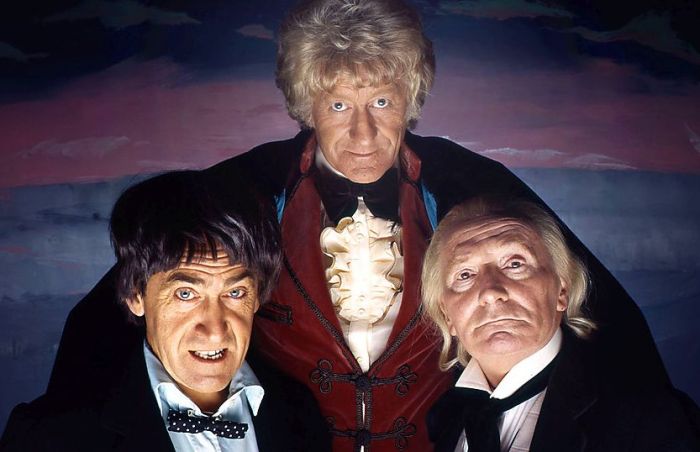
Since yesterday marked the twentieth anniversary of Jon Pertwee’s death, it seemed rather fitting to watch one of his Doctor Who stories as a small tribute. But which one? After a few moments deliberation I plumped for The Three Doctors. It may not be the best Third Doctor story, nor is it the strongest showcase for Pertwee’s talents, but it’s undeniably good fun. And after a hectic week, it was the ideal way to welcome the arrival of the weekend …..
Pertwee’s Doctor was a curious mix of arrogance and charm. His arrogance is at its height in his early seasons, where the Doctor is clearly still more than a little miffed that the Time Lords have exiled him to Earth and decides to take it out on just about every human he meets. Not even poor Jo escapes his snappy nature and thoughtlessness (the sandwiches scene in The Sea Devils is presumably designed to be humorous but it just makes the Doctor appear self-centered and insensitive).
By The Three Doctors he was clearly mellowing, although he can’t resist aiming a few jibes at the Brigadier. But the most interesting example of the Doctor’s regal nature occurs in episode one, when he and Jo return to UNIT HQ after investigating the mysterious disappearance of Mr Ollis. As the Doctor enters the lab, he shrugs off his cloak without a backward glance – no doubt fully confident that Jo (as she was) would be there to take it off him and hang it up. It’s the briefest of non-verbal moments, but it’s something that speaks volumes about the relationship between the Doctor and Jo. It’s hard to imagine some of the Doctor’s later companions being quite so pliant and biddable!
But somehow Katy Manning manages to make it all work. Jo could easily have turned out to be nothing more than a doormat, but Katy’s humour (and undeniable sexiness) help to prevent Jo from being the cardboard cipher she otherwise could have been. However, whilst Jo’s in pretty good form in this one, what’s happened to the Brigadier? The Time Monster was the first example of the dumbing down of the Brig and it’s a process continued here.
Luckily it’s only a short-term thing and he’s back to his normal self by The Green Death, but the Brig’s sadly at his most pompous and blinkered in this story. When it works (his sublime double-take as he spots Troughton’s Doctor for the first time or his reaction to the inside of the TARDIS) it’s brilliant, but there are times when the script seems to treating him as little more than a figure of fun, which is a far cry from the efficient soldier of season seven.
There’s something which has always bugged me about the first episode. When the Doctor and the others find themselves under attack from the jelly organism they take refuge in the TARDIS. The Doctor attempts to take off, but tells Jo that he can’t because the organism is preventing him. What?! He’s been exiled to Earth for three years and during all that time the TARDIS, unless it’s been under the control of the Time Lords or another outside force (such as Axos), has been immobile. A sloppy piece of scripting, fire the script editor I say!
The Gell Guards are highly amusing but also not in the least threatening and the brief battle between them and the UNIT soldiers (“holy moses”) isn’t exactly one of UNIT’s finest moments. But the always reliable Pat Gorman is lurking about, so that’s some small consolation.
With the Doctor and the Time Lords facing the same crisis (an energy drain from a mysterious black hole) there’s little the Time Lords can do to help the stricken Doctor. But wait, there’s just enough energy to lift the second Doctor from his timestream. Hurrah! The return of Troughton’s Doctor is a joyful moment and even if his Doctor has deliberately been written down at times to make the Pertwee Doctor the dominant force (“what’s a bridge for?”) then he’s still a highly entertaining force of nature.
He’s possibly at his best in episode two, after the Third Doctor and Jo have crossed over to the black hole. This leaves the Second Doctor back at UNIT HQ with the Brig and Benton for company. To be honest, this entire episode is little more than padding for all three of them (the Doctor achieves nothing in his fight against the organism, so they all could have travelled into the black hole at the start, rather than the end, of the episode). But the run-around nature of this instalment isn’t really an issue, because it’s all such fun.
There’s the Brig’s shock at seeing the old Doctor back, but even better is the working relationship between the Doctor and Benton. Originally it seems that Jamie was also scripted to appear, so no doubt he would have performed Benton’s role here. But luckily for John Levene that didn’t happen, enabling Benton to get a decent share of the action. Mind you, Levene does seem to be on the verge of corpsing several times and has to pull the most extraordinary faces in order to prevent this.
The brief appearances of the First Doctor is the icing on the cake, even if it’s tempered by how frail William Hartnell looked. Although he wasn’t that old at the time, illness had taken a heavy toll, leaving him unable to learn even the simplest of lines. His balance wasn’t terribly good either, so several stage-hands had to prop him up into the capsule – to prevent him from toppling out. But with the aid of cue-cards held off camera he still managed to capture the authoritative spirit of the original Doctor and, ill as he was, there’s a little touch of magic about these scenes.
If you wanted loud, then you booked Stephen Thorne. He was loud as Azal in The Daemons and he was even louder in his (mercifully brief) appearance as Eldrad in The Hand of Fear. As Omega, he starts fairly quietly but then works himself up into a frenzy by episode four. No doubt we’re supposed to feel sorrow for the tragic Omega, but by the end, as I’m reaching for the remote control to turn him down, I just wish he’d tone it down a little. Thorne can also do subtle (he’s a gifted audiobook reader and doesn’t tend to rant and rave on those) so it’s a pity he wasn’t encouraged to be a little more restrained here.
Once everybody makes the trip to Omega’s domain the story becomes something of a runaround – highlighted by Dr Tyler’s (Rex Robinson) totally pointless attempt to escape. But Pertwee’s Doctor does have a decent fight scene – battling the demons from Omega’s mind in a slow-motion dreamscape – and the bickering between the Second and Third Doctors never fails to raise a smile.
So it’s not perfect, but there’s no doubt that The Three Doctors is a very pleasant way to while away 100 minutes.
Long Shadow: The Great War will be released on DVD by Simply Media on 4/7/16. Review here.
Based on the prize-winning book, powerful BBC WWI documentary series Long Shadow: The Great War makes its UK DVD debut courtesy of Simply Media.
Renowned British historian David Reynolds explores the enduring impact of The Great War on our world and the shadow it has cast over Europe since the last shots were finally fired. This powerful, eye-opening three part series comes to DVD for the first time on 4 July 2016.
In the series Reynolds aims to change the perceptions of the First World War from the mud, blood, Tommies and trenches to give a sense of the broader consequences of war and its effect over the whole of the twentieth century.
Travelling to locations across Europe-from Slovenia to the Sudetenland, Belfast to Berlin- he examines everything that World War I left in its wake, illuminating how the conflict unleashed forces we still grapple with today.
This remarkable series also chronicles how the experience of war haunted the generation who lived through it, and the soldiers who survived it- dynamic characters such as Benito Mussolini, Eamon de Valera, Philippe Petain, James Ramsay MacDonald and Thomas Masaryk.
Drawing on years of research and a wealth of historical footage, Long Shadow provides a fresh, captivating and-at times-terrifying look at The Great War and its lasting legacy.







 Archive Television Musings