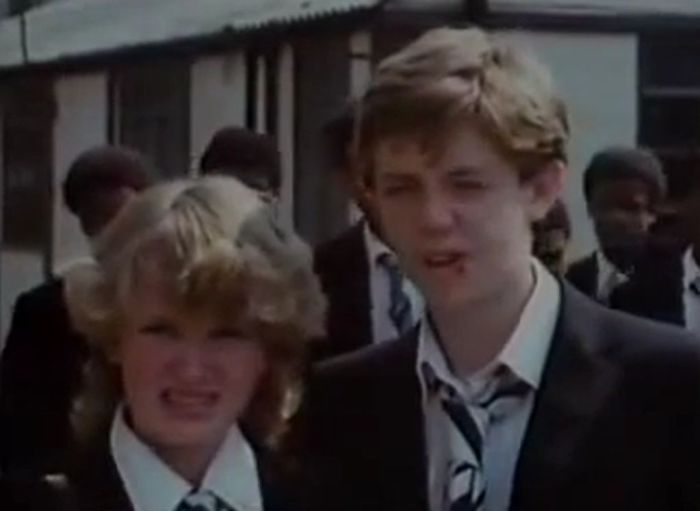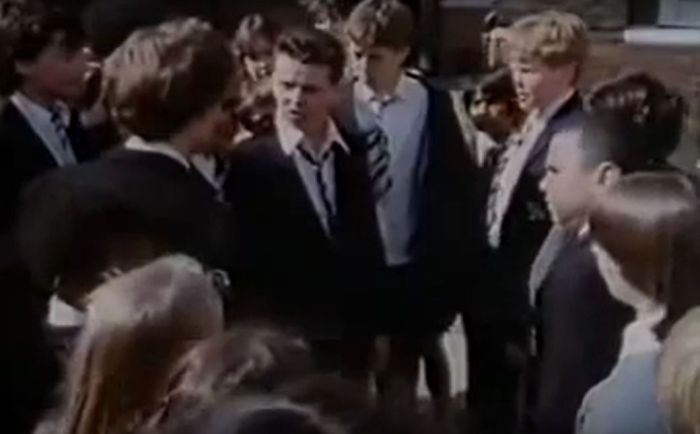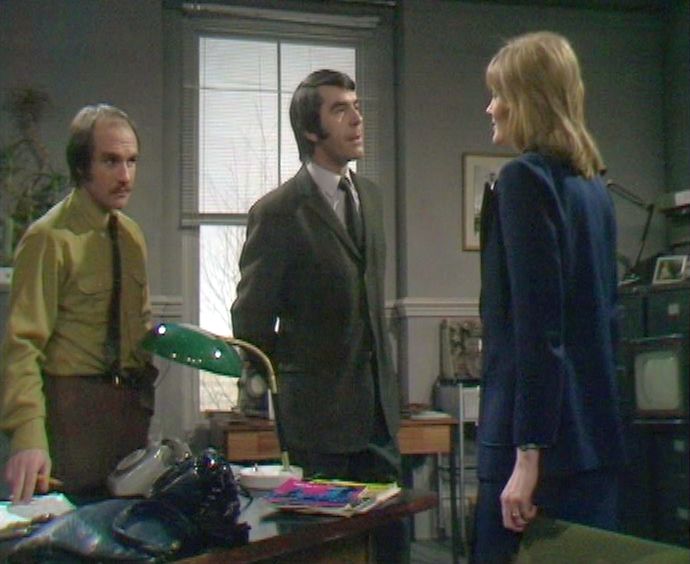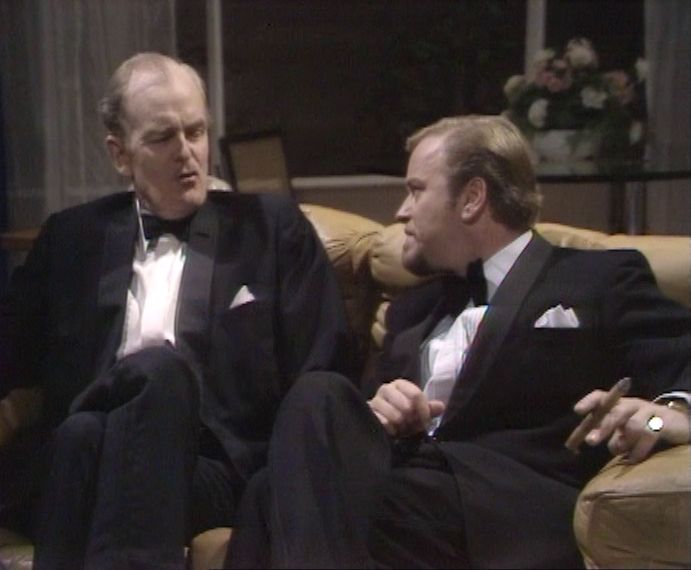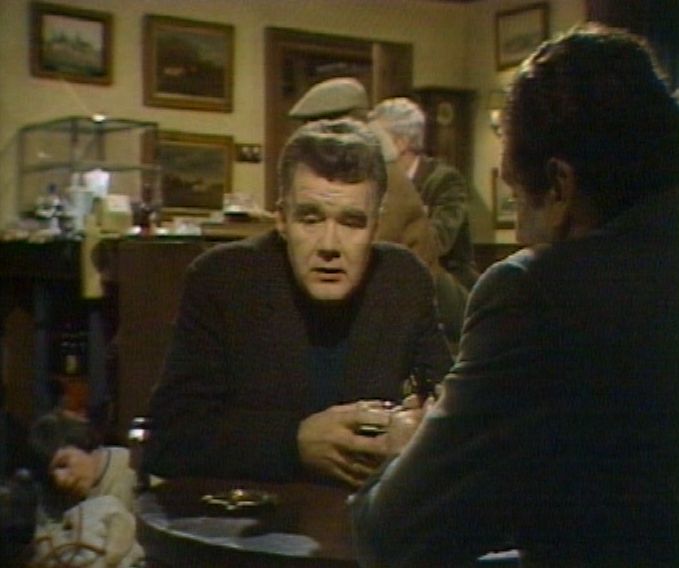
Grange Hill. Series Six – Episode Five

grange hill s06e05

 Written by Margaret Simpson. Tx 18th January 1983

The opening scene sees Zammo at the breakfast table, reading a copy of the Sun, and with a box of Kellogg’s Corn Flakes prominently in the frame.  If it wasn’t for the fact that we know the BBC doesn’t go in for that sort of thing, I’d swear it was blatant product placement! Jonah’s still keen on spending the afternoon at Rodney Bennett whilst Zammo isn’t, although he’s eventually persuaded.  It doesn’t take a genius to guess that this isn’t going to work out well ….

Gripper and Denny tangle with Roland for the first time since episode one.  Despite the fact they’ve been warned off this type of bullying, no doubt they feel confident that Roland will keep quiet.  But there’s also a newer, more insidious tone to Gripper’s abuse of the younger boy, as he tells Roland that he may look white but he’s actually black inside.  The running gag that Gripper is intellectually lacking is maintained when Denny, agreeing with Gripper as usual, tells him that Roland must have a pigment problem.  Needless to say, Gripper has no idea what he’s talking about.

After Diane feels faint during sports, this leads Jonah to wonder exactly why girls are always feeling faint.  Zammo tells him it’s to do with the time of the month, but doesn’t elaborate too much (although he does let drop the nugget of information that it’s all to do with the Moon!)

Later, Zammo and Jonah meet up with Jeremy and some other boys from Rodney Bennett as the plan to infiltrate the school begins in earnest.  One of the them is unmistakably John Drummond, who would turn up two years later as another character, Trevor Cleaver.  This obviously means that he must have been blessed with fresh-faced looks, since he could also pass for a first year a couple of years later in 1985.  A slight can of worms concerns Jeremy himself.  We’re told in an earlier episode that he’s only a first year, but in 1984 he seems to have jumped ahead somewhat as he transfers to Grange Hill and joins Zammo in the third year.  But it has to remembered that the inclusion of Jeremy in 1984 was something of a last minute decision – as we’ll no doubt discuss when we reach those episodes.

Zammo and Jonah’s misadventures at Rodney Bennett certainly benefit from being shot on film, as does the fact we see them enter the school after everyone else has already gone to class.  This makes the pair of them seem very small and instantly makes the school an even more foreboding place.  The sound of a hectoring teacher’s voice from off-screen (sounding all the world like he could have been auditioning for Pink Floyd’s The Wall) is another obvious sign that this is a far less welcoming place than Grange Hill.

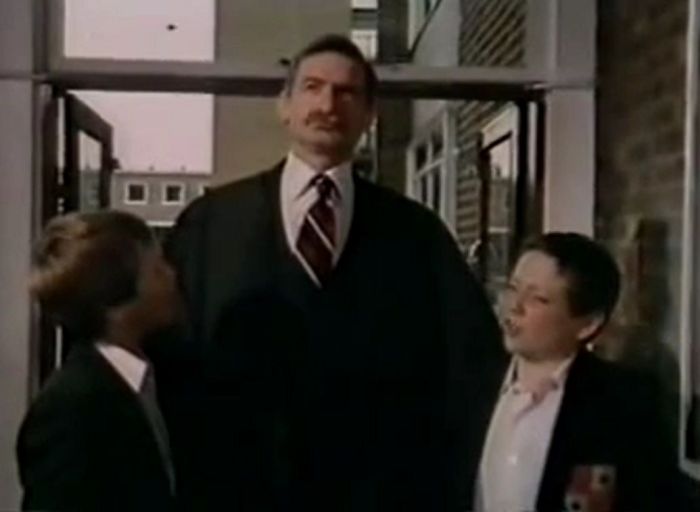
The sight of Stanley Lebor as a harsh teacher is something of a highlight.  Although probably best known as the meek and mild Howard Hughes from the classic Richard Briers sitcom Ever Decreasing Circles, prior to this Lebor had tended to play more intmindating figures (as he does here).  Lebor’s teacher has no compunction in grabbing the two boys by their ears or banging their heads together to make a point!  And a familiar film trick, used from the very first episode onwards, is also brought into play – the camera is positioned low down and angled upwards, making the adult seem even taller than he already is.

Also, Fay’s increasing interest in sports causes more friction between her and Annette whilst Diane is the recipient of some mild bullying from Roland.  That Roland, who’s suffered at the hands of bullies more than most, should start to lash out at the girl is, in one way, quite understandable.  Anybody who draws attention away from himself is clearly welcome, but that he also lashed out at the girl immediately after being bullied by Gripper indicates how the bullying of one person can have a knock on effect, as we see them then take their frustrations out on someone else.


Grange Hill. Series Six – Episode Four

grange hill s06e04

Written by Jane Hollowood. Tx 14th January 1983

Duane’s far from happy that Stewpot, in his own halting way, is attempting to ask Claire out.  Quite why this is, since Duane’s never asked her out himself, is a bit of a mystery. Duane and Claire have been friends since the first year (and it always seemed likely they would end up together) but since Duane’s not made a move by now you have to assume that he’s not interested.  Either that, or he’s a very, very slow operator.

Stewpot attempts to clear the air at breaktime. It’s always struck me as a strange detail that Duane’s reading Practical Camper whilst waiting in the tuckshop queue.  I don’t know why, it’s just a slightly unexpected magazine for him to have!

This storyline is another example of how Duane (who was a longer established character than Stewpot) has gradually been marginalised.  It seems that the rough-and-tumble Stewpot was more interesting to write for than the conventional Duane and by series seven we’ll see that Duane is even more surplus to requirements – with Stewpot and Pogo forming a decent double act, there’s no role left for Duane to play.

Gripper’s gang has grown by a few more and they continue to target Randir.  He’s rescued by Woody Woods (Tony MacPherson) who suggests he hangs around with him and his friends.  Since Woody and the others are black, there’s a clear division being made across racial lines – although it’s still yet to be openly stated that Gripper’s picking on people because of the colour of their skin.

This happens later, as Pogo asks Randir to use his scarf to make a turban.  It’s a moment of rapprochement between different cultures, which is quickly stamped on by Gripper – who tells Pogo that things aren’t going to be pleasant at Grange Hill for any foreigners soon.

Mrs McClusky seems to be aware that staff shortages are making playground bullying more of a possibility, but rather than target the bullies she elects to reduce the pupil’s breaktimes.  Mr Hopwood voices his concern that by doing this they’re not attacking the problem, only dealing with the symptoms, so it’s a strange decision.

Suzanne’s been in a strop since episode one, ever since she learnt that she wouldn’t be able to take the options she wanted.  Her split skirt doesn’t meet with Mrs McClusky’s approval either, meaning that Susan Tully’s default expression so far this year has been “disgruntled”.

Fred – Simply Media DVD Review

fred

In 1978 Fred Dibnah was commissioned to repair  the clock tower at Bolton’s Town Hall.  His casual attitude, even when suspended from a rickety bosun’s chair high above the ground, caught the attention of the BBC’s local news programme, Look North West.  Dibnah’s down-to-earth attitude meant that he was an excellent subject for a one-off documentary broadcast in 1979, Fred Dibnah, Steeplejack.   This then led to the seven part series Fred, broadcast in 1982.  Both are included on this DVD.

Easily the most famous part of Fred Dibnah, Steeplejack is the moment when he has to run fairly sharpish to avoid being crushed by a chimney which he’d just detonated.   His immediate response of “d’you like that?” was a classic television moment and it’s no surprise that it was later used on the opening credits of every episode of Fred.

Both the one-off documentary (which won a BAFTA in 1979) and the series follow a similar path.  They show Fred both at work and off-duty (where he’s often to be found tinkering in his shed). Wherever he’s working – up chimneys, church steeples, etc – the pictures are enlivened by Fred’s pre-recorded musings on a variety of topics.  Nobody could ever have called him profound, but his thoughts on life and religion have a rugged honesty about them.  Fred might have already been something of a celebrity by the time Fred was made (the third episode sees him as a guest of honour at a shop opening) but he still seems to take everything in his stride.

Fred’s all-consuming passion for his steam engine (which he spent more than a decade restoring) is gently suggested as putting something of a strain on his marriage.  After all, he seemed to spend more time in the shed with it than he did with his wife and children.  There’s also a later scene, which could possibly have been staged for the cameras, showing Fred merrily driving the steam engine very slowly down the road, whilst his wife and children stoically sit on the back!  But when you know that Alison, his first wife, let him in 1985 because she felt neglected, it does tend to make you view certain moments in a different way.

With series like these, it’s always interesting to ponder just how much we see is truthful and how much is the way it is just because there were cameras rolling.  Certain moments, such as when Fred decides to buy a new engine, do seem a little forced – mainly because the other person in the frame with Fred doesn’t seem as comfortable in front of the camera as he is.

But the public Fred probably wasn’t terribly different from the private Fred and this could be the reason why he was such a hit with the public.  Although he made many later series, for me this one is the most compelling.  With Deryck Guyler’s unmistakable tones as narrator, Fred is a pleasure from beginning to end.  Whether he’s musing about how he feels undressed without his cap or hoping that heaven will be stocked with steam engines, there’s plenty to enjoy.  And if Fred’s rough-hewn philosopy doesn’t entertain, then you can simply sit back and enjoy some of the remarkable photograpy as he scales some incredibly high constructions with a highly casual air.

Disc one contains the first four episodes of Fred, whilst disc two has the final three, plus the 1979 Fred Dibnah, Steeplejack.  Some sources say that Fred was an eight part series, although since the eighth episode listed by the likes of IMDB (A Disappearing World – not included in this set) was broadcast some six months after the rest of Fred, it’s actually a one-off and not part of the series, hence its non-inclusion here.

Fred is released by Simply Media on the 23rd of May 2016.  RRP £24.99.

fred


Grange Hill. Series Six – Episode Three

grange hill s06e03

Written by Jane Hollowood. Tx 11th January 1983

This episode opens with Randir and his family sitting around the breakfast table. The relationship between Randir and his father is one of mild conflict – especially since Randir’s father is portrayed as somewhat conflicted. On the one hand he wants his son to succeed at Grange Hill and make full use of the opportunities available, but when Randir mentions that he wants to attend the football trials on the weekend this doesn’t go down well. Somewhat stereotypically, the Singhs own a shop, and Randir is expected to work there at the weekend. So although his father wants him to do well at school (and therefore integrate into the local community) this is something that can only go so far (business must come first).

Although Mr Hopwood notes that Randir hasn’t made much of an effort to get to know his classmates, he’s far from the sort of isolated, victim character that Roland was. If Randir is self-contained, he’s also confident and this is one of the reasons why he catches Gripper’s attention (the fact that Claire speaks to him is another).

Even though Randir is outnumbered two to one (Gripper’s shadow, Denny, is still about) there’s no sense that Randir is at all cowed or frightened by Gripper’s approach. They’re pretty much the same, height and wright wise, so it wouldn’t be easy to pick a winner in a fair fight (although Gripper’s not likely to fight fair!). This begs the question as to why Gripper targets him, as before he’s always gone for easier and younger prey. We’ve seen that the others have shut down Gripper’s extortion scheme, so a spot of racial bullying is clearly a decent alternative, but in story terms this is slightly problematic.

As the rest of the school had eventually decided to stand up to Gripper and tell him that his bullying was no longer acceptable, why did they allow him to get away with a new wave of racially motivated bullying? It seems to be (although it’s only later lightly touched upon) there’s a general distrust between the different races (so if a black kid was being bullied a white kid wouldn’t necessarily go to help). There have been obvious exceptions to this – Benny, for example – but then Benny wasn’t a character defined by the colour of his skin or his religion, whilst Randir most certainly is.

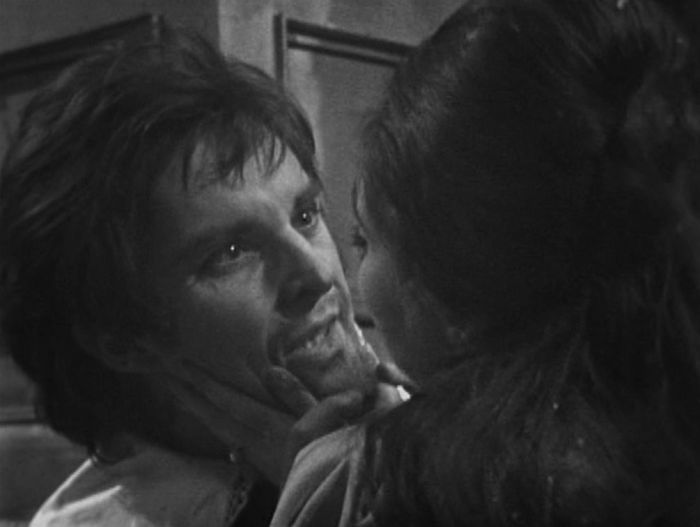
Gripper’s acquired a new henchman in addition to Denny, Georgie (Sam Smart), and the three of them decide to unwrap Randir’s turban. This then sees a number of coincidences – Claire and Suzanne are passing at precisely that moment and Gripper decides to turn his attention onto Claire (pinning the girl against the wall and asking for a kiss). The next coincidence is that Stewpot and Duane were also close at hand and Stewpot goes rushing in, fists flailing. The fight isn’t pretty, but it’s entertaining. It’s also notable that Duane hangs back and had to be pushed forward to get involved. The upshot is that Claire and Stewpot are thrown together (there’s a certain noble look of suffering in his eyes as he lies down on a bench as Claire tends his bloody face!) and they’ll shortly become an item.

We end back where we began, with Randir and his family at home.  Randir sees his turban and his religion as factors which mark him out as different and therefore a target for people like Gripper.  His father, whilst accepting that racial abuse is a part of parcel of life, tells him that he’s a Sikh and therefore he can’t deny his culture – otherwise he’d lack any sort of identity.  The tension between a wish to conform and a desire to retain existing cultural links is an interesting one, although as his family don’t reappear after this episode it doesn’t really get developed.

The Further Adventures of the Musketeers – Simply Media DVD Review

further

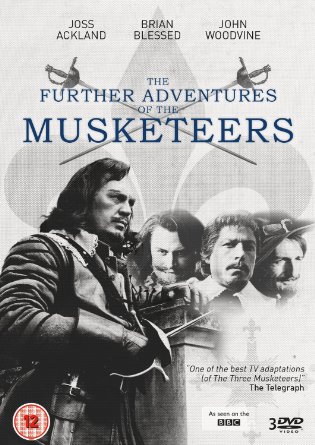
Broadcast between May and September 1967, The Further Adventures of the Musketeers (based on Dumas’ novel Twenty Years After) was a sixteen-part serial which followed on from the previous years adaptation of The Three Musketeers.

Brian Blessed and Jeremy Young returned as Porthos and Athos, but there were also two important changes.  Joss Ackland took over the role of d’Artagnan from Jeremy Brett whilst John Woodvine replaced Gary Watson as Aramis.

I have to confess at not being terribly impressed with Brett’s performance as d’Artagnan, so I wasn’t too sorry he didn’t return – although it would have been intriguing to see how he would have handled the older, more cynical character seen in this story.  In The Three Musketeers, d’Artagnan is young, keen and filled with dreams of heroism.  It’s therefore more than a little jarring when Ackland’s d’Artagnan is introduced at the start of the first episode.

Others may continue to call him a hero, but he’s not convinced.  Although he still holds a commission in the Musketeers, it now appears to be a hollow honour – especially since his three former steadfast friends (Porthos, Aramis and Athos) have all left and gone their separate ways.  When he recalls their old battle cry (“one for all, and all for one”) it’s done so ironically and whilst he bursts onto the screen with an impressive bout of swordplay, it was only to subdue a drunk in a tavern.  Brawling in taverns seems to be something of a comedown for the brave d’Artagnan, as he himself admits.

He’s therefore keen to grasp any opportunity to rekindle the glory days of old and when Queen Anne (Carole Potter) asks for his help, how can he refuse?  Potter was something of a weak link during The Three Musketeers and her rather grating performance continues here. This may be a deliberate acting choice though, as we see over the course of the serial that the Queen is a far from admirable character – instead she’s capricious, vain and frequently misguided.

d’Artagnan pledges his allegiance to the Queen, her young son, King Louis XIV (Louis Selwyn) and Cardinal Mazarin (William Dexter).  They are the orthodox ruling establishment, but the majority of the people seem to side with the imprisoned Prince de Beaufort (John Quentin).

The question of personal morality is key, especially when understanding which side the four Musketeers support.  As we’ve seen, d’Artagnan supports the Cardinal and Queen, but is this because he believes they are the right choice for France or is it just that they’ve offered him a chance to redeem his tarnished honour?

When d’Artagnan meets up with Porthos, his former colleague quickly joins him.  Blessed, a joy to watch throughout the serial, is never better than in his first scene.  He’s the lonely lord of a manor, complaining that his neighbours consider him to be something of a peasant and won’t talk to him, even after he’s killed several of them!  So he agrees to join d’Artagnan, mainly it seems because he’s always keen for a scrap.

But Aramis and Athos are both on the Prince’s side.  They believe their cause is just and Athos regards d’Artagnan’s allegiance to the Cardinal with extreme disfavour.  Athos supports the King, but in his opinion the Cardinal is manipulating both the King and the Queen to serve his own ends. It’s telling that d’Artagnan doesn’t deny this.

Joss Ackland, from his first appearance, is totally commanding as d’Artagnan.  If Brett’s take on the role tended to see him play the character at a hysterical pitch then Ackland is much more restrained and therefore much better. As I’ve said, Brian Blessed is tremendous fun – he gets to shout a lot and has some great comic lines.  John Woodvine, a favourite actor of mine, is excellent as Aramis whilst Jeremy Young once again impresses hugely as Athos.

Although there wasn’t a great deal of evidence of this in The Three Musketeers, at the start of this serial d’Artagnan tells us that Athos was always his mentor and closest friend (essentially a second father to him) so the fact they are on opposing sides means there’s some dramatic scenes between them.

Young, a rather underrated actor I feel, is compelling across the duration of the serial. Athos’ monologue in episode five, after d’Artagnan bitterly rounds on his old friends, is one performance highlight amongst many. “We lived together. Loved, hated, shared and mingled our blood. Yet there is an even greater bond between us, that of crime. We four, all of us, judged, condemned and executed a human being whom we had no right to remove from this world. What can Mazarin be to us? We are brothers. Brothers, in life and death.”

Athos is referring to the murder of his former wife, Milady de Winter. As we’ve seen, her death still preys heavily on his mind – but he’s not the only one. She had a son, Mordaunt, who spends the early episodes vowing vengeance on the men who murdered his mother. As the serial progresses we see that his thirst for revenge makes him a formidable foe. A variety of other plot threads also run at the same time – such as the kidnapping of the boy King, Athos and Aramis’ secret mission to England to rescue King Charles I (d’Artagnan and Porthos are also in England and change sides to fight for the King) and the continuing conflict between Queen Anne and Prince de Beaufort – all of which helps to ensure that the story, even though it lasts sixteen episodes, never feels repetitious.

Plenty of quality actors drift in and out.  Edward Brayshaw (once again resplendent in a blonde wig and complete with a wicked-looking dueling scar) returns as Rochefort, Michael Gothard is suitably villainous as Mordaunt, Geoffrey Palmer is memorable during his fairly brief appearance as Oliver Cromwell, David Garth is remote and aloof as King Charles I, whilst the devotee of this era of television can have fun picking out other familiar faces such as Nigel Lambert, Anna Barry, Morris Perry, Vernon Dobtcheff, David Garfield and Wendy Williams.

The budget was obviously quite decent, as there’s a generous helping of location filming and several notable set-pieces – such as the Prince’s escape from his prison fortress, which sees him absail to safety from the castle ramparts (although the use of illustrations as establishing shots for various locations is never convincing). Generally though, Stuart Walker’s production design is impressive – for example, his studio reproduction of Notre Dame Cathedral includes various architectural features from the original. Few would have missed them had they not been there, but it’s a nice example of the trouble taken to be as accurate as possible.

With a number of interconnecting plotlines, there’s certainly a great deal to enjoy in Alexander Barron’s dramatisation.  The episodes set in England may lack a little tension (as we know Charles is doomed to die) but his execution is still a powerful moment.  Athos is under the scaffold, frantically attempting to rescue the King, and is crushed when he realises that all his efforts have come to nothing.  A macabre note is created when Charles’ blood drips through the floorboards onto the numb Athos. Christopher Barry and Hugh David share the directorial duties and although there’s (possibly thankfully) few of the directorial flourishes that made The Three Musketeers notable, they manage to keep things ticking along nicely.

The Further Adventures of the Musketeers looks and sounds exactly how you’d expect an unrestored telerecording of this period to look and sound.  It’s perfectly watchable, although the picture is a little grainy and indistinct at times (and the soundtrack can also be somewhat hissy).  A full restoration would have been possible, but as always it’s a question of cost.  Niche titles like this don’t sell in huge numbers, so it’s no surprise that this DVD was a straight transfer of the available materials.

But although the picture quality is a little variable, the story and the performances of the four leads more than makes up for it.  With many classic BBC black and white serials still languishing in the vaults, hopefully sales of this title will encourage more to be licenced in the future.

The Further Adventures of the Musketeers runs for sixteen 25 minute episodes across three DVDs.  It’s released on the 23rd of May 2016 by Simply Media with an RRP of £29.99.
Grange Hill. Series Six – Episode Two

grange hill s06e02

Written by Barry Purchese. Tx 7th January 1983

There’s a disturbing flashback to the saga of Belinda’s missing clarinet with the tale of Fay’s missing hockey stick.  With Belinda now safely back in Canada, a new character, Julie Marchant (Julie York), is introduced in order to provide some discord to the Fay/Annette relationship.

As before, we see that Annette is extremely wary of anybody who attempts to establish a friendship with Fay. To Annette, Fay is her friend and she seems very disinclined to share her.  The reasons for Annette’s insecurities remain undeveloped at present and won’t really be touched upon in any depth until the following year (after it’s revealed that her home life is far from stable).

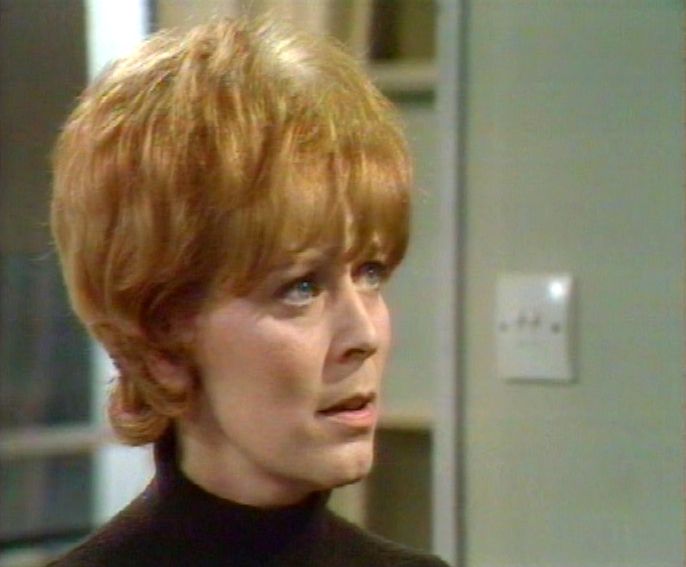
Several new characters make their debut.  Diane Cooney (Julie-Ann Steel) has severe acne and quickly becomes a figure of ridicule for the two meanest girls in the class, Mandy (Anita Savage) and Sarah (Joanne Bell).

Poor supervision of sports lessons has been a constant at Grange Hill since series one, and it continues here as Miss Saunders (Jennie Stoller) leaves her gym class under the not-very-watchful eye of Mandy and Sarah.  That Miss Saunders would chose those two girls, rather than, say, Fay, is a little hard to swallow – especially since Fay’s all-around sports ability is quite plain (even if it earns resentment, rather than appreciation,  from some of those around her – especially Annette).

Mandy and Sarah deliberately throw Diane off the vaulting horse and proceed to kick her whilst she’s on the floor –  and all the while Miss Saunders is oblivious to what’s going on.  After Fay confronts them in the changing rooms, Annette uses their argument as a cover to hide Fay’s hockey stick.  Since she’s upset about Julie’s friendship with Fay, hiding the hockey stick allows her to discredit Julie and (after she plans to later “miraculously” discover it) she no doubt believes it will strengthen her friendship with Fay. Things don’t quite go to plan though, as Mandy and Sarah discover Annette’s secret and it’s up to Julie to save the day.

This episode is also notable as it features Zammo and Jonah’s first attempt to infiltrate Rodney Bennett.  But Jonah’s plan to spend the afternoon at Rodney Bennett (don’t ask why) runs aground after Mr Baxter spots them.  But the boys are nothing if not persistent, so we’ll return to this storyline at a later date.

Grange Hill. Series Six – Episode One

grange hill s06e01

Written by Barry Purchese. Tx 4th January 1983

The first episode opens with a directorial flourish from Carol Wilks – a remarkably high panning shot which slowly tracks along rows and rows of houses. The camera then zooms into a selected house as we see Randir Singh (Kakir Singh) setting off for school.

That Randir is being positioned, even this early on, as something of an outsider is suggested by the fact that he’s carrying a satchel (generally only swots like Justin tend to have them) although it could have been provided so that Mr Smart can later crack a sort of Shakespearian joke at his expense.

As Randir walks down the street (and also as Jonah makes his way to Zammo’s flat) there’s an interesting use of non-diegetic sound – we hear a radio playing with Mike Read spinning a series of discs seemingly designed to sap the spirits of all those children returning to school for the new term.

If anybody ever picks up Grange Hill for DVD release (unlikely I know) then it’s a fair bet that one of the tracks, Pink Floyd’s Another Brick in the Wall, would be snipped out, although at least it does play out over a scene where there’s no dialogue, so a substitution would be fairly straightforward.

The early part of the episode reintroduces us to the main characters. It’s our first sight of Roland since he fell under a car late in series five and, no surprise, he’s still far from willing to go to school. That no progress has been made, even after all his meetings with the educational psychologist, is made clear after he complains that he’s got stomach pains. Mrs Browning (one of Jo Kendal’s final appearances, as she’ll be later written out – leaving Roland and his father to fend for themselves) tells him that’s a pity as she’ll have to throw his breakfast away. Unsurprisingly he then perks up and suggests he could manage something. It’s a gag in one way, but it’s also quite a sad and depressing moment.

There’s a new teacher in town, Mr Smart (Simon Haywood). His name is a none too subtle joke, Smart by name, smart by nature. To begin with, he’s a tidy and precise martinet – a stickler for discipline (his undisguished shock at Mr McGuffy’s appearance and attitude is plain to see). But whilst he may be something of a two dimensional figure this year, over time he develops and by series eight he’s a much more relaxed, humorous and approachable figure. But no doubt this was in part due to Mr Bronson’s debut in series eight, necessitating Mr Smart’s realignment as a more sympathetic character.

Jonah starts off in a very annoying fashion and Zammo’s very dense. The laboured gag that Jonah was allowed into a shop that banned Grange Hill pupils because he’d sown on a Rodney Bennett badge was painfully obvious to everyone. Everyone that is except Zammo who doesn’t notice what’s  right in front of his eyes. It’s  also the first mention of Jonah’s Rodney Bennett cousin Jeremy (Vincent Mathews) who’ll return a few times, most notably during series seven.

Gripper’s up to his usual tricks of demanding money with menaces and is delighted to welcome his old customer Roland back. That Roland is more integrated into the school community seems obvious after the others rally round to try and make him look a little more presentable after Gripper’s done his worst (Jonah offering to sew his blazer buttons back on, for example).

Gripper’s interest in Claire (which fills her with disgust) is given its first airing, but the most notable part of this episode is how everybody bands together to finally bring an end to Gripper’s extortion racket. Logically it had to happen – given that his persecution of Roland and the others seems to be common knowledge it would have stretched credibility to breaking point if he’d simply picked up where he’d left off.

But as we’ll see, it’s the arrival of new boy Randir that suggests a new course of action to him.

Doomwatch – Sex and Violence

sex

There’s a clear irony in the fact that Sex & Violence, a story which concerned itself with the question of censorship, was pulled from the schedules and was never transmitted.  Given the very depleted nature of season three Doomwatch episodes it’s odd, but welcome nonetheless, that an episode which didn’t even make it to the screen somehow managed to survive the archive purges (logic would have suggested it would have been the first to go).

One suggestion for the reason why the BBC got cold feet concerns the use of real-life Nigerian executions.  It’s certainly shocking – but this footage had already been transmitted on several occasions prior to this, so it’s reasonable to assume that for viewers at the time the shock value wouldn’t have been too great.  And had this really been a cause of concern it would have been easy to excise the section without damaging the narrative flow too greatly (we could have cut away from the clip before the shooting and simply shown the reaction of the watching committee).

It seems much more likely that the episode was pulled since several characters were thinly disguised caricatures of real people.  Both Mrs Catchpole (June Brown) and Mrs Cressy (Noel Dyson) have more than a touch of Mary Whitehouse about them.  This is made very obvious in the pre-credits sequence, which sees Mrs Catchpole holding forth at a public meeting – held in a church – and railing about the filth thrown at people like her (her audience is comprised of middle-aged, middle-class women) by the intellectual media elite.

Unlike Mrs Whitehouse, Mrs Catchpole isn’t a national figure, therefore she tends to exist around the fringes of the plot.  So Mrs Cressy also acts as a Whitehouse substitute – she’s less of a rabble-rouser, but is equally vehement about stamping out sex and violence.  Mrs Cressy is a member of the Purvis sub-committee, who have been charged with investigating all aspects of pornography and violence in the media.  Quist is also asked to look into the same question, which he’s less than keen about.

Pollution in the air or the sea he can understand, but moral pollution?  It’s not his thing at all.  But as we’ve seen several times before, Quist starts off doubtful but eventually gets more interested as the story progresses.  It’s just a pity that yet again he’s operating on the periphery of the plot. Dr Tarrant is seconded to the sub-committee, which means she’s as an active participant, leaving Quist as a fairly passive onlooker.

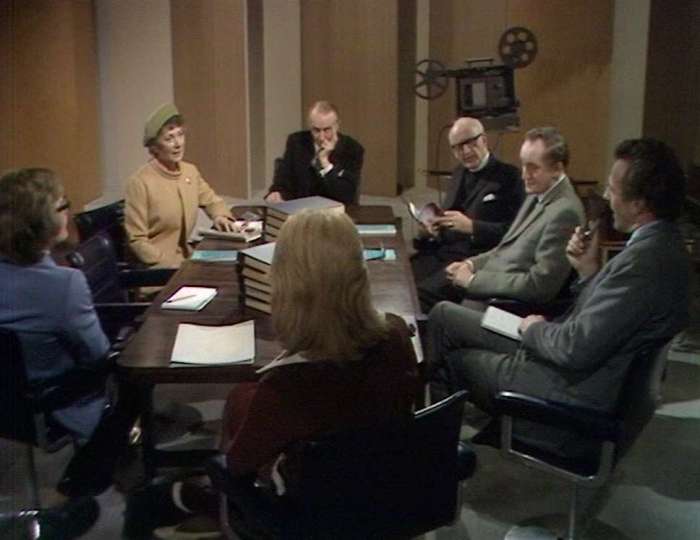
The other members are Professor Fairbairn (Brian Wilde) and Steven Grainger (Bernard Horsfall) who tend to lean towards the permissive end of the spectrum.  Mrs Cressy and the Rev Charles Garrison (Llewellyn Reees) take the opposing view, which means that Dick Burns (Christopher Chittell) is a valuable floating voter, since he holds no firm opinions either way.  Burns, a pop star, is another clear analogue to a real public figure (at the time Cliff Richard had been asked to sit on a very similar committee).  Although Burns is a much less straight-laced figure than Richard, the parallel seems clear.

Sex & Violence is a dense, talky episode – a great deal of it revolves around the committee’s debates – which really comes alive thanks to the first-rate guest cast.  Brian Wilde and Bernard Horsfall are always a pleasure to watch, whilst June Brown (a decade or more away from achieving national fame in EastEnders) has some sharply written comic scenes.  It’s fair to say that Mrs Catchpole isn’t a subtle character though, and it’s no doubt this less than veiled attack on Mrs Whitehouse which sealed the story’s fate.  The Doctor Who fan in me was quietly delighted to see Llewellyn Rees and Bernard Horsfall in the same scene (a few years later they’d both appear in The Deadly Assassin).

There’s no stunning revelations here.  For example, Anne is attacked by Mrs Hastings (Angela Crow) as she attempts to buy a ticket for an Oh Calcutta type play.  Although Anne’s hurt and bruised, she’s much more interested why a law-abiding person like Mrs Hastings would be incited to violence.  The answer seems to be that she’s always been fairly repressed about sex (since her parents didn’t talk about it at all) which it probably didn’t take a psychiatrist to work out!  It’s also worth mentioning the décor of Mrs Hastings’ flat, which has the most garish early seventies wallpaper you could possibly imagine.

When Quist later wonders exactly why Doomwatch is involved, it’s easy to agree with him.  It’s an interesting enough story, but it’s also yet another example of how far the series changed from the early Pedler/Davis ecological tub-thumping.

Possibly the most interesting part of the plot revolves around the character of  Arthur Ballantyne (Nicholas Selby).  He’s a political figure who’s made considerable capital out of the sex and violence debate (he’s revealed to have financed a number of pressure groups, including Mrs Catchpole’s).  It’s easy enough to look around today and find politicians who have risen to prominence on the coat-tails of controversial debates – which is a final demonstration that Doomwatch, even forty years later, can continue to hold a mirror up to our society.

Doomwatch – Hair Trigger

hair trigger

Anne is at Weatheroak Hall Maximum Security Medical Research Unit.  She’s there to meet Doctor McEwan (Barry Jackson) and Professor Alec Hetherington (Morris Perry) who have developed a revolutionary process to deal with hardened and psychopathic criminals.

Behind a glass panel she observes Michael Beavis (Michael Hawkins) receiving treatment.  Anne is horrified to learn that he’s essentially little more than a radio-controlled puppet – electrical impulses, controlled via a computer, damp down any negative or violent feelings he may have and McEwan is convinced this will enable him to be reintegrated into society (otherwise Beavis would remain a prisoner in Broadmoor and therefore a severe drain on the nation’s finances).

But for Anne, Beavis isn’t cured – his psychopathic tendencies are simply being suppressed.  Apart from the ethical issues this raises for her, she’s also far from convinced that the treatment is foolproof.  McEwan is happy for her to speak to Beavis on a one-to-one basis in order that her fears may be allayed, but by doing so she re-opens his long-buried trauma and after attacking her, he escapes ….

Hair Trigger was tapping into something of a zeitgeist about how technology could deal with violent criminals.  This was a theme of A Clockwork Orange (both the original book and the later film) whilst the 1971 Doctor Who story The Mind of Evil  also had its own method of removing evil impulses from the minds of criminals (an alien parasite).  Although the Doctor Who story was much more fantastical than Hair Trigger,  there are some similarities – not least Anne’s statement that by suppressing all the violent tendencies from any given subject they’ve basically been neutered and aren’t really human beings any more.

Director Quentin Lawrence creates a decent visual joke as the episode title and writer credit is displayed following the opening credits. They’ve overlaid over what appears to be a pastoral scene, but a few seconds later it’s revealed to be an album cover of classical music, which Anne puts onto the turntable as she attempts to convince Quist that McEwan’s process is fundamentally immoral.

Quist is slow to agree (although there’s the suggestion later that he was playing devil’s advocate). That Anne is the one who’s concerned whilst Quist remains a passive onlooker is another example of the way his role was downplayed during series three. He acts as a decent sounding board for Anne to develop her arguments, but apart from that Quist has little involvement in the main narrative.

The rest of the Doomwatch team are also pretty much surplus to requirements in this one. Bradley is absent, whilst Stafford and Barbara only have a couple of scenes. Although even in the limited screen time they both have, Barbara’s obvious dislike of Stafford is made quite clear.

Morris Perry and Barry Jackson both give characteristically solid performances, but the acting honours must go to Michael Hawkins as Beavis. When we first meet him, Beavis is desperately keen and eager to please, although when McEwan gently tells him that Anne will want to talk about his past life there’s a strong sense that his former crimes (he murdered his wife and children) still trouble him.

This is therefore something of a story weakness. We’re told that McEwan’s work has a zero failure rate – yet as soon as Anne starts to probe Beavis about his history he goes berserk. And the computer control isn’t able to stabilise him afterwards, as he escapes from the compound and takes a family hostage.

If the Doomwatch team aren’t terribly well used here (remember that Anne isn’t actually a member of Doomwatch) then Brian Hayle’s script is still a tautly written and well-acted affair. As I’ve said, acting kudos must go to Hawkins, especially in the final ten minutes as the hostage situation plays out to an inevitable but nonetheless powerful conclusion.

Doomwatch – Waiting for a Knighthood

waiting

Although Waiting for a Knighthood was only the fourth episode of series three, there had already been a number of key developments during the first three (all now sadly wiped) episodes.

The series opener, Fire and Brimstone, had seen John Ridge steal a number of anthrax phials in order to hold the government to ransom.  This plotline had been developed to lessen Simon Oates’ involvement in the show, as he’d disliked the way the second series had developed and didn’t wish to remain a regular for the third run.  Waiting for a Knighthood, which sees Ridge ensconced in a secure nursing home following his breakdown, is the last existing episode which features him.

Ridge’s removal from Doomwatch meant that a replacement had to be found – hence the introduction of Commander Neil Stafford (John Bown).  Stafford isn’t a scientist, he’s a security man, which meant he could take over the security and clandestine aspects of Ridge’s role whilst remaining a distinct character.  He’s certainly no womanizer and the fact that he reports to the Minster means that it’s not always easy to know where his loyalties lie.  Given the small number of series three episodes existing, he looked to be an interesting character and it’s a pity that we don’t have the opportunity to see more of him in action.

Perhaps the most jarring aspect of this episode is that we see Quist relaxing at home (or as it turns out, Anne Tarrant’s home) – the picture of perfect domestic contentment.  Up until the end of series two, Quist had been an emotionally isolated figure – living only for his work – so it’s something of  surprise to find that he’s now deep into a relationship (and also that Anne calls him “Spence”! which is something nobody else has done).

Given that when Dr Fay Chantry was introduced in series two Ridge mentioned casually in passing that she might be a decent match for Quist, it’s intriguing to wonder whether any thought had been given to matching them up.  It’s just as likely a coupling as the one-off character of Dr Tarrant (who had appeared in You Killed Toby Wren) linking up with him I guess.

Waiting for a Knighthood opens with Anne attending a church service.  Along with the other parishioners, she’s perturbed to see the vicar suffer a breakdown and it’s later revealed that he’s suffering from lead poisoning (he’s a keen mechanic and had ingested a dangerous level of fumes).  A similar thing seems to have happened to Ridge, which provides an explanation for his behaviour in Fire and Brimstone.

These incidents, and increasing concerns about the levels of lead in petrol, indicate that there should be tighter controls – but Richard Massingham (Frederick Jaeger), after enjoying a decent dinner with the Minister, Sir George Holroyd (John Barron), tells him he’s not convinced.  Massingham is an oil man and doesn’t see why a few high profile cases should mean swingeing restrictions.  After all, he says, it’s not as if people are dropping down dead all over the place.

The debate about harmful levels of lead both here and at the Doomwatch office keep the story ticking along, but the main part of the plot concerns the kidnapping of Massingham’s young child (played by Stephen Dudley).  Dudley, the son of producer Terence Dudley, would be a regular a few years later in Survivors (and already had another Doomwatch credit – Tomorrow the Rat – to his name).  Dudley the younger is rather irritating in this one, so I’m thankful his screentime was fairly limited.

Coincidence is the name of the game here.  The boy was kidnapped by Mrs Sylvester (Glenm Watford) who happened to be passing Ridge’s garage at just the right moment to hear Bradley and Stafford discussing the possibility that Ridge had suffered from lead poisoning.  Her own son had died from something similar and so she decides to kidnap Massingham’s boy in revenge.  And Massingham has direct links with the Minister, which means that Doomwatch are involved straight away.

If the plot seems a little messy and rather open-ended, then there’s still some useful food for thought about the dangers of lead in petrol.  Bradley gets  decent share of the action (as does Barbara, who becomes more of a central character during series three – just a pity that we can’t see most of it).  Frederick Jaeger as Massinghm is suitably solid.  Massingham isn’t a cartoon villain – knowingly polluting the air – he’s a realist who knows that the only way for the government to take action is if they raise petrol prices substantially, which of course they won’t do.

A pity that Quist’s rather sidelined though, but that tends to be par for the course with series three.

Doomwatch – Public Enemy

public enemy

After a young boy retrieves his football from the roof of Carlingham Alloys he collapses and later dies.  His death shocks the local community, not least Arnold Payne (Derek Benfield).  Payne’s family had previously owned the factory but sold it some time back to a major multi-national concern (and he now views it with a very jaundiced eye).

Carlingham are developing a new process to produce a low-cost substitute for carbon fibre.  If they succeed before the Americans then the profits will be immense – which explains why lead scientist Dr Anthony Lewis (Trevor Bannister) spares little thought for the fate of a child who had been trespassing.  But the later death of a factory worker confirms there is a major problem and Quist and the others are on hand to suggest a series of measures which will tighten up safety procedures to ensure such tragedies never happen again.

But the story doesn’t end there …..

Public Enemy is a Doomwatch tale of two halves.  It begins very much in the mould of a series one episode – a mysterious unexplained death which the team investigate.  The show had also covered the conflict between big-business and the environment before (for example in Train and De-Train).  Indeed, it’s interesting to directly compare this episode with Train and De-Train.  In Train and De-Train, Mitchell, the head of Alminster Chemicals, is only concerned with Alminster’s profit margin.  If they’re responsible for environmental damage along the way then that’s regrettable, but to him it’s just a fact of life (his chief scientist is the one shown to have scruples).

In Public Enemy the position is totally reversed.  The managing director of Carlingham Alloys, Gerald Marlow (Glyn Houston), totally takes on board all of Quist’s safety recommendations and promises to ensure they’re put into practice.  It’s Dr Lewis who’s shown to be dismissive and obstructive – he feels that as the boy shouldn’t have been on the roof it’s not really their fault that he died.  His attitude appalls Quist – Lewis is the sort of scientist who, in his opinion, cuts corners and is therefore dangerous – which leads to a major confrontation between Quist and Geoff.

It’s a lovely moment which helps to flesh out Geoff’s character in what turned out to be his final appearance (it was Fay’s last story too).  After the pair spend a few seconds staring at each other following Geoff’s outburst, the atmosphere is lightened by Ridge who asks Quist if he’d like him to throw Geoff against the wall to see if he bounces!

Both Glyn Houston and Trevor Bannister (best known for his later role in Are You Being Served?) offer first-rate performances.  Houston plays Marlow as the sort of caring, considerate employer who seems almost too good to be true whilst Bannister’s Lewis spends most of the episode simmering with barely concealed rage at the nosy do-gooders from Doomwatch.  When Marlow first tells him that Doomwatch have been called in, he reacts by calling them “failed boffins”.  Marlow then counters by replying that Quist can hardly be called a failed boffin, but Lewis doesn’t reply, he simply smiles faintly.

After Doomwatch have identified the problem, that seems to be an end of it.  But Carlingham are not prepared to pay the hundred thousand pounds needed to implement the safety procedures recommended by Quist – instead they decide to close the factory and move production up to Leicester.  All the workers’ jobs are secure, but few are keen to up sticks and move.

This is where the second part of the story kicks in.  Up until now both the works committee and Payne have been fully behind Quist’s recommendations.  But Payne (a noted local businessman with several shops) knows that once the factory closes he’ll lose most of his trade, so his former virulent criticisms of the factory’s safety record now undergoes an ironic adjustment.  If it means keeping the workers here, then surely a little pollution is a small price to pay?  The works committee also accepted Quist’s recommendations and indeed welcomed them, but if it’s a choice between a move to Leicester and staying at the old factory (even if, as Quist says, they could face serious lung problems in as little as five years time) many would prefer to stay put and take their chances.

The shift in emphasis helps to spin the story off in a very different direction.  Had this been a series one episode then it’s highly likely that the creative team of Pedler and Davis would have chosen to highlight the heartlessness of profit-driven modern corporate business (as happened in both The Red Sky and Train and De-Train).  But that doesn’t happen here, which is a good example of how Doomwatch changed direction once Terence Dudley wrested creative control of the series from Pedler and Davis.

The episode culminates in a blistering final scene, excellently performed by John Paul, as Quist addresses the various vested interests who have most to lose if the factory closes. As Quist finishes his impassioned speech, the camera zooms into his face as he stares directly down the lens.  Breaking the fourth wall like this was unusual and it can be taken as a clear hint that Quist’s message was meant for the watching millions at home as well.  The speech isn’t subtle, but it’s powerfully delivered and closes series two very memorably.

Raise production, raise consumption, raise wages, advance the standard of living. But is anyone any happier? All that happens is that the debris that must inevitable accumulate in the process, slowly builds up until one day it must choke us.

Now we all want a clean, healthy world to live in, don’t we? We’re all against pollution in any form? But only when the cost of fighting it is borne by someone else. When our own pocket’s hit, a shilling on the rates, six weeks on the dole, a capital investment which makes a company merely viable, then no thanks, let’s forget it. Well, I’m warning you, forget it and you’re dead.

Not just this community, but the whole of industrial civilisation. The way we’re carrying on, the way we’re polluting, over-crowding, chemicals, noise, we’ve got thirty years. Thirty years of, dirty, slow, dirty dying. Or it’s thirty years for us to clear up the mess. That’s the choice! That’s your only choice! Pay up or pack up! Not only you, or you, or you, but every single one of us, every living one of us, all of us.

It’s a pity that both Jean Trend and John Nolan were written out of the series following this episode. Nolan spent most of the second series doing very little, but that’s no criticism of him as an actor – simply that Geoff Hardcastle was such an undeveloped character. When he was given a role to play – his double act with Ridge in Invasion or indeed in this episode – he was very watchable.  Trend will also be missed.  As she was replaced by the rather similar character of Dr Anne Tarrant during series three (who had first appeared in You Killed Toby Wren) I do find the change a little baffling.

Other major changes would occur during the third and final series, but with only three episodes existing from the transmitted twelve, sadly most of the stories now are only accessible via scripts or synopsis.

Roobarb and Custard – The Complete Collection. Simply Media DVD Review.

roobarb

Roobarb, which first aired in 1974, was one of a number of children’s series (The Magic Roundabout was another) which aired on BBC1 just before the six o’clock news, thus ensuring that it attracted a large adult viewership in addition to its intended target audience.  This is probably the one of the reasons why it’s maintained a certain cult status ever since, although there are several others.

Firstly, Grange Calveley’s scripts are funny.  Although they lack the layered humour that Eric Thompson brought to the Magic Roundabout, there’s still plenty of decent puns and weird flights of fancy to enjoy.  For example, in When Roobarb Found Sauce, Roobarb is concerned to find that the pond has dried up and sets out to find its source.  This leads him to the centre of the Earth where a strange creature provides him with the pond’s sauce, which turned out to be chocolate (his favourite!)

Richard Briers’ narration is a major plus point as well.  Briers was a master storyteller, and each five minute episode benefits enormously from his spot on comic timing.  As good as the scripts are, Briers makes them just that little bit better.

And lastly, Bob Godfrey’s unmistakable animation gave the series a look and feel unlike any other on television at that time.  Although Godfrey wasn’t the only animator to work on the original (he tended to lead a core group of around four or five animators) every episode has the same hand-drawn feel which makes it seem as if it was the work of an individual.  The animation style chosen, known as “boiling”, gave Roobarb a deliberately rough feel – as colour was crudely added with marker pens and varied from frame to frame.

The minimalist style (despite the fact that most of the action took place in the garden, there was little attempt made to colour in the backgrounds – instead they remained a plain white) also helped to create a certain atmosphere.  Of course this was no doubt borne out of necessity – the cruder the animation, the quicker it could be done – but thanks to the quality of Calveley’s scripting and Briers’ narration you can forgive the rough-and-ready nature of the visuals.

As for the main character, Roobarb is terribly appealing.  He’s an eternal optimist, always ready with an invention or a plan to make everyone’s life a little better.  Things don’t always work out quite the way he intends though, and when disaster strikes he finds Custard the cat and the birds forming up to mock his efforts.  But no matter, Roobarb always bounces back to hatch another scheme next time.

Roobarb ran for thirty episodes which were repeated on numerous occasions.  As with several other classic children’s shows it received a twenty-first century makeover and returned for another series, this time entitled Roobarb and Custard Too.

Roobarb and Custard Too ran for thirty nine episodes, which were broadcast on C5 during 2005.  As with the original, Grange Calveley provided the scripts and Richard Briers the narration, although this time the visuals were generated via computer animation (the “boiling” look of the original was kept).  The opening episode, When There Was a Surprise, provides us with a clear example that this is a 21st Century Roobarb as it concerns Roobarb’s efforts to build his own computer (out of wood and other scraps) and how he’s able to get it working, courtesy of Mouse.

Although the increased cast of characters in Roobarb and Custard Too slightly diluted the enclosed charm of the original, it was still a witty and entertaining series and whilst it’ll probably never surpass the original in many peoples affections it certainly has its moments.

Roobarb and Custard – The Complete Collection contains, as its title implies, all thirty episodes of Roobarb  (on the first DVD) and all thirty nine episodes of Roobarb and Custard Too (on DVDs two and three).  Given that Roobarb and Custard Too was made in 2005, it’s slightly surprising that the picture format for all these episodes is 4:3.  I don’t have a copy of the original broadcasts to hand, but I strongly suspect they would have been made in widescreen.  It’s also a little disappointing that none of the discs are subtitled.

Roobarb and Custard – The Complete Collection is released by Simply Media on the 16th of May 2016.  RRP £34.99.
Doomwatch – The Logicians

logicians

Fay and Ridge are at Beresfords, a major pharmaceutical company.  Beresfords have been been developing a powerful new antibiotic, K27, which Doomwatch have been closely monitoring – due to concerns over possible side-effects.

But since all the potential problems now seem to have been ironed out there seems no reason why K27 shouldn’t go into production.  However the next day, Beresfords’ managing director, Priestland (Noel Johnson), discovers that the formula has been stolen.

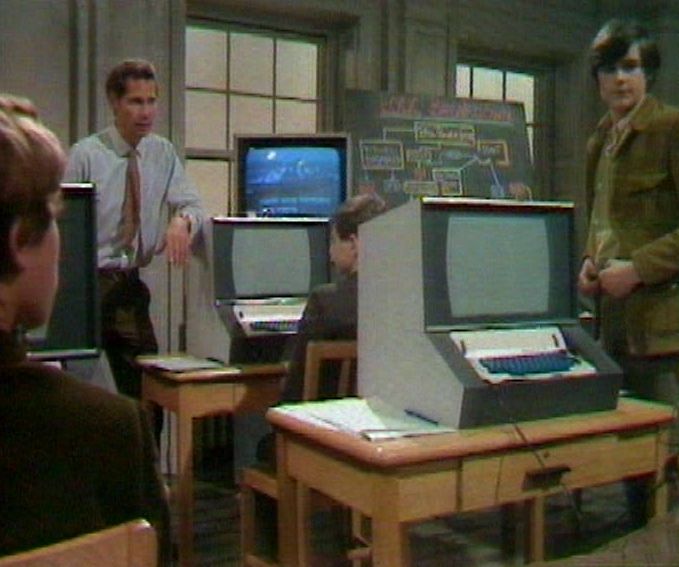
Although Ridge briefly becomes a suspect, he’s intrigued that a party of boys from a nearby private school called Elsedene were at Beresfords on the day of the robbery.  He and Geoff visit the school and Ridge is perturbed to see how dominant both computers and logical teaching methods are.  Could this be a breeding ground for emotionless, logical criminals?

Based on a story outline by Kit Pedler, it explored themes that he’d already developed in several Doctor Who stories, notably The Tomb of the Cybermen and The Wheel in SpaceTomb introduced us to Klieg and Kaftan, members of the Brotherhood of Logicians.  Pure logic was clearly something that perturbed Pedler – as it allowed Kleig to ally himself with the Cybermen with no thoughts given as to the consequences of his actions.  The Wheel in Space has even closer links to The Logicians, thanks to the appearance of Zoe.  Zoe, like the boys in this story, is a product of computer teaching and is shown to be emotionally deficient (“all brain and no heart”).

The scenes in the school, with the boys working at computer terminals, is clearly meant to be disturbing – although to a modern audience it probably seems perfectly normal.  Geoff isn’t happy with what he finds.  “It looked more like a space shell than a classroom to me. All the kids in headphones, wired up to a computer being fed questions and feeding back answers.”  This would have been a science fiction concept in 1971, but in 2016 it’s nothing out of the ordinary.

Quist approves of logical teaching for the young.  “Youth without an adult’s emotional stresses can absorb an enormous amount of this symbolic training. The ability to think straight, a cool appraisal of any situation, uncluttered by emotion or bias, that’s what the modern world needs today.”  But there are inherit dangers to this type of schooling.  Ridge tells Quist that the boys appeared to be display a type of mental arrogance (likening them to the Hitler Youth).

One slight flaw with the story is the notion that the boys are potentially dangerous because they’ve been computer taught – i.e. without the input of human teachers.  But when Ridge and Geoff observe them, the class is clearly being run by a teacher and the computers are only used as a aid to the lesson, they aren’t in control.  Elsedene is also the sort of public school where the only type of discipline is self-discipline, so even had the pupils not had access to these type of logical computer lessons they still might have developed along similar lines.

Although they’re criminals, it’s later revealed that the boys only stole the formula in order to extort a ransom (£25,000) from Beresfords so they could anonymously donate the money to Elsedene (which has been suffering from extreme financial difficulties).  But the unanswered question is what will happen when they leave school?  Will logic once again triumph over universally held notions of right and wrong?

Although the idea of a school dominated by computers may carry little resonance in the twenty first century (it’s a fact of life today) there’s plenty to enjoy in Dennis Spooner’s script.  Spooner was always the sort of writer who liked to inject humour whenever he could and this is reflected here.

Ridge is the recipient of many of Spooner’s funniest lines and Simon Oates delivers them perfectly.  Ridge and Geoff have some nice bantering scenes – Ridge turning his nose up at Geoff’s new coat and Geoff being theatrically disappointed at being forgotten when Ridge lists all the other members of the Doomwatch team.  Ridge is also on hand to pour cold water on Priestland’s gallant attempts to chat up Fay and he’s also entertaining when tangling with the police.  When Ridge later makes a clandestine call to the Doomwatch office from Elsedene and calls Fay “mother” you know that Spooner is enjoying himself!

Noel Johnson (Radio’s original Dick Barton) is suitably solid and dignified as Priestland, he’s a major plus point throughout the story.  Amongst the schoolboys is a young Peter Duncan, who’d turn up later in the Terence Dudley produced Survivors, as would Michael Gover (here playing Priesland’s number two, Kelsey).

If The Logicians is another Doomwatch story which feels a little underdeveloped (is there enough evidence to suggest that computer and logical teaching alone is responsible for turning the boys into criminals, or would that have happened anyway in the rarefied atmosphere of an unsupervised public school?) Dennis Spooner’s script clips along at a decent enough pace to cover any lapses in, well, logic.

Doomwatch – The Inquest

inquest

Geoff heads down to the country as Doomwatch’s representative at an inquest due to be held into the death of Marion Duffy, a ten year old girl who died from rabies.  John McAlister (Robert Cawdron) from the Min. of Ag. and Fish believes that this rabies infection was due to contact with an infected dog, but Mary Lincoln (Judith Furse) has another theory.

Ms Lincoln is a local resident who is bitterly opposed to the laboratory run by Dr Henry Fane (Frederick Treves).  Dr Fane’s lab is licenced to carry out experiments on animals – something which Ms Lincoln is horrified about – but he also conducts research on insects.  Ms Lincoln is convinced that an infected tsetse fly escaped from the lab and bit Marion, thereby causing her death.

The smooth running of Geoff’s preparation for his appearance at the inquest is rather derailed after shots are fired at Dr Fane’s lab and Geoff finds himself laid up in hospital, with Bradley called on to deputise for him.

The Inquest is another Doomwatch episode with a strong hook in the pre-credits sequence.  After a couple of shots are fired, Dr Fane finds Geoff senseless on the floor – although since he was clutching his shoulder it’s clearly not a fatal wound.  The post-credits meeting between Quist and Bradley is also memorable, as Quist casually mentions that Geoff’s been shot and he therefore needs to hop on a train and take over his work.  Quist’s seemingly unfeeling and cold nature is again highlighted here – although it appears to be more that he knew that Geoff was fine (with only a superficial scratch) and had therefore had mentally moved onto more pressing matters.

With both Simon Oates and Jean Trend absent, this is that rarest of beasts – a Bradley-centric episode.  Joby Blanshard naturally seems to relish having more to do then simply react to the others.  Bradley’s a key participant at the inquest, although when he expresses the opinion that all dogs within a five mile radius should be shot he doesn’t find many supporters amongst the villagers!

It’s an interesting twist that for once there’s no twist.  Since we’ve become so used to seeing Doomwatch stories where a death that appears to have been caused by x was actually caused by y, it’s a neat trick when it’s revealed that a rabid dog was responsible after all.

This follows lengthy and passionate arguments from Ms Lincoln at the inquest, who remained insistent that Dr Fane’s tsetse flies were responsible – to the growing exasperation of the coroner (very well played by Edward Evans).  The revelation that it was just a dog does take the wind out of her sails, but Dr Fane is still culpable (the infected dog had been released from his lab) but he’s not the only one.

It was the landlord of the local pub who obtained the dogs for Fane – and with the money that Fane was offering he wasn’t too choosy about where they came from.  The long arm of coincidence comes into play when it’s established that the landlord’s son Harry was responsible for tending to the released animals (and also was the one who took a pot-shot at Geoff).  Like Marion, Harry’s been bitten, and the episode ends with the boy taken to hospital and it’s left open as to whether he’ll live or die.

The nature of the story means that this is a static, wordy episode.  The scientific content is pretty low – although Bradley goes into considerable detail about why he believes tsetse flies couldn’t be responsible for carrying the rabies virus, since that whole part of the plot was a red herring it doesn’t really matter either way.

Judith Furse is excellent as the animal loving Ms Lincoln and the ever-reliable Frederick Treves is equally as good as her implacable enemy Dr Fane.  Given that Fane has a licence for animal experiments, it’s never made clear why he should have gone to such extreme measures to obtain potentially dangerous dogs (unless he needed infected animals for his experiments?)  It’s also never explicitly stated, but it seems probable that Ms Lincoln released the dogs, if so then she must take part of the blame for the child’s death.

Quist keeps a fairly low profile, although he pops up at the end of the inquest (rather stealing Bradley’s thunder!)  And even though he gets shot, Geoff is still something of a third wheel, although the absence of both Ridge and Fay means that he does get a few more lines than usual.

Scripted by Robert Holmes, The Inquest is a well-written character piece.

Doomwatch – The Human Time Bomb

time bomb

Doomwatch have been asked to investigate the Amblethorpe project.  The brainchild of Sir Billy Langly (Kevin Brennan) it aims to solve the problem of population overcrowding.   Langly paints a nightmarish vision of the future to Quist.  “By the year 2000 there’ll be over eighty million people living in this country. They’ll want cars and places to park them. They’ll want clothing and feeding and educating and work to do, to say nothing of housing…”

Langly’s solution is to build more and more high rise flats.  With a booming population, he sees no other solution – but concerns have been raised about the dehumanising effect such places have on their occupants.  Fay has been assigned to do research at a typical block of flats – the Langly estate – living and working there for an extended period.  There certainly seems to be a malaise affecting some of the people and Fay herself also begins to crumble under the pressure …..

The Human Time Bomb has a social, rather than a scientific, problem to deal with.  Although tower blocks were still a fairly modern concept at the time, it’s plain from the tone of Louis Marks’ script that their inherent dangers were already clearly understood.  We open with the unfortunate Mr Hetherington (Talfryn Thomas).  As he joins his neighbours waiting for the lift, he gives them a cheery greeting – only to receive blank contempt from them.  As the lift descends, his anxiety at being jammed in like a sardine begins to tell.  Once he gets outside he rushes straight into the path of an oncoming car – still observed with dispassion by his neighbours.

When it’s later revealed that Hetherington worked for the planning office, it’s possible to wonder whether Langly is targeting people who might be a threat to him.  Fay has begun to receive crank calls and also has to deal with innuendo and abuse from some of her neighbours, whilst another member of the planning team, Scobie (Roddy McMillan) also has a breakdown.  This turns out not to be the case though as it simply all seems to be a coincidence, which is slightly hard to swallow.

The Human Time Bomb is an excellent vehicle for Jean Trend.  Fay, seemingly by the nature of the work she’s doing at the Langly estate, becomes isolated and paranoid.  This is demonstrated best when she asks the odd-job man Donovan (Ray Armstrong) to come to her flat to repair her lights.  He does so, but Fay interprets his attitude as hostile and attempts to attack him with a hammer.  Armstrong cleverly plays the scene in a fairly neutral way, so although his line about her promise to make his visit worth his while could be taken several ways, it does seem that Fay jumped to the wrong conclusion.

Quist is fairly dense throughout.  He seems to regard Fay’s concerns as the ravings of an unbalanced woman (surprising, since he’s supposed to consider her a first class scientist) and it’s only at the eleventh hour that he realises she could well be right and rushes back to her flat – just in time to save her from attacking Donovan.  Earlier, he failed to acknowledge that she saved him from being attacked by a young boy with a hammer – which confirms that by not living in the Langly estate like Fay he’s been unable to pick up on the atmosphere of fear and alienation.

If the vision of urban, inner-city life we see here isn’t terribly oppressive in a visual way (later productions would do it much better – in The Human Time Bomb everything still seems a little too neat and tidy) then Louis Marks’ script still manages to pile on the misery.  There’s few moments of light relief – even Ridge doesn’t really crack any decent gags – so the overall impression is quite relentless, which I presume was the tone Marks was aiming for.

The main flaw with the story is that it’s debatable just how much the tower block environment is responsible for the behaviour we see. Quist is convinced – but there’s little of the rigorous, methodical research he usually champions to back this up (instead, his conclusions seem to be derived more from hunches and guesswork). Fay’s bouts of hysteria do give Jean Trend something decent to work with, but it also has the unfortunate side effect of making her character seem rather neurotic.

So whilst this isn’t the strongest that series two has to offer, thanks to placing Fay front and centre it’s certainly of interest.

Doomwatch – In the Dark

dark

A swimmer dies off the Scottish coast.  Quist doesn’t consider this to be much of a mystery – after all, people have been known to drown before.  But he begins to show a little interest when Ridge reveals that the man died of mustard gas poisoning.  Some twenty five years earlier, a ship commanded by Lionel McArthur (Patrick Troughton) sank nearby.   Since it carried mustard gas it therefore seems likely that somehow this deadly cargo has started to pollute the area.

Although McArthur is an old friend of Quist, he elects instead to send Ridge along to investigate.  But Ridge finds McArthur to be a very elusive man and even when he tracks him down he finds his answers to be rather vague.  Eventually the truth is revealed – the man posing as the public face of Lionel McArthur is actually his cousin, Alan.  The real Lionel McArthur exists in a vegetative state – kept alive by machines.  But he doesn’t regard this in a negative way, for him it’s a positive triumph.  His body became diseased, so he replaced it with machines …..

Although In The Dark has a striking pre-credits sequence showing the hapless swimmer’s death (and following the credits there’s another memorable shot of the man’s dead face in the water, overlaid with the story title) this part of the story is little more than a MacGuffin – designed to get the Doomwatch team interacting with McArthur.  It’s not the first time this sort of plot device has been used, but it still feels a little clumsy.

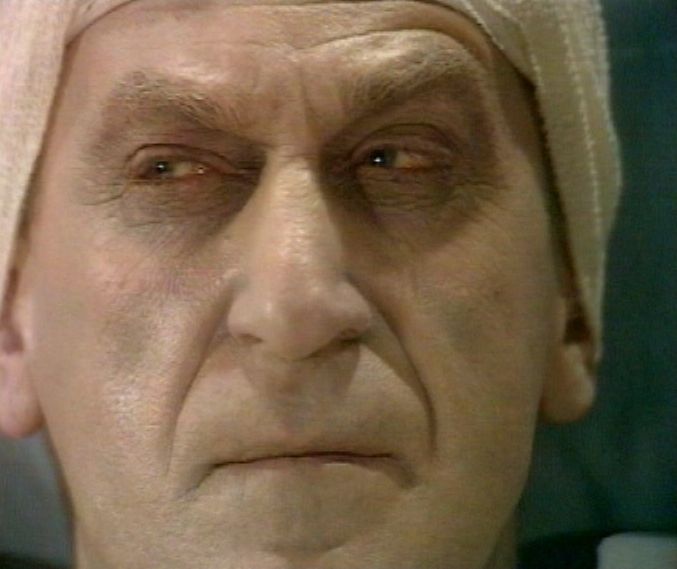
But no matter.  Once we get past the first twenty minutes the story proper can begin.  Immobile in a hospital bad, with only his head visible, Patrick Troughton still manages to dominate the screen.  It’s interesting that given the subject matter of the story you might have expected it to be scripted by Kit Pedler and Gerry Davis, rather than John Gould.  McArthur is basically a Cyberman – his body fell ill, so he cheated death by replacing it.  The only part of him that remains human is his head, and he has plans to do something with that as well.  He tells a horrified Quist that he wishes to remove emotions – “anger, fear, love, hate” – in order to make him function more efficiently.  Anybody familiar with the first Cyberman story, The Tenth Planet, will instantly see the parallel.

The question of what existence actually means is at the heart of the story.  Both Ridge and Quist regard McArthur’s half life as no real life at all.  Quist asks McArthur some probing questions.  “We have no bodies, no needs, no desires. What’s the purpose of existing at all?”  McArthur responds he wishes “to become pure. To achieve that state that all the mystics have tried to achieve in their little futile, frustrated ways.  I may not look it to you Quist, but I am perfect. I am perfect man, because I am only brain.”

Alethea Charlton, as McArthur’s daughter Flora, has a small, but telling role.  She loves her father dearly, but implores Quist to try and persuade him to turn off the machines.  Unlike him, she’s realised that he’s now barely human and that although he’s gained a version of immortality it’s been achieved at a terrible cost.  Her husband, Andrew Seaton (Simon Lack) doesn’t share her concerns.  Somewhat coincidentally he’s in charge of McArthur’s treatment, telling Fay that “we virtually abolished death for him” and clearly regarding this to be a positive thing.

As for the Doomwatch team, Geoff and Bradley once more get the short end of the stick with just a few lines apiece.  It’s clear again that Quist, Ridge and Fay are the main characters and Gould’s script is tailored to all three of them.  Quist faces a moral dilemma – McArthur is a leading scientist and an old friend, so he feels an obligation to stay and do what he can to help.

Ridge has a wonderful monologue directed at Quist.  “You absorb all life into your own, did you know that? Everything that ever happens becomes a part of you. When you’re pre-occupied sometimes, I watch you walking. You don’t walk down ordinary, mundane streets, jostled by ordinary, mundane people. You pace the streets of a deserted village, or you tread the shattered planks of a seaside pier.”  Fay now occupies the same place in the narrative that Toby did during series one – acting as something of a buffer between Quist and Ridge.

The conclusion of the story doesn’t come as a surprise, but it’s still a powerful conclusion to a tale that poses difficult questions about how technology and medical care should co-exist.

The Three Musketeers. Part Ten – Walk to the Scaffold

three 10-01

The war is over and Milady de Winter once more vows vengeance on her enemies, especially D’Artagnan.  She’s tracked down D’Artagnan’s mistress, Madame Bonacieux, who is sheltering in a convent and anxiously awaiting the arrival of her lover.

Although she’s been absent for a few episodes, Kathleen Breck picks up where she left off (alas) by still playing Madame Bonacieux as a wide-eyed giddy schoolgirl, which makes her fate something of a mercy killing for the audience. And given her broad performance during the serial it’s no surprise that she also milks her death scene for all its worth.  You can probably guess how Brett’s D’Artagnan takes it (not very well at all).  It’s just as well that the ever pragmatic Athos is on hand to tell him that “women weep for the dead, men avenge them.”

Even in this final episode, it’s clear that Peter Hammond was attempting to push the limitations of studio shooting as far as he could (the convent set features several high camera shots, not easy to do with the sort of cameras in use during the mid sixties).

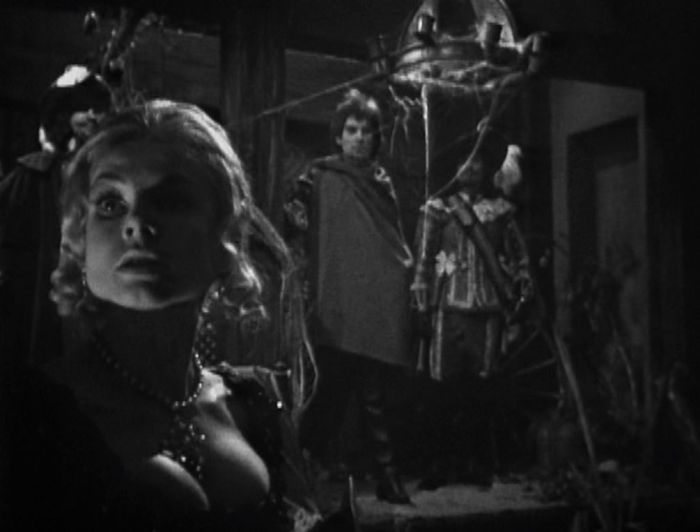
Mary Peach’s bosoms once again heave impressively as D’Artagnan and the others track her down, list her crimes and find her guilty.  Naturally enough, the sentence is death.  Her executioner (Kevin Stoney) is already known to her and it’s poetic justice that he’s the one who’s tasked to carry out the act.  Shot on film, Milady’s final scene is extravagantly played by Peach, but unlike some of the other broad performances it works well.

Although some of the playing throughout the serial isn’t subtle and Peter Hammond’s direction is rather idiosyncratic, there’s still plenty to enjoy in The Three Musketeers.  The 25 minute format means that each episode zips along and there’s plenty of familiar faces – Kevin Stoney in this episode, Pauline Collins and Milton Johns, amongst others, earlier on – who pop up in small roles.

It’ll be interesting to shortly compare this to The Further Adventures of the Musketeers, especially how the recasting (Joss Ackland for Jeremy Brett, John Woodvine for Gary Watson) blends with the returning Brian Blessed and Jeremy Young.  The additional six episodes and shared directorial duties (Christopher Barry and Hugh David) should also give the sequel a different feel.  My review can be found here.

three 10-02

The Three Musketeers. Part Nine – Assassin

three 09-01

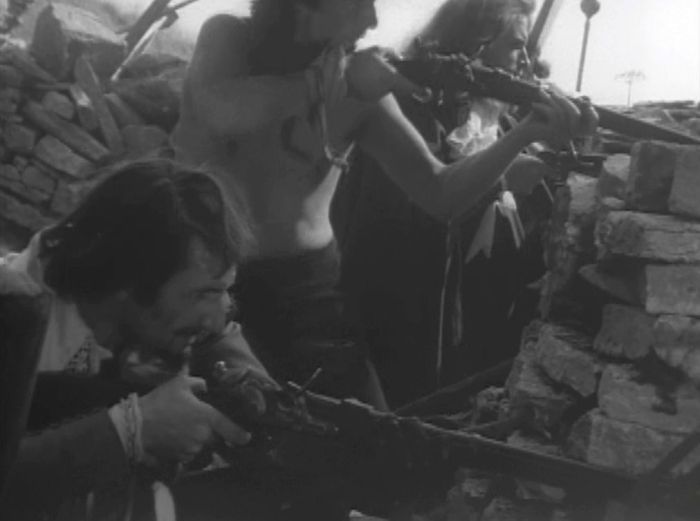
With a limited budget, the battle scenes we see throughout the serial have to be somewhat impressionistic.  This is demonstrated at the start of Assassin, as D’Artagnan and the Musketeers are seen defending a hill fort.  Although there’s a limited number of extras – representing both their allies and their enemies – sound effects, smoke and hand-held camera work all have to create the impression of many more.

The jumpy camera-cuts do effectively suggest the confusion of battle though, and it’s amusing that the Musketeers and D’Artagnan are cool enough to stop for a bite to eat and a discussion of their current troubles.  Milady de Winter’s mission to England spells trouble for all of them and although some of her plans (such as arranging the assassination of the Duke of Buckingham) don’t directly involve them, it’s still vital that they stop her.  A letter to Milady’s brother-in-law (who, we remember, had his life saved by D’Artagnan) should do the trick.

Presumably The Three Musketeers, like many series and serials of the time, had an allocated amount of film work per episode.  Since the previous episode had no filming at all, this may account for the more generous allocation in Assassin.  Some of it – for example, showing Milady’s arrival in England and her travels through the country –  aren’t strictly speaking vital to the plot, but they provide gloss and an expansive feeling (otherwise it would be too easy for the story to simply jump from one interior set to the next).

Milady de Winter’s reunited with her brother-in-law, but it’s not a happy meeting.  “Spy, bigamist, would-be-assassin, branded criminal. I’m sending you to our Southern colonies. In a few months the tropic sun would have burnt out that fatal beauty and sucked dry your evil mind.”  He leaves her a prisoner, guarded by young Felton (John Kelland) but Milady is easily able to manipulate this pious, worthy man.  Once again, it’s a pleasure to watch the delight on Mary Peach’s face as Milady manipulates yet another hapless victim.  She clearly has deep powers of persuasion, as not only is she able to obtain her release, she also convinces him to kill Buckingham.  A powerful lady indeed.

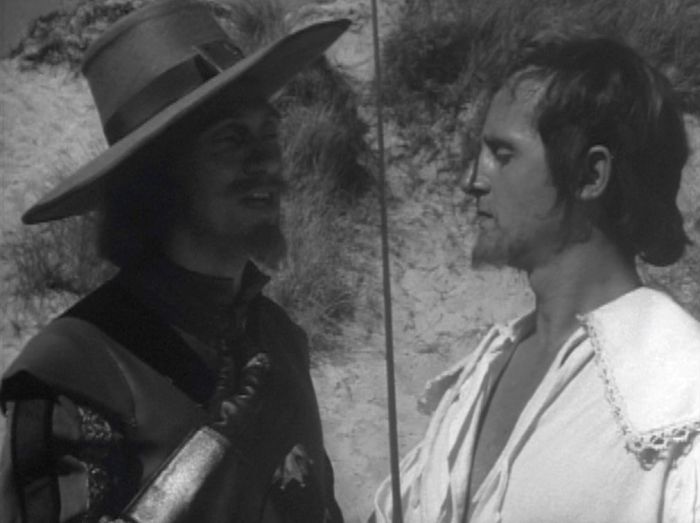
The scene where the Cardinal confronts D’Artagnan and the Musketeers is, like the earlier scene with Brett, Blessed, Young and Watson, shot on film.  This clever piece of scheduling meant that they weren’t required for the studio recording, therefore giving them a week off.

three 09-02

The Three Musketeers. Part Eight – The Cardinal

three 08-01

The revelation that Milady de Winter is Athos’ treacherous wife, whom he believed was put to death years ago, spins the story in a different direction.  Athos doesn’t fear for his own life – we’ve already seen that he doesn’t care if he lives or dies – but this revelation also places D’Artagnan’s life in immediate peril.

After the high drama of the opening scene, we quickly change gear as Porthos is brought face to face with the cuckolded husband of his latest mistress, Madame Coquenard. Porthos is humiliated by the elderly Monsieur Coquenard, who capers around in a bizarre fashion (complete with antlers on his head!) before collapsing.

D’Artagnan is summoned for a meeting with the Cardinal. Pasco’s Cardinal remains conversational and reasonable – as stated before, it makes a change from portraying Richelieu as a cackling villain and it only serves to make him all the more deadly. He doesn’t attempt to suborn people through fear, instead he uses the much subtler weapon of charm. And even when he gives D’Artagnan an ultimatum, Pasco still doesn’t raise his voice. “Up till now, whether you knew it or not, my hand has been behind you. The moment I withdraw my hand, why then my friend I would not give one farthing for your life. You will remember hereafter, if any misfortune befalls you.”

There’s more odd shot changes during this meeting. Every so often, the camera cuts away from the two actors to show the various suits of armour dotted around the room. If it happened once you might believe it was a miscue from the vision mixer, when it happens again it must be a deliberate choice.

Later, the Cardinal enlists the assistance of the three Musketeers to escort him to a meeting. This is a baffling move, since his meeting is with Athos’ hated wife Milady de Winter, whom he’s planning to send to England to meet with Buckingham.

The Cardinal wishes to prevent Buckingham from intervening in France’s civil war and has chosen the Englishman’s love, the Queen of France, as the lever. If Buckingham doesn’t withdraw his army, then the Queen’s honour will be tarnished beyond repair. With the three Musketeers ear-wigging in the next room, they now know all of the Cardinal’s plans ….

Once again an episode closes strongly, this time as Athos confronts his wife. Both Jeremy Young and Mary Peach are excellent in this short scene. Considering the wrongs he’s suffered, you might expect that vengeance would be uppermost on his mind, but, as highlighted before, he’s more concerned about D’Artagnan’s fate.

three 09-02

The Three Musketeers. Part Seven – All Cats are Grey in the Dark

three 07-01

Milady de Winter has succeeded in winning the love of D’Artagnan, but tells the Cardinal that she’ll only reciprocate in order to convert him to their side. Interestingly he reacts strongly against this, as he wants no suborned followers. If D’Artagnan is to serve him then it must be because he wishes to act for the glory of God. Appearing in just this single scene, Richard Pasco continues to impress as the wily Cardinal, offering a subtle performance that contrasts sharply with some of the more, shall we say, exuberant turns.

Speaking of exuberant, D’Artagnan turns up at the house of Milday de Winter, only to be told by her maid Kitty (Pauline Collins) that her mistress doesn’t love him at all. Considering that he spent the previous episode bemoaning the loss of his one true love, Madame Bonacieux, he clearly seemed to have quickly forgotten her once Milday fluttered her eyelashes at him (he’s clearly a fickle type). When Milady returns, Kitty hides him and this enables him to hear Milady utter the following words. “One day I will have D’Artagnan’s head on a platter.”

The Musketeers are tasked to escort the King in his upcoming campaign against the Huguenots. Porthos would sooner be fighting the English and given the current political climate it looks as if that will happen soon.

Aramis’ desire to leave the secular world has been a running thread throughout the serial and now it seems to be on the verge of happening. Porthos isn’t best pleased about this (and Brian Blessed shows this displeasure in his most typical way – he raises his voice). The cultured, religious Aramis contrasts well with the sensual, rumbustious Porthos and the pessimistic, nihilistic Athos – over the course of the seven episodes to date their various differing character traits have been skilfully drawn out.

The news that Aramis’ love still loves him changes everything though. All thoughts of taking holy orders are instantly forgotten, demonstrating that, just like D’Artagnan, he’s ruled by the women in his life.

More directorial flourishes are in evidence after Milday receives a letter which pleases her, but upsets Kitty. The picture rapidly cuts between Milday’s ecstatic face and Kitty’s distressed one. Elsewhere, a lack of location filming means that the friendly duel between Porthos and Aramis has to take place on a rather unconvincing studio set dressed as a forest clearing. Animal sound effects and a gentle breeze attempt to sell the illusion, but it’s no substitute for the real thing.

D’Artagnan’s climatic confrontation with Milady reveals that she bears the mark of the fleur-de-lys. Which means there’s a great deal of wailing and the return of the projected fleur-de-lys on the wall. It’s a strong way to conclude an episode that’s mostly chugged along in second gear (which is understandable in a ten-part serial – there’s bound to be a few episodes where the plot doesn’t advance a great deal).

three 07-02